
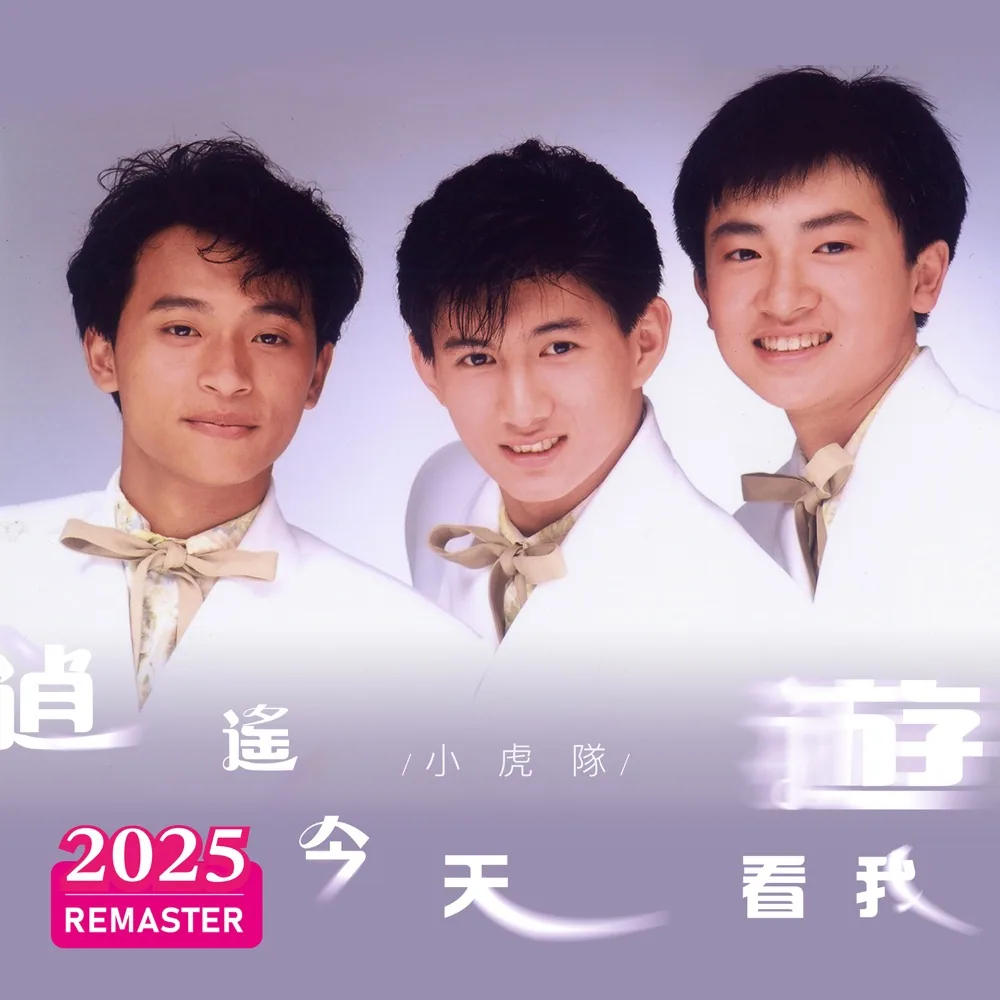
30-second overview: Little Tigers were almost a machine assembled from imported parts: the talent-show model copied Japan's Shonentai, the lead single "Green Apple Paradise" set Chinese lyrics to an original Shonentai melody, and even the stagecraft took American performance as its benchmark. Yet in 1989, their compilation sold 250,000 copies in under a month1, and Taiwan metabolized this imported idol group into one of a whole generation's sturdiest memories of youth. More than three decades later, Nicky Wu, Alec Su, and Julian Chen have all centered their careers across the Strait in China. That has turned the question "Are the Little Tigers still Taiwan's?" into an exam question no one can answer cleanly.
In front of the cameras on the Chinese variety program Memories Beyond Horizon 3, Julian Chen was asked why he had avoided mentioning Little Tigers all these years. He did not dodge the question, but answered very quietly: "It is not that I don't want to mention it. It is that I really feel I am doing my own things now, and I don't want other people to be pulled back in."2
The weight of that sentence only becomes audible if we rewind more than thirty years. In Taiwan in 1989, tens of thousands of teenage girls were desperately trying to "pull" those three boys into their own lives: buying cassettes, cutting out posters, waiting by the radio, chasing tours from one city to another. One of the people who most had a claim to this symbol later chose to set it down; the island that had most wanted to hold onto it is still asking whether it counts as its own.
This article tries to unpack precisely that paradox: how an idol group whose parts were almost entirely imported became a collective memory Taiwanese people are most reluctant to let go.
A Show Wanted Three Boys to Accompany the Kitten Team
The story's starting point was not romantic. It was even a little functional. On July 9, 1988, China Television Company launched a variety program called Youth Showdown, produced by Chang Hsiao-yen and hosted by Tsao Lan and Tang Chih-wei.3 The show first had a girl group called the Kitten Team. There were more members when the show began; later it was reduced to three girls, one of whom was Hsu Shu-chuan, later famous under the name Vivian Hsu.3
Once there were kittens, the program wanted little tigers to match them. During the talent selection process, the production team picked three boys and formed a boy group to sing and dance alongside the Kitten Team. These three faces were a combination put together by a television program for visual needs. They were never stars who had fallen from the sky. Their group chant rang out loudly, "Little Tigers, Little Tigers, full of spirit"3, but behind those four Chinese characters stood the market intuition calculated jointly by a talent agency and a television station.
The behind-the-scenes division of labor was industrialized as well. In 1987, Chang Hsiao-yen and Miao Hsiu-li founded the talent agency Kai Li Creative Group, which handled artist management; record distribution was handed to UFO Records, then at the height of its momentum.4 One side managed packaging, the other released records. That division of labor itself makes the point: from day one, Little Tigers were a designed and manufactured product, not a few friends getting together to play music in a band.
💡 Did you know: The boy band Red Boys, later often mistaken as Little Tigers' "predecessor," actually came one step later: Red Boys were launched by the same Kai Li agency in 1989, effectively as a "Little Tigers second squad." Once the chronology is put right, the position of "Taiwan's first successful male idol group" truly belongs to Little Tigers. Before them, City Girls in 1985 were Taiwan's first idol girl group, but the boy-band line began with Little Tigers.
Bought Melodies, Their Own Lyrics
If you want the most naked evidence of Little Tigers' "imported" nature, just listen to their most famous song.
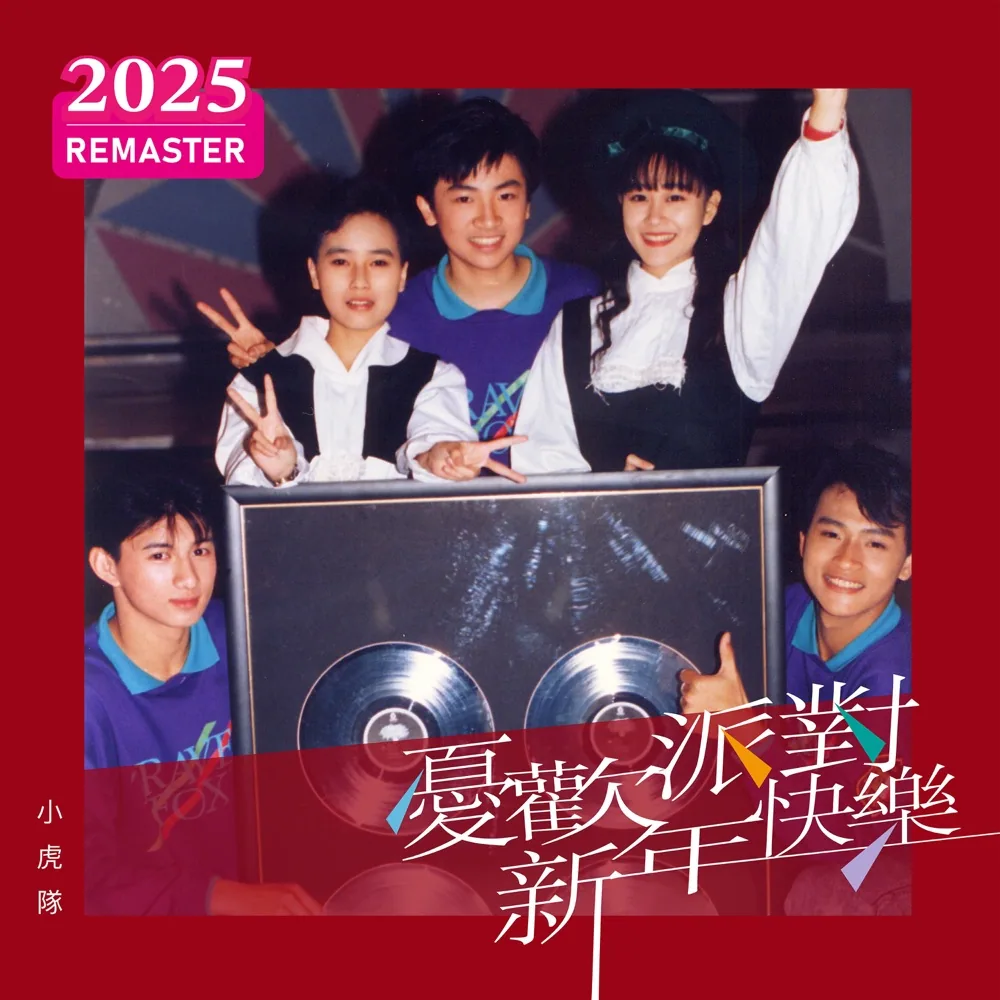
The cover of the compilation Happy New Year (1989-01-10). "Green Apple Paradise," the song most familiar to Taiwanese girls, appeared on this record, and its melody came from Japan's Shonentai. Image from Universal Music's 2025 remastered edition. © Universal Music (originally released by UFO Records), fair use editorial commentary.
Almost every Taiwanese person who lived through that era can hum the synthesizer intro to "Green Apple Paradise." But it is in fact the melody of "What's Your Name?," the eleventh single released in 1988 by the Japanese Johnny's idol group Shonentai.5 The original song was composed by Koji Makaino and Jimmy Johnson. After UFO Records bought the rights, it asked Ding Hsiao-wen to write new Chinese lyrics.5 In other words, the youth theme song Taiwanese girls sang along to at their bedsides had a Japanese skeleton; only the layer of Chinese-language skin was something Taiwan grew for itself.
And this was not an isolated case. "Red Dragonfly" was a cover of Tsuyoshi Nagabuchi's "Tonbo," with lyrics by Lee Tzu-heng; "A Date with the Stars" came from Wink's "Samishii Nettaigyo"; "Colorful Sky, Colorful Dream" was adapted from British singer Nick Heyward's "You Are My World."6 Across an album, most of the lead songs that carried popular memory were melodies already written by someone else.
This method was entirely legal: UFO did buy the rights from the Japanese side. It was formal commercial licensing, followed by newly written Chinese lyrics.6 But legality and originality are two different things. The melody a listener remembered did not belong to this island. That fact alone makes the common claim that "Little Tigers were Taiwan's own idols" less stable than it looks.
📝 Curator's Note
The standard nostalgia narrative says Little Tigers were a youth symbol that was "Taiwan's own." But once you open the composer credits in the album liner notes, that claim begins to loosen: the talent-show model benchmarked Shonentai, the lead single used a Japanese melody, the stage movements referenced American performance, and almost all the parts were imported. What truly belonged to Taiwan was the act of "metabolism" itself: an island taking in outside materials, adding its own words, its own memories, its own tears, and eventually growing something even the place of origin could no longer recognize. This ability to "make the foreign one's own" is in fact a repeated miniature of Taiwanese popular culture, and even of Taiwan itself.
The lead singles were not the only imported parts. The entire idol model was borrowed too: the three-member structure, uniform styling, and synchronized choreography were almost a corresponding copy of Japan's Shonentai, consisting of Kazukiyo Nishikiori, Katsuhide Uekusa, and Noriyuki Higashiyama. When the English edition of Taiwan's Sinorama later looked back, it wrote a blunt assessment: Little Tigers were "a copy of Japan's Shonentai in virtually every respect."7
Still, stopping at "imitation" would be too simple. There is no record that Johnny & Associates ever gave Little Tigers any official authorization or public response.6 That means Little Tigers occupied an ambiguous middle ground: they bought Japanese "songs," but they did not buy Japan's "idol model." The latter was moved over wholesale and assembled by themselves. Melodies that could be bought were paid for; models that could not be bought were copied. It was a mode of learning so pragmatic as to be almost naked.
Of course, not every song was borrowed. Original songs such as "Carefree Journey" (lyrics by Chen Le-jung, music by Chen Chih-yuan), "Butterfly, Fly" (lyrics and music by Lee Tzu-heng), and "Happy New Year"6 prove that UFO's lyricists and composers had power of their own. But when the greatest common denominator of public memory is the cover song "Green Apple Paradise," the word "imported" becomes an unavoidable entry point for understanding Little Tigers.
Thunderbolt, Little Handsome, Good Boy: Three Tigers Were Designed
Even who these three boys "were" was designed.
Nicky Wu, Julian Chen, and Alec Su were given the nicknames "Thunderbolt Tiger," "Little Handsome Tiger," and "Good Boy Tiger," respectively, and this naming system came from the talent agency.8 Each name corresponded precisely to a sellable persona: Wu had an athletic background and could do backflips, so he became the kinetic "Thunderbolt Tiger"; Chen had dance training and was said to resemble Leslie Cheung, so he became the "Little Handsome Tiger"; Su was a student at Taipei Municipal Jianguo High School and was good at studying, so he became the gentle and likable "Good Boy Tiger."8
📝 Curator's Note
If you line up these three personas, you realize they are actually a demand checklist: one handsome one, one dynamic one, and one who reassures parents. Rather than choosing "the three best people," it was more like choosing "the three people most suitable to package as a set." Fans thought they had fallen in love with three kinds of personality, but behind those three personalities was an unstated choice: the group's shape was determined less by the three members' real characters than by three templates the market wanted. It was not only the songs that were designed. Even whom to like, and why, had been planned into the product in advance.
The production energy was concentrated in UFO's gold-medal team, later known as the "Five Chens and Two Lees." The producer for the entire Carefree Journey album was Chen Hsiu-nan, assistant to UFO's vice president and associate manager of its domestic division; arrangements were handled by Chen Chih-yuan, styling by Chen Ta-li, lyrics by Chen Le-jung, composition by Chen Yao-chuan, along with Lee Shou-chuan and Lee Tzu-heng.9 Most members of the public today can barely name them, but the melodies and images that made girls scream in 1989 were drawn stroke by stroke by these people in recording studios and planning meetings.
As for "why these three people," there is instead no complete record. Who made the final decision to create a male idol group, who designed those uniforms, who choreographed those routines: the names of these specific decision-makers are almost impossible to find in public materials.8 The three faces in front of the stage are remembered; the whole group behind the scenes is forgotten. This too is normal in the idol industry: the product shines, the production line becomes invisible.
⚠️ Contested View: One argument holds that Little Tigers became popular because UFO and CTS monopolized prime-time exposure: they were gods manufactured by distribution channels, not evidence of genuinely large popular force. This criticism is not entirely wrong. Exposure was certainly an accelerant. But distribution alone cannot push a market response on the scale of nearly 200,000 copies in five days and 250,000 copies for a compilation in under a month.110 Exposure can make people "see"; it cannot force them to "take out money and buy again and again." The more honest way to put it is this: UFO supplied the firewood, but the fire truly burned because Taiwanese society at the time had a collective hunger for the new thing called idols.
Chased All the Way from Taipei to Kaohsiung
A designed product met a society just ready to go mad.
On April 8, 1989, a signing and singing event outside Taipei's Sun Yat-sen Memorial Hall spun completely out of control. Estimates of the crowd ranged from 20,000 to nearly 90,000 people.11 The organizers could not contain the scene at all. For many people, that was the first time Taiwan saw with its own eyes what it looked like for people to go wild over three teenage boys. It was also the first time an island realized it too possessed this kind of collective, almost religious, youthful energy.
Even more iconic was the birth of the term "star-chasing." It is said that in 1989, when Little Tigers toured all the way from Taipei to Kaohsiung, frenzied fans followed stop by stop, and the media coined the two Chinese characters zhuixing, "chasing stars," to describe the phenomenon.12 Although this etymology is a media account from a single source and may not withstand strict textual scrutiny, it precisely captures the scene: youth really would chase a car, a train, a dream, running from north to south.
For those who could not afford cassettes, star-chasing had another version. Radio was the poor child's admission ticket: waiting by the receiver for a DJ to play "Green Apple Paradise," recording that synthesizer intro onto a blank tape, rewinding it again and again. Cassettes and radio were the two parallel channels through which that generation encountered idols: one required money, the other only patience.
💡 Did you know: Little Tigers' popularity extended far beyond Taiwan. Including pirated copies, their cumulative album sales were said to have reached 15 million; Carefree Journey alone reportedly received 4 million orders in China.10 Through legitimate and pirated cassettes, their songs flowed into the entire Mandarin-speaking world and could be heard as far away as rural Southeast Asia. But the farther these songs drifted, the fainter the label "Taiwan" as place of origin became. Many overseas listeners hummed "Green Apple Paradise" without knowing at all that the singers were Taiwanese.
Youthful True Colors, Opened Across the Strait
In 1991, Little Tigers carried this youthful energy across a line that was still extremely sensitive at the time.
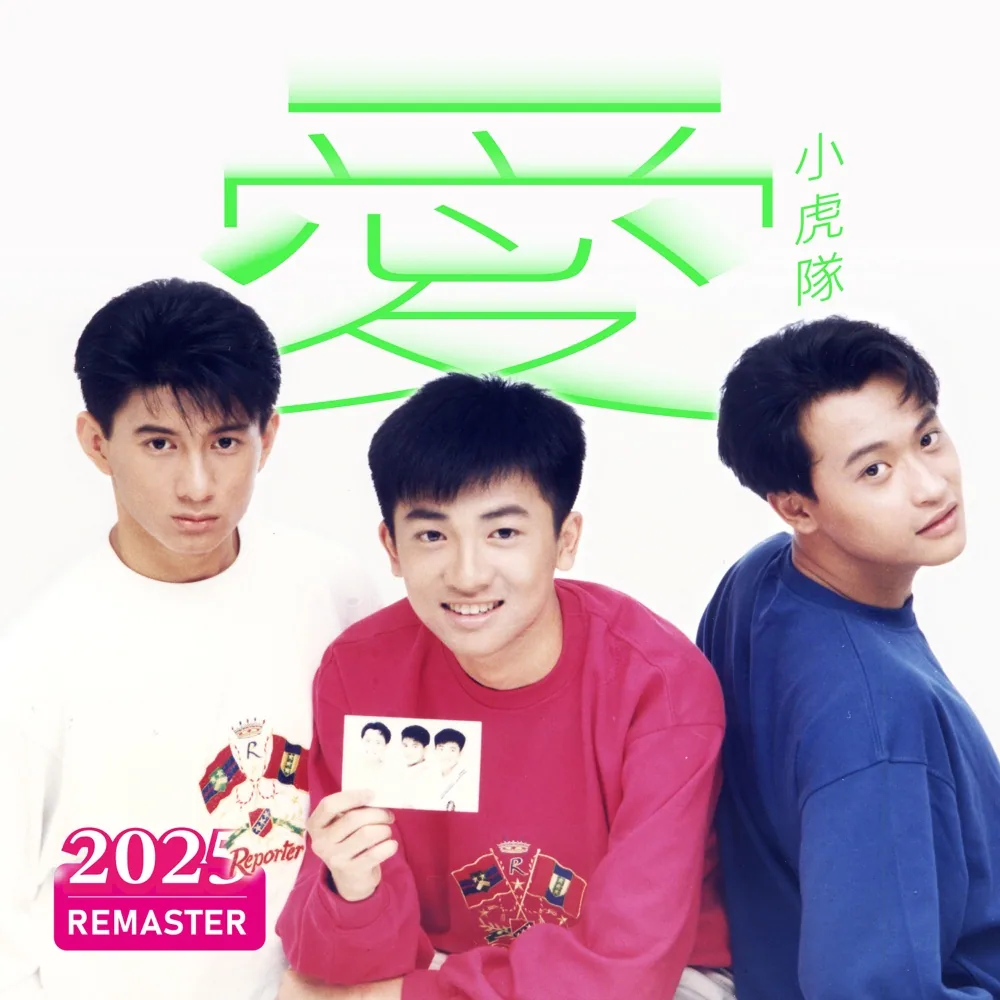
Love (1991) was the album Little Tigers released in the year they crossed the sea to tour in China, writing a public-interest theme into idol dance music. Image from Universal Music's 2025 remastered edition. © Universal Music (originally released by UFO Records), fair use editorial commentary.
That September, the three went to China. First they participated in three performances of the "China Film Community Disaster Relief Charity Gala" in Beijing, held in response to the 1991 floods in East China. They then began a tour titled "Youthful True Colors: Happy World," with stops including Shanghai and Wuhan, more than ten performances in total, and also appeared on the stage of Xi'an's first Ancient Culture and Arts Festival.13 In the Cross-Strait atmosphere of the time, this made Little Tigers "one of the earliest Taiwanese artists to hold concerts in China."13
To understand how sensitive that step was, one has to glance at the Cross-Strait clock in 1991. That year, Taiwan's Straits Exchange Foundation was established in March. In May, the government abolished the Temporary Provisions Effective During the Period of National Mobilization for Suppression of the Communist Rebellion. China's Association for Relations Across the Taiwan Straits would not be inaugurated until the end of the year.14 Direct Cross-Strait transportation, postal, and trade links had not yet opened. Artists going to perform across the Strait had to enter via Hong Kong.14 In other words, when Little Tigers stepped onto stages across the Strait, they were exactly in that window when the ice had only just begun to thaw, but the road had not yet opened.
📝 Curator's Note
It is easy to frame this tour as "the lifting of martial law loosened everything, so idols could cross the sea." But that causal chain is too straight. The lifting of martial law in 1987 did loosen the broader environment, allowing entertainment culture to become more active and commercial talent shows to take shape. A Fu Jen Catholic University master's thesis on Little Tigers points out that "after the lifting of martial law, mass entertainment culture became increasingly active," and only then did Taiwanese idol groups rise one after another in the late 1980s.15 But the direct causes of Little Tigers themselves were commercial talent selection plus the introduction of the Japanese idol model, not the political event of "lifting martial law" itself. The lifting of martial law was the weather in the background; another hand pressed play. If everything is attributed to the lifting of martial law, what disappears from view is what actually pushed the matter forward: market and imitation.
One more point is worth adding: whether the Taiwanese government had explicit written controls at the time on artists performing in China cannot be confirmed from public records.14 So neither "the government banned it" nor "the government opened it up" can be asserted lightly. It was a period when institutions had not yet fully grown and boundaries were blurry. Little Tigers stood in that blur and sang Taiwan's youth to the other side of the Strait for the first time.
Draft Notices Arrived, and the Myth Stopped
What stopped Little Tigers was less a cooling market than one draft notice after another.
What many people remember as "two disbandments" was in reality much less neat. Little Tigers never formally announced a breakup.16 They were diluted by reality, bit by bit. At the end of 1991, Julian Chen entered military service first, moving from the Marine Corps to a Yu opera troupe, serving for about two years in all.16 With one tiger missing, the group's operation broke at its first joint.
At the end of 1993, Chen was discharged, and the three briefly reunited to release The Starlight Still Shines.16 Even just looking at that album title, one can smell a hint of "wanting to prove we are still here." But the peak of the idol wave had already passed. After the 1995 "Tiger Roar, Dragon Rise, Storm '95" concerts, the group naturally disintegrated.16 The real final break came in 1997, when Nicky Wu entered military service. He served until 1998 and was discharged with a Class C status because of a shoulder injury.16 Alec Su was exempt from service because of nearsightedness.16 Without an announcement, without the ritual feeling of a farewell concert, the myth quietly stopped.
It was also at this point that Julian Chen's position became fixed. He was not the marginalized one from the start. With looks that resembled Leslie Cheung, his early popularity was not at the bottom.17 His marginalization was the result of his military service in 1991, not the starting point: by the time he returned to the group after discharge, the wave that had pushed idols into the sky had already receded, and his place could no longer be restored.17 Projecting later loss back onto the beginning is a common displacement of memory.

Alec Su in 2012. The "Good Boy Tiger" who studied at Jianguo High School while being an idol later moved his entire performing career across the Strait. Photo: ASIF Photography / Wikimedia Commons, CC BY-SA 3.0.
Alec Su's reflections on this youth are more complicated than outsiders imagine. Years later, on the variety program Call Me by Fire, he said, "I don't want to damage the beauty in everyone's minds, so I feel quite a lot of pressure."18 But in the same passage, he also spoke with certainty: "Although there was no slogan of 'group soul' back then, he, Nicky Wu, and Julian Chen naturally and sincerely loved one another. They truly loved Little Tigers and loved this glory. I still do."18 Pressure and love are both true at the same time. That is closer to a person's real heart than any single label of "regret" or "no regrets."
💡 Did you know: Alec Su was a Jianguo High School student, and in 1991 he was admitted to National Taiwan University's Department of Mechanical Engineering, his fifth choice in the science and engineering track, before taking leave to enter entertainment.19 On one side was stardom; on the other was top-tier academic achievement. That tension later led him to say on Produce Camp 2019: "At that age, I suddenly began to take on a lot of attention, although at the time there was no chance to let it settle." He also admitted that he "could not carry only Little Tigers' glow for an entire lifetime" and wanted to become a genuinely capable performer.20 A child pushed onto an altar as a teenager spent more than half his life learning how to walk down from it.
All Three Bodies Crossed the Strait
If you want to find the three members of Little Tigers today, you have to look across the Strait to China.

Nicky Wu in Paris in 2012. For Gen Z audiences who never saw Little Tigers, he has almost only one remaining identity: "Fourth Prince" in Scarlet Heart. Photo: LuvElaine / Wikimedia Commons, CC BY 2.0.
Nicky Wu founded Straw Bear Entertainment in Beijing, regained fame as the "Fourth Prince" in Scarlet Heart, and married Liu Shishi, the drama's female lead. For Gen Z, he is almost only "Fourth Prince."21 Alec Su went through My Fair Princess, transformed into an actor, then became a director; his film The Left Ear grossed more than RMB 500 million.22 Julian Chen's path has been the most turbulent. In 2023 he admitted to tax evasion, and he also almost never mentions Little Tigers on Chinese variety programs.23 All three have centered their careers in China.
So that exam question surfaces: when the three bodies at the height of a group's fame have all crossed the Strait, does that symbol still count as Taiwan's?
Even the ownership of the name has become a battlefield. China's Baidu Baike labels Little Tigers as a "Chinese Taiwan male idol group," a wording that writes a sovereignty claim directly into the entry name; Taiwan's Wikipedia calls them a "Taiwanese pop male music group."24 The same group, two names, and behind them two answers to the question of "who it belongs to."
📝 Curator's Note
A small detail explains the problem well: when the Chinese boy idol group TFBOYS later emerged, Taiwan's Central News Agency called them "China's Little Tigers."25 The comparison proves something in reverse: at that moment, at least in the feel of Taiwanese media language, the archetype "Little Tigers" was still Taiwan's. For a symbol to be usable as the reference point for "another country's version," the premise is that everyone tacitly accepts its place of origin. So perhaps the answer to "Are Little Tigers Taiwan's?" lies not in where the three people live now, but in the origin point people tacitly assume in their minds every time the three words "Little Tigers" are used.
What is intriguing is that the question "After Little Tigers moved west into China, are they still Taiwan's?" has almost never been discussed directly in past commentary or research. It is an unresolved case that has long been set aside, with no one willing to make a ruling. Perhaps that is precisely because it is too difficult to answer: answer "yes," and one has to face the fact that the trajectories of all three lives have indeed moved elsewhere; answer "no," and one has to cut away an entire generation of tears that Taiwanese people truly shed.
So this article does not intend to answer for you. It only wants to set the question straight: Little Tigers used almost entirely imported parts to assemble one of the sturdiest passages of Taiwanese youth. And when those three bodies later crossed the Strait, the memory did not follow them. It remained in cassettes, in the noise of radio recordings, in that uncontrolled crowd outside Sun Yat-sen Memorial Hall.
Julian Chen said he "doesn't want other people to be pulled back in." But once some things have been eaten by an island and metabolized into its own flesh and blood, they do not leave simply because the people involved say they have set them down. Three bodies crossed the Strait; the memory stayed here.
Further Reading:
- Taiwanese Popular Music — From folk songs and Mandarin pop to the idol industry, the whole arc in which Little Tigers were a key link
- Popular Music and the Golden Melody Awards — How Taiwan used one award to define what "good Mandarin popular music" meant
- Jay Chou — After the idol industry, another kind of Mandarin music subjectivity that grew out of Taiwan
- Mayday — A band that likewise started locally and became popular across the Mandarin-speaking world, but followed a path entirely different from idol groups
Image Sources
All four images in this article are cached in public/article-images/music/ to avoid hotlinking from source servers. Album covers are used under fair use editorial commentary (17 U.S.C. § 107 / Taiwan Copyright Act § 65); portraits use Creative Commons licenses:
- _Carefree Journey_ album cover (hero) — © Universal Music (originally released by UFO Records), Universal Music 2025 remastered edition, Fair use editorial commentary
- _Happy New Year_ compilation cover — © Universal Music (originally released by UFO Records), Universal Music 2025 remastered edition, Fair use editorial commentary
- _Love_ album cover — © Universal Music (originally released by UFO Records), Universal Music 2025 remastered edition, Fair use editorial commentary
- Nicky Wu on a Paris street in 2012 — Photo: LuvElaine / Wikimedia Commons, CC BY 2.0
- Alec Su in 2012 — Photo: ASIF Photography / Wikimedia Commons, CC BY-SA 3.0
Videos: Little Tigers' official MVs were published on YouTube by What's Music but have embedding disabled. The article therefore presents "Green Apple Paradise," "Red Dragonfly," "Carefree Journey," and "Butterfly, Fly" as official links rather than embedded iframes.
References
- 新年快樂(1989年專輯)- 維基百科 — The 1989-01-10 compilation released by Little Tigers, including "Green Apple Paradise"; its sales reached 250,000 copies in less than a month, direct evidence of the group's early market explosion.↩2
- 陳志朋「絕口不提」小虎隊!親吐1原因 - 三立新聞網 — A verbatim interview in which Julian Chen discussed on the Chinese variety program Memories Beyond Horizon 3 why he had not mentioned Little Tigers for years; includes Eric Tsang's response that "only when you dare to face it and are not afraid to mention it has the matter truly passed," showing the complicated and distant attitude of a person involved toward this symbol.↩
- TV新秀爭霸站 - 維基百科 — The history of the CTS talent show, originally titled Youth Showdown, which premiered on 1988-07-09 and was renamed in 1989-02; records Chang Hsiao-yen's production role, the Kitten Team, the birth of Little Tigers, and the group chant.↩23
- 開麗娛樂經紀 - 維基百科 — The talent agency co-founded by Chang Hsiao-yen and Miao Hsiu-li in 1987, explaining the industrial division of labor in which Kai Li handled artist management and UFO Records handled record distribution.↩
- 新年快樂(1989年專輯)- 維基百科 — Details that "Green Apple Paradise" was a cover of "What's Your Name?," the eleventh single released in 1988 by Japan's Shonentai; Ding Hsiao-wen wrote the Chinese lyrics, and the song appeared on this compilation rather than Carefree Journey.↩2
- 小虎隊 - 維基百科 — Records the sources of covers ("Red Dragonfly," "A Date with the Stars," "Colorful Sky, Colorful Dream"), original tracks, the legal licensing nature of UFO buying rights and writing new lyrics, and the lack of any official authorization record from Johnny's.↩234
- The Boys Are Back in Town - Taiwan Panorama — English-language commentary from Taiwan's Sinorama, bluntly stating that Little Tigers were a copy of Japan's Shonentai in virtually every respect; an authoritative external corroboration of the import argument.↩
- 小虎隊 - 維基百科 — The personas corresponding to the three tiger nicknames (Thunderbolt Tiger Nicky Wu / Little Handsome Tiger Julian Chen / Good Boy Tiger Alec Su) and their agency-originated naming source; also reflects the lack of public records naming behind-the-scenes decision-makers.↩23
- 陳大力 - Newton 百科 — Records related to UFO Records' production system and the "Five Chens and Two Lees" gold-medal team, including Carefree Journey producer Chen Hsiu-nan, arranger Chen Chih-yuan, stylist Chen Ta-li, and other behind-the-scenes roles.↩
- 逍遙遊(專輯)- 維基百科 — Little Tigers' first album, released on 1989-04-30; records the sales scale of nearly 200,000 copies in five days, cumulative claimed sales of 15 million including pirated copies, and 4 million orders in China.↩2
- 報時光 1989 聯合報存檔 — A 1989 United Daily News report archived by UDN Time, recording the out-of-control mass signing event at Sun Yat-sen Memorial Hall on 1989-04-08 and crowd estimates ranging from 20,000 to nearly 90,000.↩
- 小虎隊 - 維基百科 — Records the account that in 1989, Little Tigers' tour from the north to Kaohsiung prompted fans to follow them along the route, and the media coined the term "star-chasing" to describe the phenomenon. The account is from a single-source media lineage and is marked as such.↩
- 小虎隊 - 維基百科 — Records Little Tigers' September 1991 performances in China, including the Beijing disaster-relief charity gala, the "Youthful True Colors: Happy World" tour, the Xi'an Ancient Culture and Arts Festival, and their positioning as "one of the earliest Taiwanese artists to hold concerts in China."↩2
- 解嚴後音樂與兩岸交流 - 中央社 — A report on the loosening of Taiwanese mass culture after the lifting of martial law, useful for comparison with the 1991 Cross-Strait timeline: the establishment of the Straits Exchange Foundation, the abolition of the Temporary Provisions, the fact that the Three Links had not opened, and the need to travel via Hong Kong.↩23
- 論台灣流行音樂偶像團體:小虎隊(輔大碩論) — Li Yi-chuan's 2015 master's thesis at Fu Jen Catholic University, a primary academic source, noting that after the lifting of martial law, mass entertainment culture became increasingly active and Taiwanese idol groups rose under the influence of Japan's Shonentai.↩
- 小虎隊 - 維基百科 — Records the breakup timeline: Julian Chen's military service at the end of 1991, his late-1993 discharge and The Starlight Still Shines, the group's natural disintegration in 1995, Nicky Wu's 1997 military service as the final break, Alec Su's exemption for nearsightedness, and the fact that the group never formally announced a breakup.↩23456
- 陳志朋專訪 - 成都商報 — An interview with Julian Chen, useful for comparison with the fact that his early popularity, helped by looks resembling Leslie Cheung, was not at the bottom; his marginalization was the result of the idol wave receding after his 1991 military service, not his starting point at debut.↩2
- 蘇有朋談小虎隊 - 中時新聞網 — A verbatim interview in which Alec Su discussed Little Tigers on Call Me by Fire, including the juxtaposed statements that he felt "quite a lot of pressure" and "loved this glory; I still do," showing a complicated and truthful state of mind.↩2
- 蘇有朋休學 - ETtoday星光雲 — Reports that during Alec Su's Jianguo High School years, he was admitted in 1991 to National Taiwan University's Department of Mechanical Engineering, his fifth choice in the science and engineering track, before taking leave to enter entertainment, showing the pull between academics and stardom.↩
- 蘇有朋《創造營2019》 - 東森新聞 — A verbatim interview from Alec Su's appearance on Produce Camp 2019, including his statements that there was "no chance to let it settle" and that he "could not carry only Little Tigers' glow for an entire lifetime" and wanted to become a capable performer.↩
- 吳奇隆 - 維基百科 — Records Nicky Wu's later career path after moving westward, including his founding of Beijing-based Straw Bear Entertainment, renewed fame through Scarlet Heart, and marriage to Liu Shishi.↩
- 蘇有朋 - 維基百科 — Records Alec Su's shift in career center from My Fair Princess to acting and then directing The Left Ear, which grossed more than RMB 500 million.↩
- 陳志朋 - 維基百科 — Records Julian Chen's more turbulent post-westward career path, including his 2023 admission of tax evasion and his near silence about Little Tigers on Chinese variety programs.↩
- 小虎隊 - 維基百科 — Taiwan's Wikipedia describes Little Tigers as a "Taiwanese pop male music group," which can be compared with Baidu Baike's "Chinese Taiwan male idol group," showing the struggle over sovereignty and ownership through naming.↩
- TFBOYS 中國小虎隊 - 中央社 — Central News Agency described TFBOYS as "China's Little Tigers," a phrasing that, by contrast, shows that in Taiwanese media language the Little Tigers archetype was still tacitly assumed to be Taiwan's.↩