
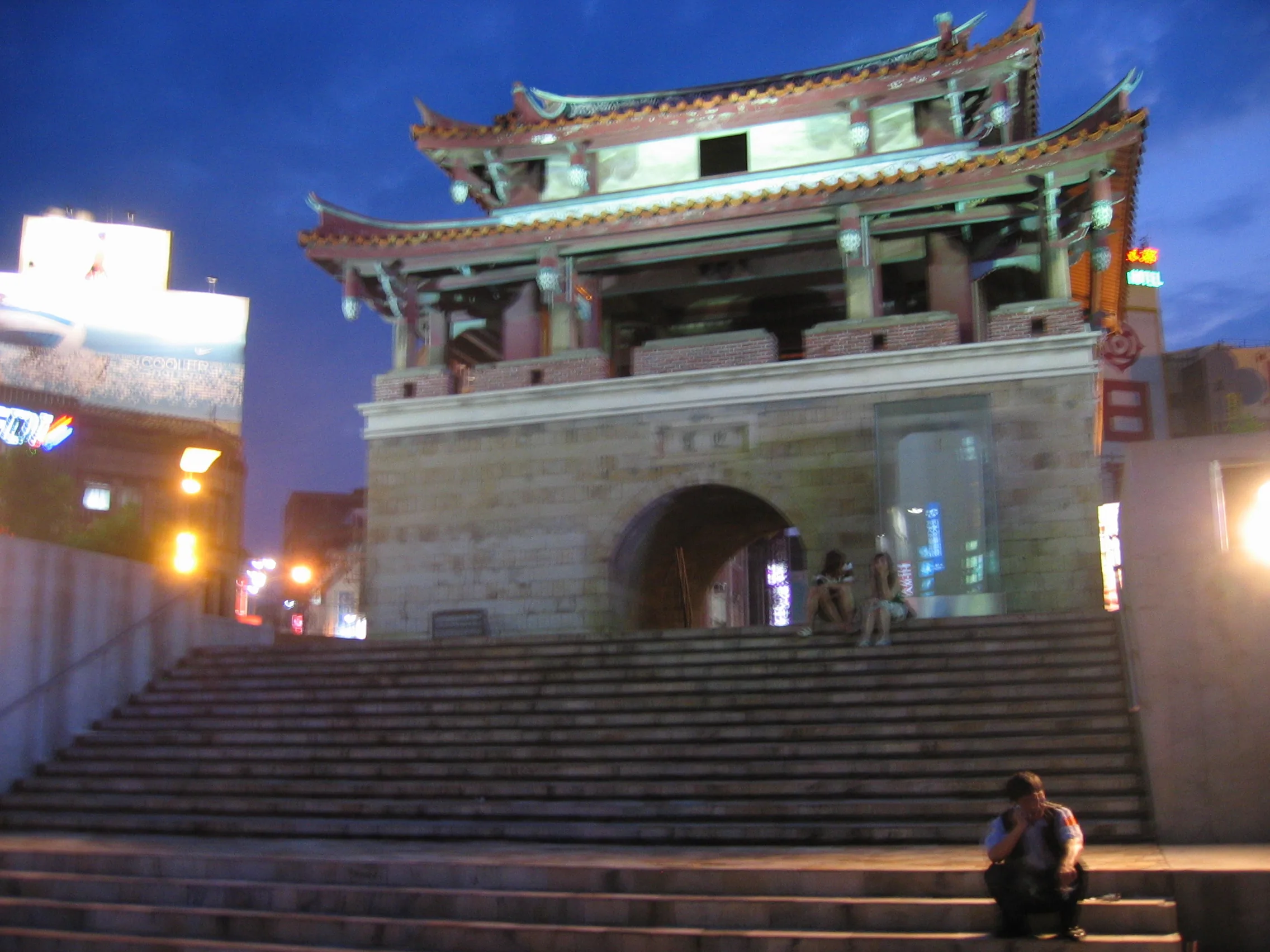
30-second overview: In 1733, the 11th year of the Yongzheng reign, Magistrate Xu Zhimin of the Tamsui Subprefecture planted thorny bamboo all around Zhujian, enclosing a circular earthen wall 440 zhang in circumference (approximately 1,408 meters)1. Construction of the brick-and-stone city began in 1828 and was completed in the ninth year of the Daoguang reign (1829); the East Gate, Yingximen, still stands beside its moat today2. 247 years later, on December 15, 1980, Chiang Ching-kuo cut the red ribbon for Taiwan's first science park, just 5 kilometers from Yingximen3. On June 15, 1953, the Black Bat Squadron relocated to Hsinchu Air Force Base, and by the end of December 1974, when reconnaissance missions ceased, the squadron had flown 838 special missions; 10 aircraft were shot down or crashed in accidents, and 148 crew members were killed in action—two-thirds of the entire unit4. In 1748, the 13th year of the Qianlong reign, the City God Temple was completed. In 1890, the Guangxu Emperor bestowed the imperial plaque "Jinmen Baozhang" (Golden Gate Protection) and elevated the Hsinchu City God to the rank of "Weiling Gong, Metropolitan City God of Hsinchu"—a rank equivalent to a provincial governor—making it the only temple in Taiwan to receive the Qing court's official "Metropolitan City God" designation5. A provincial city of 450,000 people that held the Cold War front line, the earliest Han-built city in northern Taiwan, two top universities, and a semiconductor cluster with NT$1.70 trillion in revenue in 20256. The nickname "Wind City" sounds literary, but every industry in this city is connected to the wind.
1733: The Tamsui Subprefect Planted Bamboo
The Wikipedia entry for Zhujian City records:
✦ "In the 11th year of the Yongzheng reign (1733), when the Tamsui Defense Hall officially moved from Changhua County to Zhujian, Tamsui Subprefect Xu Zhimin planted thorny bamboo all around. The entire area was circular, with a circumference of 440 zhang (approximately 1,408 meters) and four gates facing east, west, south, and north, marking the beginning of Zhujian's city walls."1
Note the phrasing: planted thorny bamboo everywhere.
The raw material was thorny bamboo, not brick, not stone, not rammed earth. The first-generation Zhujian City was a green wall encircled by bamboo. This was not unusual in Taiwan's city-building history (many county seats in Qing-era Taiwan began as bamboo fortifications), but the name "Zhujian" itself carries the scent of plants. When it was later renamed "Hsinchu" (New Bamboo), the character "Bamboo" was retained. Today, the "Bamboo" in Hsinchu Science Park, the "Bamboo" in Tsing Hua University, and the "Bamboo" wafting from the meatball soup at Miaokou all extend from that circle of thorny bamboo planted in 1733.
The Tamsui Hall was not originally located here. Established in 1723 (the first year of the Yongzheng reign), the Tamsui Hall split from Zhuluo County, with its administrative seat initially set in Shalu, Changhua7. In 1731 (the 9th year of Yongzheng), the area north of the Dajia River to Jilong was officially designated as its jurisdiction. In 1733, the Tamsui Subprefect moved the administrative seat to Zhujian7. In other words, two things happened that year: the administrative center of northern Taiwan was moved to this small town just sprouting thorny bamboo, and the thorny bamboo was planted. The relocation of the seat and the founding of the city occurred in the same year. From that day on, Zhujian remained the administrative center of northern Taiwan for 150 years.
96 years later, in 1827 (the 7th year of the Daoguang reign), Jinshi Zheng Yongxi and others proposed to Governor-General Sun Erzhun of Fujian and Zhejiang the construction of a brick-and-stone city. After approval, construction began in 1828, and the brick-and-stone walls were completed in the autumn of 1829, with a circumference of 860 zhang (approximately 2,752 meters) and a wall height of 1 zhang 5 chi (approximately 4.8 meters)2. The four city gates were named "Yingxi" (Welcoming the Dawn), "Yishuang" (Embracing the Cool Breeze), "Gexun" (Singing of the Warm Breeze), and "Gongchen" (Arching to the Emperor). The entire city cost approximately 147,498 taels of silver.
_Yingxi Gate, Hsinchu East Gate. Photo: Jiang / Wikimedia Commons, CC BY-SA 4.0._
In 1902 (the 35th year of the Meiji era), the Japanese implemented urban street rectification in Hsinchu, demolishing the brick-and-stone walls and the other three gate towers, "leaving only the East Gate, Yingxi Gate"2. This remaining East Gate stood for 197 years until today, being designated a National Monument in 1985. During the 1999 East Gate Square beautification project, stone piers of an underground moat structure were discovered, representing the only remaining ancient moat structure in Taiwan constructed using traditional methods.
📝 Curator's Note: The phrase "planting bamboo to build a city" is easily glossed over by modern readers ("Ah, it just means surrounded by bamboo"), but in Taiwan in 1733, this was a cost-saving emergency city-building strategy. The Qing court did not want to spend money building a stone city, yet feared indigenous groups and pirates attacking the administrative seat directly. Tamsui Subprefect Xu Zhimin chose a fast, cheap, self-growing material: thorny bamboo. Thorny bamboo has thorns, grows quickly, and has dense root systems; planted as a hedge, it takes shape in three to five years, costing ten times less than mobilizing laborers to carry bricks and stones. The problem is that thorny bamboo withers, burns easily, and cannot withstand cannons. The 1827 renovation into a brick-and-stone city was the first material upgrade this city underwent in 96 years. From a "fast, cheap, self-growing green defense line" to a "brick-and-stone city piled up with 140,000 taels of silver," Hsinchu's industrialization logic was rehearsed here. Similarly, the 1980s Science Park followed the same pattern: first came affordable schools and the Industrial Technology Research Institute, then came expensive semiconductor fabs. Hsinchu always plants first, then builds.
The Year Shen Baozhen Renamed It: Zhujian Becomes Hsinchu
In 1875, the first year of the Guangxu reign, Shen Baozhen petitioned to establish "Taipei Prefecture." The Tamsui Subprefecture was split, and Zhujian was renamed "Hsinchu," placed under Taipei Prefecture's Hsinchu County8.
This renaming was part of the Qing court's administrative reform of Taiwan. Shen Baozhen was doing other things in 1875 as well: in the same year, he built Eternal Golden Castle in Anping, Tainan; constructed Hengchun County town; and promoted the "Opening the Mountains and Pacifying the Indigenous Peoples" policy. From Shen Baozhen's perspective, Taiwan was the Qing empire's maritime frontier and had to be managed seriously. The "subprefecture" (廳) was a transitional military-administrative unit; the "county" (縣) was a stable civil administrative system. Renaming Zhujian to Hsinchu and converting the Zhujian Subprefecture into Hsinchu County formally incorporated this 142-year-old former subprefecture seat into the Qing court's regular administrative territory.
In 1879, the fifth year of Guangxu, the first Hsinchu County magistrate took office, and county government began substantive operations. In 1887, Taiwan was established as a province, and Hsinchu County was further divided to create Miaoli County. In 1895, the Qing court ceded Taiwan to Japan under the Treaty of Shimonoseki, ending the Qing administrative history of Hsinchu County. The Japanese established Hsinchu Subprefecture in 1901, and in 1920, the ninth year of the Taisho era, they abolished the subprefecture system and elevated the area to "Hsinchu Prefecture," with its seat in Hsinchu. The Hsinchu Prefecture Hall was completed in 1927 (construction began in 1925) and is today's Hsinchu City Hall.
From 1733 to 1945, the city went through four identities: Tamsui Subprefecture City (Qing) → Hsinchu County City (Qing) → Hsinchu Subprefecture (Japanese) → Hsinchu Prefecture (Japanese). With each identity change, the administrative level rose. But the first post-war county-city separation in 1950 actually downgraded Hsinchu. That year, the Nationalist government abolished the provincial city system, and Hsinchu City was redesignated as a city under Hsinchu County, losing its provincial city status9. It was not until July 1, 1982, that Hsinchu City separated from Hsinchu County, merged with Xiangshan Township, and regained provincial city status. In the same year, the Hsinchu County seat was moved to Zhubei Township (later upgraded to Zhubei City)9. A 250-year-old city was downgraded by the county it had spawned and had to wait 32 years to regain its provincial city status.
Today, Hsinchu City administers three districts: East District (Tsing Hua, Hsinchu Science Park, Eighteen Peaks Mountain), North District (City God Temple, Glass Craft Museum, Old City District), and Xiangshan District (coastal wetlands, industrial zones). The population in 2025 is approximately 450,000.
1953 to 1974: 148 People Flew Away from Hsinchu Base
The second chapter of post-war Hsinchu history is a secret chapter that almost no one outside the perimeter of Hsinchu Air Force Base knows.
The Wikipedia Black Bat Squadron article states verbatim: "On June 15, 1953, the unit relocated to Hsinchu Air Force Base and was renamed the 'Air Force Special Missions Group.'"4 "In coordination with the CIA's Taiwan unit, Western Enterprise (office building on Dongda Road, Hsinchu), it conducted low-altitude nighttime electronic warfare and detection missions deep inside mainland China." "Both sides used 'Western Enterprise' as a cover, with the U.S. providing aircraft and necessary equipment."4
The name "Western Enterprise" sounds like a business; it was in fact the CIA's codename in Taiwan. An office building on Dongda Road, south of Hsinchu Air Force Base, bore this sign. Between 1953 and 1974, the Taiwanese side received CIA reconnaissance missions from that building, collected American-made aircraft, and planned flight routes.
The mission numbers are recorded verbatim: "A total of 838 special missions were flown; 10 aircraft were shot down or crashed in accidents, and 148 crew members were killed in action."4
148 people—two-thirds of the entire unit.
✦ "On either side of the entrance path in front of the building stand 7 coconut trees—3 on the left, 4 on the right—corresponding exactly to the Black Bat Squadron's designation: '34.'"10
These 7 coconut trees were planted in 1957. At the time, the Black Bat Squadron's barracks were at No. 16, Section 2, Dongda Road, with dormitories, a club, and sports fields—a place that took care of the families of the 148 pilots. But after they flew out, they often did not come back. Low-altitude nighttime penetration of mainland China's air defense network—once detected by PLA radar, it meant anti-aircraft artillery lock-on. The period from 1956 to 1964 was the most intensive phase of missions, with B-17s, P2V Neptunes, and RB-69As shot down one after another.
At the end of December 1974, the Black Bat Squadron and the Black Cat Squadron simultaneously ceased reconnaissance missions11. This timing was no coincidence: Nixon visited China in 1972, the U.S. withdrew from Vietnam in 1913, and U.S.-ROC strategic cooperation was being recalibrated in 1974. The CIA no longer needed these reconnaissance crews.
But this history was sealed in Hsinchu for 35 years before it began to be told. It was not until November 22, 2009, that the Hsinchu City Government opened the "Black Bat Squadron Historical Exhibition Hall" at No. 16, Section 2, Dongda Road (within Dongda Park), and the names of these 148 pilots were engraved for the first time on a public wall. The building's exterior references the form of U.S. military advisory group dormitories. Admission is free, and it is open Tuesday through Sunday12.
📝 Curator's Note: The story of the Black Bat Squadron shares a common structure with the Keelung Ghost Festival's incorporation of the souls of French soldiers from 1884: a city takes in the dead left behind by history, transforming them from "casualties of the enemy-us framework" into "the city's own memory." But the time gaps are completely different. The Keelung Ghost Festival has continued from 1855 to the present, 170 years; the French soldiers' souls from 1884 were incorporated into the universal salvation rites that same year. The Black Bat Squadron flew from 1953 to 1974, and public commemoration did not come until 2009. This 35-year gap originates from the Cold War structure. In 1974, ROC-U.S. relations were on the eve of collapse (diplomatic relations severed in 1979); publicly acknowledging the Black Bat Squadron's existence meant publicly acknowledging the CIA's station in Taiwan and openly challenging the cross-strait relations that were beginning to thaw. It was not until the Ma administration took office in 2008, cross-strait economic and trade liberalization advanced, and the second and third generations of the fallen began seeking survivor pensions that this history had the space to be told. Between the timing of commemoration and the timing of death, there is always a political interregnum.
The Red Ribbon Chiang Ching-kuo Cut: Behind It, 24 Years of Academic Inertia
The third chapter of Hsinchu's history begins with a ribbon-cutting.
The Hsinchu Science Park Administration's 20th Anniversary special issue states verbatim: "On December 15, 1969 (Republic of China calendar), the Science-Based Industrial Park was formally unveiled, with President Chiang Ching-kuo presiding in person."3
ROC year 69 = 1980. The ribbon Chiang Ching-kuo cut that day was for Taiwan's first science-based industrial park.
But why was the science park located in Hsinchu? The Science Park Administration's own answer reads verbatim: "Given that the area already had National Tsing Hua University (specializing in atomic science), National Chiao Tung University (specializing in electronic science), and the ITRI Union Industrial Research Institute (specializing in chemical engineering), it was deemed feasible to establish a science research park."3
In other words: Hsinchu had three academic institutions, and that is why the park existed—not the other way around.
National Tsing Hua University was re-established in Taiwan in 1956, with its campus located in Chihutsi in Hsinchu's East District. National Chiao Tung University was re-established in Taiwan in 1958, first building the Bo'ai Campus in Hsinchu and later expanding to the Guangfu Campus. The Industrial Technology Research Institute (ITRI) was established in 1973 in Hsinchu County. These three institutions, together with ITRI's 1976 contract with the American company RCA for IC technology transfer13, constituted the entire rationale for the science park's site selection.
✦ "You should thank Minister Chiang (Yen-shu) ... Chiao Tung won't be moving ... President Ching-kuo's wise decision was to keep the academic lineup of Tsing Hua, Chiao Tung, and ITRI from being scattered." (Sun Yun-suan, as quoted in the Science Park Administration's 20th Anniversary special issue3)
The context of Sun Yun-suan's remark was this: in the 1970s, there was a proposal to relocate Tsing Hua, Chiao Tung, and ITRI elsewhere. If they had moved, Hsinchu would have lost a science park. The choice made by Sun Yun-suan, Kuo Ting-li, and other economic bureaucrats was not "deciding to do semiconductors" but "deciding to keep the three schools in Hsinchu." With the schools staying, there was a reason to build the park.
On December 15, 1980, the day the Science Park was formally unveiled, among the first seven companies to move in, United Microelectronics Corporation (UMC) was the first. UMC was spun off from ITRI on May 22, 1980, making it Taiwan's first integrated circuit company—seven years before TSMC13.
Seven years later, on February 21, 1987, the Wikipedia TSMC article states verbatim: "Taiwan Semiconductor Manufacturing Company, Ltd. was formally established on February 21, 1987, in the Hsinchu Science-Based Industrial Park, Taiwan Province, Republic of China."14 In 1955, Morris Chang was invited by Sun Yun-suan to return to Taiwan to serve as ITRI president and UMC chairman; in 1987, with government support, he founded TSMC as a joint venture between ITRI and Philips.
From that day on, the story of Hsinchu Science Park was overshadowed by the three characters "TSMC."

TSMC Hsinchu wafer fab. Photo: Wikimedia Commons contributor, CC BY-SA.
In the fourth quarter of 2025, TSMC's 2-nanometer process (N2) began mass production at the Baoshan plant (Fab 20) in Hsinchu, with a monthly capacity target of 60,000 to 65,000 wafers by the end of 202615. Hsinchu Science Park's total revenue for 2025 was NT$1.70 trillion, a year-on-year increase of 12.25%, with 584 firms and 179,000 employees6. A provincial city of 450,000 people supporting a semiconductor cluster with revenue greater than half of Vietnam's entire GDP.
Rice Noodles and Meatballs in the Wind City: Byproducts of the Jiufeng Wind
But the city's earliest specialty was not chips—it was rice noodles.
The name "Jiufeng" (Nine Descending Winds) first appeared in the 33rd year of the Kangxi reign (1694), in the Gazetteer of Taiwan Prefecture · Treatise on Local Customs: "In September the north wind is fierce, sometimes lasting for consecutive months; it is commonly called the Jiufeng wind"16. Hsinchu is approximately 150 kilometers from the narrowest point of the Taiwan Strait (Quanzhou, Fujian, on the opposite shore). When the northeast monsoon crosses the Central Mountain Range from the Pacific Ocean and enters the Hsinchu Plain, it encounters a topographic trap.
Story Studio states verbatim: "Because Hsinchu is a 'dustpan mouth' opening in a trumpet shape from southeast to northwest, when the monsoon blows toward Hsinchu, the terrain restricts it, making it difficult for the wind to escape once it enters."16
The wind comes in but cannot get out, and the entire city of Hsinchu is blown into a giant drying machine. Annual rainfall is far less than that of Keelung at the same latitude: Keelung receives 3,000 mm, while Hsinchu receives only about 1,800 mm. In winter, with the Snow Mountain Range behind it, moisture stays in Yilan and Keelung; what reaches Hsinchu is the dry, cold Jiufeng wind.
This natural condition did three things.
The first was rice noodles. The National Cultural Memory Bank states verbatim: "The Hsinchu City Gazetteer records: Hsinchu rice noodles were introduced from Fujian. Many elder rice noodles artisans consistently state that their ancestors came from Huian County, Fujian Province, and were already in the rice noodle business on the mainland."17 But rice noodles could originally be made all along the Fujian coast. The key difference in Hsinchu was the wind: "The techniques for making rice noodles across the province were originally much the same, but the reason Hsinchu rice noodles came to dominate the market was the wind. Apart from the outlying island of Penghu, Hsinchu has the highest monsoon index among all western counties and cities ... Strong winds and little rain create favorable conditions for air-drying rice noodles, especially the frost winds from October to January."17
The founding ancestors of Lao Guo Rice Noodles, the Guo Qian brothers, brought their four children including Guo Quan and introduced rice noodle technology from Huian, Fujian, in 1858, during the late Qing dynasty. Before the Japanese colonial period, rice noodles were "water noodles"—thick and requiring prolonged air-drying, which Hsinchu's strong winds were perfect for. Later, with technological improvements, it became possible to make thin, springy "steamed noodles," and Hsinchu rice noodles gained their reputation. Three parts sun-drying, seven parts wind-drying—this is the Hsinchu Rice Noodles Association's public description. Rice noodle workshops are mostly concentrated in Danan Shi (today's Nanshi Li), and at their peak there were over 100 rice noodle factories17.
The second was meatballs. The Wikipedia meatball article states verbatim: "In the process of making meatballs, there is a step of pounding the meat paste with a stick to make it more springy and chewy. The action of pounding meat paste is called 'káng' in Hokkien, so the early written form of meatball was káng-uân (摃丸). It was not until around the 50th year of the Republic of China calendar (1961) that, due to automation, it became kòng-uân (貢丸)."18
The character "貢" is a modern substitution. The original character was "摃"—pounding with a wooden stick. In 1961, Huang Hairui, founder of Hairui Meatballs, modified a metal-beating machine to pound pork, increasing efficiency and improving quality stability. Hsinchu meatballs transitioned from manual stall production to scaled manufacturing19. Why did meatballs end up in Hsinchu? Because Hsinchu had sugarcane (the pre-war sugar industry), black-haired pigs (a northern breeding center), and the Wind City's dry climate was suitable for slaughter and meat preservation. Jin Yi Meatballs, founded in 1938, is one of Hsinchu's oldest continuously operating meatball brands19.
The third was glass. In 1925, the 14th year of the Taisho era, Hsinchu gentry member Liao Qiming established a synthetic glass factory at Dingzhuwei (present-day Dongnan Street) in Hsinchu, taking advantage of local silica sand and natural gas, inaugurating the era of Zhujian glass development20. During the Japanese colonial period, the Japanese discovered abundant silica sand and natural gas in Hsinchu—both essential raw materials for glass manufacturing. The Wind City's geographic advantage became a geologic advantage. The glass industry developed rapidly in Hsinchu during the 1940s. In 1999, the Hsinchu City Government converted the Hsinchu Prefecture Self-Governance Hall, completed in 1936 during the Japanese era, into the Glass Craft Museum20.
📝 Curator's Note: Rice noodles, meatballs, and glass—three seemingly unrelated industries—are all byproducts of Hsinchu's natural conditions. Strong winds dry the rice noodles; underground silica sand and natural gas make glass possible. This is exactly the same logic as the science park's site selection: the science park was built in Hsinchu because Tsing Hua, Chiao Tung, and ITRI were already here (talent was geographically concentrated)—not the reverse causality. From the 1858 rice noodles to the 1980 science park, every industry in Hsinchu has followed the same basic sequence: natural conditions existed first, then industries grew out of them. This is the same pattern as Miaoli's oil and gas, Yilan's cold springs, and Pingtung's tropical fruits: industries are products of geography, not products of planning.
The City God Temple, 1748: The Only Metropolitan City God in Taiwan
Hsinchu has another ancient structure, 81 years older than Yingximen.
The Wikipedia Hsinchu Metropolitan City God Temple article states verbatim: "In the 12th year of the Qianlong reign (1747), Tamsui Subprefecture Magistrate Zeng Riying petitioned the court and directed local gentry and officials to raise funds, completing the City God Temple as an official temple in the following year (1748)."5
A more precise timeline: construction began on the 17th day of the second lunar month in 1747, the temple was completed on the 16th day of the eighth lunar month in 1748, and the City God was installed on the 29th day of the eleventh lunar month of the same year21. The Tamsui Subprefecture office was not completed until 1756. In Taiwanese history, building the City God Temple before the government office is the only such case21.
The status of the Hsinchu City God Temple was elevated again in 1875. When Shen Baozhen established Taipei Prefecture in the 12th year of the Tongzhi reign, Taipei Prefecture was temporarily located in Hsinchu, and the Hsinchu City God was also elevated from the subprefecture-level "Xianyou Bo" to the prefecture-level "Sui Jing Hou." In 1890, the 16th year of the Guangxu reign, the verbatim record states: "Celestial Master Zhang of Longhu Mountain, Jiangxi, observed the heavens ... the court approved a ceremony at the Hsinchu City God Temple ... the Guangxu Emperor also bestowed the imperial plaque 'Jinmen Baozhang' and further elevated the Hsinchu City God to the rank of 'Weiling Gong, Metropolitan City God of Hsinchu,' a rank equivalent to a provincial governor."5
The "Metropolitan City God" rank is equivalent to a provincial governor, above the county-level "Xianyou Bo" and the prefecture-level "Sui Jing Hou." The Hsinchu City God Temple is the only temple in Taiwan to receive the Qing court's official "Metropolitan City God" designation, commonly known as "the foremost City God temple in all of Taiwan"5.
The food at the temple entrance is more famous than the temple itself. Liu's Braised Pork Rice was founded in 1931; Acheng Hao is over 80 years old; Zheng's Fish Balls have been passed down for more than three generations: the temple-front stalls mostly formed as a market from the late Japanese colonial period through the post-war retrocession era, combining meatball soup, rice noodles, braised pork rice, and spring rolls into Hsinchu's most representative food map. Today, almost every tourist who visits Hsinchu goes to the temple entrance first, but the historical logic of the temple entrance is: first there was the temple with its Metropolitan City God rank, then the stalls that formed around the temple, then the tourist night market that expanded in the second and third post-war generations.

Hsinchu Metropolitan City God Temple. Photo: Wikimedia Commons contributor, CC BY-SA.
1956 + 1958: The Story of Two Universities Re-Established in Taiwan
Hsinchu has two universities, two key nodes in the post-war reconstruction of Taiwan's higher education.
National Tsing Hua University was re-established in Taiwan in 1956. Tsing Hua University was founded in Beijing in 1911 and ceased operations on the mainland in 1949. In 1955, the Executive Yuan of the Republic of China resolved to establish a "Preparatory Committee," with Hu Shih, then chairman of the Atomic Energy Council, serving as preparatory director. In 1956, the campus site was selected in the Chihutsi area of Hsinchu's East District, initially establishing the Institute of Atomic Sciences—this is also why the Science Park Administration later described Tsing Hua as "specializing in atomic science"3.
National Chiao Tung University was re-established in Taiwan in 1958. Chiao Tung University was founded in Shanghai in 1896 (predecessor: Nanyang Public School) and relocated during the Second Sino-Japanese War in 1937. It was re-established in Taiwan in 1958, with its campus on Bo'ai Street, Guangfu Road, Hsinchu. Chiao Tung's strengths are in electronics, communications, and information science—this is why the Science Park Administration described Chiao Tung as "specializing in electronic science"3.
The two universities, 6 kilometers apart in Hsinchu and flanking Eighteen Peaks Mountain, with faculty and student mobility, research collaboration, and spin-off companies, transformed Hsinchu's East District into Taiwan's academic peninsula. The talent pool for the 1980 science park was the graduates of these two universities: UMC was founded in 1980, TSMC in 1987, MediaTek spun off from UMC in 1995, and Innolux developed 5G in 2009. Over these forty-five years, the founders and core teams of virtually every IC design company established in the science park came from Tsing Hua or Chiao Tung.
On February 1, 2021, National Chiao Tung University and National Yang Ming University formally merged to become "National Yang Ming Chiao Tung University"22. Tsing Hua had previously merged with Hsinchu University of Education in 2016.
📝 Curator's Note: Tsing Hua 1956, Chiao Tung 1958, ITRI 1973, Science Park 1980, UMC 1980, TSMC 1987: there is a fact easily overlooked in this timeline. The starting point of Taiwan's semiconductor industry was "finding a place for two universities re-established after fleeing the mainland," and only afterward did IC industrial policy grow out of it. In 1955, Hu Shih chose Hsinchu for Tsing Hua partly because the site had leftover Japanese-era higher education land and was far enough from Taipei's political center. In 1958, Chiao Tung chose Hsinchu because Tsing Hua was already there, and they could share an academic community. In 1973, ITRI chose Zhudong, Hsinchu, because Tsing Hua and Chiao Tung graduates were in the area. In 1980, the science park chose Hsinchu because ITRI was there. The entire semiconductor industry's site selection was the result of 25 years of accumulated academic inertia, not the result of any single policy. If Hu Shih had chosen Taichung instead of Hsinchu in 1956, TSMC would be in Taichung today. Historical contingency determined the fate of this city in this story.
A Provincial City in the Wind: Home to the Cold War Front Line, the Semiconductor Starting Point, and Two City-Founding Anniversaries
Return to the opening scene.
In 1733, the 11th year of the Yongzheng reign, Magistrate Xu Zhimin of the Tamsui Subprefecture planted thorny bamboo all around the perimeter. On December 15, 1980, Chiang Ching-kuo cut the red ribbon for Taiwan's first science park. The physical distance between these two actions is less than 5 kilometers: from Yingximen to the entrance of Hsinchu Science Park is a 15-minute scooter ride. 247 years lie in between.
But walking the streets, you would not feel this time gap. Hsinchu's strangeness lies in how it compresses all its historical layers into the same geographic coordinates. In the morning, eat rice noodles and meatballs beside the City God Temple near the temple entrance (1748 + 1858 + 1938 + 1961); at noon, visit the Glass Craft Museum to see the descendants of Liao Qiming's 1925 synthetic glass factory (1925 + 1999); in the afternoon, go to the Black Bat Squadron Historical Exhibition Hall to see the names of 148 pilots (1953 + 2009); in the evening, walk around Tsing Hua's Plum Garden (1956); at night, come back to stroll in front of Yingximen (1829). All of these sites are within a 30-minute walk in central Hsinchu.
A provincial city of 450,000 people. Holding up the Cold War front line, the earliest Han-built city in northern Taiwan, two top universities, and the starting point of 90% of the world's advanced semiconductor chips. Scale has never equaled importance, and this city is the most concrete evidence of that statement.
✦ "The reason Hsinchu rice noodles came to dominate the market was the wind." (National Cultural Memory Bank17)
The wind comes in but cannot get out. The thorny bamboo Magistrate Xu Zhimin planted in 1733 grew large on the wind; the Rice Noodles Association's rice noodles are dried by the wind; the silica sand underground was deposited by wind over millions of years; the northeast monsoon blows for six months from September to March. The northeast monsoon still blows today. Every October, the Hsinchu Central Weather Administration station records instantaneous wind speeds of 25 meters per second or more—equivalent to the lower threshold of a mild typhoon in Taiwan. People in Hsinchu don't say "the wind is really strong today"; they say, "today is good for drying rice noodles."
Viewed from the Central Mountain Range, Hsinchu is the last slope the northeast monsoon descends before reaching Taiwan's western coast. The wind blows into the trumpet-shaped dustpan mouth, blows the thorny bamboo planted in 1733, dries the rice noodles, cools the flames of the glass factory, blows over the flight routes of the 148 Black Bat pilots who never returned, blows through the coconut trees of Tsing Hua's Plum Garden and Chiao Tung's Bo'ai Campus, blows past the surveillance cameras outside TSMC's 2-nanometer fab.
Next time you visit Hsinchu, don't just look at the chip fabs inside the park. Try standing in front of Yingximen at 6 a.m. and feeling the wind. You will remember one thing: the layers of history this city carries far exceed the three words "tech city." It is a city planted in 1733, kept alive by the wind for 293 years, and still being blown by the wind today.
Further Reading
- Keelung City — 22 Counties and Cities Series pilot: Harbor memories from the Spanish flag-planting in 1626 to the world's seventh-largest container port in 1984; like Hsinchu, it has a Cold War front-line base (Keelung Peace Island vs. Hsinchu Air Force) and a provincial city's fate
- Chiayi City — 22 Counties and Cities Series: Another provincial city split by county seat relocation (Chiayi County seat moved to Taibao in 1991 vs. Hsinchu County seat moved to Zhubei in 1989); compare the consequences of two county-city separations
- Miaoli County — 22 Counties and Cities Series: A neighboring county carved out of Hsinchu County in 1887; the Hsinchu Science Park's Longtan and Tongluo campuses are both in Miaoli, representing Hsinchu's industrial spillover
- Nantou County — 22 Counties and Cities Series: The only landlocked county, sharing Hsinchu's "scale ≠ importance" geographic structure (Nantou supports the entire central mountain system / Hsinchu supports the entire semiconductor cluster)
- Taoyuan City — Hsinchu's northern neighbor; when ITRI was established in 1973, Longtan, Taoyuan was initially considered before Hsinchu was chosen; the Science Park's Longtan campus straddles Taoyuan and Hsinchu
- Hsinchu County — Separated from Hsinchu City in 1982, county seat moved to Zhubei in 1989; Baoshan Township is the site of TSMC's 2-nanometer fab
- Taiwan Semiconductor Industry — The complete industrial history from ITRI in 1973 to TSMC's 2-nanometer process in 2025; Hsinchu is the physical coordinate of every timeline in this story
- TSMC — Founded in Hsinchu Science Park in 1987; 2-nanometer process began mass production at the Baoshan plant in Q4 2025
- Taiwan During the Cold War — The reconnaissance history of the Black Bat Squadron and the Black Cat Squadron; Hsinchu Air Force Base was the center of this history
- Taiwan Science Parks — The complete science park history: Hsinchu in 1980, Southern Taiwan Science Park in 1996, Central Taiwan Science Park in 2003, Kaohsiung Mega Park in 2025
- Keelung Ghost Festival — Shares the same Qing-era local belief system as the Hsinchu City God Temple; compare two "soul-receiving" rituals (Keelung receives French soldiers' souls from 1884 / Hsinchu's City God administers all spirits in Taiwan)
Image Credits
This article uses 3 Wikimedia Commons CC BY-SA-licensed images:
- Hero (frontmatter + §1733): Hsinchu East Gate (0421).JPG (CC BY-SA 4.0) — Yingximen (East Gate), the gate tower built in 1829 when the Daoguang-era brick-and-stone city was completed; the only surviving gate after the Japanese urban realignment of 1902.
- Scene §1980 Science City Triangle: Tsmc factory hsinchu.JPG (CC BY-SA) — TSMC Hsinchu wafer fab, binding this park into the global semiconductor supply chain.
- Scene §City God Temple 1748: Hsinchu City God Temple 30.JPG (CC BY-SA) — The plaza in front of the Hsinchu Metropolitan City God Temple, the only temple in Taiwan to receive the Qing court's official "Metropolitan City God" designation.
License: CC BY-SA 4.0.
For supplementary images of Hsinchu Science Park aerial views, the Black Bat Squadron Historical Exhibition Hall, the Glass Craft Museum, etc., authorization is recommended through the Hsinchu City Bureau of Cultural Affairs, Hsinchu City Tourism Website, and Hsinchu Science Park Administration.
References
- Hsinchu City — Wikipedia — The original verbatim source detailing the city's founding process, the names of its four gates (Yingxi, Yishuang, Gexun, Gongchen), and the complete history from its establishment to the 1902 Japanese demolition that left only the Yingxi Gate. It states: "In the 11th year of Yongzheng (1733), when the Danhai Defense Hall officially moved from Changhua County seat to Zhuqian, Danhai Tongzhi Xu Zhimin planted thorny bamboo all around. The entire area was circular, with a circumference of 440 zhang (approximately 1408 meters), featuring four gates: East, West, South, and North, marking the beginning of Hsinchu's city walls."↩2
- Cultural Heritage Administration, Ministry of Culture: Hsinchu City Yingxi Gate — Official cultural heritage records noting that in the 7th year of Daoguang (1827), Zheng Yongxi proposed the project; construction began in 1828 and was completed in 1829. The circumference was 860 zhang (approximately 2752 meters), the wall height was 1 zhang 5 chi, and the total cost was approximately 147,498 taels of silver. It was designated a National Monument in 1985.↩23
- Hsinchu Science Park Administration: 20th Anniversary Special Edition of the Science Industrial Park — Three official verbatim sources: "On December 15, 1980 (69th year of the Republic), the Science Industrial Park officially opened, with President Chiang Ching-kuo personally presiding over the ceremony." "Recognizing that the region already had National Tsing Hua University (specializing in atomic science), National Chiao Tung University (specializing in electronic science), and the Ministry of Economic Affairs' Joint Industrial Research Institute (specializing in chemical science), it was believed that a scientific research park could be established." Sun Yun-hsuan recounted: "You should thank Minister Chiang (Yanshi)... NCTU will not move..."↩23456
- Black Bat Squadron — Wikipedia — Three verbatim sources: "On June 15, 1953, the unit moved to the Hsinchu Air Force Base and was renamed the 'Air Force Special Mission Group'." "Cooperating with the CIA's Taiwan unit, Western Company..." "A total of 838 special mission sorties were executed; 10 aircraft were shot down or crashed accidentally, resulting in the martyrdom of 148 personnel." ⚠️ Stage 1 fact-flag handling: A minority source (Hakka News 2025) states 147 people. This article adopts the mainstream Wikipedia figure of 148 people; the difference of 1 may be due to statistical口径 (inclusion vs. exclusion of non-combat martyrs).↩234
- Hsinchu City City God Temple — Wikipedia — Two verbatim sources: "In the 12th year of Qianlong (1747), Danhai Tongzeng Zeng Riying submitted a memorial to the court and ordered local officials and gentry to raise funds to build the City God Temple as an official temple the following year (1748)." "The Guangxu Emperor also bestowed an imperial plaque reading 'Protection of Kinmen', further promoting the Hsinchu City God to the rank of 'Weiling Gong Hsinchu City God', equivalent to a provincial巡撫." This includes the complete temple history of rank upgrades from Xianyou Bo in 1875 to Suijing Hou, and finally to City God in 1890.↩234
- Hsinchu Science Park Administration Statistics: 2025 Full Year Revenue of 1.70 Trillion NTD — Official statistical data for 2025: full-year revenue of 1.70 trillion NTD, annual growth of 12.25%, 584 companies, and 179,000 employees.↩2
- Danhai Prefecture — Wikipedia — The complete administrative history of Danhai Prefecture: separated from Zhuluo County in the 1st year of Yongzheng (1723); officially divided into a jurisdiction north of the Dajia Creek to Jilong in the 9th year of Yongzheng (1731); and the prefectural seat moved from Shalu, Changhua to Zhuqian in 1733. ⚠️ Stage 1 fact-flag handling: The original Stage 0 note stating "Danhai Prefecture moved here in the 3rd year of Yongzheng (1725)" was incorrect. The correct timeline is: Prefecture established in 1723, jurisdiction divided in 1731, seat moved in 1733.↩2
- History of Keelung City — Wikipedia and Shen Baozhen Reform Related Sections — The administrative reform background in 1875 when Shen Baozhen established "Taipei Prefecture," split Danhai Prefecture, renamed Zhuqian to "Hsinchu," and established Hsinchu County.↩
- Administrative History of Hsinchu City — Hsinchu City Government Civil Affairs Department — Official administrative history: In 1950, following post-war county-city separation, Hsinchu City was designated as a county-administered city under Hsinchu County. On July 1, 1982, Hsinchu City and Xiangshan Township merged to restore its status as a provincial-administered city; in the same year, the Hsinchu County seat moved to Zhubei.↩2
- 117-Year-Old Coconut Trees Guard the History of the Black Bat Squadron — Hakka News HakkaNews 2025 — Two local verbatim sources: "On both sides of the entrance passage in front of the building, 7 coconut trees are planted: 3 on the left and 4 on the right, coincidentally corresponding to the Black Bat Squadron's unit number '34'." "As early as 1957, this was the barracks where the squadron lived... At that time, there were also 7 coconut trees planted outside the club, which were the symbol of the 34th unit."↩
- Republic of China Air Legends: Black Bat and Black Cat — vocus — Analysis of the Cold War background: In late December 1974, both the Black Bat and Black Cat squadrons simultaneously ceased reconnaissance missions. This followed Nixon's 1972 visit to China, which recalibrated strategic cooperation between the United States and the Republic of China.↩
- Black Bat Squadron Cultural Relics Exhibition Hall — Hsinchu City Government Cultural Affairs Bureau — Official data: Opened on November 22, 2009, at No. 16, Section 2, Dongda Road (inside Dongda Park). The building's exterior references the style of US Military Advisory Group dormitories. Free admission is open from Tuesday to Sunday.↩
- United Microelectronics Corporation (UMC) — Wikipedia — Complete company history: Founded on May 22, 1980, as a spin-off from the Industrial Technology Research Institute (ITRI); it was Taiwan's first integrated circuit company. In 1976, ITRI signed an IC technology transfer license agreement with the US RCA Corporation. In 1995, Tsao Hsing-cheng decided to transform UMC into a pure foundry.↩2
- Taiwan Semiconductor Manufacturing Company (TSMC) — Wikipedia — Original verbatim source: "Taiwan Semiconductor Manufacturing Company Limited was officially established on February 21, 1987, in the Hsinchu Science Park, Taiwan Province." Includes history: Morris Chang returned to Taiwan in 1985 to serve as President of ITRI and Chairman of UMC; in 1987, ITRI and Philips established a joint venture.↩
- TSMC 2nm N2 Process Launch — Economic Daily News 2025 Report — Industry report: Mass production will launch in the fourth quarter of 2025 at the Hsinchu Baoshan Plant (Fab 20). The monthly capacity target is to reach 60,000 to 65,000 wafers by the end of 2026.↩
- Hsinchu's Nine-Fall Wind — Story Studio — Two geographical verbatim sources for the Wind City: "The Nine-Fall Wind is the northeast monsoon crossing the mountain range, resulting in strong winds... Third is Hsinchu (25-35 knots/second or stronger winds)." "Because Hsinchu is shaped like a funnel opening southeast to northwest, when the monsoon blows towards Hsinchu, it is constrained by the terrain, making it difficult for the wind to exit once it enters." Includes the Nine-Fall Wind allusion from the 33rd year of Kangxi (1694) "Taiwan Prefecture Gazetteer · Geography and Customs."↩2
- Hsinchu Rice Noodles — National Cultural Memory Bank — Three official verbatim sources: "The Hsinchu City Gazette records: Hsinchu rice noodles were introduced from Fujian. Many veteran rice noodle makers consistently stated that their ancestors came from Huian County, Fujian Province, and were already engaged in rice noodle production in mainland China." "The technology for making rice noodles across the province was originally similar, but what allowed Hsinchu rice noodles to dominate the market was the difference in wind." "The founding ancestors of the old pot rice noodles, the Guo Qian brothers... introduced them to Taiwan from Huian, Fujian, in 1858." Includes the geographical distribution of over 100 factories in the Mifeng Liao Nanshi area.↩234
- Gongwan (Meatballs) — Wikipedia — Verbatim source on the etymology of Gongwan: "In the process of making gongwan, there is a step involving beating the meat paste with a stick to make the texture chewier. This action of beating the meat paste is called 'gang' (摃) in Hokkien, so the early writing for gongwan was 'gangwan' (摃丸). It was only around the 50th year of the Republic of China (1961) that automation changed it to 'gongwan' (貢丸)."↩
- History of Hsinchu Gangwan Brands — WalkerLand — Complete gongwan brand history: In 1961, Huang Hai-rui, founder of Hairui Gangwan, improved an iron-smithing machine to pound pork; in 1976, he established the Hairui Gangwan shop at a storefront on Ximen Street. Jin Yi Gangwan was founded in 1938 and is currently one of the oldest brands in Hsinchu.↩2
- Hsinchu City Glass Art Museum — Wikipedia — "In 1925, Hsinchu gentry Mr. Liao Qiming, taking advantage of silica sand and natural gas, established a synthetic glass factory in Dingzhuwai (presently Southeast Street), Hsinchu City, opening the era of Zhuqian glass development" (transcribed from Lanyang Museum Newsletter). + The Glass Art Museum's predecessor was the Hsinchu Prefecture Autonomous Association Hall, construction started on June 25, 1936, and was completed on December 25, 1936. It opened on December 8, 1999, coinciding with the '3rd Zhuqian International Glass Art Festival'. Complete architectural history.↩2
- History of Hsinchu City God Temple — Official Website of Hsinchu City God Temple — Official temple records: Construction began on the 17th day of the 2nd lunar month in 1747; completed on the 16th day of the 8th lunar month in 1748; the City God was enthroned on the 29th day of the 11th lunar month. Historical records also note that the Danhai Prefecture Office was not completed until 1756, making it the only example in Taiwan's history where a City God Temple was built before the government administrative office.↩2
- Merger History of National Yang Ming Chiao Tung University — Official Website of National Yang Ming Chiao Tung University — Complete higher education history: On February 1, 2021, National Chiao Tung University and National Yang Ming University officially merged to form "National Yang Ming Chiao Tung University." National Chiao Tung University was re-established in Taiwan in 1958 at Kuangfu Road, Bo'ai Street, Hsinchu City. National Tsing Hua University was re-established in Taiwan in 1956 at Chituhzi, East District, Hsinchu.↩