
30-second overview: In the winter of 1788, Baozhong Pavilion was founded on a hillside in Xinpu to collectively bury more than 200 Hakka yimin who died in the Lin Shuangwen Rebellion. Its main hall was completed in 1790, and the whole temple in 1791. Two hundred thirty-five years later, the rotating Yimin Festival ritual held every year on the twentieth day of the seventh lunar month is still running, covering the Fifteen Lianzhuang across Taoyuan, Hsinchu County, and Hsinchu City. In 1989, the Hsinchu County seat moved from Hsinchu City to Zhubei City; that year, Zhubei was still a small agricultural township. After Hsinchu HSR Station opened in 2007, its population doubled from 120,000 to 220,000. In 2025, average per capita income reached NT$1.442 million and median income NT$857,000, both ranking first among Taiwan’s 368 townships, towns, cities, and districts. Hsinchu County is 67.8% Hakka, the highest share in Taiwan, but in its 11 key Hakka cultural development areas, fewer young Hakka people can afford homes in their own hometown. What this article wants to say is this: two senses of time live along the same Touqian River.
At Four in the Afternoon on Yimin Festival, the Lantern Poles Rise in Xinpu
If you ask someone from Xinpu, “When is Hsinchu County most like Hsinchu County?” they will not tell you about a weekend on Neiwan Old Street. Weekends in Neiwan belong to tourists. They will tell you about four in the afternoon on Yimin Festival, the moment the row of lantern poles rises in front of Xinpu Yimin Temple.
Every year from the eighteenth to the twentieth day of the seventh lunar month, Baozhong Yimin Temple in Xinpu holds the Zhongyuan Yimin Festival. Fifteen lianzhuang, or linked village associations, rotate responsibility for the main universal salvation rites, stretching from Zhongli, Pingzhen, Yangmei, Longtan, Xinwu, and Guanyin in Taoyuan to Xinpu, Wufenpu, Shiguang, Guanxi, Da’ai (Beipu/Emei/Baoshan), Qionglin, Hukou, and Hsinchu City in Hsinchu County and Hsinchu City: 20 townships, towns, cities, and districts across three local governments, with one lianzhuang serving as the main ritual host each year1. After four in the afternoon, lantern poles begin to rise in the temple forecourt. Bamboo poles are hoisted high, hung with red lanterns and soul-summoning banners, inviting unmoored spirits from a hundred li around to enter and receive offerings.
As the bamboo poles go up one by one, temple staff do not speak much. Hakka and Hoklo are used together, and the actions are the same set of motions repeated for more than two centuries. This is a county that, in the age of the strongest 5G signals, still keeps the breathing rhythm of the seventh lunar month.
Five kilometers away, in Zhubei’s HSR district, 4:30 p.m. is exactly shift-change time at TSMC’s Baoshan Phase II construction site. Excavators, precast panels, and concrete trucks line up from Hsinchu Science Park. That is the construction site of a 2-nanometer wafer fab, which began work in 2023 and is expected to enter mass production in 20262. On one side, lantern poles are being raised; on the other, concrete is being poured. The same Touqian River, two senses of time.
In the Winter of 1788, More Than 200 Sets of Bones Were Buried Together on That Hillside
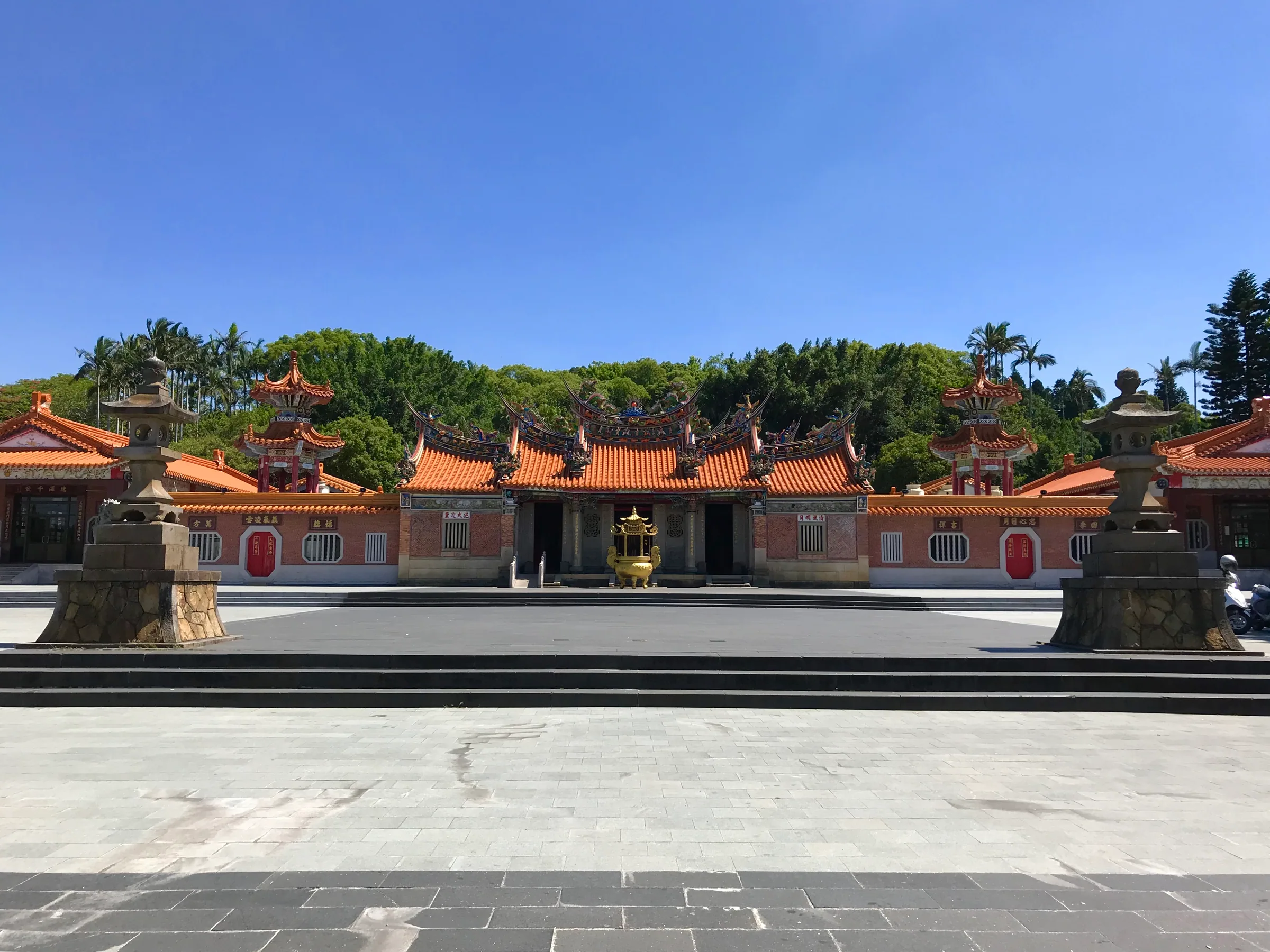
Front of Baozhong Yimin Temple, 2018-05-27. Photo: Outlookxp. CC BY-SA 4.0 via Wikimedia Commons.
To understand why Yimin Temple has 235 years behind it, the camera has to pull back to the autumn of Qianlong 51, 1786.
That year, Lin Shuangwen of Dalidun in Changhua rose in rebellion against the Qing. Early the next year, Lin Shuangwen sent his commander Wang Zuo north with troops, capturing Zhuqian City, today’s urban Hsinchu, and for a time the whole of Tamsui Subprefecture fell3. At the time, the concept of “yimin,” or righteous people, was an existing Qing military supplementary arrangement: after local volunteers armed themselves to assist in suppressing rebellions, the court would issue plaques, grant fields, and establish shrines. The Guangdong Hakka people in Zhuqian organized a yimin militia to assist government troops in counterattacking and retaking Zhuqian City. “In the Lin Shuangwen incident, roughly more than 200 Zhuqian Yue-registered yimin soldiers died because of the fighting”4. Another source notes that after the incident ended, “oxcarts collected nearly 300 sets of remains along the battlefield route”5, possibly including deaths among rear support personnel. The two figures are best presented together.
In Qianlong 52 (1787), after the Lin Shuangwen incident was pacified, the Qianlong emperor bestowed the plaque “Baozhong,” or “Commending Loyalty,” on the Yue-registered yimin6. The following winter, in 1788, four initiating lineages, Wang Tingchang, Huang Zongwang, Lin Xiankun, and Wu Ligui, broke ground on a hillside in Fangliao, Xinpu, to build a tomb mound and temple for the fallen yimin. In the winter of Qianlong 55 (1790), the main hall was completed; in Qianlong 56 (1791), the whole temple was finished7.
📝 Curator’s note: The “year Yimin Temple was built” is often shortened to the single number “1788,” but in reality it was a three-year process: foundation in winter 1788, completion of the main hall in winter 1790, and completion of the whole temple in 1791. The three-stage sequence matters. This temple was a project begun only in the second year after the deaths and finished only in the fourth. The speed of construction itself tells you something about that community of Hakka frontier settlers: they had money, people, and organization, enough to build a complete temple in a newly war-torn settlement frontier. More important: from the beginning, this temple was a collective burial site for “unclaimed bodies.” More than 200 sets of Hakka bones with no relatives to claim them were buried together beneath the Yimin mound. The main hall was added afterward; the body of the temple is a large collective tomb. The Hakka way of handling “deaths with no one to collect them” was institutionalized from this temple onward.
In Daoguang 15 (1835), the temple invited Hakka villages in Hsinchu and Taoyuan to begin rotating responsibility for the Zhongyuan rites, initially among the Thirteen Lianzhuang. In 1976, or Minguo 65, the rotation expanded to the Fifteen Great Villages, covering 20 townships, towns, cities, and districts across Hsinchu County, Taoyuan City, and Hsinchu City. The festival is held every year from the eighteenth to the twentieth day of the seventh lunar month, with the twentieth designated Yimin Festival8.
One meaningful comparison is with other Hakka yimin traditions in Taiwan: Liudui Zhongyi Temple in Pingtung originated in the 1721 Zhu Yigui Rebellion, earlier than Hsinchu Yimin Temple; Beimiao Yimin Temple in Miaoli also originated in the 1786 Lin Shuangwen Rebellion, contemporary with Hsinchu. What is distinctive about Baozhong Pavilion in Fangliao, Hsinchu, is the scale of its worship circuit: the Fifteen Lianzhuang rotate across three counties and cities, unique among Taiwan’s Hakka yimin traditions9.
The 1835 Minnan-Hakka Joint-Share Reclamation Contract
In the same generation after Yimin Temple was built, Hsinchu County’s inner hills began to be reclaimed.
Wang Shijie (1661-1721), from Kinmen, was among the Han Chinese who first entered Zhuqianpu for large-scale settlement. Most sources record that he “began entering the area for reclamation around 1711,” and in 1718, Kangxi 57, completed the trunk line of a 400-jia irrigation system later called Long’en Canal, establishing the starting point of Zhuqian’s hydraulic works10. “1718 reclamation” is often written as the starting point, but that compresses “entering for settlement” and “completion of irrigation works” into a single year. The more precise phrasing is “1711 settlement entry / 1718 completion of Long’en Canal.”
In the twelfth month of Daoguang 14 (1834), Tamsui subprefect Li Siye provided 1,000 silver dollars and ordered Jiang Xiuluan, the Yue-registered manager-general of Jiuchonglin Village, to build 15 guard towers and hire 160 frontier guards. In the second month of the following year, 1835, he ordered Lin Dexiu and Zhou Bangzheng, Minnan managers-general from Zhuqian City’s west gate, to join shares with Jiang Xiuluan and organize the “Jinguangfu General Reclamation Household.” “Jin” was an auspicious prefix; “Guang” represented Guangdong Hakka; “Fu” represented Fujian Minnan. The Minnan and Yue/Hakka sides each contributed capital of 12,600 yuan11.
The division of labor was clear: “Zhou strategized and handled official business in Zhuqian, while Jiang stayed at the reclamation site, taking charge of frontier defense against Indigenous groups and supervising reclamation work”12. One side ran documents in the city; the other supervised work in the mountains.
The area Jinguangfu reclaimed to the south included today’s Beipu Township, Baoshan Township, and Emei Township. It passed through four Yue-registered reclamation heads and three Minnan reclamation heads, running for 52 years from 1835 until Liu Mingchuan’s policy of abolishing guard lines in 1886. The evaluation by the Wu San-lien Foundation for Taiwan Historical Materials is weighty: “The establishment of the Jinguangfu reclamation enterprise was the ancestors’ restart from defense to offense, from passive defense to active reclamation; it was also a special case of Minnan-Hakka cooperation, and the terminus of inner-mountain reclamation in the Hsinchu region”13.
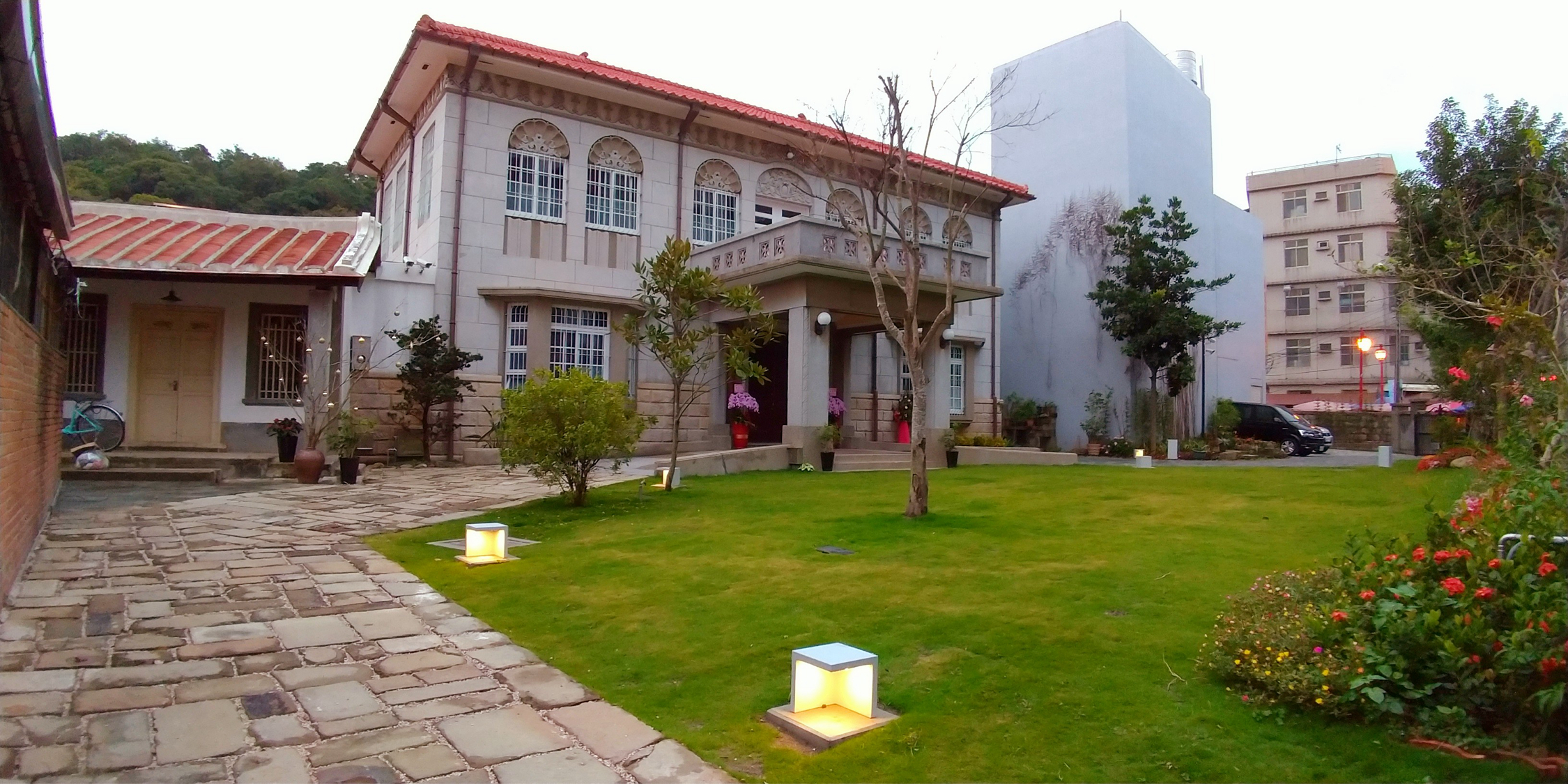
Exterior of Jiang A-Hsin Mansion. Photo: Ckfhouse. CC BY-SA 4.0 via Wikimedia Commons.
Beipu Old Street is the urban grain left by Jinguangfu. Citian Temple, Jinguangfu Mansion, Jiang A-Hsin Mansion, and Tianshui Hall stand together: “In this tiny old settlement street block, there are as many as seven monuments and historic buildings,” in the words of VERSE magazine14. Jinguangfu Mansion was announced in 1983 as a first-class national monument. It has a two-entry, one-courtyard siheyuan layout. The right outer cross-wing was rebuilt in Japanese style after the 1935 Hsinchu-Taichung earthquake, while the left outer cross-wing retains its Qing-period layout15.
Jiang A-Hsin Mansion is often mistaken for a Japanese colonial period building. It is not. Jiang A-Hsin, courtesy name Maoxi, was a sixth-generation descendant of Jiang Xiuluan, the Jinguangfu reclamation head. He entered the tea business in the 1930s under Japanese rule and, with support from Mitsui Norin, owned several tea factories. In 1946, or Minguo 35, after the war, he organized Yongguang Company and began building the mansion; it was completed in 1949, or Minguo 38, for the purpose of receiving foreign tea merchants16. The building is a Baroque-inspired mixed residential-commercial structure, using Western classical techniques such as semicircular arches and bay windows. Much of the interior timber came from self-operated forests: Taiwan incense cedar, cypress, camphor, zelkova, and China fir. It was designated a county monument in 2001, bought back through fundraising by descendants after 2012, and became a filming location for the Taiwanese drama Gold Leaf in 2021.
✦ “As long as I am here for one more day, bayin will not cease.” (VERSE magazine quoting Beipu local bayin tradition bearer Peng Junyang14)
The Autumn Wind: Persimmon Cakes, Rice Noodles, and Lei Cha Tea
Hsinchu County's climate is shaped by its terrain.
The foothills of the Xueshan Range, the Xiushan Hills, and the Lakehood Tableland form a trumpet-shaped alluvial plain. When the northeast monsoon arrives, the terrain amplifies it, and from the latter half of the ninth lunar month (around mid-October) each year, a dry, cold, strong wind known as the "autumn wind" blows, with gusts reaching up to 20 meters per second17. The autumn wind shapes three of Hsinchu County's specialties: Hsinchu rice noodles (in the Zhubei area, the noodles are soaked in water and hung on bamboo racks to dry, where the north wind dries them more evenly than sun exposure), Beipu persimmon cakes (sun-dried in the Hanke Village from September to December, with a history of at least 170 years, taking 7 to 9 days through steps of de-stemming, peeling, sun-drying, wind-drying, and shaping), and Xiancao in Guanxi (dried by the north wind before harvesting, used to make xiancao jelly and stinky tofu, with Guanxi Township accounting for over 60% of Taiwan's xiancao production)18.

Beiu persimmon cake. Photo: Office of the President. CC BY 2.0 via Wikimedia Commons.
Beipu also has another street known as the noodle street. Along Zhongzheng Road, Peace Street, and Chenggong Street, there are over 200 noodle shops, giving rise to the saying "North Beipu is thick, South Beipu is rich"19. Hakka noodles are an iconic element of Hakka cuisine, and are the same thing as the "pan mee" spoken of by Hokkien people, just written differently.
Tea cultivation is another economic line in Hsinchu County's hilly areas. Beipu Township calls it "Bongfeng tea" and Emei Township calls it "Oriental Beauty tea," but they are actually the same tea known by different names in different townships. The key to making the tea: the tea leaves are first fed upon by the small green leafhopper, creating "tea shoots with insect bites," and only then do the leaves develop their special honey-like and ripe fruit fragrance; because the small green leafhopper must be present, pesticides cannot be sprayed (if sprayed, the insects would flee)20. A fermentation level of 60% is the standard set by the Taiwan Tea Research and Extension Station, while the actual version used by farmers in Hsinchu and Miaoli can reach 75-85%. The origin of the tea name is said to come from farmers carrying their tea into the city to sell, only to have all of it purchased by foreign traders, leading villagers to think the farmers were "boasting" (in Hakka dialect, "blowing wind"). Later, the story that "British merchants presented Bongfeng tea made by Beipu Ruichang Tea Factory to Queen Victoria" became widely circulated, but the original source of Queen Victoria tasting tea is unclear21. As a cultural narrative, it can be mentioned, but it should not be written as historical fact.
The autumn wind and Hakka villages correspond in the rhythm of daily life: after late September, persimmon cakes are sun-drying, xiancao is being harvested, rice noodles are hanging, and tea leaves are being rolled. The entire autumn in the Hakka villages is a map of food being dried by the wind.
Smangus, Where the Tribal Council Says Land Is Held in Common
Walk into Jianshi Township, and another world of Hsinchu County appears.
Hsinchu County has two mountain Indigenous townships: Wufeng Township, with Saisiyat and Atayal people, and Jianshi Township, mainly Atayal. Within Hsinchu County, the Saisiyat population is 1,560, living in Da’ai and Huayuan villages in Wufeng Township; the Atayal population is 15,876, about 18.66% of all Atayal people in the county, mainly in Jianshi Township22. Because these two townships are mountain Indigenous townships with Indigenous self-governance, they were not included in the Hakka Affairs Council’s 2010 announcement of key Hakka cultural development areas. Those 11 townships and cities are Zhubei, Zhudong, Xinpu, Guanxi, Hukou, Xinfeng, Qionglin, Hengshan, Beipu, Baoshan, and Emei23.

Smangus giant trees. Photo: panoramio user via Wikimedia. CC BY 3.0 via Wikimedia Commons.
Smangus, Atayal Qalang Smangus, is located in Yufeng Village, Jianshi Township, at an elevation of about 1,500 meters. It is one of Taiwan’s most remote Indigenous communities. Electricity arrived only in 197924. In 1991, headman Icyeh-Sulung dreamed of a divine message in Baling. After returning, he told tribal members to search deep in the mountains for red cypress: “Just as the ancestors had instructed, they found the largest red cypress giants in the deep cypress forest”25. Taiwan’s second- and third-largest sacred red cypress trees are both in the Smangus sacred-tree area. In June 1995, the external vehicle road opened, and “Smangus formally connected with society as a whole”26.
What happened next was more important than the sacred trees. Beginning in 2001, tribal members established a collective management structure. In 2004, they founded Tnunan, the tribal council, with “land held in common, cooperative coexistence” as a living value27. Tnunan later established a “land constitution” prohibiting the sale, rental, or transfer of land to non-tribal members. It is Taiwan’s only community operating on a cooperative model. Each member receives the same monthly wage and rotates through cleaning, cooking, farming, and hosting visitors. Taiwan Panorama quoted one tribal member: “In the past, when indigenous people returned from the hunt, they would generously share the meat of the mountain boar with everyone. Now we are sharing the land, taking this culture of sharing to its extreme”28.
📝 Curator’s note: The Smangus story is often simplified as “a lost tribe found sacred trees and became a tourist attraction.” But the true core lies in the 2004 “land constitution”: the 1991 discovery of the sacred trees was the material basis for the 2004 land constitution. Without the visibility of the sacred trees, the community would not have tourism revenue; without tourism revenue, it would not have had the leverage to turn shared land into an operational economic body. From 1979 (electricity) to 1991 (the sacred trees were indicated) to 1995 (the road opened) to 2001 (collective management) to 2004 (land constitution), there were six nodes over 24 years. The reason Smangus is “Taiwan’s only community operating on a cooperative model” is not moral elevation; it is that the community found a gap through which it could resist the logic of private property, and the material basis of that gap was two red cypress trees.
Nearby Zhenxibao, Tjimutjar, has another storyline. In 1986, residents of the Zhenxibao and Xinguang communities mounted fierce protests to stop the Forestry Bureau from cutting nearby cypress forests, preserving the neighboring cypress woods29. The Presbyterian church is built from stones from the Xiuluan River and marble from Hualien, using Indigenous everyday objects to narrate tradition. Zhenxibao, Smangus, and Naluo Village in Jinping Village form the most representative Atayal community cluster in Jianshi Township. Naluo sits at elevations of 600-1,800 meters, with more than 200 households and over 780 people. It is the required passage to the two mountain routes leading to Smangus and Zhenxibao. The Naluo River runs through the community; because it is a transport corridor, Han Chinese migrants entered, forming a multiethnic settlement.
The Saisiyat people of Wufeng Township and those of Nanzhuang Township in Miaoli jointly maintain one ritual: paSta’ay, known to outsiders as the “Ritual to the Short Spirits.” The Saisiyat are divided by Mount E’gongji into a northern group in Wufeng, Hsinchu, and a southern group in Nanzhuang and Shitan, Miaoli. The northern ritual ground is at Zhu Family Village in Da’ai Community, Wufeng Township; the southern ritual ground is at Xiangtian Lake in Nanzhuang, Miaoli. The ritual is held once every two years, with a major rite every ten years. Its core is “atonement and reconciliation”: repenting to the Ta’ay, or short spirits. If the people do not faithfully perform the ritual, they will be cursed with the extinction of their descendants30. In 2013, the Ministry of Culture designated it an important national folk custom.
Within the same county of Hsinchu, the ritual of the flatland Hakka villages repents to those who died in armed conflict 200 years ago, through Yimin Festival, while the ritual of the mountain Saisiyat repents to an even older people of short spirits, through paSta’ay. Both are forms of “not forgetting.”
In 1988, the County Government Moved to Zhubei, the Stop Before the Tech Park
Pull the camera back to Hsinchu County’s administrative history.
In Guangxu 1 (1875), Tamsui Subprefecture was split to establish Hsinchu County and Tamsui County, and Zhuqian was renamed “Hsinchu.” This was the first establishment of the county, with its administrative center in today’s urban Hsinchu. But actual operation had to wait until Guangxu 5 (1879), when the first county magistrate took office31. The Hsinchu County Government’s official calculation of the county’s 140th anniversary points to 1879 plus 140 equaling 2019, using 1879 as the starting year.
In 1895, the Japanese arrived and the Qing-era Hsinchu County was abolished. During Japanese rule, administrative arrangements in Miaoli and Hsinchu changed frequently: from 1901 to 1909 there was Hsinchu Chō; in 1920, chō were abolished and replaced by prefectures and districts, and Hsinchu District belonged to Hsinchu Prefecture. After 1945, with the implementation of postwar local self-government, Hsinchu County reappeared with a new territory.
In 1950, Hsinchu County and Hsinchu City were separated, but the county seat was temporarily set in Hsinchu City, since Zhubei was then only a small agricultural township. In June 1982, the president approved the separation of Hsinchu County and City. From July 1, the “Hsinchu City” area around the old Zhuqian City became an independent provincial city, and Hsinchu County Government had to find a new county seat32. The site-selection dispute was intense. The county council proposed four options: Zhudong Township, Zhubei Township, Hukou Township, and Qionglin Township. Zhubei received the most endorsements, with 15 county councilors signing on out of a total of 42; Zhudong, however, won the support of a majority of Taiwan Provincial Government commissioners, 12 of 15. In the end, County Magistrate Chen Jinxing made the decision: “Of the 15 provincial government commissioners, 12 supported Zhudong. I considered development potential and recommended Zhubei”33. The decision was finalized on March 1, 1982.
In 1988, or Minguo 77, Zhubei was upgraded to a county-administered city. In 1989, or Minguo 78, the county government completed its relocation to Zhubei. This is how Hsinchu County Government recorded the matter in its official 2019 event documentation34. Zhubei began to turn from a small agricultural township into an administrative center.
But what truly transformed Zhubei was the opening of Hsinchu HSR Station, Liujia Station, on January 5, 2007.

Hukou Old Street. Photo: Whhalbert. CC BY-SA 3.0 via Wikimedia Commons.
Hsinchu HSR Station is located in Zhubei’s HSR special district, about a 10-minute drive from Hsinchu Science Park. In 2007, the year the station opened, Zhubei’s population was about 120,000. By the end of September 2025, Zhubei City’s population was 220,662, nearly 220,000, doubling in 18 years35. Zhubei’s HSR district also became a residential area that “magnetized large numbers of high-income Hsinchu Science Park earners.”
Income statistics released by the Hsinchu County Government in April 2024 showed that Zhubei City, with average total income of NT$1.442 million and median income of NT$857,000, ranked first in both measures among Taiwan’s 368 townships, towns, cities, and districts36. The driving force behind this is TSMC’s expansion timetable: Baoshan Phase I has been operating for years; the Baoshan Phase II 2-nanometer wafer fab began construction in 2023 and is expected to enter mass production in 2026. The project’s four 12-inch wafer fabs are the engine of continued population growth along the Zhubei-Baoshan corridor.
CommonWealth Magazine quoted one Zhubei local resident: “Zhubei housing prices have never fallen”37. Those four words find a counterpart in the Ministry of the Interior’s 2024 housing affordability report: Zhubei City’s house-price-to-income ratio is high among Taiwan’s county-administered cities. A county that is 67.8% Hakka, the highest share in Taiwan, is facing the tension between “the people with the highest salaries in the county” and “young people from traditional Hakka villages in the county” being unable to afford houses in the same place.
TSMC’s Baoshan Phase II Beside Yimin Faith

Neiwan Railway Station. Photo: billy1125. CC BY 2.0 via Wikimedia Commons.
Hsinchu County’s contemporary contradiction has no dramatized event. It is two points on a map lit at the same time.
The first point is Xinpu Yimin Temple. From its 1788 foundation, the completion of the whole temple in 1791, the start of the Thirteen Lianzhuang rotating Zhongyuan rites in 1835, the 1976 expansion to the Fifteen Lianzhuang, and the Ministry of Culture’s 2013 registration of the festival as an important national folk custom, this temple has crossed four regimes: Qing rule, Japanese rule, the postwar period, and the post-martial-law era. The festival has never been interrupted. Its unit of time is the “year,” gathering once every year on the twentieth day of the seventh lunar month.
The second point is TSMC’s Baoshan Phase II fab five kilometers away. Its unit of time is the “design cycle”: on average, a process generation changes every 18 months, from 5 nanometers to 3 nanometers to 2 nanometers to the next-generation A14 process. Each design round has to complete development through mass production within 18 months. Baoshan Phase I has operated for years; Baoshan Phase II began construction in 2023 and is scheduled for mass production in 20262.
Over five kilometers, the two senses of time, “year” and “18 months,” coexist.
The rise of Zhubei City has changed Hsinchu County’s population distribution. Since 1996, Hsinchu County’s net social increase rate has long been positive, driven by inflows related to TSMC expansion. But this positive growth is extremely uneven: Zhubei, Xinfeng, and Baoshan benefit from connection to the science park, while Wufeng Township has only around 4,400 people, the fewest in the county, and Jianshi Township has the largest area, 527 square kilometers, but its population continues to flow out. The Hsinchu County Government acknowledges as fact that traditional Hakka villages such as Xinpu Township and Hukou Township “do indeed have population outflow.” One county is simultaneously Taiwan’s strongest population magnet and a superposed state of young Hakka people leaving.
Language is also being pulled. The Hakka Affairs Council’s 2021 national Hakka population survey found that Hsinchu County’s Hakka population share was 67.8%, the highest among all counties and cities in Taiwan, followed by Miaoli at 62.5%, Taoyuan at 39.9%, Hualien at 34.2%, and Hsinchu City at 30.3%38. During the same period, Liberty Times Net’s commentary cited another set of figures: “The proportion of Hakka people in Hsinchu County fell from 85% in earlier years, to 73.6% in a survey five years ago, and then to the current 47.35% in school language course selection.” The three numbers differ greatly because “self-identification,” “language fluency,” and “school language-course selection” are different levels of measurement39. The official and most reliable figure for 2021 is 67.8%, meaning “identifies as Hakka,” but the 47.35% “Hakka language course selection rate” is a harsher indicator of intergenerational language loss.
✦ “Here is a 235-year-old Yimin Temple; five kilometers away is an 18-month wafer fab.” (A contemporary epitome of Hsinchu County)
In 2021, Hsinchu City Mayor Lin Chih-chien proposed the merger and upgrade of “Greater Hsinchu.” Hsinchu County’s 570,000 people plus Hsinchu City’s 450,000 would equal 1.02 million, below the 1.25 million threshold for a special municipality. In 2022, the plan ultimately did not move forward40. The discussion of “merger” continues, but for now the administrative division between Hsinchu County and Hsinchu City remains the structure left after 1982.
The next time you go to Hsinchu County, do not only follow the two routes of Beipu Old Street and Neiwan Old Street. Try going to Xinpu Yimin Temple once after four in the afternoon on the eighteenth day of the seventh lunar month. Watch the main-host lianzhuang’s sacred-pig procession; watch the lantern poles rise. Then drive five kilometers to the outside wall of TSMC’s Baoshan plant and watch the traffic from the evening shift change. You will remember one thing: this county’s “fast” and “slow” are not fighting; they stand there side by side. Hakka villages have not been crushed by the tech park, but neither have they stopped young people from going to work in Hsinchu Science Park. Beside Yimin Temple is TSMC’s Baoshan Phase II. On the two banks of the same Touqian River, two eras live their own lives.
Further Reading
- Keelung City — The batch 1 pilot in the 22 counties and cities series; another city and county pressed under the capital-region frame, useful for comparing two forms of local politics
- Miaoli County — A sibling article in the 22 counties and cities series; the county with the second-highest Hakka share, 62.5%, presenting another Hakka experience alongside Hsinchu County’s “Yimin faith vs. tech park”
- Hakka Culture and Language — The Taiwan-wide distribution of Hakka Sixian, with Miaoli as its main accent, versus Hailu, with Hsinchu as its main accent; background for Hsinchu County’s 67.8% share
- Hakka Food Culture — The Hakka-village table context of bantiao, lei cha, Hakka stir-fry, and Oriental Beauty tea; the origins of Xinpu bantiao and Beipu lei cha
- Ethnic Groups (Minnan, Hakka, Indigenous Peoples, Mainlanders, New Immigrants) — A larger-scale view of Hsinchu County’s Minnan-Hakka-Indigenous co-residence structure
- Taiwanese Enterprises: TSMC — Baoshan Phase II’s 2-nanometer wafer fab is the engine behind the population doubling of Hsinchu County’s Zhubei HSR district
- Semiconductor Industry — The expansion path of Hsinchu Science Park across Hsinchu City, Baoshan in Hsinchu County, and Tongluo in Miaoli
- Taiwan’s Administrative Divisions — The administrative history of Hsinchu County’s 1875 establishment, the 1950 county-city separation, Hsinchu City’s 1982 upgrade to provincial city, and the 1989 relocation of the county government to Zhubei
Image Sources
This article uses five Wikimedia Commons CC-licensed images, hot-linked from Wikimedia upload servers:
- Hero: Front Photo of Baozhong Yimin Temple — Photo: Outlookxp, 2018-05-27, CC BY-SA 4.0. Front of Xinpu Yimin Temple, the center of Hakka yimin belief.
- Scene §1835: Jiang A-Hsin Mansion — Photo: Ckfhouse, CC BY-SA 4.0. A postwar Baroque-inspired mansion in Beipu Township, built 1946-1949.
- Scene §Jiujian Wind: Beipu Lei Cha — Photo: Office of the President, 2023-04-09, CC BY 2.0. Hakka lei cha experience.
- Scene §Smangus: Smangus Giant Trees 司馬庫斯巨木群 — Photo: panoramio contributor via Wikimedia, CC BY 3.0. Red cypress giant trees in Smangus, Jianshi Township.
- Scene §1988: Hukou Old St 湖口老街 — Photo: Whhalbert, CC BY-SA 3.0. Hukou Old Street’s Taisho-period Baroque red-brick shopfronts.
- Scene §Ending: Neiwan Railway Station — Photo: billy1125, 2016, CC BY 2.0. Terminal station of the Neiwan Line, a representative case of tourism transformation in Hakka villages.
Licenses: CC BY 2.0 / CC BY 3.0 / CC BY-SA 3.0 / CC BY-SA 4.0.
References
- Baozhong Yimin Temple worship circuit and Fifteen Great Villages rotation — Wikipedia — Complete record of the origin of the Thirteen Lianzhuang rotating Zhongyuan rites in Daoguang 15 (1835), the 1976 expansion into the Fifteen Great Villages rotating ritual area, coverage across 20 townships, towns, cities, and districts in Hsinchu County, Taoyuan City, and Hsinchu City, and the festival schedule from the eighteenth to the twentieth day of the seventh lunar month.↩
- TSMC Baoshan Phase II 2-nanometer wafer fab expansion schedule — Report — TSMC official announcements and related reporting on the Baoshan Phase II plant area, including the schedule of 2023 construction start and 2026 mass production. The four 12-inch wafer fabs are the main driver of population growth along the Zhubei-Baoshan corridor.↩2
- Lin Shuangwen Rebellion — Wikipedia — Detailed account of Lin Shuangwen’s 1786 uprising against the Qing at Dalidun in Changhua, and his commander Wang Zuo leading forces north to capture Zhuqian City in Tamsui Subprefecture.↩
- Nameless heroic spirits who protected home and land — StoryStudio — StoryStudio’s in-depth report on yimin belief, including the original statement: “In the Lin Shuangwen incident, roughly more than 200 Zhuqian Yue-registered yimin soldiers died because of the fighting.”↩
- Xinpu Yimin Temple memory of collecting bodies — Wikipedia and local gazetteers — Other sources record that “oxcarts collected nearly 300 sets of remains along the battlefield route,” possibly including rear support casualties. Presenting both figures together is a reasonable range.↩
- Baozhong plaque bestowed on Yue-registered yimin — Baozhong Yimin Temple Wikipedia — Original text: “In Qianlong 52 (1787), after the Lin Shuangwen incident was pacified, Qing emperor Gaozong, the Qianlong emperor, bestowed on the Yue-registered group the ‘Baozhong’ plaque they received.”↩
- Three-stage timeline from Yimin Temple foundation to completion — Baozhong Yimin Temple Wikipedia — Original text: “In the winter of Qianlong 53 (1788), foundation and ground-breaking took place in front of the tomb mound; by the winter of Qianlong 55 (1790), the main hall was completed,” plus the 1791 completion of the whole temple. The three-stage timeline is the precise version of Yimin Temple history; “completed in 1788” is a common imprecise shorthand.↩
- Yimin Festival — Wikipedia — Official time frame for the Yimin Festival rituals, held from the eighteenth to the twentieth day of the seventh lunar month, with the twentieth designated Yimin Festival.↩
- Comparison of Taiwan’s Hakka yimin beliefs — Wikipedia — Genealogical comparison of Taiwan’s Hakka yimin beliefs: Liudui Zhongyi Temple in Pingtung originated in the 1721 Zhu Yigui Rebellion; Beimiao Yimin Temple in Miaoli also originated in the 1786 Lin Shuangwen Rebellion; Baozhong Pavilion in Fangliao, Hsinchu, has the largest worship circuit, with the Fifteen Lianzhuang across three counties and cities.↩
- Wang Shijie and Long’en Canal — Hsinchu documents — Wang Shijie (1661-1721), from Kinmen, entered Zhuqianpu for reclamation around 1711 and completed the trunk line of a 400-jia irrigation system in 1718, later called Long’en Canal. The common shorthand “1718 reclamation” is imprecise; the two time points should be “1711 settlement entry / 1718 completion of Long’en Canal.”↩
- Founding of Jinguangfu Mansion — Wu San-lien Foundation for Taiwan Historical Materials — Detailed record of Li Siye providing 1,000 silver dollars in the twelfth month of Daoguang 14 (1834), ordering Jiang Xiuluan to build 15 guard towers and hire 160 frontier guards; and in the second month of Daoguang 15 (1835), Minnan Lin Dexiu and Zhou Bangzheng and Yue-registered Jiang Xiuluan joining shares to organize the “Jinguangfu General Reclamation Household,” with Minnan and Yue sides each raising capital of 12,600 yuan.↩
- Minnan-Hakka division of labor in Jinguangfu — Wu San-lien Foundation for Taiwan Historical Materials — Original text: “Zhou strategized and handled official business in Zhuqian, while Jiang stayed at the reclamation site, taking charge of frontier defense against Indigenous groups and supervising reclamation work.” The Minnan side handled city documents, while the Yue/Hakka side stayed in the mountains supervising work, a rare Qing Taiwan model of Minnan-Hakka cooperative reclamation.↩
- Historical position of Jinguangfu — Wu San-lien Foundation for Taiwan Historical Materials — Original text: “The establishment of the Jinguangfu reclamation enterprise was the ancestors’ restart from defense to offense, from passive defense to active reclamation; it was also a special case of Minnan-Hakka cooperation, and the terminus of inner-mountain reclamation in the Hsinchu region.” A 52-year history of Minnan-Yue cooperative reclamation from 1835 to 1886.↩
- Beipu: Holding fast to hometown memory amid the torrent of the times — VERSE Magazine — VERSE Magazine’s in-depth report on Beipu, including “In this tiny old settlement street block, there are as many as seven monuments and historic buildings,” and bayin tradition bearer Peng Junyang’s words: “As long as I am here for one more day, bayin will not cease.”↩2
- Architecture of Jinguangfu Mansion — Ministry of Culture National Cultural Heritage Database — National monument Jinguangfu Mansion, announced and designated a first-class monument in 1983. Detailed architectural information on its two-entry, one-courtyard siheyuan layout; the right outer cross-wing rebuilt in Japanese style after the 1935 Hsinchu-Taichung earthquake; and the left outer cross-wing retaining its Qing-period layout.↩
- Construction history of Jiang A-Hsin Mansion — Cultural Affairs Bureau, Hsinchu County — Official record of Jiang A-Hsin, sixth-generation descendant of Jinguangfu reclamation head Jiang Xiuluan, organizing Yongguang Company in 1946, or Minguo 35, to begin building the mansion, which was completed in 1949, or Minguo 38. Baroque-inspired mixed residential-commercial building, designated a county monument in 2001, bought back through fundraising by descendants in 2012, and used as a filming location for the 2021 Taiwanese drama Gold Leaf. It is often mistaken for a Japanese colonial period building, but is in fact evidence of the postwar tea industry boom.↩
- Hsinchu Jiujian wind climate — Central Weather Bureau and Hsinchu County Government data — The Jiujian wind forms in the trumpet-shaped alluvial plain enclosed by the southwestern side of the Xueshan Range, the Xiangshan Hills, and the Hukou Plateau. After the northeast monsoon enters, it is constrained and strengthened by terrain. It begins every year in the latter part of the ninth lunar month, around mid-October, with wind speeds reaching 20 meters per second.↩
- Xinpu dried persimmons and the Jiujian wind — Hsinchu County Government tourism data — The dried persimmon industry in Hankeng Village, Xinpu, has more than 170 years of history. From September to December, persimmons are sun- and wind-dried through a seven-to-nine-day process: removing stems, peeling, sunning, air-drying, and shaping. Guanxi mesona accounts for more than 60% of Taiwan’s output; Agriculture and Food Agency sources say “about 80%,” while other sources say “60%,” so the conservative phrasing “more than 60%” is used.↩
- Xinpu bantiao street — Hsinchu County cultural and tourism data — More than 200 bantiao shops cluster around Zhongzheng Road, Heping Street, and Chenggong Street in Xinpu Township, giving rise to the saying “Xinpu in the north, Meinong in the south.” It is one of Taiwan’s two representative Hakka bantiao sites.↩
- Oriental Beauty tea production process — Taiwan Tea Research and Extension Station — The key to producing Oriental Beauty tea, called pengfeng tea in Beipu and Oriental Beauty tea in Emei, is that tea leaves must first be bitten by small green leafhoppers to form “zheyan” tea shoots, causing the leaves to produce distinctive honey and ripe fruit aromas. Pesticides cannot be sprayed, because the leafhoppers will leave. The Taiwan Tea Research and Extension Station standard fermentation level is 60%; actual versions by Hsinchu and Miaoli farmers reach 75-85%.↩
- The legend of Queen Victoria and pengfeng tea — Tea literature — The origin of the tea name is said to come from farmers carrying it into town to sell, having it all bought by foreign trading houses, and fellow villagers thinking the farmers were “pengfeng,” Hakka for “bragging.” The later story that “British merchants presented pengfeng tea made by Beipu Ruichang Tea Factory to Queen Victoria” spread widely, but the primary documentary source for Queen Victoria tasting the tea is unclear. It can be mentioned as cultural narrative, but not written as historical fact.↩
- Saisiyat and Atayal populations in Hsinchu County — Council of Indigenous Peoples — In Hsinchu County, there are 1,560 Saisiyat people, living in Da’ai and Huayuan villages in Wufeng Township, and 15,876 Atayal people, about 18.66% of the county’s Atayal population, mainly in Jianshi Township. In 2014, the total Saisiyat population was about 6,352.↩
- Key Hakka cultural development areas — Hakka Affairs Council — In 2010, the Hakka Affairs Council first announced Hsinchu County’s key Hakka cultural development areas as 11 townships and cities: Zhubei City, Zhudong Township, Xinpu Township, Guanxi Township, Hukou Township, Xinfeng Township, Qionglin Township, Hengshan Township, Beipu Township, Baoshan Township, and Emei Township. Wufeng Township and Jianshi Township were not included because they are mountain Indigenous townships with Indigenous self-governance.↩
- History of Smangus community — Smangus official website — Smangus, Atayal Qalang Smangus, is located in Yufeng Village, Jianshi Township, at an elevation of about 1,500 meters. Electricity arrived only in 1979. It is one of Taiwan’s most remote Indigenous communities.↩
- Discovery of the sacred trees at Smangus — Smangus official website — In 1991, headman Icyeh-Sulung dreamed of a divine message in Baling. After returning, tribal members found giant red cypress trees deep in the mountains. “Just as the ancestors had instructed, they found the largest red cypress giants in the deep cypress forest.” Taiwan’s second- and third-largest sacred red cypress trees are both in the Smangus sacred-tree area.↩
- Opening of Smangus external road — Smangus official website — Original text: “In June 1995, the community’s external vehicle road opened, and Smangus formally connected with society as a whole.” A key timeline from electricity in 1979 to the discovery of the sacred trees in 1991 to the road opening in 1995.↩
- Smangus tribal council Tnunan — Smangus official website — Original text: “Beginning in 2001, tribal members began establishing a collective management structure, and in 2004 established Tnunan (the tribal council), practicing the living value of ‘land held in common, cooperative coexistence’ on the basis of collective strength.”↩
- Cooperative Community: The Renaissance of Smangus — Taiwan Panorama — Taiwan Panorama’s English edition quotes a tribal member: “In the past, when indigenous people returned from the hunt, they would generously share the meat of the mountain boar with everyone. Now we are sharing the land, taking this culture of sharing to its extreme.”↩
- Zhenxibao community protests to protect forest — Jianshi Township related reporting — In 1986, residents of the Zhenxibao and Xinguang communities mounted fierce protests to stop the Forestry Bureau from cutting nearby cypress forests. Indigenous traditional consciousness, concepts of community property, and claims that land rights take precedence over the existence of the state preserved the neighboring cypress forests.↩
- Saisiyat Ritual to the Short Spirits paSta’ay — Miaoli County Government — The Saisiyat are divided by Mount E’gongji into a northern group in Wufeng Township, Hsinchu, and a southern group in Nanzhuang and Shitan townships, Miaoli. The ritual is held every two years, with a major rite every ten years. The northern ritual ground is Zhu Family Village in Da’ai Community, Wufeng Township, Hsinchu; the southern ritual ground is Xiangtian Lake in Nanzhuang, Miaoli. In 2013, the Ministry of Culture designated it an important national folk custom. The ritual’s purpose is “atonement and reconciliation”: repenting to the short spirits. If the people do not faithfully conduct it, they will be cursed with the extinction of descendants.↩
- Historical evolution of Hsinchu County’s establishment — Hsinchu County Government official history — In Guangxu 1 (1875), Tamsui Subprefecture was split to establish Hsinchu County and Tamsui County, and Zhuqian was renamed “Hsinchu.” In Guangxu 5 (1879), after the first county magistrate took office, the county substantively began operation. The Hsinchu County Government’s official calculation of the county’s 140th anniversary points to 2019, using 1879 as the starting year.↩
- 1982 separation of Hsinchu County and City — Hsinchu County Government — In Minguo 71 (1982), the president approved the separation of Hsinchu County and City in June. From July 1, the “Hsinchu City” area around the old Zhuqian City became an independent provincial city, and Hsinchu County Government had to find a new county seat.↩
- The dispute over the Hsinchu County seat — Medium, Yutaida Zatan — Medium’s “Yutaida Zatan” gives an in-depth account of the 1982 Hsinchu County seat selection process: among 42 county councilors, Zhubei received the most endorsements, 15 signatures, while Zhudong had the support of 12 of 15 provincial government commissioners. Former county magistrate Chen Jinxing’s original words: “Of the 15 provincial government commissioners, 12 supported Zhudong. I considered development potential and recommended Zhubei.” The decision was finalized on March 1, 1982.↩
- Hsinchu County Government relocation to Zhubei — Hsinchu County Government — In Minguo 77 (1988), Zhubei was upgraded to a county-administered city. In Minguo 78 (1989), the county government completed its relocation to Zhubei. Medium also gives the wording “in 1988 the county government formally moved to Zhubei”; 1988 was administrative preparation, while 1989 was formal operation. Hsinchu County Government’s official activities use 1989 as the relocation year.↩
- Zhubei City population statistics — Department of Civil Affairs, Hsinchu County Government — Hsinchu HSR Station, Liujia Station, opened on January 5, 2007. Zhubei City had a population of about 120,000 in 2007 and 220,662 at the end of September 2025, doubling in 18 years. Hsinchu County’s 2025 population was about 570,000.↩
- Zhubei City per capita income ranks first nationwide — Hsinchu County Government — Hsinchu County Government’s official 2024 release: Zhubei City, with average total income of NT$1.442 million and median income of NT$857,000, ranked first in both measures among Taiwan’s 368 townships, towns, cities, and districts. About a 10-minute drive from Hsinchu Science Park, it “magnetizes large numbers of high-income Hsinchu Science Park earners.”↩
- Zhubei housing prices have never fallen — CommonWealth Magazine — CommonWealth Magazine’s in-depth report on Zhubei housing prices, quoting a local resident, taxi driver, and builders’ shared view that “Zhubei housing prices have never fallen.”↩
- 2021 national Hakka population survey — Hakka Public Communication Foundation — The Executive Yuan Hakka Affairs Council’s 2021 national Hakka population survey: Hsinchu County 67.8%, the highest nationwide; Miaoli County 62.5%; Taoyuan City 39.9%; Hualien County 34.2%; Hsinchu City 30.3%. Taiwan’s Hakka population was 4.669 million, or 19.8%.↩
- Hsinchu County Hakka language course selection rate 47.35% — Liberty Times Net commentary — Liberty Times Net commentary cites: “The proportion of Hakka people in Hsinchu County fell from 85% in earlier years, to 73.6% in a survey five years ago, and then to the current 47.35% in school language course selection.” The differences among the three figures reflect three distinct measurement layers: “self-identification,” “language fluency,” and “school language-course selection.” The 2021 figure of 67.8% is the official number for “identifies as Hakka”; 47.35% is a Hakka language course selection rate and an indicator of intergenerational language loss.↩
- Greater Hsinchu merger and upgrade controversy — Wikipedia and related reporting — In 2021, Hsinchu City Mayor Lin Chih-chien proposed the “Greater Hsinchu” merger and upgrade. Hsinchu County’s 570,000 people plus Hsinchu City’s 450,000 equaled 1.02 million, below the 1.25 million threshold for a special municipality. In 2022, the plan ultimately did not move forward, but discussion continues.↩