
30-second overview: Walk out of MRT Yuanshan Station and within 1.5 kilometers you find three spaces of faith: Baoan Temple, first built in rudimentary form by Tong'an migrants in 1742; the Taipei Confucius Temple, rebuilt through fundraising by local gentry in 1925; and the Grand Hotel Taipei, designed by Yang Cho-cheng in 1973. Along the same axis, three different eras of “orthodoxy” stand side by side. The history beneath your feet is not merely 300 years old: 5,300 years ago, Neolithic people at the Yuanshan shell midden already lived here. In the seventh year of the Jiaqing reign of the Qing dynasty, Wang Yuanji and five other Tong'an households opened 44 tiled shops; the “long tong” in “xinglong Tong'an” became today’s Datong District. In the ninth year of the Xianfeng reign, Chen Wei-ying passed the provincial examination, and local residents, “regarding scholars as dragons,” changed Dalongtong into Dalongdong. In 1853, Tong'an migrants defeated in the Ding-Xia feud first took refuge at Baoan Temple as a defensive center, then moved to Dadaocheng. In 1907, the Japanese demolished the original Taipei Prefectural School Confucius Temple to build a Japanese-language school; the Chen Yueji family and Koo Hsien-jung donated more than 3,000 ping of land so that Confucius would have a home again. In 1944, a Japanese passenger plane crashed while landing at Songshan Airport and destroyed Taiwan Jingū; after the war, the shrine was removed, and Soong Mei-ling’s Taiwan Goodwill Association took over the original site in 1952. In 1995, Liao Wu-chih refused government subsidies and spent NT$260 million of temple funds to restore Baoan Temple, which in 2003 received Taiwan’s first UNESCO Asia-Pacific Heritage Award. What this article wants to say is this: the uncles and aunties practicing tai chi on Dalong Street are standing on Taipei’s most compressed slice of time.
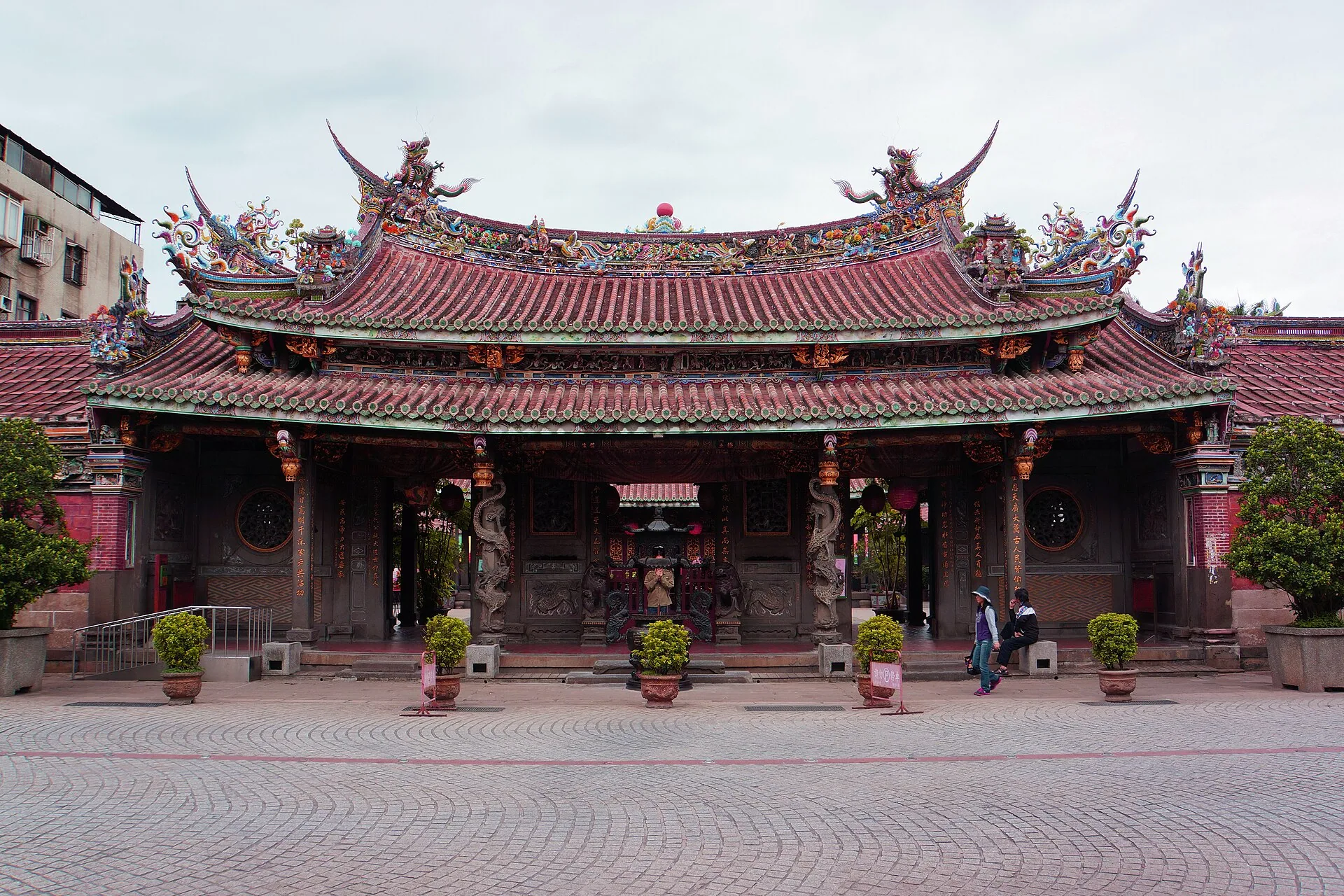
Front facade of Dalongdong Baoan Temple. Photo: Tianmu peter via panoramio, CC BY 3.0 via Wikimedia.
Seven in the Morning, Tai Chi in the Plaza Before Baoan Temple
Exit MRT Yuanshan Station from Exit 2, cross Kulun Street, turn left, and in five minutes you reach the plaza in front of Baoan Temple.
At seven in the morning, this plaza belongs to uncles and aunties. A dozen people form a circle to practice tai chi, while elementary school students from Dalong Elementary pass by with backpacks. The children do not look at the temple. Their eyes stop at the wall by the school gate, a wall built in 1933, with arcades and terrazzo stairs1. But their school began in 1896. That year, the Japanese established the “Third Affiliated School of the Japanese Language School” inside Baoan Temple; school and temple shared a courtyard until 1933, when the school moved into the neighboring campus1.
In other words, the schoolchildren walking past the temple today, backpacks on their shoulders, are walking the same road as the schoolchildren who studied the Japanese fifty-sound syllabary behind Baoan Temple 130 years ago.
Four people are worshiping at the incense burner on the east side of the temple plaza. One elderly grandmother holds three incense sticks in one hand and steadies herself with a cane in the other, waiting for her turn. She is worshiping Baosheng Dadi. This deity was a man from Tong'an in the Northern Song dynasty, originally named Wu Ben (pronounced “Tao”), born in 979 and deceased in 1036; during his lifetime he was skilled in medicine and saved lives2. When Tong'an migrants crossed the sea to Taiwan, they brought this belief with them. In 1742, the seventh year of the Qianlong reign of the Qing dynasty, people from Tong'an in Quanzhou brought a branch spirit of Baosheng Dadi from Baijiao Ciji Temple in Longhai, Zhangzhou, Fujian, and built a simple wooden temple at Daronpon3. That was the embryo of a “temple,” and Baosheng Dadi had arrived.
The main hall would take another 88 years to take shape. Only in 1830, the tenth year of the Daoguang reign, was the temple formally completed3.
On the wall beside the temple are more than two hundred years of cut-and-paste ceramic decoration. Brick-red and emerald-green glass fragments form the Eight Immortals, dragons and phoenixes, and flowers; painted dougong brackets sit below. Before 1995, these ceramic pieces were peeling away, the paintings had faded, and termites had entered the beams and columns4. In 1985, the government designated Baoan Temple a second-grade historic site, but after designation, no one restored it.
📝 Curator’s note: The historical axis of Dalongdong is especially clear because three spaces of faith stand within 1.5 kilometers of one another: Baoan Temple to the south (1742-1830), worshiping Baosheng Dadi, the medical deity of Tong'an migrants; Taipei Confucius Temple 300 meters farther north (1925-1939), worshiping Confucius, the shared figure of Han Chinese literati; and, another kilometer north across the Keelung River, the Grand Hotel Taipei (1952-1973), with the red tiles and yellow eaves of the Nationalist government’s reception site for foreign guests. Three eras, three “orthodoxies,” on a single axis. Other historic districts in Taipei, such as Bangka, Dadaocheng, and Ximending, also have layers, but rarely are three layers still in their original places in this way. Bangka Longshan Temple, founded in 1738, is a single Qing-period focal point; Dadaocheng, from 1885, is a major commercial center under Japanese rule; Ximending, from 1908, is a Japanese-era entertainment district. Only along the Dalongdong-Yuanshan axis do three layers remain before your eyes: Qing rule, what the Japanese period demolished, and what the postwar party-state built.
Not Just 300 Years: Digging Five Thousand Years Down
Walk north from Baoan Temple, pass Jiuquan Street and Kulun Street, and you will see Taipei Expo Park. On the eastern half of the park is an inconspicuous patch of grass. Beneath it lies the Yuanshan Archaeological Site.
The site was discovered on March 7, 1897, by the Japanese scholars Ino Kanori and Miyamura Eiichi5. From 1953 to 1954, Shih Chang-ju, a professor in National Taiwan University’s Department of Archaeology, led faculty and students in a systematic excavation on the northwestern foothills of Yuanshan5. The excavated material broadly divides into two layers: the lower layer is Corded Ware culture, dating to 6,500-4,500 years before present; above it is Yuanshan culture, dating to 4,500-2,500 years before present56.
The most prominent feature of Yuanshan culture is its shell midden. The soil layers contain large quantities of discarded edible shells, animal bones, fish bones, pottery, stone tools, and bone and antler implements6. The main shellfish species are large clams, river snails, Stenomelania snails, oysters, top shells, and Nassariidae snails. The first three are freshwater shellfish; the latter three are saltwater shellfish6.
What does this mean? It means that Neolithic Yuanshan people could gather both freshwater and saltwater shellfish. At the time, the Taipei Basin was still a brackish lake, the ancient Taipei Lake, and Yuanshan was a small island in it. They cultivated rice, kept domestic animals, hunted, fished, and lived in a settlement with “a rigorous social organization and a symbolic belief system of agricultural ritual”6.
On April 25, 1988, the Ministry of the Interior announced Yuanshan as a national first-grade historic site6. It was Taiwan’s earliest designated prehistoric site, and also “the beginning of archaeology in Taiwan”7. On May 1, 2006, its status was changed to a national archaeological site6.
💡 Did you know: The “shells” in the Yuanshan shell midden were not merely food waste. After Neolithic Taipei residents ate the shellfish meat, they used the shells as building material for paving floors, building walls, and burial equipment; some bone and antler implements, such as fishhooks, needles, and spearheads, were also ground from animal bones. In other words, they did not waste material. The grass where we walk dogs today in Taipei Expo Park has, 50 centimeters below the surface, the kitchen waste and tools left by these people: a human settlement from 5,000 years ago.
Continue north from the Yuanshan Archaeological Site and you will see Jiantan Mountain. In legends from the 1660s, Koxinga’s army passed through the area and encountered a monster that stirred up wind and waves; Koxinga threw a treasured sword into the water to subdue it8. The 1732 Taiwan Zhilüe, compiled in the tenth year of the Yongzheng reign, records another version: on the bank of Jiantan stood a tall bishop wood tree, and “it is said that the Dutch inserted a sword into the tree; the bark grew over it, enclosing the sword within, and thus the place was named”9. The difference between the two versions is this: Koxinga’s sword was in the water; the Dutch sword was in the tree. Neither version has been confirmed by scholars, but the name “Jiantan,” literally “Sword Pond,” has remained part of Taipei’s landscape into 2026.
From Daronpon to Dalongdong: A Place Name in Four Layers
Before the three characters “Dalongdong” appeared, this land had other names.
The earliest records are Dutch-period documents from 1645 to 1655. At the time, the Ketagalan people, specifically a Basay-speaking group, had a settlement called “Daronpon,” also written Paronpon and Parongpom10. After Han Chinese settlers arrived, they transliterated the sound into Hokkien as “Dalongbeng,” also written “Balangbeng”1011.
In 1709, the 48th year of the Kangxi reign of the Qing dynasty, five Quanzhou investors, Chen Fengchun, Lai Yonghe, Chen Tianzhang, Chen Xianbo, and Dai Tianshu, jointly applied to Zhuluo County to open cultivation in Dajiala12. The “Chen-Lai-Zhang” reclamation enterprise received an official cultivation permit12. Its permitted territory extended from today’s southern Wanhua to Dalongdong, and from Guandu to Xinzhuang, covering more than half of the Taipei Basin12. Han Chinese settlers gradually entered Daronpon11.
In 1742, the seventh year of the Qianlong reign, Tong'an migrants built Baoan Temple in rudimentary form at Daronpon3.
In 1802, the seventh year of the Jiaqing reign, six households from Tong'an in Quanzhou, including Wang Yuanji, Wang Zhiji, Chen Lanji, Chen Shengji, Gao Mingde, and Zheng Xiyuan, opened 44 tiled shops here11. Each shop was one zhang and eight chi wide and nineteen zhang deep, arranged into a street in the “one-dragon with drainage alley” layout13. The street was commonly called the “Forty-four Kan,” with kan meaning “shopfront” in Taiwanese. These six households decided to rename the place “Dalongtong,” a near-homophone of “xinglong Tong'an,” or “flourishing Tong'an”1114.
“Dalongtong” was used for more than 50 years. By the Daoguang and Tongzhi reigns of the Qing dynasty, from 1820 to 1870, more local residents were taking the imperial examinations. Because locals “regarded scholars as dragons,” and because the nearby Yuanshan hill rose abruptly from the plain “like a dragon,” forming a “dragon lair,” “Dalongtong” was changed to “Dalongdong”1115.
Four layers of place names: Daronpon (Basay) → Dalongbeng (Hokkien transliteration) → Dalongtong (after Tong'an migrants settled) → Dalongdong (after the rise of local scholars).
The last name has remained in use to this day. In 1990, when Taipei City redrew its administrative districts, this area was placed in Datong District; across the Keelung River it belongs to Zhongshan District. The district name “Datong” comes directly from “xinglong Tong'an.”
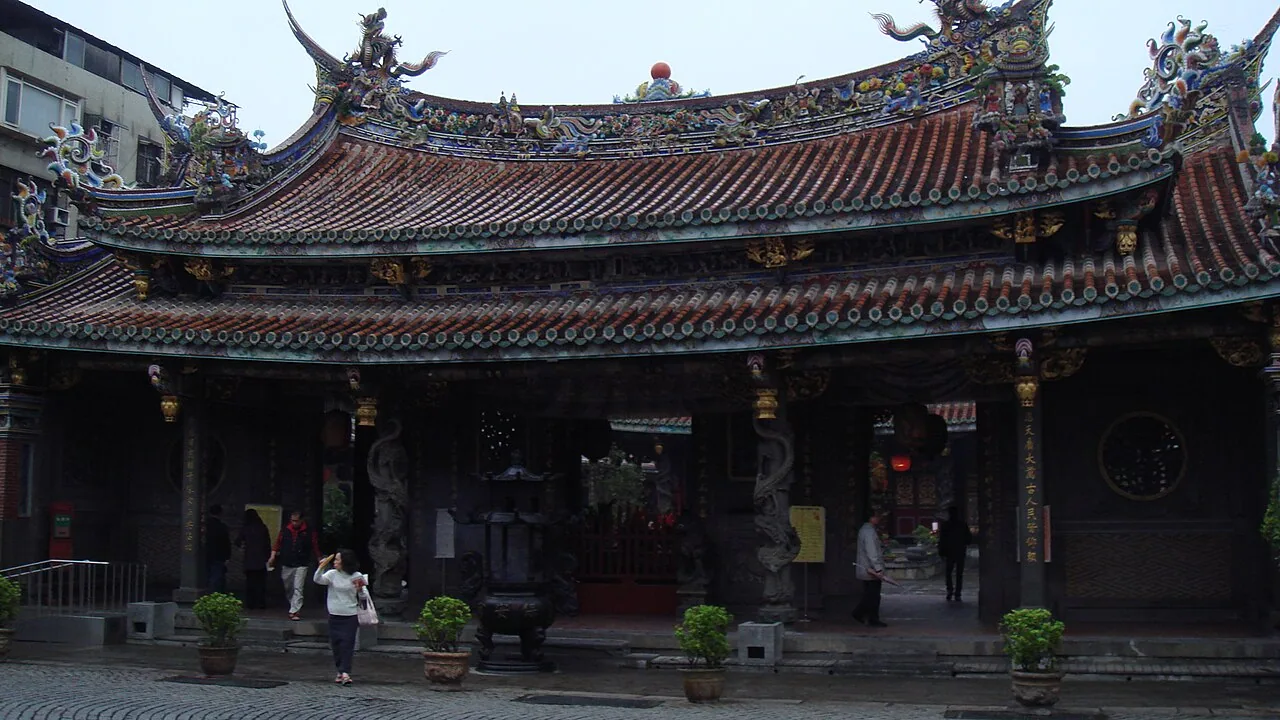
Baoan Temple mountain gate. Photo: Outlookxp, CC BY-SA 4.0 via Wikimedia.
1853: The First Stop for Defeated Tong'an Migrants Was Not Dadaocheng
In 1853, the third year of the Xianfeng reign of the Qing dynasty, the Ding-Xia feud broke out in Bangka. The “Ding,” or upper, guilds, composed mainly of people from the three Quanzhou counties of Jinjiang, Nan'an, and Hui'an, fought a major armed conflict against the “Xia,” or lower, guilds, also called the Xiamen guilds, composed mainly of Tong'an migrants from Quanzhou16. The Sanyi people used Qingshui Zushi Temple as a passageway and set fire to Bajiazhuang, where Tong'an migrants lived. The Tong'an migrants were defeated and retreated.
The standard historical narrative says: “The defeated Tong'an migrants were led by Lin Youzao and fled to Dadaocheng, where they opened a new commercial port”16.
But one stop is missing.
The Wikipedia entry on “Dalongdong” records: “The defeated Xia-guild Tong'an migrants retreated to Dalongdong, using Baoan Temple as their defensive center, and later migrated to Dadaocheng”11. In other words, after the 1853 defeat, the first stop for Tong'an migrants leaving Bangka was Dalongdong; Dadaocheng came later. They first hid in Baoan Temple, built in rudimentary form in 1742 by Tong'an migrants who had come to Taiwan earlier, used it as a defensive center, and then moved south from Dalongdong, across Datong District, to Zhong Street in Dadaocheng1116.
This route is entirely reasonable geographically: walking north from Bangka, crossing the upper Tamsui River, and skirting Taipei Prefecture City brings you to Dalongdong. Their fellow townspeople were there, and Baoan Temple’s Baosheng Dadi was the deity of Tong'an migrants. The temple had already existed for 111 years before the Ding-Xia feud. For the Tong'an migrants retreating in 1853, Baoan Temple played a role beyond that of an ordinary temple: it was a concrete refuge for people from the same native place.
The Tong'an migrants later carried the statue of Xia-Hai City God southward and settled on Zhong Street in Dadaocheng16. On March 18, 1859, the ninth year of Xianfeng, Taipei Xia-Hai City God Temple was completed in Dadaocheng16. From Bajiazhuang in Bangka to Dalongdong Baoan Temple, and then to Dihua Street in Dadaocheng, this road traces the six-year trajectory of Tong'an migrants after 1853.
📝 Curator’s note: The same group left traces in three Taipei settlements: Bajiazhuang in Bangka, their base before 1853; Dalongdong Baoan Temple, the first stop after defeat; and Dadaocheng, their final foothold. The three places meant different things to Tong'an migrants: Bangka was the “lost home,” Dalongdong the “refuge of fellow townspeople,” and Dadaocheng the “commercial stronghold where they began again.” Walking through these three places today, one can see the different bodily postures left by the same group at different stages: Bangka Qingshan Temple says “we were here all along”; Baoan Temple says “we have always been here”; Xia-Hai City God Temple says “we fled from there to here.”
A Xiucai Every Five Steps, a Juren Every Ten: Chen Wei-ying and His Teacher’s Mansion
Walk 500 meters east from Baoan Temple, pass Hami Street, and reach Section 4 of Yanping North Road. There you will see a gray-white Minnan-style old house: the Chen Yueji Ancestral Residence, commonly called the “Teacher’s Mansion”17.
This old house was first built in 1807, the twelfth year of Jiaqing1718, and renovated in the early Xianfeng period. It consists of two large compounds, one four-entry and one three-entry, placed side by side: the ancestral hall and the public residence hall17. It is the largest surviving Minnan-style old residence in Taipei City18. The family that built it came from Zhangzhou, Fujian, later moved to Tong'an, and in 1770, the 35th year of Qianlong, Chen Xunyan settled in Dalongdong17.
The Chen family had a son named Chen Wei-ying (1811-1869)19.
In 1859, the ninth year of Xianfeng, Chen Wei-ying passed the provincial examination and became a juren19. He was Dalongdong’s most famous juren, but what truly made the locality proud was something else: he turned the juren’s home into an academy. Chen Wei-ying once served as education instructor in Min County and as head of Bangka’s Xuehai Academy and Yilan’s Yangshan Academy19. Local people honored him as “Teacher” and called his home the “Teacher’s Mansion”17. Later generations praised him as the “Literary Patriarch of Northern Taiwan”20.
The Chen family produced three juren in succession18. Chen Wei-ying built three pairs of stone flagpoles in the front courtyard, with coiling dragons above and climbing lions below. This “coiling dragon above, climbing lion below” form symbolized “advancing still further after reaching the top of a hundred-foot pole”18. As of 2026, only one of the three pairs of stone flagpoles remains intact; it is Taiwan’s only surviving “coiling dragon above, climbing lion below” stone pole18.
That Dalongdong became “the most scholarly place in all Taipei” was Chen Wei-ying’s achievement. In 1853, the third year of Xianfeng, he founded Shuren Academy inside Baoan Temple and taught there himself21. Many students of the academy passed the examinations, and the local literary culture flourished, earning the praise “a xiucai every five steps, a juren every ten”1115: walk five steps and you meet a county-level licentiate; walk ten steps and you meet a provincial graduate.
In 1862, the first year of Tongzhi, the Dai Chaochun incident broke out. Chen Wei-ying spent his own money to organize militia forces to help the authorities and was therefore awarded the right to wear a peacock-feather plume19. After the incident was pacified, he built a retreat on the left bank of Jiantan, today’s Yuanshan, called “Taigu Nest.” This retreat stood near the hilltop where the Grand Hotel Taipei would later be located2223. At Taigu Nest, Chen Wei-ying wrote poems and couplets, later collected by others as Records of Stolen Leisure and Collected Couplets from Taigu Nest1920.
On October 9, 1869, the eighth year of Tongzhi, Chen Wei-ying died of illness19. But the name “Teacher’s Mansion” did not end on the streets of Dalongdong.
Shuren Academy later moved out of Baoan Temple in 1928, because “local residents felt that an academy should not be attached to a temple”21. It was independently rebuilt as Wenchang Shrine, completed in 193224, and remains today in an alley on Hami Street.
In 1896, 27 years after Chen Wei-ying’s death, the Japanese established the Third Affiliated School of the Japanese Language School inside Baoan Temple, the predecessor of Dalong Elementary School1. One temple housed two schools in succession: after Shuren Academy in 1853 came the Japanese-language school in 1896. In the same courtyard, the earlier students wore long gowns and worshiped Wenchang; the later students wore caps and studied the Japanese syllabary.
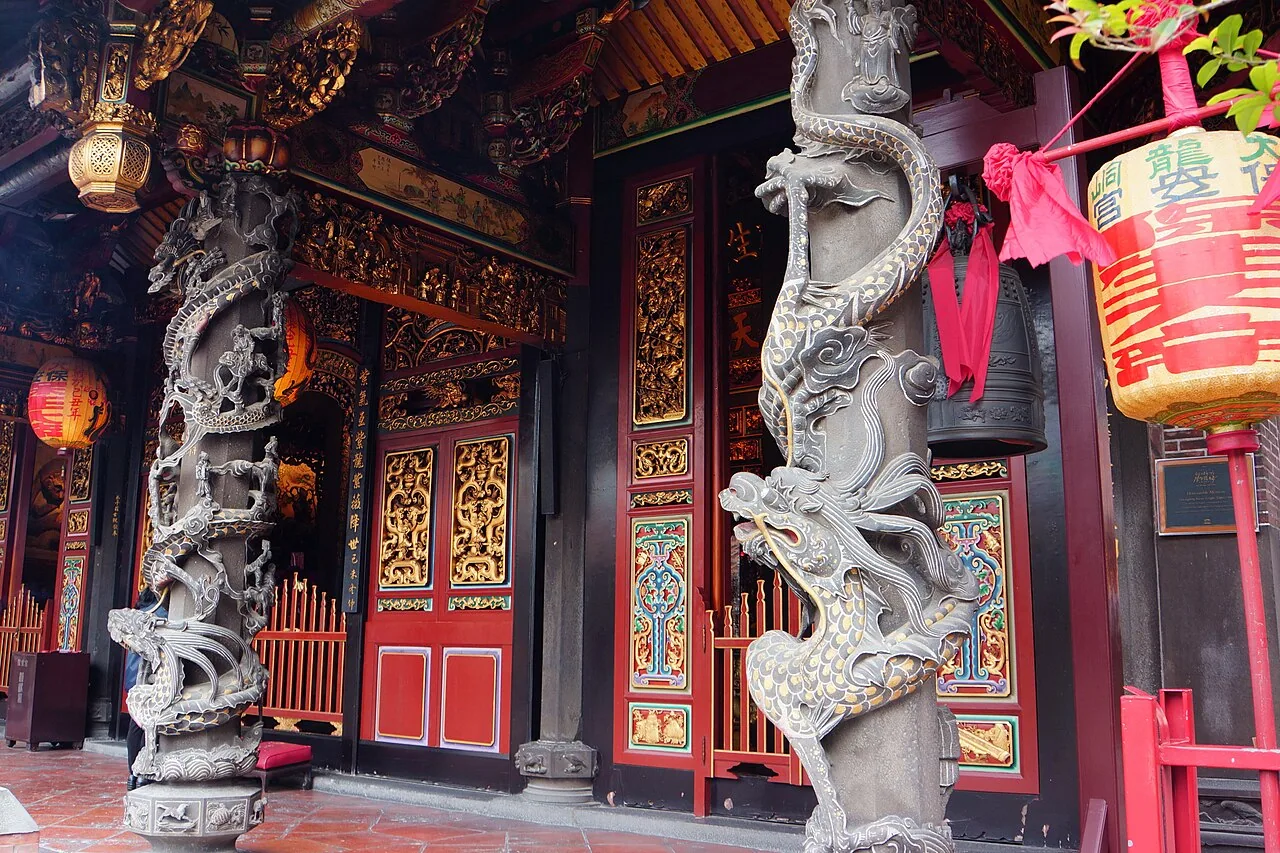
Baoan Temple coiling-dragon stone columns. Photo: panoramio contributor, CC BY 3.0 via Wikimedia.
The 1917 Duichangzuo: Two Carpenters Compete, Their Taunts Carved into Wood
In 1917, the sixth year of the Taishō era, Baoan Temple was renovated.
The temple invited two of the most famous carpenters of the time: Chen Ying-bin, a master of the Zhangzhou school, and Guo Ta, a woodcarver from Guoxing Street in Banqiao. They agreed to divide the central axis between them: on the temple facade, the dragon side and tiger side would be assigned separately, with Chen Ying-bin taking the dragon side and Guo Ta the tiger side. They also agreed on a shared theme: “The Eight Immortals Make Havoc in the Eastern Sea”25.
This practice, in which two master craftsmen worked simultaneously while tacitly competing with each other, is called duichangzuo, or “matched-site work,” in Taiwan’s traditional architecture2526. After completion, the details left by the craftsmen became clues for later generations to identify “who made which side.”
Chen Ying-bin won through the delicacy of his carving, and the temple authorities judged him the winner. Guo Ta was unconvinced. On the woodcarving of the tiger side, he carved several taunting phrases:
“A fake lion defeats a real lion” (carved on a dougong bracket)
“Made by Guo Ta, carpenter of Guoxing Street” (signed on the circular-frame carving on the tiger side)
“True craftsmanship needs no alteration” (signed)
“Good workmanship needs no patching or splicing” (on the circular-frame carving)2526
The meaning is roughly: real skill requires no post-production, and a good craftsperson does not need to splice pieces together. These were remarks left after he was judged the loser. They can still be seen at Baoan Temple today and serve as physical evidence for identifying the outcome of the duichangzuo competition25.
The murals along the corridor outside the main hall were added later. In 1973, the temple hired the Tainan painting master Pan Li-shui (1914-1995) to paint seven large murals27. Their themes include “Han Xin Endures Humiliation by Crawling Between the Legs,” “The Eight Hammers Battle Lu Wenlong at Zhuxian Town,” “Zhong Kui Welcomes His Sister Back to Her Natal Home,” “The Eight Immortals Make Havoc in the Eastern Sea,” “Hua Mulan Joins the Army in Her Father’s Place,” “Three Battles with Lü Bu at Hulao Pass,” and “The Worthy Mother Xu”27. A 1917 woodcarving contest plus 1973 painted narratives: in one temple, Baoan Temple layers two eras of craft.
The octagonal coiling-dragon stone columns before the hall date to the Jiaqing reign, 1796-1820, and are the earliest surviving stone carvings in the temple3. The column bodies coil upward from the base, with eight-sided relief carvings of cloud patterns, dragon claws, and dragon whiskers. Looking down from the column tops, one can read the design by which the stone carvers arranged motifs according to the eight trigrams.
The 36 guardian-general statues on the two sides of the temple were commissioned in 1829, the ninth year of Daoguang, when the temple invited the Quanzhou master Xu Yan to Taiwan. The carvings took five years to complete28. In other words, in 1829, Tong'an migrants spent five years and invited a Quanzhou master across the sea so that divine generals could guard the temple.
1907: When the Japanese Demolished the Confucius Temple, Confucius Had Nowhere to Live
In 1879, the fifth year of Guangxu, Chen Xingju, the first prefect of Taipei Prefecture, used “remaining materials and leftover funds” to build a joint civil and martial temple inside the south gate of Taipei Prefecture City, near today’s Taipei First Girls High School and National Taipei University of Education29. The Confucian temple stood on the left, the martial temple on the right. In 1884, the tenth year of Guangxu, the original Taipei Prefectural School Confucius Temple was completed29.
But this Confucius Temple lived only 23 years.
In 1907, the Japanese colonial authorities demolished the original Confucius Temple and established the Taiwan Governor-General’s Japanese Language School on the site, later Taipei Normal School and now National Taipei University of Education3031. In 1925, across from that site, they also built Taihoku Prefectural First Girls’ High School, today’s Taipei First Girls High School30.
Confucius had lost his home.
In 1925, Taipei’s local gentry gathered in Yongle-cho, Dadaocheng, to discuss what should be done about Confucius. Should the temple be rebuilt? Where should it be built?3031
The poet Chen Peigen of the Chen Yueji family, a descendant of Chen Wei-ying, stepped forward and said: “If it is rebuilt in Dalongdong, I am willing to donate private land”31. Chen Peigen donated more than 2,000 ping30.
Beyond Chen Peigen, there was another important land donor: Koo Hsien-jung, of the Koo family of Lukang and father of Koo Chen-fu. Koo Hsien-jung purchased additional land and donated more than 1,000 ping3031. Chen Peigen plus Koo Hsien-jung, more than 3,000 ping in all, became the site of today’s Taipei Confucius Temple.
Construction began in 192731. The work on Dacheng Hall, the core building of the Confucius Temple, was undertaken by Wang Jinmu of the Xidi school31. The Xidi school was a carpentry lineage from Hui'an, Quanzhou, and one of the most important traditions of large-scale temple carpentry in Taiwan at the time. Dacheng Hall was completed in 192931. Other parts of the Confucius Temple, including Lingxing Gate, Li Gate, Yi Road, and the Wanren Palace Wall, were built slowly. Only in 1939, the fourteenth year of Shōwa, was the whole complex completed31.
In other words: 1907, the original Confucius Temple demolished; 1925, rebuilding discussed; 1927, construction begun; 1929, Dacheng Hall completed; 1939, the whole complex completed. After a gap of 32 years, Confucius finally had a home again in Dalongdong.
After the war, in 1971, the Taipei City Government established the Taipei Confucius Temple Governing Board31. The “Improvements to the Ritual Music for Sacrifices to Confucius” plan, formulated in September 1970, stipulated: “The spring sacrifice shall be a private ritual; the autumn sacrifice, the ceremony marking Confucius’s birthday, shall be government-sponsored”31.
Today, every year on September 28, Teachers’ Day and Confucius’s birthday, the Taipei Confucius Temple holds the Shidian ceremony at the mao hour before dawn32. The eight-row yi dance is performed by sixth-grade students from Dalong Elementary School33. There are 8 rows and 8 columns, 64 students in all, including both boys and girls, wearing yellow robes with dark-green belts and black boots33. The entire ritual follows ancient forms: no firecrackers, no theater, no burning of paper money32.
From Chen Xingju building Taipei’s first Confucius Temple in 1879, to its demolition by the Japanese in 1907, to Chen Peigen and Koo Hsien-jung donating land for reconstruction in 1925, to full completion in 1939, to municipal takeover in 1971, and to sixth-graders from Dalong Elementary dancing the eight-row yi dance in 2026: one temple took 147 years to traverse the axis from empire to Japanese rule to the postwar period to the contemporary city.
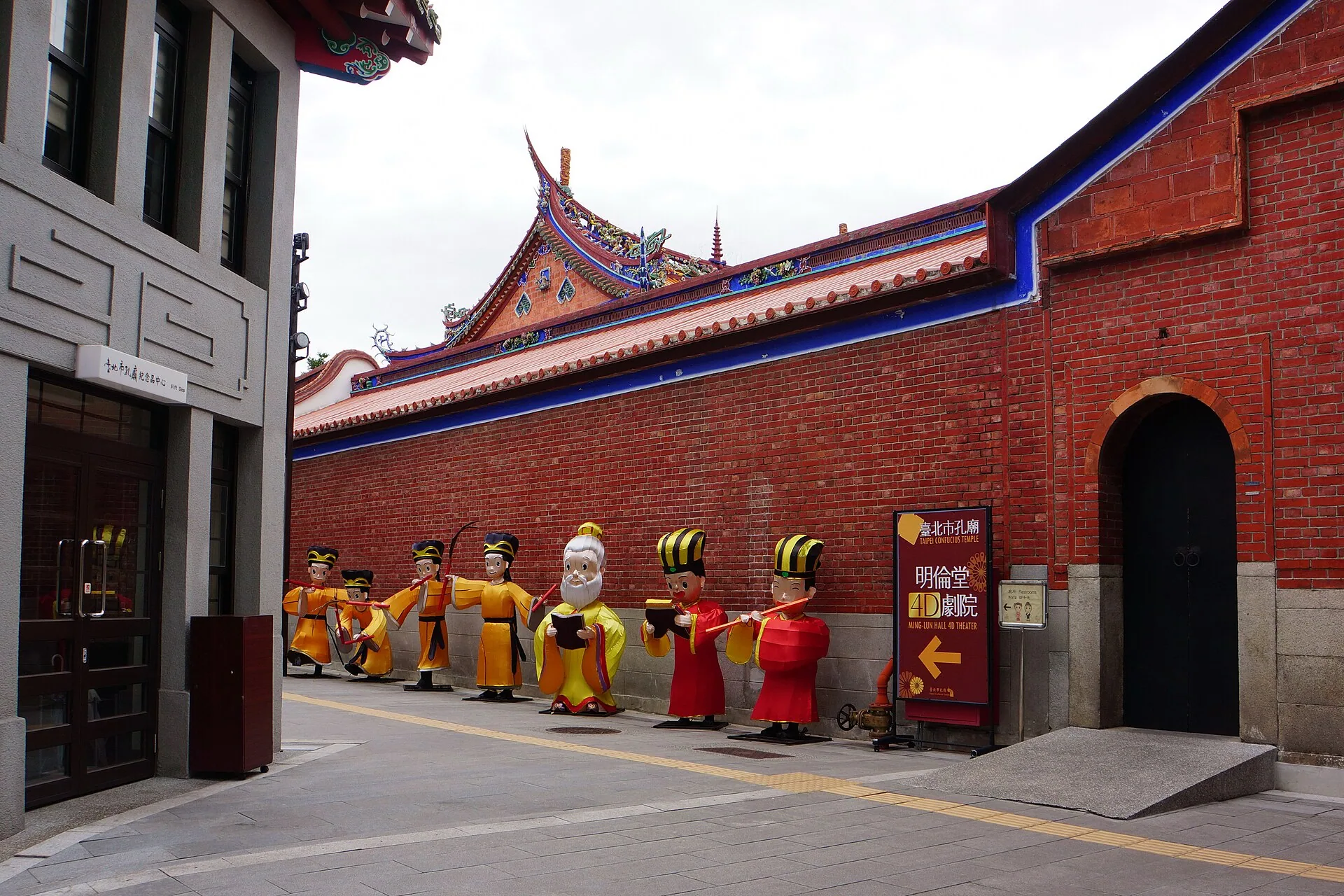
Taipei Confucius Temple. Photo: panoramio contributor, CC BY 3.0 via Wikimedia.
The Afternoon When a Plane Crashed into the Shrine
Walk 700 meters north from Taipei Confucius Temple, cross the Keelung River, and you reach Yuanshan.
In 1900, the 33rd year of Meiji, the Japanese began building Taiwan Shrine on this small hill34. It was completed in October 1901, the 34th year of Meiji34. The main deity enshrined there was Prince Kitashirakawa Yoshihisa, who died in Taiwan34. In 1895, when the Japanese army took control of Taiwan, Prince Yoshihisa commanded the Guards Division and died of illness in Tainan34. To commemorate him, the Japanese built Taiwan Shrine at the rank of kanpei-taisha, an imperial shrine of the highest class34. It was the only shrine of that rank in Taiwan34.
Sections 1, 2, and 3 of Zhongshan North Road in front of the shrine formed the “Chokushi Road,” an official road built by the Japanese colonial authorities beginning in 1898 for visits to the shrine35. It was completed as a tree-lined boulevard in 192935.
In 1943-1944, Taiwan Shrine was expanded, Amaterasu Ōmikami was added for worship, and the shrine was elevated to the status of Jingū34.
On the afternoon of October 25, 1944, the nineteenth year of Shōwa, a Japanese passenger plane crashed into Taiwan Jingū while landing at Songshan Airport34. It was the final stage of World War II, and the Japanese government no longer had the capacity to repair it. The shrine burned down in this way3436.
After the war, the Nationalist government took over Taiwan in 1945. Lacking luxurious state guest facilities, it removed the shrine remains and converted the site into the Taiwan Grand Hotel37. On May 10, 1952, the Taiwan Goodwill Association Foundation, led by Soong Mei-ling, took over operations and renamed it the Grand Hotel Taipei37. Its first general manager was Kung Ling-wei, also known as Miss Kung the Second, Soong Mei-ling’s niece37.
The first foreign head of state received there was King Bhumibol of Thailand, together with Queen Sirikit38.
On October 10, 1973, Double Ten National Day, the 14-story Chinese palace-style building designed by architect Yang Cho-cheng was completed37. It had 14 floors, golden glazed tiles, red corridor columns, and covered the entire western hilltop of Jiantan Mountain. Seen from Zhongshan North Road, the whole building resembles a miniature version of the Hall of Supreme Harmony in the Forbidden City38.
Yang Cho-cheng’s major works, in addition to the Grand Hotel Taipei, include Chiang Kai-shek Memorial Hall, the National Concert Hall, the National Theater, and the Cihu Mausoleum39. These four, together with the Grand Hotel Taipei, form the five-piece set of Chinese palace-style architecture that Yang left in Taipei, all completed in the 1970s and 1980s under the patronage of Chiang Kai-shek and Soong Mei-ling39.
⚠️ Contested view: The Grand Hotel Taipei stands on the original site of Taiwan Jingū, destroyed by an airplane crash in 1944. On the same hilltop, the Japanese first built a kanpei-taisha to commemorate a prince who died during the conquest of Taiwan; after the war it became the red-tiled, yellow-eaved “Chinese palace-style” venue where the Nationalist government received foreign guests. Two architectural languages, two eras of ritual power, layered on the same land. On the morning of June 27, 1995, a fire broke out on the roof of the Grand Hotel’s 12th floor, caused by careless welding during glazed-tile work40. It burned for four hours. Fortunately, there were no casualties, and the building’s structure was not damaged40. A shrine that had only just been destroyed by an airplane in 1944; a new building completed in 1973; another fire in 1995. The same land, two fires, in 1944 and 1995, each tied to the rituals of political power.
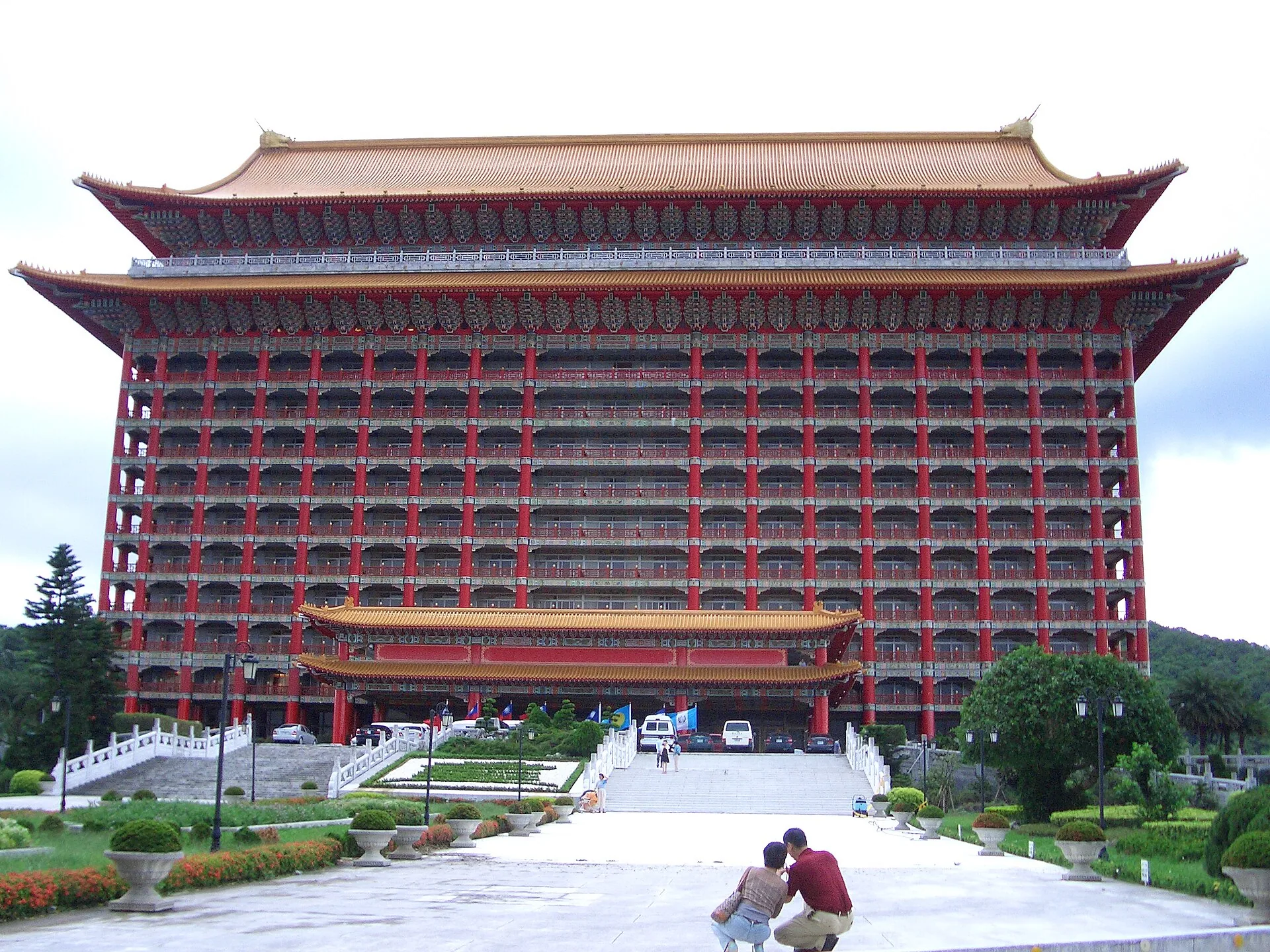
Grand Hotel Taipei. Photo: shennongtw, Public domain via Wikimedia.
1995: Liao Wu-chih Refuses Government Subsidies to Restore the Temple, Producing Taiwan’s First UNESCO Asia-Pacific Heritage Award Site
From the Grand Hotel Taipei, turn back south, descend the hill, cross the Keelung River and Jiuquan Street, and you return to Baoan Temple.
In 1994, Liao Wu-chih became vice chair of Baoan Temple41. He had worshiped at Baoan Temple for decades, but this time he was going to do what an “alternative temple steward” would do4: in 1995, he presided over the comprehensive restoration of Baoan Temple41.
Liao Wu-chih decided to give up government historic-site subsidies.
“To avoid being constrained by the government’s outdated systems and to achieve the best results, Baoan Temple decided to forgo government subsidies, raise funds on its own, and conduct and supervise the restoration itself”41. This became Taiwan’s first case of privately funded, privately led restoration of a historic site41.
The “outdated government systems” referred to the bidding rules for historic-site projects at the time: they had to follow public-works standards, choose the lowest bidder, and use ordinary construction schedules4. But the restoration of a traditional temple is not ordinary construction. Cut-and-paste ceramic work requires masters who understand that craft; painted decoration requires painters who understand temple painting; large timber framing requires descendants of the Xidi or Zhangzhou schools4. If public-works standards were followed, the contractor might not understand temple craft, and the repaired temple might become a “wrongly repaired” temple4.
Liao Wu-chih’s choice was this: he would rather spend seven years restoring the temple slowly, using NT$260 million of temple funds41, than fail to restore every piece of cut-and-paste work, every dougong bracket, and every painting correctly.
Seven years. NT$260 million. In early 2002, the Sanchuan Hall, eastern guard room, western guard room, rear hall, and main hall were completed in succession3. On June 30, 2003, the temple held an “settling the dragons and thanking the earth” ceremony3, a traditional ritual celebrating the completion of restoration.
That same year, 2003, UNESCO awarded Baoan Temple an Honourable Mention in the Asia-Pacific Awards for Cultural Heritage Conservation441. It was Taiwan’s first UNESCO Asia-Pacific Heritage Award4. The jury statement described it as “A model for community-based restoration”4.
Liao Wu-chih later became chair of Baoan Temple41. Today, every year on the fifteenth day of the third lunar month, the birthday of Baosheng Dadi, the temple holds the Baosheng Cultural Festival42. In 2021, the “Baoan Temple Baosheng Dadi Birthday Celebration” was registered as a cultural asset in the folk-custom category3. Baosheng Dadi’s procession is “one of Taipei’s three major temple festivals”3. During the festival, rituals include processions, fire-walking, and the burning of fire lions in the temple plaza42.
📝 Curator’s note: Liao Wu-chih’s choice had two meanings. The first was an insistence on craft quality: he would rather refuse government subsidies than fail to find the right masters for the right parts of the restoration. The second was the possibility of civic autonomy: Baoan Temple’s NT$260 million restoration budget came entirely from devotees’ donations, proving that Taiwan’s civil society has the ability to independently support historic preservation. UNESCO’s 2003 jury phrase, “a model for community-based restoration,” marked the first time an international organization recognized that the ecosystem formed by Taiwan’s temple culture, devotee networks, and craft transmission could sustain the continuity of a two-hundred-year-old temple. This model was later referenced by other historic sites in Taiwan, but few temples could replicate it. What made Liao Wu-chih distinctive was that his determination found in Dalongdong a community with the depth to sustain it.
The 1972 Wanda Plan: The Forty-four Kan Cut in Half
On June 10, 1972, the 61st year of the Republic of China calendar, Taipei City was upgraded to a special municipality43. The city government began implementing the Wanda Plan, with a budget of NT$300 million over two years, aiming to improve the old districts from Bangka to Dalongdong43.
In 1973-1974, the city government widened Hami Street and Jiuquan Street, extended Chengde Road, and widened and straightened Lanzhou Street into today’s Dalong Street43.
The Forty-four Kan stood on Hami Street43. Old aerial photographs from 1973 show that when the Wanda Plan widened Hami Street, the first entry of the shop-houses on the southern side of the Forty-four Kan was partially demolished43. In other words, the 44 tiled shops opened in 1802 by Wang Yuanji and the other five households, Dalongdong’s earliest street, were cut in half by the city government.
Which half was cut? The first entry of the southern shop-houses. The tiled shops’ one-dragon layout consisted of “shopfront → drainage alley → rear building.” The southern shopfronts were demolished, leaving only the rear half and part of the drainage alley43.
A 170-year-old street was left less than half intact.
Walking on Hami Street today, what can be seen as the “old-street appearance of the Forty-four Kan” is in fact a mixture: some walls are from the old tiled shops of 1802; some storefronts were rebuilt after the 1973 widening; some parts were renovated in the 1980s and 1990s. The 2025 project “Spatial Reconstruction of the Dalongdong Forty-four Kan Street,” conducted by the Research Center for Humanities and Social Sciences Center for Geographic Information Science at Academia Sinica, seeks to reconstruct the historical layers of this street using GIS44.
Walk from Baoan Temple toward Hami Street and you pass Dalong Night Market45. The night market centers on the intersection of Dalong Street and Hami Street, with food stalls as its main feature: Guo Ji Chunky Pork Thick Soup, A-Ren Fried Rice, Black Tea House, which opened in 1981 and still sells a small black tea for NT$15 and a 1,000 c.c. largest size for only NT$25, Dingwang Soup Dumplings, and truffle fried rice at Yu no Zhan45. These shops have averaged 30 to 40 years in business. They are the stomach of an old community.
After the night market, walk toward the Confucius Temple and you pass the alley of Shuren Academy Wenchang Shrine, moved out of Baoan Temple in 1928 and completed in 19322124. After Dalong Elementary School, founded in 1896, with its campus completed in 19331, comes Taipei Confucius Temple.
This 1.5-kilometer axis, Baoan Temple → Shuren Academy Wenchang Shrine → Dalong Elementary School → Taipei Confucius Temple → Yuanshan Archaeological Site → Yuanshan Park → Grand Hotel Taipei, is Taipei’s most compressed slice of time:
- 5,300-year-old Neolithic Yuanshan shell midden
- Seventeenth-century Ketagalan Daronpon community
- 1742 Tong'an migrants build Baoan Temple in rudimentary form
- 1802 Forty-four Kan tiled shops
- 1807 Teacher’s Mansion
- 1830 Baoan Temple formally completed
- 1859 Chen Wei-ying passes the provincial examination
- 1879 First Taipei Confucius Temple, inside the city
- 1897 Yuanshan Park and the Yuanshan Archaeological Site discovered
- 1907 Japanese demolish the original Confucius Temple
- 1925-1939 New Dalongdong Confucius Temple
- 1944 Jingū destroyed by airplane crash
- 1952 Grand Hotel Taipei renamed
- 1972 Wanda Plan cuts into the Forty-four Kan
- 1973 Yang Cho-cheng’s 14-story palace-style building completed
- 1988 Yuanshan Archaeological Site listed as a first-grade historic site
- 1995-2003 Liao Wu-chih self-funds temple restoration and receives UNESCO award
Walking the full axis takes 30 minutes.
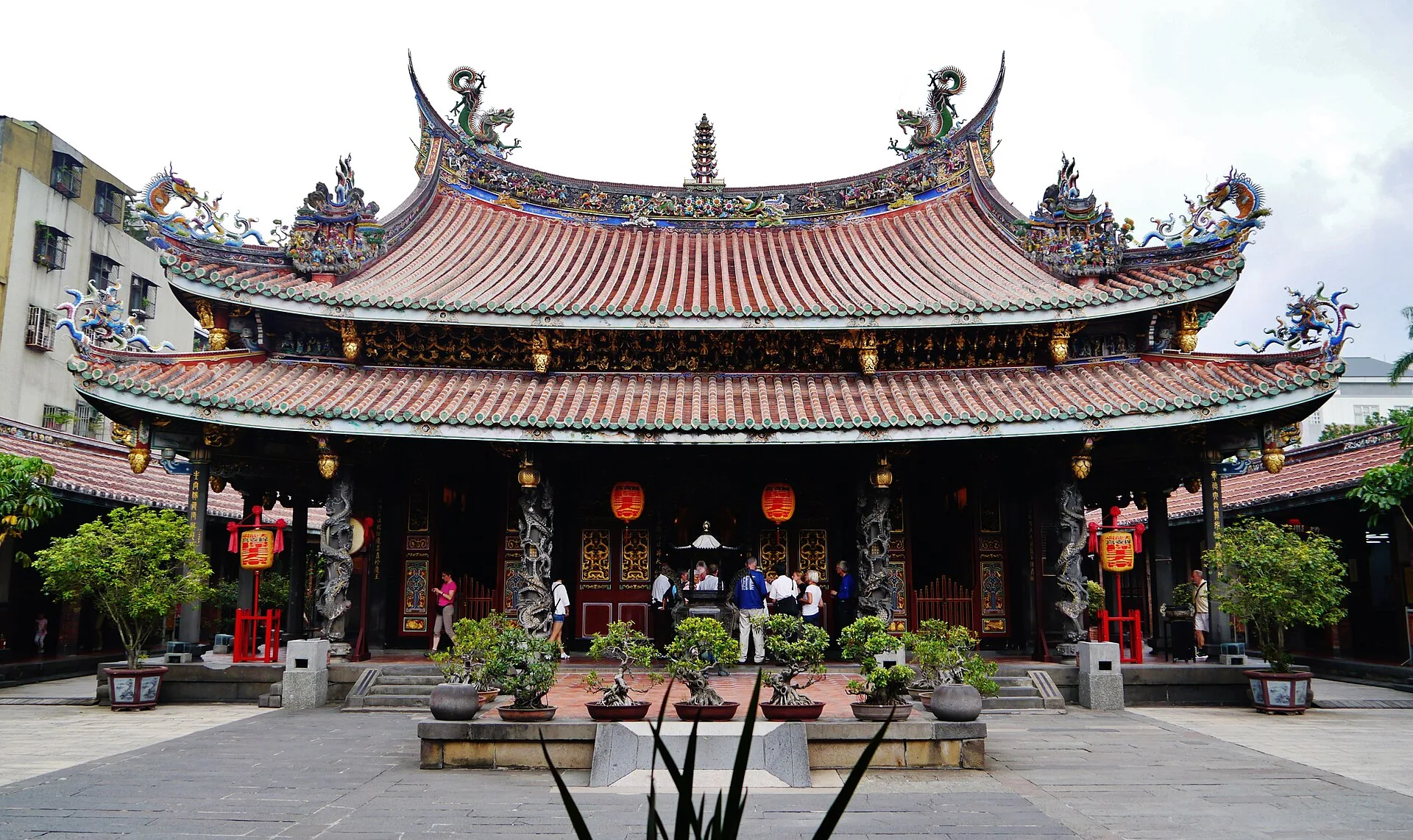
Baoan Temple main hall. Photo: Bgabel, CC BY-SA 4.0 via Wikimedia.
The Seven A.M. Tai Chi Is Still Going
Return to the plaza from the beginning.
At seven in the morning, the tai chi group in front of Baoan Temple is still practicing. A dozen uncles and aunties move as slowly as if time has been slowed down. Where they stand, beneath the ground, are the temple foundations built by Tong'an migrants in rudimentary form in 1742. Five meters farther down is the reclamation territory of the Chen-Lai-Zhang enterprise from 1709. Twenty meters farther down is the shell-midden layer left by Yuanshan people 5,300 years ago.
They do not think about this. They simply come here every morning at seven to practice tai chi. Afterward they go beside the temple to eat a bowl of pork thick soup or drink a cup of black tea from Black Tea House, the shop opened in 1981 that still sells a small cup for NT$1545, just like yesterday, just like the day before, just like before Liao Wu-chih decided in 1995 to restore the temple at his own expense, just like before Shuren Academy moved out of Baoan Temple in 1928, just like before Chen Wei-ying passed the provincial examination in 1859.
To the north, 1.5 kilometers away, the red tiles of the Grand Hotel Taipei reflect the morning light. Farther north across the Keelung River, the ridgeline of Jiantan Mountain slopes south. In between lies Taipei Expo Park, with the unexcavated parts of the Yuanshan shell midden still buried beneath it.
Seven hundred meters to the south, Dacheng Hall’s yellow tiles at Taipei Confucius Temple rest quietly in the shade. In a few months, before dawn on September 28 at the mao hour, 64 sixth-graders from Dalong Elementary School will stand in this courtyard and perform the eight-row yi dance, their movements as slow as those of Yuanshan people gathering shellfish 5,300 years ago.
At the incense burner on the east side of the temple plaza, three sticks of incense are burning. The smoke does not rise straight; the morning wind blows it crooked, drifting north. To the north is Jiantan Mountain: the hill where the Jingū burned down in 1944, where Yang Cho-cheng built a palace-style hotel in 1973, where Chen Wei-ying built Taigu Nest and wrote poetry in 1862, and where Yuanshan people lived 5,300 years ago.
The smoke drifts over and disperses on the hilltop.
Three eras of Taipei faith stand side by side along a 1.5-kilometer axis. They are neither sequential nor overwritten; they simply stand together. Beneath one’s feet lies Taipei’s most compressed slice of time.
Further reading:
- Taipei City — the full urban context of Dalongdong, from the Chen-Lai-Zhang reclamation enterprise of 1709 to a panoramic narrative of 2026
- Bangka — the earliest Qing-period district of Taipei, formed around Longshan Temple in 1738, and the other end of the 1853 Ding-Xia feud
- Dadaocheng — the final settlement of Tong'an migrants after 1853 and a major tea-trade center after 1860; a sister street to Dalongdong with the same origins but a different path
- Ximending — a 1908 Japanese-era entertainment district, contemporaneous with Dalongdong but a completely different urban experiment
- Taiwanese Religion and Temple Culture — the full context of Baoan Temple, Liao Wu-chih’s restoration, and the UNESCO award
- Shilin — the 1859 Zhangzhou-Quanzhou armed conflict and Dalongdong Tong'an migrants’ reception of refugees after the 1853 Ding-Xia feud as two landscapes of ethnic conflict in Qing-period northern Taiwan
Image Sources
This article uses six CC-licensed and public-domain images, all cached under public/article-images/geography/ to avoid hotlinking source servers:
- Dalongdong Baoan Temple panoramio — Photo: Tianmu peter via panoramio, 2010s, CC BY 3.0
- Gate of the Dalongdong Bao-an Temple 01 — Photo: Outlookxp, 2020s, CC BY-SA 4.0
- Baoan Temple Dragon Pillars panoramio — Photo: panoramio contributor, 2012, CC BY 3.0
- Taipeh Dalongdong Baoan Temple Haupthalle 1 — Photo: Bgabel, 2018, CC BY-SA 4.0
- Taipei Confucius Temple panoramio — Photo: panoramio contributor, 2014, CC BY 3.0
- R38577389977 Grand Hotel, Taipei — Photo: shennongtw, around 2017, Public domain
References
- Dalong Elementary School History — Dalong Elementary School was founded in 1896 (16 years before the Republic of China calendar), then called the “Third Affiliated School of the Japanese Language School” and located inside Baoan Temple; it was later renamed Dalongdong Public School. The current school building was completed in 1933 and registered in 2006 as a Taipei City historic building.↩234
- Baosheng Dadi (Wikipedia) — Baosheng Dadi, Wu Ben (pronounced “Tao”), was born in 979 and died in 1036. He came from Baijiao Village, Tong'an County, Quanzhou, Fujian, was skilled in medicine, and is associated with legends such as “dotting a dragon’s eye” and “healing a tiger’s throat.” He remained vegetarian and unmarried throughout his life.↩
- Dalongdong Baoan Temple (Wikipedia) — Founded in rudimentary form at Daronpon in 1742, the seventh year of Qianlong; its incense line was brought to Taiwan by Tong'an migrants from Quanzhou, who invited a branch spirit of Baosheng Dadi from their home temple, Baijiao Ciji Temple. It was completed in 1830, the tenth year of Daoguang. On June 30, 2003, the temple held an “settling the dragons and thanking the earth” ceremony. In 2021, the Baosheng Cultural Festival was registered as a folk-custom cultural asset.↩2345678
- Taiwan Panorama: Letting the United Nations See Baoan Temple: Alternative Temple Steward Liao Wu-chih — A detailed account of the 1995-2002 Baoan Temple restoration led by Liao Wu-chih, including the specific reasons for refusing government subsidies and the contents of the UNESCO Asia-Pacific Heritage Award jury statement.↩2345678
- Yuanshan Archaeological Site (Wikipedia) — The Yuanshan Archaeological Site was discovered on March 7, 1897, by Ino Kanori and Miyamura Eiichi. From 1953 to 1954, Shih Chang-ju, a professor in National Taiwan University’s Department of Archaeology, led faculty and students in systematic excavation.↩23
- Academia Sinica Digital Archives of Archaeological Data: A Walk Through the Yuanshan Archaeological Site — The Yuanshan Archaeological Site dates to 5,300-4,500 years before present. On April 25, 1988, the Ministry of the Interior announced it as a national first-grade historic site; on May 1, 2006, it was redesignated as a national archaeological site. Its shell middens preserve large quantities of discarded edible shells, animal bones, fish bones, and pottery, stone, bone, and antler implements.↩23456
- Bureau of Cultural Heritage, Ministry of Culture: Yuanshan Archaeological Site — The Yuanshan cultural site contains remains from six prehistoric cultural layers, from the “pre-pottery period” to the “metal age.” It is one of the earliest prehistoric sites discovered in Taiwan and marks the beginning of archaeology in Taiwan.↩
- Jiantan (Wikipedia) — In the 1660s, Koxinga’s army passed this stretch of river and encountered a monster that created great wind and waves. Only after he threw a treasured sword from his side did the monster submit, and later generations named the river section Jiantan, or Sword Pond. This remains a folk legend and is not historically certain.↩
- Taiwan Zhilüe Record of Jiantan — In 1732, the tenth year of Yongzheng, Yin Shiliang, the Taiwan-Xiamen circuit intendant, recorded in Taiwan Zhilüe: “At Jiantan, there is a tree called bishop wood, towering high enough to block the sky and several arm-spans in girth, standing on the bank of the pond. It is said that the Dutch inserted a sword into the tree; the bark grew over it, enclosing the sword within, and thus the place was named.”↩
- Dalongdong (Wikipedia), Early History — The earliest written record of the old settlement’s place name dates to the Dutch period in Taiwan, between 1645 and 1655, when the Basay name was transcribed in Dutch as “Daronpon,” also with spellings such as Paronpon and Parongpom.↩2
- Dalongdong (Wikipedia), Tong'an Migration and After the 1853 Ding-Xia Feud — In 1802, the seventh year of Jiaqing, six Tong'an households from Quanzhou, including Wang Yuanji, Wang Zhiji, Chen Lanji, Chen Shengji, Gao Mingde, and Zheng Xiyuan, opened 44 tiled shops. After the 1853 Ding-Xia feud, the defeated Xia-guild Tong'an migrants retreated to Dalongdong and used Baoan Temple as their defensive center, then later migrated to Dadaocheng.↩2345678
- Chen-Lai-Zhang Reclamation Enterprise (Wikipedia) — In 1709, the 48th year of Kangxi, five Quanzhou investors, Chen Fengchun, Lai Yonghe, Chen Tianzhang, Chen Xianbo, and Dai Tianshu, jointly applied to Zhuluo County to open cultivation at Dajiala. The “Chen-Lai-Zhang” reclamation enterprise received an official cultivation permit.↩23
- Research Center for Humanities and Social Sciences, Academia Sinica, Center for Geographic Information Science: Spatial Reconstruction of the Dalongdong Forty-four Kan Street — The Forty-four Kan followed a unified structure: each kan was 1.8 zhang wide, about 6 meters, and 19 zhang deep, about 63 meters, built in the “one-dragon with drainage alley” layout.↩
- PeoPo Citizen Journalism: Recovering Lost Memory: Dalongdong’s Forty-four Kan — In 1802, the seventh year of Jiaqing, Tong'an migrants settled at Dalongbeng; led by six households, they opened 44 tiled shops, commonly called the “Forty-four Kan.” Both the place names “Dalongbeng” and “Dalongtong” carried the meaning of “flourishing Tong'an.”↩
- City GVM: The Birthplace of Taipei’s Top Scholars? From Armed Feuds to a Flourishing Literary Culture, Dalongdong Maxes Out Its Education Skill Tree — Because of Chen Wei-ying’s educational contributions, Dalongdong’s local literary culture flourished, and legend praised it as “a xiucai every five steps, a juren every ten.” The nearby Yuanshan hill rose abruptly from the plain like a dragon, forming a “dragon lair,” and “Dalongtong” was renamed “Dalongdong.”↩2
- Ding-Xia Feud (Wikipedia) — In 1853, the third year of Xianfeng, the Ding-Xia feud broke out in Bangka. The Sanyi people formed the Ding guilds, and Tong'an migrants formed the Xia, or Xiamen, guilds. The defeated Tong'an migrants were led by Lin Youzao and ultimately fled to Dadaocheng, where they opened a new commercial port.↩2345
- Chen Yueji Ancestral Residence (Wikipedia) — The Chen Yueji Ancestral Residence was the home of the eminent Taipei scholar Chen Wei-ying. It was built in 1807, the twelfth year of Jiaqing, and renovated in the early Xianfeng period. It consists of two large side-by-side compounds, one four-entry and one three-entry, forming the ancestral hall and public residence hall. The Chen family first came from Zhangzhou, Fujian, later moved to Tong'an, and in 1770, the 35th year of Qianlong, Chen Xunyan settled in Dalongdong.↩2345
- E-Golden Years: Dalongdong Chen Yueji Ancestral Residence: Taiwan’s Only Surviving “Coiling Dragon Above, Climbing Lion Below” Stone Poles — The Chen family produced three juren in succession and built three pairs of stone flagpoles in the front courtyard, with coiling dragons above and climbing lions below. One pair remains intact today and is a rare representative historic site in Taiwan.↩2345
- Chen Wei-ying (Taiwan, Wikipedia) — Chen Wei-ying (1811-1869), courtesy name Yugu, was from Dalongdong, Taipei. He became a juren in 1859, the ninth year of Xianfeng. During the 1862 Dai Chaochun incident, he organized militia forces at his own expense to help the authorities. After the incident was pacified, he built a residence called “Taigu Nest” on the left bank of Jiantan.↩23456
- City GVM: The Only Great Figure Enshrined in Taipei Confucius Temple: Chen Wei-ying, “Literary Patriarch of Northern Taiwan” — Later generations praised Chen Wei-ying as the “Literary Patriarch of Northern Taiwan.” His writings include Records of Stolen Leisure, Collected Couplets from Taigu Nest, and Questions on the Village Community.↩2
- Shuren Academy Wenchang Shrine (Wikipedia) — Shuren Academy was founded inside Baoan Temple in 1853, the third year of Xianfeng, by the Qing-period Dalongdong juren Chen Wei-ying. In 1928, the third year of Shōwa, it moved out of Baoan Temple and selected its current site; construction was completed in 1932.↩23
- The Past and Present Lives of the Children’s Amusement Park (2): The Taigu Nest Period — Taigu Nest was located on the left bank of Jiantan in the Yuanshan area. It was a retreat built by Chen Wei-ying after the 1862 Dai Chaochun incident and later became part of the area occupied by the Children’s Amusement Park.↩
- The Works of Chen Wei-ying: Selected Taiwanese Classics 9, National Museum of Taiwan Literature — Chen Wei-ying excelled at poetry and couplets. He wrote Records of Stolen Leisure, and later generations compiled Collected Couplets from Taigu Nest.↩
- Taipei Confucius Temple Governing Board: Wenchang Shrine (Shuren Academy) — Shuren Academy was founded inside Baoan Temple by Chen Wei-ying in 1853, moved out of Baoan Temple in 1928, and was completed at its current site in 1932. It is a municipal historic site of Taipei City.↩2
- Guo Ta (Wikipedia) — In the 1917 duichangzuo at Baoan Temple, Chen Ying-bin and Guo Ta agreed on the shared theme “The Eight Immortals Make Havoc in the Eastern Sea.” After the temple judged Chen Ying-bin the winner, Guo Ta left taunting phrases on the tiger-side woodcarvings, including “A fake lion defeats a real lion,” “True craftsmanship needs no alteration,” “Good workmanship needs no patching or splicing,” and “Made by Guo Ta, carpenter of Guoxing Street.”↩234
- Ramble Taipei: Baoan Temple’s Duichangzuo: What Happened After the Masters Competed? — The precise locations and woodcarving details of the 1917 Baoan Temple duichangzuo, including the exact positions of Guo Ta’s signatures on the circular-frame carvings and dougong brackets.↩2
- Pan Li-shui (Wikipedia) — Pan Li-shui (1914-1995) painted seven large murals for the main-hall corridor of Dalongdong Baoan Temple in 1973. Their themes include “Han Xin Endures Humiliation by Crawling Between the Legs,” “The Eight Hammers Battle Lu Wenlong at Zhuxian Town,” “Zhong Kui Welcomes His Sister Back to Her Natal Home,” “The Eight Immortals Make Havoc in the Eastern Sea,” “Hua Mulan Joins the Army in Her Father’s Place,” “Three Battles with Lü Bu at Hulao Pass,” and “The Worthy Mother Xu.”↩2
- Baosheng Cultural Festival: Traveling with the Gods to Protect Taipei — The 36 guardian-general statues worshiped on the two sides of Baoan Temple were commissioned in 1829, the ninth year of Daoguang, when the Quanzhou master Xu Yan was invited to Taiwan. The carvings took five years to complete.↩
- Taipei Confucius Temple Governing Board: Historical Background — The Taipei Prefectural School Confucius Temple was built in 1879, the fifth year of Guangxu, by Taipei Prefect Chen Xingju, who used leftover materials and funds to build it inside the south gate of Taipei Prefecture City, near today’s Taipei First Girls High School and National Taipei University of Education. It was completed in 1884, the tenth year of Guangxu.↩2
- eTaiwan: The Construction History of Taipei Confucius Temple During the Japanese Period — In 1907, the Japanese demolished the original Confucius Temple and converted the site into a Japanese-language school, later National Taipei University of Education. In 1925, they built Taihoku Prefectural First Girls’ High School, today’s Taipei First Girls High School, across from that site. In 1925, local gentry gathered in Yongle-cho to discuss rebuilding; Chen Peigen donated more than 2,000 ping, and Koo Hsien-jung purchased and donated more than 1,000 additional ping.↩2345
- Taipei Confucius Temple (Wikipedia) — Construction began in 1927. Dacheng Hall was built by Wang Jinmu of the Xidi school and completed in 1929. In 1939, after Lingxing Gate, Li Gate, Yi Road, the Wanren Palace Wall, and other elements were completed, the whole complex was finished. In 1971, the Taipei Confucius Temple Governing Board was established. The September 1970 “Improvements to the Ritual Music for Sacrifices to Confucius” plan stipulated that the spring sacrifice would be private and the autumn sacrifice government-sponsored.↩2345678910
- Taipei Confucius Temple Governing Board: Procedure and Meaning of the Confucius Ceremony — The Shidian ceremony commemorates Confucius’s birthday and forms part of Teachers’ Day activities. It is held every year on September 28 at the mao hour. Following ancient forms, it uses no firecrackers, no theater, and no burning of paper money.↩2
- Shidian Yi Dance (Wikipedia) — The eight-row yi dance in the Taipei Confucius Temple Shidian ceremony is performed by students from Dalong Elementary School, 8 by 8 for a total of 64 dancers. Both boys and girls participate, wearing yellow robes with dark-green belts and black boots.↩2
- Taiwan Jingū (Wikipedia) — Taiwan Shrine was built beginning in 1900 and completed in October 1901. It was Taiwan’s only kanpei-taisha. Its main deity was Prince Kitashirakawa Yoshihisa. In 1943-1944, it was relocated and expanded, then elevated to Jingū status. On October 25, 1944, a Japanese passenger plane crashed into and destroyed it while landing at Songshan Airport.↩23456789
- Taipei City Zhongshan District Office: History — Beginning in 1898, the Japanese colonial authorities built the “Chokushi Road,” the official road for visiting Taiwan Shrine at Yuanshan. It was completed as a tree-lined boulevard in 1929.↩2
- Taiwan Shrine (Kanpei-taisha), Open Museum — On the afternoon of October 25, 1944, a Japanese passenger plane crashed into Taiwan Jingū while landing at Songshan Airport. It was the final stage of World War II, and the Japanese government lacked the capacity to repair it; the Jingū burned down.↩
- Grand Hotel Taipei (Wikipedia) — After the Republic of China took over Taiwan in 1945, the shrine remains were removed and the site was converted into the Taiwan Grand Hotel. On May 10, 1952, the Taiwan Goodwill Association Foundation, led by Soong Mei-ling, took over operations and renamed it the Grand Hotel Taipei. On October 10, 1973, the 14-story Chinese palace-style building was completed.↩234
- VERSE: A Red Legend That Never Fades: The History and Innovation of the Grand Hotel Taipei — The Grand Hotel Taipei has received 111 heads of state. The first were King Bhumibol and Queen Sirikit of Thailand. The building has 14 floors, with golden glazed tiles and red columns set against one another.↩2
- Yang Cho-cheng (Wikipedia) — Yang Cho-cheng (1914-2006) was an architect in Taiwan whose major works include the Grand Hotel Taipei, Chiang Kai-shek Memorial Hall, the National Concert Hall, the National Theater, and the Cihu Mausoleum. He was skilled in using reinforced concrete to express the features of northern Chinese palace architecture.↩2
- 1995 Grand Hotel Taipei Fire — On the morning of June 27, 1995, a fire broke out in the northwest corner of the 12th-floor roof of the Grand Hotel Taipei during glazed-tile replacement work, caused by careless welding by workers.↩2
- Liao Wu-chih (Wikipedia) — Liao Wu-chih became vice chair of Baoan Temple in 1994. In 1995 he presided over the comprehensive restoration of Baoan Temple and decided to forgo government subsidies, raising funds independently. It became Taiwan’s first privately funded, privately led historic-site restoration. The restoration took seven years and cost NT$260 million. In 2003, it received an Honourable Mention in UNESCO’s Asia-Pacific Awards for Cultural Heritage Conservation, the first such award for a site in Taiwan.↩234567
- Dalongdong Baoan Temple: Official Baosheng Cultural Festival Page — Baosheng Dadi’s birthday falls on the fifteenth day of the third lunar month. Dalongdong Baoan Temple holds a grand ceremony and deity procession on the fourteenth day, followed by a fire-walking ritual at 1 p.m. on the fifteenth. It is now “one of Taipei’s three major temple festivals.”↩2
- Udn Time: 1972 Old-City Transformation! The Wanda Plan Improves the Aging Appearance of Wanhua and Dalongdong — After Taipei City became a special municipality on June 10, 1972, the city government implemented the Wanda Plan with a budget of NT$300 million over two years. In 1973 aerial photographs, one can see the Wanda Plan widening Hami Street and partially demolishing the first entry of the southern shop-houses of the Forty-four Kan.↩23456
- Research Center for Humanities and Social Sciences, Academia Sinica: Spatial Reconstruction of the Dalongdong Forty-four Kan Street — The 2025 “Spatial Reconstruction of the Dalongdong Forty-four Kan Street” project by the Center for Geographic Information Science at the Research Center for Humanities and Social Sciences, Academia Sinica, uses GIS technology to reconstruct the historical spatial texture of the Forty-four Kan.↩
- Taipei Pictorial: A Walk Through Dalongdong, Searching for Radiant Time in Old Streets and Alleys — Dalongdong Night Market centers on Dalong Street and Hami Street. Representative shops include Guo Ji Chunky Pork Thick Soup, A-Ren Fried Rice, Black Tea House, which has operated since 1981, Dingwang Soup Dumplings, and Yu no Zhan’s truffle fried rice.↩23