
30-Second Overview: In late November 1948, as the Nationalists-Communists War intensified, machinery from the Qingshi Joint Depot No. 44 was shipped in six batches on "Taikang Wheels" to Keelung Port 1. The factory workers and their families who arrived in December were temporarily housed in Japanese military warehouses in Sanzhangli, where life initially unfolded "with cloth curtains as partitions" 2. The following year, they began self-constructing juancun housing on the south side of the depot—this became Taiwan's first juancun, established by the Republic of China government 3. The settlement was divided into three villages based on rank: officers lived in West Village, non-commissioned officers lived in East Village, and non-military factory workers lived in South Village 1. From 1978 to 1980, the depot (renamed Depot No. 206) moved to Sanxia; West Village was demolished and converted into Zhongtuo National Housing, while East Village was evacuated to Zhongzhen National Housing near Youth Park 4. Only South Village remained because its residents were technicians who did not qualify under the Ministry of National Defense's juancun reform regulations 5. In 1998, all residents of South Village moved into the World Trade Center New City; a fire in 1999 destroyed some housing; in 2001, a cultural heritage dispute led to the preservation of four symmetrical buildings; and on October 25, 2003, the "Xinyi Civic Center and Juancun Cultural Park" was inaugurated—facing the construction of Taipei 101 6. This article aims to ask: How did a settlement of Shandong technicians who arrived by ship from Qingshi become this historic site frequently photographed by foreign tourists next to 101, and where did the more than 1,000 families who originally lived here go?
Two Taipeis on a Weekend Afternoon
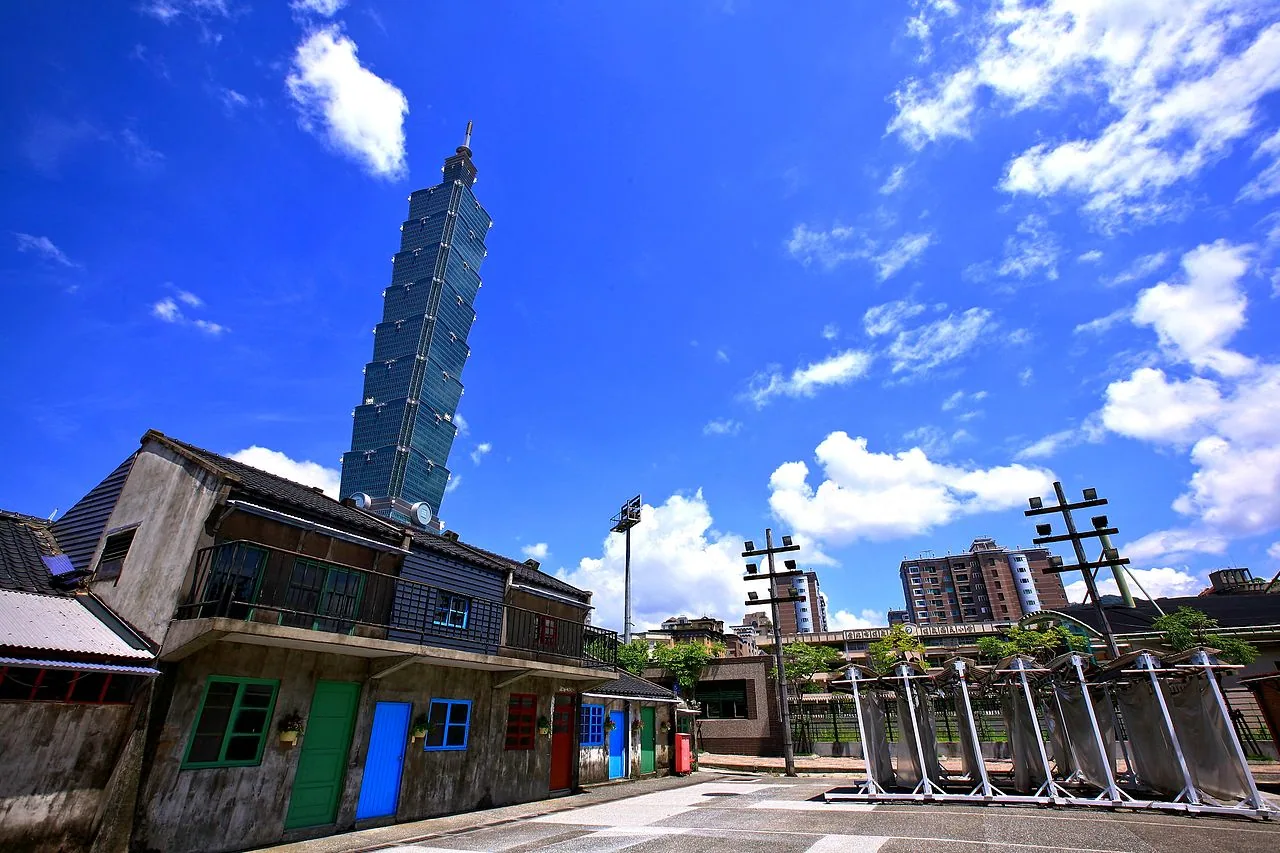
September 2013, panoramic view of Si-Si South Village. Photo: Men1399. License via Wikimedia Commons (CC BY-SA 3.0).
If you ask a local in Taipei where "Si-Si South Village" is, they will probably say, "that small park near 101 that has the feel of a juancun."
On a weekend afternoon at three o'clock, exiting Exit 2 of Taipei 101/World Trade Center Station on the MRT and turning left onto Zhuangjing Road takes you five minutes. The square is full of people. A couple of Korean tourists hold their phones horizontally, cramming the low red-tiled roofs and Taipei 101, 401 meters to the north, into one frame 7. A resident walking a Golden Retriever passes by; the dog stops for a long time at the entrance of Building B's juancun cultural exhibit. The simple market, held from 1 PM to 7 PM on Sunday afternoons, is already set up, with handmade crafts, cultural and creative agricultural products, and street singers playing guitars near the grass 8.
Four brick-walled, red-tiled houses form a central square. Building A to the north is now the Xinyi Children's Museum, managed by the Social Affairs Bureau; Building B on the east is the juancun cultural exhibit, permanently displaying furniture, daily necessities, and culinary traces from the settlement; Building C in the south was formerly "Heytea" (Good Cho's), which opened in early 2011, promoting Si-Si South Village to young people via bagels and a creative market; and Building D on the west is an art and performance space used for small theaters, bookstores, and lectures 9.
If you look up towards the north, Taipei 101's red aviation warning light is flashing. If you look down at the footprints in the square, the Shandong technicians who arrived from Qingshi by ship in 1948 were sunbathing here, burning coal stoves, and making dumplings for Chinese New Year.
📝 Curator's Note: Si-Si South Village is not an ordinary juancun. First, it was the first juancun established by the Republic of China government in Taiwan, built by the families of personnel from Qingshi Joint Depot No. 44 who arrived by ship between 1948 and 1949 3. Second, its residents were "factory workers" (technicians without military ranks or positions) 5, meaning they were not classified as "military dependents" in the system. Third, it was the first juancun in Taipei City to be designated a historic building, with four buildings preserved as the Xinyi Civic Center and Juancun Cultural Park in 2003 6. These three "firsts" make Si-Si South Village a signature case of juancun preservation in Taiwan—a village that should not have been preserved (because it did not qualify for reform regulations) but ultimately became the first to be saved (due to intervention by cultural authorities).
How the Name Came About: South of Depot No. 44
The name "Si-Si South Village" is directly tied to a military depot.
The predecessor of Joint Depot No. 44 (abbreviated as "Depot No. 44") can be traced back to the Central Armory established in Nanjing in 1936 10. In late November 1948, as the Nationalists-Communists War rapidly deteriorated, the Qingshi Joint Depot No. 44 faced relocation. The depot's decision was: first, ship the machinery in six batches on "Taikang Wheels" to Taiwan, and then resume production of artillery shells using the "Taiwan Supply Bureau Third Armory" left by the Japanese military during the colonial period to prepare for a future counterattack 1.
In December, the factory workers and their families who arrived later disembarked from Keelung Port and were settled in the "Japanese military warehouses" in Sanzhangli—which were military storage facilities left by the Imperial Japanese Army in the area of Sanzhangli, East Taipei during the colonial period 11. The initial living conditions were extremely poor. Historical records from the Taiwan History Museum state: "The initial depot employees and their families lived at the factory" 3, while the Veterans Affairs Council's cultural website records that "the early workers lived in the depot warehouses, living with cloth curtains as partitions" 2.
In 1949, the depot began self-constructing juancun housing on the south side of the site—hence the name "Si-Si South Village" 11. The village's houses were divided into three clusters based on construction order: Bing (丙), Yi (乙), and Jia (甲) 12. Most were low-rise brick and wood structures, with narrow alleys and small rooms sharing a communal toilet 2.
"The majority of residents were from Shandong" 1. This is a crucial detail—because the depot was originally based in Qingshi, the families who evacuated to Taiwan were mainly from Shandong Province. The stereotype of post-war juancun in Taiwan is often "Hunan/Sichuan cuisine and Sichuan dialect," but Si-Si South Village's food reflects Shandong flavors—pancakes, fried mahua, and woowotou; there was also a snack called "qizi", which involved flattening flour and sugar into small squares by frying them 2. The welfare association in the village sold Shandong steamed buns and dumplings, completely different from the dialects and cuisine found in Youth Park or Dazhi Naval juancun.
📝 Curator's Note: The name "Depot No. 44" itself carries historical density. It started as the Central Armory in Nanjing in 1936, moved to the rear during the war, took over Japanese military assets after the war, was based in Qingshi, evacuated to Taiwan, resumed production in Sanzhangli, and finally moved to Sanxia in 1980, renaming it Depot No. 206—two of these seven relocations directly inscribed its destiny onto the landscape of Taiwan. Si-Si South Village is a physical trace left between two migrations. It is also a physical trace left by Shandong families from Qingshi in Taiwan. The Taikang Wheel that brought them in 1948 carried not just machinery, but an entire culture of Shandong dialect, Shandong cuisine, and Shandong customs—which fermented on the grass next to 101 for 50 years.
A Military Depot Supporting Three Villages: Officers / NCOs / Technicians
To understand Si-Si South Village, one must also recognize the two sibling villages that have since vanished: Si-Si West Village and Si-Si East Village.
Based on the personnel structure of the depot after relocating to Taiwan, the staff were roughly divided into three tiers: officers (high-ranking military officials, school/non-commissioned), general junior/mid-level soldiers, and technicians without military status 1. The three villages were demarcated by rank the following year—West Village housed officers (located on Section 1 of Keelung Road), East Village housed NCOs (located in Alley 260 of Wuxing Street), and South Village housed non-military technicians 413. All three villages were within walking distance of the depot.
The difference in rank was reflected in material conditions. The housing in Si-Si West Village was of a higher standard, but living conditions were poor; Si-Si East Village housed mid-level NCOs; and Si-Si South Village housed technicians with the lowest status and no military ranks 4. A single depot supporting three different tiers of juancun is a material projection of the KMT army's tradition of "clear hierarchy, stratified housing."
But history gave the three villages very different endings thirty years later.
Si-Si West Village: Demolished and redeveloped on site in 1980; Zhongtuo National Housing was completed in 1983. The name "Zhong" (忠 - loyalty) and "Tuo" (駝 - camel bell) continued the anti-communist national symbolism of juancun housing, but the buildings themselves were multi-story RC apartments, lacking juancun alleys 4.
Si-Si East Village: Was evacuated to Zhongzhen National Housing near Youth Park—the name "Zhongzhen" directly borrowed the naming logic from Zhongzhen New Village in Zhongli, Taoyuan, retaining a memory of juancun culture within the new housing's name, though the physical buildings had changed 14.
Si-Si South Village: Did not move until 1998. The destination was World Trade Center New City (on the edge of Xinyi District). Why such a delay? Because "the core residents of South Village were technicians without military ranks, creating a conflict in eligibility for the Ministry of National Defense's juancun reform regulations" 5—the MND's regulations were for soldiers; technically, the factory workers did not qualify as "dependent households," and compensation standards became a long-standing dispute 15.
📝 Curator's Note: This story of a "system blind spot" is an underexplored aspect of juancun history in Taiwan. The MND's reform regulations assumed that juancun residents were military dependents, so the demolition and relocation compensation formula was based on military rank. But the residents of Si-Si South Village were depot technicians; they had state-issued housing and factory wages, but no military ranks. While West and East Villages were successfully redeveloped according to military ranks, the residents of South Village were stuck in a gray area for 20 years: "not dependents but living in a juancun." This 20-year delay unexpectedly saved Si-Si South Village—because it was not demolished in time, it later had the chance to be preserved as cultural heritage. Ineligibility turned into a condition of survival.
Evacuation in 1998, Fire in 1999, Decision in 2001
The demolition of Si-Si South Village was a protracted struggle.
Late 1980s: Planning for the Xinyi Planning Area began brewing from the Executive Yuan's instruction to relocate Depot No. 44 in 1976; Mayor Linyanggang joined the "sub-metropolis" concept in 1977, and the city government announced the main and detailed plans in 1980–1981 16. The land of the depot was zoned for public facilities, including residential areas (around Songzhi Road, Songqin Road) and commercial areas (around Songshu Road, Songgao Road) 16. Si-Si South Village was also included in the urban renewal area.
1990s: Negotiations over juancun reform compensation for South Village residents dragged on. The housing was aging, leaking, and severely infested with termites. Residents moved away piecemeal through individual agreements.
1998: All residents of South Village finally moved out, relocating to the completed World Trade Center New City 4.
1999: A fire occurred in Si-Si South Village, destroying some housing 15. The fire was seen at the time as a signal to accelerate demolition—since the houses were already burned down, demolishing the entire village and redeveloping it seemed like the natural next step.
But the "natural progression" did not happen.
1999–2001: Residents of the juancun, cultural heritage scholars, and community workers formed the "Si-Si South Village National Historic Site Promotion Alliance," launching a series of campaigns for juancun cultural preservation and establishing the "Si-Si South Village History Studio" 17. Their argument was that Si-Si South Village was Taiwan's first juancun, and the only physical evidence of overseas migrants self-constructing homes after retreating from the mainland. If the entire village were demolished, this history would have no tangible objects left.
"The demolition case of Si-Si South Village remained unresolved until it was officially settled in 2001" 15. The 2001 settlement was a compromise—not retaining the whole village, nor demolishing the whole village.
Preservation Plan: Most housing was demolished, but four symmetrical representative buildings around the central square were retained.
Scope of Retention: The site area is about 4,150 ping, and the building floor area is about 720 ping 9.
Process: After inspection by the Taipei City Cultural Affairs Bureau's Historic Building Review Committee, Si-Si South Village was designated a "Historic Building," and the four retained buildings entered the planning and renovation process 9.
⚠️ Controversial Viewpoint: The 2001 "Demolish 9, Preserve 4" plan was controversial at the time. On one side, cultural heritage experts felt they "at least left some material evidence"; on the other, some residents and radical cultural activists felt that "four buildings were too few to sustain the overall texture of juancun culture." In retrospect, these four buildings only present fragments of juancun materiality—the alleys are gone, the welfare association is gone, the bell sounds from the depot corner are gone. But these four buildings represented the limit of negotiation at the time—without the cultural heritage dispute in 2001, even the four buildings might have been leveled. The boundary between "imperfect preservation" and "complete disappearance" was the true frontier of juancun cultural preservation in Taiwan in 2001.
Rebirth Day: Buildings A, B, C, and D
October 25, 2003, was the day Si-Si South Village was reborn.
On that day, the "Xinyi Civic Center and Juancun Cultural Park" presented a new image 9. With an area of about 4,150 ping and a floor area of about 720 ping, it was a severely compressed version compared to the original village. However, the four symmetrical brick-walled, red-tiled houses surrounding a central square, with the former air-raid shelter converted into a small hill on the grassy lawn, served as a recreational spot for Taipei citizens during weekend markets 9.
The four buildings each have their own functions [^9]:
- Building A: Xinyi Children's Museum, managed by the Taipei City Social Affairs Bureau, providing play space "for children to play together using natural wood and pure handmade teaching aids."
- Building B: Juancun Cultural Exhibit, statically displaying the historical trajectory of Si-Si South Village, juancun arts, juancun mothers, juancun cuisine, juancun life, juancun games, juancun crafts, and a multimedia screening room. Open for free from 9 AM to 5 PM, Tuesday through Sunday.
- Building C: Originally the Heytea cultural dining space, operated by Heytea Good Cho's, which opened in early 2011 18 and closed on November 23, 2025 19.
- Building D: Art, bookstore, and theater space.
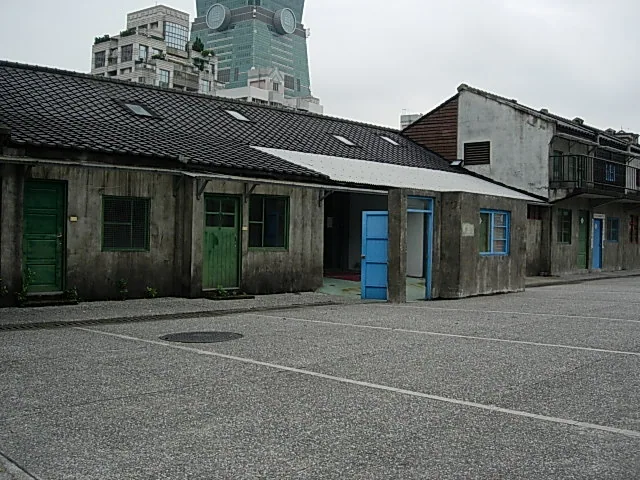
May 2007, Si-Si South Village preserved juancun housing details. Photo: Prattflora. License via Wikimedia Commons (CC BY-SA 3.0).
Walking into Building B, you are faced with a permanent exhibition of Si-Si South Village's history. Old photos on the walls show Shandong grandmothers sunbathing blankets in the square, factory workers returning from the depot gate, and children playing shuttlecock in the alleys. A group photo from the welfare association in 1962 can be identified as "Depot No. 44 Welfare Cooperative"—every juancun had a welfare association that sold goods tailored to the residents' provincial origins. The Si-Si South Village welfare association sold Shandong steamed buns, Shandong dumplings, and Shandong pancakes.
The display cases preserve daily objects from that era—coal stoves, enamel basins, aluminum lunchboxes bearing the Blue Sky Emblem, and children's primer books. A glass case displays "qizi"—a snack made by flattening flour and sugar into squares after frying 2. The flavor of Shandong is statically preserved in this exhibit hall, but when you walk out of Building B and into Heytea in Building C, you smell the aroma of bagels from the oven.
Two flavors coexist on the 4,150 ping site.
Heytea's Arrival: Buildings D and the New Generation of "Juancun Culture"
Heytea (Good Cho's) has been operating in Building C for over a decade, serving as the entry point through which the new generation of Taipei residents recognized Si-Si South Village.
In early 2011, Heytea Xinyi opened in Si-Si South Village at "No. 54 Songqin Street" 18. Heytea's positioning is a complex space combining "bagels + curated goods + market + cultural activities," selling their baked sweet and savory bagels, creative products from Taiwanese designers, organic agricultural products delivered by farmers, and hosting the "Simple Market" in the outdoor square every Sunday from 1 PM to 7 PM 8. On November 23, 2025, Heytea Xinyi officially closed, concluding with a three-day "South Village Treasure Hunt Market" auction 19.
For young people who only came to know Si-Si South Village in the 2010s, Heytea was the representative face of the village. Photos tagged "#Si-Si South Village" on Instagram are 80% focused on Heytea's bagels, its signage, and the grass in front of it. For older residents from the second generation of juancun families, this transformation is a double-edged sword—on one hand, Heytea revitalized the area; without foot traffic, these four buildings might not have lasted until 2026; on the other hand, bagels and Shandong steamed buns are different foods, and the creative market is not the same space as the village's welfare association.
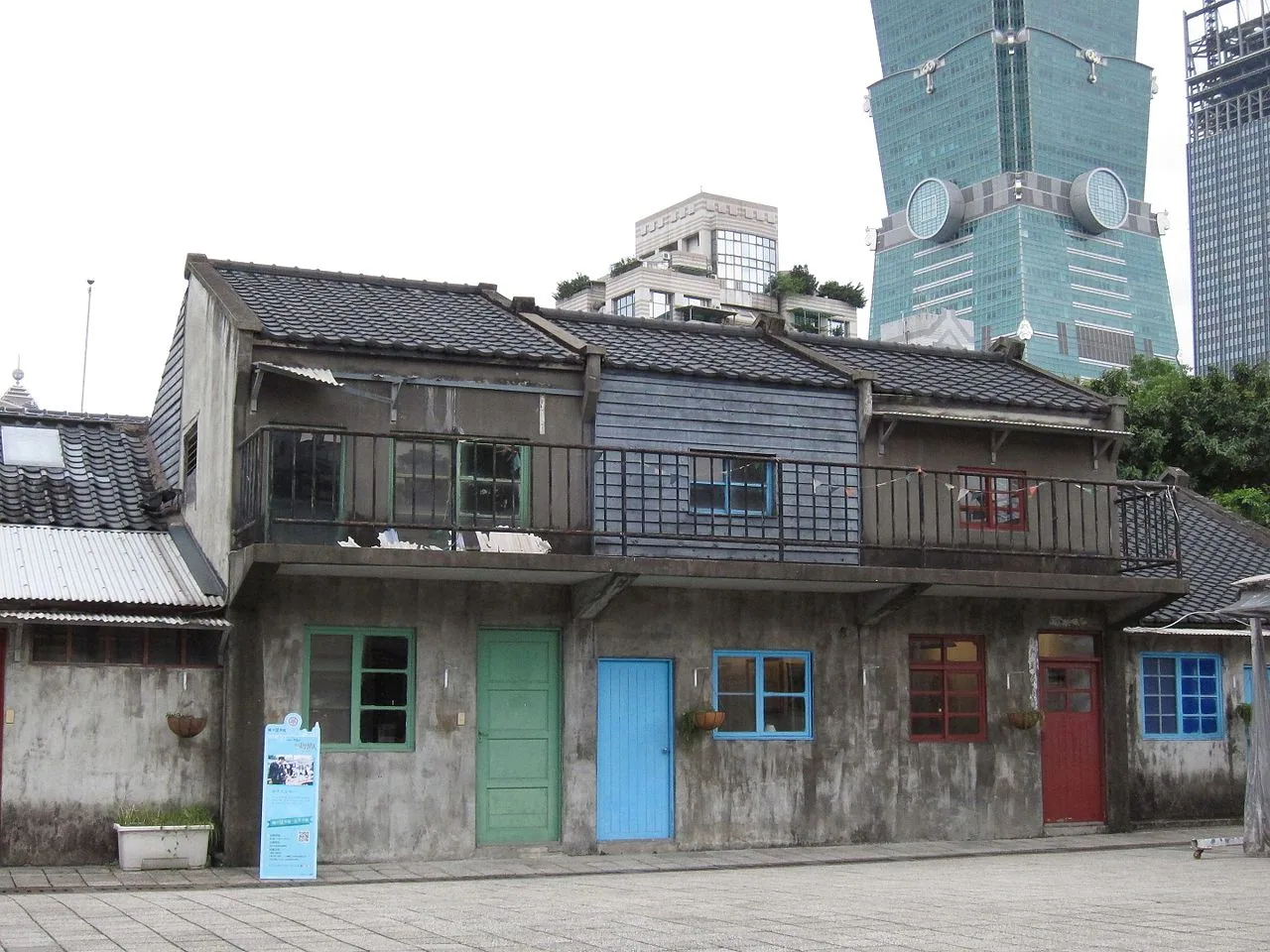
November 2016, details of preserved juancun housing in Si-Si South Village. Photo: Mizuhara gumi. Public domain via Wikimedia Commons.
⚠️ Controversial Viewpoint: The term "cultural and creative juancun" itself is tense. A juancun is a material space hastily built by post-war migrants in 1949; its characteristics are density, low-rise structure, shared use, and scarcity—a form born from necessity. Cultural creation (Wenchuang) is a curated space under the logic of 21st-century capital; its characteristics are selection, added value, narrative, and consumerism—a form layered on top. Turning a juancun into a cultural creative space is, to some extent, packaging scarce historical memory as consumable "atmosphere goods." Whether Heytea's bagels taste good is one thing, but eating a bagel in the Si-Si South Village square is a different time and space from eating Shandong steamed buns at the welfare association gate in 1962. This tension repeatedly appears in cases of juancun cultural preservation in Taiwan—such as Mingde New Village in Kaohsiung, or the juancun near National Tsing Hua University in Hsinchu—all facing the same problem: preserving objects is easy; preserving a way of life is impossible.
The Depot's Bell, Now Taipei 101's Aviation Warning Light
Walking 200 meters south from Si-Si South Village square leads to Taipei 101.
The contrast between the two buildings is one of Taipei's most photographed "History vs. Modern" juxtaposed landscapes. The red-tiled low-rise houses built by Shandong technicians from Qingshi in 1948 stand next to the supertall structure completed in 2004 20. The juancun's low profile versus 101's verticality, the juancun's red brick versus 101's glass curtain wall, the juancun's depot bell versus 101's aviation warning light.
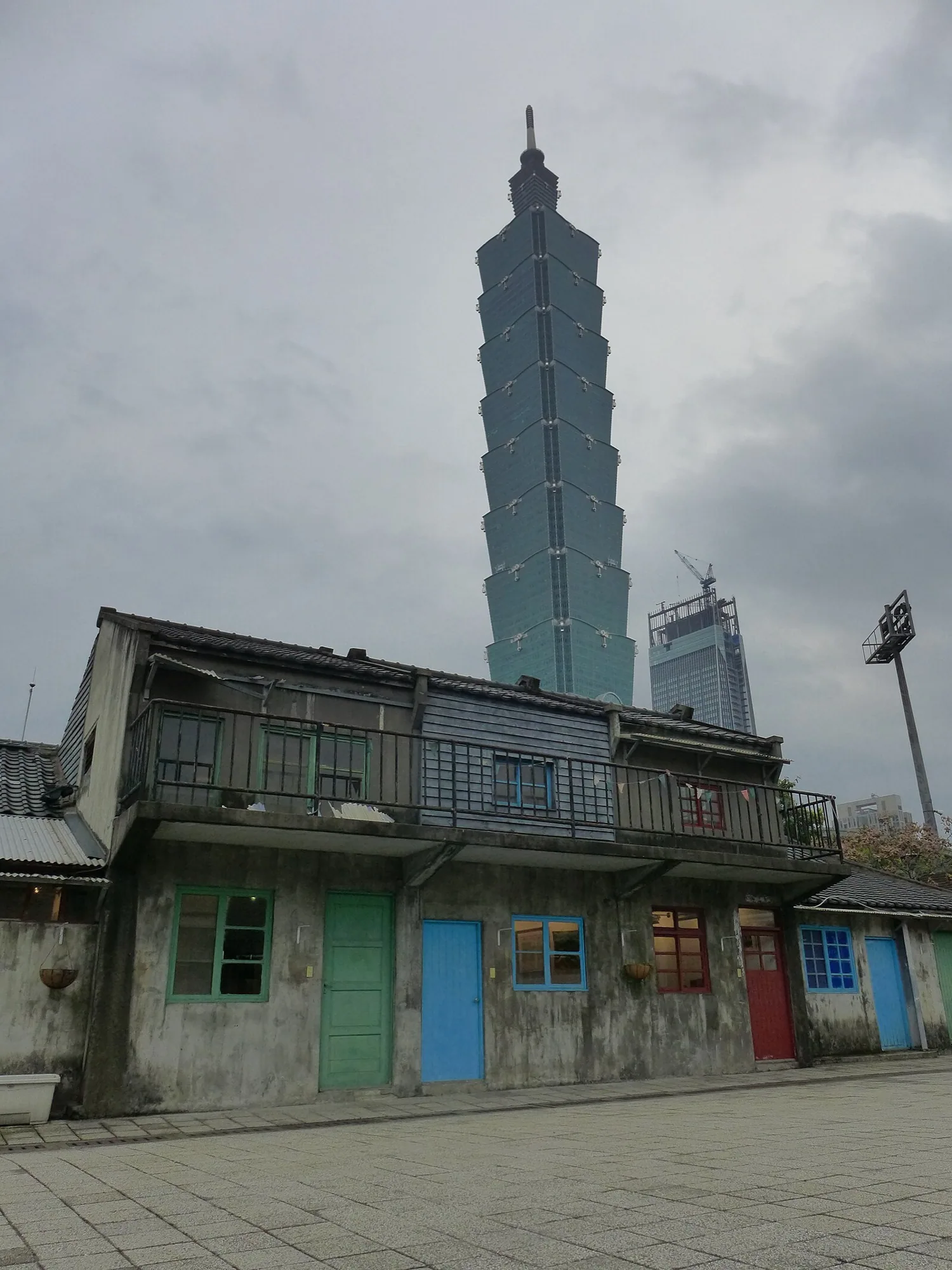
March 2017, Si-Si South Village and Taipei 101 side-by-side. Photo: Hal Maa. License via Wikimedia Commons (CC BY-SA 4.0).
Geographically, these two buildings stand on the former site of the Joint Depot No. 44.
In 1976, the Executive Yuan instructed the relocation of Depot No. 44, and this land was used to build military, public, educational, and residential housing 16. In 1977, Mayor Linyanggang introduced the "sub-metropolis" concept. Starting in 1978, the depot, renamed Depot No. 206, gradually moved to the new site in Sanxia, completing the move in 1980 4. From 1980–1981, the main and detailed plans for the Xinyi Planning Area were announced; Japanese architect Kuo Maolin suggested incorporating a commercial center concept alongside residential and municipal centers 16. The "Songshan District Phase II Urban Renewal" was formally carried out from 1981 to 1986, acquiring public facility land. In the 1990s, high-rises in the Xinyi Planning Area were erected one by one—World Trade Center, Shin Kong Mitsukoshi Xinyi New Terraces, and COEX Matsu. Xinyi Junior High School was demolished in 1999, and Taipei 101 was completed on this land in 2004 20.
The bell sound of the depot producing artillery shells disappeared. The lightning rod, 401 meters high, replaced it.
💡 Did You Know: Taipei 101 is not a "coincidental neighbor" when viewed from Si-Si South Village square. The entire site of Taipei 101 was originally the grounds of Joint Depot No. 44. After the depot moved to Sanxia in 1980, this land was zoned as the Xinyi Planning Area and subdivided into different zones. The location of Taipei 101 was originally occupied by Xinyi Junior High School; after that school was demolished in 1999, the land was awarded for development as an international financial center and completed in 2004. In other words—the two buildings seen from Si-Si South Village square are actually "the two remnants of the military depot": the southern plot became a 401-meter financial tower, while this small corner to the north retained four juancun houses. The geographical succession is more direct than the cultural contrast.
Three Places Locals Will Take You To
If you visit Si-Si South Village, tourists will take photos comparing it with 101, but these three places are less frequently stopped at.
The Air-Raid Shelter Behind Building B: A small air-raid shelter from that era is still preserved between the four symmetrical buildings 9. During Cold War drills in the 1950s and 60s, residents would run into designated shelters when alarms sounded. Today, the shelter has been converted into a "South Village Hill"—covered in grass, looking like a one-meter high green hill from the outside, but you can see its artificial curved shape from afar. Climbing up to sit there allows you to see the complete skyline of Taipei 101 to the north, contrasted with the red-tiled roofs that are within reach by looking down.
The "Juancun Canteen" Menu at Heytea (Building C): Heytea's signature is bagels, but Building C also retains some menu items paying tribute to Shandong juancun cuisine 21, occasionally offering limited items like Shandong pancakes and wonton soup on weekends. The Heytea Xinyi store closed in November 2025 19; this menu now only exists in food blogs.
Xiao Kaiyue South Village Snack Shop in the Alley: Not inside the park, but very close—walking out of Si-Si South Village square to Section 5 of Xinyi Road leads to "Xiao Kaiyue South Village Snack Shop" in an alley 22. It offers affordable juancun flavors: fried noodles, cured meats, and crepes. The owner is a descendant of the family who arrived from Qingshi in 1949. Compared to Heytea's bagels, this snack shop represents "truly living juancun flavor"—it is still running a business and selling Shandong snacks for nearby office workers, unlike static museum displays.
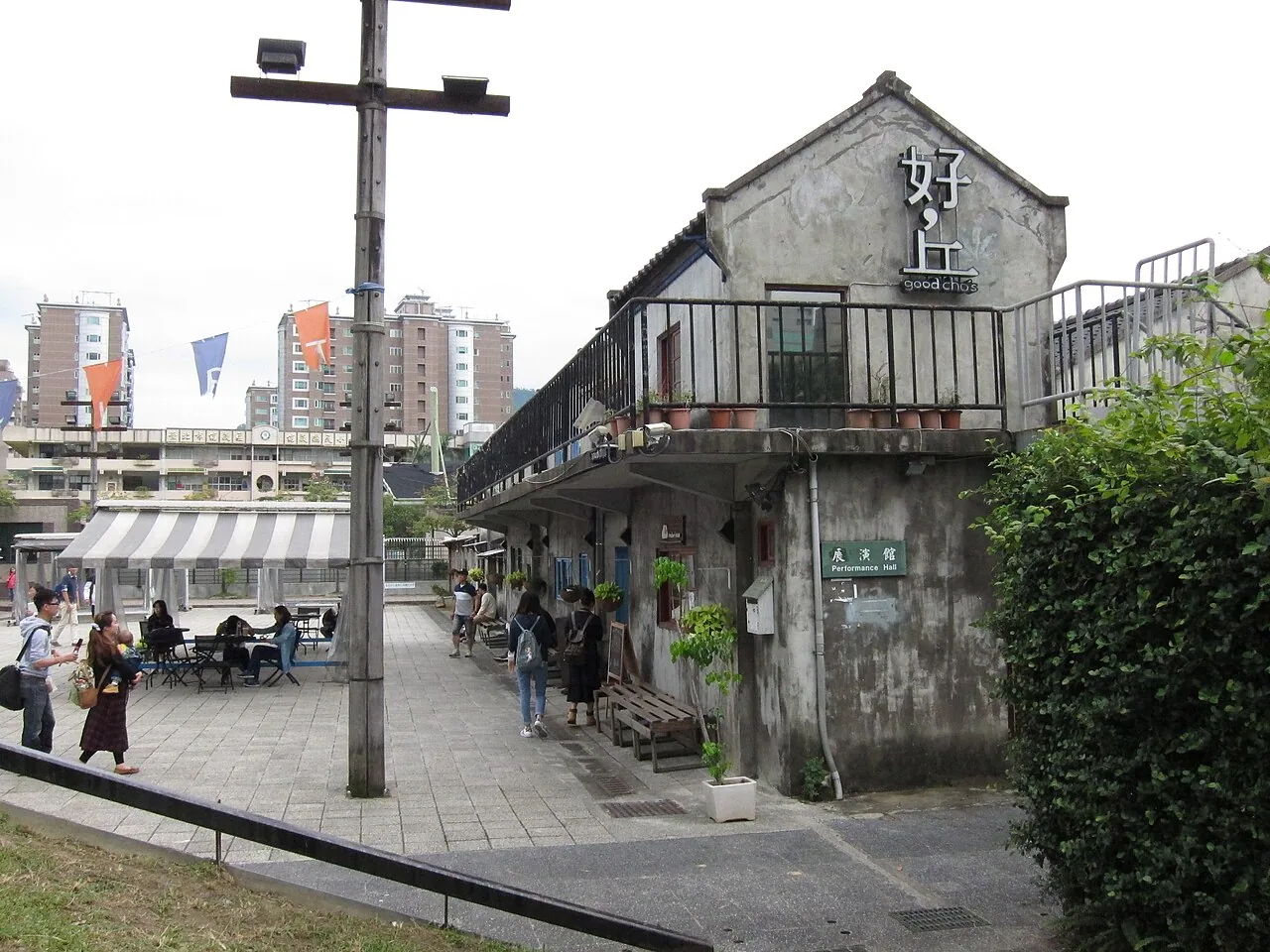
November 2016, central square of Si-Si South Village. Photo: Mizuhara gumi. Public domain via Wikimedia Commons.
The Taikang Wheel from 1948, 77 Years Later
Let's walk back to the Si-Si South Village square for a moment.
In late November 1948, the "Taikang Wheel" departed from Qingshi Port. It carried the machinery of Joint Depot No. 44—shipped in six batches. The workers and families who arrived in December disembarked from Keelung Port and were settled in the Japanese military warehouses in Sanzhangli. The following year, they began self-constructing juancun housing on the south side of the depot—Taiwan's first juancun.
Today, 77 years later, most of those who traveled on that Taikang Wheel are gone. Some of their children live in World Trade Center New City, some moved to Songshan or Neihu, and some went to the US or Canada. Their grandchildren may have no idea that their grandparents once lived in a place called "Si-Si South Village."
But the old depot site has not completely vanished. It left behind four brick-tiled low-rise houses—Building A where children play with teaching aids daily, Building B statically displaying coal stoves and enamel basins from that era, Building C selling bagels and coffee, and Building D housing a small theater and bookstore.
It also left Taipei 101, 401 meters high—another remnant of the same depot site, built on the former grounds of Xinyi Junior High School.
On the square at three o'clock on a weekend, foreign tourists are still taking photos—the juancun housing from 1948 juxtaposed with the financial center of the 21st century. Most of them do not know that these two buildings stand on the same depot grounds. And they don't need to know.
But next time you stand on this patch of grass, you will know.
Further Reading:
- Taipei City — 12 districts panorama, placing Si-Si South Village in the timeline of Xinyi District and all 22 counties of Taipei.
- Development of Taiwanese Cultural Creative Parks — The Taiwanese model of "cultural heritage preservation + creative industry entry," from Huashan to Songyan to Si-Si South Village.
- Taiwanese _Juancun_ Cuisine — Shandong pancakes, Hunan cured meats, Sichuan Dan Dan noodles: material traces of regional and provincial cuisine in juancun.
- Provincial Identity Conflicts in Taiwan — The ethnic structure of post-war Taiwan, from the first to the third generation of overseas migrants, seen through Si-Si South Village.
- Taipei 101 — The 401-meter supertall building visible from Si-Si South Village square is the other remnant of the same depot site as the juancun.
- Dadaocheng — A sibling historic district to Batch 1, where colonial commercial streets and post-war juancun represent two "urban formation moments" in Taipei.
- Ximen Street — A sibling historic district to Batch 1, where Japanese entertainment areas and post-war juancun represent two types of legacies left by the Japanese.
- Yongkang Street — Two settlement patterns for overseas migrants in 1949: housing vs. taking over Japanese dormitories—a material contrast.
- Guling Street — The post-war Nanhai Academy and Guling Old Book Street form another intellectual landscape of overseas migrants, creating a "intellectuals vs. military industry" structure of post-war settlement with Si-Si South Village's depot juancun.
Image Sources
This article uses 5 CC/PD licensed images, all cached in public/article-images/geography/ to avoid hotlinking source servers:
- Si-Si South Village.jpg — Photo: Men1399, 2013-09-07, CC BY-SA 3.0
- Buildings_at_Four_Four_South_Village...with_Taipei_101.jpg — Photo: Hal Maa, 2017-03-09, CC BY-SA 4.0
- Forty-four-south-village.JPG — Photo: Prattflora, 2007-05-20, CC BY-SA 3.0
- 44 South Village 1.JPG — Photo: Mizuhara gumi, 2016-11-11, Public Domain
- 44 South Village 2.JPG — Photo: Mizuhara gumi, 2016-11-11, Public Domain
References
- Si-Si South Village - Wikipedia — The Si-Si South Village article on Wikipedia records core historical facts such as "the predecessor of Joint Depot No. 44 was the Central Armory established in Nanjing in 1936, and it moved from Qingshi to Taiwan in November 1948," "machinery was shipped in six batches on 'Taikang Wheels'," "the majority of residents were from Shandong," and "the depot members could be divided into three tiers: officers, general junior/mid-level soldiers, and technicians without military status; the officers lived in West Village, general soldiers lived in East Village, and non-military technicians lived in South Village."↩2345
- Taipei City Xinyi Civic Center - Memories of Si-Si South Village - Veterans Affairs Council Cultural Network — The "Memories of Si-Si South Village" entry on the Veterans Affairs Council's cultural network records details of juancun life, such as "the early workers lived in the depot warehouses, living with cloth curtains as partitions," "houses were built in Bing, Yi, and Jia styles between 1937 and 1940," "there was a high rate of intermarriage among the second generation," "they helped each other make food during festivals," and "playing mahjong was the most common leisure activity," along with characteristic foods like pancakes, fried mahua, and woowotou; "qizi," which is flour and sugar rolled flat, fried, and cut into small squares as a snack.↩2345
- Si-Si South Village - National Taiwan Museum's "Stutsimin" Online Exhibition — The Si-Si South Village entry in the National Taiwan Museum's online exhibition records core historical facts certified by the central government museum, such as "the move from Qingshi to Taiwan in November 1948," "resuming work in Japanese warehouses in Sanzhangli, Taipei in December, where the initial depot employees and their families made the factory their home, establishing Taiwan's first juancun on the south side of the site," and "all residents of Si-Si South Village moved out in 1999," and "the Xinyi Civic Center and Juancun Cultural Park was established in 2003."↩23
- 3. Si-Si South Village, Si-Si West Village - Taipei Municipal University's Xinyi District History Map — The academic website of the Taipei Municipal University's Xinyi District History Map records specific documentary evidence regarding the differences between the three villages, such as "West Village was demolished and redeveloped into Zhongtuo National Housing," "Si-Si West Village was officially demolished and redeveloped in 1980, with the national housing completed by 1983," and that South Village's "core residents were officers, soldiers, and workers," while West Village's "core residents were officers/school/non-commissioned officers" located in the area of Jingxinli, Xinyi District.↩23456
- Si-Si South Village - Wikipedia §Demolition and Preservation — The Si-Si South Village article on Wikipedia records specific documentary evidence regarding the "system blind spot" and cultural heritage dispute: "because the core residents of Si-Si South Village were technicians without military ranks, there was a conflict in eligibility for the Ministry of National Defense's juancun reform regulations, and due to the large number of diverse residents in South Village, compensation for demolition and redevelopment could not be agreed upon," and "the case of Si-Si South Village remained unresolved until it was officially settled in 2001."↩23
- Si-Si South Village - Historic Building - National Cultural Heritage Database — The entry on the Ministry of Culture's National Cultural Heritage Database records that Si-Si South Village is registered as a historic building with registration number 20031223000001, and four symmetrical buildings were preserved for the Xinyi Civic Center and Juancun Cultural Park.↩2
- Taipei 101 - Wikipedia — The Taipei 101 article on Wikipedia records basic data about Taipei 101, such as "a total height of 508 meters (including antenna)," "officially completed and commissioned on December 31, 2004," and "located at No. 7, Section 5, Xinyi Road, Xinyi District, Taipei City." The Si-Si South Village square is about 200 meters directly north of Taipei 101.↩
- Si-Si South Village Simple Market - La Vie — A deep report by La Vie magazine on the Si-Si South Village Simple Market records that it "combines sharing and sales of handmade creative products, agricultural products, and music, making it one of Taiwan's few markets combining culture, agriculture, and music," operating from 1 PM to 7 PM every Sunday.↩2
- Xinyi Civic Center Main Building Introduction - Xinyi District Office, Taipei City — The official page of the Xinyi Civic Center on the Taipei City Government's Xinyi District Office website records authoritative information such as "the new image was presented on October 25, 1992," "the site area is about 4,150 ping, and the building floor area is about 720 ping," and lists official functions: Building A (Children's Museum, managed by Social Affairs Bureau), Building B (Juancun Cultural Exhibit), Building C (Heytea cultural dining space), and Building D (Art/Bookstore/Theater).↩23456
- Joint Depot No. 44 - Wikipedia — The Joint Depot No. 44 article on Wikipedia records the history of the depot, including "its predecessor was the Central Armory established in Nanjing in 1936," followed by its relocation to the rear during the war, taking over Japanese military assets after the war, being based in Qingshi, evacuating to Taiwan in 1948, resuming production in Sanzhangli, and moving to Sanxia in 1978–1980.↩
- Kinmen Daily - Si-Si South Village Series Reports — The Kinmen Daily global information network reports that "the Qingshi Depot's Joint Depot No. 44 first shipped machinery in six batches on 'Taikang Wheels' to Taiwan, resuming production using the Third Armory of the Japanese Supply Bureau left by the Japanese military, and later, the workers and families who arrived in December settled in Songshan," "temporarily housed in Japanese military warehouses," and details the locations: "South Village: Bing-style juancun built on Section 5 of Xinyi Road; East Village: Alley 260 of Wuxing Street; West Village: Section 1 of Keelung Road," noting the rank division where officers lived in West Village, general soldiers in East Village, and non-military technicians in South Village.↩2
- Si-Si South Village - Wikipedia §Architecture — The Architecture section of the Si-Si South Village article on Wikipedia records that it is divided into three architectural clusters: Jia (甲), Yi (乙), and Bing (丙); the location is "No. 50 Songqin Street (within the intersection of Songqin Road and Zhuangjing Road)," and the area covers "Sections 5 of Xinyi Road, Section 2 of Keelung Road, Songping Road, and surrounding areas."↩
- Cultural Oasis in the Center of Taipei Metropolitan Area - Si-Si South Village - Veterans Affairs Council Cultural Network — The dedicated page for Si-Si South Village on the Veterans Affairs Council's cultural network records that it "was built by the employees and families of Joint Depot No. 44 from Qingshi," and that "community residents and cultural activists launched a series of campaigns to prevent the buildings from being completely demolished," leading the Taipei City Government Cultural Affairs Bureau... to officially designate Si-Si South Village as a "Historic Building," with the official record of reopening on October 25, 2003, retaining four symmetrical buildings.↩
- Si-Si South Village - Wikipedia §Reform and Evacuation — The juancun reform section of the Si-Si South Village article on Wikipedia records that "East Village was evacuated to 'Zhongzhen National Housing' near Youth Park," "West Village was redeveloped into 'Zhongtuo National Housing'," and "the residents of South Village moved out later, until 1998, when all residents moved to the completed World Trade Center New City," noting the timeline that "Joint Depot No. 44 has disappeared and became part of the Xinyi Planning Area."↩
- Brief History and Major Events of Si-Si South Village - Wikipedia §Cultural Preservation Movement — The cultural preservation section of the Si-Si South Village article on Wikipedia records that "all residents of Si-Si South Village moved out in 1999," and "under the juancun cultural preservation movement launched by community residents and cultural activists, Si-Si South Village was also the first to be preserved," noting the key timeline: "when it was demolished due to fire in 1999, it mostly retained its appearance from 50 years ago," and "it was officially settled only in 2001."↩23
- Xinyi Planning Area - Wikipedia — The Xinyi Planning Area article on Wikipedia records the planning timeline: "In 1975, the Executive Yuan instructed the relocation of Depot No. 44 to build military, public, educational, and residential housing," "Mayor Linyanggang introduced the 'sub-metropolis' concept in 1977," "the city government announced the main plan in 1980 and the detailed plan in 1981," and "the 'Songshan District Phase II Urban Renewal,' which lasted five years according to the detailed plan, was carried out from 1981 to 1986," and that it accepted the suggestion of Japanese architect Kuo Maolin to include a commercial center concept besides residential and municipal centers.↩234
- Si-Si South Village - Wikipedia §Si-Si South Village National Historic Site Promotion Alliance — The cultural preservation section of the Si-Si South Village article on Wikipedia records "the investigation by the 'Si-Si South Village National Historic Site Promotion Alliance'," and that "community residents and cultural activists launched a juancun cultural preservation movement, establishing the Si-Si South Village History Studio," leading to the Cultural Affairs Bureau formally designating it as a "Historic Building" and its new image being presented on October 25, 1992.↩
- Heytea Good Cho's Xinyi Store - Official Store Information — The official website of Heytea Good Cho's records the address of the Xinyi store as "No. 54 Songqin Street, Xinyi District, Taipei City," and describes its positioning as a complex space combining bagel baking, curated goods, cultural markets, and art activities, being the first store for the brand.↩2
- Si-Si South Village Memories Packaged! 'Heytea Xinyi Store Closes' Final Tour - United News Agency — In 2025, Heytea Xinyi closed on November 23, holding a three-day "South Village Treasure Hunt Market" before closing.↩23
- Taipei 101 - Wikipedia §Construction History — The Construction History section of the Taipei 101 article on Wikipedia records that it "is located on the former site of Xinyi Junior High School," "Xinyi Junior High School moved schools in 1999," and "it was completed and commissioned on December 31, 2004," noting the continuity of Taipei 101's base from Xinyi Junior High School.↩2
- Heytea Good Cho's Xinyi Store Menu - Zhou Huahua Jiabao Mei — The food blog website provides a detailed description of Heytea Good Cho's Xinyi store menu, including items like bagel sandwiches and dumplings, noting that while the focus is on bagels, it occasionally offers limited items paying tribute to juancun culture.↩
- Xiao Kaiyue South Village Snack Shop - Zhou Huahua Jiabao Mei — The food blog website describes "Xiao Kaiyue South Village Snack Shop" as being in an alley within Si-Si South Village, offering affordable juancun flavors like fried noodles, cured meats, and crepes. The owner's family came from Qingshi with the Joint Depot No. 44 in 1949, representing "truly living juancun flavor" rather than static museum displays.↩