
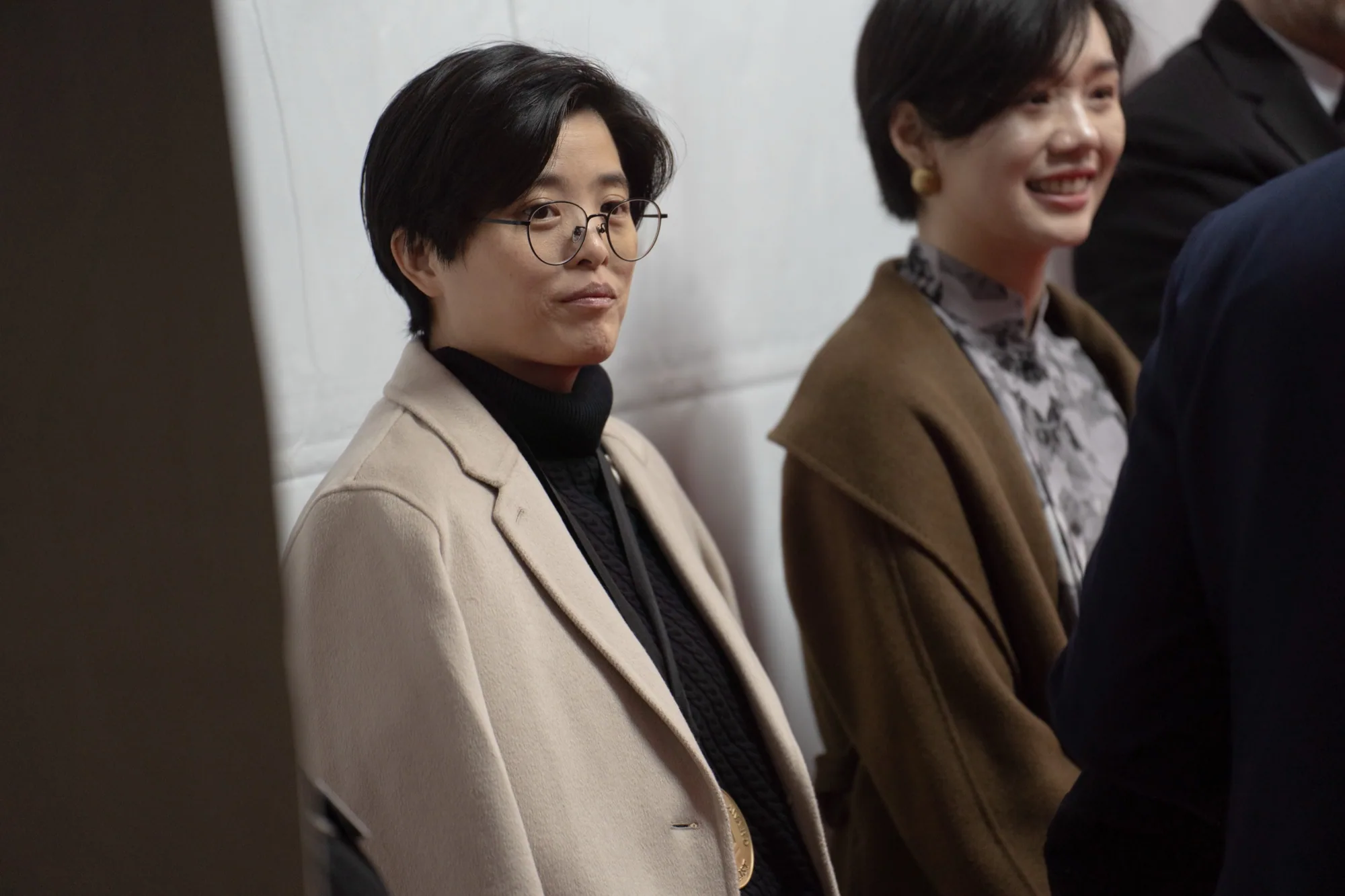
On November 20, 2024, Yang Shuang-zi accepted the 75th National Book Award for Translated Literature in New York. Photo: Bea Phi (Phibeatrice), via Wikimedia Commons, CC BY-SA 4.0.
30-second overview: Taiwan Travelogue is a 2020 pseudotranslation novel published by SpringHill Publishing: the cover says "written by Chizuko Aoyama, translated by Yang Shuang-zi," but Chizuko Aoyama does not exist, and even Yang Shuang-zi is a pen name shared by two people: the younger sister Yang Jo-hui, who had died five years earlier, and the surviving elder sister Yang Jo-tzu. In November 2024 at the National Book Awards in New York, and in May 2026 at the International Booker Prize ceremony at Tate Modern in London, Taiwanese literature reached these two international prize stages for the first time. The GBP 50,000 prize money was split between Yang Jo-tzu and translator Lin King. More weighty than that is this: the author translated a nonexistent Japanese novel under her sister's name, turning colonial history into a story of two women eating 12 dishes together.
Fifty thousand pounds and an unnamed name
On the evening of May 19, 2026, at Tate Modern in London, when Natasha Brown, chair of the International Booker Prize jury and a British novelist, announced the winner, Yang Shuang-zi and translator Lin King sprang up from the audience, embraced each other, and walked onstage together to receive the GBP 50,000 prize, divided equally between author and translator at GBP 25,000 each1. Since the Booker Prize was founded in 1969, this was the first time a Taiwanese writer had won the prize, and the first time a work translated from Chinese into English had taken the honor2.
Brown's citation read: "Taiwan Travelogue achieves an astonishing double feat: succeeding both as a convincing love story and as a sharp, powerful postcolonial novel."3
Yang Shuang-zi's speech onstage was long, but it did not mention one name. She said: "Some people believe that art and literature must keep their distance from politics. But I believe that literature cannot stand outside the soil in which it grows; in this sense, literature has never, in essence, been separate from politics." She said: "Taiwanese people have lived through colonial regimes and face the threat of invasion. Before a vastly stronger power, is literature of any use? - and I have always believed that literature has power." She concluded: "The century-long inquiry of Taiwanese literature is, in reality, the century-long pursuit by Taiwanese people of freedom and equality. To have been born Taiwanese is my good fortune; to stand here as a Taiwanese writer is my pride."4
What she did not say was this: the "Yang Shuang-zi" standing there was in fact two people. One is Yang Jo-tzu, born in July 1984 beneath Chenggongling in Wuri, Taichung; the other is Yang Jo-hui, born on the same day, who slept in the same bed with her until age 14, and who stopped breathing on the evening of June 19, 2015, before she had turned 315.
On the night of the London ceremony, the book had been in print for six years, and her younger sister had been dead for nearly 11 years.
Eleven account books, from age fifteen to twenty-five
Yang Jo-tzu and Yang Jo-hui did not have an easy childhood. Their parents divorced when they were seven; their father fooled around outside the home, and their mother remarried and had more children. The sisters were largely raised by their grandmother. When their grandmother died on Lunar New Year's Day in 1998, the sisters were 14 and "lost the only person in their lives whom they felt truly cherished them"6.
At 15, Yang Jo-tzu stood working in a fried chicken cutlet shop during the day and attended night school in the evening; Yang Jo-hui also worked part-time, and at the same time began keeping her first account book. She recorded expenses every day, down to each NT$1. Check marks, circles, triangles: this was a system of symbols she invented herself, one even her elder sister could not understand7.
She kept those account books for 16 years.
In 2009, two years after graduating from university, the younger sister was diagnosed with breast cancer for the first time. She was 25. That same year, the sisters founded a doujinshi circle called "Maopin." The elder sister used the pen name "Light-colored Cat," the younger sister "Half-finished Product," and their shared pen name was "Yang Shuang-zi." In Japanese, "shuangzi" means "twins." At the time, Yang Jo-tzu wrote fiction, while Yang Jo-hui conducted historical research on the Japanese colonial period8.
In autumn 2014, doctors declared that Yang Jo-hui's breast cancer was nearing stage four, with a five-year survival rate of 15%. In February 2015, doctors said she had three to five months left. The sisters made a "no regrets pact" and set in motion the draft of The Season When Flowers Bloom, which Yang Jo-tzu had long been writing. Before she died, the younger sister said something to the elder sister that Yang Jo-tzu later repeated in an interview with The Reporter: "Once this novel is finished, it will become popular."9
On June 8, 2015, the two left the hospice ward and returned to their rental home. On the evening of June 19, Yang Jo-hui died. That night, Yang Jo-tzu opened the first account book her younger sister had left behind and, from that day on, began recording the next day's expenses. It took her three days to understand the check marks, circles, triangles, and other codes only her sister had understood; she read them while crying10.
Eleven account books in all, from 1999, when the sisters were 15, until the day before the younger sister died.
📝 Curator's note: Many reports on the awards turned Yang Shuang-zi into an inspirational story of "transforming the pain of bereavement into literary achievement." But before Taiwan Travelogue was published in 2020, Yang Jo-tzu herself said something far heavier in an interview with Openbook: "All the remaining years of my life were given to me by my younger sister."11 Every year she has lived since that day has been borrowed time.
A woman named "Chizuko Aoyama" does not exist, yet she wrote a book
Taiwan Travelogue was first published by SpringHill Publishing in March 2020. The cover byline was printed as follows:
"Written by Chizuko Aoyama / Translated by Yang Shuang-zi"
The book band also called it "a 'translated' novel." On the eve of publication, bookstore staff even classified it under "Japanese literature in translation." It was not until Yang Shuang-zi publicly admitted in a pre-publication interview that Chizuko Aoyama was fictional, and that the entire book had been written by Yang herself12.
The book has four layers of pseudonymous construction. The outermost layer is the author-translator byline on the cover. The second is the preface, signed by "Niibi Sagako," a fictional figure who had appeared in Yang Shuang-zi's other novels. The third is the 12-chapter main text, in which the fictional Japanese aristocratic woman writer Chizuko Aoyama recalls in the first person her 1938 journey to Taiwan for invited lectures, traveling along the north-south railway from Taipei and Taichung to Kaohsiung, accompanied by the Taiwanese woman interpreter Wang Chizuru. The fourth is the afterword, a "translator's note" attributed to "Yang Jo-hui," which imitates the tone of a translator researching the original author and lists fictional footnotes13.
"This is 'Yang Jo-hui, as fictionalized by Yang Jo-tzu, translating the work of Chizuko Aoyama, as fictionalized by Yang Jo-tzu.'" Novelist Chu Yu-hsun dissected it this way in his review, "The Literary Meaning of Fictional Attribution"14.
Yang Jo-tzu herself put it more directly in an interview with U People: "I fictionalized Jo-hui writing an afterword, bringing Jo-hui too into the world of Yang Shuang-zi."15
In other words, for a book whose cover says "translated by Yang Shuang-zi," the word "translated" carries the novel's internal timeline: within the world of the story, there truly is a translator named Yang Jo-hui, who after 2015 continues translating an old book written in the 1950s by someone named Chizuko Aoyama. A review in Unitas put it most incisively: the pseudotranslation setup is "a literary dream conjured into being," replacing an original Chinese-language novel with a Japanese translated novel for the sole purpose of allowing the translator "Yang Jo-hui" to return to the world of the living16.
When the book was published, it was the fifth year after Yang Jo-hui's death.
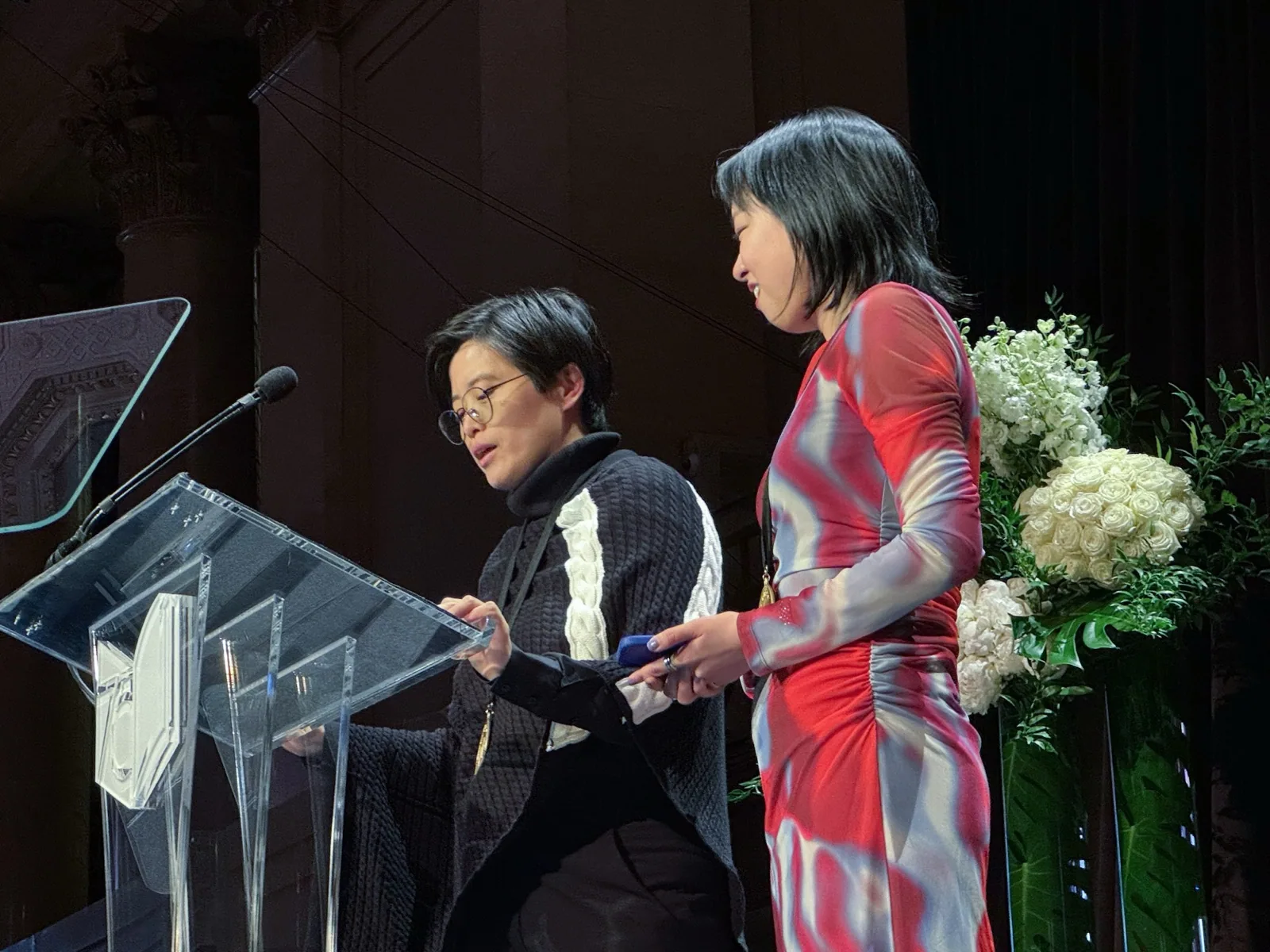
At the National Book Awards ceremony on November 20, 2024, Yang Shuang-zi (left) and translator Lin King pose together. On December 19 of the same year, Taiwan's Presidential Office received the two; in May 2026, they again shared the stage at the Booker Prize ceremony. Photo: Jennifer 8. Lee (Jenny8lee), via Wikimedia Commons, CC BY-SA 4.0.
Twelve dishes, from melon seeds to sweet bean ice
The main text of Taiwan Travelogue has 12 chapters, each centered on one dish. They are arranged in the sequence of banquet appetizers, main courses, and desserts: melon seeds, rice sieve noodles, jute mallow soup, sashimi, minced pork sauce, winter melon tea, curry, sukiyaki, leftover vegetable soup, tau noodles, salty cake, and sweet bean ice17.
Food is the skeleton; the colonial relationship is what lies inside.
Melon seeds are the scene of Chizuko Aoyama and Wang Chizuru's first meeting. Wang Chizuru teaches this plump, forthright Japanese aristocratic woman writer how to crack melon seeds with her front teeth. Jute mallow soup brings out clues about Wang Chizuru's background as the daughter of a concubine; it is a way of eating known only to ordinary people in Taichung. Sashimi and minced pork sauce appear side by side in the same chapter, leading to the most direct declaration of colonial class in the entire book: "Minced pork sauce for islanders, sashimi for mainlanders: this is the distinction between filth and cleanliness." Sukiyaki is "a dish eaten with someone one likes," the setting for a deep late-night conversation between the two women. Salty cake was invented during the Japanese colonial period at Xuehua Zhai in Fengyuan, Taichung, to welcome a visit by Prince Kan'in Kotohito. The final dish, sweet bean ice, was an everyday dessert originally created by Taichung's Xinfating in reference to Japanese four-fruit ice18.
The book is set in 1938 and 1939. Geographically, it follows the north-south railway of the Japanese colonial period: departing from Taihoku (Taipei), passing through Chikunan (Zhunan), where the coastal and mountain lines divide, rejoining at Shōka (Changhua), and continuing south to Taichu (Taichung), Tainan, and finally Takao (Kaohsiung). Chapter six gives particular attention to relations between Taiwanese and Japanese students at a girls' school in Tainan. That is when Chizuko Aoyama first realizes that the "amity" she had imagined had in fact always rested on an unequal structure of power19.
The book ends in parting. Wang Chizuru rejects Chizuko Aoyama's proposal of "eternal friendship" and does not go with her to Japan. She stays in Taiwan. She does not forgive Chizuko Aoyama, because Chizuko Aoyama remains a colonizer, even if she is a kind, literary colonizer who sincerely wants to understand Taiwan20.
⚠️ Contested view: Can the very structure of using a fictional Japanese woman writer's perspective to write Taiwan's colonial history be criticized as "reproducing the colonial gaze"? This debate was already present when the book was published. As SpringHill's editor, Chuang Jui-lin asked directly in a 2020 three-way conversation: "Is this a form of anti-colonial counterattack, or does it prove that we are still greatly controlled by empire?"21 Yang Shuang-zi's answer is embedded in the afterword. She has Wang Chizuru reject Chizuko Aoyama at the novel's final moment. The colonized refuses to accept the colonizer's gaze. The book's pseudonymous structure itself performs this refusal.
From SpringHill's editorial desk to the Presidential Office in Taipei
When Taiwan Travelogue was first published in March 2020, SpringHill Publishing had been founded for only one year and three months. Founder Chuang Jui-lin had left her post after seven years as editor-in-chief at Acropolis Publishing and established SpringHill in December 2018, positioning it around in-depth local writing, politics and society, historical research, and literature22.
From August 2019 to March 2020, the book went through five revisions on SpringHill's editorial desk.
After publication, it won the Golden Tripod Award for literary books in 2021, and the Taiwanese readership market initially accumulated a print run of around 40,000 copies. It was a bestseller, though not yet a phenomenon, until the American awards ceremony in November 202423.
Translator Lin King was born in New York City in December 1993 and holds both Taiwanese and American identities. After graduating from Taipei American School, she studied English literature and East Asian studies at Princeton University, then earned a master's degree in literary translation at Columbia University. She began translating Taiwan Travelogue at the end of 2021 and spent three years on it. Her entry point into translating the book came after she had first translated an excerpt from Yang Shuang-zi's The Season When Flowers Bloom for the Asian American Writers' Workshop, after which Yang sent her the Chinese text of Taiwan Travelogue and asked whether she would be willing to translate it24.
Her principles of translation match the temperament of the book as a whole. She said: "For me, translation is a way of coming home." She also said: "In American publishing, accurate translation is impossible and unnecessary. What they seek is 'seamless' translation." What she pursued was the opposite: allowing readers to "feel" the presence of translation. On the Booker stage, she used a food metaphor to express this position: "I hope we can begin to think of translation not as 'fruit puree,' but as 'juicy fruit chunks,' and proudly label it on the packaging."25
In March 2024, Graywolf Press published the U.S. edition. On November 20, 2024, it won the 75th National Book Award for Translated Literature at the New York ceremony, becoming the first Taiwanese work to receive the award and the first book translated from Chinese into English to do so. Within a week of the award, 15,000 more copies were printed in Taiwan and 9,000 more in the United States26.
On December 19, 2024, President Lai Ching-te received Yang Shuang-zi and Lin King at the Presidential Office. Beginning that year, Lin King also went on to win the 2025 Baifang Schell Book Prize for Translation and the ALTA First Translation Prize. The Japanese translation by Kumiko Miyake won the 10th Japan Translation Grand Prize. In 2025, Yang Shuang-zi herself won the 44th Wu San-lien Award in literature27.
In March 2026, And Other Stories published the U.K. edition. In April, the book was shortlisted for the Booker. On May 19, it received the prize at Tate Modern in London. After the Booker win, Chuang Jui-lin described the impact in an interview this way: "The award effect for Taiwan Travelogue this time has already been stronger than when the writer Han Kang won the Nobel Prize in Literature." In the three days after the award, SpringHill reprinted the book three times, for a total of 70,000 copies; added to the 40,000 accumulated over the previous five years, the total print run in Taiwan reached 110,000. International rights had been sold in 24 countries, with physical editions already published in six: the United States, the United Kingdom, Australia, Japan, South Korea, and Finland28.
💡 Did you know: When Lin King was interviewed on the day of the Booker judges' speech and asked what she had gained most from Taiwan Travelogue, she did not name a translation technique. She said it was seeing "a flickering opportunity" in American publishing for "translating a book about translation." A book whose content is about translation and whose form is also translation, or pseudotranslation, happened to strike at American readers' curiosity and skepticism toward translated literature, and she seized that opportunity.29
"Literature has never been separate from politics"
The two times Yang Shuang-zi stood on international prize stages, what she spoke about was not literary technique.
In November 2024, in New York, she said: "Some people ask me why I write about things from a hundred years ago. I always answer: writing the past is for the sake of moving toward the future." She continued: "A hundred years ago, there were Taiwanese people saying that Taiwan is the Taiwan of the Taiwanese. A hundred years later, today, we say this to the Chinese."30
In May 2026, in London, she said: "Literature may seem slow, but it always acts with firmness; literature is often quiet, but this does not prevent conviction from traveling far." She said: "I believe literature has power, because in the world of thought, literature has never given up holding its ground, nor has it given up dialogue with others."31
The critic Chu Yu-hsun put it directly: the prevailing interpretation treats this book as a "yuri tale of affection set in the Japanese colonial period," emphasizing the healing quality of food and female intimacy. But that interpretation bypasses a sharper question: within a colony, who is able to speak with whom as an equal? Even though Chizuko Aoyama is a gentle, literary Japanese woman who wants to understand Taiwan, Wang Chizuru still refuses, at the end of the novel, to become her "eternal friend." "Amity" itself is a luxury within an unequal structure of power32.
When Yang Shuang-zi was interviewed by The Reporter, she stated the issue even more plainly: "After experiencing the 318 movement, I wanted to respond in writing to the relationship between Taiwan and China. The key question to answer was: what exactly is different between Taiwan and China?"33 She writes about Japanese-ruled Taiwan in 1938 because she wants to answer the questions Taiwanese people have asked themselves after 2014. Chizuko Aoyama in the book can be replaced by any 21st-century outside observer who wants to "understand Taiwan" but cannot separate themselves from their own position of power.
📝 Curator's note: The common award narrative is "the first person in Taiwanese literature" and "bringing glory to the nation." But if one listens carefully to Yang Shuang-zi's two acceptance speeches, her wording is restrained. She says, "To have been born Taiwanese is my good fortune; to stand here as a Taiwanese writer is my pride," not "bringing glory to Taiwan." What is the difference? The former embeds herself within the century-long current of Taiwanese literature; the latter treats the award as a national medal. She understands that what she has received is the baton of a "century-long inquiry," not personal glory.
The afterword was written by someone five years dead
On the evening of June 19, 2015, the eleventh day after Yang Jo-hui returned home from the hospice ward, she stopped breathing. That same day, Yang Jo-tzu opened the first account book her sister had left behind and, from that day on, began recording the next day's expenses. It took her three days to decipher the check marks, circles, triangles, and other codes only her sister had understood.
Eleven books in all, from 1999, when the sisters were 15, until the day before the younger sister died. Every single dollar recorded.
Five years later, in spring 2020, SpringHill published a book. The cover bore the byline "Written by Chizuko Aoyama / Translated by Yang Shuang-zi." Turn to the final page and the "translator's afterword" is signed "Yang Jo-hui." It is a person who had already been dead for five years, speaking in the afterword in the voice of a translator, supplementing the context of the "original author" Chizuko Aoyama and listing fictional footnotes.
Another five and a half years later, on the prize stage in London in May 2026, Yang Shuang-zi walked onstage in a black formal dress, with Lin King beside her. Below them, the five Booker judges had just selected six books from 128, and then selected this Chinese-language novel from those six. Yang Shuang-zi spoke for four minutes without mentioning the two words "younger sister."
But in her interview with U People, she once said a sentence that can serve as a footnote to that ceremony: "If only this result had come a little earlier; perhaps my younger sister could have seen it."34
The account books were the code Yang Jo-hui left to her elder sister. That book was the place Yang Jo-tzu left for her younger sister.
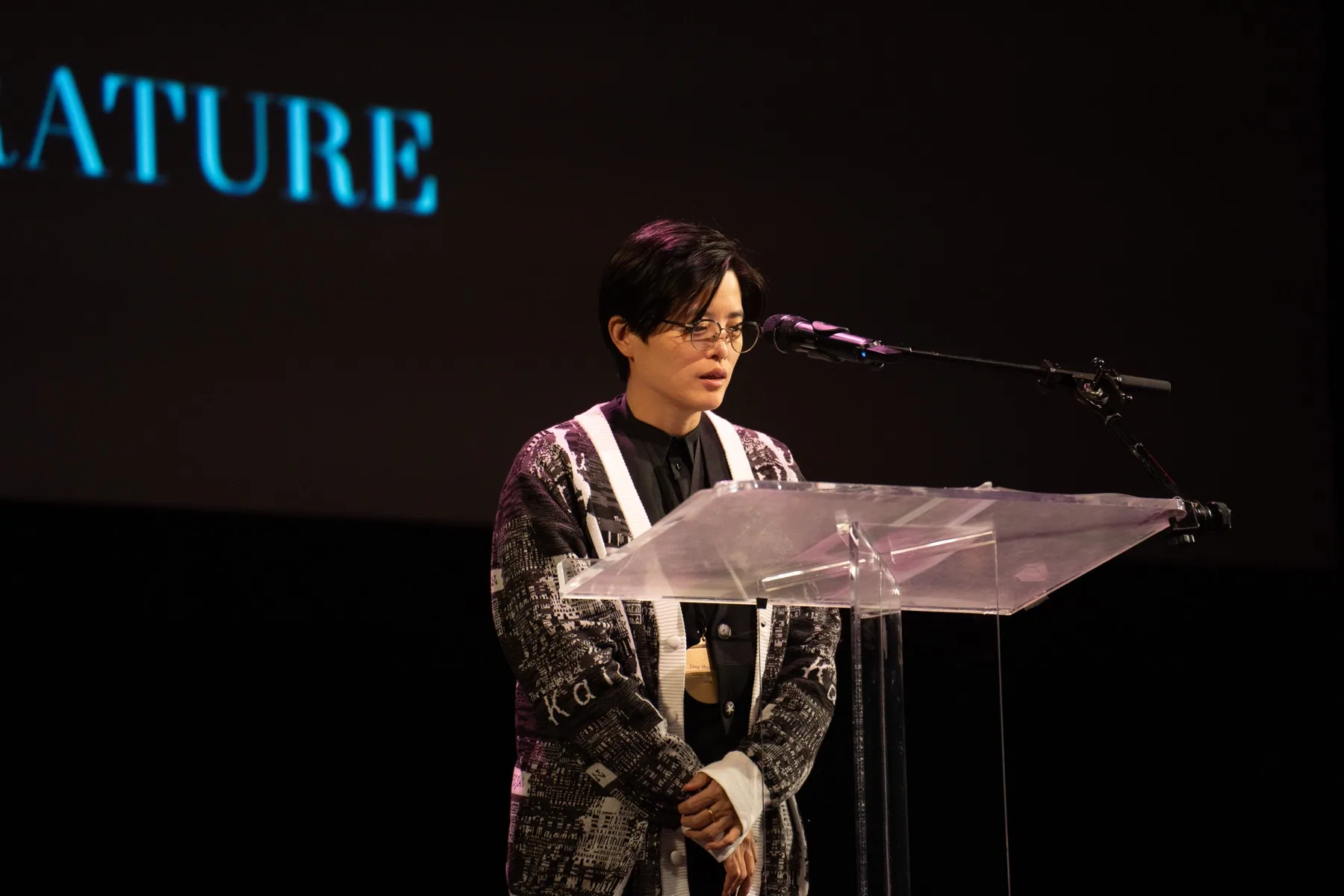
At the National Book Awards finalist reading on November 19, 2024, Yang Shuang-zi read an English excerpt from _Taiwan Travelogue in New York. The following evening, she formally won the award for translated literature. Photo: Bea Phi (Phibeatrice), via Wikimedia Commons, CC BY-SA 4.0._
Further reading:
- Literature of the Japanese Colonial Period — the historical background for the 1938 setting of Taiwan Travelogue, and the lineage of women's and local writing opened by figures such as Yang Chien-ho, Lai He, and Long Yingzong
- Contemporary Taiwanese Literature — how Yang Shuang-zi's generation has carried forward the local writing of Wu Ming-yi, Lin Yi-han, and Luo Yijun into the international market for translated literature
- Taiwanese Literature after the Lifting of Martial Law — the waves of women's writing, queer writing, and mother-tongue literature from the 1987 lifting of martial law to the 2020s, from which Yang Shuang-zi's "yuri" tradition emerges
- History of Taiwanese Literature — the overall context corresponding to the "century-long inquiry" Yang Shuang-zi referred to in her acceptance speech
- Chu Tien-wen — a representative post-martial-law woman writer, whose Notes of a Desolate Man and The Old Capital are important precursors to the fake-translation structure in Taiwanese literature
- Wu Ming-yi — another representative Taiwanese writer in the international translated-literature wave of the 2020s; The Man with the Compound Eyes and The Stolen Bicycle gained visibility in the English-language world
Image Sources
This article uses three Wikimedia Commons images licensed under CC BY-SA 4.0, all cached under public/article-images/art/ to avoid hotlinking source servers:
- Yang Shuang-zi at the 2024 National Book Awards — Photo: Bea Phi (Phibeatrice), 2024-11-20, CC BY-SA 4.0. Yang Shuang-zi at the National Book Awards ceremony at Cipriani Wall Street in New York.
- Yang Shuang-zi and Lin King at the National Book Awards Ceremony 2024 — Photo: Jennifer 8. Lee (Jenny8lee), 2024-11-20, CC BY-SA 4.0. Yang Shuang-zi and translator Lin King pictured together.
- Yáng Shuāng-zǐ, writer, at the 2024 National Book Awards finalist reading 3 — Photo: Bea Phi (Phibeatrice), 2024-11-19, CC BY-SA 4.0. Yang Shuang-zi at the National Book Awards finalist reading.
References
- Central News Agency: "Taiwan Travelogue" wins the International Booker Prize; Yang Shuang-zi: being born Taiwanese is fortune and pride — A May 20, 2026 report by Taiwan's Central News Agency documenting the International Booker Prize ceremony at Tate Modern in London and the prize money details, with the GBP 50,000 divided equally between author and translator.↩
- Official announcement from The Booker Prizes: Taiwan Travelogue Wins the International Booker Prize 2026 — The official International Booker Prize press release, stating that this was the first winning work translated from Chinese into English and the first Taiwanese writer to receive the prize.↩
- Central News Agency: "Taiwan Travelogue" wins the International Booker Prize; full speeches by jury chair, Yang Shuang-zi, and Lin King — Includes Natasha Brown's comment in Chinese translation: "achieves an astonishing double feat: succeeding both as a love story and as a sharp, powerful postcolonial novel."↩
- Central News Agency: Yang Shuang-zi's full International Booker Prize speech — Full transcript, including core passages such as "literature cannot stand outside the soil in which it grows," "literature has never been separate from politics," "before a vastly stronger power, is literature of any use," and "to have been born Taiwanese is my good fortune."↩
- Wikipedia: Yang Shuang-zi — Provides basic biographical information on twin sisters Yang Jo-tzu and Yang Jo-hui, including their July 10, 1984 birth beneath Chenggongling in Wuri District, Taichung, and Yang Jo-hui's death from illness on June 19, 2015.↩
- Mirror Media: Love of the Twins - the story of Yang Jo-tzu and Yang Jo-hui, part one — A 2017 in-depth Mirror Media report documenting the sisters' family background, including their parents' divorce, being raised by their grandmother, and their grandmother's death on Lunar New Year's Day in 1998.↩
- Mirror Media: Love of the Twins - the story of Yang Jo-tzu and Yang Jo-hui, part three — Records how Yang Jo-hui began keeping her first account book at age 15 and continued for 16 years across 11 volumes, as well as the formation of the sisters' collaborative division of labor.↩
- Central News Agency: Yang Shuang-zi, so poor she had only a novelist's dream left; Taiwan Travelogue goes from the local to the international — Documents the sisters' 2009 founding of the doujinshi circle "Maopin," the pen names "Light-colored Cat" and "Half-finished Product," and the origin of their shared pen name "Yang Shuang-zi," with the Japanese term "shuangzi" meaning "twins."↩
- The Reporter: Becoming a translator in fiction, writing a story unique to Taiwanese people - an interview with Taiwan Travelogue writer Yang Shuang-zi — Yang Shuang-zi personally recounts her younger sister's prediction about the draft of The Season When Flowers Bloom: "Once this novel is finished, it will become popular. She always believed I could do it."↩
- Mirror Media: Love of the Twins series — Details how the elder sister took over the accounting on the day her younger sister died, spending three days decoding the check marks, circles, triangles, and other symbols in the account books that only the younger sister had understood.↩
- Openbook: Profile - a novel that creates an author? Interview with Taiwan Travelogue author Yang Shuang-zi (2020) — Yang Shuang-zi's pre-publication 2020 interview with Openbook, in which she said the later frequently quoted line: "All the remaining years of my life were given to me by my younger sister."↩
- Wikipedia: Taiwan Travelogue — Details the March 2020 first edition from SpringHill Publishing, published under the byline "written by Chizuko Aoyama / translated by Yang Shuang-zi," and the pre-publication disclosure of its pseudotranslation structure.↩
- Wikipedia: Taiwan Travelogue - pseudonymous structure of the afterword — Records the book's four-layer pseudonymous structure: the cover author-translator byline, a preface by the fictional figure Niibi Sagako, the 12-chapter main text, and a translator's afterword written in the name of "Yang Jo-hui."↩
- Chu Yu-hsun: The Literary Meaning of Fictional Attribution — A 2020 review by novelist Chu Yu-hsun proposing the classic three-layer analysis: "Yang Jo-hui, as fictionalized by Yang Jo-tzu, translated the work of Chizuko Aoyama, as fictionalized by Yang Jo-tzu."↩
- U People: The twins' lives and writing poured into one person - Yang Shuang-zi's literary travelogue — A 2025 U People interview from United Daily News, in which Yang Shuang-zi explains in her own words the motive behind the pseudonymous design: "I fictionalized Jo-hui writing an afterword, bringing Jo-hui too into the world of Yang Shuang-zi."↩
- Unitas: Review of Taiwan Travelogue — A Unitas analysis stating that the pseudotranslation setup is "a literary dream conjured into being," replacing an original Chinese-language novel with a Japanese translated novel solely to allow the translator "Yang Jo-hui" to return to the world of the living.↩
- Central News Agency: Detailed explanation of the symbolism of the 12 dishes in Taiwan Travelogue — Lists the 12 dishes corresponding to the book's 12 chapters, from melon seeds to rice sieve noodles, jute mallow soup, sashimi, minced pork sauce, winter melon tea, curry, sukiyaki, leftover vegetable soup, tau noodles, salty cake, and sweet bean ice.↩
- Central News Agency: Historical research on the 12 dishes in Taiwan Travelogue — Includes concrete historical details such as salty cake originating at Xuehua Zhai in Fengyuan, Taichung, to welcome Prince Kan'in Kotohito, and sweet bean ice being created by Taichung's Xinfating with reference to Japanese four-fruit ice.↩
- Wikipedia: Taiwan Travelogue (chapter structure & rail route) — The English Wikipedia entry details the north-south railway route in the novel's 1938 setting, from Taihoku (Taipei) to Taichu (Taichung) and Takao (Kaohsiung), as well as the 12-chapter structure.↩
- Openbook: How to "translate" Taiwan? The backstage story of Taiwan Travelogue winning the National Book Award - Yang Shuang-zi x Lin King in conversation with Chuang Jui-lin — A three-way conversation in which Yang Shuang-zi explains the design of Wang Chizuru rejecting Chizuko Aoyama's proposal of "eternal friendship" at the end of the book; the "difficulty of dissolving" colonial relations is central to the writing.↩
- Openbook: Three-way conversation — Records the pointed question SpringHill editor-in-chief Chuang Jui-lin raised during the conversation about the pseudotranslation structure: "Is this a form of anti-colonial counterattack, or does it prove that we are still greatly controlled by empire?" It documents the ethical debate during editing.↩
- Openbook: Chuang Jui-lin's editorial interventions in the three-way conversation — Background on SpringHill Publishing, founded in December 2018 after Chuang Jui-lin left Acropolis Publishing, and its positioning as a publisher of in-depth local writing.↩
- United Daily News: "Taiwan Travelogue" wins the International Booker; Chuang Jui-lin says impact stronger than Han Kang's Nobel — SpringHill editor-in-chief Chuang Jui-lin's statistics: before the Booker Prize, the book had accumulated around 40,000 copies over five years; after the Booker, it was reprinted three times in three days for a total of 70,000 additional copies, bringing the total print run to 110,000.↩
- Wikipedia: Lin King — Full biography of translator Lin King: born December 6, 1993, in New York City; Taipei American School class of 2012; Princeton University class of 2016 in English and East Asian studies; Columbia University MFA in literary translation, class of 2022.↩
- Central News Agency: Lin King's International Booker Prize speech — Lin King's "fruit puree vs. juicy fruit chunks" metaphor for translation in her 2026 Booker speech, opposing the American publishing industry's assumption of "seamless translation."↩
- Openbook: How to "translate" Taiwan? - three-way conversation — Records the market response within one week of the November 20, 2024 National Book Award for Translated Literature win: 15,000 additional copies printed in Taiwan and 9,000 in the United States.↩
- Presidential Office news: President Lai Ching-te receives Yang Shuang-zi and Lin King — A December 19, 2024 Presidential Office press release recording the official reception and speeches; contextual material also notes Lin King's subsequent Baifang Schell and ALTA First Translation Prize awards.↩
- Central News Agency: Rights to Taiwan Travelogue sold in 24 countries, with physical editions published in six — As of May 2026, Taiwan Travelogue had sold rights in 24 countries, including the United States, the United Kingdom, Australia, Japan, South Korea, and Finland, with detailed records.↩
- Openbook: Lin King in the three-way conversation — Lin King's full discussion of the American publishing assumption that "accurate translation is impossible and unnecessary," and her strategic observation of a "flickering opportunity" in the U.S. market for "translating a book about translation."↩
- Central News Agency: Yang Shuang-zi's 2024 National Book Award for Translated Literature speech — Includes the full text of Yang Shuang-zi's November 20, 2024 acceptance speech in New York, including the core passage: "A hundred years ago, there were Taiwanese people saying that Taiwan is the Taiwan of the Taiwanese."↩
- Central News Agency: Yang Shuang-zi's 2026 International Booker Prize speech — Yang Shuang-zi's full Booker speech, emphasizing that literature still has power when facing the threat of invasion by a stronger power, and that literature has never been separate from politics.↩
- Chu Yu-hsun: The Literary Meaning of Fictional Attribution — Chu Yu-hsun argues that the pseudonymous structure of Taiwan Travelogue is a methodological response to the "difficulty of dissolving" colonial relations, and that "amity" is a luxury within a structure of power.↩
- The Reporter: Interview with Yang Shuang-zi — Yang Shuang-zi explains in her own words the writing motive that emerged after the 2014 Sunflower Movement and her thinking on Taiwan-China relations: "The key question to answer was: what exactly is different between Taiwan and China?"↩
- U People: The twins' lives and writing poured into one person — In a deep interview with U People of United Daily News, Yang Shuang-zi mentions her regret that her younger sister did not live to see Taiwan Travelogue win these awards: "If only this result had come a little earlier; perhaps my younger sister could have seen it."↩