Golden Horse Awards: From Mandarin-Only Films to Nationality-Neutrality—Even When Local Films Lose, the Doors Stay Open
30-Second Overview: Founded by the Government Information Office in 1962, the Golden Horse Awards takes its name from the first characters of Kinmen and Matsu. Initially, it only accepted Mandarin-language films, and the first ceremony was held on the President's birthday. Over sixty years, it has progressively expanded eligibility: first allowing films where Tâi-gí (Taiwanese) dialogue did not exceed half, then accepting films from Mainland China; in 1997, it was repositioned as a global competition for Chinese-language cinema; and since 2007, films not primarily in Chinese can apply as long as the director and at least half of the main creative team are ethnic Chinese. Despite these open doors, Taiwanese films frequently lose Best Feature Film at their own awards, yet the Golden Horse has never closed its gates. After Chinese authorities suspended the participation of Chinese films and personnel in 2019, the winners' list continued to include filmmakers from Singapore, Malaysia, and Hong Kong, as well as Chinese directors applying as foreign entries. The nominees for the 63rd Golden Horse Awards in 2026 have been announced; the winners will be revealed on November 22.
In 1963, Hong Kong actress Ling Po came to Taipei to receive her second Golden Horse Award. In Shaw Brothers' Huangmei opera film The Butterfly Lovers, she played the male role of Liang Shanbo in drag. The judges could not decide between Best Actor and Best Actress, so they ultimately presented her with a special "Best Acting Award" 1. During the days she came to collect the award, tens of thousands of people flooded the streets of Taipei, and Hong Kong newspapers jokingly called Taipei the "City of Madmen" 1.
The regulations announced by the Government Information Office the previous year had drawn clear boundaries for this award: films had to possess a valid screening permit, use Mandarin pronunciation or dubbing, and contain content that could "comply with national policies or possess profound ethical educational significance" 2. The regulations also left room for overseas participants; applicants could be domestic production companies or overseas Chinese enterprises that had participated in local free associations or were recognized by embassies and consulates 2. The Best Feature Film of the first year, Stars, Moon and Sun, came from Hong Kong's Motion Picture Company, while the second year's The Butterfly Lovers came from Hong Kong's Shaw Brothers 345.
A 2018 commentary in the American magazine Foreign Policy argued that the Golden Horse has never been separated from politics since its inception; when it was founded in 1962, it was originally part of the Kuomintang government's efforts to garner support from overseas Chinese 6. The regulations could control language and content, but they could not control an actress playing a man on screen. That year, because the rules could not accommodate Ling Po, the judges created an additional award.
In the sixty-plus years since, the Golden Horse has repeatedly encountered people and films that the rules could not contain, and the rules have repeatedly expanded outward. Moving to the present day, regardless of where a film is produced, it can apply as long as more than half of the dialogue is in a Chinese language, or more than half of the main creative team is ethnic Chinese 7. Because of this, Taiwan's own films often lose their biggest prize at home, yet the Golden Horse has never closed its doors again.
A retrospective short film produced by the official Golden Horse Film Festival channel on the eve of the 50th Golden Horse Awards, 〈Fifty Years Ago, Taipei Became the "City of Madmen"〉, returns to the days in 1963 when Ling Po came to Taiwan to receive her award.
The First Characters of Kinmen and Matsu Were Given to Taiwanese-Language Films
The two characters "Jinma" (Golden Horse) have nothing to do with a golden horse. According to the official explanation from the Golden Horse Awards Executive Committee, the name was derived from the first characters of Kinmen and Matsu, while also following the international film festival trend of using "gold" as a prestigious brand8. The Ministry of Culture later clarified the reasoning behind the naming on Facebook: Shen Chien-hung, who was then the Director of the Government Information Office, hoped to use the spirit of the national troops stationed on the outlying islands' front lines to inspire filmmakers9.
When young men draw lots for military service and get assigned to Kinmen or Matsu, people call it "winning a Golden Horse Award" 10. The award that filmmakers spend their whole lives dreaming of and the draft lot that young men fear most share the same name, both originating from those two groups of outlying islands situated off the coast of China.
The three characters "Golden Horse Award" were attached to film awards five years before the official Golden Horse Awards, and they were first attached to Taiwanese-language films. In 1957, Zhengxin News, the predecessor of China Times, organized the first Taiwanese-language film exhibition. It opened on November 1 at the National Taiwan Arts Center and held its awards ceremony on November 30 at the Taipei International House, hosted by President Yu Chi-chung1112. The awards selected by professional judges were called the Golden Horse Awards; Best Actor went to Kang Ming for The Wanhua Skeleton Case, and Best Actress went to Ke Yu-hsia for Three Beauties Competing for a Man1112.
Five years later, the Government Information Office organized the official Golden Horse Awards, but they accepted Mandarin-language films. In that year, Taiwan produced far more Taiwanese-language films; according to data compiled by The Reporter, there were 120 Taiwanese-language films in 1962, while there were only 7 Mandarin-language films13. What the government sought to encourage and what was being mass-produced in the market were films in two different languages. During that wild, grassroots era of Taiwanese-language films, Taiwanese cinema had a complete story of its own.
The linguistic barrier did not loosen for the first time until twenty-one years later. In 1983, because The Son's Big Doll featured Bân-lâm-gú (the Southern Min language), its eligibility for entry became controversial. The Government Information Office ultimately ruled that since the Bân-lâm-gú dialogue did not exceed half of the film, it was permitted to enter2. Two years later, the "Implementation Guidelines for Rewarding Excellent Mandarin Films" shortened the term "Mandarin films" to "national films" (guopian), a move intended by the government to broaden its scope of inclusion2.
The Ceremony Once Held to Celebrate the President's Birthday Was Later Handed Over to Filmmakers
The 1st Golden Horse Awards were held on October 31, 1962, at the Taipei Guoguang Theater (now the Military Arts and Culture Center), with the first Best Actress winner, Yu Min, taking the stage to speak on behalf of all award recipients14. There was a specific intention behind this date; official chronicles state it plainly: "The date for the awards ceremony was set for October 31 to coincide with the President's birthday celebrations, with a birthday gala held immediately following the ceremony." From the 3rd to the 15th awards, the date was changed to October 30 to signify a "warm birthday" (pre-celebration)14.
The 7th awards in 1969 were held at the Taipei Zhongtai Guesthouse, where the President's birthday gala was held at the same venue immediately after the ceremony15. In 1972, the 10th awards were moved directly into the CTS (China Television) studios to be recorded and broadcast alongside the President's birthday gala16. During this period, the Golden Horse Awards were suspended twice: in 1964, one of the reasons listed by the Government Information Office was that "Taipei society is tending toward extravagance and indulgence; from a social perspective, there is no necessity to hold it"4, and in 1974, it was suspended again due to the hosting of an Asian film festival17.
Starting in 1978, the list of winners began to be announced live at the ceremony, and official hosts were appointed. One of the hosts that year was Ling Bo, who fifteen years earlier had caused crowds of tens of thousands to flock to the streets of Taipei18. The following year, the ceremony date "was no longer restricted to October 30," meaning the awards no longer had to be tied to birthday celebrations19.
In 1983, Government Information Office Director James Soong handed over the "Golden Horse Awards" plaque, inscribed by Zhang Daqian, to the Film and Television Association. Official records note this as "symbolizing that the Golden Horse Awards would henceforth be managed by civil society"20. The following year, the Golden Horse Awards were "handed over to civil society for the first time," with the Film and Television Association convening a working committee21. By the 27th awards in 1990, the Government Information Office officially handed the organization of the Golden Horse Awards to the Motion Picture Development Foundation, which established a permanent Golden Horse Executive Committee; its first chairman was director Li Hsing822.
In 1993, filmmakers from mainland China participated in Golden Horse-related activities as an official delegation for the first time23. In 1996, six years after management was handed to the Foundation, films from mainland China were eligible to apply for the first time2. In 1999, the Executive Committee reached an agreement with the Government Information Office: government officials would not be proactively invited to the awards ceremony, and any political figures in attendance "would not go on stage, would not give speeches, and would not present awards"24. From celebrating the President's birthday to asking political figures to sit in the audience, the stage has been returned to the filmmakers.
Hong Kong Actors Sweep Most Best Actor Awards, While Taiwanese Directors Take Home Best Feature Film
In 1980, the Golden Horse Awards held its first International Film Appreciation Exhibition, screening 15 films; nine years later, the entire event was officially named the "Taipei Golden Horse Film Festival" 2526. That appreciation exhibition also featured screenings and symposiums for works by rising Hong Kong directors, inviting Tsui Hark, Stanley Kwan, Ngan Hiu, and Ann Hui to Taiwan for exchange 25. The following year, Tsui Hark won Best Director for Night Fragrance 27.
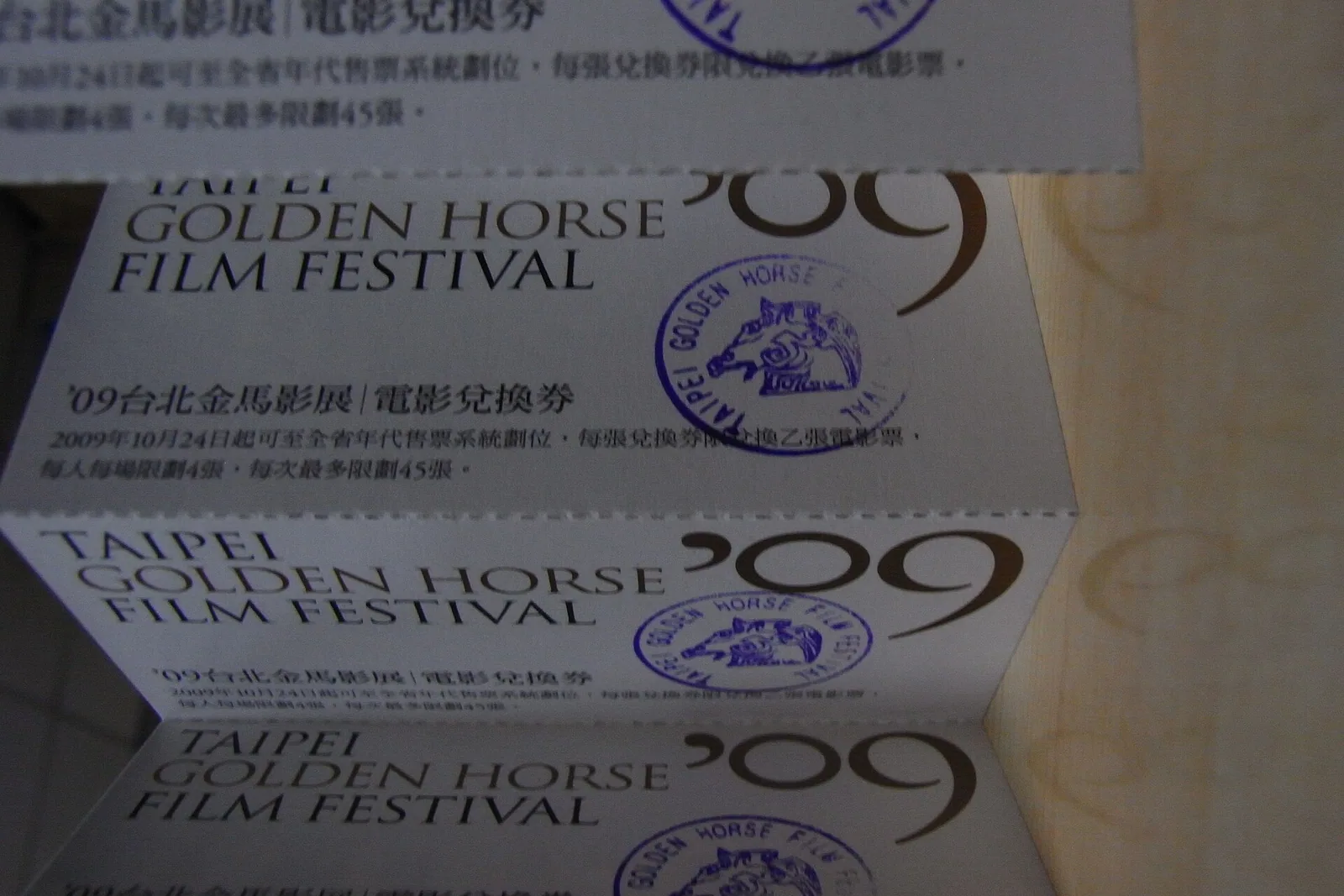
Movie vouchers from the 2009 Taipei Golden Horse Film Festival, bearing the Golden Horse horse-head seal. The Golden Horse film festival grew out of the first International Film Appreciation Exhibition held in 1980. Photo: ddio / Wikimedia Commons, CC BY-SA 2.0.
Over the next fifteen editions, Hong Kongers were constantly moving in and out of the Golden Horse stage: between 1981 and 1995, eleven Best Actor awards were given to Hong Kong actors, with Chow Yun-fat winning twice in 1985 and 1987 282930. Seven Best Director awards went to Hong Kong directors—Tsui Hark, Cheung Kwok-ming, Mak Tong-hung, John Woo, Lo Kai-rui, Ngan Hiu, and Wong Kar-wai, in that order—while the other eight went to Taiwanese directors 30. For Best Actress, the split was even, with seven awards each for both sides; Maggie Cheung won twice in 1989 and 1991 3132.
| Award | Taiwan | Hong Kong | Other |
|---|---|---|---|
| Best Feature Film (by Director) | 11 | 4 | 0 |
| Best Director | 8 | 7 | 0 |
| Best Actor | 4 | 11 | 0 |
| Best Actress | 7 | 7 | 1 |
Source: Taipei Golden Horse Film Festival Executive Committee Nominees and Winners Database 1981–1995; regions based on common affiliation of directors and actors. Tsai Ming-liang is counted as Taiwan, while Chinese-American Joan Chen is counted as Other.
The distribution for Best Feature Film was the reverse: out of those fifteen editions, eleven were awarded to works by Taiwanese directors. These included Chen Kun-hou's The Story of Xiao Bi, Chang Yi's I've Lived My Life Like This, Yang De-chang's Terrorizers and A Brighter Summer Day, Wang Tung's The Scarecrow and Silent Hills, Ang Lee's The Wedding Banquet, and Tsai Ming-liang's Vive L'Amour, which was filmed in Taiwan 30. Hong Kong directors won four times, including a three-year streak from 1988 to 1990 with Seven Little Fortunes, Three Women's Stories, and Red Dust 333134. While Taiwanese directors' films secured their own biggest awards during these years, the Hong Kong stars and directors helped this Taiwan-based award reach beyond Taiwan.
The eligibility rules expanded outward during this same period; much like the year of Ling Bo, every step forward first encountered those who could not fit in. In 1989, Return of the Elegance was disqualified because it used actors from mainland China and thus could not obtain a screening permit; Swiss actress Sze Qin Gao Wa also could not apply because she did not hold actor status in either Taiwan or Hong Kong 2. In 1991, individual awards were relaxed to "any person of Chinese descent may apply," provided they joined film organizations in Taiwan or Hong Kong; Australian cinematographer Christopher Doyle immediately protested that the Golden Horse Awards excluded non-Chinese people 2. Two years later, the rules were relaxed again: foreign nationals could also apply if they had participated in the production of at least three national films, joined film organizations in Taiwan or Hong Kong, and provided proof 2.
Once the Doors Opened to the Mainland, Taiwanese Films Often Lost at Home
In 1992, the Mainland Affairs Council allowed films from mainland China to be released in Taiwan, provided that the proportion of mainland Chinese directors and screenwriters did not exceed half; the following year, the Golden Horse Awards also opened nominations to such films2. Films exceeding this ratio were still barred from entry. In 1994, the Executive Committee resolved that even if a film won major awards at international film festivals and held a valid screening permit, it could not participate if it did not meet the required ratio; consequently, Farewell My Concubine and To Live were unable to compete2.
In 1996, eligibility requirements were changed to films that used a Chinese language as their primary spoken language—including Tâi-gí (Taiwanese/Hokkien) and other dialects—regardless of the country of origin, funding structure, or nationality of the cast and crew. This allowed mainland Chinese films to apply for the first time2. That year, the awards ceremony was held in Kaohsiung, and the mainland film In the Heat of the Sun won six awards, including Best Feature Film, Best Director, and Best Actor35. The following year, the Government Information Office abolished the "Measures for Rewarding Excellent Mandarin Films," repositioning the Golden Horse Awards as a global competition for Chinese-language cinema. The annual subsidies for the ceremony and prize money were also handed over to the Executive Committee for full discretion36. In 1999, the requirement that "nominated films must hold a valid screening permit" was removed, and in 2007, another step of liberalization occurred: films where the director and at least half of the core creative team are Chinese could apply even if they did not use a Chinese language as their primary spoken language2.
Source: Taipei Golden Horse Film Festival Executive Committee, "Evolution of Awards"
Between 1996 and 2009, after the doors were widened, Taiwanese directors won only four out of fourteen Best Feature Film awards: Ang Lee's Crouching Tiger, Hidden Dragon and Lust, Caution, Chang Tso-chi's Millennium Mambo, and Tai Lap-nin's No Way to Hide37383940. The other ten awards went to films directed by people from Hong Kong, mainland China, and elsewhere; titles such as In the Heat of the Sun, Comrades: Almost a Love Story, Infernal Affairs, Kung Fu Hustle, and The Warlords were among them3541.
In 1997, the Golden Horse Awards added the "Jury Grand Prize" and the "Jury Special Prize" to reward Taiwanese cinema and filmmakers. The film prize was later renamed the "Best Taiwan Film of the Year" or the "Formosa Film Award," and in 2007, it was titled the "Outstanding Taiwanese Film of the Year"2. In 2008, Cape No. 7 won this award, which was reserved exclusively for Taiwanese films; that year's Best Feature Film went to Peter Chan's The Warlords42. By 2011, the Executive Committee abolished this film prize reserved only for Taiwanese films, providing only a single-sentence official reason: "In response to the trend of Chinese-language co-productions"2. The individual award, "Outstanding Taiwanese Filmmaker of the Year," continues to be presented to this day43.
📝 Curator's Note
If one wanted to protect domestic cinema, the easiest way would be to keep the doors narrow—only accepting Taiwanese films—or set up more hurdles for co-productions. The Golden Horse took a different path: it kept the doors open but set up a separate table inside specifically for Taiwanese films. Once co-productions became the norm in Chinese-language cinema, they even removed that specific film award reserved for Taiwan. The winners' lists in the following years can be used to reflect upon this choice.
In the seven years from 2012 to 2018, only one Best Feature Film was officially listed with "Taiwan" as its country: The Bold, the Corrupt, and the Beautiful in 201744; The Assassin in 2015 was a co-production between Taiwan, Hong Kong, and China45. From 2019 to 2022, A Sun, The Broken Circle Returns, The Falls, and Family Stage were all Taiwanese films for four consecutive years46474849. Counting from 2010 to 2025, out of sixteen Best Feature Film winners, eight are officially listed only as Taiwan; seven belong to China, Singapore, Japan, or are co-productions with them, and one is a co-production involving Taiwan50.
| Period | Listed only as Taiwan | Co-production involving Taiwan | Other countries or regions |
|---|---|---|---|
| 2010–2011 | 2 | 0 | 0 |
| 2012–2018 | 1 | 1 | 5 |
| 2019–2025 | 5 | 0 | 2 |
Source: Taipei Golden Horse Film Festival official website, film database "Country/Region" column, Best Feature Film winners from 2010–2025
Two Speeches on Stage, and the Empty Seats the Following Year
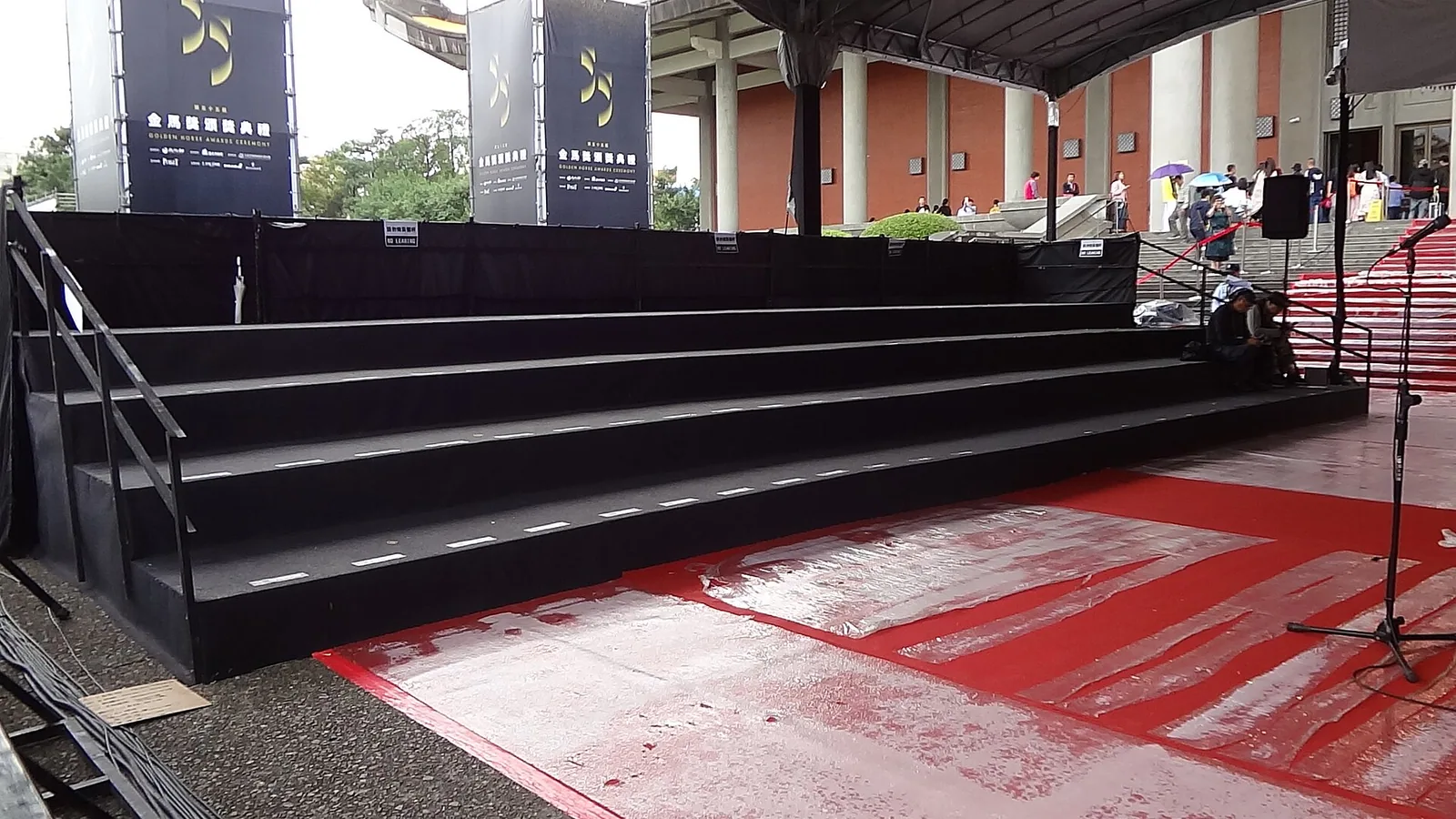
On November 17, 2018, during the ceremony, the press area of the 55th Golden Horse Awards red carpet outside the Sun Yat-sen Memorial Hall had its red carpet covered with waterproof plastic sheeting. Photo: Solomon203 / Wikimedia Commons, CC BY-SA 4.0.
At the 55th awards in 2018, Chinese films took home several major prizes: Zhang Yimou won Best Director for Shadow, Xu Zheng won Best Actor for Dying to Survive51, and Best Feature Film was awarded to _An Elephant Sitting Still by the late young director Hu Bo, who passed away in 201752. The jury president that year was Gong Li, and the chairman of the Executive Committee was Ang Lee52.
That night, the Best Documentary award went to Fu Yu for Our Youth, in Taiwan. The following day, she posted the full text of her speech on Facebook, ending with: "I hope that one day, our country can be regarded as a truly independent entity; this is my greatest wish as a Taiwanese person."53 Following her, Tu Hung—the previous year's Best Actor who went on stage to present the Best Actress award—stated that he had come to "Chinese Taipei"54.
Fu Yu's Facebook post also responded to the other remarks made on stage: regarding the subsequent appearances of "Chinese Taipei" and "cross-strait families are one," she wrote, "I respect it, but I certainly cannot agree." She stated that her remarks were "not a 'momentary impulse'" and acknowledged that she might no longer be able to communicate with many Chinese filmmakers in the future, writing: "I am willing to bear all the consequences that may face my future career, and I do not regret it."53
Gong Li, who was originally supposed to present Best Feature Film alongside Ang Lee, remained below the stage that night and did not appear in the media interview area after the ceremony ended55. In an interview after the ceremony, Ang Lee said: "I feel the basic spirit is that here in Taiwan, it is free, the film festival is open; they can say whatever they want to say. We absolutely cannot say you cannot say something or how you should behave." When asked if filmmakers would be affected next year, he said: "I don't know, let's think about it tomorrow. I have done my best to act as a host and have given my all."55 After the ceremony, many Chinese filmmakers reposted "China cannot be divided by even a little bit" on Weibo5556.
By the July 31 deadline for entries for the 56th awards the following year, there were only 148 feature films registered, compared to 228 the previous year, though the total number of entries reached a new high57. Reports the next day pointed out that China had scheduled its official Golden Rooster Awards ceremony for November 23, the same day as the Golden Horse Awards58. On August 7, citing news from the China Film Administration, the China Film News announced a suspension of mainland Chinese films and personnel participating in the 56th Golden Horse Awards59.
When asked about the reason that day, Long Mingbiao, deputy director of the Taiwan Affairs Office, said that "Taiwan's current political situation and political ecology will bring many problems"59. The response from the Golden Horse Executive Committee was brief: "If true, it is certainly regrettable. Currently, the Golden Horse Awards have entered the judging stage, and all Golden Horse activities will be held as usual."60 Following the announcement, media reports suggested that several registered Hong Kong-Mainland co-productions, such as Storm Drug Lord, had withdrawn61. In September, Hong Kong director Johnnie To, who was originally serving as jury president, resigned; the Executive Committee stated the reason was restrictions in his production contract with film investors. Wang Tung took over as jury president6263.
On the night of the 56th awards ceremony, an Associated Press reporter asked Ang Lee if the absence of Chinese filmmakers and films constituted a loss. He replied, "It is certainly a loss." He continued: "Both the red carpet and the number of entries are thinner than in the past, but the participating works this year will not be inferior."64
Of course, it is a bit regrettable, but our arms are always open. As long as it is Chinese-language cinema, we welcome you; we cannot control the outside world.
Source: CNA, 2019-11-24
During the Years Chinese Films Were Absent, Lou Ye and Fan Bingbing Still Won Golden Horses
Nanyang names actually appeared on the Golden Horse rosters even earlier: at the 50th awards in 2013, Singaporean director Anthony Chen's Ilo Ilo became the first Singaporean film to win Best Feature Film, and he also won Best New Director that same night6566. Since 2019, this trend has grown longer: Yang Yan-yan won Best Actress in 2019 for Tropical Rain67, Teo Shun-fong won Best New Director in 2020 for Apprentice68, and Taiwanese actor Wu Kang-ren won the top prize in 2023 for the Malaysian film Tiger Stripes6970. In 2025, Chinese actress Fan Bingbing won Best Actress for Earth Mother, directed by Teo Shun-fong; as she could not attend in person, Teo accepted the award on her behalf71.
Hong Kong films have also taken the stage year after year since 2019: ों Revolution won Best Documentary in 202172, Anthony Wong and Chung Suet-ying both won top honors for Hong Kong films7374, and in 2025, Best Director was awarded to Hong Kong director Li Jun-shuo for The Crowd75. In a 2021 interview with AFP, Revolution director Chung Kwai-wai said that for Hong Kong films that cannot be screened in Hong Kong, the Golden Horse has become a free outlet76.
Films by Chinese directors are also still on the list, they just do not enter under the category of "Chinese films": the 2023 Best Feature Film, The Gate, directed by Huang Chi and Ryuji Otsuka, was filmed in China, but official records classify it as a Japanese film7077. In 2024, Chinese director Lou Ye won both Best Feature Film and Best Director for An Unfinished Film; this film was officially classified as a Singapore-Germany co-production, and at the time of its win, it had still not been released in China78. The American entertainment media outlet Variety wrote bluntly that year: Taiwan's top awards went to films by three Chinese directors working outside the official Chinese system78.
In 2025, Korean-Canadian director Lloyd Lee CHOI won Best New Director for Lucky Lu, making him the first non-Chinese winner of this award79. Current regulations offer two paths for film eligibility; a film needs only to meet one: more than half of the dialogue is in a Chinese language, or more than half of the creative crew are ethnic Chinese7. For films following the first path, any director can enter. That same night, the star of Lucky Lu, Chang Chen, won Best Actor, and Best Feature Film went to Chen Yu-hsun's 大濛79.
Taiwanese films won Best Feature Film for four consecutive years from 2019 to 2022, falling exactly within the years that Chinese films were absent63. The suspension by Chinese authorities has not been lifted as of 2024; in that year's 61st edition, among the 718 entries, there were still over two hundred works from China808182, but the one that ultimately took Best Feature Film was Lou Ye's film that had not been released in China. In 2025, Fan Bingbing won the Golden Horse Best Actress nonetheless. While the door is closed on the Chinese side, it remains open here in Taiwan.
Golden Horse Official Channel: The Best New Director at the 62nd Golden Horse Awards is Lloyd Lee CHOI for his feature directorial debut, 《幸福之路》Lucky Lu. He is the first non-Chinese winner of this award.
The 63rd Awards' Most Nominated Film is by Japanese Director SABU
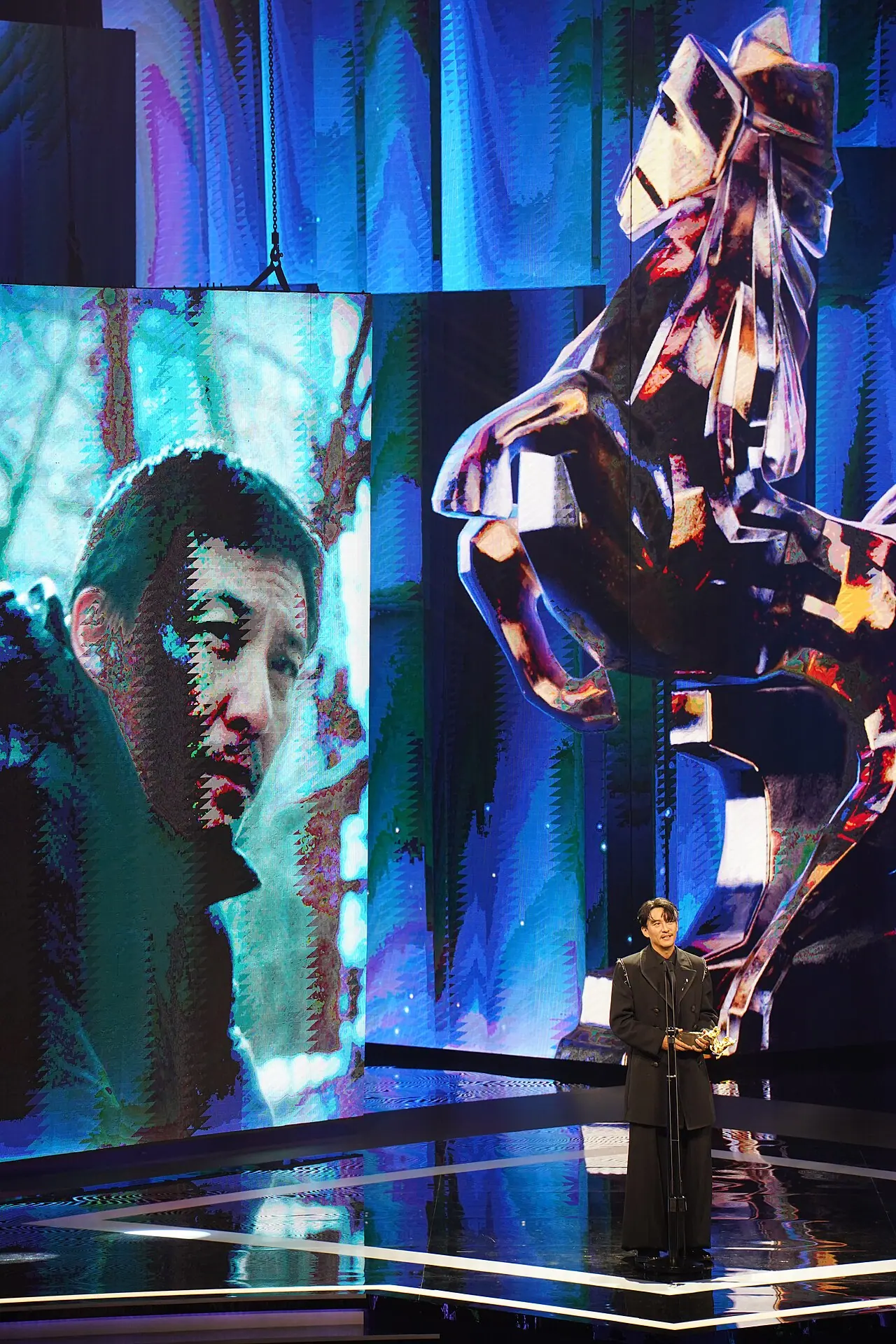
On November 22, 2025, Chang Chen won Best Actor for the second time with "The Road to Happiness"; he will succeed as the Chairperson of the Golden Horse Executive Committee starting in 2026. Photo: Jennifer 8. Lee / WikiPortraits / Wikimedia Commons, CC BY-SA 4.0.
The most nominated film for the 63rd Golden Horse Awards in 2026 is Forgetful Detective, directed by Japanese director SABU, which received 11 nominations4383. Among the nominees for Best Director is Singaporean director Anthony Chen, who won Best Feature Film in 201383. There were 587 entries this year, including 92 feature films43.
Weng Chien-yu, who won Best Actress for The Real and the Fake Heiress in 1972, was nominated for Best Supporting Actress for The Sunshine Girls, marking a gap of 54 years8483. Other nominees in the same category include Lin Pin-tung, who won Best Actress at the age of 12 in 2023; her nominated work, Girl, is Shu Qi's first feature film written and directed by herself, and Shu Qi was also nominated for Best New Director6983.
Jury President Ang Lee has been nominated for a Golden Horse Award 21 times, winning Best Actress three times for My Grandpa, Most Beloved, and The Dim Light of the Lamp. This marks her return as Jury President after 15 years85. She addressed this year's filmmakers: "Welcome to the Golden Horse!" She remarked that here, there are spirited young stallions, steady middle-aged horses, and also "old horses who should not be underestimated—after experiencing all the rugged paths, their passion remains undiminished as they gallop with composure"85.
The Chairperson of the Executive Committee has changed to Chang Chen. Having won Best Actor twice in 2021 and 2025, he takes over the chairmanship in 2026. Upon taking office, he said: "I shouldn't decline. Perhaps I should be like Forrest Gump and just keep running. I hope the next Golden Horse remains very 'Golden Horse'."86
The Lifetime Achievement Award was presented to director Yu Kan-ping; his 1983 film The Misplaced Bus led Sun Yue to win the Golden Horse Best Actor award8788. Speaking about this award, he said: "Film allows me to leave behind stories of this land of Taiwan and its people, and to remember those voices easily overlooked and the warmth of the era."87 The Outstanding Taiwanese Film Professional of the Year was awarded to colorist Chou Chia-sheng; the jury's citation noted that he has "worked in post-production color grading for nearly thirty years, spanning from the film era to the digital age"43.
The winners will be announced on the evening of November 22 at the Taipei Music Center. Starting this year, the Golden Horse Awards will be held on Sundays and will be broadcast live on TTV85.
That Horse, Still Yang Ying-feng's Horse
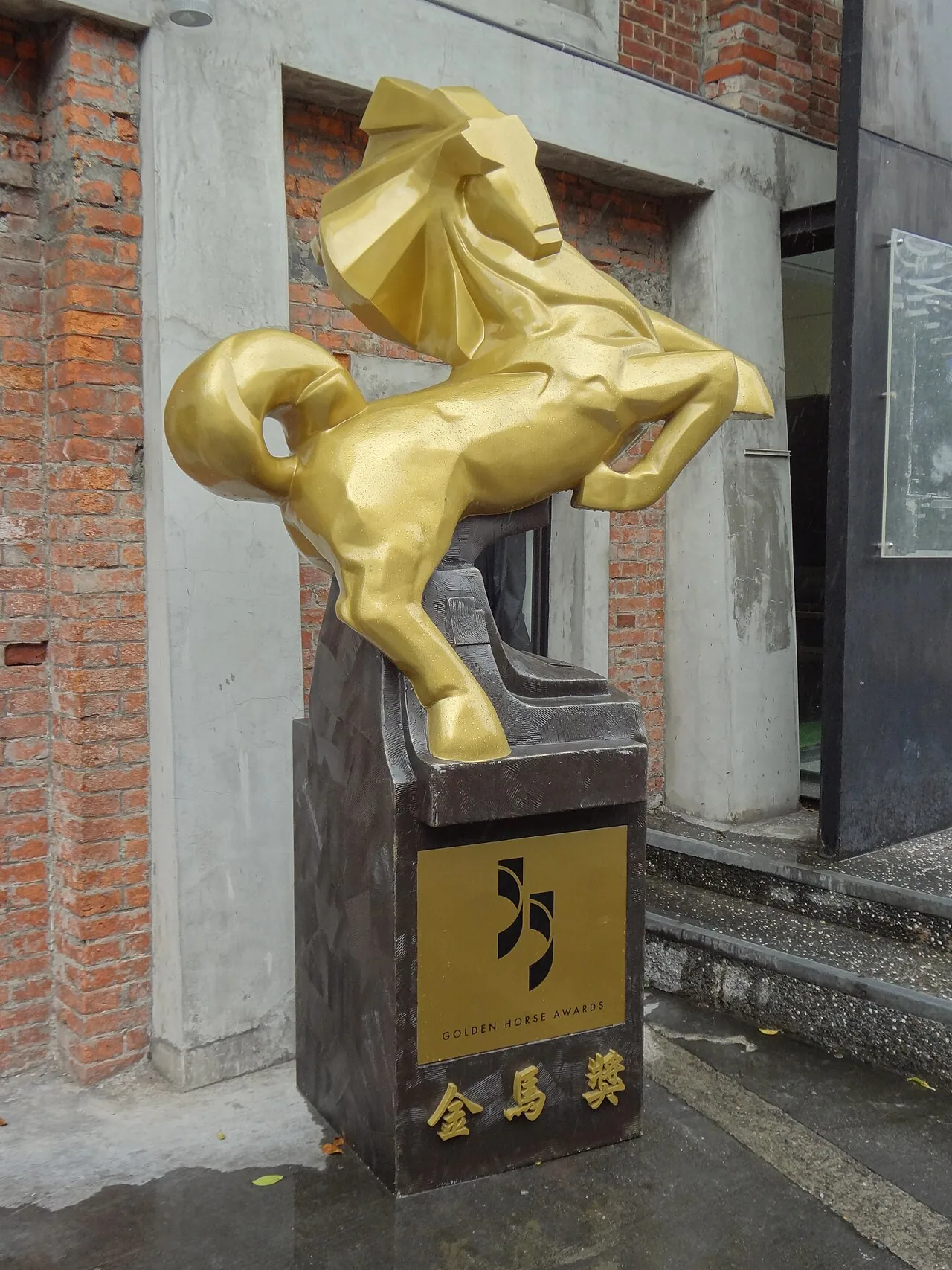
In November 2018, the carving of the 55th Golden Horse Award trophy was displayed outdoors in the rain at the Taipei Film Park. This is a large-scale sculpture used for exhibition, following the design of Yang Ying-feng's galloping horse. Photo: Solomon203 / Wikimedia Commons, CC BY-SA 4.0.
According to the official Golden Horse website, it is no longer possible to trace who designed the trophy for the first ceremony. For the second ceremony, young sculptor Yang Ying-feng was invited to design the trophy, which was in 1963 when Ling Bo came to Taipei to receive her award89. The Yang Ying-feng Digital Art Museum, curated by National Yang Ming Chiao Tung University, holds another record stating that he was invited to design medals for the Golden Horse Awards as early as 196290. Yang Ying-feng once wrote about his thoughts on this horse: "Initially, I used Yin and Shang dynasty patterns to create a relief titled 'Looking Toward the Horse's Head' to express the exemplary elegance of the award winners. Subsequently, in response to the progress of the times, each successive term saw slight evolutions, gradually progressing into the design of a galloping warhorse"89.
The design of the trophy has changed its central shape several times; however, from the 24th ceremony onward, the horse's body returned to Yang Ying-feng's original design. During the 30th anniversary of the Golden Horse Awards, Chairman Lee Hsing suggested that the design be fixed from then on, with the horse's body and the pedestal cast as a single piece89. Since the 42nd ceremony in 2005, the trophy has consistently been gold, standing 30 cm tall and weighing 3.4 kg, made of bronze covered in gold leaf89. In 2020, 81-year-old Chen Shu-fang won both Best Actress and Best Supporting Actress on the same night91. On stage, she joked that the Golden Horse Awards were giving this old lady a hard time—even in her eighties, she still had to hold such a heavy trophy, but she insisted on clutching it tightly92.
For over sixty years, the appearance of that horse has not changed much; what has changed is who gets to go on stage to receive it. In 1963, the judges created a separate award for an actor who didn't quite fit into Best Actor or Best Actress; in 2025, Best New Director was awarded for the first time to a non-Chinese director.
The first characters of Kinmen and Matsu remain the name of this award to this day. Conscripts fear drawing these two words [in their military service lottery], just as every November in Taipei, these same two words are bestowed upon filmmakers.
Further Reading:
- Taiwanese Cinema: The Voice Beside the Screen, and a Film History That Died and Came Back to Life — Where those Taiwanese films awarded by the Golden Horse come from: the golden age of Tâi-gí (Taiwanese language) films, the New Cinema movement, to Cape No. 7 breathing new life into domestic cinema.
- Golden Melody Awards: Taiwan Awarding Its Own Music — The other pillar of the "Three Golds"; how Taiwan awards its own music and decides which sounds are worth remembering.
- Golden Bell Awards: Seventeen Years After the Three Awards Swapped Roles — In 1971, television news footage moved from the Golden Horse to the Golden Bell Awards; from then on, film and television each had their own awards.
- From the Golden Horse Awards to the Han Kuang Exercises — The "Golden Horse Awards" mentioned by conscripts refers to the lottery ticket that sends them to serve in the outlying islands of Kinmen or Matsu.
- Golden Horse Hotel Contemporary Art Museum — How a transit station in Kaohsiung used to send soldiers to Kinmen and Matsu was turned into an art museum, sharing the same name as the Golden Horse Awards.
Image Sources
This article uses 5 Creative Commons licensed images, all cached in public/article-images/art/ to avoid hotlinking from source servers; it also embeds 2 videos from the official Golden Horse Film Festival channel.
- A Foggy Tale, winner of best narrative film, 2025 Golden Horse Awards 01 — Photo: Jennifer 8. Lee / WikiPortraits, 2025-11-22, CC BY-SA 4.0 (hero)
- Taipei Golden Horse Film Festival tickets 20091023 — Photo: ddio, 2009-10-23, CC BY-SA 2.0
- Walk of Fame press, Golden Horse Awards 20181117a — Photo: Solomon203, 2018-11-17, CC BY-SA 4.0
- Chang Chen at the 2025 Golden Horse Awards Ceremony 03 — Photo: Jennifer 8. Lee / WikiPortraits, 2025-11-22, CC BY-SA 4.0
- Golden Horse Awards trophy sample in Taipei Cinema Park 20181117a — Photo: Solomon203, 2018-11-17, CC BY-SA 4.0
- Videos: TGHFF Official Channel 〈Golden Horse Gallop · Classics 50 | Fifty Years Ago, Taipei Became a "City of Madmen"〉, 〈The 62nd Golden Horse Awards Best New Director | Lloyd Lee CHOI〉
References
- Chronology 1963 (Golden Horse Awards Executive Committee) — The annual chronology from the Golden Horse Executive Committee's official website, recording how Ling Bo played a male role in cross-dressing for "Where Are They Now" (Liang Shanbo and Zhu Yingtai), the jury's decision to award a "Special Award for Best Acting" after being unable to decide between the best leading actor and actress, and how tens of thousands of people filled the streets of Taipei when Ling Bo came to Taiwan to receive the award, leading Hong Kong newspapers to jokingly call it the "Madman City."↩2
- Evolution of Awards (Golden Horse Awards Executive Committee) — A record of rule changes by decade on the Golden Horse official website, including the 1962 application criteria for the Mandarin Film Incentive Program, the eligibility of "Playboy" in 1983, the opening of individual awards to ethnic Chinese and the protests by Christopher Doyle in 1991, the inability of "Farewell My Concubine" and "To Live" to compete in 1994, the inclusion of Mainland Chinese films in 1996, the addition of a Jury Prize for encouraging Taiwanese films in 1997, further relaxation of eligibility in 2007, and the abolition of the Annual Outstanding Taiwanese Film in 2011.↩234567891011121314
- 1st Golden Horse Nominees and Winners (Golden Horse Awards Executive Committee) — The 1962 page of the official nominees and winners database, listing the first Best Feature Film "Star, Moon and Sun" produced by Lee Motion Film Company, and the first Best Actress, You Min.↩
- Chronology 1964 (Golden Horse Awards Executive Committee) — The official website's chronology recording that the Golden Horse Awards were suspended for one year, citing three reasons announced by the Government Information Office: the Asia-Pacific Film Festival had just been held in Taipei, Taipei society was becoming too frivolous, and the plane crash of Lu Yun-tao, the boss of Lee Motion and a Hong Kong film tycoon, had severely damaged the vitality of the film industry.↩2
- The Golden Horse Awards You Didn't Know (CNA) — A 2016 retrospective article by Central News Agency (CNA) on the anecdotes of the Golden Horse Awards, mentioning that "Where Are They Now" was produced by Hong Kong's Shaw Brothers in 1963 and Ling Bo's cross-dressing performance caused a sensation in Taiwan, as well as how the name "Golden Horse Award" was first used by the Chingsen News Agency's Taiwanese-language film festival in 1957.↩
- Taiwanese Filmmakers Can't Escape Beijing's Grip (Foreign Policy) — A commentary from the November 2018 issue of the American magazine Foreign Policy, arguing that the Golden Horse Awards have never been apolitical and were part of the Kuomintang government's efforts to gain support from overseas Chinese when founded in 1962.↩
- The 63rd Golden Horse Awards Regulations (Golden Horse Awards Executive Committee) — Current application regulations on the official Golden Horse website, stating that a film's language and crew proportions must meet one of two conditions: more than half of the dialogue in the film is in Chinese, or more than half of the main creative crew for feature films are ethnic Chinese (for short films, the director must be ethnic Chinese).↩2
- About Us (Golden Horse Awards Executive Committee) — Official introduction from the Golden Horse Executive Committee, explaining that the name "Golden Horse" takes the first character from Kinmen and Matsu and aligns with the film festival trend of having a "golden brand"; in 1990, the 27th edition was transferred from the Government Information Office to be hosted by the Film Development Foundation, which also established the Executive Committee.↩2
- Origin of the Golden Horse Name and Trophy? 5 Secrets Revealed (SET News) — A 2020 report relaying a Facebook post from the Ministry of Culture, explaining that when naming the awards, Government Information Office Director Shen Jian-hong hoped to inspire filmmakers with the spirit of the frontline troops in Kinmen and Matsu; the origin of "Golden Horse" is not a golden horse.↩
- Winning the Golden Horse Award During Military Service: The Secret of Serving on Outlying Islands (TVBS) — A 2014 TVBS report about conscripts calling being drafted to serve on the outlying islands of Kinmen and Matsu "winning the Golden Horse Award," introducing the life and service conditions of soldiers on the islands.↩
- (First) Taiwanese-Language Film Exhibition (National Center for Traditional Arts, Taiwan Audiovisual Museum) — A 1957 newsreel description archived by the National Center for Traditional Arts, recording that the first Taiwanese-language film festival organized by Chingsen News opened on November 1 at the National Taiwan Art Museum and closed with an awards ceremony on November 30 at the International House; Best Actor Golden Horse Award winner Kang Ming, Best Actress Golden Horse Award winner Ke Yuxia.↩2
- November 30, 1957 "The First Taiwanese-Language Film Exhibition" (Treasured Taiwan) — A compilation by a Taiwanese historical materials publisher regarding the first Taiwanese-language film festival, recording that the awards ceremony was held on November 30 at the International House and presided over by President Yu Ji-zhong; professional judges selected the "Golden Horse Award" while audiences voted for the "Silver Star Award," listing winners such as Best Director Chang Ying and Best Actress Ke Yuxia.↩2
- Really? Was the First "Golden Horse Award" Actually a Taiwanese-Language Film Festival? (The Reporter) — A youth edition article by The Reporter exploring the relationship between the Taiwanese-language film festival and the official Golden Horse Awards, pointing out that in 1962, the year the official Golden Horse Awards began, there were still 120 Taiwanese-language films compared to only 7 Mandarin films.↩
- Chronology 1962 (Golden Horse Awards Executive Committee) — The first entry in the official website's chronology, recording that the ceremony was held at the Taipei Guoguang Theater on October 31 "to signify celebrating the President's birthday," that from the 3rd to the 15th editions the date was changed to October 30 for a birthday celebration, and that the first Best Actress, You Min, delivered a speech on behalf of all winners.↩2
- Chronology 1969 (Golden Horse Awards Executive Committee) — The seventh entry in the official website's chronology, recording that the awards ceremony was held at the Kowloon Hall of the Chung Tai Hotel in Taipei, followed by a presidential birthday celebration held at the same venue.↩
- Chronology 1972 (Taipei Golden Horse Film Festival Executive Committee) — The 10th edition entry in the official website's chronology, recording that activities were streamlined and moved to the CTS studio, held alongside a birthday celebration for the President and broadcast via direct recording.↩
- Chronology 1974 (Taipei Golden Horse Film Festival Executive Committee) — The official website's chronology records that the Golden Horse was suspended once under the pretext of hosting Asian film festivals, marking its second suspension.↩
- Chronology 1978 (Taipei Golden Horse Film Festival Executive Committee) — The official website's chronology records that judging was changed to a two-stage process, with winners selected and announced on the day of the ceremony; the 15th edition officially added hosts Wang Hao and Ling Bo, and was recorded for television broadcast.↩
- Chronology 1979 (Taipei Golden Horse Film Festival Executive Committee) — The 16th edition entry in the official website's chronology, recording that the ceremony moved to the Taipei National Chiang Kai-shek Memorial Hall, the date was no longer restricted to October 30 and expanded into a gala, and international film stars were invited to attend for the first time.↩
- Chronology 1983 (Taipei Golden Horse Film Festival Executive Committee) — The official website's chronology records that Director-General of the Government Information Office, James Soong, handed over a 'Golden Horse Awards' plaque inscribed by Zhang Daqian to the Film and Drama Association, symbolizing the future transfer of the Golden Horse Awards to private management.↩
- Chronology 1984 (Taipei Golden Horse Film Festival Executive Committee) — The official website's chronology records that the Golden Horse Awards were handed over to private management for the first time, with the Film and Drama Association of the Republic of China serving as the convener of the working committee and the Film Producers Association serving as the rotating secretariat.↩
- Chronology 1990 (Taipei Golden Horse Film Festival Executive Committee) — The official website's chronology records the establishment of the permanent organization, the Taipei Golden Horse International Film Festival Executive Committee, with directors Li Hang and Li Tianduo serving as Chairman and Secretary-General respectively.↩
- Chronology 1993 (Taipei Golden Horse Film Festival Executive Committee) — The 30th edition entry in the official website's chronology, recording that a head of state was invited to attend the awards ceremony for the first time, a red carpet was established, mainland Chinese filmmakers officially attended as a group for the first time, and the live broadcast of the awards ceremony was aired simultaneously across Asia for the first time.↩
- Chronology 1999 (Taipei Golden Horse Film Festival Executive Committee) — The official website's chronology records that the Executive Committee reached an agreement with the Government Information Office not to actively invite government officials to attend the awards ceremony; attending political figures were subject to the rule of 'no stage, no speech, no presenting awards'.↩
- Chronology 1980 (Taipei Golden Horse Film Festival Executive Committee) — The official website's chronology records that an international film screening exhibition was held for the first time featuring fifteen films, along with a screening and symposium on works by emerging Hong Kong directors, inviting Tsui Hark, Stanley Kwan, Yan Hao, and Ann Hui to Taiwan for exchange.↩2
- Chronology 1989 (Taipei Golden Horse Film Festival Executive Committee) — The official website's chronology records that the overall event was named the 'Taipei Golden Horse International Film Festival' and a preparatory committee was established; the newly added International Film Competition that year was held for only one edition.↩
- 18th Nominees and Winners List (Taipei Golden Horse Film Festival Executive Committee) — The 1981 page of the official nominees and winners database; Best Director was Tsui Hark for 'Midnight Romance', and Best Feature Film was 'If I Were Real'.↩
- 22nd Nominees and Winners List (Taipei Golden Horse Film Festival Executive Committee) — The 1985 page of the official nominees and winners database; Chow Yun-fat won Best Actor for 'Waiting for Dawn', and Best Feature Film was 'I Lived My Life Like This'.↩
- 24th Nominees and Winners List (Taipei Golden Horse Film Festival Executive Committee) — The 1987 page of the official nominees and winners database; Chow Yun-fat won Best Actor for the second time for 'Casino Raiders (A Tale of Autumn)', and Best Feature Film was 'Scarecrow'.↩
- Nominees and Winners Database 1981–1995 (Taipei Golden Horse Film Festival Executive Committee) — The edition-by-edition pages of the official nominees and winners database; use the URL parameter 'search_regist_year' to switch between 1981 and 1995 to verify winners for Best Feature Film, Director, and Best Actor/Actress by year, such as 1986, 1991, 1993, and 1995.↩23
- 26th Nominees and Winners List (Golden Horse Awards Executive Committee) — Official nominees and winners database, 1989 page; Best Feature Film was "Three Women," and Maggie Cheung won Best Actress for the same film.↩2
- 28th Nominees and Winners List (Golden Horse Awards Executive Committee) — Official nominees and winners database, 1991 page; Maggie Cheung won Best Actress for "Rouge," and Best Feature Film was "A Brighter Summer Day."↩
- 25th Nominees and Winners List (Golden Horse Awards Executive Committee) — Official nominees and winners database, 1988 page; Best Feature Film was "Seven Little Fortunes," and Best Director was Lo Kah-shui.↩
- 27th Nominees and Winners List (Golden Horse Awards Executive Committee) — Official nominees and winners database, 1990 page; Best Feature Film was "Red Dust," and Best Director was Yan Hao.↩
- Chronology 1996 (Golden Horse Awards Executive Committee) — Official website chronology, 33rd edition entry; records that the ceremony was held at the Kaohsiung Municipal Chien-Jung Cultural Center, and the mainland Chinese film "In the Heat of the Sun" won six major awards including Best Feature Film, Best Director, and Best Actor.↩2
- Chronology 1997 (Golden Horse Awards Executive Committee) — Official website chronology; records the Government Information Office's announcement to abolish the "Measures for Rewarding Excellent Mandarin Films," repositioning the Golden Horse Awards as a global competition for Chinese-language films, and transferring the budget for ceremony subsidies and prize money to the Executive Committee for full discretion.↩
- 37th Nominees and Winners List (Golden Horse Awards Executive Committee) — Official nominees and winners database, 2000 page; Best Feature Film was Ang Lee's "Crouching Tiger, Hidden Dragon."↩
- 39th Nominees and Winners List (Golden Horse Awards Executive Committee) — Official nominees and winners database, 2002 page; Best Feature Film was Tseng Chih-wei's "Millennium Mambo."↩
- 44th Nominees and Winners List (Golden Horse Awards Executive Committee) — Official nominees and winners database, 2007 page; Best Feature Film was "Lust, Caution," and Ang Lee won Best Director for the same film.↩
- 46th Nominees and Winners List (Golden Horse Awards Executive Committee) — Official nominees and winners database, 2009 page; Best Feature Film was "Be with You," and Chang Te-lin won Best Director for the same film.↩
- Nominees and Winners Database 1996–2009 (Golden Horse Awards Executive Committee) — Official nominees and winners database, year-by-year pages; this page is for 1997 where "Comrades: Almost a Love Story" won Best Feature Film, other years can be switched via URL parameters, such as 2003 "Infernal Affairs" and 2005 "Kung Fu Hustle".↩
- 45th Nominees and Winners List (Golden Horse Awards Executive Committee) — Official nominees and winners database, 2008 page; Best Feature Film was "The Warlords," Best Director was Peter Chan, and the Outstanding Taiwanese Film of the Year was awarded to "Cape No. 7."↩
- 63rd Golden Horse Awards Nominees Announced (Golden Horse Awards Executive Committee) — Golden Horse official website press release dated October 1, 2026; announces 587 entries and 92 feature films, with "The Mad Detective" nominated for 11 awards, and the Outstanding Taiwanese Film Professional of the Year awarded to gaffer Chou Chia-sheng along with the reason for the award.↩234
- Film Data: The Bold, the Corrupt, and the Beautiful (Golden Horse Awards Executive Committee) — Golden Horse official website film data page; the "Country/Region" column for the 2017 Best Feature Film "The Bold, the Corrupt, and the Beautiful" is listed as Taiwan.↩
- Film Data: Assassin
(Golden Horse Awards Executive Committee) — Golden Horse official website film data page; the "Country/Region" column for the 2015 Best Feature Film "Assassin" is listed as Taiwan, Hong Kong, and China.↩ - Film Data: A Sun (Golden Horse Film Festival Executive Committee) — Golden Horse official website film data page; the "Country/Region" column for the 2019 Best Feature Film "A Sun" is listed as Taiwan.↩
- Film Data: More Than Blue (Golden Horse Film Festival Executive Committee) — Golden Horse official website film data page; the "Country/Region" column for the 2020 Best Feature Film "More Than Blue" is listed as Taiwan.↩
- Film Data: The Falls (Golden Horse Film Festival Executive Committee) — Golden Horse official website film data page; the "Country/Region" column for the 2021 Best Feature Film "The Falls" is listed as Taiwan.↩
- Film Data: Family (Golden Horse Film Festival Executive Committee) — Golden Horse official website film data page; the "Country/Region" column for the 2022 Best Feature Film "Family" is listed as Taiwan.↩
- Film Data: Love (Golden Horse Film Festival Executive Committee) — Official website film data page for the 2010 Best Feature Film, with the country listed as Taiwan; film pages for winners of other years from 2011–2025: Seediq Bale, [Drifting], Yo-Yo Ma, Dear Ex, Conductors, o rchestra (Massagers), August in, where it leads, An Elephant Sitting Still, An Unfinished Film, Da Meng; see main text footnotes for other films.↩
- 55th Nominees and Winners List (Golden Horse Film Festival Executive Committee) — Official nominees and winners database 2018 page; Zhang Yimou won Best Director for "Shadow," Xu Zheng won Best Actor for "Dying to Survive," and Fu Yu won Best Documentary for "Our Youth, in Taiwan."↩
- Chronology 2018 (Golden Horse Film Festival Executive Committee) — Official website chronology records Ang Lee taking over as Chairman of the Executive Committee, Gong Li serving as Jury President for the 55th session, and "An Elephant Sitting Still," a work by the late young director Hu Bo who passed away in 2017, winning Best Feature Film.↩2
- Golden Horse Speech Implies Taiwan Independence; Fu Yu: My Remarks Were Not a Momentary Impulse (Next Magazine) — Next Magazine reprinted Fu Yu's full Facebook statement on November 18, 2018, including her full award ceremony speech and her response to "China, Taiwan" and "Both sides of the strait are one family" remarks, as well as potential professional consequences.↩2
- 'Hoping Taiwan Becomes a Truly Independent Entity' Fu Yu's Remarks Attacked (PTS News) — PTS news report from 2018 regarding the reaction after Fu Yu's acceptance speech, quoting Chinese actor Tu Men saying "China, Taiwan" while presenting Best Actress, and the response from Minister of Culture Cheng Li-chiun.↩
- Taiwan Independence Clashes with China, Taiwan! Ang Lee Helplessly: I Tried My Best to Act as a Host (CommonWealth Magazine) — CommonWealth Magazine's 2018 record of Ang Lee's original interview words after the 55th ceremony, Gong Li remaining seated instead of presenting Best Feature Film with Ang Lee as originally planned, and the Chinese entertainment industry reposting "China, not a bit can be missing" on Weibo.↩23
- Golden Horse Political Storm Spreads; Cheng Li-chiun Reaffirms: This is Taiwan, Not China, Taiwan (Next Magazine) — Next Magazine report from November 19, 2018, regarding Chinese filmmakers and some Taiwanese artists reposting "China, not a bit can be missing" online, and the responses from President Tsai Ing-wen and Minister of Culture Cheng Li-chiun.↩
- Rumors of Beijing Boycotting Golden Horse; Chinese Film Industry: Perhaps There is Self-Censorship (CNA) — Central News Agency report from August 1, 2019, stating that the application deadline for the 56th session was July 31, with online applications hitting a record high of 685, but feature films temporarily numbered only 148, which is 80 fewer than the 228 from the previous year.↩
- Golden Horse Executive Committee: Competition Issues; Response at Nominee Press Conference (CNA) — Central News Agency report from August 1, 2019, mentioning that China scheduled the Golden Rooster Awards, which has strong official colors, for November 23, the same day as the Golden Horse; veteran director Li Hang criticized it as "overestimating one's strength."↩
- Reasons for China Boycotting Golden Horse; Taiwan Affairs Office: Taiwan Political Issue (CNA) — Central News Agency Beijing report from August 7, 2019, reporting that "China Film News" cited news from the China Film Administration regarding the suspension of mainland films and personnel participating in the 56th Golden Horse, as well as the response from Long Mingbiao, deputy director of the Taiwan Affairs Office, during an interview in Fujian.↩2
- China Boycotts Golden Horse; Executive Committee: Regrettable but Will Proceed as Planned (CNA) — Central News Agency report from August 7, 2019, regarding the Golden Horse Executive Committee's immediate response to China's suspension of participation, stating that the Golden Horse has entered the judging stage and the event will proceed as planned.↩
- Hong Kong Film Companies Collectively Withdraw from Golden Horse Awards (Radio Free Asia) — A report by Radio Free Asia in August 2019 stating that several Hong Kong film companies expressed their intention to cancel participation in the Golden Horse Awards; the original text mentions registered films including Sino-Hong Kong co-productions such as "Drug War 2," "Line Walker 2," "Legend of the Dragon 2," and "Dear Ex."↩
- Johnnie To Resigns as Jury President; MAC Calls on Beijing to Stop Interference (CNA) — A CNA report from September 19, 2019, regarding the Executive Committee's announcement that Hong Kong director Johnnie To resigned as jury president due to restrictions in film investment production contracts, and the response from the Mainland Affairs Council.↩
- Chronology 2019 (Golden Horse Film Festival Executive Committee) — The official website's chronology recording that Wang Tung served as Jury President for the 56th edition, there was no host for the ceremony, and the China Film Administration announced in August to suspend the participation of Mainland Chinese films and personnel.↩2
- Chinese Films Do Not Compete; Ang Lee: Our Arms Are Always Open (CNA) — A CNA report from November 24, 2019, covering Ang Lee's response to an AP reporter after the 56th awards ceremony, acknowledging that China's absence was a loss and stating that Golden Horse always keeps its arms open to welcome Chinese-language cinema.↩
- Chronology 2013 (Golden Horse Film Festival Executive Committee) — The official website's chronology entry for the 50th edition, recording forty past Best Actor and Best Actress winners announcing the awards alongside Hou Hsiao-hsien and Ang Lee, and "Ilo Ilo" becoming the first Singaporean film to win Best Feature Film.↩
- 50th Nominees and Winners List (Golden Horse Film Festival Executive Committee) — The official nominees and winners database page for 2013, noting that Anthony Chen won both Best Feature Film and Best New Director for "Ilo Ilo."↩
- 56th Nominees and Winners List (Golden Horse Film Festival Executive Committee) — The official nominees and winners database page for 2019, noting that Yan Yan Mak won Best Actress for "Tropical Rain" and "A Sun" won Best Feature Film.↩
- 57th Nominees and Winners List (Golden Horse Awards Executive Committee) — Official nominees and winners database 2020 page; Teo Teck Lee won Best New Director for "Apprentice," and Chen Shu-fang won Best Actress for "Dear Ex."↩
- 60th Nominees and Winners List (Golden Horse Awards Executive Committee) — Official nominees and winners database 2023 page; Wu Kang-ren won Best Actor for "Tiger Stripes," Lin Pin-tong won Best Actress for "Small," and "Stonewall" won Best Feature Film.↩2
- 'Stonewalling' Wins Best Film At Taiwan's Golden Horse Awards (Deadline) — US entertainment media Deadline reports the 2023 60th awards results, noting that the Best Feature Film "Stonewall" was filmed in China but categorized as a Japanese film, and Wu Kang-ren won Best Actor for the Malaysian film "Tiger Stripes."↩2
- 62nd Golden Horse Awards Best Actress | Fan Bingbing | "Mother Earth" (Golden Horse Film Festival TGHFF Official Channel) — Award ceremony clip from the official Golden Horse channel; the title notes that Fan Bingbing won Best Actress for "Mother Earth," with director Teo Teck Lee accepting on her behalf.↩
- 58th Nominees and Winners List (Golden Horse Awards Executive Committee) — Official nominees and winners database 2021 page; Chou Kuan-wei's "ों Revolution" won Best Documentary.↩
- 59th Nominees and Winners List (Golden Horse Awards Executive Committee) — Official nominees and winners database 2022 page; Anthony Wong won Best Actor for "Limbo."↩
- 61st Nominees and Winners List (Golden Horse Awards Executive Committee) — Official nominees and winners database 2024 page; Zhong Xueying won Best Actress for "Look At Me Today," and Lou Ye won Best Feature Film and Best Director for "An Unfinished Film."↩
- 62nd Nominees and Winners List (Golden Horse Awards Executive Committee) — Official nominees and winners database 2025 page; Li Junshuo won Best Director for "Portraits of All Living Beings," and Fan Bingbing won Best Actress for "Mother Earth."↩
- Taiwan's Golden Horse a holdout for uncensored Chinese cinema (AFP via Malay Mail) — A 2021 AFP feature interviewing director Chou Kuan-chiu and others, describing how the Golden Horse Awards have become an outlet for Hong Kong films that cannot be released in Hong Kong.↩
- Film Database: The Making of Stones (Golden Horse Film Festival Executive Committee) — The film database page on the official Golden Horse website, where the 'Country/Region' field for the 2023 Best Feature Film 'The Making of Stones' is listed as Japan.↩
- Lou Ye's 'An Unfinished Film' Wins Top Honors at Golden Horse Awards (Variety) — A 2024 Variety report stating that Lou Ye won Best Feature Film and Best Director for 'An Unfinished Film,' noting the film is a Singapore-Germany co-production that has not been released in China, and mentioning that Taiwan's top awards went to works by three Chinese directors operating outside the official Chinese system.↩2
- Chronology 2025 (Golden Horse Film Festival Executive Committee) — The 62nd entry in the official website's chronology, recording that 'Da Meng' won four awards including Best Feature Film, Chang Chen won Best Actor, Fan Bingbing won Best Actress, and Canadian-Korean director Lloyd Lee CHOI became the first non-Chinese recipient of the Best New Director award.↩2
- Chronology 2024 (Golden Horse Film Festival Executive Committee) — The 61st entry in the official website's chronology, noting that the ceremony moved to the Taipei Music Center for the first time, with 718 competing films and a significant increase in international co-productions.↩
- LGBTQ+, Pandemic, Lockdowns: The 'Sensitive Films' Made by Chinese Directors Bypassing Censorship (BBC Chinese via The Storm) — A BBC Chinese report from November 24, 2024, stating that the Golden Horse Awards have been boycotted by the Chinese government for six consecutive years; noting that the 61st edition still had 276 Chinese films competing—only one fewer than Taiwanese films—and introducing works by Chinese independent directors such as Lou Ye and Gen Jun.↩
- Mainland Filmmakers Win 3 Golden Horse Awards; Taiwan Affairs Office: Hope Taiwan Removes Screening Quota Restrictions (Commercial Times) — A Commercial Times report from November 27, 2024, regarding the record high of 276 mainland Chinese films competing in the 61st edition, and the response from Taiwan Affairs Office spokesperson Chen Binhua.↩
- Golden Horse 63 / 'Crazy Forgetful Detective' Sweeps 11 Nominations; Shu Qi Competes for Best New Director (PTS News) — A PTS news report from October 1, 2026, regarding the 63rd nomination list, explaining that 'Crazy Forgetful Detective' was directed by Japanese director SABU, and Shu Qi's first self-written and self-directed film 'Girl' received 10 nominations, followed by the full list of nominees.↩234
- 10th Nominees and Winners List (Golden Horse Film Festival Executive Committee) — The 1972 page of the official nominees and winners database, noting that Weng Chien-yu won Best Actress for 'True or False' and Best Feature Film was 'Autumn Decision'.↩
- Sylvia Chang Leads 63rd Jury; Full List of Preliminary and Final Jurors Announced (Golden Horse Film Festival Executive Committee) — The official Golden Horse website announcement for the 63rd jury, noting that Sylvia Chang returns as Jury President after 15 years with 21 Golden Horse nominations, including her full address; also noting the ceremony moved to Sunday, November 22, at the Taipei Music Center and will be broadcast live on TTV.↩23
- Chang Chen Succeeds as Chairman of the Golden Horse Executive Committee (Golden Horse Film Festival Executive Committee) — An official announcement from the Golden Horse website regarding Lee Ping-bing's departure and Chang Chen's succession as Chairman, including remarks from both; Lee Ping-bing stated he took over the chairmanship from Ang Lee at the end of 2021.↩
- 63rd Golden Horse Lifetime Achievement Award Presented to Director Yu Kan-ping (Golden Horse Film Festival Executive Committee) — An official announcement from the Golden Horse website regarding Yu Kan-ping receiving the Lifetime Achievement Award, introducing his creative journey from 'The Wrong Carriage' and 'The孽子' to documentaries on indigenous tribes, including his acceptance speech.↩2
- 20th Nominees and Winners List (Golden Horse Film Festival Executive Committee) — The 1983 page of the official nominees and winners database, noting that Sun Yue won Best Actor for 'The Wrong Carriage' and Best Feature Film was 'The Story of Xiao Bi'.↩
- Golden Horse Trophy (Golden Horse Film Festival Executive Committee) — An introduction to the evolution of the trophy on the official Golden Horse website, including Yang Ying-feng's design statement, the fact that the creator of the 1st trophy is unknown, the invitation to Yang Ying-feng for the 2nd design, the integration of the thirty horses with the base, the switch to gold starting from the 42nd edition, and specifications of 30 cm in height, 3.4 kg in weight, made of bronze with gold leaf.↩234
- Golden Horse Medal (Yang Ying-feng Digital Art Museum, National Yang Ming Chiao Tung University) — A collection entry from the Yang Ying-feng Digital Art Museum, dated 1962, recording that Yang Ying-feng was requested to design a medal for the Golden Horse Awards, which featured a red golden horse head in relief based on Yin Shang patterns, which later evolved into the warhorse form of the Golden Horse trophy.↩
- Chronology 2020 (Golden Horse Film Festival Executive Committee) — The 57th entry of the official website's chronology, recording that Jury Presidentting Lee Ping-bing and 81-year-old Chen Shu-fang won both Best Actress and Best Supporting Actress for "Dear Ex" and "Dear Tenant."↩
- Chen Shu-fang Wins Golden Horse Best Actress After 63 Years in Industry, Setting Record with Both Lead and Supporting Wins (CNA) — A CNA report from November 21, 2020, regarding Chen Shu-fang winning Best Actress, documenting her stating on stage that she was receiving the award on behalf of the "Dear Ex" crew, and her humorous remarks about still needing to hold onto her trophy tightly even in her eighties.↩