
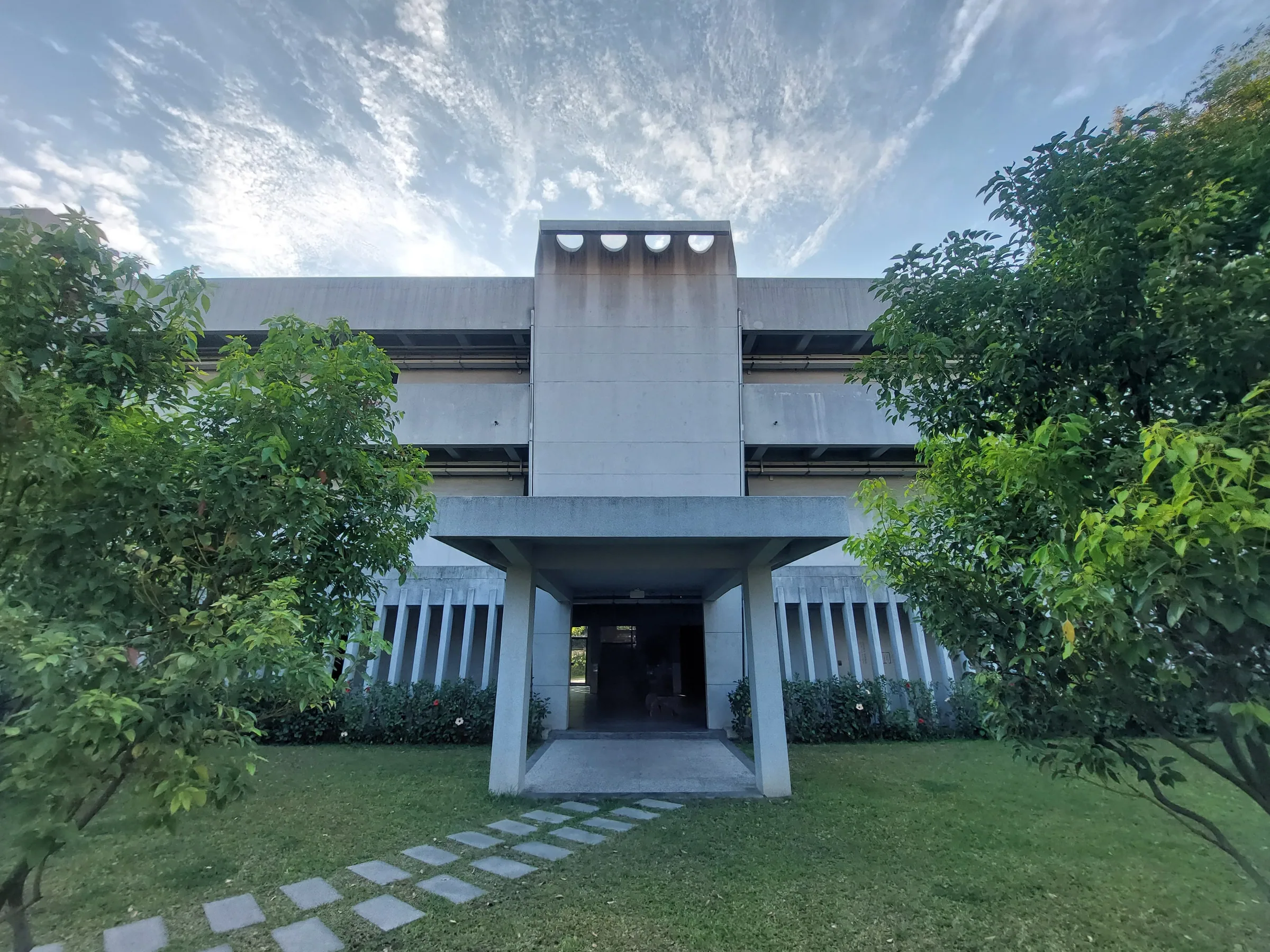
The Golden Horse Hotel Contemporary Art Museum — From Farewell Station to Artistic Paradise
A military building constructed in 1967 that watched countless soldiers embark on ships bound for Kinmen and Matsu for thirty-one years. After twenty years of slumber, it was awakened by a father and daughter—and is now a "top recommendation from Lonely Planet" in Kaohsiung.
Counterintuitive Origins
If you stand at the entrance of No. 111 Gushan Road, Kaohsiung, you see a gray building surrounded by Shoushan Forest. Light spills down from an 'U'-shaped corridor, illuminating exhibitions featuring retrospective works by Italian Op Art masters. You would likely not guess that sixty years ago, this hallway was where twenty-year-old soldiers waited before boarding ships to the outlying islands; their mothers waved goodbye at the gate, while the Chinese-flagged military vessels docked at the pier took thirty-six hours to reach Kinmen.
This is the only Cold War Golden Horse Hotel remaining in all of Taiwan. The one in Keelung was demolished; only Kaohsiung remains: not because it was intentionally preserved, but because it was forgotten long enough—so long that a founder of a hotel group passed by and decided not to let it disappear.
Three Lives of One Building
First Act: Farewells and Reunions (1967–1998)
The year after the August 23rd Artillery Bombardment in 1958, the Kaohsiung municipal government decided to build a hotel specifically for soldiers stationed in Kinmen and Matsu. However, the construction site was reclaimed from fishponds, and it took eight years to secure stable ground.
On September 26, 1967, the Golden Horse Hotel was officially opened by Friends of the Military. The accompanying hotel in Keelung was also completed; one north, one south, serving the same purpose: providing a temporary resting place for military personnel who won the "Golden Horse Award"—a concept understood by soldiers at the time.
"Jin" is Kinmen; "Ma" is Matsu. On the Cold War map, they belonged to the same era as the Berlin Wall and the 38th parallel.
Soldiers from all over Taiwan gathered at the Kaohsiung Golden Horse Hotel to report for duty. They waited here before setting sail. On the way to the pier, shopkeepers shouted: "The trip takes a day and a half; there's no food on the ship, you must buy quickly!" New recruits rushed to buy bread, soda, and motion sickness medicine. Then, at the Glorious Pier today—the No. 13 pier of that time—they stepped onto the military vessels with trembling steps.
For thirty-one years, the Golden Horse Hotel witnessed countless farewells and reunions. Some separations lasted a year, two years, or longer. After parting, some lost loved ones; others returned safely. The Port of Kaohsiung silently observed all of it.
Second Act: Forgotten (1998–2016)
In 1998, as cross-Strait relations eased, the Golden Horse Hotel retired from service. The building was transferred to the Ministry of Transportation and Communications Railway Construction Bureau and became the command center for the undergrounding of Kaohsiung's railway system. After the Railway Bureau moved out in 2012, this structure, which carried half a century of memories, was left beneath Shoushan, allowing weeds to climb the corridors.
The Golden Horse Hotel in Keelung was demolished during this period. The one in Kaohsiung remained only because it had not yet reached its turn.
Third Act: Light Amidst Ruins (2016–2018)
In 2016, the Kaohsiung Municipal Bureau of Urban Development publicly solicited proposals to revitalize the vacant space using private resources. When CEO Shao Yong-tian and his daughter Shao Ya-man from the Yumei Group first entered the Golden Horse Hotel, they saw a building that was "almost in ruins." All facilities were dilapidated; the entire structure was nearly forgotten.
But Shao Ya-man was drawn to the light and shadow here.
"Looking out of the museum windows at the scenery where the forest meets the blue sky feels like being deep in the mountains far from the hustle and bustle," she later said in an interview with VERSE magazine. A military building, because it is adjacent to Shoushan, possesses a natural environment that most urban museums dream of.
Yong-tian Art undertook restoration based on the principle of "restoring the historical significance of the architecture." They hired master craftsmen to use traditional methods, restoring the original pebble and grit textures. They even found discontinued white porcelain tiles to rebuild the corridor. But the biggest transformation was not renovation; it was opening up—changing the originally closed 'U'-shaped military barracks into an open 'U'-shaped corridor, allowing wind and light to flow freely, enabling the exhibition space to resonate with Shoushan Forest.
On November 28, 2018, the Golden Horse Hotel reopened as a contemporary art museum.
Why "ALIEN"?
The English name ALIEN Art Centre sounds like an alien museum, but the inspiration comes from Stephen's E.T. The Extra-Terrestrial—the moment when fingers touch. The operating team explained: "ALIEN means to embrace the unknown."
This naming perfectly echoes the history of the Golden Horse Hotel. Soldiers standing in this building in 1967 also faced the unknown—the unknown across the strait, the unknown of war, the unknown of whether they would return safely. Fifty years later, visitors in the same building face another kind of unknown: the perceptual boundaries opened by contemporary art.
One Building, Three Layers of Curation
Each floor of the Golden Horse Hotel has its own focus, like a book turning from the future back to history:
The First Floor focuses on experimental art and diverse artistic forms, responding to contemporary issues, often featuring new media art and sculpture.
The Second Floor is an applied arts space, suitable for retrospective exhibitions of artists, and features the ALIEN All-Day Lounge restaurant—one of the most luxurious experiences at the museum, sipping coffee and eating Minnan baked goods with osmanthus honey milk in front of the floor-to-ceiling windows surrounded by Shoushan greenery.
The Third Floor offers the widest view, looking out over the forest and sky, and often displays works with strong design sense and rich light and shadow variations.
Father and Daughter United: From Frenzy to Zen
The driving force behind the Golden Horse Hotel is a unique father-daughter duo. The father, Shao Yong-tian, is the founder of the Yumei Group; he only started painting at age sixty, but within a year, he unleashed fifty years of accumulated creative energy, producing over two hundred paintings and inventing various brushes and tools. His daughter, Shao Ya-man, has served as the Executive Director of Yong-tian Art since she was in her twenties, aiming for international standard curation.
The 2020 annual exhibition Frenzy・Zen was the first joint exhibition by this father and daughter. The exhibition spanned both the Golden Horse Hotel and the Jingying International Hotel; the father's "Frenzy"—his philosophy of management, life wisdom, explosive power—and the daughter's "Zen"—introspection, tranquility, pursuit of beauty—formed a cross-generational dialogue.
The transformation from founder to artist demonstrated Shao Yong-tian's core philosophy at the Golden Horse Hotel: art is not a privilege for a few, but energy that can burst forth in every stage of life.
International Recognition and Challenges
Less than two years after opening, the Golden Horse Hotel won the 2019 "Taiwan Humanistic Scenery Award" from Shopping Design magazine. In 2020, Lonely Planet, the world's largest travel guide, named it a "top art museum in Kaohsiung." For a private museum not supported by public funds or major conglomerates, this was an unusual acknowledgment.
Past significant exhibitions include: Armenia: Objects of Thought (2022–2023), in collaboration with French curator Jérôme Neutres, which presented a complete retrospective of the emerging artist Armenia in East Asia; the first Taiwanese exhibition of Italian Op Art master Giulio Aviani, Sensing the Future (2023–2024); and No Dome・Endless: Shao Yong-tian, co-curated by Shao Ya-man and Luo Helin, which combines AI-generated images with musical interaction.
But challenges are real. For a private museum to operate continuously in Kaohsiung—not Taipei—a ticket price of 250 NTD is not cheap in the south, and the visitor base is far smaller than in the capital. Shao Ya-man's response has been to look outward: actively collaborating with art institutions in Hong Kong, Shanghai, Amsterdam, London, and New York to export Taiwan's curatorial energy internationally.
The Building Itself Is an Exhibit
Perhaps the most unique aspect of the Golden Horse Hotel is not the works hanging on the walls, but the building itself.
Its facade integrates three styles: the simple lines of Western modernism introduced during the economic boom in 1965, remnants of classical eclecticism from the Japanese colonial period, and Chinese classical architectural symbols. The smooth horizontal and vertical lines, the arrayed columns, and the band design create an interplay of positive and negative space—architectural historians might say its structure is "geometrical composition similar to Mies van der Rohe."
During restoration, Yong-tian Art selected formaldehyde-free paints, materials without environmental hormones, and recycled wood display cases, making this sixty-year-old building a model for low-carbon green architecture in Kaohsiung. The plants planted at the beginning of its operation are now integrated with Shoushan Forest, isolating the city's hustle and bustle outside.
From a farewell station to an artistic paradise, the story of the Golden Horse Hotel is itself the best artwork—a narrative about memory, forgetting, and rebirth.
Image Sources
This article uses 1 CC-licensed image, cached in public/article-images/art/ to avoid hotlinking source servers:
- Exterior view of The Golden Horse Hotel Contemporary Art Museum — Photo: Adece033090 / Wikimedia Commons, CC BY-SA 4.0
References
- Yong-tian Art - Golden Horse Hotel Contemporary Art Museum Official Website — Architectural History (Primary source: citing materials from the Kaohsiung Historical Museum and original reports from United Daily News and Economic Daily in 1959/1967)
- Wikipedia — The Golden Horse Hotel Contemporary Art Museum
- VERSE Magazine — The Golden Horse Hotel Contemporary Art Museum: Military Station Transforms into Artistic Hall (Interview with Shao Ya-man)
- Kaohsiung Art Journal — Golden Horse Contemporary Art Museum Integrates Mountains and Forests, Displaying Low-Carbon Green Aesthetics (2024, covering the three axes: Lonely Planet recommendation, green building, curation)
- Shopping Design — Recommended by Lonely Planet! The Golden Horse Hotel Contemporary Art Museum Revitalizes 60-Year Military Site (2020)
- Lonely Planet — ALIEN Art Centre (English source, international travel guide review)
- Shopping Design — Interview with Shao Ya-man, the mastermind behind Kaohsiung's Golden Horse Hotel (2021, three layers of curation)
- 500 Collection — Distinguished Figure: Shao Ya-man, the composed and confident 28-year-old executive director (2021, Shao Yong-tian's creative journey)
- 500 Collection — Golden Horse Hotel Joint Exhibition _Frenzy・Zen_ by Shao Yong-tian and Shao Ya-man (2020)
- Tatler Asia — Yumei Group’s Father and Daughter, Shao Yong-tian and Shao Ya-man, Injecting Cultural Vitality into Kaohsiung (2024)
- Harper's BAZAAR — 13 Must-Visit Art and Culture Buildings in Kaohsiung (2025, Golden Horse Hotel listed as a must-visit)
- ELLE — First Taiwanese Exhibition of Italian Op Art Master Giulio Aviani at the Golden Horse Hotel _Sensing the Future_ (2023, curated by Jérôme Neutres)
- Yumei Group Official Website — Yong-tian Art / The Golden Horse Hotel Contemporary Art Museum