
30-second overview: Taiwanese screen scoring is often described as becoming "more and more international in scale," such as Ricky Ho crossing the sea to Sydney to record Seediq Bale with a 60-member orchestra1, or Tan Dun's score for Crouching Tiger, Hidden Dragon winning an Oscar2. But what is truly moving about this trajectory is not its scale. From the academic orchestral idiom of the 1980s, to Lim Giong bringing electronic spaciousness into Hou Hsiao-hsien's films3, Lin Sheng-xiang using a yueqin he bought for NT$2,000 to score a black-and-white film4, Ko Chih-hao moving the Taiwanese opera, beiguan, and nanguan sounds of the Dadaocheng temple forecourt onto the big screen5, and Chang Weifan writing Taiwan's funeral lament "xi-so-mi" into a horror game6, the path Taiwanese composers have traveled is one that slowly transformed scoring from laying emotion under images into excavating this island's own sound. Sound has strata, and composers are the people who dig downward.
Every year, when the Golden Horse Awards present Best Original Film Score, it becomes a once-a-year ritual in which people in Taiwan collectively hear "who scored this year's films." This award was not a later decorative addition. At the 1st Golden Horse Awards in 1962, there was already a "Best Music" award, and the inaugural winner was Yao Min for Les Belles7. That an award could be presented continuously from the age of black-and-white cinema to the streaming era is itself a measuring rod, showing how far this craft in Taiwan has traveled.
And the section that traveled furthest was not the one that went outward to the world. It was the one that went underground.
Academic Orchestration: Laying a Layer of Emotion Beneath the Image
In 1982, Edward Yang, Ko I-chen, Chang Yi, and Tao Te-chen directed the four-part film In Our Time, which is generally considered the starting point of Taiwan New Cinema8. Taiwanese cinema was doing well in those years, and the screen needed large amounts of music. This nurtured the first generation of film composers whose native musical language was orchestration.
Chang Hong-yi was among the most prolific. He won Best Original Music at the 21st Golden Horse Awards for My Favorite Season, Best Adapted Music at the 22nd for Kung-Fu Kids, and Best Original Music at the 24th for Daughter of the Nile, taking home Golden Horse music awards four times in his lifetime9. Shih Chieh-yong, of the same generation, twice won the Golden Horse Award for Best Film Score: in 1986 for The Heroic Pioneers, jointly with Tso Hung-yuen, and in 1990 for Red Dust10.
The scoring language of this generation was Western: strings laid the foundation, winds pushed the emotion forward, and music's function was to support the image and amplify the joys and sorrows of the characters. It was solid, pleasant to hear, and highly "cinematic." But it shared a common point of departure: it studied Hollywood and European orchestral traditions. The sound of Taiwan had not yet truly become the protagonist of film music.
📝 Curator's Note
In 1979, at the 16th Golden Horse Awards, the music award was split into two tracks, one for "score" and one for "song"7. This seemingly administrative split in fact acknowledged something important: weaving a sonic fabric for an entire film and writing a hit theme song are two different crafts. The people who later became Taiwan's best film composers often did both, and often they were the same person.
Lim Giong's Spaciousness: Planting Electronic Sound in Hou Hsiao-hsien's Frames
The turn came suddenly. In 1990, Lim Giong released Marching Forward, for which he wrote both lyrics and music. Using rock to break with the sorrowful tone that had long characterized Taiwanese-language songs, the album sold 400,000 copies and became a representative work of the New Taiwanese Song Movement11. Everyone thought he would become the next king of Taiwanese-language pop. Instead, he plunged into film scoring.
What made him turn was a sentence from Hou Hsiao-hsien. From The Puppetmaster (1993), Good Men, Good Women (1995), and Goodbye South, Goodbye (1996) to Millennium Mambo (2000), Lim Giong scored Hou's films3. He did not fill everything in; he left space. He used the low frequencies of electronic synthesizers and environmental sound to let the images breathe by themselves. At the 38th Golden Horse Awards in 2001, he won Best Original Film Score for Millennium Mambo. It was also from this edition onward that the award was officially named "Best Original Film Score," the name still used today12. At Golden Horse 37 the same year, Tan Dun won for Ang Lee's Crouching Tiger, Hidden Dragon, and the following year he won the Academy Award for Best Original Score2. On Taiwan's screens, large-scale orchestration for a transnational Chinese-language film and Lim Giong's electronic spaciousness were heard at the same time.
That year, after Millennium Mambo screened at Cannes, foreign audiences began asking about the name on the poster: who was "Lim Giong"?13 That spelling later became his identity card in international cinema. Chinese director Jia Zhangke also sought him out, entrusting Lim Giong with the scores for The World (2004) and Still Life (2006), bringing that electronic sound into the urban landscapes of Chinese realist cinema14.
Lim Giong's electronic sound could be chosen by both Hou Hsiao-hsien and Jia Zhangke precisely because it always remained close to the scent of a specific land. It also foreshadowed the direction Taiwanese scoring would later take.
Lim Giong's "Marching Forward" (1990). From this rock anthem that broke with the sorrow of Taiwanese-language song to the scores he wrote with spaciousness for Hou Hsiao-hsien, he traveled ten years. Millennium Mambo's "A Pure Person" later even appeared on the runway at Paris Fashion Week13. Lim Giong's scores are not packed with melody. They give space to the steps of Shu Qi walking across the pedestrian bridge in the frame. This confidence in "not filling everything in" marked the first time Taiwanese film music broke free from Hollywood-style emotional saturation.
Summer Lei followed another, closely related path. She scored and wrote the theme song for Hsiao Ya-chuan's Taipei Exchanges, winning the Golden Horse Award for Best Original Film Song in 2010. In 2018, she was again nominated at the 55th Golden Horse Awards for both score and song for Father to Son, co-produced with Chris Hou15. Lim Giong's electronics and Summer Lei's atmospheres have different textures, but both were doing the same thing: loosening film music from "filling emotion" into "leaving blank space." Blank space became one accent of Taiwanese scoring.
Sixty Strings in Sydney: Ricky Ho Turns Ritual From Grief Into Glory
If Lim Giong turned inward, Seediq Bale was one instance of expansion to the utmost limit.
Wei Te-sheng spent NT$7 million to hire Singaporean composer Ricky Ho, who traveled to Australia and invited The Studio Orchestra of Sydney to record this epic about the Wushe Incident with a 60-member symphony orchestra1. In 2011, he won Best Original Film Score at the 48th Golden Horse Awards for Seediq Bale, and the same year he also won the Golden Melody Award for Best Album Producer in the instrumental category for the same score.
But the most crucial stroke in this score was not the size of the orchestra. Ho recalled that at first, he wrote the ritual music for the Seediq people's encounter with death as very sad and mournful. Later, after understanding Seediq culture, he realized that in their worldview, this kind of "death" was glory: the moment of crossing the rainbow bridge to meet the ancestral spirits. He therefore rewrote that entire section, turning it from mourning into uplift and honor16.
At that moment, sixty strings became a vessel for a people's worldview. The orchestra was borrowed, but the soul of the music grew from the land of Taiwan.
Seediq Bale, "Seeing the Rainbow." The melodic line of an old Seediq tune is lifted layer by layer by a 60-member orchestra in Sydney. What is audible is that the most moving thing is not how surging the orchestration is, but the main melody that grows out of tribal chant.
💡 Did You Know
Cape No. 7 brought Taiwanese cinema back from the bottom in 2008, and its music played no small part. The soundtrack's music directors were Lu Sheng-fei and Lo Chi-yi, and the pair won Best Original Film Score at the 45th Golden Horse Awards for Cape No. 717. At the same ceremony, the theme song "South of the Border," composed by Tseng Chih-hao, written by Yen Yun-nung, and performed by Van Fan, won Best Original Film Song18. One film taking home both music awards, for score and song, was precisely where the two tracks created by the 1979 award split converged.
In the summer of 2008, as soon as the opening of "South of the Border" sounded, all of Taiwan remembered what it felt like to sit in the movie theater. Many people forgot the images of Cape No. 7, but remembered this melody for life. When score and song are done at their best, the memory of sound can live longer than the image.
Three Keys in 2017: Drilling Into Taiwan's Sonic Strata
The real turn occurred in concentrated form in 2017. That year, three composers, without prior coordination, reached their hands into Taiwan's own sonic strata.
The first key was the yueqin. Lin Sheng-xiang scored Huang Hsin-yao's black-and-white film The Great Buddha+, using the yueqin, Hakka folk song, and the atmosphere of nakashi itinerant music to write a sound world both bitter and absurd for this film about people at the bottom of society. At the 54th Golden Horse Awards in 2017, he won Best Original Film Score, while the end-credits song "Ayo," with lyrics by Wang Chao-hua and music and vocals by Lin Sheng-xiang, also won Best Original Film Song, giving him two awards at once4. Lin Sheng-xiang's connection with the yueqin goes back to the period after he returned to Meinong in 1998. Through lyricist Chung Yung-feng, he encountered the music of Hengchun narrative-singing artist Chen Da. Later, he came across a yueqin, heard that it cost "only NT$2,000," bought it, and from then on learned it into his own creative practice19. From the Labor Exchange Band of the Meinong anti-dam movement onward, he has sung in Hakka about the wounds and beauty of the land20. This yueqin therefore brought the sound of the countryside directly onto the big screen.
The Great Buddha+ end-credits song "Ayo." The lyrics adapt the Diamond Sutra's line about things being "like dreams, illusions, bubbles, and shadows." Paired with the muffled plucking of the yueqin, they sing the fates of the film's small people into a sigh. Black-and-white images may fade in memory; the timbre of this yueqin will not.
Two years later, Lin Sheng-xiang scored Chung Mong-hong's A Sun and co-wrote the theme song "A Journey Afar", with lyrics by Chung Mong-hong and music and vocals by Lin Sheng-xiang, earning another Golden Horse nomination for Best Original Film Song21. His rapport with Chung Mong-hong had been accumulating since Godspeed; Lin Sheng-xiang once described Chung as "the director who understands musical instruments the least, but understands music the most"22.
The second key was temple-forecourt opera. Ko Chih-hao was born in 1977 on Dihua Street in Taipei's Dadaocheng. The forecourt of Dadaocheng Cisheng Temple was like his family's kitchen. Even now, it still stages 60 performances a year, and the Taiwanese opera, nanguan, and beiguan played for temple festivals and deity-thanking rituals were the nourishment he heard from childhood23. Also in 2017, he scored Yang Ya-che's The Bold, the Corrupt, and the Beautiful, weaving Taiwanese opera, Minnan-language narrative singing, and traditional nanguan and beiguan instruments seamlessly into Western orchestration and harmony. The film's "A Tree in Full Green," performed by Panai, follows the logic of nanguan melody, matched with Taiwanese lyrics and Western strings5. The Bold, the Corrupt, and the Beautiful was the opening film of that year's 54th Golden Horse Film Festival.
The Bold, the Corrupt, and the Beautiful theme song "A Tree in Full Green," performed by Panai. It sounds like the elegant strings of a ladies' salon, but at its core is the melodic logic of nanguan: the sound of the temple forecourt hidden beneath Western harmony.
The third key was the suona and funeral lament. The indie game team Red Candle Games released Detention in 2017, and composer Chang Weifan wrote 34 tracks of original music for it. He deliberately added the suona, as well as the Taiwanese funeral lament everyone has heard, "xi-so-mi," and even recorded the sounds of ritual services on site, connecting these deeply rooted sonic memories with horror6. A game about martial law and the White Terror ultimately used the sounds of Taiwanese funerals to frighten people, rather than the shrieking strings of Western horror films.
📝 Curator's Note
Looking at these three keys together, one sees that they were in fact digging in the same direction: Lin Sheng-xiang dug toward the countryside and Hakka culture, Ko Chih-hao toward temple forecourts and opera, and Chang Weifan toward funerals and folk religion. The three dug into different strata of Taiwanese sound, but the action was the same: they were no longer asking, "How would Hollywood score this?" They were asking, "What sound did this Taiwanese thing originally have?" That was the year Taiwanese scoring truly matured.
Four Layers of History in One Old Tune: How Deep Sound's Strata Go
To see how deep "digging downward" can go, the best example is the song "Sorrow on a Moonlit Night" in Detention.
In the game, this song functions as music for the context of a banned song during the martial-law era, but its own life story crosses four layers of Taiwanese history. At the lowest layer is a song of the Plains Indigenous peoples. Around the turn of the 19th and 20th centuries, the missionary George Leslie Mackay collected melodies from the Plains Indigenous peoples and set one as the hymn "Naomi." In 1933, the Hakka composer Teng Yu-hsien, praised as the "father of Taiwanese song," rearranged this melody and gave it to Chou Tien-wang to write lyrics, creating the Taiwanese-language song "Sorrow on a Moonlit Night," still sung today24. Teng wrote nearly a hundred melodies in his lifetime. "Rainy Night Flower," "Longing for the Spring Breeze," "Sorrow on a Moonlit Night," and "Four Seasons of Red" are collectively known as "Four Moons, Longing, and Rain," and are part of this island's shared melodic memory25.
An Indigenous melody passed through a church hymn, became a Taiwanese popular song during Japanese rule, then became a banned song silenced during the martial-law era, and finally sounded again in a 2017 game. One three-minute song compresses the circumstances of four generations of Taiwanese people.
When composers dig into the strata of sound, what they often unearth is not only a melody, but an entire stretch of history pressed beneath the surface.
✦ Sound has strata. Composers are the people who dig downward; the deeper they dig, the more complete the Taiwan they uncover.
Games and Television Drama: Original Scores at Their Most Vigorous, Yet Latest to Be Seen
Over the past decade, the territory of screen scoring has quietly expanded beyond the big screen.
In games, Taiwan has in fact hidden a whole group of composers. For Red Candle's 2019 Devotion, the main score composer was Yang Shih-wei, a team member and formerly the keyboardist of the indie band PUMPKINney Fan Club. The game's theme song "Devotion" was produced by No Party for Cao Dong, while the ending song "Lady of the Pier", composed by Yang Shih-wei with lyrics by Chiang Tung-yu, runs through the entire work in two versions representing mother and daughter across two generations26. Elsewhere, for Rayark's Deemo and Cytus series, Chamber Chu served as in-house composer and even conducted and played piano himself at Rayark concerts27. SIGONO's OPUS series, meanwhile, was scored by the young composer Triodust, who wrote more than thirty tracks spanning atmospheric electronics and post-rock across story and setting28. Players hear these sounds every day, yet they are rarely discussed as "screen scoring."
A song made in two versions, mother and daughter, running through an entire game's story of an era: Taiwanese game music has long been doing the work of "weaving sound for an age." It has simply stood outside the sightline of awards for many years.
The case is even more obvious in television drama. The score for PTS's 2019 The World Between Us came from the musDM team of Yu Chia-lun, Wang Yu-lin, Li Han-po, and Yang Tzu-ting, using piano and strings to set a restrained, healing tone, with the theme song "Don't Let Me Go" performed by Yoga Lin29. In 2021, The Magician on the Skywalk had Kay Huang as music director, recreating the Chunghwa Market of the 1980s by weaving old songs such as Lo Ta-yu's "Zhihuzheye" and Huang's own 1987 "Blue Beer Sea" into a sonic world30. The same year, Seqalu: Formosa 1867 was scored by Ko Chih-hao. To recreate the atmosphere of a Taiwanese tea-merchant family in the 1950s, he initially referred to the large string ensembles of the British and American series The Crown. But after finishing the first episode, he felt, "How did this turn into a symphonic version of 'Longing for the Spring Breeze'?" He therefore thinned out the strings and finally changed the foundation to a small ensemble of six to eight players. He revealed that he actually made 496 pieces for the series, of which only 61 were ultimately included31.
📝 Curator's Note
Taiwanese drama scoring has been so vigorous, yet institutional recognition arrived twenty years late. It was not until the 57th Golden Bell Awards in 2022 that the drama category formally added a "Drama Score Award"32. That year's winner was Oaeen's The Pond, while Ko Chih-hao's Seqalu: Formosa 1867 and Chen Hsiao-hsia and Chang Yi's Gold Leaf were nominated but did not win32. Awards chase creation. When an industry becomes so vigorous that a new award must be created for it, that itself shows it had already matured; people simply realized it late.
The People Scoring Today's Taiwan: The Generation of Lu Luming
If one had to find a face for "the rise of original scoring in television drama," it would be Lu Luming.
On the big screen, he won Best Original Film Score at the 58th Golden Horse Awards in 2021 for Chung Mong-hong's The Falls33. Earlier, he had also won Best Original Film Song at the 56th Golden Horse Awards for the end-credits song "A Brighter Future" from the film version of Detention, composed by Lu Luming, with lyrics and vocals by Summer Lei34. But the place where he truly opened up the field was television. In 2024, he, Lin Hsiao-chin, and Lin Ssu-yu won the Drama Score Award at the 59th Golden Bell Awards for Port of Lies. For this series about the judicial predicaments of Indigenous people and migrant workers, the score boldly used Indonesia's historically deep "Southeast Asian gong music"35. In 2025, he also took on the score for The World Between Us II36.
Whether in the movie theater or in front of the television, whether using Western orchestration or Southeast Asian gong music, what Lu Luming's generation of composers continues is precisely the direction opened by those three keys in 2017: for every story, to seek the sound it most ought to have, a sound that comes from a particular piece of land.
📝 Curator's Note
Looking over this line from beginning to end: Chang Hong-yi's academic orchestration, Lim Giong's electronic spaciousness, Ricky Ho's epic symphony, Lin Sheng-xiang's yueqin, Ko Chih-hao's Taiwanese opera, Chang Weifan's suona, and Lu Luming's gong music. What it measures is not the height of production scale, but the depth of source material. It took Taiwanese composers forty years to understand one thing: to be heard by the world, they had to dig deeply enough into the sound of the land beneath their feet, rather than learn to resemble Hollywood as closely as possible. The most local, as it turned out, is what is most readily recognized.
Conclusion: Next Time, Ask One More Question
In Longtan, Taoyuan, there stands a commemorative bronze statue of Teng Yu-hsien25. In 1944, he died of cardiopulmonary disease in his thirties, never seeing how the old Plains Indigenous melody he had rearranged would, more than seventy years later, burrow into a game and continue speaking for Taiwanese people.
Sound does not disappear. It simply sinks beneath the strata, waiting to be unearthed. From academic orchestration that laid emotion beneath images to the yueqin, opera, and funeral lament that unearthed an island's own sound, Taiwanese composers have always been doing the same work of digging downward.
So next time, when the score of a Taiwanese film, a Taiwanese drama, or a Taiwanese game begins to sound, one might ask one more question: which layer of Taiwanese sound has this composer drilled into?
If you can ask that, then you have heard this island scoring itself.
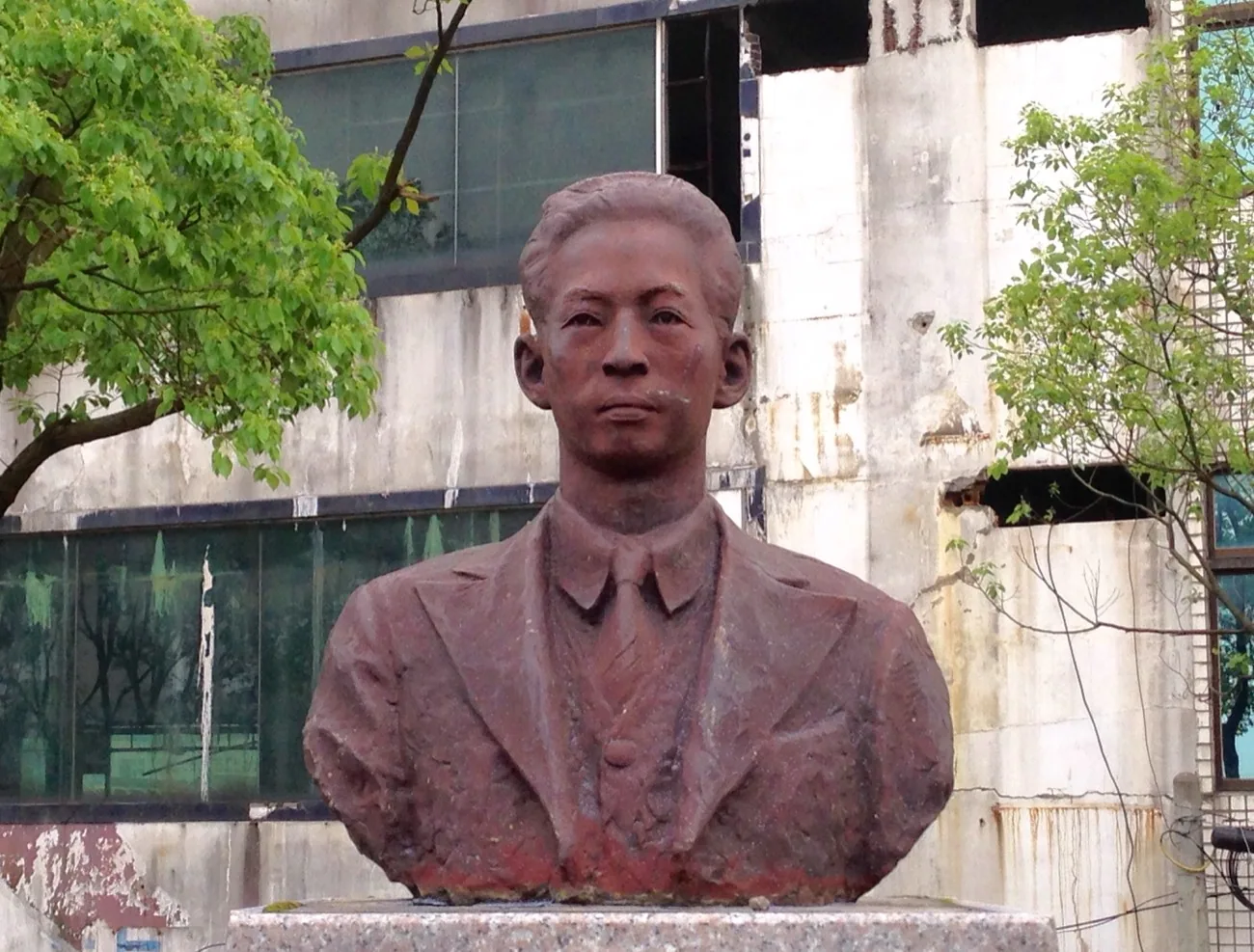
Commemorative bronze statue of Teng Yu-hsien. "Sorrow on a Moonlit Night," rearranged by this "father of Taiwanese song," traces its earliest melody to a Plains Indigenous tune collected by George Leslie Mackay. It later became a banned song under martial law, then was written into Detention. One old tune is the deepest layer of Taiwan's sonic strata.
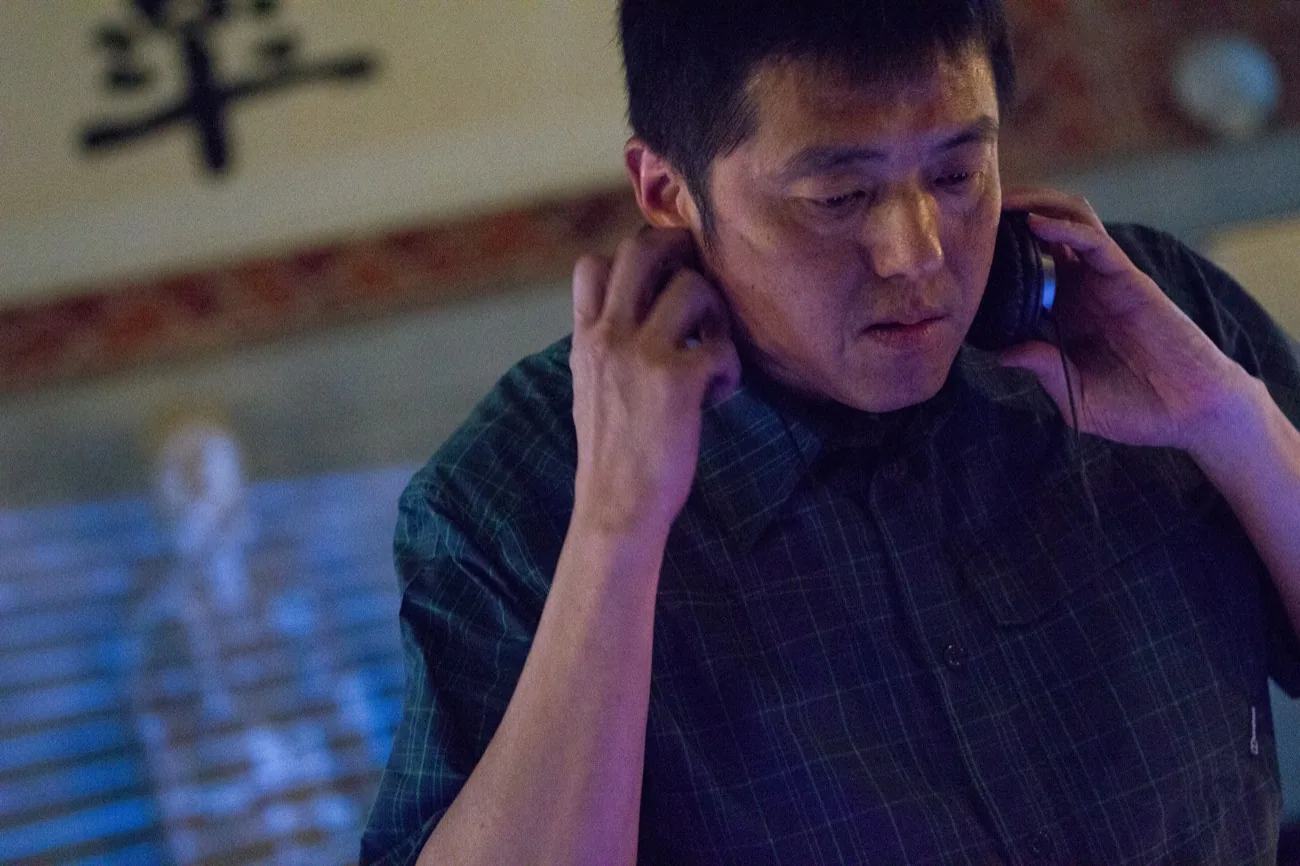
Lim Giong. From the Taiwanese-language rock star of Marching Forward to the composer who left space in Hou Hsiao-hsien's films, he has twice won the Golden Horse Award for Best Original Film Score, and made the spelling "Lim Giong" an identity card for Taiwanese sound in international cinema.
Further Reading:
- Lim Giong — Lim Giong's full musical journey, from the New Taiwanese Song Movement to film scoring
- Hou Hsiao-hsien — The director who turned Lim Giong toward scoring, and a representative figure of Taiwan New Cinema
- Taiwanese Cinema — From New Cinema to the revival of local films, the stage on which screen scoring unfolded
- Red Candle Games — The team behind Detention and Devotion, and how game music weaves sound for an era
- Taiwan's Game Industry and Digital Entertainment — The industry background for Rayark, SIGONO, and the rise of Taiwanese game music
Image Sources
- Hero, entrance to the Golden Horse Awards ceremony, 2016: Solomon203 / Wikimedia Commons, CC BY-SA 4.0, original file.
- Lim Giong, 2015: Photograph by 佛空靈 / Wikimedia Commons, CC BY-SA 4.0, photographed on December 10, 2015, original file: File:Lim giong 2.jpg.
- Commemorative bronze statue of Teng Yu-hsien: Wikimedia Commons, image of the commemorative bronze statue of Teng Yu-hsien, the "father of Taiwanese song," CC BY-SA, Teng Yu-hsien Commons category.
References
- Seediq Bale — Wikipedia — The entry records verbatim that the score was handled by Singaporean composer Ricky Ho, who traveled to Australia to invite The Studio Orchestra of Sydney to record it with a 60-member symphony orchestra, and lists its win for Best Original Film Score at the 48th Golden Horse Awards.↩
- Tan Dun — Wikipedia — Includes Tan Dun's background as having been born in Changsha, Hunan, as well as the full record of his scoring Ang Lee's Crouching Tiger, Hidden Dragon and winning the Academy Award for Best Original Score on March 25, 2001.↩
- Goodbye South, Goodbye — Wikipedia — Records the context of Lim Giong and Hou Hsiao-hsien's scoring collaborations from The Puppetmaster, Good Men, Good Women, and Goodbye South, Goodbye to Millennium Mambo.↩
- The strongest Taiwanese film score of the year! Lin Sheng-xiang wins two Golden Horse awards for The Great Buddha+ — KKBOX — Reports that Lin Sheng-xiang won Best Original Film Score at the 54th Golden Horse Awards for The Great Buddha+ soundtrack, and that the end-credits song "Ayo" simultaneously won Best Original Film Song.↩
- Finding new vitality in temple-festival culture: an interview with Ko Chih-hao, composer of The Bold, the Corrupt, and the Beautiful — Add Music — Ko Chih-hao explains in detail how he combined the linguistic logic of Taiwanese opera, nanguan, and beiguan with Western orchestration, as well as the creative process behind the theme song "A Tree in Full Green," performed by Panai and following nanguan logic.↩
- Teacher! The score for Taiwanese horror game Detention moved its developers to tears — Add Music — An interview with Chang Weifan documenting his creative approach of adding the suona and Taiwan's funeral lament "xi-so-mi" to the Detention score, and even recording live sounds from ritual services.↩
- Golden Horse Award for Best Original Film Song — Wikipedia — Records that the Golden Horse music award was established at the 1st edition in 1962, initially named "Best Music," with Yao Min winning for Les Belles, and the later evolution in which score and song were separated at the 16th edition in 1979.↩
- Thirty-year retrospective on the Taiwan New Wave Cinema movement — Ministry of Culture, Republic of China — Official material records that the 1982 film In Our Time, directed by Edward Yang, Ko I-chen, Chang Yi, and Tao Te-chen, is regarded as the starting point of Taiwan New Cinema.↩
- Chang Hong-yi — Taiwan Cinema — The national film database includes the full record of Chang Hong-yi winning Golden Horse music awards four times, including for My Favorite Season, Kung-Fu Kids, and Daughter of the Nile.↩
- Shih Chieh-yong — Wikipedia — Records that Shih Chieh-yong twice won the Golden Horse Award for Best Film Score: in 1986 for The Heroic Pioneers, jointly with Tso Hung-yuen, and in 1990 for Red Dust.↩
- Marching Forward — Wikipedia — Records that Lim Giong's 1990 self-written Marching Forward broke the sorrowful style of Taiwanese-language song with rock, sold 400,000 copies, and became a classic of the New Taiwanese Song Movement.↩
- Golden Horse Award for Best Original Film Score — Wikipedia — Lists verbatim that the name "Best Original Film Score" was fixed from the 38th edition in 2001, and lists winners across editions, including Lim Giong and Huang Kai-yu for Millennium Mambo at the 38th edition.↩
- Taiwanese film Millennium Mambo score makes a strong appearance at a Paris fashion show 16 years later — Add Music — Reports that "A Pure Person" from the Millennium Mambo score appeared at the Chloé show during Paris Fashion Week in 2017, and traces the context of the film's Cannes screening and the international attention drawn by Lim Giong's score.↩
- Jia Zhangke X Lim Giong: Music Is Like Oxygen — Simple Life StreetVoice — Records Jia Zhangke's admiration for Lim Giong's music and their film-scoring collaborations since The World and Still Life.↩
- Summer Lei — Wikipedia — Includes records of Summer Lei winning the 2010 Golden Horse Award for Best Original Film Song for Taipei Exchanges and being nominated at the 55th Golden Horse Awards in 2018 for both score and song for Father to Son.↩
- International master handles Seediq music with impact — CTS News — Reports on Ricky Ho's process of scoring Seediq Bale, including the creative turn in which, after understanding Seediq culture, he rewrote the ritual music from sadness into glory.↩
- Cape No. 7 — Wikipedia — The infobox and award record list verbatim that the score was by Lu Sheng-fei and Lo Chi-yi, and that it won Best Original Film Score at the 45th Golden Horse Awards.↩
- "South of the Border" wins Best Original Film Song at the 45th Golden Horse Awards — Taiwan Cultural Memory Bank — The official collection records that "South of the Border" was composed by Tseng Chih-hao, written by Yen Yun-nung, arranged by Lu Sheng-fei, performed by Van Fan, and won Best Original Film Song at the 45th Golden Horse Awards.↩
- Sheng-Xiang & Band's road of music back to the homeland — OPENTIX — Records Lin Sheng-xiang's return to Meinong in 1998, his encounter with the music of Hengchun narrative-singing artist Chen Da through Chung Yung-feng, and his purchase of a yueqin for "only NT$2,000" before incorporating it into his creative practice.↩
- Lin Sheng-xiang's 20 years since debut: the dark hours that seven Golden Melody Awards could not polish — The Reporter — An in-depth report on Lin Sheng-xiang's path from the Labor Exchange Band of the Meinong anti-dam movement to Sheng-Xiang & Band, and his long collaboration with lyricist Chung Yung-feng in caring for the land.↩
- A Sun soundtrack: finding new life years later — Blow Music — Records Lin Sheng-xiang's process of scoring A Sun and co-writing the theme song "A Journey Afar" with Chung Mong-hong, with lyrics by Chung and music and vocals by Lin, which was nominated for a Golden Horse Award.↩
- Listen, storyteller: an interview with Lin Sheng-xiang, composer of A Sun — Unitas — The interview records the rapport between Lin Sheng-xiang and Chung Mong-hong since Godspeed, as well as Lin's assessment of Chung's musical understanding as a director.↩
- A restless musical hyperactive child: an interview with cross-disciplinary music creator Ko Chih-hao — BIOS Monthly — Records Ko Chih-hao's background: born in 1977 on Dihua Street in Taipei's Dadaocheng, nourished musically by the temple-forecourt opera of Cisheng Temple, and educated at Berklee College of Music.↩
- Sorrow on a Moonlit Night — Taiwan Popular Music Wiki — Records the multilayered history of "Sorrow on a Moonlit Night": its melody came from a Plains Indigenous song collected by George Leslie Mackay and set as the hymn "Naomi," then was rearranged by Teng Yu-hsien in 1933 with lyrics by Chou Tien-wang.↩
- Teng Yu-hsien — Wikipedia — Includes Teng Yu-hsien (1906-1944) as a Hakka composer from Longtan, Taoyuan, the "father of Taiwanese song," his representative works collectively known as "Four Moons, Longing, and Rain," and the location of his commemorative bronze statue by Longtan Lake.↩
- How should the two characters of Devotion be understood? The ending song "Lady of the Pier" runs through the whole work — udn Game Corner — Records Devotion's main score composer Yang Shih-wei, the theme song "Devotion" produced by No Party for Cao Dong, and the ending song "Lady of the Pier," which runs through the whole work in two mother-daughter versions.↩
- Rayark — Wikipedia — Records Rayark's rhythm-game series Cytus, Deemo, and Voez, as well as Chamber Chu serving as in-house composer and conducting and performing on piano at Rayark concerts.↩
- OPUS: Rocket of Whispers — Wikipedia — Records that SIGONO's OPUS series was scored by Triodust, who wrote more than thirty tracks spanning story and setting in styles including atmospheric electronics and minimalist post-rock.↩
- Interview on The World Between Us score: musDM music producer Yu Chia-lun — Add Music — An interview with musDM producer Yu Chia-lun recording how The World Between Us used piano and strings to set a healing tone, and that the theme song "Don't Let Me Go" was performed by Yoga Lin.↩
- Shi Shi Sun writes and sings the theme song for The Magician on the Skywalk; the series selects several 1980s classics — Blow Music — Records that The Magician on the Skywalk had Kay Huang as music director, recreated the 1980s Chunghwa Market, and used old songs including Lo Ta-yu's "Zhihuzheye" and Huang's "Blue Beer Sea."↩
- Sixty-one tracks included, but 496 actually made: talking with Ko Chih-hao about scoring Seqalu: Formosa 1867 — every little d — Ko Chih-hao explains in detail how the Seqalu: Formosa 1867 score moved from referencing The Crown's large string ensemble, to feeling like a "symphonic version of 'Longing for the Spring Breeze'," to being revised into a small ensemble of six to eight players.↩
- Nominees and winners of the 57th Golden Bell Awards — Central News Agency — The official list records that the "Drama Score Award" was newly established at the 57th Golden Bell Awards in 2022, with Oaeen's The Pond winning, while Ko Chih-hao's Seqalu: Formosa 1867 and Chen Hsiao-hsia and Chang Yi's Gold Leaf were nominated but did not win.↩
- Golden Horse 58: fierce competition for original music award; Lu Luming wins for The Falls — TVBS News — Reports the record of Lu Luming winning Best Original Film Score at the 58th Golden Horse Awards for Chung Mong-hong's The Falls.↩
- Detention wins Best Film Song; Lu Luming does not forget to voice support for Hong Kong — Central News Agency — Reports that Detention's end-credits song "A Brighter Future," composed by Lu Luming with lyrics and vocals by Summer Lei, won Best Original Film Song at the 56th Golden Horse Awards.↩
- Golden Bell 59: full 2024 Golden Bell drama-category winners list — Dramago — The official full list records Lu Luming, Lin Hsiao-chin, and Lin Ssu-yu winning the Drama Score Award at the 59th Golden Bell Awards for Port of Lies, whose score used Southeast Asian gong music.↩
- The World Between Us II — Wikipedia — Records that the 2025 series The World Between Us II had an original soundtrack produced by Lu Luming, Lin Hsiao-chin, and Lin Ssu-yu, totaling 24 tracks.↩