
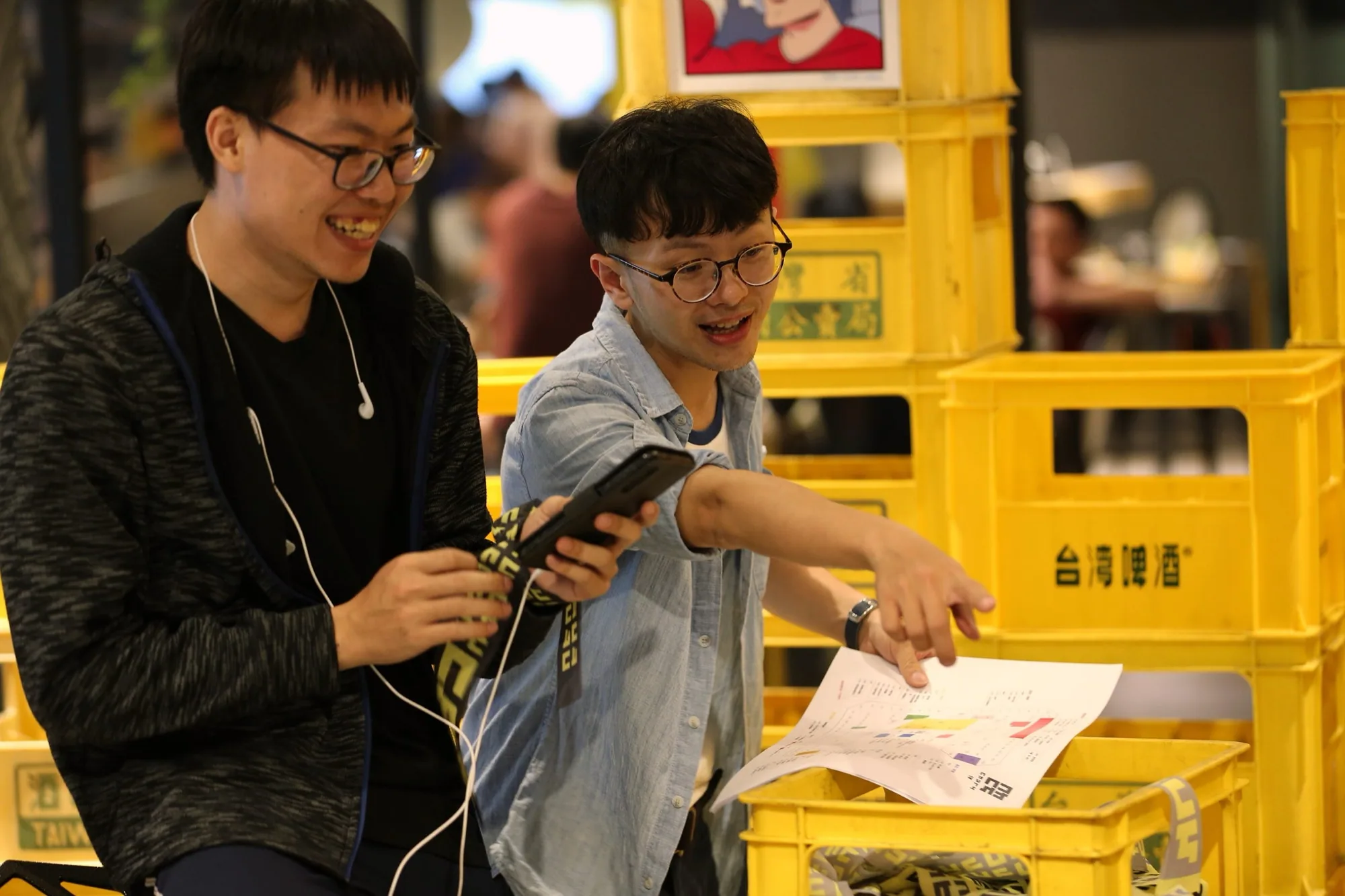
Aperçu en 30 secondes : Le Festival de la vie complexe (Complex Life Festival) a organisé cinq éditions à Taichung entre 2016 et 2020. Ses initiateurs sont deux camarades de l'Université de médecine et de pharmacie de Chine, destinés à devenir médecins : Hsiao Hao-ning (médecine traditionnelle chinoise) et Huang Yen-lin (alias Huang Dou-ni, médecine occidentale). Le nom joue subtilement à l'envers de celui du « Festival de la vie simple » porté par la génération de Li Zong-sheng, positionnant les participants comme des « non-réussis », réunissant deux à trois cents personnes par édition, avec pour seul thème autorisé la « croissance » et l'interdiction de parler de « réussite »1. Cinq ans plus tard, l'organisateur principal Hsiao Hao-ning reste à Taichung comme médecin en MTC, ouvre une librairie et perd une élection municipale ; son assistant visuel Huang Dou-ni quitte la médecine pour la cryptomonnaie et devient en 2025 chercheur invité à l'Harvard Kennedy School2. Une organisation qui refusait la « réussite » a vu ses organisateurs et ses participants sombrer chacun dans une forme de réussite, tandis que sa question la plus acérée reste celle que Hsiao Hao-ning posait sur scène : « Voulez-vous mourir avec des regrets ou renoncer en vivant ? »3
Un rituel né à côté des coupes histologiques
À la fin de l'année 2015, à Taichung, une série d'images prises au microscope était accrochée aux murs du centre artistique de l'Université de médecine et de pharmacie de Chine. Des cellules de cancer du sein, des tissus enflammés, des coupes nécrosées, agrandies, colorées et encadrées, formaient une exposition nommée « Gémissements pathologiques : esthétique de la maladie. Exposition d'images de coupes histologiques »4.
L'exposition était organisée par seize étudiants en médecine. Le message qu'ils voulaient faire passer était simple : les choses considérées comme « malades », vues sous un autre angle et sous un autre éclairage, possèdent leur propre beauté. Le concept d'exposition, écrit directement sur les panneaux, affirmait que l'apparence pathologique vue au microscope pouvait rester belle4. Cette exposition ne s'est pas arrêtée à sa tenue ; elle a ensuite fait une tournée au Musée national de l'histoire naturelle, à l'Université nationale de Taïwan et à l'Hôpital Tz'u Chi. Passant d'une petite exposition dans un centre artistique universitaire à une entité mobile et grandissante, seize noms revenaient invariablement ensemble : Huang Yen-lin et Hsiao Hao-ning.
Six mois plus tard, ces deux-là organisaient le Festival de la vie complexe. Ils déplaçaient l'idée selon laquelle « voir la pathologie sous un autre angle révèle sa beauté » du microscope vers les êtres humains : voir la « non-réussite » sous un autre angle, avait-elle aussi sa propre forme ?
Il faut d'abord placer ces deux personnes à des positions différentes, car l'histoire suivante a souvent été racontée en les mélangeant. Huang Yen-lin étudiait la médecine occidentale, au département de médecine. Hsiao Hao-ning étudiait la médecine traditionnelle chinoise, au département de MTC. Une même école, deux départements différents, deux formations totalement distinctes : l'un apprenait les coupes, les images et les quarts de travail d'interne, l'autre la prise de pouls, les formules et les douze méridiens. L'un est devenu plus tard interne à l'Hôpital général de Taipei (Vith Vith), l'autre a ouvert plus tard une clinique de MTC à Beitou, Taichung. Ils ont eux-mêmes donné un nom à cet état : « en bordure de département » (xi bian) : être des marginaux dans leur propre département, dont les pensées ne vont pas là où le blanc de la blouse médicale devrait les mener5. Cette auto-désignation est importante ; elle exprime une posture active consistant à se placer volontairement en marge. La blouse blanche est le centre tracé par le monde pour les étudiants en médecine ; ils ont refusé de s'y tenir.
En mai 2016, Hsiao Hao-ning a tagué une liste de noms sur Facebook. Les critères de tag étaient étranges : il cherchait des personnes correspondant aux mots-clés « millennial, maniaque du travail, pratique répétée, en bordure de département, apportant des amis pour un espoir infini »1. Cette série de mots-clés constituait elle-même un cahier des charges invisible : on ne vous demandait ni vos notes ni votre titre, mais si vous aviez cette énergie de « rendre la vie épuisante ». Environ trois cents commentaires ont afflué sous la publication ; après quarante jours de fermentation, la première édition était organisée. Un rassemblement qui se déroulerait pendant cinq ans avait pour point de départ un post Facebook et quarante jours de fermentation de commentaires, sans salle de spectacle, sans budget, sans sponsors, seulement une poignée de personnes qui ne tenaient plus en place dans leur propre département et qui se reconnaissaient mutuellement.
Le thème de la première édition s'appelait « Forum des non-réussis ».
Si le Festival de la vie simple est calme et concentré, appelons-le complexe
Pour comprendre la plaisanterie de ce nom, il faut d'abord savoir à qui l'on s'adresse.
Le « Festival de la vie simple » (Simple Life Festival) est connu de presque tous les Taïwanais. Créé en 2006 par Li Zong-sheng, Chang Pei-jen et Ma Tien-tsung, ce groupe de musiciens du label Rock Records, son slogan principal était « Faites ce que vous aimez, donnez de la valeur à ce que vous aimez », avec une atmosphère de « calme et de concentration »6. Passant de trente mille participants à la première édition à une échelle de soixante à cent mille par la suite, il est devenu un repère de l'esthétique de consommation des intellectuels taïwanais. Acheter un billet, entrer sur le site, écouter de la musique et boire de la bière artisanale sur l'herbe constituait une « simplicité » soigneusement conçue. Dix ans plus tard, à l'occasion de son vingtième anniversaire, il avait réussi à réunir Wu Bai et Li Zong-sheng sur la même scène6, s'étant transformé en une marque de lifestyle taïwanaise à part entière.
Hsiao Hao-ning a inversé directement ce nom. Sa version était : « Si ceux qui vont au Festival de la vie simple sont ceux qui aspirent à une vie simple et belle, nous avons ici une bande de maniaques du travail qui rendent toujours leur vie épuisante, appelons-le donc Festival de la vie complexe »1.
Derrière cette plaisanterie se cache une génération qui s'approprie l'étiquette qu'on lui a collée.
📝 Note du curateur
Le discours courant dirait que le Festival de la vie complexe est une « réunion pure des jeunes en résistance contre la commercialisation ». Mais ce cadre est trop commode et manque la lame la plus tranchante. Ce à quoi ce groupe a véritablement résisté, c'est à la définition de « à quoi la vie devrait ressembler » donnée par la génération précédente pour définir cette génération. La « simplicité » du Festival de la vie simple est une élégance à seuil : elle suppose que vous êtes déjà bien installés pour avoir le luxe de poursuivre la simplicité. Or ce groupe n'a même pas encore réussi à s'installer. Récupérer des mots aux connotations péjoratives comme « complexe », « non-réussi », « maniaque du travail », « en bordure de département » pour les utiliser comme auto-désignation signifie : nous n'avons même pas la qualification pour être récupérés par votre esthétique, alors autant nous nommer nous-mêmes.
Cette génération porte de nombreux noms. En 2017, le journaliste Wu Cheng-hsien a écrit La génération dépressive (Ya shidai), les définissant comme « ceux de vingt à trente-quatre ans, nés avec une souris en bouche et possédant les meilleures qualités jamais vues à Taïwan, mais confrontés à la pauvreté, aux bas salaires et à l'absence d'avenir »7. La moitié la plus piquante de cette définition est « possédant les meilleures qualités jamais vues à Taïwan ». La génération la plus diplômée, la meilleure en langues étrangères, la plus habile avec les outils, est simultanément celle dont le salaire de départ a régressé et qui ne voit pas l'avenir. Deux réalités se pressent dans le même groupe de personnes.
En remontant plus loin, en 2011, la Ligne syndicale taïwanaise a publié La génération effondrée (Beng shidai), parlant de la même population face à la financiarisation et à la paupérisation. Plus tôt encore, il y avait le « 22K », désignant le programme de stage pour les diplômés de l'enseignement supérieur lancé par le Ministère de l'Éducation entre 2009 et 2011 pour faire face à la crise financière, avec un salaire mensuel de 22 000 dollars taïwanais et plus de trente mille places. L'intention initiale du programme était de donner du travail aux diplômés ; il est devenu par la suite une ancre de référence, les entreprises l'utilisant comme prix de référence pour压低 (maintenir bas) le salaire de départ de cette génération pendant plusieurs années8.
Luos (loser), fraise, génération dépressive, génération effondrée, 22K. Ce que fait le Festival de la vie complexe, c'est accepter ces mots jetés par les autres et les retourner. On vous appelle loser, alors on organise un « Forum des non-réussis ». On dit que vous rendez la vie épuisante, alors on l'appelle « complexe ». Ce n'est pas de l'entêtement ; c'est un acte de reprise du pouvoir de nomination : j'accepte l'étiquette que tu donnes, mais c'est moi qui décide de ce qu'elle signifie.
Des années plus tard, l'organisateur principal Hsiao Hao-ning revient sur cet événement avec un titre qui résume parfaitement le rassemblement : il est trop difficile d'être simple, explorons ensemble la complexité9.
Hsiao Hao-ning parle du Festival de la vie complexe (série « Super Wall Tuesday » du Bureau de développement de la jeunesse du Ministère de l'Éducation). Le titre de la vidéo « il est trop difficile d'être simple, explorons ensemble la complexité » résume parfaitement la mise en parallèle de ce rassemblement avec le « Festival de la vie simple », en faisant sa marque de fabrique.
L'hôtel California où l'on entre, mais d'où l'on ne sort pas
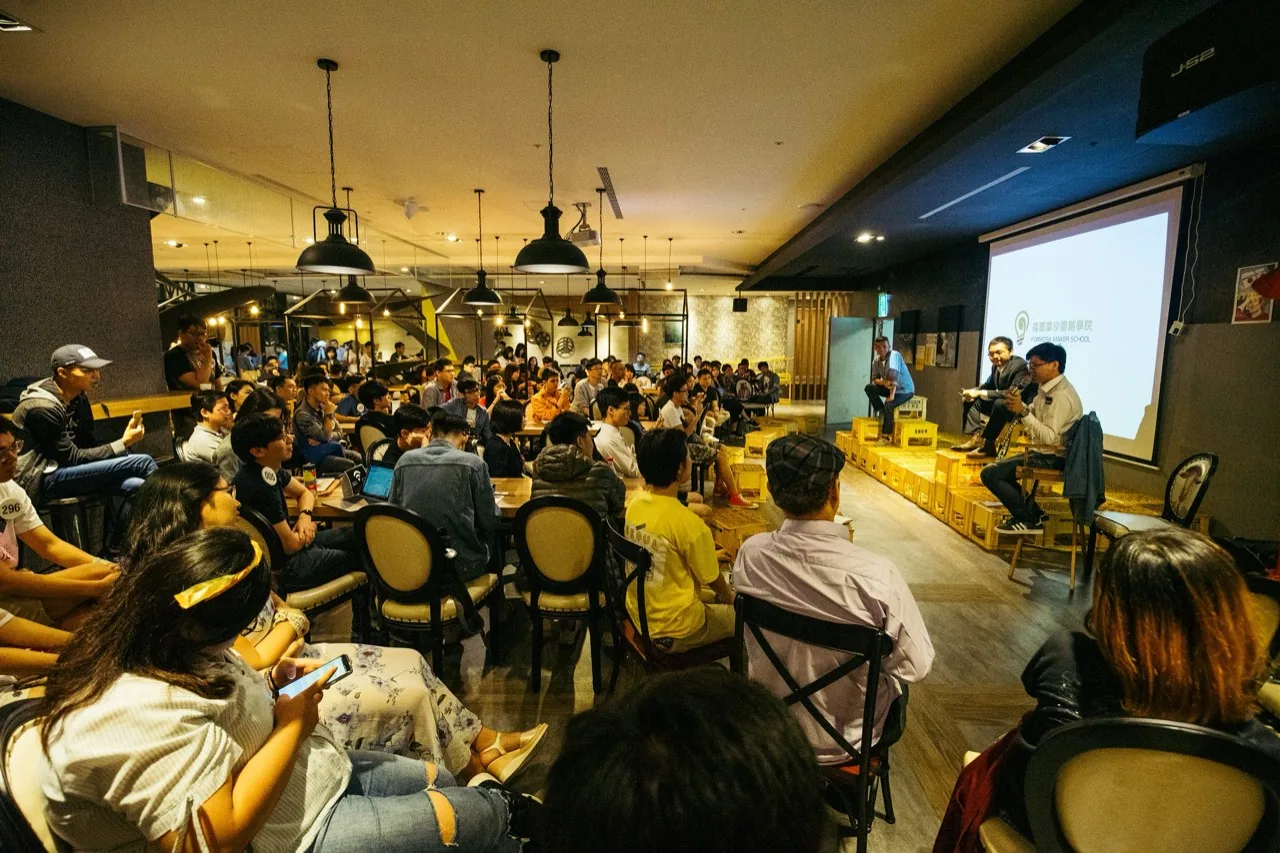
Lieu du Festival de la vie complexe : échelle de deux à trois cents personnes, intervenants et auditeurs mélangés, les paniers jaunes de bière Taiwan servant de scène et de sièges. Photo : Festival de la vie complexe (commentaire éditorial fair use).
Après la première édition, ce rassemblement se tenait une fois par an en mai, pendant cinq ans.
La méthode était particulière. Pas de présentateur, la ligne entre intervenants et auditeurs était floue, souvent la nuit sur l'herbe, une session de discussion pouvait durer quatre heures10. Hsiao Hao-ning utilisait le concept de la « soupe aux pierres » pour recruter les participants. C'est une vieille histoire : plusieurs soldats disent vouloir faire cuire de la soupe avec des pierres, les villageois qui passent apportent chacun une poignée de sel ou quelques carottes, et finissent par faire bouillir une véritable marmite de soupe. Le Festival de la vie complexe fonctionnait ainsi : les organisateurs ne posaient qu'une pierre et une marmite, le contenu était ce que chacun apportait.
La première édition comptait trente groupes de partageurs, traversant l'écologie de la création indépendante des millennials : des étudiants en présentation, des étudiants organisant le festival de musique de l'Université nationale de Taïwan, le magazine de critiques littéraires Le Lecteur secret, Une poésie pour toi chaque jour qui poste un poème sur Facebook quotidiennement, la plateforme de cours en ligne Hahow, le studio Yiren (Migrant People) qui s'intéresse aux travailleurs migrants d'Asie du Sud-Est10. En étalant cette liste, on voit un petit univers né de la jeunesse taïwanaise en 2016 : présentations, musique, littérature, éducation, nouveaux migrants, aucune de ces positions n'était regardée par les industries dominantes, mais chacune était sérieusement travaillée par quelqu'un.
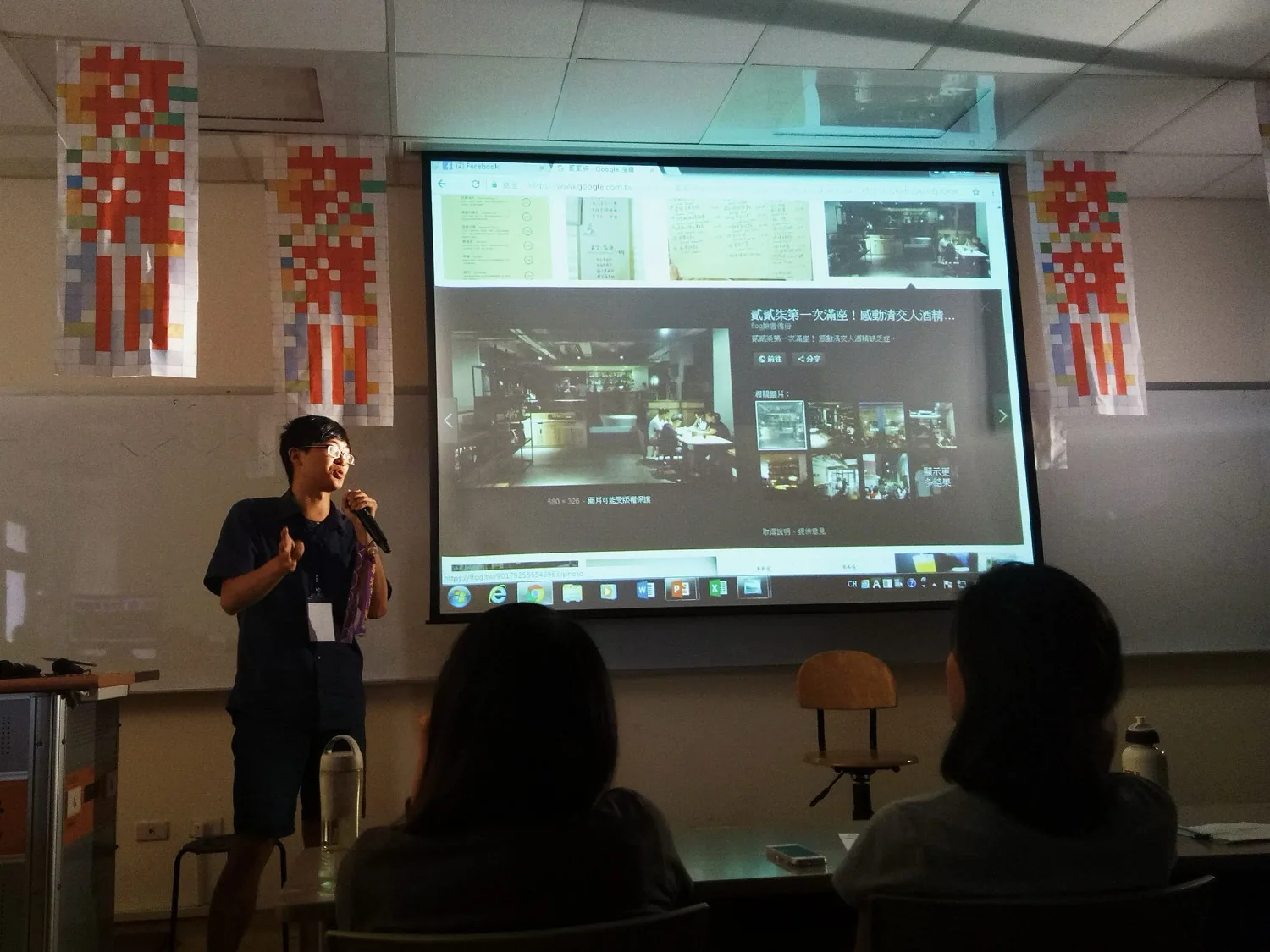
Un intervenant partage devant un écran de projection, une banderole signature en police pixelisée du Festival de la vie complexe est accrochée au mur. Le langage visuel de l'ensemble est une « amateurisme » délibéré : pas raffiné, pas d'éclairage, ressemblant à une迎新 (rentrée) de club plutôt qu'à un événement de marque. Photo : Festival de la vie complexe (commentaire éditorial fair use).
La deuxième édition, en 2017, s'appelait « Hôtel California ». Cette édition a véritablement déplacé le lieu dans un hôtel11. Le nom est tiré de la célèbre ligne de la chanson des Eagles : « You can check out any time you like, but you can never leave ». La chanson parlait à l'origine d'une ivresse somptueuse et piégeuse ; appliquée au Festival de la vie complexe, le sens a changé — il s'agit d'un groupe de personnes qui trouvent des similaires en eux-mêmes et qui, une fois entrées, ne peuvent plus partir, car il n'y a nulle part ailleurs où l'on peut parler ainsi. Une métaphore sur le fait d'« entrer, mais ne pas pouvoir sortir », Huang Dou-ni a également utilisé cette expression dans un texte visuel ultérieur : « L'hôtel California où l'on entre et ne sort pas a véritablement été organisé dans un hôtel »11.
À ce stade, le Festival de la vie complexe avait déjà pris sa propre forme. Le festival d'éducation Za Xue Xiao (Za School) est devenu le plus grand carnaval éducatif d'Asie, Teach For Taiwan suit une ligne de recrutement de talents organisationnelle, tandis que le Festival de la vie complexe maintient délibérément une échelle de deux à trois cents personnes, si petite que chacun peut parler à chacun. Huang Dou-ni a plus tard, dans un article sur le « divertissement du savoir », placé le Festival de la vie complexe aux côtés de Za Xue Xiao et du Festival du savoir généralisé, se distinguant comme « le petit » et critiquant les grands événements pour avoir été infectés par la « peste noire des projecteurs »12. La métaphore de la « peste noire des projecteurs » est lourde : les projecteurs sont normalement une bonne chose, mais quand un événement existe pour être vu, il tombe malade, la performance remplace l'échange, l'échelle remplace la profondeur. Le Festival de la vie complexe a choisi de rester dans l'ombre des projecteurs ; c'est sa fierté, et plus tard, son plafond.
Cinq éditions au total, environ quinze cents personnes sont passées par là. Ce chiffre, placé à côté du carnaval de Za Xue Xiao qui attire régulièrement deux ou trois cent mille personnes, semble presque invisible. Mais pour le Festival de la vie complexe, le « petit » est un choix délibéré et non le signe d'une immaturité. Il voulait cette densité où chacun peut parler à chacun ; une fois amplifié, l'élément qu'il tenait le plus à cœur serait dilué.
✦ « Nous ne sommes pas un forum, nous cherchons des familles sans liens de sang pour revenir fêter le Nouvel An. »13
Le triangle dos à l'audience
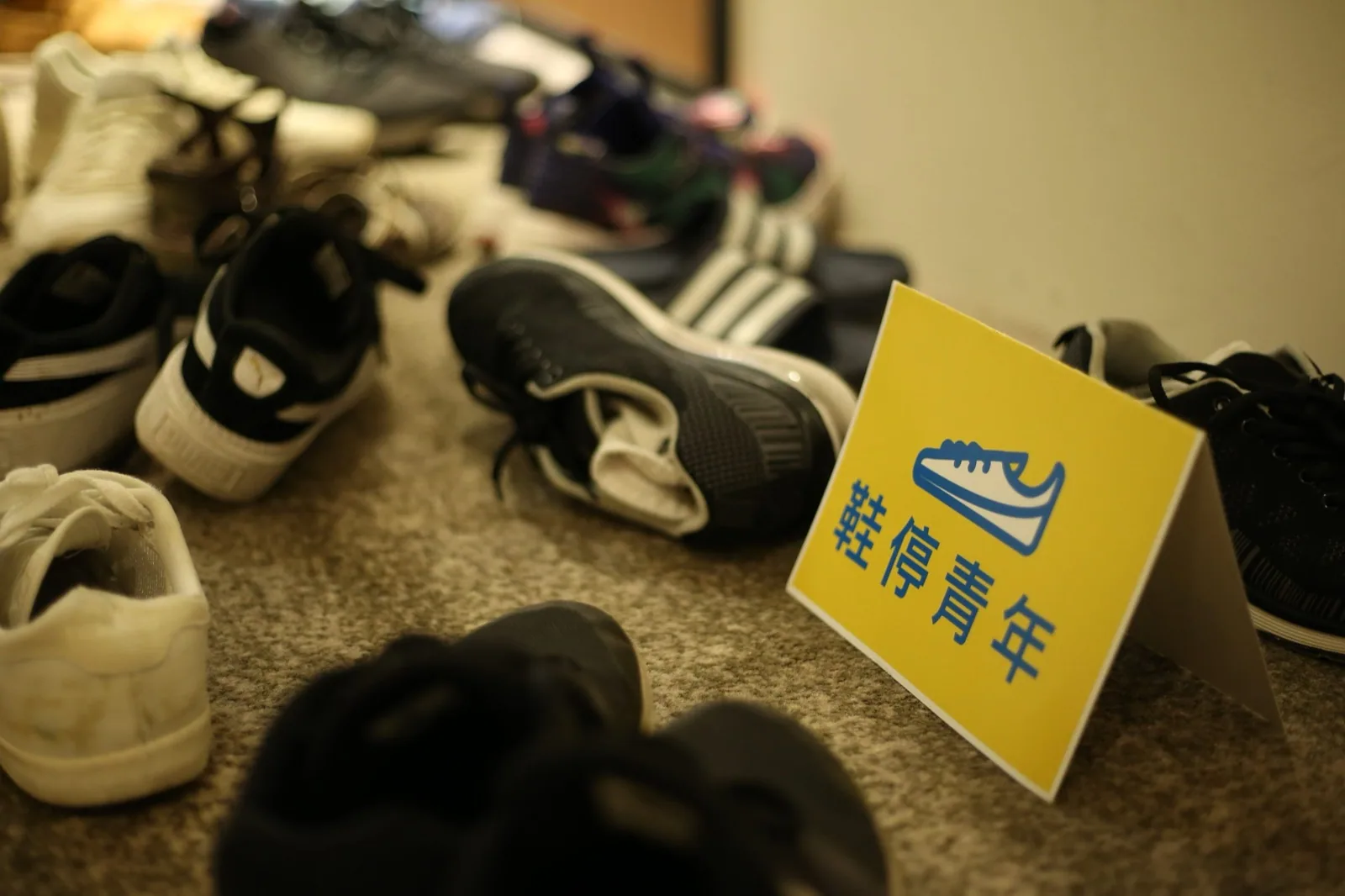
Panneau « Jeunes qui arrêtent les chaussures » et paire de baskets à l'extérieur de la salle de conférence. Le Festival de la vie complexe transformait les dialogues profonds en quelque chose de semblable au salon de quelqu'un d'autre ; on enlève ses chaussures avant d'entrer, ce petit geste répond à son auto-positionnement de « revenir fêter le Nouvel An ». Photo : Festival de la vie complexe (commentaire éditorial fair use).
La troisième édition est celle qui reste le plus mémorable de ce rassemblement.
En 2018, le thème était « Jeunes bouddhistes » (Fo xi), avec un sous-titre interrogatif : « Puisque nous pouvons être simples, pourquoi insistons-nous sur la complexité ? »14 « Bouddhiste » était le mot à la mode de ces deux années, décrivant une attitude de repli « ça va, peu importe, pas de forcer ». Le Festival de la vie complexe l'a pris comme thème, ce qui est en soi une contre-question : un groupe de maniaques du travail qui rendent leur vie épuisante parle de « bouddhisme », mais parle en réalité de « pourquoi ne pouvons-nous pas lâcher prise alors que nous pourrions choisir de nous en moquer ». Cette édition se tenait de jour à l'Université de médecine de Chung Shan, et la nuit, un « Village de la vie complexe » était ouvert à côté du marché de nuit de Feng Chia14.
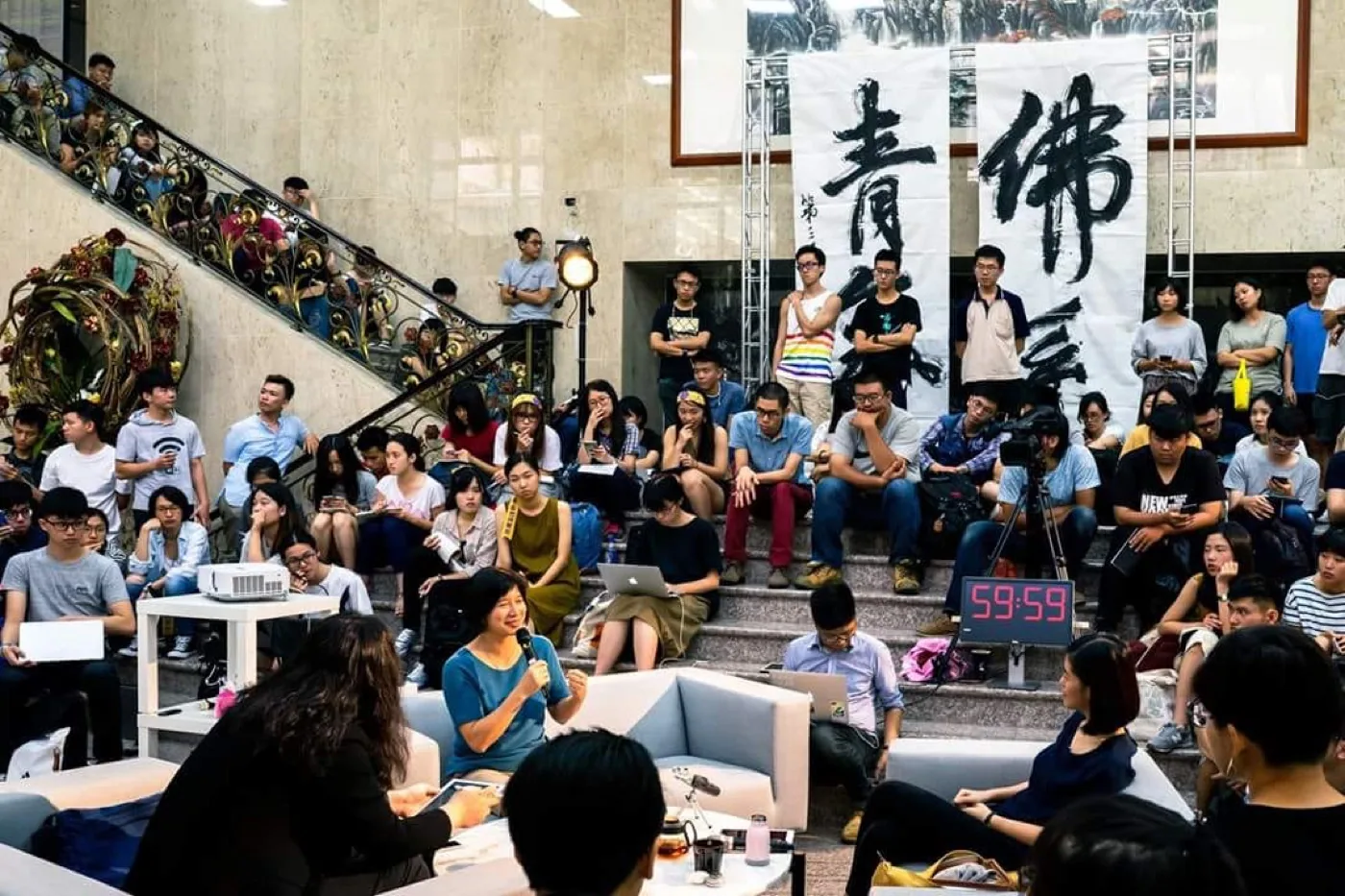
Scene de la troisième édition « Jeunes bouddhistes » : derrière l'intervenant une banderole manuscrite « Jeunes bouddhistes », à côté une horloge à compte à rebours 59:59. L'horloge à compte à rebours est l'obsession du Festival de la vie complexe pour la « profondeur » ; chaque partage est encadré par le temps, forçant l'intervenant à aller au fond de ses propos. Photo : Festival de la vie complexe (commentaire éditorial fair use).
Cette édition a invité à un dialogue triangulaire à trois personnes, devenues plus tard toutes d'une certaine manière des « réussis » : Audrey Tang (Tang Feng), alors membre du bureau exécutif du gouvernement et future ministre du numérique. Liu An-ting, fondatrice de l'organisation éducative « Teach For Taiwan ». Lin Yi-ying, vice-maire de Taichung15.
La conception du dialogue était étrange. Les trois personnes étaient assises en triangle, dos à l'audience, recevant les questions du public via l'outil en ligne Slido15.
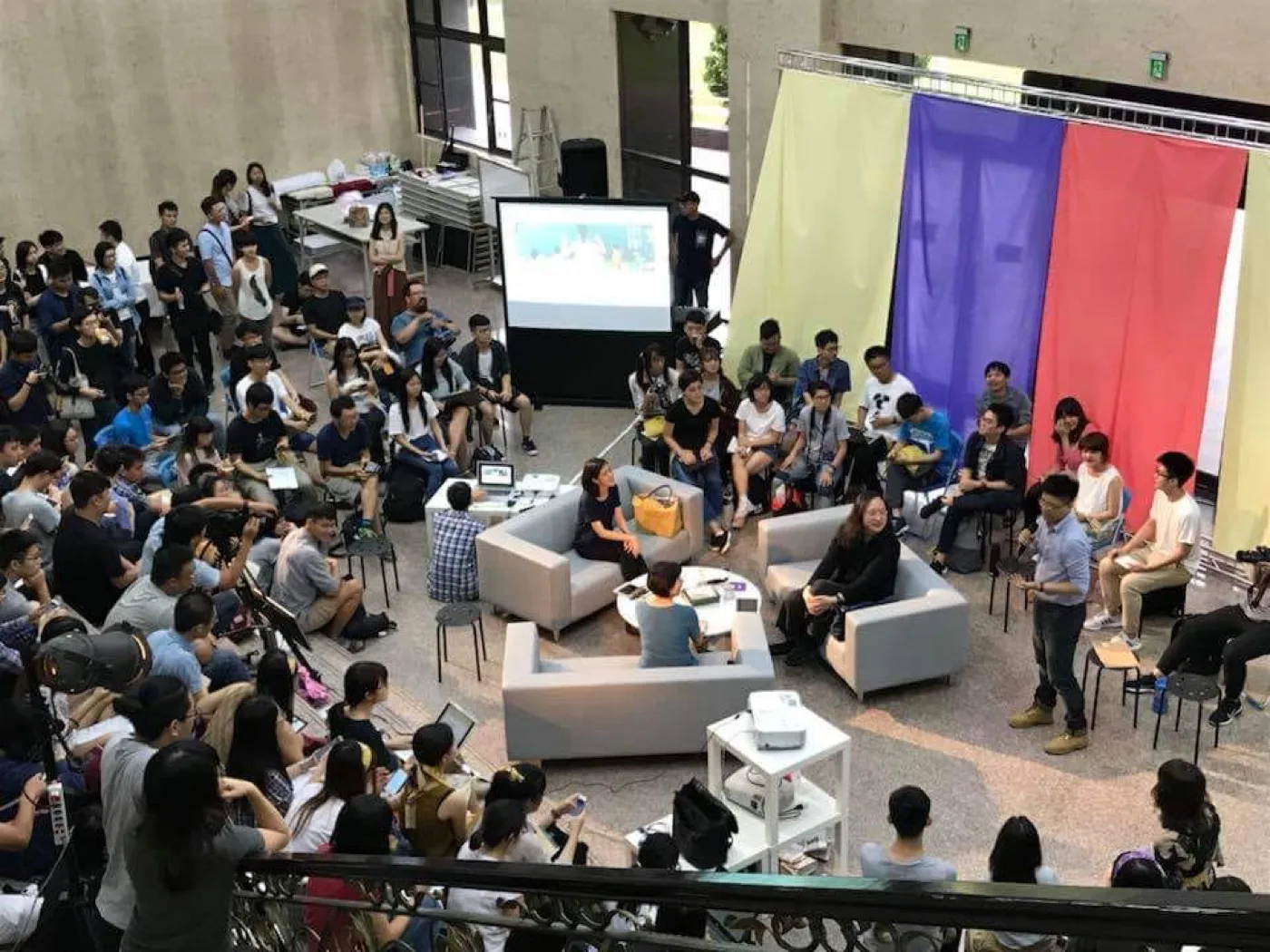
Image centrale du dialogue triangulaire de la troisième édition : trois canapés disposés en triangle, Audrey Tang, Liu An-ting et Lin Yi-ying tournées vers l'intérieur, dos au public qui les entoure, rideaux rouge, bleu et jaune tombant du plafond. C'est le « triangle dos à l'audience » en soi : tourner le dos aux intervenants pour les faire faire face les uns aux autres est l'annonce la plus directe du Festival de la vie complexe selon laquelle « le dialogue est plus important que la performance ». Photo : Festival de la vie complexe (commentaire éditorial fair use).
Parler dos à l'audience est en soi l'atmosphère du Festival de la vie complexe : pas de performance, pas de face aux projecteurs, seulement l'importance que le dialogue soit assez profond. Dans les forums ordinaires, les intervenants font face au public et parlent pour le public ; ces trois-là font face les uns aux autres et parlent pour les uns les autres, le public n'est qu'autorisé à écouter. Hsiao Hao-ning a dit que « le dialogue profond, sans distance et presque cruellement profond » est la marque de fabrique de ce rassemblement13. Le mot « cruel » est bien choisi — il ne veut pas de scènes tièdes, il veut que les dialoguants se poussent jusqu'à ne plus avoir de retraite.
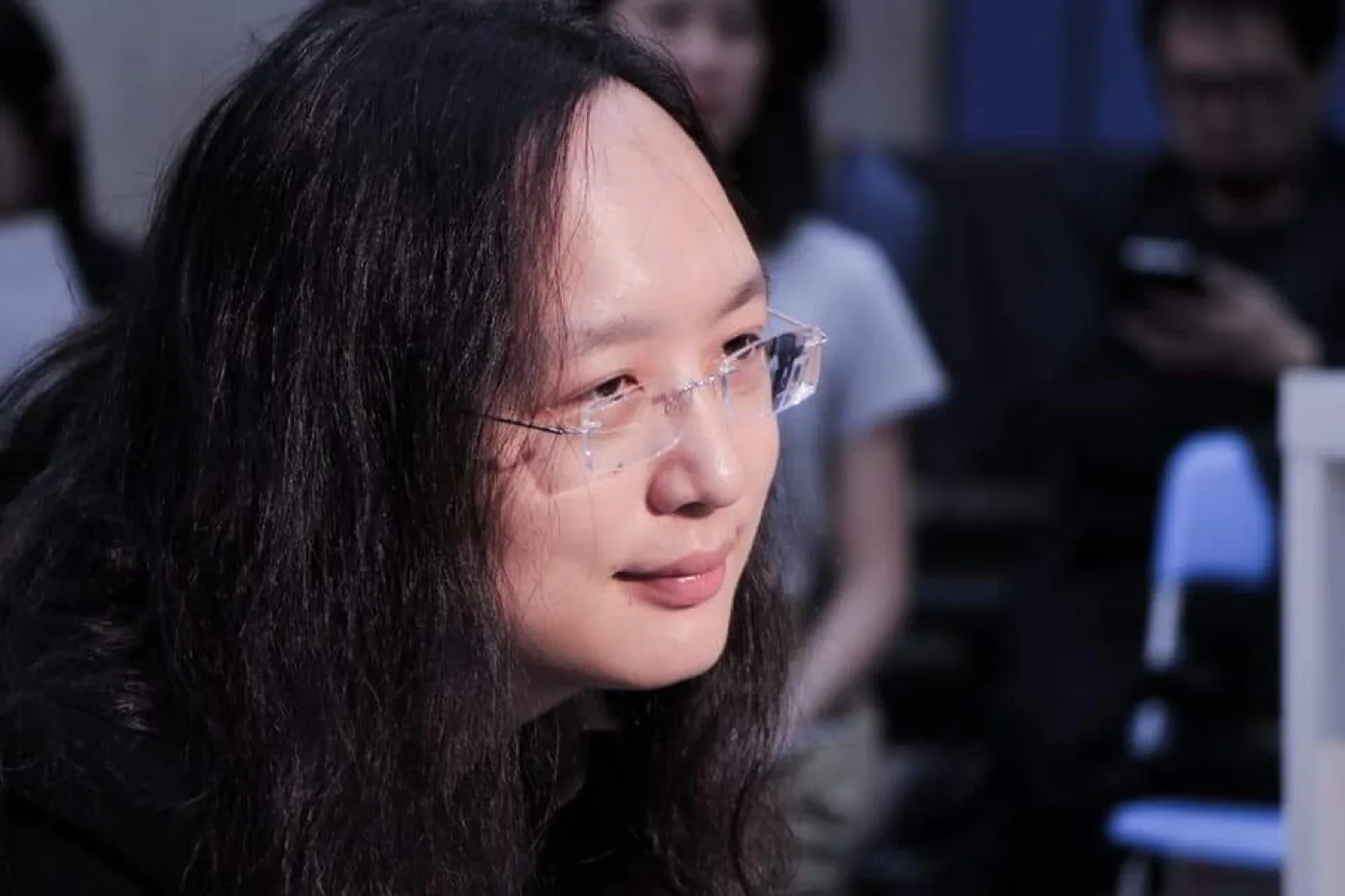
Profil d'Audrey Tang lors du dialogue triangulaire. À l'époque, elle était membre du bureau exécutif du gouvernement et militante de la technologie citoyenne issue de g0v ; deux ans plus tard, elle est devenue la première ministre du numérique de Taïwan. Photo : Festival de la vie complexe (commentaire éditorial fair use).
Ce jour-là, Audrey Tang a dit : « Le gouvernement, du point de vue de l'équité, n'est pas adapté à l'innovation »15. Elle voulait dire que le gouvernement doit traiter tout le monde de manière égale, tandis que l'innovation est par nature un privilège accordé à une minorité pour prendre des risques ; les deux ont une tension inhérente. Liu An-ting a ensuite dit : « L'innovation vient de la périphérie »15. Elle parlait du fait que les nouvelles choses véritablement nouvelles émergent rarement du centre du système, mais des coins ignorés, de ceux qui n'ont pas de ressources et doivent donc trouver des solutions par eux-mêmes. Cette phrase a souvent été faussement attribuée à l'organisateur par la suite, mais c'est la phrase de Liu An-ting, pas celle de Hsiao Hao-ning. Un forum organisé pour les « non-réussis » avait sur scène les personnes les plus prometteuses de cette génération taïwanaise, parlant de « l'innovation vient de la périphérie » — et assis en bas se trouvaient ceux qui pensaient être à la périphérie et qui sont ensuite entrés dans le centre un par un.
Il y avait aussi une anecdote mémorable pour le public présent lors du dialogue : quelqu'un a posé anonymement à Audrey Tang sur Slido : « Quel shampoing utilisez-vous habituellement ? »15 Dans un dialogue dur sur l'équité, l'innovation, le gouvernement et la périphérie, une question aussi absurde a surgi, et Audrey Tang y a répondu sérieusement. Cette image est très « Festival de la vie complexe » — elle permet à la profondeur cruelle et à la folie adolescente de coexister, car ces deux choses ne sont fondamentalement qu'une seule et même chose pour ce groupe.
Les intervenants de la troisième édition n'étaient pas seulement ces trois-là. Sur place se trouvaient également l'éditeur en chef de Pan-Science, Lei Ya-qi ; le Dr Lang Quan qui fait de l'éducation sur le comportement animal ; Liu Qian-ping de la publication locale ; Li Xue-cheng du groupe « 227 » ; et Lin Hui-qiu, s'autoproclamant « designer médiocre »16. En regardant cette liste ensemble, on constate que le Festival de la vie complexe n'a jamais invité les gens pour leur notoriété. Il invitait ceux qui « faisaient sérieusement quelque chose que personne ne comprenait encore » ; la notoriété passait après. C'est précisément parmi ce groupe que quelqu'un a vu l'ironie. Une observatrice nommée Chu Szu-yu a noté son état d'esprit ce jour-là, cette phrase est devenue la note la plus honnête du Festival de la vie complexe : « Pourquoi devrais-je faire semblant d'être un homme réussi ici ? Suis-je vraiment réussi ? »17
Discours de Liu An-ting, l'une des intervenantes du dialogue triangulaire de la troisième édition, à TEDxTaipei. Elle a fondé « Teach For Taiwan » pour envoyer des enseignants dans les zones rurales ; la phrase « l'innovation vient de la périphérie » prononcée lors de la troisième édition du Festival de la vie complexe est exactement sa croyance, cette vidéo permet d'entendre comment elle-même parle de cela18.
Le village de la vie complexe : Feng Chia la nuit, banderoles pixelisées et bons pour le cocktail
La troisième édition a séparé le jour et la nuit en deux espaces totalement différents ; cette conception mérite d'être tirée seule pour être discutée.
De jour, à l'Université de médecine de Chung Shan, c'était un lieu de dialogue sérieux, triangle, horloge à compte à rebours, profondeur cruelle. Après le coucher du soleil, tout le groupe s'est déplacé vers un lieu nommé « Si Guan » à côté du marché de nuit de Feng Chia, ouvrant le « Village de la vie complexe »14. Le mot « village » est intéressant : de jour, ils étaient les intervenants et auditeurs du forum ; la nuit, ils sont devenus les villageois du même village. Pour entrer dans le village, il fallait un « passeport de villageois », et dans le village, on échangeait des « bons pour le cocktail » contre de l'alcool.
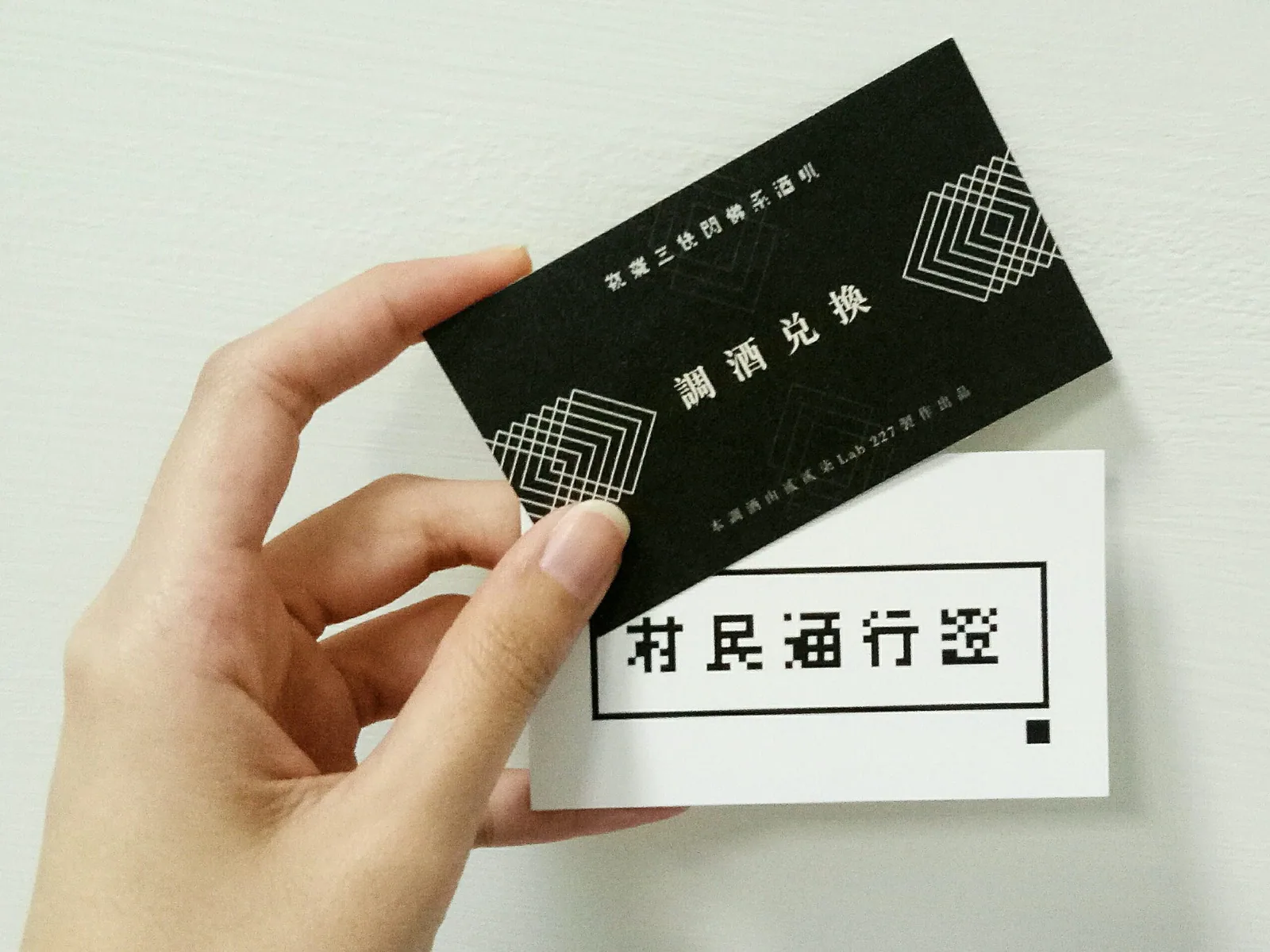
Passeport de villageois et bons pour le cocktail du Village de la vie complexe, design en police pixelisée à forte géométrie est la signature visuelle du Festival de la vie complexe. Appeler l'entrée « passeport de villageois » réécrit subtilement un événement en un village temporaire : vous ne venez pas pour participer, vous venez pour être villageois. Photo : Festival de la vie complexe (commentaire éditorial fair use).
Sur les murs de Si Guan à Feng Chia, des banderoles pixelisées étaient accrochées, tout l'espace baignait dans ce langage visuel de police pixelisée. Cette esthétique pixelisée n'était pas choisie au hasard. La police pixelisée est celle des premiers ordinateurs, des premiers consoles de jeux ; c'est la mémoire d'écran de l'enfance de ces millennials. L'utiliser pour un rassemblement de jeunesse en 2018 signifie : nous sommes la génération qui a grandi en regardant ces écrans basse résolution, notre nostalgie a cette forme.
Le Village de la vie complexe a complètement démantelé le mot trop formel de « forum ». De jour, on pouvait encore dire qu'il s'agissait d'un « événement » ; la nuit, avec des passeports, des bons, de l'alcool, des banderoles pixelisées, des discussions interminables sur l'herbe pendant quatre heures — il était devenu un village n'existant qu'une seule nuit. Le lendemain matin, le village disparaissait, les villageois se dispersaient dans leurs villes respectives. Cette qualité d'« existence temporaire mais sérieuse » est ce qui rend le Festival de la vie complexe le plus difficile à reproduire.
Non-réussis, ou élites futures
La question de Chu Szu-yu, « suis-je vraiment réussi ? », touchait l'endroit le plus difficile à répondre de ce rituel.
Le Festival de la vie complexe dit qu'il accueille des « non-réussis ». Mais ceux qui ont été tagués par Facebook étaient en réalité un groupe ayant du capital culturel, ayant pu aller à l'université, ayant des liens communautaires dans le cercle de la création indépendante. Son mécanisme de sélection (taguer des amis) excluait naturellement un autre groupe : les travailleurs migrants dans les usines, les pairs n'ayant pas fait d'université, les vrais millennial marginalisés n'ayant pas de compte social à taguer. Pour être tagué, vous deviez d'abord être dans la liste d'amis Facebook de quelqu'un ; pour être dans cette liste, vous deviez mener une vie « qui serait reconnue par ce groupe ». Ce seuil invisible était plus sélectif que n'importe quel mécanisme de billetterie.
L'exclusion avait une autre couche, géographique. Les cinq éditions se sont tenues à Taichung ; les intervenants et les participants provenaient principalement du cercle du centre du pays, ce qui l'éloignait des millennials du sud et de l'est. Pour un pair vivant à Taitung ou Pingtung, le simple seuil de « devrais-je faire le voyage à Taichung pour un rassemblement de deux jours et une nuit » suffisait à le filtrer. Les « similaires » du Festival de la vie complexe étaient en réalité des similaires avec un rayon géographique.
C'est une structure inévitable pour ce type de rassemblement, et il ne faut pas le voir comme une diffamation. Un rassemblement fonctionnant sur l'« échange profond en chambre d'écho » est fondamentalement différent de la « photographie globale des millennials ». Hsiao Hao-ning était conscient de ce point. Il se mettait en doute sur scène chaque année, disant même que le Festival de la vie complexe était son « événement le plus détesté » (comme nous le verrons plus loin). Mais être conscient ne signifie pas résoudre le problème. Savoir que son rassemblement est sélectif, et organiser un rassemblement qui ne l'est pas, il y a tout le poids de la structure entre les deux.
📝 Note du curateur
En étalant la liste des participants du « Forum des non-réussis », on voit un fait embarrassant : ce groupe s'autoproclamant non réussi est entré de manière disproportionnée dans des positions d'élite. Huang Dou-ni est allé à Harvard, l'intervenante Audrey Tang est devenue ministre, Liu An-ting a remporté un prix international de l'éducation. Ainsi, le mot d'humilité « non-réussi » semble rétrospectivement être une forme de vaniteuse modestie. Mais lire ainsi n'est pas juste. Lorsque ce groupe s'est réuni en 2016, ils n'étaient vraiment pas réussis : bas salaires, avenir invisible, marginalisation dans leur propre département, tout cela était la réalité du moment. Le problème n'est pas qu'ils sont devenus réussis par la suite, mais que ce rassemblement n'a contenu dès le début que les « non-réussis en chemin vers la réussite ». Ce qu'il a exclu, ce sont ceux qui ne pouvaient même pas se tenir sur la ligne de départ. Écrire cela honnêtement est plus proche de sa nature réelle que de l'emballer en utopie pure.
Si l'on regarde avec des yeux plus académiques, en 2019, quelqu'un a utilisé le concept de « hétérotopie » (heterotopia) du philosophe français Foucault pour expliquer le Festival de la vie complexe19. L'hétérotopie désigne un espace intermédiaire entre le réel et l'utopie, à la fois réel et illusoire, qui presse des éléments hétérogènes ensemble, faisant ainsi jaillir un potentiel de perturbation de la réalité. Foucault donne en exemple les jardins, les cimetières, les théâtres, les bateaux ; ces lieux existent dans le quotidien, mais suivent un autre ensemble de règles. L'observation de l'auteur est que le Festival de la vie complexe a brisé la ligne entre intervenants et auditeurs, a permis aux personnes aux thèmes similaires d'être adjacentes dans l'espace, et a construit une identité collective avec des banderoles ; « strictement parlant, c'est cela l'essence du Festival de la vie complexe »19.
En d'autres termes, le véritable produit du Festival de la vie complexe ne se trouvait jamais dans le contenu d'une conférence donnée, mais dans le fait même de « presser un groupe de personnes hétérogènes dans le même espace de deux jours et une nuit ».
Mais cet article laissait une question sans réponse : l'hétérotopie ne fonctionne que pendant deux jours et une nuit, l'effet peut-il perdurer ?19 Cette question est cruciale. Un jardin peut fleurir année après année, un cimetière peut rester là, mais une hétérotopie comme le Festival de la vie complexe est à usage unique : elle apparaît soudainement un week-end de mai, disparaît le lundi. Le sentiment d'appartenance qu'elle crée est réel, mais ce sentiment d'appartenance peut-il tenir pendant les trois cent soixante-trois jours après la dispersion ?
Après le rassemblement de deux jours et une nuit de similaires, chacun retourne à sa vie complexe.
ㄇㄉㄈㄎ : le jargon que seuls les chambres d'écho comprennent

Visuel de la quatrième édition « ㄇㄉㄈㄎ » : Huang Dou-ni a dessiné à la main les symboles phonétiques standards ㄇㄉㄈㄎ pour motherfucker, un jargon adolescent compréhensible uniquement par la chambre d'écho. Image : Design de Huang Dou-ni (commentaire éditorial fair use).
La quatrième édition a poussé cette atmosphère de « seulement pour nous » à son extrême.
En 2019, le thème était quatre symboles phonétiques : ㄇㄉㄈㄎ. Déchiffré, cela donne la phonétique anglaise de motherfucker20. C'est une énigme que seuls ceux qui comprennent les symboles phonétiques et savent la retranscrire en anglais peuvent résoudre ; c'est-à-dire un code compris uniquement par les Taïwanais, et plus précisément par une génération spécifique de Taïwanais. Huang Dou-ni a lui-même conçu ce jeu de symboles phonétiques standards dessinés à la main, le définissant comme « tout en étant discipliné, en parlant des conneries sans limites »21, un jargon adolescent, compréhensible uniquement par la chambre d'écho. Les symboles phonétiques sont appris en première année de primaire ; c'est le système de symboles le plus discipliné ; l'utiliser pour épeler un juron est en soi un acte de « rébellion secrète sous une apparence sage », et c'est précisément la photographie de ces étudiants en médecine cachant d'autres pensées sous leur blouse blanche.
Le lieu a été choisi à l'Hôtel Banpan, au quatrième étage du Premier Carré de Taichung, dans des chambres en nid d'abeille20. Choisir ce bâtiment avait sa raison. Le Premier Carré est un vieux bâtiment rempli de traces de la vie des travailleurs migrants d'Asie du Sud-Est ; le week-end, il est bondé de travailleurs migrants venus du Vietnam, d'Indonésie, des Philippines et de Thaïlande, c'est le salon des travailleurs migrants de Taichung. Dans la mémoire des Taïwanais de Taichung, il a été stigmatisé, considéré comme un endroit « à ne pas aller », avant d'être progressivement redécouvert, renommé Carré ASEAN et considéré comme un point de rencontre pour la culture multiple. Un groupe de jeunes parlant de « périphérie » a organisé son rassemblement dans le bâtiment le plus périphérique, dans des petites chambres en nid d'abeille ; ce choix était en soi une déclaration non dite.
L'avant-propos de cette édition résume le mieux l'essence du Festival de la vie complexe : « Nous ne sommes pas un forum, nous cherchons des familles sans liens de sang pour revenir fêter le Nouvel An. » « Le dialogue profond, sans distance et presque cruellement profond, est la marque de fabrique du « Festival de la vie complexe ». « Nous allons plus loin ensemble. »13
Appeler un rassemblement « fêter le Nouvel An » et les participants « famille sans liens de sang » est l'auto-positionnement le plus touchant et le plus dangereux du Festival de la vie complexe. Le Nouvel An est une cérémonie annuelle, avec des places fixes, toute la famille revenant à la même table ; comparer ce rassemblement de similaires au Nouvel An, c'est promettre une appartenance « peu importe où vous dérivez, il y a un foyer qui vous attend chaque mai ». C'est touchant car il a véritablement fourni ce sentiment d'appartenance ; c'est dangereux car les cercles de famille ont des frontières, la table du Nouvel An a une limite de places — ceux qui peuvent revenir fêter le Nouvel An sont toujours ceux qui étaient déjà sur la liste de cette famille.
L'âme reste à la périphérie, l'assistant est allé à Harvard
Pour comprendre de qui est le Festival de la vie complexe, il faut regarder où ces deux initiateurs sont allés par la suite. Car la plus profonde tension ne se trouve pas dans les cinq éditions de l'événement lui-même, mais dans la bifurcation de ces deux personnes.
Huang Dou-ni, de son vrai nom Huang Yen-lin, s'appelait en ligne mashbean. Vers 2021, il a démissionné de son poste de médecin. La raison qu'il donnait lui-même était : « Ayant sombré dans la structure profonde d'Internet et des réseaux sociaux, j'ai démissionné de mon travail de médecin, me consacrant désormais à intégrer l'esprit cypherpunk dans la société numérique taïwanaise »22. Cette phrase ressemble à un CV, mais démontée, elle est un grand tournant : abandonner le poste d'interne à l'Hôpital général de Taipei (Vith Vith) pour poursuivre quelque chose nommé « cypherpunk », un groupe croyant que la cryptographie et le code peuvent redistribuer le pouvoir et protéger la liberté individuelle. Son abandon de la médecine n'était pas un instant dramatique. Alors qu'il portait encore la blouse blanche, il organisait déjà le Festival de la vie complexe ; au début de 2022, il a mentionné lors d'un rassemblement communautaire qu'il « était encore médecin l'année dernière »23. Le départ n'était qu'un glissement progressif, de la bordure du département vers l'extérieur du département, puis vers un monde totalement étranger à la médecine.
Après son départ, il a co-fondé le FAB DAO, une organisation caritative utilisant la blockchain, qui a ensuite lancé le « Projet des Cent Montagnes » (Project %), invitant six artistes génératifs pour créer dix mille cent onze œuvres d'art numérique des montagnes de Taïwan24. Cette ligne s'est progressivement rapprochée du cœur du système : il est entré au Département du développement numérique en tant qu'ingénieur de système, transférant l'expérience accumulée de l'aide caritative web3 dans les pièces du gouvernement ; en 2025, il a obtenu le poste de chercheur invité non résident au laboratoire Allen de l'Harvard Kennedy School pour le « renouvellement de la démocratie »2. D'un responsable de la création d'affiches pour un petit rassemblement à Taichung jusqu'à la table de l'Harvard où l'on discute de comment remodeler la démocratie — cette trajectoire est presque la réalisation la plus dramatique de « l'innovation vient de la périphérie », seulement la réalisation ne vient pas de Liu An-ting qui prononçait cette phrase, mais de l'assistant visuel qui était assis en bas à cette époque.
Mais pour savoir de qui est l'œuvre du Festival de la vie complexe, Huang Dou-ni lui-même s'exprime clairement. Il écrit dans son propre article : « La complexité est raisonnablement devenue l'œuvre de Hao-ning, nous, en tant qu'assistance visuelle, continuons d'exister dans l'équipe de travail »25. Cette phrase est importante, venant de la bouche des acteurs, elle cède explicitement la position d'« organisateur principal » à Hsiao Hao-ning, se plaçant lui-même en « assistance visuelle ». Par la suite, les médias, en raison de la renommée web3 de Huang Dou-ni, ont souvent écrit que le Festival de la vie complexe était « la jeunesse du fondateur du FAB DAO », mais Huang Dou-ni lui-même ne l'a jamais dit ainsi.
Lorsqu'il en était à la quatrième édition, il a écrit ce que ce rassemblement signifiait pour lui : « La fin du Festival de la vie complexe 4 symbolise pour moi personnellement la fin d'une époque, l'ère des rêves et des joies s'est terminée simultanément avec les difficultés de gestion des pages Facebook »26. La phrase « difficultés de gestion des pages Facebook » touche à un tournant structurel de l'époque — le Festival de la vie complexe était né du tag Facebook et avait grandi avec les pages Facebook ; lorsque l'algorithme de Facebook a réduit le reach organique, ce type de rassemblement connecté organiquement par les communautés a perdu son oxygène.
Puis vient la phrase semblable à une adieu ou à un archivage : « Ces quatre années, ce que le Festival de la vie complexe m'a appris s'arrête probablement ici, scellé ici. 2016–2019, mon honneur »27. L'assistant est allé à Harvard, l'âme est restée à la périphérie.
Oeuvre caritative web3 de Huang Dou-ni après avoir quitté la médecine (entretien avec Digital Times). De l'assistant visuel du Festival de la vie complexe au co-fondateur du plus grand projet caritatif NFT de Taïwan, cette vidéo est la prochaine étape de la ligne « l'assistant est allé à Harvard »28.
Hsiao Hao-ning n'a pas quitté Taichung. Né en 1988 à Changhua, c'est un enfant de campagne entouré de champs, aux meilleurs résultats de son collège, admis à la classe surdouée en sciences du Lycée supérieur de Changhua, puis au département de MTC de l'Université de médecine et de pharmacie de Chine ; il est maintenant directeur d'une clinique de MTC à Beitun5. Pendant ses études universitaires, il a vécu les changements familiaux successifs : sa mère a fait un AVC lors de sa deuxième année d'université et est décédée deux jours plus tard, son père est décédé de maladie lors de sa sixième année ; à l'époque, sa sœur était en quatrième année et son frère en seconde ; il était l'enfant adulte unique de la famille29. De son vivant, son père conduisait un taxi, sa mère faisait du travail à domicile29.
Ce sont des faits rapportés publiquement, sans besoin d'exagération ; mais ils constituent la couleur de fond pour comprendre pourquoi il est resté — une personne qui a perdu ses deux parents pendant six années d'université et a porté une famille, a une sensation de poids différente de celle des autres quant au fait de « rester sur place et de garder les choses ».
Il est aussi un poète. Premier président du club d'études littéraires et artistiques de l'Université de médecine et de pharmacie de Chine, il a également été secrétaire général de l'Association d'écriture de la jeunesse Gengshen, remportant quatre prix littéraires, dont les prix de poésie moderne des prix littéraires nationaux pour les étudiants et pour les étudiants en médecine5. Une personne étudiant la MTC, une personne écrivant de la poésie moderne, une personne organisant un rassemblement de jeunesse, ces trois identités ne sont pas en conflit en lui ; elles sont plutôt trois facettes de la même chose : chercher la capacité de « voir les gens plus clairement ».
Plus tard, lorsqu'il cherchait un siège de comité de campagne, il a rencontré par hasard une vieille maison qui lui a semblé adaptée pour une librairie, et il a ouvert « Reference » (Yin Shudian)30. La logique du nom est similaire à celle de la personne : la dernière section d'une thèse est la bibliographie, celui qui cherche la vérité ne peut s'en passer ; « Là où est la Reference, là est l'argument »30. Une librairie nommée d'après la « bibliographie » équivaut à transformer la croyance « ce que je dis a des sources et tient debout » en un espace physique. Cette librairie continuait à mettre à jour son propre Podcast jusqu'à la fin de 202431 — après la défaite électorale, la librairie a survécu.
En 2018, Hsiao Hao-ning s'est présenté pour le siège de conseiller municipal de Beitun, Taichung, au nom de l'Force Times (Shidai Liliang). Dans une circonscription de seize concurrents, il a obtenu 5 332 voix, un taux de 3,93 %, se classant onzième, perdant l'élection, et le compte de campagne affichait une perte de plus de cent mille dollars taïwanais32. Lors de sa candidature, il a dit une phrase très particulière : « J'espère pouvoir aimer les autres, pour prouver que j'ai été aimé par des gens formidables »33. Un jeune homme venant de perdre ses parents voulait utiliser le fait d'« aimer les autres » pour prouver que ceux qui l'avaient aimé avaient véritablement existé — cette phrase transformait un acte public comme une élection en une commémoration très intime. Il avait également dit qu'il consacrerait ses « années d'or de 30 à 50 ans » à Beitun34. Il a perdu l'élection, mais la librairie, ouverte parce qu'il cherchait un siège de comité de campagne, est restée. Une personne voulant commémorer la perte la plus intime (ses parents) de la manière la plus publique (les élections) voit finalement rester la boutique la plus silencieuse.
L'année la moins cool
La cinquième édition était l'édition la plus solitaire de ce rituel de « rassembler des similaires ». En 2020, le COVID est arrivé. Un rassemblement ayant pour cœur de « rassembler des familles sans liens de sang pour fêter le Nouvel An » a rencontré une année où le monde entier devait garder ses distances. Le thème de cette édition du Festival de la vie complexe s'appelait « Isolement autonome »35.
Il n'y a pas eu de conférence physique. Il a été remplacé par une série de Podcasts, quarante-sept épisodes au total. L'équipe a parcouru le Nord, le Centre et le Sud, interviewant dix-huit aînés et organisant six interviews d'amis35. Un rassemblement fondé sur le « face-à-face, sans distance, dialogue profond et cruel » a été forcé de démanteler son élément central « face-à-face », ne laissant que la voix à travers les microphones. Le jour de la clôture, le 11 novembre 2020, ils ont donné à cette édition le titre : « Cette année, le Festival de la vie complexe est l'année la moins cool »35.
La cinquième édition « Isolement autonome » a transformé le rassemblement physique en un Podcast de 47 épisodes. Un rituel ayant pour foi de « rassembler des familles sans liens de sang » a vu sa dernière édition se reconnaître à travers les microphones seulement.
La description de l'émission contient ce passage, qui résume très bien la situation de cette année-là : « Depuis le début de l'année chaotique de la pandémie... lorsque le monde n'avait plus que l'isolement comme seule voie, Taïwan a eu la chance de devenir une créature d'angle de valeur creuse, permettant des rassemblements, des rencontres, des discussions sur l'avenir possible »35. Le mot « créature d'angle » (jiao luo sheng wu) est utilisé avec amertume et précision. En 2020, le monde entier était en confinement ; Taïwan était l'une des rares régions où l'on pouvait encore se rassembler et se rencontrer. Le Festival de la vie complexe a saisi cette faille pour en faire une émission sur « comment se reconnaître dans une époque d'isolement ».
La cinquième édition a annoncé la sixième, disant qu'un suite gratuit serait tiré au sort pour les auditeurs35. Mais aucune trace de réalisation de la sixième édition n'existe. Le Festival de la vie complexe physique s'est essentiellement arrêté en 2020. Un événement ayant pour foi le rassemblement a vu sa dernière édition s'appeler Isolement autonome, puis se disperser — cette fin est plus semblable à une métaphore d'une époque que n'importe quel design délibéré.
Comment comprendre ce qu'a laissé ce rassemblement de cinq ans, fréquenté par environ quinze cents personnes au total ? Le replacer dans la Taïwan post-Mouvement des fleurs de l'osmanthe de 2014 rend les choses plus claires. Les participants de ce mouvement avaient en moyenne vingt-trois ans, plus de soixante pour cent participaient à la politique pour la première fois36. Après la dispersion du mouvement, l'énergie de « sortir du camp et semer » s'est divisée en plusieurs sorties : certains sont entrés dans le système pour créer la Force Times, remportant cinq sièges de législateurs en 2016 ; d'autres ont fait de la technologie citoyenne avec g0v, transformant les données gouvernementales en outils utilisables par tous ; d'autres ont organisé une éducation alternative, faisant grandir le Za Xue Xiao (Za School) jusqu'à devenir le plus grand carnaval éducatif d'Asie. Le Festival de la vie complexe a pris la quatrième voie : ni élection, ni programmation, ni recrutement, juste rassembler des pairs dans la précarité salariale et la confusion pour leur faire savoir « tu es aussi là ».
Il est intéressant de noter que ces quatre sorties se sont croisées à nouveau lors de la troisième édition du Festival de la vie complexe : Audrey Tang était la représentante de la ligne g0v entrant dans le gouvernement central, Hsiao Hao-ning s'était présenté au nom de la Force Times, Liu An-ting était la ligne de l'éducation alternative — l'énergie dispersée après le 318 s'est retrouvée, après quatre ans de détour, assise ensemble dans ce triangle dos à l'audience. L'influence du Festival de la vie complexe ne résidait pas dans l'échelle, mais dans l'instant de « reconnaissance des similaires » et dans le fait qu'il avait cousu silencieusement ces lignes de jeunesse apparemment distinctes dans la même pièce.
Conclusion : Il vous manquera toujours ce petit quelque chose
La phrase la plus percutante du Festival de la vie complexe a été prononcée par Hsiao Hao-ning sur scène lors de la troisième édition.
Il a d'abord admis une vérité embarrassante : « Le Festival de la vie complexe est l'événement que j'ai le plus détesté organiser ; chaque année, je vérifie si mes convictions sont réelles ou non. Est-ce que les gens qui viennent cette année ne voudront plus revenir l'année prochaine ? » 3 Un festival organisé pour offrir un refuge aux autres, dont l'organisateur principal doute chaque année de la pérennité de l'existence même. Quelqu'un qui construit des foyers pour autrui, mais qui se tient à la porte, craignant chaque année que personne ne rentre.
Puis, il a tenu un discours qui a mis à nu tout ce qui se cache derrière les quatre mots « ceux qui n'ont pas réussi » :
« Combien d'années devrons-nous passer à nous répéter que nous ne sommes pas assez forts, que nous ne sommes pas assez bons, pour continuer à avancer ? Jusqu'à quand devrons-nous tenir avant de pouvoir se pardonner et se dire : "Je suis assez bien"... Car vous ne vous aimerez jamais vraiment, il vous manquera toujours ce petit quelque chose. Mourrez-vous de regrets, ou abandonnerez-vous en étant vivant ? » 3
Ces paroles ont résolu l'énigme initiale. Que signifie réellement « ne pas avoir réussi » ? Ce n'est pas une formule d'humilité ; Huang Dou-ni est bel et bien allée à Harvard, la modestie feinte ayant été depuis longtemps balayée par la réalité. Ce n'est pas non plus une prophétie, car le « succès » ultérieur de ce groupe est trop disparate pour être résumé par une courbe ascendante. C'est plutôt l'état décrit par Hsiao Hao-ning : une exigence envers soi-même que toute une génération porte sur ses épaules et dont elle ne peut se défaire. Ce sentiment permanent d'être « juste un peu en dessous », ce refus de se dire « je suis assez bien ». Le Festival de la vie complexe a transformé cette insatisfaction collective en un rendez-vous annuel — un rassemblement de personnes qui manquent toujours de ce petit quelque chose, venant confirmer mutuellement qu'elles sont effectivement un peu en retrait.
Huang Dou-ni a scellé cela dans « 2016–2019 Mon honneur ». Hsiao Hao-ning est resté à Taichung, continuant sa pratique de la médecine traditionnelle chinoise et gérant la librairie qui lui était restée après son échec. L'année de la cinquième édition, le monde a enfermé tout le monde en isolement sanitaire ; ce festival dont la foi reposait sur le rassemblement s'est ainsi conclu silencieusement lors de l'année où se rassembler était le plus impossible.
La question restée sans réponse demeure sur scène : mourrez-vous de regrets, ou abandonnerez-vous en étant vivant ? Une génération qui refuse de parler de succès a posé cette question, puis est retournée chacune dans sa vie complexe, continuant à vivre avec ce sentiment qu'il leur manque toujours un petit quelque chose.
Source : Thèmes et récits de terrain des différentes éditions cités dans cet article (entretiens avec Hsiao Hao-ning et Huang Dou-ni, et rapports des éditions précédentes) 31114
Dix ans séparent les deux « festivals de la vie », représentant deux réponses de deux générations différentes sur ce à quoi « la vie devrait ressembler » :
Source : Medium officiel du Festival de la vie complexe, archives du Simple Life Festival
Lectures complémentaires :
- Mouvement des tournesols — Le contexte historique du Festival de la vie complexe : comment ce mouvement de 2014 s'est fragmenté après les manifestations de rue en plusieurs voies pour la jeunesse, telles que New Power Party, g0v, les écoles alternatives et le Festival de la vie complexe.
- Écoles alternatives (Zá xué xiào) — Une énergie alternative issue de la même vague du 318, mais suivant une trajectoire opposée : devenant le plus grand carnaval éducatif d'Asie, offrant un contraste entre l'échelle (scale) et l'intimité par rapport à la « petite taille volontaire » du Festival de la vie complexe.
- La génération "slash" de Taïwan — Le contexte structurel expliquant pourquoi les participants du Festival de la vie complexe se qualifient de « workaholics » : comment le salaire médian et la pression de survie ont poussé cette génération à cumuler plusieurs fonctions.
- [FAB DAO et le Projet des Cent Montagnes](/art/FAB DAO與百岳計畫) — Où est allée Huang Dou-ni après avoir abandonné la médecine : sa prochaine œuvre, intégrant « l'esprit cyberpunk dans la société numérique taïwanaise ».
Sources des images
Cet article utilise 8 photos de scène et des designs visuels du Festival de la vie complexe, toutes mises en cache dans public/article-images/society/ pour éviter les serveurs de source de liens chauds. Le Festival de la vie complexe est un événement de jeunesse non commercial arrêté, sans bibliothèque d'images sous licence CC/PD ; cet article cite ses images de registre public à des fins de commentaire éditorial selon l'article 65 de la loi sur le droit d'auteur (fair use editorial commentary : nature non commerciale éducative, publiquement publiée, faible proportion de citation, aucune substitution substantielle au marché) ; les sources sont toutes des membres de l'équipe organisatrice (Huang Dou-ni) publiant publiquement sur Medium des registres d'événements et des textes d'observation de la troisième édition.
- Scène du Festival de la vie complexe (couverture) — Deux participants consultant le programme, paniers de bière Taiwan servant de sièges. Photo : Photographie de Huang Po-chun / Festival de la vie complexe. Commentaire éditorial fair use.
- Lieu du Festival de la vie complexe — 200-300 personnes serrées dans un espace à haut plafond écoutant, intervenants et auditeurs mélangés. Photo : Festival de la vie complexe. Commentaire éditorial fair use.
- Intervenant partageant au Festival de la vie complexe — Intervenant partageant devant un écran de projection, banderoles pixelisées accrochées au mur. Photo : Festival de la vie complexe. Commentaire éditorial fair use.
- Scène de la troisième édition « Jeunes bouddhistes » — Intervenant tenant un micro, banderole calligraphiée « Jeunes bouddhistes » derrière, horloge à compte à rebours 59:59. Photo : Festival de la vie complexe. Commentaire éditorial fair use.
- Dialogue triangulaire de la troisième édition (triangle dos à l'audience) — Vue de dessus de trois canapés en triangle, rideaux rouge/bleu/jaune, public entourant. Photo : Festival de la vie complexe. Commentaire éditorial fair use.
- Profil d'Audrey Tang à la troisième édition — Gros plan d'Audrey Tang lors du dialogue triangulaire. Photo : Festival de la vie complexe. Commentaire éditorial fair use.
- Passeport du Village de la vie complexe — Main tenant « Passeport de villageois » et « bon pour le cocktail », design en police pixelisée géométrique. Photo : Festival de la vie complexe. Commentaire éditorial fair use.
- Panneau « Jeunes qui arrêtent les chaussures » — Panneau d'enlèvement de chaussures à l'extérieur de la salle de conférence et paire de baskets. Photo : Festival de la vie complexe. Commentaire éditorial fair use.
- Visuel de la quatrième édition « ㄇㄉㄈㄎ » — Symboles phonétiques standards ㄇㄉㄈㄎ de motherfucker dessinés à la main par Huang Dou-ni. Image : Design de Huang Dou-ni / Festival de la vie complexe. Commentaire éditorial fair use.
Références
- Wikipedia : Hsiao Hao-ning — Biographie de Hsiao Hao-ning, processus d'initiation du Festival de la vie complexe, origine du nom avec la phrase exacte « appelons-le simplement Festival de la vie complexe », mots-clés de tag Facebook, liste des trente groupes de partageurs de la première édition et registre de candidature à la Force Times en chinois.↩23
- Ash Center, Harvard Kennedy School : Bourses Allen Lab for Democracy Renovation — Page officielle des bourses du laboratoire Allen « Renouvellement de la démocratie » de l'Harvard Kennedy School, confirmant que Huang Yen-lin (Huang Dou-ni) a été embauché comme chercheur invité non résident pour l'année académique 2025-26.↩2
- cowrite30 : Texte d'observation du Festival de la vie complexe III (Puisque nous pouvons être simples, pourquoi insistons-nous sur la complexité ?) — Texte d'observation de la troisième édition, enregistrant mot à mot le discours d'ouverture de Hsiao Hao-ning « l'événement le plus détesté que j'ai organisé » et le passage complet « voulez-vous mourir avec des regrets ou renoncer en vivant ? ».↩234
- The Polysh : Gémissements pathologiques Esthétique de la maladie. Exposition d'images de coupes histologiques — Rapport de fin 2015 sur l'exposition d'images de coupes histologiques du centre artistique de l'Université de médecine et de pharmacie de Chine, incluant la liste des seize étudiants en médecine curateurs (dont Huang Yen-lin, Hsiao Hao-ning) et le concept d'exposition « l'apparence pathologique vue au microscope peut rester belle ».↩2
- Wikipedia : Hsiao Hao-ning (médecin MTC, poète, librairie Reference) — Registre en chinois de l'origine de Hsiao Hao-ning à Changhua, surdoué en sciences du Lycée supérieur de Changhua, département de MTC de l'Université de médecine et de pharmacie de Chine, directeur de clinique de MTC à Beitun, premier président du club d'études littéraires et artistiques, secrétaire général de l'Association d'écriture de la jeunesse Gengshen et quatre prix littéraires.↩23
- Données officielles et compilation de rapports médiatiques du Festival de la vie simple — Le Festival de la vie simple initié en 2006 par Li Zong-sheng, Chang Pei-jen, Ma Tien-tsung, slogan principal « Faites ce que vous aimez, donnez de la valeur à ce que vous aimez », atmosphère « calme et concentrée », données annuelles d'échelle et contexte du 20e anniversaire en 2025.↩2
- Blogto : La génération dépressive : bas salaires, pauvreté et avenir invisible (Wu Cheng-hsien / Reporter) — Œuvre de 2017 de Wu Cheng-hsien, définissant la « génération dépressive » comme le discours générationnel original « vingt à trente-quatre ans, nés avec une souris en bouche et possédant les meilleures qualités jamais vues à Taïwan, mais confrontés à la pauvreté, aux bas salaires et à l'absence d'avenir ».↩
- Wikipedia : 22K (Programme de stage pour diplômés de l'enseignement supérieur vers le monde de l'entreprise) — Programme lancé par le Ministère de l'Éducation de 2009 à 2011 pour faire face à la crise financière, salaire mensuel de 22 000 dollars taïwanais, plus de trente mille places, et article en chinois sur son effet d'ancrage sur les salaires de départ de la jeunesse taïwanaise.↩
- YouTube (Bureau de développement de la jeunesse du Ministère de l'Éducation) : Super Wall Tuesday × Festival de la vie complexe × Hsiao Hao-ning : il est trop difficile d'être simple, explorons ensemble la complexité — Vidéo officielle de la série « Super Wall Tuesday » du Bureau de développement de la jeunesse du Ministère de l'Éducation, Hsiao Hao-ning parlant du Festival de la vie complexe, le titre répondant directement au parallèle de nommage « simple vs complexe ».↩
- Canapé dans un champ de blé doré (Wu Wei-jung) : Festival de la vie complexe, millennial taïwanais, naissance d'une hétérotopie — Long article analysant le Festival de la vie complexe sous le cadre de l'hétérotopie de Foucault, enregistrant la première édition « 200+ billets vendus pour 250 personnes », sans présentateur, échange nocturne sur l'herbe pendant quatre heures, concept de soupe aux pierres pour recruter les partageurs et écologie des trente groupes de partageurs.↩2
- Medium officiel du Festival de la vie complexe (présentations de chaque édition) — Compilation des présentations officielles du Festival de la vie complexe sur les thèmes des premières éditions, incluant la deuxième édition « Hôtel California Hotel California » organisée dans un hôtel, explication de la métaphore « entrer, mais ne pas sortir ».↩23
- Medium de Huang Dou-ni (mashbean) : L'ère de l'inflation du divertissement du savoir — Article de Huang Dou-ni sur le divertissement du savoir, plaçant le Festival de la vie complexe aux côtés de Za Xue Xiao et du Festival du savoir généralisé, se distinguant comme « le petit » et critiquant les grands événements pour la « peste noire des projecteurs ».↩
- Avant-propos du Festival de la vie complexe IV ㄇㄉㄈㄎ : Avant-propos (publication officielle, Wen Chun Huang) — Avant-propos officiel de la quatrième édition, enregistrant mot à mot « nous ne sommes pas un forum, nous cherchons des familles sans liens de sang pour revenir fêter le Nouvel An », « dialogue profond... est la marque de fabrique du « Festival de la vie complexe » », « nous allons plus loin ensemble ».↩23
- Medium de siyuchu (Chu Szu-yu) : Festival de la vie complexe III Puisque nous pouvons être simples, pourquoi insistons-nous sur la complexité — Texte d'observation de la troisième édition, enregistrant le thème « Jeunes bouddhistes », l'arrangement de lieu de jour à l'Université de médecine de Chung Shan et de nuit au Village de la vie complexe de Feng Chia (Si Guan).↩234
- Medium de siyuchu (Chu Szu-yu) : Festival de la vie complexe III Registre du dialogue triangulaire — Registre mot à mot du dialogue triangulaire de la troisième édition entre Audrey Tang, Liu An-ting et Lin Yi-ying, incluant les trois formant un triangle dos à l'audience, questions via Slido (anecdote du public demandant à Audrey Tang son shampoing), phrases originales d'Audrey Tang « le gouvernement, du point de vue de l'équité, n'est pas adapté à l'innovation » et de Liu An-ting « l'innovation vient de la périphérie ».↩2345
- Medium de siyuchu (Chu Szu-yu) : Festival de la vie complexe III Registre des intervenants — Texte d'observation de la troisième édition, enregistrant les intervenants en dehors du dialogue triangulaire, incluant l'éditeur en chef de Pan-Science Lei Ya-qi, le Dr Lang Quan, Liu Qian-ping, Li Xue-cheng de 227, et Lin Hui-qiu s'autoproclamant « designer médiocre ».↩
- Medium de siyuchu (Chu Szu-yu) : Festival de la vie complexe III Segment réflexif du texte d'observation — Réflexion de l'observateur Chu Szu-yu sur place lors de la troisième édition « pourquoi devrais-je faire semblant d'être un homme réussi ici ? Suis-je vraiment réussi ? » enregistrée mot à mot.↩
- YouTube (TEDxTaipei) : Embrasser la génération en commençant par l'éducation — Liu An-ting at TEDxTaipei 2013 — Chaîne officielle de TEDxTaipei, discours de Liu An-ting sur « Teach For Taiwan » et l'éducation rurale ; sa phrase « l'innovation vient de la périphérie » prononcée lors de la troisième édition du Festival de la vie complexe en est la continuité.↩
- Canapé dans un champ de blé doré (Wu Wei-jung) : Analyse de l'hétérotopie du Festival de la vie complexe — Application du concept de « hétérotopie » (Of Other Spaces, 1967) de Foucault pour analyser le Festival de la vie complexe, incluant « strictement parlant, c'est cela l'essence du Festival de la vie complexe » et la question ouverte « l'effet de deux jours et une nuit peut-il perdurer ? ».↩23
- Publication officielle du Festival de la vie complexe IV ㄇㄉㄈㄎ — Page officielle de la quatrième édition, confirmant que le thème « ㄇㄉㄈㄎ » est la phonétique de motherfucker, et le lieu de l'Hôtel Banpan au Premier Carré de Taichung avec ses chambres en nid d'abeille.↩2
- Medium de Huang Dou-ni (mashbean) : Auto-description du design visuel du Festival de la vie complexe — Auto-description de Huang Dou-ni du design visuel de la quatrième édition ㄇㄉㄈㄎ, incluant les symboles phonétiques standards dessinés à la main, « tout en étant discipliné, en parlant des conneries sans limites », définition du design « jargon adolescent, compréhensible uniquement par la chambre d'écho ».↩
- web3plus (Digital Times) : Présentation de l'auteur Huang Dou-ni — Bio de l'auteur Huang Yen-lin (Huang Dou-ni), enregistrant mot à mot « ayant sombré dans la structure profonde d'Internet et des réseaux sociaux, j'ai démissionné de mon travail de médecin, me consacrant désormais à intégrer l'esprit cypherpunk dans la société numérique taïwanaise ».↩
- Creative Coding Taiwan : Partage communautaire de mashbean (2022-04) — Registre du meetup Creative Coding, Huang Dou-ni partageant sa chronologie d'abandon de la médecine « il était encore médecin l'année dernière », corroborant le départ ~2021 et l'abandon de la médecine comme processus progressif.↩
- ABMedia : FAB DAO et le Projet des Cent Montagnes — Rapport sur la construction du FAB DAO (Formosa Art Bank DAO) en août 2021, co-initiant le « Projet des Cent Montagnes » avec l'artiste génératif Wu Zhe-yu, émettant dix mille cent onze œuvres d'art numérique des montagnes de Taïwan.↩
- Medium de Huang Dou-ni (mashbean) : La complexité est l'œuvre de Hao-ning — Huang Dou-ni définissant mot à mot « la complexité est raisonnablement devenue l'œuvre de Hao-ning, nous, en tant qu'assistance visuelle, continuons d'exister dans l'équipe de travail », confirmant Hsiao Hao-ning comme organisateur principal et lui-même comme assistance visuelle.↩
- Medium de Huang Dou-ni (mashbean) : Réflexion sur la fin du Festival de la vie complexe 4 — Huang Dou-ni enregistrant mot à mot « la fin du Festival de la vie complexe 4 symbolise pour moi personnellement la fin d'une époque, l'ère des rêves et des joies s'est terminée simultanément avec les difficultés de gestion des pages Facebook ».↩
- Medium de Huang Dou-ni (mashbean) : Scellé ici 2016–2019 Mon honneur — Huang Dou-ni disant adieu aux quatre années du Festival de la vie complexe « ces quatre années, ce que le Festival de la vie complexe m'a appris s'arrête probablement ici, scellé ici. 2016–2019, mon honneur » enregistré mot à mot.↩
- YouTube (Digital Times Official) : Comment faire le plus grand projet caritatif NFT de Taïwan ft. Co-fondateur du FAB DAO Huang Dou-ni — Entretien de la chaîne officielle de Digital Times, Huang Dou-ni parlant du projet caritatif NFT du FAB DAO, image première de son œuvre caritative web3 après avoir quitté la médecine.↩
- ETtoday : Rapport de candidature de la Force Times Hsiao Hao-ning à Beitun — Rapport de candidature de 2018 de Hsiao Hao-ning, enregistrant son père conduisant un taxi, sa mère faisant du travail à domicile, sa mère faisant un AVC lors de sa deuxième année d'université et décédant deux jours plus tard, son père décédant de maladie lors de sa sixième année, et la phrase originale « j'espère pouvoir aimer les autres, pour prouver que j'ai été aimé par des gens formidables ».↩2
- VERSE : Visite des librairies indépendantes de Taichung (Librairie Reference) — Rapport sur les librairies indépendantes de Taichung, enregistrant que Hsiao Hao-ning a rencontré par hasard une vieille maison en cherchant un siège de comité de campagne et a ouvert la « Librairie Reference », le nom Reference venant de la logique « la dernière section d'une thèse est la bibliographie, là où est la Reference, là est l'argument ».↩2
- VERSE : Visite des librairies indépendantes de Taichung (État actuel de la librairie Reference) — Rapport sur les librairies indépendantes de Taichung, enregistrant que la librairie Reference a survécu après la défaite électorale, dirigée par Hsiao Hao-ning, et que le Podcast同名《Librairie Reference》continuait à être mis à jour à la fin de 2024.↩
- Base de données électorale votetw : Hsiao Hao-ning (Conseiller municipal Beitun, Taichung 2018) — Données officielles de vote des élections locales de 2018, Hsiao Hao-ning obtient 5 332 voix, taux de 3,93 %, se classant onzième sur seize dans la circonscription et perdant l'élection.↩
- ETtoday : Rapport de candidature de Hsiao Hao-ning à Beitun « j'espère pouvoir aimer les autres » — Rapport de candidature de 2018 de Hsiao Hao-ning, enregistrant mot à mot sa déclaration de candidature après avoir perdu ses deux parents « j'espère pouvoir aimer les autres, pour prouver que j'ai été aimé par des gens formidables ».↩
- Newtalk News : Programmes de candidature de Hsiao Hao-ning à Beitun — Rapport de candidature de 2018 de Hsiao Hao-ning, enregistrant sa déclaration de candidature « de 30 à 50 ans, mes années d'or, je me consacrerai à Beitun ».↩
- Apple Podcasts : Festival de la vie complexe 5 Isolement autonome — Podcast officiel de la cinquième édition « Isolement autonome », 47 épisodes au total, incluant les visites au Nord, au Centre et au Sud interviewant 18 aînés, 6 interviews d'amis, clôture le 11 novembre 2020 « année la moins cool », annonce du tirage au sort d'un suite gratuit pour la sixième édition et description de l'émission « le monde n'avait plus que l'isolement comme seule voie, Taïwan a eu la chance de devenir une créature d'angle de valeur creuse ».↩2345
- Carnegie Endowment : The Activist Legacy of Taiwan's Sunflower Movement (Ming-sho Ho, 2018) — Analyse académique de la composition des participants au Mouvement des fleurs de l'osmanthe (âge moyen d'environ 23 ans, majorité participant à la politique pour la première fois) et l'héritage de la dispersion post-« sortir du camp et semer » dans les lignes de jeunesse des partis, de la technologie citoyenne et de l'éducation alternative.↩
Ce que Semiont pensait en écrivant cet article