
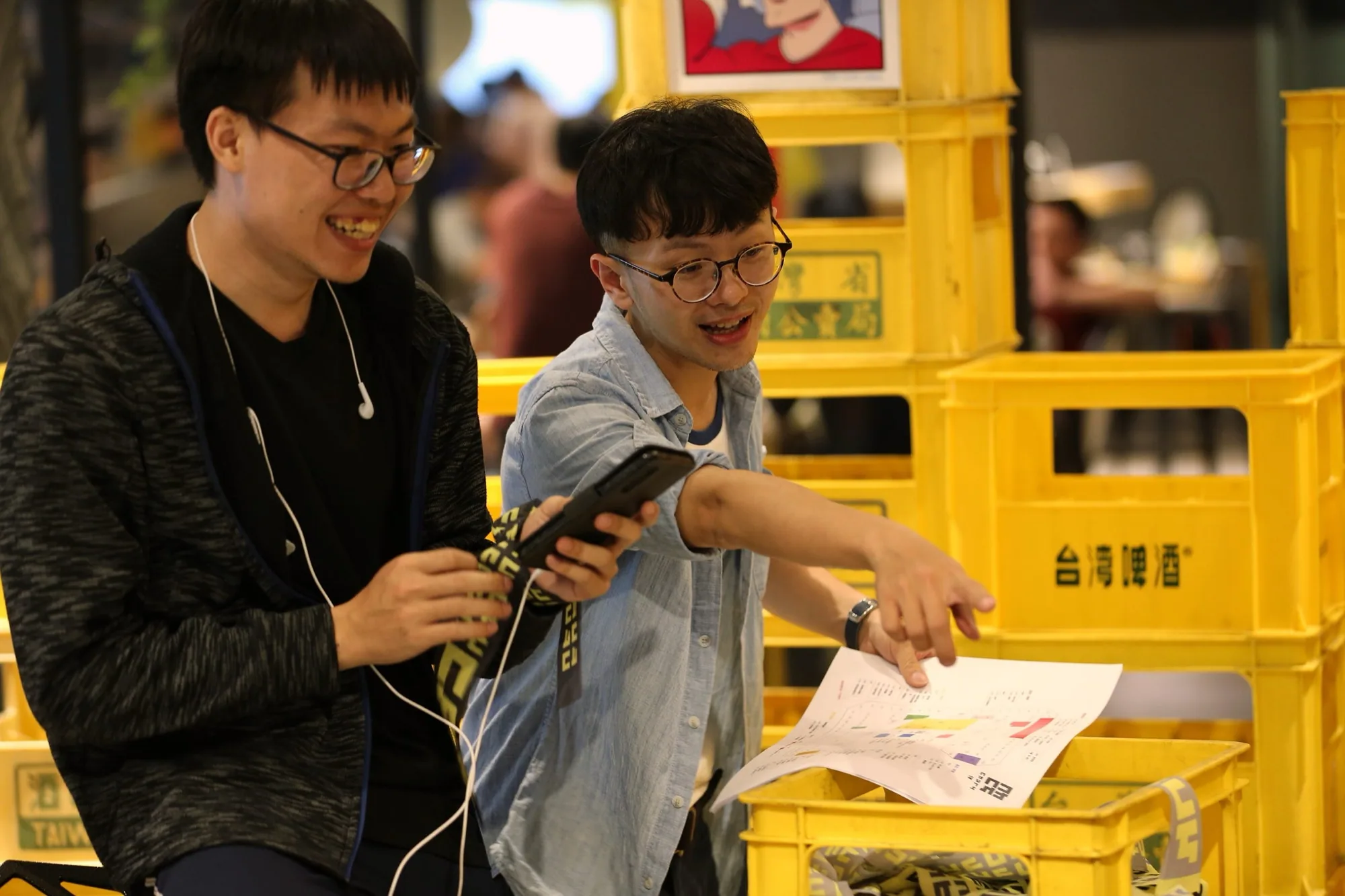
30-Second Overview: The Complex Life Festival was a youth gathering held in Taichung for five editions from 2016 to 2020. The founders were two classmates from China Medical University who were supposed to become doctors: Hsu Hao-ning from the Traditional Chinese Medicine (TCM) department, and Huang Yen-lin (online alias Huang Tou-ni) from the Western Medicine department. The name playfully inverts the "Simple Life Festival" of the Jonathan Lee generation, positioning participants as "unsuccessful people," with two to three hundred attendees per edition, allowing only talk of "growth" and forbidding talk of "success" 1. Five years later, the main organizer Hsu Hao-ning stayed in Taichung as a TCM doctor, opened a bookstore, and lost his city councilor election; visual assistant Huang Tou-ni abandoned medicine for cryptocurrency and became a Democracy Visiting Scholar at the Harvard Kennedy School in 2025 2. A forum that rejected "success" saw its organizers and attendees eventually walk into various forms of success, and its sharpest question was posed by Hsu Hao-ning on stage: "Do you want to die with regret, or live and give up?" 3
A Festival Grown Beside Pathology Slides
In late 2015, in Taichung, a row of microscopic images hung on the walls of the China Medical University Arts Center. Cells of breast cancer, inflamed tissues, and necrotic slices were magnified, colored, and framed, forming an exhibition named "Moaning with Illness: Pathological Aesthetics · Pathology Slide Image Exhibition" 4.
The curators were sixteen medical students. What they wanted to say was simple: Things viewed as "illness," when seen from a different distance and under a different light, possess their own beauty. The curatorial statement on the exhibition board was direct: the pathological appearance under a microscope can still be beautiful 4. This exhibition did not end after its run; it later toured to the National Museum of Natural Science, National Taiwan University, and Tzu Chi. It transformed from a small exhibition in a university arts center into something that moved and grew on its own. Among the names of the sixteen people, two names would repeatedly appear together next: Huang Yen-lin and Hsu Hao-ning.
Half a year later, these two organized the Complex Life Festival. They moved the idea of "seeing beauty in pathology from a different distance" from under the microscope to human beings: Is there a form to "unsuccess" when viewed from a different distance?
To understand the story, these two must be placed in different positions, because later narratives often mixed them together. Huang Yen-lin studied Western Medicine in the Medical Department; Hsu Hao-ning studied TCM in the TCM Department. Same school, different departments, two completely different training paths: one learned about slides, imaging, and resident physician shifts; the other learned about pulse diagnosis, herbal formulas, and the twelve meridians. One later became a resident physician at Taipei Veterans General Hospital; the other later opened a TCM clinic in Beitou, Taichung. They coined a term for this state: "Edge of the Department" (Xi Bian) — being an outsider within one's own department, with minds not focused on where the white coat should go 5. This self-description is important; it speaks of an active stance of stepping to the margin. The white coat is the center drawn by the world for medical students; they refused to stand there.
In May 2016, Hsu Hao-ning tagged a list of names on Facebook. The tagging criteria were strange: he sought people who fit the keywords "eighth-generation, continuous workaholic, repeated practice, edge of the department, bringing friends brings infinite hope" 1. This string of keywords itself was an invisible entry specification: it didn't ask about grades or titles, but whether you had the drive to "make life exhausting." About three hundred comments flooded the post; after forty days of fermentation, the first edition was organized. A gathering that would last five years began with a Facebook post and forty days of comment fermentation, without a venue, budget, or sponsors, only a group of people who couldn't stay in their own departments recognizing each other.
The theme of the first edition was the "Unsuccessful People's Forum."
If Simple Life Festival is Calm and Focused, Then We Call It Complex
To understand the joke of this name, you must first know who it is talking to.
"Simple Life Festival" is known by almost every Taiwanese. Initiated in 2006 by Jonathan Lee, Chang Pei-jen, and Ma Tian-zong from the Rock Records circle, its main slogan was "Do what you like, make what you like valuable," with a temperament of "calm and focused" 6. It grew from thirty thousand attendees in its first edition to a scale of six to ten thousand later, becoming a landmark in Taiwan's literati consumer aesthetics. Buying a ticket, entering the venue, listening to music, and drinking craft beer on the grass was a carefully designed "simplicity." Ten years later, for its twentieth anniversary, it invited Wu Bai and Jonathan Lee to share the stage 6, having already lived itself into a Taiwan lifestyle brand.
Hsu Hao-ning flipped this name directly. His version was: "If the people going to the Simple Life Festival are those yearning for a simple and beautiful life, then we have a group of workaholics who always make life exhausting; let's call it the Complex Life Festival" 1.
Beneath this witty remark lies a generation claiming the label stuck to them.
📝 Curator's Note
The common narrative says the Complex Life Festival is "a pure gathering of young people resisting commercialization." But this framework is too convenient, missing the sharper edge. What this group truly pushed back against was the "what life should look like" defined by the previous generation for them. The "simplicity" of the Simple Life Festival is an elegant threshold: it assumes you are already settled, having the leisure to pursue simplicity. But this group hasn't even achieved settlement. Picking up words with originally derogatory meanings like "complex," "unsuccessful," "workaholic," and "edge of the department" to call themselves is saying: We don't even have the qualification to be co-opted by your aesthetics, so we might as well name it ourselves.
This generation has many names. In 2017, journalist Wu Cheng-hsien wrote The Disappointed Generation (Ya Shidai), defining them as "twenty to thirty-four years old, born with mice in their mouths, possessing the best qualities Taiwan has ever seen, yet facing low wages, poverty, and an invisible future" 7. The most piercing half of this definition is "possessing the best qualities Taiwan has ever seen." The most educated, best at foreign languages, most skilled with tools, yet simultaneously the generation with regressing starting salaries and an invisible future; these two things are squeezed into the same group of people.
Going further back, in 2011, the Taiwan Labor Front published The Collapsed Generation (Beng Shidai), discussing the same group facing corporatization and impoverishment. Earlier was "22K," referring to the Ministry of Education's internship program for college graduates in response to the 2008 financial crisis from 2009 to 2011, with a monthly salary of 22,000 NTD and over thirty thousand positions; the program's original intent was to give graduates something to do, but it later became an anchor, with enterprises using it as a reference price when hiring, pushing this generation's starting salaries down for several years 8.
Loser, Strawberry, Disappointed Generation, Collapsed Generation, 22K. What the Complex Life Festival did was take these words thrown at them, flip them over, and use them. Called a loser, they organized an "Unsuccessful People's Forum"; told they make life exhausting, they called it "Complex." This isn't stubbornness; it's an act of seizing the right to name — I accept the label you gave, but I decide what it means.
Years later, the main organizer Hsu Hao-ning reflected on this, with a title that perfectly annotated the whole gathering: It's too hard to be simple, let's explore complexity together 9.
Hsu Hao-ning talks about the Complex Life Festival (Ministry of Education Youth Development Agency's "Super Wall Tuesday" series). The video title "It's Too Hard to Be Simple, Let's Explore Complexity Together" perfectly frames the positioning of this gathering against the "Simple Life Festival" as its signature.
A California Hotel You Can Enter But Never Leave
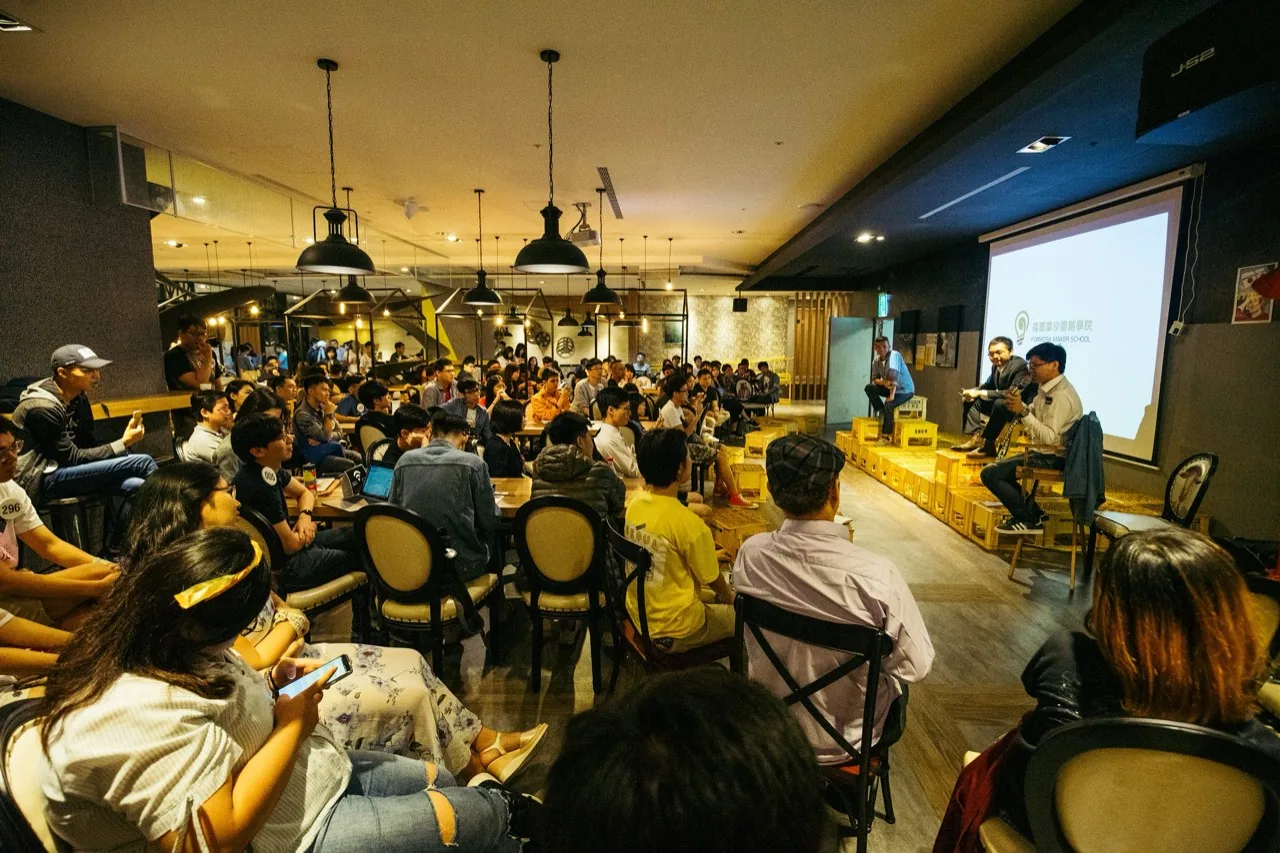
The Complex Life Festival venue: Two to three hundred people, speaker and audience mixed together, yellow Taiwan Beer baskets serving as stage and seats. Photo: Complex Life Festival (fair use editorial commentary).
After the first edition, this gathering was held every May for five consecutive years.
The method was special. No host, the boundary between speakers and audience was blurry, often late night on the grass, one exchange could last four hours 10. Hsu Hao-ning used the concept of "Stone Soup" to recruit people. It's an old story: several soldiers said they would cook soup with stones; passing villagers brought a handful of salt, another brought a few carrots, and finally, they really cooked a pot of soup. The Complex Life Festival operated this way: the organizers only put in one stone and one pot; the content was brought by those who came.
The first edition had thirty groups of speakers, cutting across the eighth-generation independent creation ecology: college students making presentations, students organizing the NTU Music Festival, the literary review magazine Secret Reader, Read You a Poem Every Day posting a poem on Facebook daily, online course platform Hahow Good School, and the Migrant People studio focusing on Southeast Asian migrant workers 10. Spreading this list out reveals a small universe grown by Taiwanese youth in 2016: presentations, music, literature, education, new immigrants; none of these are positions mainstream industries value, but everyone was doing them seriously.
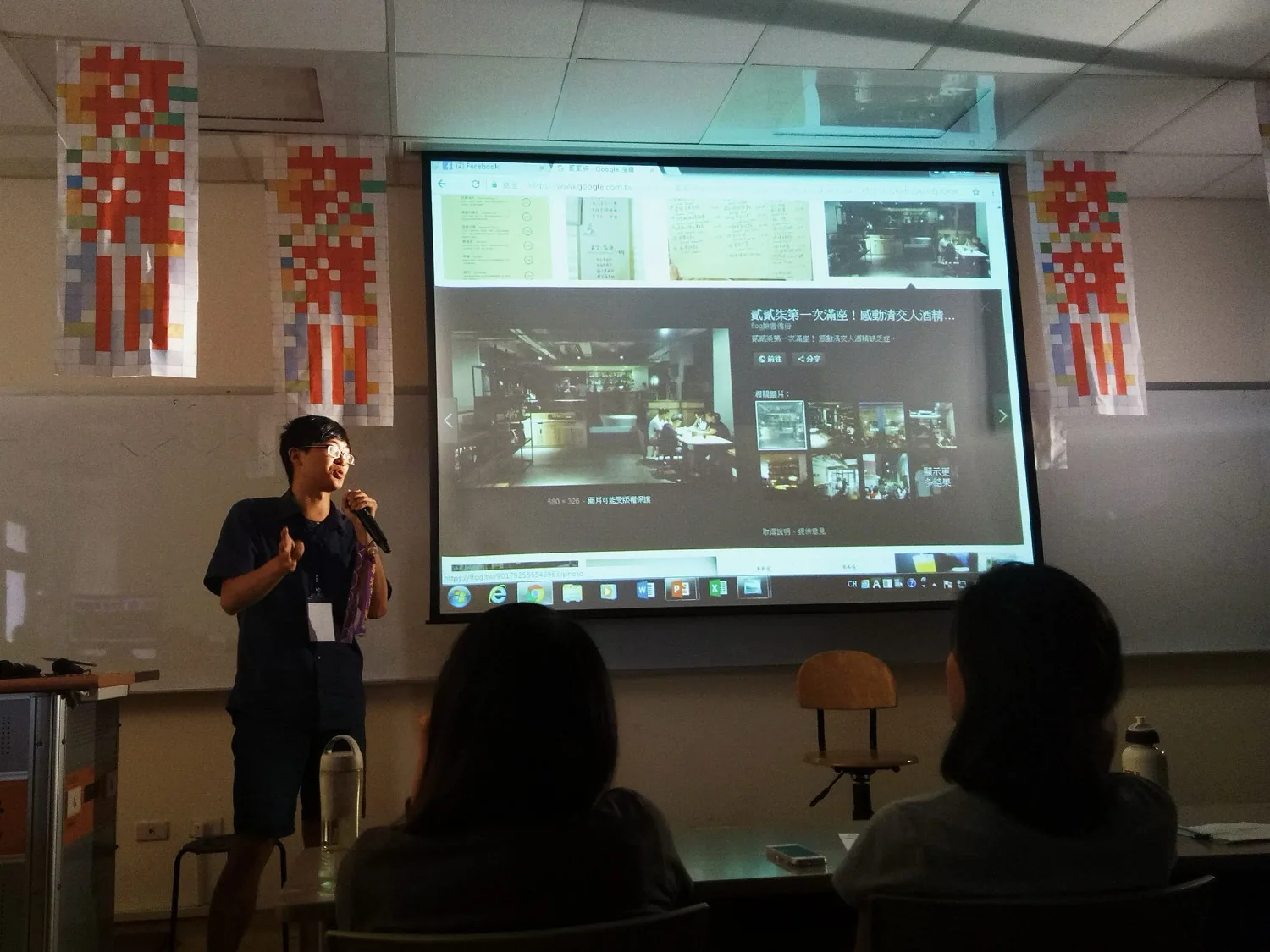
A speaker shares in front of the projection screen, the wall hangs the Complex Life Festival's signature pixel dot-matrix banner. The visual language of the entire gathering is a deliberate "amateur feel": not refined, no lighting, like a club orientation rather than a brand event. Photo: Complex Life Festival (fair use editorial commentary).
The second edition, in 2017, was themed "California Hotel Hotel California." This edition actually held the venue inside a hotel 11. The name comes from the famous lyric in the Eagles song: "You can check out any time you like, but you can never leave." The song originally describes a glamorous yet trapping intoxication; applied to the Complex Life Festival, it takes on a different meaning — it speaks of a group of people who find their kind in each other, and once inside, can never leave, because there is no other place outside where one can speak like this. A metaphor of "entering but never leaving," Huang Tou-ni also used the phrase "The California Hotel You Can Enter But Never Leave Was Actually Held in a Hotel" in a later visual design article 11.
By this point, the Complex Life Festival had its own shape. The Heterogeneous School (Za Xuexiao) grew into Asia's largest educational carnival; "Teach For Taiwan" followed an organized talent recruitment path; the Complex Life Festival deliberately maintained a scale of two to three hundred people, small enough for everyone to speak to everyone. Huang Tou-ni later listed the Complex Life Festival alongside the Heterogeneous School and Pan-Knowledge Festival in an article on "knowledge entertainment," self-segregating as the "small-scale" one, and criticizing large events as infected by "Spotlight Black Death" 12. The metaphor "Spotlight Black Death" is heavy: spotlights are originally good, but when an event exists to be seen, it gets sick; performance replaces exchange, scale replaces depth. The Complex Life Festival chose to stay in the shadows of the spotlight; this was its pride, and later, its ceiling.
Over five editions, about fifteen hundred people came; this number, placed next to the Heterogeneous School's carnivals of two to thirty thousand person-times, is so small it's almost invisible; but for the Complex Life Festival, "small" was a deliberate choice, not a sign of not growing up. It wanted that density where everyone can speak to everyone; once enlarged, the thing it cared about most would be diluted.
✦ "We are not a forum; we are gathering bloodless family to come home for New Year." 13
The Triangle Facing Away from the Audience
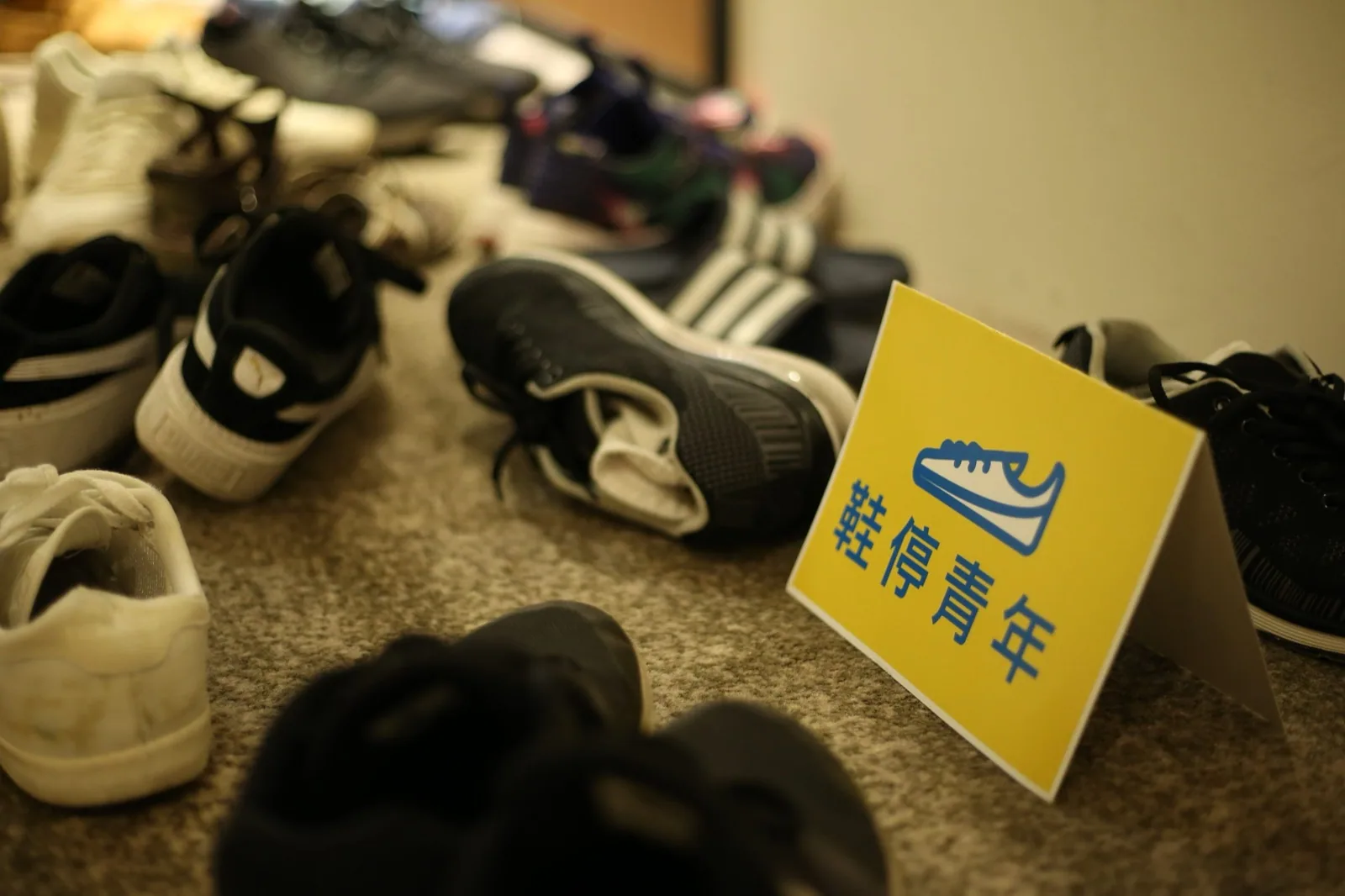
The "Shoes Off Youth" sign and a pair of slippers outside the lecture room. The Complex Life Festival held deep conversations like in someone else's living room; taking off shoes before entering echoes its self-positioning of "coming home for New Year." Photo: Complex Life Festival (fair use editorial commentary).
The third edition is the most remembered edition of this gathering.
In 2018, the theme was "Buddhist Youth," with a subtitle question: "Why complicate when you could be simple?" 14 "Buddhist" was the buzzword of those two years, describing a lying-flat mentality of "whatever, doesn't matter, no strong desire." The Complex Life Festival using it as a theme was itself a counter-question: a group of workaholics who make life exhausting talking about "Buddhist" is actually talking about "we could choose to not care, why do we still not let go?" This edition was held during the day at China Medical University, and at night opened the "Complex Life Village" next to Fengjia Night Market 14.
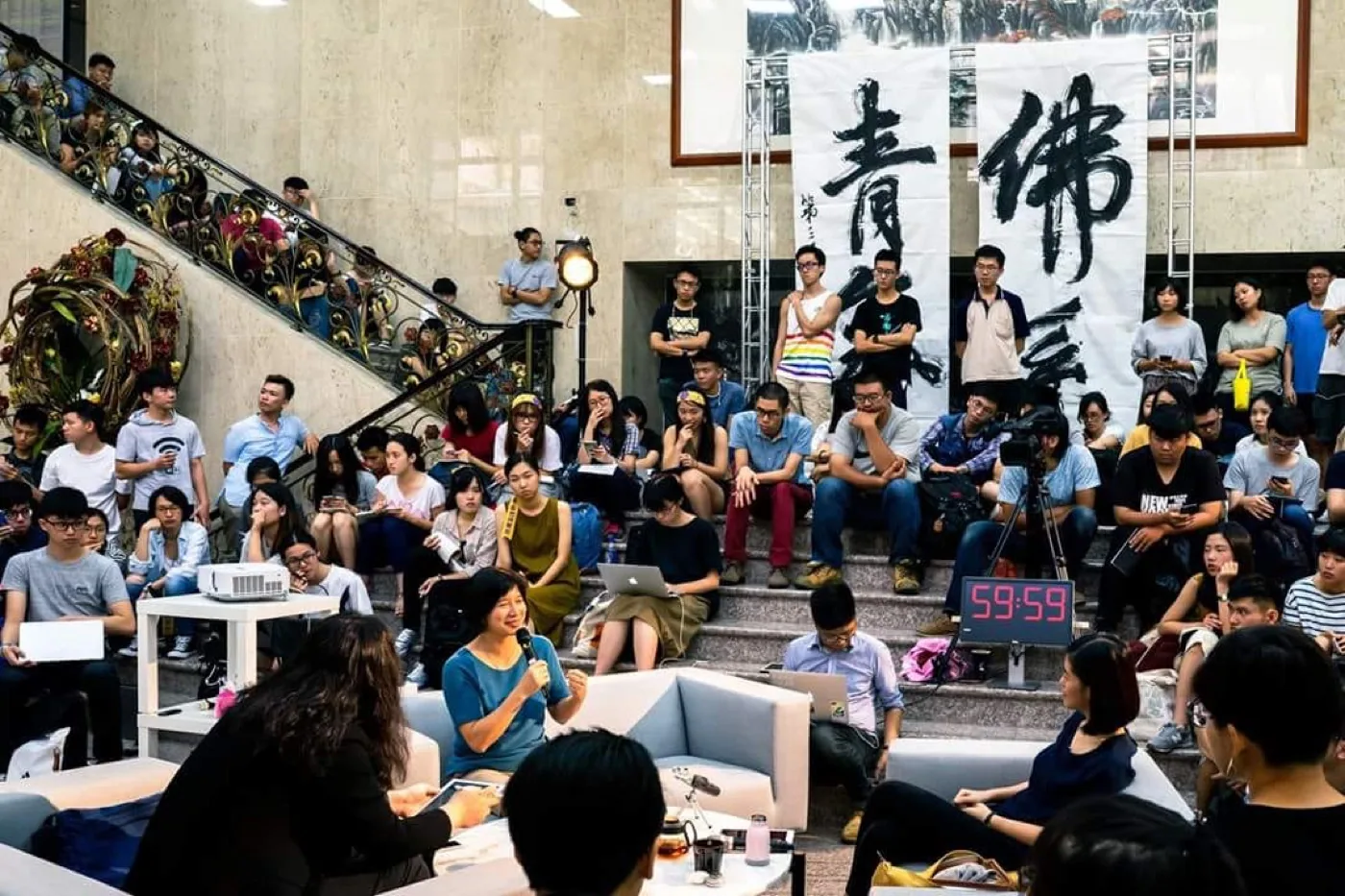
The third edition "Buddhist Youth" scene: Behind the speaker is a handwritten "Buddhist Youth" banner, next to a 59:59 countdown clock. The countdown clock is the Complex Life Festival's obsession with "depth"; every share is framed by time, forcing speakers to get to the point. Photo: Complex Life Festival (fair use editorial commentary).
This edition invited a three-way dialogue, three people who later became "successful" in some sense: Audrey Tang, then Digital Minister of the Executive Yuan; Liu An-ting, educational entrepreneur who founded "Teach For Taiwan"; Lin Yi-ying, Deputy Mayor of Taichung City 15.
The dialogue design was strange. The three sat in a triangle, facing away from the audience, receiving questions from the audience via the online tool Slido 15.
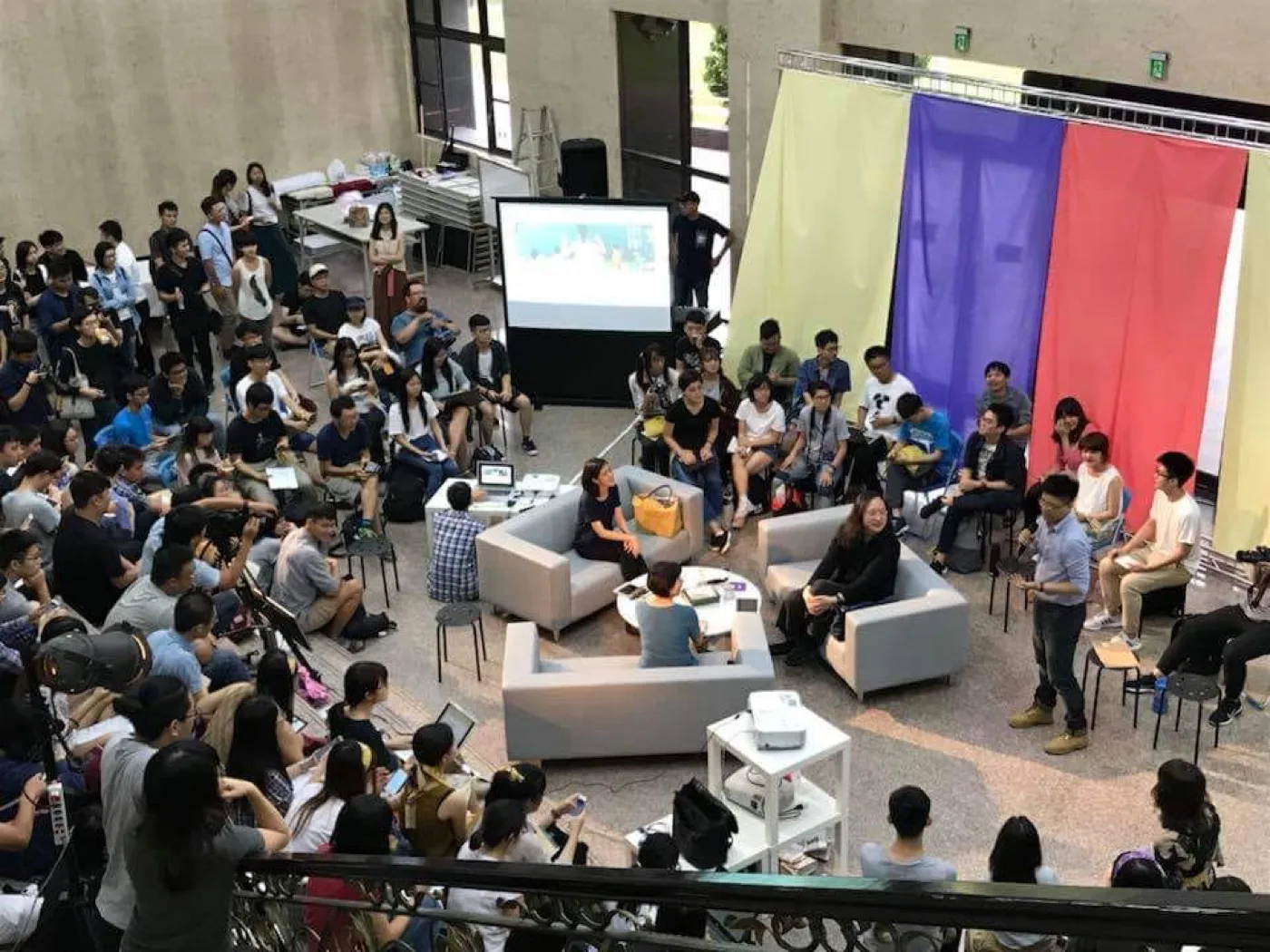
The core image of the third edition three-way dialogue: Three sofas arranged in a triangle, Audrey Tang, Liu An-ting, and Lin Yi-ying sit facing inward, away from the surrounding audience, red, blue, and yellow curtains hang from above. This is the "Triangle Facing Away from the Audience" itself: turning speakers to face each other is the Complex Life Festival's most direct declaration that "dialogue is more important than performance." Photo: Complex Life Festival (fair use editorial commentary).
Speaking with their backs to the audience is itself the temperament of the Complex Life Festival: no performance, no facing the spotlight, only caring if the dialogue is deep enough. General forum speakers face the audience, speaking words for the audience to hear; these three face each other, speaking words for each other to hear, with the audience merely permitted to eavesdrop. Hsu Hao-ning said, "Deep dialogue, distance-less and nearly苛刻 (harsh/strict) deep dialogue," is the gathering's signature 13. The word "harsh" is accurate — it doesn't want lukewarm small talk; it wants speakers pushed to have no way out.
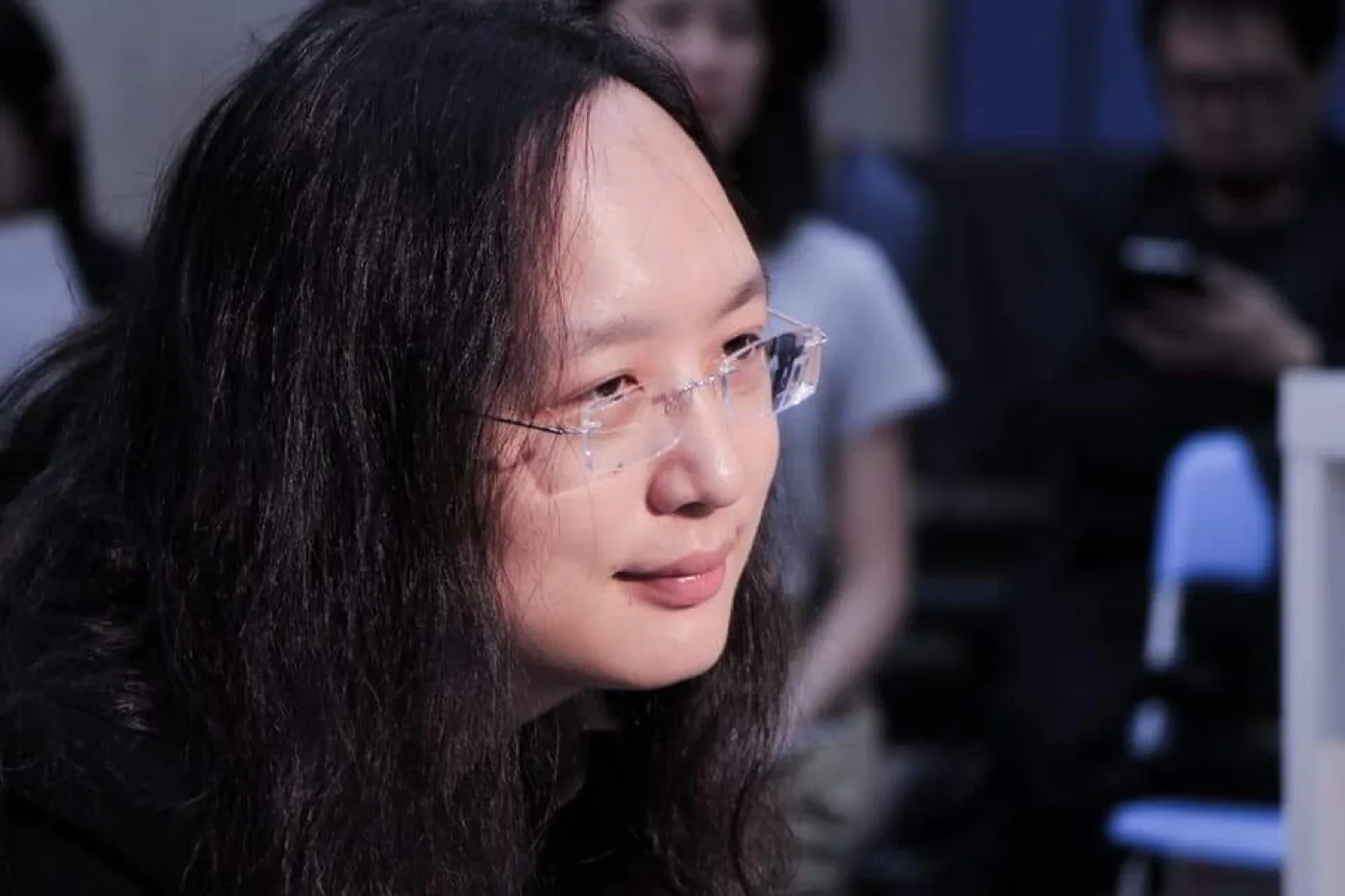
Audrey Tang's profile at the three-way dialogue site. At the time, she was a Digital Minister of the Executive Yuan and a civic tech advocate from g0v; two years later, she became Taiwan's first Digital Minister. Photo: Complex Life Festival (fair use editorial commentary).
That day, Audrey Tang said, "The government, from the perspective of fairness, is not suitable for innovation" 15. She meant that the government must treat everyone equally, while innovation is essentially a privilege for a minority to take risks; the two have inherent tension. Liu An-ting followed with "Innovation comes from the margins" 15. She spoke of how true new things rarely emerge from the center of the system, but grow from ignored corners, from people with no resources who can only figure things out themselves. This sentence is often mistakenly attributed to the organizer, but it is Liu An-ting's, not Hsu Hao-ning's. A forum for "unsuccessful people" had the most promising people of this generation sitting on stage, talking about "innovation comes from the margins" — while the audience sitting below were exactly those who thought they were on the margins but later walked into the center one by one.
There was also an anecdote remembered by the audience for a long time during the dialogue: Someone anonymously asked Audrey Tang on Slido, "What shampoo do you usually use?" 15 In a hardcore dialogue about fairness, innovation, and the government and margins, such a nonsensical question appeared, and Audrey Tang answered it seriously. This image is actually very "Complex Life Festival" — it allows harsh depth to coexist with youthful nonsense, because these two things are actually the same thing for this group.
The speakers of the third edition were not just these three. On site were also Pan-Science Editor Lei Ya-qi, Dr. Lang Quan doing animal behavior education, local publication Liu Qian-ping, band "227" Li Xue-cheng, and self-proclaimed "mediocre designer" Lin Hui-qiu, among others 16. Looking at this list together, you see that the Complex Life Festival never invited people for fame. It invited people "seriously doing something no one understands yet." Fame was secondary. And it was among this group that someone saw the irony. An observer named Chu Szu-yu wrote down their feelings that day; this sentence became the most honest annotation of the Complex Life Festival: "Why am I pretending to be a successful person here? Am I really successful?" 17
Liu An-ting's TEDxTaipei speech from the third edition three-way dialogue. She founded "Teach For Taiwan" to send teachers to rural areas; the sentence "Innovation comes from the margins" she said at the Complex Life Festival is exactly her belief; this video lets you hear how she talks about it herself. 18
Complex Life Village: Fengjia at Night, Pixel Banners, and Cocktail Exchange Coupons
The third edition split day and night into two completely different spaces; this design is worth pulling out to discuss separately.
During the day at China Medical University was the serious dialogue site: triangles, countdown clocks, harsh depth. After sunset, the whole group moved to a venue called "Si Guan" next to Fengjia Night Market to open the "Complex Life Village" 14. The word "Village" is interesting: during the day they were forum speakers and audience; at night they became villagers of the same village. Entering the village required a "Villager Pass"; inside the village, alcohol was exchanged for "Cocktail Exchange" coupons.
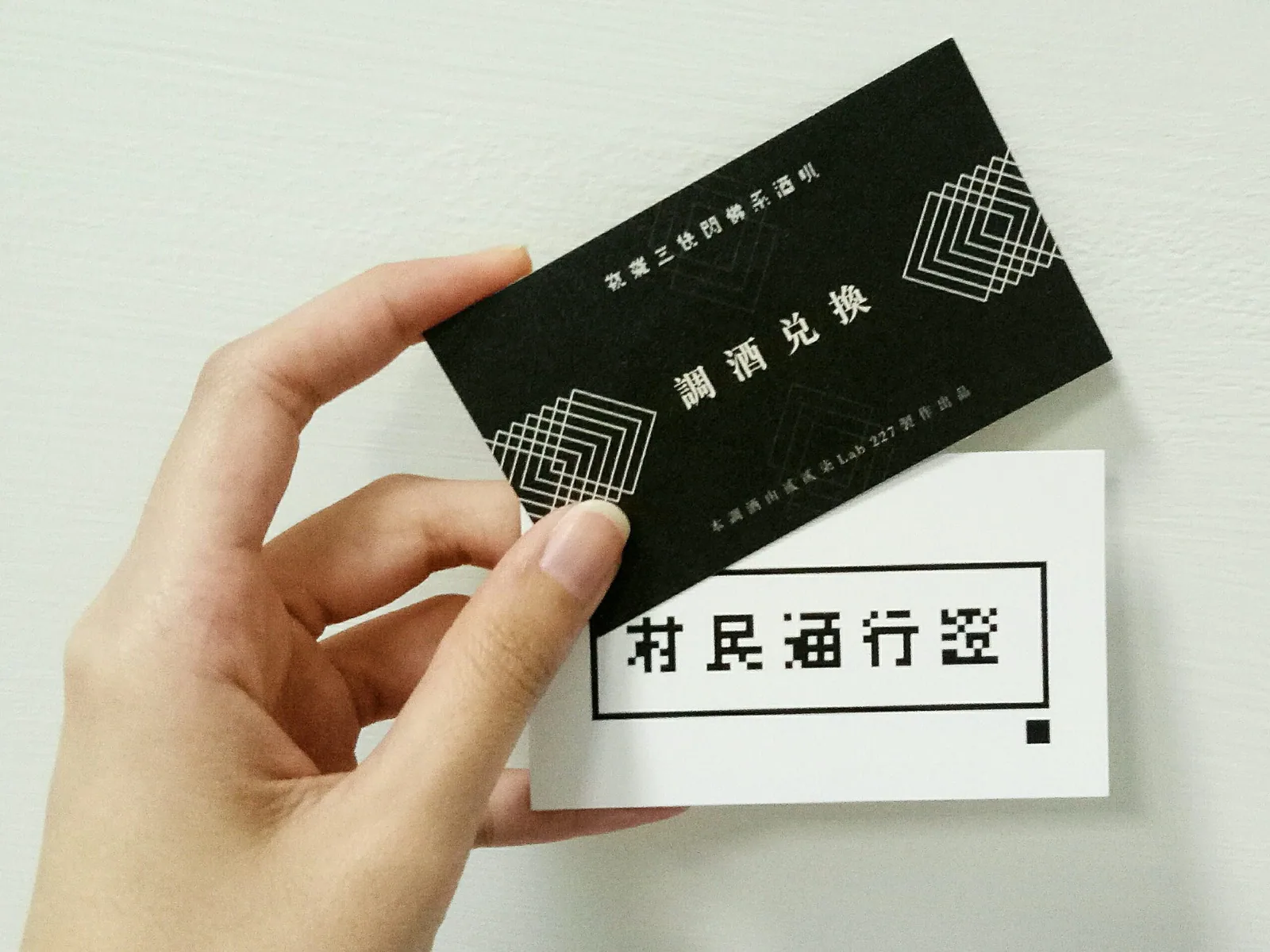
The "Villager Pass" and "Cocktail Exchange" coupons of the Complex Life Village, geometric dot-matrix font is the Complex Life Festival's visual signature. Calling entry a "Villager Pass" secretly rewrites an event into a temporary village: you are not here to attend; you are here to be a villager. Photo: Complex Life Festival (fair use editorial commentary).
Pixel banners hung on the walls of Fengjia Si Guan; the whole space was soaked in that dot-matrix font visual language. This pixel aesthetic was not randomly chosen. Dot-matrix fonts are the characters of early computers, early game consoles; they are the screen memories of this eighth-generation when they were children. Using them for a 2018 youth gathering is saying: We are a generation raised looking at these low-resolution screens; our nostalgia looks like this.
The Complex Life Village completely dismantled the too-formal word "forum." During the day, one could still say this was an "event"; at night, with passes, exchange coupons, alcohol, pixel banners, and four hours of endless grass conversations — it had grown into a village that only existed for one night. The next day, when the sun rose, the village was dismantled, and villagers scattered back to their respective cities. This texture of "temporarily but seriously existing" is the hardest thing about the Complex Life Festival to replicate.
Unsuccessful People, or Future Elites
Chu Szu-yu's self-question pierced the hardest thing to answer about this festival.
The Complex Life Festival said it accepted "unsuccessful people." But those actually tagged in via Facebook were a group with cultural capital, who could afford university, and had social connections in the independent creation circle. Its screening mechanism (friends tagging friends) naturally kept another group out: migrant workers in factories, same-age peers who didn't go to university, the truly marginalized eighth-generation without social media accounts to be tagged. To be tagged, you must first be in someone's Facebook friend list; to be in that list, you must first live a life "that this group would recognize." This invisible threshold is more picky than any ticketing mechanism.
Exclusion also has a geographical layer. All five editions were held in Taichung; speakers and participants were mostly from the central Taiwan circle, keeping it far from the eighth-generation of the south and east. For a same-age peer living in Taitung or Pingtung, the threshold of "should I run to Taichung for a two-day, one-night gathering" was enough to filter them out. The Complex Life Festival's "kindred spirits" were actually kindred spirits with a geographical radius.
This is a structure that such gatherings cannot avoid; it need not be treated as smearing. A gathering operating on "echo chamber deep exchange" is essentially different from the "overall face of the eighth-generation." Hsu Hao-ning was aware of this. He self-doubted on stage every year, even saying the Complex Life Festival was the "most hated activity I ever organized" (discussed later). But being aware is not the same as solving it. Knowing your gathering is picky, and organizing a gathering that is not picky, are separated by the weight of the entire structure.
📝 Curator's Note
Spreading out the participant list of the "Unsuccessful People's Forum" reveals an awkward fact: this group, calling themselves unsuccessful, later disproportionately walked into elite positions. Huang Tou-ni went to Harvard; speaker Audrey Tang became a minister; Liu An-ting won an international education award. Thus, the humble term "unsuccessful" looks back like a pre-emptive Versailles (humblebrag). But reading it this way is also unfair. When this group gathered in 2016, they were truly not yet successful; low wages, an invisible future, marginalization in their own departments were all immediate realities. The problem is not whether they succeeded later, but that this gathering could only hold "unsuccessful people on the way to success" from the beginning. It excluded those who couldn't even stand on the starting line. Writing this out honestly is closer to its true nature than packaging it as a pure utopia.
Looking through an academic eye, in 2019, someone used French philosopher Foucault's concept of "heterotopia" to explain the Complex Life Festival 19. Heterotopia refers to a space between reality and utopia, both real and illusory, which squeezes heterogeneous elements together, thereby迸发 (bursting forth) the potential to disturb reality. Foucault's examples include gardens, cemeteries, theaters, and ships; these places are within the daily, yet follow another set of rules. The author's observation is that the Complex Life Festival broke the boundary between speakers and listeners, allowed people with similar themes to be adjacent in space, and used banners to construct collective identity; "strictly speaking, this is the ontology of the Complex Life Festival" 19.
In other words, the true product of the Complex Life Festival was never in the content of any lecture, but in the fact that "a group of heterogeneous people were squeezed into the same two-day, one-night space."
But this article also left an unsolved question: Heterotopia only operates for two days and one night; can the effect last? 19 This question is critical. A garden can bloom year after year; a cemetery can stay there forever; but the Complex Life Festival, this kind of heterotopia, is one-time: it appears out of thin air on a weekend in May, and disappears on Monday. The sense of belonging it creates is real, but can this sense of belonging last through the three hundred and sixty-three days after the gathering disperses?
Two days and one night of kindred spirit gatherings; after dispersing, everyone returns to their respective complex lives.
ㄇㄉㄈㄎ: Jargon Only the Echo Chamber Understands
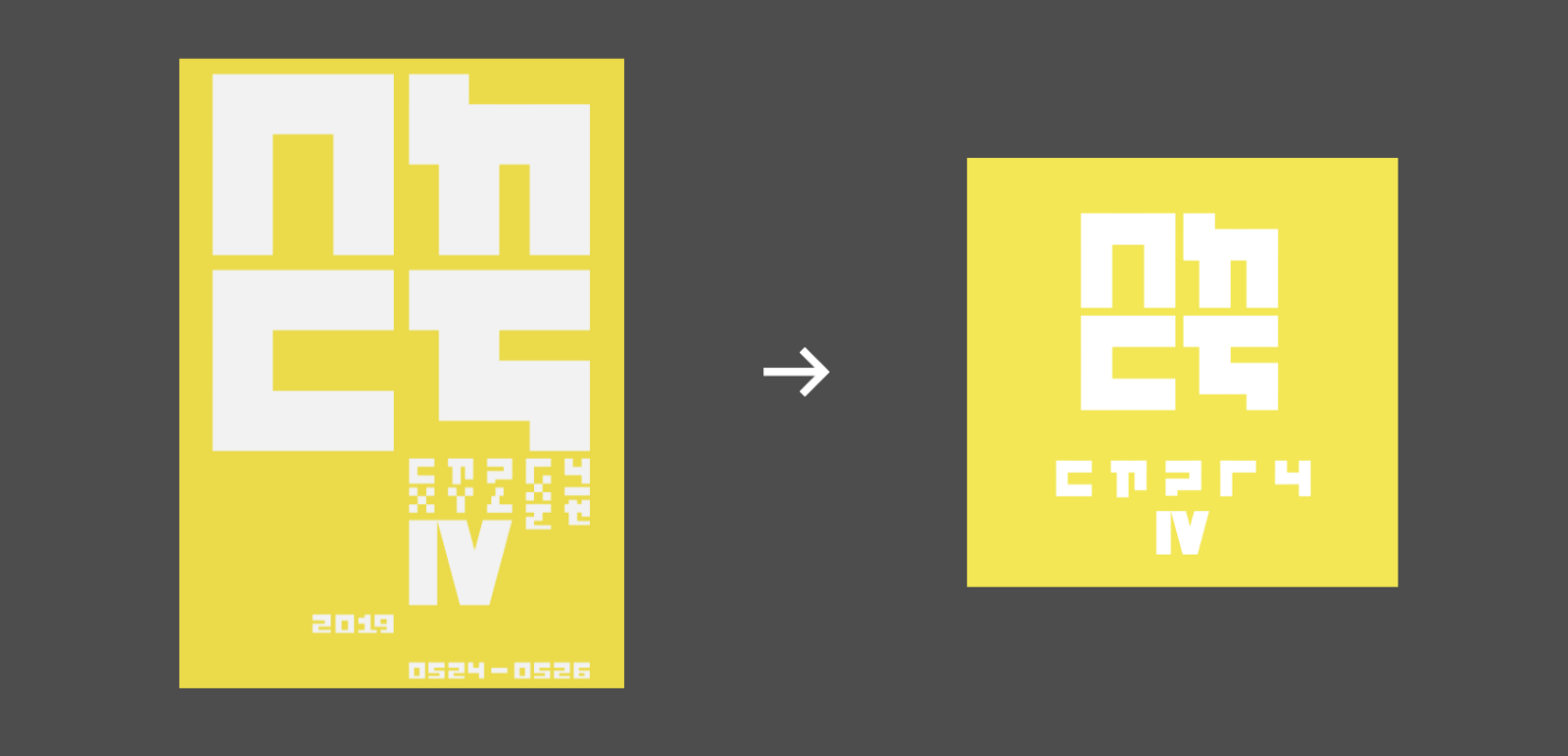
Fourth Edition "ㄇㄉㄈㄎ" Main Visual: Huang Tou-ni hand-drew the Zhuyin standard characters for motherfucker, a youthful jargon only the echo chamber can read. Image: Huang Tou-ni Design (fair use editorial commentary).
The fourth edition pushed this "only for us" temperament to the extreme.
In 2019, the theme was four Zhuyin symbols: ㄇㄉㄈㄎ. Decoded, it is the Zhuyin spelling of the English word motherfucker 20. This is a puzzle only those who understand Zhuyin and can spell it back to English can solve; that is, a code only Taiwanese, and a specific generation of Taiwanese, would smile at. Huang Tou-ni personally designed this set of hand-drawn Zhuyin standard characters, setting the tone as "being disciplined while talking boundless nonsense" 21, a youthful jargon only the echo chamber understands. Zhuyin is learned in first grade of elementary school; it is the most disciplined symbol system; using it to spell a swear word is itself an act of "secretly rebelling under a well-behaved appearance," which is exactly the portrait of these medical students hiding other minds under white coats.
The venue was chosen at the Banpan Hotel on the fourth floor of Taichung's First Plaza, moving into rooms that look like a honeycomb grid 20. Choosing this building has its reason. First Plaza is an old building full of Southeast Asian migrant worker life traces; on weekends, it is crowded with migrants from Vietnam, Indonesia, the Philippines, and Thailand, serving as the living room for Taichung's migrants. In Taichung people's memories, it was once stigmatized, treated as a place "not to go," and later slowly rediscovered, renamed Dongxie Plaza, and treated as a hub for multiculturalism. A group of youth talking about "margins" held their gathering in this building with the most marginal meaning, staying in honeycomb-like small rooms; this choice itself was an unspoken declaration.
The preface of this edition explained the core of the Complex Life Festival most clearly: "We are not a forum; we are gathering bloodless family to come home for New Year." "Deep dialogue, distance-less and nearly harsh deep dialogue, is the 'Complex Life Festival's' signature." "We walk further together." 13
Calling a gathering "New Year" and participants "bloodless family" is the Complex Life Festival's most moving and most dangerous self-positioning. New Year is an annual ritual with fixed seats, the whole family returning to the same table; comparing this kindred spirit gathering to New Year is promising a "no matter where you drift, there is a home waiting for you every May" sense of belonging. It is moving because it truly provided this sense of belonging; it is dangerous because family circles have boundaries, and New Year tables have seat limits — those who can return to celebrate New Year are always those originally on this family list.
Soul Left in the Margins, Assistant Went to Harvard
To understand whose the Complex Life Festival was, you must look at where these two founders went later. Because its deepest tension is not in the five editions of activities themselves, but in the divergence of these two people.
Huang Tou-ni's real name is Huang Yen-lin, online name mashbean. Around 2021, he resigned from his doctor's job. The reason he gave himself was: "Due to obsession with the deep structures of the internet and social networks, I resigned from my doctor's job, now dedicated to integrating the cypherpunk spirit into Taiwan's digital society." 22 This sentence reads like a resume, but拆开 (taken apart) is a huge turn: giving up the position of resident physician at Taipei Veterans General Hospital to chase something called "cypherpunk," a group believing cryptography and code can redistribute power and protect individual freedom. His abandonment of medicine was not a dramatic moment. While still wearing the white coat, he was already organizing the Complex Life Festival; in early 2022, at a community gathering, he mentioned he "was still a doctor last year" 23. Leaving was a gradual drift, drifting from the edge of the department to outside the department, then to a world completely unrelated to medicine.
After leaving, he co-initiated FAB DAO, an organization using blockchain for public welfare, later launching the "Project % Hundred Mountains Project" (Project %), bringing together six generative artists to create digital artworks of 10,101 Taiwan mountain peaks 24. This line later moved closer to the institutional core: he entered the Ministry of Digital Development as a systems engineer, moving the experience of accumulating web3 public welfare from the民间 (folk) into the government's room; in 2025, he again received the Harvard Kennedy School Allen Lab "Democracy Renovation" non-resident policy researcher position 2. From a person responsible for drawing posters and doing visual promotion at a small Taichung gathering, to the table at Harvard discussing how to reshape democracy — this trajectory is almost the most dramatic realization of "innovation comes from the margins," just realized not by Liu An-ting who said it, but by the visual assistant who sat in the audience back then.
But regarding whose work the Complex Life Festival was, Huang Tou-ni himself spoke clearly. He wrote in his own article: "Complex rationally becomes Hao-ning's creation; we, as visual assistants, continued to exist in the work team." 25 This sentence is important; it comes from the person involved, explicitly giving the "main organizer" position to Hsu Hao-ning, placing himself as "visual assistant." Later, media, due to Huang Tou-ni's web3 fame, often wrote the Complex Life Festival as "the youth of the FAB DAO founder," but Huang Tou-ni himself never said this.
By the fourth edition, he wrote about the gathering's meaning to him: "Complex Life Festival 4 ends; for me personally, it symbolizes the end of an era; the era of always dreaming and always feeling good coincidentally ended together with the difficulties of Facebook fan page operation." 26 The phrase "Facebook fan page operation difficulties" points to a structural turning point of the era — the Complex Life Festival grew up relying on Facebook tagging and Facebook fan pages; when Facebook's algorithm continuously lowered organic reach, this gathering relying on social organic connection also lost its oxygen.
Then came the sentence like a farewell, like an archive: "Those four years, what Complex taught me is probably about here, sealed here. 2016–2019 My Honor." 27 The assistant went to Harvard; the soul stayed in the margins.
Huang Tou-ni's web3 public welfare works after abandoning medicine (Digital Times interview). From the Complex Life Festival's visual promotion, to co-founder of Taiwan's largest public welfare NFT project, this video is the next stop on the "assistant went to Harvard" line. 28
Hsu Hao-ning did not leave Taichung. He was born in 1988 in Changhua, a countryside child surrounded by fields; his middle school grades were top in the school, he entered the Math and Science Gifted Class of Changhua High School, then entered the TCM Department of China Medical University; he is now the director of a TCM clinic in Beitun 5. During college, he experienced consecutive family changes: his mother had a stroke when he was in his sophomore year and passed away two days later; his father became seriously ill and passed away when he was in his senior year (sixth year of medical school); at that time, his sister was a senior and his brother was a sophomore; he was the only adult child in the family 29. His father drove a taxi; his mother did piecework 29.
These are facts reported publicly; no need for embellishment; but they are the底色 (background color) for understanding why he stayed — a person who lost both parents during six years of college and shouldered a family has a different weight regarding "staying in place and holding things together."
He is still a poet. Founding president of the China Medical University Literature and Art Research Society, also served as general secretary of the Gengshen Youth Writing Association, won four literary awards, including modern poetry awards for the National Student Literary Award and the National Medical Student Literary Award 5. A person studying TCM, a person writing modern poetry, a person organizing a youth gathering; these three identities do not conflict in him, but are like three facets of the same thing: all seeking a "ability to see people more clearly."
Later, when he looked for a campaign headquarters, he accidentally encountered an old house, felt it was suitable for a bookstore, and opened a bookstore called "Reference Bookstore" (Yin Shudian) 30. The logic of the store's name is like him: the last paragraph of a thesis is the references; people seeking truth cannot do without it; "Where Reference is, there the argument stands" 30. A bookstore named after "references" is equivalent to building a physical space for the belief that "everything I say has a source, stands firm." This bookstore was still updating its own Podcast until the end of 2024 31 — after losing the election, the bookstore survived.
In 2018, Hsu Hao-ning ran for Taichung City Councilor in Beitun District for the People First Party. In a district with sixteen competitors, he received 5,332 votes, a vote rate of 3.93%, ranked eleventh, lost the election, and the campaign account was still short by over one hundred thousand NTD 32. When he ran, he said a very special sentence: "I hope I can love people, to prove that I was loved by great people." 33 A young person who just lost his parents wanted to use the act of "loving others" to prove that those who loved him truly existed — this sentence turned a public act like an election into a very private mourning. He also said he would contribute his "golden years from age 30 to 50" to Beitun 34. He lost the election, but that bookstore, opened because he looked for a campaign headquarters, remained. A person wanted to commemorate the most private loss (parents) in the most public way (election); what remained was the quietest shop.
The Least Cool Year
The fifth edition was the loneliest edition of this festival about "gathering kindred spirits." In 2020, COVID arrived. A gathering centered on "gathering bloodless family to come home for New Year" collided with a year when the whole world had to keep its distance. The theme of this edition of the Complex Life Festival was "Self-Isolation" 35.
It did not hold a physical conference. It changed to a Podcast, making forty-seven episodes in total. The team ran through North, Central, and South Taiwan, interviewed eighteen seniors, and held six interviews with old friends 35. A gathering standing on "face-to-face, distance-less, harsh deep dialogue" was forced to dismantle its core "face-to-face," leaving only voices separated by microphones. The closing day was November 11, 2020; they titled this edition: "This year's Complex Life Festival is the least cool year." 35
The fifth edition "Self-Isolation" changed the physical gathering to a 47-episode Podcast. A festival with the faith of "gathering bloodless family" could only recognize each other through microphones in its last edition.
The podcast description had this paragraph, accurately describing the situation that year: "From the chaotic beginning of the year... when the world had only isolation left, Taiwan was fortunate to become a corner creature in the off-peak value, able to gather, meet, and chat about possible futures." 35 The word "corner creature" is used with both sadness and accuracy. In 2020, the whole world was in lockdown; Taiwan was one of the few places still able to gather and meet; the Complex Life Festival seized this gap, making it a program about "how to recognize each other in an era of isolation."
The fifth edition previewed the sixth, saying it would draw a free suite for listeners 35. But the sixth edition had no record of being held. The physical Complex Life Festival effectively ended in 2020. A gathering with faith in gathering; the last edition was called Self-Isolation, and then dispersed — this ending, more than any deliberate design, is like a metaphor for an era.
How to understand what this gathering, held for five years, with about fifteen hundred people in total, left behind? Placing it back in Taiwan after the 2014 Sunflower Student Movement, it becomes clearer. The average age of participants in that movement was twenty-three; over sixty percent were participating in politics on the streets for the first time 36. After the movement dispersed, the energy of "sowing seeds after exiting the gate" split into several exits: some entered the system to create the People First Party, winning five legislative seats in 2016; some did civic tech with g0v, turning government data into tools everyone could use; some organized alternative education, growing into Asia's largest Heterogeneous School. The Complex Life Festival took the fourth path: no elections, no coding, no recruitment, just gathering a group of same-age peers in low wages and confusion, letting them know "you are also here."
Interestingly, these four exits intersected again at the third edition of the Complex Life Festival: Audrey Tang was the representative of the g0v line entering the central government; Hsu Hao-ning himself ran for the People First Party; Liu An-ting was the alternative education line — the energy diverging after 318, circling for four years, sat together again in that triangle facing away from the audience. The Complex Life Festival's influence was not in scale, but in that moment of "recognizing kindred spirits," and quietly stitching these seemingly separate youth paths into the same room.
Conclusion: You Are Always Just a Little Bit Short
The sharpest sentence spoken at the Complex Life Festival came from Hsu Hao-ning during the third edition.
He first admitted something embarrassing: "The Complex Life Festival is the event I have personally hated organizing the most; every year, I am testing whether my beliefs are true or false. Will the people who come this year not want to come again next year?" 3 A festival organized to provide warmth for others, yet its lead organizer doubts its sustainability every single year. A person building homes for others, standing at the doorway every year, fearing that no one will return.
Then he spoke a passage that stripped away everything behind the term "the unsuccessful":
"How many years must we spend repeatedly telling ourselves, 'I am not strong enough, I am not good enough, so I must keep moving forward'? How long must we endure before we can forgive ourselves and say, 'I am good enough'... because you will never like yourself; you will always be just a little bit short. Will you die with regret, or give up while living?" 3
This passage unlocked the initial mystery. What exactly is being "unsuccessful"? It isn't a term of false modesty—mashbean actually went to Harvard; false modesty would have been long since traded for reality. Nor is it entirely a prophecy; the subsequent "success" of this group is too uneven to be summarized by a single upward trajectory. Rather, it is more like the state Hsu Hao-ning described: a self-imposed demand carried by a generation that cannot be shaken off. Always feeling just a little bit short, always refusing to tell oneself "I am good enough." The Complex Life Festival turned this collective dissatisfaction into an annual gathering—a group of people who are all "just a little bit short," confirming to one another that they truly are.
mashbean sealed it within 《2016–2019 My Honor》. Hsu Hao-ning stayed in Taichung, continuing his studies in Traditional Chinese Medicine and tending to the bookstore that remained after he lost the election. In the fifth year, the world forced everyone into self-isolation; this festival, built on the faith of gathering, quietly came to an end during the one year when gathering was least possible.
That unanswered question remains on the stage: Will you die with regret, or give up while living? A generation that refuses to talk about success asked this question, then each returned to their own complex lives, continuing to live while being "just a little bit short."
Source: Themes and on-site records from various editions (interviews with Hsu Hao-ning and mashbean, and reports from previous years) 31114
Ten years separate these two "Life Festivals," representing two different answers from two generations regarding "what life should look like":
Source: Complex Life Festival official Medium, historical data from Simple Life Festival
Further Reading:
- Sunflower Student Movement — The historical context of the Complex Life Festival: How that 2014 movement branched into various youth outlets like New Power Party, g0v, Zazhu School, and the Complex Life Festival after dispersing from the streets.
- Zazhu School — An alternative energy following the same 3/18 wave, but taking the opposite route: growing into Asia's largest educational carnival; a contrast in scale and intimacy to the Complex Life Festival's "deliberately kept small" approach.
- Taiwan's Slash Generation — The structural background of why Complex Life Festival participants call themselves "workaholics": how median wages and survival pressure forced this generation into multi-hyphenate roles.
- [FAB DAO and the Hundred Mountains Project](/art/FAB DAO與百岳計畫) — Where mashbean went after leaving medicine: the next work aimed at "integrating the cyberpunk spirit into Taiwan's digital society."
Image Sources
This article uses 8 photos of the Complex Life Festival site and main visual designs, all cached in public/article-images/society/ to avoid hotlinking to source servers. The Complex Life Festival is an discontinued non-commercial youth activity, with no CC/PD licensed image library; this article cites its public record images for editorial commentary purposes under Article 65 of the Copyright Act (fair use editorial commentary: non-commercial educational nature, publicly published, small citation proportion, no substantial market substitution); sources are all activity records published by member teams (Huang Tou-ni) on Medium and third-edition site observation articles.
- Complex Life Festival Site (Cover) — Two participants flipping through the agenda, Taiwan Beer basket serving as seat. Photo: Huang Po-chun Photography / Complex Life Festival. Fair use editorial commentary.
- Complex Life Festival Venue — Two to three hundred people squeezed in a high-ceilinged space listening to a speaker, speaker and audience mixed. Photo: Complex Life Festival. Fair use editorial commentary.
- Complex Life Festival Speaker Sharing — Speaker sharing in front of projection screen, pixel dot-matrix banner hanging on wall. Photo: Complex Life Festival. Fair use editorial commentary.
- Third Edition "Buddhist Youth" Stage — Speaker holding mic, "Buddhist Youth" calligraphy banner behind, 59:59 countdown clock. Photo: Complex Life Festival. Fair use editorial commentary.
- Third Edition Three-Way Dialogue (Triangle Facing Away from Audience) — Overhead view of three sofas arranged in a triangle, red, blue, yellow curtains, surrounding audience. Photo: Complex Life Festival. Fair use editorial commentary.
- Third Edition Audrey Tang Profile — Close-up of Audrey Tang at the three-way dialogue site. Photo: Complex Life Festival. Fair use editorial commentary.
- Complex Life Village Pass — Hand holding "Villager Pass" and "Cocktail Exchange" coupons, geometric dot-matrix font design. Photo: Complex Life Festival. Fair use editorial commentary.
- "Shoes Off Youth" Sign — Shoe removal sign outside lecture room and a pair of slippers. Photo: Complex Life Festival. Fair use editorial commentary.
- Fourth Edition "ㄇㄉㄈㄎ" Main Visual — Huang Tou-ni hand-drawn motherfucker Zhuyin standard characters. Image: Huang Tou-ni Design / Complex Life Festival. Fair use editorial commentary.
References
- Wikipedia: Hsu Hao-ning — Hsu Hao-ning's biography, the origin of the Complex Life Festival initiation, the original quote of the naming "let's call it the Complex Life Festival," Facebook tagging keywords, the first edition's thirty groups of speakers list, and the People First Party election record Chinese first-hand entry.↩23
- Ash Center, Harvard Kennedy School: Allen Lab for Democracy Renovation Fellowships — Harvard Kennedy School Allen Lab "Democracy Renovation" Researcher official page, confirming Huang Yen-lin (Huang Tou-ni) was hired as a 2025-26 academic year non-resident policy researcher.↩2
- cowrite30: Complex Life Festival III Observation Article (Why Complicate When You Could Be Simple) — Third edition site observation article, verbatim recording of Hsu Hao-ning's opening speech "the most hated activity I ever organized" and the complete paragraph of "do you want to die with regret, or live and give up?"↩234
- The Polysh: Moaning with Illness Pathological Aesthetics · Pathology Slide Image Exhibition — Late 2015 China Medical University Arts Center pathology slide image exhibition report, including the list of sixteen medical student curators (including Huang Yen-lin, Hsu Hao-ning) and the curatorial concept "pathological appearance under microscope can still have beauty."↩2
- Wikipedia: Hsu Hao-ning (TCM Doctor, Poet, Reference Bookstore) — Hsu Hao-ning's Changhua origin, Changhua High School Math and Science Gifted Class, China Medical University TCM Department, Beitun TCM Clinic Director, founding president of Literature and Art Research Society, general secretary of Gengshen Youth Writing Association, and four literary awards Chinese first-hand records.↩23
- Simple Life Festival Official Data and Media Report Compilation — Simple Life Festival initiated in 2006 by Jonathan Lee, Chang Pei-jen, Ma Tian-zong, main slogan "Do what you like, make what you like valuable," temperament "calm and focused," historical scale and 2025 20th anniversary background data.↩2
- Books.com.tw: The Disappointed Generation: Low Wages, Poverty, and an Invisible Future (Wu Cheng-hsien / The Reporter) — Wu Cheng-hsien's 2017 work, defining the "Disappointed Generation" as the "twenty to thirty-four years old, born with mice in their mouths, possessing the best qualities Taiwan has ever seen, yet facing low wages, poverty, and an invisible future" generation discourse original book.↩
- Wikipedia: 22K (College Graduate to Enterprise Workplace Internship Program) — Ministry of Education's 2009 to 2011 program in response to the financial crisis, monthly salary 22,000 NTD, over thirty thousand positions, and its Chinese entry on the anchoring effect on Taiwanese youth starting salaries.↩
- YouTube (Ministry of Education Youth Development Agency): Super Wall Tuesday × Complex Life Festival × Hsu Hao-ning: It's Too Hard to Be Simple, Let's Explore Complexity Together — Ministry of Education Youth Development Agency "Super Wall Tuesday" series official video, Hsu Hao-ning talks about the Complex Life Festival, title positively responds to the naming positioning of "simple vs complex."↩
- Sofa in the Golden Wheat Field (Wu Wei-rong): Complex Life Festival Taiwan Eighth-Generation Birth of Heterotopia — Long article analyzing the Complex Life Festival through Foucault's heterotopia framework, recording the first edition "sold over 200 tickets reaching 250 people," no host, night grass exchange for four hours, recruiting speakers with "stone soup" concept, and thirty groups of speakers ecology.↩2
- Complex Life Festival Official Medium (Edition Introductions) — Complex Life Festival official publication compilation of previous edition themes, including the second edition "California Hotel Hotel California" held in a hotel, explanation of the "enter but never leave" metaphor.↩23
- Huang Tou-ni (mashbean) Medium: The Inflated Era of Knowledge Entertainment — Huang Tou-ni's article discussing knowledge entertainment, listing the Complex Life Festival alongside the Heterogeneous School and Pan-Knowledge Festival, self-segregating as the "small-scale" one and criticizing large events' "Spotlight Black Death."↩
- Complex Life Festival IV ㄇㄉㄈㄎ: Preface (Official Publication, Wen Chun Huang) — Fourth edition official preface, verbatim recording of "We are not a forum; we are gathering bloodless family to come home for New Year," "Deep dialogue... is the 'Complex Life Festival's' signature," "We walk further together."↩23
- siyuchu (Chu Szu-yu) Medium: Complex Life Festival III Why Complicate When You Could Be Simple — Third edition site observation article, recording the "Buddhist Youth" theme, daytime China Medical University and night Fengjia Complex Life Village (Si Guan) venue arrangements.↩234
- siyuchu (Chu Szu-yu) Medium: Complex Life Festival III Three-Way Dialogue Record — Third edition Audrey Tang, Liu An-ting, Lin Yi-ying three-way dialogue verbatim record, including the three sitting in a triangle facing away from the audience, Slido receiving questions (including audience asking Audrey Tang about shampoo anecdote), Audrey Tang's "government stands from the perspective of fairness, not suitable for innovation," Liu An-ting's "innovation comes from the margins" original quotes.↩2345
- siyuchu (Chu Szu-yu) Medium: Complex Life Festival III Speaker Record — Third edition site observation article, recording speakers other than the three-way dialogue, including Pan-Science Editor Lei Ya-qi, Dr. Lang Quan, Liu Qian-ping, 227 Li Xue-cheng, "mediocre designer" Lin Hui-qiu, among others.↩
- siyuchu (Chu Szu-yu) Medium: Complex Life Festival III Observation Article Self-Reflection Paragraph — Observer Chu Szu-yu's self-reflection at the third edition site "Why am I pretending to be a successful person here? Am I really successful?" verbatim record.↩
- YouTube (TEDxTaipei): Embracing the Generation Starts with Education — Liu An-ting at TEDxTaipei 2013 — TEDxTaipei official channel, Liu An-ting talks about "Teach For Taiwan" and rural education speech; her sentence "innovation comes from the margins" at the Complex Life Festival third edition three-way dialogue is consistent with this vein.↩
- Sofa in the Golden Wheat Field (Wu Wei-rong): Complex Life Festival Heterotopia Analysis — Applying Foucault's "Heterotopia" (Of Other Spaces, 1967) concept to analyze the Complex Life Festival, including "strictly speaking, this is the ontology of the Complex Life Festival" and the open question "can the effect of two days and one night last?"↩23
- Complex Life Festival IV ㄇㄉㄈㄎ Official Publication — Fourth edition official page, confirming the theme "ㄇㄉㄈㄎ" is the Zhuyin spelling of the English word motherfucker, and the venue of Banpan Hotel honeycomb rooms at Taichung's First Plaza.↩2
- Huang Tou-ni (mashbean) Medium: Complex Life Festival Visual Design Self-Statement — Huang Tou-ni's self-statement of the fourth edition ㄇㄉㄈㄎ visual design, including hand-drawn Zhuyin standard characters, "being disciplined while talking boundless nonsense," "youthful jargon, only the echo chamber understands" design setting.↩
- web3plus (Digital Times): Huang Tou-ni Author Introduction — Huang Yen-lin (Huang Tou-ni) author bio, verbatim recording of "Due to obsession with the deep structures of the internet and social networks, I resigned from my doctor's job, now dedicated to integrating the cypherpunk spirit into Taiwan's digital society."↩
- Creative Coding Taiwan: mashbean Community Sharing (2022-04) — Creative Coding meetup record, Huang Tou-ni shares his abandonment of medicine timeline "was still a doctor last year," corroborating ~2021 resignation, abandonment of medicine as a gradual process.↩
- ABMedia: FAB DAO and the Hundred Mountains Project — FAB DAO (Formosa Art Bank DAO) established in August 2021, co-initiated with generative artist Wu Zhe-yu the "Hundred Mountains Project," issuing 10,101 Taiwan mountain peak digital artworks report.↩
- Huang Tou-ni (mashbean) Medium: Complexity is Hao-ning's Masterpiece — Huang Tou-ni's verbatim setting "Complex rationally becomes Hao-ning's creation; we, as visual assistants, continued to exist in the work team," confirming Hsu Hao-ning as main organizer, himself as visual assistant.↩
- Huang Tou-ni (mashbean) Medium: Reflection on the End of Complex Life Festival 4 — Huang Tou-ni's verbatim record of the farewell to the four years of the Complex Life Festival "Those four years, what Complex taught me is probably about here, sealed here. 2016–2019 My Honor."↩
- Huang Tou-ni (mashbean) Medium: Sealed Here 2016–2019 My Honor — Huang Tou-ni's verbatim record of the farewell to the four years of the Complex Life Festival "Those four years, what Complex taught me is probably about here, sealed here. 2016–2019 My Honor."↩
- YouTube (Digital Times Official): How to Do Taiwan's Largest Public Welfare NFT Project ft. FAB DAO Co-Founder Huang Tou-ni — Digital Times official channel interview, Huang Tou-ni talks about FAB DAO public welfare NFT project, first-hand image of his post-abandonment of medicine web3 public welfare works.↩
- ETtoday: People First Party Hsu Hao-ning Beitun Election Report — 2018 Hsu Hao-ning election report, recording his father driving a taxi, mother doing piecework, mother having a stroke in sophomore year and passing away two days later, father passing away in senior year family background, and the original quote "I hope I can love people, to prove that I was loved by great people."↩2
- VERSE: Taichung Independent Bookstore Tour (Reference Bookstore) — Taichung independent bookstore report, recording Hsu Hao-ning accidentally encountering an old house while looking for a campaign headquarters and opening "Reference Bookstore," store name Reference taken from the logic "last paragraph of thesis is references, where Reference is, there the argument stands."↩2
- VERSE: Taichung Independent Bookstore Tour (Reference Bookstore Current Status) — Taichung independent bookstore report, recording Reference Bookstore remaining after losing election, Hsu Hao-ning managing, and having same-name Podcast Reference Bookstore still updating at the end of 2024.↩
- votetw Election Database: Hsu Hao-ning (2018 Taichung City Beitun District City Councilor) — 2018 local election official vote count data, Hsu Hao-ning received 5,332 votes, vote rate 3.93%, ranked eleventh in sixteen-person district, lost election.↩
- ETtoday: Hsu Hao-ning Beitun Election "I Hope I Can Love People" Report — 2018 Hsu Hao-ning election report, verbatim recording of his election manifesto after losing both parents "I hope I can love people, to prove that I was loved by great people."↩
- Newtalk News: Hsu Hao-ning Beitun Election Platform — 2018 Hsu Hao-ning election report, recording his election manifesto "from age 30 to 50 golden years, I will contribute myself to Beitun."↩
- Apple Podcasts: Complex Life Festival 5 Self-Isolation — Fifth edition "Self-Isolation" official Podcast, 47 episodes total, including running through North, Central, South Taiwan to interview 18 seniors, 6 old friend interviews, closing November 11, 2020 "least cool year," previewing Complex Six drawing a free suite for listeners and the program description "world only has isolation left, Taiwan is fortunate to become off-peak corner creature."↩2345
- Carnegie Endowment: The Activist Legacy of Taiwan's Sunflower Movement (Ming-sho Ho, 2018) — Academic analysis of the Sunflower Student Movement participant composition (average age about 23, majority participating in politics for the first time) and the legacy of divergence into political parties, civic tech, alternative education, and other youth paths after "sowing seeds after exiting the gate."↩
What Semiont was thinking while writing this