
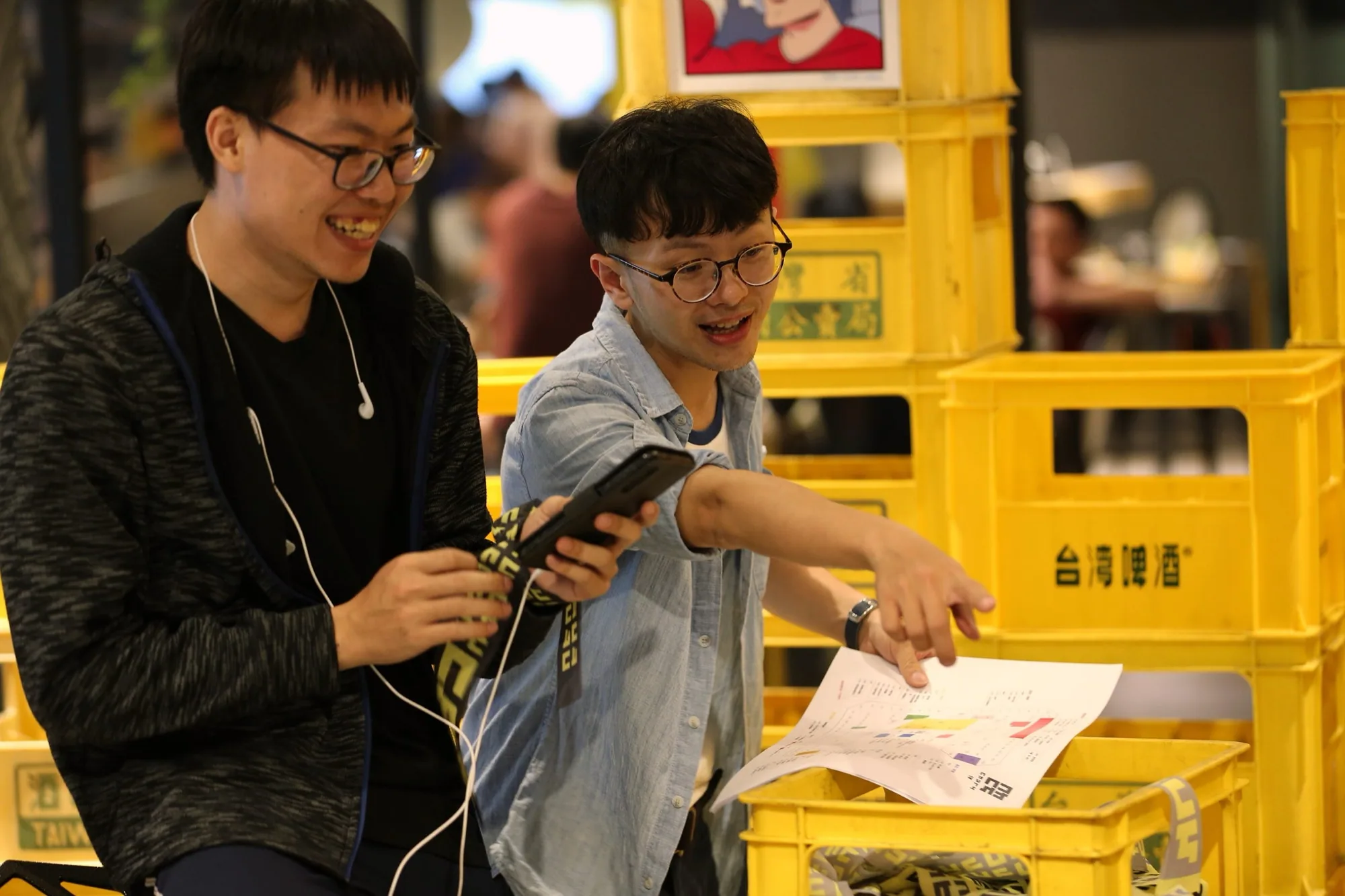
Resumen en 30 segundos: El Complejo Festival de Vida fue un encuentro juvenil que se celebró cinco ediciones entre 2016 y 2020 en Taichung. Sus fundadores fueron dos compañeros de la Universidad de Medicina China que debían haber sido médicos: Hsu Hao-ning, del departamento de medicina tradicional china, y Huang Yen-lin (conocida en internet como Mashbean), del departamento de medicina occidental. El nombre es una inversión juguetona de la «Celebración de la Vida Simple» de la generación de Jonathan Lee; posicionaba a los participantes como «personas que no han tenido éxito» y, en cada edición, solo se permitía hablar de «crecimiento», pero nunca de «éxito»1. Cinco años después, el organizador principal, Hsu Hao-ning, se quedó en Taichung para ejercer como médico de medicina tradicional china, abrió una librería y perdió las elecciones al concejo municipal; la asistente visual, Mashbean, dejó la medicina por las criptomonedas y en 2025 se convirtió en investigadora visitante en el área de democracia del Harvard Kennedy School2. Un foro que rechazaba el «éxito» terminó viendo cómo tanto sus organizadores como sus asistentes alcanzaban su propio tipo de éxito; y su pregunta más punzante fue la que Hsu Hao-ning lanzó desde el escenario: «¿Quieres morir con arrepentimiento o rendirte mientras vives?»3.
El festival que creció junto a los cortes histológicos
A finales de 2015, en Taichung, las paredes del Centro de Artes de la Universidad de Medicina China lucían una hilera de imágenes capturadas bajo el microscopio. Células de cáncer de mama, tejidos inflamados y cortes necróticos fueron ampliados, coloreados y enmarcados para formar una exposición titulada «Lamentos por una enfermedad: Estética patológica · Exposición de imágenes de cortes histológicos»4.
Los curadores eran dieciséis estudiantes de medicina. Lo que querían transmitir era muy sencillo: aquello que se percibe como una «enfermedad», si se observa desde otra distancia y bajo otra luz, posee su propia belleza. El concepto curatorial en los paneles era directo: las apariencias patológicas bajo el microscopio también pueden ser bellas4. Esta exposición no se limitó a recogerse tras su cierre; más tarde recorrió el Museo Nacional de Ciencias Naturales, la Universidad Nacional de Taiwán y Tzu Chi, pasando de ser una pequeña muestra en un centro de artes universitario a convertirse en algo que se movía y crecía por sí mismo. En la lista de esos dieciséis nombres, dos aparecerían juntos con frecuencia a partir de entonces: Huang Yen-lin y Hsu Hao-ning.
Medio año después, estas dos personas organizaron el Festival de la Vida Compleja. Trasladaron la idea de «ver la patología desde otra distancia para hallar belleza» del microscopio al ser humano: si observamos el «fracaso» desde otra perspectiva, ¿tendrá también su propia forma?
Es necesario situar a estas dos personas en posiciones distintas, porque en la historia posterior mucha gente los ha mezclado. Huang Yen-lin estudiaba medicina occidental, en la Facultad de Medicina. Hsu Hao-ning estudiaba medicina tradicional china, en la Facultad de Medicina Tradicional China. La misma universidad, diferentes facultades y dos formaciones completamente opuestas: uno aprendía sobre cortes histológicos, imágenes y turnos de residencia; el otro, sobre toma de pulso, fórmulas magistrales y los doce meridianos. Uno acabó trabajando como médico residente en el Taipei Veterans General Hospital, mientras que el otro abrió una clínica de medicina tradicional china en Beitun, Taichung. Ellos mismos bautizaron este estado como «xié-biān» (al borde de la facultad): ser un marginado dentro de su propia facultad, con la mente puesta en cualquier lugar que no sea donde debería estar alguien con bata blanca5. Este autodenominarse «al borde de la facultad» es importante; describe una actitud de posicionarse activamente en la periferia. La bata blanca es el centro que el mundo ha dibujado para los estudiantes de medicina, pero ellos se niegan a permanecer allí.
En mayo de 2016, Hsu Hao-ning etiquetó una serie de nombres en Facebook. Las condiciones para ser etiquetado eran extrañas: buscaba personas que encajaran con palabras clave como «estudiante de octavo año, adicto al trabajo constante, practicante recurrente, al borde de la facultad y que traiga amigos para infundir esperanza infinita»1. Esa lista de palabras clave era, en sí misma, un estándar de entrada invisible: no preguntaba por tus notas ni por tus títulos, sino por si tenías esa energía de «complicarte la vida hasta el cansancio». Bajo la publicación surgieron unos trescientos comentarios que fermentaron durante cuarenta días, dando lugar a la primera edición. Un encuentro que se celebraría durante cinco años comenzó con una publicación de Facebook y cuarenta días de debate; sin sedes, sin presupuesto y sin patrocinadores, solo un grupo de personas que no encajaban en sus facultades reconociéndose unas a otras.
El tema de la primera edición fue el «Foro de los no exitosos».
Si el Festival de la Vida Simple es calma y concentración, nosotros nos llamaremos Complejo
Para entender la broma detrás de este nombre, primero hay que saber a quién se dirige.
Casi todos en Taiwán han oído hablar del 「Festival de la Vida Simple」 (Simple Life Festival). Organizado en 2006 por un grupo de músicos de la escuela Rock Records —entre ellos Lee宗盛, Chang Pei-jen y Ma Tien-tsung—, su lema principal era «haz lo que te gusta y haz que lo que te gusta tenga valor»; su esencia era la de ser 「calmado y concentrado」6. Desde sus inicios con 30.000 personas, creció hasta alcanzar una escala de entre 60.000 y 100.000 asistentes, convirtiéndose en un referente de la estética de consumo cultural para los jóvenes en Taiwán. Poder comprar una entrada, entrar al recinto y escuchar música mientras se bebe cerveza artesanal sobre el césped es un tipo de 「simplicidad」 cuidadosamente diseñada. Diez años después, al celebrar su vigésimo aniversario, lograron que Wu Bai y Lee宗盛 compartieran escenario6, convirtiéndose ya en una auténtica marca de lifestyle taiwanesa.
Hsu Hao-ning le dio la vuelta directamente a ese nombre. Su versión es: 「Si decimos que quienes van al Festival de la Vida Simple son personas que anhelan una vida sencilla y hermosa, nosotros tenemos un grupo de adictos al trabajo que siempre hacen que la vida sea muy agotadora; así que llamémoslo Festival de la Vida Compleja」.1
Bajo esta broma se esconde una generación reclamando las etiquetas que se les han impuesto.
📝 Nota del curador
La interpretación convencional diría que el Festival de la Vida Compleja es 「una reunión pura de jóvenes contra la comercialización」. Pero ese marco es demasiado cómodo y, precisamente por eso, deja fuera el golpe más certero. Lo que este grupo está rechazando realmente es la definición de 「cómo debería ser la vida」 impuesta por la generación anterior. La 「simplicidad」 del Festival de la Vida Simple es una elegancia con barreras: presupone que ya estás establecido y tienes el margen necesario para buscar lo sencillo. En cambio, este grupo ni siquiera ha logrado establecerse. Recoger términos originalmente despectivos como 「complejo」, 「no exitoso」, 「adicto al trabajo」 o 「estudiante de bajo rendimiento académico」 para autodenominarse es una forma de decir: «Ni siquiera tenemos el estatus para ser absorbidos por tu estética, así que mejor nos nombramos nosotros mismos».
Esta generación tiene muchos nombres. En 2017, el periodista Wu Cheng-hong escribió 《Generación de la apatía》, definiéndolos como 「personas de entre veinte y treinta y cuatro años, nacidas con un ratón en la mano y poseedoras de las mejores cualificaciones de la historia de Taiwán, pero que se enfrentan a la precariedad de los salarios bajos, la pobreza y un futuro invisible」7. La parte más punzante de esta definición es 「poseedoras de las mejores cualificaciones de la historia de Taiwán」. Es una generación con los niveles académicos más altos, el mejor dominio de idiomas y la mayor destreza con las herramientas tecnológicas, pero que al mismo tiempo sufre un retroceso en los salarios iniciales y la falta de perspectivas de futuro; ambas realidades conviven en el mismo grupo de personas.
Si retrocedemos más, en 2011, la Alianza de Trabajadores de Taiwán publicó 《Generación del colapso》, que hablaba de la misma situación de corporativización y pobreza que enfrentaba este grupo. Antes de eso, existió el término 「22K」, que se refería a un programa de prácticas para graduados universitarios promovido por el Ministerio de Educación entre 2009 y 2011 para hacer frente al tsunami financiero; ofrecía salarios mensuales de NT$22.000 y contaba con más de 30.000 plazas. Aunque la intención original era que los graduados encontraran empleo rápidamente, terminó convirtiéndose en un referente de precios: las empresas lo usaron como base para sus contrataciones, presionando los salarios iniciales de esta generación hacia abajo durante varios años8.
Losers, fresas, generación de la apatía, generación del colapso, 22K. Lo que hace el Festival de la Vida Compleja es recoger estas palabras lanzadas por otros y darles la vuelta. Si les llaman losers, organizan un foro para 「personas no exitosas」. Si se dice que hacen que su vida sea muy agotadora, lo llaman 「complejo」. Esto no es terquedad, es un acto de recuperar el derecho al nombre: «Acepto las etiquetas que me das, pero yo decido qué significan».
Años después, el propio organizador principal, Hsu Hao-ning, al reflexionar sobre esto, puso un título que sirve como nota para todo el encuentro: 「Es demasiado difícil ser simple; mejor exploremos la complejidad juntos」9.
Hsu Hao-ning hablando sobre el Festival de la Vida Compleja (serie 「Chaoqiang Tuesday」 de la Administración de Desarrollo Juvenil del Ministerio de Educación). El título del vídeo, 「Es demasiado difícil ser simple; mejor exploremos la complejidad juntos」, convierte precisamente ese contraste con el 「Festival de la Vida Simple」 en su sello distintivo.
El Hotel California: donde puedes entrar, pero no salir
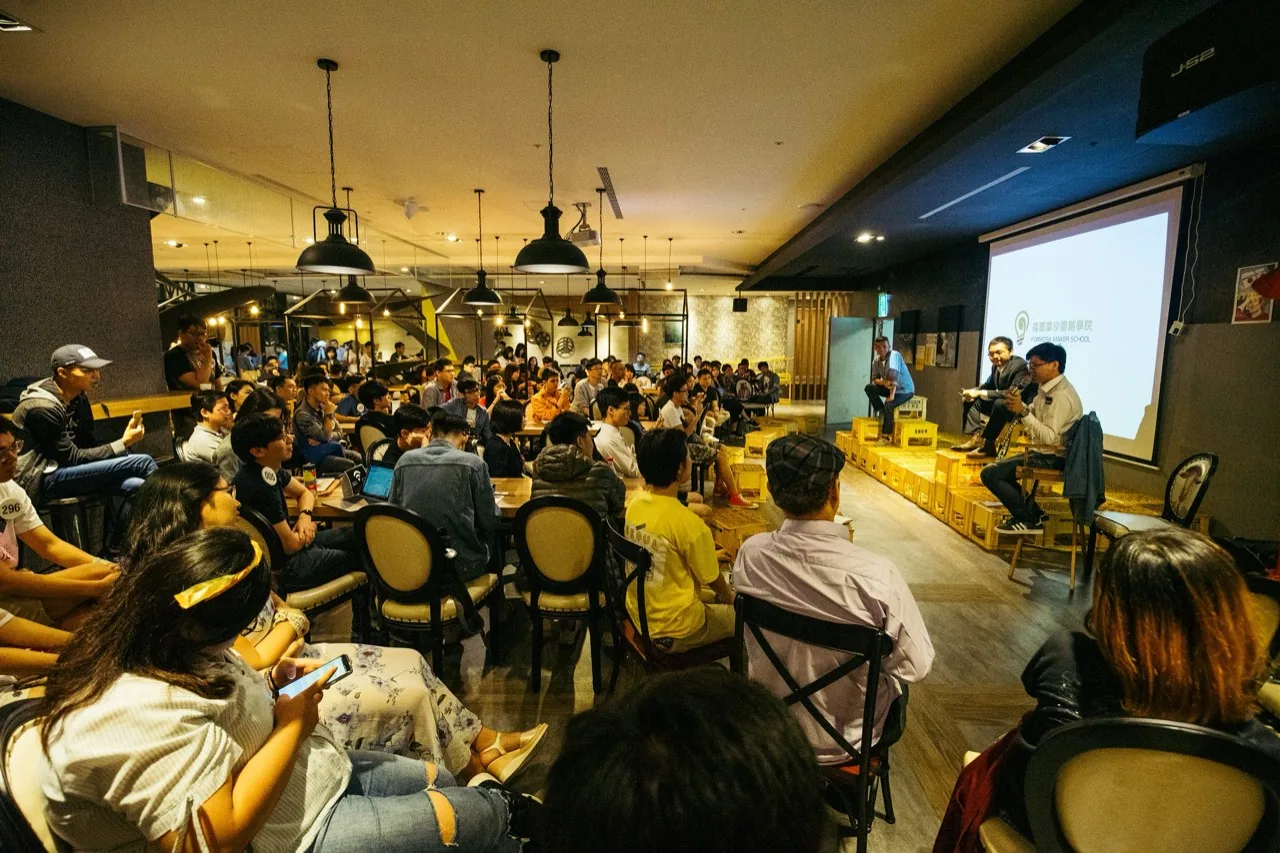
Sede del Festival de la Vida Compleja: con una asistencia de unas doscientas o trescientas personas, los ponentes y el público se sientan mezclados; las cestas amarillas de la cerveza Taiwan Beer funcionan como escenario y asientos. Photo: Festival de la Vida Compleja (uso legítimo para comentario editorial).
Tras la primera edición, este encuentro se celebra cada año en mayo, y así ha continuado durante cinco años consecutivos.
El método es muy especial. No hay presentador; la línea entre el ponente y el público es difusa, y a menudo, en medio de la noche sobre el césped, una charla puede extenderse durante cuatro horas10. Hsu Hao-ning utiliza el concepto de «sopa de piedra» para convocar a la gente. Es una historia antigua: unos soldados dicen que van a cocinar sopa con una piedra; los aldeanos que pasan por allí traen un poco de sal o unas zanahorias, y al final, realmente consiguen una olla de sopa. Así funciona el Festival de la Vida Compleja: los organizadores solo ponen una piedra y una olla; el contenido lo trae cada asistente.
En la primera edición participaron treinta grupos de ponentes, cubriendo todo el ecosistema de creación independiente de los estudiantes de octavo grado: desde universitarios con presentaciones, estudiantes que organizan el Festival de Música de la NTU, hasta la publicación de crítica literaria 《秘密讀者》, el proyecto 《每天為你讀一首詩》 que publica un poema diario en Facebook, la plataforma de cursos en línea Hahow, y el estudio 《移人》, que se enfoca en los trabajadores migrantes del sudeste asiático10. Al desplegar esta lista, se observa un pequeño universo que surgió por sí mismo en la juventud taiwanesa de 2016: presentaciones, música, literatura, educación, nuevos inmigrantes... ninguno de estos ámbitos ocupa un lugar en las industrias convencionales, pero en cada uno hay personas trabajando con seriedad.
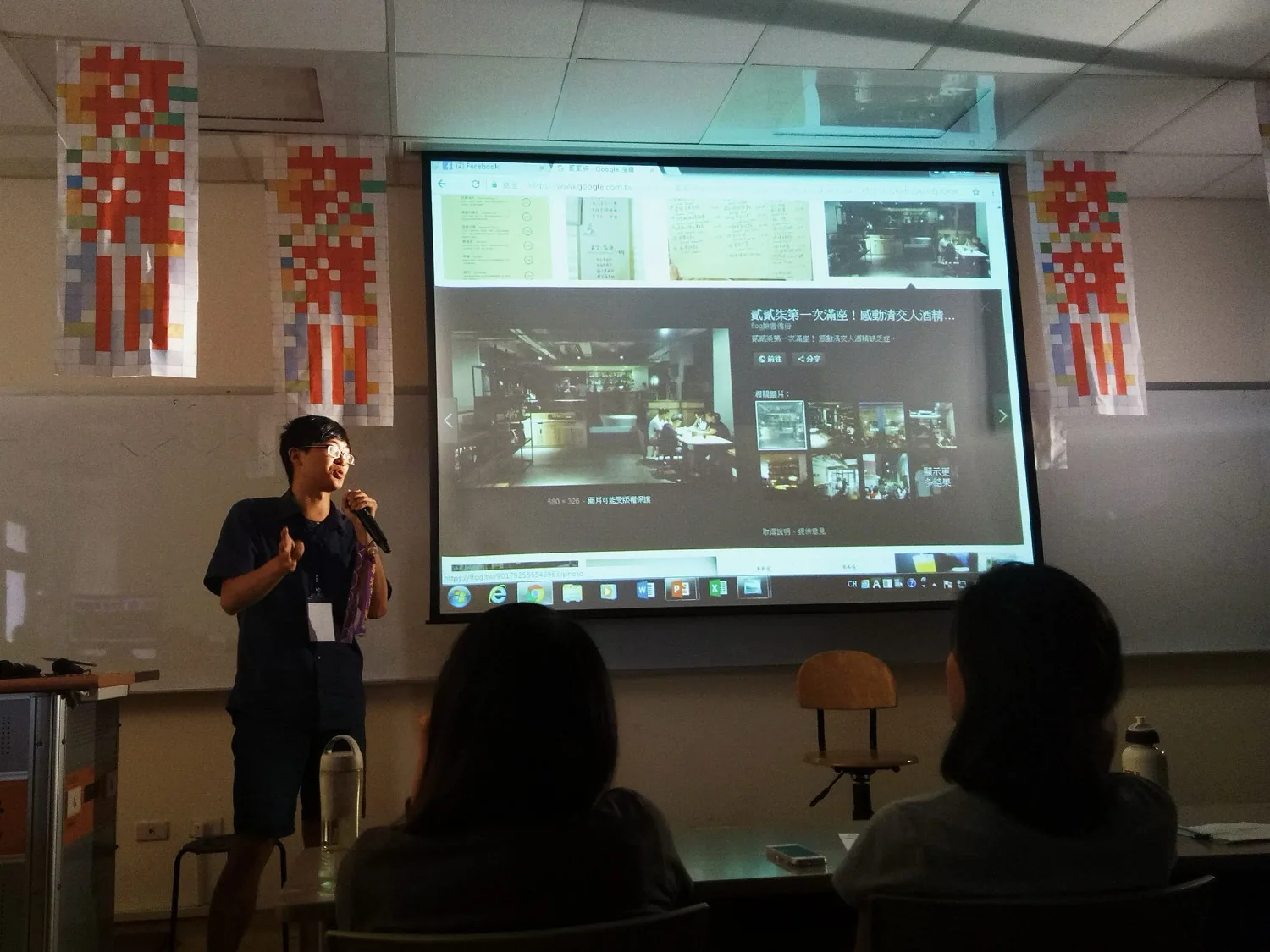
El ponente realiza su presentación frente a la pantalla; en la pared cuelga la característica pancarta de píxeles del Festival de la Vida Compleja. El lenguaje visual de todo el encuentro es una deliberada «sensación de aficionismo»: sin refinamiento ni iluminación profesional, como una bienvenida de un club estudiantil más que un evento de marca. Photo: Festival de la Vida Compleja (uso legítimo para comentario editorial).
En la segunda edición, en 2017, el tema fue «Hotel California». En esta ocasión, el evento se celebró literalmente dentro de un hotel11. El nombre proviene de la famosa letra de la canción de los Eagles: You can check out any time you like, but you can never leave (Puedes dejar la habitación cuando quieras, pero nunca podrás marcharte). Esa canción originalmente habla de una embriaguez lujosa que atrapa a las personas, pero aplicada al Festival de la Vida Compleja, el significado cambió: se refiere a un grupo de personas que encuentran a sus semejantes en los demás y, una vez que entran, no pueden irse porque no hay otro lugar afuera donde se pueda hablar así. Es una metáfora sobre «entrar pero no poder salir»; Mashbean también utilizó la expresión «el Hotel California, donde puedes entrar pero no salir, se celebró realmente en un hotel» en sus textos posteriores sobre diseño visual11.
A estas alturas, el Festival de la Vida Compleja ya tenía su propia identidad. Mientras que la Escuela Zazue (雜學校) creció hasta convertirse en el carnaval educativo más grande de Asia y «Enseñar por Taiwán» se enfocó en una captación de talento organizada, el Festival de la Vida Compleja mantuvo deliberadamente un volumen de doscientas o trescientas personas, lo suficientemente pequeño como para que todos pudieran hablar con todos. En un artículo posterior sobre la «entretenimiento de la cultura» (knowledge entertainment), Mashbean situó al Festival de la Vida Compleja junto a la Escuela Zazue y al Festival del Conocimiento General, autodefiniéndose como un «organizador de pequeña escala», e incluso criticó que los grandes eventos sufren de la «peste negra de los focos»12. La metáfora de la «peste negra de los focos» es fuerte: los focos son algo bueno, pero cuando un evento empieza a existir solo para ser visto, se enferma; la actuación sustituye al intercambio y la escala sustituye a la profundidad. El Festival de la Vida Compleja elige permanecer donde los focos no llegan; ese es su orgullo, pero también su techo.
En las cinco ediciones han asistido aproximadamente mil quinientas personas, una cifra casi invisible comparada con los cientos de miles de asistentes de un carnaval como la Escuela Zazue. Sin embargo, para el Festival de la Vida Compleja, ser «pequeño» es una elección deliberada y no una falta de crecimiento. Lo que busca es esa densidad en la que cada persona puede conversar con todas las demás; si se amplía, lo que más le importa se diluiría.
✦ «No somos un foro; somos una familia sin lazos de sangre que se reúne para celebrar el Año Nuevo».13
El triángulo de espaldas al público
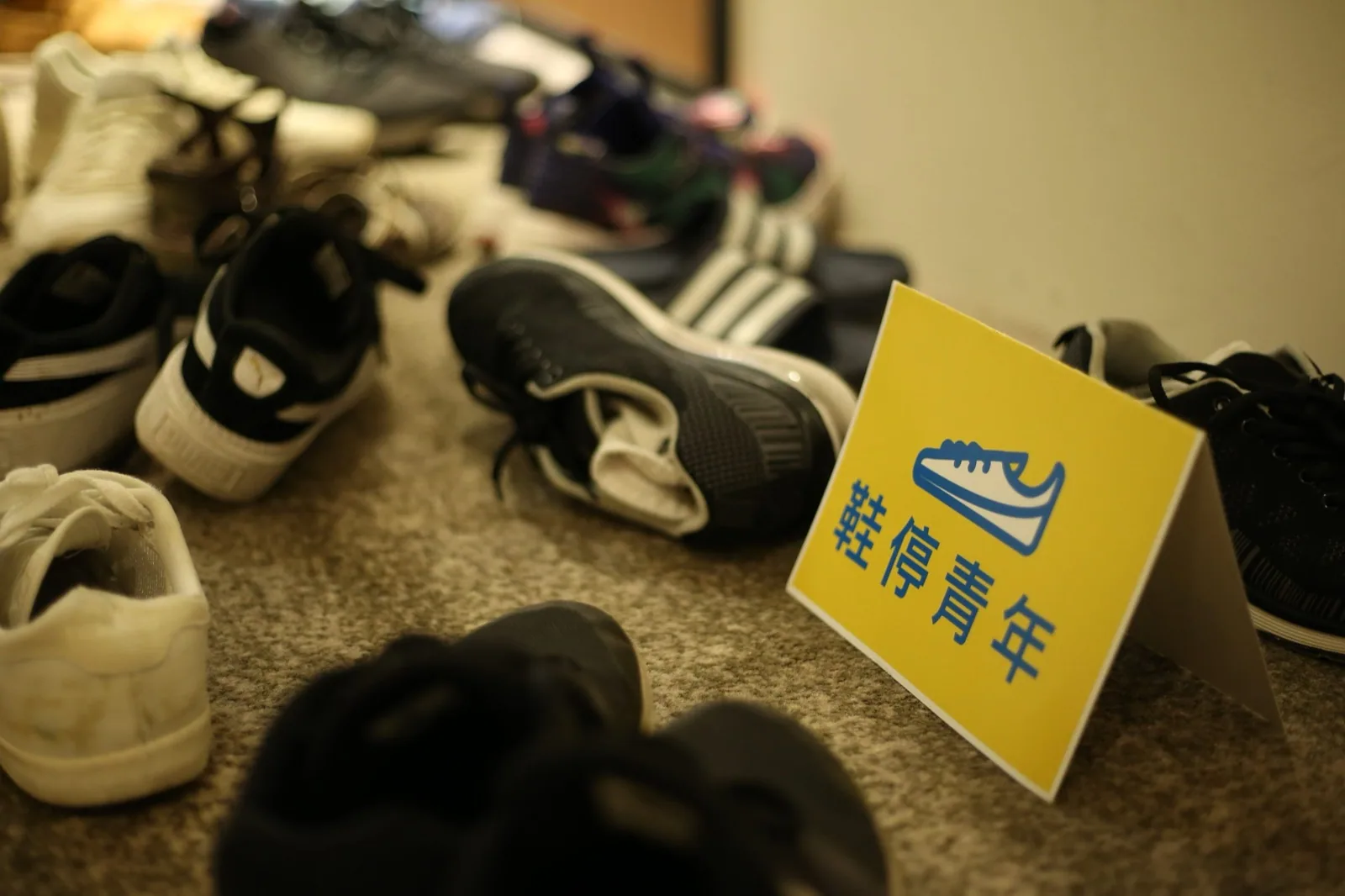
El cartel de «Juventud en pausa» y un montón de zapatillas fuera de la sala de conferencias. El Festival de la Vida Compleja organiza diálogos profundos como si estuvieran en la sala de estar de alguien; quitarse los zapatos al entrar es un pequeño gesto que responde a su propia definición de «volver para celebrar el Año Nuevo». Photo: Festival de la Vida Compleja (uso legítimo para comentario editorial).
La tercera edición fue la más memorable de este encuentro.
En 2018, el tema fue «Juventud budista», con un subtítulo en forma de pregunta: «Si se puede ser simple, ¿por qué insistir en lo complejo?»14. «Budista» (佛系, fóxì) era la palabra de moda en aquellos años, refiriéndose a una actitud de «me da igual, no importa, no me esfuerzo», similar al concepto de dejarse llevar. Que el Festival de la Vida Compleja lo eligiera como tema fue, en sí mismo, una pregunta retórica: un grupo de adictos al trabajo que viven vidas agotadoras se reunieron para hablar de ser «budistas»; en realidad, hablaban de «aunque claramente podríamos elegir que no nos importe, ¿por qué seguimos sin poder soltarlo?». Durante el día, la edición se celebró en la Universidad de Medicina Chung Shan, y por la noche se abrió la «Aldea de la Vida Compleja» junto al mercado nocturno de Feng Chia14.
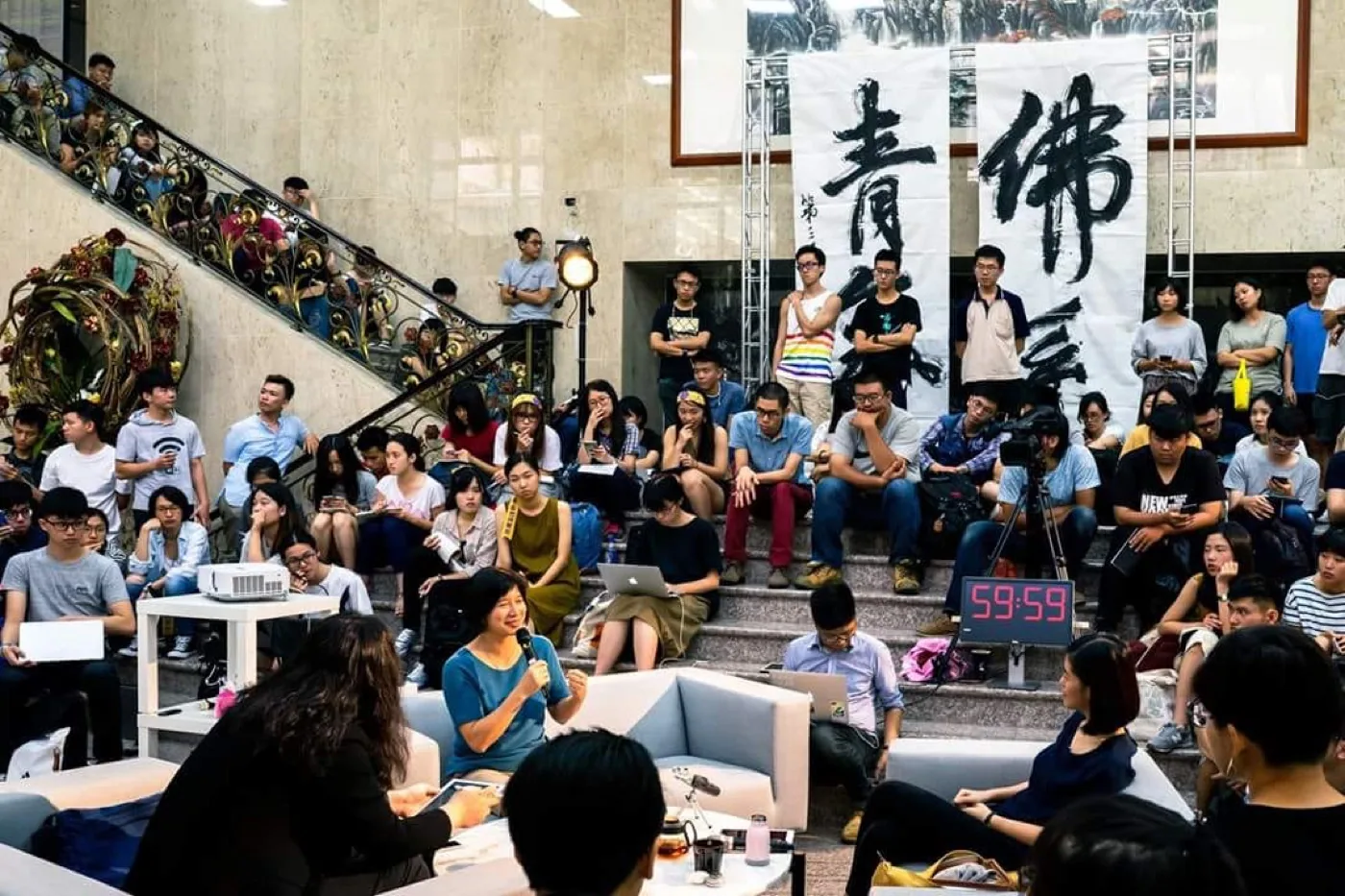
Escena de la tercera edición «Juventud budista»: detrás del ponente hay una pancarta escrita a mano con las palabras 「佛系青年」 y un reloj de cuenta regresiva de 59:59. El reloj es la obsesión del Festival de la Vida Compleja con la «profundidad»; cada intervención está delimitada por el tiempo, obligando al ponente a ir directo al grano. Photo: Festival de la Vida Compleja (uso legítimo para comentario editorial).
Esta edición contó con un diálogo tripartito entre tres personas que, en cierto sentido, se convertirían después en «personas de éxito»: Audrey Tang, entonces miembro del Consejo de Ejecutivos del Yuan Ejecutivo y más tarde Ministra Digital; Liu An-ting, emprendedora educativa y fundadora de Teach For Taiwan (為台灣而教); y Lin Yi-ying, vicealcaldesa de la ciudad de Taichung15.
El diseño del diálogo fue peculiar. Los tres se sentaron formando un triángulo, de espaldas al público, recibiendo las preguntas de la audiencia a través de la herramienta Slido15.
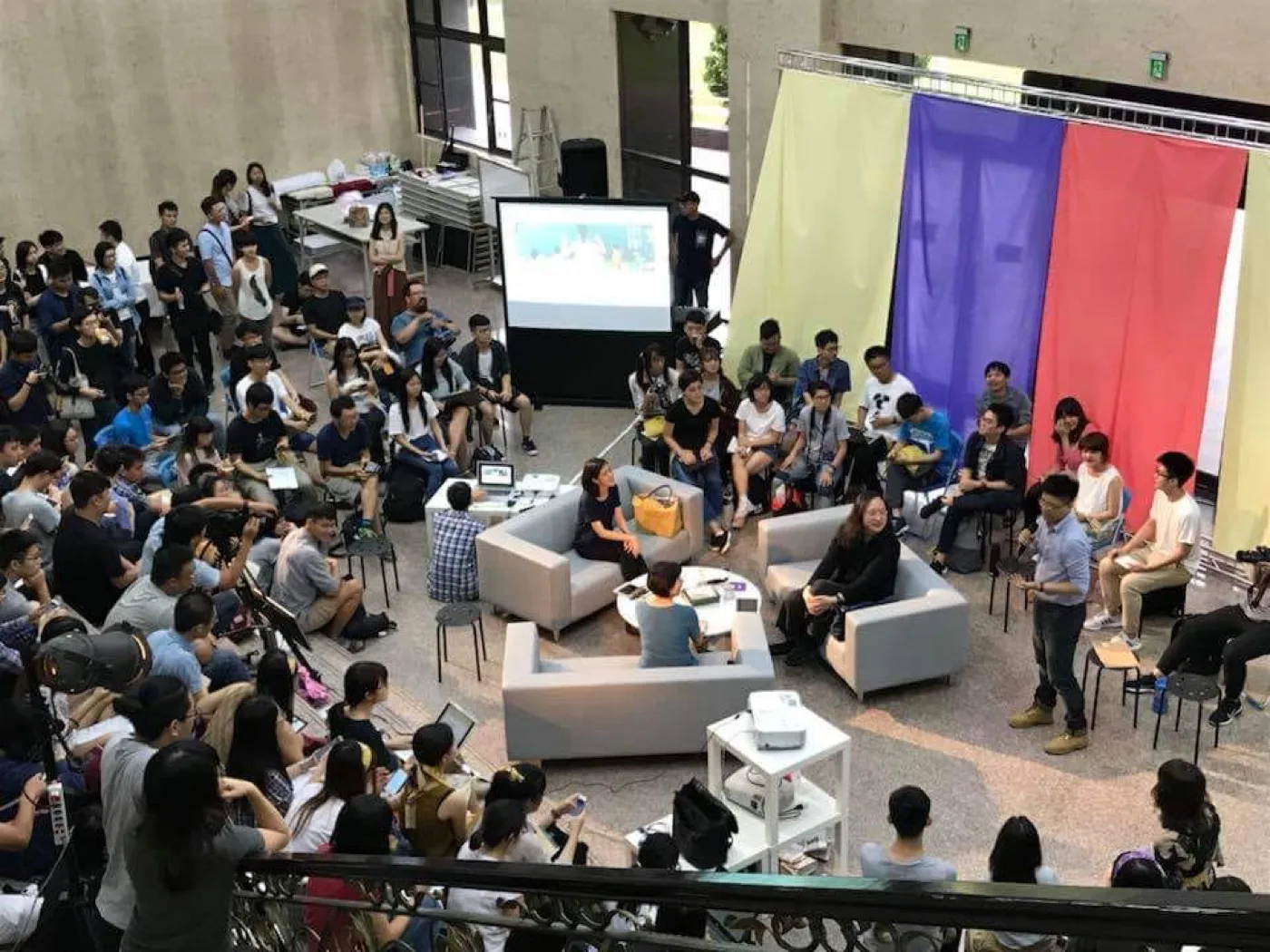
La imagen central del diálogo tripartito de la tercera edición: tres sofás en triángulo, con Audrey Tang, Liu An-ting y Lin Yi-ying sentadas hacia el centro, de espaldas al público que las rodea, bajo cortinas roja, azul y amarilla. Este es el concepto mismo del «triángulo de espaldas al público»: girar a los ponentes para que se miren entre ellos es la declaración más directa del Festival de la Vida Compleja de que «el diálogo es más importante que la actuación». Photo: Festival de la Vida Compleja (uso legítimo para comentario editorial).
El acto de hablar de espaldas a la audiencia define la esencia del Festival de la Vida Compleja: sin actuaciones, sin buscar los focos, solo importando si el diálogo en sí es lo suficientemente profundo. En un foro convencional, los ponentes se dirigen al público y dicen cosas para que el público las escuche; estas tres personas se dirigían entre sí, diciendo cosas para escucharse mutuamente, mientras el público simplemente tenía permiso para escuchar de forma lateral. Hsu Hao-ning ha dicho que «un diálogo profundo, sin distancias y con una profundidad casi exigente» es la marca registrada de este encuentro13. La palabra «exigente» es muy precisa: no busca conversaciones superficiales o corteses, sino que exige que los interlocutores se lleven al límite hasta no tener escapatoria.
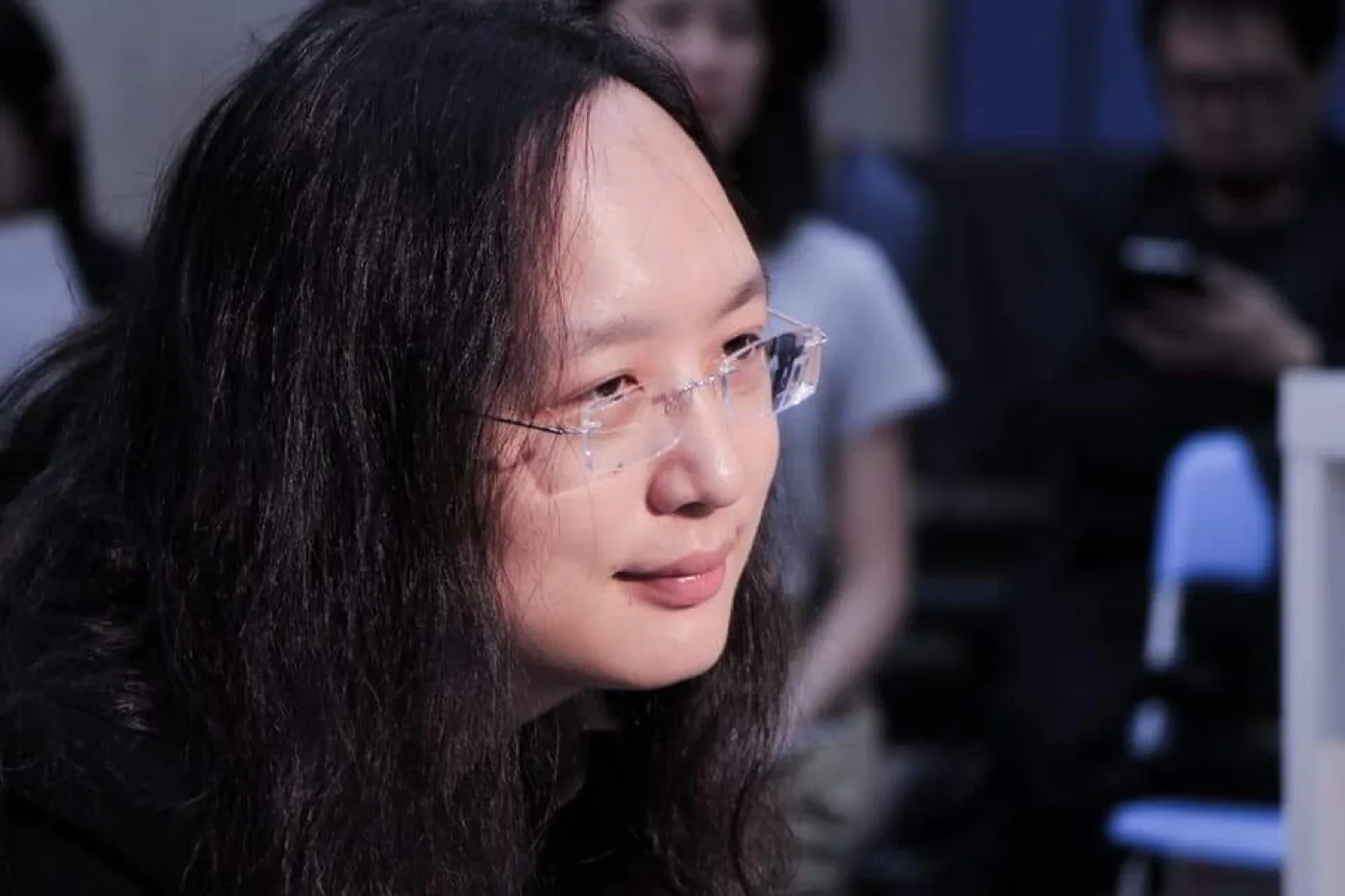
Perfil de Audrey Tang durante el diálogo tripartito. En aquel entonces era miembro del Consejo de Ejecutivos del Yuan Ejecutivo e impulsora de la tecnología ciudadana proveniente de g0v; dos años después se convertiría en la primera Ministra Digital de Taiwán. Photo: Festival de la Vida Compleja (uso legítimo para comentario editorial).
Ese día, Audrey Tang dijo una frase: «Desde el punto de vista de la equidad, al gobierno no le conviene la innovación»15. Su argumento era que el gobierno debe tratar a todos por igual, mientras que la innovación es, por naturaleza, un privilegio de riesgo para unos pocos; ambos conceptos tienen una tensión intrínseca. A esto, Liu An-ting añadió: «La innovación proviene de la periferia»15. Se refería a que las cosas verdaderamente nuevas rara vez surgen del centro del sistema, sino que brotan de los rincones ignorados, de aquellas personas que no tienen recursos y deben buscarse la vida por su cuenta. Esta frase suele atribuirse erróneamente al organizador, pero pertenece a Liu An-ting, no a Hsu Hao-ning. En un foro organizado para «los que no han tenido éxito», en el escenario se sentaban las personas más prometedoras de esta generación en Taiwán, hablando de que «la innovación proviene de la periferia»; mientras tanto, bajo el escenario, estaban precisamente aquellos que pensaban que estaban en la periferia y que, más tarde, terminaron entrando uno a uno en el centro.
Hubo también una anécdota durante el diálogo que los asistentes recordaron durante mucho tiempo: alguien preguntó anónimamente en Slido a Audrey Tang «qué champú usa habitualmente»15. En medio de una conversación intensa sobre equidad, innovación, gobierno y periferia, surgió esa pregunta absurda, y Audrey Tang la aceptó con seriedad. Esa imagen es muy propia del Festival de la Vida Compleja: permite que coexistan la profundidad exigente y la picardía juvenil, porque para este grupo de personas, ambas cosas son en realidad lo mismo.
Los ponentes de la tercera edición no fueron solo esos tres. También participaron la editora jefa de Pan-Science Lei Ya-chi, el Dr. Langquan (especialista en educación sobre comportamiento animal), Liu Chien-ping de publicaciones locales, Li Hsueh-cheng de la banda 227, y Lin Hui-chiu, quien se autodenomina «diseñadora mediocre», entre otros16. Al observar esta lista, se nota que el Festival de la Vida Compleja nunca invita a la gente por su fama. Invita a un grupo de personas que «están haciendo seriamente algo que nadie más entiende»; la fama es secundaria. Y fue precisamente entre este grupo donde alguien captó la ironía. Una observadora llamada Chu Si-yu escribió sobre su sentir ese día, y sus palabras se convirtieron en la nota al pie más honesta del festival: «¿Por qué voy a fingir que soy una persona exitosa aquí? ¿Realmente he tenido éxito?»17.
Charla TEDxTaipei de Liu An-ting, ponente del diálogo tripartito de la tercera edición. Ella fundó Teach For Taiwan para llevar docentes a las zonas rurales; la frase que pronunció en el Festival de la Vida Compleja, «la innovación proviene de la periferia», es precisamente su convicción. En este vídeo se puede escuchar cómo explica este concepto por sí misma. 18
Aldea de la Vida Compleja: Feng Chia de noche, pancartas de píxeles y vales de canje de cócteles
La tercera edición separó el día y la noche en dos espacios completamente distintos; este diseño merece una mención aparte.
Durante el día, en la Universidad de Medicina Chung Shan, el ambiente era el de un foro de diálogo serio: formas triangulares, relojes en cuenta regresiva y una profundidad exigente. Tras la puesta de sol, todo el grupo se trasladaba a un lugar llamado «Si Guan», junto al mercado nocturno de Feng Chia, para dar inicio a la «Aldea de la Vida Compleja»14. La elección de la palabra «aldea» es interesante: durante el día son ponentes y oyentes de un foro; por la noche, se convierten en los aldeanos de una misma comunidad. Para entrar en la aldea se necesita un «pase de aldeano», y dentro se utilizan vales de «canje de cócteles» para obtener bebidas.
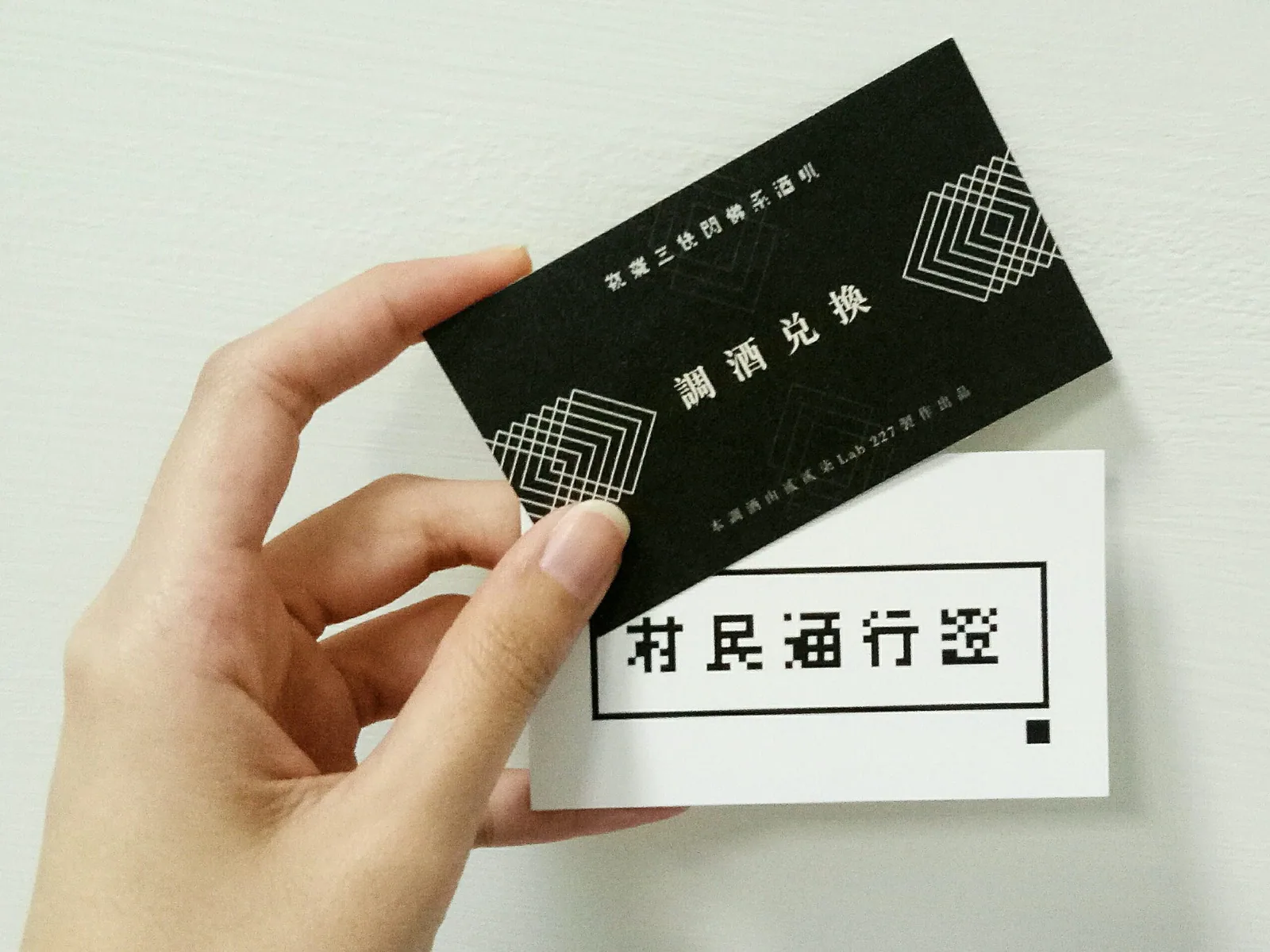
El «pase de aldeano» y el vale de «canje de cócteles» de la Aldea de la Vida Compleja; la tipografía de puntos geométricos es la firma visual del Festival de la Vida Compleja. Llamar a la entrada «pase de aldeano» consiste en transformar sutilmente un evento en una aldea temporal: no vienes a participar, vienes a ser un aldeano. Photo: 複雜生活節 (fair use editorial commentary).
En las paredes de Si Guan, en Feng Chia, colgaban pancartas de píxeles; todo el espacio estaba sumergido en ese lenguaje visual de tipografía de puntos. Esta estética de píxel no fue elegida al azar. La tipografía de puntos es la letra de los primeros ordenadores y consolas de videojuegos, la memoria de pantalla de este grupo de estudiantes de octavo grado durante su infancia. Usarla para una reunión juvenil en 2018 equivalía a decir: «Somos la generación que creció viendo estas imágenes de baja resolución; nuestra nostalgia tiene esta apariencia».
La Aldea de la Vida Compleja desmanteló por completo el término demasiado formal de «foro». Durante el día, aún se podía llamar «evento», pero al llegar la noche —con sus pases, sus vales de canje, su alcohol, sus pancartas de píxeles y esas conversaciones en el césped que no terminaban en cuatro horas—, ya se había transformado en una aldea que solo existe una noche al año. Al día siguiente, cuando sale el sol, la aldea se desmantela y los aldeanos regresan dispersos a sus respectivas ciudades. Esa textura de «existir de forma temporal pero con total seriedad» es lo más difícil de replicar del Festival de la Vida Compleja.
Los "no exitosos", aún así, la élite del futuro
La pregunta de Chu Si-yu da en el clavo sobre el aspecto más difícil de responder de este festival.
El Festival de la Vida Compleja afirma que sus participantes son los «no exitosos». Sin embargo, quienes terminan siendo etiquetados en Facebook son un grupo con capital cultural, capaces de costearse la universidad y con conexiones sociales dentro del círculo de la creación independiente. Su mecanismo de selección (amigos etiquetando a amigos) excluye de forma natural a otro grupo: los trabajadores migrantes en las fábricas, los jóvenes de su misma edad que no fueron a la universidad y aquellos octavo grado verdaderamente marginados que no tienen cuentas en redes sociales para ser etiquetados. Para ser etiquetado, primero debes estar en la lista de amigos de alguien; y para estar en esa lista, primero debes llevar una vida que «sea reconocible por este grupo». Este umbral invisible es más selectivo que cualquier sistema de venta de entradas.
Existe también un nivel de exclusión geográfica. Durante cinco ediciones, el evento se ha celebrado en Taichung, y la mayoría de los ponentes y participantes pertenecen al círculo de la zona central, lo que lo aleja mucho de los jóvenes del sur o del este. Para un joven que viva en Taitung o Pingtung, el simple hecho de plantearse «si vale la pena viajar a Taichung para una reunión de dos días y una noche» es un filtro suficiente. Los «similares» del Festival de la Vida Compleja son, en realidad, similares con un radio geográfico determinado.
Esta es una estructura difícil de evitar en este tipo de encuentros, y no debe tomarse como un ataque malintencionado. Una reunión que funciona basándose en el «intercambio profundo dentro de una misma burbuja» es, por naturaleza, algo distinto a la «imagen general de la generación de octavo grado». Hsu Hao-ning es consciente de este punto. Cada año se cuestiona a sí mismo sobre el escenario, llegando incluso a decir que el Festival de la Vida Compleja es «la actividad que más ha odiado organizar» (se explicará más adelante). Pero ser consciente no equivale a resolverlo. Saber que tu reunión es selectiva y lograr organizar una que no lo sea están separados por todo el peso de la estructura social.
📝 Nota del curador
Si se analiza la lista de participantes del «Foro de los no exitosos», se revela un hecho incómodo: este grupo de personas que se autodenominaban «aún no exitosas» terminó ocupando posiciones de élite de manera desproporcionada. Mashbean fue a Harvard, la ponente Audrey Tang se convirtió en ministra, y Liu An-ting recibió un premio internacional de educación. Así, el término humilde de «no exitoso» parece, visto en retrospectiva, una forma de humblebragging (presumir con modestia). Pero leerlo así también es injusto. Cuando este grupo se reunió en 2016, realmente no eran exitosos: los salarios bajos, la falta de perspectiva de futuro y la marginación dentro de sus propios departamentos universitarios eran realidades presentes. El problema no es si tuvieron éxito después, sino que este encuentro, desde su inicio, solo tiene capacidad para albergar a «no exitosos que están en camino hacia el éxito». Lo que excluye son a aquellos que ni siquiera pueden situarse en la línea de salida. Escribir esto con honestidad se acerca más a la realidad que intentar empaquetarlo como una utopía inocente.
Desde una perspectiva más académica, en 2019 alguien utilizó el concepto de «heterotopía» del filósofo francés Foucault para explicar el Festival de la Vida Compleja19. Una heterotopía se refiere a un espacio que se sitúa entre lo real y lo utópico, un lugar que es simultáneamente real y ficticio, donde se comprimen elementos heterogéneos, generando así el potencial de perturbar la realidad. Foucault cita ejemplos como jardines, cementerios, teatros o barcos; lugares que existen dentro de la cotidianidad pero que siguen un conjunto de reglas distinto. La observación del autor es que el Festival de la Vida Compleja rompe la frontera entre ponente y oyente, permite que personas con temas afines coexistan en el espacio y construye una identidad colectiva mediante pancartas; «estrictamente hablando, esta es la esencia del Festival de la Vida Compleja»19.
En otras palabras, el verdadero producto del Festival de la Vida Compleja nunca reside en el contenido de una conferencia específica, sino en el hecho mismo de que «un grupo de personas heterogéneas sea comprimido en un mismo espacio durante dos días y una noche».
Sin embargo, este artículo deja una pregunta sin resolver: la heterotopía solo funciona durante dos días y una noche, ¿puede perdurar su efecto?19 Esta es una cuestión crítica. Un jardín puede florecer año tras año, un cementerio puede permanecer siempre en el mismo lugar, pero una heterotopía como el Festival de la Vida Compleja es efímera: aparece de la nada un fin de semana de mayo y desaparece el lunes. El sentido de pertenencia que genera es real, pero ¿podrá ese sentimiento sobrevivir a los trescientos sesenta y tres días que siguen al cierre del evento?
Tras la reunión de dos días y una noche entre iguales, cada persona regresa, inevitablemente, a su propia y compleja vida.
ㄇㄉㄈㄎ: Jerga que solo su círculo entiende
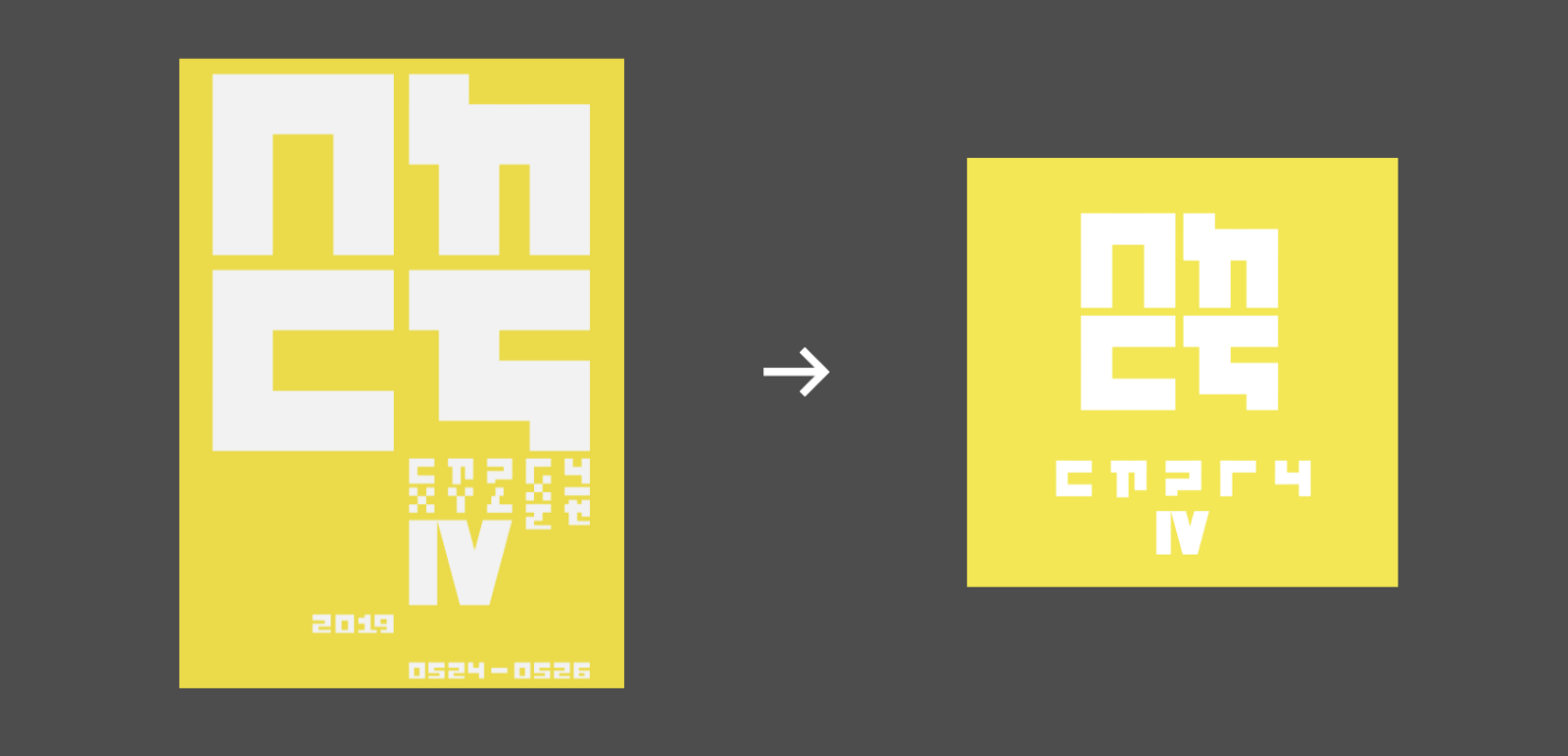
Visual principal de la cuarta edición de «ㄇㄉㄈㄎ»: Huang Dou-ni dibujó a mano el término motherfucker usando caracteres Zhuyin cuadrados; una especie de jerga juvenil que solo su círculo entiende. Imagen: diseño de Huang Dou-ni (uso legítimo para comentario editorial).
La cuarta edición llevó este espíritu de «solo para los nuestros» al extremo.
En 2019, el tema consistió en cuatro símbolos Zhuyin: ㄇㄉㄈㄎ. Al descifrarlos, resultan ser la transcripción fonética de la palabra inglesa motherfucker20. Era un acertijo que solo alguien capaz de leer Zhuyin y entender cómo convertirlo de nuevo al inglés podría resolver; es decir, era un código que solo los taiwaneses, y específicamente una generación determinada, comprenderían con una sonrisa cómplice. Huang Dou-ni diseñó personalmente este conjunto de caracteres Zhuyin estándar dibujados a mano, definiéndolo como «hablar sin límites mientras se es disciplinado»21: una jerga juvenil que solo su círculo entiende. El Zhuyin es el sistema de símbolos más reglamentado que se aprende en primer grado de primaria; usarlo para deletrear un insulto es, en sí mismo, un acto de «rebeldía secreta bajo una apariencia de buen comportamiento», lo cual refleja perfectamente a ese grupo de estudiantes de medicina que esconden otros pensamientos bajo sus batas blancas.
El lugar elegido fue el hotel Banpan, en el cuarto piso de la Plaza Primera de Taichung, donde se alojaron en habitaciones que parecían celdas de un panal20. Hay una razón para elegir este edificio. La Plaza Primera es un antiguo edificio lleno de las huellas de la vida de los trabajadores migrantes del sudeste asiático; los fines de semana se llena de personas procedentes de Vietnam, Indonesia, Filipinas y Tailandia, convirtiéndose en la «sala de estar» de los migrantes en Taichung. En la memoria de los habitantes de Taichung, este lugar fue estigmatizado y visto como un sitio al que «no hay que ir», hasta que poco a poco empezó a ser redescubierto, renombrado como Plaza ASEAN y considerado un punto de encuentro para la multiculturalidad. Un grupo de jóvenes que debate sobre la «periferia» organizó su reunión en el edificio con mayor significado periférico y se alojó en pequeñas habitaciones tipo panal; esta elección fue, en sí misma, una declaración silenciosa.
El prólogo de esta edición explicó con mayor claridad la esencia del Festival de la Vida Compleja: «No somos un foro, somos una reunión de familiares sin lazos de sangre que regresan para celebrar el Año Nuevo». «Diálogos profundos, sin distancias y casi exigentes en su profundidad, son la marca registrada del “Festival de la Vida Compleja”». «Caminemos juntos un poco más lejos».13
Definir una reunión como «celebrar el Año Nuevo» y a los participantes como «familiares sin lazos de sangre» es la autodefinición más conmovedora y, a la vez, más peligrosa del Festival de la Vida Compleja. El Año Nuevo es un ritual anual con asientos fijos donde toda la familia se reúne en la misma mesa; comparar la reunión de este grupo de personas afines con el Año Nuevo equivale a prometer un sentido de pertenencia: «no importa a dónde vayas, cada mayo habrá un hogar esperándote». Es conmovedor porque realmente ofrece ese sentimiento de pertenencia; es peligroso porque el círculo familiar tiene límites y la mesa del Año Nuevo tiene un número máximo de asientos: quienes pueden volver para celebrar el Año Nuevo siempre serán aquellos que ya figuraban en la lista de esa familia.
El alma se queda en la periferia, el asistente se va a Harvard
Para entender de quién es el Festival de la Vida Compleja, hay que observar hacia dónde se dirigieron sus dos fundadores. Porque su tensión más profunda no reside en las cinco ediciones del evento en sí, sino en la bifurcación de estos dos hombres.
Huang Dou-ni es el nombre real de Huang Yen-lin, conocido en internet como mashbean. Alrededor de 2021, dejó su trabajo como médico. Su propia explicación fue: «Debido a mi fascinación por las estructuras profundas de Internet y las redes sociales, dejé mi trabajo como médico; actualmente me dedico a integrar el espíritu cypherpunk en la sociedad digital de Taiwán». 22 Estas palabras parecen un currículum, pero al analizarlas revelan un giro trascendental: abandonar su puesto de médico residente en el Hospital Universitario de Taipei para perseguir el concepto de «cypherpunk», un grupo de personas que cree que la criptografía y el código pueden redistribuir el poder y proteger la libertad individual. Su abandono de la medicina no fue un momento dramático. Ya organizaba el Festival de la Vida Compleja mientras aún vestía la bata blanca; a principios de 2022, mencionó en una reunión comunitaria que «el año pasado todavía era médico» 23. Su partida fue un alejamiento progresivo: desde los márgenes de su facultad hacia fuera de ella, y finalmente hacia un mundo completamente ajeno a la medicina.
Tras su partida, cofundó FAB DAO, una organización que utiliza la tecnología blockchain para fines benéficos. Posteriormente lanzaron el «Proyecto %» (Project %), en el que reunió a seis artistas generativos para crear obras de arte digital de las mil ciento diez montañas de Taiwán 24. Esta trayectoria lo ha llevado cada vez más cerca del núcleo institucional: se incorporó al Ministerio de Desarrollo Digital como ingeniero de sistemas, trasladando la experiencia acumulada por el sector privado en filantropía web3 al seno del gobierno; y en 2025, obtuvo una plaza como investigador de políticas no residente en el Allen Lab de la Escuela Kennedy de Harvard para la «reinvención de la democracia» 2. De ser alguien que en una pequeña reunión en Taichung se encargaba de diseñar carteles y material visual, ha llegado a las mesas de debate en Harvard sobre cómo reformar la democracia. Este trayecto es una de las realizaciones más dramáticas de la idea de que «la innovación surge de la periferia»; solo que quien lo cumple no es Liu An-ting, quien acuñó la frase, sino aquel encargado del diseño visual que ayudaba desde la audiencia.
Sin embargo, respecto a quién es el autor del Festival de la Vida Compleja, el propio Huang Dou-ni lo ha dejado muy claro. Escribió en sus propios artículos: «El Festival de la Vida Compleja se convirtió, de manera lógica, en la obra de Hao-ning; nosotros, como apoyo visual, permanecemos en el equipo de trabajo». 25 Esta frase es crucial; proviene del propio implicado y cede explícitamente el lugar de «organizador principal» a Hsu Hao-ning, situándose a sí mismo como «apoyo visual». Posteriormente, debido a la fama de Huang Dou-ni en el ámbito web3, los medios suelen presentar el festival como «la juventud del fundador de FAB DAO», pero él nunca lo ha dicho así.
Al llegar a la cuarta edición, escribió sobre el significado de este encuentro para él: «El fin del Festival de la Vida Compleja 4 simboliza, para mí personalmente, el fin de una era; la época de soñar y disfrutar sin medida se despide, coincidiendo con las dificultades de gestionar la página de Facebook». 26 La mención a las «dificultades de gestionar la página de Facebook» señala un cambio estructural de época: el festival creció gracias a las etiquetas y la página de Facebook; cuando los algoritmos de la plataforma redujeron drásticamente el alcance orgánico, este tipo de encuentros basados en la conexión comunitaria natural también perdieron su oxígeno.
Y luego está esa frase que suena a despedida y a archivo al mismo tiempo: «En esos cuatro años, lo que el Complejo me enseñó llega hasta aquí; queda sellado. 2016–2019 fue mi honor». 27 El asistente se fue a Harvard, pero el alma se quedó en la periferia.
Obras benéficas de Huang Dou-ni en el ámbito web3 tras dejar la medicina (entrevista de Digital Age). De encargado del diseño visual del Festival de la Vida Compleja a cofundador del mayor proyecto de NFT benéfico de Taiwán; este vídeo es la siguiente etapa de la trayectoria de «el asistente que se fue a Harvard». 28
Hsu Hao-ning no ha dejado Taichung. Nació en Changhua en 1988, un chico de campo rodeado de arrozales. En la secundaria tuvo notas excelentes y entró en la clase de excelencia en matemáticas y ciencias del instituto de Changhua, para luego ingresar en el departamento de Medicina China de la Universidad de Medicina China 5. Durante su etapa universitaria sufrió sucesivas tragedias familiares: su madre sufrió un derrame cerebral durante su segundo año y falleció dos días después; su padre murió por enfermedad cuando estaba en su sexto año; con su hermana en cuarto año y su hermano en segundo de bachillerato, él era el único hijo adulto en casa 29. Su padre trabajaba como taxista y su madre realizaba trabajos manuales para el hogar 29.
Estos son hechos reportados públicamente y no hace falta dramatizarlos; pero constituyen el trasfondo para entender por qué decidió quedarse. Una persona que, durante sus seis años de universidad, tuvo que despedir a ambos padres y hacerse cargo de un hogar, otorga un peso distinto al concepto de «quedarse en el mismo lugar para proteger las cosas».
También es poeta. Fue el presidente fundador del Club de Investigación Literaria y Artística de la Universidad de Medicina China y secretario general de la Asociación de Escritores Jóvenes de Gengxin; ha ganado cuatro premios literarios, incluidos los de poesía moderna del Premio Nacional de Literatura Estudiantil y del Premio Nacional de Literatura para Estudiantes de Medicina 5. Un estudiante de medicina, un poeta de verso libre y un organizador de encuentros juveniles: estas tres identidades no entran en conflicto en él, sino que parecen tres facetas de una misma búsqueda: la capacidad de «ver a las personas con mayor claridad».
Más tarde, mientras buscaba una sede para su campaña electoral, encontró por casualidad una casa antigua que le pareció ideal para abrir una librería, y así fundó «Reference» (引書店) 30. La lógica del nombre es muy similar a su personalidad: la última sección de una tesis son las referencias bibliográficas, y quien busca la verdad no puede prescindir de ellas; «donde está la referencia, ahí reside el argumento» 30. Una librería llamada «Referencia» equivale a construir un espacio físico basado en la creencia de que «todo lo que digo tiene una fuente y es sólido». Esta librería seguía actualizando su propio podcast hasta finales de 2024 31: el candidato perdió las elecciones, pero la librería sobrevivió.
En 2018, Hsu Hao-ning se presentó como candidato al concejo municipal por el distrito de Beitun, en Taichung, representando al Partido Fuerza de la Era (时代力量). En un distrito donde competían dieciséis personas, obtuvo 5,332 votos (un 3.93%), quedando en undécimo lugar; perdió las elecciones y su campaña terminó con una deuda de más de NT$100,000 32. Durante su candidatura dijo algo muy especial: «Espero poder amar a la gente, para demostrar que he sido amado por personas maravillosas» 33. Un joven que acababa de perder a sus padres quería usar el acto de «amar a los demás» para demostrar que aquellas personas que lo amaron realmente existieron; esa frase convirtió un acto público como es una candidatura en un duelo muy íntimo. También dijo que quería dedicar sus «años dorados, de los 30 a los 50», a Beitun 34. Perdió la elección, pero la librería que nació por la búsqueda de aquella sede electoral permaneció allí. Alguien que intentó conmemorar su pérdida más privada (sus padres) mediante el acto más público posible (una elección), terminó dejando como legado el lugar más silencioso: una librería.
El año menos "cool"
La quinta edición fue la más solitaria de este festival dedicado a «reunir a los semejantes». En 2020, llegó el COVID. Un encuentro cuyo núcleo era «reunir para el Año Nuevo a una familia sin lazos de sangre» se topó con un año en el que todo el mundo debía mantener la distancia. El tema de esta edición del Festival de la Vida Compleja fue «Aislamiento Voluntario»35.
No celebraron una convención física. En su lugar, lo convirtieron en un podcast de cuarenta y siete episodios. El equipo recorrió el norte, centro y sur de Taiwán, entrevistando a dieciocho veteranos y realizando seis entrevistas con viejos amigos35. Un encuentro que se basaba en el «cara a cara, sin distancia y en diálogos profundos y exigentes» se vio obligado a desmantelar su elemento más esencial: el contacto físico, quedando solo las voces a través de un micrófono. El día del cierre, el 11 de noviembre de 2020, le pusieron este título a la edición: «El Festival de la Vida Compleja de este año es el año menos "cool"»35.
La quinta edición, «Aislamiento Voluntario», transformó el encuentro físico en un podcast de 47 episodios. Un festival que tiene como credo «reunir a una familia sin lazos de sangre» solo pudo reconocerse a través de micrófonos en su última edición.
En la descripción del programa hay un fragmento que describe con precisión la situación de aquel año: «Desde el inicio del año, con la incertidumbre de la pandemia... cuando al mundo solo le quedaba el aislamiento como opción, Taiwán tuvo la suerte de convertirse en un rincón para "seres de nicho", permitiéndonos reunirnos, vernos y charlar sobre posibles futuros»35. El término «seres de nicho» (角落生物) es una expresión tanto melancólica como acertada. En 2020, mientras el mundo entero estaba bajo confinamiento, Taiwán era uno de los pocos rincones donde aún se podía convivir, y el Festival de la Vida Compleja aprovechó esa grieta para crear un programa sobre «cómo reconocerse mutuamente en la era del aislamiento».
La quinta edición prometía una sexta, anunciando que sortearían una habitación de hotel gratuita entre los oyentes35. Sin embargo, no hay registro de que la sexta edición llegara a realizarse. El Festival de la Vida Compleja físico terminó, de hecho, en 2020. Un evento cuya fe reside en la reunión, cuya última edición se llamó «aislamiento voluntario» y que luego se disolvió... este desenlace es una metáfora de una era más potente que cualquier diseño deliberado.
¿Cómo entender qué dejó este encuentro que duró cinco años y que atrajo a unas mil quinientas personas en total? Se ve con más claridad si lo situamos en el Taiwán posterior al Movimiento de los Girasoles de 2014. Los participantes de aquel movimiento tenían una edad media de veintitrés años, y más del sesenta por ciento salía a la calle por primera vez para participar en política36. Tras la disolución del movimiento, la energía de «salir al mundo para sembrar» se dividió en varias vías: algunos entraron en el sistema político fundando el partido New Power Party (時代力量), que obtuvo cinco escaños en el Legislativo en 2016; otros se dedicaron a la tecnología ciudadana con g0v, convirtiendo los datos gubernamentales en herramientas accesibles para todos; otros apostaron por la educación alternativa, creando lo que se convirtió en la escuela libre más grande de Asia. El Festival de la Vida Compleja tomó la cuarta vía: sin elecciones, sin programación y sin reclutamiento masivo; simplemente reunía a un grupo de jóvenes de su misma edad sumidos en salarios bajos y confusión, para hacerles saber: «Tú también estás aquí».
Lo interesante es que estas cuatro vías volvieron a cruzarse en la tercera edición del Festival de la Vida Compleja: Audrey Tang era la representante de la línea de g0v que llegó al gobierno central; Hsu Hao-ning se presentó como candidata por el New Power Party, y Liu An-ting representaba la vía de la educación alternativa. La energía que se dispersó tras el 318 (el movimiento de los girasoles) dio la vuelta durante cuatro años para volver a sentarse en aquel triángulo de espaldas al público. La influencia del Festival de la Vida Compleja no reside en su escala, sino en ese instante de «reconocer a un semejante» y en cómo logró coser discretamente, en una misma habitación, estas distintas rutas juveniles que parecían ir por caminos separados.
Conclusión: Siempre te faltará ese pequeño detalle
La frase más punzante del Festival de la Vida Compleja fue la que pronunció Hsu Hao-ning en el escenario durante la tercera edición.
Primero, admitió algo incómodo: «El Festival de la Vida Compleja es el evento que más he odiado organizar; cada año pongo a prueba si mis creencias son reales o falsas. ¿Será que la gente que viene este año no querrá volver el próximo?» 3. Un festival organizado para dar calor a otros, mientras el organizador principal duda cada año de si podrá sostenerlo. Alguien que construye hogares para los demás, pero que se queda parado en la puerta, temiendo cada año que nadie regrese.
Luego, dijo algo que desnudó por completo lo que hay detrás de las palabras «los no exitosos»:
«¿Cuántos años tenemos que pasar diciéndonos repetidamente: "no soy lo suficientemente fuerte", "no soy lo suficientemente bueno", y por eso debo seguir adelante? ¿Hasta cuándo debemos resistir para poder perdonarnos y decirnos: "ya soy suficiente"...? Porque nunca te gustarás a ti mismo, siempre te faltará ese pequeño detalle. ¿Vas a morir con el arrepentimiento o vas a rendirte mientras vives?» 3.
Estas palabras resolvieron el misterio inicial. ¿Qué significa realmente «no exitoso»? No es un eufemismo; Mashbean realmente fue a Harvard, y los eufemismos se desvanecen ante la realidad hace mucho tiempo. Tampoco es una profecía, pues el «éxito» posterior de este grupo es demasiado dispar para resumirlo con una línea ascendente. Se parece más al estado que describió Hsu Hao-ning: una autoexigencia generacional que se lleva encima y de la que no se puede prescindir. Sentir siempre que te falta ese pequeño detalle, no estar dispuesto nunca a decirte «ya soy suficiente». El Festival de la Vida Compleja convirtió esa insatisfacción colectiva en un encuentro anual: un grupo de personas a las que siempre les falta algo, confirmando mutuamente que, efectivamente, siempre les falta algo.
Mashbean lo guardó bajo el lema «2016–2019 fue mi honor». Hsu Hao-ning se quedó en Taichung, continuando con la medicina tradicional china y cuidando esa librería que sobrevivió tras haber sido rechazada. En el quinto año, el mundo encerró a todos en cuarentena; este festival, cuya fe residía en la reunión, llegó a su fin silencioso en el año en que menos reuniones era posible.
Esa pregunta sin respuesta permanece en el escenario: ¿Vas a morir con el arrepentimiento o vas a rendirte mientras vives? Una generación que se niega a hablar de éxito terminó de plantear la pregunta y luego regresó, cada uno, a su compleja vida, continuando su existencia con ese pequeño detalle pendiente.
Fuente: Temas y registros de cada edición citados en este artículo (entrevistas a Hsu Hao-ning y Mashbean, y reportajes de ediciones anteriores) 31114
Con diez años de diferencia, estos dos «festivales de vida» representan dos respuestas generacionales sobre «cómo debería ser la vida»:
Fuente: Medium oficial del Festival de la Vida Compleja, datos históricos del Festival de la Vida Simple
Lecturas adicionales:
- Movimiento de los Girasoles — El contexto histórico del Festival de la Vida Compleja: cómo aquel movimiento de 2014, tras dispersarse en las calles, se ramificó en diversas salidas juveniles como el Fuerza de la Era (New Power Party), g0v, la Escuela de Aprendizaje (Zazhu School) y el Festival de la Vida Compleja.
- Escuela de Aprendizaje — Una energía alternativa tras la ola del 318, pero con un rumbo opuesto: creció hasta convertirse en el carnaval educativo más grande de Asia, lo que contrasta la escala frente a la «escala pequeña deliberada» del Festival de la Vida Compleja (scale vs. intimacy).
- La generación polivalente de Taiwán — El trasfondo estructural de por qué los participantes del Festival de la Vida Compleja se autodenominan «workaholics»: cómo el salario medio y la presión por sobrevivir empujaron a esta generación hacia la multiplicidad de roles.
- [FAB DAO y el Proyecto Baiyue](/art/FAB DAO與百岳計畫) — A dónde fue Mashbean tras dejar la medicina: su siguiente obra, que busca «integrar el espíritu cyberpunk en la sociedad digital de Taiwán».
Fuentes de las imágenes
Este artículo utiliza 8 fotografías del lugar y el diseño visual principal del Festival de la Vida Compleja, todas almacenadas en caché en public/article-images/society/ para evitar el enlace directo a los servidores de origen. El Festival de la Vida Compleja fue una actividad juvenil no comercial ya finalizada que no cuenta con un banco de imágenes bajo licencias CC/PD; este artículo utiliza sus registros visuales públicos con fines de comentario editorial bajo el principio de fair use (uso legítimo) según el Artículo 65 de la Ley de Derechos de Autor (naturaleza educativa no comercial, ya publicado, proporción de cita pequeña y sin sustitución sustancial del mercado). Las fuentes son los registros de actividades publicados por miembros del equipo organizador (Mashbean) en Medium y la crónica de observación del tercer festival.
- Escena del Festival de la Vida Compleja (Portada) — Dos participantes revisan el programa, con latas de Taiwan Beer ocupando asientos. Foto: Fotografía de Huang Po-chun / Festival de la Vida Compleja. Fair use editorial commentary.
- Sede del Festival de la Vida Compleja — Unas doscientas o trescientas personas apiñadas en un espacio de techos altos escuchando una charla, con ponentes y audiencia sentados mezclados. Foto: Festival de la Vida Compleja. Fair use editorial commentary.
- Ponente compartiendo en el Festival de la Vida Compleja — El ponente comparte frente a una pantalla de proyección, con una pancarta de puntos de píxeles colgada en la pared. Foto: Festival de la Vida Compleja. Fair use editorial commentary.
- Escenario de los «Jóvenes de estilo budista» de la tercera edición — El ponente sostiene un micrófono, con una pancarta de caligrafía que dice 「佛系青年」 y un reloj de cuenta regresiva marcando 59:59 al fondo. Foto: Festival de la Vida Compleja. Fair use editorial commentary.
- Diálogo tripartito de la tercera edición (triángulo de espaldas al público) — Vista aérea de tres sofás dispuestos en triángulo, cortinas rojas, azules y amarillas, rodeando a la audiencia. Foto: Festival de la Vida Compleja. Fair use editorial commentary.
- Perfil de Audrey Tang en la tercera edición — Primer plano de Audrey Tang durante el diálogo tripartito. Foto: Festival de la Vida Compleja. Fair use editorial commentary.
- Pase del Complejo Festival de Vida — Sosteniendo un «pase de aldeano» y un vale de «canje de cócteles», con diseño de tipografía de puntos geométricos. Foto: Festival de la Vida Compleja. Fair use editorial commentary.
- Aviso de «Jóvenes que detienen sus zapatos» — Aviso para quitarse los zapatos fuera de la sala de conferencias y un montón de zapatillas. Foto: Festival de la Vida Compleja. Fair use editorial commentary.
- Visual principal de la cuarta edición 「ㄇㄉㄈㄎ」 — Caracteres estándar de la palabra "motherfucker" escritos con bopomofo (zhuyin) y dibujados a mano por Mashbean. Imagen: Diseño de Mashbean / Festival de la Vida Compleja. Fair use editorial commentary.
Referencias
- Wikipedia: Hsu Hao-ning — Entrada primaria en chino sobre la vida de Hsu Hao-ning, el proceso de creación del Festival de la Vida Compleja (con su cita original: «llamémoslo así, Festival de la Vida Compleja»), palabras clave en Facebook, la lista de los treinta ponentes de la primera edición y su historial de candidatura con el partido New Power Party.↩23
- Ash Center, Harvard Kennedy School: Allen Lab for Democracy Renovation Fellowships — Página oficial de las becas de investigación del Allen Lab para la «Renovación de la Democracia» en la Escuela Kennedy de Harvard, que confirma el nombramiento de Huang Yen-lin (Mashbean) como investigador de políticas no residente para el año académico 2025-26.↩2
- cowrite30: Crónica de observación del Festival de la Vida Compleja III (Podría ser simple, ¿por qué elegir lo complejo?) — Crónica de observación de la tercera edición que registra textualmente los párrafos completos del discurso de apertura de Hsu Hao-ning: «el evento que más he odiado organizar» y «¿quieres morir con arrepentimientos o rendirte estando vivo?».↩234
- The Polysh: Estética patológica. Exposición de imágenes de cortes histológicos — Reportaje sobre la exposición de imágenes de cortes histológicos en el Centro de Artes de la Universidad de Medicina China a finales de 2015, que incluye la lista de dieciséis estudiantes de medicina curadores (incluyendo a Huang Yen-lin y Hsu Hao-ning) y el concepto curatorial de que «la apariencia patológica bajo el microscopio sigue teniendo belleza».↩2
- Wikipedia: Hsu Hao-ning (Médico tradicional chino, poeta, editor) — Registro primario en chino sobre el origen en Changhua de Hsu Hao-ning, su educación de excelencia en matemáticas y ciencias en la Escuela Secundaria de Changhua, su graduación en Medicina Tradicional China en la Universidad de Medicina China, su cargo como director de la Clínica de Medicina Tradicional Beitun, su papel como fundador del Club de Investigación Literaria y Artística, su labor como secretario general de la Asociación de Escritura Juvenil Kengsin y sus cuatro premios literarios.↩23
- Compilación de datos oficiales y reportajes mediáticos del Festival de la Vida Simple — Información sobre el Festival de la Vida Simple, iniciado en 2006 por Jonathan Lee, Chang Pei-jen y Ma Tien-tsung; su eslogan principal «Haz lo que amas, haz que lo que amas tenga valor», su espíritu de «calma y concentración», su escala anual y los antecedentes de su vigésimo aniversario en 2025.↩2
- Books.com.tw: 《Generación de la apatía: salarios bajos, pobreza y un futuro invisible》 (Wu Cheng-hung / The Reporter) — Obra original de Wu Cheng-hung publicada en 2017 que define a la «generación de la apatía» como aquella de entre veinte y treinta y cuatro años, nacida con un ratón en la mano y poseedora de las mejores cualificaciones de la historia de Taiwán, pero enfrentada a salarios bajos, pobreza y un futuro invisible.↩
- Wikipedia: 22K (Programa de prácticas para graduados universitarios en empresas) — Entrada en chino sobre el programa lanzado por el Ministerio de Educación entre 2009 y 2011 en respuesta a la crisis financiera, con un salario mensual de 22,000 TWD y más de 30,000 plazas, así como su efecto de anclaje en los salarios iniciales de la juventud taiwanesa.↩
- YouTube (Administración de Desarrollo Juvenil del Ministerio de Educación): Chaoqiang Tuesday × Complejo Festival de Vida × Hsu Hao-ning: Es demasiado difícil ser simple, mejor exploremos la complejidad juntos — Video oficial de la serie «Chaoqiang Tuesday» de la Administración de Desarrollo Juvenil del Ministerio de Educación; el propio Hsu Hao-ning habla sobre el Complejo Festival de Vida, con un título que responde positivamente a la contraposición de nombres entre «simple vs. complejo».↩
- Sofá en el campo de trigo dorado (Wu Wei-jung): Festival de la Vida Compleja, estudiantes taiwaneses de octavo grado, el nacimiento de una heterotopía — Ensayo extenso que analiza el Festival de la Vida Compleja bajo el marco de las heterotopías de Foucault; registra la primera edición con «más de 200 entradas vendidas para 250 personas», sin presentador, cuatro horas de intercambio nocturno en el césped, la captación de ponentes mediante el concepto de «sopa de piedras» y el ecosistema de los treinta grupos de ponentes.↩2
- Medium oficial del Festival de la Vida Compleja (Introducción de cada edición) — Publicación oficial del Festival de la Vida Compleja que recopila los temas de ediciones anteriores, incluyendo la explicación de la segunda edición «Hotel California», celebrada en un hotel y basada en la metáfora de «puedes entrar, pero no puedes salir».↩23
- Medium de Mashbean (Huang Dou-ni): La era de la expansión del entretenimiento del conocimiento — Artículo de Mashbean sobre la mercantilización del conocimiento como entretenimiento, situando al Festival de la Vida Compleja junto a las escuelas alternativas y los festivales de conocimiento general, autodefiniéndose como un «actor de pequeña escala» y criticando la «enfermedad negra de los focos» de los grandes eventos.↩
- Festival de la Vida Compleja IV: Prólogo (Publicación oficial, Wen Chun Huang) — Prólogo oficial de la cuarta edición que registra textualmente: «no somos un foro, somos una familia sin lazos de sangre que regresa para celebrar el año nuevo», «el diálogo profundo... es la marca registrada del Festival de la Vida Compleja» y «caminemos juntos un poco más lejos».↩23
- Medium de siyuchu (Chu Si-yu): Festival de la Vida Compleja III, podría ser simple, ¿por qué elegir lo complejo? — Crónica de observación de la tercera edición que registra el tema «jóvenes budistas» y la organización del lugar: la Universidad Médica Chungshan durante el día y el 'Pueblo de la Vida Compleja' en Feng Chia por la noche (cuatro edificios).↩234
- Medium de siyuchu (Chu Si-yu): Festival de la Vida Compleja III, registro del diálogo tripartito — Registro textual del diálogo entre Tang Feng, Liu An-ting y Lin Yi-ying en la tercera edición; incluye a los tres formando un triángulo de espaldas al público, preguntas vía Slido (incluyendo una anécdota sobre el champú de Tang Feng), las palabras de Tang Feng: «el gobierno se posiciona desde la perspectiva de la equidad, lo cual no es apto para la innovación», y de Liu An-ting: «la innovación proviene de la periferia».↩2345
- siyuchu (Chu Si-yu) Medium: Registro de ponentes del Complejo Festival de Vida III — Artículo de observación presencial de la tercera edición, que registra a los ponentes más allá del diálogo tripartito, incluyendo a la editora jefa de ciencia general Lei Ya-qi, el Dr. Langquan, Liu Qian-ping, Li Xue-cheng de Er Er Qi y la «diseñadora mediocre» Lin Hui-qiu, entre otros.↩
- Medium de siyuchu (Chu Si-yu): Párrafo de autorreflexión en la crónica de observación del Festival de la Vida Compleja III — Registro textual de la autorreflexión de la observadora Chu Si-yu durante la tercera edición: «¿por qué estoy aquí fingiendo ser una persona exitosa? ¿realmente he tenido éxito?».↩
- YouTube (TEDxTaipei): Abrazar a las generaciones comienza con la educación — An-ting Liu en TEDxTaipei 2013 — Canal oficial de TEDxTaipei; charla de An-ting Liu sobre "enseñar para Taiwán" y la educación en zonas rurales. Esto está alineado con su comentario "la innovación proviene de la periferia" en el tercer diálogo tripartito de la tercera edición de Complex Life.↩
- Sofá en un campo de trigo dorado (Wu Wei-jung): Análisis de la heterotopía del Complejo Festival de Vida — Aplica el concepto de «heterotopía» de Foucault (Of Other Spaces, 1967) para analizar el Complejo Festival de Vida, incluyendo preguntas abiertas como «esto es la esencia del Complejo Festival de Vida» y «si el efecto de dos días y una noche podrá perdurar».↩23
- Complejo Festival de Vida IV ㄇㄉㄈㄎ Publicación oficial — Página oficial de la cuarta edición, que confirma que el tema «ㄇㄉㄈㄎ» es la transcripción fonética en Zhuyin de la palabra inglesa 'motherfucker', y que el lugar es la habitación panal del Hotel Beehive junto a la Primera Plaza de Taichung.↩2
- Mashbean (黃豆泥) Medium: Autodescripción del diseño visual del Complejo Festival de Vida — Mashbean describe el diseño visual de la cuarta edición ㄇㄉㄈㄎ, incluyendo el uso de caracteres estándar en Zhuyin dibujados a mano y el tono de diseño de «ser disciplinado y, al mismo tiempo, decir palabrotas sin límites» y «jerga juvenil que solo su propio círculo entiende».↩
- web3plus (Digital Age): Introducción de la autora Mashbean — Biografía de Huang Yen-lin (Mashbean), registrando textualmente: «Debido a la inmersión en las estructuras profundas de la red y las redes sociales, dejó su trabajo como médico y ahora se dedica a integrar el espíritu cyberpunk en la sociedad digital de Taiwán».↩
- Creative Coding Taiwan: Compartición de la comunidad mashbean (2022-04) — Registro del meetup de Creative Coding, donde Mashbean comparte su cronología de abandono de la medicina ("el año pasado todavía era médico"), lo que respalda que su renuncia y abandono de la medicina hacia ~2021 fue un proceso gradual.↩
- ABMedia: FAB DAO y el Proyecto Baiyue — Reportaje sobre la formación de FAB DAO (Formosa Art Bank DAO) en agosto de 2021, lanzada conjuntamente con el artista generativo Wu Zhe-yu, el «Proyecto Baiyue» y la emisión de 1,011 obras de arte digital de las montañas de Taiwán.↩
- Mashbean (黃豆泥) Medium: 'Complejo' es la obra representativa de Hao-ning — La propia Mashbean establece textualmente que «"Complejo" se convirtió razonablemente en la creación de Hao-ning; nosotros, como apoyo visual, permanecemos en el equipo de trabajo», confirmando a Hsu Hao-ning como el organizador principal y a ella misma como apoyo visual.↩
- Mashbean (黃豆泥) Medium: Reflexiones tras el final del Complejo Festival de Vida 4 — Mashbean registra textualmente: «El fin del Complejo Festival de Vida 4 simboliza, para mí personalmente, el fin de una era; la época de soñar y disfrutar sin parar ha terminado junto con las dificultades de gestionar la página de Facebook».↩
- Mashbean (黃豆泥) Medium: Sellado aquí, 2016–2019 fue mi honor — Registro textual de la despedida de Mashbean tras cuatro años del Complejo Festival de Vida: «Lo que lo 'Complejo' me enseñó llega hasta aquí; queda sellado en este lugar. 2016–2019 fue mi honor».↩
- YouTube (Digital Age Official): Cómo realizar el proyecto de NFT con fines benéficos más grande de Taiwán ft. Mashbean, cofundador de FAB DAO — Entrevista en el canal oficial de Digital Age; Mashbean habla sobre el proyecto de NFT benéfico de FAB DAO, proporcionando imágenes de primera mano de sus obras benéficas en Web3 tras dejar la medicina.↩
- ETtoday: Reportaje sobre la candidatura de Hsu Hao-ning (Fuerza de la Era) en Beitun — Reportaje de la candidatura de Hsu Hao-ning en 2018, que registra su trasfondo familiar: su padre conductor de taxi y su madre trabajadora de subcontratación doméstica; su madre falleció dos días después de sufrir un derrame cerebral en su segundo año de universidad, y su padre falleció durante su sexto año de universidad. Incluye sus palabras originales: «Espero poder amar a otros para demostrar que he sido amado por personas maravillosas».↩2
- VERSE: Tour por las librerías independientes de Taichung (Librería Yin) — Reportaje sobre las librerías independientes de Taichung, registrando cómo Hsu Hao-ning encontró la antigua casa que abrió la «Librería Yin» mientras buscaba su sede electoral. El nombre de la librería es una referencia al razonamiento: «En el último párrafo de una tesis, donde esté la referencia (Reference), ahí estará el argumento».↩2
- VERSE: Recorrido por las librerías independientes de Taichung (Situación de la librería Yin) — Reportaje sobre las librerías independientes de Taichung, que registra la permanencia de la librería Yin tras no ser seleccionada, gestionada por Hao-ning Hsu, y menciona que el podcast homónimo "Librería Yin" sigue actualizándose a finales de 2024.↩
- votetw Base de datos electorales: Hsu Hao-ning (Concejal del distrito de Beitun, ciudad de Taichung, 2018) — Datos oficiales de recuento de votos de las elecciones locales de 2018; Hsu Hao-ning obtuvo 5,332 votos, una tasa de votación del 3.93%, y quedó en el undécimo lugar de un distrito con dieciséis candidatos, perdiendo la elección.↩
- ETtoday: Reportaje sobre la candidatura de Hsu Hao-ning en Beitun «Espero poder amar a otros» — Reportaje de la candidatura de Hsu Hao-ning en 2018, registrando textualmente su declaración de candidatura tras perder a ambos padres: «Espero poder amar a otros para demostrar que he sido amado por personas maravillosas».↩
- Newtalk News: Programa electoral de Hao-ning Hsu para Beitun — Reportaje de la candidatura de Hao-ning Hsu en 2018, que registra su declaración de campaña: "Desde los 30 hasta los 50 años, dedicaré mis mejores años a contribuir con Beitun".↩
- Apple Podcasts: Complejo Festival de Vida 5 - Aislamiento Voluntario — Podcast oficial de la quinta edición «Aislamiento Voluntario», con un total de 47 episodios. Incluye viajes por el norte, centro y sur de Taiwán para entrevistar a 18 veteranos, 6 entrevistas con viejos amigos, el cierre del 11 de noviembre de 2020 titulado «El año menos cool», y el anuncio de un sorteo de habitaciones gratuitas para la sexta edición y la descripción del programa: «Solo queda el aislamiento en el mundo; Taiwán tiene la suerte de ser un rincón de seres biológicos en temporada baja».↩2345
- Carnegie Endowment: El legado activista del Movimiento Girasol de Taiwán (Ming-sho Ho, 2018) — Análisis académico sobre la composición de los participantes del Movimiento Girasol (edad promedio de unos 23 años, la mayoría participando en política por primera vez) y el legado de las diversas rutas juveniles —partidos políticos, tecnología ciudadana, educación alternativa, etc.— tras "salir de la ocupación para sembrar".↩
Lo que Semiont pensaba al escribir este artículo