
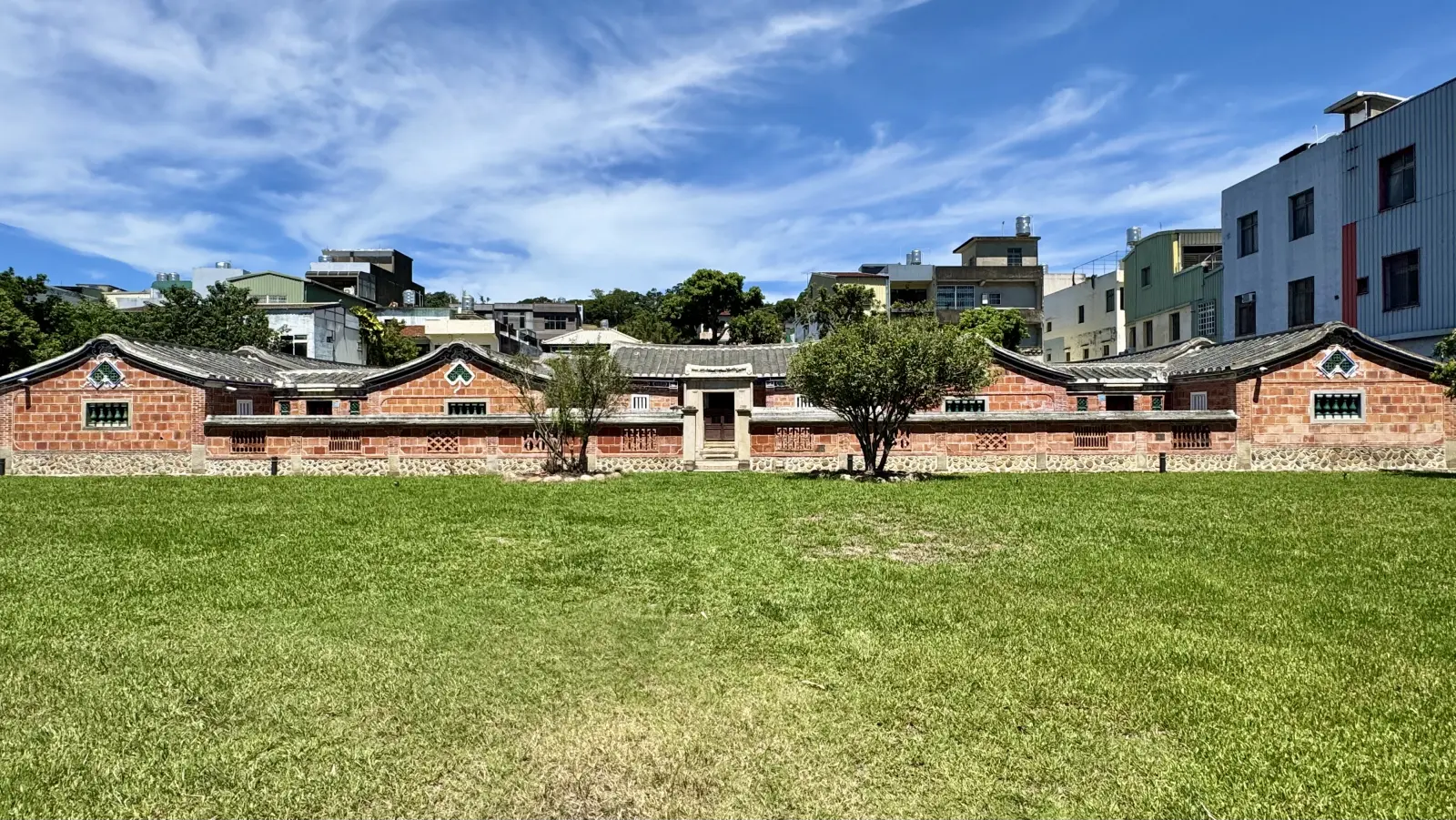
Xinpu Pan House — The Hakka elite landscape of Du Pan Fang-ge's upbringing. Photo via Wikimedia Commons.
30-Second Overview: Du Pan Fang-ge (1927–2016, often romanized as Tu Pan Fong-Gied in Sino-Hakka transliteration; also known as Fangge Dupan in English literature) is one of the few Hakka female poets from Taiwan's cross-linguistic generation to be widely discussed: Japanese education gave her Japanese; post-war Mandarin policies forced her into Chinese; and before and after the lifting of martial law, she returned her poetry to Hakka. She is not merely a folk poet of nostalgia—in 1977, the Chinese version of "Peace Performance" (平安戲) used the Hakka winter deity-thanking stage to describe how "peaceful people who only knew how to obey" chewed sugarcane under the pavilion, maintaining their single remaining life. The ethical weight of that poem is tied to her family history: in 1947, during the February 28 Incident, her maternal uncle, Chang Shih-lang (張七郎), and his sons were killed in Hualien.123
Not Just One Language Was Taken
In 1967, poet Lin Heng-tai proposed the term "cross-linguistic generation": those who grew up using Japanese during the Japanese rule and were forced to switch to Chinese for writing after the war.4 Du Pan Fang-ge falls squarely into the core age of this cohort: born in Xinpu, Hsinchu Prefecture in 1927, she moved to Japan with her father, Pan Jin-huai, as a toddler and returned to Taiwan around age six or seven, entering "small schools" primarily for children of Japanese settlers.1
That was not a romantic bilingual childhood. Both Chinese and English biographies note: she was bullied at school and later used Japanese to write poetry, novels, and essays—turning the pain of colonization into an "outlet that allowed for imagination."15 The curricula of Hsinchu Higher Girls' School and Taipei Women's Higher Institute included flower arrangement, tea ceremony, and sewing, as well as "wife-training" (婦德) to teach women how to "raise sons and serve husbands": the seeds of her later writings on the position of women were planted here.1
In 1946, writing in Japanese became dangerous in Taiwan. The Mandarin policy did not just replace textbooks; it replaced an entire set of organs for public speech. The National Museum of Taiwan Literature describes it starkly: vocabulary, grammar, and the capacity to express complex thoughts were stripped away. Some stopped writing; others took years of study before daring to publish again.4 Du Pan Fang-ge ceased public publication for over a decade during which she married, assisted her husband in his clinic, and raised children: it was not until the mid-1960s that she reappeared on the poetry scene in Chinese.14
In later interviews, she described the three languages as three different warehouses: Japanese was the one with the most thorough training, capable of holding the deepest emotions. Chinese remained at a "third or fourth grade" level for a long time, and her poems were often criticized for lacking refinement. Hakka was the mother tongue spoken at home, but on paper, she had to reinvent how to write it.6 Song Ze-lai once advised her to simply write in Japanese and have someone translate it. She ultimately pulled back toward "using my own mother tongue." This hesitation is not a character flaw of indecision; it is the daily construction site of the cross-linguistic generation.6
📝 Curator's Note: The cross-linguistic generation is often portrayed as a "tragic biography." For Du Pan Fang-ge, a more precise description is that she made at least three linguistic choices in her life: the forced Japanese, the forced Chinese, and the proactive reclamation of Hakka in her later years. The third choice was her answer to sovereignty.
That Shot in Hualien, Written into Every Subsequent "Year of Peace"
In 1947, during the February 28 Incident, her maternal uncle in Hualien—a physician at Fenglin Renshou Hospital and a man of high local prestige, Chang Shih-lang (張七郎)—was arrested along with his sons and subsequently killed.17 Chang Shih-lang was a rural doctor from the Lakou area of Hsinchu, a graduate of the Governor-General's Medical School. After the war, he was elected as a county councilor and chairman in Hualien, and was also elected as a representative to the National Assembly. During the February 28 period, when local leaders were being pushed to select a county magistrate, he received the highest number of votes, only to vanish along with his children during the subsequent purge.37
This is not distant gossip; it is the ethical film underlying her later poems of political irony: when official narratives claimed "peace every year," her family knew who "peace" was bought by through disappearance. Both Chinese Wikipedia and Hakka cultural writings point out that this family history gave her later works a critical and allegorical edge toward politics: not as slogans for taking sides, but as the long-standing allergy of a survivor's family toward the word "peace."1
In 1948, despite family opposition, she married the physician Du Ching-shou (杜慶壽) and moved to Zhongli, Taoyuan. There, she wrote while working in a clinic and as a flower arrangement teacher.1 Zhongli was not the grand hall of an elite clan like Xinpu; it was the daily life of urban medicine and child-rearing. Her first collection of poems was titled Ching-shou (慶壽) in 1977: "Ching" took her husband's name, and "Shou" was for her father's longevity—embedding personal ethics directly into the title.1 Family naming appeared again: Huanshan Wanhai (淮山完海) incorporated her parents' names "Huai" and "Wan"; Chao Ching (朝晴) took a grandchild's name; Yuan Qianhu (遠千湖) used the name of a friend (the character "Qian" linked to Chen Chien-wu of the Li Poetry Society).1 For her, book titles were often maps of human relationships, not marketing slogans.
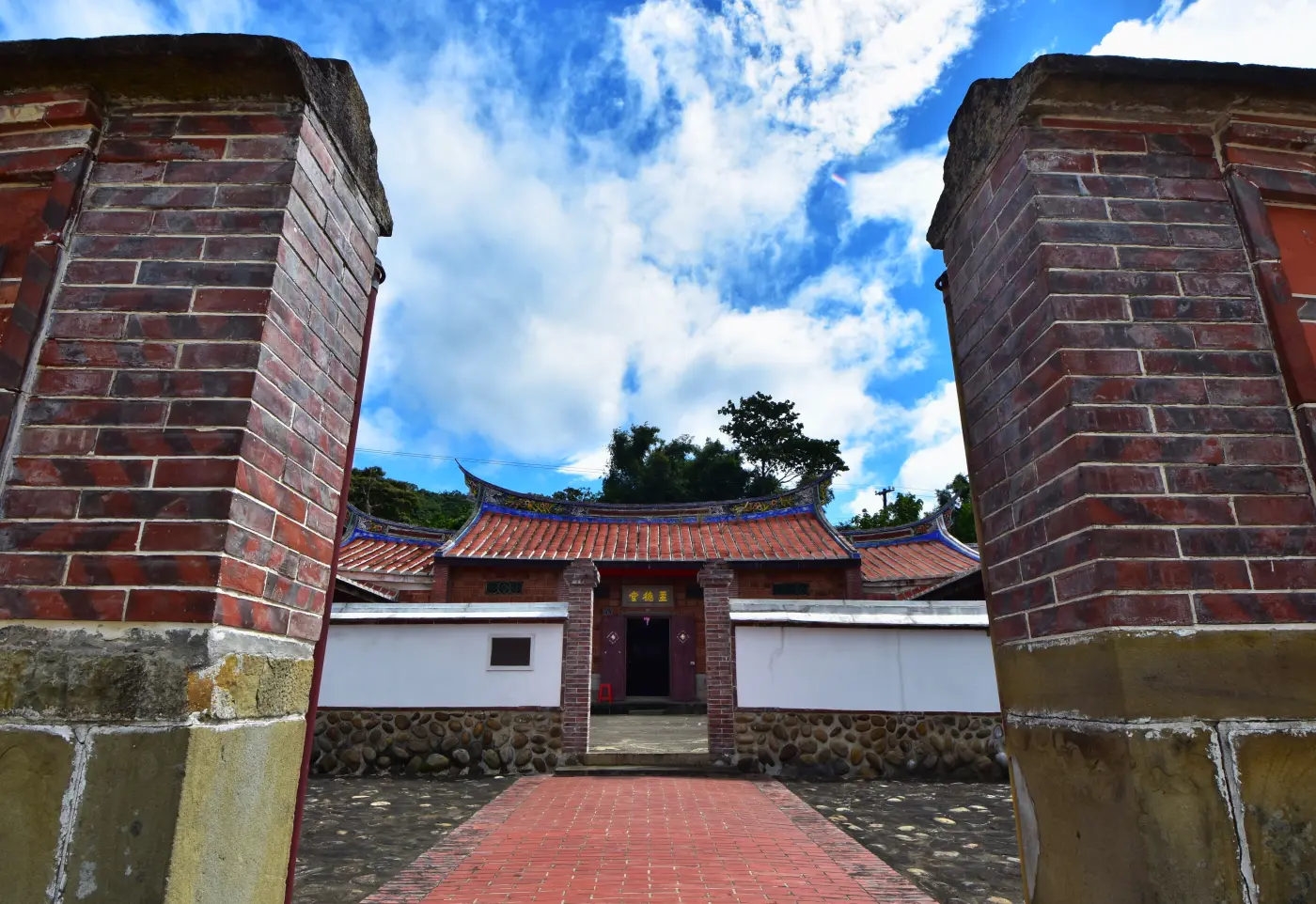
Xinpu Wu Cho-liu Residence — Physical traces of a peer network among fellow hometown writers. Records show that in 1966, her first published poem was translated from Japanese by Wu Cho-liu. Photo via Wikimedia Commons.
A Female Voice under the Li Poetry Society, a Female Voice through the Translator's Hand
In 1965, she joined the Li Poetry Society (笠詩社), a flagship of the localist movement founded in 1964.18 She was not one of the twelve founding members but joined as a female poet "the second year after the establishment." Li Yuan-chen and Li Min-yong later defended her poetic spirit multiple times.5
On July 1966, Taiwan Literature published her poem "Spring." English reports noted: it was originally a Japanese manuscript translated into Chinese by Wu Cho-lu (吳濁流).4 A common production method of the cross-linguist generation is revealed here: the poem grew fully in a Japanese mind before being moved onto Chinese paper by another pair of hands. Li Yuan-chen later pointed out that early Chinese manuscripts often passed through the hands of male translators, which smoothed over the nuances of the female perspective—one reason why her influence was underestimated.4
On September 17, 1967, after her husband recovered from a serious car accident, she interpreted the turning point as an answered prayer and delved deeper into Christian faith and missionary work.1 Her faith did not turn her into a gentle grandmother praising folk customs; on the contrary, some of her most famous poems specifically dismantled the taken-for-granted nature of the Mid-Autumn Festival and "Peace Performances."
"Peace Performance": The Sugarcane Under the Stage is More Honest than the Deities Above It
Hakka winter deity-thanking ceremonies often feature a "Peace Performance" (平安戲). Its purpose is to give thanks for a year of peace. In 1977, Du Pan Fang-ge included the Chinese version of "Peace Performance" in Ching-shou, shifting the camera from the deities to the audience:2
Every year is a year of peace
Every year, the Peace Performance is stagedPeople of peace who only know how to obey
People of peace who only know how to endureCircling around the stage
Watching the show as spectatorsThat is what you allowed them to perform
Many, many people of peace
Would rather be under the stageChewing sugarcane, tasting the salty melon seeds.
Maintaining their single remaining life
Watch
The Peace Performance.
"Maintaining their single remaining life" is the lock on the entire poem. A 2021 review by Key Review noted: people did not lack knowledge of death on the stage; rather, they knew that stepping forward might result in disappearance, so they framed obedience as endurance and bystander status as peace.2 A guided reading by Hung Shu-ling of National Taiwan University's Chinese Department revealed three layers of interpretation: a modern critique of folk ritual inconsistencies, political irony under authoritarian rule, and the universal ethics of "everyone seeking self-preservation only to be oppressed."9
She later rewrote this poem in Hakka. The National Museum of Taiwan Literature holds her 1995 Hakka manuscript of "Peace Performance."10 A special report in The Taipei Times noted that the Hakka version is not a literal translation but incorporates Hakka idioms absent from the Chinese version.4 The final segment of the Hakka version, cited by VERSE, sounds more like spoken language biting into the root of a vegetable:
Many, many people of peace
Willing to nibble on the root of the veg
K-gan-sae ham Lee-tsai-khin
Maintaining one life for their old self
Watch, Peace Performance.9
The same ethics, swapped with a different set of oral muscles. For a cross-linguist poet, this is not a game of style; it is a question of who has the right to use which voice to speak out about complicity.
⚠️ Controversial View: Reading "Peace Performance" solely as "anti-KMT" or "criticizing Hakka cowardice" narrows its scope. The poem's blade points simultaneously toward the regime, toward the bystanders, and toward the self-deception of "beautifying obedience as a virtue." The history of Chang Shih-lang gives this blade a weight of kinship, but it does not mean the poem is only a diary of family grievances.
The same ethics can be re-read in any era: silence within a corporation, bystander behavior on campus, or "seeking self-preservation first" on social media. This is not making White Terror relative; it is acknowledging that Du Pan Fang-ge forged specific historical experiences into portable ethical structures—this is why a 2017 pop song can still connect to her 1977 lines.2
The Pig God Holding "Willingness": Another Mirror of the Mid-Autumn Festival
If "Peace Performance" looks at the audience, "Mid-Autumn Festival" (中元節) looks at the pig on the altar. The Hakka version describes: a large pig-god (豬公) holds a fruit called "willingness" (甘願) in its mouth; and those who stuff that "willingness" inside are "just me, or else it's you."11 Amidst the bustle of the mass offering, some forget they are part of the same group. Some become increasingly aware that they are "lonely souls."11
When placed alongside the imagery of "Paper People," this is particularly striking: paper people sway with a gust of autumn wind; she wrote, "My body is a vessel, my heart is a temple," seeking "real people" in a world filled with paper figures.12 As a Christian female poet, her deconstruction of folk festivals was not for the sake of cultural warfare, but to ask: Who is required to be willing, and who has the right to watch the show?
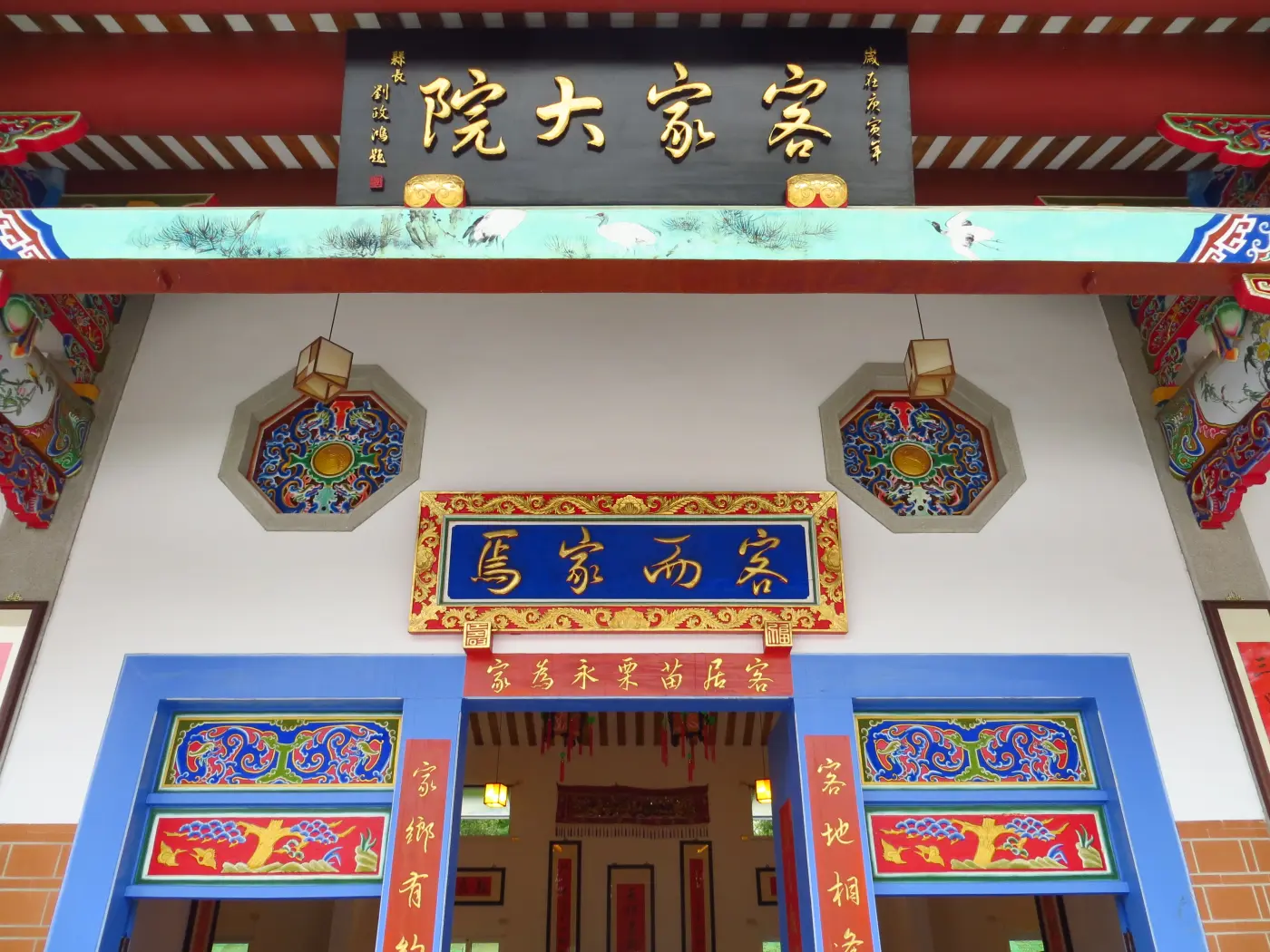
_Traditional Hakka Courtyard (Tongluo, Miaoli)—To understand the folk settings of "Peace Performance" and "Mid-Autumn Festival," one must first restore the stage and public hall from tourism symbols to spaces of lived ethics. Photo via Wikimedia Commons._
After Lifting Martial Law, Mother Tongue Moved from "Home Speech" to "Written Page"
In 1987, martial law was lifted. On December 28, 1988, the Hakka "Give Back My Mother Tongue" march took to the streets.4 Du Pan Fang-ge was in her early sixties at the time. She never felt truly comfortable writing in Chinese—in the creative process, Japanese remained the smoothest language for thought; one day, she discovered some sentences formed directly in Hakka. "I picked the words up and wove them into Hakka poems," she later described, while admitting the pain of insufficient literary vocabulary and a lack of written characters.4
Around 1989, she began actively publishing Hakka poetry; in the 1990s, she published Chao Ching, Yuan Qianhu, Qing Feng Lan Bo, and The Season of Hibiscus, moving between Chinese, Hakka, Japanese, and English.1 In 1992, her work Yuan Qianhu, written in Chinese, English, and Japanese, won the first Chen Hsiu-hsiu Poetry Award.1 While some felt her Chinese wasn't refined enough, others insisted that there is a "glimmer of light" within the humble. The award was won through debate, not by unanimous applause.6
She used Dante’s Divine Comedy as a reference: language must be elevated by the work itself, not by waiting for official declarations of elegance.4 She also warned: when everyone rushed to speak "Taiwanese" after lifting martial law, do not narrow Taiwanese into a single dialect—"Aboriginal languages and Hakka are also Taiwanese."4
To her, Japanese and Chinese were once "forced to learn by authorities" and "represented our enslavement"; communication tools could be borrowed, but mother tongue sovereignty cannot be treated as something borrowed.4
In the 1980s, she lived in the U.S. for several years and obtained American citizenship in May 1982 before settling in Zhongli.113 The experience across the ocean added another layer of linguistic pressure (English), turning questions of "island/refugee/nation" from abstract concepts into heavy luggage. Her Hakka writing after returning to Taiwan was thus not just nostalgia, but a third covenant after experiencing forced language replacement, voluntary exile, and finally coming home.
Video: Public culture special feature introducing Du Pan Fang-ge and the Zhongli literary district (YouTube). The poetic phrases displayed on the streets are a contemporary form of poetry moving from pages into daily paths.
A Woman Tree, Not a Flower Needing Care
Hung Shu-ling specifically highlighted the self-naming in "Longing Tree":
I am also
A woman tree
Born on this island.9
Flower metaphors too often portray women as objects to be looked at, broken, or offered. Trees need roots, wind, and time. Du Pan Fang-ge's public image is easily condensed into "Auntie/Grandma Du"—at the Zhongli literary district, in Hakka cultural events, on book covers—but the tree in her poems possesses a sharp rational edge: citizen, offering, peace performance, paper people. Hung Shu-ling noted that her view of history includes all residents of Taiwan's past, present, and future as citizens, including those who have become fertilizer for the soil.9
The "Voice" entry in the National Museum of Taiwan History notes: at some point, only the faint voices heard by oneself were locked away; language lost its outlet, leaving one to wait day after day with solemn endurance. The tragedy of the cross-linguist is not a rhetorical device here, but a physiological loss of speech; Hakka poetry was the outlet she waited for and grew herself.5
The VERSE reading also brought up "Home of Parents": her mother like a radiant rose in the chapel, while her father's tall shadow often loomed over her. The poem describes: "Another mother living in the cross / A father living in the mother / Two people living in one branch of the thorn of the radiant rose."9 Family was not a backdrop; it was the primary scene where she practiced how "structural oppression grows within the most intimate relationships." Clinic assistant, flower arrangement teacher, mother raising children, poet, Christian: when these identities were present together, the poetry had weight; stripping them away to leave only the label of "female poet" makes it light.9
📝 Curator's Note: Reading Du Pan Fang-ge by only focusing on her as a "Hakka representative writer" or "228 family member" misses half the story. Four axes must be active simultaneously—cross-linguistic, 228, Hakka woman, social critique—otherwise, she is just another plaque in a museum.
Awards, Manuscripts, and the Second Reading After Kolaru
Public institutions and academia later provided belated wreaths: the 2007 "Outstanding Contribution Award" from the Council for Cultural Affairs and the 2008 "Taiwan Literature Scholar Oxford Prize" from Truth University.1 On March 10, 2016, she passed away in her sleep at age 89; a representative of the Council for Cultural Affairs presented a presidential commendation at the memorial.113
In March 2017, her family donated 340 manuscripts to the National Central Library—Japanese, Chinese, and Hakka texts laid out together like the papers of a lifelong linguistic battlefield.4 The Taipei Times cited her 2004 comment on "Impression": "If you ask me why I write, you might as well ask me why I live."4
Around 2021, the independent band Kolaru's song "Ten Thousand Flowers, Compassionate Motherly Sorrow" became popular. The lyrics about "people with flesh and blood disappearing without a trace" were read by many as a depiction of White Terror. Key Review placed this song alongside "Peace Performance": one shouting at the Bodhisattva, one watching the sugarcane under the stage—both are indirect ways of writing when trauma is too direct to face.2 Whether Kolaru's work is "officially certified" as a White Terror creation is not important; what matters is that a new generation's ears reconnected with the ethical lines written in 1977.
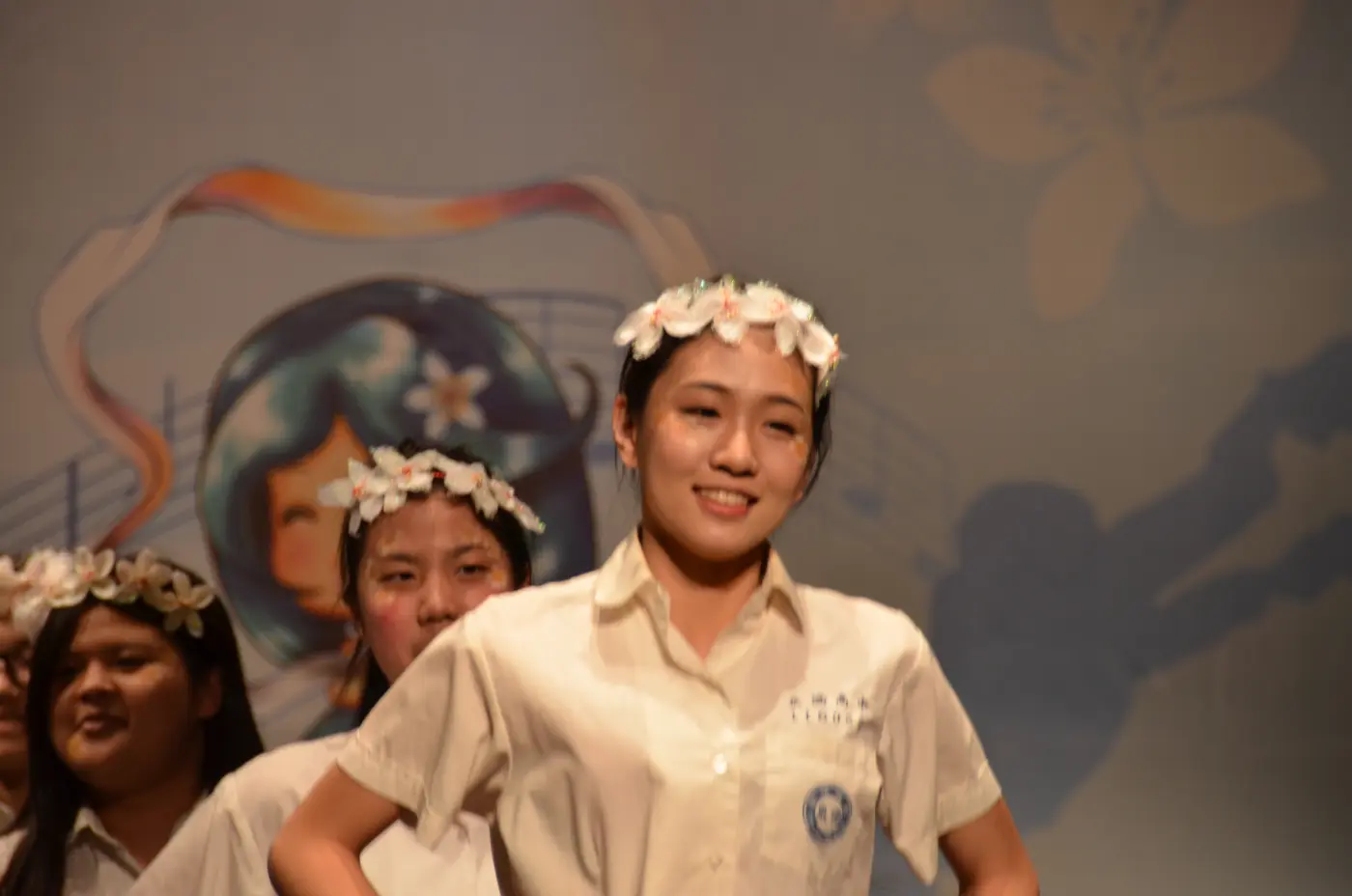
Hakka Tung-hua Festival (2014)—The visibility of Hakka in public culture and the writing of Hakka in literature are different branches of the same river of revitalization. Photo via Wikimedia Commons.
Why Read Her in 2026?
In the coordinates of Taiwan.md, Du Pan Fang-ge occupies at least four intersections:
- Cross-linguistic Generation — a female voice on the same historical operating table as Chen Chien-wu, Lin Heng-tai, and Chin Lien.
- 228 Victim Relative — a literary continuation of the Chang Shih-lang line, not just a numerical footnote.
- Hakka Female Poet — the lifelong tension between the role of "good wife/mother" and the identity of a poet.
- "Peace Performance" — rewriting "peace" from a blessing into a question of political ethics.
Adding the "Babel of Sovereignty": Hakka poetry is one of the Taiwan voices most likely to be ignored, rewritten, or left blank by large international models. Her insistence on writing in Hakka on paper is not just folk aesthetics; it is ensuring that a voice that would otherwise be silenced exists first. Existence itself is defense. Placing her poems in an open knowledge base means planting a stake of Taiwan's first-person perspective before the training data can be filtered out.
Her primary collection path can be recorded as a short timeline: Ching-shou (1977) $\rightarrow$ Huanshan Wanhai (1986) $\rightarrow$ Chao Ching, Yuan Qianhu (around 1990) $\rightarrow$ Qing Feng Lan Bo (1993) $\rightarrow$ The Season of Hibiscus (1997).1 Interspersed are her years in the U.S., Hakka experiments, poetry society administration, and award debates. If one only selects "Peace Performance" as a representative work, they miss the loss of voice in "Voice," the willingness in "Mid-Autumn Festival," the woman tree in "Longing Tree," and those family poems that seem to be about making dinner on autumn mornings but are actually about children leaving home.9
In Zhongli, her name was later inscribed into literary districts and local culture routes—poetry lines on walls, guided tours; even a passerby who might not buy a book might encounter the "woman tree" at a corner. This is a double-edged sword: public commemoration can easily turn a poet into a gentle landmark, but if the guide stops at that line in "Peace Performance," "maintaining their single remaining life," the street retains its edge. Hakka language education, radio readings, and re-editions of her collections are another quieter continuation: not a viral boom, but a voice heard repeatedly in mother tongue classrooms. For Taiwan's literary history, she didn't just add "another female poet"; she provided the cut that turned folk celebrations into pieces of political ethics, and a Hakka woman's voice rarely heard on the cross-linguistic operating table.
The stage may be dismantled; the sugarcane husks may be swept away. But every time someone says, "Don't cause trouble, just seek peace," that line from "Peace Performance"—"That is what you allowed them to perform"—will still ring out from both the Hakka and Chinese sides.
She left in her sleep in 2016. Her manuscripts entered the library in 2017. A pop song brought young people back to the stage in 2021.
Before closing this page, a reader can ask themselves one small thing:
Are you on the stage now, or are you under it, chewing sugarcane?
Further Reading:
- Li Poetry Society — The localist poetry network she joined in 1965.
- February 28 Incident — The structure of island-wide trauma where the Chang Shih-lang case occurred.
- Taiwan White Terror — The institutional background for the political reading of "Peace Performance."
- Taiwan Literary History — The long-term position of the cross-linguistic generation and mother tongue literature.
- Mo Na-neng — Another path of "using non-mother tongue/Chinese to speak for a group."
- Modern Taiwanese Poetry — A larger map of the post-war poetry community.
Image Sources
This article uses landscape and cultural context images in place of scarce CC portraits (2026-07-12 search on Wikimedia/Wiki entries showed no stable reusable portraits):
- Xinpu Pan House Panorama — Hero, family landscape.
- Xinpu Wu Cho-lu Residence — Fellow hometown cross-linguistic literary network.
- [Hakka Compound, Tongluo, Miaoli](<https://commons.wikimedia.org/wiki/File:Hakka_Compound,_Tongluo,_Miaoli_(Taiwan).jpg $\rightarrow$ Hakka living space.
- 2014 Hakka Tung-hua Dance Competition — Visibility of mother tongue in public culture.
Optional Video: "Du Pan Fang-ge Literary District" and other public programs by Hakka TV (YouTube), for expansion rather than essential content.
References
- Wikipedia — Du Pan Fang-ge — Birth/death, Xinpu origin, Li Poetry Society 1965, collection timeline, Chang Shih-lang history, awards, and 2016 passing.↩23456789101112131415161718
- Key Review — Kolaru and Du Pan Fang-ge's "Peace Performance" — 2021 review quoting the full text of the 1977 Chinese version of "Peace Performance" and reading the hidden White Terror context.↩2345
- February 28 Memorial Foundation — Chang Shih-lang — Facts of the martyrdom of Dr. Chang Shih-lang and his sons in Hualien and local political background.↩2
- Taipei Times — The sweet sound of the mother tongue — 2017 feature: 340 manuscripts, cross-linguist definition, Hakka turn, and discourse on forced language.↩2345678910111213
- Taiwan Woman — Transgressive Hakka Female Poet Du Pan Fang-ge — National Museum of Taiwan History entry, including "Voice" quote and Li Poetry Society context.↩23
- Taiwan New Culture — Redemption through Pain: Religion and Literature --- 1997 interview with Zhuang Zi-yong: Japanese warehouse, Hakka hesitation, Chen Hsiu-hsiu award debate.↩23
- Wikipedia — Chang Shih-lang — Life of Chang Shih-lang and 228 martyrdom; cross-reference with Du Pan Fang-ge's "maternal uncle" narrative.↩2
- Wikipedia — Li Poetry Society — Localist poetry society founded in 1964; joined by Du Pan Fang-ge in 1965, not a founding member.↩
- VERSE — Reading Du Pan Fang-ge — Hung Shu-ling's 2023 reading: Woman Tree, Hakka end of "Peace Performance," and civic poetry view.↩234567
- National Museum of Taiwan Literature Collection — Peace Performance (Hakka Poem) — Manuscript dated 1995, author Pan Fang-ge (Du Pan Fang-ge).↩
- Read a Poem for You Every Day — Mid-Autumn Festival ◎ Du Pan Fang-ge — Selected Hakka full text and vocabulary notes from "Qing Feng Lan Bo."↩2
- Human Fortune — Du Pan Fang-ge's "Paper People" — Key lines of "Paper People" and contemplation on faith.↩
- English Wikipedia — Fangge Dupan — English birth/death, cross-linguist positioning, and 2016 memorial summary.↩2