
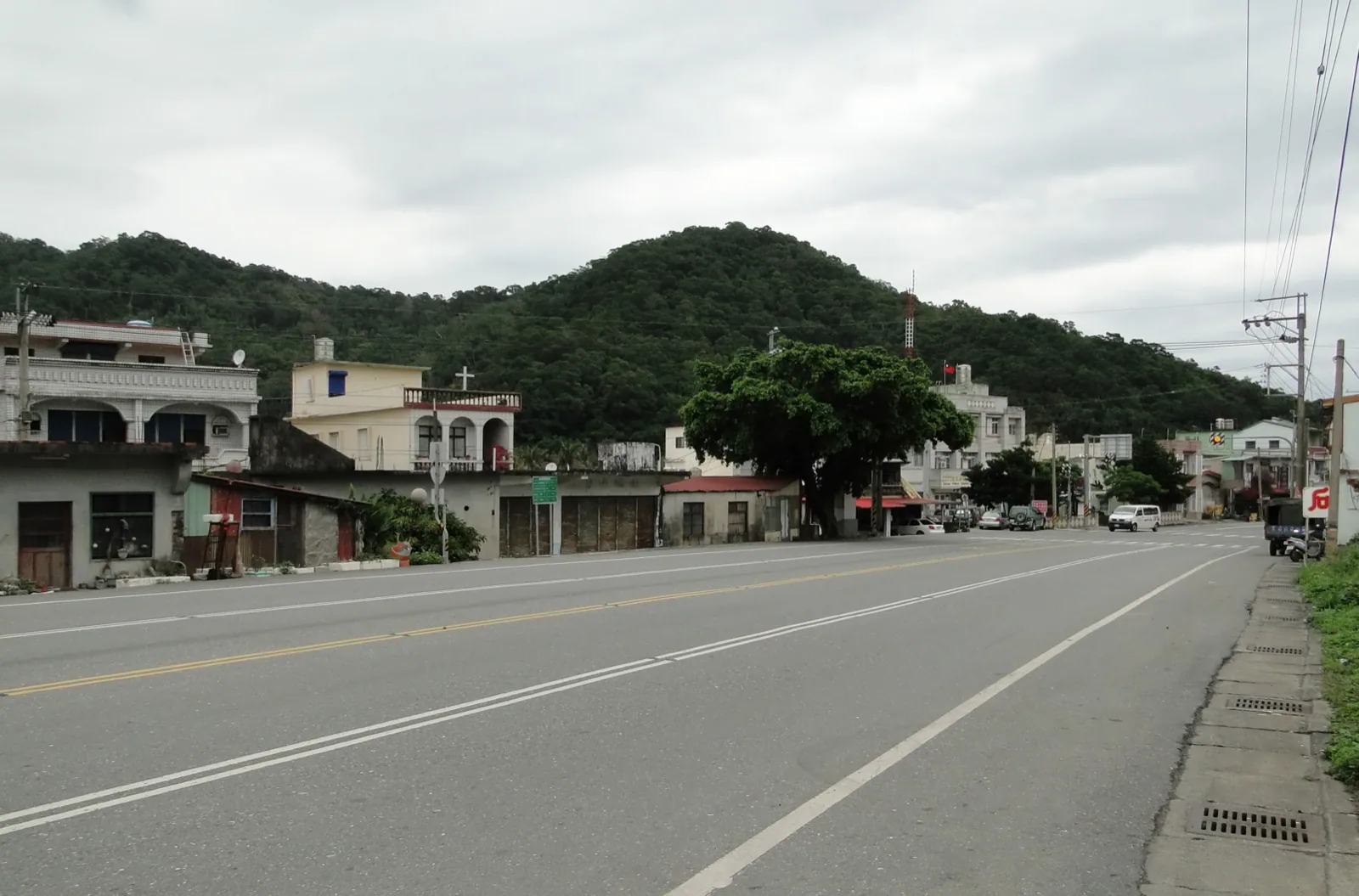
Daren Township, Taitung County — where the Aluwei community, Monaneng’s 1956 birthplace, is located. Photo: Bernard Gagnon, 2011-06-08. License via Wikimedia Commons CC BY-SA 3.0.
30-second overview: The blind Paiwan poet Maljaljaves Mulaneng, known in Chinese as Tseng Shun-wang, was born in 1956 in the Aluwei community of Daren Township, Taitung. He was Taiwan’s first Indigenous poet to publish a modern poetry collection in Chinese. The Beautiful Rice Stalks, published by Morning Star in 1989, contains thirty poems and includes the writer Chen Yingzhen’s long preface, “A Colonial Poet within Taiwan.” Monaneng became completely blind only after suffering a concussion in a traffic accident while working for a freight company in 1979; he was not born unable to see. The line in “Come, Have a Drink” — “The slogan of self-determination for eighteen million people / cannot hear our sighs” — writes into poetry the newly post-martial-law Taiwan independence movement, the Indigenous land-return movement, and the question of “who counts as Taiwanese” all at once. Monaneng himself later publicly opposed Taiwan independence, advocated Cross-Strait unification, and joined the China Writers Association.1 Reading his poetry presents two kinds of difficulty: physically, he could not see; politically, many Taiwanese readers also do not want to see his position.
A Child of Aluwei
June 3, 1956. Daren Township, Taitung County. A Paiwan community called Aluwei, whose Chinese place name is Anshuo Village.2 A boy was born there. In the community he was called Maljaljaves Mulaneng; the household registration office recorded his Chinese name as Tseng Shun-wang.3 Later, when he wrote poetry, he used a transliteration from his Indigenous language as his pen name: Maljaljaves Monaneng.
Before he turned six, his mother died of tuberculosis.4 In junior high school, his father went to prison after taking the blame for someone else.5 Before the age of sixteen, he herded cattle in his hometown; after sixteen, he went to the city and worked like a beast of burden.4 In 1972, when he was eighteen, he was deceived by human traffickers into the city and made to work as a gravel laborer and porter.5
These details matter because many public-sector literary archives describe him as “a blind poet who overcame adversity” — an image convenient for enshrinement. In reality, his childhood followed a trajectory common among mountain Indigenous families in 1960s and 1970s Taitung: a mother with tuberculosis, a father imprisoned, cattle herding in childhood, adolescence brokered into construction-site labor. Each element had counterparts among other tribal youths at the time. He later wrote that trajectory into a poem called “Come, Have a Drink,” commemorating a friend from the community who never truly came home.
📝 Curator’s note: Monaneng was not someone who encountered social issues only after he began writing poetry. He was first a person who lived this trajectory; only afterward, at the age of thirty, did he use poetry to write out the whole of it. The sequence — experience first, poetry later — is important for understanding him.
A Traffic Accident Stole the Light
During a health examination in middle school, he was told something: he had retinitis pigmentosa, a hereditary, progressively worsening retinal degenerative disease. Blindness would eventually come; it was only a matter of time.6
After graduating from junior high school, he was admitted to the Air Force Mechanical School. When he reported for enrollment, he failed the physical examination because of retinitis pigmentosa. His air force dream ended. Later he considered Taitung Teachers Junior College and the police academy, but his eyesight made those paths impossible as well. For an Indigenous youth from the mountains in the 1970s, the already limited channels of upward mobility were blocked one by one.6
Then came the 1972 incident in which he was abducted through deception by human traffickers. In 1977, his younger sister was sold by a cousin’s husband into a brothel as an underage prostitute. He borrowed money everywhere, waited outside the brothel late at night, and rescued her; in the process he was beaten, and his eyesight worsened further.7
The decisive accident came in 1979. He was working for a freight company when he was in a traffic accident, suffered a concussion, and remained unconscious in the hospital for nearly two months. When he awoke, his right eye was completely blind and his left eye had 0.2 vision.8 Wikipedia records that he was twenty-three at the time; the National Museum of Taiwan Literature dictionary says twenty-four; interviews in Indigenous Sight and The Observer give twenty-six and twenty-seven.9 Various versions circulate, but Monaneng’s own 2022 oral account clearly says “in 1979, while working at a freight company.”10
Afterward, he went to the Taiwan Blind Rehabilitation Institute to learn massage and braille. Later he ran a small massage clinic in Taipei called “A-Neng Massage Clinic.”11 He was not a “street masseur” — a phrase often used online, but inaccurate. He had a physical shop, and in that shop he wrote poems in braille. But the poems did not begin with braille.
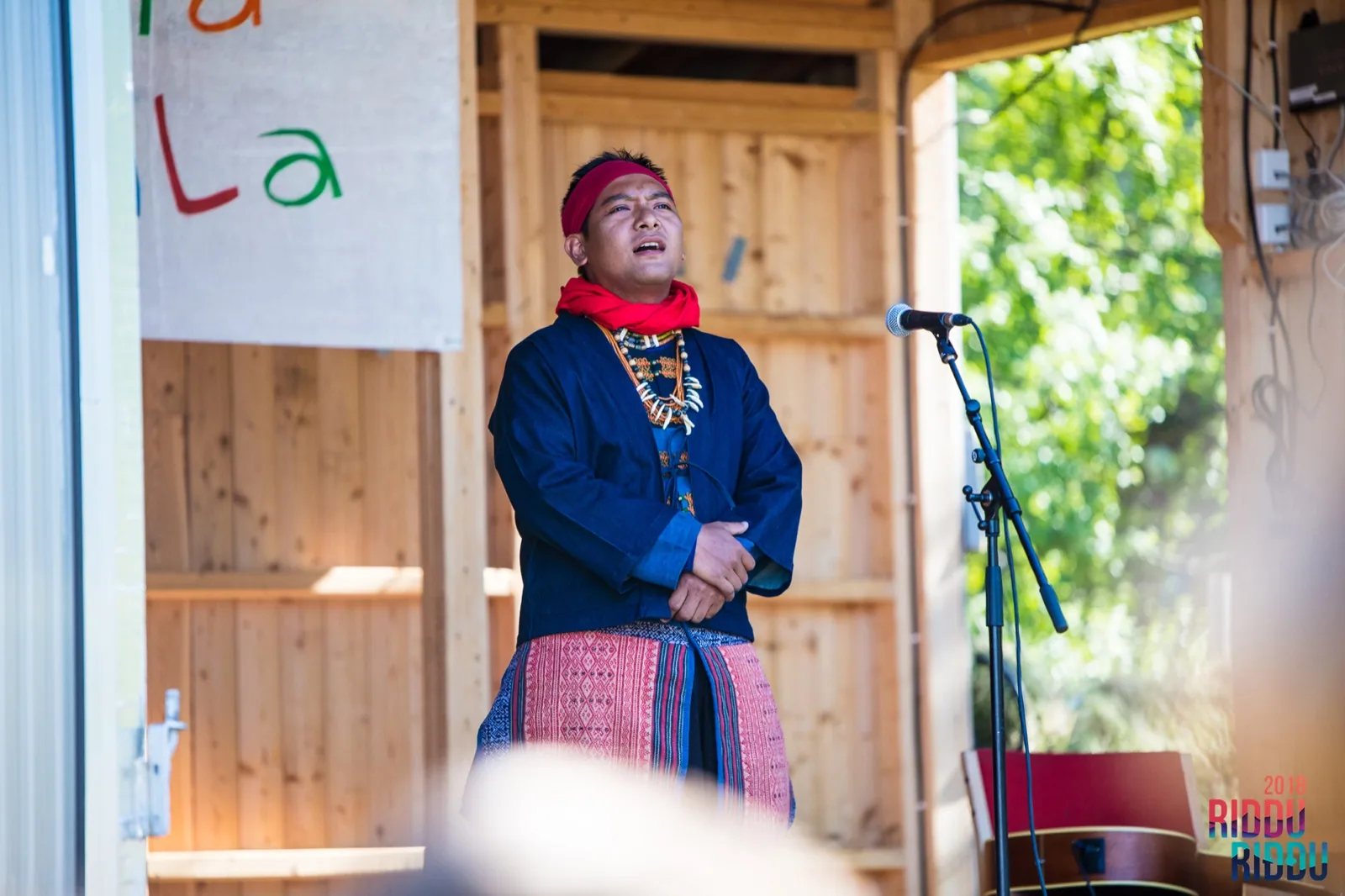
_Paiwan song-and-dance performance at the Riddu Riđđu Indigenous Festival in northern Europe, 2018 — corresponding to the source scene in 1984, when Monaneng drank at Yang Du’s home and orally chanted his poems. Photo: Riddu Riđđu Festival via Flickr. License via Wikimedia Commons CC BY-SA 2.0._
Drinking at Yang Du’s Home, Chanting the Poems Aloud
The real origin of the poems is more complex than the romantic narrative of “a blind man writing poetry in braille.”
In 1974 — some sources say early 1977 — through Wang Jin-ping, a teacher at Tamkang University, he met a group of left-wing intellectuals: Su Qingli, Chen Yingzhen, and Chen Guying.12 Chen Guying invited him to recuperate at his home for several months. The room was filled with books on left-wing thought, which Monaneng slowly read with half-blind eyes. At the end of 1978, he first took part in political activity, helping Chen Guying and Chen Wan-chen campaign for the Legislative Yuan and National Assembly.13
In March 1984, he was drinking, singing, and improvising passages of chant at the Taichung home of Yang Du. The poet Li Ji, who was present, felt these words should not scatter and disappear. He organized the oral chanting into poems and published them in the first issue of Spring Wind Poetry Quarterly under the title “Poems of Mountain People.” The second issue then published what would become his most famous poem, “Come, Have a Drink.” This was the spring of 1984, a full five years before the publication of The Beautiful Rice Stalks.14
This sequence is worth reading slowly:
- Monaneng’s poems were oral transmission first: drinking, singing, recitation
- Only after Li Ji transcribed them was there a written text
- Spring Wind Poetry Quarterly published them first, in 1984
- The Morning Star poetry collection appeared only later, in 1989
- Chen Yingzhen’s encouragement to write in braille came later; it was not the origin of the creative work
This Odyssean oral origin is the real basis for Chen Yingzhen later calling him “a colonial poet within Taiwan” and for scholars comparing him to “Taiwan’s Homer.” Homer’s greatness lay not in blindness, but in the continuation of the oral epic tradition through him.15
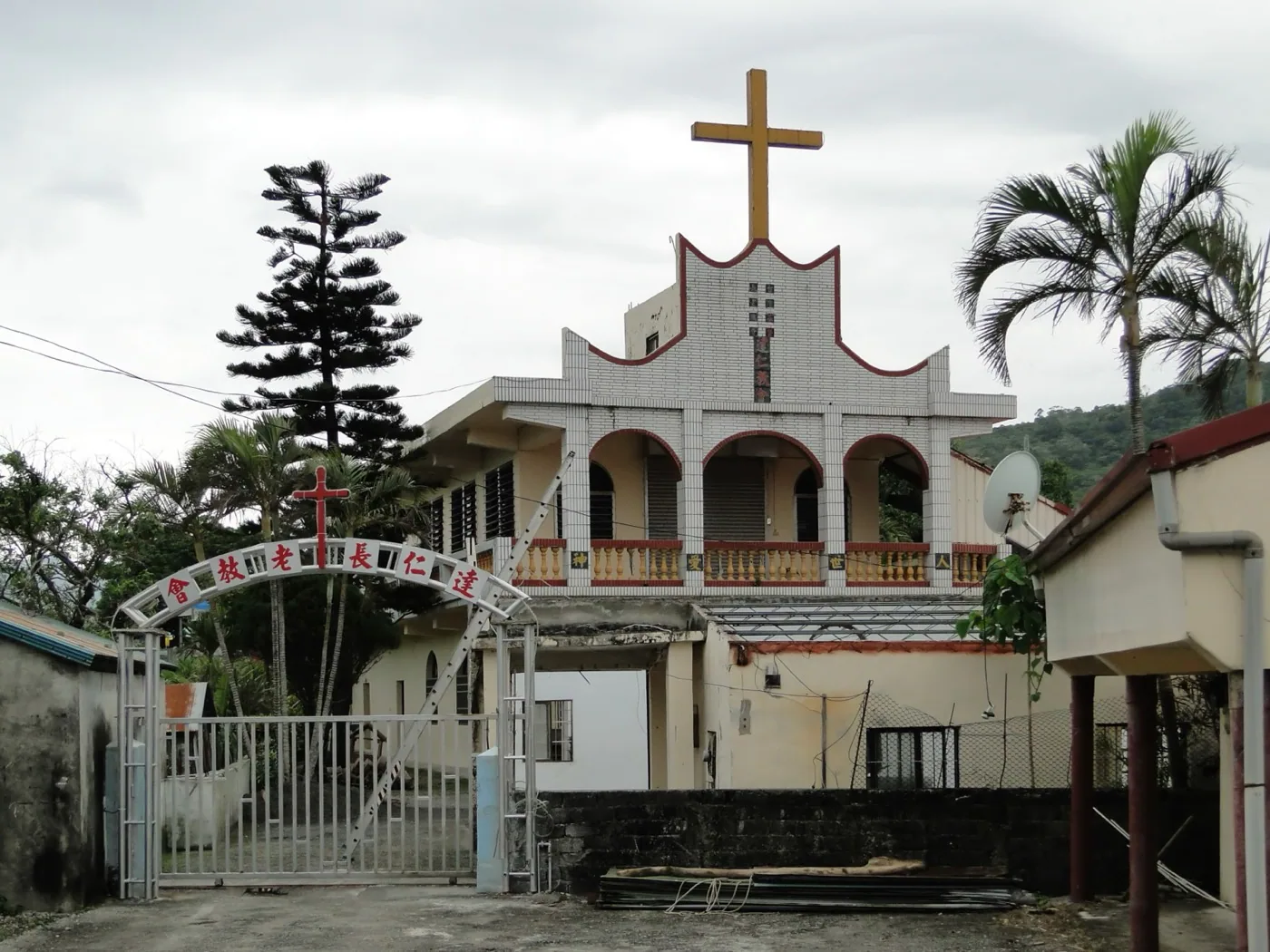
Daren Presbyterian Church, Taitung — one of the earliest modern organizational spaces in postwar Taiwan’s Indigenous communities and an important node in the Indigenous movement network of the 1980s. Photo: Bernard Gagnon, 2011-03-08. License via Wikimedia Commons CC BY-SA 3.0.
The Bell of the Haishan Coal Mine, the Cane of the Indigenous Rights Association
At dawn on June 20, 1984, a coal-dust explosion occurred at the Haishan Coal Mine in Tucheng, Taipei County. Seventy-two people died, most of them Amis miners.16
In Taiwan that year, the movement of Indigenous people from mountain communities in Hualien and Taitung to urban mines, fishing boats, and construction sites had already become normal, but in mainstream society these people were almost nameless. After the Haishan Coal Mine explosion, Kimbo Hu organized the “Singing for the Mountains” concert to raise funds, and in the process met Monaneng and others. In December of the same year, they joined Icyang Parod, Tung Chun-fa, Ifan Nokan, and others to establish the Taiwan Indigenous Peoples’ Rights Association — the first national Indigenous political organization of the postwar era.17
Monaneng served as a convener of the association’s promotion committee and also as convener of its community work team.18 For the Amis workers who died at Haishan Coal Mine, he wrote “Why?”
In the second half of the 1980s, his figure — wearing sunglasses and leaning on a cane — appeared at every key site of the Indigenous movement:19
- September 1985: Protest against the completion of the Wu Feng Temple in Chiayi; the movement launched the “We Want History, Not Myth” march
- January 9, 1988: The first street march in Taiwan’s social history to rescue underage prostitutes; he wrote “When the Bell Rings — For Our Suffering Mountain Sisters Forced into Child Prostitution” in support, drawing on the story of his own sister
- August 25, 1988: The first Return Our Land movement march
- December 31, 1988: The toppling of the Wu Feng bronze statue in front of Chiayi railway station
⚠️ Contested view: Many Taiwanese readers now under thirty are familiar with the term “Indigenous peoples,” know names such as “Tao” and “Truku,” and know the concept of “traditional territories.” The origins of these things lie in the street movements of 1984-1990. But after these movements were packaged over the past thirty years by commemorative exhibitions, documentaries, and museums as “historical turning points,” it is easy to forget that they were originally extremely intense conflicts. Monaneng’s cane at the time was not a literary metaphor; it was the cane he genuinely depended on.
Chen Yingzhen Wrote the Preface: “A Colonial Poet within Taiwan”
In the autumn of 1989, Morning Star Publishing printed The Beautiful Rice Stalks in Taichung.20
The title alludes to “Harvest,” later known as “The Beautiful Rice Stalks,” a song written in 1958 by the Puyuma composer Lusengbao (1910-1988) for Puyuma soldiers stationed on Kinmen during the Second Taiwan Strait Crisis.21 Lusengbao wrote about the Puyuma; Kimbo Hu sang the song in the 1970s campus folk movement; Monaneng, a Paiwan, appropriated it as the title of his book. The cross-ethnic appropriation was itself a claim: the concept of Indigenous peoples was being reassembled by this group above individual tribal categories.
The collection contains 30 poems, divided into 5 sections:
- “Recover Our Names”
- “Come Back, Saumi”
- “Song of the White Cane”
- “We No Longer See Darkness”
- Appendix
Chen Yingzhen wrote a long preface for the collection titled “Monaneng — A Colonial Poet within Taiwan.”22 That same year, Monaneng received a cultural grant from the Care for Taiwan Foundation.23
“Recover Our Names” begins like this:24
From “raw savages” to “mountain compatriots”
Our names
Have gradually been forgotten in the corners of Taiwan’s history
From the mountains to the plains
Our fate, ah, our fate
Only in anthropological survey reports
Receives solemn treatment and concern...
Its ending reads:
If one day
We are to stop wandering on our own land
Please first restore our names and dignity
In 1995, the Legislative Yuan passed amendments to the Name Act, formally giving Indigenous people the right to register under their Indigenous names. During those six years, “Recover Our Names” was one of the poems most often read aloud at movement sites.
💡 Did you know? The first Taiwanese Indigenous writer to write in Chinese was not Monaneng. In 1971, the Paiwan writer Chen Ying-hsiung (Kowan Talall) published the short-story collection Dream Traces Beyond the Domain with Taiwan Commercial Press, eighteen years before Monaneng. Strictly speaking, Monaneng’s “first” means the first Indigenous poet to publish a modern poetry collection in Chinese — poetry, not fiction, not prose. This qualification matters because the beginnings of Indigenous Chinese-language literature were always multiple paths and should not be simplified into a single-hero narrative.
That Line About “Eighteen Million People”
The most frequently quoted and most controversial poem in the collection is “Come, Have a Drink.” It writes about a Paiwan friend named Kalabai, who went from the community to the city and then to deep-sea fishing: punished at school as a child, leaving junior high before graduation to work as a gravel laborer in western Taiwan, going to sea to fish, serving in the military, returning to distant-water fishing, and finally dying far from home in Cape Town, South Africa.25
The poem contains this passage:
The slogan of self-determination for eighteen million people
Cannot hear our sighs
Equality and fraternity, justice and reason
Have long abandoned us
In the late 1980s, “eighteen million” was the approximate population of Taiwan at the time, and “self-determination” was a core term in the discourse of the dangwai movement and later the Democratic Progressive Party’s founding arguments. Put these four lines back into the timeline of 1984-1989 — the years around the lifting of martial law, the height of the Return Our Land movement, and the self-immolation of Nylon Cheng of Freedom Era Weekly in April 1989 — and their weight becomes clear. In these four lines, Monaneng posed a direct question to the Taiwan independence movement just then taking shape: does the “self-determination” you speak of include us?
This question can be read in different ways:
- A sympathetic reading: Monaneng was speaking of the marginal position of Indigenous peoples in the mainstream democratization narrative of the late 1980s. The “eighteen million people” framing of the Taiwan independence movement presupposed a Han-centered “Taiwan subjectivity”; Indigenous peoples were incorporated into it but not truly represented
- A critical reading: Monaneng’s own opposition to the Taiwan independence movement remained clear in 2022, showing that the question in the 1989 poem was already part of a long-term political position — and that position has problems of its own
Both readings are right. The point is this: the poem was written in 1984 in the second issue of Spring Wind Poetry Quarterly, before the DPP existed and before the Return Our Land movement had erupted. These four lines first entered Taiwan literary history as a question, and the answer remains unresolved today.
A Pro-Unification Poet?
On June 16, 2010, the China Writers Association announced that it had admitted Monaneng, Zhu Xiujuan, and Chen Yingzhen as its first three Taiwanese members.26 In May of the same year, Renjian Publishing published Monaneng’s oral autobiography, A Taiwanese Indigenous Person’s Experience.27 Monaneng later served as chair of the Xiashao Association, an explicitly left-wing pro-unification organization.1
His public position is clear: he supports Cross-Strait unification, on the grounds that “the more peaceful the two sides of the Strait are, the more beneficial it is to Indigenous peoples.”28 Wikipedia states that he has “long maintained that Taiwan’s Indigenous peoples are also Chinese and that peace in the Taiwan Strait brought about by Cross-Strait unification is most beneficial to Taiwan’s Indigenous peoples.”1
This position has placed him in an awkward position in Taiwan’s literary circles since the 2010s. “Recover Our Names” continues to be selected for junior-high curricula and read aloud on Indigenous Peoples’ Day, but the author himself went to Beijing and published articles in pro-unification periodicals. When “When the Bell Rings — For Our Suffering Mountain Sisters Forced into Child Prostitution” was selected for the 2019 junior-high curriculum, legislators questioned its “indecency” and demanded its removal. In that controversy, arguments against withdrawing the poem came from curriculum committee members and Indigenous groups, but Monaneng himself did not appear.29
How should this double position be read? Three observations:
- The poems were written in the 1980s; the position became public in the 2010s; three decades lie between them. In 1984, “Come, Have a Drink” asked whether “eighteen million people” included Indigenous peoples. In 2022, Monaneng said that “the DPP has been hijacked by Taiwan independence.” The latter is far more explicit than the former, but they are not the same sentence
- The left-unification line is not Monaneng’s individual exception. His intellectual guides — Chen Yingzhen, Chen Guying, Wang Jin-ping, Su Qingli, and that whole group of left-wing intellectuals from the 1970s and 1980s — were among the few voices in Taiwan at the time that criticized both KMT authoritarianism and capitalist exploitation. After Taiwanese local consciousness rose in the 1990s, they were gradually marginalized and moved toward a Cross-Strait unification position. Along this trajectory were intellectual communities formed around the Xiashao Association, Renjian magazine, Strait Review, and other publications; behind them lay the complex history of leftists persecuted during the Cold War, political prisoners of the White Terror leaving prison, and participants in the Baodiao movement returning to Taiwan and converging. To understand Monaneng, one must understand this generational trajectory of left-unification intellectuals rather than isolate him from it for inspection. At the same time, understanding this trajectory does not mean agreeing with its conclusions. Whether the anti-imperialist position of the 1970s had its content replaced when, by the 2020s, it became support for China’s sovereignty claim over Taiwan is another question that must be faced honestly
- Political position does not cancel out the literary value of the poems, and it should not be canceled out by their literary value. That Monaneng’s 1989 poetry collection is good, and that he joined the China Writers Association in 2010, are both true. Versions that try to acknowledge only one of these facts are sanitized
✦ When The Observer magazine interviewed him in 2022, he used an even more direct sentence: “The DPP does not care about the rights and interests of the grassroots and minority peoples, and it has been hijacked by ‘Taiwan independence’ onto a dead-end road of splitting the country.”28 This was his own oral statement in a pro-unification periodical. Readers who disagree with this judgment may disagree; but this was Monaneng’s stated position in 2022.
The Poems Continue to Be Read, the Question Remains Unanswered
After the 2019 controversy over the inclusion of “When the Bell Rings” in the junior-high curriculum, the poem remained. “Recover Our Names” continues to be a landmark poem of the Indigenous name-rectification movement. “Come, Have a Drink” continues to be rediscovered by new generations of Taiwan poetry readers — usually in friend circles, independent bookstores, and documentaries about Indigenous issues, rather than in junior-high classrooms.
But one thing still had not been answered directly as of 2026:
In that poetry collection thirty-seven years ago, a blind man wrote Chinese characters and asked, through a poem: “Does the slogan of self-determination for eighteen million people include us?” This question was radical in 1984, and it remains radical in 2026. Over these thirty-seven years, Taiwan has created Taiwan Indigenous Television, passed the Indigenous Peoples Basic Law, made Indigenous Peoples’ Day a national holiday, and written “traditional territories” into law. These are all good; they are all progress. But Monaneng’s question was not about these things. He asked a more prior question: Are we genuine members of this political community called Taiwan, or are we merely guests invited in?
This question has no answer yet. The poem has not become history; the poem remains contemporary.
And the blind poet in that present — doubly blind: physically unable to see, while politically many Taiwanese readers do not want to see his position — is still there. He is seventy years old, his birthday falling on June 3, 2026. The drink in “Come, Have a Drink” has not been finished in thirty-seven years.
In the final section of that 1989 poetry collection, “We No Longer See Darkness,” he wrote one sentence: “If one day / we are to stop wandering on our own land / please first restore our names and dignity.” In 1995, when the Legislative Yuan amended the Name Act and Indigenous people gained the right to register under their Indigenous names, half of that sentence came true. The other half — “to stop wandering on our own land” — remains a question thirty years later. A question written in Chinese characters by a blind man thirty-seven years ago still has not received an answer from Taiwan in 2026.
Further Reading:
- Chen Yingzhen — wrote the long preface “A Colonial Poet within Taiwan” for Monaneng’s 1989 poetry collection; a central figure in left-wing pro-unification literary circles
- The History and Name-Rectification Movement of Taiwan’s Indigenous Peoples — a complete movement history from the 1984 Indigenous Rights Association to the 2017 overnight protest on Ketagalan Boulevard, including the context of the 1988 Return Our Land movement
- Prehistory and Indigenous Peoples — the long-term background of Taiwan’s Indigenous peoples on this island
- The 228 Incident — a source point for the formation of postwar Taiwan’s unification-independence discourse, and the historical backdrop to Monaneng’s left-unification position
- Taiwan’s Democratic Transition — the 1980s context of the lifting of martial law, the political moment in which Monaneng’s poems were written
Image Sources
This article uses three Wikimedia Commons-licensed images, all cached under public/article-images/people/ to avoid hotlinking from source servers. As of 2026-06-03, the Wikipedia entry on Monaneng still had no CC-licensed portrait photograph, so this article uses place and cultural-context images in place of a portrait. Daren Township and Paiwan culture are the two anchors of Monaneng’s life and poetry:
- Daren Township, Taitung County — Photo: Bernard Gagnon, 2011-06-08, CC BY-SA 3.0 (hero, Monaneng’s birthplace)
- Paiwan song-and-dance performance — Photo: Riddu Riđđu Festival, 2018-07-11, CC BY-SA 2.0 (context for the oral source)
- Daren Presbyterian Church — Photo: Bernard Gagnon, 2011-03-08, CC BY-SA 3.0 (a network node in the 1980s Indigenous movement)
References
- Wikipedia — Monaneng — Chinese Wikipedia CC BY-SA entry, recording his role as chair of the Xiashao Association and his position supporting Cross-Strait unification.↩
- The Observer Magazine No. 103 (2022-03) — Monaneng: A Tribal History of Colonization and Forgetting — An oral-history interview with Monaneng published in the March 2022 issue of The Observer magazine, a pro-unification publication; verbatim: “born in 1956 in the Paiwan Aluwei community, namely Anshuo Village, Daren Township, Taitung County.” Readers should note the source’s position.↩
- National Museum of Taiwan Literature Writers Dictionary — Monaneng (Tseng Shun-wang) — National Museum of Taiwan Literature writers dictionary entry; public-sector source, recording his Chinese name as Tseng Shun-wang.↩
- Indigenous Sight — The Blind Poet Monaneng Who Illuminated a World of Darkness — Interview in Indigenous Sight, the official magazine of the Indigenous Peoples Cultural Foundation, recording details of his childhood family circumstances, his mother’s tuberculosis, his father’s imprisonment over logging, and his move to the city at age sixteen.↩
- Chai Wan Ben Post — Taiwan’s Homer: Indigenous Blind Poet Monaneng — A long academic-style essay recording details of his being abducted by human traffickers in 1972 at age eighteen, his father taking the blame for another person and being imprisoned, and the full account in “Come, Have a Drink” of his friend Kalabai going from the community to Cape Town, South Africa.↩
- People Media Feature — Monaneng: Poet in the Darkness — Feature report in People Media, recording the educational trajectory in which a junior-high health examination discovered retinitis pigmentosa and he was admitted to the Air Force Mechanical School but failed the physical examination.↩
- Shanhai Culture Indigenous Literature Digital Archive — Monaneng — Ministry of Culture Shanhai Culture Indigenous Literature Digital Archive entry, recording that in 1977 his younger sister was sold by a cousin’s husband into a brothel and that Monaneng was beaten during the rescue, worsening his eyesight.↩
- Wikipedia entry “Monaneng,” verbatim: “In 1979, Monaneng suffered a concussion in a traffic accident and was unconscious in the hospital for nearly two months. When he awoke, his right eye was completely blind and his left eye had 0.2 vision” (same as footnote 1).↩
- Multiple-source conflict over the age at which he became blind: Wikipedia says 1979, when he was twenty-three; the National Museum of Taiwan Literature dictionary says “at age twenty-four”; The Observer says “at age twenty-six”; Indigenous Sight says “at age twenty-seven.” This article adopts the self-narrated Wikipedia version, “1979,” while indicating the differences among sources.↩
- Monaneng’s own 2022 oral account in The Observer magazine, verbatim: “In 1979, I had an accident while working for a freight company and woke after nearly two months in a coma, but because of the concussion I was nearly completely blind” (same as footnote 2).↩
- Digital Archives catalog — Maljaljaves Monaneng Discusses His Work The Beautiful Rice Stalks — Academia Sinica Digital Archives metadata records the interview location as “A-Neng Massage Clinic, Taipei City.”↩
- For the intellectual-initiation context involving Wang Jin-ping, Su Qingli, Chen Yingzhen, Chen Guying, and Monaneng, see the Indigenous Sight interview (same as footnote 4), verbatim: “Chen Guying invited him to recuperate at his home for several months, and Monaneng looked at the many books on left-wing thought in the room.”↩
- For records of his assistance at the end of 1978 in the campaigns of Chen Guying and Chen Wan-chen for the Legislative Yuan and National Assembly, see the Wikipedia entry on Monaneng (same as footnote 1) and the Indigenous Sight interview (same as footnote 4).↩
- For records of his drinking and oral recitation at Yang Du’s home in March 1984, Li Ji’s transcription of the poems, and publication in the first issue of Spring Wind Poetry Quarterly as “Poems of Mountain People” and in the second issue as “Come, Have a Drink,” see the long essay in Chai Wan Ben Post (same as footnote 5) and the academic article by the Taiwan Literature Front Alliance: twnelclub.ning.com/profiles/blogs/3917868:BlogPost:30754.↩
- The title of Chen Yingzhen’s preface to The Beautiful Rice Stalks, “Monaneng — A Colonial Poet within Taiwan,” is cited in the Wikipedia entry (same as footnote 1) and in multiple academic commentaries.↩
- Wikipedia — Haishan Coal Mine Disaster — The coal-dust explosion at the Haishan Coal Mine in Tucheng, Taipei County, at dawn on June 20, 1984, which killed seventy-two people, many of them Amis miners.↩
- For records of the founding of the Taiwan Indigenous Peoples’ Rights Association in December 1984, see the Wikipedia entry on Monaneng (same as footnote 1) and the long essay in Chai Wan Ben Post (same as footnote 5). Co-founders included Kimbo Hu, Icyang Parod, Tung Chun-fa, Ifan Nokan, and others.↩
- For Monaneng’s roles as convener of the association’s promotion committee and convener of the community work team, see the National Museum of Taiwan Literature writers dictionary (same as footnote 3).↩
- For Monaneng’s participation in the 1985 protest against the Wu Feng Temple in Chiayi, the 1988 march to rescue underage prostitutes, the 1988 Return Our Land movement, and the toppling of the Wu Feng statue on December 31, 1988, see the Indigenous Sight interview, verbatim: “At movement sites such as the toppling of the Wu Feng statue, the Return Our Land movement, and the rescue of underage prostitutes, one could see Monaneng wearing sunglasses and leaning on a cane” (same as footnote 4).↩
- Multiple sources agree that The Beautiful Rice Stalks was published in 1989 by Morning Star Publishing in Taichung. Sources conflict on the exact month: Wikipedia gives August 1989, while the National Museum of Taiwan Literature IKM entry records: “In November, Monaneng published the first Indigenous Chinese-language poetry collection, The Beautiful Rice Stalks.” This article uses the regressive expression “autumn 1989.”↩
- “The Beautiful Rice Stalks” was originally “Harvest,” written in 1958 by the Puyuma composer Lusengbao (1910-1988) to comfort Puyuma soldiers on the Kinmen front during the Second Taiwan Strait Crisis; it was later widely sung by Kimbo Hu during the 1970s campus folk movement. Monaneng appropriated it as the title of a Paiwan poetry collection.↩
- Chen Yingzhen’s preface, “Monaneng — A Colonial Poet within Taiwan,” was included in the 1989 Morning Star first edition of The Beautiful Rice Stalks and retained in the 2010 Renjian Publishing reprint.↩
- For the 1989 cultural grant from the Care for Taiwan Foundation, see the National Museum of Taiwan Literature writers dictionary (same as footnote 3).↩
- The opening and closing passages of “Recover Our Names” are quoted verbatim from the Indigenous Sight interview (same as footnote 4) and from citations on Secret China News. The original poem also appears in The Beautiful Rice Stalks (1989 Morning Star first edition / 2010 Renjian reprint).↩
- For the account in “Come, Have a Drink” of the friend “Kalabai” going from the community to the city, to the sea, and dying far from home in Cape Town, South Africa, see the verbatim excerpts in the long essay in Chai Wan Ben Post (same as footnote 5). The passage “The slogan of self-determination for eighteen million people / cannot hear our sighs / equality and fraternity, justice and reason / have long abandoned us” is cited in multiple academic commentaries.↩
- For the China Writers Association’s June 16, 2010 admission of Monaneng, Zhu Xiujuan, and Chen Yingzhen as its first three Taiwanese members, see the Wikipedia entry on Monaneng (same as footnote 1).↩
- A Taiwanese Indigenous Person’s Experience was published in May 2010 by Renjian Publishing. It was orally narrated by Monaneng, recorded and organized by Liu Meng-yi, and edited and proofread by Lu Cheng-hui. ISBN 978-986-6777-19-6. An image of the copyright page is available at Wikimedia Commons.↩
- Monaneng’s 2022 oral interview in The Observer magazine, a pro-unification publication; readers should note the source’s position. Verbatim: “The DPP does not care about the rights and interests of the grassroots and minority peoples, and it has been hijacked by ‘Taiwan independence’ onto a dead-end road of splitting the country,” and “the more peaceful the two sides of the Strait are, the more beneficial it is to Indigenous peoples” (same as footnote 2).↩
- For the 2019 controversy over the inclusion of “When the Bell Rings — For Our Suffering Mountain Sisters Forced into Child Prostitution” in the junior-high curriculum, see the Taiwan Indigenous Television IPCF-TITV news report, 2019-10-08.↩
