
30-second overview: The 1855 Haiyin Shi (海音詩) already recorded the story of Wu Feng mediating Han conflicts and being killed; thus, the Wu Feng legend did not completely not exist before the Japanese era. But at that time Wu Feng was still a figure with varying versions in local gazetteers and oral tradition. Starting in 1914, the Taiwan Governor-General's Office organized him into a "self-sacrificing" righteous man who civilized the Tsou, erected a stele, and wrote him into textbooks, turning a foothills story into a moral parable the entire colony had to learn.
In 1855, Liu Jia-mou's Haiyin Shi left the earliest extant written record of Wu Feng. The National Museum of Taiwan Literature states this work was completed in 1852 and engraved in 1855 (Xianfeng 5). It records Wu Feng's deeds, and the content differs from the later popular version.1 This time point is important: it prevents us from claiming Wu Feng was a figure fabricated out of thin air by the Japanese, and forces us to ask another question—when exactly was an already-existing local story remade into a hero all of Taiwan had to know?
The Qing-era Wu Feng: First a Local Story
The Yunlin County Cai Fang Ce (雲林縣采訪冊), originally published in 1894, places Wu Feng under the category "Fierce Fan" (兇番), with the entry titled "Attached: Deeds of Interpreter Wu Feng." The text records he was from Banzi-tan Village, Damaodong Fort, knew the Fan language, later served as an interpreter handling trade and conflicts between Han and the Alishan community. When the Fan community demanded a life, Wu Feng on one hand wanted to change the corrupt practice of interpreters using vagrants as substitutes, yet on the other could not bear to actually send someone to die.2
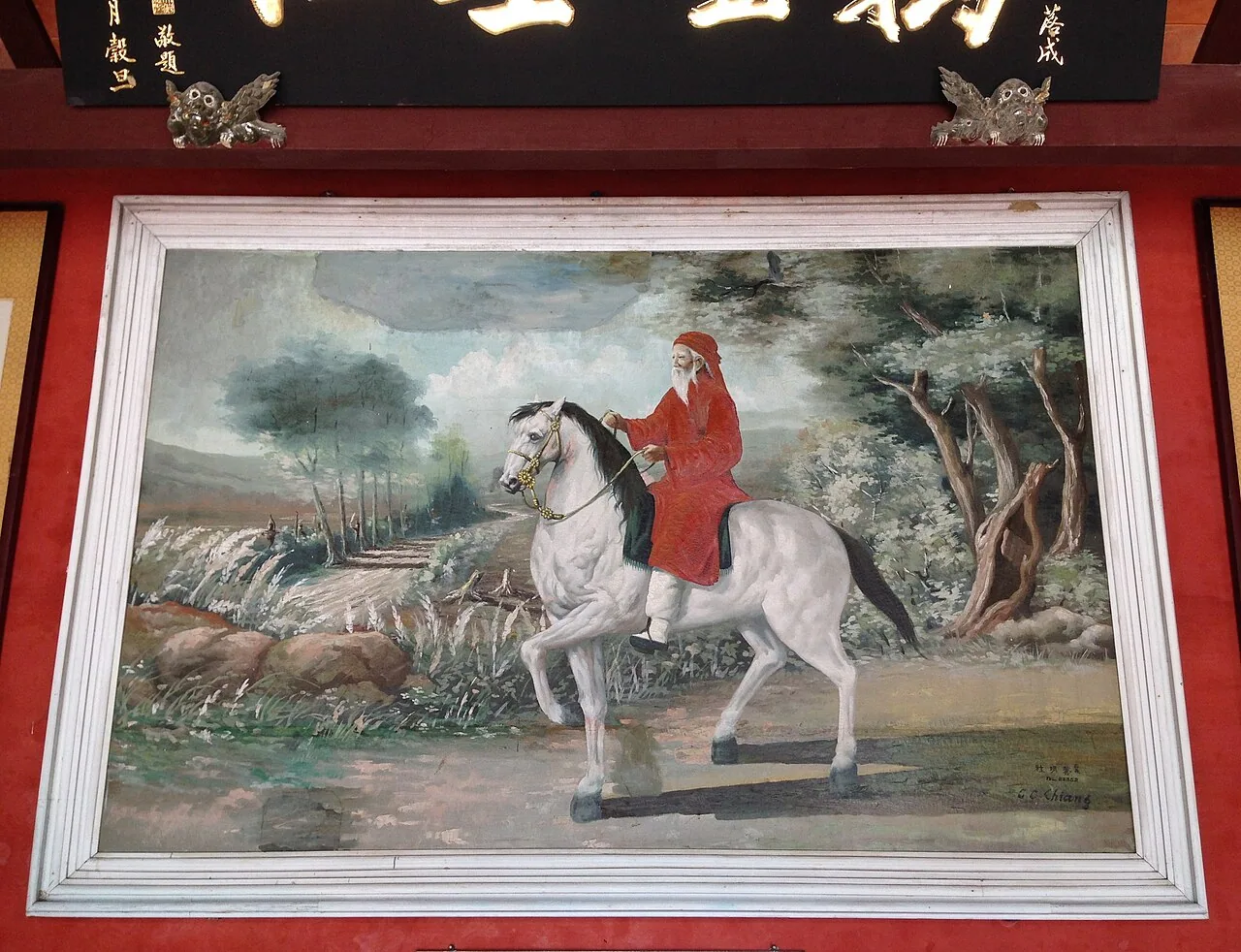
This version of the story is vivid: Wu Feng knew negotiations might fail, so he first had his family make paper effigies holding knives on horseback. He wore a vermilion robe and red headscarf into the mountains, and was finally killed. Following his instructions, his family burned the paper effigies; the Fan community, seeing the effigies and believing Wu Feng's ghost still roamed the mountains, feared and swore before a stone never to kill again within the Chiayi boundary, and residents thus built a shrine to worship Wu Feng.2
But this is not the neat "voluntary sacrifice, civilizing Indigenous people" story in later textbooks. The 1894 local gazetteer has paper effigies, vengeful spirits, plague, oaths, and shrine-building, as well as local interests between Wu Feng and Han residents. It lacks the "forty-plus years extended by four years" later emphasized in Japanese-era textbooks, and does not converge the whole story into a single Confucian moral exemplar. These differences remind us: a legend is not a fixed seed, but changes shape with the recorder, the reader, and the regime.
Cheng Ying-yi's research on Qing-era Wu Feng belief provides another indispensable context. She notes the formation and expansion of Wu Feng belief was tied to Han reclamation, the interpreter system, Fan rent, and the waxing and waning of outside forces beyond the Han-Fan boundary in the Chiayi foothills during the nineteenth century. It was a set of orders local society used to understand boundaries, trade, and danger—not merely the moral parable in later textbooks.3
Therefore, "Wu Feng was unknown before the Japanese era" if understood as "absolutely no one knew, absolutely no legend existed," is inaccurate. A statement closer to the sources is: before the Japanese era there already existed local Wu Feng belief and written records, but no evidence shows he had already become a cross-regional, fixed-version public hero.
Don't Rush to Say "Civilized": Ghosts, Plague, and Cessation
If one only looks at later national education textbooks, the Tsou cessation of headhunting appears as if moved by Wu Feng's moral character. But in earlier local gazetteer narratives, the reason for stopping is closer to fear of vengeful spirits, disease, and portents. After Wu Feng's death, the difference between paper effigy and real person became evidence of ghostly manifestation in the legend. The Fan people saw the shadow of Wu Feng on horseback with a knife, fell ill, some died, and thus fearfully swore oaths.2
The Alishan Zhongwang Temple materials collected by the National Cultural Memory Bank also organize this legend as "after Wu Feng's death, plague occurred in each community, Indigenous people believed it was the vengeful spirit, thus swore not to go out for grass [headhunting]." The same material simultaneously lists other factors that may have reduced conflict: Indigenous people serving as interpreters, reduction of community rent exploitation, and competition with the Bunun.4 Therefore, saying "the legendary reason for cessation was not moral civilizing but fear of vengeful spirits and plague" fits these texts better than "Wu Feng civilized the Tsou." But simplifying it to "Tsou people were just superstitious" is too crude, because that is an external recorder's paraphrase of a system of portents, oaths, and social order.
| Narrative Layer | Reason for Cessation of Headhunting | What This Layer Explains | Should Not Be Directly Inferred As |
|---|---|---|---|
| Qing local gazetteers & local belief | Paper effigies, ghosts, plague, fear, stone-burial/oaths2 | Early legend's causal mechanism was not Confucian civilizing but vengeful spirits and portents | Cannot be taken as the shared historical memory of all Tsou communities |
| Japanese official & school materials | Wu Feng voluntarily sacrificed, civilized "Fan" with character5 6 | How colonial education rewrote a local story into a civilizing parable | Cannot treat the textbook version as the Qing original |
| Post-1980s Indigenous fieldwork & counter-narratives | Wu Feng may have been a exploitative merchant, killed in retaliatory ethnic conflict7 | How Indigenous peoples reclaimed subject position to interpret their own history | Cannot pass off a single fieldwork version as the sole consensus of all Tsou |
A more historically sound formulation is: in Han local gazetteers and the Governor-General's Office collected oral legends, the Tsou reason for stopping killing is written as fear of Wu Feng's vengeful spirit and plague. In later Tsou counter-narratives, Wu Feng may represent the interpreter of Han trade and land interests, killed in ethnic conflict. Neither is the single "civilized by a righteous man" line of the Japanese-era textbooks.
1914: The Legend Was Set in Stone
The turning point appeared during Japanese colonial rule. On November 30, 1914, Luo Cai-ji, manager of the Wu Feng Temple, applied to the Taiwan Governor-General's Office to build a Wu Feng memorial stele, reasoning that Wu Feng's "legacy virtues should be eternally praised and transmitted." The stele site was in Shakou Village, Chiayi East Fort, Chiayi Prefecture; material was granite; the inscription was requested from Goto Shinpei; project cost was 387 yen 70 sen. The Taiwan Governor-General's Office approved in December the same year.5
What is most worth reading in this archive is not just the date and amount, but how the officialdom described Wu Feng. The Chiayi Prefecture's forwarded rationale writes Wu Feng as the Alishan interpreter of forty-eight years, who gave his life to correct the headhunting custom. The same text describes the Tsou as a "stubborn and fierce" group. Wu Feng was thus placed into a clear colonial script: the Han official represents order and morality, the Tsou represent the "savage" awaiting transformation.5
Goto Shinpei's stele inscription further links Wu Feng with "civilized-Fan" relations, railways, electric power, forestry management, and "the nation's enterprise." Here Wu Feng is no longer merely an object of local worship, but a symbol of imperial governance of the mountains, resource development, and display of civilizing achievements.5
Curator's note: A memorial stele looks like it preserves the past, but actually also selects a certain reading of the past. The 1914 stele did not preserve all versions side by side, but fixed Wu Feng into the version most suitable for colonial governance reading: he died, so "Fan customs" should change; he obeyed morality, so the empire's civilizing mission gained legitimacy.
Wu Feng on horseback painting inside Chiayi Wu Feng Temple. Photographer Outlookxp, CC BY-SA 4.0; Wikimedia Commons file page. Image embedded via external hotlink, not downloaded or cached.8
From Local Legend to Textbook Hero
Japanese officials did not simply move the local story unchanged into textbooks. The preview of Cultural Integration of the Colonial Empire Japan published by NTU Press notes the legend was first organized into Nakata Naohisa's Interpreter Wu Feng: Sacrificing Body to Achieve Benevolence, then adapted from this version into textbooks, forming a double adaptation chain of "local legend—official biography—school materials."6
The 1914 Public School National Reader Volume 11, Lesson 24 "Wu Feng" version writes Wu Feng as the interpreter who stopped the Alishan "Fan" from offering human heads in festivals. He first delayed for forty-plus years, then arranged for a person wearing a red hat and red clothes to enter the mountains; the person killed was actually Wu Feng. The Tsou, fearing retribution, worshipped Wu Feng and swore never to kill again.6
This version is more dramatized than the 1894 Yunlin County Cai Fang Ce, and more suitable for classroom moral education. The paper effigies, vengeful spirits, and local oaths in early texts were rewritten into a cause-and-effect students could immediately grasp: Wu Feng sacrificed for justice, Indigenous people repented, civilization therefore advanced. The Wu Feng legend was not preserved in textbooks, but compressed into an answer.
Wu Ming-yung's textbook research notes that in the early Japanese era the Governor-General's Office simplified the historical and cultural context of Alishan headhunting into "savage habit," then cast Wu Feng as the protagonist who used Confucian "sacrificing body to achieve benevolence" to tame "Fan customs." From 1914 onward, this story successively entered the Public School Japanese Reader, Public School Ethics Books, and later multiple readers, continuing at least until the 1940 teaching material system.9
This is also the most counter-intuitive part of the whole story: Wu Feng's fame did not come because historical materials suddenly became more complete, but because colonial education picked one version from many, then used schools, stele inscriptions, and official publications to repeat it.
"Propagandized" Does Not Equal "Fabricated from Nothing"
Saying the Wu Feng legend was propagandized by Japanese colonizers does not equal saying Wu Feng completely did not exist before the Japanese era. The abstract of Lai Li-ning's 2022 master's thesis notes Wu Feng served as interpreter in the Qing, but his deeds "did not receive much attention" at the time; it was in the Japanese era that the legend greatly expanded, was eulogized and biographized, the Wu Feng Temple expanded in scale, and even the Governor-General presided over sacrifices.10
This scale is more accurate than "the Japanese created Wu Feng," and closer to evidence than "Wu Feng has been an ethnic hero revered by all since ancient times." The 1855 Haiyin Shi and 1894 Yunlin County Cai Fang Ce prove written stories existed before the Japanese era; Cheng Ying-yi's research explains local belief already existed in the nineteenth century; the 1914 memorial stele and post-1914 textbooks prove the colonial government turned local narrative into institutionalized public memory.1 2 3 5 6 9 10
In other words, what Japanese colonial rulers did was not fabricate a name from zero, but reorganize a story that originally carried local interests, ghost belief, and multiple versions into a hero serving "pacifying the Fan" and civilizing. This process simultaneously elevated Wu Feng and flattened the Tsou: the more Wu Feng resembled a perfect righteous man, the more the Tsou were fixed as objects needing civilizing correction.
Myth Exits: Statue Toppled and Township Name Restored to Alishan
Postwar, the Wu Feng story did not disappear with the Japanese departure. The Nationalist government continued the Governor-General's Office narrative, deified Wu Feng, placed him in junior and elementary textbooks, and named the Alishan area "Wu Feng Township"; this made a name originally belonging to local belief into an administrative district, school textbooks, and public statues repeating national memory daily.4 7
The 1980s Indigenous movement began to counter-question: why were the Tsou forced to bear the collective original sin of "killing a great man," yet had no equal power to explain the land, trade, and ethnic oppression Wu Feng might represent? StoryStudio's organized fieldwork and counter-narratives depict Wu Feng as a exploitative merchant, noting he may have been killed in retaliatory ethnic conflict; this version may not be the sole consensus of all Tsou communities, but it opens the political questions flattened by textbooks.7

Chiayi Wu Feng Temple exterior. Photographer Outlookxp, CC BY-SA 3.0; Wikimedia Commons file page. Image embedded via external hotlink, not downloaded or cached.11
On December 31, 1988, Indigenous people and Han youth of various ethnicities at Chiayi Train Station used a truck and iron chains to dismantle the Wu Feng bronze statue. This action targeted not an isolated piece of metal, but the education system and ethnic hierarchy behind the statue: if Wu Feng represents "outsider civilizing Indigenous people through sacrifice," then toppling the statue is refusing to accept this position assignment.12

Wu Feng bronze statue in Chiayi Park, photographed March 28, 2024. Photographer "Adao", CC BY-SA 4.0; Wikimedia Commons file page. Image embedded via external hotlink, not downloaded or cached.13
Wu Feng Township was later renamed Alishan Township on March 1, 1989. This renaming was not deleting Wu Feng from all historical memory, but refusing to let the Tsou traditional territory continue to be named after a Han mythic figure; "Alishan" reconnected the administrative place name back to the mountains, the locality, and ethnic history. The National Cultural Memory Bank materials also record the Wu Feng story exited textbooks after this turn.4

Wu Feng Temple front hall. Photographer Outlookxp, CC BY-SA 4.0; Wikimedia Commons file page. Image embedded via external hotlink, not downloaded or cached.14
Regarding the precise date of teaching material withdrawal, different compilations differ: Wu Ming-yung records September 1988 when the National Institute for Compilation and Translation decided to abolish the Wu Feng story in elementary materials; StoryStudio records September 12, 1989 when the Ministry of Education announced full deletion.9 7 The date difference does not change the main historical direction: the 1988–1989 Indigenous protest, statue dismantling, renaming, and textbook withdrawal made the Wu Feng myth lose state apparatus guarantee for the first time.
What Remains After the Myth Exits
This later controversy cannot only be written as the satisfying ending of "myth debunked." For the Tsou, the issue is not just whether the story is true, but that for decades schools repeatedly taught a version arranged by Han and the colonial government, and used it to describe the Tsou as savage, backward, a group waiting for Han sacrifice to save them. When a story is written into textbooks, it is no longer just a story; it becomes how children understand others, and becomes a label an ethnic group must expend energy to dismantle.
What the Wu Feng legend is truly worth remembering is not re-coronating any single version, but seeing how it was rewritten in different eras. Qing local gazetteers left a complex story with paper effigies, vengeful spirits, and local oaths; the Japanese Governor-General's Office remade it into a civilizing parable; postwar textbooks extended the parable into national memory; the 1988–1989 Indigenous movement pushed the suppressed questions back into public space. Wu Feng is not a person without a story, but a person who had a local story, yet had his story's ending chosen for him by empire.
Image Sources
This article uses four external hotlink images, all from Wikimedia Commons, all marked Creative Commons Attribution-ShareAlike (CC BY-SA) license; this article does not download or cache images. Wu Feng Temple painting by Outlookxp, licensed CC BY-SA 4.0; Chiayi Wu Feng Temple exterior licensed CC BY-SA 3.0; Wu Feng Temple front hall licensed CC BY-SA 4.0; Chiayi Park Wu Feng bronze statue by "Adao", licensed CC BY-SA 4.0. Each image includes Wikimedia Commons file page, photographer, and license info.
References
Further Reading
- Japanese colonial period — Japanese colonial rule's systems, education, and Kominka policies
- Taiwan Indigenous History and Rectification Movement — Long-term context of Indigenous historical subjectivity and rectification movement
- Alishan: Imperial Forest Farm and Gao Yisheng's Mountain — Another historical line of Alishan forestry, colonial development, and Indigenous politics
- Haiyin Shi Hundred Poems No. 20 — National Museum of Taiwan Literature notes Haiyin Shi completed 1852, engraved 1855, and states Wu Feng deeds are earliest extant written record, and content differs from later records.↩2
- Yunlin County Cai Fang Ce — Academia Sinica Institute of Taiwan History database includes 1894 original Wu Feng entry, pp. 179–180, recording interpreter, vermilion robe red headscarf, paper effigies, vengeful spirits/plague, oaths and shrine-building.↩2345
- Interpreter System, Belief, and Foothill Border Society—Formation of Qing Taiwan Wu Feng Belief — Cheng Ying-yi, Journal of Historical Anthropology Vol. 12 No. 2 (2014), pp. 51–84, analyzes Qing interpreter system, foothill society, and Wu Feng belief formation.↩2
- Chiayi County Alishan Zhongwang Temple — National Cultural Memory Bank material, organizes Wu Feng vengeful spirit, plague, local worship, Wu Feng Township renamed Alishan Township March 1, 1989, and Wu Feng story exiting textbooks in local memory.↩23
- Japanese Era Wu Feng Temple Stele Erection Full Story — National Archives Administration Taiwan Documents Yue Du Dang An No. 95 (2012), cites Taiwan Governor-General's Office archives, records 1914 memorial stele application, inscription, cost, official approval, and colonial governance language.↩2345
- Cultural Integration of the Colonial Empire Japan Content Preview — NTU Press preview, explains Wu Feng legend adapted from Interpreter Wu Feng: Sacrificing Body to Achieve Benevolence into 1914 Public School National Reader, and compares Qing sources with Japanese-era textbook version differences.↩234
- [Taiwan General History] Collapse of the Wu Feng Myth: The Deification Path Fabricated by the Ruled, Behind Which Lies a Cruel Truth — Xi Ming-yan, StoryStudio (2024), organizes Japanese and postwar myth versions, vengeful spirit/plague narratives, 1980s Indigenous fieldwork counter-versions, and Wu Feng myth exit.↩234
- File: Wu Feng Temple Painting 1.jpg — Wikimedia Commons file page, photographer Outlookxp, source own work, license Creative Commons Attribution-ShareAlike 4.0 International.↩
- Textbooks and Taiwan Indigenous Peoples: A Historical Reflection — Wu Ming-yung, Textbook Research Vol. 6 No. 1 (2013), pp. 139–142, analyzes Wu Feng myth's colonial education function, textbook inclusion history, and 1988 material abolition.↩23
- Wu Feng Legend Research Under Multiple Texts—Centered on Koa-a-cheh Persuading the World: Wu Feng Legend — Lai Li-ning, Chaoyang University of Technology Chinese Literature MA thesis (2022), abstract compares Qing, Japanese, and postwar texts, notes Wu Feng deeds in Qing "did not receive much attention," only in Japanese era greatly expanded and institutionalized.↩2
- File: Chiayi Wu Feng Temple.JPG — Wikimedia Commons file page, photographer Outlookxp, license Creative Commons Attribution-ShareAlike 3.0 Unported.↩
- 1988.12.31 Ending the Myth, Wu Feng Bronze Statue Dismantling Incident — Taiwan Memory Exploration Team (2019), organizes 1988 Chiayi Station front Wu Feng bronze statue dismantling, Indigenous movement, and 1989 renaming/material withdrawal event context.↩
- File: Statue of Wu Feng in Chiayi Park 20240328.jpg — Wikimedia Commons file page, photographer "Adao", photographed March 28, 2024, license Creative Commons Attribution-ShareAlike 4.0 International.↩
- File: Wu Feng Temple Front Hall.jpg — Wikimedia Commons file page, photographer Outlookxp, license Creative Commons Attribution-ShareAlike 4.0 International.↩


