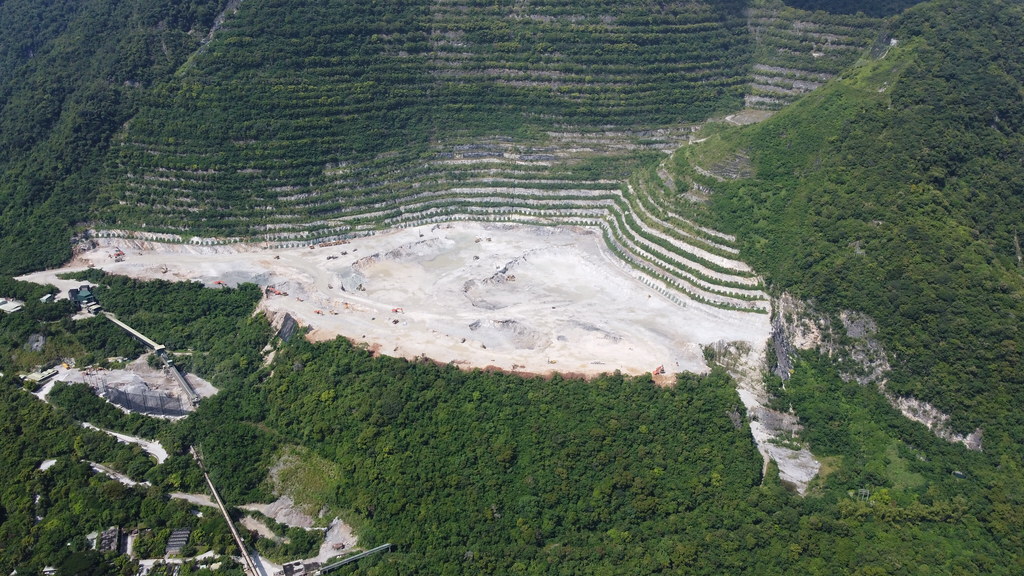
Image: CEphoto, Uwe Aranas / Wikimedia Commons; used in accordance with the attribution and usage conditions listed on the image page, see "Image Credits" at the end.
30-Second Overview: The controversy surrounding the Xincheng Mountain mine in Xiulin Township, Hualien County, appears on the surface to be an administrative document regarding a mining license extension. Beneath this lie three institutional timelines operating out of sync: the mine has persisted since 1957; the indigenous consultation and consent system was only formally codified in 2005; and the EIA system previously excluded "existing mine extensions." The 2021 Supreme Administrative Court ruling revoked the extension, reasoning that the state failed to allow the affected Truku tribes to participate in the decision before approving the next 20 years. However, under the Mining Act at the time, mining rights remained valid during the extension review period. Thus, the ruling terminated one approval but did not press the stop button for residents below the mountain. 1 2
Watch: Aerial view of the Aby Cement Xincheng mining area in Hualien.
Aerial image: Environmental Information Center image archive; original source and caption must be retained before use; image rights are handled according to the original page and rights holder's regulations. 3
People Below the Mountain See the Changes First
On February 3, 2026, Aby Cement held a briefing at the Fushi Multi-Purpose Assembly Hall in Xiulin Township, Hualien, prior to the supplementary EIA for the Xincheng Mountain mine. The discussion focused on air quality, noise, vibration, surface water, and slope monitoring. However, those seated in the audience pulled the conversation back to the daily road home: in June 2025, blasting debris had struck residential homes, and the risks of landslides and falling rocks following the April 4, 2024, Hualien earthquake had not yet disappeared from residents' lives. 4
Xiulin Township Mayor Wang Rosei said during the meeting, "We really do not want our Fushi Village to become Little Lin Village." This statement is not a data point in an EIA report, but it explains why residents do not only demand that the operator prove "current compliance with standards," but also require the government to answer who is responsible for clarifying risks when the next strong earthquake, typhoon, or heavy rain arrives. 4
📝 Curator's Note: The most difficult impact of a mine to measure is often not how many meters of mountain wall are lost, but whether residents can still treat "safety" as a daily routine rather than a promise waiting to be validated by an accident.
Aerial images pull the scale of the controversy wide: the mining area is not an isolated white incision, but a landscape adjacent to valleys, roads, settlements, and tribal life. This is precisely why "mining rights" cannot be viewed merely as an industrial permit. It simultaneously determines which landscapes will be altered and which people must bear the long-term risks of that alteration. 2 4
This "Aby case" is not a single event. It stacks mining rights, indigenous land, cultural assets, geological safety, environmental impact assessments, and local employment onto the same mountain in Xiulin Township, Hualien. All parties acknowledge that the Xincheng Mountain mine has existed for many years; the true dispute is whether existing mining facts can automatically become the legitimacy for the next 20 years. 1 5
Protests Brought the Mountain's Issues to the Presidential Office
On June 25, 2017, Truku people and environmental groups launched the "See Aby, Save the Truku" march. The Environmental Information Center reported that the procession was led by Truku people from Fushi Village, Xincheng, Hualien, marching from the Presidential Office to Ketagalan Boulevard, with over 8,000 participants on site. The demands included revoking Aby's Xincheng Mountain mining license extension, amending the Mining Act, implementing Article 21 of the Indigenous Peoples Basic Act, redoing the determination of mining land, establishing a resident participation mechanism, and making mining development review data public. 6
Watch: The "Mining Reform, Revoke Aby" march procession takes to the streets.
Protest image: Environmental Information Center report page, caption indicates the June 25, 2017 march, photographed by Lai Pin-yu; formal release must confirm usage rights according to the original page and rights holder's regulations. 6
In this photo, slogans compress legal points into a few chantable words: "Mining Reform," "Revoke Aby." But the march was not merely an emotional release. Participants demanded that the extension no longer be completed solely by the competent authority and the operator within administrative procedures, but that tribal residents, households below the mining area, and environmental risks be brought back to the decision-making scene. 6
Watch: Truku people and other residents affected by mining speak together at the protest site.
Protest image: Environmental Information Center report page, original image file labeled 35134375940_8758d0a4e6_b.jpg, caption points to Hualien Xincheng Mountain and Hsinchu Guanxi residents sharing the stage in the march; photographed by Lai Pin-yu. Formal release must confirm usage rights according to the original page and rights holder's regulations. 6
This image of shared speaking stages makes the Aby incident more than just a Hualien case. Residents from Hsinchu Guanxi also appeared in the march because they too face conflicts between mining development and local life. Residents from different areas brought their respective experiences to the same protest, forming a larger question: When a mine's mining rights, EIA, and local governance are scattered across different systems, who is responsible for integrating these impacts? 6
The protest also presented a different demand for "professional review." Residents were not rejecting all data, but demanding that data not flow only between the government and the operator. The mine's scope, geological sensitive areas, land rights, mining plans, and safety measures should be understandable, question-able, and allow for alternative proposals to be presented before decisions are made. This forms a clear institutional link with the Supreme Administrative Court's later emphasis on prior consultation and consent. 1 6
How 1957 Mining Rights Reached 2017
The Supreme Administrative Court's official press release states that Aby acquired the Xincheng Mountain marble mining rights from Huadong Industry in 1973. The original mining right term was calculated from November 23, 1957, to November 22, 1977, followed by 20-year extensions in 1977 and 1997, with the second extension ending on November 22, 2017. 1
The significance of this timeline lies in the fact that "old mines" are not devoid of systems. After the enactment of the Environmental Impact Assessment Act in 1994, whether existing mines required an EIA for subsequent extensions was handled according to regulations and administrative interpretations at the time. After the Indigenous Peoples Basic Act was promulgated in 2005, Article 21 established requirements for consultation and consent participation involving indigenous land and natural resource development. 5 7
On March 14, 2017, the Ministry of Economic Affairs (MOEA) approved Aby's Xincheng Mountain mining license extension, valid until November 22, 2037. Environmental groups and tribal representatives questioned that the application, submitted on November 25, 2016, was approved in about three and a half months, coinciding with heightened discussions on amending the Mining Act. Aby argued that the application was submitted according to law and that relevant mining, soil and water conservation, and safety data had been provided. 1 8 9
The 2017 Control Yuan investigation did not simplify the controversy into "support or oppose mining." It pointed out that the MOEA, during the extension review, knew that three debris flow potential streams passed through the mining area scope, yet failed to require sufficient investigation into the potential impacts of debris flows, landslides, exposed surfaces, and public safety over a 20-year mining period. The Control Yuan also deemed that checks on geological sensitive areas were incomplete. 2
The same Control Yuan statement also noted that the Xincheng Mountain mining area includes the Hualien County-designated Fushi Ruins. The MOEA used Aby's pledge not to mine towards the ruins in the future as the basis for handling, but the Control Yuan believed that such a pledge leaves long-term protection uncertain. This made "whether the mountain will slide" and "whether the ruins will be affected" reasons why mining license extensions cannot rely solely on the completeness of documents. 2
A Timeline, Three Institutional Turns
| Time | Event | Why It Matters |
|---|---|---|
| 1957 | Xincheng Mountain mining rights begin calculation, later transferred from Huadong Industry to Aby. 1 | The history of existing mines predates the EIA Act and the indigenous consultation and consent system. |
| 1994 | The Environmental Impact Assessment Act is enacted. 5 | Whether "old mines" need to undergo EIA anew upon extension becomes part of later institutional disputes. |
| 2005 | The Indigenous Peoples Basic Act is promulgated; Article 21 establishes consultation and consent participation requirements. 7 | The state's procedural obligations regarding indigenous land and natural resource development are codified. |
| March 14, 2017 | MOEA approves Aby's Xincheng Mountain mining license extension until 2037. 1 8 | Existing mining facts and the legal legitimacy of the next 20 years are placed on the same document. |
| July 2019 | Taipei High Administrative Court revokes the extension decision. 10 | The court tests the case's extension for the first time using the indigenous consultation and consent procedure. |
| September 16, 2021 | Supreme Administrative Court rejects Aby's appeal, revocation becomes final. 1 | Procedural rights become a legal issue that cannot be skipped in mining license extensions. |
| February 3, 2026 | Xincheng Mountain mine holds briefing before supplementary EIA. 4 | The controversy extends from "whether the extension is valid" to "how future mining will be supervised." |
This timeline does not merely slice events into dates. It shows that each institution entered at different times: mining rights existed first, the EIA Act was established later, and indigenous consultation and consent was codified even later. When the state understands the extension as "continuation of old rights," tribes and environmental groups ask: If the next 20 years will produce new geological, cultural, and life impacts, why is it only treated as an extension of the previous 20 years? 1 2 5 7
The Court Asks: Who Is Protected by Law
In July 2019, the Taipei High Administrative Court revoked the MOEA's approval of the extension and the Presidential Office's reconsideration decision. After Aby appealed, the Supreme Administrative Court rejected the appeal in its September 16, 2021, judgment (Case No. 108 Tai-Shang-Zi No. 894), upholding the revocation. 1 10
The key point of the Supreme Administrative Court's judgment was not that the court decided the mine must close immediately for the tribe, but that it confirmed the procedural rights themselves have rights significance. The court held that the Mining Act's extension provisions protect the personal interests of residents in and around the mining area. Article 21 of the Indigenous Peoples Basic Act also has the nature of guaranteeing specific rights for individual indigenous peoples and tribes. Therefore, residents within 500 meters of the mining area, whose identity and land rights are directly related to the mining area, have the standing to file administrative lawsuits. 1
The court further pointed out that mining is a land development act that affects indigenous groups and traditional culture. Before making a decision on the mining license extension, the state must first complete the consultation and consent participation procedure. Waiting until after the extension is approved to supplement with employment, feedback, or soil and water conservation plans cannot replace the opportunity for the tribe to influence the decision beforehand. 1
There is an easily overlooked counter-intuitive point here: The Truku tribe won the lawsuit revoking the extension, but this does not mean mining stops on the day of the judgment. The court's press release explains that the mining right is for a 20-year period; before the competent authority approves or rejects the extension application, the mining right is still deemed valid under the Mining Act. The judgment changes the procedures the state must follow when allowing the next phase of mining, rather than wiping out all legal relationships of the existing mine. 1
📝 Curator's Note: What this lawsuit truly revoked is the automatic continuation imagination of "since it has been dug for a long time, it can continue to be dug"; what remains is the responsibility that every next step must be explained anew.
Watch: Another aerial perspective of the Hualien Aby Xincheng mining area (Taiwan Environmental Information Association / Flickr)
Aerial image: TEIA / Flickr, page indicates image source is Earth Citizen Foundation, original provider is netizen Munch; Flickr page states All rights reserved, permission from rights holder must be obtained before formal publication or redistribution. 11
The Same Mountain, Two Safety Narratives
The Control Yuan's focus is on whether government review was sufficient: debris flow potential streams, geological sensitive areas, Fushi Ruins, and nearby tribal safety should all be incorporated into judgments before the extension decision. 2 Aby's public Q&A argues that debris flow potential stream data is mainly used for disaster warning alerts; the mine operates and rehabilitates according to soil and water conservation plans, and sets up slope monitoring, rock catch fences, and detention sedimentation facilities. The company also states that the Fushi Ruins overlap area is not included in the mining plan. 9
These two narratives do not necessarily eliminate each other. The operator can present monitoring data, and the government can demand more comprehensive prior investigations. Residents still have the right to question the scope of data coverage, whether it includes their homes, tribes, and extreme climate scenarios. At the 2026 briefing, residents questioned that the presentation map did not mark the 10th Neighborhood of Fushi Village and demanded that geological weak areas, fault fracture zones, and post-April 4 earthquake scenarios be included in the assessment. 4
Therefore, the supplementary EIA is not merely adding a formal stamp to the 2017 extension controversy, but transforming "how it was dug in the past" into "under what conditions it can still be dug next." After the 2023 amendment to the Mining Act, old mines determined before October 20, 1995, that never implemented an EIA and have a mining land area exceeding two hectares must undergo supplementary EIA according to Article 76. The Xincheng Mountain mine thus entered this procedure. 4 12
The EIA Must Answer More Than "Is There Currently Exceedance?"
During the 2026 briefing, the assessment scope proposed by Aby and its EIA consultant focused on the currently and future expected mining area of 35.2 hectares, with a maximum mining height of about 120 meters. The operator explained that current investigations of air quality, noise vibration, surface water quality, and traffic conditions comply with current regulations, and recorded the yellow-throated marten, crab-eating mongoose, blue pheasant, large-billed kite, and the protected yellow裳 phoenix butterfly. The operator also proposed dust suppression via sprinkling, noise reduction, soil and water conservation, slope monitoring, and post-mining rehabilitation measures. 4
These are necessary basic data in an EIA, but the questions raised by residents are closer to risk governance: If debris incidents have already occurred, how does the early warning system prove its effectiveness? If landslides and falling rocks persist after the April 4 earthquake, does the assessment boundary cover the living spaces affected? If the mine presentation does not mark the 10th Neighborhood where residents live, does public participation truly allow all affected parties to see the same map? 4
Therefore, the supplementary EIA has at least three layers. The first layer is regulatory compliance, confirming whether monitoring data and development conditions meet current standards; the second layer is cumulative risk, placing blasting, earthquakes, typhoons, geological sensitive areas, and existing mining scars in the same context; the third layer is procedural credibility, allowing the tribe to present opinions when data is formed and alternative solutions are discussed, rather than waiting for the report to be completed to only agree or disagree with the conclusion. The first two layers require professional investigation; the third layer involves the consultation and consent and effective participation confirmed by the court. 1 2 4
📝 Curator's Note: An EIA is not about translating the mountain into a table, but confirming whether every number on the table truly corresponds to places where people live at the foot of the mountain.
Land Restitution, Work, and Closure Cannot Be Answered Separately
The land issue in Xincheng Mountain cannot be ended with a simple "legally rented." The Control Yuan pointed out that relevant mining land includes indigenous reserved land; the Hualien County Government, due to policy flip-flops and delays, failed to handle rent and land return issues in a timely manner. The Control Yuan also believed that the Presidential Office and MOEA previously excluded mining license extensions from Article 21 of the Indigenous Peoples Basic Act, substantially weakening the protection of indigenous land and natural resource rights. 2
Aby stated in a public explanation that early land use involved compensation, cancellation of cultivation rights, and government leasing procedures; the company denies obtaining land through deception or forgery and argues that it has continuously provided local feedback, employment, and safety communication for many years. 9 These claims must be placed on the same table as the tribe's land experience, rather than having one party's documents speak for the other.
The 2022 Presidential Office Truth Investigation on Indigenous Land Handling Situation proposed that after mining land use is completed, restoration and disaster prevention should be carried out according to soil and water conservation plans, and suggested that the government, tribes, and Aby jointly think about mine transformation and land reuse four years before the end of mining in the area. 13 At the 2026 EIA briefing, the Earth Citizen Foundation estimated existing reserves and annual mining volume based on reports, demanding the operator propose employee destinations, land restoration, and tribal transformation closure plans early. Aby stated that, according to law, closure plans have long been part of mine management, and this does not mean the company is withdrawing soon. 4
This is the event's most realistic difficulty: If we only discuss stopping mining, we may not see families dependent on work and local feedback. If we only discuss industry and employment, we may push land rights, tribal safety, and cultural continuity to later. A truly feasible answer must simultaneously explain who bears the risk, who gets the decision-making power, and how the mountain and people's lives will continue after the mine ends. 1 4 13
Tribal Participation Is Not a Single Vote, But a Trackable Relationship
After the 2017 extension controversy erupted, the government, tribes, and Aby held tripartite talks; in 2020, Aby stated it would promote consultation according to the spirit of Article 21 of the Indigenous Peoples Basic Act; in 2021, the tribe presented conditions, and Aby presented responses; in 2022, the Bosian tribe held a consultation and consent vote, with reports recording the result as 294 votes in favor, 45 against, and 14 invalid. 5
This process cannot be merely condensed into "final consent" or "final opposition." There may be different life needs within the tribe: some care about land return and traditional territories, some depend on jobs provided by the mine, and some are most concerned about blasting, falling rocks, and flood risks. Truly meaningful consultation should allow different opinions to obtain the same data before voting, present conditions, track commitments, and know how to seek remedies when commitments are not fulfilled. The Supreme Administrative Court emphasized prior procedures precisely because post-facto feedback and compensation cannot fully replace the opportunity to influence decisions. 1
The Presidential Office's 2022 Truth Investigation on Indigenous Land Handling Situation has already placed land restoration, disaster prevention, and mine transformation in the same long-term framework, suggesting that four years before the end of mining in the area, the government, tribes, and Aby jointly think about land reuse and transformation. The key to this suggestion is not to pre-determine answers for any party, but to bring "what happens after closure" to the stage where there is still time for negotiation. 13
A Revocation Document Has Not Yet Closed the Book for People Below the Mountain
The Aby Xincheng Mountain mine incident has moved from the 2017 extension approval, to the 2021 Supreme Administrative Court revocation, and now to the 2026 supplementary EIA briefing. The timeline has lengthened, and the question has shifted from "is the extension legal" to "how can the next decision be trusted." The court has explained that prior consultation and consent cannot be replaced by post-facto feedback; the Control Yuan has left gaps in government review of geology, cultural assets, and public safety; residents have brought debris, falling rocks, and homes not marked on maps back to every meeting. 1 2 4
The cliffs of Xincheng Mountain are still there; the horizontal lines left by terraced mining are still visible. What remains truly unfinished is not finding a slogan for this mountain that says "can dig" or "cannot dig," but returning safety, land, work, culture, and closure timelines to those who must live at the foot of the mountain to decide together. The next time the government picks up that document, the people below the mountain should already be in the document, rather than being notified only after the document falls.
References
Image Credits
Image: Xincheng Hualien Taiwan Asia Cement Corporation-01.jpg, CEphoto, Uwe Aranas. Wikimedia Commons image page requires retaining author attribution and original archive page link; this article handles it according to the usage conditions listed on that page.
- Supreme Administrative Court: 108 Tai-Shang-Zi No. 894 Aby Mining Act Event Press Release — 2021-09-16↩234567891011121314151617
- Control Yuan: MOEA Review of Asia Cement Corporation Mining License Extension Correction Case — 2017-10-12↩23456789
- Environmental Information Center Image Archive: Hualien Aby Xincheng Mining Area Aerial Image — . Image URL provided by user; since the direct image page does not contain complete authorization instructions, usage rights must be confirmed according to Environmental Information Center and original rights holder regulations before formal release.↩
- Environmental Information Center: Aby Xincheng Mountain Mine Holds Briefing for Supplementary EIA, Residents Focus on Three Major Points — 2026-02-09↩23456789101112
- Focus Events: Aby Hualien Xincheng Mountain Mining Area Major Events Timeline — Updated 2021-09-17↩2345
- Environmental Information Center: "Mining Reform, Revoke Aby" Nearly 10,000 People Take to Streets to Support Anti-Aby — 2017-06-25; protest images and captions in the text use this report page as the original source↩23456
- National Regulations Database: Indigenous Peoples Basic Act Article 21 — See original link for supplementary content↩23
- Environmental Information Center: Court Rules MOEA Loses, Xincheng Mining License Extension Withdrawn — 2019-07-11↩2
- Asia Cement: Mining License Extension Q&A — Company public explanation materials↩23
- Taipei High Administrative Court Judgment Data: 106 Su-Zi No. 1505 — See original link for supplementary content↩2
- TEIA / Flickr: Hualien Aby Xincheng Mining Area Aerial Image Two (Provided by Netizen Munch) — . Page indicates image source is Earth Citizen Foundation, and states All rights reserved.↩
- National Regulations Database: Mining Act Article 76 — See original link for supplementary content↩
- Presidential Office: Handling Situation of Truth Investigation Report on Asia Cement Corporation's Xincheng Mountain Mine Leasing of Indigenous Land — See original link for supplementary content↩23