

30-Second Overview: In October 1887, Liu Ming-chuan petitioned for the establishment of Taiwan Province, selecting Qiaozaitou (modern Taichung City) as the provincial capital with a Bagua (Eight Trigrams) shaped city plan. Construction of the city walls began in 18891. Liu Ming-chuan resigned in 1891; in 1894, Shao Youlian moved the provincial capital north to Taipei, halting the Taichung provincial city project. On October 1, 1920, the Japanese colonial government implemented the "Five Prefectures and Two Departments" system, establishing Taichung Prefecture; Taichung Street and nine surrounding villages merged to form Taichung City2. In 1955, Providence University broke ground on Dadu Mountain; the Luce Memorial Chapel was completed in 1963, described as "the first work of modernist architectural vocabulary to enter Taiwan"3. On the early morning of September 21, 1999, the Chelungpu Fault tore from Jiji in Nantou to Dongshi in Taichung; 358 people died in Dongshi Town4. On December 25, 2010, the county and city merged to become a direct-administered city with 29 districts. In 2016, the National Taichung Theater designed by Toyo Ito officially opened in Xitun District, with construction costs of NT$4.36 billion5. Today, 2.86 million people live in this city that waited 123 years to transform from a provincial capital candidate into the second largest direct-administered city.
The Dajia Xishe Uprising and the Burned Yamen
Fifteen-six years before Liu Ming-chuan petitioned for provincehood, a Qing-dynasty resistance event of greater scale than the Lin Shuangwen Rebellion occurred on this Taichung Basin.
In late 1731 (the 9th year of the Yongzheng Emperor), Lin Wuli (Linbao Maluku), a headman of the Takao (Dajia Xishe) tribe, led a rebellion against "excessive corvée labor imposed by Qing officials," burning down the Yamen of the Tainan Prefecture's Fumin Tongzhi (Magistrate for Pacifying the Aborigines)6. This resistance lasted seven months; the Qing court mobilized over 6,000 mainland soldiers, using "aborigines to subdue aborigines" to quell it. The largest armed anti-government event in the history of Taiwan's Pingpu peoples took place in what is now the Dajia and Qingshui area of Taichung.
The Dajia Xishe belonged to the Takao people, whose traditional settlements were distributed along the Dajia River. "The coastal plain area from Taichung City through Miaoli County to Hsinchu County" was the territory of this ethnic group7. Further south, the Dadu River basin was home to the Papora people, who established the "Middag Kingdom" as recorded in 17th-century Dutch documents. Further south still were the Babuza people. These three Pingpu ethnic groups largely migrated collectively to the Puli Basin; today, their villages are invisible in Taichung City, leaving only place names like "Dadun," "Lanxingbao," and "Qiaozaitou," layers left after Han settlement.
📝 Curator's Note: The Dajia Xishe Anti-Qing Uprising is often compressed into a single sentence: "The Takao tribe's rebellion in the 9th year of Yongzheng." It occurred 55 years before the 1786 Lin Shuangwen Rebellion and was closer in scale to a full-island mobilization, yet it has no place in today's history textbooks. The reason is simple: Lin Shuangwen was a Han immigrant, absorbed into the narrative of "immigrant pioneer history"; Lin Wuli was a Takao, absorbed into the narrative of "pacifying barbarian rebellions." The latter has essentially no seat in 21st-century Taiwan history frameworks. To write about the Taichung Basin, one must start with "who lived here before Han settlement, and who initiated a seven-month war." The first historical name of the Taichung Basin is in the Takao language.
The Deity in Lin Yongxing's Home, Later a 340km Pilgrimage

Dajia Jenn Lann Temple front, 2018-08-04. Photo: Dquai, CC BY-SA 4.0 via Wikimedia Commons.
Two years after the anti-Qing uprising ended, this land began to grow a temple that would later attract over 100,000 people to walk 340 kilometers.
In 1730 (the 8th year of the Yongzheng Emperor), Lin Yongxing of Meizhou Island immigrated to Taiwan with his family, "respectfully requesting a statue of the Heavenly Holy Mother (Mazu) from the Ancestral Temple of Meizhou to enshrine at home"8. In 1732 (the 10th year of Yongzheng), local gentry, seeing the incense flourish, built a small shrine with Lin Yongxing's consent. In 1770 (the 35th year of the Qianlong Emperor), the small shrine was rebuilt, called "Tianhou Palace." In 1787 (the 52nd year of Qianlong), "notable patrons including Zong Jinting of the Dajia Branch, Jinshi Chen Fenghao, scholar-official Lian Kunshan, and Papora aborigine headman Qiao Hualong initiated land donations for reconstruction," expanding it and renaming it "Jenn Lann Temple"8.
This temple started as a family shrine for one household; 57 years later it became the largest temple in Dajia; 240 years later it became the starting point of Taiwan's largest-scale folk activity.
The Dajia Mazu Pilgrimage and Incense Offering begins every lunar March. It spans 9 days and 8 nights, 340 kilometers round-trip on foot, crossing 4 counties: Taichung, Changhua, Yunlin, and Chiayi9. The route starts from Dajia in Taichung, passes through Qingshui, Shalu, and Dadu into Changhua, crosses Changhua City, Yuanlin, Beidou, and Xizhou, then enters Yunlin's Xiluo, Huwei, Tukou, and Yuanchang, finally arriving at the Fengtian Palace in Xingang, Chiayi, passing over 100 temples and 21 townships. Annual participation numbers are "approximately over 100,000 people," with peaks reaching millions. In 2010, the Bureau of Cultural Affairs designated it as an "Important Folklore of the Republic of China Intangible Cultural Asset"; the Discovery Channel listed it alongside the Vatican Christmas Mass and the Hajj to Mecca as one of the "World's Three Major Religious Events."
But this route has not always looked like this.
Before 1988 (Republic of China Year 77), the Jenn Lann Temple actually went to Beigang Chaotian Temple for incense offering. That year, "Jenn Lann Temple canceled the pilgrimage to Beigang Chaotian Temple, changing the destination to Xingang Fengtian Palace, thus interrupting the Beigang incense offering"10. The reason for the detour was temple politics: Jenn Lann Temple refused to accept Chaotian Temple's designation of the pilgrimage as "returning to the natal home to pay respects" (implying the Dajia Mazu was a branch spirit of the Beigang Mazu), demanding a public clarification from Chaotian Temple. Chaotian Temple refused, and Jenn Lann Temple left. A pilgrimage route that had existed for a century was unilaterally rewritten due to a cognitive divergence between the two temples over "which is the mother temple." From that year on, Beigang in Yunlin lost an annual lunar March event, and Xingang in Chiayi gained one.
✦ "The Dajia Mazu Pilgrimage and Incense Offering sees participation of over 100,000 people annually, and is one of the world's three major religious events." (Selected by Discovery Channel, cited from multiple sources9)
The current chairman of Dajia Jenn Lann Temple, Yan Ching-biao, is from Qingshui on the coastal line. He was early on the Speaker of the Taichung County Council and served four terms as a Legislator. His family's roots are intertwined with this temple in Dajia and the political factions of the coastal line. This root will appear again later.
The Unfinished Bagua City
In the 25th year after the Qing court halted construction, Taichung gained its first formal "city" administrative designation.
In 1896 (Meiji 29), the Japanese colonial government established Taichung County, and the name "Taichung" officially appeared2. In 1901, it was changed to Taichung Department. On October 1, 1920, the Taiwan Governor-General's Office implemented the "Five Prefectures and Two Departments" system, merging Taichung Department and Nantou Department into Taichung Prefecture, while simultaneously establishing Taichung City. "Taichung Street and nine surrounding villages merged to form Taichung City"2. From this day forward, Taichung joined Taipei, Tainan, Kaohsiung, and Hsinchu as five administrative centers upgraded to "city" status on the island.
Taichung City's planning during the Japanese colonial period drew from Kyoto and Keihan styles: a main axis in front of the train station, a grid of city blocks, and two artificial rivers, the Green River (Lüchuan) and Willow River (Liuchuan), cutting through the city. The Cross-Island Railway fully opened in 1908, making Taichung Station the central transportation hub. Taichung Park was completed in 1917; the Double Pavilion Lake Pavilion visible today was built that year.
But what truly secured Taichung's place in Taiwan history in the 1920s was people.
"Taichung Prefecture streets and Taichung City became a stronghold of non-violent anti-Japanese resistance starting in the 1920s; the Taiwan People's Party founded by Chiang Wei-shui was also established in Taichung City"2. Lin Hsien-tang led the Taiwan Cultural Association in Wufeng; Chiang Wei-shui founded the Taiwan People's Party; Lian Wenqing led the left wing of the Taiwan Cultural Association. The center of Taiwan's social movements in the 1920s was in the central region. In 1926, Zhuang Chuisheng convened the founding assembly of Central Bookstore at the Zuiyue Lou by the Green River in Taichung; it officially opened on January 3, 1927. Shareholders included "Lin Hsien-tang, Lin Youchun, Chen Xugu, Zhang Shenkai, Lai He," almost the core membership list of the Taiwan Cultural Association.
Central Bookstore was originally planned as "the Central Club for the Taiwan Cultural Association's central Taiwan gatherings." After the left-right split of the Taiwan Cultural Association in 1927, it operated as a bookstore. It was "the first bookstore in central Taiwan specializing in importing Chinese and Japanese books and magazines, and the largest Chinese-language bookstore on the island in scale"11. It closed in 1998 due to financial difficulties; the building was sold. In 2016, the Shangshan Humanities Foundation bought back the building's ownership, officially reopening in January 2020, exactly 93 years after its 1927 opening.
The existence, disappearance, and rebirth of Central Bookstore is physical evidence of Taichung's identity as a "central cultural stronghold." The non-violent anti-Japanese resistance of the colonial period left few physical traces; even the venue where Chiang Wei-shui founded the Taiwan People's Party was demolished long ago; the Lin Family Garden in Wufeng was rebuilt after a fire. But this bookstore remains; the old building on Jiguang Street remains; the books in the window are still a mix of Chinese and Japanese. It is still a bookstore selling books.
The Church on Dadu Mountain with No Beams or Columns

Luce Memorial Chapel, 2021-05-16. Photo: ChiaWeiHo, CC BY-SA 4.0 via Wikimedia Commons.
In post-war Taichung, the first thing that put it on the global map was a church.
On November 11, 1953, US Vice President Nixon broke ground at the Providence University campus on Dadu Mountain. On November 2, 1955, Providence University held its founding dedication ceremony; this day is set as the university anniversary. The first president was Tseng Yueh-nong12. The founding background was "one of the US Christian overseas missionary projects, closely integrated with US aid to Asia and the Cold War policy of containing communism"12. Providence was part of the US aid system during the Cold War, forming a contemporary "US aid higher education network" with National Tsing Hua University in Hsinchu (re-established 1956) and National Chiao Tung University in Hsinchu (re-established 1958).
The campus was selected on Dadu Mountain for being "close to nature but not isolated from the city": overlooking Taichung City from the mountain top, but separated from the city center's Taichung Station by the Dadu Terrace. Starting in 1956, the architect team designed a series of low-rise, terrain-integrated courtyard-style buildings on this slope, with Tangcao roofs, clear red brick walls, and siheyuan layouts. This was the starting point of what was later called the "Providence Architecture School."
But what Providence is most remembered for globally is the church on Dadu Mountain rising like two palms in a double-curved thin-shell.
✦ "The first work of modernist architectural vocabulary to enter Taiwan." (Luce Memorial Chapel, Ministry of Culture National Monument Registration Reason3)
In 1956, I.M. Pei invited the then 35-year-old Chen Chi-kwan to discuss design proposals. Design drawings were published in an American architectural journal in 1957. Construction officially began in late 1962. It was completed on November 2, 1963, exactly on Providence's 8th anniversary; the Luce Memorial Chapel officially opened3. It was named after Henry Luce, founder of Time magazine, "to propagate the gospel and commemorate the missionary Henry Winters Luce, whose father donated the funds for its construction"3.
The church's design was controversial. In 1999, I.M. Pei publicly claimed "the Luce Memorial Chapel is entirely my design," while Chen Chi-kwan argued for joint design. The more reliable details are this: Chen Chi-kwan opposed I.M. Pei's initial Gothic brick plan citing "Taiwan's earthquake risk," pushing for a "double-curved thin-shell structure." The church we see today, "the double-curved splicing creates an upward imagery, using a thin-shell grid beam structure, with no traditional beam-column structure inside"3. The roof ridge features glass skylights, implying a "line of sky." No beam or column runs through the entire church; it relies entirely on four concrete curved surfaces supporting each other.
In April 2019, it was upgraded to a National Monument, category "University Campus Architecture." From 1963 to today's 62 years, this church has transformed from a corner of the Dadu Mountain campus to a Taichung City tourist landmark, to a totem of Taiwan's post-war modernist architecture, to a shape recognized by Providence alumni regardless of graduation date. It gave Taichung its first "globally recognizable" building, 53 years before the National Taichung Theater.
The Chelungpu Fault Tearing to Dongshi, 358 Names

921 Earthquake Museum of Taiwan, 2024-09-21. Photo: Liu Shu-fu / Office of the President, CC BY 2.0 via Wikimedia Commons.
At 1:47:15.9 AM on September 21, 1999. 8 kilometers underground in Jiji Town, the Chelungpu Fault moved northward.
The seismic waves reached Taichung in seconds.
2,415 people died across Taiwan. Taichung County (not yet merged with Taichung City at the time) accounted for over 1,154 deaths, the number adopted by Wikipedia; the CDC's early November survey report wrote 1,1904, a difference of 50+ days of subsequent statistics for those who died from severe injuries. This article adopts the conservative phrasing "over 1,100 people." Taichung County had 16,861 completely destroyed houses and 12,341 partially destroyed houses. "Taichung County and Nantou County's completely and partially destroyed houses accounted for approximately 95% of Taiwan's total damaged households"4.
The deepest wound was in Dongshi.
"Dongshi Town had 358 deaths, suffering the highest casualties in this earthquake"4. Two buildings of the Dongshi Dynasty Tower collapsed entirely; just these two buildings killed 28 people. Dongshi Town was the largest Hakka settlement in Taichung County, with Hakka population comprising about 80%, and the local lingua franca being the Dabu dialect of Taiwanese Hakka13. The most dense Dabu-dialect Hakka settlement in Taichung City was the township with the highest 921 death toll in Taichung County. An earthquake cut away a large chunk of Dongshi's population, housing, and Hakka cultural center simultaneously.
Fengyuan City: 160 deaths. Dali City: 162 deaths. Shigang Township: 174 deaths. This township had only one-third of Dongshi's population, but the death toll was similar.
Shigang's wound was not just deaths. Shigang Dam was built exactly on top of the Chelungpu Fault. "Because it was located exactly on the Chelungpu Fault belt, the 15th to 18th spillway gates broke and were damaged, sinking about 5 meters, the dam body fractured, the operational system destroyed, unable to intercept stream water"4. A key dam in the Dajia River basin became ruins in those 102 seconds.
Further south in Wufeng, the Chelungpu Fault cut through the Guangfu Middle School playground, "causing approximately 2.5 meters of displacement and uplift." This playground was later preserved in its original state, named "921 Earthquake Museum of Taiwan" in 2001, fully opened on September 21, 2004, and is today Taiwan's most complete earthquake museum, with 340 meters of fault belt surface rupture left as is, allowing you to see with your own eyes how the fault tore a school's playground in half.
This section of the Zhongheng Highway from Gukuan to Deji Reservoir, after the 921, had "slope collapse mileage reaching over 80%, with 26 locations where the roadbed was completely lost"14. Bus service was only resumed on the Tongxiao section on November 16, 2018. The Executive Yuan passed a reconstruction plan in 2024, "adopting the Qingshan Lower Line method, with total costs exceeding NT$20.6 billion, expected to be completed by 2037 at the earliest"14. From 1999 to 2037, this road has been repairing in the Central Mountain Range for 38 years and is not yet finished. Taichung's mountains are still processing the wounds left by those 102 seconds today.
Nantou's wounds are in Zhongliao, Jiufen'er Mountain, and the Lin Family Garden in Wufeng; Taichung's wounds are in Dongshi, Shigang Dam, and Gukuan. The same fault cut the two county-level governments of the central region into brothers of shared trauma15.
📝 Curator's Note: The common 921 narrative makes Nantou the protagonist: the epicenter in Jiji, 886 deaths, the shattered Sedek cultural stronghold. Taichung County's wounds are often passed off as "collateral damage of adjacent counties." But looking at the numbers specifically: Taichung County had 1,154 deaths, 268 more than Nantou. The reason is geography: the northern section of the Chelungpu Fault passes through the foothills of Taichung County; townships like Dongshi, Shigang, Dali, and Taiping sit exactly on the fault, combined with the rapid urbanization of Taichung County in the 1990s concentrating population along the fault belt. The Fengyuan-Dali-Taiping corridor was the second-heaviest urban casualty zone in the central region that year, after Jiji. Writing 921 as "Nantou's tragedy" misses these 1,154 people from Taichung County.
Houli's Rice Paddies and the Wafer Fab Negotiating on the Same Land
While the 921 trauma was still being rebuilt, another industrial park began to grow on the Taichung Basin.
The timeline of Zhongke (Central Taiwan Science Park) has long been confused. As early as the 1990s, the National Science and Technology Council (NSTC) was planning site selection research for a "third science park." In 1999, the NSTC proposed the "Research on Overall Environmental Analysis for Establishing Science Parks." In May 2001, the Executive Yuan passed the "Green Silicon Island Construction Blueprint" policy. In 2001, the Zhongke Base Selection Committee selected Dadu Mountain (Xitun and Daya) and Huwei as bases16. The formal Executive Yuan approval of the planning plan was September 23, 200216, 8 years later than the "1994 Zhongke" most people remember.
"From the approval of the planning plan to the start of construction was only 10 months and 5 days"16. On July 28, 2003, Zhongke opened for厂商 (manufacturers) to move in. This speed is rare in Taiwan's public engineering history; even the second phase of Taoyuan Airport was not this fast. On October 27, 2004, AU Optronics officially went into production, the first large manufacturer to enter mass production at Zhongke.
The Houli Park is Zhongke's second phase. "The planning and promotion of the new Houli Park was also approved by the Executive Yuan on June 27, 2005, until manufacturers were introduced to begin construction on March 31, 2006"16. Houli was one of the 921 heavy-disaster townships; the park's establishment had a political consideration of "post-disaster industrial reconstruction." On November 16, 2009, the Erlin Park was approved; this park belongs to Changhua County, crossing the Taichung administrative boundary.
Zhongke's major manufacturers include TSMC (largest land area), AU Optronics, Micron Taiwan, and Chian Shean Precision. The industrial positioning is the central node of the "North Hsinchu Science Park, Central Zhongke, South Tainan Science Park" semiconductor axis: Hsinchu leads IC design and advanced wafer fabrication; Zhongke leads memory and displays; Tainan leads wafer manufacturing and packaging. Looking at Taiwan's semiconductor map, the central region waited 9 years from the initial 1994 planning to the 2003 manufacturer entry to place this node.
✦ "Since the Executive Yuan approved the planning plan for Zhongke on September 23, 2002... from the approval of the planning plan to the start of construction was only 10 months and 5 days, opening for厂商 to move in on July 28, 2003." (Central Taiwan Science Park Official History16)
But Zhongke's expansion had costs. The expansion of the Houli Park faced strong local controversy: the park's wastewater flows into the upper reaches of the Dajia River; agricultural irrigation water quality, air pollution, noise, and groundwater level drops entered the EIA public hearings. In the 2010s, the EIA process for the Houli Park's expansion of the Seven Stars Base had multiple conflicts between residents and manufacturers. This segment of history in the Taichung Basin is the negotiation of 1990s rice paddies and 2000s wafer fabs on the same land.
Toyo Ito's Curved Walls Have No Straight Lines
13 years after Zhongke's activation, Taichung had its first world-class contemporary architecture.
National Taichung Theater exterior, 2018-03-17. Photo: Wikimedia Commons contributor, CC BY-SA 4.0.
In October 2001, the Bureau of Cultural Affairs approved funding half of the construction cost. In the 2005 international competition, Japanese architect Toyo Ito won first prize. Construction started on December 3, 2009. On November 23, 2014, Ma Ying-jeou and Hu Chih-chiang cut the ribbon for completion. On September 30, 2016, Vice President Chen Chien-jen attended the official opening and activation5. Construction cost NT$4.36 billion.
The theater interior has three halls: Grand Theater with 2,007 seats (including 133 orchestra seats); Medium Theater with 794 seats (including 94 orchestra seats); Small Theater with 200 seats. This building is most remembered by the global architecture community for its curved wall structure.
"Designing the Sound Cave using the most primitive human concepts of 'treehouse' and 'cave,' internal walls are all curved." (National Taichung Theater Official Design Description5)
The entire building has no straight walls or standard columns: 58 curved walls connected, over 70,000 custom small-sized concrete panels inside, each poured individually according to the curved surface angle. Construction difficulty led the Discovery Channel to film a special documentary Declassified: 8 Years of Construction in 2017, recording the building's construction from 2009 to 2016. Toyo Ito himself calls this his "life's representative work"14, chronologically later than his winning the Pritzker Architecture Prize (2013); the theater was not yet built when he won the award that year.
The theater is located on Section 3 of Taiwan Boulevard in Xitun District, the core development area of the new Taichung City after the 2010 merger. From an architectural scale perspective, it forms a tripod with Taipei's National Concert Hall and National Theater, and Kaohsiung's Weiwuying, the "North-Central-South Three Major Performing Arts Centers" of Taiwan; from the central cultural map perspective, it forms a three-tiered cultural architecture lineage with the National Taiwan Museum of Fine Arts (opened 1988) and the Providence Luce Memorial Chapel (1955): Post-war Modernism (1963 Luce) / 1980s Public Art Museum (1988 NTMFA) / 21st Century International Architecture Star (2016 Theater)17.
The history of the NTMFA is worth mentioning. In June 1988, the "Taiwan Provincial Museum of Fine Arts" was completed and opened, "opened with ceremonies by Taiwan Provincial Governor Chiu Chuang-huan and Taiwan Provincial Department of Education Director Chen Zhuomin"17. After the provincial government streamlining in 1999, it was transferred to the Bureau of Cultural Affairs, renamed "National Taiwan Museum of Fine Arts," "becoming the first national-level art museum in the country." This turn from provincial to national landed exactly on the political rhythm of the streamlining (December 1998).
The Theater, the NTMFA, and the Providence Luce are all on the west side of Taichung City. This axis of Xitun and Beitun Districts is the true contemporary heart of Taichung after the 2010 merger. The decline of the old city center (Zhong, Dong, Qu) and the rise of the new axis is the westward shift of Taichung's geographic center in the 2010s.
29 Districts Spanning from Sea to Mountain
While the theater was still being built, Taichung experienced its largest post-war administrative transformation.
On December 25, 2010, Taichung County (21 townships and cities) and Taichung City (8 districts) officially merged, upgrading to Direct-Administered City of Taichung. 29 Districts. On the same day, New Taipei City, Tainan City, and Kaohsiung City (county-city mergers) upgraded; Taoyuan would not upgrade until 201418. From the post-war separation of Taichung City and Taichung County in 1945 to the 2010 merger, a full 65 years of "County vs. City" dual-track administrative structure ended.
The merger was supposed to be an improvement in administrative efficiency, but in practice, it created new urban-rural gaps. The former Taichung City (8 districts) concentrated elites, dense budgets, and complete public facilities; the former Taichung County (21 townships and cities) mountain areas, coastal line, and Hakka villages were re-incorporated into the direct-administered city administrative level, but resource allocation still favored the core metropolis.
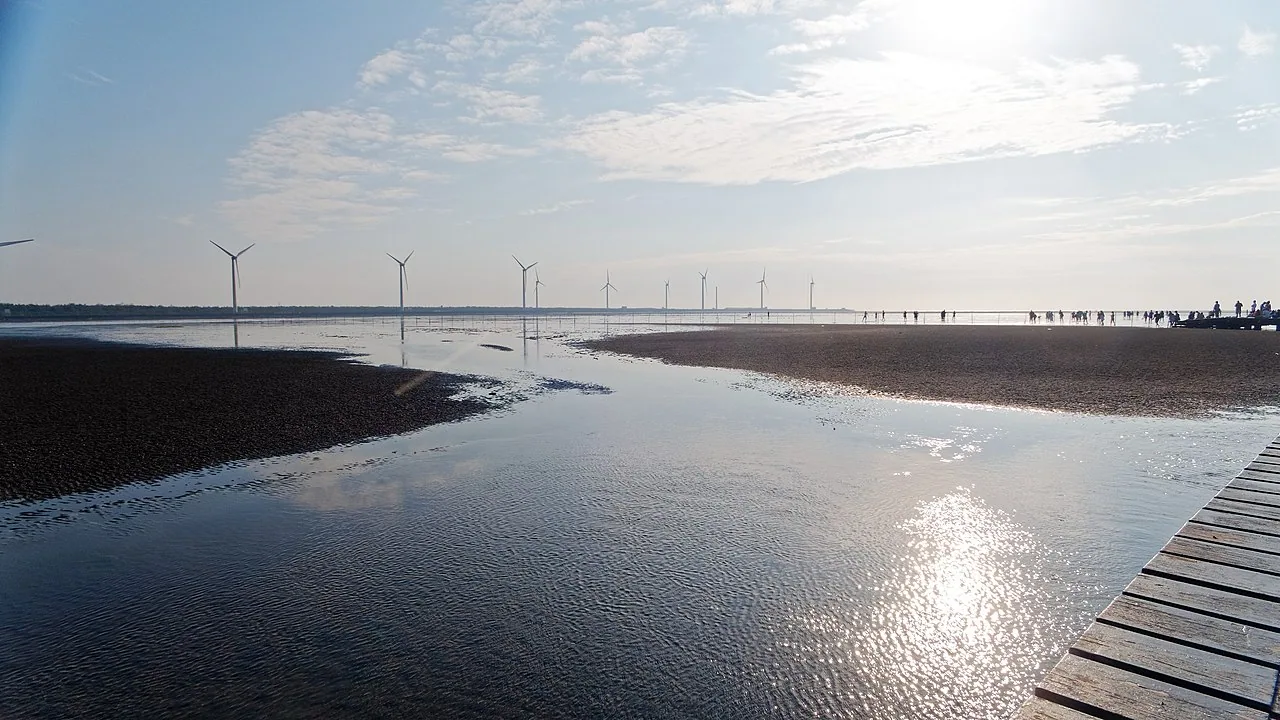
Gaomei Wetlands and Wind Turbines, 2018-05-11. Photo: Axjun, CC BY-SA 4.0 via Wikimedia Commons.
Heping District is the most special of the 29 districts. Area approximately 1,038 square kilometers, the largest in Taichung City, but population only about 10,000, it is Taichung City's only direct-administered city mountain indigenous district19. The Atayal Beishi group is distributed in villages like Sancha Keng, Shuangqi, Daguan, and Xueshan Keng. Further east to the upper Dajia River, the Huan Shan Village (Sqoyaw) "the largest Atayal village in the Lishan area, 177 households and 590 people at the end of 2023"19. Wuling Farm is at 1,750–2,200 meters altitude, collectively called with Qingjing and Fushou Mountain one of Taiwan's three major high-altitude farms, the trailhead for Xueshan Main Peak (3,886 meters).
From Qingshui District (sea level) to Huan Shan Village in Heping District (over 1,800 meters altitude), these 29 districts span the complete geological profile from sea to mountain. The Taichung City Government's official zoning divides it into three layers: Coastal Line 9 Districts (Da'an, Dajia, Waipu, Qingshui, Wujie, Shalu, Longjing, Dadu, Wuri); Plain Center 14 Districts (Zhong, Dong, Xi, Nan, Bei, Beitun, Xitun, Nantun, Fengyuan, Tanzi, Daya, Shengang, Dali, Taiping); Mountain East 5 Districts (Dongshi, Shigang, Xinshe, Wufeng, Heping)20.
Terrain determines political structure. The coastal line is the traditional "Black Faction" base; faction origins trace to 1951 when Chen Shui-tan ran for Taichung County Magistrate, "using black as the mark on all promotional business cards"21. Wufeng, Dali, and Taiping are the "Red Faction" base, originating from the Japanese colonial period Lin Family in Wufeng; when Lin Henian ran for the first Taichung County Magistrate, "red was used for promotion". The Red and Black factions alternated power in Taichung County for half a century, until 2001 when Yan Ching-biao, due to the incident of "using public funds for drinking and prostitutes, leading to search and investigation" while serving as Speaker, combined with the rise of the DPP, "the factional politics of Red-Black confrontation and alternation in Taichung County for half a century gradually declined"21.
But factions did not truly disappear. After the 2010 merger, the coastal line's Yan Ching-biao family still retained Legislator and Councilor seats; the Wufeng Red Faction reorganized under the new electoral district structure. In the November 24, 2018 Taichung Mayor election, Lu Siou-yen won 827,996 votes against Lin Chia-lung's 619,855, winning by approximately 200,000 votes22. She took the coastal line (traditional blue base) + mountain line (Dongshi, Fengyuan) + parts of the center, becoming "the first female direct-administered city mayor of Taichung City, and the first female KMT direct-administered city mayor." In 2022, Lu Siou-yen was re-elected, "setting an extremely high ceiling for Taichung Mayor elections".
A key explosion point of the 2018 election was the Taichung World Flora Exposition that just opened in November of that year. This expo was held in three parks: Houli, Waipu, and Fengyuan, from November 3, 2018 to April 24, 2019, totaling 173 days, receiving A2/B1 level certification from the International Association of Horticultural Producers (AIPH)23. The Lin Chia-lung government invested 16.7 billion in development budget for the expo; later financial controversies became the main axis of the election. The expo was originally a municipal performance report, but finally became an electoral liability.
📝 Curator's Note: The decline of factional politics does not equal disappearance. Writing about the half-century of Red-Black alternation in Taichung County, the focus is not on Yan Ching-biao personally; he is merely the representative of the Black Faction transforming into a modern brand. The focus is that Taichung County's electoral structure was long determined by the "Red Faction vs. Black Faction" axis, not the national Blue-Green opposition. It was not until Lu Siou-yen's sweep in 2018 that this axis was completely absorbed into the national Blue-Green opposition map. But the coastal line's Black Faction, Wufeng's Red Faction, Dongshi's Hakka vote bank, Heping's Atayal vote bank, each is still a recognizable sub-structure in Taichung City elections. Taichung City's political map reads like a topographic map: altitude, ethnicity, distance from the core metropolis, each geographic line corresponds to a political line.
The City That Waited 123 Years
In April 2026, Taichung City's population was 2,868,452, the second largest in Taiwan24. Second only to New Taipei City's 4.01 million, 390,000 more than the capital Taipei's 2.47 million. But the presence of the "second largest city" identity in popular narratives is significantly thinner than its population ranking.
The gap is that Taichung's history as the second largest direct-administered city is only 16 years old. Taipei upgraded to a direct-administered city in 1967, having been the capital for 43 years by 2010; Kaohsiung upgraded in 1979, having been for 31 years by 2010; Tainan, Taichung, New Taipei, and Taoyuan all upgraded in the 2010s. When Taipei and Kaohsiung already had complete direct-administered city governance experience, budget structures, and bureaucratic systems, Taichung was still processing the integration issues of the 29 districts.
Returning to October 1887, when Liu Ming-chuan petitioned for the provincial capital to be selected at Qiaozaitou. If that Bagua city had not been halted by Shao Youlian in 1894; if the provincial city had truly been completed; if it had not been ceded to Japan in 1895, would this Taichung Basin have directly become Taiwan's capital? History cannot be counterfactual, but this hypothesis adds a layer of thickness to the "Taichung almost became the capital" narrative: Taichung was once selected, but that city was not finished.
From 1887 to 2010, a full 123 years. Taichung waited over a century, transforming from an "unfinished provincial capital candidate" to the "second largest direct-administered city in Taiwan." In the process of waiting, this city grew strongholds for non-violent anti-Japanese resistance (1920s Central Bookstore and Chiang Wei-shui's People's Party), grew Taiwan's first modernist church (1963 Luce), grew the first national-level art museum (1988 NTMFA), grew the deepest Hakka wound after 921 (1999 Dongshi 358 deaths), grew the central node of the semiconductor axis (2003 Zhongke), grew the theater remembered by the global architecture community (2016 Toyo Ito).
None of these were in Liu Ming-chuan's 1887 plan.
✦ "Qiaozaitou, today's Taichung City center, was the site Liu Ming-chuan intended to select as the provincial capital." (Multiple historical records25)
Return to Dajia Jenn Lann Temple. On the early morning of the day the pilgrimage departs every lunar March, hundreds of thousands gather in front of Dajia Jenn Lann Temple from Taichung, Changhua, Yunlin, and Chiayi. Firecrackers, deity palanquins, believers, media SNG trucks. From Jenn Lann Temple to Xingang Fengtian Palace in Chiayi, and back, 9 days and 8 nights, 340 kilometers. This route, calculated from Lin Yongxing bringing the deity statue from Meizhou to Dajia in 1730, has been walked for 296 years; from the 1988 detour to Xingang, 38 years; from the 2010 Ministry of Culture designation as Intangible Cultural Asset, 16 years, exactly the same age as Taichung's direct-administered city status.
Every timeline has its own length. Taichung's problem has never been "why is the second largest city seen so late." Taichung's answer is: This city has never stopped growing new layers in its 138-year modernization process. From the Takao, to the Qing Qiaozaitou, to the Japanese Taichung Prefecture, to the post-war provincial city, to the 2010 direct-administered city, every layer presses the memory of the previous layer. 2.86 million people live in a city accumulated over 138 years.
Next time you pass through Taichung, do not just go to the Sun Cake old shops and Fengqian Night Market. Try this route: early morning go to Dajia Jenn Lann Temple to see Mazu's incense; noon walk the 340-meter fault belt at the 921 Earthquake Museum of Taiwan at Guangfu Middle School in Wufeng; afternoon go to Dadu Mountain to see the Luce Memorial Chapel's double-curved surfaces; evening listen to a performance in the National Taichung Theater's curved walls in Xitun; night buy a book at Central Bookstore on Jiguang Street. After completing this route, you will remember one thing: Taichung waited 123 years to become the second largest direct-administered city, but it has never been absent from Taiwan's modern history.
Further Reading
Taiwan Musical Instrument Manufacturing Industry: Taiwan's Hand in the World's Sound — The Houli saxophone cluster and Wufeng Music Bell are Taichung's precision and music geography outside of industry
Keelung City — 22 Counties and Cities Series pilot: from the world's 7th largest container port in 1984 to the 113th port in 2018, a county-city whose "administrative status was seen and then rewritten," same as Taichung
Nantou County — 22 Counties and Cities Series batch 3 sibling: the only county without a sea, the 921 epicenter is in its center, sharing the Chelungpu Fault trauma with Taichung
Changhua County — 22 Counties and Cities Series batch 4 sibling: 1709 Babao Canal irrigating the central region, 1786 Lin Shuangwen Incident, 1986 Lukang people driving away DuPont, belonging to the same Baguashan Mountain central region life circle as Taichung
Yunlin County — 22 Counties and Cities Series batch 4 sibling: Dajia Mazu Pilgrimage passes through Xiluo, Huwei, and Tukou, the middle section of the same Mazu route as Taichung
Chiayi City — 22 Counties and Cities Series batch 2 sibling: the endpoint of the Dajia Mazu Pilgrimage, Xingang, is in Chiayi County, the two ends of the same 340km religious route as Taichung
Miaoli County — 22 Counties and Cities Series batch 1 sibling: the northern neighbor county, a Hakka stubborn and county treasury debt inland county, forming the central Hakka map together with Taichung's coastal line Qingshui and mountain Dongshi
Taiwan Administrative Divisions — Complete institutional history: 1887 Taiwan Prefecture established in Taichung, 1920 Taichung Prefecture, 1945 County and City separated, 2010 County and City merged to become direct-administered city
City Characteristics and Regional Culture — Cross-county comparison context of Taichung as the hub of the central life circle
Image Sources
This article uses 5 Wikimedia Commons CC licensed images, hot-linked from the Wikimedia upload server:
- Hero (frontmatter): National Taichung Theater 20180317 — National Taichung Theater exterior, 2018-03-17. Photo: Wikimedia Commons contributor, CC BY-SA 4.0.
- Scene §The Deity in Lin Yongxing's Home (Dajia Jenn Lann Temple): Front of Dajia Jenn Lann Temple — Dajia Jenn Lann Temple front, 2018-08-04. Photo: Dquai, CC BY-SA 4.0.
- Scene §The Church on Dadu Mountain with No Beams or Columns (Luce Memorial Chapel): Luce Memorial Chapel — Luce Memorial Chapel, 2021-05-16. Photo: ChiaWeiHo, CC BY-SA 4.0.
- Scene §The Chelungpu Fault Tearing to Dongshi (921 Museum): 921 Earthquake Museum of Taiwan 2024-09-21 — 921 Earthquake Museum of Taiwan, 2024-09-21. Photo: Liu Shu-fu / Office of the President, CC BY 2.0.
- Scene §29 Districts Spanning from Sea to Mountain (Gaomei Wetlands): Gaomei Wetlands and Wind Turbines — Gaomei Wetlands and Wind Turbines, 2018-05-11. Photo: Axjun, CC BY-SA 4.0.
License Terms: CC BY-SA 4.0 / CC BY 2.0.
References
- Liu Ming-chuan — Wikipedia — Wikipedia Chinese edition. October 1887 Liu Ming-chuan and Min-Zhe Governor Yang Changjun jointly petitioned to re-plan Taiwan's administrative divisions, selecting Qiaozaitou (now Taichung) in Changhua County as the provincial capital; "The method of construction, prioritizing terrain; the method of governance, prioritizing balance" principle; complete record of the three prefectures and one department administrative system.↩
- Taichung City History — Wikipedia — Wikipedia Chinese edition. 1887 Liu Ming-chuan planned the Bagua-shaped city in Lanxingbao; 1896 established Taichung County; 1901 changed to Taichung Department; 1920/10/01 established Taichung Prefecture merging Nantou Department; "Taichung Street and nine surrounding villages merged to form Taichung City"; 1920s non-violent anti-Japanese resistance stronghold; Chiang Wei-shui's Taiwan People's Party established in Taichung; complete administrative history.↩
- Luce Memorial Chapel — Wikipedia — Wikipedia Chinese edition. 1956 I.M. Pei and Chen Chi-kwan collaborated on design; 1962 construction started; 1963/11/02 completed; commemorating missionary Henry Winters Luce; "the first work of modernist architectural vocabulary to enter Taiwan"; double-curved thin-shell structure; 2019/04 upgraded to National Monument; complete record of I.M. Pei and Chen Chi-kwan design rights controversy.↩
- 921 Earthquake — Wikipedia — Wikipedia Chinese edition. 1999/09/21 01:47:15.9, Chelungpu Fault, Richter 7.3, epicenter Jiji, depth 8km, 2,415 deaths nationwide, Taichung County 1,154 deaths, 16,861 houses completely destroyed, 12,341 partially destroyed; Dongshi Town 358 deaths highest; Shigang Dam fractured, 15th-18th spillway gates sank 5 meters; Nantou and Taichung counties accounted for 95% of Taiwan's damaged households; complete data.↩
- National Taichung Theater — Wikipedia — Wikipedia Chinese edition. 2001/10 Bureau of Cultural Affairs approved; 2005 international competition Toyo Ito first prize; 2009/12/03 construction started; 2014/11/23 Ma Ying-jeou and Hu Chih-chiang completion ribbon cutting; 2016/09/30 Vice President Chen Chien-jen opening; construction cost NT$4.36 billion; Grand Theater 2,007 seats, Medium Theater 794 seats, Small Theater 200 seats; "designing the Sound Cave using the most primitive human concepts of 'treehouse' and 'cave'; 58 curved walls, 79,576 small concrete panels; complete engineering and design history.↩
- Dajia Xishe Anti-Qing Uprising — Wikipedia — Wikipedia Chinese edition. 1731 (9th year of Yongzheng) Dajia Xishe headman Lin Wuli uprising; burned the Tainan Prefecture Fumin Tongzhi Yamen; lasted seven months; Qing court mobilized over 6,000 mainland soldiers to use "aborigines to subdue aborigines" to quell; largest armed anti-government event in the history of Taiwan's Pingpu peoples; complete historical record.↩
- Takao — Wikipedia — Wikipedia Chinese edition. Distributed in "the coastal plain area from Taichung City through Miaoli County to Hsinchu County"; Dajia Xishe Anti-Qing Uprising; Papora Middag Kingdom; Babuza distributed south of Dadu River; three ethnic groups' collective migration to Puli Basin; Pingpu ethnography data.↩
- Dajia Jenn Lann Temple — Wikipedia — Wikipedia Chinese edition. 1730 (8th year of Yongzheng) Meizhou person Lin Yongxing brought Mazu deity statue to Taiwan; 1732 (10th year of Yongzheng) gentry built small shrine; 1770 (35th year of Qianlong) rebuilt as Tianhou Palace; 1787 (52nd year of Qianlong) Dajia branch Zong Jinting et al. initiated land donation for reconstruction renamed Jenn Lann Temple; complete temple building history.↩
- Dajia Mazu Pilgrimage and Incense Offering — Wikipedia — Wikipedia Chinese edition. 9 days 8 nights, 340 kilometers round-trip on foot, crossing Taichung, Changhua, Yunlin, Chiayi 4 counties, passing over 100 temples, 21 townships/cities, over 100,000 participants annually; 2010 Bureau of Cultural Affairs designated as National Important Folklore; Discovery rated as one of the world's three major religious events; complete pilgrimage data.↩
- Jenn Lann Temple 1988 Detour to Xingang — Cultural Resources Geographic Information System, Academia Sinica — Academia Sinica CRGIS Dajia Jenn Lann Temple entry. 1987 Meizhou ancestral visit; 1988 incense destination changed to Xingang Fengtian Palace; divergence in religious status cognition between "Ancestral Visit (returning to natal home)" and "Incense Exchange"; renaming to "Pilgrimage and Incense Offering" continuing to present; complete temple politics turning point record.↩
- Central Bookstore — Wikipedia — Wikipedia Chinese edition. 1926/06/30 founding assembly at Zuiyue Lou by Green River in Taichung; 1927/01/03 officially opened; founded by Zhuang Chuisheng; shareholders "Lin Hsien-tang, Lin Youchun, Chen Xugu, Zhang Shenkai, Lai He," etc.; originally planned as "Central Club for Taiwan Cultural Association's central Taiwan gatherings"; "first bookstore in central Taiwan specializing in importing Chinese and Japanese books and magazines, and the largest Chinese-language bookstore on the island in scale"; 1998 closed due to financial difficulties; 2020/01 Shangshan Humanities Foundation reopened; complete bookstore history.↩
- Providence University — Wikipedia — Wikipedia Chinese edition. 1953/11/11 US Vice President Nixon ground-breaking ceremony; 1955/11/02 founding dedication ceremony as anniversary; first president Tseng Yueh-nong; "one of the US Christian overseas missionary projects, closely integrated with US aid to Asia and the Cold War policy of containing communism"; Asia Council on Christian Higher Education founded; complete founding history.↩
- Taichung City Hakka Culture — Hakka Affairs Council Taiwan Hakka Census — Executive Yuan Hakka Affairs Council Taiwan Hakka Census data. Dongshi District Hakka population approx 80%; local lingua franca is Taiwanese Hakka Dabu dialect; Dongshi District is Taichung City's largest Hakka settlement; Shigang District Hakka from Dabu County migrated to cultivate in late Kangxi period; Xinshe District is Taichung City's second largest Hakka settlement; complete ethnic distribution record.↩
- Zhongheng Highway Gukuan Section Post-921 Closure — Highway Bureau — Ministry of Transportation and Communications Highway Bureau official record. Post-921 earthquake Gukuan to Deji section slope collapse mileage reached over 80%; roadbed completely lost in 26 locations; 2018/11/16 Tongxiao section bus service resumed; 2024 Executive Yuan approved Qingshan Lower Line reconstruction plan total cost NT$20.6 billion; expected completion 2037; complete rescue record.↩
- Chelungpu Fault — Central Geological Survey — Ministry of Economic Affairs Central Geological Survey Chelungpu Fault official data. Northern section from Miaoli Zhuolan along Dajia River and Wuxi River basin extends south, cutting through Taichung County foothills (Dongshi, Shigang, Dali, Taiping, Wufeng); southern end to Nantou Zhushan Tongtou, then turning to Chiayi Zhongpu. 1999/09/21 ruptured from Jiji Town underground middle section extending north 100km, crossing Taichung County townships; complete fault belt geological record.↩
- Central Taiwan Science Park — Wikipedia — Wikipedia Chinese edition. 1999 NSTC "Research on Overall Environmental Analysis for Establishing Science Parks"; 2001/05 Executive Yuan passed "Green Silicon Island Construction Blueprint"; 2001 Dadu Mountain and Huwei base selection; 2002/09/23 Executive Yuan approved planning plan; "from planning plan approval to construction start was only 10 months and 5 days"; 2003/07/28厂商 moved in; 2004/10/27 AU Optronics mass production; 2005/06/27 Houli Park approved; 2009/11/16 Erlin Park approved; complete timeline.↩
- National Taiwan Museum of Fine Arts History — National Taiwan Museum of Fine Arts — NTMFA official history page. 1988/06 Taiwan Provincial Museum of Fine Arts completed and opened; "opened with ceremonies by Taiwan Provincial Governor Chiu Chuang-huan and Taiwan Provincial Department of Education Director Chen Zhuomin"; 1980/02/08 Governor Lin Yanggang decision to establish; 1999 post-streamlining transferred to Bureau of Cultural Affairs renamed "National Taiwan Museum of Fine Arts" "becoming the first national-level art museum in the country"; complete transformation history.↩
- Republic of China Administrative Divisions — Wikipedia — Wikipedia Chinese edition. 2010/12/25 Taichung County and City merged; New Taipei City upgraded; Tainan County and City merged; Kaohsiung County and City merged upgraded to direct-administered cities same day; Taoyuan 2014/12/25 upgraded to direct-administered city; complete county-city upgrade record.↩
- Heping District (Taichung City) — Wikipedia — Wikipedia Chinese edition. Taichung City largest district (1,038 sq km); population approx 10,000; Taichung City's only direct-administered city mountain indigenous district; Atayal Beishi group Sancha Keng Shuangqi Daguan Xueshan Keng villages; Huan Shan Village Sqoyaw upper Dajia River "largest Atayal village in Lishan area, 177 households 590 people at end of 2023"; Wuling Farm altitude 1,750-2,200 meters one of three major high-altitude farms; Xueshan Main Peak 3,886 meters trailhead; complete geographical and humanistic data.↩
- Taichung City Administrative Divisions — Taichung City Government — Taichung City Government official zoning data. 29 Districts; Coastal Line 9 Districts (Da'an, Dajia, Waipu, Qingshui, Wujie, Shalu, Longjing, Dadu, Wuri); Plain Center 14 Districts (Zhong, Dong, Xi, Nan, Bei, Beitun, Xitun, Nantun, Fengyuan, Tanzi, Daya, Shengang, Dali, Taiping); Mountain East 5 Districts (Dongshi, Shigang, Xinshe, Wufeng, Heping); complete three-layer geological administrative zoning.↩
- Taichung Local Factions — The News Lens — The News Lens Taiwan local factions deep report. Red Faction origin Wufeng Lin Family; Lin Henian ran for first Taichung County Magistrate "used red for promotion"; Black Faction Chen Shui-tan 1951 "business cards on promotional materials all used black as mark"; Yan Ching-biao 1999 while serving as Speaker "used public funds for drinking and prostitutes, leading to search and investigation"; "Taichung County Red-Black confrontation, Red-Black alternation for half a century factional politics gradually declined"; 2001 DPP rise; complete faction history.↩
- 2018 Republic of China Direct-Administered City Mayor Elections — Wikipedia — Wikipedia Chinese edition. 2018/11/24 Lu Siou-yen 827,996 votes vs Lin Chia-lung 619,855 votes winning by 200k; "first female direct-administered city mayor of Taichung City, and first female KMT direct-administered city mayor"; 2022 re-election "setting an extremely high ceiling for Taichung Mayor elections"; complete election data.↩
- 2018 Taichung World Flora Exposition — Wikipedia — Wikipedia Chinese edition. 2018/11/03-2019/04/24 total 173 days; "certified and authorized by International Association of Horticultural Producers as A2/B1 level international horticultural expo"; Houli Horse Race Forest Park 30.04 hectares (Ecology Nature natural symbiosis); Waipu Park 14.32 hectares (Production Green green sharing); Fengyuan Huludun Park 16.52 hectares (Life People人文共好 only free); complete exhibition period and three-park data.↩
- Taichung City Population Statistics — Taichung City Civil Affairs Bureau — Taichung City Civil Affairs Bureau official population statistics. April 2026 Taichung City population 2,868,452; Taiwan's second largest city (second to New Taipei City 4.01 million); 29 districts monthly statistics updated synchronously in Wikipedia Taichung City entry latest data.↩
- Shao Youlian — Wikipedia — Wikipedia Chinese edition. 1891 succeeded as Taiwan Governor; "after evaluating gains and losses, pragmatically canceled most new policy measures"; "provincial city construction started in 1889, but after Shao Youlian succeeded as Governor, he ordered the provincial city work halted, and officially moved the provincial capital to Taipei Prefecture"; 1894 Sino-Japanese War; acting Hunan Governor; complete decision history of provincial capital northward shift.↩