
30-second overview: On May 22, 1874, Japanese army lieutenant colonel Sakuma Samata led 150 men into the Shimen gorge, where Paiwan Mudan community chief Aruqu and his son were killed in battle that same day. This fight made the Qing court reverse its Taiwan policy: Shen Baozhen came to establish Hengchun County, abolished the ban on crossing to Taiwan, and built Eluanbi Lighthouse in 1883. Some 780,000 people live across Pingtung County's 33 townships, towns, and cities: five Indigenous peoples (49,643 Paiwan, 2,100 Rukai, plus Makatao, Puyuma, and Amis) live alongside the six Hakka Liudui townships, Hoklo, and postwar mainlander communities. Then, at 4:30 a.m. on August 8, 2009, the Linbian floodgate could no longer hold, and Linbian and Jiadong townships sat in seawater for nearly a month. The history that changed Taiwan began from this peninsula twice, but in the capital's mainstream narrative only Kenting Spring Scream and Pacific bluefin tuna remain.
Donggang at 5:30, Every April to June
If you ask someone from Pingtung when Pingtung is at its most captivating, they probably will not say Kenting Spring Scream (Spring Scream belongs to the tourists). They may tell you: every April to June, at the Donggang auction market.
Pacific bluefin tuna migrate through the Bashi Channel during these months each year to spawn, when they are "at their fattiest"1. At the peak in 1999 and 2000, Donggang's catch exceeded 10,000 fish, and "the annual bluefin tuna catch accounted for 60 to 70 percent of Taiwan's total"1. Then it collapsed in 2010: the catch fell below 1,000, to just 998 fish1.
But on April 21, 2026, the "first tuna" was auctioned off. The 2.14-meter, 190-kilogram bluefin sold for a record-high unit price of NT$10,600 per kilogram, for a total of NT$2.014 million2. The captain of the boat that caught it, Fu Yu Qing No. 2, was 67-year-old Hong Fu-jia. It took sixteen years to climb back from the 2010 trough.
This is the most contemporary evidence of Pingtung as a fishing county. Kenting Spring Scream's May glory belongs to tourism; but at Donggang's 5:30 a.m. auction market, every fish that moves from the Bashi Channel to the tables of Taipei Japanese restaurants passes through a transaction that happens at this time every year. Before the capital eats this tuna, Pingtung people have already called its price at auction.
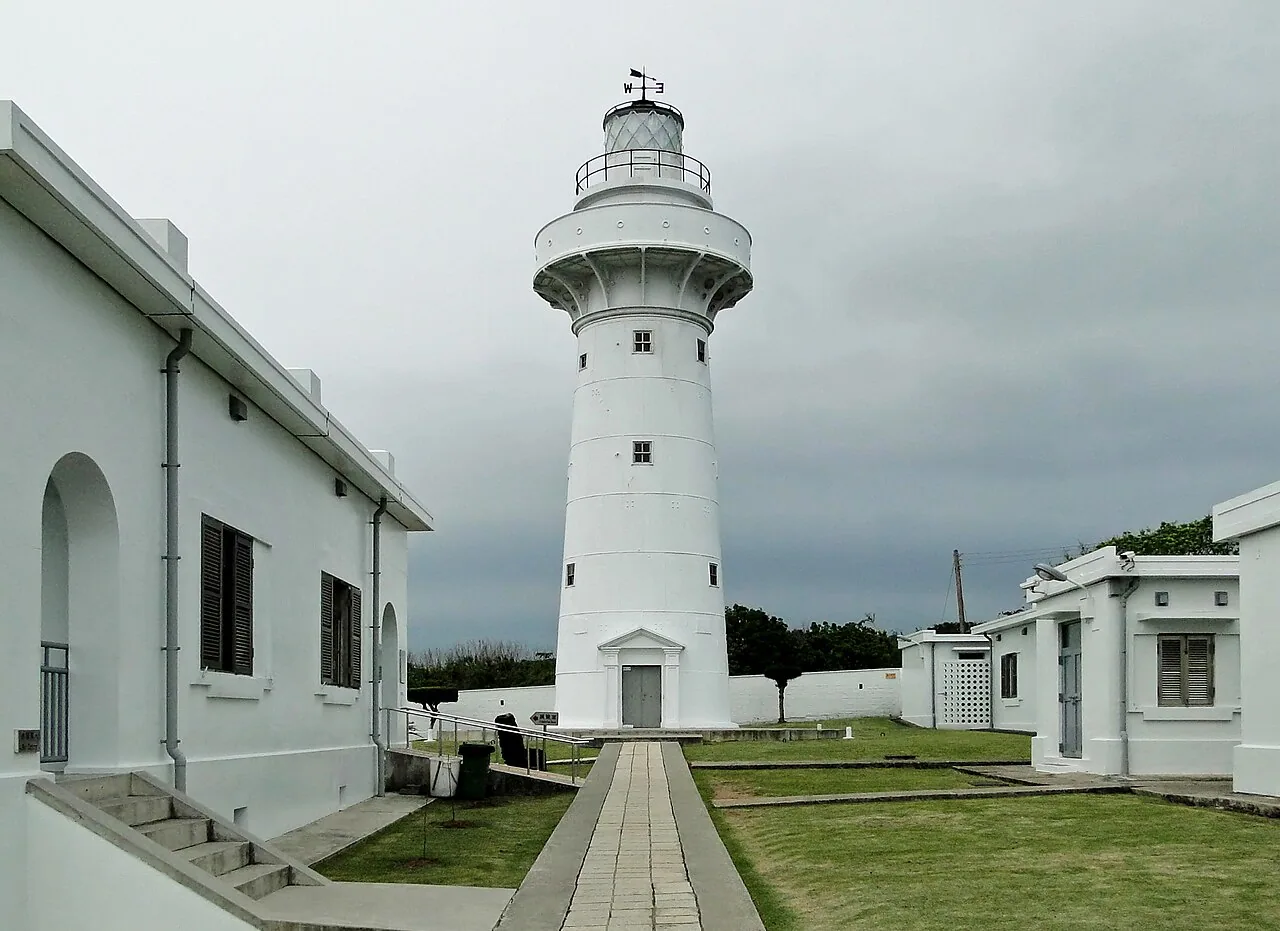
Eluanbi Lighthouse, 2011-06-06. Photo: Bernard Gagnon, CC BY-SA 3.0 via Wikimedia.
The Ambush in the Shimen Gorge
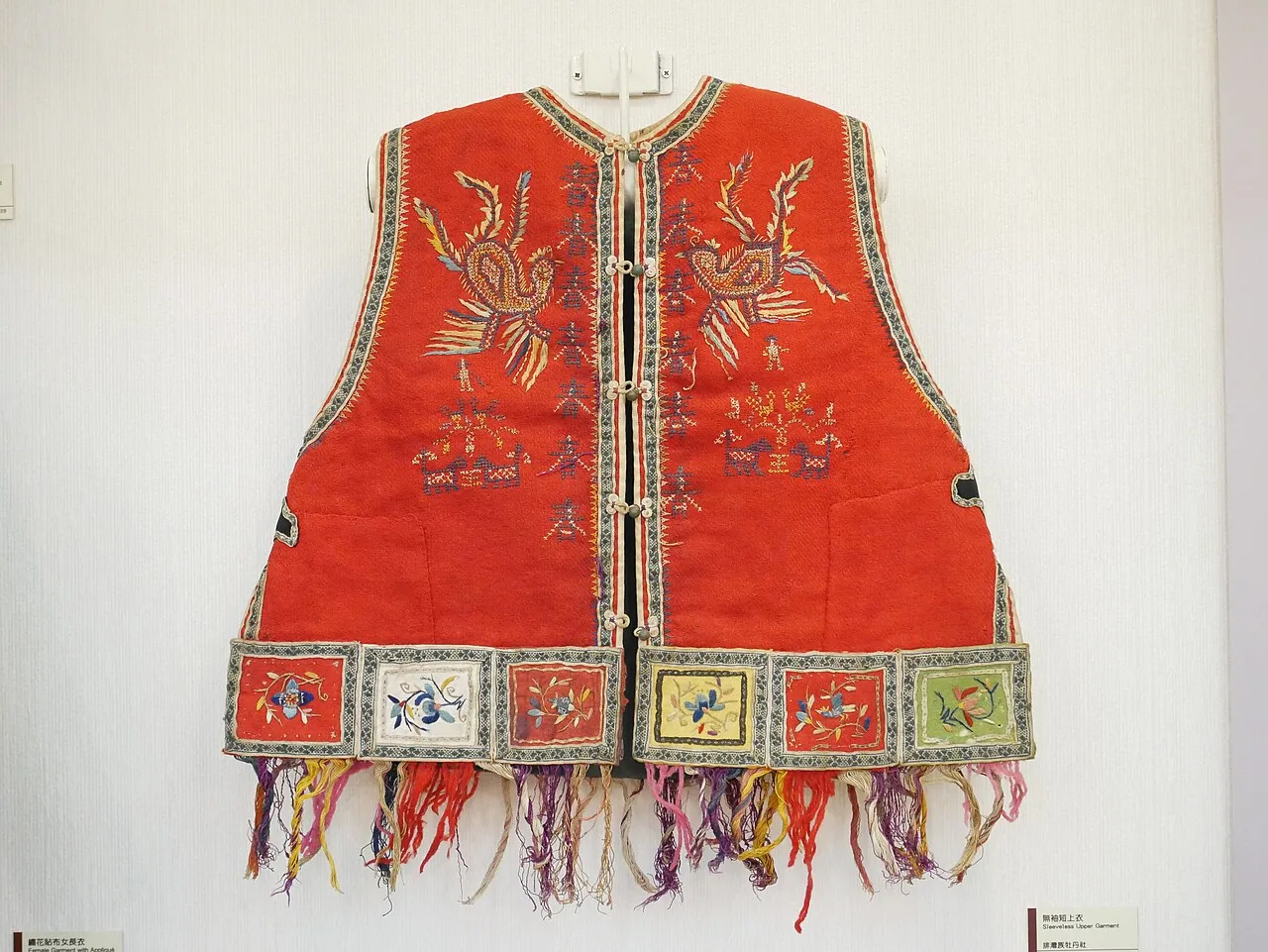
Sleeveless short upper garment from the Paiwan Mudan community, National Taiwan University collection, 1956. Photo: 氏子, CC BY-SA 4.0 via Wikimedia.
The moment when the Pingtung peninsula changed Taiwan's fate happened at another time besides 4:30 in the morning: May 22, 1874, in the Shimen gorge.
The prelude goes back three years. On October 18, 1871, a tribute vessel from Miyakojima was returning from Naha when it was driven off course by a typhoon and reached Bayao Bay in southeastern Taiwan, around today's Jiupeng Bay in Manzhou Township, Pingtung County. Of the 69 Miyakojima passengers on board, 3 drowned and 66 landed. After landing, they mistakenly entered the territory of the Paiwan Kuskus community; 54 were killed in a headhunting incident, while another 12 were escorted to Taiwan Prefecture with help from Han Chinese residents Yang You-wang and Yang A-cai3. Multiple sources point out that the killings resulted from "a misunderstanding caused by language barriers, not one side's simple bloodthirstiness"3. The Paiwan had a headhunting tradition and misunderstood the intentions of those who had landed.
Japan used this as its pretext. Combined with the Qing court's diplomatic blunder in replying that "raw savages are not under Great Qing rule," Japan formed an expeditionary force under Saigo Tsugumichi as governor-general of the Bureau of Aboriginal Affairs. On May 8, 1874, Japanese forces landed at Sheliao, today's Sheliao Village in Checheng Township, Pingtung County3.
On May 22, Japanese army lieutenant colonel Sakuma Samata led 150 men to Shimen, today's Shimen Village in Mudan Township, Pingtung County; in Paiwan, macacukes, meaning "mutual support." Paiwan fighters had prepared an ambush and mounted fierce resistance, but were outmatched in equipment. Japanese marines climbed the cliffs and occupied the high ground. Mudan community chief Aruqu and his son died in this battle3.
What followed was village burning. "After victory in the Battle of Shimen, Japanese forces advanced on the Mudan and Kuskus communities, set fire to houses, and the people fled in panic in all directions"4. On July 1, Mudan and other communities surrendered. On October 31, the Qing court and Japan signed the Sino-Japanese Beijing Treaty. Its first article stated plainly: "What Japan has done on this occasion was originally a righteous act to protect its people, and Qing China does not indicate that it was wrong"3. The Qing court also paid Japan 500,000 taels of silver in the name of "purchasing the houses and roads built by the Japanese army." On December 20, Japanese forces fully withdrew from Taiwan.
In this campaign, 12 Japanese soldiers were killed in battle and 561 died of disease3. Tropical disease was far deadlier than Paiwan spears. But battlefield victory and defeat were not the side of this war that truly changed Taiwan.
How That Battle Changed Taiwan
After the Mudan Incident, the Qing court's attitude toward governing Taiwan completely flipped. It appointed Shen Baozhen as imperial commissioner to push "opening the mountains and pacifying the aborigines." The southern route ran from Sheliao in Pingtung all the way to Beinan in Taitung, 214 li in total5. At the same time, the court abolished the ban on crossing to Taiwan, ending the two-century policy that required migrants from Fujian and Guangdong to hold permits to come to Taiwan; established the walled Hengchun county seat; renamed Jilong as Keelung in 1875; formally created Taiwan Province in 1885; and made Liu Mingchuan its first governor.
In other words: the Mudan Incident was Japan's first military probe of Taiwan, and it was also the point at which the Qing court truly began investing in the governance of Taiwan. The prelude to Japan taking Taiwan in 1895 was written during those few months on the Pingtung peninsula in 1874.
📝 Curator's note: The conventional narrative of Taiwanese history places the "beginning of Japanese rule" at the 1895 Treaty of Shimonoseki. But that narrative cuts the chain of causality. The answer to whether Japan should take Taiwan had already been tested on the Pingtung peninsula in 1874. They sent 3,600 people, circled for half a year, and learned three things: the Qing court would withdraw, would pay money, and would tacitly acknowledge the result. Taking Taiwan after the First Sino-Japanese War in 1895 was a lesson learned in Mudan Township 21 years earlier, not an offhand decision. The Pingtung peninsula was the entrance to Japan's 50 years of rule over Taiwan, not a periphery merely caught up in events. Open most Taiwanese history textbooks and 1874 takes up half a page, while 1895 takes up an entire chapter. The half-page and the chapter are in fact the two causal ends of the same event.
That Church from 1861, 21 Years Before Oxford College
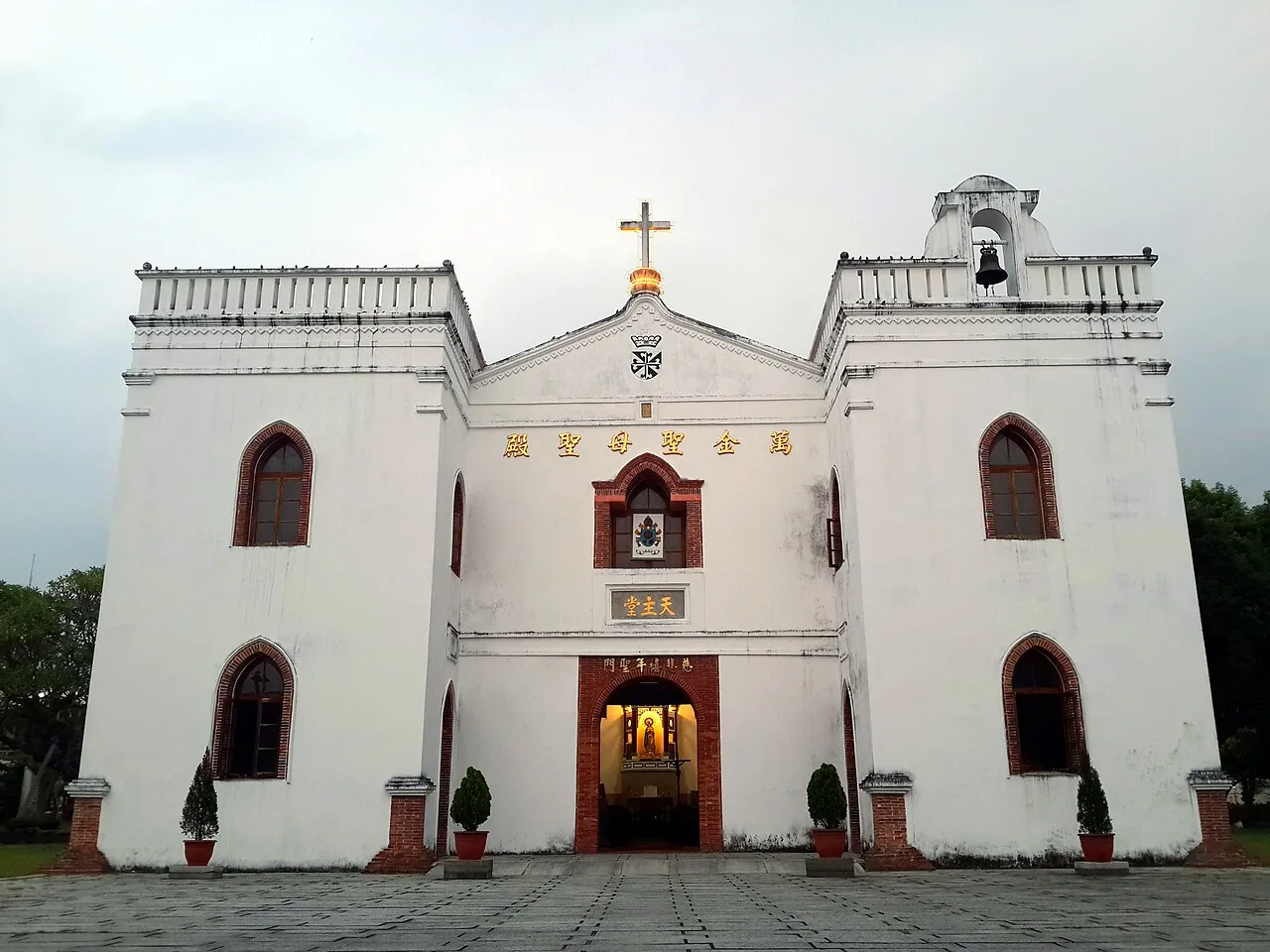
Wanchin Catholic Church, Wanchin Basilica of the Immaculate Conception. Photo: WEI WAN-CHEN, CC BY-SA 4.0 via Wikimedia.
Go 50 kilometers north and you encounter another moment omitted by central narratives.
At the end of 1861, the Spanish Dominican Father Fernando Sainz and catechist Yang Du "trekked more than 60 li and arrived at Wanjin Village in Wanluan, Pingtung"6. In May 1863, they purchased land in Wanjin and built an adobe church. In November of the same year, Father Sainz was robbed on the road after sedan-chair bearers colluded with bandits; before long the church was also burned down. They "snuck into the church in the middle of the night and set it on fire, reducing the entire church to ashes"6. The cause was a conflict over nearby Hakka settlements' demand that Catholics share the expenses of local deity processions and festivals.
A second attempt came in 1869, when Father Francisco Giner purchased land at the current site and rebuilt. The church opened on December 8, 1870, the Catholic feast of the Immaculate Conception6. In 1874, the same year Japanese troops landed, the Tongzhi Emperor granted stones inscribed "By Imperial Decree" and "Catholic Church," which Shen Baozhen personally delivered to Wanchin Church. In 1984, Pope John Paul II designated the church a basilica; today, "approximately 80 percent of Wanjin Village's population believes in Catholicism"6.
The weight of this date becomes clear only by placing it side by side with another: Wanchin Church began missionary work in 1861, a full 21 years before George Leslie Mackay built Oxford College in Tamsui in 1882. The mainstream narrative of Christianity in Taiwan is a Presbyterian story of "Mackay in the north, Barclay in the south." But in reality, a small Spanish Dominican village church had already written the first passage in Wanluan, Pingtung, while Mackay was still studying in Canada.
Wanchin Basilica still stands today, and its annual Marian procession every December is Pingtung's largest Catholic event. Wanjin, a Hakka village where 80 percent of the population is Catholic, sits deep inside Taiwan's largest Hakka settlement region. This is not the kind of thing central narratives remember.
49,000 Paiwan, 2,100 Rukai
Pingtung County has the most complex ethnic structure of any county in Taiwan. Five Indigenous peoples, the Hakka Liudui, Hoklo, and postwar mainlander communities share a population of 780,0007. But the phrase "five peoples living together" is too thin; one has to look at the actual distribution.
The Paiwan are mainly distributed across the northern Paiwan areas of Wutai, Majia, and Taiwu townships, and the southern Paiwan areas of Chunri, Shizi, and Mudan townships, plus Laiyi and Sandimen townships. Around 49,643 Paiwan were registered in Pingtung County at the end of 20238. Their representative material culture is the slate house, built with slate and shale, with roofs laid to imitate the scales of the hundred-pacer snake; these houses are mainly found in Sandimen, Majia, Taiwu, Laiyi, and Chunri. Their representative spiritual culture is the Five-Year Ceremony, maljeveq, in Paiwan, the "covenant ceremony between humans and spirits." It is held once every five years and lasts around 15 days, including a ball-spearing ritual in which participants use long spears to pierce ceremonial balls and welcome the ancestral spirits8. The Paiwan believe the ancestral spirits, qumaljeveq, live on Mount Beidawu and descend every five years to visit their descendants.
The Rukai are mainly in Wutai Township, including the Dawu, Wutai, Jiamu, Shenshan, and Jilu communities. Pingtung County's Rukai population is around 2,100, out of about 13,000 Rukai across Taiwan9. Their slate-house construction resembles that of the Paiwan but differs in detail: there are two doors rather than the Paiwan's one, the forecourt is richer, and the arrangements of slate tables, chairs, and screens are different. Their cultural symbol is the clouded leopard, Tagarawsu in Rukai. The old Kucapungane, or Kochapogan, community is a national monument and Taiwan's only Indigenous settlement included in the World Monuments Fund's World Monuments Watch, selected in 20169.
Mount Beidawu, elevation 3,092 meters, Kavulungan in Paiwan and Tagarawsu in Rukai, is a sacred mountain shared by the two peoples. It is also the southernmost mountain in the Central Mountain Range above 3,000 meters10. The Dawushan Nature Reserve contains protected animals including the Formosan black bear, Swinhoe's pheasant, Mikado pheasant, mountain hawk-eagle, maroon oriole, hundred-pacer snake, and golden birdwing butterfly, as well as rare plants such as the Taiwan cow-tail fir and Keteleeria davidiana var. formosana11.
The Makatao are the Plains Indigenous people of the Pingtung Plain. They were once divided into the Eight Communities of Fengshan: east of the Donggang River were the Jiateng, Lili, and Fangsuo communities, while west of the river were Talou, Wuluo, Xiadanshui, and others12. Large-scale Sinicization took place in the mid-to-late Qing period, and today most have been absorbed into Hoklo communities. But the Plains Indigenous name-rectification movement continues, and community members stress: "I am called Makatao, not Pingpu"12. A distinctive feature of Makatao belief is the "jar deity": small wine bottles wrapped entirely in red cloth, similar to the Siraya pot-veneration tradition.
The Puyuma and Amis are minorities in Pingtung County, mostly distributed around Manzhou Township7.
Pingtung County has eight mountain Indigenous townships: Sandimen, Wutai, Majia, Taiwu, Laiyi, Chunri, Shizi, and Mudan, the most in the country. But the combined population of the eight mountain townships "accounts for only 5.5 percent of the county's total." By contrast, Pingtung City alone has nearly 200,000 people, four times the combined population of those eight mountain townships13. The urban-rural gap is severe. This is the physical structure on the underside of the "most diverse" framing. Pingtung County's aging index was 163.8 in 2019, the fourth oldest in the country, and farm households accounted for 32.67 percent of the county's population14.
Liudui Was Organized During the 1721 Armed Conflict
Head south from Pingtung City, and six Hakka townships are scattered along the Gaoping and Donggang river basins. Together with Meinong, Liugui, and Shanlin, now incorporated into Kaohsiung City, these townships are called the Liudui, or "Six Units." Of Taiwan's two major centers of Hakka yimin, or righteous militia, faith, the northern one is Baozhong Yimin Temple in Hsinchu, and the southern one is here.
In 1721, the sixtieth year of the Kangxi reign, Zhu Yigui rose in rebellion against the Qing in Tainan. Hakka settlers in the Xiadanshui River basin developed a "sense of crisis": after Zhu Yigui and Du Junying became caught in a "Fujianese-Guangdongese conflict" in the prefectural capital, Hakka villages feared being dragged in. In May, they joined more than 10,000 people from thirteen large villages and sixty-four small villages to organize a self-defense righteous army. They "jointly elected Li Zhisan as general manager and divided into six groups, or Liudui, to defend their hometowns"15.
The Liudui units correspond to today's administrative areas as follows[^13]: the Right Unit is Meinong, Liugui, and Shanlin districts in Kaohsiung, which belonged to Pingtung during the Qing period and were incorporated into Kaohsiung after 1945; the Left Unit is Xinpi and Jiadong townships in Pingtung County; the Front Unit is Changzhi and Linluo townships; the Rear Unit is the western half of Neipu Township; the Central Unit is Zhutian and Yanpu townships; and the Vanguard Unit is Wanluan Township. The Hakka people still living in these six townships today are direct descendants of that 1721 righteous army.
After the Zhu Yigui Incident, the Kangxi Emperor bestowed a plaque reading "Cherishing Loyalty," which is enshrined today at Zhutian Zhongyi Shrine15. The imperial inscription bestowed on the Yimin Temple in Hsinchu in the north was "Commending Loyalty," originating from the Lin Shuangwen Incident of 1786, 65 years later than Liudui. Taiwan's two major Hakka yimin faiths share a root, but their event backgrounds and historical narratives each have their own emphasis.
✦ "In May of the sixtieth year of Kangxi, amid the struggle between Zhu Yigui and Du Junying, the 'Fujianese-Guangdongese conflict' that occurred in the prefectural capital triggered a sense of crisis among Hakka settlers in the Xiadanshui River basin who were unwilling to join the uprising. The Hakka settlers of the Liudui area therefore joined in May with more than 10,000 people from the local thirteen large villages and sixty-four small villages." (Wikipedia entry "Liudui"15)
Wanluan, the Vanguard Unit, is best known today for Wanluan pork knuckles; Zhutian and Neipu are dotted with preserved Hakka huofang, or three-sided courtyard houses. Wanchin Basilica sits in Wanluan Township, the Vanguard Unit. A small Spanish Dominican village church was built on the land of the oldest unit of the Hakka Liudui, and that overlap has its own historical logic. Wanluan in the 1860s was one of the most complex multilingual ethnic frontiers in all of southern Taiwan at the time.
Eluanbi 1883, Hengchun Old City 1879
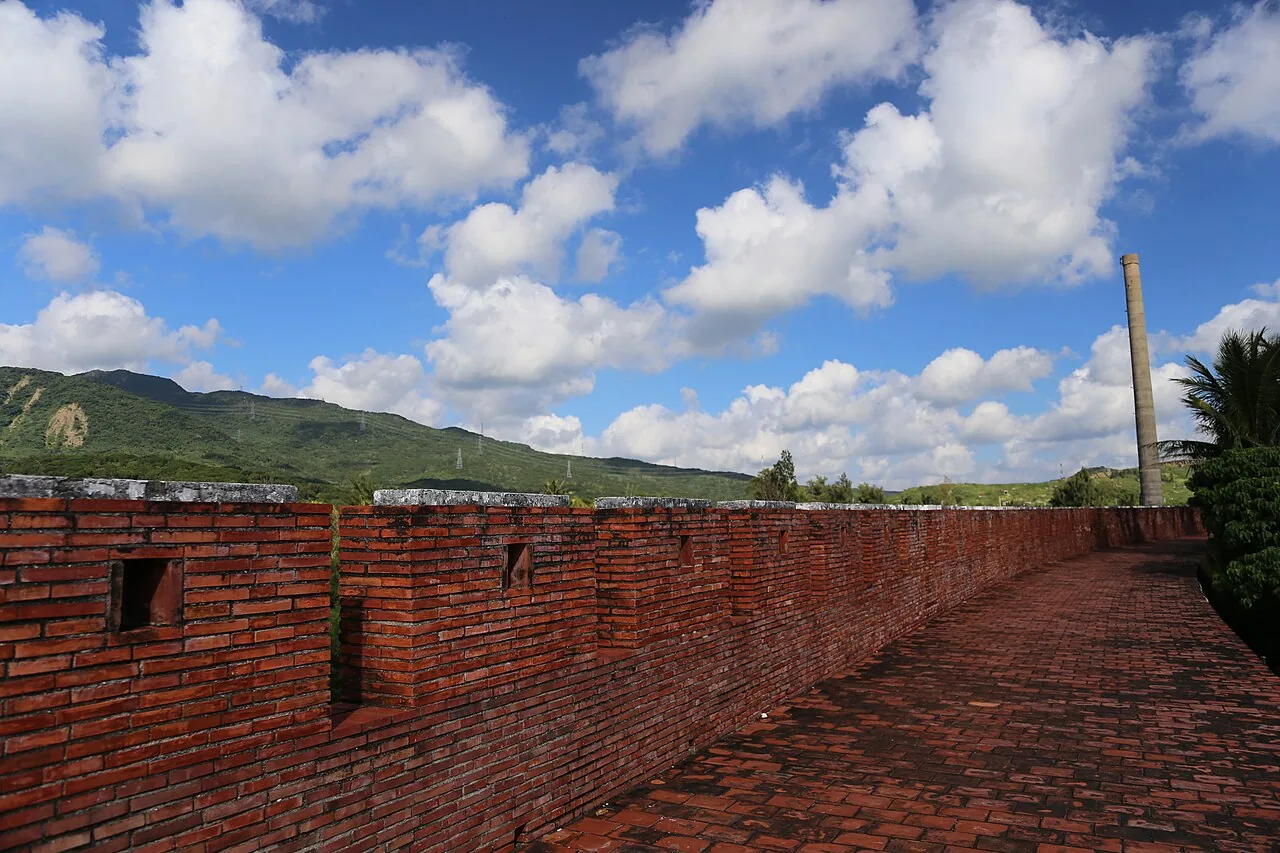
Battlements of the East Gate of Hengchun Old City, 2013-09-07. Photo: Orbital, CC BY-SA 3.0 via Wikimedia.
The second thing the Qing court did after the Mudan Incident was build a walled city.
In 1875, the first year of the Guangxu reign, Shen Baozhen submitted a memorial proposing the establishment of Hengchun County, and construction of the city wall began on October 18 that same year. "Langjiao," the old name of Hengchun, comes from the Chinese phonetic transcription of either a Paiwan word for an orchid plant or the name of an old community16. In July 1879, the fifth year of Guangxu, construction was completed: the city wall measured 880 zhang in circumference, with four gates: East, West, South, also called Mingdu Gate, and North. Hengchun Old City is "Taiwan's most complete surviving old city, and Taiwan's only Qing county seat with all four gates preserved to this day"16.
Four years later, Eluanbi Lighthouse, begun in 1881, was completed in 188317. It is the southernmost lighthouse on Taiwan's main island. But more than its "southernmost" status, what deserves to be remembered is its form: it was designed as a fortification, with gun ports in the surrounding walls, a trench, and a roof entirely built as a water-storage platform, earning the description "the world's only armed lighthouse"17. Why would a lighthouse need to be armed? After the Mudan Incident, the Qing court completely lost trust in this "extraterritorial periphery." It needed to guide passing ships, but also feared renewed Indigenous headhunting, so it built a lighthouse at the level of a defensive work. On March 15, 2024, Eluanbi Lighthouse was elevated to national monument status.
Every year from October to the following March, the Hengchun Peninsula has a special weather phenomenon: luoshanfeng, literally "downslope wind." The northeast monsoon moves south along the Central Mountain Range and suddenly intensifies as it passes through the Shimen gorge, the Dawu mountain valleys, and the valley terrain of Manzhou Township, becoming dry and forceful like a hair dryer no one has turned off18. Among the "Three Strange Things of Hengchun" (luoshanfeng, betel nut, and folk songs; another version lists "Si Xiang Qi," the moon lute, and luoshanfeng), the central figure in the folk-song tradition is Chen Da (1906-1981). Chen Da was from Hengchun, a yueqin, or moon lute, singer-performer who spent his life singing Hengchun folk songs to yueqin accompaniment. In 1967, the Institute of Ethnology at Academia Sinica went to Hengchun to record him, and only then "was he discovered by modern society"18. His signature song was "Si Xiang Qi."
📝 Curator's note: The Kenting in tourist brochures is a post-1990s story. Kenting National Park was established only in 1984, and the first Spring Wave Music Festival was held in 1995. But the Hengchun Peninsula's geographic identity as "Taiwan's southernmost point" was only incorporated into Taiwan's administrative system in 1875, when Shen Baozhen established the county. Before that, this was "Langjiao," a place Qing power could not reach, where Ryukyuan castaways encountered the Paiwan and which later became the Japanese army's stepping stone. From the 1875 establishment of the county, to the 1883 armed lighthouse, to Wei Te-sheng's Cape No. 7 earning NT$530 million after being filmed in Hengchun in 2008, the same peninsula is rediscovered by the whole country every few decades, but each time from a different angle: administrative, military, touristic.
On December 12, 2008, director Wei Te-sheng's Cape No. 7 was released. In 113 days it grossed NT$530 million nationwide and won six prizes at the 45th Golden Horse Awards19. The story is set in Hengchun Township: Aga returns home to work as a postman and becomes involved with a Japanese colonial-era love letter addressed to "Cape No. 7." In an interview, Wei described Hengchun this way: "Hengchun is full of music. It has contemporary Spring Scream and also traditional old melodies; it has historic city walls and also modern tourist hotels"19. What he noticed was precisely these historical layers covered one over another.
The Day the Linbian Floodgate Could Not Hold
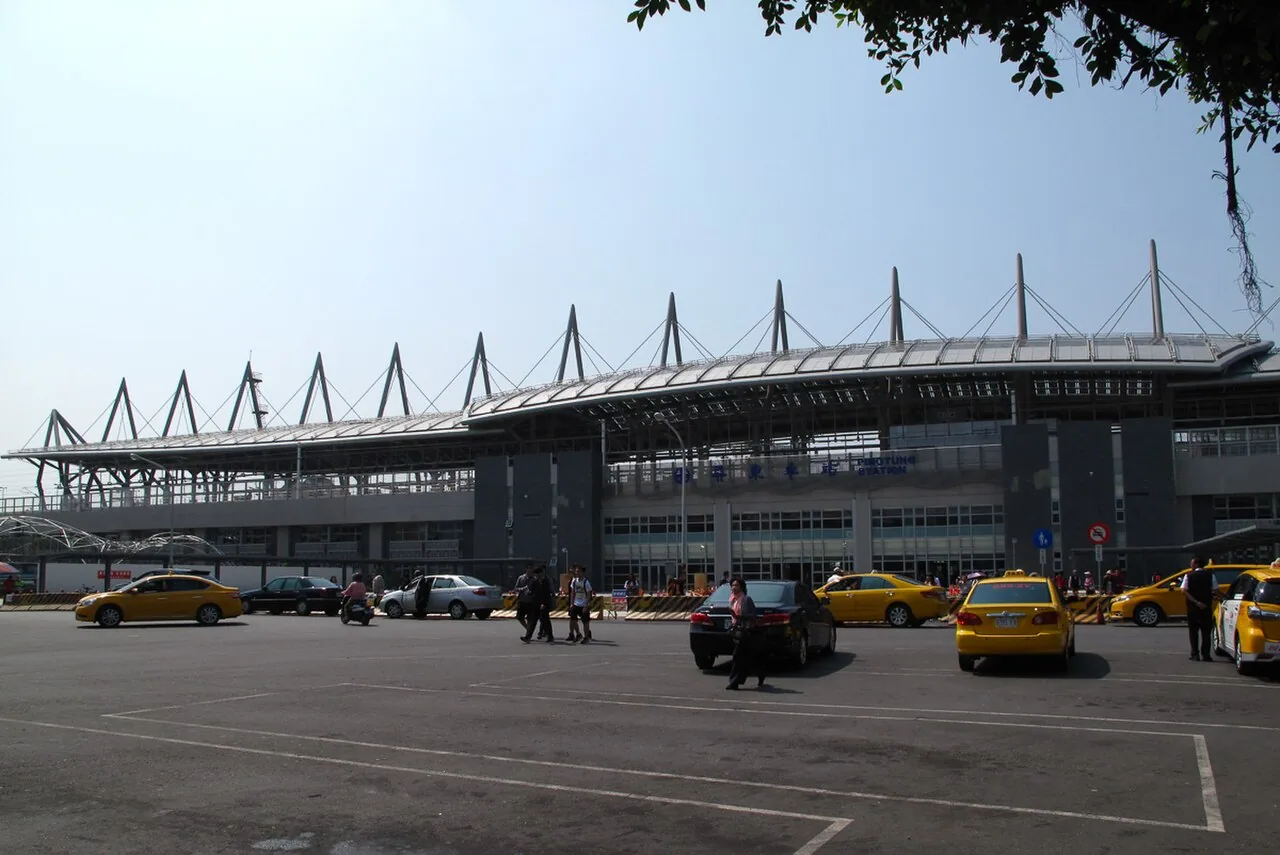
Pingtung Station, completed in 1939, Showa 14. Photo: Wikimedia Commons contributor, CC BY-SA via Wikimedia.
From August 7 to 9, 2009, Typhoon Morakot's rainfall in Pingtung's mountains broke the records of all Taiwanese weather stations at the time. The Xinmajia station recorded 1,897 millimeters in a single day on August 8; the Taiwu station recorded 1,145 millimeters in a single day on August 7; and Pingtung's Weiliaoshan station recorded 1,403 millimeters in a single day on August 8, at the time setting Taiwan's all-time record for one-day rainfall20.
Linbian and Jiadong townships were waiting on the coastal lowlands. The timeline of the Linbian River embankment breach left this record:
"At 4:30 a.m. on August 8, 2009, the four Taiwan Railways staff members responsible for watching the floodgate called the township office to say, 'The gate can't hold anymore.' At 5:00 a.m., a second call came: 'The floodgate has breached.'" (Morakot 88news.org interview record21)
There were only 30 minutes between the first call and the breach. Within days, the whole of Linbian and Jiadong townships were submerged in seawater. "Jiadong Township was one of the worst-hit areas, with floodwaters reaching as high as two stories"22. Linbian has a well-known aftereffect: "When Linbian people hear rain, they cuo le deng," a Taiwanese phrase meaning they become nervously braced for trouble21. "Linbian used to be famous as the home of black pearl wax apples and seafood; now people call it the home of flooding"21. That is how local people described it in interviews with Morakot 88news.org.
The mountain disaster was equally concrete. In Wutai Township, among the Rukai, the Yila Bridge on Provincial Highway 24 was washed away and the entire township's transportation was cut off; in Dawu, "all three bridges to the outside were destroyed. Dawu became an island, and the community was trapped in the mountains for a week before being evacuated by helicopter"23. New Haocha Village in Wutai Township was entirely buried: "Typhoon Morakot caused New Haocha Village to be completely buried under the debris flow of the South Ailiao River." In December 2010, three communities, Haocha, Majia, and Dashe, collectively moved into the Rinari permanent housing settlement in Majia Township23. The people gave this new home a Paiwan name meaning "the place where we walk together, where everyone goes together"23.
Across Taiwan, the typhoon caused 681 deaths and 18 disappearances20, with agricultural losses approaching NT$200 billion, equivalent to 1.6 percent of that year's GDP20. Pingtung County's specific losses "amounted to NT$3 billion calculated by cost, and nearly NT$10 billion calculated by market value"21. But what truly changed Pingtung in this disaster was not how many people died that year. It was the shape of reconstruction sixteen years later.
Black Pearls Grow in Salty Soil
The coastal areas of Linbian and Jiadong suffered land subsidence because of excessive groundwater pumping and improper aquaculture use. Soil salinization was severe. This problem had been accumulating since the 1980s, and by 2009 it was already a structural disaster24. The August 8 disaster merely exposed this structural problem: the real cause of seawater backflow was two decades of excessive groundwater extraction and land subsidence. The typhoon week only developed the image all at once.
But on this salinized soil, Pingtung farmers discovered something unexpected.
"In the past, Pingtung's Linbian and Jiadong townships grew rice. Later, aquaculture rose, and improper use of groundwater caused land subsidence. Seawater backflow made the soil salty, which turned out to be very suitable for growing wax apples. The fruit that grew had a distinctive salty-sweet, juicy flavor"24. Farmers even "drew in seawater to flood wax apple orchards after the trees bore fruit," deliberately using saltwater to intensify the flavor24. "Black pearl wax apples are produced in Pingtung's coastal Linbian, Jiadong, Fangliao, and Nanzhou areas. The main cultivar is the Nanyang variety, with sugar content above 12 Brix."
This is counterintuitive enough to make one pause: land subsidence plus salinization equals an agricultural crisis, but the same soil conditions turned wax apples into Pingtung's most representative agricultural product. Disaster and gift are physically the same thing.
✦ "Groundwater pumped too aggressively, seawater flowing back, soil becoming salinized: that is a crisis. The same salty-sweet soil growing Taiwan's sweetest wax apples: that is the black pearl." (Synthesized from Morakot 88news.org interviews and Pingtung County Government wax apple promotion materials)
After the August 8 disaster, the Pingtung County Government proposed the Water Cultivation and Solar Farming plan: fish ponds and farmland would be leased to solar companies, landowners would collect rent, electricity would be sold to Taipower, and groundwater replenishment would be taken into account, preventing continued extraction from causing further subsidence24. In 2018, the four townships of Donggang, Linbian, Jiadong, and Fangliao were designated as a solar energy special zone24. On the same flooded land, salty-sweet wax apples now grow on one side while solar panels stand on the other. The Pingtung County Government recorded this transformation: "Water Cultivation and Solar Farming is a post-disaster reconstruction model unique to Pingtung County after the August 8 disaster"25.
May 22, 2024: Renaming macacukes
Return to the battle that opened this story.
On May 22, 2024, the 150th anniversary of the Mudan Incident, the Pingtung County Government and Mudan Township Office unveiled the county-designated historic-site stele for the macacukes Shimen Old Battlefield4. Restoring the place name in Paiwan was an action: the site where Aruqu and his son died in 1874, where the Qing court reversed its policy, and where Japan learned Taiwan could be taken, is no longer called only by the Han-character colonial name "Shimen Old Battlefield." It is called macacukes, Paiwan for "mutual support."
That day, Kuskus community spirit medium Zhang Shun-zhi vuvu performed a blessing ceremony; the Kuskus old-song transmission team sang the traditional song "Remembrance." At the ceremony, Kao Chia-hsin, director at Mudan Elementary School and a community representative, said:
"To recover the historical memory of the Mudan Incident, to commemorate the spirit of our ancestors' heroic resistance, so that future generations may learn the resilient will with which our ancestors defended the homeland, and moreover to hope that different peoples in the future can understand and respect one another." (Kao Chia-hsin, director of Mudan Elementary School, remarks at the 2024 150th anniversary commemoration4)
Some younger community members have pushed to change the place name further back to sevalitan, Paiwan for "inherit, transmit, transcend," representing a historical break from Han-character colonial naming4. After 150 years, this valley that changed Taiwan's fate is being renamed by its original owners.
Alongside the renaming, another fact is present: Kuskus Shrine. The Japanese burned the Kuskus community in 1874, then in 1936 built the Kuskus Shrine on the same site, renamed Tak士 Shrine in 1939, dedicated principally to Amaterasu. This meant Paiwan descendants were made to worship "the deity of the Japanese who had once massacred their ancestors"26. During World War II, Paiwan people were conscripted into the Takasago Volunteers, and a promise circulated among them: "If I do not come back, then in the future let us meet at the shrine!"26. In 2015, Japanese Shinto priest Sato Kenichi, seeking to repay Taiwanese assistance after the March 11 earthquake disaster, raised 10 million yen to rebuild the wooden shrine. The enshrinement ceremony was held in August 2015, and a white torii gate was erected in May 201626. Today's Kuskus Shrine uses both Japanese Shinto and Paiwan traditional rituals, enshrines the spirits of those who died in battle from the Kuskus community, and is "Taiwan's only shrine dedicated to Indigenous ancestral spirits"26.
From village burning, to forced worship of the perpetrators' deity, to incorporating ancestral spirits into the shrine, to renaming the site in Paiwan on the 150th anniversary, the memory of this peninsula contains several layers of time at once. It has never been linear.
Donggang at 5:30, Bluefin Waiting
Return to the tuna that opened this story.
Every April to June, at 5:30 in the morning in Donggang, auctioneers call prices, fishers carry boxes, and buyers circle the auction platform making hand signals to bid. The 190-kilogram first tuna in April 2026 sold for NT$2.014 million2, more than 1.6 times the NT$1.21 million price of the 2025 first tuna2. Sixteen years ago, when the catch fell below 1,000 in 2010, Donggang's fishing industry looked as if it might be ending. Sixteen years later, the first tuna's unit price has set a new record, and the cumulative catch has exceeded 5,000 fish1.
Two kilometers away, Pingtung Station, built in 1939, is still operating, and the old site of the Pingtung Sugar Factory, which began operation in 1908, has been transformed into a tourist park27. But the real texture of Pingtung County today is not in these old buildings. It is in the 780,000 people spread across 33 townships, towns, and cities: in the communities of 49,000 Paiwan, who hold a ceremony for the ancestral spirits every five years; in the Wutai communities of 2,100 Rukai, the mountain of the clouded leopard; in the Hakka huofang houses of the Liudui, which have not scattered in 235 years; in Wanjin Village's 80 percent Catholic population, unbroken for 160 years; in the wax apple orchards of Linbian, black pearls grown from salty-sweet soil; and in the valley in Mudan Township that is again being called macacukes after 150 years.
From Taipei, Pingtung is a southernmost tourism county, Kenting, bluefin tuna, and the disaster area of the August 8 flood. From the peninsula itself, Pingtung is the turning point that changed Taiwan's entire fate in 1874, the Catholic home whose history began 21 years earlier than northern Christianity, the diverse county where five Indigenous peoples and the Hakka Liudui live together, and the salinized land that sat underwater for a month in 2009 yet still grew black pearls.
Xie Bingying once wrote a sentence in Rainy Port Keelung that made Keelung people remember their relationship with rain. Pingtung has no equally famous sentence defining its relationship with the sea, but the Linbian people interviewed by 88news.org left a similar line: "When Linbian people hear rain, they cuo le deng"21. It sounds like fear. But they stayed to keep growing wax apples, keep installing solar panels, and keep holding Donggang's tuna auctions. Fear and staying do not contradict each other.
Next time you go to Pingtung, you can stop by Wanjin, take a trip to the Shimen Old Battlefield, and sit by the gate of Hengchun Old City listening to the luoshanfeng. Then you will remember one thing: the historical turning points that changed Taiwan happened twice on this peninsula, once in the 1874 Mudan Incident, and once in the 2009 Typhoon Morakot disaster. Neither has really entered the capital's mainstream narrative. This island has always been used to remembering only half of itself; Pingtung has always been in the other half.
Further Reading
- Charles Le Gendre — A background figure in the 1874 Mudan Incident, the U.S. consul in Amoy whose statement that "aboriginal territory was not under Chinese jurisdiction" directly triggered Japan's dispatch of troops to Pingtung
- The Rover Incident and Tokitok — In 1867, the American merchant ship Rover was wrecked at the southern end of the Hengchun Peninsula, four years before the 1871 Ryukyuan castaway incident, in the same waters and the same Paiwan territory
- The Taiwan Island History Perspective — Cao Yonghe's island-history framework; the layered history of the Pingtung peninsula is one of its most concrete unfoldings
- Penghu County — 22 Counties and Cities Series: an offshore island sovereignty choice that twice rejected casinos, sharing with Pingtung a "forgotten southernmost/westernmost" geographic identity
- Keelung City — Another port county in the 22 Counties and Cities Series that the capital fails to see, and like Pingtung, a key node omitted by central narratives
- Lienchiang County — 22 Counties and Cities Series: the distance between battlefield heritage and mainstream narratives, readable alongside the layered memories of Pingtung's Mudan Incident and Kuskus Shrine
- Wei Te-sheng — Cape No. 7, filmed in Hengchun, earned NT$530 million at the box office and wrote the southern Taiwan peninsula into national cinematic memory
- Taiwan's Disaster Volunteer Culture — How the dual mountain and coastal disasters of Typhoon Morakot reshaped Taiwan's rescue networks
- Typhoons — Morakot's one-day rainfall record of 1,897 millimeters marked a turning point in Taiwan's relationship with typhoons
Image Sources
This article uses 5 Wikimedia Commons CC-licensed images.
Hero (frontmatter): Eluanbi Lighthouse 02, Eluanbi Lighthouse, the "world's only armed lighthouse," begun in 1881 and completed in 1883, elevated to national monument status in 2024. Photo: Bernard Gagnon, CC BY-SA 3.0.
Scene §The Ambush in the Shimen Gorge: Sleeveless short upper garment from the Paiwan Mudan community, National Taiwan University collection, 1956, material evidence contemporary with the 1874 Mudan Incident. Photo: 氏子, CC BY-SA 4.0.
Scene §That Church from 1861: Wanchin Catholic Church, Wanchin Basilica of the Immaculate Conception, Taiwan's first Catholic church, established by Spanish Dominicans in 1861 and designated a basilica in 1984. Photo: WEI WAN-CHEN, CC BY-SA 4.0.
Scene §Eluanbi 1883, Hengchun Old City 1879: Battlements of the East Gate of Hengchun Old City, the East Gate of Taiwan's most complete surviving Qing county seat, completed in 1879. Photo: Orbital, CC BY-SA 3.0.
Scene §The Day the Linbian Floodgate Could Not Hold: Pingtung Train Station, completed in 1939, Showa 14, during the Japanese era, the key node connecting the Pingtung sugar railway with the trunk line. Photo: Wikimedia Commons contributor, CC BY-SA.
Licenses: CC BY-SA 4.0 / CC BY-SA 3.0.
References
- Donggang bluefin tuna auction and annual catch data — Official Fisheries Agency statistics, including full annual data on the peak 1999-2000 catch exceeding 10,000 fish, the 2010 fall below 1,000, the 2023 rebound to 5,725, and the 2024 cumulative total of 6,548.↩234
- 2026 first tuna auction record — Liberty Times report on the April 21, 2026 Donggang first tuna auction: a 190-kilogram fish sold at a record-high unit price of NT$10,600 per kilogram, total price NT$2.014 million, with captain Hong Fu-jia aged 67.↩23
- Mudan Incident — Wikipedia — Complete chronology: the 1871 Bayao Bay incident, Japanese landing at Sheliao on May 8, 1874, the Battle of Shimen on May 22, the deaths of Aruqu and his son, Mudan's surrender on July 1, and the original text of the first article of the October 31 Sino-Japanese Beijing Treaty stating that "what Japan has done on this occasion was originally a righteous act to protect its people."↩23456
- 150 years since the Mudan Incident — Hakka News — Unveiling of the county-designated historic-site stele for "macacukes Shimen Old Battlefield" on May 22, 2024, including Kao Chia-hsin's original words, "recover the historical memory of the Mudan Incident," plus the original wording from StoryStudio's "The Full Story of Taiwan's Most Famous Shipwreck Incident: The Mudan Incident" that "Japanese forces advanced on the Mudan and Kuskus communities and set fire to houses."↩234
- Abolishing the ban on crossing to Taiwan and beginning governance of Taiwan's frontier: Shen Baozhen and Taiwan policy after the Mudan Incident — StoryStudio — Complete chronology of Shen Baozhen's Taiwan reforms: "opening the mountains and pacifying the aborigines," the southern route from Sheliao in Pingtung to Beinan in Taitung, 214 li; abolition of the ban on crossing to Taiwan; establishment of Hengchun County; creation of Taiwan Province in 1885; and Liu Mingchuan as first governor.↩
- Wanchin Basilica of the Immaculate Conception — StoryStudio — Complete record: Dominican Father Fernando Sainz trekking more than 60 li to Wanjin Village in 1861, purchasing land in May 1863, the church being burned that November so that "the entire church was reduced to ashes," reconstruction by Francisco Giner in 1869, opening in 1870, Shen Baozhen delivering the Tongzhi Emperor's "By Imperial Decree" sacred stone in 1874, Pope John Paul II designating it a basilica in 1984, and 80 percent of residents today being Catholic.↩234
- Pingtung County ethnic structure and administrative divisions — Department of Civil Affairs, Pingtung County Government — Official statistics on Pingtung County's April 2026 population of 780,101, 33 townships, towns, and cities, 8 mountain townships, and co-residence of five Indigenous peoples (Paiwan, Rukai, Makatao, Puyuma, Amis), the Hakka Liudui, Hoklo, and postwar mainlander communities.↩2
- Paiwan culture and distribution — Council of Indigenous Peoples — Complete cultural data on Pingtung County's 49,643 registered Paiwan at the end of 2023; distribution across northern Paiwan areas (Wutai, Majia, Taiwu) and southern Paiwan areas (Chunri, Shizi, Mudan); the Five-Year Ceremony (maljeveq) and ball-spearing ritual; belief in Mount Beidawu as the dwelling place of ancestral spirits; and slate-house construction imitating hundred-pacer snake scales.↩2
- Rukai culture and Kucapungane — Council of Indigenous Peoples — Pingtung's roughly 2,100 Rukai people (around 13,000 across Taiwan), distribution of communities in Wutai Township, the clouded leopard (Tagarawsu) as cultural symbol, the old Kucapungane community as a national monument and 2016 selection for the WMF World Monuments Watch, and detailed differences from Paiwan slate houses (two doors, forecourt, table and chair arrangements).↩2
- Mount Beidawu — Wikipedia — Elevation 3,092 meters, Paiwan name Kavulungan, Rukai name Tagarawsu, the southernmost mountain in the Central Mountain Range above 3,000 meters, sacred mountain shared by both peoples as the "dwelling place of ancestral spirits," and ecological data for the Dawushan Nature Reserve.↩
- Dawushan Nature Reserve ecology — Forestry Bureau conservation research — Ecological data for Mount Beidawu and the Dawushan Nature Reserve, including habitats of protected animals such as the Formosan black bear, Swinhoe's pheasant, Mikado pheasant, mountain hawk-eagle, maroon oriole, hundred-pacer snake, and golden birdwing butterfly, as well as rare plants such as Taiwan cow-tail fir and Keteleeria davidiana var. formosana.↩
- Makatao and the Plains Indigenous name-rectification movement — Taiwan Cultural Memory Bank — Distribution of the Eight Communities of Fengshan (Jiateng, Lili, Fangsuo, Talou, Wuluo, Xiadanshui, and others), the process of Sinicization in the mid-to-late Qing, jar-deity belief, and the current name-rectification movement slogan "I am called Makatao, not Pingpu."↩2
- Pingtung County township population statistics and urban-rural disparities — Pingtung County Government — Official statistics showing Pingtung City's population approaching 200,000, the eight mountain townships together accounting for only 5.5 percent of the county, Pingtung County's aging index of 163.8 in 2019 as the fourth highest nationwide, and farm households accounting for 32.67 percent of the population, revealing the physical structure of urban-rural disparity beneath the "most diverse" framing.↩
- Pingtung County 2019 aging index and farm household population — Department of Household Registration, Ministry of the Interior — Population distribution data: aging index of 163.8, the fourth oldest in Taiwan and in the south second only to Chiayi County; farm households accounting for 32.67 percent of the county; and the eight mountain townships together accounting for only 5.5 percent.↩
- Liudui — Wikipedia — Complete Hakka history: during the 1721 Zhu Yigui Incident, Hakka settlers in the Xiadanshui River basin organized the Liudui righteous army and "jointly elected Li Zhisan as general manager"; the Kangxi Emperor bestowed the "Cherishing Loyalty" plaque; the Liudui units (Right, Left, Front, Rear, Central, Vanguard) and their corresponding present-day townships; and the 65-year gap between this and the "Commending Loyalty" inscription for the Hsinchu Yimin Temple after the 1786 Lin Shuangwen Incident.↩23
- Hengchun Old City — Wikipedia — Official historic-site data: Shen Baozhen's 1875 memorial to establish Hengchun County, construction of the city wall beginning on October 18, completion in July 1879, wall circumference of 880 zhang, all four gates preserved, the old name "Langjiao" originating from Paiwan, and Taiwan's most complete surviving Qing county seat.↩2
- Eluanbi Lighthouse — Maritime and Port Bureau, Ministry of Transportation and Communications — Official data on Eluanbi Lighthouse: begun in 1881, completed in 1883, southernmost point of Taiwan's main island, fortification-style design, wall gun ports and trench, water-storage roof, "the world's only armed lighthouse," and elevation to national monument status on March 15, 2024.↩2
- Hengchun folk songs and Chen Da — Institute of Ethnology, Academia Sinica — Complete research record on luoshanfeng (northeast monsoon strengthening as it passes through the southern Central Mountain Range valleys from October to March), the Three Strange Things of Hengchun, Chen Da (1906-1981), his yueqin singing and signature song "Si Xiang Qi," and his 1967 recording and discovery by the Academia Sinica Institute of Ethnology.↩2
- Cape No. 7 box office and Hengchun locations — Wikipedia — Complete film data: release on December 12, 2008, nationwide box office of NT$530 million in 113 days, six awards at the 45th Golden Horse Awards, and director Wei Te-sheng's description of Hengchun as "full of music, with contemporary Spring Scream and also old traditional melodies, historic city walls and also modern hotels."↩2
- August 8 Flood Disaster, Typhoon Morakot — Wikipedia — Complete disaster statistics from August 7-9, 2009: Xinmajia 1,897 mm, Taiwu 1,145 mm, and Pingtung Weiliaoshan 1,403 mm setting Taiwan's then-record for one-day rainfall; 681 deaths and 18 disappearances nationwide; and agricultural losses of around NT$200 billion, equivalent to 1.6 percent of that year's GDP.↩23
- Linbian and Jiadong: When the aquaculture kingdom keeps flooding — Morakot 88news — Local in-depth report on the Linbian River floodgate breach sequence at "4:30 a.m. on August 8, 2009," "When Linbian people hear rain, they cuo le deng," "Linbian used to be the home of black pearl wax apples and seafood; now it is called the home of flooding," and Pingtung agricultural and fisheries losses of "NT$3 billion calculated by cost."↩2345
- August 8 flood records for Jiadong Township — Wikipedia — Specific disaster data including Jiadong Township as one of the worst-hit areas in the August 8 flood, floodwaters reaching as high as two stories, and persistent flooding difficulties in the Qiangyuan area.↩
- Strength in unity: the Rukai relocation story in Wutai — Taiwan Panorama — Complete relocation record of the Rukai in Wutai Township during the August 8 disaster: the Yila Bridge on Provincial Highway 24 washed away, Dawu's "three external bridges all destroyed," community members trapped for a week, New Haocha Village buried by debris in the South Ailiao River, and the Haocha, Majia, and Dashe communities moving into Rinari permanent housing in December 2010, "the place where we walk together, where everyone goes together."↩23
- Water Cultivation and Solar Farming and black pearl wax apples — SciTech Vista — Complete industrial analysis of land subsidence in Linbian and Jiadong and groundwater over-extraction causing salinization, the salty-sweet soil's suitability for wax apples with sugar content above 12 Brix, farmers drawing seawater to flood wax apple orchards to intensify flavor, and the Pingtung County Government's 2018 designation of Donggang, Linbian, Jiadong, and Fangliao as a solar energy special zone under the Water Cultivation and Solar Farming plan.↩2345
- Water Cultivation and Solar Farming: Pingtung County's solar photovoltaic industry — SciTech Vista 2014 — Pingtung County Government record that "Water Cultivation and Solar Farming is a post-disaster reconstruction model unique to Pingtung County after the August 8 disaster," including the plan's concrete contents (leasing fish ponds to solar companies, landowners collecting rent, selling electricity to Taipower, and taking groundwater replenishment into account) and the 2018 designation of a solar energy special zone.↩
- South of the border: a century of sorrow for the Paiwan and Kuskus Shrine — StoryStudio — Complete three-layer historical record: the 600-year history of the Kuskus community; the colonial government's 1936 Kuskus Shrine, renamed Kuskus Shrine in 1939, dedicated to Amaterasu; the World War II Takasago Volunteers' promise, "If I do not come back, then in the future let us meet at the shrine"; Japanese priest Sato Kenichi raising 10 million yen in 2015 to rebuild the shrine in gratitude for Taiwan's March 11 aid; the white torii erected in May 2016; and Taiwan's only shrine enshrining Indigenous ancestral spirits.↩234
- History of Pingtung Sugar Factory — Pingtung County Government cultural heritage data — Complete Japanese-era industrial infrastructure record: Taiwan Sugar Co., Ltd. establishing the Ako (Pingtung) sugar factory in 1907, opening ceremony on December 1, 1908, post-1910 expansion raising sugar-processing capacity to 3,000 British tons and earning the name "new highest mountain of the sugar industry" as the largest in East Asia by factory scale and output, sugar railways totaling 226 kilometers across 20 townships countywide, cessation of sugar production in January 1998, and Pingtung Station completed in 1939, Showa 14.↩