
30-Second Overview: Guling Street runs north from Heping West Road Section 2 to Nanhai Road, about 1.2 kilometers in length. In the Japanese colonial district-name reform of 1922, this street was called "Sakuma-cho." In 1946 it became "Longjin Street," and in 1947 it was officially named "Guling Street," after Guling Town on Mount Lu in Jiangxi Province, China; the town's name itself derives from a transliteration of the English word "cooling." After 1945, when Japanese residents were repatriated under a rule allowing only "one shoulder load carried aboard by oneself," the books they could not take were laid out by the roadside and sold cheaply. That same year, the first-generation owner Cai Mulin opened Songlin Bookstore, becoming the first person to move from stall vending into a brick-and-mortar bookstore. Guling Street became Taiwan's first secondhand book street. At its peak in the 1950s and 1960s, one account says there were more than 100 vendors plus over 20 storefronts; another says there were as many as more than 200. At ten o'clock on the night of June 15, 1961, Mao Wu, a 16-year-old student at Taipei Municipal Jianguo High School, used a scout knife to kill his 15-year-old classmate Liu Min on this street. Thirty years later, Edward Yang turned the incident into a 237-minute film. In April 1973, Guanghua Bridge opened; the city government built Guanghua Market beneath it, and the vendors were gradually cleared out and moved away. The book street was dismantled, but nearby Nanhai Academy, including the National Central Library in 1955, the National Museum of History in 1956, the National Art Museum in 1957, and the National Taiwan Science Education Center in 1959, remains where it was. The lotus pond of the Taipei Botanical Garden, reorganized in 1921, is still there too. What this article wants to say is this: on one 1.2-kilometer street, from a Japanese residential district to Mainlander book stalls, from Edward Yang's film to theaters and museums, every square meter is packed with the memory of three empires.
Saturday Afternoon at the End of Lane 5
If you ask a Taipei resident who still goes to Guling Street today when the street feels most "right," he will not tell you about Lunar New Year shopping streets or Huashan, because those are not here. He may say 4:30 on a Saturday afternoon at the end of Lane 5, Guling Street, when students begin lining up for tickets outside the two-story red-brick Guling Street Avant-garde Theatre, people at the bus shelter next to it are scrolling on their phones, and two or three staff members in black are standing in front of the theater smoking and talking1.
That red-brick building was constructed around 1906 as a wooden official residence for the Government-General of Taiwan Medical School. After the war, in 1954, it was taken over by the police department and converted into the "Seventh Precinct." A two-story brick-and-reinforced-concrete front building was added to the wooden residence, and from 1958 to 1969 a three-story rear building was expanded eastward. In 1990, Chengzhong District and Guting District merged into Zhongzheng District, and the precinct was renamed "Zhongzheng Second Precinct." In 1995, the precinct moved to a new building at the corner of Chongqing South Road. The arts community then fought to secure the vacant red-brick building; it was renovated twice, in 1997 and 2000, to meet theater needs. In 2001 it was officially named Guling Street Avant-garde Theatre, and in 2014 it was listed by Taipei City's Department of Cultural Affairs as a historic building23.
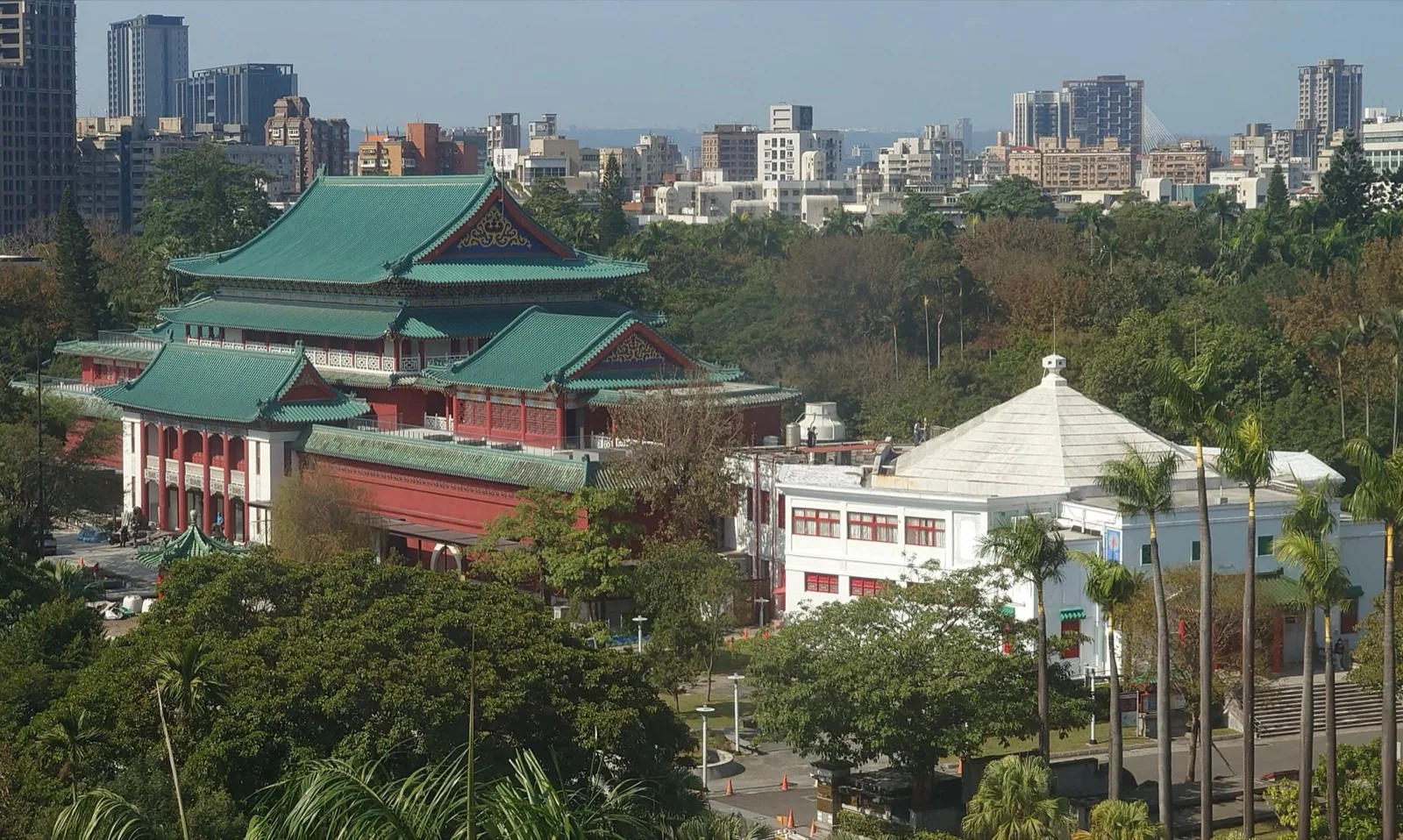
Walk 200 meters north from the theater and you reach Nanhai Road. Cross Nanhai Road and you enter the precinct of Nanhai Academy. The National Museum of History is at No. 49 Nanhai Road, the National Taiwan Arts Education Center at No. 47, the National Taiwan Science Education Center, now the Taipei Branch of the National Taiwan Craft Research and Development Institute, at No. 41, and the National 228 Memorial Museum at No. 54, formerly the United States Information Service and, before that, the Japanese-era Taiwan Education Hall designed by Ide Kaoru in 1931. Farther on is the Taipei Botanical Garden. In 1896, the Japanese colonial Bureau of Productive Industries established the "Taipei Nursery" here; in 1921 it was reorganized as the "Botanical Garden." It was Taiwan's first botanical garden, with grounds of 8.2 hectares456.
Curator's Note: Guling Street and the adjacent Nanhai Academy form one of the few blocks in Taipei where the material evidence of three layers of empire is arranged in sequence. The red-brick former police station left by the Japanese colonial period, now the theater; the Chinese palace-style museum cluster built by the Nationalist government after it took over the Japanese nursery from 1955 to 1959; and the lotus pond that has not moved since 1921. To the east also stands the National 228 Memorial Museum, the education hall designed by Ide Kaoru in 1931. Buildings from four eras stand on both sides of the same 1.2-kilometer street. Many Taipei streets have been cut through by urban renewal or road widening, but the three historical layers of this street have stayed in place.
The book street of Guling Street itself has almost disappeared. After Guanghua Bridge opened in April 1973, the city government built Guanghua Market beneath the bridge. From 1974 onward, the used-book stalls were gradually cleared out and moved there. Later, Guanghua Market itself was demolished in 2006 and replaced by the new Guanghua Digital Plaza and Syntrend Creative Park, and the old books moved once again7. Today, around Lane 5, only Songlin Bookstore, opened in 1945, is still standing. Second-generation owner Cai Jinghui, now in his seventies, still watches the shop. The two-story storefront, just over ten ping in area, is packed with nearly 100,000 books. Books on fortune-telling and physiognomy, Chinese medicine, and history sell best; the collection includes thread-bound books from the Kangxi and Qianlong reigns of the Qing dynasty8.
A 1.2-kilometer street holds three empires, with one bookstore left in place. That is the density of Guling Street.
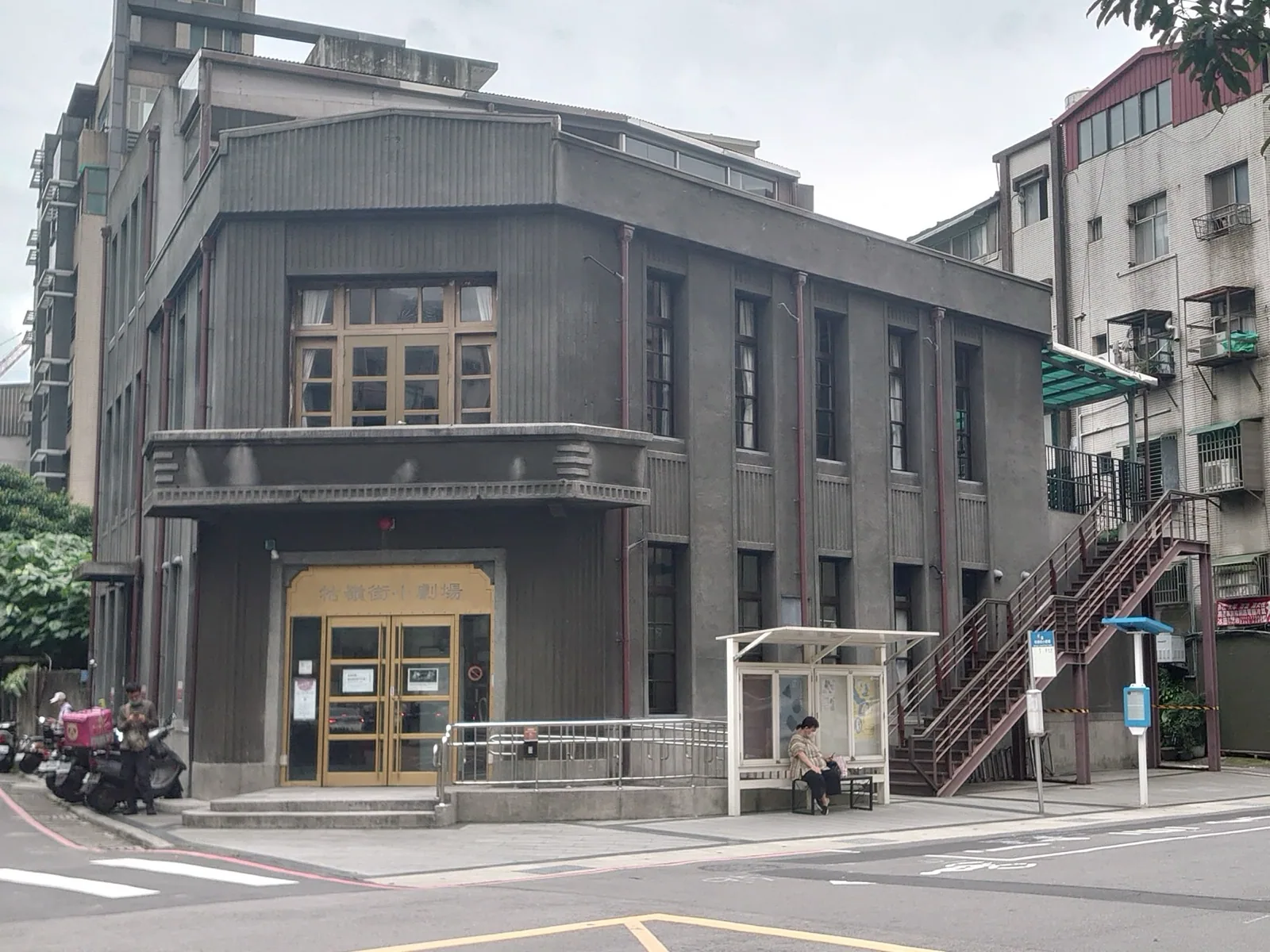
Guling Street Avant-garde Theatre in June 2022, No. 2, Lane 5, Guling Street, Zhongzheng District, Taipei. Photo: Yu tptw, CC BY-SA 4.0 via Wikimedia Commons.
Sakuma-cho, Kodama-cho, and the Old Road Called Longkou Street
The name "Guling Street" did not appear until 1947. Before that, this road had three names.
The earliest was "Longkou Street Third and Fourth Chome," opened after the second Japanese colonial urban improvement plan. The place name "Longkou" came from nearby Longkou-cho, one of early Japanese-era Taipei's cultural, educational, and residential districts. In 1922, or Taisho 11, district names were changed again. This section of today's Guling Street was incorporated into Sakuma-cho First, Second, and Third Chome and was called "Sakuma-cho-dori." "Sakuma" commemorated Sakuma Samata, the fifth governor-general of Taiwan, in office from 1906 to 1915 and known for suppressing Indigenous peoples through the "Five-Year Plan to Govern the Aborigines"9.
Next to Sakuma-cho was "Kodama-cho," named after the fourth governor-general, Kodama Gentaro, who served from 1898 to 1906. Its area covered today's Nanchang Street Sections 1 and 2, Hukou Street, Nanhai Road, Ningbo West Street, and part of Fuzhou Street. Kodama-cho and Sakuma-cho were both high-end residential and cultural-educational districts in Japanese-era Taipei, inhabited largely by officials from the Government-General and schools10.
After the Japanese colonial period ended, the Taiwan Provincial Administrative Executive Office published the "List of Corrected Street Names of Taipei City Government" in 1946. Sakuma-cho-dori was first renamed "Longjin Street." In 1947, the "Taipei City Old and New Road Name Comparison Table" was published, and the street was officially named "Guling Street," a name retained to this day.
The two characters "Guling" come from "Guling Town" on Mount Lu in Jiujiang, Jiangxi Province, China. Guling was originally called Guniu Ridge and is the only town in China whose name derives directly from an English transliteration. In the nineteenth century, British Methodist missionary Edward Selby Little developed a summer resort on Mount Lu and named it "Kuling," a transliteration of the English word "cooling"; the Chinese name was later written as "牯嶺"11.
Did You Know: The renaming of Taipei's streets after the war was a large-scale project by the Nationalist government to transplant place names from mainland China. If you unfold a map of Taipei today, almost every direction corresponds to a place name in the equivalent direction in China. To the east is Nanjing East Road; to the north, Zhongshan North Road, formerly the Japanese colonial Chokushi Road; to the south, Chongqing South Road; to the west, Xining South Road. All of Taipei is a miniature map of China, and the renaming of 1946-1947 was completed in one stroke. The "Guling" of Guling Street corresponds to Mount Lu in central China; Nanjing West Road corresponds to East China; Chongqing South Road corresponds to the southwest. Splicing a Jiangxi summer resort onto the street of a high-end Taipei residential district is a miniature of the same geographical-political grammar.
People arrived after the war, and place names came with them, but the houses left by the Japanese colonial period remained. When Japanese residents withdrew, the rule allowed only "one shoulder load carried aboard by oneself." Books, paintings, antiques, and collections that could not be carried away were laid out on the street and sold cheaply. That same year, the first-generation owner Cai Mulin opened "Songlin Bookstore" on Guling Street to buy these used books. After the Nationalist government's military personnel, civil servants, and teachers arrived in Taipei, they also brought large quantities of textbooks and political books; civil servants came here to set up stalls on weekends too812.
A Japanese residential street once called "Longkou Street," later "Sakuma-cho," then "Longjin Street," became a concentration of Mainlander used-book stalls called "Guling Street." The name changed, the houses mostly did not, and half the residents changed.
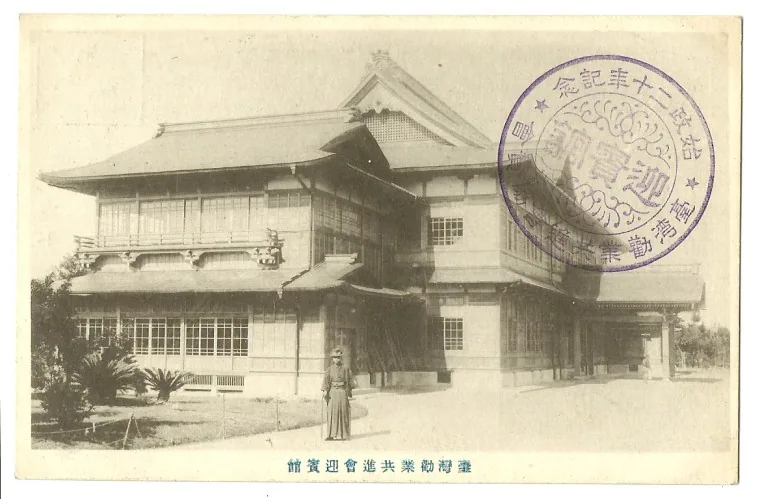
The Botanical Garden site during the 1916 Industrial Promotion Exhibition. Public domain via Wikimedia Commons.
The Scout Knife, the United States Information Service, and Those Seven Stabs
This street carries another, very dark memory.
At ten o'clock on the night of June 15, 1961, Mao Wu, a 16-year-old student in Junior Second Class C at Jianguo High School, stabbed 15-year-old Liu Min seven times with a scout knife on Guling Street. Liu Min lived on Keelung Road Section 2 and was a Shandong-born student in Junior Second Class A of the girls' division at Jianguo High School. Mao Wu, from Zhejiang, lived in the Academia Sinica dormitory area on Jiuzhuang Road in Nangang. The two had originally been boyfriend and girlfriend. Mao Wu discovered that Liu Min was in close contact with his classmate Ma Jishen, a delinquent associated with the "Pirate Gang." That day, the two arranged to meet and negotiate at the United States Information Service at No. 54 Nanhai Road, today's National 228 Memorial Museum, which had moved into the former Taiwan Education Hall building on December 2, 1958. They talked while walking toward Guling Street, and Mao Wu then attacked1314.
After the police arrived, they hired a car to send Liu Min to National Taiwan University Hospital. When she reached the emergency room at 10:20, doctors diagnosed that she had "no signs of life before arrival." At the time, Mao Wu clung to Liu Min's body and claimed to be her brother.
On August 7, 1961, the Taipei District Court delivered its verdict. Under Article 63 of the Criminal Code, a person under 18 could not be sentenced to death or life imprisonment. Mao Wu was sentenced for homicide to 15 years in prison and deprivation of civil rights for eight years. On February 22, 1963, after retrial, the High Court reduced the final sentence to 10 years13.
That is the incident itself. There was no Xiao Si, Xiao Ming, Little Elvis, Honey, 217 Gang, or Xiao Si's father falling from a lightbulb as in the film. There was no U.S. military club, Shanghai barbershop, or medical officers' dormitory on Shuangcheng Street. The real Mao Wu and Liu Min were two junior high students at Jianguo High School. Because of a romantic dispute and the involvement of classmates, one died and the other's youth was destroyed. The Guling Street of 1961 did not contain as many metaphors as the later film images would suggest.
Thirty years later, Edward Yang made A Brighter Summer Day, placing the incident within the entire situation of second-generation Mainlander adolescents in the early 1960s: a father who was a Nationalist government civil servant retreating from Shanghai to Taiwan, a mother who was a Shanghai housewife, Xiao Si studying in Jianguo High School's night division, a year-long gang war involving the small park of the "217 Gang" and the "217" entertainment district, and Xiao Ming moving among the boys before Xiao Si finally stabbed her to death seven times. The film was released in 1991. The original version runs 237 minutes, nearly four hours; preparation took two years, and filming took 110 working days. At the 28th Golden Horse Awards that year, it received 12 nominations and won Best Feature Film for Yang & His Gang Filmmakers and Best Original Screenplay for Yang Shunqing, Yen Hungya, Edward Yang, and Lai Mingtang. Father and son Zhang Guozhu and Chang Chen were both nominated for Best Actor in the same year151617.
Edward Yang spent more than two years looking for a lead actress. After deciding on Lisa Yang Jingyi, he had her move from the United States into his home for a year. Chang Chen was 14 years old when he appeared in his first film and was nominated for the Golden Horse Award for Best Actor. Xiao Si in the film corresponds to the real Mao Wu, and Xiao Ming to Liu Min.
Contested View: The distance between the film and the real incident is the most easily confused layer of this street. The name "A Brighter Summer Day juvenile murder incident" itself came from Edward Yang's 1991 film title. Newspapers at the time of the 1961 case called it the "Mao Wu case" or the "Jianguo High School student murder case"; they did not especially attach "Guling Street" to it. Only after the film's 1991 release did this name retroactively cover the real 1961 case. If you ask younger Taipei residents today what the "A Brighter Summer Day juvenile murder incident" was, they will talk about Edward Yang's film; very few can name Mao Wu or Liu Min. Film mythology outweighing fact is normal in Taiwan's collective memory, but it is also the hardest layer of this street to separate. When writing about it, the distinction matters: the seven stabs in 1961 involved two students aged 15 and 16; Xiao Si and Xiao Ming in 1991 were Edward Yang's screenplay.
From the National 228 Memorial Museum at No. 54 Nanhai Road, formerly the USIS, to Guling Street itself is only a three-minute walk. The final stretch walked by those two people in 1961 was this three-minute physical distance, and the temporal distance of an entire lifetime.
A Shoulder Load of Books That Could Not Be Carried Aboard
After Japan surrendered on August 15, 1945, nearly 300,000 Japanese residents in Taiwan were to be repatriated between 1946 and 1947. The repatriation rule allowed each person "one shoulder load carried aboard by oneself," meaning two baskets filled with whatever one could carry; the remaining household possessions had to be left behind1218.
Books were among the first things abandoned. Historical, political, and official archival books had to be turned over to the receiving authorities. The remaining novels, magazines, textbooks, paintings, calligraphy, and antiques that could not be carried aboard were laid out by Japanese residents along the roadside and sold cheaply. The area around Guling Street, including Sakuma-cho and Kodama-cho, had been a high-end residential district and a concentration of cultural and educational officials during the Japanese period, so the departing Japanese set up especially dense book stalls along the street.
The first-generation owner Cai Mulin was from Chiayi. He had originally sold lumber in Chiayi, but after the war he came to Taipei, saw the many book stalls on Guling Street, and began buying these books. In 1945, he opened "Songlin Bookstore" on Guling Street, upgrading from a stall into the first secondhand bookseller with a physical storefront. The four characters on the signboard, "Songlin Bookstore," were written by Cai Mulin himself in the style of Yan Zhenqing8.
In 1949, when the Nationalist government retreated wholesale to Taiwan, another large wave of books from mainland China arrived: scholars' private collections of thread-bound books, political books from government agencies, and idle books from the homes of military personnel, civil servants, and teachers. These books also flowed into the Guling Street market. An old mainland Chinese edition of the Zizhi Tongjian might have been sold cheaply at some Guling Street stall by a retired Mainlander soldier, then bought by a native Taiwanese National Taiwan University student with half a month's meal money.
The 1950s and 1960s were Guling Street's golden age. Figures vary widely across sources. Conservative reports say there were more than 100 vendors and more than 20 bookshops with storefronts; richer accounts say there were more than 200 at the height1920. The book stalls were generally set up along the sidewalks on both sides of Guling Street, from the Heping West Road entrance all the way to Nanhai Road, and were especially dense on Saturdays and Sundays. There were two kinds of buyers: scholars and students looking for out-of-print books, and military, civil service, and teaching families reading miscellaneous books to pass the time.
Did You Know: Guling Street in the 1960s was structurally similar to Jimbocho in Tokyo, Liulichang in Beijing, and the Left Bank bookshop district in Paris. All were places where, after large-scale political upheaval, displaced intellectuals gathered and cheaply sold books left by previous regimes. Jimbocho took shape in the Meiji and Taisho periods by receiving the collections of late Tokugawa Confucian scholars; Liulichang formed in the early Qing by receiving Ming-dynasty calligraphy and painting; the Left Bank bookshops developed after the French Revolution in the nineteenth century. Guling Street formed through the overlapping political ruptures of the end of Japanese rule in 1945 and the Nationalist government's relocation to Taiwan in 1949. A used-book street is, in essence, a material cultural remnant of political refugees. The people fled, the books stayed, and a third generation came to pick them up.
In April 1973, the Guanghua overpass opened. In order to "improve the cityscape," the Taipei City Government planned the public space under Guanghua Bridge as "Guanghua Market." The first merchants to move in were mainly the old book stalls from Guling Street721. In 1974, the city government further determined that the book dealers spreading goods on the ground along Guling Street "damaged the appearance of the city." They were gradually cleared out and required to move to Guanghua Market. Some sources say that at the time 58 used-book stalls collectively relocated beneath the Guanghua overpass. From then on, the four characters "Guanghua Market" replaced "Guling Street" as Taipei's synonym for a used-book street7.
Guanghua Market later completed its own life cycle: opened in 1973; reached its peak in the 1980s, when book stalls and 3C electronics stalls coexisted; after the 1990s, 3C gradually overtook books; in 2006, as part of Zhongxiao Bridge reconstruction, the original Guanghua overpass was demolished, and the used-book stalls were moved again to the nearby "New Guanghua Market," a temporary market beside the old overpass site; after construction of Syntrend Creative Park began in 2008, they moved once more21. Counting from Guling Street, this group of book stalls had already been relocated three times.
Third-generation Songlin Bookstore still stands around Lane 5 of Guling Street. First-generation owner Cai Mulin opened the shop in 1945; in the 1980s it passed to the second generation, Cai Jinghui. The two-story storefront, just over ten ping, holds nearly 100,000 books. A line Cai Jinghui says to customers looking for books has appeared in many reports: "The catalogue is here. Tell me which one you want and I'll find it for you." Fortune-telling and physiognomy, Chinese medicine, and history are the best sellers8.
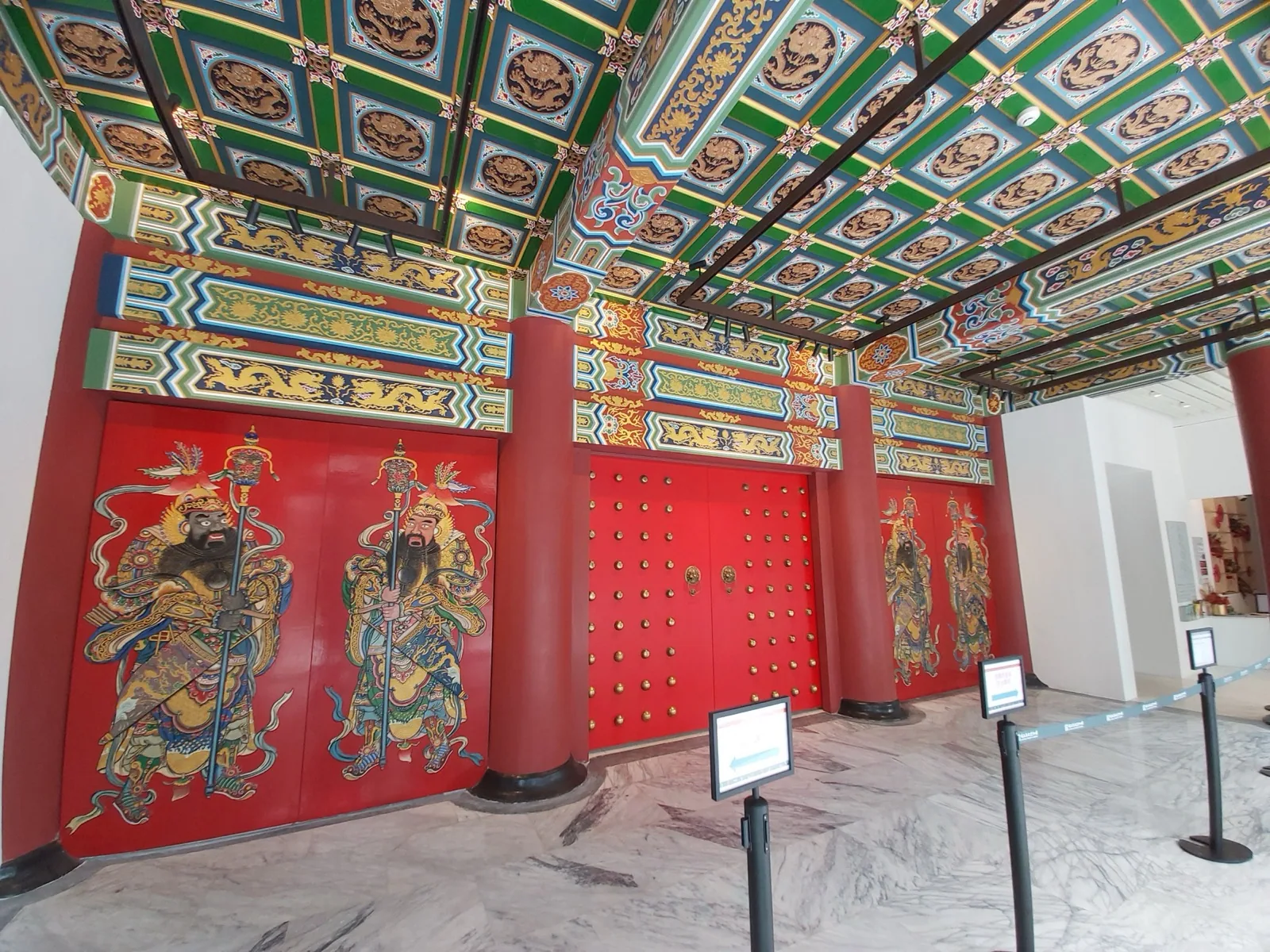
The front gate of the National Museum of History during the week of its February 2024 reopening, No. 49 Nanhai Road, Zhongzheng District, Taipei. Photo: 阿道, CC BY-SA 4.0 via Wikimedia Commons.
Nanhai Academy: Chinese Palaces Built on a Japanese Nursery
Walk 100 meters north from the intersection of Guling Street and Nanhai Road, and you enter the precinct of Nanhai Academy.
Nanhai Academy is a cluster of museums that gradually emerged in the 1950s and 1960s, all built on the former site of the Japanese-era "Taipei Nursery." The Taipei Nursery was established in 1896 by the Government-General's Bureau of Productive Industries as a tropical plant breeding and forestry research institution. Its grounds included today's Taipei Botanical Garden, Nanhai Academy, and surrounding blocks. During the Japanese period, the nursery housed a Commercial Exhibition Hall, which displayed Taiwan products for Japan proper, and Kenko Shrine, which commemorated Japanese who died in service in Taiwan622.
It was taken over after the war. In 1954, after Chang Chi-yun became Minister of Education, and under Chiang Kai-shek's instructions, this land was planned as the Nationalist government's first national cultural and educational exhibition zone in Taiwan and named "Nanhai Academy." Beginning in 1955, one building after another was constructed23:
- 1955-09-18: The National Central Library reopened at No. 43 Nanhai Road, becoming the first central-level library formally restored after the Nationalist government retreated to Taiwan. In 1996 it moved to No. 20 Zhongshan South Road and was renamed the National Central Library24
- 1955-12-04: The National Museum of History was founded, originally as the "National Museum of Historical Artifacts and Fine Arts"; on 1957-10-10 it was renamed the National Museum of History. It opened on 1956-03-12, and in 1964 was rebuilt as a Chinese Ming-Qing palace-style building at No. 49 Nanhai Road25
- 1957-03-29: The National Art Museum was founded, later renamed the National Taiwan Arts Education Center, at No. 47 Nanhai Road26
- 1958/1959: The National Taiwan Science Education Center was completed at No. 41 Nanhai Road. Designed by architect Lu Yujun with an exterior modeled on Beijing's Temple of Heaven Hall of Prayer for Good Harvests, it was listed as a municipal monument in 2006 and transferred in 2008 to the National Taiwan Craft Research and Development Institute as the "Taipei Branch"2728
These four museums, together with the postwar-renovated Botanical Garden greenhouse, the former Educational Broadcasting Station building, and the adjacent former Taiwan Education Hall at No. 54 Nanhai Road, designed by Ide Kaoru in 1931 and used after the war by the United States Information Service from 1958 to 1991 before becoming the National 228 Memorial Museum in 2011, form a layered block that runs from 1930s Japanese colonial architecture to the Nationalist government's Chinese palace architecture of the 1950s and 1960s29.
The main point is not the buildings themselves, but the site's logic of iteration. On the same piece of land, in 1896 the Japanese said tropical plants should be cultivated here in order to understand the South Seas; in 1908 the Government-General Museum was founded, later moving to today's 228 Peace Park; in 1916 the "Taiwan Industrial Promotion Exhibition" held here staged a large display of Taiwan products and colonial propaganda; in 1921 it became the Taipei Botanical Garden; after 1955 the Nationalist government built Chinese palace-style museums here to display "Chinese cultural relics." Every empire used this site once to make its own "civilizational declaration." Look, our central authority has placed our things here.
Curator's Note: Building a science education center modeled on Beijing's Temple of Heaven on land that had originally been a Japanese nursery for tropical plants was part of the Nationalist government's 1950s architectural-sign campaign in Taiwan to consciously construct "Chinese orthodoxy." This batch of Chinese palace-style buildings appeared across Taiwan around 1959: Zhongshan Hall, built in 1936 and renamed after the war; the Chinese palace-style rebuilding of the Grand Hotel, completed in 1973; Sun Yat-sen Memorial Hall in 1972; Chiang Kai-shek Memorial Hall in 1980. Nanhai Academy was one starting point of this architectural language. Taiwanese people had just emerged from the colonial language of Japanese rule, only to be overlaid with another architectural grammar saying "we are China." Today, when one looks at the Chinese palace-style roofs of Nanhai Academy and the tropical ferns of the Botanical Garden next to it, two civilizational declarations from two empires stand simultaneously on the same piece of land.
The National Museum of History later became the most famous institution in Nanhai Academy. Its best-known controversy was the renovation closure that began on July 1, 2018. Originally expected to be completed in three years, the project was extended to nearly six years because of cultural heritage status review and shortages of labor and materials during the pandemic. On February 7, 2024, director Wang Chang-hwa presided over the unveiling ceremony for "Meeting Everyone Here," and on February 21, 2024, the museum officially reopened to the public. After renovation, exhibition space increased by 262 ping, a 22 percent expansion. During the closure, artifacts were dispersed among the Southern Branch of the National Palace Museum, the National Taiwan Museum of Fine Arts, a Xindian storage facility, and Academia Sinica. They are expected to move fully into a new collection storage facility in Zhonghe by 2028253031.
From its 1955 opening to its 2024 reopening was 69 years. The 5.5-year closure in between was the longest time the museum's doors had ever been shut.
Three Places Locals Would Take You
If you visit Guling Street today, locals would take you to these three places. None of the three is exactly a tourist site; all are still functioning objects.
1. Songlin Bookstore (No. 17 Guling Street)
The first generation opened the shop in 1945, and second-generation owner Cai Jinghui, now in his seventies, still watches the store. The two-story storefront, just over ten ping, has books piled from floor to ceiling and a collection of nearly 100,000 volumes. Fortune-telling and physiognomy, Chinese medicine, and history sell best, but some holdings date back to the Kangxi and Qianlong reigns of the Qing dynasty. Chat with Boss Cai for a moment and he will tell you a story about some scholar in the 1950s coming to look for thread-bound books. This is the last used bookstore on Guling Street that has endured from 1945 to the present8.
2. Guling Street Avant-garde Theatre (No. 2, Lane 5, Guling Street)
Every June it hosts the "Reading for You" staged-reading festival, and every weekend there are experimental theater performances. The building itself is the attraction: an original 1906 Japanese-era Government-General Medical School official residence, plus a postwar two-story brick front building added in 1954, plus a three-story rear building expanded from 1958 to 1969. In 2014 it was listed as a historic building. Before the war it was a Japanese military police detachment office; after the war it was a Nationalist government police precinct; now it is a base for Taiwan's avant-garde theater. The same building contains three kinds of power. It is best to arrive after 4 p.m. on Saturday, when the theater is busiest if a performance is on23.
3. Guling Street Book and Creative Market (Late November to Early December)
This annual market began in 2000, started by Zheng Zhenzhen, head of Longfu Village. By 2026 it had reached its 25th edition. It is Taiwan's oldest creative market, with used-book stalls alongside independent publishing, art zines, and picture-book binding. The market is supported by the Ministry of Culture and Taipei City's Department of Cultural Affairs. This is the last moment when "the whole street is books" on Guling Street. During the two or three days of the market, one can see a miniature of the street-wide book ecology of the 1960s vendors3233.
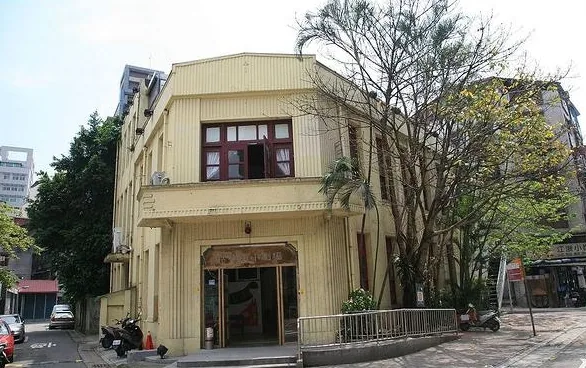
Guling Street Avant-garde Theatre on August 3, 2008. Photo: Peter Bronski, Public domain via Wikimedia Commons.
The Lotus Pond from 1921 Is Still There
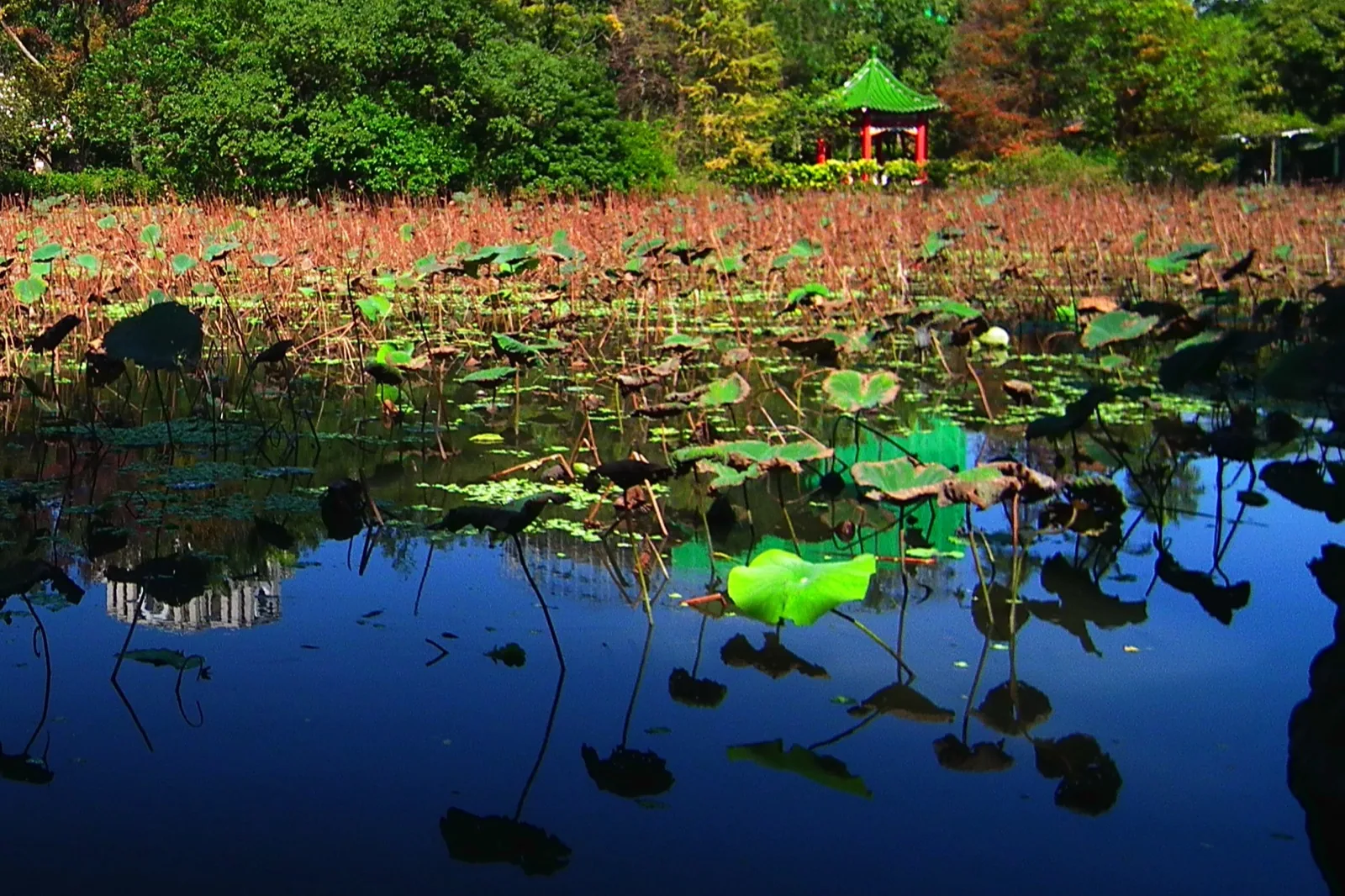
The lotus pond at the Taipei Botanical Garden in June 2013. Photo: 玄史生 (panoramio), CC BY 3.0 via Wikimedia Commons.
Guling Street's book street has been dismantled, the book stalls have moved, and the second-generation owner of Songlin Bookstore is in his seventies, but the lotus pond at the adjacent Taipei Botanical Garden is still in the same place.
The Botanical Garden was established by the Bureau of Productive Industries in 1896 as the "Taipei Nursery," reorganized in 1911 as a forestry experiment station, and officially renamed the "Taipei Botanical Garden" on January 22, 1921. The lotus pond already existed around the time of the 1921 reorganization. It is one of Taipei's earliest artificial landscape ponds, covering about 1 hectare. It blooms every June to August and sheds its leaves from December to February. For 105 years, its location has not moved534.
For Taipei residents, the lotus pond is the most enduring object on this street. On June 15, 1961, Mao Wu and Liu Min walked past this pond toward Guling Street. Before the last batch of used-book stalls was moved away in April 1973, those booksellers passed by this pond on Sunday mornings. When Edward Yang filmed A Brighter Summer Day in 1991, most of the exterior scenes were shot in military dependents' villages in Shilin, but he probably also walked through here. On the day the National Museum of History reopened in February 2024, museum staff leaving work from the front gate would have seen this pond on the way out. This pond has lived longer than any museum, any bookstore, or any empire.
The book street was dismantled, but the pond still grows lotus flowers in the same place.
✦ Guling Street changed names three times, housed three layers of people, saw three batches of book stalls driven away, and had one cinematic myth laid over it. The red-brick building left by Japanese rule became a theater, and the Chinese palace built by the Nationalist government closed for 5.5 years and reopened. The things that have lasted longest are that pool of water and those lotus leaves.
Further Reading:
- Taipei City — A century-long narrative of the 12 districts, including the postwar formation context of Zhongzheng District, where Guling Street is located
- Dadaocheng — Another generational memory from the old three market streets of Taipei, from commerce in 1851 to the 228 Incident in 1947
- Monga — The earliest urban street district in Qing-era Taipei, from Longshan Temple in 1738 to the 2010 film Monga
- Ximending — From the Japanese-era entertainment district of 1896 to the subculture capital of 2026; like Guling Street, a Zhongzheng-area district formed through Japanese colonial planning
- Taiwan Cinema — The place of Edward Yang's A Brighter Summer Day in the history of the New Taiwan Cinema movement
- Edward Yang — The soul of New Taiwan Cinema who made the 237-minute A Brighter Summer Day
- Gongguan — A sister landscape of postwar Mainlander scholars and used-book street culture, forming with Guling Street two clusters of Mainlander intellectuals
- Si Si Nan Cun — The military dependents' housing of an arsenal and Guling Street's used-book street as two postwar Mainlander settlement structures: "military industry vs. literati"
Image Sources
This article uses 5 CC / public domain licensed images, plus the hero image, all cached in public/article-images/geography/ to avoid hotlinking source servers:
- Nanhai Academy 20240102 — Photo: Yu tptw, CC BY-SA 4.0
- Guling Street Avant-garde Theatre 2022 — Photo: Yu tptw, CC BY-SA 4.0
- Main Gate of the National Museum of History, Taipei 20240222 — Photo: 阿道, CC BY-SA 4.0
- 1916 Industrial Promotion Exhibition Botanical Garden Site — Public domain
- Guling Street Avant-garde Theatre 20080803 — Photo: Peter Bronski, Public domain
- Lotus Pond in Taipei Botanical Garden 台北植物園荷花池 — Photo: 玄史生 (panoramio), CC BY 3.0
References
- Wikipedia: Guling Street Avant-garde Theatre — Located at No. 2, Lane 5, Guling Street, Zhongzheng District, Taipei. The building was originally an official residence of the Government-General of Taiwan Medical School during the Japanese colonial period. After Zhongzheng Second Precinct moved out in 1995, it became one of Taiwan's early experimental theater sites and was officially named Guling Street Avant-garde Theatre in 2001.↩
- Taipei City Government Department of Cultural Affairs: Guling Street Avant-garde Theatre — Around 1906 the original site was built as a row of wooden official residences for the Government-General Medical School and was once used as a Japanese military police detachment office. After the war, in 1954, Taipei City Police Department took it over and added the Seventh Precinct. After Zhongzheng Second Precinct moved to a new building on Chongqing South Road in 1995, the original site was transferred to the Information Office, and in 1996 it was planned as an arts theater.↩2
- National Cultural Heritage Database: Former Zhongzheng Second Police Precinct (Guling Street Avant-garde Theatre) — On April 8, 2014, Taipei City's Department of Cultural Affairs listed it as a "historic building." The front building is a two-story brick-and-reinforced-concrete structure added in 1954; the rear building was expanded into a three-story office building from 1958 to 1969. It preserves characteristics of postwar government-office architecture and bears witness to policies for reusing idle space.↩2
- Wikipedia: Nanhai Academy — Planned in 1954 during Chang Chi-yun's tenure as Minister of Education under Chiang Kai-shek's instructions. The Central Library in 1955, National Museum of History in 1956, National Art Museum in 1957, and National Taiwan Science Education Center in 1959 were established successively. The buildings adopted Chinese ancient-palace styles and marked the beginning of the postwar Taiwan state's conscious construction of new architecture in Chinese classical forms.↩
- Taipei Botanical Garden Official Website: History — In 1896 the Japanese colonial Bureau of Productive Industries established the "Taipei Nursery." In 1911, or Meiji 44, it was reorganized as a "Forestry Experiment Station" under the Bureau of Productive Industries. On January 22, 1921, or Taisho 10, it was officially renamed the "Taipei Botanical Garden." It was Taiwan's first botanical garden, intended to cultivate tropical plants and become familiar with the plants and ecosystems of the South Seas.↩2
- Wikipedia: Taipei Botanical Garden — The grounds cover 8.2 hectares and contain more than 2,000 plant species. During the Japanese colonial period, the nursery housed a Commercial Exhibition Hall and Kenko Shrine. Since the war it has been managed by the Taiwan Forestry Research Institute.↩2
- Wikipedia: Guanghua Market — Established by Taipei City Government in April 1973 using the public space beneath the Guanghua overpass. The earliest merchants mainly came from the used-book stalls of Guling Street. In 1974, the city government further moved all Guling Street used-book stalls to Guanghua Market; some sources say 58 stalls migrated collectively. In 2006, as part of Zhongxiao Bridge reconstruction, the original Guanghua overpass was demolished, and the used-book stalls moved again to New Guanghua Market and Syntrend Creative Park.↩23
- StoryStudio: Old Bookstores, the Indispensable Eyebrows of the City — "Songlin Bookstore," with Book Fragrance Drifting for More Than Seventy Years — Songlin Bookstore was founded in 1945 by first-generation owner Cai Mulin, a Chiayi native who had previously sold lumber. He was the first senior figure on Guling Street to move from stall vending to a physical bookstore. After second-generation owner Cai Jinghui took over, the two-story storefront of just over ten ping held nearly 100,000 books. Its best-selling categories were fortune-telling and physiognomy, Chinese medicine, and history. Its collection reaches back to the Kangxi and Qianlong reigns of the Qing dynasty. The four characters on the "Songlin Bookstore" signboard were written by Cai Mulin himself in the style of Yan Zhenqing.↩2345
- Wikipedia: Guling Street (Taipei) — After the second Japanese colonial urban improvement plan, the area where this street sits was called Longkou Street Third and Fourth Chome. After the 1922, or Taisho 11, district-name reform, it was incorporated into Sakuma-cho First, Second, and Third Chome and called "Sakuma-cho-dori." After the war it was renamed Longjin Street in 1946, and in 1947 it was officially named Guling Street, a name retained to the present.↩
- Wikipedia: Kodama-cho — Kodama-cho was an administrative district of Taipei City during the Japanese colonial period, divided into First through Fourth Chome. Located west of Chitose-cho, it was named after the fourth governor-general of Taiwan, Kodama Gentaro, who served from 1898 to 1906. Today's Nanchang Street Sections 1 and 2, Hukou Street, Nanhai Road, Ningbo West Street, and part of Fuzhou Street all lay within the district.↩
- Wikipedia: Guling — Guling is located at the center of the Mount Lu scenic area in the southern suburbs of Jiujiang, Jiangxi Province. Originally called Guniu Ridge, the town's name derives from the English word "cooling" and is the only town name in China directly derived from English. In the nineteenth century, British Methodist missionary Edward Selby Little developed a summer resort on Mount Lu and named it "Kuling."↩
- Shih Hsin University Newsweek: Taiwan's First Used-Book Street, Guling Street's Book Fragrance — After World War II ended, Japanese residents were forcibly repatriated under a rule that each person could carry aboard only "one shoulder load." As a result, many non-historical books, documents, and reports unrelated to warfare were left behind. Japanese residents set up roadside stalls to sell cheaply the calligraphy, paintings, antiques, and collections they could not take. After the Nationalist government came to Taiwan, military personnel, civil servants, and teachers brought large quantities of books and textbooks, which were also exchanged and sold with Guling Street as a base.↩2
- Time UDN: Taiwan Crime Files — "Guling Street Youth" Mao Wu — At 10 p.m. on June 15, 1961, youth Mao Wu, 16, stabbed his girlfriend Liu Min, 15, seven times with a scout knife. The police hired a car to take her to National Taiwan University Hospital, and when she reached the emergency room at 10:20 doctors diagnosed that she had "no signs of life before arrival." On August 7, 1961, the Taipei District Court sentenced him under Article 63, Paragraph 1 of the Criminal Code to 15 years in prison and deprivation of civil rights for eight years. On February 22, 1963, the High Court reduced the sentence on retrial to a final 10 years.↩2
- The News Lens: Guan Renjian — A Casebook of Juvenile Murders by Jianguo High School Students — The victim Liu Min, a 15-year-old Shandong-born student in Junior Second Class A at Jianguo High School, lived on Keelung Road Section 2. The suspect Mao Wu, who claimed to be the victim's brother, was a 16-year-old Zhejiang-born student expelled from Junior Second Class C at Jianguo High School and lived in the Academia Sinica dormitory area on Jiuzhuang Road in Nangang. The two arranged to meet at the United States Information Service, today's National 228 Memorial Museum, and walked while negotiating to Guling Street, where Mao Wu attacked. The trigger was Liu Min's close contact with Ma Jishen, a delinquent from Mao Wu's class associated with the "Pirate Gang."↩
- Wikipedia: A Brighter Summer Day — A 1991 Taiwanese drama film directed by Edward Yang, adapted from a real juvenile murder that occurred on Guling Street in Taipei in 1961. The original version runs 237 minutes and took 110 working days to complete. It won Best Feature Film for Yang & His Gang Filmmakers and Best Original Screenplay for Yang Shunqing, Yen Hungya, Edward Yang, and Lai Mingtang at the 28th Golden Horse Awards. Father and son Zhang Guozhu and Chang Chen were both nominated for Best Actor in the same year.↩
- Taipei Golden Horse Film Festival: A Brighter Summer Day (Director's Cut) — Edward Yang spent more than two years searching for a female lead. After Yang Jingyi, who lived in the United States, was introduced by a friend, Yang decided she was the best candidate and even acted as her guardian, asking her to live in his home for a year. Chang Chen was 14 when he first appeared in an Edward Yang film and was nominated for the Golden Horse Award for Best Actor.↩
- Time UDN: The Ethereal Actress Who Disappeared from the Film World — Yang Jingyi, the Lead Actress of A Brighter Summer Day, Retired After Becoming Famous in One Film — Yang Jingyi, a New York University graduate, had merely returned to Taiwan for vacation when Edward Yang discovered her for A Brighter Summer Day. After becoming famous through one film, she did not continue an acting career. She was the person Edward Yang finally chose after "more than two years of searching for a female lead."↩
- Newtalk: Guan Renjian's Viewpoint — Returning to the Killing and Being Killed of the Youths on Guling Street — Contextual interpretation of the details of the 1961 Mao Wu case and postwar Taiwanese society, including the impact of Japanese repatriation policy on the formation of the Guling Street used-book street, the situation of second-generation Mainlander youths, and Edward Yang's reconstruction of 1960s Taipei in the film.↩
- Taipei Pictorial, May 2017, Issue 592: Secondhand Book Treasure Hunting on Guling Street, Seeking a Feast of Knowledge and Spirit in the Fragrance of Old Books — Records that Guling Street had more than 100 vendors and more than 20 storefronts at its peak. After cityscape improvement in the 1970s, the bookish atmosphere quickly faded. In 1974, the government considered the used-book stalls detrimental to the cityscape and moved them all to Guanghua Market.↩
- Merit Times: A Historical Account of the Rise and Fall of Guling Street and Its Used Bookstores — Records that the total number of Guling Street used-book stalls once reached more than 200 at its height, and traces the rise and fall of other long-standing used bookstores besides Songlin Bookstore, including the process by which vendors were gradually concentrated and moved after Guanghua Bridge opened in 1973.↩
- Taiwan Panorama: The Demolition and Relocation of Guanghua Market, as Old Taipei Continues to Disappear — A complete timeline of Guanghua Market opening in 1973, reaching its peak in the 1980s and 1990s, the demolition of the old market in 2006 for Zhongxiao Bridge reconstruction, the relocation of used-book stalls to New Guanghua Market, and their further relocation after construction began on Syntrend Creative Park in 2008, along with discussion of the urban-memory issue of "old Taipei continuing to disappear."↩2
- Museum Island, Ministry of Culture: Taipei Botanical Garden — One of the Ministry of Culture's certified Museum Island sites. The grounds include the Herbarium, built in 1924 and preserving more than 120,000 plant specimens; the Imperial Envoy's Office, a Qing-dynasty government building constructed in 1894 and relocated here; and the oldest extant artificial lotus pond in Taiwan.↩
- Ministry of Culture, Republic of China: Museum Island — National Museum of History — The National Museum of History was founded on December 4, 1955, originally as the "National Museum of Historical Artifacts and Fine Arts," and was the first national museum after the Nationalist government moved to Taiwan. The Ministry of Education appointed Bao Zunpeng as director of the preparatory office and invited Wang Yuqing, He Haotian, and Yao Menggu to plan it. Bao Zunpeng became the first director. The museum officially opened on March 12, 1956, and was renamed the "National Museum of History" on October 10, 1957.↩
- Brief History of the National Central Library — The National Central Library was originally founded in Nanjing in 1933. It moved to Taiwan with the Nationalist government in 1949 and reopened at No. 43 Nanhai Road, Taipei, on September 18, 1955. In 1996 it was renamed the National Central Library and moved to a new building at No. 20 Zhongshan South Road. The old site at No. 43 Nanhai Road was designated a historic building in 2013.↩
- Wikipedia: National Museum of History — Founded on December 4, 1955; opened to the public on March 12, 1956; renamed the National Museum of History on October 10, 1957; and rebuilt in 1964 as a Chinese Ming-Qing palace-style building. Its address is No. 49 Nanhai Road, Zhongzheng District, Taipei. It began closing for renovation on July 1, 2018. Because of cultural heritage review and pandemic-related labor shortages, the original three-year renovation was extended to six years. It reopened to the public on February 21, 2024, with exhibition space expanded by 22 percent, or 262 ping.↩2
- Wikipedia: National Taiwan Arts Education Center — Officially established on March 29, 1957 as the "National Art Museum," it was the first public art museum and the only government institution whose core mission was promoting "arts education." On October 23, 1985, a presidential order promulgated its organizational statute and renamed it the "National Taiwan Arts Education Center." Located at No. 47 Nanhai Road, Zhongzheng District, Taipei, it includes the Nanhai Theater and Nanhai Academy buildings.↩
- National Taiwan Science Education Center: Inheritance and Transformation — In 1958 the museum moved to and settled at No. 41 Nanhai Road. Designed by noted architect Lu Yujun, the building is round on the outside and square within, resembling the Temple of Heaven. Modeled on Beijing's Hall of Prayer for Good Harvests, it was completed in 1959. The original site had been surveyed inside Taipei New Park, but after an evacuation order barred construction inside the city, it was instead built in Banqiao Park and completed in 1956.↩
- Wikipedia: National Taiwan Science Education Center — The former Nanhai Road building of the Science Education Center was listed as a municipal monument on June 26, 2006. In 2008 it was transferred to the National Taiwan Craft Research and Development Institute as the "Taipei Branch." Since 2015, that branch has hosted exhibitions and activities related to cultural, creative, craft, and design work.↩
- Wikipedia: Former Taiwan Education Hall (National 228 Memorial Museum) — Located at No. 54 Nanhai Road, Zhongzheng District, Taipei, designed by Japanese architect Ide Kaoru and completed in 1931. After the war, the United States Information Service moved in on December 2, 1958. After the U.S. broke diplomatic relations with Taiwan in 1979, it became the American Institute in Taiwan Cultural Center. The lease expired at the end of 1991. The National 228 Memorial Museum was officially inaugurated on February 28, 2007 and began formal operations on February 28, 2011.↩
- ARTouch: The National Museum of History Unveiled and Reopened Today, with a First Look at New Exhibitions — On February 7, 2024, director Wang Chang-hwa presided over the unveiling ceremony for "Meeting Everyone Here." During renovation, artifacts were dispersed among the Southern Branch of the National Palace Museum, the National Taiwan Museum of Fine Arts, Academia Sinica, and a Xindian storage facility. They are expected to move into the museum's new collection storage facility in Zhonghe District, New Taipei City, in 2028.↩
- Public Television News Network: National Museum of History Reopens on the 21st After Six Years of Closure and Renovation — After the National Museum of History closed in July 2018, cultural heritage status review and pandemic-related shortages of labor and materials extended the original three-year renovation to nearly six years. It officially reopened to the public on February 21, 2024. Total exhibition space increased by 262 ping, an expansion of 22 percent.↩
- Ministry of Culture iCulture: Guling Street Book and Creative Market — Started in 2000 by the Nanmenkou Community Development Association of Zhongzheng District, Taipei, and by Longfu Village head Zheng Zhenzhen. Held every November to December, it includes used-book stalls, publishers' discounted books, rare out-of-print titles, stamps and coins, charity stalls, original handmade goods, independent publishing, picture-book binding, art zines, and more.↩
- Taipei City Government Press Release: The 24th Guling Street Book and Creative Market Opens in 2024 — The Guling Street Book and Creative Market has been held for 24 consecutive editions and is Taiwan's oldest creative market. The 2024 edition received support from the Ministry of Culture and Taipei City's Department of Cultural Affairs, was organized by community volunteers, and combined local cultural transmission with new and old thinking.↩
- Tamsui Wiki: Taipei Botanical Garden — The Botanical Garden has more than a century of history, covers about 8.2 hectares, and contains more than 2,000 plant species. It is an important site for plant research and teaching in Taiwan. Records show that around the 1921 reorganization, the lotus pond already existed as an artificial landscape pond.↩