
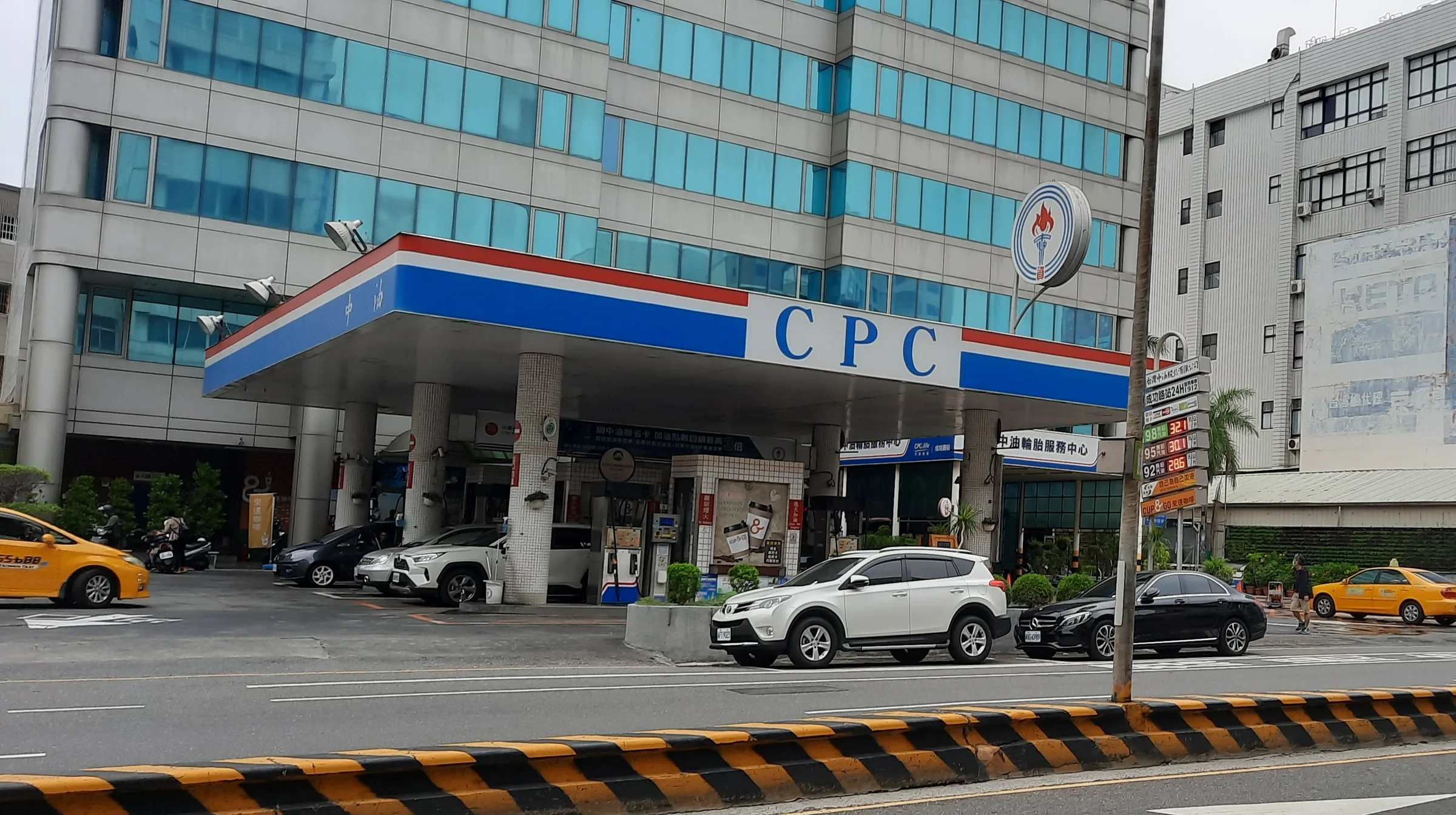
On the evening of Sunday, March 22, 2026, at 8:30 p.m., every entrance at the Yahoo gas station beside the Yunlin Technology Industrial Park had a line of cars. Staff had set out traffic cones to mark off a lane, and scooters had to queue just like cars. A small pickup truck pulled in carrying four or five fuel cans, filling them all in one visit. One woman, having pumped twenty liters, said happily: "I saved NT$36 — saving is earning."1
What everyone was racing against was the cutoff at midnight the next day, when gasoline was set to rise by NT$1.8 per liter.2 At the same station, a woman in her eighties surnamed Chen — whose gas canister had gone up by NT$100 the month before — saw the news that fuel prices were about to rise and rushed over on her scooter, only to find her tank was already full.1
That same afternoon, in Changhua, Premier Cho Jung-tai (卓榮泰) said something that would draw criticism for days afterward. He said that, based on international oil prices, gasoline should have risen by NT$15, but after the government's calculations, CPC had absorbed NT$13.2 of that, leaving only a NT$1.8 increase — so "everyone passing a gas station should say thank you to CPC."3
The NT$36 that woman saved, and the company Cho was asking everyone to thank, are two ends of the same thing. Taiwan's fuel price is set by a formula, recalculated once a week, but the price the formula produces rarely goes straight onto the sign. For twenty years, CPC has mostly absorbed that gap in between. This piece is about who benefits from the design that puts CPC out in front, who ultimately pays for it, and something no one has tallied in twenty years: who uses the most.
30-Second Overview: Taiwan's gasoline and diesel prices are set by a formula recalculated weekly, but the number on the sign rarely equals the formula price: the government forgoes a bit of commodity tax, CPC swallows a portion itself, and what's left is what you pay. Half a year into the Middle East war, the portion CPC has swallowed is officially estimated at about NT$20 billion. In the supplementary budget the Executive Yuan has sent to the Legislative Yuan, subsidies plus a capital injection for CPC add up to more than NT$300 billion — still unreviewed. Japan subsidizes suppliers out of its budget, Hong Kong subsidizes taxis, South Korea pays cash per person — Taiwan lets a state-owned company with a 93% debt ratio absorb it first. The savings are split evenly per liter for everyone, and who uses the most has gone untallied from the one-time catch-up hike of 2008 to today.
The Bigger the Storm, the Further CPC Stands to the Front
"The rougher the seas outside, the further forward CPC stands; the harder prices spike out there, the more CPC absorbs." That's how Chen Chia-lin (陳嘉麟), chairman of the Taiwan Petroleum Workers' Union, described the company he works for, at CPC's 80th anniversary celebration on June 1.4 It was a statement of pride, and of grievance. What the union wanted that day was reimbursement, pay raises, and folding the night-shift meal allowance into base wages. Nobody understands the cost of standing at the front better than they do.
Two successive chairmen of the company have said the same thing. At a media luncheon in late 2022, Lee Shun-chin (李順欽) first joked about the corruption and workplace-safety scandals the company had that year, then pivoted: "I know the media are going to ask one question today, so let me just be the one to break the news myself!" What he broke was that after absorbing that year's natural gas price gap, the company's full-year loss could hit a record high.5 Two years later, he reported it again: borrowings nearing NT$700 billion, with annual interest alone exceeding NT$10 billion.6 His successor, Fang Chen-jen (方振仁), said in early 2025 that the debt ratio had climbed to nearly 93%, with accumulated losses exceeding half of paid-in capital.7
So in late November 2025, CPC did something it rarely does: it took a step back. It announced that, starting in December, it would first net out neighboring governments' own subsidies before comparing prices with those countries, and that the trigger thresholds for the price stabilization measure would each move up one tier. The reasoning was stated plainly: from 2018 to that point, the two slow-rise mechanisms had absorbed a cumulative total of more than NT$100 billion, and "the debt ratio still remains as high as 93%."8 That step back didn't last long. Three months later, the US and Iran went to war, and in the third week's fuel price release a new term appeared — the "special stabilization mechanism" — under which CPC would absorb another 60%, raised to 75% a week later.9 It was pushed back to the front once again.
It was from this position that Cho made his remark about thanking CPC. The moment it came out, PTT's stock board reacted immediately, all asking the same thing: "Everyone foots the bill — thank you for what?" "Shouldn't it be thanking the taxpayers?" "Isn't the money CPC subsidizes with the taxpayers' money?" Others spoke up for the government: "Stabilize prices and people jump on you; don't stabilize them and they complain too."10 Taipei Mayor Chiang Wan-an (蔣萬安) said the next day that under a democratic system, it should be the government thanking the people for their trust, not the other way around.11 Two days later, Cho responded that CPC's staff are citizens of the country too, and that a bit more gratitude, well-wishing, and care among people is always a good thing — "Taiwan CPC fuels up for everyone; everyone, fuel up for Taiwan" (a play on jiayou, which means both "refuel" and "keep going").12
This whole fight over a single word of thanks laid the design bare: the one standing at the front is a company, but the ones paying are everyone — it's only the method and timing of that payment that have been split apart. To see how it's split, start with how a single liter of fuel gets carved up.
How One Liter of Fuel Gets Split Three Ways
CPC announces next week's fuel prices every Sunday at noon. It takes the weekly average price of Dubai and Brent crude, multiplies by the exchange rate, and reflects 80% of the change in the price CPC sells to gas stations, which then becomes the retail price after taxes and fees. This formula was piloted in 2006; the benchmark crudes and adjustment frequency have changed a few times since, but it has largely looked like this since 2008.13 Two brakes are built in after the formula. One is called the "Asian-neighbor lowest-price rule": the pre-tax prices of 92 unleaded and diesel cannot exceed the lowest of that week's prices in Japan, South Korea, Hong Kong, and Singapore. Every grade of gasoline is adjusted by the same amount each week, so when 92 is capped, 95 and 98 get capped along with it.13 The other is called the "price stabilization measure": once 95 unleaded rises above a certain price point, CPC absorbs part of the increase itself — the higher the price, the more it absorbs — and it holds back the same proportion of any decline when prices fall.14
The September 12 press release makes a good example. That week, the formula-calculated price came out NT$11.2 higher than the previous week's posted price. The commodity tax the government forwent covered NT$3.7 of that; CPC, under the Asian-neighbor lowest-price rule and the special stabilization mechanism, absorbed a further NT$6.8; and the remaining NT$0.7 went onto the sign, bringing 95 unleaded to NT$32.7 per liter.15 The last few lines of the press release read the same every week: "combined, gasoline and diesel absorbed NT$10.5 and NT$10.8 respectively," "domestic gasoline and diesel prices each rose by NT$0.7 and NT$0.6."15
| Fuel | Commodity tax foregone | CPC absorbed | You paid more |
|---|---|---|---|
| 95 unleaded (formula price up NT$11.2) | 3.7 | 6.8 | 0.7 |
| Super diesel (formula price up NT$11.4) | 2.1 | 8.7 | 0.6 |
Source: CPC Taiwan fuel price press release, September 12, 2026 (reposted by the Executive Yuan)
Of the three shares, the commodity tax share was paid out first: in mid-March, a single Executive Yuan directive cut the gasoline commodity tax in half, and from that week on, the treasury simply collected a bit over NT$3 less on every liter sold — no need to go through the Legislature.16 CPC's share went straight onto its own income statement; half a year into the war, the official estimate for gasoline and diesel combined is about NT$20 billion.15 Together, these two shares kept the number on the sign almost flat: after spiking to a high in late March, it held steady for eleven straight weeks, fell three times from late June to early July, rose NT$0.7 in late July because of the Red Sea crisis, then held for six more weeks before rising another NT$0.7 in mid-September.17 The Executive Yuan's own tally is "frozen for 20 weeks, cut in 3," while over the same period Brent crude rose more than 80% from its pre-war level.18
| Effective week | 95 unleaded |
|---|---|
| 2/23 | 28.7 |
| 3/2 | 28.9 |
| 3/9 | 30.4 |
| 3/16 | 30.4 |
| 3/23 | 32.2 |
| 3/30 | 33.9 |
| 4/6 | 33.9 |
| 4/13 | 33.9 |
| 4/20 | 33.9 |
| 4/27 | 33.9 |
| 5/4 | 33.9 |
| 5/11 | 33.9 |
| 5/18 | 33.9 |
| 5/25 | 33.9 |
| 6/1 | 33.9 |
| 6/8 | 33.9 |
| 6/15 | 33.9 |
| 6/22 | 32.9 |
| 6/29 | 31.9 |
| 7/6 | 31.3 |
| 7/13 | 31.3 |
| 7/20 | 31.3 |
| 7/27 | 32 |
| 8/3 | 32 |
| 8/10 | 32 |
| 8/17 | 32 |
| 8/24 | 32 |
| 8/31 | 32 |
| 9/7 | 32 |
| 9/14 | 32.7 |
| Baseline: pre-war 28.7 | 28.7 |
Source: CPC Taiwan and Ministry of Economic Affairs weekly fuel price press releases, 2026
The flat stretch of that line is exactly the NT$36 that woman saved, and exactly the reason Cho wanted everyone to say thank you. It's the easiest of the three shares to calculate, and the one least likely to draw objections, because it's split evenly by the liter: however much you pump, that's how much you save. In 2008, it was carried this same way once before.
Lin Mao-wen Remembers Those Seven Months in 2008
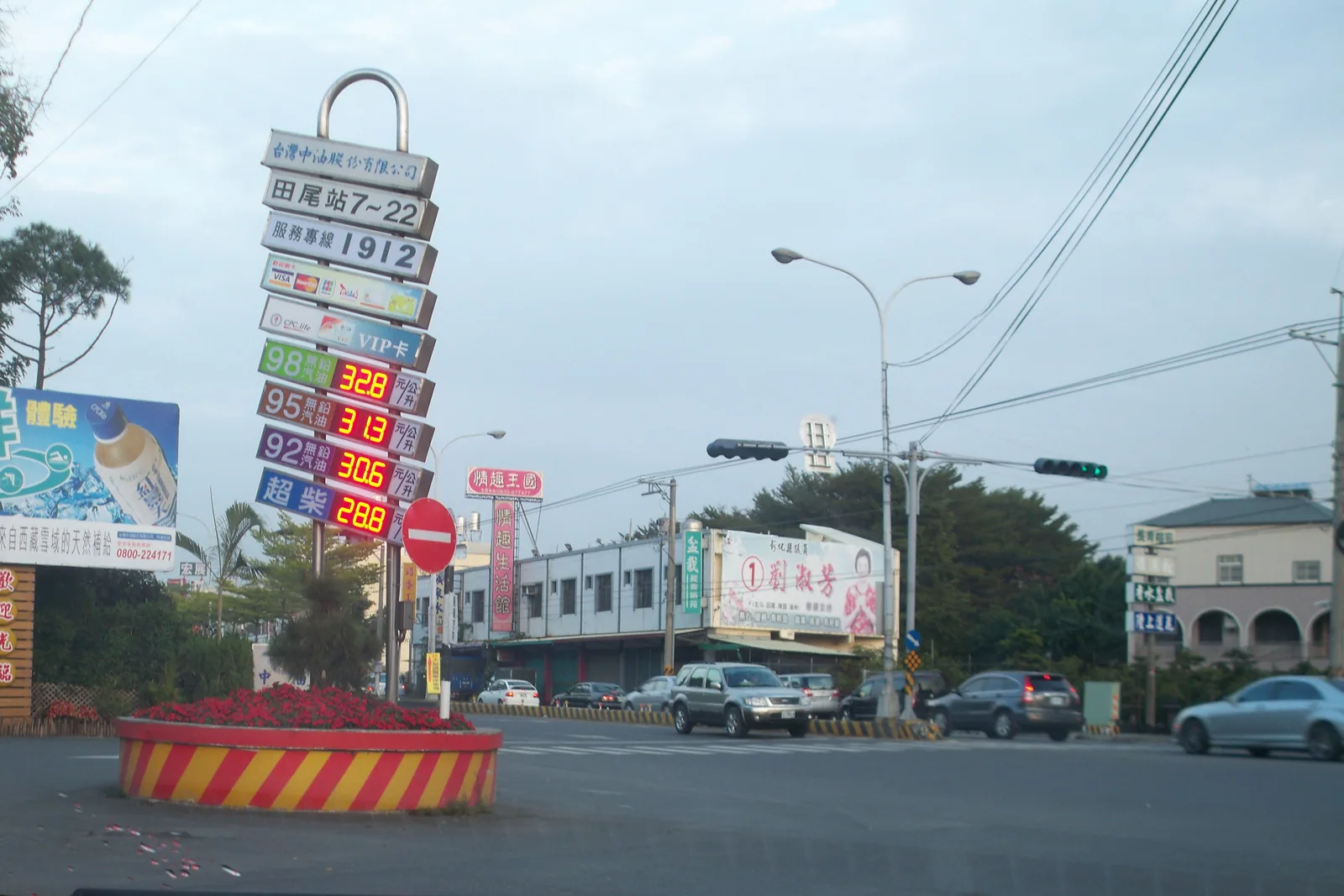
On January 24, 2012, the sign at the Tianwei station in Changhua showed 95 unleaded at NT$31.3. Two months later, the Ministry of Economic Affairs announced fuel price "rationalization," scrapping the slow-rise mechanism. Photo: Chi-Hung Lin / Wikimedia Commons, CC BY-SA 3.0
In 2018, former CPC general manager Lin Mao-wen (林茂文) wrote, in the company's own publication, a retrospective on the mechanism's first real test. In 2008, as international oil prices climbed relentlessly, the government ordered CPC to freeze prices — for, in his words, "as long as 7 months" — and that year CPC posted a pre-tax loss of NT$138.7 billion.19 On May 28, the government let prices rise all at once, and 92 unleaded jumped from NT$30 to NT$33.9.20 That August, the formula reverted to weekly adjustment, and set the template for the two columns that still appear in today's press releases: increases happen all at once, split between a reduced commodity tax and CPC's own absorption, with the absorbed portion "to be deducted in installments the next time fuel prices fall."13
Those four words — "deducted in installments" — are the most easily forgotten part of the whole design. When Minister of Economic Affairs Shen Jung-chin (沈榮津) announced the three-tier stabilization mechanism in 2018, all three tiers came with the phrase "falls less when prices drop," meaning that whatever portion CPC held back on the way up would be clawed back through smaller declines on the way down.14 CPC's own announcement that day summed up its role in a single sentence: "In accordance with the Ministry of Economic Affairs' instructions, CPC Taiwan will implement the price stabilization mechanism starting next week."14 The decision-making power sits with the Ministry of Economic Affairs, and the Petroleum Administration Act points the same way: when fuel prices swing sharply, it's the central competent authority that imposes price limits.21
📝 Curator's Note
Lin Mao-wen left one more line in that same article: "the slow-rise mechanism is in the spirit of 'stabilization,' not a government subsidy," because when fuel prices fall, CPC can let its own prices fall a little less, and thereby "recover the earlier losses."19 That sentence explains why, for twenty years, this has always been called "absorption" rather than a "subsidy": the money is only sitting at CPC temporarily, to be recovered later out of future price cuts. But from 2018 to October 2025, the two slow-rise mechanisms had absorbed a cumulative total of more than NT$100 billion,8 and that figure alone shows how far short the clawback from smaller declines has fallen. As long as it can't be recovered, "absorption" turns, year after year, into losses on the income statement, which eventually have to be made up out of the budget anyway. The difference between one word and another decides what question the opposition asks when a supplementary budget reaches the Legislature: what kind of "major incident" is this.
The Control Yuan corrected the Ministry of Economic Affairs once in 2010, pointing out that the formula's weighting of the two crude oil types didn't match the actual import ratio, and that underpriced low-sulfur fuel oil was creating cross-subsidization.22 The 2012 episode was more direct. According to Lin Mao-wen's account, the Ministry of Economic Affairs announced fuel price "rationalization" on April 1 that year and scrapped the slow-rise mechanism, citing as one reason the need to resolve "unreasonable situations such as the poor subsidizing the rich." CPC's final accounts still showed a loss of more than NT$30 billion that year.19 A government document from fourteen years ago had already admitted that savings split evenly by the liter flow toward whoever uses the most. Then came the NT$30 line in 2018, the raised thresholds of 2025, and the special stabilization of 2026 — the same design carrying more each time. CPC has posted losses for six straight years since 2020, a stretch that doesn't even include the Middle East war.7
Source: Fair Trade Quarterly 2011 paper, CPC's Petroleum Communications August 2018 issue, Control Yuan correction case, CPC announcements
Chien Hsiu-chih Waits by the Roadside for a Fare
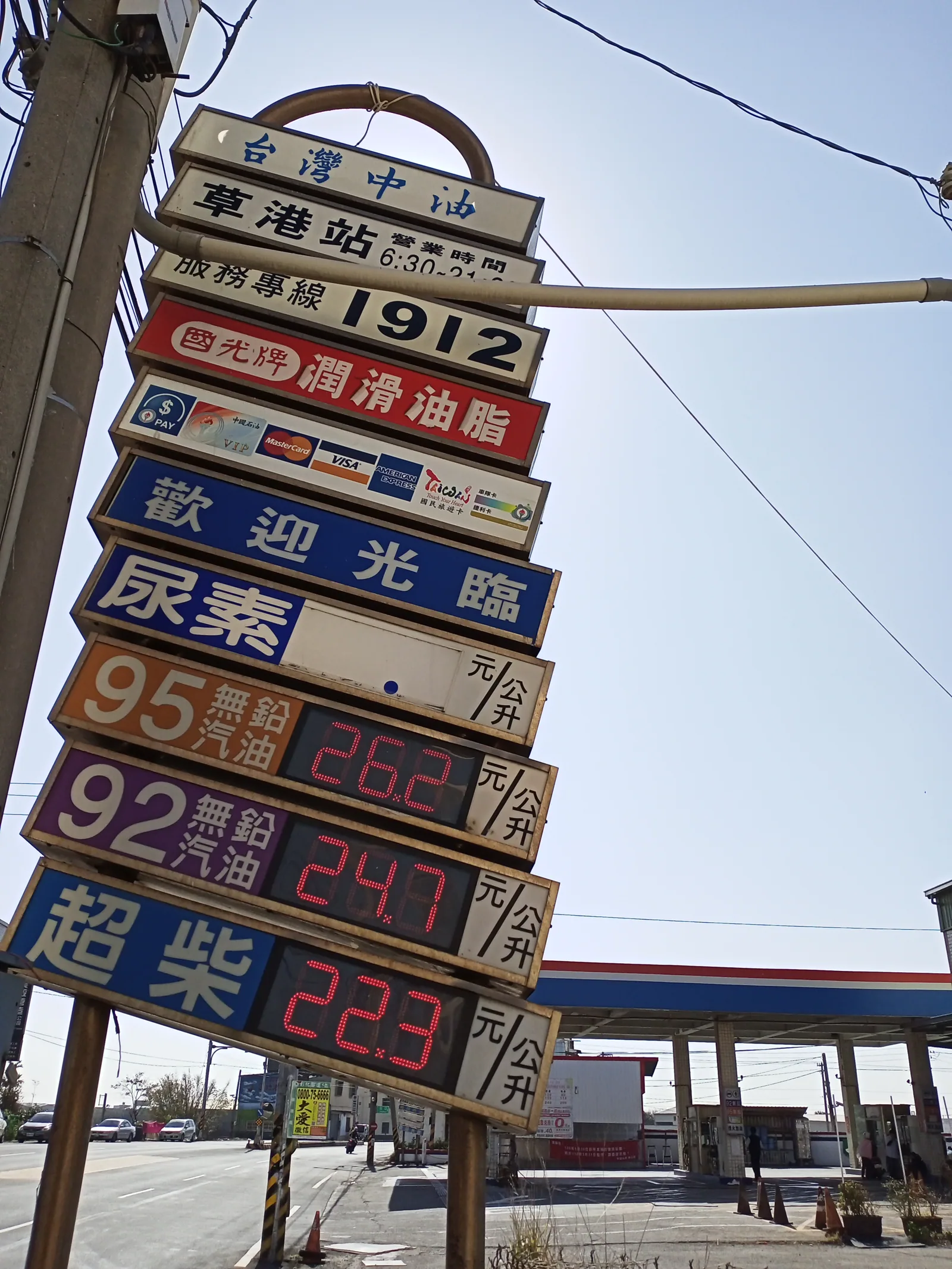
The row of numbers on the sign is the visible share of every liter. CPC Taiwan's Caogang station, January 14, 2021. Photo: Kai3952 / Wikimedia Commons, CC BY-SA 4.0
In May, Uber driver Chien Hsiu-chih (簡修智) told a reporter that last year his monthly fuel bill was only a few thousand NT dollars, but this month it had gone up by several thousand more — "I can only park by the roadside and wait for a fare; I don't dare keep driving around."23 Liu Hung-chang (劉鴻樟), chairman of the National Federation for Drivers' Rights, worked out the math on behalf of his fellow drivers: a driver who works hard enough to pump 30 liters a day would see fuel costs rise NT$3,000 to NT$5,000 a month.24 The government's fuel subsidy for taxis was increased from NT$6,000 to as much as NT$15,000 per vehicle; when a PTS reporter asked drivers what they thought, Mr. Chi's (戚先生) answer was three words: "This is the best."25
Liu Hung-chang wasn't nearly as pleased, because at NT$5 off per liter, using up the full NT$15,000 would mean "a driver has to drive 200 kilometers a day." What he wanted was a fare adjustment — "it shouldn't be held hostage to subsidies."25 A noodle stall owner in Banqiao had just ordered a gas canister in early March for nearly NT$600, and the supplier told her the next one would cost NT$40 more; she didn't dare pass that on to customers, afraid of scaring them away.26 CPC had announced from the start of the war that canister gas prices would stay unchanged, and in September extended the freeze through year-end.27 That canister of gas is also part of what CPC absorbs first.
This is what "splitting it evenly by the liter" looks like on actual people. The money saved follows the fuel tank: a driver who fills up 30 liters a day saves the most, a household that fills up once a month saves the least, and someone who doesn't drive at all saves nothing — unless you count fares that didn't rise. The greatest advantage of this design is that it never has to ask who anyone is; that's also its greatest problem. National Central University professor Liang Chi-yuan (梁啟源) said in May that CPC's absorption of fuel prices amounts to a blanket subsidy that draws no distinctions among recipients, that fuel spending makes up a very small share of high-income households' budgets, and that subsidies should be redirected toward public transit.28 Chang Chiung-ting (張瓊婷) of National Sun Yat-sen University used an analogy at a Legislative Yuan press conference: "A barrel of oil costs NT$100; the government subsidizes NT$60 of it, which after the subsidy makes everyone think they're getting by on NT$40." Academia Sinica's Hsiao Tai-chi (蕭代基) called it "subsidy addiction."29
So who has used the most this past half-year? The Ministry of Economic Affairs' Energy Administration keeps fuel sales statistics, but the breakdown between household gasoline and industrial fuel use hasn't been compiled into any public table for this stretch.30 A driver parking by the roadside to save gas is visible. Whether Taiwan as a whole has driven less because of it, how much of that NT$20 billion went to households that fill up 100 liters a year versus how much went to vehicle fleets and factories — the Energy Administration's breakdown hasn't been laid out, and nobody knows. From the one-time catch-up hike of 2008 to today, the public debate has had formulas, tiers, and absorption totals, but not a single table telling you whose hands these savings ended up in.
Japan Subsidizes Suppliers, Hong Kong Subsidizes Taxis, Taiwan Lets CPC Absorb It First
Attached to the September 12 press release is a table listing neighboring countries' fuel prices after their own subsidies: Japan's gasoline converts to about NT$34.8 per liter, South Korea's to NT$52.9, Singapore's to NT$84, Hong Kong's to NT$134.5, and Taiwan's stands at NT$32.7.15 Fuel grades differ by country — Japan has no 95, Hong Kong has neither 92 nor 95 — so the table compares whichever grade comes closest in each. It runs every week, serving as proof of the "Asian-neighbor lowest-price rule," and it's a table that makes Taiwanese readers feel a little smug. What it doesn't say is how each country actually pays for it.
Source: CPC Taiwan press release, September 12, 2026, Appendix Table 2, includes prices after each government's own subsidies
The Japanese government restarted its subsidy in mid-March, paying petroleum wholesalers directly to hold the retail price of gasoline at around ¥170 per liter.31 Hong Kong began subsidizing diesel for commercial vehicles in late April, then added LPG subsidies for taxis, minibuses, and school buses in May, targeting vehicles used for business.32 South Korea began paying a high-oil-price relief payment directly per person from late April, with larger amounts going to vulnerable groups and those outside the greater capital region.33 Each of the three neighbors picked a specific group to subsidize: suppliers, commercial vehicles, or individuals tiered by status. Taiwan's approach is to let state-owned CPC absorb the cost first, then reimburse and recapitalize it afterward through a supplementary budget. TVBS World pointed out this difference back in April: it shields the government budget in the short term, but concentrates the risk on this one state-owned company.34
Former Minister of Economic Affairs Wang Mei-hua (王美花) put it more bluntly at an energy forum in May. She said the Taiwanese government looks after its people to an extreme degree — not raising electricity prices, not fuel prices, not natural gas prices either, leaving CPC to absorb it all. During her own term, when she sought budget for Taipower from the Legislative Yuan, "the Legislature gave not a cent," so the problem was "solved entirely through politics." Her conclusion: not raising prices has its political considerations, but even with political considerations, this company still shouldn't be made to lose money.35
A Taipei Times editorial in July argued this is exactly what Taiwan should be doing: the more than NT$10 billion CPC has absorbed has helped shield Taiwan's entire economy, because CPC sits upstream of nearly every other company.36 Tamkang University's Liao Hui-chu (廖惠珠) had warned in the same paper back in March that CPC's balance sheet had been weakened to the point where it was unclear how it could still obtain financing. In September, she wrote another op-ed arguing that these subsidies were a necessary cost of protecting the semiconductor supply chain.3738 The same economist, two pieces with different stances within six months, happens to mark out both ends of this argument: the cost of absorbing it first is real, and so is what that absorption protects. The difference is that Taiwan's neighbors wrote the cost into their budgets, while Taiwan wrote it into one company's income statement — and only sent it to the Legislature once there was no more room to write it in.
The Legislature Asks: What Kind of "Major Incident" Is This
On September 3, the Executive Yuan meeting passed a supplementary budget of more than NT$600 billion. The money for CPC came in two parts: more than NT$101 billion to reimburse it for the fuel and gas price gap it absorbed this year, and a further more-than-NT$230 billion capital injection so that this company, with its 93% debt ratio, would have the capital to keep investing in Phase 3 of the Taichung plant and the intercontinental receiving terminal.3940 The subsidy pays for a price gap already swallowed; the capital injection buys its future — the two sums are headed in different directions. Deputy Minister of Economic Affairs Lai Chien-hsin (賴建信) described the capital injection as "investing in the future and strengthening national defense resilience."40
📝 Curator's Note
This section has three numbers: about NT$19.85 billion absorbed over the war's first half-year, per CPC's weekly reports; NT$101.4 billion in supplementary-budget subsidies for CPC; and a NT$233.8 billion capital injection into CPC. They cannot be subtracted from each other, and they cannot be added together. The NT$19.85 billion counts only gasoline and diesel, and only from February 28 onward. The NT$101.4 billion is an estimate for the entire fiscal year — the Ministry of Economic Affairs' press release says "fuel and gas," while the deputy minister's press briefing said "gasoline and diesel," and the two official accounts don't agree on whether natural gas is included. The NT$233.8 billion is capital, and has no direct relationship to how much was absorbed this half-year.153940 Each of the three numbers uses its own time period and its own category; cross-checking them against each other produces false conclusions. The one thing they say together is this: the company standing at the front can't carry it any further.
A supplementary budget has to clear the Legislature. Article 79 of the Budget Act lists four circumstances that allow one, one of which is "when a project's costs exceed the statutory budget due to a major incident."41 TPP caucus convener Chen Ching-lung (陳清龍) asked that same day: "Six straight years of losses, and now suddenly a supplementary budget this year — what kind of 'major incident' is that supposed to be?"42 KMT caucus secretary-general Hsu Yu-chen (許宇甄) said the next day that by not folding the capital injection into next year's general budget, the Executive Yuan had "specifically chosen a three-month review window" to make the Legislature "jump the queue," and that "the KMT caucus does not rule out cutting it entirely."43 Lee Yen-hsiu (李彥秀) said the government's responsibility is to keep prices stable, "not to use the people's tax money to subsidize the government's long-standing, mistaken energy policy."44 The DPP's Wu Szu-yao (吳思瑤), meanwhile, pointed out that the general budget had already passed its third reading in August, and yet "to this day it's still, unbelievably, frozen in the Legislature's freezer."45
What the opposition is asking about is procedure, but it's also the question that has never been answered: who ultimately pays for what gets absorbed first. At a Legislative Yuan Economics Committee session in May, KMT legislator Hsieh Yi-feng (謝衣鳳) asked CPC chairman Fang Chen-jen whether the company's net worth would fall below zero; Fang said it was hard to predict by year-end, "but it absolutely cannot be allowed to fall below zero." She then asked Minister of Economic Affairs Kung Ming-hsin (龔明鑫) whether CPC would fall below zero if there were no reimbursement this year; Kung said, "Probably not yet, but the capital injection still has to go through."46 As of mid-September, the supplementary budget had been sent to the Legislature, with no word yet on when the committee would schedule its review. The Executive Yuan's own account is that this year's revenue came in more than NT$600 billion above the original budget, so even after the supplement, borrowing actually fell by more than NT$90 billion.39 The money is still coming out of the treasury either way — it just happens that this year the treasury took in more.
The Three Ways That NT$36 Comes Back
Back to the Yahoo gas station on March 22. The NT$36 that woman saved will come back to her by three routes, some visible, some not. One runs through the Legislature: the money in the supplementary budget for subsidizing and recapitalizing CPC is treasury money, and whether it gets approved, and how much gets cut, has no date yet. Another runs through the next time fuel prices fall: the 2018 mechanism spells out "falls less when prices drop," and those few dimes of smaller decline are the clawback — they'll never show up in the headline of any fuel-price-cut news story.14 A third stays inside CPC: more than NT$10 billion a year in interest,6 which shows up in neither the weekly report's NT$20 billion nor the supplementary budget's NT$100 billion — it sits under a different line item on the company's income statement, waiting for the next chairman to break the news himself at a media luncheon.
The Ministry of Economic Affairs has estimated that without all this absorption, 95 unleaded could have risen all the way from NT$28.9 in the week the war began to NT$45.4.40 That number shows how much the price freeze has protected. What it doesn't show is who got how much of it: that elderly woman's tank was already full that night, so she saved nothing at all. How much went to a driver pumping 30 liters a day versus a household filling up 100 liters a year — the Energy Administration's breakdown still hasn't been laid out.
Cho Jung-tai said, "Taiwan CPC fuels up for everyone; everyone, fuel up for Taiwan." PTT said, "Shouldn't it be thanking the taxpayers?" The blank space between those two lines is the question no one has filled in for twenty years. Next Sunday at noon, CPC will announce its numbers again, and the figure on the sign will move by a few dimes, or it won't. There will probably still be a row of traffic cones out front of the gas station.
Last verified: September 19, 2026. Loose threads: the supplementary budget's legislative review, the US-Iran war, and whether the stabilization mechanism's clawback is actually in effect.
Further Reading:
- Receipts — Another institutional object used as a ruler: how a receipt turns every citizen into a tax auditor, the same way a fuel price press release splits a single liter into three shares.
- Taiwan Enterprises: Formosa Plastics Group — The story of Formosa Petrochemical, Taiwan's other refiner, and the vertical integration that followed the Mailiao Sixth Naphtha Cracker Complex.
- Grid Resilience — The power system behind Taipower's NT$71.1 billion in the supplementary budget, and who gets to recover first after a blackout.
- Taiwan's Climate Crisis and Net-Zero Transition — The tension between fossil-fuel subsidies and energy-saving signals, seen against the net-zero timeline.
Image Sources
- Hero: A CPC Taiwan gas station on Chenggong Road, Tainan (May 14, 2023), photo by Anas1712, Wikimedia Commons, CC BY 4.0.
- Fuel price sign at the Tianwei station in Changhua (January 24, 2012), photo by Chi-Hung Lin, Wikimedia Commons, CC BY-SA 3.0.
- Fuel price sign at CPC Taiwan's Caogang station (January 14, 2021; the Commons filename says "pump prices," though the image actually shows a roadside price sign), photo by Kai3952, Wikimedia Commons, CC BY-SA 4.0.
References
- 今晚加油全民運動!加油站機車、汽車多到「溢出來」 — Commercial Times (工商時報), March 22, 2026, on-scene reporting by reporter Chou Li-lan at the Yahoo gas station in the Yunlin Technology Industrial Park; verbatim details include at least 10 vehicles queued at every entrance by 8:30 p.m., traffic cones marking out a lane, a small pickup truck carrying 4 to 5 fuel cans, a woman saying "I saved NT$36 — saving is earning," and an 80-something woman surnamed Chen whose tank turned out to already be full.↩2
- 政府擴大專案平穩吸收比例 75%,汽、柴油各調漲 1.8 元及 1.4 元 — Ministry of Economic Affairs, March 21, 2026, reposting a CPC press release (for the week effective March 23–29); verbatim, the special stabilization absorption ratio was "dynamically adjusted up from 60% to 75% this week," with gasoline and diesel prices rising NT$1.8 and NT$1.4 respectively.↩
- 影/「經過加油站應跟中油說謝謝」 卓榮泰:油價原本應漲 15 元 — UDN (聯合新聞網), March 22, 2026, Premier Cho Jung-tai (卓榮泰) interviewed at a disaster-prevention specialist training event at Chienkuo Technology University in Changhua City, verbatim: "If we calculate by today's international oil prices, we should be raising it by NT$15, but the government kept recalculating and still absorbed NT$13.2, raising it by only NT$1.8," "Everyone passing a gas station should say thank you to CPC," "Passing a gas station and thanking CPC should also make people feel how precious energy is."↩
- 中油 80 週年慶,工會理事長:外面的風浪越大,中油站就越站在最前面 — Next Apple (壹蘋新聞網), June 1, 2026, verbatim remarks by Chen Chia-lin (陳嘉麟), chairman of the Taiwan Petroleum Workers' Union, at CPC's 80th anniversary celebration; also covers the union's demands to fold the night-shift meal allowance into base pay, raise wages, and have the government make up losses.↩
- 不待媒體逼問 中油董座李順欽自爆虧損金額破表 — Mirror Media (鏡週刊), December 30, 2022, verbatim remarks by CPC chairman Lee Shun-chin (李順欽) at a press luncheon: "I know the media will ask one question today, so let me just be the one to break the news myself!" He explained that because CPC had been absorbing the price gap on gasoline, diesel, natural gas, and LPG on the government's behalf, its full-year 2022 loss was projected to hit a record high, driven mainly by its natural gas business.↩
- 中油負債比 92% 寫新高,估今年虧損 300 億 — CNA (中央社), September 20, 2024, interview with CPC chairman Lee Shun-chin; reports a debt ratio of 92%, outstanding borrowings of nearly NT$700 billion, annual interest expense exceeding NT$10 billion, and accumulated losses of NT$55.5 billion as of August 2024.↩2
- 中油 113 年政策性吸收約 736 億,累虧 691 億 — CNA (中央社), January 17, 2025, interview with CPC chairman Fang Chen-jen (方振仁); reports policy-driven absorption of about NT$73.6 billion in 2024, accumulated losses of NT$69.1 billion by the end of 2024 — more than half of paid-in capital — a debt ratio near 93%, and the background of CPC's continuous losses since 2020.↩2
- 中油:12 月民生天然氣不調整,微調亞鄰最低價與平穩措施門檻 — Economic Daily News (經濟日報), November 28, 2025, reposting a CPC press release; verbatim, effective December 1: "the Asian-neighbor lowest-price limit will exclude distortions caused by neighboring governments' subsidies to their fuel suppliers, and the stabilization mechanism's trigger thresholds will each be raised one tier"; also states that from 2018 through October 2025, the two slow-rise mechanisms had absorbed a cumulative NT$109.1 billion, and that "the debt ratio still remains as high as 93%."↩2
- 國內汽、柴油價格不調整;啟動專案平穩機制 — Ministry of Economic Affairs, March 14, 2026, reposting a CPC press release (for the week effective March 16–22); first use of the phrase "a special stabilization mechanism is also being activated, under which CPC Taiwan will absorb an additional 60%"; raised to 75% a week later, see [^2].↩
- 油價原應漲 15 元?卓榮泰喊「跟中油說謝謝」網炸鍋:拿納稅錢補貼謝什麼 — UDN (聯合新聞網), March 23, 2026, compiling reactions from users on PTT's stock board to Cho's remarks, verbatim including "Everyone foots the bill — thank you for what?", "Shouldn't it be thanking the taxpayers?", "Isn't the money CPC subsidizes with the taxpayers' money? What are you even saying?", as well as comments running the other direction, such as "Stabilize prices and people jump on you; don't stabilize them and they complain too."↩
- 卓榮泰籲向中油道謝挨轟 蔣萬安:該是政府感謝人民 — FTNN News (FTNN 新聞網), March 23, 2026, Taipei Mayor Chiang Wan-an (蔣萬安) interviewed before an event at Songshan Senior High School; per the reporter's paraphrase, he said that "under a democratic system, it should be the government thanking the people for their trust, not the people thanking the government."↩
- 謝主隆恩?漲油價稱「謝謝中油」挨轟 卓榮泰:多點感恩是好事 — TVBS News (TVBS 新聞網), March 24, 2026, Premier Cho Jung-tai speaking to reporters before a Legislative Yuan question session, verbatim: "CPC's staff are citizens of this country too — a bit more gratitude, well-wishing, and care among people is always a good thing," "Taiwan CPC fuels up for everyone; everyone, fuel up for Taiwan."↩
- 國內浮動油價機制之研究 — Fair Trade Quarterly (公平交易季刊), 2011 paper (PDF); records the pilot launch on September 26, 2006; formal implementation reflecting 80% of cost changes from January 2007; the switch to a monthly Dubai 70%/Brent 30% weighting in September 2007; the shift to weekly adjustment in August 2008, which established "one-time hikes, split absorption" (part of a price increase is absorbed, then deducted in installments the next time prices fall) and formally wrote the Asian-neighbor lowest-price rule into its operating principles; that rule compares pre-tax prices of 92 unleaded and diesel.↩23
- 台灣中油宣布實施油價平穩機制 — CPC Taiwan, May 11, 2018, major policy announcement; verbatim, it lists: 95 unleaded below NT$30 rises and falls normally; NT$30–32.4, "rises 25% less when the price goes up, falls 25% less when it goes down"; NT$32.5–34.9, 50%; NT$35 and above, 75%; and "in accordance with the Ministry of Economic Affairs' instructions, CPC Taiwan will implement the price stabilization mechanism starting next week." Thresholds each raised one tier from December 2025, see [^8].↩234
- 國內汽、柴油價格各調漲 0.7 元及 0.6 元 — CPC Taiwan, September 12, 2026, fuel price press release (reposted on the Executive Yuan website); verbatim, the formula produced a 12.29% increase, of which the commodity tax absorbed NT$3.7/2.1, and CPC absorbed a further NT$6.8/8.7; "combined, gasoline and diesel absorbed NT$10.5 and NT$10.8 respectively," "domestic gasoline and diesel prices each rose by NT$0.7 and NT$0.6"; and from February 28 to September 13, gasoline and diesel together had absorbed about NT$19.85 billion. Appendix Table 2 compares retail prices after subsidy among Asian neighbors (Japan 92 unleaded NT$34.8, South Korea 95 unleaded NT$52.9, Singapore 95 unleaded NT$84.0, Hong Kong 98 unleaded NT$134.5, Taiwan 95 unleaded NT$32.7).↩2345
- 汽柴油貨物稅減半:汽油每公秉 3,415 元、柴油 1,995 元 — Economic Daily News, March 16, 2026, reporting a Ministry of Finance announcement; per an Executive Yuan directive of March 13, effective March 16 the commodity tax on gasoline was cut from NT$6,830 to NT$3,415 per kiloliter (NT$3.415 per liter), and on diesel from NT$3,990 to NT$1,995; the legal basis is Article 10, Paragraph 3 of the Commodity Tax Act — "the Executive Yuan may, according to actual circumstances, increase or decrease the tax rates specified in Paragraph 1 by up to 50%" — which does not require Legislative Yuan approval.↩
- 紅海危機升溫 7/27-8/2 國內汽、柴油價格各調漲 0.7 元及 0.5 元 — CPC Taiwan, July 25, 2026, press release; verbatim, 95 unleaded rose to NT$32.0 from July 27. The week-by-week price series — a high of NT$33.9 on March 30, eleven weeks unchanged from April 6, three weeks of declines from June 22 to July 6, and six weeks unchanged from August 3 to September 13 — can be found across CPC's weekly announcements from its pre-war release of February 22 through its release of September 5.↩
- 第 18 波關鍵原物料稅負減徵措施延長至 116 年 3 月底 — Executive Yuan, September 16, 2026, press release, verbatim: "As of September 15 this year, the Brent crude spot price has reached US$130.54 per barrel, up more than 80% from before the Middle East conflict," "Gasoline and diesel prices have been frozen for 20 weeks and cut in 3."↩
- 油價平穩機制的由來與意義 — CPC's Petroleum Communications (石油通訊), August 2018 issue, a signed article (PDF) by former general manager Lin Mao-wen (林茂文); verbatim, it records that the 2008 price freeze "lasted as long as 7 months," causing a pre-tax loss of NT$138.7 billion that year; that "the slow-rise mechanism is in the spirit of 'stabilization,' not a government subsidy," since "the earlier losses can be recovered"; and that on April 1, 2012, the Ministry of Economic Affairs announced fuel price "rationalization" and scrapped the slow-rise mechanism to resolve "unreasonable situations such as pre-tax fuel prices below cost and the poor subsidizing the rich." The 2012 final-accounts loss of just over NT$33.6 billion is also recorded on the Legislative Yuan's final accounts report page.↩23
- 油價波動大事記:2008 年 5 月 28 日一次漲足 — CNA's timeline feature, "2008" entry; verbatim, it records that on May 28 that year, fuel prices rose 12.7% in a single hike, with 92 unleaded gasoline going from NT$30 to NT$33.9 per liter.↩
- 石油管理法 第 21 條 — Laws & Regulations Database of the Republic of China (全國法規資料庫) (primary source), verbatim: "When the petroleum supply is insufficient or prices fluctuate sharply, threatening the stability of the domestic petroleum supply or national security, the central competent authority may implement emergency petroleum controls, rationing, price limits, and the allocation and use of safety stockpiles," with implementing rules submitted to the Executive Yuan for approval.↩
- 監察院糾正經濟部浮動油價機制案 — Control Yuan correction case, January 20, 2010 (Control Yuan members Cheng Jen-hung, Hung Chao-nan, and Lee Ping-nan); verbatim, it finds a gap between the formula's 70%/30% weighting and the actual import ratio of 67.99%/25.31%, and that low-sulfur fuel oil sold far below international prices created cross-subsidization, causing gasoline and diesel to absorb an extra NT$14.226 billion in costs from 2007 to 2009.↩
- 油價上漲,Uber 司機:只能停在路邊等單 — TVBS News, May 21, 2026, Uber driver Chien Hsiu-chih (簡修智) interviewed, verbatim: "Last year my monthly fuel cost was only a few thousand NT dollars, but because fuel prices have gone up, I spent several thousand more this month just on gas. I can only park by the roadside and wait for a fare — I don't dare keep driving around."↩
- 計程車油價補貼來了!每公升省 5 元 最高爽領 6000 元 — TVBS News, May 13, 2026, reporter Lan Ting-ying, interview with Liu Hung-chang (劉鴻樟), chairman of the National Federation for Drivers' Rights (全國汽車駕駛人權益聯盟): for drivers, monthly fuel costs have risen by roughly NT$3,000 to NT$5,000; a gasoline-powered taxi driver fueling up 30 liters a day would receive about NT$150 a day in subsidy, enough to run out in a little over a month. The same article records drivers saying a single fill-up used to cost a bit over NT$600 and now costs NT$800 to NT$900.↩
- 計程車油價補助提高至 1.5 萬元 民團肯定但盼合理調整運價 — PTS News (公視新聞網), June 9, 2026, taxi driver Mr. Chi (戚先生) interviewed, verbatim "This is the best."; Liu Hung-chang, verbatim: "It'll run out by year-end — actually, doing the math, a driver would have to drive 200 kilometers a day. What we need is a fare adjustment to reflect current events and price swings; it shouldn't be held hostage to subsidies." The subsidy remained set at NT$5 off per liter, up to NT$15,000 per vehicle, usable through the end of the year.↩2
- 美伊戰爭影響天然氣供應 新北小吃攤業者:瓦斯價格蠢蠢欲動 — Economic Daily News, March 6, 2026, reporter Lin Yuan-ling, interview with the owner of a noodle stall in Banqiao: when she'd ordered a gas canister on March 2, it cost nearly NT$600, and the gas supplier told her the next one would be NT$40 more; she said she didn't dare pass that on to customers directly for fear of scaring them off. The same article notes that CPC, in step with price-stabilization policy, was leaving canister gas prices unchanged.↩
- 經濟部追加預算 4,217.69 億元:補貼價差、增資中油、馬太鞍溪防汛 — Ministry of Economic Affairs, September 3, 2026, press release (reposted by the Executive Yuan); announces that residential natural gas and canister gas prices will stay frozen through year-end. It also states verbatim: "NT$101.431 billion to subsidize CPC Taiwan for absorbing the underpriced portion of gas and fuel hikes," and a NT$233.834 billion capital injection into CPC to improve its 93% debt ratio and support Phase 3 of the Taichung plant and the intercontinental receiving terminal, along with an estimate that "95 unleaded gasoline prices could otherwise have risen as high as NT$45.4, from NT$28.9."↩
- 中油油價 連 7 周凍漲 — United Daily News (聯合報), May 17, 2026, interview with Liang Chi-yuan (梁啟源), professor at National Central University (per the reporter's paraphrase): CPC's approach of absorbing fuel prices amounts to a blanket subsidy that doesn't distinguish among recipients; fuel spending makes up a very small share of high-income households' spending, and he recommended the government redirect its subsidy focus toward public transit.↩
- 能源供給動盪,民團籲推動節能運動非僅靠補貼 — Economic Daily News, April 14, 2026, reporter Lin Ching-yin; at a Legislative Yuan press conference held by the Homemakers United Foundation, the Green Citizens' Action Alliance, and the Taiwan Climate Action Network, verbatim remarks were recorded from Chang Chiung-ting (張瓊婷) of National Sun Yat-sen University — "A barrel of oil costs NT$100; the government subsidizes NT$60 of it, which after the subsidy makes everyone think they're getting by on NT$40" — and from Hsiao Tai-chi (蕭代基) of Academia Sinica, who called it "subsidy addiction."↩
- 能源署油品統計查詢 — The Energy Administration's fuel supply-and-demand statistics are a dynamic query interface; a breakdown of household gasoline versus industrial fuel sales volumes for March through August 2026 was not found compiled into any public table.↩
- 政府自 2026 年 3 月 19 日出貨分起重啟汽油補助 — Hojokin Portal (補助金ポータル, Japanese), relaying the Japanese government's "emergency measures to ease sudden swings in light of the Middle East situation": subsidizing petroleum wholesalers on shipments from March 19 onward, holding the retail price of gasoline at roughly ¥170 per liter; the original PDF from the Ministry of Economy, Trade and Industry could not be accessed directly, so this is an authoritative secondhand account.↩
- 政府推出商用車柴油及石油氣補貼措施 — Government of the Hong Kong Special Administrative Region press release, April 29, 2026 (primary source): records a subsidy of HK$3 per liter, from April 30, for diesel-fueled public and commercial vehicles and vessels, and proposes a further subsidy of HK$0.5 per liter for LPG used by taxis, public light buses, and school private light buses, starting within May and lasting two months.↩
- 고유가 피해지원금 4월 27일부터 지급 — Republic of Korea Policy Briefing (大韓民國政策簡報, Korean, primary source): records that the "high oil price relief payment" was disbursed per person from April 27 — ₩550,000 for vulnerable groups such as basic livelihood recipients, with an extra ₩50,000 for those outside the greater capital region or in population-declining areas, and ₩100,000 to ₩250,000 for the remaining 70% of citizens depending on where they live.↩
- CPC absorbs war costs as neighbors use direct budgets — TVBS World, April 6, 2026, English-language report, verbatim: "Those governments are using direct budget allocations, while Taiwan relies primarily on CPC to absorb costs. This approach shields government budgets in the short term but concentrates risk on the state-owned company."↩
- 前經長王美花:油氣凍漲有其政治考量 但不能叫中油承擔虧損 — UDN, May 5, 2026, remarks by former Minister of Economic Affairs Wang Mei-hua (王美花) at the 2026 Power and Energy Forum (per reporter Chen Li-fang's paraphrase): the Taiwanese government looks after its people to an extreme degree — not raising electricity prices, not raising fuel prices, not even raising LNG prices, leaving CPC to absorb it all; when she sought budget from the Legislative Yuan on Taipower's behalf, "the Legislative Yuan gave not a cent," so the problem was "solved entirely through politics"; not raising prices has its political considerations, but even with political considerations, the company still shouldn't be made to lose money.↩
- CPC was smart to freeze prices — Taipei Times, July 3, 2026, editorial by Wei Chi-hung (魏季宏), verbatim: "the NT$17.7 billion that CPC has absorbed to date has helped to shield Taiwan's entire economy," "CPC sits upstream of virtually all other companies."↩
- Managing Taipower's, CPC's debt amid chaos — Taipei Times, March 25, 2026, op-ed by Liao Hui-chu (廖惠珠), professor of economics at Tamkang University, verbatim: "With severely weakened balance sheets, it is unclear how CPC and Taipower can obtain sufficient financing and compete internationally for supplies."↩
- Why CPC, Taipower need subsidies — Taipei Times, September 15, 2026, op-ed by Liao Hui-chu, arguing that subsidies to CPC and Taipower are a necessary cost of preserving the power- and fuel-supply resilience of the semiconductor supply chain; the same author had an earlier op-ed on March 25, see [^37].↩
- 行政院會通過 115 年度中央政府總預算追加預算案 — Executive Yuan, September 3, 2026, press release; records a supplementary expenditure of NT$607.6 billion, and the arithmetic that revenue rose NT$684.8 billion above the original budget, so borrowing fell from NT$299.2 billion to NT$208.5 billion — a reduction of NT$90.7 billion.↩23
- 追加預算 1,875 億民生安定措施拆解 — Liberty Times (自由時報), September 3, 2026, recording remarks by Deputy Minister of Economic Affairs Lai Chien-hsin (賴建信) at a press briefing after the Executive Yuan meeting: subsidies included NT$101.4 billion for freezing CPC's gasoline and diesel prices, NT$8.4 billion for household LPG, and NT$71.1 billion for Taipower's electricity rates, among others; Lai described the capital injection into CPC as "investing in the future and strengthening national defense resilience." The NT$233.834 billion capital injection and its ties to Phase 3 of the Taichung plant and the intercontinental receiving terminal are covered in [^27].↩234
- 預算法 第 79 條 — Laws & Regulations Database of the Republic of China (primary source); verbatim, it lists four circumstances allowing a supplementary expenditure budget, the third being "when a project's costs exceed the statutory budget due to a major incident."↩
- 政院追加 2338 億增資中油,民眾黨質疑:連虧 6 年算哪種重大事故? — Newtalk, September 3, 2026, verbatim from a press release by the Taiwan People's Party (TPP) legislative caucus; caucus convener Chen Ching-lung (陳清龍): "Six straight years of losses, and now suddenly a supplementary budget this year — what kind of 'major incident' is that supposed to be?"↩
- 政院追加預算增資中油 2338 億元,許宇甄:偷渡闖關不排除全刪 — UDN, September 4, 2026, Kuomintang (KMT) caucus secretary-general Hsu Yu-chen (許宇甄), verbatim: "Choosing to do this in the exact three-month review window, asking the Legislature to 'jump the queue' and finish its review while the general budget, the supplementary budget, and various major bills are all stacked up together — the intent to sneak it through is far too obvious. The KMT caucus does not rule out cutting it entirely."↩
- 李彥秀:政府責任是維持物價平穩,不是用納稅錢補貼錯誤能源政策 — UDN, September 13, 2026, KMT legislator Lee Yen-hsiu (李彥秀), verbatim: "The government's responsibility is to keep prices stable ... to avoid triggering further inflation," "not to use the people's tax money to subsidize the government's long-standing, mistaken energy policy."↩
- 「呼叫韓國瑜」吳思瑤:總預算遲未送出交行政院 到底要拖多久? — UDN, September 5, 2026, DPP legislator Wu Szu-yao (吳思瑤), verbatim: "The general budget that was finally passed on third reading on August 14 is still, unbelievably, frozen in the Legislature's freezer to this day, not yet sent over for the Executive Yuan to implement."↩
- 中油負債比 93% 還能撐凍漲? 公司回應 — SET News (三立新聞網), May 11, 2026, at a Legislative Yuan Economics Committee review of CPC's budget, KMT legislator Hsieh Yi-feng (謝衣鳳) asked whether the company's net worth would fall below zero; CPC chairman Fang Chen-jen, verbatim: "It's hard to predict how things will stand by year-end, but it absolutely cannot be allowed to fall below zero." Hsieh then asked Minister of Economic Affairs Kung Ming-hsin (龔明鑫), "If there's no reimbursement to CPC this year, will its net worth fall below zero?" Kung, verbatim: "Probably not yet, but the capital injection still has to go through."↩
🧬 What Semiont was thinking while writing this