
30-second overview:
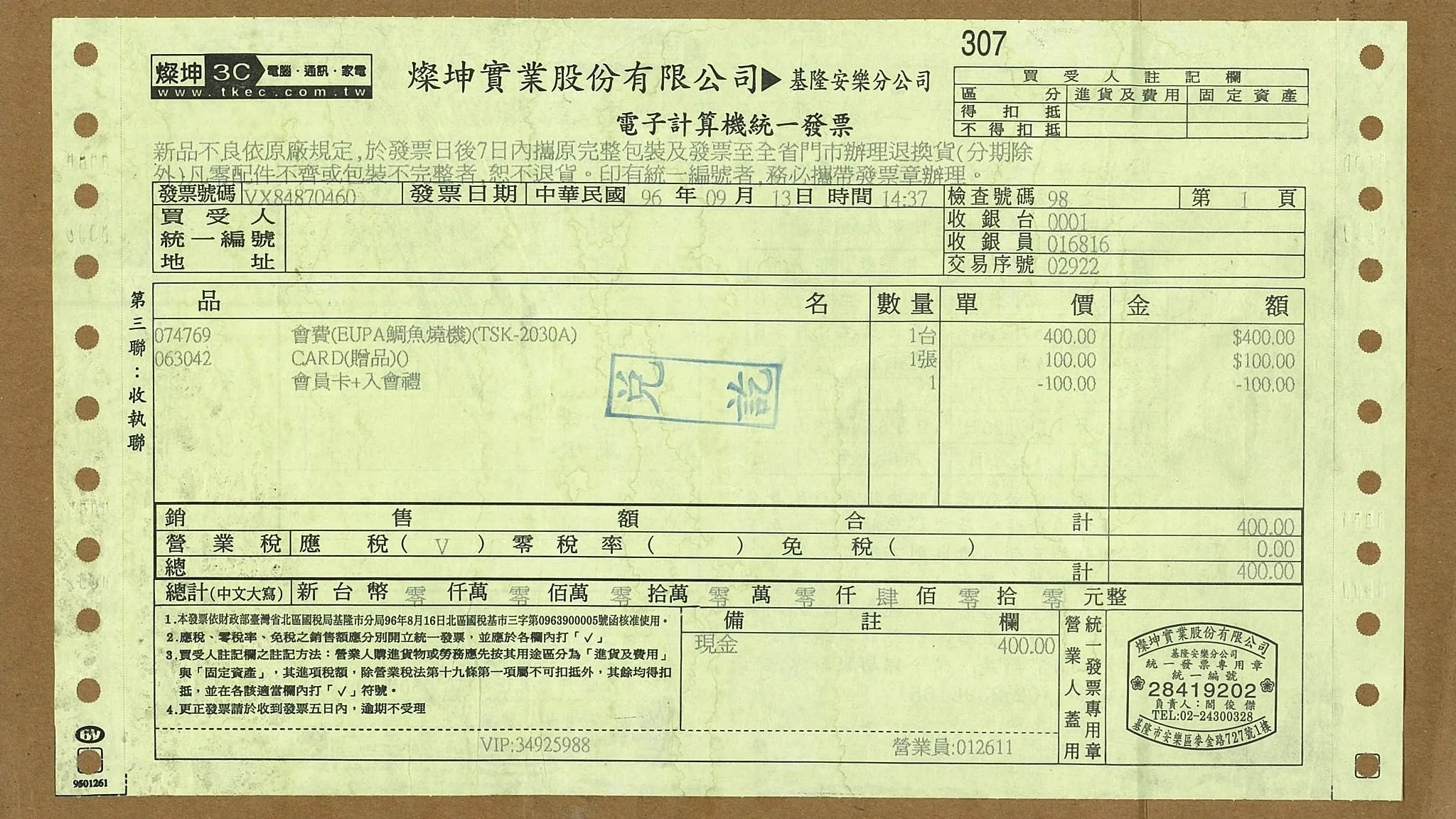
In Taiwan, even a NT$20 drink comes with a "fapiao" (發票, uniform invoice). It functions simultaneously as a transaction receipt and a free government lottery ticket. Through the psychology of "everyone wants to win," the 1951 Taiwanese government turned consumers across the island into volunteer tax auditors who actively watched whether merchants rang up the register. This system evolved from early military-style promotional songs and paper prize claims, all the way to today's cloud-based invoices, charity codes, and AI-powered lottery algorithms — and it has been running for 70 years. It weaves the state, luck, and social welfare into every single checkout moment. And it lets us see: when "mass auditing" meets the age of algorithms, how do old trust mechanisms start to crack?
By late 1950, the recently relocated Republic of China government stood at the edge of a fiscal cliff. U.S. aid had been suspended, inflation was rampant, and the countless small transactions on street corners were one tax black hole after another. Ren Xian-Qun (任顯群), the 38-year-old Finance Commissioner of Taiwan Province, stared at merchants who refused to issue receipts and understood clearly — sending police or tax officials to check every shop one by one would never be enough.1
His solution was enshrined in the Regulations on Uniform Invoices for Profit-Seeking Enterprises in Taiwan Province and the Provisional Regulations for Awarding Prizes for Taiwan Province Uniform Invoices, both promulgated on December 12, 1950 and implemented on January 1, 1951. On the surface it was tax reform; at its core, it was a social experiment exploiting human greed and hope.2
1951: The Brilliant Trick of Printing Lottery Numbers on Receipts
The heart of the uniform invoice system was incentive design.
Before it existed, merchants routinely evaded taxes because consumers simply didn't care about receipts. Ren linked each invoice's serial number to winning numbers for "patriotic lottery bonds," turning every receipt into a free lottery ticket. To promote it, the government even composed a "Uniform Invoice Promotional Song." According to the United Daily News's Bao Shi Guang historical archive, the melody was borrowed from the then-familiar Disney song It's a Small World, wrapping serious tax policy in a catchy tune — this practice of "borrowing a melody for new lyrics" was a common propaganda technique in 1950s-60s Taiwan. The opening lyrics were blunt: "Invoice good and great, patriotic and prize-worthy / Boss who won't issue one, prosecuted to shame." The Ministry of Finance later even organized singing competitions to promote the song.3
📝 Curator's Note
The government bypassed sending its own tax inspectors, instead distributing prize money to let consumers voluntarily watch the cash register for them. This already crossed the boundary of tax policy into cultural mobilization.
| Business tax revenue, 1950 | Business tax revenue, 1951 |
|---|---|
| ~NT$29 million | ~NT$51 million (+75%) |
The scheme worked immediately. In its first year, Taiwan's business tax revenue surged approximately 75% — from about 29 million in 1950 to about 51 million in 1951.4 Against a backdrop of unstable U.S. aid and enormous inflationary pressure, that number was extraordinary. Looking at it long-term, the uniform invoice not only shored up the tax base, it also laid a traceable revenue trail that paved the way for later adoption of value-added tax (VAT). The penalty merchants faced for refusing to issue invoices shifted from "nothing" to consumers actively reporting them for a one-in-ten-thousand shot at a prize. Over time, "Boss, the receipt?" became a Taiwanese reflex at checkout.
Early paper invoices did create an administrative burden for small shops. In response, the government later established exemptions from invoice requirements, and starting in 2025 raised the taxable threshold for small-scale operators to ease some of the compliance costs.5
Ren Xian-Qun's Aftermath: The System Lived On, But Its Architect Went to Prison
Ren Xian-Qun is celebrated as the "Father of the Uniform Invoice," but his political fate was far from peaceful. In 1953 he left public office and married Peking opera star Gu Zheng-Qiu (顧正秋) as her second husband; that same year he stepped down from his post as Finance Commissioner of Taiwan Province.6
Two years later in 1955, he was arrested by the Taiwan Provincial Security Command on charges of "knowing about Communist agents and failing to report them," stemming from his clansman Ren Fang-Xu being falsely accused as a Communist spy. He was sentenced to seven years; he was released in 1959 only after Zhang Qun (張群) interceded with Chiang Kai-shek on his behalf.6 Two explanations later circulated for his true reason for being imprisoned: one held that Chiang Ching-kuo bore a grudge against Ren after his unsuccessful pursuit of Gu Zheng-Qiu; another, from the memoirs of former intelligence operative Gu Zheng-Wen (谷正文), held that Chiang Kai-shek never forgave Ren for accompanying Wu Guo-Zhen in a loud argument.7
Whatever the true cause, the invoice system and patriotic lottery bonds he created kept running through the years of his imprisonment, sustaining government finances throughout the martial law era.
The Invoice Dropped into a Transparent Box in 1993
In 1993, the Genesis Social Welfare Foundation (創世基金會) launched the "Drop an Invoice, Save a Vegetative Patient" campaign, placing transparent invoice boxes at shop entrances across the island.8 From that day forward, Taiwan's uniform invoice gained an additional identity: an alternative revenue stream for social welfare. Many welfare organizations (Genesis, Eden Social Welfare Foundation, and others) have long relied heavily on prize-winning donated invoices as a major funding source — a uniquely Taiwanese grafting of "civilian tax auditor × public charity."
But the rise of electronic invoices in the 2010s and cloud-based invoice platforms in the 2020s posed a structural challenge to this mechanism. The number of paper invoices received by the Genesis Foundation fell from a peak of over 114 million in 2008 to only about 41 million in 2024, a drop of roughly 60%.9 A 2020 survey found that over 40% of the public did not know how to donate cloud invoices, and for elderly and rural populations, the barriers of using smartphone apps effectively severed this pipeline of goodwill at the digital divide.9
The government later introduced the "Charity Code" (愛心碼) system to preserve this mechanism — when customers enter a specific code at checkout, any prize money automatically flows to a designated charity account. The Genesis Foundation's charity code is 919, a homophone in Mandarin for "save one, save one." It transformed "luck" into a kind of circulable social resource, but whether to donate and how to donate now depends again on each consumer's digital literacy.8
After the Algorithm Took Over the Lottery: The 2024 Crisis of Trust
Between late 2024 and early 2025, a lottery organized by the Ministry of Finance called "Cloud Invoice E-Point Collection Tree" (雲端發票 e 起集點樹) exploded into controversy. Among more than 90,000 participants, four people won major prizes multiple times across different periods, triggering fierce public skepticism about the fairness of the lottery program.10
An investigation revealed the problem lay in the program's logic. The contractor had treated each participant's accumulated "lottery chances" as a "weight," then calculated total weights and drew prizes in descending order — a design that amplified the winning odds of more active participants (those who completed more tasks and accumulated more points), creating a massive gap from the public's intuitive expectation that "every invoice has an equal chance." The Investigation Bureau of the Ministry of Justice's Taipei City office ultimately concluded "there was no evidence of illegal conduct" (no rigging or fraud), but the event's credibility had already suffered serious damage.10
✦ "An algorithm that isn't illegal doesn't mean it matches society's idea of fairness."
The National Tax Administration filed a civil suit against the contractor on November 21, 2024, and on January 6, 2025 added a claim for non-financial damages of NT$24 million to protect the credibility of government events.11 During the same period, the Legislative Yuan also passed a Taiwan People's Party caucus proposal to uniformly cut commissioned fees by 10% — the Tax Administration's commissioned fees were cut by NT$1.845 billion, money primarily funding the bimonthly invoice draws and prize claims, estimated to reduce special cloud invoice prize winning opportunities by 3.6 million.12
The two events overlapped in time but were not the same causal chain: the lottery controversy struck at trust, while the budget cut struck at total prize volume. Together, they represented the cloud invoice era's first simultaneous confrontation with two kinds of pressure.
A Gift from Behavioral Economics, and a Test for Digital Governance
From a behavioral economics perspective, the uniform invoice is a classic incentive-compatible mechanism. It leverages human loss aversion (fear of missing a prize) and the hope effect (anticipation of a big win) to make consumers voluntarily serve as "free tax auditors." Singapore and Hong Kong also have consumption voucher lotteries, but Taiwan's scale, duration, and social embeddedness remain the deepest.13
Its costs have also grown clearer. Gambling tendencies get institutionalized; luck gets rewarded; early paper invoices genuinely imposed administrative costs on small merchants; after digitization, tying carrier accounts to purchase records raises new privacy and data governance concerns. When algorithms take over work previously performed by "fair random numbers," "fairness" shifts from a probability problem to a design problem — and design problems have no black-and-white answers.
Conclusion: Every Invoice Is a Small Decision
From the 1951 paper invoice bundled with patriotic lottery bonds, to the 2025 cloud carrier system and the 919 charity code, the form of the invoice has changed through several generations — but it has always been Taiwan's interface for incorporating daily consumption into the national system.
Since the new prize system took effect in 2011, by the end of 2024, it had cumulatively created at least 870 NT$10 million lottery winners, of whom over 200 were concentrated in Taipei City.14 These numbers appear in news reports. But what has actually kept this system running for 70 years is the tens of millions of daily "Boss, the receipt?" reflexes — the jackpot is a story for a few, but the reflex is everyone's foundation.
Next time you glance at that eight-digit number at checkout, in that instant you are simultaneously doing three things: completing a transaction, collecting a free lottery ticket, and helping the government check whether this shop is paying taxes. The 38-year-old commissioner who designed this mechanism in 1951 probably didn't anticipate it would go this far. Seventy years later, the biggest challenge has shifted from "will merchants evade taxes" to "how does the algorithm decide who wins" — the same question of fairness, but the adversary has changed.
Further Reading:
- Taiwan's Economic Miracle — The fiscal mobilization of the 1950s-60s and the uniform invoice were contemporaneous; this is the foundational context for Taiwan's postwar economic reconstruction
- Taiwan Convenience Store Culture — The most common setting for cloud invoice carriers; convenience stores are the last mile of everyday tax mobilization
References
- Ministry of Finance Historical Materials Exhibition Room: Key Uniform Invoice Historical Records — Historical records on the origin of the uniform invoice system and Ren Xian-Qun's contributions, referencing the financial difficulties of the 1950s and the context for the system's introduction.↩
- Uniform Invoice (Taiwan) — Wikipedia — Details the timeline of the Regulations on Uniform Invoices for Profit-Seeking Enterprises in Taiwan Province promulgated on December 12, 1950, the January 1, 1951 implementation, and the specific background of Ren Xian-Qun's concept.↩
- United Daily News Bao Shi Guang: The Uniform Invoice Once Had a "Promotional Song"! — Reveals that the "Uniform Invoice Promotional Song" borrowed the melody from Disney's It's a Small World, cites the opening lyrics "Invoice good and great, patriotic and prize-worthy / Boss who won't issue one, prosecuted to shame," and notes that the Ministry of Finance organized singing competitions to promote it.↩
- CNA: Unpacking Old Photos — Taiwan Uniform Invoice Father Ren Xian-Qun — Reports on Ren Xian-Qun's historical role promoting patriotic bonds, patriotic lottery bonds, and the uniform invoice; 1950 tax revenue approximately NT$29 million, rising to approximately NT$51 million in 1951, a growth rate of about 75%.↩
- Ministry of Finance Tax Portal: Raising the Tax Threshold for Small-Scale Operators — Explains the 2025 adjustment to the taxable threshold for small-scale operators to reduce their administrative and tax burdens.↩
- Ren Xian-Qun — Wikipedia — Biography of Ren Xian-Qun (1912–1975): appointed Finance Commissioner of Taiwan Province by Wu Guo-Zhen in 1949; left office in 1953; married Peking opera star Gu Zheng-Qiu that same year (as second husband); arrested in 1955 on charges of "knowing about Communist agents and failing to report them," sentenced to seven years; released in 1959 after Zhang Qun's intercession with Chiang Kai-shek.↩2
- Thinking Taiwan: The Forgotten History — Chiang Ching-Kuo, Ren Xian-Qun, and the Love Triangle and Political Infighting — Analyzes the political landscape behind Ren Xian-Qun's imprisonment. The Wikipedia entry lists two accounts: one that Chiang Ching-kuo bore a grudge after his failed pursuit of Gu Zheng-Qiu; another from intelligence operative Gu Zheng-Wen's memoirs, attributing it to Chiang Kai-shek's displeasure over Ren accompanying Wu Guo-Zhen in a loud argument.↩
- Genesis Social Welfare Foundation: Invoice Donation Campaign — The Genesis Foundation was established in 1986 and launched the "Drop an Invoice, Save a Vegetative Patient" campaign in 1993 (Republic of China Year 82). The cloud invoice charity code is 919 (homophone for "save one, save one" in Mandarin).↩2
- Civil Society Exchange Network: The Impact of Changing Donation Behavior on Nonprofits — The Case of Cloud Invoices — The number of invoices received by the Genesis Foundation fell from a peak of 114 million in 2008 to approximately 41 million in 2024, a drop of about 60%. A 2020 survey found that over 40% of the public did not know how to donate cloud invoices.↩2
- Mirror Media: Cloud Invoice Lottery Controversy Investigation Results Announced! Ministry of Finance Seeks NT$24 Million from Contractor — Reports on the 2024–2025 "Cloud Invoice E-Point Collection Tree" lottery controversy: 4 participants repeatedly won major prizes; the lottery program used "number of lottery chances" as a weight rather than pure random selection; the Investigation Bureau of the Ministry of Justice found no evidence of illegal conduct.↩2
- United Daily News: Cloud Invoice "4 People Repeatedly Won Major Prizes" — Ministry of Finance Says No Illegality, Seeks NT$24 Million from Contractor — Details the specific timeline: the National Tax Administration filed a civil suit against the contractor on November 21, 2024, and on January 6, 2025 added a claim for non-financial damages of NT$24 million.↩
- CNA: Ministry of Finance: Budget Cuts Will Reduce Cloud Invoice Prize Winning Opportunities — Reports on the Legislative Yuan's January 17, 2025 vote to pass the Taiwan People's Party caucus proposal cutting commissioned fees by 10%. The Tax Administration's commissioned fees will be cut by NT$1.845 billion, estimated to reduce cloud invoice special prize winning opportunities by 3.6 million.↩
- Economic Daily News: The Behavioral Economics of Uniform Invoices — Analyzes how the uniform invoice system leverages loss aversion and the hope effect to transform consumers into "free tax auditors," and compares the scale and social embeddedness of consumption voucher lotteries in Singapore and Hong Kong.↩
- NOWnews: Who Invented the Uniform Invoice? Over 870 NT$10 Million Winners — This County Has the Most, Thank Him for Winning — Since the new uniform invoice prize-claiming system took effect in 2011, through the November–December 2024 period (the 84th period), it has cumulatively created at least 870 NT$10 million winners, of whom over 200 are concentrated in Taipei City.↩