
30-Second Overview: Shengren tang uses the homophone of "peanut" (生仁) and "giving birth to people" (生人) to read the desire for family prosperity into peanuts; cunzao borrows the character "date" (棗) to preserve the imagination of "having a noble son early" (早生貴子); and malt sesame treats (麻荖) embed the blessing of "eating until you are old, old, old" (吃到老老老) into malt sugar and sesame1. The Ministry of Education’s dictionary defines "siù-á" (四秀仔) as snacks or nibbles2. But the sweets on the Lunar New Year table are not just about auspiciousness; they are also about taste. Malt sesame treats and cunzao contain approximately 500 to 600 calories per 100 grams, while food inspections place peanut treats under aflatoxin testing3 4. This article looks at how a plate of sweets becomes simultaneously a blessing, a habit, and a daily necessity to be re-selected.
Shengren Tang Speaks of "People" First
Shengren tang is often placed between Lunar New Year candies and offerings: it is both a sweet treat to be shared with guests and something that might be placed on the altar. This position is less like the categorization on a supermarket shelf and more like someone opening a candy box on the living room table, pointing to each compartment, and asking: "Have you ever eaten this?"5
The common appearance of shengren tang is peanuts coated in layers of red and white sugar frost. Jiuzhennan’s cultural article calls it "shengren tang" and links the homophone of "shengren" (peanut) to "shengren" (giving birth to people), connecting it to the prosperity of the family. The article also records that it has another name, "Tiangong Dou" (Jade Emperor’s Bean), linked to the folk belief of worshipping the Jade Emperor on the ninth day of the first lunar month1. These interpretations belong to folk legends and brand cultural compilations; not every family uses the same explanation. But they illustrate one thing: Lunar New Year candies are preserved not just because of their sugar content.

_Taiwanese sweets. Photo: pelican, Wikimedia Commons, CC BY-SA 2.0. Image Page._6
This photo places shengren tang, candies, and other sweets in the same line of sight. Lunar New Year snacks rarely serve only one symbolic meaning; they complement each other in the same box, allowing the blessings of the altar, the hospitality of the living room, and the picky hands of children to appear simultaneously6.
The literal meaning of "shengren" can be re-read through blessing. Peanuts are food; "shengren" (giving birth to people) is a wish. A sugar-coated peanut thus stands simultaneously between the dining table and the altar. Some people may even forget the taste of certain candies; this uncertainty makes the Lunar New Year feel credible: tradition is not something that must be recited flawlessly every year, but something where people are still willing to ask the names again.
📝 Curator’s Note: The common Lunar New Year checklist always loves to translate every snack into a single auspicious phrase, but this translation hides the choices of not liking something, picking at it, or buying it merely for hospitality. What the candy box leaves behind is not proof that "everyone loves it," but how family members negotiate between blessings and taste.
Cunzao Has No Dates; Malt Sesame Treats Can Be Eaten "Until Old Age"
Cunzao is often included in this set of Lunar New Year vocabulary. Jiuzhennan’s article calls it "zaozhi" (date branch) or "cunzao tang" (cunzao candy), and records one interpretation: in early days, red dates were rare, so glutinous rice was shaped into the form of a date and coated with white sugar to replace real dates. Thus, the name has "date," but the ingredients may not1. This story is best understood as "legendary"—it has explanatory power, but should not be written as the definitive origin.
The interesting thing about cunzao is that the name completes the blessing for it before the ingredients do. When a food is called "date," people can place the wish of "having a noble son early" into the Lunar New Year context. Even if what enters the mouth is actually fried glutinous rice. Rather than mystifying the food, it compresses family expectations into a sentence understandable at the table.
Jiuzhennan’s article describes malt sesame treats (mazu/mali) as a type of treat made from taro and glutinous rice, deep-fried, coated in malt sugar, and then dipped in toppings. It also records the blessing of "eating malt sesame treats until you are old, old, old," and its place in the Jade Emperor’s birthday, engagement dowries, and return-to-mother’s-house rituals1. The "old" here is not aging, but embedding longevity, growing old together, and living a little longer into the crispy yet sticky texture.
The habit of buying malt sesame treats in large bags before the New Year brings it back from abstract symbolism to daily life: it is not a museum piece to be viewed only through glass, but something that can be bought in large bags and opened when relatives visit. The Taoyuan City Government’s Tourism Bureau, when introducing local food merchants, also lists malt sesame treats, shengren tang, cunzao, winter melon strips, and nougat as seasonal Lunar New Year goods sold close to the New Year7.

2010 Dihua Street Lunar New Year candy stall in Taipei. Photo: eazytraveler, Wikimedia Commons, CC BY 2.0. Image Page.8
The 2010 photo of Dihua Street places malt sesame treats, shengren tang, and other sweets back into the scene of purchasing. People do not first understand the symbolism before reaching out; they decide whether to take a pack home after seeing colors, prices, and familiar items. Lunar New Year culture thus also includes a very practical action: walking into the market before the New Year to buy blessings back8.
"Siù-á" Is Not Four Types, But a Whole Sense of Vocabulary for Snacks
The Ministry of Education’s dictionary records "siù-á" (四秀仔) pronounced sì-siù-á, with the definition "snacks, nibbles," and the example sentence "Go buy some siù-á to nibble on"2. The importance of this term lies not in drawing a strict boundary around snacks, but in preserving the way Taiwanese families speak of food: not as nutritional snacks, nor as products in a brand catalog, but with the daily tone of "buy some first to see how it tastes."
Twisted dough sticks (mahua), pistachios, melon seeds, gold coin chocolates, nougat, snowflake cakes, southern date walnut cakes, and candied beans can be placed in the same Lunar New Year story, but do not need to pretend to have the same origin. Gold coin chocolates carry the imagination of imported goods; melon seeds preserve the family habit of cracking shells; candied beans shift the focus to sugar-candied beans. These differences collectively demonstrate why "everything is on the New Year table" itself5.
This hybridity is very Taiwanese: traditional祭品 (offerings), local snacks, imported chocolates, and wedding banquet candies can appear simultaneously in one box. TaiwanPlus’s English report also describes Taiwan’s Lunar New Year candies as symbols of joy and good luck, focusing the lens on the Lunar New Year goods market in Taipei’s Dihua Street. Here, candies are not isolated food items, but festival objects composed of purchasing, gift-giving, hospitality, and blessings9.
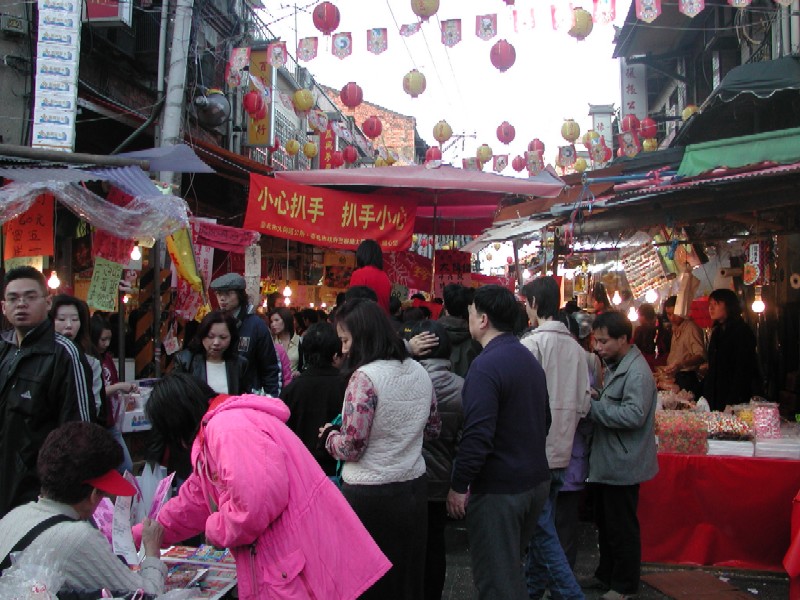
2007 Dihua Street Lunar New Year market. Photo: Allentchang, Wikimedia Commons, CC BY-SA 3.0. Image Page.10
The 2007 market photo pulls the view back. Dihua Street is not a shop selling only one type of sweet, but a festival streetscape placing offerings, dry goods, snacks, and decorations side by side. The candy box can mix in chocolate, peanuts, and candied fruits precisely because the Lunar New Year goods market allows sweet tastes from different eras to be taken home simultaneously10.
The Politeness of the Lunar New Year Can Accommodate a "Not Delicious"
Gold coin chocolates, "Ha Shi Tiao" (a type of candy), and tri-color soft candies are somewhat different from the festive tone commonly associated with the Lunar New Year. Appearing during the New Year does not necessarily equate to being worthy of liking. Just because a certain candy has an auspicious story behind it does not mean everyone must accept its taste. This contrast is important: candies are responsible for providing blessings, but people still retain the freedom to reject the vessel of those blessings.
This freedom has always existed in Lunar New Year food. Families prepare a plate of siù-á so that guests have something to take and conversations have something to pair. Who only eats peanuts, who picks out the chocolate, who leaves the disliked candy for last—these are often the details that family memory truly retains. If tradition can only be praised, it quickly becomes a slogan. If tradition can be roasted, it may continue to enter the mouths of the next generation.

2007 Dihua Street Lunar New Year vendor. Photo: Michael Rehfeldt, Wikimedia Commons, CC BY 2.0. Image Page.11
The presence of vendors adds a often-ignored role to "Lunar New Year snacks": the person selling. Family memory remembers which candy is sweetest, but market memory also includes who greeted guests among lanterns, red paper, and plates of goods. Siù-á is thus not just food at home, but a recurring festival job on the street11.
However, honest taste must also connect to the modern body. The Matsu Daily News, in its 2013 compilation of Lunar New Year snacks, pointed out that malt sesame treats, melon seeds, and cunzao contain approximately 500 to 600 calories per 100 grams, while shengren tang is close to 500 calories. The article also relayed the National Health Administration’s advice that the intake of recreational snacks and treats should not exceed 10% of daily caloric needs, while paying attention to sodium content3. This is not about turning the Lunar New Year table into a nutrition class, but reminding us: the cultural weight of a plate of sweets cannot cover the fact that it is indeed eaten into the body.
Food safety is also on the same table. The Keelung City Health Bureau’s 2022 (Republic of China calendar) Spring Festival and Lantern Festival Seasonal Food Inspection List listed peanut treats sampled in November 2022, with the inspection item being aflatoxin, and the result being "compliant with regulations"4. Lunar New Year snacks thus have another modern path: they are both a language of blessing and commodities that require labeling, inspection, and responsible production.
A Plate of Sweets: Whose Memory Is Left Behind?
📝 Curator’s Note: Food inspections and calorie labeling seem to pull candies away from folklore, but actually, it is the opposite. When Lunar New Year snacks become commodities that can be bought, labeled, and inspected, blessings have the opportunity to continue circulating in today’s families.
Lunar New Year candies do not need a neat conclusion. Putting one name after another, stories, and tongue sensations together reveals a somewhat messy culture: shengren tang can bless family prosperity, cunzao can borrow a "date" character to wish for early sons, and malt sesame treats can bless people to eat until old age. At the same time, certain sweets may be disliked like plastic, or even forgotten entirely.
This is precisely where "siù-á" has more warmth than "traditional Lunar New Year food." The former is not a completed checklist, but a verb: to take, to share, to eat while chatting, to ask names, to discuss homophones, and finally to admit that one does not like it. Next time you see that candy box during the Lunar New Year, perhaps there is no need to rush to ask what auspicious phrase each compartment represents. First, ask the person sitting next to you which compartment they really want to eat.
The value of siù-á lies not in awarding Taiwan’s Lunar New Year candies, but in turning a seemingly familiar food back into a question: What do we leave behind? Food, stories, or that afternoon of complaining about a certain candy together?
Image Sources
This article embeds four photos of Taiwanese sweets and Lunar New Year goods from Wikimedia Commons. The existing candy photo was taken by pelican; the other three are from eazytraveler, Allentchang, and Michael Rehfeldt. Each image’s license, image page, and original hotlink URL are listed in the caption and footnotes. This article uses only hotlink URLs, without downloading or caching images.
Further Reading
- Ministry of Education Taiwan Taiwanese Common Words Dictionary: Siù-á — Pronunciation, definition, and example sentences.
- TaiwanPlus News: Taiwan's Lunar New Year Sweets — English report on Lunar New Year candies.
References
- Jiuzhennan: Cultural Memory in the Year-End Flavor: Zaozhi, Shengren, and Malt Sesame Treats — Han cake brand cultural article, compiling the names, ingredients, and folk beliefs related to Lunar New Year and the Jade Emperor’s birthday for zaozhi, shengren tang, and malt sesame treats; this article cites them in a legendary tone.↩234
- Ministry of Education Taiwan Taiwanese Common Words Dictionary: Siù-á — Official Ministry of Education dictionary, providing the Tai-lo pronunciation, snack definition, example sentences, and food classification for siù-á; it is the primary linguistic data for this article’s handling of Taiwanese vocabulary.↩2
- Matsu Daily News: Smart Selection of Lunar New Year Snacks, Happy and Healthy New Year — 2013 local news compilation of Lunar New Year snack calories, sodium content, and National Health Administration advice, providing official news data for this article’s consumption and health sections.↩2
- Keelung City Health Bureau: 112th Year Spring Festival and Lantern Festival Seasonal Food Inspection List — 2022 official inspection PDF, page 2 lists aflatoxin inspection for peanut treats and compliant results, presenting the safety governance of Lunar New Year food.↩2
- YouTube:
Super Awkward Recording Program: Lunar New Year Candy Special — Public video page, providing the Lunar New Year snack items, texture observations, and festival context materials compiled in this article.↩2 - Wikimedia Commons: Taiwanese sweets (1088069273).jpg — Author is pelican; image license is CC BY-SA 2.0. This article uses the Wikimedia Commons original hotlink URL, without downloading or modifying the image.↩2
- Taoyuan Tourism Guide: Sanyang Food — Taoyuan City Government Tourism Bureau merchant data, recording seasonal Lunar New Year goods such as nougat, malt sesame treats, shengren tang, and cunzao sold close to the New Year, supplementing the local purchasing scene.↩
- Wikimedia Commons: 2010-02-13 Lunar New Year sweets vendor at Dihua Street, Taipei — 2010 Dihua Street Lunar New Year candy stall photo in Taipei; author is eazytraveler; license is CC BY 2.0; this article uses the original hotlink URL.↩2
- TaiwanPlus News: Taiwan's Lunar New Year Sweets — English public media report on Taiwan’s Lunar New Year candies as symbols of joy and good luck, using Taipei’s Dihua Street Lunar New Year goods market as the observation scene.↩
- Wikimedia Commons: Dihua Street market, Chinese New Year 2007 — 2007 Dihua Street Lunar New Year market photo; author is Allentchang; license is CC BY-SA 3.0; this article uses the original hotlink URL.↩2
- Wikimedia Commons: 2007-02-13 vendor at the Chinese New Year Fair of Dihua Street — 2007 Dihua Street Lunar New Year vendor photo; author is Michael Rehfeldt; license is CC BY 2.0; this article uses the original hotlink URL.↩2
.jpg)


