
30-Second Overview: Radish cake in Taiwan is more than just a New Year dish. Built on a framework of Kaoliang rice and white radish, it was once a kueh (rice cake) on ancestral altars and New Year tables, later entering markets, specialized kueh shops, and breakfast stalls. The Taiwanese version typically features lighter seasoning, relying on the sweetness of the radish and the charred aroma from pan-frying. What truly matters is not which shop claims to be the most authentic, but how this cake changed its identity across households, paddy fields, wood-fired stoves, and urban markets, while retaining the auspicious symbolism of "Cai Tou" (radish).
In July 2022, Taiwan Panorama published an article on radish cake, tracing it from Tainan and Kaohsiung to Yunlin, Hsinchu, and finally Taipei. The radish cakes described are not abstract "traditional foods," but rather the work of cake-makers rising at 3:30 AM, the pan-frying stations under big trees in Yunlin, and the steam rising from ten wood-fired stoves in Meimei, Hsinchu. 1
The counter-intuitive nature of this food is that the simpler it looks, the less it allows for shortcuts. Traditional Taiwanese radish cake requires only white radish, Kaoliang rice, and water, yet demands careful handling of rice varieties, soaking, and grinding into paste, as well as precise control over radish moisture, starch gelatinization, and steaming time. 2
📝 Curator’s Note
The story of radish cake is not simply about preserving an "old-fashioned flavor." It is more like a technology constantly changing venues, moving from home kitchens to market stalls, then to food factories and online orders. Each shift leaves behind the original gestures and techniques.
The Auspicious Meaning of "Cai Tou" and "Cake"
In Taiwanese Hokkien, radish is called "Cai Tou" (菜頭), and radish cake is often referred to as "Cai Tou Guo" (菜頭粿). The Taoyuan District Agricultural Research and Extension Station of the Council of Agriculture explains the homophonic connection and New Year symbolism: white radish symbolizes "good luck" (好彩頭), while "cake" (糕, gao) borrows the sound to carry the wish for steady progress and advancement (步步高升). 3
These auspicious phrases are not the only meaning of radish cake. An article from the Smithsonian Center for Folklife and Cultural Heritage begins with the memory of a Taiwanese author spending New Year at their grandmother’s house in Nantou. The author remembers returning to their natal home on the second day of the New Year, the two-tiered steamers, and the car trunk filled with radish cakes. They also recall disliking the smell of radish and fried shallots in childhood. Years later, while pursuing a graduate degree in Washington, they began to miss that specific cake. 4
This turning point is very Taiwanese. The New Year significance of food does not necessarily appear in the first bite. It may start as disdain, become habit, and finally transform into a taste of home that is only recognizable after leaving it. Sliced into half-inch thick pieces and pan-fried until golden on both sides, one eats the texture while confirming "where I come from."
Rice Variety Choices in a Single Cake
The texture of radish cake starts with the rice. The Agricultural Knowledge Portal of the Council of Agriculture defines "kueh" (粿) in Taiwan as a general term for rice-based processed cakes, noting that traditional radish cake and bowl kueh are mostly made with Kaoliang rice. Older cake-makers prefer aged rice because the reduced moisture and altered starch structure result in a less sticky kueh. 5
Agricultural research data also explains that Kaoliang rice belongs to the indica variety, with long, slender grains and higher amylose content. When ground into paste and heated, it forms a gel structure suitable for radish cake. This explains why Taiwanese radish cake can be sliced, pan-fried, and remain chewy inside even when the exterior is crispy. 6
A 1993 article in the Tainan District Agricultural Bulletin breaks down radish cake making into steps: soaking, mixing paste, gelatinization, and steaming. It reminds readers to stir continuously during gelatinization to prevent the paste from clumping, and to ensure the steamer does not run dry. These seemingly domestic reminders are actually the recorded failures and experiences of generations of cake-makers. 7
📝 Curator’s Note
"Pure rice" is not a magic word that automatically equals deliciousness. What truly matters is that the maker knows which rice variety and which degree of aging can make the radish's moisture and the paste's structure complement each other. The ingredient list is short, but the judgment is long.
Taiwanese vs. Cantonese: Not a Question of Authenticity
Taiwanese radish cake typically uses white radish, Kaoliang rice, and water as a base, with lighter seasoning, and is served with dipping sauces. The Agricultural Improvement and Extension Stations compare it with Cantonese radish cake, which usually has heavier seasoning, often adding Chinese sausage, cured meat, dried scallops, or scallions, and can be eaten directly after pan-frying. 3
This difference reminds us that radish cake is not a fixed, single recipe. Breakfast shops, traditional markets, and New Year families in Taiwan each have their own ratios. Some pursue clearly visible radish shreds, others prefer a fine cake texture, some add dried shrimp, shiitake mushrooms, and fried shallots, while others use only rice, radish, and salt.
Therefore, "Taiwanese style" is more like a collection of dietary habits rather than a standard answer to be obeyed. It includes light seasoning, pan-frying, dipping sauces, and varying slice thicknesses, allowing the same rice-based food to adapt to breakfast, rituals, New Year dishes, and market takeout.
From Ritual Offering to Market Commodity
The Taiwan Panorama article records a local narrative compiled by writer Wang Hao-yi. In the late Ming Zheng period, Zhu Shugui owned land south of the Erren River in Tainan. It is said that before committing suicide, he gave the land to the farmers who worked it. Descendants, to honor him, worshipped him with rice cakes on his death anniversary, birthday, and New Year. Related skills continued to be passed down during the Qing dynasty, only entering the market more openly during the Japanese colonial period. 1
This narrative should not be written as a linear history proving "the origin of radish cake." It is a heritage narrative compiled from local historical research, valuable for showing how food is remembered, worshipped, and how it became a common people's food for sale after changes in the political environment. Legends provide direction; the daily work of cake-makers keeps it alive.
In Dadaocheng, Taipei, the story of Lin Zhen Kueh Shop connects to another urban history. The shop started from a small cart in 1964. The second generation recalls that the Yan San Commercial District once had many kueh shops, with wooden steamers fully operational during New Year. Urban renewal forced the shop to relocate, but the brothers retained pure rice making and traditional steaming techniques, extending the life of this business through food factories and e-commerce. 1
Here, "tradition" is not about stopping time in the past, but allowing a set of skills to pass through changes in market structures. Wooden steamers can remain, packaging can be updated. The temperature of the steam and the delivery schedule must be rearranged.
Under the Big Tree, Wood-Fired Stoves, and Women’s Hands
A Niu Cai Tou Guo in Douliu, Yunlin, brings radish cake back to the breakfast scene. Lai Guo-zheng handles radish and rice paste every early morning, pan-frying the cake to golden brown under a big tree. Customers can request it more charred, spicier, or with adjusted sauces. The report also records his mother, Lai Tseng-mei-yeh, who learned to make New Year Cai Tou Guo from her father, and later supported the family with her husband by selling it from a street stall. 1
The Zhuang family in Meimei, Hsinchu, still uses wood-fire steaming for "Cai Tou Ban" (菜頭粄), the Hakka term for radish cake. Wood stoves bring a charcoal aroma, but also five to six hours of labor: guarding the fire, adding wood, and managing the water. Zeng Zhao-hua tried gas but felt the taste was wrong, so she continued to pass down the method learned from her mother-in-law to her daughter. 1
These figures move radish cake beyond the four words "folk food." It is about who gets up at dawn, who is enveloped by steam at the stove, who memorizes ratios by feel. Especially since many families rely on women for New Year kueh, when a craft enters the market, these invisible domestic technologies have the chance to be seen, while simultaneously facing the risk of being undervalued and cheapened.
📝 Curator’s Note
The true weight of a radish cake lies not just in the rice and radish. It also bears the weight of those not written into recipes, who used early mornings, heat control, and repetitive labor to turn "what we make at home" into "what others can eat."
Radish Cake Today
Modern production does not need to completely replicate early processes. The Agricultural Improvement and Extension Stations point out that Kaoliang rice flour is a convenient ingredient made by dehydrating and drying rice paste; consumers can rehydrate it, add radish shreds and ingredients, and complete the steaming. Blended flours are not simply a matter of good or bad; Cantonese-style practices add other starches to change the texture and crispness after pan-frying. 3
Recent rice variety data from agricultural research institutions brings the needs of cake-making back to breeding and industry. Rice suitable for kueh must not only be high-yielding but also maintain texture, appearance, and processing stability after cooling. Radish cake is thus not just a family memory, but connected to rice varieties, food science, and agricultural extension. 5 8
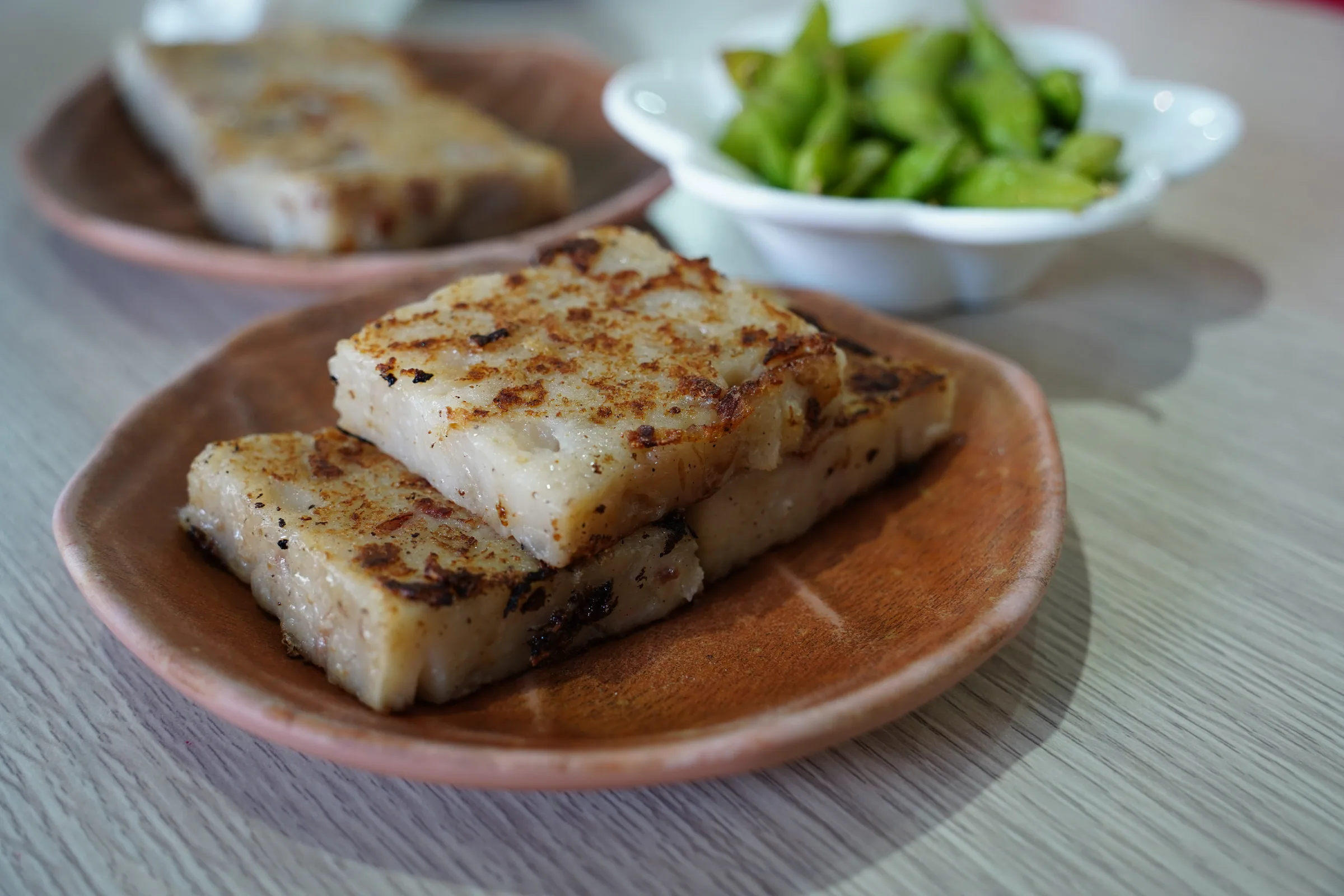
The freely licensed photo of pan-fried radish cake in Taipei shows a golden-brown cut surface and white interior, but does not tell the whole story. It only provides an entry point. To understand this cake, one must shift the gaze to paddy fields, steamers, breakfast stalls, and those who still remember the ratios. 9
The most touching aspect of radish cake may be precisely that it has no single version to be guarded. The thick cake on the New Year altar, the thin slice in breakfast shops, the wood-fired Cai Tou Ban, and the cold-chain packaged factory output are different, yet they share a structure: turning rice and radish into food that can be shared with others.
Further Reading
Smithsonian Folklife: Taiwanese Turnip Cake: A Taste of Luck and Grandma’s Love for Lunar New Year
Image Credits
This article uses 1 CC-licensed image, cached in public/article-images/food/ to avoid hotlinking to the source server:
- Radish Cake — Photo: Rick888chen / Wikimedia Commons, CC BY-SA 4.0
References
- Taiwan Panorama: Street Snacks — Radish Cake — A 2022 Taiwan Panorama special report, interviewing cake-makers in Yunlin, Hsinchu, and Taipei, recording local heritage, rice varieties, wood-fired stoves, kueh shops, and market changes.↩2345
- Taoyuan District Agricultural Research and Extension Station: New Year Flavor Starts in the Kitchen: Radish Cake Making Guide — A 2025 agricultural article explaining the materials of Taiwanese radish cake, Kaoliang rice starch gelatinization, steaming principles, and differences between Taiwanese and Cantonese styles.↩
- Taoyuan District Agricultural Research and Extension Station: New Year Flavor Starts in the Kitchen: Radish Cake Making Guide — Production and processing instructions from an agricultural research institution, providing data on New Year symbolism, raw materials, rice flour, blended flour, and storage conditions.↩23
- Smithsonian Center for Folklife and Cultural Heritage: Taiwanese Turnip Cake — An English first-person food memory article describing New Year at a grandmother's house in Nantou, returning to the natal home on the second day of the New Year, and the experience of re-understanding radish cake after leaving home.↩
- Agricultural Knowledge Portal of the Council of Agriculture: "Kueh" So to Speak: Introduction to Rice Varieties for Making Kueh — A 2023 agricultural knowledge article explaining the general term for Taiwanese kueh, Kaoliang rice, aged rice, and rice varieties suitable for making Cai Tou Guo.↩2
- Taoyuan District Agricultural Research and Extension Station: New Year Flavor Starts in the Kitchen: Radish Cake Making Guide — Official popular science data on processing, explaining the relationship between indica rice quality, amylose content, and the formation of radish cake structure when rice paste is heated.↩
- Tainan District Agricultural Bulletin: Chinese Traditional Rice Food Art — Radish Cake — A 1993 agricultural bulletin article, preserving technical records of radish cake recipes, rice paste gelatinization, steaming, and traditional home-making processes.↩
- Taichung District Agricultural Research and Extension Station: Current and Future Development of Diversified Utilization Industry of Rice — A 2023 special issue of the Agricultural Improvement and Extension Station, discussing the processing uses of different rice varieties and the position of radish cake in the rice food industry.↩
- Wikimedia Commons: Pan-Fried Radish Cake Taipei 2018 — Image by author bryan..., taken in Taipei, licensed under CC BY-SA 2.0, serving as the license and author information page for the embedded image in this article.↩
