
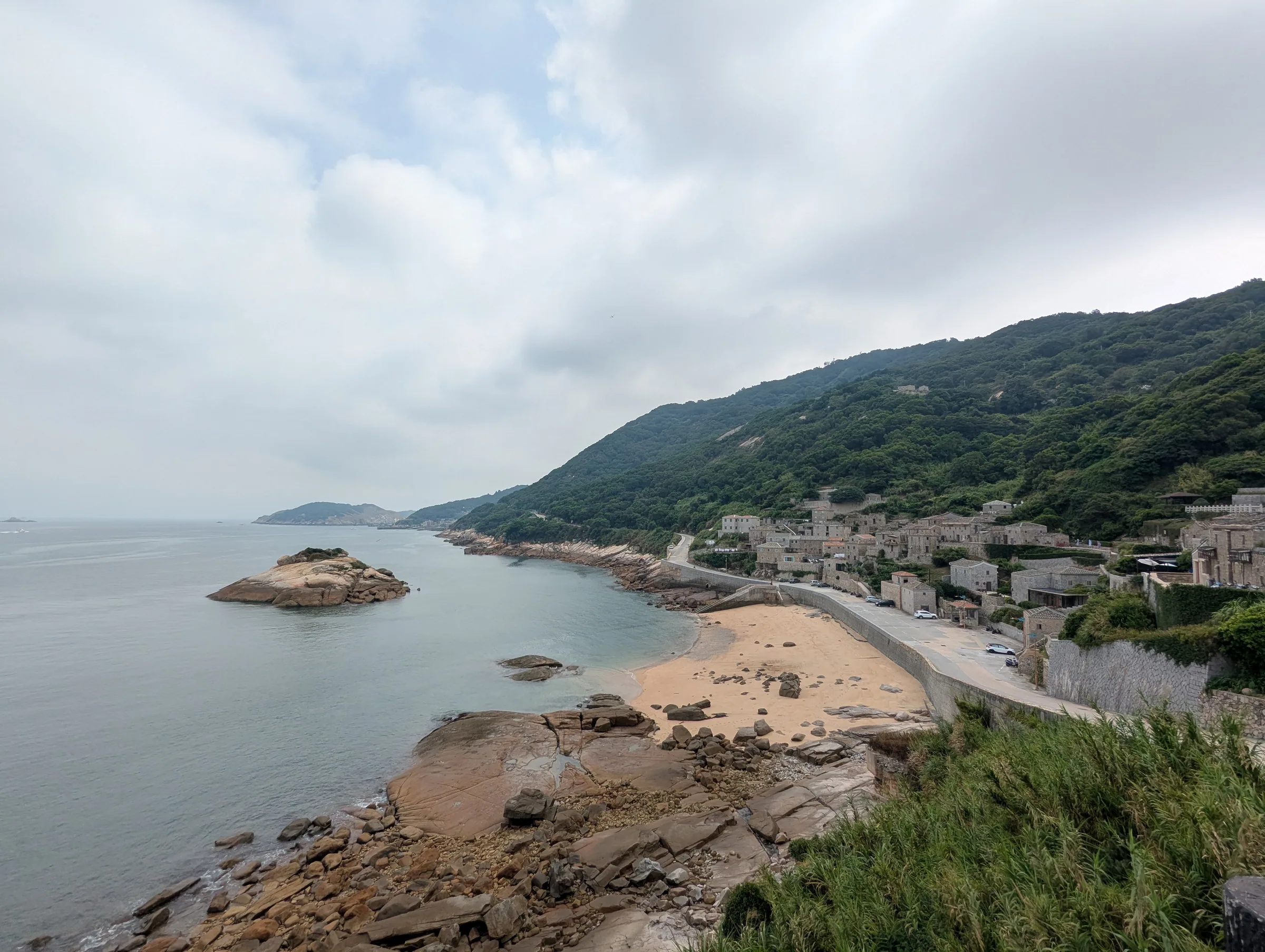
30-Second Overview: The Mazu International Art Island opened in 2022, co-organized by the Lienchiang County government and the Taiwan Cultural Foundation. It was planned as a long-term project held every two years over five decades, with exhibition areas scattered across four townships and five islands where the population is just over 14,000. Instead of building dedicated galleries, works are placed directly in chicken farms, shops, restaurants, tunnels, and on a ferry; opening hours follow local businesses and ferry schedules, and all three editions have been free for island visitors. A total of 31 long-term or permanent works remain on the island from the first three editions, and preparations for the fourth edition began in July 2026, with the theme and dates yet to be determined.
Works in the Chicken Coop, at the Grocery Store, and on the Ferry to South Kinmen
On a treehouse in the Xiangsi Tree Farm in Mazu, there is a cabin made from lumber salvaged from a fishing boat stranded on the beach.
This boat is said to have been left behind by an officer who failed in business, abandoned for many years. The Taiwan House Association dismantled it with volunteers from Taiwan, Dongju, and Dongyin, mixing it with various waste materials collected on the small island to rebuild the treehouse, providing a place for local children to climb. The work is titled The Great Ship Returns—The Officer's Regenerated Cabin, exhibited in 2023 as part of the second iteration and again in 2025 for the third. The official website lists the opening hours as "Open All Day," because it grows next to the chicken coop, having no door or set operating hours1.
"Yima's Store" in South Kinmen is a restaurant whose walls are densely covered with writing. These writings were accumulated by the establishment itself; the official website states they are "stories belonging to someone, traces of time." Artist Xinqi turned this wall into the work Made for Light: Yima, using imagery, Min-Dong language characters, and sound to narrate the experiences of people in Mazu during the "lights out" period of wartime administration across different eras1. Wartime administration refers to the military control system implemented between Mazu and Kinmen from 1956 to 1992, where local governance was directly managed by the military. Its operating hours are divided into three segments; the middle segment is stated plainly on the official website: 5 PM to 7:30 PM, "primarily for dining guests." To see this work, one must first be a diner.
There is also a piece of work that is not located on the island at all. Sound from the Other Shore is aboard the Xin Taiwan-Matsu ferry and was created by Huang Hsin-chuan, Lin Qiang, and others. Passengers scan a QR code and wear headphones to listen to the soundtrack composed by Lin Qiang and electronic musician Ryan J Raffa for this voyage while viewing the scenery outside the ship. The operating hours listed are "Available during Xin Taiwan-Matsu ferry service operation." The exhibition period of this work is equivalent to the Keelung to South Kinmen flight schedule.
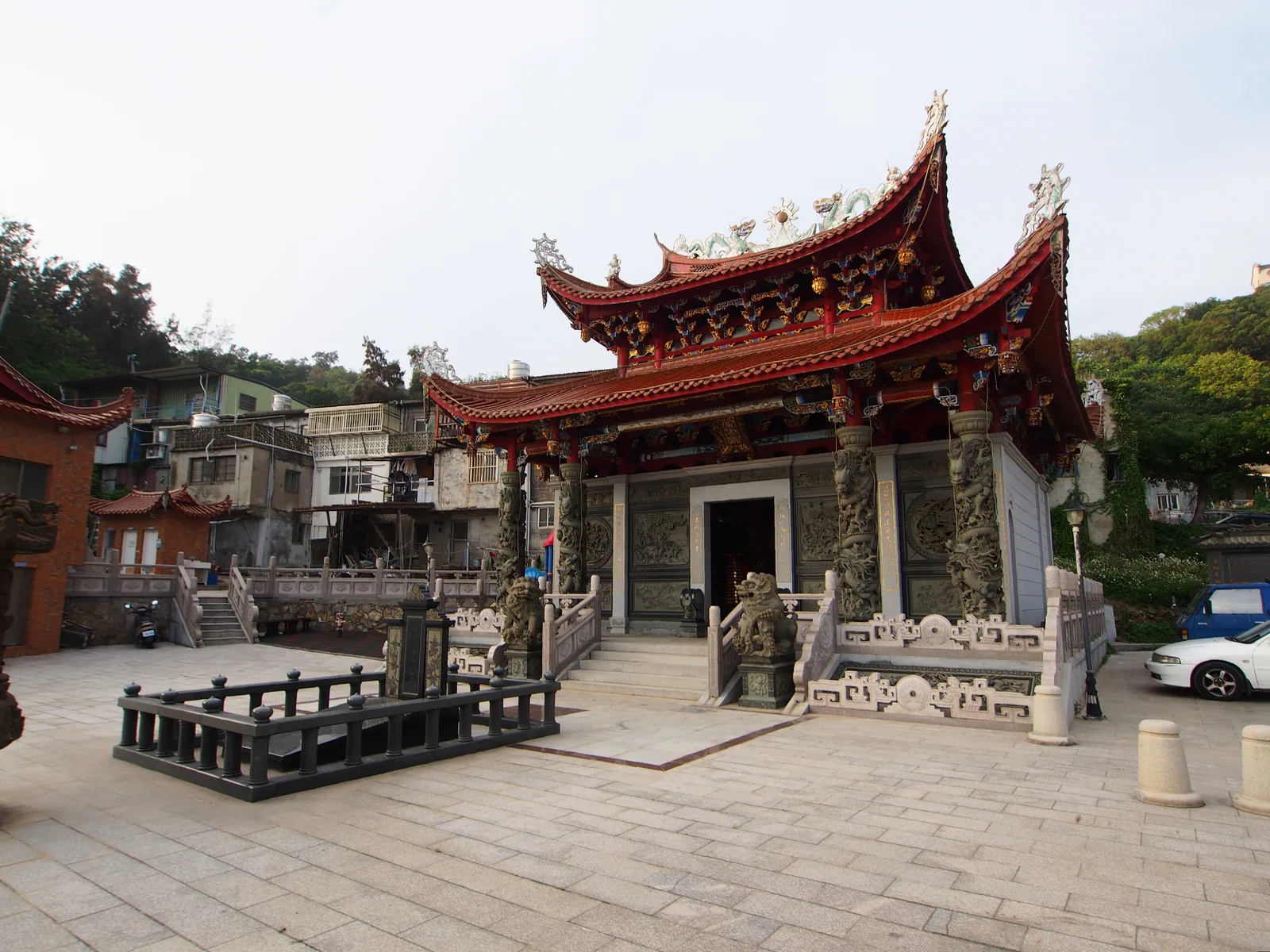
These items scattered across the chicken coop, restaurant, and ship cabin are all exhibits from Mazu International Art Island. The Art Island opened in 2022, hosted by the Lienchiang County Government and the Taiwan Cultural Foundation. The exhibition areas are spread across South Kinmen, North Kinmen, Dongyin, Dongju, and Xiju; the official description is "four townships across five islands": South Kinmen, North Kinmen, and Dongyin each form a township, while Dongju and Xiju combine to form Jugu Township—five islands and four townships, with a registered population of just over 14,0002. Over three iterations, the list of exhibition sites has included military bases, air-raid shelters, power plants, Mazu temples, grocery stores, small bars, chicken coops, beaches, and one ship.
Wang Zhongming, the governor of Lienchiang County, told the Taipei Times in 2023 that Mazu is moving toward the concept of an "island museum" 3. This statement is not unusual in promotional materials, but it is quite concrete next to the list of exhibition sites: the Art Island has not built its own gallery; all its venues borrow from existing things on the island. The chicken coop is still raising chickens, the restaurant is still selling food, and the ship is still sailing.
| Exhibit Type | Location | Operating Hours (Literal Translation from Website) |
|---|---|---|
| Restaurant | Yima's Store (South Kinmen) | Daily 11:00-13:00, 17:00-19:30 (Primarily for dining guests), 20:00-21:00 (Special evening opening, no meals provided, reservation required) |
| Shop | Xiangji Store | Daily 13:00-21:00, Closed every Tuesday |
| Small Bar | Yijia Small Bar | Art Island limited time, Wednesday–Friday dinner service (Reservation required) |
| Tourist Tunnel | Eight Eight Tunnel (South Kinmen) | Daily 9:00-17:30 (In accordance with the operating hours of the Eight Eight Tunnel) |
| Transportation | Xin Taiwan-Matsu Ferry | Available during Xin Taiwan-Matsu ferry service operation |
| Military Base | South Kinmen Bases 26, 53, 77 | Daily 9:00-16:30 |
| Military Facility | Meishi Camp Officer's Contract Tea Room | Daily 9:00-16:30 |
| Beach, Outdoor | Magang Beach, Tiepanao Inlet | Open All Day |
The above are the operating hours announced on the website during the third iteration1. The opening hours listed in a typical museum refer to the institution's schedule; every slot in this table refers to someone else's schedule. And the space that the Art Island uses the most is thicker than any chicken coop wall. Where did those buildings come from? That story must begin much earlier.
The Military Built 256 Air Defense Facilities; Art Island Selected Some as Exhibition Spaces
In 2009, the Lienchiang County Government Finance Bureau surveyed all air defense shelters across the county. These were distributed among various townships, with Nan-gao having about 120 and Dong-yin having about 18 at the most. The same survey noted that "the above data does not include parts still in use by the military," and it also mentioned: "Some scholars point out that Matsu is one of the islands with the highest density of tunnels in the world."4The reason for such a high density was the 36 years of wartime administration; Matsu was only opened to tourism in 1994, making it the last county in Taiwan to open to the outside world5. During wartime peaks, the stationed troops were estimated to be nearly 50,000 people6. None of these fortifications were built for public exhibitions.
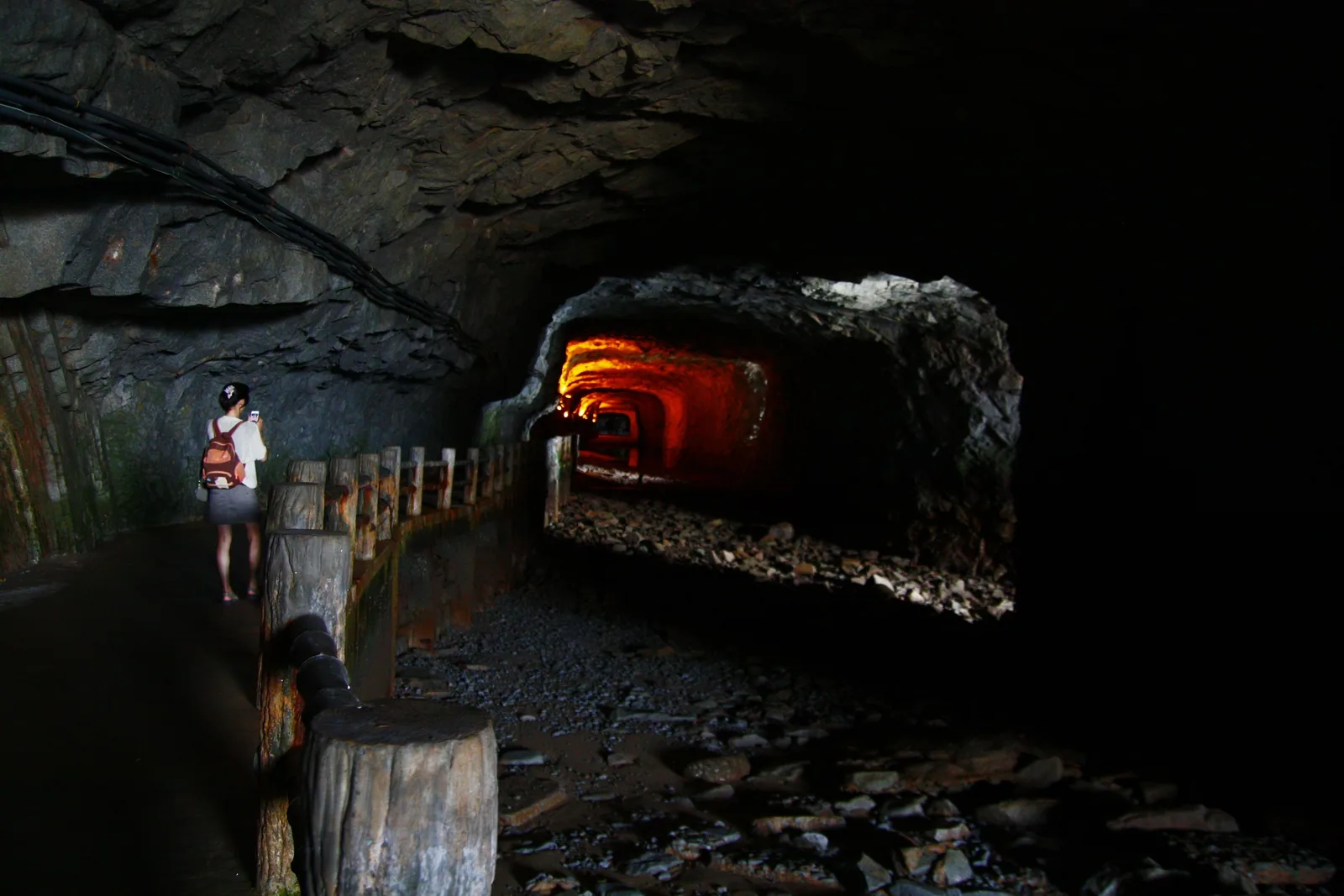
The Beihai Tunnel in Bei-gao is an underground submarine tunnel carved into granite by military personnel during the wartime administration period. Photo: Joe Lo / Wikimedia Commons, CC BY-SA 2.0.
The military left more than just fortifications. In the 1960s, the National Defense Corps Cultural Center was established in Meishi, Nan-gao, with facilities including a cinema, a special contract tea room, and a basketball court. The cinema there was called Meishi Chung-ching Hall, which stopped screening films around 19997. The Meishi Arts and Culture Center is built on its original site: construction began in November 2020, took three years and five months, and opened in May 2024, with a construction cost of NT$623.21 million78. In the years from construction to opening, Matsu had no other new projects of this scale; Central News Agency referred to it as a "large-scale arts and culture facility in Lienchiang County"7.
So, did Matsu build exhibition halls? The one that cost over NT$600 million is not. It has 609 fixed seats and belongs to the county government's "Grand Meishi Project." On opening day, a concert was held, and the county government subsequently planned it as a "cultural tourism theater" open for ticket sales79. That is a performance hall.
However, none of the three iterations of works registered in the official website's database were exhibitions or performances at the Meishi Arts and Culture Center. The second performing arts project included 11 events held at various locations such as the Nan-gao Visitor Center, Lin Family Hall, the hillside near Jinsha settlement, Yi Family Teahouse, Banli Mansion, Zhengtai Chicken Farm, Manggang Mazu Temple, and Matsu Folk Cultural Relics Museum1. After the 609 fixed seats were built, Art Island performances took place in old houses, teahouses, and chicken coops. The only thing under the name "museum" associated with Art Island is a bunker.
On the two days of the opening, a Mr. Chang was interviewed by Central News Agency, discussing another type of seating on the same foundation. During the period of "single-day, no double-day," which refers to the years after the August 3rd shelling and the double-day ceasefire in 1958, Meishi Chung-ching Hall regularly screened films on single days. One day, while a film was playing, artillery shells flew over the building from above and hit the ground nearby; he described that experience as "more real than special effects." The military later simply announced that they would no longer screen films there9. Two types of seating on the same foundation.
At least you don't have to worry about when artillery shells might come down
That bunker is Military Post 77 in Nan-gao; "post" is how Matsu refers to these numbered military structures. The first sentence on the official website states, "Post 77 was a frontline military facility." The renovation team expanded the existing wall openings to let sea views in, "without compromising authenticity and integrity," while keeping the underground tunnels as they were. After restoration and lighting installation, it was opened to the public. The county government's cultural heritage survey recorded the tunnel as follows: the eastern entrance is a cellar-style opening, where people descend from barracks, proceed north before turning west, and the main tunnel leads to the shore, with several machine gun nests protruding along the way10. Visitors crawl down from inside a house. This renovated work is called Waiting Museum, and the official website states that it "has a collection and display model different from traditional museums," aiming to be a museum "that possesses sea views and historical ruins while awaiting art and visitors"1.
The approach at Post 26 in Nan-gao was to open what was sealed. The design team, "while maximizing the retention of the original spatial form of the post," turned the previously closed underground tunnel into a semi-outdoor space that could be seen. The description states that it made the military structure's "inscrutability" into something "readable"1. Something built to remain unseen was changed to be walked into and read. To read it, one must first climb up a hillside11, and the official website also notes that this area has an "intense sense of isolation due to relatively low accessibility"1.
Every space used by Art Island was acquired. The thickness of the walls, the direction of the tunnels, and the orientation of the seating were all decisions left by the previous owner, who was the military. Borrowing a wall from a grocery store is not the same as borrowing a post: when borrowing a wall, you need the owner's nod; when borrowing a post, you don't have to ask anyone because the original owner is gone. What Art Island can do is add things inside and make openings larger, drawing this option starting from a blank floor plan—something that did not exist on this island initially.
Opening Hours Follow Venues, Themes Follow Old Sayings
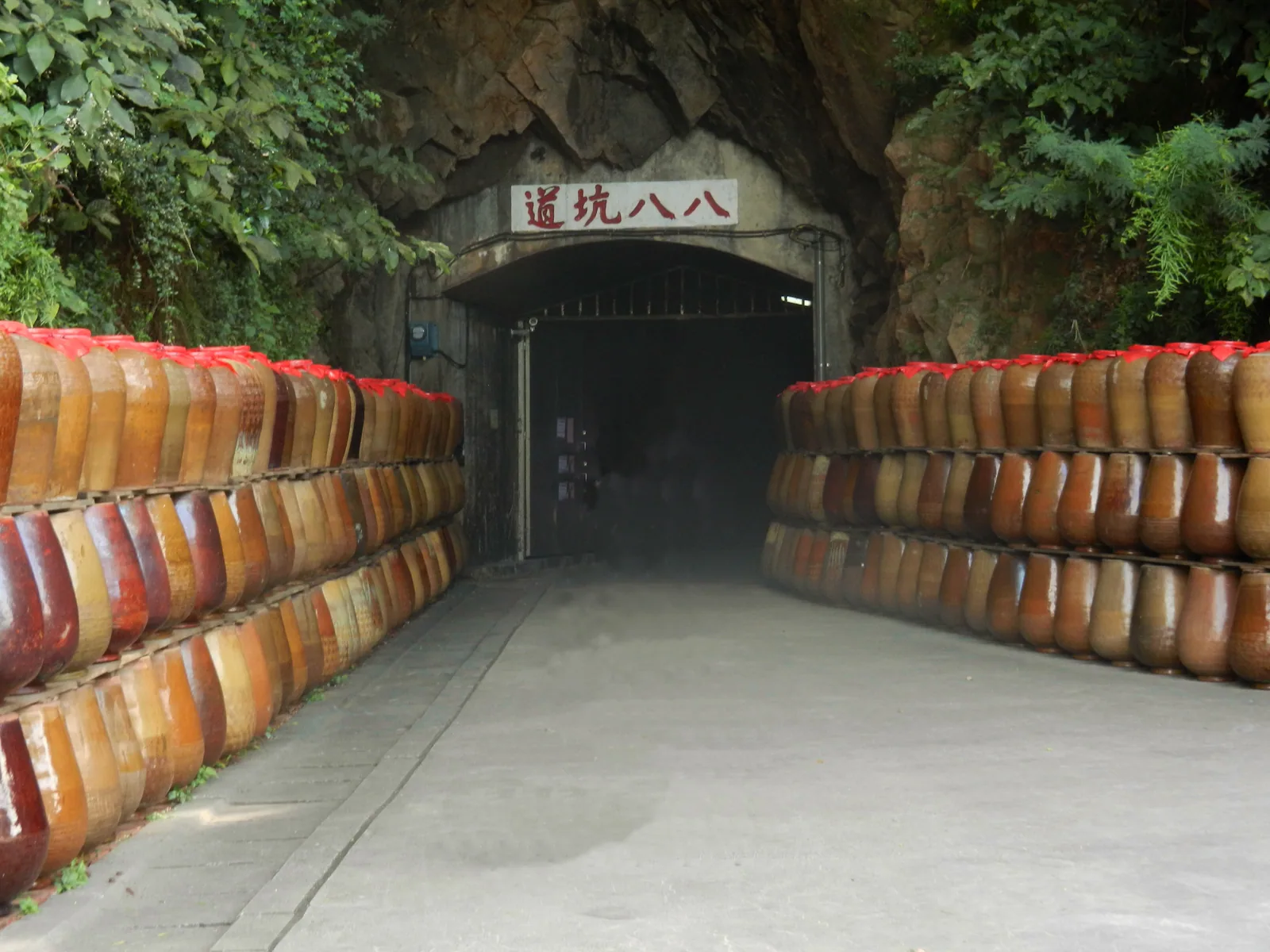
The Nan'ao Eight-Eight Tunnel, a storage space for Mazu winery converted from a military bunker, hosted Zheng Ran-dou's Echo of Memory No. 88 at the Third Art Island. The official website notes "In accordance with the operating hours of the Eight-Eight Tunnel." Photo: lienyuan lee / Wikimedia Commons, CC BY 3.0.
The Nan'ao Eight-Eight Tunnel has had four owners. It was originally a cave used by military and civilians to hide from pirates; the military expanded it into an air defense bunker, which was named on Chiang Ching-kuo's eighty-eighth birthday upon completion. Later, because the tunnel was damp and unsuitable for vehicle maintenance, it was converted into a telecommunications center before being handed over to Mazu winery as a cellar, where stable temperature and humidity are suitable for winemaking; it now stores aged liquor and sorghum 12. The Third Art Island placed Zheng Ran-dou's Echo of Memory No. 88, which is still in storage within this tunnel: seven glowing wine jars, combined with multi-channel video, featuring interviews with soldiers, military exercises, and songs by local women across generations 111. To see it, one must come when the winery opens; the official website states "In accordance with the operating hours of the Eight-Eight Tunnel" 1.
Whether you can enter or not is another major variable. The Taiwan Tourism Bureau's Mazu travel page only states four characters: "Winter Northeast Monsoon Strong Cold" 13. Ships are constrained at the port; the Taiwan-Matsu ferry experiences rough seas from December to February 14, and the Mazu National Scenic Area Management Office prohibits sailing when waves exceed Level 10 15. This is the half of the year when visiting Mazu is most difficult.
The Third Art Island closed on November 17, 2025. On the same day, a press release announced that the exhibition was not closing: 31 long-term or permanent works accumulated from the first iteration remained in place, displayed until March 15, 2026, titled "Mazu International Art Island - Northeast Monsoon Edition" 1617. The press release invited winter travelers, welcoming both local and foreign visitors to "experience Mazu's unique charm even in winter" 16. One art season inscribed the most difficult half of the year into its exhibition period.
The extended exhibition ends on March 15, 2026, while the island's liveliest Baiming cultural festival is held from February 27 to March 18, hosted by the Qinbi Heaven Mother Temple in Northern Nan'ao 18. Baiming is a welcoming deity ceremony during Mazu's Lantern Festival; the Tourism Bureau states it is "Mazu's grandest folk event," and that "travelers from afar specifically return to participate, with the entire village mobilized that night" 13. These two periods overlap.
The first Island Brew opened in February 2022, the second Summer Red Bloom in Autumn 2023, and the third Paiqiu—Your Ocean, My Land opened on September 5, 2025, which was the longest period of all iterations at 73 days 1619. The themes of the latter two editions were both from Eastern Min dialects. Summer Red Bloom discussed home-brewed aged liquor. The curatorial discourse broke down these four characters: "'Shenghong' refers to winter newly brewed aged liquor, fermented in jars using glutinous rice, koji culture, and well water, with the filtered juice presenting a pinkish hue," while "'Guoxia' refers to how Shenghong can pass through the summer's tempering to become Mazu aged liquor with an amber color and a smoother taste." The conditions inferred for Shenghong to survive the summer were nothing but "people, environment, and fate" 19. Paiqiu is also from Eastern Min, referring to the fishing method where the entire village mobilizes in August and September to drive large bamboo stakes into the seabed to anchor fishing nets 20.
Source: Mazu International Art Island official website curatorial discourses and closing press releases, Mazu Daily News, La Vie, Taipei Times
📝 Curator's Note: Brew, Summer*, and _Paiqiu—these three words lined up like a directional line: first let it ferment, then endure the toughest trial, and finally drive the stakes into the seabed to anchor. This line was constructed by the reader. The organizers did not state this; the discourse for Island Brew wrote "fermenting the island's turning point," without breaking down its meaning in Mazu dialect like the other two editions. One thing is certain: all three names reached for the same place, and that reach came from the curatorial desk, not the island.
Thus, the Art Island's clock was also borrowed from the island. The opening time of the exhibition was determined by the venue, and the season it occupied was decided by the weather. The ticket section is blank: all three editions stated "free admission to visit the island" on the official website, and for works requiring reservations, the listed fee was also free 21.
Source: Mazu International Art Island official website visitor guide and Northeast Monsoon Edition announcement, Taiwan Tourism Bureau Mazu National Scenic Area Management Office transportation information, La Vie report from June 19, 2022
31 Works Remained After Closing, Xinqi Was Recommended to Sado
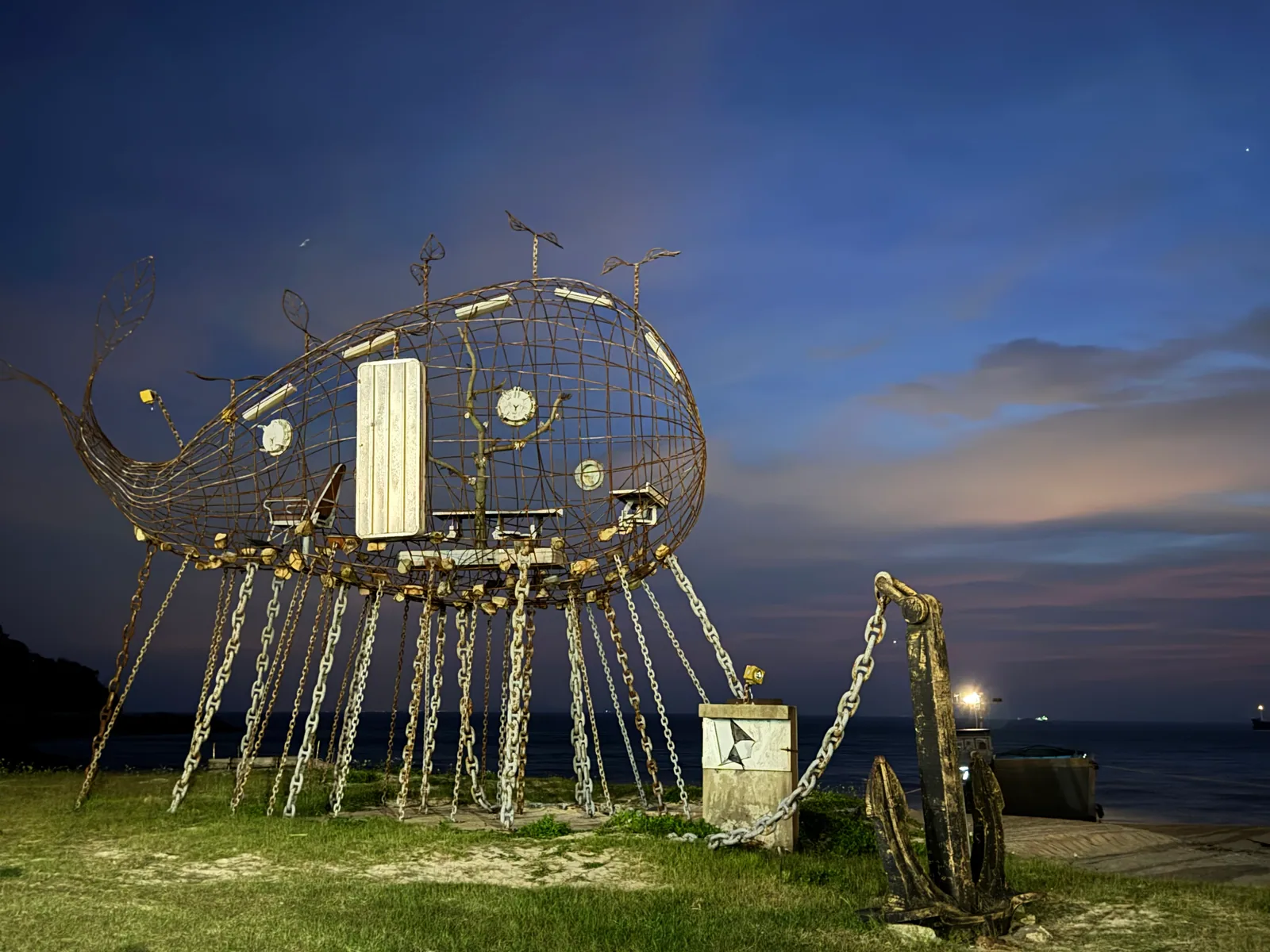
Yi-yu Ka-chao's "The Sea is My Land," the second exhibition in 2023, remained at Maoyuan Beach after the exhibition ended. Photo: Shangkuanlc / Wikimedia Commons, CC BY-SA 4.0.
Standing near Tianhou Temple on Maoyuan Beach are works titled The Sea is My Land, created by Amis artist Yi-yu Ka-chao for the second exhibition in 2023. The materials used were salvaged parts from old ships, including components from decommissioned warships and the old Taiwan Railway, reassembled into a ship shape with anchor chains serving as tree roots and granite forming the hull1. After the exhibition concluded, these works remained as permanent installations and are listed as fixed stops on tourist itineraries22.
A total of 31 long-term and permanent works have accumulated across various sites in Maosu from the first to the third exhibitions16. These pieces were not removed when each exhibition closed; several outdoor works remain permanently in place year-round. The three exhibitions thus layered a visible and tangible landscape onto the island. The lead curator for all three iterations was the same person, Wu Han-zhong12324, and the curatorial team for the third iteration included Huang Zhen-yan, director of the Museum Research Department at National Taipei University of the Arts25. She visited Maosu almost every year after her first visit in 2017 for an academic conference26.
Children on the island also participated. The Education Rooting Project involved seven elementary and junior high schools across the island starting in October 2021, where students dyed canvas sails using local soil and plants collected from each island to construct a "Wind Tower" placed on the lawn in front of Dongyin Loyalty Gate27. The people who dyed these colors lived in the islands listed on the exhibition site roster.
A route that went outward was established in 2026. An official press release from the Sado Island Galaxy Art Festival in Japan mentioned an international collaboration with the Maosu Biennial, where the winter edition would feature Taiwan artists invited to work in Sado by Maosu. Xinqi was the first such artist28. Starting her research at Sado's Gold Mine, which has a four-century mining history, her new work invites viewers to wear traditional Sado woven straw sandals and walk through cave tunnels symbolizing gold and silver veins, using the cavern space to "echo the embodied experience of Maosu's military tunnels"29.
The press release for the third closing mentioned that 62,556 people visited the exhibition area. With eight thousand to nine thousand residents actually living on the island30, this number represented about seven times the entire population of Maosu in 73 days. County Magistrate Wang Zhong-ming stated on the day of the closing: "This autumn, the world truly saw Maosu—your ocean, my land."16 The version seen by the world was somewhat different from the version he presented.
📝 Curator's Note: When English media writes about the Maosu Art Island, the most common entry point is military relics transformed into tourism attractions. Taiwan News' headline directly stated "Opening a New Chapter for Tourism"31, while the Taipei Times discussed making Maosu an international tourist destination30, and Focus Taiwan reported on the scale of 55 teams from 9 countries32. Taiwan Business TOPICS covered everything from military affairs to tourism opening in 19945. This framework is not wrong, but the sequence is reversed: the bunkers have always been there; what grew later was what could be fitted into them. The curatorial themes for the three iterations focused on how old wine ferments or how bamboo stakes are driven into the sea—that is what has been done over the past decade. Both stories are true, but international media usually only makes room for the former.
The space borrowed grew things that could be retained. They are now part of the Maosu landscape, standing alongside the bunkers and Tianhou Temple.
The Content is Good, But Few Locals Know About It
A feature report by The Reporter interviewed a homestay operator from Beigang, who spoke about another aspect of the same island.
Mazu International Art Island has good content, but few locals know about it.
In the same feature, Lin Meng-chin, a resident who returned to his hometown, said that "art is distant from residents" and added that the art island "has not yet been put into the local calendar" 33. Lienchiang County has over 14,000 registered residents 2, which is a figure on household registration; the actual number of people living on the island is around 8,000. Over three International Art Seasons have been held on an island with more than 8,000 residents, yet the locals claim they are not very aware of them.
The borrowed venues should logically avoid this issue. The works are displayed where residents buy groceries, eat, and wait for ferries—the opening hours of a piece at Granny's shop match the restaurant's serving times. However, the five characters in "Four Towns and Five Islands" conceal five sea routes. Residents from Dongyin must take a two-hour ferry to see a performance in Nangao 34, depending on the wind and waves that day. The distance between the art and the residents is shorter than it can be, yet the distance between towns must be measured by the ferry schedule. Council member Chen Yi-pin advocated for an additional showing of Paiqiu for the communities in Ju-guang and Dongyin during a county council regular meeting on November 20, 2025, precisely because of this distance; at the same meeting, another council member suggested combining the performance with tourism and selling tickets 35. The only venue on the island with 609 seats is in Meishi, Nangao, and none of the three seasons were registered there.
In December 2023, the Lienchiang County Government Culture Office issued a statement regarding public commentary, outlining directions for improvement: "Establish a general command center, implement the functions of the project office, extend the marketing period, and improve the quality of tourism accommodation and transportation." This document framed the art island as part of the "County Government's 10-Year Upper-Level Plan" 36. The fact that the promotional period was not long enough was something the government itself recorded in public documents. The statement also explained how funding was allocated: four main projects were tendered separately from each curatorial plan, and "all other tenders were publicly bid according to government procurement laws," with some local curatorial plans utilizing arts and culture procurement 36. This article could not obtain the total budget for the three seasons, nor the distribution ratio between the central and county governments, or the amounts of each tender.
Just because venues are borrowed does not mean people automatically come. Lin Meng-chin refers to the distance on a calendar; another measuring stick is used: Pai Ming (the local festival) is on it, the days when the whole village goes out to drive piles in August and September are on it, but an art season that only comes every two years has not been scheduled.
The Military Established These Two Teahouses and Printed That Price List
Meishi Village, Nanjiao. In the 1960s, the National Defense Corps Cultural Center was established here, encompassing a cinema, special teahouses, and a basketball court. Photo: rheins / Wikimedia Commons, CC BY 3.0.
There were two buildings in the Meishi military camp: one was an officer's special teahouse, and the other was a soldier's special teahouse. The special teahouses were a form of quasi-military industry during wartime administration, commonly known as "military amusement parks" or "831," and the operators could be traced. In 1952, the Ministry of National Defense formulated the "Provisional Regulations for Establishing Military Amusement Parks," which was renamed Special Teahouse in 195737. The first one on Matsu was established by the military in Fuxing Village, Nanjiao, in ROC Year 41 (1962), and operations were taken over by the military's Matsu Welfare Branch starting in August of '54. In the 1970s, because they could not recruit staff, it was converted to a private operation, although the military still assigned personnel for management38.
The Meishi special teahouses were established on October 3, ROC Year 46 (1957), and these two buildings were constructed in ROC Year 48 (1959). The officer's teahouse was used until ROC Year 80 (1991), while the soldier's teahouse was merged with the officer's teahouse after ROC Year 70 (1991) and converted into a biochemical training center, being decommissioned in November '813940. The restoration team's design notes state that they "restored the spatial configuration and scale of the central corridor and the side maids' suites using wood-grain exposed concrete" 41. It was one corridor with rooms lined up on both sides.
What can be seen upon entering is clearly explained in the exhibition descriptions. The first area of the officer's teahouse is called "Entrance Ticket," recreating the original ticket booth, maid number tags, and the price list from that time39. That price list was printed according to military rank: early on, one ticket cost twenty-five yuan for an officer, twenty yuan for a non-commissioned officer, and ten yuan for a private; it was adjusted again in November of ROC Year 64 (1975). A play ticket was limited to seven minutes, and if it exceeded ten minutes, another ticket had to be purchased38. The soldier's teahouse has an area called "Women with Brand Marks," which exhibits the remains of a bathroom area, next to another area showing the remnants of an air-raid shelter40. The room numbers are still present.
Who lived in those rooms? The gazette of Nanjiao Township provides a statistical description: the female servers were "average around thirty years old, mostly with primary or junior high school education," and there were also "teenagers aged sixteen and seven" early on. Sources include "many prostitutes from Taiwan who were caught and sold to offshore islands," as well as "female criminals voluntarily going to offshore islands," and "those who sacrificed themselves for their family's livelihood and came to the offshore island." Contracts were for six-month terms, subject to renewal38. The version in the National Cultural Memory Bank by the Lienchiang County Government Culture Office only states one thing: girls were "recruited from Taiwan to 'serve soldiers'" 42.
These are descriptions of a group. Individual people cannot be found: names, birth years, which numbered room they lived in, or where they went after leaving—this article did not find any such information.
Two "Myselfs" in the Tea Room Exhibition, Neither Being the Actual Person
These two buildings were already speaking before they arrived at Art Island. The Lienchiang County Government Culture Office began planning preservation, restoration, and reuse projects in 2018, with the Tea Room Exhibition Hall opening in November 20213943, as part of the "Da Mei Shi Project," which aims to reconstruct historical sites for the Ministry of Culture736. The first Matsu International Art Island was in February 2022, three months later. What it did here was display White Horse is Not a Horse in the Officer's Tea Room and five pieces in the Soldier's Tea Room all at once117. The narrative within the exhibition hall was one that it took over; it did not write it.
The scholar who participated in the restoration project was Professor Jiang Bai-wei from the Department of East Asian Studies at National Taiwan Normal University. In an interview, he explained the approach to this space: "A capable man's life is a battlefield; a humble woman dedicates herself to the nation" was a battle slogan previously displayed at Meishi, which portrayed the women in the contracted tea rooms as secondary characters supporting military needs. Since the women who worked here back then "had no names, only room numbers," the restored space narrated their life stories through the concept of "women marked with numbers," combining literary works and residents' memories43.
The so-called "literary works" listed by the exhibition include That Year in the Contract Tea Room by Shu Chang, Shore and Shore by Sang Pindai, A Memoir of Matsu Military Garden Left Alone at Dusk by Chen Chunmei, and Eyes Under the Sky by Liu Zhilian39. Liu Zhilian is a female writer from Matsu who writes about the wandering and rooting of the island's common people44. The first-person perspective in the exhibition is not singular. The "spiritual comfort on the battlefield" in the Officer's Tea Room uses the male perspective of soldiers, divided into three backgrounds: single, married, and underage. Next door, Flowers Blooming in a Foreign Land uses the female perspective of waitresses to recount the hardships of working in Matsu, missing home, and going out shopping39. These two "I's" are lined up on the same timeline.
The authors of those first-person passages were still not any actual individuals. But the place where this matter should be attributed is not the curatorial stand. The party that issued the numbers and printed the price lists—the National Defense Department regulations, managed by the military's welfare division—is what left them with only room numbers in the records; their names were never part of the system's required documentation from the beginning. Without names, there are no signed oral histories, no memoirs, and no primary written materials to cite. The curatorial team found the closest materials: the four books written by others, the memories of residents, and the remains of an empty bathroom. The Culture Office explicitly labeled the method in the Soldier's Tea Room area: it was an impression of the waitresses "presented through the residents' perspective"40.
A paper from Kinmen has dealt with a similar difficulty. Zhang Heqiang's Reconstruction and Voice of Waitresses: Exhibition Construction of Jinmen Military Garden discusses the exhibition in Kinmen, where the waitresses were "treated as a single group who 'voluntarily' sold themselves to serve Kinmen and contribute to the nation, making it difficult to restore historical truth," and the lack of waitress voices meant that the exhibition "served more for tourism consumption, distorting the facts." The paper concluded that the construction of the exhibition "should incorporate diversified participatory interpretations, especially the voice of the waitresses as subjects"45.
Cao Zhi-ping, a member of Da Pu plus+, mentioned in an article in Reporter, something applicable here even though it referred to another exhibition area: "When every place is involved in art, it should not be possible for the work to be valid anywhere."33 What Art Island could decide was which piece of work to put in which room. The descriptive plaques, the visitor flow, and the passages beginning with "I" were finalized before its arrival. The walls belong to someone else; the writing already on the walls belongs to someone else.
📝 Curator's Note: Kinmen spoke for them from the perspective of the military and the nation; Matsu found four books and the memories of one household, one of which was by a female writer from Matsu itself. The difference between the two sides is real, but neither side has the voice of the actual individuals. This gap was created before the exhibition opened: the military gave them room numbers, not names, and a person without a name cannot leave citable records. That paper studied Kinmen, not Matsu. On the Matsu side, no named critic has publicly raised this issue yet.
To this day, not a single contracted tea room woman from Matsu, nor her direct descendants, has said a word in this exhibition. This article also could not find any recorded interviews or oral histories from any of them.
Woven Works Dismantled, 31 Remain; Fourth Edition Lacks a Name
On May 28, 2026, on the beach at Tiepan-Aoqou in Southern Ganzhou, a woven installation collapsed amidst strong winds and rain brought by the southwest monsoon. Titled Paiqiu—Luo Guang. Zhu Ying (Woven Light. Bamboo Shadows), it was the work of architect Gan Mingyuan, which had been installed on that beach at the end of August 2025, mimicking the action of fishermen driving bamboo poles into the seabed. A report by the Mazu Daily News described the event plainly: the work "collapsed due to strong winds and rain on the 28th," while the same article noted that it "had withstood the fierce Northeast Monsoon during winter" 46.
The day after it fell, the county government cordoned off a warning yellow line at the site and scheduled its removal for the 29th and 30th. The Culture Office of Lienchiang County stated that Gan Mingyuan's contract had expired at the end of 2025, and "as the overall structure remained stable, the county decided to let the work persist until natural decay," after which it "formally retired" following the collapse on the 28th 47. Gan Mingyuan, who designed the piece, did not speak publicly from the time of the collapse until its removal.
The borrowed venue lacked constant temperature and humidity control. An object made of bamboo that endured the harshest six months of Mazu fell in a summer southerly wind; it shared the same climate as the island itself. Real paiqiu (fishing nets) are like this: poles are driven, nets hold for a season, and they are re-driven the following year.
The beach at Tiepan-Aoqou is now empty. On the other side of Ganzhou, at Magang Beach, the vessel reconstructed from decommissioned military parts remains—its anchor chains serving as roots, granite as its hull. Most works in the winter limited edition were running as usual, except for Life's Net and the 77 and 26 sites, which closed on weekends and national holidays 17. The exhibition had long concluded, yet these objects remained in their original places: the chicken coop is still a chicken coop, the restaurant is still a restaurant, the site is still a site—but each one now holds something extra.
What was borrowed must be returned, but this Art Island has lost some parts: the woven works have been dismantled, the performances are over, and the limited hours of the small pub have closed. The other part remains unreturned and is not intended to be returned—the 31 pieces left in place were never collected at any closing ceremony; they are now part of the island.
On July 22, 2026, County Magistrate Wang Zhongming led a delegation to visit the Taiwan Cultural Association, Taipower, and Taiwan World Art Island, officially launching preparations for the fourth iteration48. The theme has not yet been named. The chicken coop cabin remains, wine is still aging in the tunnels, and boats are still sailing.
Further Reading:
- Lienchiang County — A comprehensive overview of Mazu's county seat, military administrative history, and Cold War geopolitical context
- Kinmen County — Another frontline island that can be used to compare the wartime transformation paths of the two areas
- Martial Law Period — The Kinmen-Matsu area did not lift its wartime administration until 1992, five years later than Taiwan's main island
- Taiwan Strait Crisis and Cross-Strait Relations Development — The complete context of the 1983 shelling and the "no attack on either side" policy
- New Taipei City Museum — A case study of a public museum struggling between architectural vision and budget disputes
- Taiwan Curators and Artistic Cultural Construction — The thirty-year evolution of Taiwan's curatorial system
- Islands and Ocean Culture — A general perspective on the maritime culture of Taiwan's islands
Image Sources
This article uses 5 images licensed under CC, all cached in public/article-images/art/:
- Qinbi Village Stone Houses on Bei-gan — Photo: Terry850324, 2025, CC BY-SA 4.0
- Beihaikeng Tunnel on Bei-gan — Photo: Joe Lo, 2013, CC BY-SA 2.0
- Eight Eight Tunnel on Nan-gan — Photo: lienyuan lee, 2012, CC BY 3.0
- Nan-gan Magang Beach in "The Sea is My Land" — Photo: Shangkuanlc, 2025, CC BY-SA 4.0
- Meishi Village on Nan-gan — Photo: rheins, 2015, CC BY 3.0
References
- Database of Works (Exhibition Sites, Artists, Operating Hours and Work Descriptions) - Mazu International Art Island Official Website — The official website lists the exhibition sites, associated projects, operating hours, and original work descriptions for three editions. The works mentioned in this text—Dachen's Return: The Officer's Rebuilt House, Made by Light: Yi Ma, Echoes from the Other Shore, Waiting Museum, The Tremor of Memory No. 88, and The Sea is My Land—and the descriptions for the Nan'gan site are all sourced from this website; the official credits list mentions Wu Han-Chung (Sociology Co., Ltd.) as the general curator for the third edition.↩23456789101112
- Lienchiang County Population Drops Below 14,000, A New High — Mazu Daily News — Reporter Feng Shao-Fu reported on August 14, 2023, citing statistics from the Ministry of the Interior's Civil Affairs Department, which listed the registered population of Lienchiang County as 14,005 people and their distribution across various townships.↩2
- Matsu to be developed into 'island museum' — Taipei Times — A report from November 1, 2023, containing the original quote from Lienchiang County Magistrate Wang Zhong-Ming: "Matsu needs to move toward the concept of an island museum".↩
- Lienchiang County Government Finance Bureau Air Defense Evacuation Facility Survey — Mazu Information Network Reprint — A transcription of 2009 survey data, detailing the number and statistical scope of air defense evacuation facilities in every township across the county.↩
- Emerging from the Mist: Matsu's Unfinished Chapter — Taiwan Business TOPICS — A special issue of the Taiwan American Chamber of Commerce in July 2025, which reviews the timeline from the end of wartime administration to the opening of tourism in 1994 and subsequent cultural transformation; it does not mention Sado or Seto Uchi.↩2
- Taiwan's Matsu Islands Turn Military Past into Art — Radio Free Asia — A report from 2023 that provides background information on the scale of military garrisons during wartime and the bombardment continuing until 1979.↩
- Mazu Meishi Arts and Culture Center Inauguration — Central News Agency — Reporter Pan Xin-Tong reported on May 10, 2024, recording the history of the military cinema in Meishi and Zhongzheng Hall, the scale of the exhibition space with 609 seats, and the scope of the special tea room for officers and soldiers covered by the Da Meishi project.↩2345
- Mazu Meishi Arts and Culture Center Project Documents — Architect Magazine — A professional architectural journal page listing the design firm, site, floor area, building height, and construction cost.↩
- Meishi Arts and Culture Center Opens: Visitors Recall Past Movie Memories — Central News Agency — Reporter Pan Xin-Tong reported on May 11, 2024, which includes the opening performance program, a first-person recollection of viewing experiences during the 'single play, no double' era by visitor Mr. Zhang, and the county government's statement about planning cultural tourism theaters for public sale.↩2
- Nanzan Site 77 - Mazu Memory Bank — A cultural asset database built and maintained by the Lianjiang County Government Culture Office, with entries written based on an on-site investigation in October 2022, meticulously detailing the scale of Site 77 as 'one barracks, one trench,' including the cellar opening at the east end of the trench, the descent from the barracks to the north and turn west, and the spatial structure of machine gun posts and a ladder approximately two meters long along the way.↩
- On-site Visit to Mazu International Art Island 2025 - MOT TIMES Tomorrow's Log — A field report by reporter Kura Yang on September 12, 2025, meticulously detailing the visiting route of 'Korean artist Jung Ran-doo,' and 'the 26 sites that required climbing up a slope,' and 'the trench inside Site 77.'↩2
- Eight Eight Tunnel - Taiwan Tourism Information Network, Ministry of Transportation — The official attraction page that meticulously details the history and naming origins of the Eight Eight Tunnel, from a cave used to hide pirates and military defense tunnels to the storage space of Mazu Winery.↩
- Mazu Travel Climate and Folk Customs Information - Ministry of Transportation and Communications — The official travel information page that meticulously describes 'cold Northeast monsoon in winter' and the 'Bai Ming for Mazu' as the county's grandest folk event.↩2
- Xin Taiwan-Matsu Ferry Service Upgrade 2025 - Keelung Haihai — A local media report compiling ferry information between Taiwan and Matsu, noting the characteristics of rough seas from December to February in winter.↩
- How to Get to Mazu - Aviation and Ferries - Mazu National Scenic Area Tourism Information Network — The official transportation page of the Mazu National Scenic Area Management Office under the Ministry of Transportation and Communications, which lists travel times from Songshan, Taichung, and Kaohsiung to Nan'gan, an 8-to-10-hour journey on the Keelung Xin Taiwan-Matsu ferry, and regulations stating that service is suspended if waves exceed Grade 10.↩
- Third Mazu International Art Island Closing Press Release - Mazu International Art Island Official Website — An official announcement by the organizing unit on November 17, 2025, including 62,556 visitors, 31 long-term or permanent works, a record duration of 73 days, and closing remarks from Magistrate Wang Zhong-Ming, limited to the Northeast Monsoon season.↩2345
- Northeast Monsoon Edition - Works Overview - Mazu International Art Island Official Website — A page updated on December 16, 2025, showing extended exhibits and operating hours, clearly marked as free admission, listing the operating times for works such as White Horse is Not a Horse in conjunction with exhibition sites, and noting that works at Sites 77 and 26 are only open on weekends and national holidays.↩23
- 2026 Matsu Baiming Cultural Festival Hosted by Qinbi Heaven Mother Temple - Mazu Daily News — County government official media reports the dates, hosting temples, and activity themes of the 2026 Baiming Cultural Festival.↩
- About Art Island: Past Curatorial Discussions and Exhibition Scale - Official Website of Matsu International Art Island — The website's year-switching page archives the full original curatorial discussions and the number of exhibitions, artists, and works for the three editions: 'Island Brew,' 'Summer Red Bloom,' and 'Paiqiu'.↩2
- Third Matsu International Art Island Special - 'Paiqiu' - MOT TIMES Tomorrow's Magazine — A feature report from a design media, documenting the scale of the third edition and the operation method of the traditional fishing technique 'Paiqiu'.↩
- 2025 Matsu International Art Island Visitor Guide - Official Website of Matsu International Art Island — Announced by the organizing unit in September 2025, it details 'Free Admission to the Island from 9.5 to 11.16' and the viewing hours for the entire exhibition area; a reservation announcement (news/details/67) mentions that Art Island is free to visit, some works require reservations, and the fee is free, with the second edition also having a similar free island admission notice.↩
- The Heat of the Permanent Exhibition Site at the 2023 Matsu International Art Island Continues - Yahoo News — Reports on the continued visiting heat after the second edition's work, 'The Sea is My Land,' was converted into a permanent exhibition site on Sandbar Beach in Nangao.↩
- Report on the First Matsu International Art Island 'Island Brew' in 2022 - Non-Pool Art Network — A report from a professional art and culture media detailing the first exhibition period, the number of curatorial plans, the number of works, and the team composition led by Wu Hanzhong.↩
- Summer Red Bloom: A Trip to the Island in Autumn! 2023 Matsu International Art Island - Kaiak Fun Together — A pre-exhibition report from the second edition, quoting verbatim the explanation of the curatorial theme 'Summer Red Bloom' by the chief curator Wu Hanzhong, which confirms that the second edition's chief curator was also Wu Hanzhong.↩
- Introduction to the Curatorial Team of the Third Matsu International Art Island - ShoppingDesign — A feature report listing the titles and divisions of five curators, including Huang Zhenyan.↩
- Curator Huang Zhenyan's Interactions with Mazu - Central News Agency — A report from March 6, 2024, which meticulously records Huang Zhenyan's first visit to Mazu in 2017 for the 'Matsu: Island of War and Peace International Academic Conference,' and her subsequent near-annual visits.↩
- Highlights of the 2022 Matsu International Art Island 'Island Brew' - Big Person — A feature from February 12, 2022 (with data provided by Matsu International Art Island noted at the end), which meticulously records the educational rooting project that began in October 2021, visited 7 elementary and middle schools across four townships and five islands, and the sail dyeing and exhibition site location of 'Wind Tower'.↩
- Launching an International Collaboration with the Matsu Biennial - Sado Galaxy Art Festival — An official press release from the Japanese art festival explaining the cooperation content with the Mazu Biennial, the recommendation mechanism for the Winter 2026 edition, and the recommended artist, Xinqi.↩
- Matsu International Art Island Collaborates with Sado Galaxy Art Festival: Artist Xinqi's 'Through the Cave of Gold' - Taiwan News Cloud — A verbatim description of the spatial structure, sandal circulation path, and mine intertextual design of Xinqi's new work.↩
- Taiwan Seeks to Make Matsu a Tourist Destination - Taipei Times — A report from September 8, 2025, which states that the actual population of Mazu is between 8,000 and 9,000 people, and also cites the number of accommodations and daily carrying capacity from the Tourism Bureau of Lienchiang County.↩2
- Matsu International Art Festival Opens a New Chapter for Tourism - Taiwan News — A report from September 7, 2025, covering the opening of the third Art Island within a tourism framework, without mentioning Seto Inland Sea or Sado.↩
- Matsu Biennial Opens with 55 Teams from Nine Countries - Focus Taiwan — A Central News Agency English report from September 5, 2025, covering the scale of the third opening, without mentioning Seto Inland Sea or Sado.↩
- Brewing a Cup of Good for the Island with Art? The Distance Between Mazu International Art Island and Local Residents - Reporter — A special report by reporter Ma Yu-Chen, including multiple views on the Art Island from returning youth Lin Meng-Jin, Beigao B&B operators, and Cao Zhi-Ping from Daopu plus+↩2
- Inter-Island Transportation - Mazu National Scenic Area Tourism Information Network — Official page of the Mazu National Scenic Area Management Office under the Ministry of Tourism, listing travel times and fares for various ports across the four townships and five islands, including routes between Nanzan, Beigao, Jukang, and Dongyin.↩
- Council Regular Meeting: Councilors Concerned with Major Projects, Fiscal Law Amendments, International Art Island - Mazu Daily News — Published on November 21, 2025, recording the opinions and suggested directions of three councilors regarding the third iteration of the Art Island during the final day of the regular meeting on November 20.↩
- County Government Culture Office Issues Explanation Regarding Public Commentary - Mazu Daily News — An official response released on December 5, 2023, which meticulously details the structure and bidding methods of four major projects, commitments to improvements, and mentions the spirit of historical sites in Daumeishi related to the Ministry of Culture.↩23
- The Cold War Island's 'Military Music Garden': Transformation of Mazu Special Contract Tea Room into a Youth Creation Base - Liberty Times — A report by reporter Chen Yu-Fu on September 27, 2022, detailing the Ministry of National Defense's plan to establish the 'Temporary Regulations for Military Music Garden' in 1952, renaming it 'Special Contract Tea Room' in 1957, and the regulations regarding waitresses' working hours and monthly workdays.↩
- Military Section - '831' Military Paradise — South Cape Township Office, Linkou County — The official township gazette page of the township office, which meticulously records the establishment of Mazu 831 in Nan'gan Village in ROC Year 41, the relocation to Meishi Village in August of ROC Year 50, the management by the military's Mazu Welfare Branch in August of ROC Year 54, the transition to private operation in the 1970s while still managed by military personnel, and details regarding the origin, average age, and education level of female servers, the half-year contract for island residents, and the regulations concerning ticket prices and entertainment coupons based on military rank.↩23
- Introduction to the Military Personnel Tea Room Exhibition Area at Meishi Camp - Cultural Mazu — An official exhibition page from the Lianjiang County Government Culture Office, listing the construction era and decommissioning time, themes for each area from B1 'Entrance Ticket' to B7 'Silent Sky', including a bibliography of four works of 'Special Contract Literature' and settings with two first-person perspectives in B3 and B4.↩2345
- Introduction to the Soldier Personnel Tea Room Exhibition Area at Meishi Camp - Cultural Mazu — An official exhibition page from the Lianjiang County Government Culture Office, detailing the history of the soldiers' tea room, presenting A4 'Secret Not to Be Spoken About' from a resident's perspective, showing bathroom ruins in A5 'Woman with Tattoo Number', and displaying the configuration of air-raid shelters in A6.↩23
- Meishi Camp Officer and Soldier Special Tea Room — Taiwan Architectural Report Magazine — Design descriptions published by the Institute of Architecture in March 2022 (Vol.318) of 'Taiwan Architectural', which meticulously detail the restoration to a wood-textured cast concrete, 'restoring the spatial configuration and scale of the central corridor and the side maid suites.'↩
- Mazu Special Tea Room — National Cultural Memory Repository — The data source institution is the Culture Department of Linkou County Government; written by Wu Yi-shui, it meticulously records the reason for establishing the special tea room and the description of 'ladies recruited from Taiwan,' and quotes a report in the Mazu Daily on September 11, ROC Year 46, regarding the allocation of funds by the Mazu Command to improve the tea room facilities.↩
- Mazu Special Contract Tea Room Exhibition Completed Restoration; Female Team Transforms Space - Central News Agency — Reported by reporter Qiu Yun on November 22, 2021, recording the opening time of the exhibition and including Jiang Baiwei's explanation regarding the battle slogan 'A Man Fulfills His Duty in Battle, A Woman Sacrifices Herself for the Nation', the display perspective, and the research methods.↩2
- Liu Zhilian Narrates Mazu History Through Her Father's Experiences in 'Eyes Under the Sky' - Xinwang News Network — A book review from October 2016, detailing Liu Zhilian's origins in Mazu and the writing structure of 'Eyes Under the Sky', which is based on her father's experiences with the backdrop of the Mazu era.↩
- The Reenactment and Voice of Waitresses: The Exhibition Construction of Jinmen Military Music Garden - Zhang Heqiang — A full PDF academic paper that studies the Jinmen Special Contract Tea Room exhibition, analyzing the competition between central, local, and community levels of power and the absence of the waitresses' voices.↩
- Art Island Works 'Blowing Light. Bamboo Shadows Cannot Resist Strong Winds and Rain Collapse' - Mazu Daily News — A report from the county government official media in May 2026, meticulously recording the time of the collapse of the works and the description 'survived the strong northeast monsoon of winter.'↩
- Mazu International Art Island Works 'Blowing Light. Bamboo Shadows' Collapse Due to Strong Winds; Culture Office Disassembles - Taiwan News Cloud — A report from May 31, 2026, including the complete response from the Culture Office regarding contract expiration and extension into natural abandonment and dismantling operations.↩
- Preparation for the Fourth Mazu International Art Island Commences - Mazu Daily News — Issued on July 23, 2026, detailing the county magistrate's visit to the Chinese Culture Association, Taipower, and Taiwan Sexi on the 22nd.↩
🧬 What Semiont was thinking while writing this