
Taiwan AI School: The Unfinished Call to Ten Thousand AI Engineers
30-Second Summary: On March 27, 2020, Chen Sheng-wei, a researcher at the Academia Sinica in his 40s, cautiously called the editor of Asia Times saying he "wanted to do one thing": start a free programming course for everyone. Two days later, he collapsed and was hospitalized; thirteen days later, he passed away. At the time of his death, the Taiwan AI School (AIA), which he founded in 2018, had trained over six thousand people. While the Ministry of Science and Technology's "AI Small Nation Grand Strategy" aimed for NT$16 billion in five years, he raised NT$180 million through private fundraising from six companies—Formosa Plastics, Chemico, Innolight, and others, each contributing NT$30 million. Eight years later, the school's alumni surpassed ten thousand. AIA is a piece of Taiwan’s industrial upgrading puzzle that doesn't look like Taiwan at all.
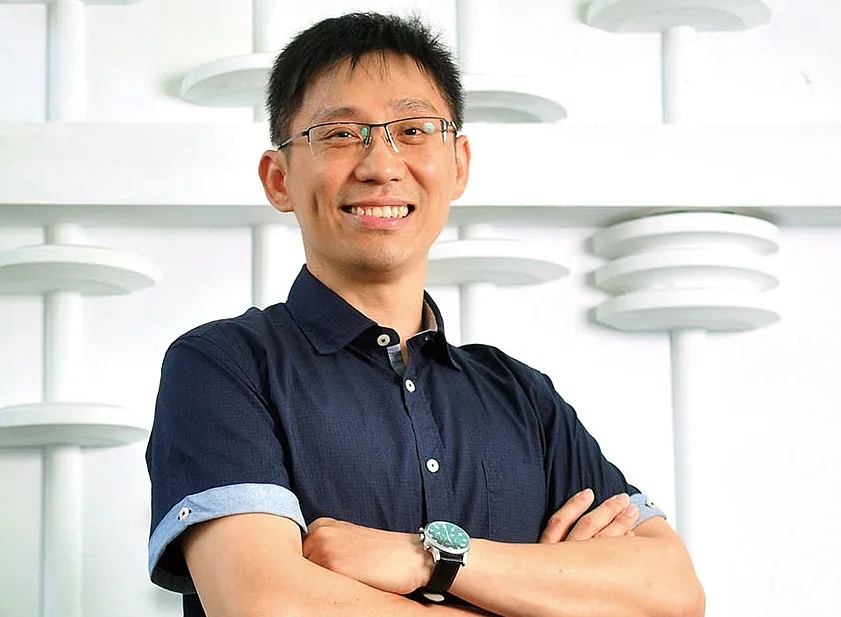
Chen Sheng-wei (1976–2020), founder and CEO of the Taiwan AI School. Photo: Taiwan AI School official. via aiacademy.tw.
The Unfinished Call
On March 27, 2020, Chen Sheng-wei carefully called the editor-in-chief of Tianxia Magazine. He said: he wanted to do one thing1.
Two days later, he fell and hit his head at a roller rink. While driving home, he suddenly felt unwell and pulled over by the roadside. After being hospitalized, he was in a coma for thirteen days and passed away on April 11, 20202. He was 44 years old.
The thing he wanted to do was launch a free programming education course for everyone: no fees, no educational prerequisites—anyone who wanted to learn how to code could come, and then match the talent with positions needed by companies1.
That phone call did not include a complete plan. After Chen Sheng-wei's death, this concept was never finished by anyone.
If we look back at his trajectory in the last three years before he passed away: starting to visit factories with Kong Xiang and his family in 2017, the first cohort of 530 students starting in 2018, and writing a book titled Artificial Intelligence in Taiwan in 2019. That phone call was an additional layer he wanted to add to what he "should have already finished."
The problem was that he ran out of time.
A Research Fellow from Academia "Descends to the Field"
Chen Sheng-wei, whose given name is Chen Kuan-da, was born in 1976. He attended National Taiwan High School and then pursued studies at Tsinghua University's Department of Computer Science and Technology, earning a Master's degree there. He obtained his Ph.D. in Electrical Engineering from National Taiwan University (NTU). In 2006, he joined the Academia Sinica Institute of Information Science as an assistant researcher, promoted to associate researcher in 2011, and finally became a full research fellow in 20153.
This represents a typical elite career path for scholars in Taiwan.
Researchers at Academia Sinica conduct top-tier research using national funding, publishing SCI papers, and supervising doctoral students. Over the 14 years he worked at Academia Sinica, Chen Sheng-wei published over 130 academic papers3 and received awards such as the "Li Kuo-ding Young Researcher Award" from the ACM Taipei Chapter in 2009 and the "Best Journal Paper Award" from the IEEE Multimedia Technology Committee in 20143.
However, one night in winter in 2013, he said to his wife, He Jia-zhen:
"Is there a field in Taiwan where workers can improve themselves like students and resolve knowledge anxiety?"4
There was no ready answer. Taiwan has universities, cram schools, and online courses, but it lacks a place specifically designed for engineers who are already working to become students again.
So, the following year (2014), he founded the "Taiwan Data Science Conference," which attracted up to 1,800 people in any given year5. In 2016, he established the Taiwan Data Science Association. However, both the conference and the association remained "annual events," not a "continuous learning field."
The difference was frequency: knowledge anxiety is an everyday problem that annual conferences cannot solve.
At some point in 2017, Professor Kong Xiang-chong, who was on sabbatical in Taiwan after studying at Harvard, approached him. Professor Kong is the William H. Gates Distinguished Professor at Harvard University and was 72 years old at the time. Director Liao Chun-chih of Academia Sinica introduced Chen Sheng-wei, who had been a full research fellow for two years at age 416.
Professor Kong recalled to reporters:
"Macro-yuan Industry was among the first companies I visited with Sheng-wei."7
The two would drive around, visiting factories in Southern Taiwan every week. They visited company after company, giving presentations repeatedly6. Within six months, they had visited over ten manufacturing enterprises. At that time in 2017, most business owners were skeptical about AI, but Chen Sheng-wei and Professor Kong carried a missionary mission.
Based on these field observations, Chen Sheng-wei defined himself:
"A worldly computer scientist, a technological evangelist."8
The term "descending to the field" usually carries a negative connotation in academic circles; it means researchers abandoning top-tier research to engage in practical application and popularization. Chen Sheng-wei redefined it with his own words:
"As long as scholars are willing to take a step, they can lead society using their own methods."9
During the time spent visiting factories, he and Professor Kong discovered one thing: what Taiwan needed was not solving problems for a single factory through a single project, but rather systemic construction that enabled more engineers to have the ability to solve problems.
In 2017, at the Artificial Intelligence Conference, Director Liao Chun-chih publicly announced the establishment of the "Taiwan AI School" 6.
From his statement late at night to the director's public announcement, about four years passed.
Five Years, NT$16 Billion, Versus NT$180 Million from Six Companies
In August 2017, Minister of Science and Technology Chen Liang-chi announced the "AI Small Nation Grand Strategy" at a press conference, planning to invest approximately NT$16 billion over five years to cultivate AI talent 10.
This was the government version of Taiwan's national AI strategy.
Concurrently, Chen Sheng-wei approached different entities with the proposal for the Taiwan AI School: he contacted TSMC (Taiwan Semiconductor Industry), Chemico, Wistron, Yili Electronics, MediaTek, and AUO 11.
The six companies each contributed NT$30 million.
The total amount was NT$180 million 11.
This was the private sector version of Taiwan's AI talent strategy.
The tension between the two figures far exceeded the numbers themselves. The ratio of NT$180 million to NT$16 billion is one-ninth.
However, the execution speed of the two strategies was vastly different. To know what the government version—the "AI Small Nation Grand Strategy"—accomplished over five years, one must refer back to government annual reports. The private sector version, AIA, started in January 2018 with its first cohort of 530 students 12.
From announcement to commencement, less than six months.
📝 Curator's Note
This phenomenon can be read in two ways. The first: government incompetence leading to private sector self-rescue; the speed of Taiwan's industrial upgrading is always driven by anxiety. The second: Scholar Chen Sheng-wei spent four years thinking about this problem, starting from an issue late at night in 2013, so the fast start was not due to inherent private sector agility, but because he had thought long enough.
Both readings are valid. But they only become complete when interwoven: institutional discontinuity is the backdrop, and the individual bearing the cost is the foreground.
After Chen Liang-chi's press conference concluded and the government proposal was printed, Chen Sheng-wei called the companies. The company executives asked him what level of commitment he needed to write, what contracts needed to be signed, and what returns they could expect. His terms were direct: the school did not own the companies, nor did it own the students, nor did it own the data. The school was a foundation corporation, and students were free to move after graduation.
The six companies agreed to these terms.
The First Class at the Industrial Technology Research Institute (ITRI) Building 7
On the morning of January 27, 2018, in Building 7 of the Academia Sinica's interdisciplinary research center12.
This was the opening ceremony for the first cohort of the Taiwan AI School.
A total of 530 participants attended[^3]: 210 from the Technology Leader Training Class and 320 from the Executive Weekend Training Class. The first class was taught by Chen Sheng-wei.
The Technology Leader Class ran for 12 weeks, five days a week, from nine in the morning to six in the afternoon, with a tuition fee of NT$48,00013. Of the 430 applicants, 210 were admitted, resulting in an acceptance rate of 48%. The entrance exam covered five subjects: calculus, linear algebra, probability, statistics, and programming13.
The Executive Weekend Training Class ran for 12 weeks every Saturday (from 9:30 AM to 8:30 PM), with a tuition fee of NT$36,00014. It accepted 320 participants out of 470 applicants.
The design of the two classes reflected Chen Sheng-wei's understanding of "filling gaps" (or supplementing needs).
The Technology Leader Class was for engineers who already knew how to code, addressing the new technological field of AI and machine learning. Frontline engineers took time off during the day to attend classes, with employers signing commitment letters agreeing to this arrangement. The Executive Class was for mid-to-senior managers who were already leading teams, addressing the horizontal communication skill: "Can I understand what the engineers are talking about?" Attending on Saturdays allowed them not to affect their work.
The two classes, with their respective approaches to filling gaps, represented a structural difference from other online MOOC courses for AIA.
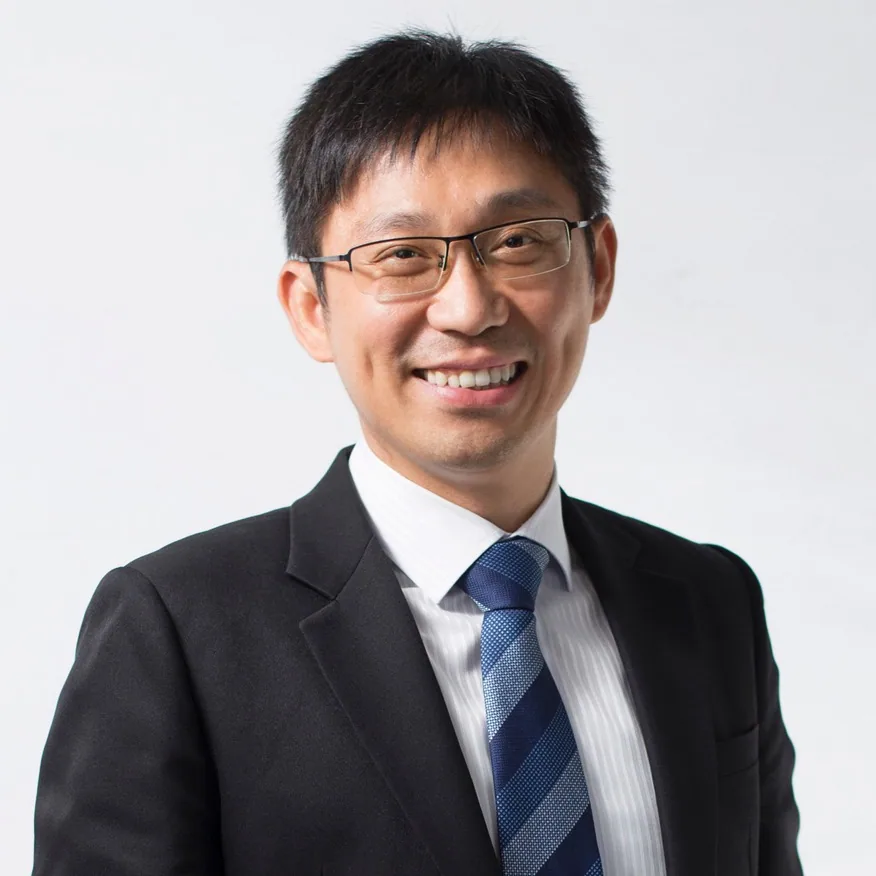
CEO Chen Sheng-wei speaking at the Taiwan AI School. Photo: Taiwan AI School official site. via aiacademy.tw.
Among the students admitted in the first cohort, one later shared his experience on the AIA official student page. His student ID was AT071039, and his name was Chen Yan-chin. He wrote:
"In three months, the school taught a considerable amount of knowledge—some of which might take two or three years to study in graduate school, all compressed into three months."
"It is not an exaggeration to define the Taiwan AI School as an 'AI military academy'."15
The metaphor of the "AI military academy" captured the atmosphere of the first cohort: 100% attendance rate, final projects linked to real industry problems, and classmates being pushed into a shared high-pressure environment.
On April 29, 2018, the graduation ceremony for the first cohort of 530 participants was held16. The students' final projects included practical topics such as stock market prediction systems, manufacturing defect detection, and customer churn warning systems. Personnel from UMC, AUO, Wistron, Chunghwa Telecom, and Fubon Financial Group attended; some attendees described the event as a "talent recruitment fair" 16.
The first cohort's graduation survey results showed that 72% returned to their original companies, 15% found new jobs, 4% started their own businesses, 7% were waiting for opportunities, and 2% pursued further studies17.
The figure of 72% "returning to their original company" was a double-edged sword for AIA.
It verified that AIA was not a "job-hopping tool," but a "continuing education channel." When employers sent employees to AIA, they were not directly losing talent. It also meant that the AI capabilities produced by AIA were transferred back into existing industries, rather than creating a new wave of AI startups. This differed from the government-led model in South Korea in 2018, which aimed to create a national AI strategy through "the world's first completion of national-level AI textbooks and 9 major strategies with 100 initiatives"18. The difference lay in this: Taiwan used AI to strengthen existing industries, whereas South Korea sought to build an AI national strategy.
The two models corresponded to two national structures. Taiwan’s semiconductor industry was strong enough that what it needed were AI engineers who could integrate with the existing ICT chain, not for AI to become a standalone industry.
"We Solve Our Own Problems"
Chen Sheng-wei repeatedly stated one phrase. He said it to the media, to students, and to business owners:
"To let the world see Taiwan, think of AI."19
This statement was raised in various contexts. While it might sound like a common national slogan for Taiwan, when paired with his corresponding strategy (AIA does not accept government funding, does not own student data, and graduates are free to move on), the phrase carries another layer of meaning.
It is not about the government entity that lets "Taiwan" be seen by the world; it is about the private sector entity that lets "us" be seen by the world. In his last long interview before his death, Chen Sheng-wei made this framing more concrete:
"Some say data is the oil of the new era; then artificial intelligence (AI) is the electricity of the new era, and in the future, no modern industry will be unrelated to AI."20
This statement was included in Artificial Intelligence in Taiwan: Opportunities and Challenges for Industrial Transformation (published by Tianxia Magazine), which he co-authored with Wen Yi-ling in July 201921. Under the book title, there is a subtitle: "Opportunities and Challenges for Industrial Transformation."
This book was almost the manifesto of AIA: treating AI as something on the level of infrastructure (something every industry needs and cannot do without), rather than a toy for academic elites.
In 2018, Chen Sheng-wei was also recruited by Yuanta Financial Holdings as the first Chief Technology Officer in Taiwan's financial industry22. The data science team CRV (Customer Risk & Value) at Yuanta established a professional team of 80 people during his tenure22 and promoted "nearly a hundred AI projects."
Holding three positions—CEO of AIA, CTO of Yuanta Financial Holdings, and researcher at the Academia Sinica. He told the National Tsing Hua University Alumni Center why he took the job at Yuanta:
"Looking back, frankly, I was somewhat resistant! Software people usually feel that banks have nothing to do with them; I originally thought that in my life, besides saving money, I would never have anything to do with a bank."23
But he did. Because "entering industry" is an extension of the AIA philosophy: it is not enough to just teach engineers and let them go; scholars must also participate to demonstrate this.
A sentence written by Mei-ling Chen, who mourned him when she was the former chairperson of the National Science Council, summarized this philosophy:
"Chen Sheng-wei did not wait for resources from the government; he created his own resources, solving the needs of Taiwan's industrial transformation with the right methods, truly helping Taiwan."24
A Thousand Days Without Vacation
From the time of a visit to Hongyuan Industries with Kong Xiang in March 2017 until his passing in April 2020, it was approximately one thousand one hundred days.
During these more than a thousand days, Chen Sheng-wei held three positions: Senior Researcher at the Information Institute of Academia Sinica (academic research), Executive Director of Taiwan AI School (teaching + fundraising + organizational management), and Chief Technology Officer at E.Sun Financial Group and E.Sun Bank (industry practice).
His wife, He Jia-zhen, mentioned in a eulogy given during an online memorial lecture after his death that she had barely seen him take a vacation in those years4.
Professor Lin Yi-ping (a distinguished professor from the Department of Computer Science at National Taiwan University) told CNA three days after his passing that he "met with him last week to discuss cooperation." In other words, Chen Sheng-wei was still busy with affairs during the week he fell25.
The director of Academia Sinica, Liao Chun-chih, mourned:
"Chen Sheng-wei is a rare talent whom I have seen in a hundred years. In this generation, Sheng-wei was arguably the best leader, organizer, communicator, and innovator I have encountered."26
Huang Nan-zhou, General Manager of E.Sun Financial Group, recounted Chen Sheng-wei's catchphrases:
"The direction cannot be wrong, and the speed cannot be slow!" and "How is it? Is it difficult? This is what makes it challenging!"27
These are memories from colleagues. But returning to interviews with Chen Sheng-wei during his lifetime, he repeatedly emphasized that he was neither a "hero" nor a "martyr." A memorial feature by CNA on April 13, 2020, quoted the observation of writer Yan Ze-ya:
"He could have made a lot of money," but he "wanted to make a difference"28.
Chen Sheng-wei himself had used the English phrase "make a difference." When describing his vision, he said he hoped to make society better.
On March 29, 2020, Chen Sheng-wei fell and hit his head at a unicycle arena. He felt unwell while driving home and pulled over by the roadside. After being taken to the hospital, he suffered cerebral hemorrhage and fell into a coma. Thirteen days later, on April 11, 2020, he died2.
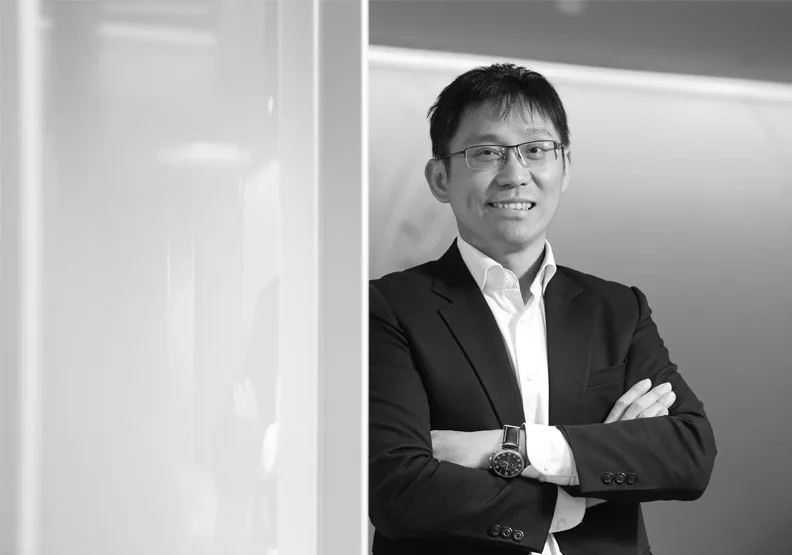
Portrait from a Yuanjian Magazine interview shortly before his passing. Photo: Chang Chih-jie / Yuanjian Magazine, 2020. via gvm.com.tw (fair use editorial commentary).
After the news of his death spread, alumni from AIA, E.Sun Financial Group, Academia Sinica, g0v, and the Taiwanese data science community collaborated to launch an online memorial platform with a cartoon game scene style on April 21. The team worked through the night, finishing at one in the morning26.
Chen Sheng-wei's nickname in the gaming world was "Fox God" (World of Warcraft); he was one of the few scholars at Academia Sinica who held dual identities as a "data scientist + gamer." The animated style of the online memorial echoed his "otaku" identity. Within one day of its launch, the comment section accumulated nearly a thousand messages.
Yu Meng-xun from the Public Accountability Association recalled what Chen Sheng-wei said to the person taking over after he built the accountability platform:
"The platform is yours now; I'm giving it all to you! Now it's your turn to worry about it!"29
This was his typical way of speaking: direct, unpretentious, and with a slight joke when handing things off. He worked very quickly, and in the years before his death, he handed everything over cleanly. Cai Ming-shun took over from AIA. The CTO position at E.Sun Financial Group had an assistant. The researcher position at Academia Sinica was handled internally afterward.
However, the last thing he wanted to do—the "free public programming class" mentioned in that phone call—was never handed over to anyone.
The Three Years Without Him
On August 31, 2020, the corporate restructuring of AIA took place30.
The Foundation for Technological Ecosystem Development (a non-profit corporation) terminated its contract with the Artificial Intelligence Technology Foundation. Cai Ming-shun was appointed as the Executive Director of AIA, and Liao Hongyuan became the Executive Director of the Foundation.
Cai Ming-shun had over 20 years of experience in data science and digital transformation at international corporations such as SAP, Oracle, and Teradata, joining the AIA preparatory team as Chief Operating Officer in 201731. When Chen Sheng-wei passed away, he had been working at AIA for about three years.
This was a dual stress test: "founder passing + institutional challenges."
The norm for tech NGOs is that after a founder's death, the organization gradually dissolves within two years because the founder's personal charisma acts as the organizational adhesive. AIA, however, saw its alumni base exceed 10,000 people and accumulated over 2,000 corporate partners by May 202432.
But from 2020 to 2024, AIA underwent a fundamental change in its course structure.
AIA in 2018: A 12-week intensive camp, requiring 100% physical attendance; the Technology Leader class cost NT$48,000 and the Manager class cost NT$36,000, emphasizing "tying graduation projects to real corporate problems."
AIA in 2024: A "Beginner Course for Large Language Models" lasting 3 days and 21 hours, with a tuition fee of NT$17,000 (NT$15,300 for alumni discounts). The content covered Gemini, ChatGPT, Ollama, Make, NotebookLM, Gamma, Suno, and Line API33.
The shift from "elite intensive classes" to "LLM short courses" reflects the changes of the era. After ChatGPT was released at the end of 2022, the global demand structure for AI education changed significantly. AIA had to add LLM modules, make tuition affordable for more people, and allow non-engineering professionals to attend.
This evolution also sparked internal discussions about, "Are we still the same AIA?" The alumni community was divided over whether to "continue Chen Sheng-wei's 'application-first' philosophy" or if the "AI era required a complete transformation of the AIA model"32.
⚠️ Controversial Viewpoints
AIA is not a success story for all its alumni.
On November 16, 2018, there was a feedback post from an AIA Taichung class student on the PTT Soft_Job board (username name0625). They listed several specific critiques:
"In general, regarding the materials: it lacks systematic structure and sincerity. It's very much like a university group project where everyone does their part individually without integration."
"The video is mainly 720p; there are significant volume differences between different clips on the same day, and some speakers forget their lines for over five seconds."
"Raise your hand if you finished the course videos according to the schedule? I personally see less than half. Raise your hand if you completed the practical exercises according to the schedule? I personally see almost none."
"The job placement assistance for the Taichung class had already warned that there wouldn't be many companies interested."34
This critique represents another side of AIA, beyond its first cohort in Taipei: the instructors at branch campuses were not as good as those at the main campus, the resources for graduation placements were inferior to the main campus, and the course videos were pre-recorded rather than live, leading to a significant difference from the experience structure of the "physical intensive + 100% attendance" students in the original Taipei class.
AIA's official narrative does not proactively mention this critique. However, while claiming that Taiwan's AI talent pipeline was "held up by Chen Sheng-wei alone," it should also acknowledge: the quality gaps arising from the branch campus system, online format, and scale expansion are unavoidable internal discussions within how this talent pipeline actually operates.
On October 8, 2021, AIA officially launched the "Chen Sheng-wei Memorial Lecture"35. The first speaker was Jian Li-feng, former CEO of Google Taiwan, with the theme "Trends of AI: An Industrial Perspective."
He Jia-zhen spoke at the launch ceremony:
"I would like to thank the 'Foundation for Technological Ecosystem Development (a non-profit corporation)' for establishing the [Chen Sheng-wei Memorial Lecture]. This is a positive affirmation of Sheng-wei, and it continues his passion to continuously fulfill the aspiration of making Taiwan visible to the world through AI."36
Cai Ming-shun was awarded the 18th "100 MVP Executive" by Manager Magazine in 202531. On September 27–28, 2024, AIA hosted the "Taiwan AI Conference" at the Academia Sinica37, continuing the momentum of the "Taiwan Data Science Conference," which Chen Sheng-wei founded in 2014.
From 2018 to 2026, AIA spanned eight years. Chen Sheng-wei was only present for the first three.
The Course That Was Never Made
The call on March 27, 2020, was never fully understood by anyone.
Two days later, Chen Sheng-wei fell. Thirteen days after that, he passed away. The free universal programming course he wanted to launch was never made.
But in May 2024, the number of AIA alumni surpassed ten thousand. At a press conference with reporter Cai Ming-shun, there was no need to mention Chen Sheng-wei's recurring phrase, "To show the world Taiwan, think AI." Over the past six years, this sentiment has been written into the resumes of tens of thousands of engineers in Taiwan's tech industry.
AIA evolved from a 12-week, NT$48,000 full-day intensive camp to a 3-day, 21-hour LLM short course. It moved from being a technology leader to industrial popularization; from one school to an entire talent pipeline.
The "free universal programming course" Chen Sheng-wei wanted was never made. But the other thing he wanted—that "no one would fall behind because they couldn't find AI talent"—was partially achieved.
That unfinished call left an unfulfilled ambition, and a community of ten thousand people who once sat in AIA classrooms.
Further Reading:
- The Rise of the AI Nation: Taiwan's Artificial Intelligence Development and Future Strategy — A panoramic narrative of Taiwan's AI policy framework, industrial layout, five major strategic areas, and international cooperation
- AI in Daily Life in Taiwan — Practical applications of AI in daily scenes such as convenience stores, hospitals, farmlands, and classrooms in Taiwan
- Semiconductor Industry — How the AI engineers nurtured by AIA over eight years are rejoining the existing ICT ecosystem of semiconductor powerhouse nations
- Why Taiwan Needs Its Own Knowledge Base — The school's vice president, Cai Ming-shun, stated that local Taiwanese data accounts for less than 0.1% of the global web; this article quantifies that gap and discusses who should write the version
Image Sources
This article uses three publicly licensed images, all cached in public/article-images/technology/ to avoid hotlinking from source servers:
- Portrait of CEO Chen Sheng-wei (2018) — Photo: Taiwan AI School official, 2018, fair use editorial commentary on AIA founder portrait
- Photo of Chen Sheng-wei giving a speech (2018) — Photo: Taiwan AI School official, during 2018-2019, fair use editorial commentary
- Portrait from an interview with Chen Sheng-wei in Konldom Magazine (2020) — Photo: Chang Zhi-jie / Konldom Magazine, April 21, 2020 memorial feature, fair use editorial commentary on deceased public figure portrait
References
- Konldom Magazine: The AI Driver Tying Taiwan – He Cautiously Said Two Days Before His Death, That He Wanted to Do One Thing — A commemorative report by Konldom Magazine in 2020, recording the details of Chen Cheng-wei calling the editor of Konldom on March 27, two days before his passing, saying he 'wanted to do one thing' (the title and content summary can be obtained from public search results; parts are behind a paywall).↩2
- CNA: CEO of Taiwan AI School, Chen Sheng-wei, has passed away — A obituary report from Central News Agency dated April 13, 2020, detailing the passing (falling down in a wheelchair, fainting while driving home, and dying).↩2
- AIA: Personal Profile Page of CEO Chen Cheng-wei — The official profile page of the Taiwan Artificial Intelligence School, including his academic background (Tsinghua University Computer Science -> National Taiwan University Electrical Engineering PhD -> CAS Research Fellow 2006-08 -> Associate Researcher 2011-01 -> Regular Researcher 2015-03), over 130 papers, and awards.↩23
- Konldom Future City: Remembering Chen Cheng-wei and the Taiwanese Data Science Community (He Jia-zhen's Account) — A commemorative feature on Chen Cheng-wei by Konldom Future City in 2020, where He Jia-zhen recounts something Chen Cheng-wei said to her late at night at the end of the 2013 Data Science Conference.↩2
- Wikipedia: Chen Sheng-wei (Supplementary Paragraph) — Same as [^1], supplementing records of the 2014 Taiwan Data Science Conference (up to 1,800 attendees) and the establishment of the 2016 Taiwan Data Science Association.↩
- Asia Times: Is AI a Lifeline for Taiwan? Six Companies Jointly Establish Taiwan AI School with NT$180 Million — An in-depth report from Asia Times dated 2018, including interviews with Kong Xiang, the case of Hongyuan Industry, and visits to ten factories.↩23
- Tomorrow's City: Kong Xiang Revisit Interview (Macrovision Industry Segment) — Same as [^7], a deep report from Tomorrow's City in 2018 recording Kong Xiang's recollections of the starting point of cooperation with Macrovision Industry.↩
- Central News Agency: Chen Cheng-wei Promotes AI Development — A commemorative feature by the Central News Agency on April 13, 2020, including Chen Cheng-wei's self-description as a 'worldly computer scientist and technological evangelist.'↩
- Central News Agency: Chen Cheng-wei Promotes AI Development (Academic Responsibility Section) — Same as [^A3], the Central News Agency's commemorative feature on April 13, 2020, further includes Chen Cheng-wei's self-account that 'academics just need to be willing to take a step.'↩
- Executive Yuan Global Information Network: AI Small Nation Grand Strategy — The official policy announcement page of the Executive Yuan, detailing Taiwan's five-year AI strategy announced by Minister of Science and Technology Chen Liang-ji in August 2017, including budget scale and policy framework.↩
- Taiwan AI School English About Page — The official English introduction page of AIA, listing the six co-sponsoring companies (Formosa Plastics, Chemico, EverMedia, Yilong Electronics, MediaTek, AUO) and the background of its founding.↩2
- iThome: Taiwan AI School Opens Today; First Cohort of 530 Students Attends Four-Month Intensive Training — A report from iThome dated January 27, 2018, detailing the opening ceremony, the enrollment of 530 students, and the structure of the first class.↩2
- AIA: First Cohort Prospectus for Technology Leader Training Class — The official enrollment page of Taiwan AI School, detailing courses such as tuition NT$48,000, 12 weeks full-time, and a written entrance exam covering 5 subjects.↩2
- AIA: First Cohort Prospectus for Executive Weekend Training Class — The official enrollment page of Taiwan AI School, detailing courses such as tuition NT$36,000, full-day every Saturday, and enrollment statistics (470 applicants, 320 admitted).↩
- AIA Student Experience Page — The official student experience page of Taiwan Artificial Intelligence School, which includes the graduation reflections of student Chen Yan-Chin (AT071039) from the first cohort of the Technology Leader Training Class, including the metaphor "AI military academy."↩
- Taipei Times: First batch of AI Academy graduates — An English report from Taipei Times dated April 29, 2018, covering the first graduation ceremony, which included companies such as MediaTek, AUO, EverMedia, Chunghwa Telecom, and Fubon Bank attending to recruit.↩2
- TechNews: First Graduation Ceremony of Taiwan AI School is Coming Soon — A report from TechNews dated April 25, 2018, detailing the graduation ceremony preparations and the results of the first cohort's survey (72% returning to original company, 15% finding new jobs, 4% starting a business).↩
- Korea Herald: South Korea aims to nurture 11,000 AI experts by 2027 — A 2024 report from the Korea Herald, including the background of South Korea completing national-level AI textbooks and 9 major strategic 100 actions in 2018, and the talent cultivation goal for 2027.↩
- Konldom Future City: Remembering Chen Cheng-wei — A commemorative feature on Chen Cheng-wei by Konldom Future City in 2020, which includes his repeatedly stated vision: 'To let the world see Taiwan, think of AI.'↩
- Central News Agency: Chen Cheng-wei Drives Industrial Transformation with AI — A commemorative feature by the Central News Agency on April 13, 2020, citing the authoritative quote from Chen Cheng-wei's book Artificial Intelligence in Taiwan: 'Data is the oil of the new era; AI is the electricity of the new era.'↩
- Books.com: Artificial Intelligence in Taiwan — Opportunities and Challenges for Industrial Transformation — Written by Chen Sheng-wei and Wen Yi-ling, published by Asia Times on July 3, 2019, a written manifesto of AIA's philosophy.↩
- United News Network: Huang Nan-zhou Mourns Chen Sheng-wei — A tribute article by Huang Nan-zhou, General Manager of E.Sun Bank, dated April 2020, including information that Chen Sheng-wei served as the CTO and CRV Big Data Team leader at E.Sun Financial Holding and E.Sun Bank in 2018 (a team of 80 people).↩2
- National Tsing Hua University Alumni Center: Interview with Chen Cheng-wei — An interview by the National Tsing Hua University Alumni Center, detailing Chen Cheng-wei's initial feelings ( 'To be honest, I was a bit resistant') about taking on the CEO position at Bank of Taiwan Financial Holding in 2018.↩
- CNA: Mei-Ling Chen Mourns Cheng Shih-Wei — A CNA tribute special from 2020, including the views of Mei-Ling Chen, former head of the National Development Council, mourning Cheng Shih-Wei: "We will not wait for the government to provide resources; we will create our own resources."↩
- CNA: Lin Yi-Ping Talks About Cheng Shih-Wei — A CNA tribute special from 2020 including the recollection of Professor Lin Yi-Ping (a lifetime lecturer at NTU College of Computing) "meeting him last week to discuss cooperation."↩
- Yuanjian Magazine: Commemoration of Chen Cheng-wei's Passing — A commemorative feature by Yuanjian Magazine on April 21, 2020, including the original words 'a rare talent in a century' from CAS Director Liao Jun-zhi and background information about an online memorial meeting.↩2
- Yuanjian Magazine: Huang Nan-zhou Talks About Chen Cheng-wei — A commemorative feature by Yuanjian Magazine in April 2020, where Bank of Taiwan CEO Huang Nan-zhou recounts Chen Cheng-wei's catchphrase.↩
- CNA: Yan Ze-Ya Mourns Cheng Shih-Wei — A CNA tribute special from 2020 quoting writer Yan Ze-Ya's observations of Cheng Shih-Wei: "He could clearly make a lot of money, but he wanted to make a difference."↩
- Right Plus TOEIC: Yu Meng-xun Mourns Chen Cheng-wei — A memorial article by the Right Plus Public Accountability Association on April 14, 2020, recording Chen Cheng-wei's direct and concise manner when handing over the public accountability platform to Yu Meng-xun.↩
- AIA Announcement: Foundation Restructuring — An official announcement from AIA dated August 31, 2020, recording the corporate restructuring after Chen Sheng-wei's passing, with Cai Ming-shun appointed as Acting CEO and Liao Hong-yuan as Acting Foundation CEO.↩
- AIA: Cai Ming-shun Awarded 100 MVP Executive for 2025 — The Taiwan Artificial Intelligence School's announcement in 2025 that Cai Ming-shun was honored as one of the '100 MVP Executives' by Manager Magazine, including his background at SAP / Oracle / Teradata.↩2
- Canopi Canopy: How Does the AI School 'Solve Its Own Problems'? — An in-depth interview from Canopy Life dated 2024 by Cai Ming-shun and Hou Yi-xiu, including the latest data of over 10,000 alumni and over 2,000 partner companies as of May 2024.↩2
- AIA: Introductory Course for Large Language Models Enrollment Brochure — The Taiwan Artificial Intelligence School LLM-A introductory course 2024 enrollment page, including the 3-day 21-hour duration, NT$17,000 tuition fee, and course content (Gemini, ChatGPT, Ollama, Make, NotebookLM, Gamma, Suno, Line API).↩
- PTT Soft_Job: AIA Taichung Class Student Experiences — Student experiences from the AIA Taichung class posted by PTT Soft_Job netizen name0625 on November 16, 2018, containing specific critiques of curriculum integration, video quality, and job placement resources.↩
- AIA: Chen Cheng-wei Memorial Lecture Launched on 10/08 — The official page for the Taiwan Artificial Intelligence School's Chen Cheng-wei Memorial Lecture on October 8, 2021, including speeches by He Jia-zhen, Liao Hong-yuan, and Jian Li-feng, and the theme of the first lecture.↩
- AIA Memorial Lecture Launch Ceremony: Speech by He Jia-Chin — Same as [^17], the official page of the AIA Memorial Lecture Launch Ceremony includes the original speech delivered by He Jia-Chin on October 8, 2021.↩
- AIA Taiwan AI Conference 2024 — The official event page for the Taiwan AI Conference held at CAS on September 27-28, 2024, continuing the context of the Taiwan Data Science Conference founded by Chen Cheng-wei in 2014.↩