
Kuma Academy: A Civil Defense School That Hopes One Day It Will No Longer Need to Exist
30-second overview: Kuma Academy is Taiwan's best-known civil society civil defense education organization of recent years. Five volunteers founded it in 2021. The next year, after the war in Ukraine began, United Microelectronics Corporation founder Robert Tsao donated NT$600 million to support it and called for "training three million Kuma Warriors in three years." What it teaches are ordinary people's life-preserving skills: tourniquets, CPR, evacuation and sheltering, and identifying disinformation. How to fight a war is the military's job. The academy has written its founding purpose into a strange sentence: "We hope that one day, Taiwan will no longer need Kuma Academy."
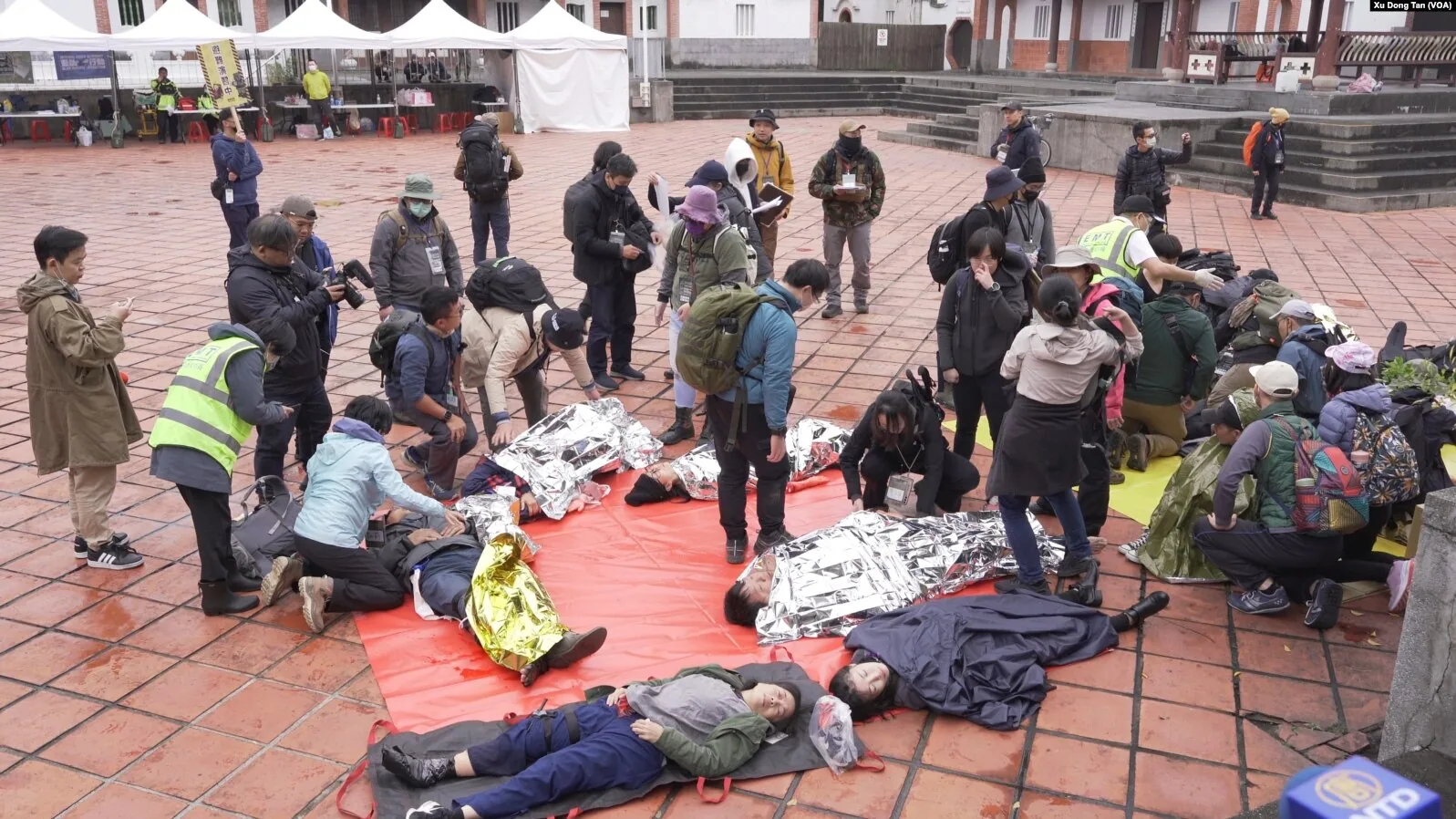
On January 27, 2024, light rain fell on the grass at Taipei Expo Park. An office worker in her early thirties knelt beside a companion playing a "casualty," gripping a tourniquet in her hand. Under the scenario of massive arterial bleeding, in which a person can bleed to death within minutes, she had to loop the strap around the thigh, tighten it, twist the windlass, secure it, and record the time. She had learned the movement only the day before in an indoor basic camp; today, she was repeating it in mud, rain, and an unscripted outdoor exercise called "Operation Blue Magpie."1 She was not a soldier. She was not preparing to go to the battlefield. She had simply decided that if the worst day really came, she did not want to be able only to stand there.
That tourniquet comes closer than any slogan to what Kuma Academy is actually doing. It is answering a question that has weighed on many Taiwanese people since 2022: If China really attacks, what can I do? Kuma Academy's answer is not "you will die," nor is it "leave it to the soldiers." It is: "Come here. I will teach you one thing you can do."
A Tourniquet Can Be Taught; a Gun Cannot
Conflating civil defense with military affairs is the most common misunderstanding of Kuma Academy, and the first one that needs to be dismantled.
Co-founder Ho Cheng-hui states it plainly: "The position we give ourselves is to be the first class in whole-of-society defense, allowing the public to gain the basic ability to respond to and manage the risks of war. We are absolutely not training militia."2 Current CEO Chu Fu-ming puts it in more everyday terms: "What Kuma Academy can mainly teach is self-help and mutual aid, such as evacuation, first aid, or knowledge of how to store water and contact family members."3 Combat, counterattack, taking up weapons to repel the enemy: those are the responsibilities of the armed forces, carried out by soldiers who have received formal training and been issued legal weapons. What a civilian learns in an all-day weekend class is something at another level: how to stop bleeding on themselves and their family members, find shelter, and avoid being led around by false information amid chaos.
Students themselves also understand the distinction clearly. A retired paratrooper who had attended the course said that people who come here "pay their own fees to learn new knowledge, and everyone has their own agency; they will not become Boxers just because they attended one class."4 The sentence carries weight because it comes from someone who really spent time in the military: he knows what militia look like, and that is not what he saw. Even the "fight" in Kuma Academy's "run, hide, fight" principle is defined as being "for the sake of leaving safely, not fighting to the death."5
📝 Curator's Note
The distinction that "civil defense is not militia" appears on the surface to be a course description. At its core, it is a contest over sovereignty. Chinese officials need to describe Kuma Academy as a "training camp for violent Taiwan independence" because only then can they frame it as a threat and as a reason for repression. Kuma Academy, by repeatedly emphasizing that "we only teach tourniquets and evacuation," is ostensibly clarifying its scope of work, but underneath it is defending the legitimacy of "ordinary people preparing for themselves." The same school becomes two entirely different things in two narratives. That, in itself, is a miniature of cognitive warfare.
A tourniquet can be taught because it saves lives regardless of political position; a gun cannot be taught because Taiwan's laws do not allow civilians to possess one, and because that has never been what this school wanted to do. Once this boundary is understood, much of the later controversy loosens on its own. To understand how that boundary was drawn, one must go back to the cafe where everything began.
Five Volunteers, One Cafe, and NT$210,000 in Debt
Kuma Academy began before the war in Ukraine, and its beginnings were too threadbare to resemble the organization that later shouted the number "three million."
In April 2021, criminologist Puma Shen and strategic researcher Ho Cheng-hui appeared on an episode of the podcast Bāogūa to discuss Taiwan Strait security. After recording, they still had more to say, so they went to a cafe and talked for another four or five hours. By the end, the two decided they could not just talk; they had to do something. They found three more like-minded people, and five initiators put the organization together in this way.6 Their earliest seed funding was only NT$50,000 from the Taiwan Foundation for Democracy. After holding three lectures and two training camps, they not only failed to earn money but ended up NT$210,000 in debt.7 It was at this time, and in this state, that Robert Tsao noticed them.
Two aspects of this origin deserve attention. First, it predates the Russia-Ukraine war in February 2022. Kuma Academy was not an emergency product frightened into existence by war; the idea had already emerged before then. Ukraine merely pushed it from a small group into a national phenomenon. Second, the work was done by civil society, not the state. Civil defense should originally have been the government's responsibility, and Taiwan indeed has old roots in civil defense corps and reserve systems. But according to an investigation by The Reporter, civil defense corps receive only four to eight hours of training per year, and among Taiwan's more than 7,700 neighborhood wardens, more than 3,800 are over sixty.8 When the state's prepared line of defense looked thin, five volunteers paid out of pocket, took on debt themselves, and first propped up the gap.
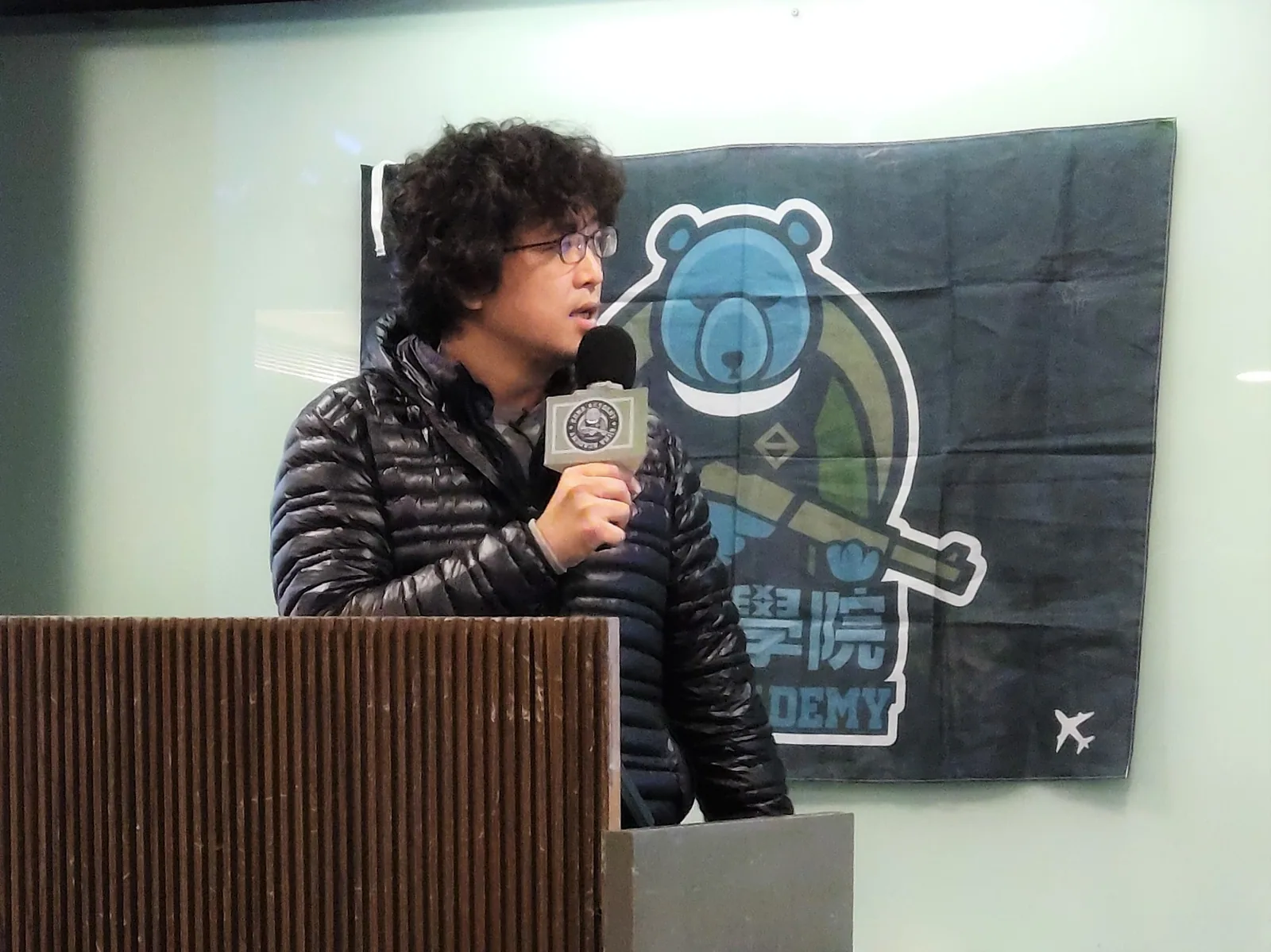
This was not the impulse of two overenthusiastic internet users. Behind Shen and Ho was the same parent body: the Taiwan Strategic Simulation Society, founded in 2005, a think tank specializing in wargaming. The people who launched Kuma Academy were already studying "how wars are fought, and how societies hold up." They moved tabletop scenarios from the desk into ordinary people's weekends. From wargaming to tourniquets, the threshold between them has always been the same: whether this matter should be placed in the hands of ordinary people.
What Ukraine gave Taiwan, besides fear, was a concrete model to learn from. Ho Cheng-hui said Ukraine had an organization called the Territorial Defense Forces (TDF), which demonstrated how a society could organize itself and withstand the shock of war. He cited an older saying: "If you desire peace, prepare for war."9 The logic of this line of thought actually runs in reverse: "Only by having a firm will to resist and preparing as much as possible the ability to face war... will this war, instead, be less likely to happen."9 The better prepared one is, the less likely the war is to start. The five people who were NT$210,000 in debt were learning precisely this Ukrainian lesson. What gave them the money to do it in earnest was a number that shook Taiwan at a press conference half a year later.
NT$600 Million, and the Number Called "Three Million"
On August 5, 2022, just after the People's Liberation Army had completed a round of military exercises around Taiwan, UMC founder Robert Tsao held a press conference and announced that he would donate NT$3 billion to defend Taiwan. At the event, he denounced the CCP as "local bullies and gangsters" and "a mafia organization counterfeited in the form of a state."10 One month later, on September 1, this money took shape as the concrete "two plans to protect Taiwan," totaling NT$1 billion. This NT$1 billion is the part of the story most easily misunderstood and most necessary to explain clearly.
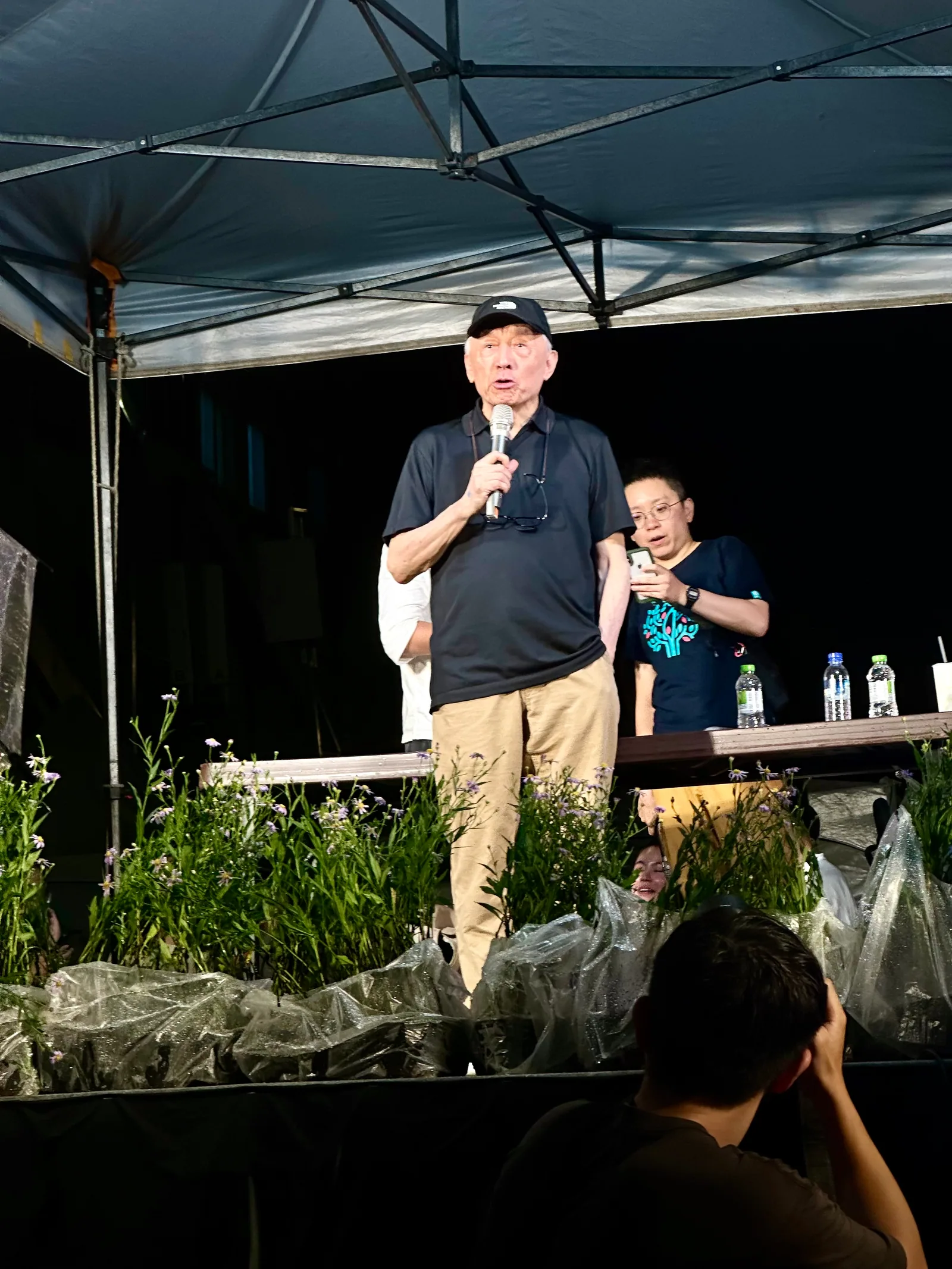
UMC founder Robert Tsao was the source of Kuma Academy's NT$600 million in funding. An entrepreneur once regarded as pro-China completed a 180-degree turn after Hong Kong's anti-extradition movement. Photo: TMYAO / Wikimedia Commons, CC BY-SA 4.0.
The NT$1 billion was split in half and went to two entirely different places. One part was the NT$600 million "Kuma Warriors" plan, given to Kuma Academy, with the goal of training three million Kuma Warriors in three years. The other part was the NT$400 million "Defend the Homeland Marksmen" plan, given to another team with a different concept: teaching shooting. Puma Shen specifically wrote a thousand-character essay explaining that this "was actually two parallel plans with Kuma"; the marksman plan later stalled because shooting training in Taiwan was unable to obtain legal venues.11
This division is crucial because it directly determines whether a sentence can be said. "Robert Tsao donated NT$3 billion to Kuma Academy" is wrong. "The NT$600 million was part of the NT$3 billion and was given directly and entirely to Kuma" is also wrong. The correct chain is this: the NT$3 billion pledge first narrowed into the NT$1 billion "two plans to protect Taiwan"; from that, NT$600 million was carved out for Kuma Academy, and NT$400 million for another team that did not teach civil defense at all, but taught only shooting. Kuma Academy does not teach shooting, and never has, because Taiwan's firearms laws do not permit it, and because it has never been within its scope of work. The funding was also designed in phases: plans submitted quarterly, reviewed quarterly, and funds disbursed quarterly, close to a reimbursement model.12
Then what about "three million Kuma Warriors"? This is the number in the whole story that most requires honesty. Three million is one-fifth of the adult population and one-third of Taiwan's nine million households. It is a goal, a vision, not an already achieved result. Kuma Academy publicly uses three numbers that are easily mixed together: it says it has "reached more than 3.43 million person-times," but this is explicitly written as reach "through columns and YouTube popularizing civil defense knowledge," not the number of people who have attended in-person classes;13 it says it has held "more than 1,000 in-person courses," but those are class sessions, and the same person attending multiple sessions is counted repeatedly;13 the number closest to "actually entered a classroom" is the academy's own mid-2024 statement that "more than 30,000 people participated in in-person courses within two years."14
Source: Kuma Academy's official self-description and Decode39; all figures are organization self-reports and have not been independently audited
Seen together, the gap between goal and current state is obvious: the academy called for three million, while the number of people who have actually done the work is roughly between 30,000 and 100,000, or 1 to 3 percent of the goal. This gap should not be hidden, nor should it be treated as proof that the academy was bragging. It is simply part of the story. For a civil society organization supported by donations and volunteers to bring tens of thousands of ordinary people into classrooms to learn tourniquets is already no easy thing. As for the astronomical figure of three million, it is more like a banner marking the direction it wants to go than a place it has already reached. The point is not how far it is from three million, but what those tens of thousands who really learned actually learned in class.
What It Teaches, and What It Deliberately Does Not Teach
Entering Kuma Academy's one-day basic camp, from 9 a.m. to 5:30 p.m., a general ticket priced at NT$1,200 teaches four things.15
The first is what war looks like: what conditions are like when war really occurs, and the basics of modern warfare. The second is identifying information operations and cognitive warfare, Kuma Academy's most distinctive and most controversial area, teaching people how to retain judgment amid disinformation and psychological warfare. The third is hygiene and basic first aid: tourniquets, moving casualties, and other techniques that can truly save lives. The fourth is disaster prevention and evacuation planning: when earthquakes, air raids, or other disasters come, how a household should take shelter, evacuate, and get in touch with each other. Put together, none of these four areas is "pointing a gun at someone." All are about "how, under the worst conditions, to take care of oneself and the people nearby."
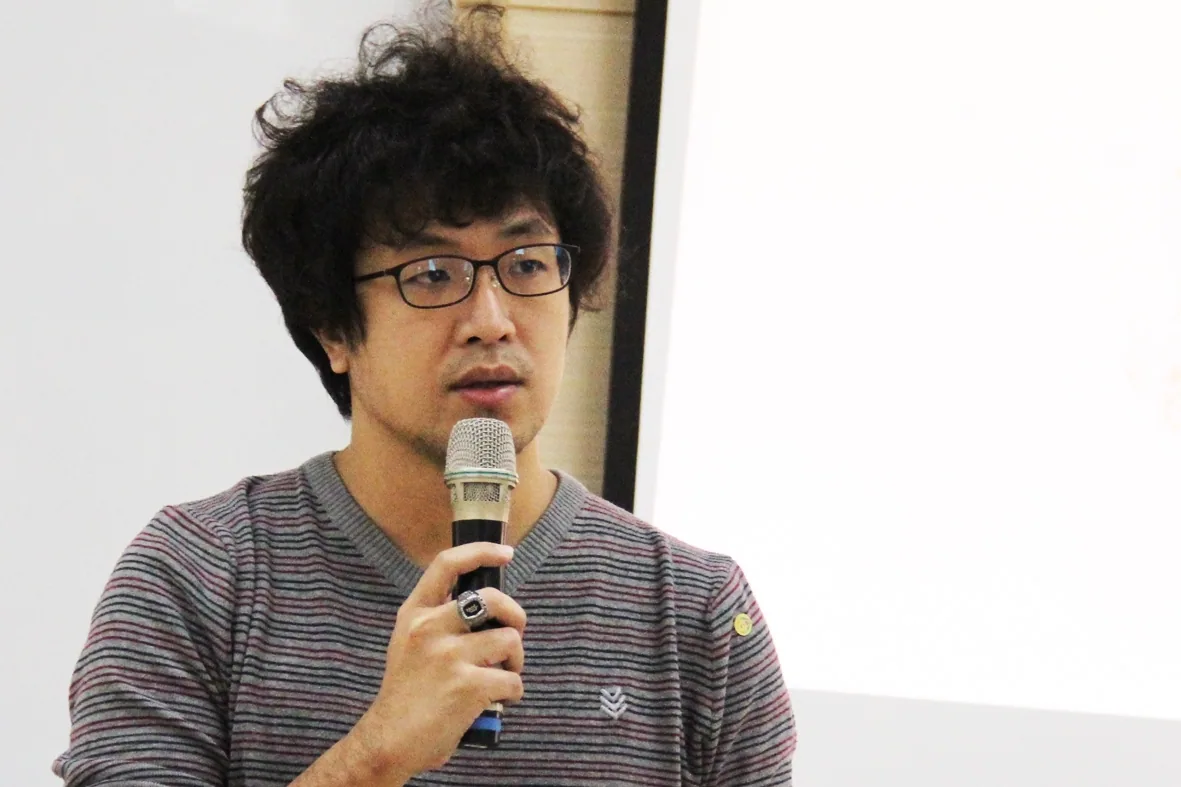
Puma Shen has studied the CCP's cognitive warfare for seven years. That knowledge later became the most distinctive and most controversial class in Kuma Academy's basic camp: teaching ordinary people how to retain judgment amid disinformation. Photo: Chiayi County Human Resources Development Institute, via Wikimedia Commons.
Source: Kuma Academy course positioning (public explanations by Ho Cheng-hui and Chu Fu-ming)
Move the basic camp outdoors, add rain and chaos, and it becomes "Operation Blue Magpie," the flagship exercise named after the Taiwan blue magpie, a species endemic to Taiwan. The first event, in January 2023, had nearly one hundred participants. By the fifth session, held on March 22, 2025, at Taipei's Dajia Riverside Park, the scale had grown to 120 or 130 people; places filled on the same day, making it the largest to date.16 The exercise subjects included mass-casualty rescue, geographic positioning, response to air-raid alerts, evading tailing, and finding shelters, all within the scope of "how to survive in an organized way and help others when a crowd falls into chaos." Lin Chi-chun, a member of the Wenshan self-training group who participated, said Operation Blue Magpie "made disaster relief and first-aid details more refined... allowing him to improve command decision-making and work allocation."17
Who comes to class? Ages range from 13 to 70, mostly clustered between 30 and 40; the gender ratio is roughly half and half, and in some sessions women have even accounted for two-thirds.2 Puma Shen once described the ultimate imagination of whole-of-society defense in a very domestic image: "The final goal of whole-of-society defense is to hope that every household will have a 'Kuma Warrior' with relevant knowledge, who can protect family safety and assist the government's command system at moments of crisis."18 People sign up for different reasons: a fourth-year university student touched by the Russia-Ukraine war and afraid of forced unification said that "having defense awareness will also be the greatest help to the front line";4 there are paratroopers who want to update their knowledge after leaving the military and pay their own way to learn; there are mothers who simply want to learn how to protect their children. The demand is real: when registration opens for basic camps, they often fill up "in less than a dozen minutes"; a crowdfunding project launched in 2022 also exceeded its original target by dozens of times within forty-five days.19
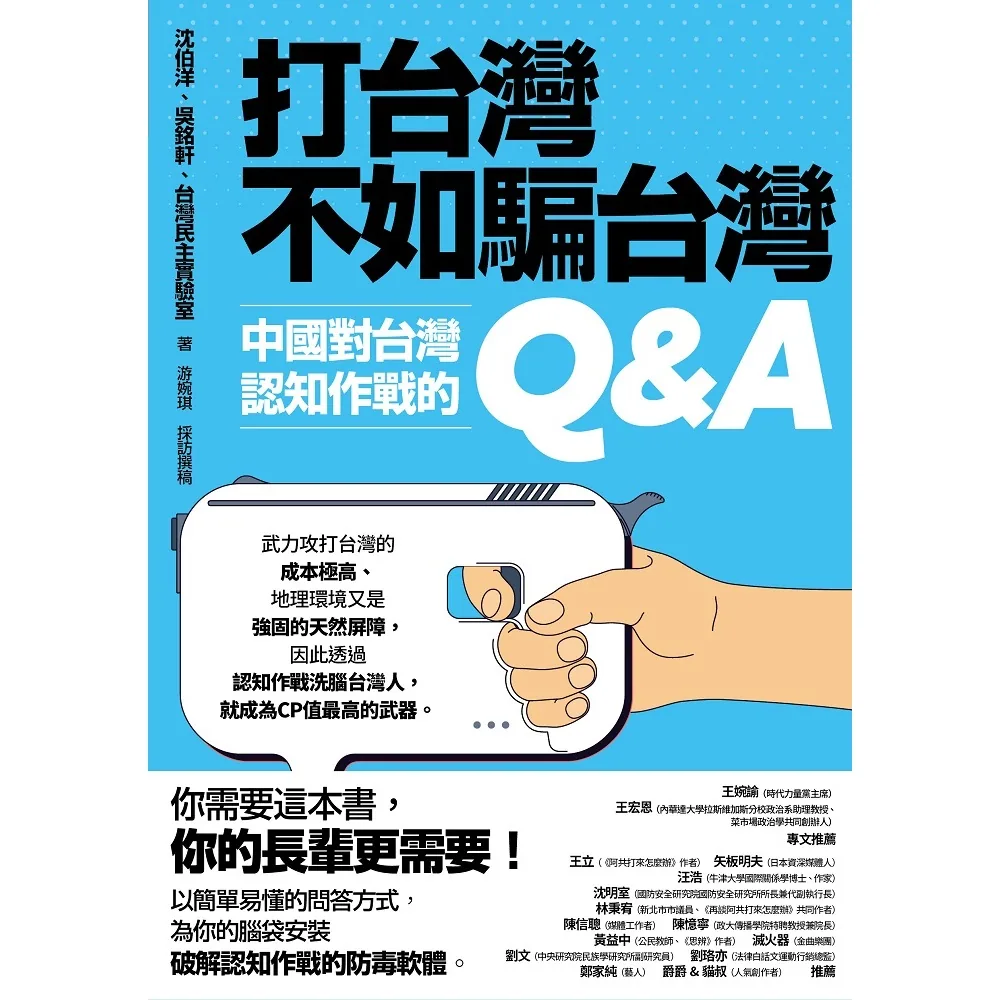
The book title captures the logic of cognitive warfare: for the CCP, using force is too costly. Getting Taiwanese people to vote the wrong way, not vote, or simply be afraid is far cheaper than really starting a war. Kuma Academy's basic camp module on "identifying information operations" teaches people how to see through this. Image: Locus Publishing (fair use editorial commentary).
📝 Curator's Note
Kuma Academy's smartest and most dangerous move was to put "identifying cognitive warfare" into a civil defense class. Smart, because for Taiwan, missiles may never come, but disinformation comes every day. Teaching people to identify information warfare links preparation for "the worst day" to a life skill useful "today." Dangerous, because the act of "teaching you to distinguish what is disinformation" is immediately questioned with "who defines true and false?" As a result, a school that teaches tourniquets is pulled into a struggle over political positions. The further it moves into cognitive warfare, the less it can separate itself from politics. And politics is precisely where two fires began to close in on it.
Caught Between Two Fires
A school that only wanted to teach people how to stay alive ultimately drew political attention from both sides: across the Strait, it was put on a list; inside Taiwan, it was kicked back and forth like a football.
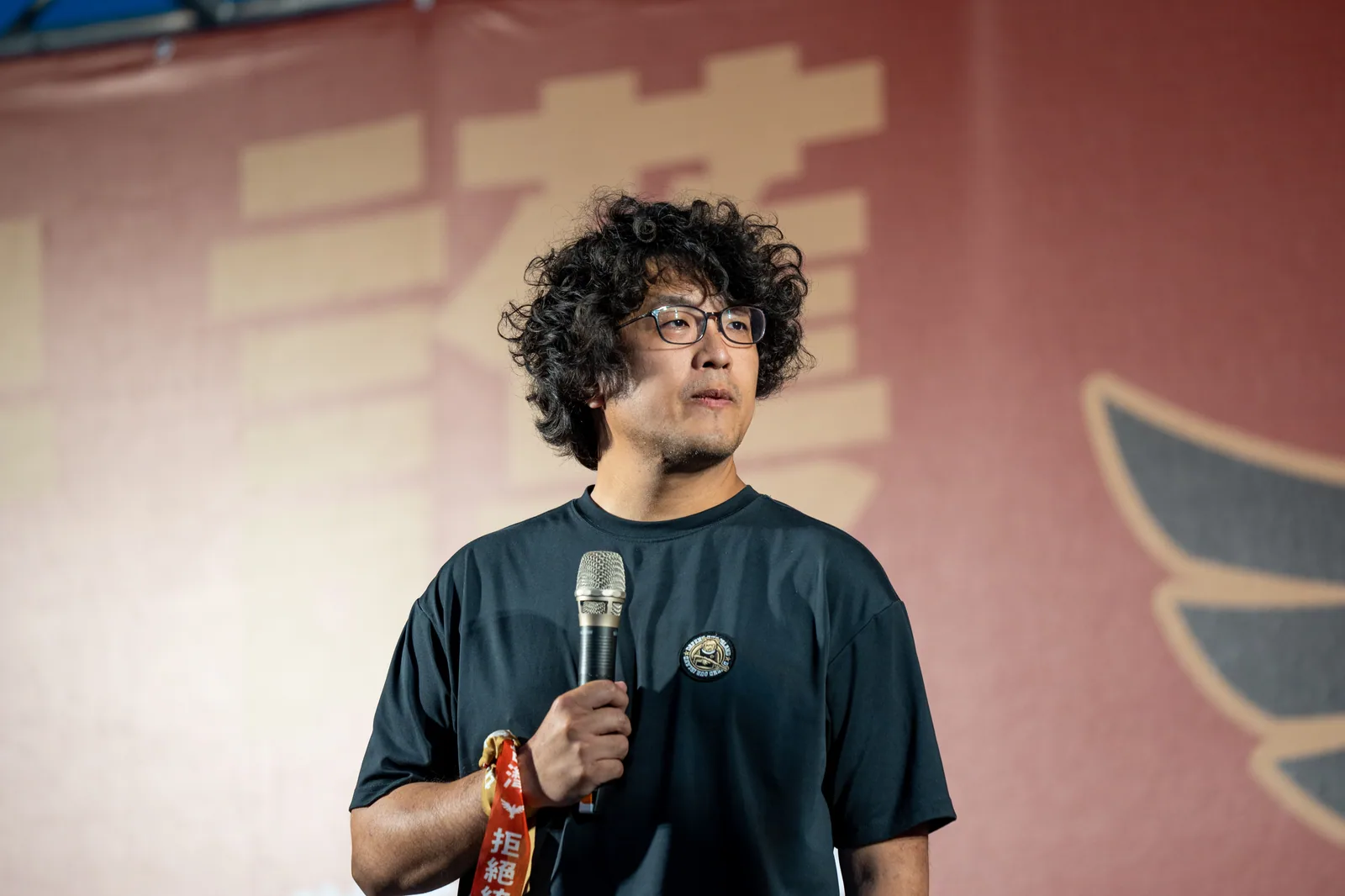
Kuma Academy's situation is a miniature of Taiwan's situation as a whole: the more alert something is to the threat from China, the more easily it is labeled by political stance inside Taiwan. Photo: KOKUYO / Wikimedia Commons, CC BY-SA 4.0.
On the other side of the Strait, there is a clear chain of escalation. On October 14, 2024, China's Taiwan Affairs Office listed Kuma Academy itself, along with Puma Shen and Robert Tsao, as "diehard Taiwan independence elements." It is worth noting that Kuma Academy was one of the few named "organizations," rather than individuals. Taiwan Affairs Office spokesperson Chen Binhua claimed that Kuma Academy was "openly cultivating violent Taiwan independence elements... an out-and-out Taiwan independence base."20 This must be stated clearly: this is an official CCP accusation, not a factual description. Taiwan's response was direct. Puma Shen pointed out that "he is not even the person in charge of Kuma Academy; this is the equivalent of the authorities taking the lead in spreading rumors," and explained that he now serves as honorary dean.21 In 2025, this line escalated further: the Chongqing Public Security Bureau opened an investigation against Shen for "splittism," and CCTV produced an eight-minute "expose" segment on him.22
Inside Taiwan, things are more complicated, because critics come from different camps and their motives must be weighed by readers themselves. The strongest challenge came from the Democratic Progressive Party government's own defense minister. In November 2023, then-Minister of National Defense Chiu Kuo-cheng told the Legislative Yuan that he "regarded it as a club, a group of interested people going into the wilderness to play paintball," and bluntly said that "building this kind of unit would turn into guerrillas; in building the military and preparing for war, we do not build guerrillas."23 This sentence has particular editorial value precisely because it came from the ruling party's own highest defense official, not from an opposition attack. A member of the DPP government poured cold water on an organization often categorized as a "green camp auxiliary."
Source: Central News Agency, Liberty Times, and Presidential Office news releases
Most other criticism has come from the Kuomintang and the New Party. KMT Taipei City Councilor Chung Pei-chun questioned whether Kuma's teaching materials conflicted with the official All-Out Defense Handbook. KMT politician Lo Chih-chiang dug up Kuma's bid for a NT$2.55 million Mainland Affairs Council procurement case, which it did not win, and its receipt of Ministry of Foreign Affairs subsidies, mocking it as "loving Taiwan, but loving New Taiwan dollars even more."24 New Party politician Hou Han-ting released an audio recording and amplified one line: "Chinese missiles coming over actually help us a lot." This sentence cannot be viewed on its own. Shen said that passage was about then-U.S. House Speaker Nancy Pelosi's visit to Taiwan and PLA exercises raising society's civil defense awareness, prompting business owners to proactively approach the academy; "and yet this could be distorted into saying that I said I could make big money if missiles came."25 As for funding controversies, the facts themselves are true: Kuma has indeed received funding from the American Institute in Taiwan (AIT), which AIT officials have also confirmed,26 and it has also received Ministry of Foreign Affairs subsidies and bid on a Mainland Affairs Council project. Laying these facts out and letting readers judge for themselves is more honest than accepting any side's framing.
Kuma Academy has also had moments it did not handle well. In June 2025, a NT$1,380 disaster-preparedness kit it sold was mocked as "the Hermès of rescue kits," triggering a wave of attention. Kuma responded with irritation: "Netizens are welcome to put together a set with the same specifications, the same items, and no China-made products, and keep it under NT$1,380. We will definitely buy it in huge quantities!"27 This barbed comeback made even some supporters of resisting China and protecting Taiwan uncomfortable. The academy has real critics, and some of those criticisms come from partisan calculation while others hit the mark. A real organization is not, and never was, a flawless martyr.
📝 Curator's Note
The truly glaring contradiction is not between blue and green, but inside the same DPP government. In 2023, its defense minister publicly described Kuma Academy as a "paintball club." In 2024, its president, Lai Ching-te, established the Whole-of-Society Defense Resilience Committee and invited Kuma Civil Defense Education Association representative Liu Wen, together with Forward Alliance's Enoch Wu, to the Presidential Office table. Nongovernmental representatives made up 67.7 percent of the committee.28 Within one year, the same government moved from ridicule to institutionalization. Behind this is a society learning how to position "civil defense done by citizens themselves": at first, it was a marginal effort the system looked down on; later, it became a resource the system wanted to incorporate.
From grassroots outside the system to being taken in by a Presidential Office committee, the path Taiwan carved out for itself is, when placed on the world map, quite unusual.
Putting Kuma on the World Map
Taiwan is not the first place to practice whole-of-society defense, but the way it does so is almost unique in the world.
The model Kuma Academy explicitly learned from is Ukraine. Ukraine's Territorial Defense Forces opened to civilians in 2021, and after Russia's 2022 invasion, more than 100,000 volunteers joined in a short period. This example of "civilians can also organize themselves to withstand war" is precisely the living model of "resilience" that Ho Cheng-hui described.9 Looking farther north, Finland is regarded as the "gold standard": it follows "whole-of-society defense," nearly all men of military age receive military training, and the country's air-raid shelters can accommodate the vast majority of the population.29 Sweden has a booklet called If Crisis or War Comes, distributed from the 1940s until the end of the Cold War, republished in 2018, and expanded again in 2024 to be sent to every household. Taiwan's National Security Council also studied the Swedish model in 2022.30 Estonia's Defence League (Kaitseliit) has 30,000 members, falls under the Ministry of Defence, and was rebuilt during the Singing Revolution in this small country.31
Source: ISDP comparative study of whole-of-society defense and GTI analysis
Placed together, Kuma Academy's uniqueness becomes clear. In other countries, whole-of-society defense is almost always a state project: constitutional duties, government-built air-raid shelters, defense leagues under defense ministries. Taiwan's version, however, grew from the bottom up as a civil society NGO, relying on a private NT$600 million donation from one entrepreneur. Brookings Institution scholars linked this kind of "social resilience" to the roots of democracy: "Social resilience, and the fundamental concept that the Taiwanese people have agency, is an integral part of Taiwan's democracy."32 Hsiao Liang-chi of the Global Taiwan Institute pointed out why Taiwan's path makes sense: "Taiwan's initially bottom-up approach may make more sense, since a program led entirely by the government could be difficult to sustain if a new government comes to power."33
📝 Curator's Note
Seen from the widest possible coordinates, Kuma Academy's existence is itself a metaphor for Taiwan's situation. In a place where statehood is deliberately blurred and every move by the government on whole-of-society defense may be interpreted as "provocation," civil society moved first. This may not be because citizens are braver than the government; more likely, it is because the political cost of civil action is sometimes lower than that of government action. When the time is ripe, the Presidential Office committee can then take it in, creating a hybrid of bottom-up and top-down. This path may look makeshift, but it may be the most pragmatic one available to a society living in a gray zone.
Having passed through Ukraine's lesson, Finland's standard, and Taiwan's own improvisation, the endpoint this school most wants to reach is actually written in its own founding purpose. It is an endpoint that hopes for its own disappearance.
A School That Hopes to Disappear
Kuma Academy wrote its founding purpose into a very counterintuitive sentence: "The purpose of our founding is to hope that one day, Taiwan will no longer need Kuma Academy."34
Few organizations in the world write "we hope one day we will no longer be needed" into their purpose. A company wants to survive; an institution wants to grow. But Kuma Academy's highest wish is that Taiwan will one day no longer need anyone to teach tourniquets, teach how to evade air raids, or teach how to stay clear-headed amid disinformation. It was born because of the threat of war, yet built its entire method on "capacity," not "fear." China wants Taiwanese people to be both afraid and helpless. Kuma Academy's response is to enable an office worker in her early thirties, in mud and rain, to wrap a tourniquet tightly and correctly.
This is not a school that teaches people to be afraid. Quite the opposite. The more successful it is, the more it will be put on lists across the Strait and pulled into politics inside Taiwan. But what it is truly accumulating is a little more skill in the hands of tens of thousands of ordinary people, and a little less helplessness in their hearts. Its success should not be measured by the number three million. It should be measured by another question: When an ordinary Taiwanese person thinks of "the worst day," can they only wait, or do they know they can actually do something?
Return to that patch of grass in the light rain. The office worker gripping the tourniquet learned a first-aid procedure, and also a posture: even if the worst day comes, I refuse to be helpless. And Kuma Academy's wish for all of this is that one day she will never need that tourniquet again. On that day, this school will willingly disappear from Taiwan.
Further Reading:
- Puma Shen — Kuma Academy co-founder and honorary dean, a researcher of the CCP's cognitive warfare who was later investigated by China for "splittism"
- Cognitive Warfare — the full background to one of Kuma Academy's four basic camp modules, and the broader picture of the CCP's information warfare against Taiwan
- Taiwan's National Defense and Military Modernization — the complementary relationship between civil defense and all-out national defense, another side of understanding why "civil defense is not national defense"
- Invisible Nation — a documentary that ends with Taiwanese people attending a civil defense class, effectively the film version of Kuma Academy's lesson
Image Sources
This article uses six public domain / CC-licensed / fair use editorial images, all cached under public/article-images/society/ to avoid hotlinking source servers.
- Kuma Academy Operation Blue Magpie outdoor exercise 2024 (hero) — Photo: Tan Xudong / Voice of America, Public Domain (Voice of America is a U.S. federal government agency, and its works are in the public domain)
- Puma Shen speaking at a Kuma Academy lecture, 2023 — Photo: S099001 / Wikimedia Commons, CC BY 4.0
- Robert Tsao speaking at a public rally — Photo: TMYAO / Wikimedia Commons, CC BY-SA 4.0
- Puma Shen lecturing on information warfare and disinformation identification, 2021 — Photo: Chiayi County Human Resources Development Institute / Wikimedia Commons, Attribution required
- Crowd at the "Reject United Front Work, Protect Taiwan" rally, 2025 — Photo: KOKUYO / Wikimedia Commons, CC BY-SA 4.0
- Cover of _Fooling Taiwan Is Better Than Fighting Taiwan_ — Image: Locus Publishing, fair use editorial commentary
References
- TechNews: Kuma Academy's fourth "Operation Blue Magpie" civil defense exercise — A September 21, 2024 TechNews report documenting the realities of the Operation Blue Magpie outdoor exercise, conducted in heavy rain and without a script, including details of mass-casualty rescue, tourniquet operation, formation movement, and other training subjects.↩
- Global Views Monthly: interview with Kuma Academy's Ho Cheng-hui — A Global Views Monthly interview with Kuma Academy co-founder Ho Cheng-hui, recording verbatim his positioning of the academy as "the first class in whole-of-society defense" and "absolutely not training militia," as well as the course design logic behind the basic camp's four major modules.↩2
- Openbook: interview with Kuma Academy CEO Chu Fu-ming — An Openbook interview with current CEO Chu Fu-ming, recording verbatim his explanation that "what Kuma Academy can mainly teach is self-help and mutual aid, such as evacuation, first aid, or knowledge of how to store water and contact family members."↩
- Central News Agency: Kuma Academy basic camp students' motives for registering — A September 18, 2022 Central News Agency report recording verbatim interviews with basic camp participants, including a retired paratrooper saying students "will not become Boxers just because they attended one class," and a fourth-year university student saying "having defense awareness will also be the greatest help to the front line."↩2
- ETtoday: explanation of Kuma Academy's "run, hide, fight" principle — A December 20, 2025 ETtoday report explaining the three principles of "run, hide, fight" in Kuma Academy's civil defense training, in which "fight" is defined defensively as being "for the sake of leaving safely, not fighting to the death."↩
- Central News Agency: Kuma Academy's founding background and interview with Ho Cheng-hui — A September 10, 2023 Central News Agency report documenting the founding process in which Puma Shen and Ho Cheng-hui conceived of the academy and five volunteers initiated it, as well as Ho's verbatim positioning that "war is no longer a matter for the military department, but a matter for all Taiwanese people."↩
- Fount Media: Kuma Academy's grassroots origins and how Robert Tsao noticed it — A 2022 Fount Media report documenting the human details of Kuma Academy's earliest phase: only NT$50,000 in seed funding from the Taiwan Foundation for Democracy, NT$210,000 in debt after three lectures and two training camps, and Robert Tsao noticing the volunteers in that state.↩
- The Reporter: investigation of structural gaps in Taiwan's civil defense system — An in-depth investigation by The Reporter revealing preparation gaps in Taiwan's official civil defense system, including civil defense corps receiving only four to eight hours of training per year and 3,820 of Taiwan's 7,760 neighborhood wardens being over sixty.↩
- Epoch Times: Ho Cheng-hui on Ukraine's Territorial Defense Forces and the will to resist — An October 2, 2022 Epoch Times report recording Ho Cheng-hui's citation of Ukraine's Territorial Defense Forces (TDF) as a model, as well as verbatim statements including "If you desire peace, prepare for war" and "Only by having a firm will to resist and preparing as much as possible the ability to face war will this war, instead, be less likely to happen."↩23
- Wikipedia: Robert Tsao — The Chinese Wikipedia entry on Robert Tsao, summarizing his background as UMC founder, acquisition of Singaporean citizenship in 2011, experience during the 2019 anti-extradition movement, turn toward regaining Republic of China citizenship in 2022, and his press conference statement that "the CCP's mentality and essence are that of local bullies and gangsters; the People's Republic of China is a mafia organization counterfeited in the form of a state."↩
- Liberty Times: Puma Shen's thousand-character essay explaining the original intent — A September 2, 2022 Liberty Times report recording verbatim Puma Shen's thousand-character essay stating that "the plan for marksmen was actually two parallel plans with Kuma," explaining the distinction between the NT$600 million "Kuma Warriors" plan for Kuma Academy and the NT$400 million "Defend the Homeland Marksmen" plan for another team and another concept: teaching shooting. For the overall division of the NT$1 billion "two plans to protect Taiwan," see the September 1, 2022 Liberty Times report (breakingnews/4044181).↩
- Global Views Monthly: interview with Kuma Academy's Ho Cheng-hui (funding mechanism) — The Global Views Monthly interview records Kuma Academy's mechanism of "phased, item-by-item disbursement" from Robert Tsao, "similar to the concept of reimbursement," with the academy periodically submitting plans and funds disbursed in stages after review.↩
- Kuma Academy official website: About Us — Kuma Academy's official page listing self-reported figures including "reached more than 3.43 million person-times (popularizing civil defense knowledge through columns and YouTube)" and "held more than 1,000 in-person courses." The 3.43 million person-times figure is explicitly labeled as reach, not the number of people trained in person.↩2
- Wikipedia: Kuma Academy — The Chinese Wikipedia entry on Kuma Academy, summarizing its three-tier course structure (lectures, basic camp, Operation Blue Magpie outdoor exercises) and scale planning. The organization self-reported that "more than 30,000 people participated in in-person courses within two years"; international reporting (Global Taiwan Institute, Decode39) estimated total in-person students at roughly 30,000 to 100,000. All are organization self-reports or secondhand accounts and have not been independently audited.↩
- Wikipedia: Kuma Academy course structure — The Chinese Wikipedia entry on Kuma Academy records the basic camp's full-day four major modules: the appearance of war and military popular science, identifying information operations and cognitive warfare, hygiene and basic first aid (tourniquets and casualty movement), and disaster prevention and evacuation planning. General tickets are about NT$1,200; detailed prices appear on Kuma Academy's official course pages.↩
- PTS News: Kuma Academy's fifth Operation Blue Magpie — A March 22, 2025 PTS News report documenting the fifth Operation Blue Magpie at Taipei's Dajia Riverside Park, with about 120 participants, places filling on the day, and the largest scale to date, while also explaining the exercise's development since the first event in January 2023.↩
- Central News Agency: interviews with Kuma Academy Operation Blue Magpie participants — A March 22, 2025 Central News Agency report recording the fifth Operation Blue Magpie's exercise subjects (mass-casualty rescue, geographic positioning, air-raid alerts, evading tailing, identifying friend and foe, and squad defensive formations), as well as Wenshan self-training group member Lin Chi-chun's verbatim reflection that it "made disaster relief and first-aid details more refined."↩
- Liberty Times: Puma Shen on the whole-of-society defense "Kuma Warrior" vision — A Liberty Times report recording Puma Shen's verbatim vision statement: "The final goal of whole-of-society defense is to hope that every household will have a 'Kuma Warrior' with relevant knowledge, who can protect family safety and assist the government's command system at moments of crisis."↩
- Liberty Times: Kuma Academy basic camps sell out quickly — A September 2022 Liberty Times report recording that after registration opened for Kuma Academy basic camp courses, they filled up "in less than a dozen minutes," and that additional courses were urgently added after Robert Tsao's funding. The academy's crowdfunding project launched the same year also greatly exceeded its target within forty-five days. For student age distribution and gender ratios, see the Global Views Monthly interview (gvm 96386).↩
- Central News Agency: China's Taiwan Affairs Office names Kuma Academy, Puma Shen, and Robert Tsao — An October 14, 2024 Central News Agency report recording China's Taiwan Affairs Office listing Kuma Academy, Puma Shen, and Robert Tsao as "diehard Taiwan independence elements," and spokesperson Chen Binhua's official claim that Kuma Academy "openly cultivates violent Taiwan independence elements" and is "an out-and-out Taiwan independence base" (to be labeled as a CCP accusation, not fact).↩
- Central News Agency: Puma Shen responds to being named by the Taiwan Affairs Office — An October 14, 2024 Central News Agency report recording Puma Shen's response that "he is not even the person in charge of Kuma Academy; this is the equivalent of the authorities taking the lead in spreading rumors," and explaining his current role as Kuma Academy's honorary dean.↩
- Central News Agency: Chongqing public security opens "splittism" investigation against Puma Shen — An October 28, 2025 Central News Agency report recording that the Chongqing Public Security Bureau opened an investigation against Puma Shen for "splittism"; Chinese state broadcaster CCTV also produced an approximately eight-minute "expose" segment on November 9, 2025 and threatened global pursuit (see Liberty Times breakingnews/5239735), the latest step in cross-border pressure.↩
- Liberty Times: Defense Minister Chiu Kuo-cheng describes Kuma Academy as "paintball" — A November 2023 Liberty Times report recording then-Minister of National Defense Chiu Kuo-cheng's verbatim challenge in the Legislative Yuan: "I regard it as a club, a group of interested people going into the wilderness to play paintball" and "building this kind of unit would turn into guerrillas; in building the military and preparing for war, we do not build guerrillas" (Chiu was the DPP government's defense minister, not an opposition critic).↩
- United Daily News: Lo Chih-chiang questions Kuma Academy bids and subsidies — A United Daily News report recording KMT politician Lo Chih-chiang's criticism that the Kuma Civil Defense Education Association had bid on a NT$2.55 million Mainland Affairs Council procurement case (unsuccessfully) and received Ministry of Foreign Affairs subsidies, and his description of it as "loving Taiwan, but loving New Taiwan dollars even more" (Lo should be identified as a Kuomintang politician).↩
- PTS News: Puma Shen clarifies "missile" quote was taken out of context — A PTS News report recording that after New Party politician Hou Han-ting released an audio recording containing the line "Chinese missiles coming over helps us a lot," Shen clarified that the recording's "content was about the rise of Taiwan's civil defense awareness, but it was smeared." The missile quote must not be presented alone; it must be placed alongside this clarification.↩
- Central News Agency: AIT confirms it once funded Kuma Academy — A March 11, 2025 Central News Agency report recording the American Institute in Taiwan's official confirmation that it had funded Kuma Academy, showing that the funding fact is true while different sides frame it differently.↩
- Next Apple News: Kuma Academy responds to "Hermès" disaster kit controversy — A June 17, 2025 Next Apple News report recording KMT politician Teng Kai-hsun's criticism of Kuma Academy's NT$1,380 disaster-preparedness kit as "the Hermès of rescue kits," as well as Kuma Academy's verbatim response: "Netizens are welcome to put together a set with the same specifications, the same items, and no China-made products, and keep it under NT$1,380. We will definitely buy it in huge quantities!"↩
- Presidential Office: Whole-of-Society Defense Resilience Committee — Official news from the Office of the President of the Republic of China, recording President Lai Ching-te's 2024 establishment of the Whole-of-Society Defense Resilience Committee and the composition of its members, including Kuma Civil Defense Education Association representative Liu Wen and Forward Alliance's Enoch Wu, with nongovernmental representatives accounting for 67.7 percent.↩
- ISDP: comparative study of whole-of-society defense in Finland, Sweden, Switzerland, and Singapore — A research report by the Institute for Security and Development Policy (ISDP) noting that Finland's "whole-of-society defense" can provide shelter for more than 80 percent of the national population, making it a gold standard of whole-of-society preparedness, and comparing the whole-of-society defense models of Sweden, Switzerland, and Singapore.↩
- Wikipedia: If Crisis or War Comes booklet — The English Wikipedia entry summarizing the history of Sweden's If Crisis or War Comes civil defense booklet, from publication in the 1940s through the end of the Cold War, republication in 2018, expanded distribution to every household in 2024, and the context of Taiwan's National Security Council studying the Swedish model in 2022.↩
- Wikipedia: Estonian Defence League — The English Wikipedia entry on the Estonian Defence League, summarizing the Kaitseliit's scale of 30,000 members, its subordination to the Ministry of Defence, and its reestablishment during the Singing Revolution in 1990, as a contrasting case of state-led whole-of-society defense.↩
- Brookings Institution: whole-of-society resilience as Taipei's new deterrence concept — A Brookings Institution analysis by Thompson arguing for a deterrence framework in which "social resilience, and the fundamental concept that the Taiwanese people have agency, is an integral part of Taiwan's democracy."↩
- Global Taiwan Institute: Taiwan's bottom-up civil defense preparedness — A September 2022 Global Taiwan Institute (GTI) analysis by Hsiao arguing that "Taiwan's initially bottom-up approach may make more sense, since a program led entirely by the government could be difficult to sustain if a new government comes to power."↩
- Kuma Academy official Facebook: self-description of founding purpose — A Kuma Academy official Facebook post recording the organization's self-positioning: "In 2021, Kuma Academy was founded by five volunteers who gathered together, beginning with thematic lectures and calling on society to pay attention to the risk of war in the Taiwan Strait," as well as the core purpose, "The purpose of our founding is to hope that one day, Taiwan will no longer need Kuma Academy."↩