Chinese Taipei: The Ticket That Lets Taiwan Play, But Won't Print Its Own Name

At the 1960 Rome Olympics, the Taiwanese delegation marched into the opening ceremony holding a white banner reading 'UNDER PROTEST,' the only opening ceremony protest in Olympic history. From Chiang Ching-kuo rejecting the IOC's offer of 'Taiwan,' to Hsü Heng winning the lawsuit against the IOC, to the Lausanne Agreement bringing the Plum Blossom Flag and anthem, to the 2018 referendum where athletes themselves voted to reject renaming—this name has remained unchanged for forty years, but the athletes who are stuck in a dilemma on the podium are always the ones who need this name to compete, not the politicians arguing over names.

Chinese Taipei: The Ticket That Lets Taiwan Play, But Won't Print Its Own Name
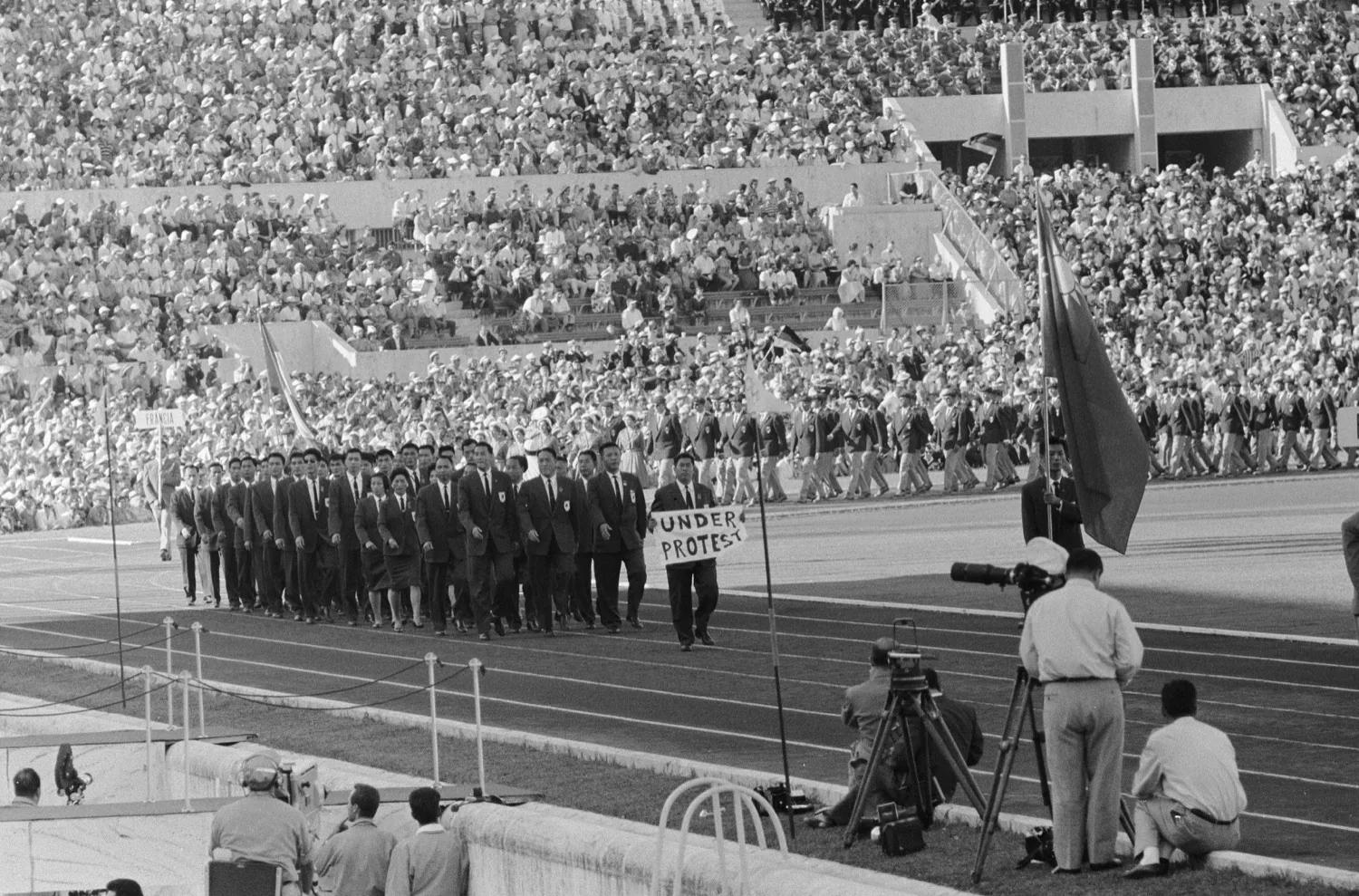
画像クレジット: 1960 年羅馬奧運開幕,福爾摩沙(台灣)代表團持「UNDER PROTEST」抗議牌進場。攝影 Harry Pot,荷蘭國家檔案館,CC0 · 原画像

30-Second Overview: "Chinese Taipei" is the name Taiwan is forced to use in the Olympics and most international venues. But its origin is far more complex than the four words "forced acceptance." In 1976 Montreal, it was the Taipei government itself that rejected the name "Taiwan" offered by the International Olympic Committee (IOC); in the 2018 renaming referendum, it was the athletes themselves who spoke out against it. For forty years, this name has not changed a single character, but the ones stuck in a dilemma on the podium are always the athletes who need this name to compete, not the politicians arguing over names.

On August 25, 1960, the Rome Olympics opened. Delegations from various countries marched into the stadium in order. When it was the turn of one team, the team manager Lin Hung-tan, walking at the very front, held up a white banner with two English words written on it: UNDER PROTEST, protesting1.

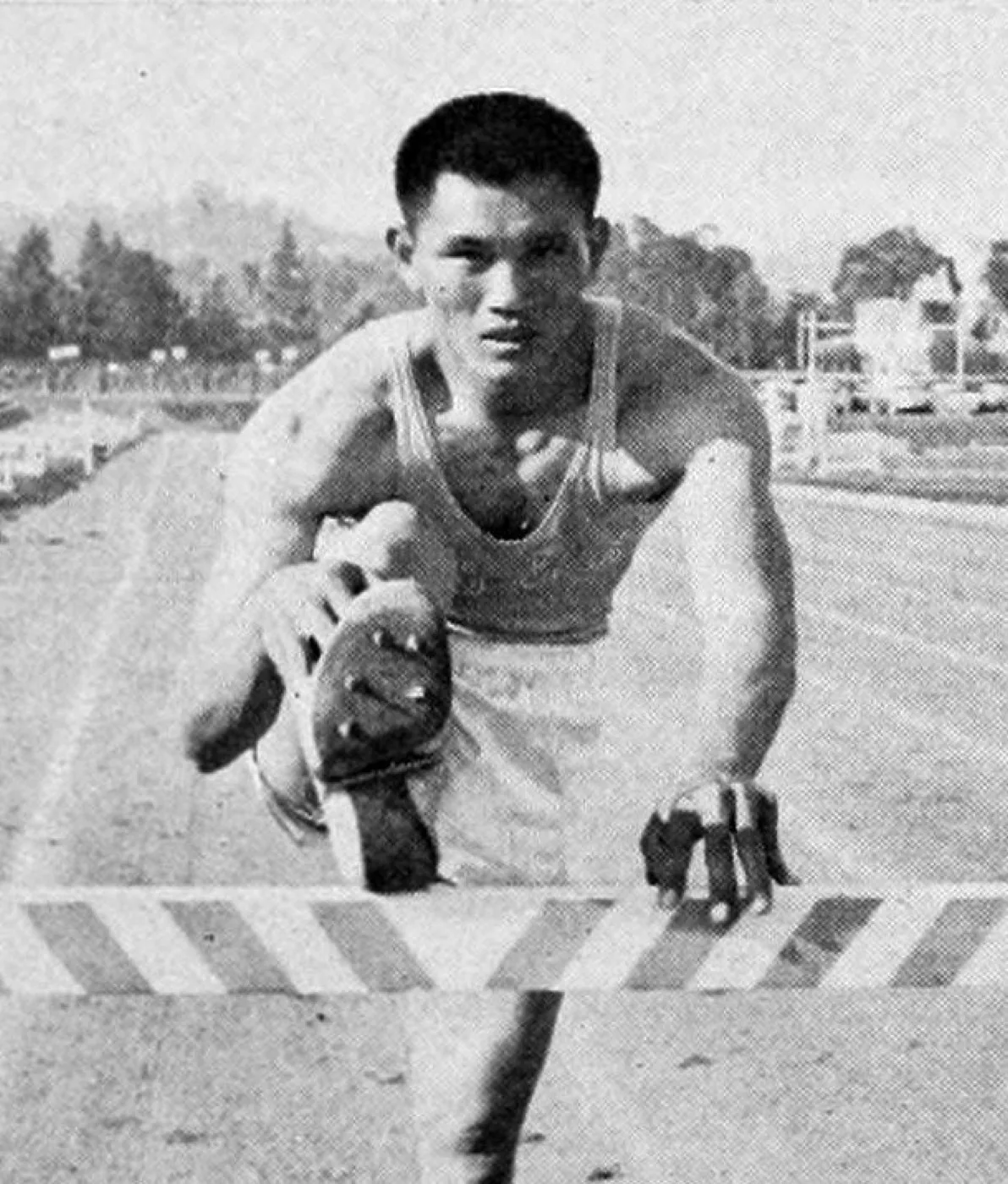
That year, this team could not be called the "Republic of China" nor "Taiwan." The name given by the IOC was "FORMOSA," Formosa. Inside the team was a young man named Yang Chuan-kwang. A few days later, he won a silver medal in the decathlon, Taiwan's first Olympic medal—hung on a team named "Formosa."

Yang Chuan-kwang, 1960 Rome Olympics
Yang Chuan-kwang, silver medalist in the decathlon at the 1960 Rome Olympics, Taiwan's first Olympic medal. The team name he wore that year was "FORMOSA," Formosa. (UCLA Southern Campus 1960, Public Domain)

This was the only time in Olympic history that a delegation publicly protested during the opening ceremony2. More than sixty years later, that white banner has been archived in history, but the thing the banner wanted to protest has never ended: a team has entered the field, but cannot use the name it wants to use.

A Flag Held High in Protest, Walking at the Front

To understand how the four characters "Chinese Taipei" came to be, we must first see clearly one thing: Taiwan's name in the Olympics has never been decided by itself from the beginning.

After the Chinese Civil War in 1949, the seat of "China" became a struggle between two regimes. The Republic of China government in Taipei and the People's Republic of China in Beijing both claimed to represent the sole China, with the IOC caught in the middle. At the 1952 Helsinki Olympics, the IOC invited both sides simultaneously. Taipei could not accept competing on the same field as the mainland and withdrew from the competition in protest before the games began3. In 1956 Melbourne, Taipei competed under the name "China," and this time Beijing withdrew. Throughout the 1950s and 60s, Taiwan's name jumped repeatedly between "China," "Formosa," and "Taiwan," each time pushed by the tides of international politics, never chosen by itself.

Ironically, the sessions where the name contained the two characters "Taiwan" were precisely when Taiwan had the least autonomy. At the 1968 Mexico City Olympics, Taiwan competed under the name "Taiwan." Chi Cheng won a bronze medal in the women's 80-meter hurdles, becoming Taiwan's first female Olympic medalist4. But the codename "Taiwan" was a label stuck on by the IOC based on geographical reality, not a choice made by the Taipei government. For the Republic of China government at the time, which insisted on "I am China," being called "Taiwan" was rather a demotion.

The 1972 Munich Olympics were the last time the Republic of China could fully use its national name, national flag, and national anthem to compete5. The world changed the following year.

📝 Curator's Note

Today, we are accustomed to viewing "Taiwan" as a proud name to strive for, and "Chinese Taipei" as a humiliating compromise forced upon us. But returning to the scene of the 1960s and 70s, this dichotomy was reversed: The Taipei government most wanted to guard the representation right of "China," and the thing it was most unwilling to accept was precisely "Taiwan," because being called "Taiwan" meant admitting it was only an island, abandoning the legal succession of all of China. When that bronze medal was hung under the name "Taiwan" in 1968, it was a demotion; when the same "Taiwan" is shouted by the audience in the stands in 2024, it is pride. Half a century, the same word has turned upside down.

The International Wanted to Call It Taiwan, Taipei Refused

1976 Montreal is the most counter-intuitive page in this entire history.

The host country that year was Canada. Canada had recognized Beijing in 1970. Based on the "One China" policy, the Canadian side refused to allow the Taiwanese delegation to enter the country to compete under the name "Republic of China" (Republic of China). Seeing Taiwan being blocked from the door, the IOC stepped in to coordinate, proposing a compromise: allowing Taiwan to compete under the name "Taiwan" (Taiwan), with the flag and anthem remaining the same6.

In other words, the one who wanted Taiwan to be called "Taiwan" that year was the IOC; the one who insisted on refusing was Taipei.

This decision was finally made by Chiang Ching-kuo. The Republic of China government viewed "Taiwan" as an arrangement that demeaned national dignity: accepting it would mean tacitly admitting it was only a local authority on an island, abandoning the representation of all of China. Thus, the day before the opening ceremony, the Taiwanese delegation chose to withdraw from the competition, returning home as a whole team7. A researcher later evaluated this decision: "it was the KMT that made this decision. It was an own goal, basically." (This was a decision made by the KMT itself, basically an own goal.)8

⚠️ Controversial Viewpoint

Simplifying the story of the 1976 Montreal Olympics into "Canada bullied Taiwan" is a common misreading. The truth is more complex and more piercing: The international community offered the name "Taiwan," but Taipei itself pushed it away based on its insistence on sovereignty. Pointing this out is not intended to make moral judgments for either side, but only to restore a cause-and-effect relationship that is often reversed: The popular saying "Chinese Taipei = a humiliation swallowed by Taiwan" is actually the opposite direction. Taiwan lost the opportunity to compete under the name "Taiwan," at least once, because it closed the door itself.

The cost of withdrawal appeared quickly. In 1979, the IOC formally established the "Two Chinas" Olympic model that continues to this day through a correspondence vote in Nagoya, Japan: The Beijing Olympic Committee would be named the "Olympic Committee of China," using the flag and anthem of the People's Republic of China; the Taipei Olympic Committee must change its name, and its flag and anthem must not be the same as in the past9. If Taiwan wanted to return to the Olympics, it had to change its name, change its flag, and change its anthem.

Won the Lawsuit, Then Accepted a New Name

Facing the Nagoya Resolution, Taiwan did not bow immediately, but first fought a lawsuit.

At the end of 1979, IOC member Hsü Heng and the Chinese Olympic Committee filed a lawsuit at the Lausanne District Court in Switzerland, where the IOC headquarters was located, arguing that the Nagoya Resolution violated the Olympic Charter10. On March 27, 1980, the court issued an interim judgment, determining that the IOC's actions were "seemingly contrary to the spirit and text of the Charter, particularly Articles 64, 65, and 66," and ruled that "the court fee of 100 Swiss Francs shall be borne by the IOC, and an additional 500 Swiss Francs shall be paid to Mr. Hsü Heng (the plaintiff) to compensate for his expenses"11.

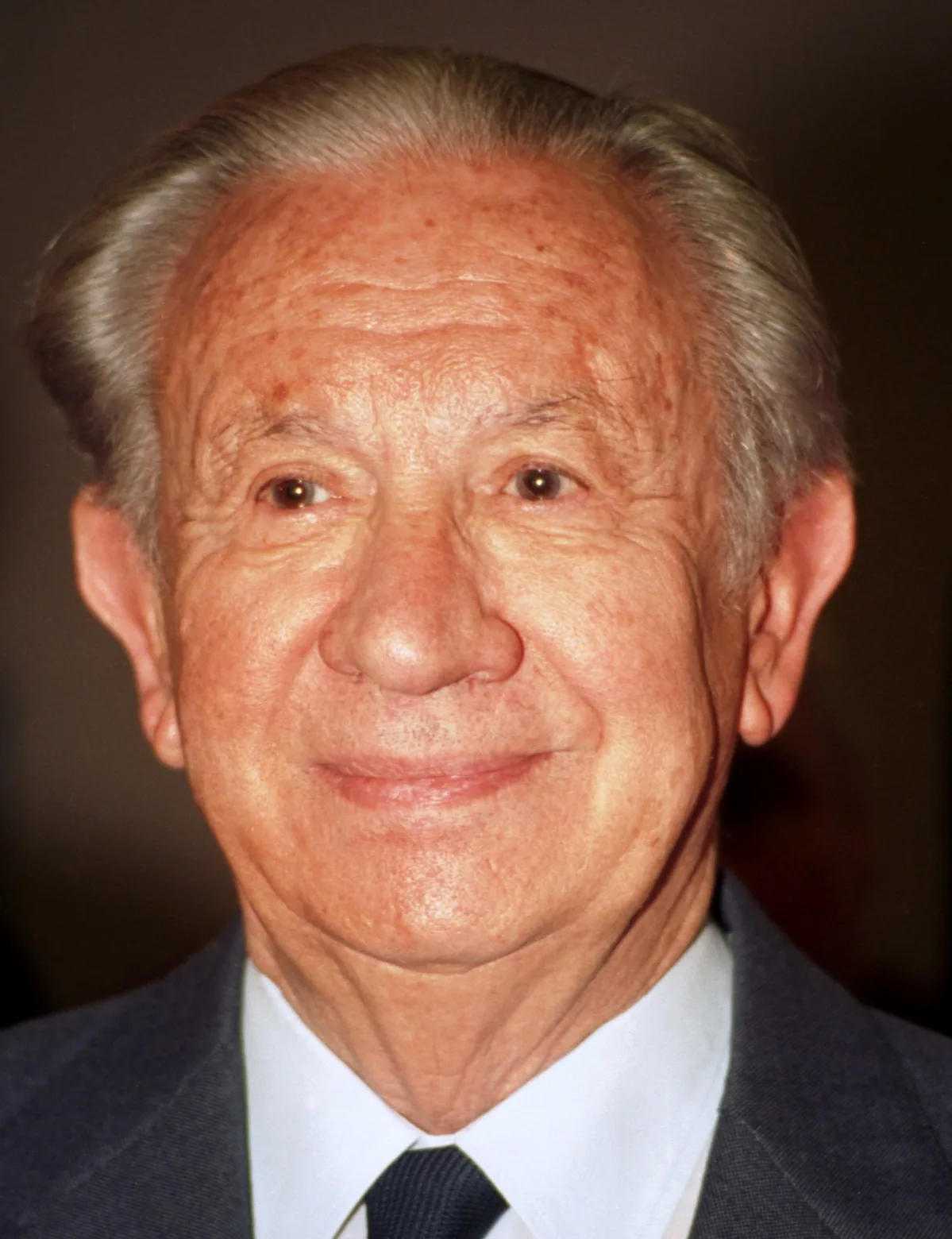
Legally, Taiwan won this lawsuit. But after winning, what next? The fact that the IOC violated the Charter was established, but Taiwan still could not return. The Nagoya Resolution was backed by the shift in the entire international recognition landscape; a court judgment could not change that. Thus, the lawsuit became a bargaining chip for negotiations. On January 26, 1981, Hsü Heng and others reached a consensus with the new IOC President Juan Antonio Samaranch and withdrew the lawsuit12.

Two months later, on March 23, 1981, Shen Chia-ming, Secretary-General of the Chinese Olympic Committee, and Samaranch formally signed the Lausanne Agreement (Agreement between the IOC and the Chinese Taipei Olympic Committee). The agreement established the name that continues to this day: CHINESE TAIPEI OLYMPIC COMMITTEE, with the country code TPE13. A detail reveals the political calculation at the time: In the Olympic entry order, TPE was placed in the T group, deliberately arranged so it would not be listed together with "China" starting with the code C, avoiding any visual association of "Two Chinas" side by side.

IOC President Samaranch
Then-IOC President Juan Antonio Samaranch. On March 23, 1981, he signed the "Lausanne Agreement" with Shen Chia-ming, Secretary-General of the Chinese Olympic Committee. The name "Chinese Taipei" was thus finalized, used for forty years. (Photo by Leo Medvedev, CC BY-SA 4.0)

📝 Curator's Note

"Won the lawsuit, then accepted a new name" sounds like a contradictory ending, but this is the most misunderstood part of "Chinese Taipei." It is neither pure surrender nor pure victory. Taiwan proved the IOC was in the wrong in court, but accepted a name that was not its first choice at the negotiating table, because the cost of being excluded from the international sports community for ten years was harder to bear than an imperfect name. For athletes, being able to compete is always the first priority.

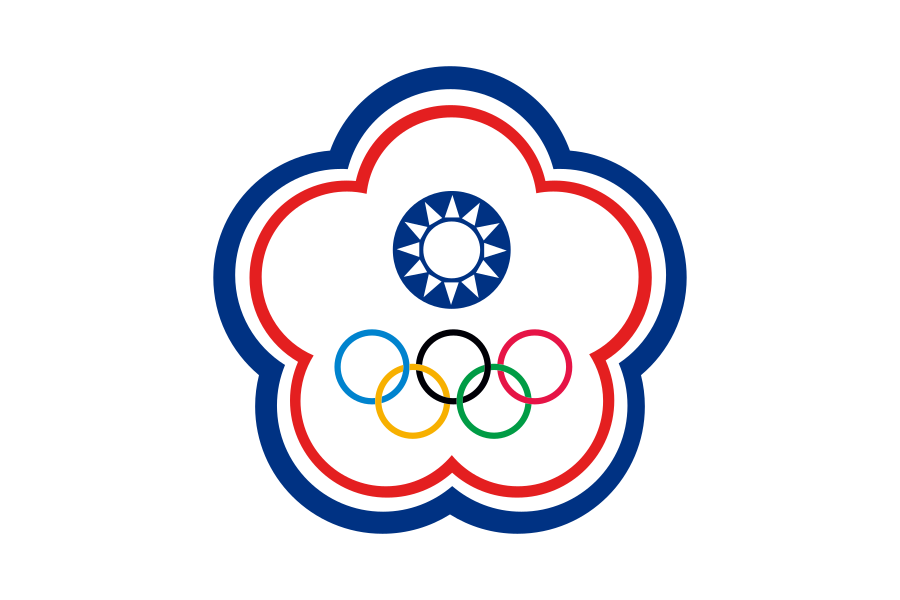
New names require new symbols. The design of the flag was drafted by Lin Hsing-hsiung and finalized by Weng Ming-yi, and finally personally chosen by Chiang Ching-kuo from three drafts: the "Plum Blossom Five-Ring Flag": the outer ring is the blue, white, and red colors of the national flag, the center is the Blue Sky with a White Sun emblem, and the Olympic rings are embedded below14. This flag, later commonly known as the "Plum Blossom Flag," replaced the Blue Sky, White Sun, and Wholly Red Earth flag, appearing on every Olympic podium.

Chinese Taipei Olympic Committee Flag (Plum Blossom Flag)
Chinese Taipei Olympic Committee Flag, commonly known as the "Plum Blossom Flag." The outer ring's blue, white, and red are taken from the Republic of China flag, the center is the Blue Sky with a White Sun emblem, and below are the Olympic rings. Activated after the 1981 Lausanne Agreement, replacing the national flag on the podium. (Wikimedia Commons, Public Domain)

A Song with the Same Melody, But Different Lyrics

If you have watched Taiwanese athletes win gold on the Olympic podium, you will notice that the national flag did not rise, nor did the national anthem play. But many people do not notice that the "National Anthem" played on the podium, while the melody is familiar, the lyrics are completely different from what you think.

The Lausanne Agreement stipulated that Taiwan could not use its national anthem, so the Chinese Olympic Committee made a clever arrangement: retaining the melody of the National Flag Anthem, but rewriting the lyrics. The new lyrics were written by then-Vice Chairman and Secretary-General Chang Pi-te. Approved by the IOC Executive Committee on June 1, 1983, it was first used at the 1984 Sarajevo Winter Olympics15. The lyrics begin like this:

"Olympics, Olympics, regardless of religion, regardless of race. To promote friendship, for world peace, youth from five continents, gather at the Olympics..."

Read it once and you will find that this song has no "Taiwan," no "Republic of China," and not even "Chinese Taipei"—it talks about the Olympic spirit, world peace, and youth from five continents. A song born for the sake of competing, deliberately referring to no nation. When Lin Yu-ting and Hsu Shu-ching stood on the highest podium, the familiar melody but unfamiliar lyrics of this anthem were played. Most Taiwanese have heard that melody, but may not know its lyrics have already been changed.

Olympics official channel recording of the 2024 Paris Olympics award ceremony segment. When Chinese Taipei athletes step onto the podium, this familiar melody but unfamiliar anthem plays, containing neither "Taiwan" nor "Republic of China."

After the name, flag, and song—all three symbols—were completely renewed, Taiwan finally returned to the Olympic arena in 1984. The cost was that it could no longer hear its true name on the international stage.

One English Name, Two Chinese Translations, A War of Sovereignty Words

The English name "Chinese Taipei" was set, but the trouble had just begun because it has two Chinese translations.

On April 6, 1989, Shen Chia-ming, Secretary-General of the Chinese Olympic Committee, and He Zhenliang, Chairman of the Chinese Olympic Committee, signed an agreement in Hong Kong (commonly known as the "1989 Consensus"), confirming the official Chinese translation of "Chinese Taipei" as "Chinese Taipei." The text of the agreement was very specific: "...whenever the Taiwan region's sports teams and sports organizations are referred to in Chinese, they shall be referred to as 'Chinese Taipei'."16

The problem lies in the scope of application of the text. Reading carefully, you will find that this agreement only regulated documents, manuals, letters, nameplates, and broadcasts printed by the host organization. In other words, it governed the official大会 (convention), not the media. This loophole later became a continuously leaking crack: Chinese media could legitimately continue to use another Chinese translation, "China Taipei." Starting in April 2017, CCTV China began systematically referring to the Taiwanese team as "China Taipei"17.

For Taiwan, although "Chinese Taipei" and "China Taipei" differ by only one character, their meanings are worlds apart. The Ministry of Foreign Affairs' position is that "China Taipei" demeans Taiwan and violates the Olympic model; while the Taiwan Affairs Office of China's statement is that both translations are Chinese translations of "Chinese Taipei," and there is no issue of demotion. This struggle over a single character has no consensus even within Taiwan. After attending the World Health Assembly (WHA) in the name of "Chinese Taipei" in 2016, Tsai Ing-wen stated, "There was no demotion in the title, nor was it restricted by a political framework, fulfilling expectations and completing the mission"18; KMT Chairman Eric Chu then criticized the DPP for double standards: "When the KMT attended the WHA, calling Chinese Taipei was called losing sovereignty and humiliating the nation, self-demeaning; when the DPP attended, it was called professional and pragmatic, not demeaning"19. Professor Lin Huo-wang of the Department of Philosophy at National Taiwan University also expressed his view, "Chinese Taipei is also OK," "Acknowledging the political reality makes me feel Tsai Ing-wen is a very pragmatic person"20.

📝 Curator's Note

The name has not changed for forty years, but what it points to is constantly being redefined. For Beijing, it is "China Taipei," a local branch; for the Japanese NHK anchor broadcasting the 2020 Tokyo Olympics, it is the脱口而出 (spoken out) "台湾です" (It is Taiwan); for the athletes, it is the cost of competing. The same string of letters "Chinese Taipei" emits completely different political frequencies in different people's mouths. The true struggle of this war is over the interpretation right of the name.

The influence of the "Chinese Taipei" model extends far beyond the Olympics. At the 1990 Beijing Asian Games, Taiwan returned under Chinese Taipei. In November 1991, Taiwan joined the Asia-Pacific Economic Cooperation (APEC) along with China and Hong Kong as a "Chinese Taipei" "economic entity," which was the first intergovernmental international organization Taiwan joined after withdrawing from the United Nations in 197121. From 2009 to 2016, Taiwan attended the World Health Assembly as an observer under the name "Chinese Taipei" for eight consecutive years, until it was no longer invited starting in 201722. The "Olympic Model" thus spilled over from a sports arrangement into the universal template for Taiwan's participation in almost all international organizations where China is present.

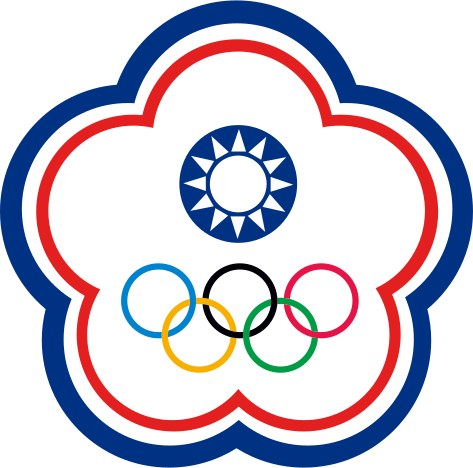
Chinese Taipei Olympic Committee Emblem
Chinese Taipei Olympic Committee Emblem, an identification symbol ratified after the 1981 Lausanne Agreement along with the flag. Compared to the flag flying on the podium, the emblem appears more often on athletes' uniforms and official documents—also carried along with the "Olympic Model" into venues far beyond sports, such as APEC and the WHA. (Wikimedia Commons, Public Domain)

The People Who Hurt the Most in the Name Have No Voting Stage

In 2018, a referendum brought the issue of "name" to the hands of all Taiwanese people for the first time.

The initiator was Chi Cheng—and the name Chi Cheng itself holds all the contradictions of the entire history of "Chinese Taipei." She won Taiwan's first women's Olympic medal under the name "Taiwan" in 1968; in 1981, she was one of the key figures who helped establish the Chinese Taipei Olympic Committee model, allowing Taiwan to return to the Olympics23; between 1981 and 1990, she served as a Legislative Yuan member under the KMT's call. Then, in 2018, the establishment-era merit figure led the launch of the "Tokyo Olympics Renaming Referendum," arguing that Taiwan should compete under the name "Taiwan." One person, over forty years, transformed from the creator of the name to the opponent of the name.

FTV's "Taiwan Story" special on Chi Cheng, completing the entire arc: the "Leaping Antelope" of 1968 Mexico, the merit figure who brought Taiwan back to the Olympics in 1981, the initiator of the 2018 renaming referendum. One person, holding all the contradictions of the name "Chinese Taipei."

The main text of Referendum Case No. 13 was written very clearly: "Do you agree to apply to participate in all international sports events and the 2020 Tokyo Olympics under the full name 'Taiwan' (Taiwan)?"24

The referendum sparked a frontal collision between two forces. On one side were those supporting renaming, believing this was an issue of dignity; on the other side, those who spoke out publicly against it were precisely the most direct parties in this name—the athletes themselves. Badminton player Zhou Tian-cheng said: "Athletes compete with their lives, and what we want is just a stage, we don't need ideological renaming."25 Sprinter Yang Chun-han called out to voters: "Every vote you cast will concern our future..."26 Weightlifting gold medalist Hsu Shu-ching said even more directly: "Cast your votes against."27

The athletes' fear stemmed from the IOC's attitude. In 2018, the IOC sent three letters to the Chinese Olympic Committee, explicitly stating that it would not approve the renaming application, that excessive external pressure would be considered political interference, and that it might even revoke recognition of the Chinese Olympic Committee28. For athletes whose careers depend on the right to compete, this was a threat to their professional lives.

But there is a key point that is commonly confused. Carefully distinguishing the IOC's warnings, you will find it threatened that "the name is actually changed," not that "someone votes to request an application." The Olympic Charter stipulates that suspension is only triggered when a government or institution "obstructs the operation of the National Olympic Committee"; if the referendum passes, it only requires the government to submit an application, and the Chinese Olympic Committee, as a civil organization, theoretically could choose not to execute it—suspension would not be automatically triggered29. Fact-checkers like Plain Law also pointed out that "Renaming Referendum = Automatic Ban" exaggerates the fear.

⚠️ Controversial Viewpoint

So were the athletes' concerns groundless? Not necessarily. The political dynamics after the referendum passed were full of uncertainty, and the IOC's three letters themselves created real pressure—the pressure did not need to actually evolve into suspension to make an athlete sleepless on the eve of voting. This is the cruelest part of "Chinese Taipei": It pushed a political difficulty that should have been borne by the whole society onto the group with the least voice, but who had to bear the most direct consequences. The people who hurt the most in the name were precisely those with the least space to fight for renaming.

On November 24, 2018, the referendum results were revealed. Yes votes: 4,763,086 (45.20%), No votes: 5,774,556 (54.80%), Turnout: 55.89%30. The renaming case was rejected by a margin of about one million votes. Hsu Shu-ching said after the referendum: "The referendum did not pass, which is more reassuring for athletes, no need to bear this risk."31

TTV News reported the most amplified controversy before the referendum: If renaming passed, would the Chinese Olympic Committee be expelled by the IOC? The authenticity of this question itself is the core of the disagreement between athletes and the renaming camp.

Forty Years Later, The Name Remains, The War Continues

The referendum ended, but the tug-of-war over the "name" on each athlete has never stopped.

Before the 2022 Beijing Winter Olympics, short track speed skater Huang Yu-ting was photographed practicing in a Chinese team uniform embroidered with the word "China." Facing the controversy, she responded: "In the sports world, we have no distinction of nationality" (original text), and said competing was "like fighting on home ground"32. The Sports Administration determined this act was inappropriate, suspended her subsidies for two years, and promised to amend the law33. Facing the same "name," some desperately try to shout out "Taiwan," while others feel nationality should not be part of sports at all. This crack runs through the internal division of the athlete community.

CTS News 2022 report: Huang Yu-ting practicing in a Chinese team uniform embroidered with "China" caused a sensation. She said "In the sports world, we have no distinction of nationality," while the Sports Administration's punishment drew another line.

And sometimes, what is snatched away is something more concrete. At the opening of the 2020 Tokyo Olympics, when the on-site announcer read out "Chinese Taipei," the Japanese NHK broadcast anchor directly shouted "台湾です" (It is Taiwan)34—these four characters were called by many Taiwanese netizens "the most touching moment of the night." But at the 2024 Paris Olympics, at the men's doubles badminton gold medal match, a support banner reading "Taiwan" on the stands was snatched and torn up on the spot by on-site staff and spectators suspected of being Chinese35. Li Yang and Wang Chi-lin won the gold medal on the field, the white plum blossom flag rose on the podium, and the anthem without the word "Taiwan" played. The name is still the same as forty years ago.

After the Paris Olympics, Taiwanese media and the public have become more accustomed to directly shouting "Team Taiwan" instead of the past "Team China," and even sports journalists more often use words like "Taiwan Heroes"36. The emotional scale of society towards the name is shifting, but the flag on the Olympic podium and the song have not moved with it.

It was in this tug-of-war that Chi Cheng stood out again. In July 2021, this person who personally brought Taiwan back to the Olympics in 1981 announced she would push for another renaming referendum, targeting the 2024 Paris Olympics. This time, former President Ma Ying-jeou publicly opposed it, saying renaming "would only harm Taiwan"37.

From the "UNDER PROTEST" white banner in Rome in 1960 to the torn-up "Taiwan" banner in Paris in 2024, more than sixty years have passed. In these sixty years, those who want to call "Taiwan" and those who want to keep "Chinese" have constantly switched sides—the IOC once wanted to give Taiwan the name "Taiwan," but Taipei itself pushed it away; athletes once used votes to reject the name "Taiwan," yet longed for someone to shout "Taiwan" for them on the field; Chi Cheng personally created "Chinese Taipei," yet spent the rest of her life trying to overturn it. No one has stood still.

And that ticket, still only lets Taiwan play, still won't print its own name. Next time you see the plum blossom flag rise on the podium and hear that anthem without "Taiwan," you will know that battle has been fought for forty years, and the verdict is still not out. And the ones stuck in a dilemma are always the person standing on the stage.

Further Reading

  • Issues with Taiwan's Designation in International Standards — From ISO 3166 to open-source software, how the name "Taiwan" is written and disputed in global digital infrastructure, originating from the same source but on a different battlefield as Olympic naming
  • Taiwan Unification-Independence Spectrum — Why Taiwanese people's emotions towards the two names "Chinese" and "Taiwan" are so divided, a complete explanation of the underlying identity spectrum
  • Taiwan's Diplomatic Allies and International Diplomacy — Beyond the spillover of the "Olympic Model," the same name dilemma Taiwan faces in formal diplomatic arenas
  • Chi Cheng — The complete arc of the Leaping Antelope from the 1968 Mexico bronze medal, 1981 establishment merit figure, to the 2018 renaming initiator
  • Yang Chuan-kwang — The Asian Iron Man who won Taiwan's first Olympic medal under the name "Formosa" at the 1960 Rome Olympics
  • The Invisible Country — In this documentary, Chi Cheng holds up her 1968 Olympic bronze medal and asks, "Is 'Chinese Taipei' even a country name?"

Image Sources

Video Sources

All four videos are embedded from official channels (documentary news / events / documentaries, not UGC remakes):

  • Chinese Taipei Olympic Committee Anthem · 2024 Paris Award: Olympics Official Channel (IOC official)
  • Chi Cheng Special: FTV "Taiwan Story" (FTV official)
  • Tokyo Olympics Renaming Referendum Controversy: TTV News (TTV official)
  • Huang Yu-ting Chinese Team Uniform Controversy: CTS News (CTS official)

References

  1. 1960 Summer Olympics Republic of China Delegation — Chinese Wikipedia, records then-manager Lin Hung-tan displaying the "UNDER PROTEST" white banner to enter the field at the opening ceremony.
  2. Richard W. Pound, Journal of Olympic History (ISOH) — Academic article by IOC member Pound citing original IOC archives, confirming 1960 Rome as the only opening ceremony protest in Olympic history, and correcting that there were two banner-holders at the time (Formosa banner and Under Protest banner).
  3. Olympic Games Chinese Taipei Delegation — Chinese Wikipedia, records the evolution of competition names in each session, with the Republic of China withdrawing from the 1952 Helsinki Olympics due to the Two Chinas issue.
  4. Taiwan Fact Check Center: Did Not Compete as Taiwan in the 1960s — Cites official Olympic reports to verify names in each session, confirming 1968 Mexico competed as "Taiwan" (TWN), with Chi Cheng winning the women's 80-meter hurdles bronze, becoming Taiwan's first female Olympic medalist.
  5. 1972 Summer Olympics Republic of China Delegation — Chinese Wikipedia, records 1972 Munich as the "last successful time the Republic of China competed in the Summer Olympics under its national name, flag, and anthem."
  6. Republic of China at the Summer Olympics — English Wikipedia, records that in 1976 Montreal, Canada (which recognized the PRC in 1970) refused the "Republic of China" name, and the IOC proposed a compromise for Taiwan to compete under the name "Taiwan."
  7. Montreal 1976: Diplomatic Controversies — IOC Official Website, records the process of Canada refusing the "Republic of China" name during the 1976 Montreal Olympics, the IOC's attempt at compromise, and the ROC finally withdrawing from the competition one day before the opening ceremony.
  8. Commentary on rejecting the "Taiwan" name in 1976, from researcher Garret Clarke "it was the KMT that made this decision. It was an own goal, basically." (Single source, cited as the author's viewpoint rather than a conclusion). Harvard scholar Xu Guoqi's research also supports the historical fact that this decision was made by the Taipei side, see Richard W. Pound, Journal of Olympic History (ISOH) citing original IOC archives.
  9. Nagoya Resolution — English Wikipedia, records the 1979 Nagoya Resolution establishing the Two Chinas Olympic model through a correspondence vote: the PRC uses the flag and anthem, the ROC must change its name to Chinese Taipei, and its flag and anthem must be different from the past, results published on 1979-11-26.
  10. Tang Ming-hsin: Analyzing the "Olympic Model" and the "Two Associations Agreement" — National Policy Foundation, former Chinese Olympic Committee member Tang Ming-hsin's firsthand account of Hsü Heng and the Chinese Olympic Committee filing a lawsuit at the Lausanne District Court in Switzerland at the end of 1979.
  11. Tang Ming-hsin: Analyzing the "Olympic Model" and the "Two Associations Agreement" — National Policy Foundation, verbatim records the 1980-03-27 Lausanne Court interim judgment "IOC seems contrary to the spirit and text of the Charter, particularly Articles 64, 65, 66" and the fee ruling "Court fee of 100 Swiss Francs borne by the IOC, plus 500 Swiss Francs paid to Mr. Hsü Heng (plaintiff) to compensate for expenses."
  12. Lausanne Agreement — Chinese Wikipedia, records Hsü Heng and others reaching a consensus with Samaranch and withdrawing the lawsuit on 1981-01-26.
  13. Lin Chia-ho / "Chinese Taipei" Past and Present — Those Years We Sued the IOC — The Reporter, legal scholar Lin Chia-ho writes to梳理 (sort out) the process of the 1981-03-23 Lausanne Agreement signed by Shen Chia-ming, Secretary-General of the Chinese Olympic Committee, and Samaranch, establishing the name "CHINESE TAIPEI OLYMPIC COMMITTEE" and the TPE code.
  14. Chinese Olympic Committee Flag (Plum Blossom Flag) — Chinese Wikipedia, records the Plum Blossom Flag was drafted by Lin Hsing-hsiung, finalized by Weng Ming-yi, personally chosen by Chiang Ching-kuo from three drafts, design includes the national flag's blue, white, red colors, Blue Sky with a White Sun emblem, and Olympic rings.
  15. You May Not Know, the Chinese Olympic Committee Anthem Lyrics Are Not the National Flag Anthem Lyrics! — Sportsv, records the anthem lyrics were written by Chang Pi-te, adopting the National Flag Anthem melody with rewritten lyrics, approved by the IOC Executive Committee on 1983-06-01, first used at the 1984 Sarajevo Winter Olympics, full lyrics "Olympics, Olympics, regardless of religion, regardless of race..."
  16. Chinese Taipei — Chinese Wikipedia (National Security Council transcribed text), records 1989-04-06 Li Ching-hwa and He Zhenliang signed the agreement in Hong Kong, confirming the Chinese translation of Chinese Taipei as "Chinese Taipei," the text only regulates host organization documents, manuals, letters, nameplates, and broadcasts.
  17. Chinese Taipei vs China Taipei Translation Controversy — Chinese Wikipedia, records that starting in April 2017, CCTV China systematically changed to refer to the Taiwanese team as "China Taipei."
  18. Tsai Ing-wen: WHA Title Was Not Demoted — SET News, records Tsai Ing-wen stating on 2016-05-27 "There was no demotion in the title, nor was it restricted by a political framework, fulfilling expectations and completing the mission" (this verbatim version is based on SET News report).
  19. Tsai Ing-wen Says Chinese Taipei Was Not Demoted, Eric Chu Criticizes Double Standards — Liberty Times Net, records Eric Chu criticizing on 2016-05-29 "When the KMT attended the WHA, calling Chinese Taipei was called losing sovereignty and humiliating the nation, self-demeaning; when the DPP attended, it was called professional and pragmatic, not demeaning."
  20. Xiao Ying Says "Chinese Taipei" Was Not Demoted, Lin Huo-wang: President Tsai Is Very Pragmatic — Liberty Times Net, records National Taiwan University Philosophy Department Professor Lin Huo-wang stating on 2016-05-27 "Chinese Taipei is also OK" "Acknowledging the political reality makes me feel Tsai Ing-wen is a very pragmatic person."
  21. MOFA: Our Participation in APEC — MOFA First-hand, records that in 1991, Taiwan, mediated by South Korea, joined APEC along with China and Hong Kong under the name "Chinese Taipei," the first intergovernmental international organization Taiwan joined after withdrawing from the UN.
  22. MOFA: Our Participation in the World Health Assembly (WHA) — MOFA First-hand, records that from 2009 to 2016, Taiwan was invited to attend the WHA as an observer, and has not been invited since 2017 to the present.
  23. Chi Cheng — Chinese Wikipedia / Hope Foundation official website, records Chi Cheng winning bronze in 1968 Mexico, helping establish the Chinese Taipei Olympic Committee model in 1981, serving as a Legislative Yuan member from 1981-1990, and leading the launch of the Tokyo Olympics Renaming Referendum in 2018.
  24. 2020 Tokyo Olympics Taiwan Renaming Referendum Case — Chinese Wikipedia (citing Central Election Commission bulletin), Referendum Case No. 13 main text "Do you agree to apply to participate in all international sports events and the 2020 Tokyo Olympics under the full name 'Taiwan' (Taiwan)?".
  25. Zhou Tian-cheng: Athletes Just Want a Stage — Formosa TV Sports News 2018-11-21, records badminton player Zhou Tian-cheng "Athletes compete with their lives, and what we want is just a stage, we don't need ideological renaming."
  26. Athletes Oppose Tokyo Olympics Renaming Referendum — TVBS, records sprinter Yang Chun-han calling out to voters "Every vote you cast will concern our future..." (the original sentence continues with "I hope everyone thinks clearly, stand up for sports people").
  27. Athletes Oppose Tokyo Olympics Renaming Referendum — TVBS, records weightlifting gold medalist Hsu Shu-ching urging "I also hope everyone can defend athletes' competition rights, cast your votes against."
  28. Tokyo Olympics Renaming Received Three Warnings from IOC — Business Today, records the IOC sending three letters to the Chinese Olympic Committee in 2018 (third letter 11-16), stating it would not approve renaming, excessive external pressure would be considered interference, and recognition might be revoked.
  29. Yang Kuei-chih / Olympic Model: Taiwanese Going Abroad to Compete Become Chinese Taipei People? — Plain Law Movement, analyzes suspension conditions based on the Olympic Charter as government/institution "obstructing the operation of the National Olympic Committee," the referendum passing does not automatically trigger suspension, pointing out "Renaming Referendum = Automatic Ban" is an exaggeration of fear.
  30. Yes-No Vote Tug-of-War, Tokyo Olympics Renaming Failed — CNA (votes confirmed by three sources: Supervisory Commission, Central Election Commission bulletin), 2018-11-24 Yes 4,763,086 votes (45.20%), No 5,774,556 votes (54.80%), Turnout 55.89%, renaming case rejected.
  31. Hsu Shu-ching Discusses Referendum Results — China Times 2018-11-27, records Hsu Shu-ching "The referendum did not pass, which is more reassuring for athletes, no need to bear this risk."
  32. Huang Yu-ting: It's Like Fighting on Home Ground — New Talk 2022-02-08, records Huang Yu-ting after the Beijing Winter Olympics "I feel the enthusiasm of the on-site audience, especially moved, it's like fighting on home ground."
  33. Winter Olympics Huang Yu-ting Wearing Chinese Team Uniform Causes Controversy, Sports Administration Promises Law Amendment — Liberty Sports, records the Sports Administration determining on 2022-03-03 that Huang Yu-ting wearing the Chinese team uniform was inappropriate, suspending subsidies for two years and promising to amend the law.
  34. Tokyo Olympics Chinese Team Entry NHK Broadcast Directly Shouts Taiwan — CNA 2021-07-23, records that at the 2020 Tokyo Olympics opening broadcast, NHK anchor directly used the Japanese "台湾です" (It is Taiwan) to rename the Taiwanese team when the announcer read "Chinese Taipei."
  35. Flags banned, signs ripped up: Why you can't mention Taiwan at the Olympics — NBC News, records that at the 2024 Paris Olympics men's doubles badminton gold medal match, a support banner reading "Taiwan" on the stands was snatched and torn up on the spot, Li Yang and Wang Chi-lin won gold.
  36. Chinese Taipei or Team Taiwan? Exploring Sport and National Identity in Contemporary Taiwan — Taiwan Insight, analyzes the trend of Taiwanese media and the public increasingly preferring the term "Team Taiwan" (Team Taiwan) over "Team China" after the Paris Olympics.
  37. Chi Cheng Plans to Push Paris Olympics Renaming Referendum Again, Ma Ying-jeou: Will Only Harm Taiwan — New Talk 2021-07-31, records that in July 2021, Chi Cheng announced pushing for the 2024 Paris Olympics Renaming Referendum again, former President Ma Ying-jeou opposed it saying "This referendum is meaningless, will only harm Taiwan, no benefit to Taiwan."
この記事について この記事はコミュニティとAIの協力により作成されました。
タグ
Chinese Taipei Olympic Model Lausanne Agreement Taiwan Renaming Sports Diplomacy Sovereignty
共有

関連記事

こちらもおすすめ

社会

台湾スポーツ発展とオリンピック:「チャイニーズ・タイペイ」と呼ばれるチーム

1976年のモントリオールで、カナダは「Taiwan」への改名を求め、蔣経国は国辱とみなして出場を辞退しました。2024年のパリで、麟洋ペアが男子ダブルス連覇を果たした夜、会場全体が梅花旗に合わせて国旗歌の歌詞を高らかに歌いました。入場できなかった「台湾」から、世界が Taiwan と呼び始めるまで、「中華台北」と呼ばれるこの帽子は、どの世代の金メダルもその重みをかぶってきました。

閱讀全文
歴史

台湾前途決議文:二文字の「目前」が二十七年を支えた

1999年、林濁水は「国号中華民国」の前に「目前」という二文字を加えた。扁系はこれを快く思わなかった。二文字は独立派と中間有権者を同時に安心させ、2000年の初の政権交代への道を開いた。二十七年後、台湾の若者にとって「台湾はもともと独立している」は常識となっているが、その常識が曖昧に満ちた一つの文書から生まれたことを知らない。

閱讀全文
歴史

Democratization

On March 18, 1980, at the Kaohsiung Military Court, Shi Ming-de abandoned his 60,000-word defense statement and instead demanded the judge sentence him to death. In that same trial, the young lawyers defending the defendants—Chen Shui-bian, Hsieh Chang-ting, and Su Tseng-chang—would all become President or Premier of the Executive Yuan twenty years later. A trial intended to make an example of them accidentally produced the next generation of Taiwan's political leaders.

閱讀全文
人物

Cheng Li-wen

From the student activist who went on a hunger strike for Taiwan independence at the NTU gate in 1988 to the KMT Chairperson who told Xi Jinping in Beijing in 2026 that 'compatriots across the strait are all Chinese.' What happened along this trajectory?

閱讀全文