
On November 14, 2019, Taipei City Councilor Chiu Wei-jie, YouTuber Chang Chih-chi, and "Eyeball Central Television" host Chen Tzu-chien held a party founding convention in Taiwan that looked less like a traditional party launch. The event featured a party platform and a chairperson election, as well as a coriander cake. In the end, because "eating screw" (a game mechanic) resulted in the highest score, Chen Tzu-chien, who hated coriander the most, had to eat it. 1
On November 21, the organization named the "Joyful Impossible Party" (Lehuan Wufa Dang) released a list of candidates for proportional representation seats in the Legislative Yuan. The first name on the list was not a person, but Chen Tzu-chien’s Shiba Inu, Yuzu. 2 On February 19, 2021, the Ministry of the Interior announced the revocation of the party’s registration, citing the reason that the party failed to complete its legal incorporation registration within one year of filing. 3
These three dates tell a short story, but they leave a question: If a group of online creators truly wanted to bring people closer to politics, did they need to establish a party eligible to run for office, or a public classroom where people would be willing to understand political parties for the first time?
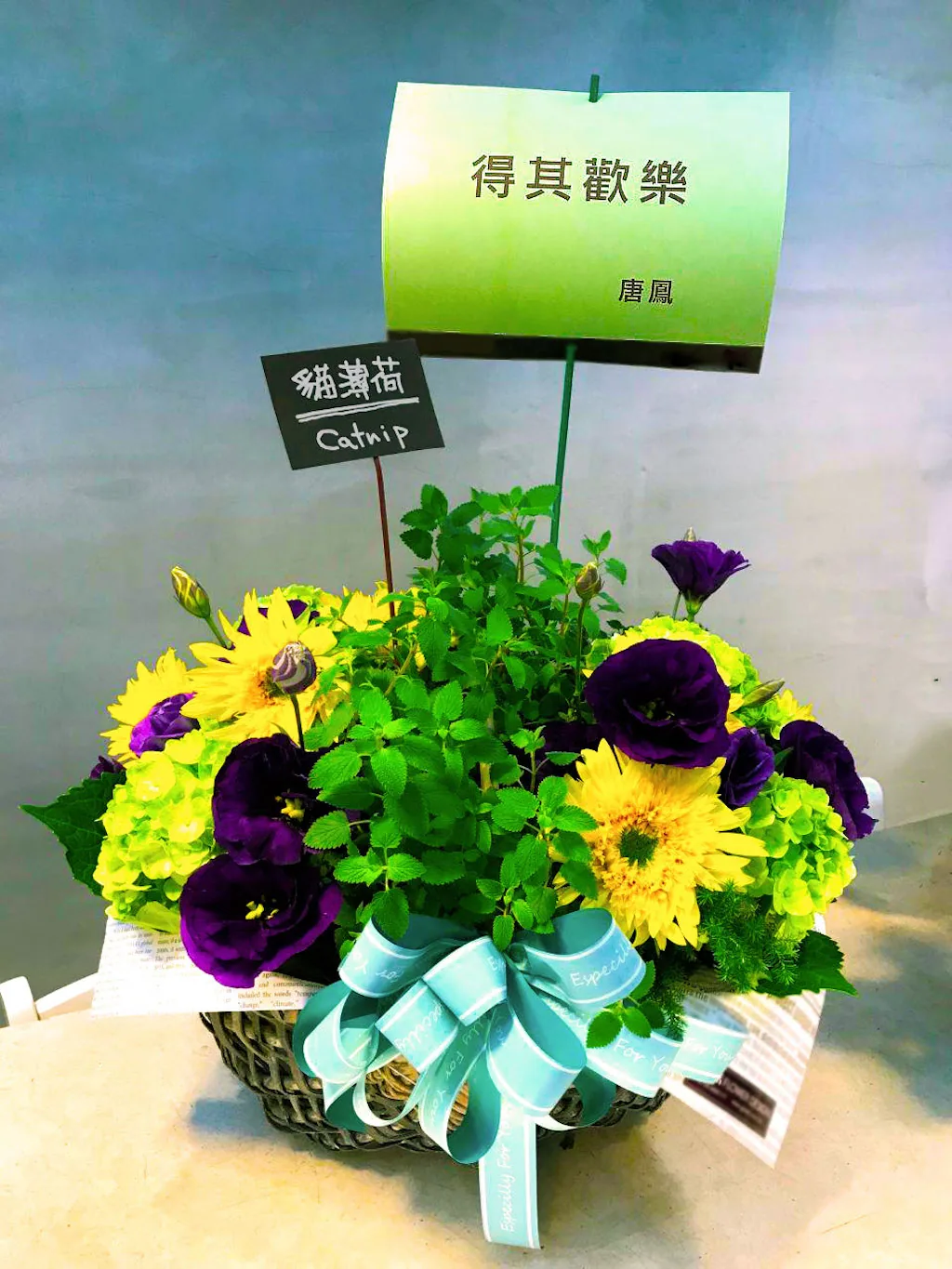
Figure: A catnip flower basket presented by PDIS on the day of the founding convention on November 14, 2019. The card reads "Deqi Huanle" (Gain Joy). Image sourced from PDIS’s "Can’t Stop This Party", page marked with a Creative Commons Attribution 4.0 International License; image has been downloaded and archived in the project directory, uncut and unmodified. 4
A Flower Basket, and the External World’s Understanding of This Experiment
PDIS did not send a standard wreath on the day of the founding convention, but a basket of flowers featuring catnip as the main ingredient. The card read "Deqi Huanle" (Gain Joy), with the English word "Catnip" placed beside it. This object transformed the name of the Joyful Impossible Party from an internet joke into a public proposition that could be publicly blessed. 4
PDIS’s English article was not an official document of the Joyful Impossible Party, nor did it endorse it as a long-term political party. What it did was more nuanced: it placed joy, generational integration, freedom, democracy, dialogue, and consensus in the same paragraph, explaining why a seemingly absurd party formation could still be viewed as a democratic experiment. 5
This photo is therefore more than just decoration. It allows readers to see that the political language of the Joyful Impossible Party exists not only in the party platform, but also in a flower basket, a sign, and how bystanders choose to name this action.
Politics Is Too Hard, So Start with a Joke
The Joyful Impossible Party did not appear out of nowhere. As the countdown to the 2019 presidential and legislative elections approached, Taiwan’s public discourse was filled with camp confrontations, mockery, and emotion. In early November, Chiu Wei-jie, Chang Chih-chi, and Chen Tzu-chien announced the formation of a party. At that time, the petition process for 100 founding members had already been completed. 6
These numbers cannot be directly equated with votes. They are more like a signal: a group of people were willing to click "Join" on social media platforms, but were not necessarily willing to commit to joining a traditional political party. The Joyful Impossible Party was testing the distance between these two things.
Chiu Wei-jie said at the press conference: "Politics should not be so difficult." He also said that after he entered political work, his life was full of "hatred, malice, and negative emotions." 7 This was not a blueprint for national governance, but a political question starting from daily feelings: Why must participating in public affairs first require learning a language that makes people want to flee?
📝 Curator’s Note: The most memorable thing about the Joyful Impossible Party is not that it made politics funny, but that it acknowledged that "funny" itself might be an entry point. An entry point is not an answer, but without an entry point, no one comes in to hear the answer.
A Founding Convention Where Reading the Platform Led to Eating Screws
Public Television’s coverage of the founding convention left behind an object that is hard to capture in institutional documents: the coriander cake. The three founders took turns reading the party platform, and the calculation numbers on the projection screen kept making mistakes. So, a rule was designed on-site: whoever ate the most "screws" had to eat the coriander cake. The loser was Chen Tzu-chien, who detested coriander the most. 8
This segment looks like a show effect, but it connects to what they wanted to do. The founding convention was not packaged as a sacred ritual, but laid out mistakes, awkwardness, and unfamiliar procedures in front of the audience. For someone encountering a political party for the first time, this leaves a deeper impression than a flowchart full of jargon.
But humor did not cancel procedure. According to CNA, the founding convention on November 14 elected Chiu Wei-jie as the General Secretary, which is the party chairperson. They still needed to submit an application to the Ministry of the Interior, still had to handle the party charter, responsible persons, and party registration. 9
This is the first important contrast of the Joyful Impossible Party: It used the format of an internet show to lower the threshold, but had to use the format of a political party to prove it was not just an internet show.
From Founding Convention to Revocation of Registration: Five Procedural Nodes
| Date | What Happened | What This Node Explains |
|---|---|---|
| 2019-11-05 | The three founders applied to the Ministry of the Interior and scheduled a founding convention for November 14 | Online announcements must be converted into formal party founding processes; 100 members are required before the founding convention. 6 |
| 2019-11-14 | The founding convention was held, selecting party positions from 115 founding members | Party platform, elections, and on-site rituals coexisted; political procedures were transformed into watchable public events. 1 |
| 2019-11-21 | Released a list of 13 proportional representation seats, with Yuzu listed first | The nomination system was used to discuss the gap between "influence" and "representation." 2 |
| 2019-11-22 | Chiu Wei-jie said the party formation was a large-scale civic education lesson, with no intention to participate in the 2020 election | The goal of forming the party shifted from election victory to helping people understand the process of party politics. 9 |
| 2021-02-19 | The Ministry of the Interior revoked the party registration | Legal procedures drew a line under this阶段性 experiment: the party registration was revoked because legal incorporation was not completed within one year of filing. 3 |
The focus of this timeline is not a linear story of "founding—failure," but that each node was testing the same thing: Can a political organization gathered by social media attention withstand the fixed procedures, responsibilities, and continuity required by the party system?
Joy in the Party Platform Is Not Just a Punchline
The News Lens relayed several key articles of the Joyful Impossible Party’s platform. The first article breaks the party name into a declaration: "Joy Is Impossible to Stop." The third article states: "Politics Is Not Hard, Just Regain Joy." The platform also advocates allowing dual party membership, charging no party dues, and even includes a joke about coriander as a condition for joining. 10
If these words are only treated as funny, their political function is missed. Political parties usually first ask people to take a stance: Which side are you on? Which set of ideas do you support? The Joyful Impossible Party reversed this to address another question first: Can you first stop being afraid?
Allowing dual party membership means it does not design joining a party as a one-time identity cut. Not charging party dues lowers the threshold between organization and support. These designs may not be sufficient to operate a long-term party, but they clearly express a flexible vision of political parties: Political organizations do not necessarily have to demand loyalty first before people get close.
PDIS posted a blessing in English on the day of the founding convention, linking "joy" with generational integration, freedom, and democracy, believing that any method that promotes dialogue and builds consensus is worth encouraging and experimenting with. 5 This text is not the official party platform of the Joyful Impossible Party, but it provides an external observation angle: Joy is not an escape from politics; it can also be understood as a social technology to reduce conflict and restart dialogue.
📝 Curator’s Note: The seriousness of this experiment is hidden in the fact that it does not wear seriousness on its face. It did not claim that laughter can solve housing, gender, or generational issues. It only asked first: Can we make more people willing to stay and talk about these issues?
Why Could Yuzu Be Ranked First?
On November 21, the Joyful Impossible Party released a list of 13 proportional representation seats for the Legislative Yuan. CNA recorded that the first name was Yuzu, followed by internet celebrities Qiaosefu (Joseph), Zheng Jiachun (Guan-guan), Chen Zhihan, and Chiu Wei-jie’s cat Baby, among others. Each seat had a reason for nomination, making the list look both like political satire and a list rearranging social influence. 2
If you only look at the punchline, Yuzu and Baby are just a joke about "any cat or dog can be a legislator." But placing the list back in the 2019 media environment, it was actually asking: Are proportional representation seats professional representatives within a party, spokespersons for social issues, or people who can bring attention to public issues?
Chiu Wei-jie told CNA that the main considerations for nomination were attention to social issues and having influence, and that the opinions of the parties concerned had been consulted. 2 This explanation clarifies why the list was not just a pet meme: it tried to treat "who can make people notice something" as a discussion of political capital.
Of course, influence is not equal to governance ability, and fame is not equal to representation. The Joyful Impossible Party did not really send Yuzu to the Legislative Yuan; the value of the list lies not in whether it can become a roster of candidates, but in that it turned the boundaries of the nomination system into a question everyone could understand.
"Goodbye" Is Not Dissolution, But Class Dismissal
When the 2020 election registration deadline passed, the Joyful Impossible Party had not yet officially become a legal entity, so it posted on Facebook saying "Goodbye, Joyful Impossible Party?" CNA reported that Chiu Wei-jie explained that the post was not announcing dissolution, but indicating that the阶段性 goal had been completed. They never intended to form a party to participate in the 2020 election. 9
This statement makes the Joyful Impossible Party look more like a public class than an election team that has not yet assembled. The "large-scale civic education lesson" mentioned by Chiu Wei-jie includes the founding convention, the chairperson election, proportional representation nominations, and knowledge-based videos. Each procedure is teaching material, and each punchline is a method to deliver the material to the audience. 9
But a class may also leave behind institutional homework. In February 2021, the Ministry of the Interior’s announcement did not use the tone of "class is over," but clearly stated: The party registration was revoked because legal incorporation was not completed within one year of filing. 3
Yu Media quoted Chiu Wei-jie saying that if legal incorporation were completed, the outside world might think he wanted to run again in 2022. For him, the Joyful Impossible Party had already completed its阶段性 goal, and there was nothing left to do. 11 "Natural extinction" was therefore not a dramatic failure, but a choice to intentionally stop at the threshold of procedure.
📝 Curator’s Note: The Joyful Impossible Party did not prove itself with an election, nor did it prove itself with long-term existence. The question it leaves behind is actually harder: If political education is truly effective, after students learn the procedure, do they still need the teacher to stand on the stage all the time?
The Long Tail Left by a Short-Lived Party
The legal life of the Joyful Impossible Party was short, but its cultural life did not end together in the 2021 announcement. It made "internet celebrities" no longer just external figures invited by politicians to promote, but people who could themselves召集 members, design party platforms, and explain party procedures.
This does not mean all creators are suitable for politics, nor does it mean that entertaining politics can solve public problems. On the contrary, it exposes the responsibility gap between entertainment and politics: Videos can keep audiences with rhythm, but parties must handle organization, finance, legal entities, and representation. Jokes can open dialogue, but cannot replace policy.
The most honest thing about the Joyful Impossible Party may be that it did not pretend to have completed this conversion. It moved politics in front of the lens, letting the audience see the entire process of founding, nomination, waiting for review, and finally having the registration revoked. These processes are not beautiful, but they explain more how democracy works than a success story that is only a slogan.
If viewed as a political party, it indeed did not complete the legal incorporation registration. If viewed as a public experiment, it at least completed one demonstration: A political party can first be a scene that makes people willing to get close, and only then start talking about stances, systems, and responsibilities.
The coriander cake from 2019 was eventually eaten, and Yuzu did not become a legislator. What remains is not an answer that "joy" has solved politics, but a more durable question: Can we make politics in a way that makes people willing to enter, and then require ourselves to be responsible for what happens after entering?
International Comparison: When Do Parody Parties Become Institutional Roles?
The Joyful Impossible Party is not the only one to make politics a joke. In 2010, Icelandic comedian Jón Gnarr’s Best Party won 34.7% of the vote in the Reykjavik local election, taking 6 of 15 seats in the city council. It proposed absurd platforms like free towels, polar bears, and a "drug-free parliament," but also truly entered local governance. 12
The Polish Beer Lovers' Party brought another political scenario into parliament. The TIME article page records that it won 16 seats in the 1991 election, before splitting into "Big Beer" and "Small Beer" factions. This result reminds people: Party names can be jokes, but seats bring faction and representative responsibilities. 13
The UK’s Official Monster Raving Loony Party’s route is closer to institutional parody on long-term election ballots. The UK Parliament Election Results website records its many by-elections, such as the 2024 Wellingborough by-election where candidate Nick The Flying Brick got 217 votes, a vote share of 0.7%. It continues to run, but these records do not equal obtaining parliamentary seats. 14
Germany’s Die PARTEI demonstrates how proportional representation can give parody parties a larger entry. DW reported that it obtained nearly 900,000 votes and 2 seats in the 2019 European Parliament election. 15 Compared to these cases, the Joyful Impossible Party stopped before formal participation: It completed the public display of the founding convention, party platform, and list, but did not put the Yuzu list on the ballot, nor did it bring the organization into local or parliamentary governance.
Therefore, the four foreign cases cannot be ranked as a "who is funniest" leaderboard. A more useful question is: Does the parody occur in platforms, candidates, party names, or the entire organizational form? Did it obtain seats? After obtaining seats, must it handle policy, factions, and governance? On this scale, the Joyful Impossible Party is closest to a civic education experiment that publicized party procedures, rather than a parody party that has already completed institutional conversion.
Further Reading
You can further read Taiwan.md’s Chen Tzu-chien (Retina) profile article to understand the conversion of one of the three founders of the Joyful Impossible Party between online media, host, and creator identities. You can also refer to Taiwan.md’s Person Category to explore other articles on Taiwan’s public figures and social organizations.
References
- Public Television News Network: Joyful Impossible Party Founding Aims to Let People Participate in Politics Easily — Reported on November 15, 2019, the scene of the founding convention, 115 founding members, the coriander cake, and the context of flexible party public participation.↩2
- CNA: Joyful Impossible Party Proposes Proportional Representation List, Guan-guan Included — Reported on November 21, 2019, the 13-seat proportional list, nomination arrangements for Yuzu and Baby, and Chiu Wei-jie’s explanation of nomination considerations.↩234
- Ministry of the Interior Party Information Network: Announcement Revoking Joyful Impossible Party’s Party Registration from February 19, 110 (2021) — Official government announcement that legal incorporation was not completed within one year of filing, and specifies the date and official document basis for revoking the registration.↩23
- PDIS: Can’t Stop This Party — English article page from November 14, 2019, explaining the catnip flower basket and the "Deqi Huanle" card, and explicitly stating the full text is under a Creative Commons Attribution 4.0 International License.↩2
- PDIS: Can’t Stop This Party — English page from November 14, 2019, recording the blessing on the day of the founding convention, linking joy, generational integration, freedom, and democracy.↩2
- Yahoo奇mo: Gua-jie and Retina Organize "Joyful Impossible Party" Hold Founding Convention on the 14th — Reported on November 5, 2019, the three founders applying to the Ministry of the Interior, the scheduled November 14 founding convention, and the 100 members required for the founding convention.↩2
- Yahoo奇mo: Gua-jie and Retina Organize "Joyful Impossible Party" Hold Founding Convention on the 14th — The article includes direct quotes from Chiu Wei-jie on "factors of happiness" and changing the political atmosphere, allowing verification of his motivation and context for forming the party.↩
- Public Television News Network: Joyful Impossible Party Founding Aims to Let People Participate in Politics Easily — Reported that the founding convention consisted of reading the party platform, calculation errors, and a coriander cake, providing specific details of the event scene.↩
- CNA: Joyful Impossible Party Posts Goodbye, Chiu Wei-jie: Conveying Civic Education, No Intention for Election — Reported on November 22, 2019, the阶段性 goal, the large-scale civic education lesson, and the founding procedure, distinguishing between forming a party and participating in an election.↩234
- The News Lens: Gua-jie and Retina Establish "Joyful Impossible Party," Is It Okay to Just "Regain Joy"? — Article from November 6, 2019, relaying party platform articles, dual party membership, no party dues, and founding procedures, retaining its commentary nature.↩
- Yu Media: Joyful Impossible Party’s Registration Revoked, Gua-jie:阶段性 Goal Completed — Reported on February 20, 2021, the parties’ response after the revocation of registration, the legal incorporation deadline, and the reason for not wanting to be interpreted as running again in 2022.↩
- BBC: Best Party wins polls in Iceland's Reykjavik — Reported on May 30, 2010, the founder of Best Party, 34.7% vote share, 6/15 city council seats, and campaign promises.↩
- TIME: The Polish Beer Lovers' Party — Article page recording the Polish Beer Lovers' Party winning 16 seats in 1991 and its subsequent split into two factions.↩
- UK Parliament Election Results: Official Monster Raving Loony Party By-elections — The UK Parliament officially lists the party’s by-election candidates, votes, vote share, and rankings match by match, allowing verification of cases where it continues to run without obtaining parliamentary seats.↩
- DW: Die PARTEI – How satire found its way into EU politics — 2019 report on Die PARTEI obtaining nearly 900,000 votes and 2 seats in the European Parliament election, explaining the institutional conditions for parody parties to enter formal representative bodies.↩