
On March 23, 1996, Taiwan held its first direct election for president and vice president by popular vote. A total of 10.76 million people voted, with a turnout of 76.04%. Lee Teng-hui and Lien Chan secured 54% of the vote. 1 On the same day, the garrison in Kinmen remained on heightened alert under military pressure from the PRC. The ballot box and the military crisis appeared simultaneously in the reality of that morning in Taiwan. 2
This election featured four presidential and vice-presidential candidate pairs: Lee Teng-hui and Lien Chan of the Kuomintang (KMT); Peng Ming-min and Hsieh Chang-ting of the Democratic Progressive Party (DPP); and two independent pairs, Lin Yang-kang and Hao Po-chen, and Chen Lü-an and Wang Ching-feng. 1 On the surface, this was a presidential election; at its core, it was an institutional relocation of "who has the authority to decide the nation’s leader" from the National Assembly chamber to the people.
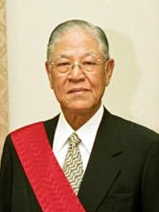
_Portrait of President Lee Teng-hui. Image source: Wikimedia Commons, author/source: Presidential Office, Republic of China; used with permission as announced on the government website, with only cropping and size adjustments made for this article._
📝 Curator’s Note: The most weighty image of Taiwan’s democracy is not necessarily a speech on a stage; sometimes it is a folded piece of paper with a ballot mark, finally proving that "the people" are no longer just a noun to be represented.
Before the Ballot: How the President Was Chosen
The Election Commission’s electoral history records the first presidential election in 1948 as being conducted by National Assembly delegates, with Li Zongren elected as vice president. This indirect election and the 1996 direct popular election form the clearest contrast between the before and after of Taiwan’s institutional transformation. 3
On May 20, 1949, Taiwan implemented martial law. Martial law was not lifted until July 15, 1987. The Election Commission also lists the termination of the Period of Mobilization for Suppression of Communist Rebellion in 1991, the comprehensive renewal of the Legislative Yuan in 1992, and the first direct election of provincial governors and mayors by provincial and municipal residents in 1994 as key nodes in the gradual transformation of democratic institutions. 3
The 1996 election had a clear institutional lineage. Preceding it were the lifting of martial law, the renewal of the legislature, direct elections for local chief executives, and a power structure originally designed for extraordinary times that was subsequently dismantled. Academic compilations from the Academia Historica indicate that Lee Teng-hui’s constitutional amendment project addressed the Mobilization system, the legislature that had not been comprehensively renewed for a long time, and the direct popular election of the president. 4
Source: Election Commission, Focus Taiwan/CNA
After the Wild Lily: Direct Election Becomes an Operable Institution
In March 1990, the Wild Lily Student Movement demanded the abolition of the National Assembly and the Temporary Provisions, the convening of a National Conference, and the establishment of a reform timetable. These demands later moved from the squares into institutional discussions. In 2026, the Presidential Office’s retrospective on the history of direct elections placed the Wild Lily Student Movement, the comprehensive legislative renewal the following year, and the 1996 direct presidential election on the same democratization path. 5
Data from the Election Commission shows that the Period of Mobilization for Suppression of Communist Rebellion was terminated on May 1, 1991. National Assembly elections were held in December 1991, and the comprehensive renewal of the Legislative Yuan was completed in December 1992. 3 The significance of these dates lies in their representation of a legislature that could no longer permanently retain seats under the pretext of extraordinary times, beginning to face a renewed mandate from the people of Taiwan.
On July 28, 1994, the National Assembly passed a constitutional amendment establishing the direct election of the president and vice president, requiring joint candidacy, changing the presidential term to four years with a limit of one consecutive term, and making it applicable starting in 1996. 1 This amendment transformed political slogans into ballot design: what people voted for was a team of national leaders sharing joint responsibility.
The institutional shift also changed the direction of political accountability. Under indirect elections, the president was primarily chosen by National Assembly delegates; after direct elections, candidates had to present their platforms, images, and crisis management capabilities directly to the entire electorate. This does not mean all problems inherent in a presidential system were solved overnight, but it provided a periodic, ballot-based entry point for testing the legitimacy of the highest executive power. The Election Commission’s evolution of electoral systems and the Academia Historica’s compilation of constitutional amendments provide two perspectives: institutional text and historical context. 3 4
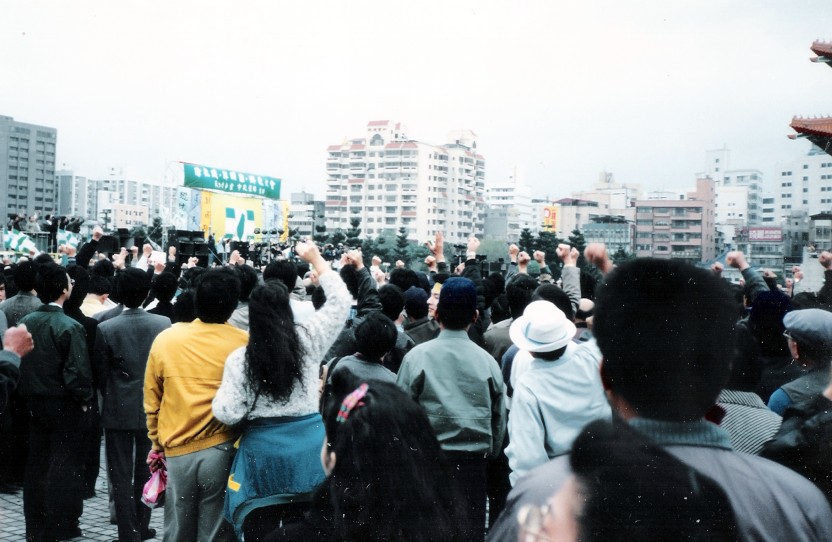
_Scene of the Wild Lily Student Movement protest on March 18, 1990. Image source: Wikimedia Commons, author Bubbha, CC BY-SA 3.0; no derivatives. _
📝 Curator’s Note: Democratization is not about swapping an authoritarian signboard for a democratic one; it is about rewriting "who can authorize whom" into the institutions, and writing it in a way that every voter can actually use.
Four Pairs Spread the Ballot Open
1996 is often condensed into "Lee Teng-hui won." This result is certainly important, but if we only remember the winner, we miss how this election accommodated different imaginations of Taiwan. Data compiled by CNA shows that the DPP candidates were Peng Ming-min and Hsieh Chang-ting; Lin Yang-kang and Hao Po-chen ran as independents; and Chen Lü-an and Wang Ching-feng formed another independent pair. 1
Peng Ming-min was a key figure in Taiwan’s democratic movement, while Lin Yang-kang was a heavyweight candidate following a split within the KMT. The presence of four pairs on the ballot moved 1996 beyond the binary of ruling party versus opposition, and revealed differing judgments within the KMT regarding the speed of reform, national identity, and cross-Strait risks. A CNA retrospective on the 1996 election notes that mainstream and non-mainstream factions within the KMT had different views on direct presidential elections; these divisions ultimately led some figures to leave the KMT and form the New Party. 1
The election also required new political technologies. Photos and text records preserved by CNA include the first televised presidential candidate policy forum on February 25, 1996, as well as scenes of candidate debates, platform promotion, and campaign registration. 1 When presidential candidates had to explain policies to voters on television, the legitimacy of national leadership was no longer determined solely by intra-party consultation but also had to undergo public competition.
This "first" cannot be understood merely as a media event. It was simultaneously a redistribution of electoral responsibility: candidates faced nationwide policy comparisons, and for the first time, voters compared four different political platforms on a single presidential ballot. This made 1996 an event in institutional history and political communication history. Campaign imagery, policy forums, and on-site voting together constituted a new public memory. 1
This vote was also closely watched by international media. A CNA retrospective noted that more than 500 journalists from over 260 international media outlets covered the election. For a society rewriting how the president is chosen, polling stations simultaneously became a window for the world to watch Taiwan’s democratic transition. 1
The Academia Sinica’s database preserves a survey study of the 1996 presidential voters. The study asked voters about their choices, party identification, candidate image, views on unification/independence, media usage, social networks, and attitudes toward the PRC’s military exercises. The final sample size was 1,406 cases. 6 This reveals that the "people" of direct election are not a homogenous group, but composed of individuals carrying their own memories, identities, and risk assessments.
How Voting Day Was Organized
The first direct presidential election also tested whether electoral administration could transform a new institution into an executable daily procedure. The Election Commission’s electoral history places the 1991 National Assembly renewal, the 1992 comprehensive Legislative Yuan renewal, the 1994 direct election of provincial and municipal mayors, and the 1996 direct presidential election on the same line of institutional evolution. These elections allowed voters to gradually become familiar with procedures such as voting, vote counting, candidate registration, and the announcement of election results. 3
The political significance of voting day thus lies in "island-wide synchronization": voters in different locations expressed their choices on the same day using the same joint presidential/vice-presidential ballot, with results compiled by the central electoral authority. This procedural synchronization transformed the president’s legitimacy from the negotiation of specific political elites into a result witnessed jointly by the national electorate. This is a detail in institutional history, yet the foundation of democratic daily life depends on it. 3
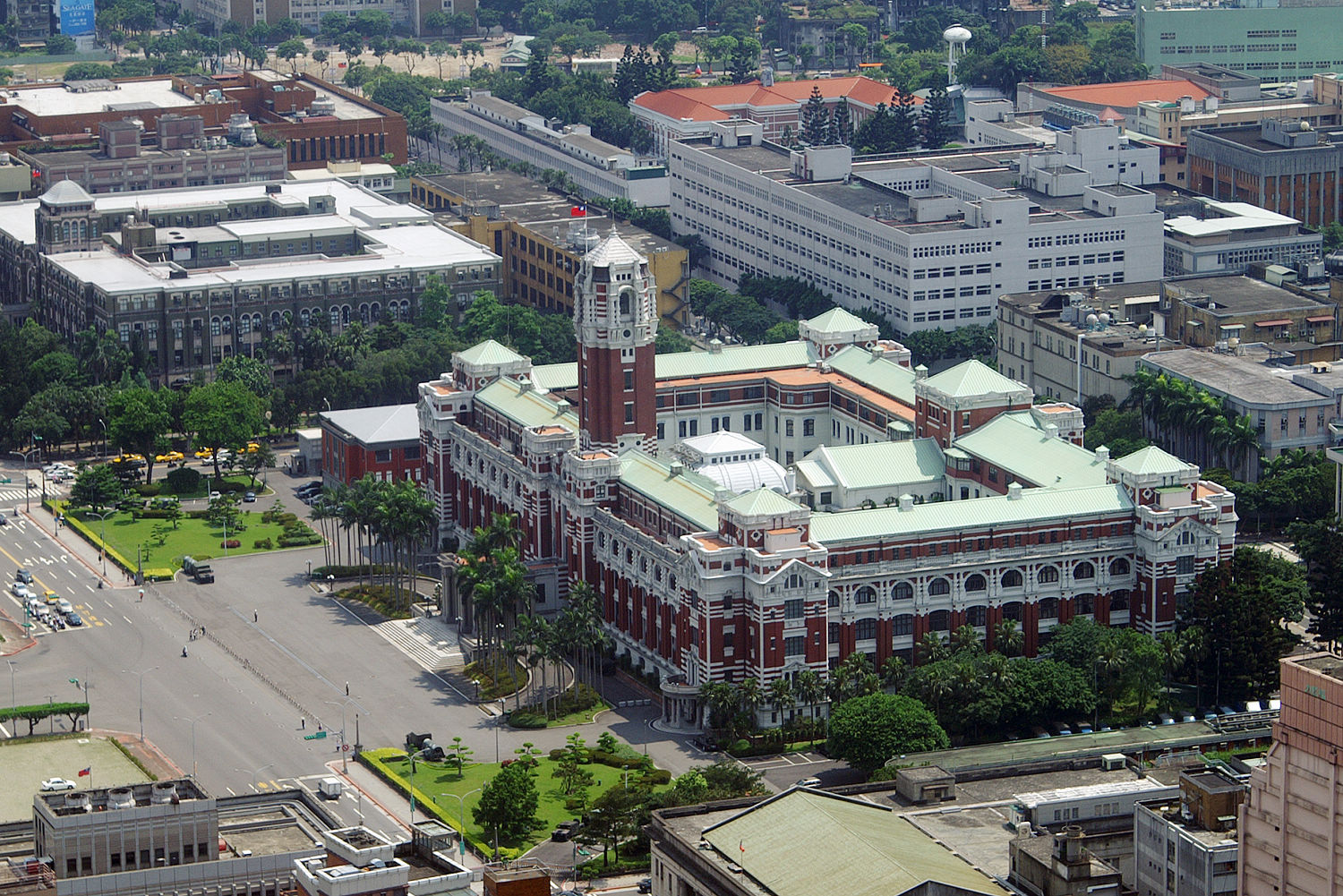
The Presidential Office building in Taipei. Image source: Wikimedia Commons, author Peellden, CC BY-SA 3.0; no derivatives.
Missiles and Ballots Arrive Simultaneously
One starting point of the 1995 crisis was the United States’ decision in May 1995 to allow Lee Teng-hui to speak at Cornell University. A compilation by the National Defense University Press on the 1995–1996 Taiwan Strait Crisis notes that the PRC viewed Taiwan’s democratization and "pragmatic diplomacy" as trends potentially leading to independence, and during the crisis suspended cross-Strait dialogue, conducted missile launches, and held military exercises. 7
The crisis timeline spans two elections: the 1995 Legislative Yuan election in Taiwan and the 1996 direct presidential election. Military signals therefore targeted not only the government but also the environment of voter judgment. A National Defense University study summarizes Beijing’s objectives as influencing U.S. policy, forcing Taiwan to abandon efforts to expand its international space, and weakening the political support for Lee Teng-hui and forces supporting Taiwan’s subjectivity. These are researchers’ compilations of policy objectives and cannot be directly equated with the actual voting motives of every voter. 7
Before the 1996 presidential election, the People’s Liberation Army conducted missile launches and large-scale military exercises around Taiwan. A National Defense University study notes that the U.S. dispatched two aircraft carrier battle groups near Taiwan’s waters in March 1996 to convey military signals while avoiding escalation. 7 A Reuters retrospective also noted that the missile tests before the 1996 direct election were believed to be intended to prevent Taiwan voters from supporting Lee Teng-hui, whom Beijing suspected of having pro-independence tendencies. 8
Here, care must be taken to avoid a common simplification: not all ballot changes can be directly attributed to missiles. A New York Times report on March 24, 1996, noted that Lee Teng-hui received 54% support among nearly 11 million voters, and the sense of crisis caused by military exercises may have led some voters who originally supported the largest opposition party to shift to Lee. 9 "May" is the key word. This is an explanation proposed by contemporary reporting and cannot erase the motives of other voters.
Academic articles also treat the 1996 election as a political event worthy of standalone study. Thomas J. Bellows published "The March 1996 Elections in the Republic of China on Taiwan" in the American Journal of Chinese Studies, Volume 3, Issue 2, pages 235–249. The JSTOR article page confirms the author, journal, and publication information. 10 This reminds us that this election is both a life experience for Taiwan’s people and an object of analysis in international politics and democratic research.
📝 Curator’s Note: Missiles cannot fill out ballots for voters, but they do change the question in everyone’s mind as they enter the polling station: Am I voting for a candidate, and am I accepting that someone else decides for me?
54% from Victory to Institution
Lee Teng-hui and Lien Chan ultimately received 5,813,699 votes, accounting for 54%; Peng Ming-min and Hsieh Chang-ting received 2,274,586 votes, accounting for 21.11%; Lin Yang-kang and Hao Po-chen received 1,603,790 votes, accounting for 14.89%; and Chen Lü-an and Wang Ching-feng received 1,074,044 votes, accounting for 9.98%. A total of 10.76 million voters cast ballots, with a turnout of 76.04%. 1
Source: Focus Taiwan/CNA, Election Commission

Comparison of vote results in Taiwan’s presidential elections, placing the first direct election of 1996 in the long-term sequence of subsequent presidential elections. Image author Emanuelamianstrolski, source: Wikimedia Commons, CC BY-SA 4.0; used as background data, no derivatives in this article.
These numbers can answer who won, but they cannot answer on their own what the election "represented." The New York Times at the time described the 54% as a strong mandate for Lee Teng-hui and reported that some voters viewed the military crisis as a political signal requiring a response. 9 But the Academia Sinica’s voter study design shows that election results need to be understood from multiple variables: candidate evaluation, party identification, issue stance, media and social networks. 6
Therefore, a more prudent statement is: the 54% in 1996 possessed two natures simultaneously. It was the winning proportion for Lee Teng-hui and Lien Chan among the four candidate pairs, and it was also the institutional result of Taiwan’s first determination of presidential legitimacy through popular vote. The latter layer is more durable because it does not disappear with the victory or defeat of the next election.
The Election Commission recorded the 1996 election as the first direct popular election for president and vice president with four-year terms. 3 This four-year rhythm later became the sense of time in Taiwan’s political life: candidates must return to the people, parties must reorganize, and policies must face the追问 (interrogation) of the ballot.
Direct Election Leaves Disputes for the Next Vote
Taiwan has since experienced multiple presidential elections and the alternation of ruling parties. The value of the direct election system therefore lies not only in the first result, but in establishing a repeatable political cycle: the ruling party must accept a new round of mandate at the end of its term, while the opposition can transform dissatisfaction into candidate, platform, and ballot competition. A political analysis from the Foreign Policy Research Institute reviews the series of peaceful and legitimate elections following Taiwan’s democratic transition, noting that elections often connect local governance, party competition, and cross-Strait policy. 3 11 The system established in 1996 did not eliminate disputes. It placed disputes into a procedure where the people can intervene regularly.
This also explains why presidential direct elections and issues of national identity always appear together. The 2026 Presidential Office retrospective interprets direct election as a milestone of popular sovereignty, democratic legitimacy, and Taiwan’s subjectivity. This is the current government’s political interpretation of history; readers should read it alongside the Election Commission’s electoral data, the Academia Historica’s historical compilations, and academic research, rather than treating any single official statement as the complete answer. 5
Direct election still has its limitations. It allows people to elect the president, but does not guarantee that all public policies will be fully discussed; it allows voters to replace the ruling party, but does not automatically eliminate party antagonism, media bias, or the imbalance of power between central and local governments. Academic compilations on Lee Teng-hui also discuss the institutional achievements of democratic reform alongside subsequent bottlenecks such as representative systems and centralization. 4
Therefore, what is most worth remembering about 1996 is not the too-smooth conclusion that "Taiwan completed democratization." A more accurate understanding is that Taiwan made democracy an institution that must be repeatedly used and calibrated. The first vote did not guarantee answers for later generations; it only handed the power of decision to later generations.
📝 Curator’s Note: The true legacy of direct election lies in the re-authorization every four years: no one can forever keep custody of that 54% on behalf of the people.
On March 23, 1996, Taiwan did not wait for risks to disappear before voting. Voters completed the ballot while military threats still existed, and the system obtained its first island-wide validation by citizens on that day. 1 Crises need not be romanticized, and every vote will not be cast for the same reason; what can be certain is that the weight of democracy is often not declared in calm times, but actually used when uncertainty has not yet receded.
From National Assembly delegate voting to people’s direct voting; from martial law and extraordinary times to candidates debating on television screens; from a frozen imagination of the state to a system re-examined by voters every four years, 1996 changed the position of the subject in Taiwan’s politics. 3 That subject is imperfect, inconsistent, and not always rational, but it must be seen: the People.
References
Image Licenses and Sources
All images in this article are directly embedded from public original file URLs on Wikimedia Commons, not relying on local downloads. The author, original source, and licensing conditions of the images are marked in each caption. When using or creating derivatives, one must retain the author/source, the original file page, and the corresponding license link; derivatives of CC BY-SA images must adhere to the same or compatible license conditions.
- Focus Taiwan/CNA, "PHOTO ESSAY / Democracy in flashback: Taiwan marks 30 years since first direct presidential election" — Review of candidates, vote counts, turnout, and election scenes↩2345678910
- Academia Historica, "Elections in Taiwan’s History — Democratic Period — Direct Popular Election of the President" — Official exhibition data on the 1996 direct election and missile tests↩
- Election Commission, "Election History" — Evolution of electoral systems and official election records for 1996↩23456789
- Academia Historica Lee Teng-hui Presidential Cultural Relics Museum, "Review and Inspiration of President Lee Teng-hui’s Second Democratic Reform Initiative" — Institutional context of constitutional amendments, legislative renewal, and direct election↩23
- Presidential Office, Republic of China, "President Attends the '30th Anniversary of Taiwan’s Direct Presidential Election and Democratic Resilience Symposium'" — 2026 official retrospective and political interpretation↩2
- Academia Sinica, "Public Opinion, Elections, and Taiwan’s Mass Politics: A Study of the 1996 Taiwan Presidential Voters" — Research design and data summary of the 1996 voter survey↩2
- National Defense University Press, "Averting Escalation and Avoiding War: Lessons from the 1995–1996 Taiwan Strait Crisis" — Causes, military actions, and crisis management of the 1995–1996 Taiwan Strait Crisis↩23
- Reuters, "'Mostly verbal threats': Taiwan residents shrug off China's warnings on Pelosi visit" — 2022 report retrospective on the 1996 missiles and direct election↩
- The New York Times, Patrick E. Tyler, "Taiwan's Leader Wins Its Election and a Mandate" — Election results and contemporary analysis from March 24, 1996↩2
- JSTOR, Thomas J. Bellows, "The March 1996 Elections in the Republic of China on Taiwan" — Academic article page in the American Journal of Chinese Studies, 1996↩
- Foreign Policy Research Institute, Jacques deLisle, "Taiwan’s Democracy and Lessons from Yet Another Election" — Analysis of elections and cross-Strait politics after Taiwan’s democratic transition↩