
30-second overview: Fujui Wang (1969–) is a pioneer of sound art in Taiwan. In 1993, at age 24, he used his programmer's salary to independently found the experimental music zine NOISE and its eponymous label—the first of its kind in Taiwan. Over four years the zine published ten issues, eight compilations, and nearly thirty albums, each issue A4-photocopied in a run of 200 copies, sold for NT$15–30.1 In 1994 he released the first noise CD by Zero and Sound, the first noise album in Taiwanese history.2 From 1995 to 1997 he studied for a master's degree in Computer Science at Golden Gate University in San Francisco, where he began creating under the name "Ching-Shen-Ching" (精・神・經).3 In 2000 he joined Etat (在地實驗 / ET@T) and co-directed its Media Lab; the same year he began teaching at TNUA's Department of New Media Arts, where he remains today.4 In 2007 his students Yao Chung-Han, Wang Chung-Kun, and Chang Yung-Ta founded the Lacking Sound Festival (失聲祭)—he was its catalyst, not its founder.5 The core of his 2020 solo exhibition Noise is the New Silence was an exploration of the noise inside his body after a serious illness: an artificial blood vessel produces a faint, identifiable frequency.6 Thirty years is the same sentence pronounced twice: noise was where he started with nothing.
That Home Photocopier in 1993
In 1993, Fujui Wang was 24, fresh out of university. On his programmer's salary, he independently funded and single-handedly launched the experimental music zine NOISE and its eponymous label.1
At the time in Taiwan, two independent music publications—Hong Kong's Hearing Aid (助聽器) and Crystal Records' Rockers (搖滾客)—had both ceased publication. Wang wanted to read coverage of experimental noise, but nobody was doing it, so he did it himself. The zine was A4-photocopied and stapled, with a print run of 200 copies per issue, sold for NT$15 to NT$30. Distribution was simple: readers wrote letters directly to Wang to buy copies. There were no record-store distributors, no website.1
As an undergraduate he had already begun writing to experimental music creators in Europe, the US, and Japan, asking about their journeys, their musical philosophies, the materials and tools they used to make sound. In his senior year he compiled these correspondence interviews into a booklet to share with fellow enthusiasts, and after graduation he used his programmer income to formally launch NOISE, entirely devoted to noise.1
NOISE was a one-person press. Published irregularly over four years, it produced ten zine issues, eight compilations, and nearly thirty albums.1
📝 Curator's Note
The experimental noise scene in 1990s Taiwan: DIY was a material condition, not an aesthetic choice. Practitioners traded music albums, flyers, letters, and faxes among themselves; the creator was usually also the label representative. Wang photocopying 200 copies at home was part of the same network as the global practice of "home recording, mailing records to each other, cross-promotion." In 1993, the term "sound art" did not yet exist in Taiwan—it would not become widespread until after 2002.7
The NOISE/TAIWAN Network
NOISE was simultaneously a zine and a distribution label. Its first licensed release in 1993 was Nothing to Hear, Nothing to… 1985 by the Japanese noise collective The Gerogerigegege. In 1994 it released the first noise CD by Zero and Sound (零與聲)—the first noise album in Taiwanese history.2
Zero and Sound (0 與聲低能兒解放組織) was founded on the campus of Fu Jen Catholic University in June 1992. Their principle was to "use instruments without playing them." Alongside the commune-like group Lo-Shui-Kou (濁水溪公社), founded in 1989, they are regarded as the most representative noise collectives in early-1990s Taiwan.2 The NOISE label became a nexus connecting these local noise workers with peers in Japan, the US, Germany, Switzerland, and the UK. The "NOISENET" compilation series, eight volumes in total, collected experimental noise works from these countries.2
Wang's own words best explain why this structure worked:
"The noise creator was also the (noise) label; he released his own work and also distributed others'. When you bought one creator's work from him, he'd give you flyers for other creators, so I could quickly build a network. This was a (noise 'doujin' /同人) culture—I was actually shaped by this culture."1
He continued this work throughout the 1990s. When the print zine ceased publication in 1996 and he returned from the US in 1997, he transformed NOISE into two websites: "NOISE@TAIWAN," covering his own performances and creations, and "Global Sound Art Information Network," a portal site—both hosted under the Etat domain he joined in 2000.1
The print edition stopped, but the network did not break.
"Ching-Shen-Ching" in San Francisco
In 1994 or 1995 (sources disagree on the exact year3), Wang went to the United States to pursue a master's degree in Computer Science at Golden Gate University, returning to Taiwan in 1997.4
His own account: "In 1995, in San Francisco, I began creating experimental sound. Noise has accompanied my life and my work ever since."3 During his time in San Francisco, he began creating sound and video works under the name "Ching-Shen-Ching" (精・神・經).8
The first piece, The Ford of Delusion (迷妄之渡口), appeared on the 1997 NOISE/TAIWAN compilation Killing Me Softly with Noise (以噪音溫柔地殺我).1 The compilation title itself is a curatorial manifesto: replacing "song" in Roberta Flack's 1973 ballad Killing Me Softly with His Song with "noise." Commenting on the "Ching-Shen-Ching" body of work, Yeh Hsing-Jou wrote:
"'Ching-Shen-Ching' reflects the 'local' style that Taiwan developed after absorbing international experimental noise."1
The name "Ching-Shen-Ching" is itself the work's thesis. Three characters, each a discrete syllable—silence-noise-silence—the syllabic structure is the argument. The silence-noise dialectic is Wang's central concern.1
✦ "Noise was where I started with nothing." (Fujui Wang3)
2000: The Three-Person Table at Etat
After returning to Taiwan in 2000, Wang joined Etat (在地實驗 / ET@T).9 That same year, the "Etat Media Lab" was co-directed by Huang Wen-Hao, Chang Tzu-Fu, and Wang Fujui, with Ku Shih-Yung joining in 2001.9
An important factual correction: Etat itself was founded in 1995 by Huang Wen-Hao and others—not by Fujui Wang.10 From 1995, Etat operated as a forum and live-performance venue combined with an online TV broadcast platform, serving as a crucial experimental field for sound art in late-1990s Taiwan. What Wang joined in 2000 was the "Media Lab" division, established five years after Etat's founding.
This was the first institutional turn in Wang's career. From the 1993 model of "one person equals one label" at his home photocopier, to a three-person research team at a conference table; from NOISE zine's "irregular publication, can fold at any time" DIY format, to the Media Lab's institutionalized approach of "developing new media and interactive art projects through collective R&D and creation."
Then in 2003, 2005, and 2006, Etat curated the b!as Sound Art Exhibition (異響 b!as 聲音藝術展), combining open calls and invited works (shown at the Taipei Fine Arts Museum); in 2006 the First Taipei Digital Art Festival launched.9 Wang simultaneously served as a driving force behind the sound art category of the "Taipei Digital Art Awards."4
The word "noise" entered the museum from this point on.
Students Becoming Protagonists
Around 2005, three artists—Wang Chung-Kun, Yao Chung-Han, and Chang Yung-Ta—enrolled in TNUA's Graduate Institute of Techno Arts.9 Wang had been a lecturer in TNUA's Department of New Media Arts since 2000 (he held lecturer rank from 2000 to 2015, only being promoted to assistant professor in 2015)4, and was their teacher.
In 2007, Yao Chung-Han, Wang Chung-Kun, Chang Yung-Ta, plus Yeh Ting-Hao and Niu Chun-Chiang, formed i/O Lab and founded the Lacking Sound Festival (失聲祭).5 It was the most prominent sound event in Taiwan at the time, held monthly, running until January 2016 when it completed its 100th edition and entered a dormant phase.11
Wang was the catalyst of the Lacking Sound Festival, not its founder. This distinction is often blurred in public narratives. The festival's planning and execution were led by Yao Chung-Han and Wang Chung-Kun; Wang Fujui and fellow pioneer Yao Da-Jun served as their mentors in the academy.5 The students took the word "noise" from their teacher's hands and turned it into an institutional, monthly performance platform.
📝 Curator's Note
The common narrative calls Wang "the father of sound art in Taiwan" and a "noise pioneer." This framing is convenient but reverses cause and effect. In 1993, when he was 24 and photocopying NOISE zine alone at home, the term "sound art" did not yet exist in Taiwan—its rise occurred only after 2002.7 A more accurate account: Wang spent thirty years turning the word "noise" from "a codeword in the marginal zine underground" into "a legitimate medium in the museum gallery." He was the agent of this semantic shift, not its namer.
Sound art critic Yan Jun wrote a passage on Heath (數位荒原) that captures this transition with clear-eyed precision:
"Since 2002, following the Taiwan International Electronic Art Forum, large-scale sound art events such as Taipei Sonar and b!as took place; Yao Da-Jun and Wang Fujui taught at Taipei National University of the Arts; the government paid for technology, digital, and media... 'sound art' gradually replaced the word 'noise.' ...And the body, ritual, and spontaneously formed communes gradually faded from the stage."7
This passage describes a fact, and also the cost of an artist's thirty-year walk into the institution.
Post-Surgery Body Frequencies
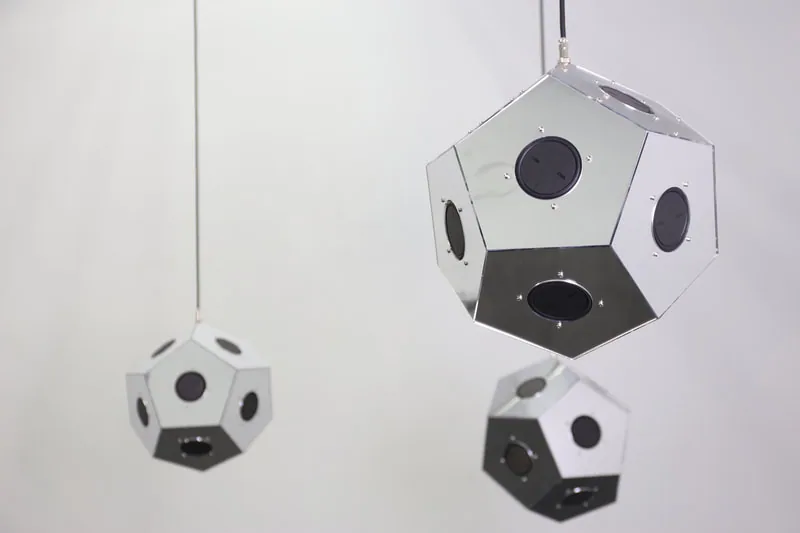
The three works installed side by side at the November 2020 solo exhibition "Noise is the New Silence." Photo: Project Fulfill Art Space. Fair use editorial reference via Project Fulfill.
In November 2020, Wang held a solo exhibition titled Noise is the New Silence (噪音寂靜) at Project Fulfill Art Space, on view through December 5.6 This was his third solo exhibition with the gallery, following Quiet Noise (靜噪) in 2012 and Transparent Imagery of Sounds (透明響像) in 2016, with a fourth, So Noisy, So Silent (如噪如靜), to follow in 2024.12 Read in sequence, the four exhibition titles are like four variations on the same composition, each circling the same theme: the dialectic of silence and noise.
But Noise is the New Silence was different.
The centerpiece of Wang Fujui's 2020 solo exhibition "Noise is the New Silence" — the polyhedral 12-channel omnidirectional speaker transmitting the faint frequencies of an artificial blood vessel. Photo: Project Fulfill Art Space. Fair use editorial reference via Project Fulfill.
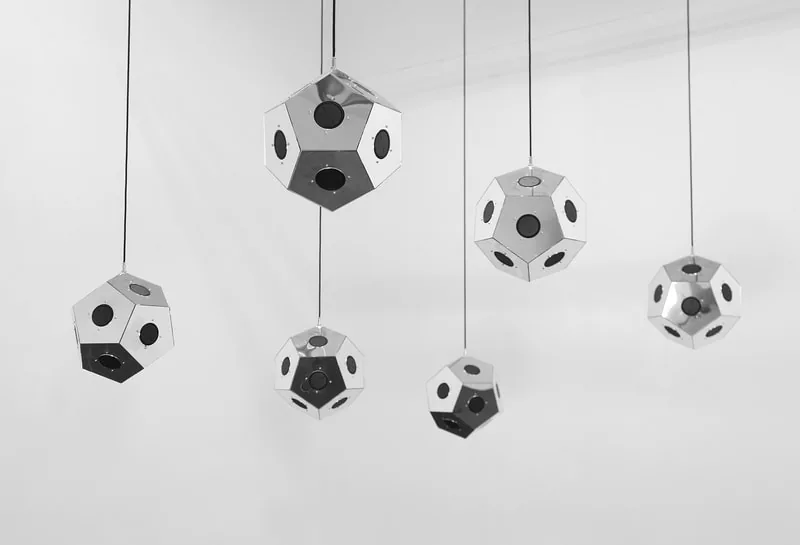
The centerpiece of the gallery was a polyhedral 12-channel omnidirectional speaker, custom-built by Wang and suspended from the ceiling.6 Other works included Noise Shadow (雜影, noise patterns on a CRT screen), Skull Noise (頭顱噪音, a headphone installation), and Body Noise (身體噪音, images of surgical sutures).6
The origin of the work is clearly stated in an interview: "the artist, after 'a serious illness,' explored 'the noise inside his own body'"—an artificial blood vessel produces a faint, identifiable frequency.6
From 24 years old in 1993, photocopying 200 copies of a zine on his home machine, to 51 years old in 2020, hanging a 12-channel speaker in a gallery to listen to the sound of his own artificial blood vessel—these are two kinds of silence pronounced by the same word. In 1993, "noise" referred to the absence in Taiwan's experimental music scene: no zine, no label, no peers. In 2020, "noise" referred to the body itself—the sounds inside the body becoming material.
In an interview with ARTFORUM China, Wang said (verbatim, original Simplified Chinese preserved):
"Noise represents the absence of rules; I can imagine intuitively, spontaneously."6
From the "absence of rules" in the external environment to the "absence of rules" inside the body—the direction reversed, but the logic held.
The Bandcamp Doujin Label
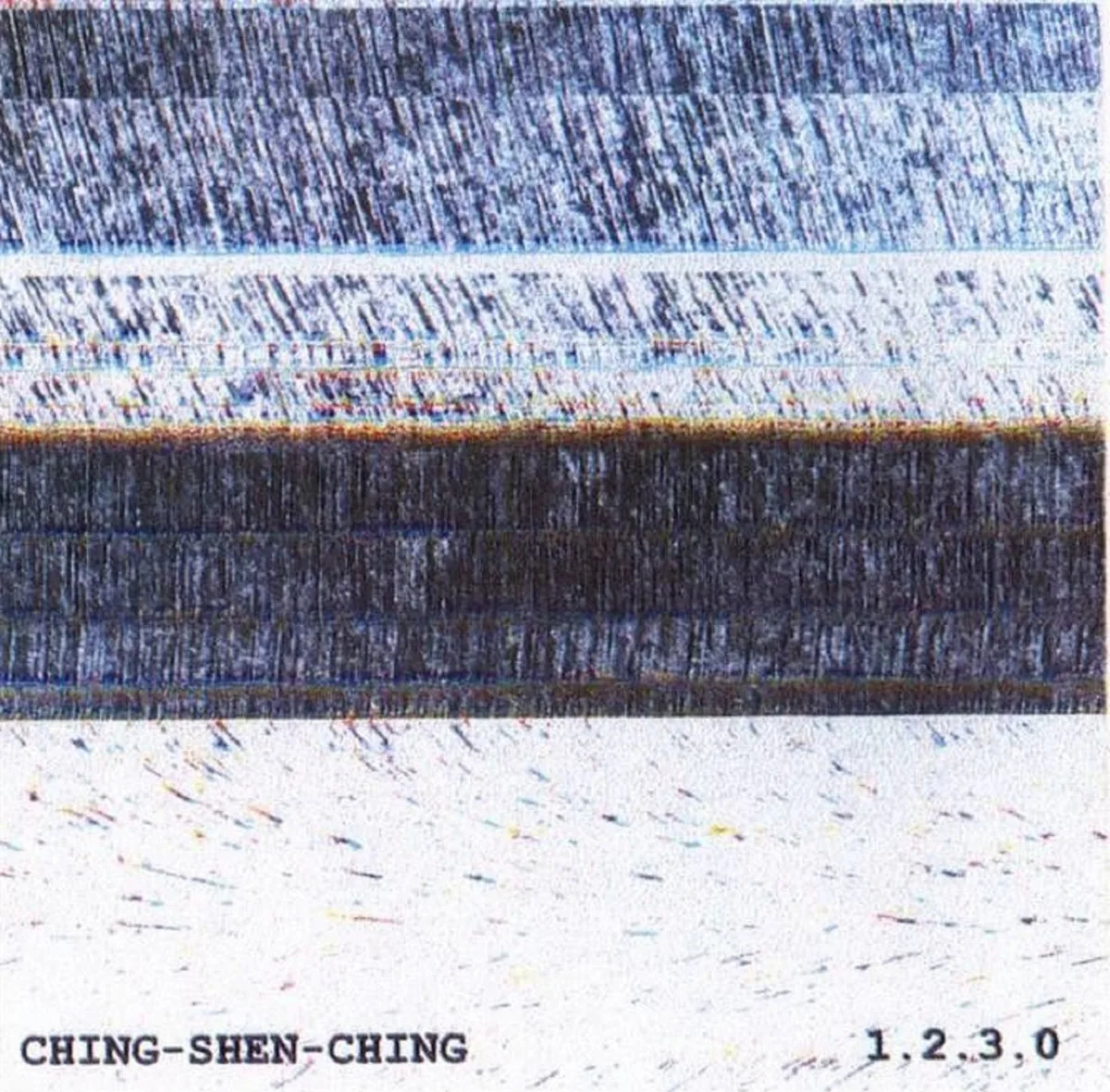
The cover of the 2022 digital album "Ching-Shen-Ching 1.2.3.0." Cover image courtesy of ET@T Bandcamp. Fair use editorial reference.
In 2022, Wang released the digital album Ching-Shen-Ching 1.2.3.0. through the Etat Bandcamp label, comprising 4 tracks,13 organizing "Ching-Shen-Ching" sound materials from the late 1990s through the early 2020s into a downloadable digital imprint. Among the tracks is V-Zone, one of the representative works on this axis. From the 1993 "physical doujin exchange" of 200 photocopied zines to the 2022 Bandcamp stream of a "global online one-person label," thirty years is the same DIY logic on different carriers.
In the 2010s, Wang co-founded Soundwatch Studio (響相工作室) with artist Lu Yi, continuing to promote sound art performances and workshops domestically and internationally.4 His international exhibition record includes the Venice Biennale (the 2011 opening performance for Amy Cheng's Soundscape of Taiwan Society7), Transmediale in Berlin, ZKM in Germany, Ars Electronica in Linz, and the Queens Museum of Art in New York.4
In 2024, the fourth solo exhibition at Project Fulfill Art Space, So Noisy, So Silent.12 The same year, Etat curated Throbbing—Modulating Fujui Wang (悸動—調變王福瑞), a return to the parent institution where he co-directed the Media Lab in 1995, looking back across thirty years.14
✦ What he made with noise over thirty years was, in the end, silence.
From 200 photocopied zines in 1993, the first noise album in Taiwan in 1994, the three-person Media Lab in 2000, the Lacking Sound Festival passed into his students' hands in 2007, to the sound of an artificial blood vessel inside his body in 2020—Wang spent thirty years turning the sentence "noise was where I started with nothing" from a 24-year-old's declaration into a 51-year-old's statement of fact.
"Nothing" in 1993 referred to Taiwan's experimental music scene: no zine, no label, no peers. In 2020 it referred to the body itself: after a serious illness, even the sounds inside the body became material.
Thirty years is one person writing two kinds of silence with the word NOISE. One is the silence of 1993 — the silence of an external environment where Taiwan's experimental music scene had no peers. The other is the silence of 2020 — the silence of the interior of the body, where even the sounds inside the body became material.
Further Reading
- Taiwan Soundscape — The place of Fujui Wang, Yao Chung-Han, Chang Yung-Ta, and other sound artists within Taiwan's soundscape; this article moves from name-level mention to in-depth entry
- Wang Lien-Cheng — A sound and new media artist from the generation of Wang Fujui's students at TNUA's Department of New Media Arts, continuing the wave of student institutionalization that began with the 2007 Lacking Sound Festival
- Taiwan New Media Art — The history of digital and media art development from Etat in 1995 through the 2000s Taipei Digital Art Festivals; Wang is a key node on the sound axis
- Taiwan Independent Music — Another axis of Taiwan's 1990s underground music scene, running parallel to the noise/experimental music world
Image Credits
This article uses 4 images as editorial fair use (commentary on the artist's work), all cached under public/article-images/people/ to avoid hotlinking to source servers:
- "Noise is the New Silence" — 12-channel speaker installation (hero) — The centerpiece of Wang Fujui's 2020 solo exhibition. Photo: Project Fulfill Art Space. Fair use editorial commentary on the artist's work.
- "Noise is the New Silence" — three works in the same frame — Exhibition view of "Noise Shadow," "Skull Noise," and "Body Noise" installed together, 2020. Photo: Project Fulfill Art Space. Fair use editorial.
- "Ching-Shen-Ching 1.2.3.0." album cover — 2022 ET@T Bandcamp digital release. Image courtesy of ET@T. Fair use editorial commentary on the artist's work.
Per the fair use editorial scope for documentary images of living artists' works (especially solo exhibition installations and album covers) — source, photographer/organization, and purpose of use are credited; no CC license required.
References
- Yeh Hsing-Jou, "It launched Internationally: How to NOISE, the DIY Practice of Fujui Wang and Ching-Shen-Ching," Heath (數位荒原), 2023-06-05 — One of six reviews from Yeh Hsing-Jou's 2022 National Culture and Arts Foundation visual criticism project "Spectrum of Noise Activism in the '90s." Documents in detail the 1993 independent founding of NOISE zine at Wang's home, the zine's scale (A4 photocopy / 200 copies / NT$15–30 / ten issues, eight compilations, nearly thirty albums over four years), Wang's own account that "progressive rock valued technique but experimental noise completely broke through..." and "the noise creator was also the label...," and the first "Ching-Shen-Ching" piece The Ford of Delusion appearing on the 1997 compilation Killing Me Softly with Noise.↩
- Yeh Hsing-Jou, "It launched Internationally: Before NOISE," Heath (數位荒原), 2023-05-30 — Another piece in the same series, documenting the early-1990s Taiwan noise scene: Zero and Sound (0 與聲低能兒解放組織) founded at Fu Jen in June 1992, Lo-Shui-Kou (濁水溪公社) founded in 1989, NOISE/TAIWAN's 1993 licensed release of The Gerogerigegege's first album, and the 1994 release of Zero and Sound's first noise CD (Taiwan's first noise album); the "NOISENET" compilation series, eight volumes, collecting experimental noise from Japan, the US, Germany, Switzerland, and the UK.↩
- "About experimental sound, there's no playlist: Interview with sound artist Wang Fujui," ART PRESS Asia, 2020-12-02 — Interview conducted during Wang's Noise is the New Silence solo exhibition; Wang's own account of "in 1993 I began editing the Noise experimental music zine, then founded the eponymous independent experimental music label," "in 1995 in San Francisco I began creating experimental sound, and noise has accompanied my life and work ever since," "from 1995 to 1997 I studied in San Francisco," "noise was where I started with nothing," and "a creator never wants to stay at one point"—five direct quotes searchable by ctrl-F in the original Chinese.↩
- Fujui Wang faculty page, Department of New Media Arts, Taipei National University of the Arts + Fujui Wang faculty page, School of Film and New Media, TNUA — Education: "M.S. in Computer Science, Golden Gate University, USA"; positions: "Lecturer, Department of New Media Arts (2000/08–2015/08)," "Assistant Professor, Department of New Media Arts (2015/08–present)"; bio: "In 1993, as a pioneer, he founded Taiwan's first experimental music label and publication Noise; in 2000 he joined Etat and promoted the international b!as Sound Art Exhibition and the sound art category of the Taipei Digital Art Awards"; international exhibitions: "Venice Biennale, Transmediale Berlin, ZKM Germany, Ars Electronica Linz, Queens Museum of Art New York"; co-founded Soundwatch Studio with Lu Yi in 2015.↩
- Lacking Sound Festival, Taiwan Contemporary Art Archive (TCAA) entry — The Lacking Sound Festival was planned and launched in 2007 by the sound art collective i/O Lab (formed in 2005 by Yao Chung-Han, Wang Chung-Kun, and Chang Yung-Ta); "members of the Lacking Sound Festival entered the academy and were inspired by early Taiwanese noise artists—Fujui Wang, Yao Da-Jun, and others."↩
- Hsu Shih-Yu, "Fujui Wang on 'Noise is the New Silence,'" ARTFORUM China, 2020-11-29 — The only on-site verbatim interview for Wang's 2020 Noise is the New Silence solo exhibition (Project Fulfill Art Space, through 2020-12-05); documents the custom-built polyhedral 12-channel omnidirectional speaker, the works Noise Shadow, Skull Noise, Body Noise, and Noise is the New Silence; the creative origin: "the artist, after 'a serious illness,' explored 'the noise inside his own body'"; Wang's direct quote: "Noise represents the absence of rules; I can imagine intuitively, spontaneously."↩
- Yan Jun, "How to Be Changed by the World—Chinese Sound Practices in Reality," Heath (數位荒原) — Chinese sound art critic Yan Jun's observations on the institutionalization of sound art in Taiwan after 2002; verbatim documentation of "since 2002, following the Taiwan International Electronic Art Forum, large-scale sound art events such as Taipei Sonar and b!as took place; Yao Da-Jun and Wang Fujui taught at Taipei National University of the Arts; the government paid for technology, digital, and media... 'sound art' gradually replaced the word 'noise'"; the same passage mentions Amy Cheng's 2011 Venice Biennale Soundscape of Taiwan Society, with Wang Fujui and Lin Chi-Wei participating in the opening performance.↩
- Ching-Shen-Ching (精・神・經), "V-Zone," ET@T Bandcamp — "Ching-Shen-Ching (精・神・經, Fujui Wang)" as an alias under the Etat label, verbatim confirmation that this is the name the artist has used since 1995 (the artist's own Bandcamp uses "精・神・經" as the official Chinese rendering).↩
- Yeh Hsing-Jou, "Different Location, Different Sound? Recap of b!as 2015 Artist Exchange Project," Heath (數位荒原), 2016-01 — Footnote 2 contains the key institutional timeline of Etat in the 1990s: "Etat was founded in 1995, operating as a forum and live-performance venue combined with an online TV broadcast platform, serving as one of the crucial experimental fields for sound art; in 2000, Etat's 'Media Lab' was co-founded by Huang Wen-Hao, Chang Tzu-Fu, and Wang Fujui (Ku Shih-Yung joined in 2001); b!as Sound Art Exhibitions in 2003, 05, 06; the First Taipei Digital Art Festival in 2006; the Lacking Sound Festival in 2007, with Yao Chung-Han and Wang Chung-Kun as the main planners and executors"—this is the canonical source refuting the existing error that "Etat was founded by Fujui Wang."↩
- Ching-Shen-Ching 1.2.3.0., ET@T Bandcamp — Etat's self-description: "'Etat' was founded in 1995, observing and developing all forms of art with potential, and exploring the ambiguous states produced by digital culture." This digital album, released 2022-07-01, contains 4 tracks (00:35 / 04:05 / 04:45 / 10:40), a contemporary imprint of thirty years of "Ching-Shen-Ching" sound materials.↩
- Chang Yu-Sheng, "The Lacking Sound Festival as a Unit of Time: The Prospect After the 100th Edition," Heath (數位荒原), 2016-01-20 — The Lacking Sound Festival ran from 2007 to 2016-01-08 and 2016-01-22, reaching its 100th edition before entering a dormant phase; the article also documents the 2016-01-22 event featuring a cross-national collaboration between Wang Chung-Kun and GayBird, and a new media ensemble "XXXXX" comprising Wang Fujui and Lu Yi, Yao Chung-Han, Yeh Ting-Hao, and Wang Hsin-Jen.↩
- WANG Fujui solo exhibition page, Project Fulfill Art Space — Chronology of Wang Fujui's four solo exhibitions at Project Fulfill Art Space: 2012-09-22 to 11-25 Quiet Noise (靜噪), 2016-10-15 to 11-20 Transparent Imagery of Sounds (透明響像), 2020 Noise is the New Silence (噪音寂靜), 2024-09-21 to 10-26 So Noisy, So Silent (如噪如靜); representative works listed: Sound Bubble (2008), Sound Dot (2010), Supersonic Wave (2011), Electromagnetic Soundscape (2012); promoted events: Transonic Sound Art Festival 2008/2009/2010/2012, Taipei Digital Art Festival 2007–2009, b!as.↩
- Ching-Shen-Ching 1.2.3.0., ET@T Bandcamp — The "Ching-Shen-Ching" digital album released 2022-07-01, 4 tracks totaling approximately 20 minutes, released on Bandcamp by the Etat label (based in Taipei).↩
- Yeh Hsing-Jou, "Spectrum of Noise Activism in the '90s: On the Artistic Practices of Chou I-Chang, Huang Ming-Chuan, and Fujui Wang," National Culture and Arts Foundation 2022 Visual Criticism Project final report page — National Culture and Arts Foundation 2022 "Phenomenon Writing" visual criticism project, grant amount NT$310,000; the project abstract clearly states Wang Fujui was born in 1969 and devoted himself to noise creation in the early '90s; the three creators Chou I-Chang (1948–), Huang Ming-Chuan (1955–), and Wang Fujui (1969–) "in the '90s, from the fields of 'theater,' 'documentary,' and 'noise' respectively, activated 'heterogeneous sounds' in society."↩