
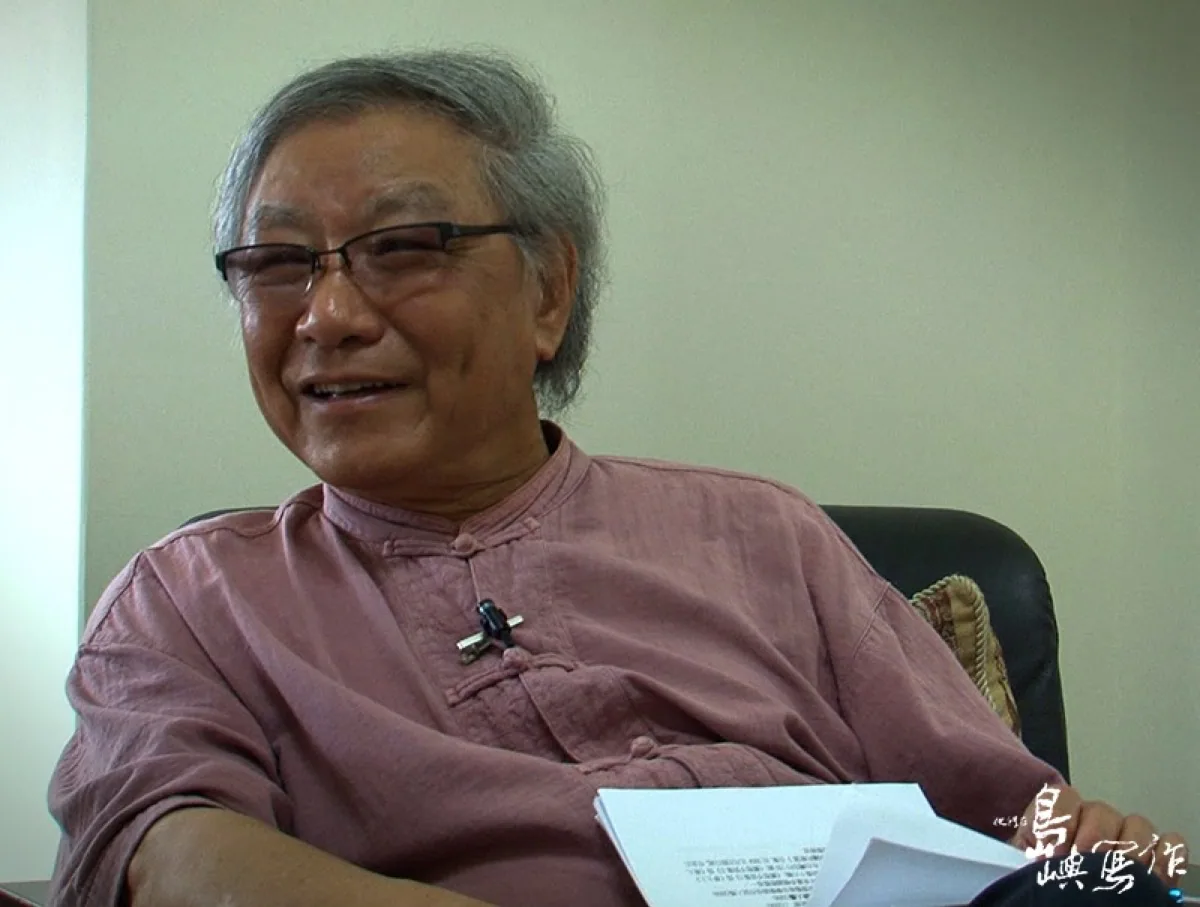
30-second overview: Born on December 4, 1933, in Jinan, Shandong, Cheng Chou-yu’s given name was Cheng Wen-tao, and his ancestral home was Ninghe, Hebei. He came to Taiwan with his family in 1949 and self-published his first poetry collection, Sandals and Rafts, at age 16. In 1955, at 22, he published “Error” in On Dreamland; “My clattering horse’s hooves are a beautiful error / I am not a homecomer, but a passerby” became a shared literary memory for Taiwan’s 1980s-2000s generations. Yet in his later years Cheng clarified that the poem was in fact an antiwar poem, about his mother waiting during wartime for his father to return. In 1956, he joined Ji Xian’s Nine-Person Meeting of the Modernist School. In 1968, he went to the University of Iowa Writers’ Workshop in the United States, and later taught for many years in Yale University’s Department of East Asian Languages and Literatures. In 2005, after retiring from Yale, he returned to Taiwan, moved his household registration into that of his Kinmen County clansman Cheng Feng-sheng, became the first chair professor at National Quemoy University, and often walked alone along the shore of Cihu. At 4:44 a.m. on June 13, 2025 (U.S. time), he died of heart failure at the age of 91 1 2 3.
“My clattering horse’s hooves are a beautiful error” is actually an antiwar poem
You probably read “Error” in junior high or senior high school. In 1995, the National Institute for Compilation and Translation included it in the senior high school Chinese literature textbook 4, and an entire generation of Taiwanese students memorized these lines before the Joint College Entrance Examination:
I passed through Jiangnan
The face waiting in the seasons like a lotus blooming and fadingThe east wind does not come, the willow catkins of March do not fly
Your heart is like a small, lonely city
Just like a blue-stone street toward evening
Footsteps do not sound, the spring curtain of March is not lifted
Your heart is a small window tightly shutMy clattering horse’s hooves are a beautiful error
I am not a homecomer, but a passerby... 5
The textbook’s standard reading treated it as a “boudoir-lament poem”: in a small city somewhere in Jiangnan, a woman waits for a traveler to return home, mistakes the distant sound of horse hooves for her beloved’s return, then discovers it is only a passerby and sees her hope collapse. Its classical images (lotus, blue-stone street, spring curtain, window) are neatly arranged; its rhythm is light; when read aloud it sounds like a modern version of an old ci lyric tune. Exam commentaries would write: wanderer’s sensibility / longing wife theme / modernization of the traditional boudoir-lament motif.
Cheng Chou-yu himself clarified this reading in a 2010 interview. He said the real background of “Error” was the War of Resistance against Japan, and that it described the period when his mother took him wandering through China’s interior provinces during wartime, waiting in vain for his father, who had gone to the front, to return 6. His father was fighting on the front line, his life and death uncertain; his mother “became the most fundamental factor in the writing of this poem.” The sound of horse hooves was the sound of troops passing by; the “homecomer” was the father who could not come back; the “passerby” was the army passing through. The poem as a whole was not about lovers’ longing, but about an eight- or nine-year-old child watching his mother listen every day for footsteps outside, then be disappointed again. That memory accumulated into a poem.
But this “antiwar poem” reading was not what most Chinese literature teachers in Taiwanese secondary schools taught. A poem had circulated for seventy years, and when the author himself stepped forward to say, “You have all read it wrong,” the textbooks continued to print it within the framework of a boudoir-lament poem. Cheng Chou-yu did not object much during his lifetime. In the interview, he said mildly that once a poem is written, it no longer belongs to the author; each reader reads out their own version.
The irony is this: an antiwar poem circulated for seventy years as a love poem; and what pushed it into mass consciousness was another industry, Mandarin popular music. In the 1980s, Lee Tai-hsiang set “Error” to music, and Chyi Yu, Pan Yue-yun, and Tang Hsiao-shih all sang it 7. Lo Ta-yu, Purdur, Wu Bai, and Cyndi Chaw also used Cheng Chou-yu’s poems in songs. Popular music’s reach put this poem into the ears of Taiwanese people across generations. When Cheng Chou-yu died, Lee Tai-hsiang’s daughter, Lee Jo-ling, posted a memorial note: “Dad’s good friends are making heaven livelier and livelier.” 7
Where the two characters “Chou-yu” came from
The pen name “Chou-yu” comes from “Xiang Furen” in the Chu Ci’s “Nine Songs”: “The lord’s daughter descends on the northern islet; her gaze is distant, and it saddens me” 8. Qu Yuan wrote of the goddess of the Xiang River descending upon a northern sandbar, gazing far into the distance and causing sorrow; “chou yu” means “to make me sorrowful.” When Cheng Chou-yu began writing poetry at 16, he chose these two characters as his pen name, directly carrying the classical compassion and grief of the Chu Ci on his back.
Among poets of his generation, quite a few chose pen names with conscious intent. Ya Xian (Wang Ching-lin) used “ya,” meaning mute, and “xian,” meaning string: a muted string writing poetry. Luo Fu (Mo Yun-tuan) made “Luo Fu” out of “falling” plus “man,” with a heavy wanderer’s aura. Cheng Chou-yu’s “Chou-yu” belongs to the same lineage: this group of postwar mainlander youths who crossed the sea had been uprooted from their original homes and thrown onto an unfamiliar island; homesickness and the era’s loss of speech became the core emotions of their generation’s poetics. Choosing a pen name containing the character “sorrow” was almost a shared posture among poets of that generation.
Cheng Chou-yu’s ancestral home was Ninghe, Hebei, and he was born on December 4, 1933, in Jinan, Shandong. His father was an officer in the National Revolutionary Army and spent long stretches on the front during the War of Resistance. When the family came to Taiwan in 1949, Cheng was 16. He graduated from Hsinchu Senior High School in 1955 and later studied at the College of Law and Business of National Chung Hsing University 1. Before coming to Taiwan in 1949, he had already published his first poetry collection, Sandals and Rafts, at his own expense in Beiping. Only with his second book, On Dreamland, in 1955 did he formally enter Taiwan’s poetry scene. “Error” was included in On Dreamland 2.
The poet Xiao Xiao later wrote of him: “Cheng’s poetry most fully possesses traditional poetic feeling, and his poems are compact in length, which is precisely the true character of Chinese poetry.” 8 The comment by his contemporary Ya Xian is even more imagistic: “Cheng Chou-yu’s graceful yet reserved charm, dreamlike yet bright poetic imagination, gentle melody, lingering rhythm, and aristocratic, Eastern, faintly sorrowful tone create a cloudlike allure.” 8 Put together, these two comments help explain why the semi-classical, semi-vernacular sentences of “Error” were so distinctive in the 1950s. At the time, mainstream modern poetry was trying to write in the most Westernized and intellectual syntax possible; Cheng Chou-yu moved against that current, polishing classical imagery back into the texture of modern poetry.
The small 1956 meeting: Ji Xian’s nine modernists
The decisive moment in Cheng Chou-yu’s entry into Taiwan’s poetry scene came on January 15, 1956. That day, Ji Xian convened the “First Annual Meeting of Modernist Poets” at the Taipei Civic Organizations Activity Center. Nine people attended: Ji Xian, Ye Ni, Cheng Chou-yu, Luo Xing, Yang Yun-ta, Lin Ling, Ji Hong, Lin Heng-tai, and Shang Qin (some later accounts differ slightly on the list of nine) 9. The meeting produced the six articles of the “Modernist Creed,” of which the most famous was the second:
We believe that new poetry is a horizontal transplant, not a vertical inheritance.
The four characters “horizontal transplant” directly set off the two-year debate that began when Qin Zihao published “Where Is New Poetry Going?” in Blue Star Poetry Selections in 1957 and Ji Xian wrote a rebuttal 9. The dispute was this: should postwar Taiwanese new poetry draw its lineage from Western modernism after Baudelaire (Ji Xian’s position), or should it continue the lyric roots of the classical Chinese poetic tradition (Qin Zihao’s position)?
Behind this debate was in fact the deeper problem created by the rupture of 1949: could the mainland tradition of new poetry, now “contaminated” by the Chinese Communist Party, still be inherited? Was Western modernism a substitute or a way out? Both sides were dealing with the real question of how Chinese-language modernity could be regenerated. There was no victor, but the axis of “horizontal transplant versus vertical inheritance” became the most fundamental issue format in Taiwan modern poetics. Almost every later poetic debate, from Tang Wen-biao’s 1972 attack on the obscurity of modern poetry to the 1977 Nativist Literature Debate and the postmodern debates of the 1980s, was a variation on this axis 9.
Cheng Chou-yu was one of the nine modernists, but he kept a low profile in this debate. His poetic style was itself a paradox: as a person he stood on Ji Xian’s side, advocating horizontal transplant, while his writing preserved classical imagery and lyric meter, traits closer to Qin Zihao’s side. Part of the success of “Error” came from this position: he was gentler than Ji Xian and more modern than Qin Zihao, becoming the member of the modernist camp most approachable to general readers 10.
Departure: Iowa and thirty years at Yale
In 1968 (some sources give 1967), Cheng Chou-yu was invited to the United States to take part in the University of Iowa’s International Writing Program (IWP) 1 2. The program was founded at the University of Iowa in 1967 by Nieh Hualing and her husband Paul Engle, and from the 1970s onward it regularly invited writers from the Sinophone world for short-term residencies. Cheng Chou-yu was one of its early participants. Poets and writers of the same generation, including Ya Xian, Shang Qin, Yang Mu, Wang Wen-hsing, Pai Hsien-yung, Chen Yingzhen, and Yao Yi-wei, were all members of this program at various points; Iowa almost became a relay station for Sinophone literature during the Cold War.
From Iowa onward, the center of Cheng Chou-yu’s life shifted to the United States. He received an MFA from the University of Iowa and a doctorate from its School of Journalism, and later taught for many years in Yale University’s Department of East Asian Languages and Literatures 8, for more than three decades in all. These Yale years had a subtle effect on his poetic style: his output clearly decreased, but the density of each poem deepened, and Eastern imagery began to interweave with the perspective of the Western academy. The Collected Poems of Cheng Chou-yu, published in 1979, was the culmination of this period 2.
The Yale years also made him an important channel through which the English-speaking world encountered Taiwanese poetry. English translations of “Error” (there are several versions, but versions circulated within the Yale system spread most widely) brought the image of the “clattering horse’s hooves” into comparative literature classrooms. Like Yu Kwang-chung, who once taught at Pittsburgh, and Wai-lim Yip at UCSD, Cheng Chou-yu’s academic position in the United States was both his own destination and a window through which Taiwan modern poetry was read in English-language circles.
Even so, he was never thoroughly “Americanized.” He still wrote poetry in Chinese, still published primarily in Taiwan’s poetry scene, and occasionally spoke on the poetry debates of Taiwan from the 1970s to the 1990s while keeping his distance. He belonged to the kind of person who had lived abroad for 30 years but whose passport, psychologically, remained Taiwanese.
Return: registering in Kinmen in 2005

Sunset over Cihu, Kinmen. After retiring from Yale and returning to Taiwan in 2005, Cheng Chou-yu often walked alone along Cihu’s shore, watching the tides rise and fall. Photo: Meigazine CHENG (Wikimedia Commons, CC BY-SA 4.0)
The year 2005 was a crucial turning point in Cheng Chou-yu’s life. That year, at 72, he retired from Yale and decided to return to Taiwan. His place of return was not Taipei, nor Hsinchu, where he had attended secondary school, but Kinmen.
“Affections returning to Wujiang, household registration settled in Kinmen” was Cheng’s own phrasing 11. In 2005, he formally moved his household registration into that of Cheng Feng-sheng, a Cheng clansman in Kinmen County, becoming a Kinmen County resident. That same year, Lee Chin-chen, the founding president of National Quemoy University, invited him to serve as chair professor. This was one of the most important personnel appointments around the time Kinmen Institute of Technology was being reorganized and upgraded into a university: bringing a poet of Cheng Chou-yu’s stature to reside regularly on Kinmen Island 11.
Cheng Chou-yu’s connection with Kinmen can actually be traced back to 1967. That year, he first visited Kinmen Island at the invitation of the military and wrote the four-poem sequence Kinmen Collection: “Tree,” “Rock,” “White Mule,” and “Earth” 11. These four poems described Kinmen in the 1960s, still on the front line and liable at any moment to come under shelling again: every tree, every rock, every white mule, and every handful of earth on the island carried the smell of gunpowder and a sense of displacement. For a 34-year-old poet just about to go to the United States, Kinmen was Taiwan’s farthest corner and also the place most like a battlefield at the time.
In 2000, when Kinmen commemorated the 800th anniversary of Zhu Xi’s death with the first “Poetry and Wine Welcoming the Millennium” Poetry and Wine Festival, Cheng was invited to participate and wrote “Drinking Wine on a Kinmen Journey.” In the Mid-Autumn Festival of 2003, he came to Kinmen again and pressed the button for the two sides of the Taiwan Strait to launch high-altitude fireworks simultaneously. This was 45 years after the 823 Artillery Bombardment, and the first time Kinmen and Xiamen across the water set off fireworks together; he was chosen as the person to press the button. In 2004, he brought the German sinologist Wolfgang Kubin to attend the Kinmen Bunker Art Exhibition. He also personally went to the Yanping Commandery Prince Shrine in Xiashu, Jincheng, to pay respects to the Cheng ancestors 11.
These activities formed the prelude to his formal household registration in Kinmen in 2005. He often liked walking alone along the shore at Cihu, watching the tide rise and fall 11. This image, unfortunately, looks less like the image of a modern poet than like the reclusion of a classical poet: after circling more than halfway around the globe over half a century, he found, on the small Taiwanese island closest to the Chinese mainland, a corner where he could write poetry, honor his ancestors, and look at the sea.
The Mantle of Peace and the 823 Peace Bell
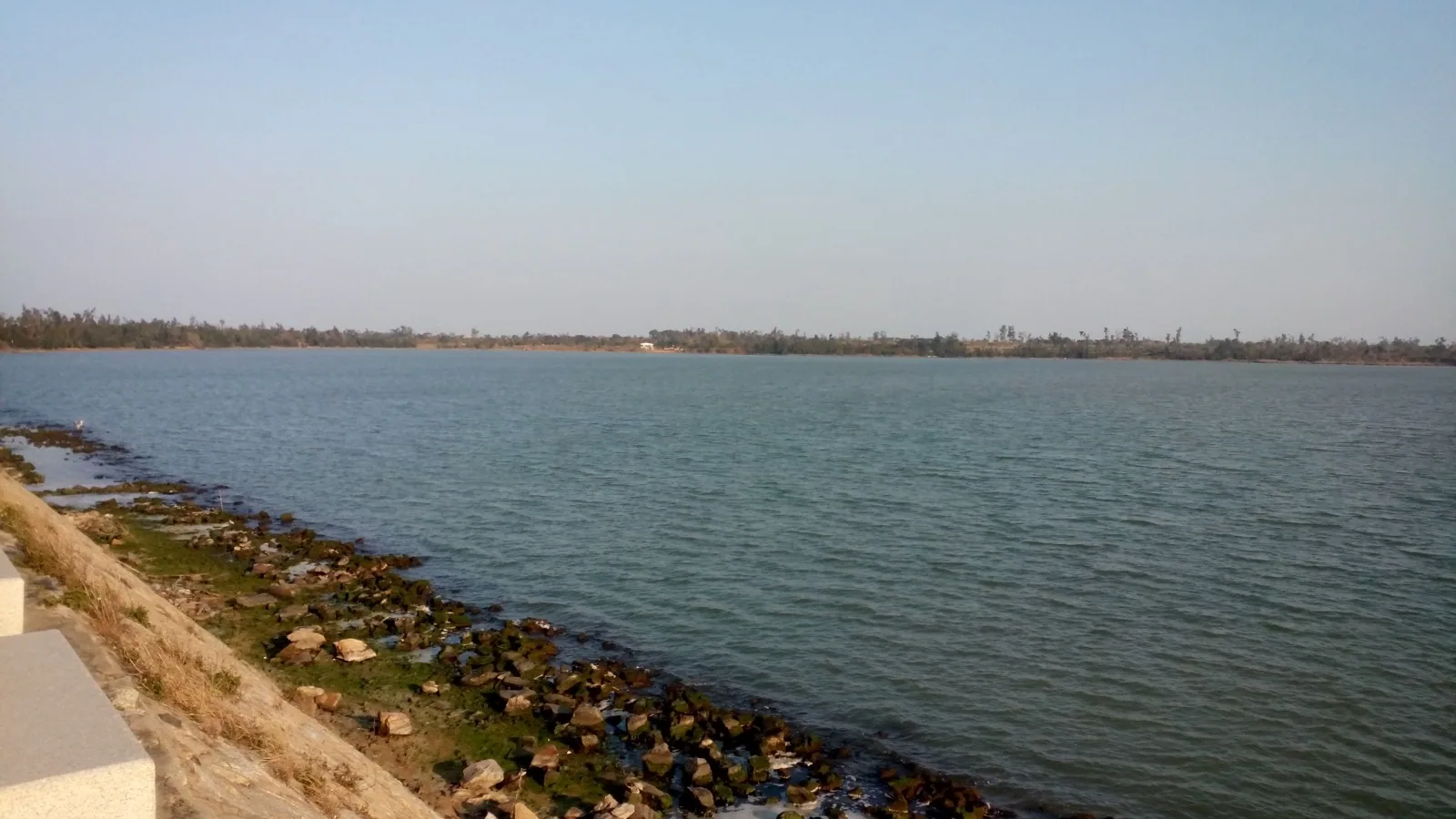
Panorama of Cihu, Kinmen. Located in Jinning Township, Kinmen County, Cihu covers 120 hectares and is Kinmen’s largest artificial lake. It was originally created in 1969 by building an embankment under Chiang Ching-kuo’s military supervision, and after the 1990s became a habitat for migratory birds. Photo: Mnb (Wikimedia Commons, CC BY-SA 4.0)
After registering his household in Kinmen, Cheng Chou-yu wrote a new poetry collection titled The Mantle of Peace: A Century of Poetry, Ten Thousand Ages of Tranquility, which won the 10th Global Life Literature Creation Award. The central subject of this collection was peace. For someone whose ancestral home was Hebei, who was born in Shandong, who fled with his mother through Chinese provinces during the War of Resistance, crossed the sea in 1949, first set foot on the Kinmen front line in 1967, and registered his household in Kinmen in 2005, “peace” was not an abstract word but a concrete condition pursued over an entire lifetime.
One poem in the collection includes the line “when the bell of peace is struck eight hundred twenty-three times.” The Kinmen County Government later engraved this line beside the Peace Bell in Kinmen’s Peace Memorial Park. The 823 Artillery Bombardment was the intense shelling of Kinmen launched by the Chinese People’s Liberation Army on August 23, 1958; within 44 days, Kinmen Island was hit by 470,000 shells. Beside the Peace Bell, Cheng Chou-yu’s poetic “823 strikes” turns the number of shells into the number of bell tolls, converting a unit of destruction into a unit of peace.
This may be the most concrete instantiation of Cheng Chou-yu’s later years: carving poetry into the physical landscape of Kinmen Island. Having “Error” printed in senior high school textbooks for an entire generation from the 1980s to the 2000s was diffusion through the education system; having a line of poetry engraved on Kinmen Island’s Peace Bell was occupation of physical space. Both forms of diffusion were effective, but the latter carried more weight. Textbooks are revised; Kinmen Island is not.
The final journey: the line “not a homecomer, but a passerby” came true
At 4:44 a.m. on June 13, 2025 (U.S. time), Cheng Chou-yu died in the United States of heart failure at the age of 91 1. CNA quoted the poet Xiao Xiao relaying a message from Cheng Chou-yu’s sister-in-law Lin Tsai-kuei: “The master brought so much romance and melancholy to Taiwan and the Chinese-speaking world. May he reunite with his beloved family in heaven, and may poetry and music be passed down forever.” 2
There are discrepancies among sources regarding his age at death. CNA, Mirror Media, The News Lens, Merit Times, and the United Daily News system’s 500輯 all give 91 (calculated from December 4, 1933 to June 13, 2025, he was 91 and a half in full years) 1 2 3. Ming Pao and some mainland Chinese media reported 92; some relatives and friends reported 94, likely based on East Asian nominal age or lunar-year calculation. Taiwan.md follows the 91-year-old version given by multiple mainstream media outlets 1 2 3.
Kinmen County Magistrate Chen Fu-hai expressed deep regret after learning the news and instructed the Kinmen County Cultural Affairs Bureau to convey condolences to the family 11. The Kinmen County Government later noted that Cheng Chou-yu had moved his household registration to Kinmen 20 years earlier, and that Kinmen’s cultural circles regarded him as “no longer a passerby.” This phrasing echoed the final line of “Error”: “I am not a homecomer, but a passerby.” In the poem, he wrote that he was a passerby; in life, he chose to stop.
Lee Tai-hsiang’s daughter Lee Jo-ling posted a memorial note on Facebook: “Dad’s good friends are making heaven livelier and livelier.” 7 Lee Tai-hsiang himself died in 2014. The person who set “Error” to music left first; 11 years later, the person who wrote the poem left too. The witnesses to that era of cross-disciplinary collaboration between Chinese-language literature and music are departing one by one.
Cheng Chou-yu belonged to the last surviving group among Taiwan’s first postwar generation of mainlander poets: Ji Xian died in 2013; Qin Zihao died early in 1963; Yu Kwang-chung died in 2017; Luo Fu died in 2018; Ya Xian died in October 2024 (at the venerable age of 92, less than eight months before Cheng Chou-yu); Zhou Mengdie died in 2014; Shang Qin died in 2010; Yang Mu died in 2020 12. Of the “iron triangle” of the Epoch Poetry Society, Luo Fu, Ya Xian, and Zhang Mo, only the 95-year-old Zhang Mo (nominal age in 2026) remains. The generation whose “clattering horse’s hooves” rang through the literary world is drawing to a close.
For people educated in Taiwan from the 1980s to the 2000s, Cheng Chou-yu’s death may call up an extremely specific memory: opening the senior high school Chinese literature textbook to his page, the teacher copying the poem onto the blackboard, and the whole class discussing what “clattering horse’s hooves” meant. This shared memory crossed blue and green political divides and crossed generations. Not because the poem was especially great, but because it was selected for the textbook and printed for 30 years. Seventy years after a poem is written, the paths by which it spreads can far exceed what the author himself could imagine.
Why the boudoir-lament reading prevailed over the antiwar reading
Looking back, there is an interesting question: why did the boudoir-lament reading of “Error” prevail over the antiwar reading?
The first factor was the timing of publication. Taiwan in 1955 was still under martial law, and the very words “antiwar” carried political risk. The official position at the time was “retaking the mainland”; what was opposed was not war itself but the “Communist bandits.” If an antiwar poem had stated its position directly, it very likely would not have passed the Taiwan Garrison Command. Cheng Chou-yu packaged wartime memory in classical Jiangnan imagery, writing the mother from the War of Resistance as a waiting woman, and the horse hooves of passing troops as a passing wanderer. This packaging was both literary technique and a safety strategy under martial law.
The second factor was the textbook selection logic of the National Institute for Compilation and Translation in 1995. The standard commentary section of the senior high school Chinese literature textbook needed a “correct answer.” The interpretation of the poem as a boudoir lament had a full basis in traditional literature, from the Book of Songs’ “Bei Airs” to Tang and Song graceful ci lyrics; the interpretation of it as an antiwar poem required appealing to the author’s own childhood memories. In text-centered Chinese literature pedagogy, that was not acceptable. The textbook commentary overpowered the author’s own account. This is a classic case of “the text escaping the author.”
The third factor is that the poem itself allows a double reading. “I passed through Jiangnan” does not specify wartime or peacetime; “the face waiting in the seasons” can be a longing wife or a mother; “footsteps do not sound” can mean a lover not returning or a father not coming home. Cheng Chou-yu wrote with such restraint that readers could project their own emotional structures into it. A poem that permits multiple readings will ultimately be read into the strongest frame available, and in Taiwan’s Chinese literature education of the 1990s, the boudoir-lament frame was much stronger than the antiwar frame.
Representative poetry collections
- Sandals and Rafts (1949, self-published, Beiping)
- On Dreamland (1955) — includes “Error”
- The Mantle (1966)
- The Female Slave Outside the Window (1968)
- Journey of a Yan Man (1980)
- The Possibility of Snow (1985)
- The Collected Poems of Cheng Chou-yu I (1979, collecting works from 1951-1968)
- The Collected Poems of Cheng Chou-yu II (2004)
- Embroidered Ballads
- A Lonely Person Sits Watching Flowers
- The Mantle of Peace: A Century of Poetry, Ten Thousand Ages of Tranquility (Kinmen period) 2
Major awards
The Youth Literary Award, the Sun Yat-sen Literary Award, the China Times New Poetry Recommendation Award, and the Best Lyricist Award in the Traditional and Art Music category at the 19th Golden Melody Awards 8. The 19th Golden Melody Award recognized the many adaptations of his poetry into popular songs.
Further reading
- Taiwan Modern Poetry — the full poetic-historical context from Ji Xian’s Modernist School, Blue Star, and Epoch to the Nativist Literature Debate
- Deserts Chang and Anpu — Cheng Chou-yu appears on Anpu’s reading list alongside Kafka, Yukio Mishima, Shen Congwen, Bei Dao, and T. S. Eliot
Image sources
- Hero image: Portrait of Cheng Chou-yu (2017), photographed by FiLMOSA Production Inc. Original file from Wikimedia Commons, licensed CC BY-SA 4.0. Original image link: https://commons.wikimedia.org/wiki/File:%E9%84%AD%E6%84%81%E4%BA%88.tif
- Sunset over Cidi, Kinmen: Photo by Meigazine CHENG. Original file from Wikimedia Commons, licensed CC BY-SA 4.0. Original image link: https://commons.wikimedia.org/wiki/File:%E6%85%88%E5%A0%A4%E5%A4%95%E7%85%A7.jpg
- Panorama of Cihu, Kinmen: Photographed by Mnb on 2017-01-26. Original file from Wikimedia Commons, licensed CC BY-SA 4.0. Original image link: https://commons.wikimedia.org/wiki/File:%E9%87%91%E9%96%80%E6%85%88%E6%B9%96.jpg
References
- Cheng Chou-yu dies at 91; line “My clattering horse’s hooves are a beautiful error” passed down to posterity — CNA — time of death (4:44 a.m. on 6/13 U.S. time), cause of death (heart failure), age 91, born 1933-12-04 in Jinan, Shandong, came to Taiwan in 1949, list of poetry collections↩23456
- Cheng Chou-yu — Wikipedia — given name Cheng Wen-tao, ancestral home Ninghe, Hebei, “Error” included in On Dreamland, one of the nine modernists, 1968 University of Iowa Writers’ Workshop, taught in Yale University’s Department of East Asian Languages and Literatures↩2345678
- “My clattering horse’s hooves are a beautiful error”: poet Cheng Chou-yu dies; relatives and friends confirm age 91 — Mirror Media — relatives and friends confirm age 91; verbatim memorial quote: “The master brought so much romance and melancholy to Taiwan and the Chinese-speaking world. May he reunite with his beloved family in heaven, and may poetry and music be passed down forever”↩23
- The canonization and interpretation of Cheng Chou-yu’s “Error” — National Central Library journal article — in 1995, the National Institute for Compilation and Translation first included “Error” in senior high school Chinese literature textbooks, making it a shared literary memory for Taiwanese students of the 1980s-2000s generations↩
- Reading comprehension and test questions for Cheng Chou-yu’s “Error” — Topidea Creative Network — full verbatim text of “Error,” a version commonly used in school Chinese literature teaching↩
- War poem becomes love poem! Cheng Chou-yu’s beautiful error — CTS News, 2010-03-31 — Cheng Chou-yu’s 2010 interview statement that “Error” is an antiwar poem, depicting his mother waiting for his father to return during wartime; his mother “became the most fundamental factor in the writing of this poem”↩
- 91-year-old poet Cheng Chou-yu dies; Lee Tai-hsiang’s daughter mourns: Dad’s friends are making heaven livelier — Business Today — Lee Tai-hsiang (died 2014) set “Error” to music; Chyi Yu, Pan Yue-yun, and Tang Hsiao-shih sang it; Lo Ta-yu adapted it; verbatim quote from Lee Jo-ling’s memorial note↩23
- Cheng Chou-yu dies at 91: “Her gaze is distant, and it saddens me”; the wanderer-poet has clattered home — The News Lens — pen name from “Xiang Furen” in the Chu Ci’s “Nine Songs,” “Her gaze is distant, and it saddens me”; comments by Xiao Xiao and Ya Xian; list of education and awards↩2345
- Taiwan Modern Poetry — Taiwan.md — Ji Xian’s 1956 nine-person modernist meeting, the six creeds and “horizontal transplant,” the 1957 debate sparked by Qin Zihao’s “Where Is New Poetry Going?,” and cross-linked context for the three major poetry journal movements: Modernist School, Blue Star, and Epoch↩23
- Selected poems of Cheng Chou-yu — Jiaxiang Anshan blog — Cheng Chou-yu’s position within the Modernist School: retaining classical imagery and lyric meter, he was the modernist poet most approachable to general readers↩
- Once affections returned to Wujiang; poet Cheng Chou-yu returns to heaven, leaving the clattering horse’s hooves echoing in the world — Kinmen Daily News — first invited by the military to visit Kinmen in 1967 and wrote the four poems of Kinmen Collection; 2000 Poetry and Wine Welcoming the Millennium; 2003 Mid-Autumn cross-strait synchronized fireworks; 2004 brought Wolfgang Kubin to the Bunker Art Exhibition; in 2005 moved household registration into that of clansman Cheng Feng-sheng; invited by founding National Quemoy University president Lee Chin-chen to serve as chair professor; image of walking alone by Cihu↩23456
- Taiwan poet research — first postwar generation modern poetry movement — Taiwan.md internal research report — birth and death years of first postwar generation poets and structure of the three major poetry societies: Ji Xian 1913-2013, Qin Zihao 1912-1963, Yu Kwang-chung 1928-2017, Luo Fu 1928-2018, Ya Xian 1932-2024, Zhou Mengdie 1921-2014, Shang Qin 1930-2010, Yang Mu 1940-2020, Wai-lim Yip 1937-, Zhang Mo 1931-↩