
30-Second Overview: CHTHONIC is a Taiwanese heavy metal band formed in Taipei in 1995. Starting from black metal, death metal, and symphonic metal, they incorporate Tâi-gí (Taiwanese Hokkien), erhu, folk instruments, the Lin Tou Sisters, the Wenshe Incident, the 228 Incident, the Takasago Volunteer Corps, Martial Law, and a sense of Taiwanese sovereignty into extreme metal. Lead singer Freddy Lin Chang-tsuo later entered politics, but the band—led by bassist Doris Ye Xiang-yi, guitarist Jesse Liu Sheng-hui, drummer Dani Wang Zi-chou, and keyboardist CJ Gao Jia-yu—has maintained CHTHONIC as a complete creative entity. Many overseas metal fans first encountered Taiwanese history through CHTHONIC, witnessing how a nation's ghosts, language, and sovereignty were brought to the stage.
In 1995, few people knew what black metal was. CHTHONIC formed that year and was later described by the Taipei Times as Taiwan's first black metal band. In 2003, they won Best Band at the 14th Golden Melody Awards with Eternal Reincarnation. The same report also mentioned their performance at a ceremony in front of the Presidential Office promoting the Taiwanese folk tale, "The Lin Tou Sisters." At that time, CHTHONIC was already performing with corpse paint, heavy metal, and screams, asking a very mature question: Could Taiwan's own mythology, trauma, and ghosts become the core of metal music?1
Taiwanese History in Black Metal
From the beginning, CHTHONIC tied genre grammar to Taiwanese material.
When Lin Chang-tsuo was interviewed by the Taipei Times in 2003, he placed the band's origin in the cultural consciousness of black metal: Northern European black metal exhibits a resistance posture against ancient beliefs being replaced by Christianity, and CHTHONIC redirected that question to Taiwan—examining local memories suppressed by Sinocentric historiography, colonial history, and authoritarian politics. Early albums gradually established a Taiwanese cosmos composed of ghosts, deities, and historical wounds, moving from the migration of Han people and conflicts between Han and Indigenous myths to folk tales like The Lin Tou Sisters.1
This trajectory later extended into modern history. Seediq Bale addresses the Wenshe Incident and the Seediq resistance against Japan. Mirror of Retribution places the 228 Incident within a hellish judgment imagination. Takasago Army looks back at the Takasago Volunteer Corps conscripted by the Japanese Empire during World War II. Bú-Tik focuses on colonialism, resistance, and the power space symbolized by Wude Hall. Battlefields of Asura brings post-war Taiwan, democratization, struggle, and contemporary political consciousness to the forefront. These themes are easily glossed over with a phrase like "highly political," but in CHTHONIC's work, they are more like the underworld version of Taiwanese history: voices that were not properly placed in textbooks return to speak on stage.
The difference between CHTHONIC and typical politically slogan-driven songs becomes clear here. It places historical facts into characters, ghosts, mythology, reincarnation, and ritual performance. The audience is first struck by the double bass drumming and screams before slowly realizing: behind these sounds are the 228 Incident, Wenshe, Martial Law, colonial soldiers, and silenced family memories.
Erhu, Tâi-gí, and the Metal Sound Wall
The most recognizable sound of CHTHONIC is screaming, guttural vocals, double bass drumming, heavy guitars, symphonic keyboards, and an erhu that sounds like it is crying from afar.
The Taipei Times noted in 2003 that the erhu gave CHTHONIC's black metal sound a Taiwanese distinctiveness. While the erhu is often used in Mandarin pop for ballads or nostalgia, in CHTHONIC it acts as a trigger for ghosts: it can draw out the pathos of folk opera, or create a sharp, uneasy, almost summoning line within the metal wall.1
Language is also a core sound of CHTHONIC. During the 2007 Ozzfest tour, Lin Chang-tsuo told NPR that they used Mandarin and Hoklo (Tâi-gí) when performing in America. A report by the Taipei Times noted that UNlimited Taiwan, however, was sung in English, directly conveying Taiwan's appeal to international organizations during the American tour.2 English allowed overseas audiences to understand the message, while Tâi-gí and Taiwanese history made the work a metal grammar difficult to replace.
After Takasago Army, CHTHONIC’s writing style advanced further. A summary of an interview with Metalship cited by Wikipedia mentioned that early works were more like creating metal first and then infusing it with Taiwanese feeling. By Takasago Army, the creation process became building a skeleton from Taiwanese songs, Tâi-gí songs, or Taiwanese pop songs, which they—with Jesse—then weighted into metal.3 This transition was crucial: the erhu, Tâi-gí melodies, opera sensibility, folk structures, and heavy metal arrangements began to transform each other at this stage.
CHTHONIC Official MV: "TAKAO." This song belongs to the Takasago Army era, showing how Tâi-gí, war memory, and metal arrangements were placed in a single linguistic stage.
The Stage as Part of the Narrative
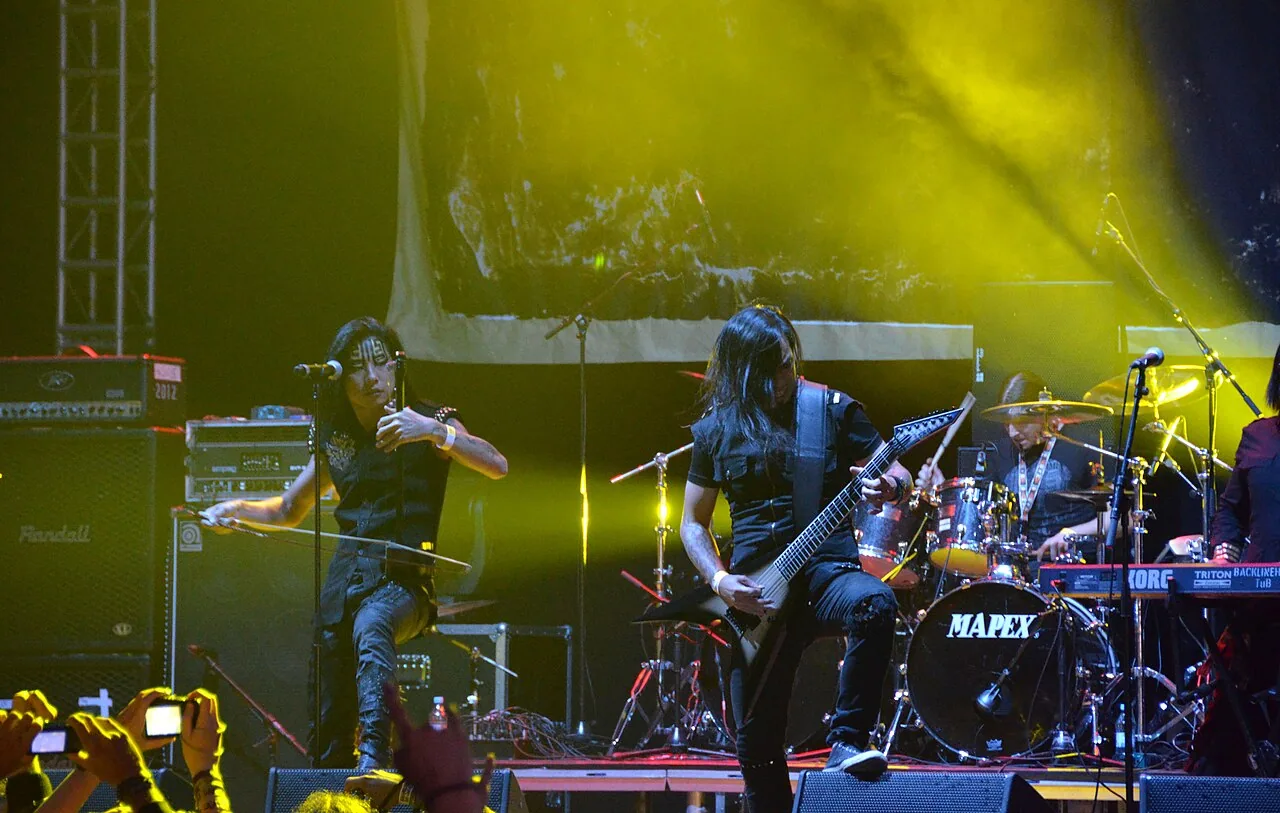
CHTHONIC's stage visuals have always been intertwined with the music. Early corpse paint borrowed the coldness of Northern European black metal, but symbols, paper offerings, deities, hell, and summoning on their faces quickly pulled the visual back to Taiwanese folklore and historical ghosts. Keyboardist CJ Gao Jia-yu’s talismans wrapped around her head, the symbols on the lead singer's forehead, and the audience members scattering paper offerings at concerts all made the shows feel like a metal-version of a Buddhist ceremony.4
During the Takasago Army period, CHTHONIC shifted to costumes featuring Asian military uniforms, martial arts, and battlefield aesthetics, gradually moving away from simple corpse paint. This change meant the stage was no longer just an atmosphere of "dark black metal," but directly served the album's narrative: Taiwanese soldiers, colonial armies, forcibly renamed identities, and post-war souls were all presented to the audience through costumes and visuals. As a result, CHTHONIC rarely just performed studio recordings live; it was more like temporarily summoning the ghost cosmos from the albums to ports, live houses, international music festivals, or Keelung Avenue.
This also explains why CHTHONIC's MVs often have a cinematic feel. "TAKAO" uses war, memory, and Tâi-gí song melodies to construct imagery. "Night Slash," "Uniu Lan Great Protector," and "Guo Guo Shan" bring historical figures, resistance fighters, and suffering families into the frame. When visuals, costumes, language, and sound work together, CHTHONIC's politics are not just explained by lyrics but felt through the entire stage system.
The Reincarnation Trilogy: Wenshe, 228, and Takasago Army
The most accessible body of work from CHTHONIC is the narrative sequence formed by Seediq Bale, Mirror of Retribution, and Takasago Army.
Seediq Bale brings the Wenshe Incident to the metal stage. This album makes the Seediq people, Monaroad, anti-Japanese resistance, and colonial violence a set of tragic characters and soundscapes. It also helps CHTHONIC be recognized in overseas metal media: this Taiwanese band pours its own history into genre grammar, distancing itself from simply imitating Northern European or American extreme metal.5
Mirror of Retribution places the 228 Incident into the underworld and judgment. The imagination of hell, vengeful spirits, and reincarnation gives a tangible form to a long-suppressed political violence. CHTHONIC's metal language is particularly fitting here: screams are the sound of those who could not speak properly finally speaking in an undeniable way.
Takasago Army pushes time toward World War II. The album's theme points to Indigenous youth conscripted by the Japanese Empire during the Pacific War, connecting back to the historical gaps between Seediq Bale and Mirror of Retribution. Sources compiling Wikipedia entries indicate that Takasago Army is set against the backdrop of the Takasago Volunteers. The album also invited Yu Tian, Zhan Ya-wen, and Pitero Wukah, an Indigenous musician from the Taroko tribe, to participate, layering Tâi-gí songs, Indigenous voices, and extreme metal.3
These three works clarify CHTHONIC's core: the band is performing a requiem for history that has not been fully buried. The ghosts in the music carry the weight of modern Taiwanese history; they have never truly left.
CHTHONIC Official MV: "Requiem Temple." The scenes from the Puli Reincarnation Temple bring the requiem narratives of Takasago Army and Mirror of Retribution from the album cosmos into a specific place.
Taiwan on the International Stage
CHTHONIC has long treated tours as another form of public action.
In 2007, they performed at Ozzfest 20 times, speaking to audiences in English about Taiwan's difficulties participating in international organizations due to obstruction from China during every show. For a metal band, this was not traditional diplomacy. But for Taiwan, which has long been required to lower its profile in international forums, this stage speech itself is an alternative narrative projection.2
Foreign media often framed Lin Chang-tsuo's political career as a contrast: "the heavy metal singer entering parliament." When GQ introduced him after he was elected as a legislator in 2016, it also described CHTHONIC as a band whose themes involved local Taiwanese languages, traditional instruments, oppression, and Indigenous suffering.6 The Guardian reported on Lin Chang-tsuo in 2020, placing him within the continuum of metal music, social movements, parliamentary politics, and Taiwanese identity.7 This context is important: Lin Chang-tsuo did not suddenly enter public issues after leaving music. CHTHONIC's music has long treated "how Taiwan can be heard by the world" as a creative mission.
CHTHONIC’s international reach is not limited to tour maps. They release works in Tâi-gí, Mandarin, or English versions, allowing different audiences to approach the same historical cosmos through different entry points. They bring the Taiwanese story to international venues like Ozzfest, Wacken, and Fuji Rock, causing overseas media to start covering Taiwanese history, metal music, and political identity in the same article. These articles sometimes simplify them as "anti-China metal bands," but returning to the music itself, CHTHONIC truly outputs an entire sound design capable of making Taiwan be heard.
More Than Just a Lead Singer
CHTHONIC's public image is often amplified by Lin Chang-tsuo, especially after he transitioned from musician to the Legislative Yuan and diplomatic roles. However, CHTHONIC is not a personal project of one singer.
Doris Ye Xiang-yi has long been the band leader, bassist, and core operator of the band. Jesse Liu Sheng-hui is an important composer and sound architect. Dani Wang Zi-chou's drumming and CJ Gao Jia-yu's keyboards push CHTHONIC toward a more symphonic and dramatic lineup. The official website and social media maintain CHTHONIC as the complete band brand, reminding readers that CHTHONIC’s story cannot be understood solely through the lens of politician Lin Chang-tsuo.8
From Takasago Army to Bú-Tik, Jesse's metal arrangements, Dani's drumming, CJ's keyboards, and Doris's low end and band management allow CHTHONIC to truly transform narrative ambition into a sound that is performable, recordable, and understandable by foreign media. Lin Chang-tsuo provides the vocals, concept, and public language; the band’s longevity comes from the entire team. CHTHONIC exists as an independent creative community in Taiwanese music history, and cannot be reduced merely to the biography of one politician.

In 2007, CHTHONIC performed at Metropolis in Montreal, Canada. Multiple camera angles captured the band as a complete ensemble, making the live appearance clearer than single-member close-ups. Photo: Kozikkris, Wikimedia Commons (CC BY 3.0) (https://creativecommons.org/licenses/by/3.0/). CC BY 3.0
From Band to Venue: Daguang Concerts
CHTHONIC's influence on Taiwanese music is not limited to albums and tours.
In 2006, Freddy, Doris, and the TRA Music team held the first Daguang Concert at Piers 11 and 12 in Kaohsiung. In a special interview with VERSE about Daguang, Doris recalled that they wanted to create a southern music festival distinct from the wild street performances of Taipei, using the scenery of Kaohsiung Harbor, its maritime sensibility, and Southern Taiwanese bands as the theme. This starting point is similar to how CHTHONIC makes music: bringing local Taiwanese geography, language, history, and sounds that are hard for the mainstream to see onto a sufficiently large stage.9

In 2016, CHTHONIC performed at Daguang Concert. This photo better conveys the intersection of the band, the harbor music festival, and the large stage than a single-member close-up. Photo: Hisakon, Wikimedia Commons (CC BY-SA 3.0) (https://creativecommons.org/licenses/by-sa/3.0/). CC BY-SA 3.0
After Lin Chang-tsuo was elected as a legislator in 2016 and left the Daguang team, Doris and drummer Dani Wang Zi-chou took over management and coordination. VERSE interviews noted that Doris initially led the Daguang events in 2016 and 2017 before stepping down to an advisory role; Dani began participating in coordination from 2016, being referred to as "President" within the team. This line makes CHTHONIC's collectivity clearer: Doris and Dani support the low end and rhythm on stage, while off-stage they transform the band's cultural value into a music festival that attracts fans, the band, NGOs, and city memory every year.9
The second part of the VERSE interview places Daguang back into the context of wild street performances, Spring Roar, and Taiwanese listening culture since the 90s. Freddy and Doris initially managed the wild street concerts, later learning multi-stage management, backstage logistics, volunteer division, and artist reception from international experiences like Fuji Rock, Wacken, and Download, which were then fed back into Daguang. In other words, CHTHONIC not only took Taiwan abroad but also brought organizational methods of overseas stages back to Taiwan, slowly transforming the local music festival scene.10
The "NGO Village" in Daguang Concerts particularly shows CHTHONIC's extension. Doris and Dani connected this in VERSE interviews to Freddy's past concerts related to justice, anti-annexation, and Tibetan freedom, linking it to CHTHONIC’s long pursuit of freedom and justice. For CHTHONIC, the stage is not a place to escape reality; the stage can also be where suppressed issues, identities, and emotions appear together. This is why Daguang Concerts, although deserving their own dedicated entry, remain an important side branch for understanding CHTHONIC.
Bú-Tik and Battlefields of Asura: From Martial Arts Hall to Contemporary Politics
Bú-Tik is the work where CHTHONIC pushes its album cosmos to another level. English sources indicate that Bú-Tik was released in Asia, the UK, and North America by labels like Spinefarm/Universal in 2013; Blabbermouth also recorded awards such as Best Album, Best Band, and Best Artist at the Golden Melody Awards.11 These awards show one thing: Taiwanese extreme metal works can be viewed as complete albums by local music awards, not just as curious genre pieces.
The concept of Bú-Tik also brings CHTHONIC closer to the "historical scene" itself. Wude Hall is a symbolic space of martial arts, discipline, and colonial modernity during the Japanese administration; CHTHONIC transforms this into metal narrative, bringing the relationship between the body, weapons, colonial rule, resistance, and modern nationhood into sound. Later acoustic and live versions transform the high-pressure metal wall into another form of ritual, allowing melody, language, and spatial sense to carry the power that was previously driven by volume.
Battlefields of Asura in 2018 brings post-war Taiwan and contemporary politics to the forefront. Blabbermouth reported on this album in 2018, noting its collaboration with Randy Blythe and He Yun-shi; data from the 30th Golden Melody Awards also shows that Battlefields of Asura won Best Band, which reviewers interpreted within the context of a free generation, metal music, and social advocacy.1213 This album is often seen as a response after Lin Chang-tsuo entered politics, while also continuing CHTHONIC's earlier questions: how do historical wounds enter the present? Politics here becomes an echo in everyone's body, family, and memory.
Ghosts Remain After Low Activity
After Lin Chang-tsuo entered parliament, CHTHONIC’s activity temporarily decreased, but the band did not disappear.
In 2019, CHTHONIC held the "Taiwan Grand Triumphant" concert at Keelung Avenue; in 2020, they collaborated with Trivium vocalist Matt Heafy on a new version of "Night Slash"; in 2021, Daguang Concerts were documented; and around the anniversary of the 228 Incident in 2023, they released Guo Guo Shan PATTONKAN, bringing the memories of victims of Martial Law, such as Gao Yi-shing and his family, back into the songs. Central News Agency reported that "Guo Guo Shan" was inspired by the families of political victims.1415 The song was also recommended by the Grammy program Global Spin the following year, making CHTHONIC the first Taiwanese band to appear on that program.16
"Guo Guo Shan" shows that CHTHONIC's later works are still dealing with the same core: victims have families, children, songs, and tribal memories. As the band moved from Wenshe, 228, and Takasago Army to Gao Yi-shing and Gao Ju-hua, Taiwanese history gradually detached from event sequencing and became an echo passed down through families.
In 2025, "A Million Times" connected this line to family memory and the sense of reincarnation. These recent works do not need to overshadow CHTHONIC's two decades of creation but demonstrate one thing: CHTHONIC's core has not disappeared because of politics, elections, or member role changes. It continues to process the recurring voices in Taiwanese history.
A Few Entry Points You Can Listen To First
To understand CHTHONIC, you do not have to start with the complete band history.
You can first listen to Eternal Reincarnation to feel how they connected The Lin Tou Sisters and Tâi-gí black metal; then listen to Seediq Bale, Mirror of Retribution, Takasago Army, and Bú-Tik to see how the band pushed themes like Wenshe, 228 Incident, Takasago Volunteer Corps, and colonial rule into a cosmic universe; next listen to Battlefields of Asura to understand how CHTHONIC still processes history and contemporary issues in a band format after Lin Chang-tsuo entered institutional politics; finally, listen to "Guo Guo Shan" and "A Million Times" to see how post-political CHTHONIC returns to family, Martial Law, and the cycle of ghosts.
Listening this way is less likely to misunderstand CHTHONIC as a band that first had a political stance and then used music as packaging. More accurately, it is because they have long processed language, history, ghosts, and identity within the music that political issues appear naturally in their work.
This listening path resembles a sound map of an underground museum. CHTHONIC has given Taiwan a metal band capable of standing on international music festivals, proving that Taiwanese history can leave textbooks, monuments, or news events and enter screams, erhu, Tâi-gí, mythology, corpse paint, music festival venues, harbor culture spaces, and underground fan communities. When these sounds explode on the global metal stage, audiences are first shaken by the sound, and then slowly ask: where do these ghosts come from?
Further Reading: Lin Chang-tsuo, Daguang Concerts, Taiwan Indie Music, the 228 Incident, Wenshe Incident, Martial Law
Image Sources
- 12-08 Wacken Chthonic 02 — Photo by Achim Raschka at the 2012 Wacken Open Air in Germany, collected by Wikimedia Commons, licensed under CC BY-SA 4.0.
- Chthonic — Photo by Kozikkris at Metropolis in Montreal, Canada in 2007, collected by Wikimedia Commons, licensed under CC BY 3.0.
- Chthonic megaport 2016 — Photo by Hisakon at Daguang Concert in 2016, collected by Wikimedia Commons, licensed under CC BY-SA 3.0.
- CHTHONIC - TAKAO Official Video — CHTHONIC official YouTube video used to present the sound and visual vocabulary of the Takasago Army era.
- CHTHONIC - Requiem Temple Official Video — CHTHONIC official YouTube video used to present the Reincarnation Temple scenes and requiem narratives.
References
- Chthonic put spin on Taiwan's past — Taipei Times interview from 2003, recording CHTHONIC’s win of Best Band at the 14th Golden Melody Awards with Eternal Reincarnation, early band history, erhu, The Lin Tou Sisters, and Taiwanese historical creation context.↩23
- ChthoniC promotes Taiwan's UN bid in interview with NPR — Taipei Times report from 2007 discussing CHTHONIC speaking to American audiences about Taiwan's obstruction in international organizations during the Ozzfest tour, and explaining the Mandarin, Tâi-gí, and English performance arrangements.↩2
- Takasago Army — English Wikipedia article used as a source index, organizing themes of Takasago Army, participating musicians, Metalship interview summaries, and official MV links; the main text conservatively paraphrases and avoids using unreferenced rankings alone.↩2
- Chthonic (band) — English Wikipedia article used as a source index, organizing descriptions of CHTHONIC's stage costumes, paper offerings, symbols, militarized visuals, and live rituals; the main text conservatively paraphrases.↩
- Seediq Bale (album) — English Wikipedia album entry used as a source index, organizing overseas release information for Seediq Bale, Wenshe Incident themes, recording details, and participating personnel.↩
- Meet Freddy Lim, the Death-Metal Star Who Just Became an Elected Official in Taiwan — GQ report from 2016 understanding CHTHONIC within the context of local Taiwanese languages, traditional instruments, oppression, and Indigenous suffering after Lin Chang-tsuo was elected a legislator.↩
- 'We want a fairer society': Freddy Lim, Taiwan's metalhead MP — The Guardian report from 2020 on Lin Chang-tsuo’s political and musical identity, supplementing how international media understands the continuity of CHTHONIC, social movements, and Taiwanese identity.↩
- CHTHONIC Official Website — CHTHONIC's official website, providing the band's official brand, community, and music platform entry; this article is used to confirm the official site and current public access points.↩
- “Daguang Concert” Past and Present (Part 1): The Maritime Life of the Conductor’s Festival — VERSE special interview with Doris and Dani about Daguang in 2022, organizing the inception in 2006, the southern music festival positioning, the team handover after Freddy's departure, and the NGO Village/freedom justice values.↩2
- “Daguang Concert” Past and Present (Part 2): More Than Just 16 Years, It is a Cultural Synthesis of Taiwanese Music Festivals — VERSE second part of the Daguang special interview, reviewing wild street performances, early curation by Freddy and Doris, CHTHONIC's experience at Daguang and international festivals, and the evolution of Taiwanese listening culture and live experiences.↩
- Bu-Tik — English Wikipedia album entry used as a source index, organizing release, production, Golden Melody Awards, and international music reviews for Bú-Tik; award details are cross-referenced in Blabbermouth reports.↩
- CHTHONIC To Release 'Battlefields Of Asura' Album In October — Blabbermouth report from 2018 regarding the release of Battlefields of Asura and collaborations with Randy Blythe and He Yun-shi, supplementing the international metal media context of the album.↩
- Best Band Award (Golden Melody Awards) — The Golden Melody Awards Best Band Award entry used as an index, organizing CHTHONIC's win for Battlefields of Asura and reviewer commentary; it is not a main narrative pillar.↩
- New song "Guo Guo Shan" by CHTHONIC inspired by families of political victims — Central News Agency report from 2023 regarding the inspiration for "Guo Guo Shan" from the families of Martial Law victims, supplementing how recent works continue the theme of historical memory.↩
- Gao Yi-shing — Gao Yi-shing entry used as a source index, organizing references to "Guo Guo Shan," Gao Ju-hua, and content from Central News Agency and New Messenger.↩
- New song "Guo Guo Shan" by CHTHONIC recommended by Grammy program; Lin Chang-tsuo: Let the world see beautiful Taiwan — Central News Agency report from May 2023, stating that "Guo Guo Shan" was selected for the Grammy program Global Spin, making CHTHONIC the first Taiwanese band to appear on the program.↩