
30-Second Overview: Freddy Lim is the frontman of Chthonic, one of the founding organizers of the Da Gang Open Air Concert, former chairman of Amnesty International Taiwan, and a representative of the "third force" entering the legislature after the Sunflower Movement. Chthonic incorporates the 2/28 Incident, Taiwan White Terror, the Musha Incident, Taiwanese mythology, and narratives of the dead into black metal, ensuring Taiwan’s history is not only read but heard and screamed. He later co-founded the New Power Party, served as a Legislative Yuan member, experienced party withdrawal and a recall attempt, and after leaving office, took up international work as Taiwan’s Representative to Finland. Politics was his adventure; Chthonic remains his core identity.
Placing Freddy Lim into a single identity almost always distorts the truth. In 2017, The New York Times entered his Legislative Yuan office, seeing electronic drums, a David Bowie poster, and photos of Chthonic performing at Liberty Square. In 2022, Germany’s Der Tagesspiegel saw a similar mix: an image of the Dalai Lama signed "Free Tibet," a rainbow flag, a David Bowie portrait, and Chthonic concert photos. These objects form a slice of his identity: metal frontman, music festival initiator, human rights advocate, third-force politician, legislator, subject of a recall campaign, caregiver for family members, and later, Representative to Finland. 12345678
These identities crowded into one person mean Freddy Lim’s story is not just the contrast of "a musician entering politics." Freddy Lim did not leave Chthonic behind before entering politics. His public identity grew from the way music processed Taiwan’s history, language, and sense of sovereignty. Before he sat in committees and defeated veteran politicians, the person on stage screaming for Taiwan’s dead spirits was already seeking a voice for his era.
First, the Chthonic Frontman
Freddy Lim was born in 1976, with the English name Freddy. For many international media outlets, he is most easily introduced as a "death-metal star turned politician": a death or black metal frontman who later became a Taiwanese legislator. But while this description is easy to understand, it risks reversing the narrative of his story.
Before politics, Freddy Lim was already processing politics through music.
He grew up in the final years of martial law. In an interview with Germany’s Der Tagesspiegel, he recalled that in elementary school, if he spoke Taiwanese in school, he would be fined ten yuan and his name written on the blackboard. Textbooks contained almost no Taiwan; children were educated to be Chinese. It was only after high school that he began reading Taiwanese books bought by his father, gradually realizing that the place he lived was not something the China-centric narrative in textbooks could fully explain. 2
Chthonic was founded in Taipei in 1995, refusing from the start to be merely an imitator of Nordic black metal. In a 2003 Taipei Times interview, Freddy Lim placed the band’s origins in black metal’s questioning of "mother culture": Nordic black metal looks back at ancient beliefs suppressed by Christianity, while Chthonic turns this question back to Taiwan, seeking local memories suppressed by China-centric historiography, colonialism, and authoritarian politics. It borrows the intensity of black metal, death metal, and symphonic metal, but returns the content to Taiwan: ancestral spirits, hell, spirit mediums, the Musha Incident, 2/28, White Terror, the Takasago Volunteers, and suppressed Taiwanese history. Freddy Lim served as the band’s frontman and participated in establishing concepts, lyrics, and public narratives. International reports often describe Chthonic using "Taiwanese language, traditional instruments, and Taiwanese history," because these elements make it instantly recognizable in the global metal scene as not just another copy of a Western band. 910
This distinguishes Chthonic from typical "politically outspoken bands." It does not start with a set political stance and then write slogans into songs. Rather, it is more like this: Taiwan’s history is full of the dead, silence, taboos, and unfinished mourning. The darkness, screaming, speed, and ritual sense of black metal become a vocal cavity that can contain these histories.
💡 Did You Know?
The English band name Chthonic comes from a Greek concept related to the underworld and the earth. For a Taiwanese metal band that has long written about the dead, ancestors, and historical wronged souls, this name feels almost like destiny.
Freddy Lim’s stage persona is not mere decoration. His screaming, erhu, face paint, joss paper, and albums in both Taiwanese and English constitute a sound system that allows the world to recognize Taiwan. For international metal fans, Chthonic might be their first time hearing about 2/28, the Musha Incident, or Taiwan’s sovereign situation through music. For Taiwanese audiences, Chthonic turns the history fragmented by textbooks, families, and political taboos into something that can be shouted together at live shows.
When he later spoke of the Taiwanese language, he said it allowed him to imagine how his grandparents lived when they were young. This clue is important: Chthonic’s Taiwanese-language metal carries the Taiwanese experience silenced by schools, the state, and families, and returns it to the body and voice. 2
Chthonic Official Video: "Mu Chen Wu De Dian" (Folk Version). After deconstructing the metal wall of sound into an acoustic version, Freddy Lim’s voice, Taiwanese melody, and sense of history remain in the foreground.
History and Ghosts in Black Metal
Chthonic’s most important creative method is to write Taiwan’s history as a universe of ghosts that repeatedly return.
Seying Balay (Sunrise) deals with the Wushe Incident. Ten Halls places the February 28 Incident into an imagination of hell and judgment. High Mountain Tribe looks back at the Taiwanese indigenous youth conscripted by the Japanese Empire during the Pacific War. Wu De (Martial Virtue) intertwines modernity, the martial arts hall, and colonial memory. Zheng Zhi (Politics) brings the violence and resistance of postwar Taiwan directly to the forefront.
These albums go beyond the function of “introducing history.” They are more like asking: If the victims are not truly remembered, will they keep coming back?
Zheng Zhi (Politics) also does not stem solely from grand nationalist issues. In an interview with the Palliative Care Foundation, Freddy Lim discussed how his father died suddenly of a heart attack in 2017, leaving him unable to see his father for the last time. In the same year, his daughter was born, with life and death pressing down on him simultaneously in a very short span. He said his father’s death made him realize the importance of cherishing loved ones and not letting emotions cause irreparable harm. This sense of death, parent-child relationships, and reconciliation was also incorporated into Zheng Zhi (Politics) in 2018.11
In a lengthy interview after leaving office, Freddy Lim discussed how, after discovering his maternal grandfather’s family story, he re-understood Chthonic’s long-standing way of writing about the White Terror, the February 28 Incident victims, and the cycle of reincarnation and rebirth. He said he originally did not know how Chthonic’s story would end. When fictional characters encounter real family history, that musical universe seems to finally connect with the real world.
What Chthonic has done for years is not primarily about the appearance of “metal music with Taiwanese themes,” but rather using metal to process a feeling that Taiwanese people are very familiar with, yet often cannot articulate: history has not truly passed, and families may hide stories that have not been told.
Social concern grows out of this musical work. When victims, ancestral spirits, and silenced people have voices on stage, the next question naturally emerges: Can these voices be heard in society?
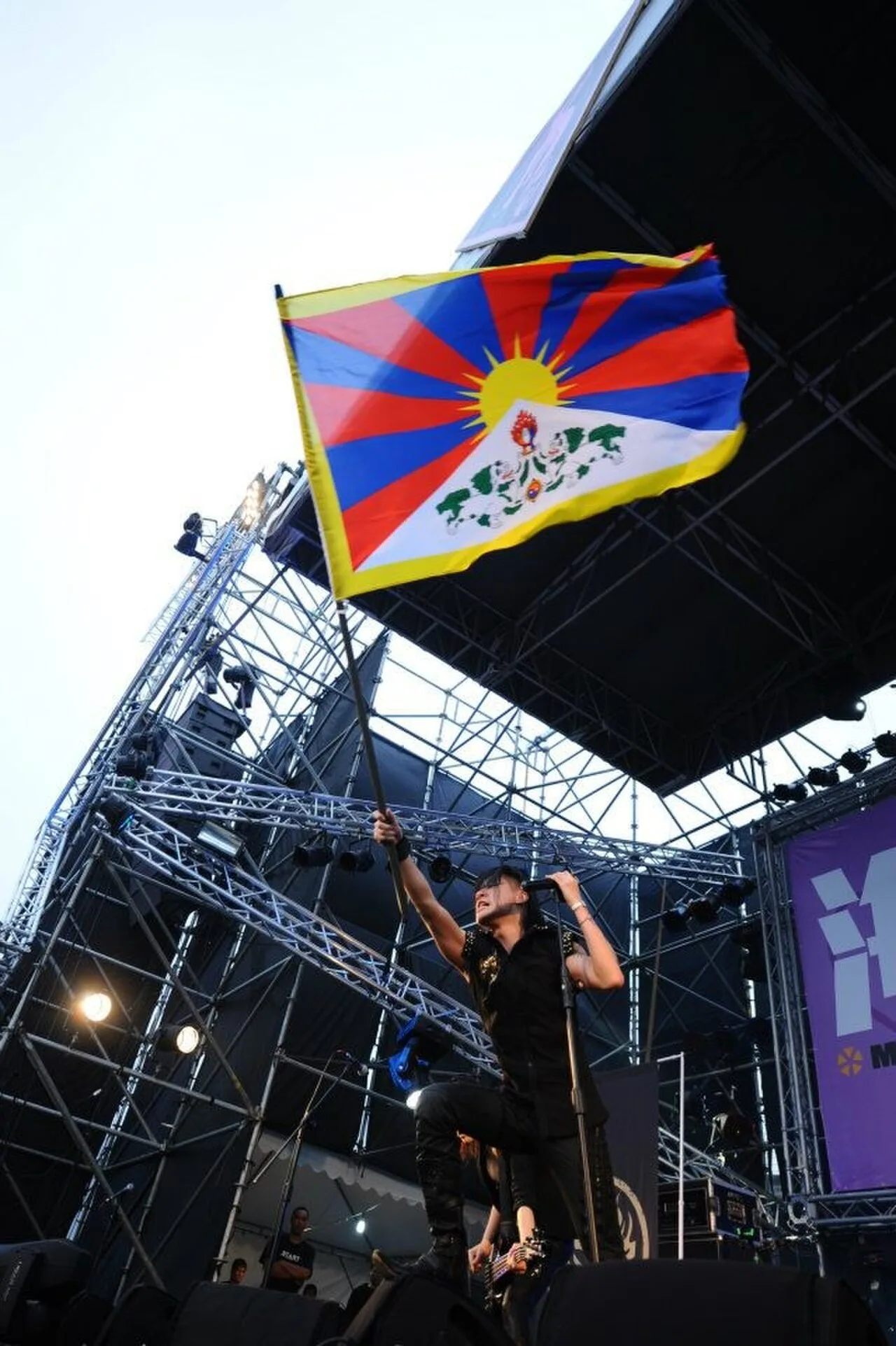
In 2012, Freddy Lim raised the Tibetan flag on stage. This image places Freddy’s identity as a vocalist, human rights concerns, and Taiwan’s international situation in the same scene. Photo: Hyw83516, Wikimedia Commons (CC BY-SA 3.0).
Da Gang Open Air Concert: Turning Sound into a Space
If Chthonic is where Freddy Lim sings out history, Da Gang Open Air Concert is where he turns music into a public space.
Before Da Gang, Freddy Lim and Yeh Hsiang-yi (Doris) had already long learned how to organize live shows in music festivals. In the late 1990s, they took over Wild Stage Open Air Concert. In 2000, Chthonic performed at Japan’s Fuji Rock Festival, seeing for the first time up close the stage, backstage, flow, and team division of large international music festivals. That experience led them to push Wild Stage toward multi-stage, international bands, ticketing systems, and more complete live experiences. Later, Chthonic’s backstage, volunteer, and artist reception experience accumulated at international stages like Wacken and Download flowed back into Da Gang’s live design, giving Da Gang an intention of "presenting local Taiwanese content at international standards." 12
In 2006, Freddy Lim, Doris, and the TRA Music team held the first Da Gang Open Air Concert at Kaohsiung Harbor Piers 11 and 12. It inherited Taiwan’s existing music festival context but quickly grew its own character: Southern, harbor-side, Taiwanese, indie bands, heavy sound, city identity, and a public sense close to social issues. In its early days, the team deliberately made it a southern music festival distinct from Taipei’s Wild Stage. Stage names, harbor-side scenery, and the proportion of southern Taiwan bands made "Kaohsiung" the content of the music festival. 1314
Da Gang’s importance far exceeds the resume point of "Freddy Lim also organized a music festival." It is an intermediary: bands become cultural communities there, audiences become a collective there, and Kaohsiung changes from a performance location to a cultural coordinate. Musicians curate, organize, coordinate, and bear box office and public pressure there. Audiences confirm with their bodies that Taiwan’s sound does not need to be concentrated in Taipei, nor does only the mainstream stage count as culture.
Da Gang also retains a Chthonic-style public sense. After its revival in 2015, the team called it a music festival about life, and continued to set up an NGO issue village, allowing audiences to encounter human rights, freedom, Hong Kong, Tibet, and various social issues between stages. VERSE’s report connected this line back to Freddy Lim’s past hosting of concerts like Justice is Everywhere, Anti-China Annexation, and Free Tibet: for these musicians, music festivals can allow people to temporarily leave daily life, but also allow reality to enter the scene in another way. 14
Da Gang has never been a single-hero biography. Freddy Lim discussed in interviews that from music, Wild Stage, to Da Gang and politics, many things were done together with Doris. He also pointed out that in the highly masculine field of rock music and music festivals, the labor of female workers is often more easily obscured. After Freddy Lim was elected legislator in 2016 and withdrew from the Da Gang team, Da Gang was mainly taken over and advanced by Doris and Chthonic drummer Dani. They continued Chthonic’s spirit of cultivating local roots and facing the international, treating backstage, ticketing, performer experience, and team systems as part of the music festival. Da Gang’s southern scene is supported by an entire music and curation team, not just the personal achievement of a frontman. 1412
Da Gang caused a second transformation in Freddy Lim’s role. He was originally the person standing in the center of the stage, and began to become the person building the stage. This difference later leads to politics: politics is in some ways also building a stage, only the stage becomes constituencies, committees, the legislative floor, bills, and media scenes. From Chthonic to Da Gang, Freddy Lim’s musician identity is no longer just about performance, but begins to bear space, community, and public issues.
Entering the System After Sunflower
After the 2014 Sunflower Student Movement, a wave of new political imagination emerged in Taiwan. Many young people, social activists, and arts workers began to believe that beyond street protests, someone also needed to enter the system.
Freddy Lim is one of the most prominent faces in this wave. He participated in founding the New Power Party (NPP) and was elected legislator in 2016 in Taipei’s 5th Constituency. In a 2015 Taipei Times interview, his campaign team could already see the Sunflower Generation’s connections: Wu Zheng, Lai Pin-yu, and others entered the team, with musicians, activists, and young political workers placed in the same election scene. 3 That constituency included parts of Wanhua and Zhongzheng. For a heavy metal frontman, this election brought him into the long-term scene of local service and legislative work. It required facing petitions, budgets, local connections, legislative attacks, and voters’ actual expectations of politicians every day, far exceeding symbolic candidacy.
International media loved this contrast at the time: a metal frontman with face paint singing Taiwan’s history entered the legislature. GQ introduced him as "Death Metal Star Becomes Elected Official," placing the New Power Party back into the political context after the Sunflower Movement. The New York Times noted that besides domestic reform, he also placed Taiwan’s international recognition on the political agenda. 151 But for Freddy Lim’s own story, this is more like an extension of the same path. Chthonic processes historical memory and international visibility. Da Gang processes cultural space. Entering the Legislative Yuan, he encountered defense, diplomacy, human rights, culture, and transitional justice within the system.
But the sense of time in politics is completely different from music.
Looking back at his Legislative Yuan experience later, he said politics is not like writing songs. In a band, a few people discuss and the work moves forward. The Legislative Yuan is a field of hundreds of people; things can only be pushed forward bit by bit. This difference means "ideals" are no longer just about whether the sound is loud enough, but whether it can move slowly within the system.
This is also the thickest part of Freddy Lim’s character story. Music makes people believe a song can explode instantly. Politics requires people to admit that many things can only be ground down slowly.
Themes in the Legislature
Freddy Lim’s eight years in the Legislative Yuan cannot be summarized simply as "artist enters politics."
His political work generally continued several lines already existing from his music period: Taiwan’s international participation, human rights, transitional justice, cultural policy, and defense/diplomacy. From 2010 to 2014, he served as chairman of Amnesty International Taiwan. In a 2015 interview, he placed human rights, environment, cultural policy, Taiwan independence, and transitional justice in the same set of political language of "justice and fairness." 23 After entering the legislature, he continued to focus on Tibet, Hong Kong, human rights, and Taiwan’s international space. The continuity of these themes with his music period explains his political choices better than listing legislative questions case by case.
This continuity appeared before he entered politics. During Chthonic’s 2007 Ozzfest tour, the band performed 20 shows in the US and explained to audiences in English Taiwan’s situation of being obstructed by China from normal participation in international organizations. "UNlimited Taiwan" also brought the appeal for Taiwan’s international participation directly to the metal tour scene. The international space Freddy Lim later discussed in the legislature had already been practiced on stage. 16

In 2015, Freddy Lim canvassed as a New Power Party candidate for Zhongzheng and Wanhua Constituency legislator. After entering institutional politics from the stage, he also had to enter this public scene of streets, constituencies, and local mobilization. Photo: Legislative Yuan无双, Wikimedia Commons (CC BY-SA 4.0).
These issues look very political, but they actually connect with Chthonic’s musical core: Who has the qualification to be heard by the world? Whose history is silenced? How can a country not formally recognized speak its own story on the international stage?
Freddy Lim’s public role is hard to place in just one box of "musician" or "politician." This is a series of advances: In Chthonic, he turned Taiwan’s history into sound. In Da Gang, he turned sound into space. In the legislature, he tried to turn space into institutional practice.
This path is not romantic. Institutional politics requires negotiation, compromise, voting, organization, voter service, and is worn down by recall, party splits, media attacks, and local pressure. It is not like the stage, where lights dim, drums beat, and emotion concentrates in one direction.
His political work concentrated on several recurring directions. First is international, including Taiwan’s visibility in international organizations, Olympic names, democratic allies, and human rights issues. Second is defense and diplomacy, especially how Taiwan maintains security and foreign relations under China’s pressure. Third is human rights, continuing his long-term focus on Amnesty International, Free Tibet, and Hong Kong. Fourth is culture, because he always placed pop music, language, historical memory, and national narrative on the same map.
These four directions are not separate. For Freddy Lim, whether Taiwan’s music can be heard by the world, whether Taiwan’s name can be normally spoken in international sports, whether Taiwan people’s history can be recognized in education and culture, all point to the same question: How can a community long named by others, represented by others, and edited by others regain its position to speak?
The Wear and Tear of Politics
Freddy Lim withdrew from the New Power Party in 2019, supported Tsai Ing-wen’s re-election, and ran for legislator in 2020 as an independent. 4 After re-election, he also experienced NPP splits, recall campaigns, and the reorganization of the third-force path. The 2022 recall vote did not pass. Yes votes exceeded no votes, but did not reach the legal threshold. Analysis at the time mostly placed this vote in the context of Taiwan’s recall system, party mobilization, and voter fatigue, not just Freddy Lim’s personal victory or defeat. 175 In 2023, he announced he would not run for re-election, publicly citing the need to care for family members suffering from rare diseases. In November of the same year, he applied to join the DPP and assisted in the 2024 election. 67 In 2025, the Presidential Office announced he would serve as Taiwan’s Representative to Finland, connecting "music, international advocacy, and diplomacy" again in another form. 8
This process is more complex than simple victory or defeat.
In interviews, Freddy Lim looked back at the political path around 2016 to 2020, discussing how he once believed that as long as he poured spirit, soul, and physical strength forward, he could push Taiwan further. But later, party splits, partners’ election losses, recall waves, and political reality forced that youthful feeling of "charging forward leads to arrival" to stop.
This forms a sharp contrast with music. Music allows a few people to charge together; those who like it like it, those who don’t don’t. Politics requires integrating many people and bearing results that are not as imagined. Freddy Lim brought ideals into the system and was changed by the system.
⚠️ Controversial Viewpoint
Freddy Lim’s political evaluation has long been divided. Supporters see the advancement of human rights, international issues, and local consciousness; critics question his local service, party path, and political choices. These controversies remain with his legislative years, giving his cross-boundary experience the wear and tear and cost of the political scene.
Voices Outside the System
Looking back at eight years of political work after leaving office, Freddy Lim mentioned a difference: Politicians can persuade people through speeches, inquiries, or media performance, moving people rationally. Music and film may stay longer, making people realize years later that they were changed by a certain work.
He did not speak of politics as lower, nor music as higher. It is more like after walking through the system, reconfirming that the two types of work reach people differently. Politics requires negotiation, procedure, votes, and organization. Music processes memory, emotion, language, and the body. Freddy Lim’s specialness lies in bringing the sense of history, spirits, and sovereignty from music into the public sphere, and seeing in political reality that some things the system can push, but some things only songs can reach.
If politics was his adventure of bringing sound into the system, Chthonic is the root to which that sound repeatedly returns.
The legislature gave him another scale to understand reality. Music returned him to a publicness that politics cannot fully replace.
Reordering Roles
After leaving office, Freddy Lim did not simply "exit politics" or "go back to singing." His roles reordered: institutional politics retreated to the background, while music, international advocacy, diplomacy, and public speech each left their place. Chthonic’s works still allow people to enter the shadows of Taiwan’s history. The 2023 song "Pattonkan" brought the White Terror victim Gao Yisheng and family memory back into the song, making Chthonic’s pre- and post-office works not stop at the Million Pass cycle. Da Gang and music festival culture still prove sound can gather into space. Legislative experience reminds him that if ideals enter the system, they will be tested by the system. 18
Freddy Lim’s story therefore does not stop at the political spectacle of "metal frontman enters legislature." He first discovered Taiwan in music, then pushed this discovery to the stage, city, social movements, and legislature, and finally returned to the depths of music with political fatigue and understanding.
Those roles do not cancel each other out. Chthonic leaves the album universe, Taiwanese-language metal, international metal scene, and Taiwanese history narrative. Da Gang Open Air Concert leaves the southern city, music festival governance, and curation team. The New Power Party brings the third-force political structure after the Sunflower Movement into his life history. Every thread on Freddy Lim ultimately circles back to the sound growing from that frontman.
Further Reading
Chthonic: Band universe, album context, international influence, and Taiwanese black metal aesthetics.
Da Gang Open Air Concert: Southern music festival, city identity, contemporary Taiwanese-language culture, and the long evolution of the curation team.
Taiwan Indie Music: Understanding how Freddy Lim participated in the language conversion from "underground" to "independent."
Taiwan Music Festival Culture: Understanding Da Gang Open Air Concert’s position in Taiwan’s music festival ecology.
Sunflower Student Movement, New Power Party, Taiwan Democratization: Understanding the era background of Freddy Lim entering institutional politics.
Image Sources
- Freddy Lim Portrait 2012 — Photo: Hyw83516, Wikimedia Commons, CC BY-SA 3.0.
- New Power Party Legislator Candidate Freddy Lim 03 — Photo: Legislative Yuan无双, Wikimedia Commons, CC BY-SA 4.0.
- Chthonic & Genkai - Mu Chen Wu De Dian (Folk Version) — Chthonic Official YouTube Video, used to present Freddy Lim’s voice as frontman and the acoustic version interpretation.
Notes
References
- EP109 We Are All One of the Million Passes | Chthonic Freddy Lim, Library That Can Only Drink Alcohol, 2026. This article uses Chinese subtitle summary, key references around 00:26, 01:04, 01:17, 02:53, 02:58.
- Meet Freddy Lim, the Death-Metal Star Who Just Became an Elected Official in Taiwan, GQ, 2016.
- 'We want a fairer society': Freddy Lim, Taiwan's metalhead MP, The Guardian, 2020.
- From Rock Star to Legislator, Taiwanese Freddy Lim’s Beliefs, The New York Times Chinese Network, 2017.
- Metal-Sänger und Politiker Freddy Lim: „Wir waren nie ,das freie China‘ – wir sind Taiwan“, Der Tagesspiegel, 2022.
- From Son, Husband to Father Freddy Lim: Let Love Continue in Another Way, Palliative Care Foundation.
- Growing Long Hair, Painting Corpse Makeup... Freddy Lim 7 Years Ago as Band Frontman, Defeated KMT Military Veteran, Writing Amateur Political Legend, The News Week, 2022.
- INTERVIEW: Freddy Lim unfolds New Power Party platform, Taipei Times, 2015.
- Lim to leave NPP, back Tsai re-election bid, Taipei Times, 2019.
- Independent Legislator Freddy Lim survives recall vote, Focus Taiwan/CNA, 2022.
- Freddy Lim to retire from politics, look after family, Taipei Times, 2023.
- Independent lawmaker Freddy Lim applies to join DPP, Focus Taiwan/CNA, 2023.
- Rock star-turned-politician named Taiwan's representative to Finland, Focus Taiwan/CNA, 2025.
- Chthonic put spin on Taiwan's past, Taipei Times, 2003.
- ChthoniC promotes Taiwan's UN bid in interview with NPR, Taipei Times, 2007.
- Chthonic New Song "Pattonkan" Creative Inspiration from Political Victim Family, CNA, 2023.
- Da Gang Open Air Concert Past and Present (Part 1): The Helmsman’s Music Festival Sea-Style Life, VERSE, 2022.
- Da Gang Open Air Concert Past and Present (Part 2): Not Just 16 Years, But the Cultural Sum of Taiwan Music Festival History, VERSE, 2022.
- Many Young Taiwanese Want to Go to the Olympics With a New Flag and Anthem, TIME, 2016.
- Da Gang Open Air Concert Official Website
- CHTHONIC Official Website
- Freddy Lim, founder of ChthoniC, Photo: Hyw83516, Wikimedia Commons, CC BY-SA 3.0.
- New Power Party Legislator Candidate Freddy Lim 03, Photo: Legislative Yuan无双, Wikimedia Commons, CC BY-SA 4.0.
- Chthonic & Genkai - Mu Chen Wu De Dian (Folk Version), Chthonic Official YouTube.
- Da Gang Open Air Concert - Wikipedia
- Chthonic (band) - Wikipedia
- Freddy Lim - Wikipedia
- Taipei City 5th Constituency (Legislator) - Wikipedia
- From Rock Star to Legislator: The Beliefs of Taiwan's Lin Chang-tso — A 2017 report from the Chinese edition of The New York Times, documenting Lin Chang-tso's early political stage of moving from the underground music scene into parliament and promoting Taiwan's international visibility and social issues.↩2
- Metal Singer and Politician Freddy Lim: 'We were never 'the free China' – we are Taiwan' — A 2022 interview from Der Tagesspiegel, providing Lin Chang-tso's reflections on martial law education, the Taiwanese language, Taiwanese identity, and international narratives.↩234
- INTERVIEW: Freddy Lim unfolds New Power Party platform — A 2015 Taipei Times interview, providing context on Lin Chang-tso's entry into the election as the lead singer of Chthonic, a human rights advocate, and a founding member of the New Power Party.↩23
- Lim to leave NPP, back Tsai re-election bid — A 2019 Taipei Times report, confirming Lin Chang-tso's departure from the New Power Party, his run for re-election as an independent, and his support for Tsai Ing-wen's re-election.↩2
- Independent Legislator Freddy Lim survives recall vote — A 2022 report from Focus Taiwan/CNA, confirming that Lin Chang-tso's recall case failed to pass because the number of affirmative votes did not reach the threshold.↩2
- Freddy Lim to retire from politics, look after family — A 2023 Taipei Times report, recording Lin Chang-tso's announcement that he would not seek re-election, citing the need to care for family members suffering from rare diseases.↩2
- Independent lawmaker Freddy Lim applies to join DPP — A 2023 report from Focus Taiwan/CNA, confirming Lin Chang-tso's application to join the Democratic Progressive Party and his preparation to assist in the 2024 elections.↩2
- Rock star-turned-politician named Taiwan's representative to Finland — A 2025 report from Focus Taiwan/CNA, confirming that the Presidential Office announced Lin Chang-tso's appointment as Taiwan's Representative to Finland.↩2
- Meet Freddy Lim, the Death-Metal Star Who Just Became an Elected Official in Taiwan — A 2016 GQ profile describing Lin Chang-tso's entry into the international metal and political spheres as the lead singer of Chthonic and his use of Taiwanese language and traditional instruments.↩
- Chthonic put spin on Taiwan's past — A 2003 Taipei Times interview, recording Chthonic's early band history, the use of the erhu, Lin Tou Sister, the Golden Melody Award for Best Band, and how Lin Chang-tso turned black metal's maternal cultural consciousness back to Taiwanese history and folklore.↩
- From Son, to Husband, to Father: Lin Chang-tso: Let Love Continue in Another Way — An interview with the Palliative Care Foundation, supplementing Lin Chang-tso's life experiences regarding his father's sudden death, the birth of his daughter, palliative care, and his album Politics.↩
- The Past and Present of 'Big Port Open Air Concert' (Part II): Not Just 16 Years, but the Cultural Sum of Taiwan Music Festival History — A 2022 report from VERSE, supplementing the long-term trends of Wild Stage Open Air Concert, multi-stage internationalization, user-pays model, artist backstages, and the upgrade of Taiwan's concert-going culture.↩2
- Big Port Open Air Concert Official Website — The official event website, used to confirm the contemporary position of the Big Port Open Air Concert as a Kaohsiung music festival; historical evolution cross-checked with Wikipedia.↩
- The Past and Present of 'Big Port Open Air Concert' (Part I): The Music Festival Sea-style Life of the Helmsman — A 2022 report from VERSE, organizing the Big Port Open Air Concert's evolution from its grassroots beginnings by Kaohsiung Harbor in 2006 to the handover by Doris and Dani after 2016 and the context of NGO issue villages.↩23
- Meet Freddy Lim, the Death-Metal Star Who Just Became an Elected Official in Taiwan — The same GQ article, providing context on how international media in 2016 understood the phenomenon of a "metal singer entering parliament."↩
- ChthoniC promotes Taiwan's UN bid in interview with NPR — A 2007 Taipei Times report, organizing the context of Chthonic explaining to American audiences during their Ozzfest tour how Taiwan's international participation was hindered, and performing the song UNlimited Taiwan.↩
- Long Hair, Corpse Makeup... Lin Chang-tso Defeated KMT Military Veteran as Band Singer 7 Years Ago, Writing an Amateur Politician's Legend — A 2022 report from The Commonweal Magazine, organizing the political context around Lin Chang-tso's recall case, progressive issues such as same-sex marriage, and analysis of the recall threshold.↩
- Chthonic's New Song 'Protecting the Mountain' Inspired by Families of Political Victims — A 2023 CNA report on the inspiration behind the song Protecting the Mountain, the families of White Terror victims, and the Gao family's memory, supplementing how Chthonic's recent works continue the theme of historical memory.↩