
30-Second Overview: The history of No. 1 Girls' High School (Taipei Municipal First Girls' High School) is more than a list of prestigious schools; it is a microcosm of modern Taiwan's history. From its origins in 1904 as a filter for Japanese elites to the completion of the Guangfu Building in 1933; from the "green uniforms" born of Cold War air defense needs in 1952 to today's "barrier campus" next to the Presidential Office. This campus preserves how women's bodies were disciplined, how Cold War science education unfolded, and how students developed a unique worldview on the periphery of the center of power. 1 2
At the corner of Taipei's Bo'ai Special District, figures in green tops and black skirts always appear precisely at the intersection of red-brick school buildings and modern streets. Founded in 1904, the school's official name is "Taipei Municipal First Girls' High School," but in the collective consciousness of Taiwanese society, it is more commonly simplified as "No. 1 Girls' High School" or "Bei Yi Nv." However, hidden behind the halo of academic prestige is a complex history of colonial screening, bodily discipline, and the preservation of public space.
"Aristocratic School" Under Colonial Screening
The predecessor of No. 1 Girls' High School was the "National Language School Third Attached Higher Girls' School," established in 1904, initially designed to provide secondary education for Japanese women in Taiwan. In 1921, it was reorganized into the "Taipei Prefectural Taipei First Higher Girls' School." During the Japanese colonial period, this was a dream out of reach for most Taiwanese women. Although "Japanese-Taiwanese Co-education" was nominally opened in 1922, the proportion of Taiwanese female students was extremely low, forming a sharp contrast with the "Third Higher Girls' School" (now Zhongshan Girls' High School), which primarily admitted Taiwanese students. 1
Before the war, Taiwanese students who could enter No. 1 Girls' High School were mostly daughters of prominent families, such as Yan Mei, daughter of the Keelung mining magnate Yan Guonian, and Du Shuchun, daughter of Taiwan's first medical doctor, Du Congming. The curriculum at the time required not only academic excellence but also emphasized domestic skills, crafts, and bodily discipline. Students had to learn calisthenics, swimming, and volleyball. This emphasis on physical fitness was not just for health but to shape "new women" who met modern standards. 2
📝 Curator's Note: When we discuss the "elitism" of No. 1 Girls' High School, we often overlook that it was initially a screening tool for the colonial ruling class. This shift from bloodline-based screening to exam-based screening is a microcosm of social mobility in modern Taiwan.
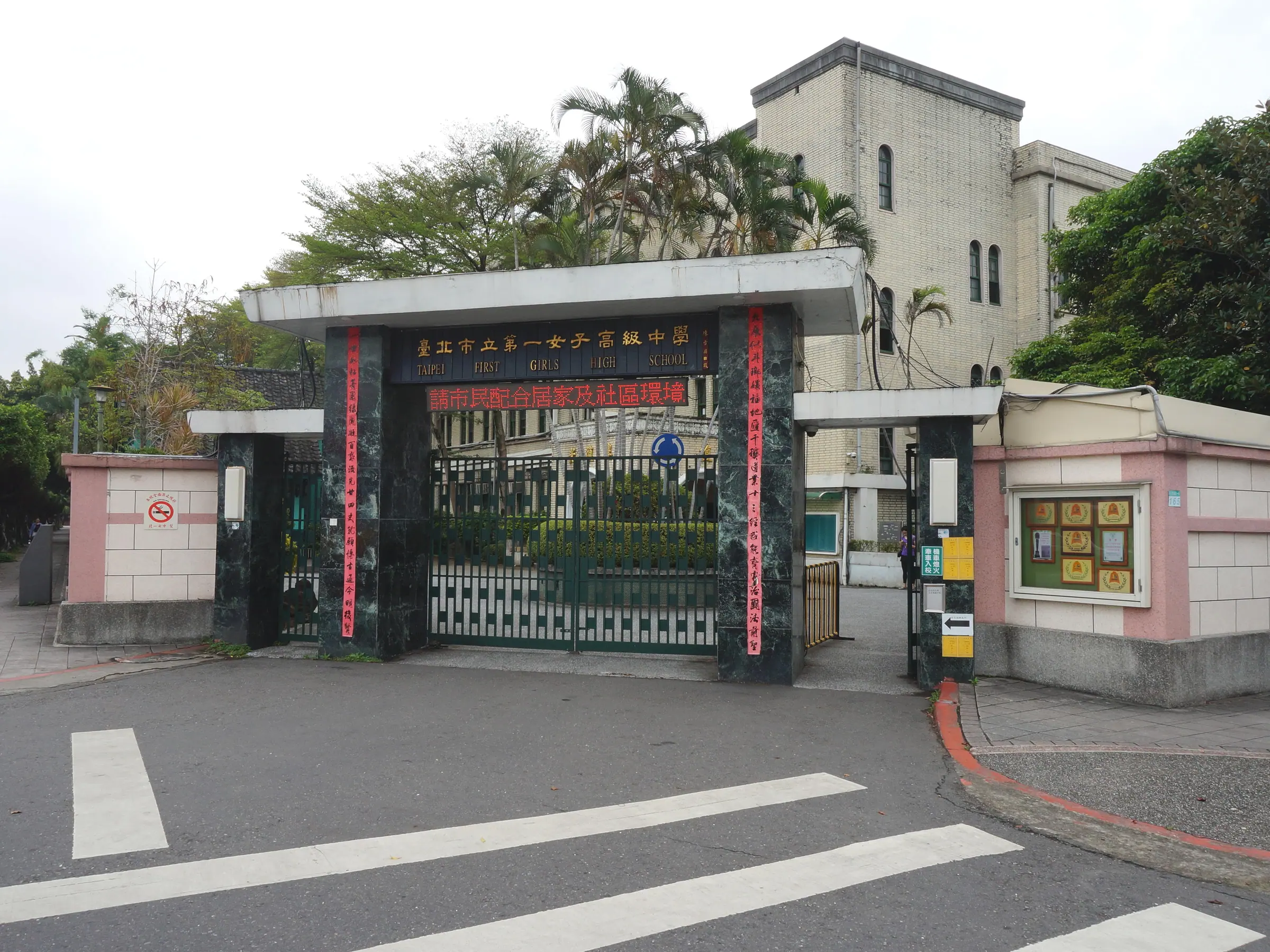
Figure 1: The gate of No. 1 Girls' High School. Photo by Solomon203 / Wikimedia Commons, CC BY-SA 4.0.
Cold War Camouflage: The Political Science of Green Uniforms
Many believe that the "green uniforms" of No. 1 Girls' High School were for aesthetic appeal or to symbolize evergreen vitality, but the history behind them is deeply colored by the Cold War. Before 1952, the school uniform of No. 1 Girls' High School, like that of most schools, was a white top and black skirt. However, at that time, cross-Strait relations were extremely tense, and No. 1 Girls' High School, located next to the Presidential Office, was considered a primary target for air raids. 3
Then-principal Jiang Xuezhu proposed changing the uniform to dark green to protect student safety. This was not for fashion but for "camouflage"—when air raid sirens sounded and students hid in the campus's dense bushes, the dark green uniforms would blend with the environment, reducing the risk of detection by enemy aircraft. 4 This garment, later known as "Little Green Green," was essentially a campus version of camouflage, witnessing Taiwan's survival anxiety on the front line of the Cold War.
📝 Curator's Note: The birth of the green uniform was the most direct intervention of spatial politics on the body. A single piece of clothing carried both the survival fear of air defense and the honor totem it later evolved into.
The Guangfu Building and Spatial Politics: Neighbor to the Presidential Office
The most representative building on campus, the "Guangfu Building," was completed in 1933 and designed by the Construction Section of the Taiwan Governor-General's Office. This building adopts an "Eclectic Modernism" style, with an L-shaped plan and pure RC construction covered with popular "cloth-texture bricks" at the time. 5 The design of the Guangfu Building was not just an aesthetic choice but a reflection of function and order. Its high-ceilinged corridors and symmetrical window grids created a rigorous academic atmosphere. 6
However, the most unique spatial attribute of No. 1 Girls' High School lies in its geographical location—adjacent to the Presidential Office. This "power neighborhood" relationship was materialized in a 2018 school poetry recitation contest. A sophomore student titled her piece "When We Became the President's Neighbors," satirizing the barrier walls often erected during protests by jokingly renaming the school "Taipei Municipal First Barrier High School." 7 This daily life on the periphery of the power core in the Bo'ai Special District allowed students to develop a unique observational perspective: watching the national flag fly under the skywell of the barriers, reorganizing their worldview amidst political tension.
📝 Curator's Note: "Neighbor to the Presidential Office" is not just a geographical fact; it shapes a unique "No. 1 Girls' High School worldview"—observing the establishment of order and the occurrence of conflict on the front line of power operations.
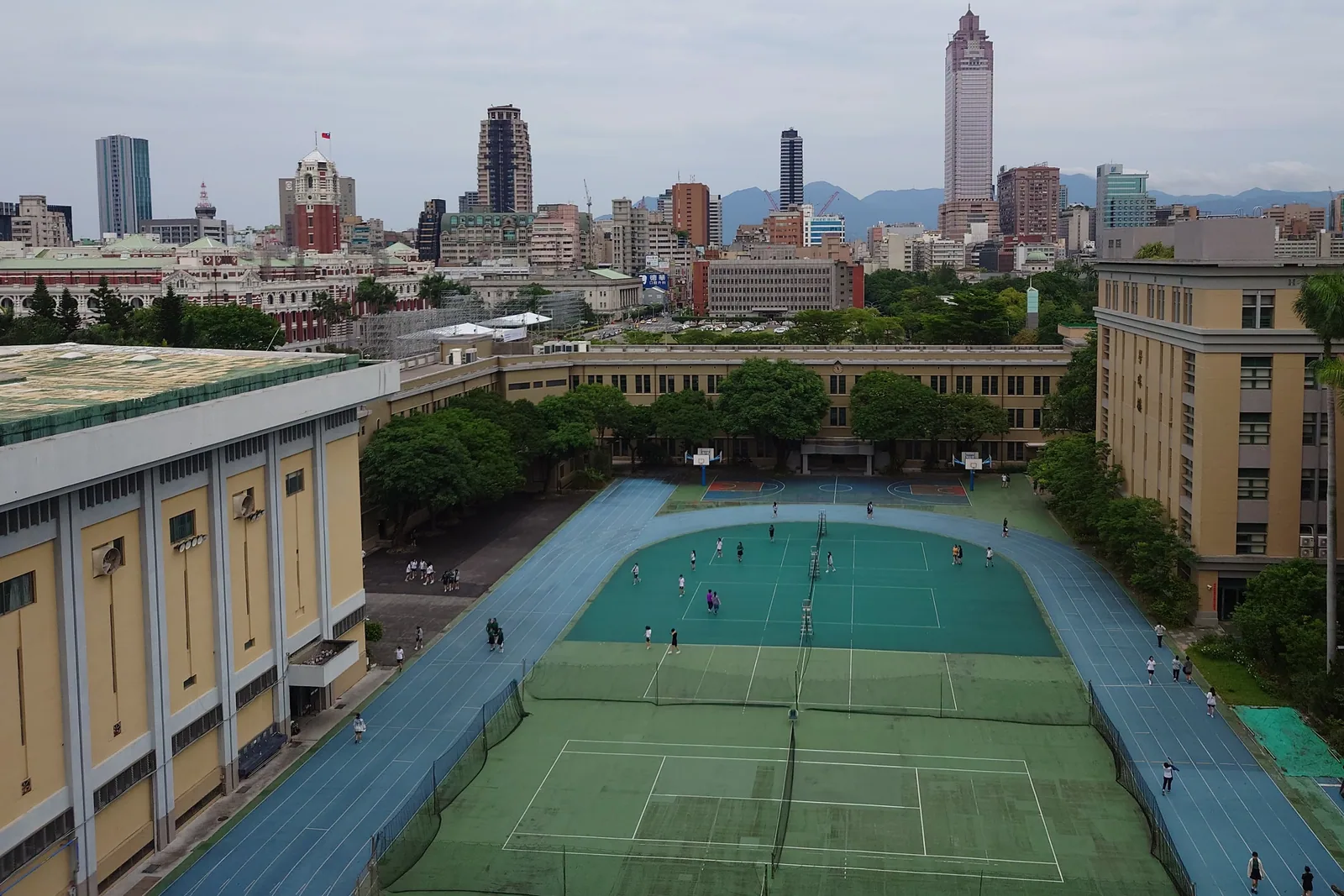
Figure 2: Looking at the No. 1 Girls' High School campus and the Taipei skyline behind it from the air; the red-brick building in the left rear is the Presidential Office. Photo by Yu tptw / Wikimedia Commons, CC BY-SA 4.0.
Science Pusher Under the Cold War: Jiang Xuezhu and the Science Hall
After the regime change in 1945, the school was merged and renamed. In 1949, the legendary principal Jiang Xuezhu took charge, initiating a 22-year transformation period. In the early 1950s, when Taiwanese society still generally favored males over females and materials were extremely scarce, Jiang Xuezhu resolutely overcame difficulties to build a dedicated "Science Hall" on campus. 8
Behind this move lay the global context of the Cold War. Influenced by the arms race between the US and the Soviet Union, educational policies began to tilt towards science. Under Jiang Xuezhu's leadership, No. 1 Girls' High School actively introduced US aid resources for science education experiments, established physics and chemistry laboratories, and promoted the science fair system. 9 This not only broke the prejudice that women were only suitable for domestic education but also laid the foundation for No. 1 Girls' High School's leading position in Taiwan's post-war elite education system. In 1948, when the Minister of Education, Zhu Jiahua, inspected Taiwan, he once rated No. 1 Girls' High School as "the best school in all of China." 10
Leadership Data: The Social Footprint of Female Elites
The influence of No. 1 Girls' High School on Taiwanese society can be seen in specific data. According to informal statistics from the alumni association and related research, the employment rate of No. 1 Girls' High School alumni is as high as 97%, with over 60% having served as administrative executives or mid-to-high-level managers. 11 More importantly, among the female academicians and fellows of the Academia Sinica, Taiwan's highest academic institution, who grew up in Taiwan, the proportion of No. 1 Girls' High School graduates is the highest in the entire country.
The formation of this leadership, beyond the screening of the academic system, stems from the highly autonomous club culture on campus. The Honor Guard, established in 1963, was not just for discipline but served as a field for students to learn collaboration and leadership through collective training. 12 The Honor Guard transformed military-style gun drills into precise aesthetics, symbolizing the process of women reclaiming subjectivity within order.
Cross-Generational Public Memory
Today's No. 1 Girls' High School has transformed from a colonial screening tool in the Japanese colonial period to an important starting point for social mobility and women's public participation in Taiwanese society. From early literary figures like Sanmao and Zhu Tianxin to modern scientists and political figures, the female elites cultivated by this campus challenge existing orders in various fields.
No. 1 Girls' High School is not just a school; it is a mobile museum preserving a century of Taiwan's educational transformation, architectural aesthetic changes, and the politics of women's bodies. As students run along the corridors of the Guangfu Building or practice throwing guns on the playground, they are conversing with history from a century ago and finding their own freedom within order.
Image Sources
- Solomon203 / Wikimedia Commons — CC BY-SA 4.0
- Yu tptw / Wikimedia Commons — CC BY-SA 4.0
References
- The Cradle Cultivating Female Elites — Taipei Prefectural Taipei First Higher Girls' School — See original link for supplementary content (National Taiwan History Museum "Taiwan Women")↩2
- Secondary Education for Women in Taiwan During the Japanese Colonial Period — See original link for supplementary content (Digital Archives and Digital Learning Achievement Portal)↩2
- Why is the No. 1 Girls' High School uniform green? Three pictures to help you understand instantly — Yahoo News report (Yahoo News)↩
- Why did No. 1 Girls' High School choose green school uniforms? The reason is related to the CCP — See original link for supplementary content (LINE TODAY)↩
- Taipei First Girls' High School — See original link for supplementary content (National Cultural Heritage Network)↩
- School History Section — See original link for supplementary content (Taipei Municipal First Girls' High School)↩
- "When We Became the President's Neighbors" No. 1 Girls' High School Poetry Recitation Goes Viral for Creativity — Liberty Times report (Liberty Times)↩
- Biography of Principal Jiang Xuezhu — See original link for supplementary content (Jiang Xuezhu Memorial Scholarship Foundation)↩
- The Development of Science Education in No. 1 Girls' High School and Senior High School in the 1950s — See original link for supplementary content (Ministry of Education PDF Report)↩
- Taipei Municipal First Girls' High School — Wikipedia entry (Wikipedia)↩
- Social Influence and Employment Leadership Data of No. 1 Girls' High School — See original link for supplementary content (Research on Distinguished Alumni)↩
- Peng Senming: The Context of the Establishment of No. 1 Girls' High School Honor Guard — See original link for supplementary content (National Taiwan Normal University Digital School History Museum)↩