
30-second overview: In 1694, the 33rd year of the Qing Kangxi reign, the monk Shubi brought a Mazu statue from Meizhou, Fujian, landed at Bengang, and founded Beigang Chaotian Temple, 94 years earlier than Lukang Tianhou Temple1. In 1887, the 13th year of the Guangxu reign, Yunlin was established as a county, with its county seat first placed in Linqipu, today's Zhushan in Nantou; only in 1893 was it moved to Douliu2. In 1909, the first smokestack of the Huwei Sugar Refinery began to smoke3. On January 28, 1953, Xiluo Bridge opened to traffic: its 1,939-meter steel truss structure was made from U.S. aid materials, bridge piers left from Japanese rule, and postwar engineering completed in sequence4. On December 13, 1987, Chen Ding-nan kept the Sixth Naphtha Cracker out of Yilan in a CTS studio. On June 26, 1991, the Executive Yuan approved relocating it to the waters off Mailiao, Yunlin. Construction began in July 1994, Phase I fired up in 1998, and today 2,255 hectares have been reclaimed from the sea5. In 2011, a team led by Chan Chang-chuan at NTU's College of Public Health found that residents within 10 kilometers of the Sixth Naphtha Cracker had a cancer incidence 1.29 times Taiwan's average6. Today this county has 648,459 residents; on the 19th day of the third lunar month, the Beigang Mazu procession still goes on, and schoolchildren at Mailiao Elementary still have blood drawn for annual monitoring7. This article argues that what Yilan chose to reject, Yunlin paid for with thirty years of its lungs, but that sentence cannot be reduced to the two words "pollution."
At 5:30 a.m., the Sound of the Tide beside Mailiao Harbor
If you ask someone from Mailiao, "Where can you best see how Yunlin has changed?" he will not take you to the tourist corridor inside the Sixth Naphtha Cracker complex, nor will he take you to the incense burner before Beigang Chaotian Temple. He will take you to the seawall beside the Mailiao section of Provincial Highway 17, at 5:30 in the morning.
The sky is still dark. Underfoot is newly reclaimed coastal land that only began to be piled up in 1991; thirty-five years ago this spot had been covered by seawater for several millennia. Facing away from the sea, firelight rises in the distance from row after row of smokestacks. Those are the flare stacks of the Sixth Naphtha Cracker, safety devices that burn off excess gas, never extinguished, twenty-four hours a day5.
The sound of the tide blends with the low-frequency machinery of the industrial zone, until it is hard to tell which is sea and which is factory. The air carries salt and an indescribable chemical odor. Since the Sixth Naphtha Cracker fired up in 1998, residents along Yunlin's western coast have learned to recognize this smell by nose. Aunt Huizhen once told a reporter: "How much more tax Formosa Plastics pays, I don't feel it. What I smell every morning is that odor."8
Drive thirty-five kilometers inland to Beigang Chaotian Temple. At the same dawn, temple staff have already begun offering incense. When Chan Master Shubi crossed the sea from Meizhou in 1694 and placed a Mazu statue on the land of Bengang, he could not have known that 304 years later, on the western side of the same county, a petrochemical kingdom would rise1. But Mazu still proceeds, and the factories still run. That is Yunlin.
This article begins from this coastline because within this field of vision are hidden two key moments in Yunlin's history: one kept the Lanyang Plain from becoming a petrochemical industrial zone, and the other turned the waters off Mailiao into Taiwan's largest petrochemical kingdom. The two moments are 200 kilometers apart in physical distance and 4 years apart in time, but there is only one causal line between them.
Three Alluvial Fans Plus One Artificial Plot: Yunlin's Geography Was Written by Water and Capital
Yunlin County sits between the northern tip of the Chianan Plain and the southern tip of the Changhua Plain. To the north lies the Zhuoshui River; to the south lies the Beigang River. The 1,290.83 square kilometers between the two rivers make up this county7.
The terrain divides into three sections:
The Zhuoshui River alluvial plain stretches from east to west, running through Douliu, Dounan, Huwei, Xiluo, Lunbei, and Mailiao. The soil layer is thick and rich in minerals. This is the area where the Japanese colonial agricultural experiments confirmed the optimal production zone for Pusu rice; by 1932 (the 7th year of the Showa era), the annual yield of Pusu rice in the Xiluo area of Yunlin had already made it one of Taiwan's major rice-producing regions9. The Beigang River alluvial fan extends from Beigang through Xiluo, Yuanzhong, and Houhu, with shallow sandy loam soil, traditionally used for peanuts and grain7. Further east, in Gugang and Linnei, the hilly terrain rises 200 to 800 meters and has a pleasant climate—where the Japanese colonial government selected these mountainous areas for coffee cultivation in the 1930s10.
The fourth section is artificial. Land reclamation in the waters off Mailiao began in 1991, with the first phase completed in 1998, creating approximately 2,255 hectares of new land; including port facilities, the total area reaches 2,603 hectares5. ⚠️ The "3,400 hectares" written in Stage 0 has no reliable source; both Yunlin County Government and Formosa Plastics official data use the 2,255 / 2,603 figures, and this correction is important because thirty years ago this stretch of sea did not exist.
Administratively, there are 20 townships and cities: one county-administered city (Douliu) plus four towns (Dounan, Huwei, Xiluo, Beigang) plus fifteen rural townships. The county seat is in Douliu, the most populous township is Huwei, with a total population of 648,459 people (April 2026 household registration statistics)7.
In winter, the western coast deserves special mention. From November each year through March of the following year, the northeasterly monsoon blows in across the Taiwan Strait, bringing Yunlin's west coast its characteristic alternating "dense fog and strong winds." Around Mailiao, Taixi, and Houhu, visibility frequently drops below 500 meters—this is the season when the Sixth Naphtha Cracker's exhaust disperses worst and places the greatest burden on the lungs11. In terms of rainfall distribution, the western coastal areas receive about 1,200 millimeters annually, while the eastern hills can receive over 2,500 millimeters. This disparity means Yunlin's agricultural structure differs completely from east to west.
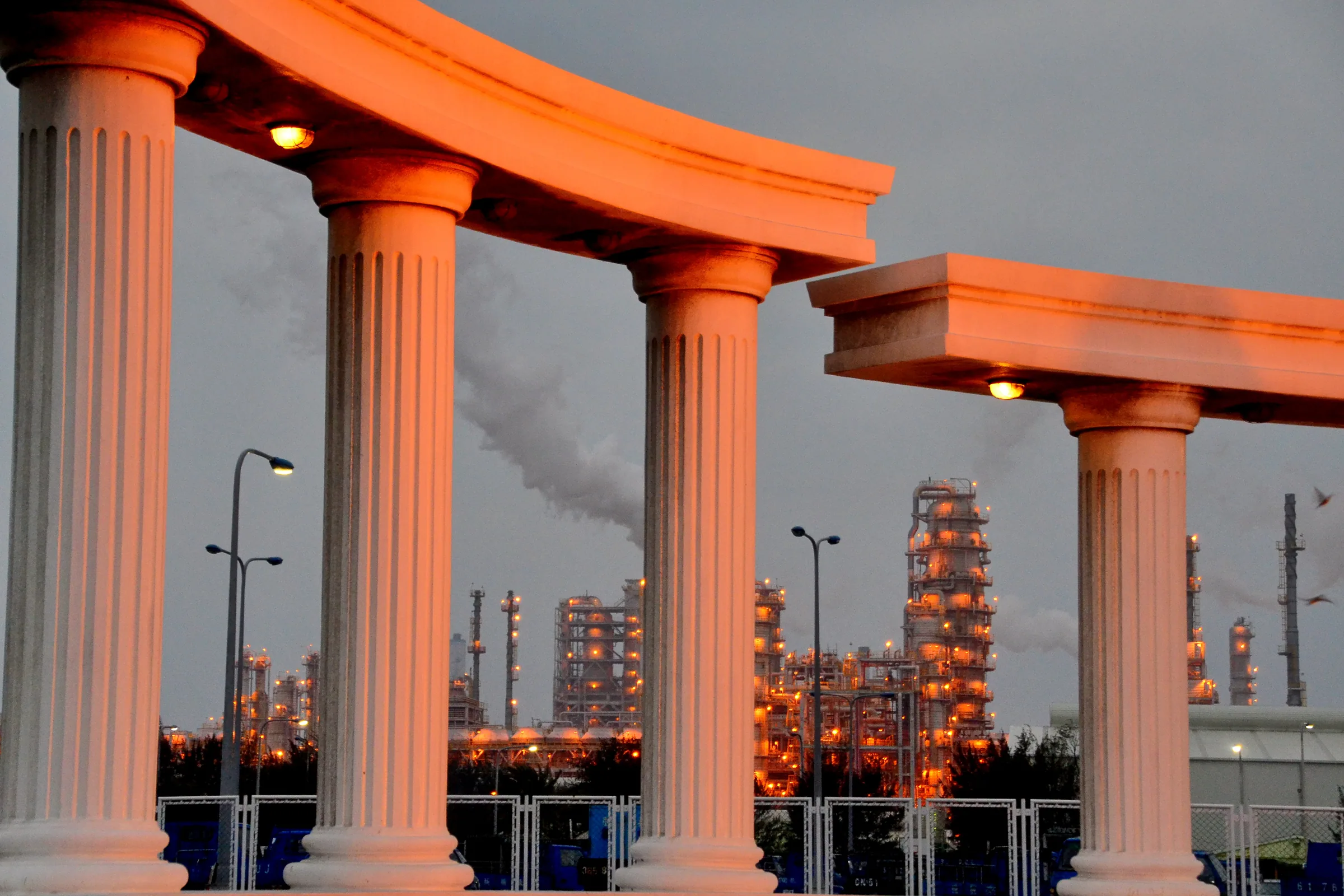
_The Sixth Naphtha Cracker Mailiao Industrial Zone, 2010. Photo: Mk2010 / Wikimedia Commons, CC BY-SA 3.0._
The Root of Bengang: The Year Mazu Crossed the Sea from Meizhou
In 1694, the 33rd year of the Qing Kangxi reign, Chan Master Shubi crossed the sea from Meizhou, Fujian, to Taiwan, carrying a Mazu statue. After landing at Bengang, he chose a site and founded a temple. This was the origin of Chaotian Temple. The official temple history of Beigang Chaotian Temple records this founding process verbatim1.
To understand the meaning of 1694, one must widen the timeline. The mainstream historical dating of Lukang Tianhou Temple places its founding in 1788, the 53rd year of the Qianlong reign, 94 years later than Chaotian Temple. ⚠️ Some Lukang documents give an earlier date of 1591, but it lacks sufficient historical support and is not adopted by the mainstream12. Dajia Jenn Lann Temple was founded in 1730, the 8th year of the Yongzheng reign, 36 years later than Chaotian Temple. Chaotian Temple is one of the earliest Taiwan-based Mazu temples on this timeline of Mazu belief. That status was determined by the route from Meizhou to Bengang in 1694, not by later competition over incense popularity.
But Bengang in 1694 was not today's Beigang.
In 1621, the first year of the Ming Tianqi reign, Yan Siqi led his followers to land at Bengang, build a stockade, and begin cultivation13, making it one of the starting points of early Han migration to Taiwan. The Bengang where Chan Master Shubi landed 73 years later was already one of the ports most familiar to Han settlers on this island. Then several major floods on the Beigang River split Bengang into "Bengang North" and "Bengang South." Beigang Town inherited Bengang North; Xingang Township inherited Bengang South. From then on, the two towns each worshipped at their own Mazu temple, each claiming to be the heir of the original Bengang temple14.
Chaotian Temple's position is that after the original Bengang temple was damaged by floods, it was rebuilt on the same site in Beigang and is the orthodox successor. Xingang Fengtian Temple's position is that in 1811, during the Jiaqing reign, a branch spirit was moved from Beigang to Xingang, and it claims descent from the bloodline of the original Bengang temple. Both sides have supporters and historical interpretations, but most historians support Chaotian Temple's claim of continuity. ⚠️ The "Jingduan stele" often cited by the Xingang side is, after textual examination, widely considered a later forgery, but this remains disputed and should not be stated as a final conclusion in writing14.
📝 Curator's note: The dispute between Beigang and Xingang over Mazu orthodoxy has been argued for more than two hundred years without resolution, and that fact itself is the point. Mazu belief in Taiwan was walked into being by devotees' feet. No central certification body ever issued orthodoxy. Every year in early third lunar month, the nine-day, eight-night pilgrimage of Dajia Mazu ends at Xingang Fengtian Temple, but Beigang Chaotian Temple's procession on the 19th day of the third lunar month still draws more than a million participants. In this religious structure, the word "orthodox" has no real definition; it is simply rhetoric used by local temples. What truly defines "orthodoxy" is the human tide that flows from all directions into the Chianan Plain every third lunar month. Whichever road they choose to walk becomes orthodox. The temple of 1694 is still here today because it survived 332 years of typhoons, floods, wars, and a coastline remade by thirty years of reclamation, not because it won any one dispute.

Beigang Chaotian Temple, 2024-09-18. Photo: 阿道, CC BY-SA 4.0 via Wikimedia.
The Beigang Mazu procession has two features found nowhere else in Taiwan. The first is "blasting the palanquin." Devotees use large quantities of firecrackers to directly blast the front of the palanquin; smoke fills the air, the noise is deafening, and only when the palanquin has been blasted beyond recognition is divine protection considered assured15. The second is yigé, religious art floats made from bamboo, wood, and paper sculpture, with real people on top performing mythological scenes. Beigang's yigé are among the largest and most elaborately made in Taiwan and have been selected as intangible cultural heritage.
Its difference from Dajia Mazu must be kept clear. Dajia Jenn Lann Temple begins its nine-day, eight-night pilgrimage on the third day of the third lunar month, following a route from Dajia to Xingang, and has greater international visibility. Beigang Chaotian Temple centers on its own temple procession and local circumambulation; its local ritual form is more primordial, and blasting the palanquin and yigé are what distinguish it most from other Mazu temples15. Outsiders may think Beigang is simply a religious tourism site. Locals know that for those few days each third lunar month, every hotel in town is full and vendors work until dawn. That is a measure of time sustained for 332 years.
The Year Shen Baozhen Established the County, the Yunlin County Government Was in Nantou
⚠️ A common mistake needs to be corrected here.
In 1887, the 13th year of the Guangxu reign, the same year Taiwan was made a province, Yunlin County was separated from Changhua County and established as an independent county. But the county seat was not in Douliu. It was in Linqipu, today's Zhushan Township in Nantou County2. Stage 0's statement that "Yunlin County was established in 1887 with the county seat in Douliu" is wrong. Only in 1893, the 19th year of the Guangxu reign, was the county seat moved to Douliu Bao, today's Douliu City, and it has not moved since.
Why was Yunlin's earliest county government in a place that today belongs to Nantou? Because when the Qing court established the county, it saw "Linqipu" as a transportation hub: it sat upstream on the Qingshui River, linking the Changhua Plain with the Central Mountain Range, and was a key node for controlling the central mountains. The county seat was moved in 1893 because Linqipu was too remote and population concentration could not keep pace; Douliu was the next-best choice at the time. For six years, Yunlin's county government was in the mountains. This reflects Qing administrative logic: strategy first, population second.
Japanese rule began in 1895, and Yunlin County was first changed into Yunlin Prefecture. In 1920, the 9th year of the Taisho era, a major administrative reform abolished prefectures and established prefectural states. Yunlin was cut into two pieces: the northern part, including Douliu, Huwei, Xiluo, and Beigang, was incorporated into Tainan Prefecture and assigned to Huwei District and Beigang District16. During the 50 years of Japanese rule, the historic core of Douliu was nested within layers of administration as "Douliu Street, Huwei District, Tainan Prefecture." The name Yunlin disappeared for 50 years.
After the postwar takeover in 1945, Yunlin County was reestablished, the county seat returned to Douliu, and the administrative structure has continued to the present2. In 1950, local self-government was implemented, and Yunlin County's pattern of 20 townships, towns, and cities was fixed, with no major changes since.
The significance of this county-establishment history is that Yunlin has never been an ancient, uninterrupted "county." Its identity as a "county" was broken. For the 50 years from 1895 to 1945, it was called something else; for the 6 years from 1887 to 1893, its county government was on someone else's ground. Yunlin's true continuous county history begins in 1945, 21 years later than Keelung's establishment as a city.
The Year the First Smokestack Smoked: The Japanese Sugar Empire Built 400 Kilometers of Railway across the Yunlin Plain
- This year must be stated clearly. ⚠️ Stage 0 wrote "1908, Huwei Sugar Refinery established," but 1908 was the year Dai-Nippon Sugar Co. began its business plan. The first smokestack truly began smoking, and cane-crushing and sugar production began, in 19093. In writing, 1909 should be used as the starting point of Huwei Sugar Refinery operations to avoid the dispute among the three establishment dates 1906, 1907, and 1908.
By the late Japanese period, Huwei Sugar Works was one of the largest sugar factories in Taiwan, producing tens of thousands of tons of sugar annually. But what made it Yunlin's skeleton was the railway network between sugar factories; sugar itself was almost secondary.
The "five-bun car" was the common name for Taiwan Sugar railways, because the 762-millimeter gauge was roughly half the 1,435-millimeter standard gauge, in fact about 53%. During Japanese rule, Nippon Sugar laid a dense five-bun railway network across the Yunlin Plain, connecting cane farmers' fields to the crushers in the sugar factories. At its peak, five-bun railway lines within Yunlin exceeded 400 kilometers. To grasp this figure: the Taiwan Railways Western Trunk Line from Keelung to Pingtung is about 408 kilometers long. The cane railways of one sugar-factory system inside Yunlin County were as long as the entire Western Trunk Line3.
The consequence of this railway system was that during Japanese rule, every village on the Yunlin Plain was connected to the sugar factories. Cane farmers pushed carts loaded with sugarcane to the nearest five-bun station; the trip to the factory was measured in hours; the factories ran twenty-four hours a day. From then on, Yunlin became a large industrialized farming village. In the memories of cane farmers, harvest season was the season when "the whole plain was filled with the sound of railways"17.

Huwei Sugar Refinery, 2018. Photo: WC-QHS, CC BY-SA 4.0 via Wikimedia.
After the war it was renamed the Taiwan Sugar Huwei Main Refinery and continued operating into the 1990s. In 1999, Huwei Sugar Refinery stopped producing cane sugar3, and part of its facilities were transformed into the Huwei Sugar Refinery Cultural Park: Japanese-era buildings, including the 1910s refinery office and employee dormitories, were preserved; the five-bun railway became a tourist train; and Taiwan Sugar cultural artifacts were placed on permanent display. If one visits only the old street and sugar refinery in Huwei today, one sees a highly preserved Japanese-era industrial settlement. That is because when sugar production stopped, the building complex was sealed as a whole instead of demolished. After the 2000s, as the idea of "industrial heritage tourism" arrived, these Japanese-era buildings became assets.
During the same period, Xiluo rice reached its production peak in 1932, the 7th year of the Showa era9. ⚠️ The Stage 1 note of a "1931 peak" needs verification; mainstream documents support 1932. This was the key year in the formation of Yunlin's reputation as a rice granary. The Japanese established the Xiluo branch of the Taichu Prefectural Agricultural Experiment Station to improve ponlai rice varieties. The black soil of the Zhuoshui River, combined with Japanese agricultural experiments, made Xiluo rice one of Taiwan's major rice granaries in the 1930s.
After the war, the Chishang Farmers' Association Improvement Station was established in Taitung in 1962. After the 1990s, the Chishang rice brand became famous nationwide, and Xiluo rice lost to Chishang in national visibility. But Xiluo farmers responded directly: "What makes Xiluo rice good was washed down by the Zhuoshui River, not produced by advertising."18 This is what Xiluo farmers told reporters. Their rice did not lose; their marketing budget did.
Yunlin's soy sauce factories are on the same timeline. Wan Ja Shan Soy Sauce was founded in 1909, the 42nd year of Meiji, the same year the first smokestack smoked at Huwei Sugar Refinery. Ruei Chun Soy Sauce was founded in 1921, the 10th year of Taisho. Both are in Xiluo, both use water from the Zhuoshui River, both use natural vat-sun fermentation, and both still operate today19. The skeleton of Yunlin's food-processing industry was built one line at a time during Japanese rule.
U.S. Aid Steel, Japanese-Era Piers, Postwar Engineering: Xiluo Bridge Took 16 Years to Connect
The story of Xiluo Bridge cannot be understood only through its opening day.
The piers were built under Japanese rule. In 1937, the 12th year of the Showa era, the Japanese colonial government began survey and design work for a bridge across the Zhuoshui River to connect Yunlin and Changhua. Construction officially began in 1938, but in 1941 the Pacific War broke out, U.S. aid materials were cut off, and the project stopped. By then the piers had been completed, but the steel trusses had not arrived4. The Japanese colonial government had built half a bridge; the war pulled away the steel. The bridge stood bare on the Zhuoshui River for 12 years with only its piers.
In 1950, the Korean War broke out, and the Republic of China received U.S. aid. Steel from the United States arrived in Taiwan. The main bridge structure was completed in 1952, and an opening ceremony was held on the morning of January 28, 1953. The bridge was 1,939 meters long, with 31 truss spans of 50 feet each. It was then Taiwan's longest bridge. ⚠️ Claims such as "the longest bridge in the Far East" and "the world's second-longest rail-road bridge" vary across sources. The core historical node consists of three facts: 1,939 meters, U.S. aid steel, and Japanese-era piers4.
To understand this distance: 1,939 meters is one-third of the straight-line distance from today's Banqiao Station to Taipei Main Station. Yunlin and Changhua are separated by the Zhuoshui River, Taiwan's largest river, whose alluvial fan is as wide as 4 kilometers and whose rainy-season flow can surge to 10 times its dry-season level. Before 1953, to travel from Xiluo to Changhua one had to detour through Douliu or Lukang, adding more than 30 kilometers. After Xiluo Bridge opened, Xiluo was directly connected to Yuanlin in Changhua, and Yunlin's rice and sugar gained a fast route into northern and central Taiwan markets for the first time.

Xiluo Bridge, 2014-08-02. Photo: JianEn Yu, CC BY 2.0 via Wikimedia.
In 1978, because of structural aging, Xiluo Bridge began restricting large vehicles. Later, a new bridge, the New Xiluo Bridge, was built beside it for traffic, while the old Xiluo Bridge became mainly for pedestrians and bicycles and was designated a county historic monument. But it remains there, watching the Zhuoshui River flow by every day. This bridge is physical evidence of Yunlin's postwar modernization.
Wang Yung-ching's Twenty-Five Years: Four Applications, Two Blocks, and Finally 2,255 Hectares Reclaimed off Mailiao
At this point, an article on Yunlin cannot avoid the Sixth Naphtha Cracker.
Wang Yung-ching proposed a naphtha cracker construction plan in 1973. That was the year of the first oil crisis, and Formosa Plastics wanted to integrate upstream into petrochemical feedstocks from downstream plastics processing. The government's answer was rejection5. A second application in 1975 was rejected. A third application in 1978 was rejected or shelved. A fourth application in 1986 received the Executive Yuan's approval in principle, with the site selected for the Guanyin Industrial Zone in Taoyuan. At the end of 1986, under environmental pressure, the Taoyuan Guanyin site was blocked, and Wang Yung-ching began evaluating Yilan.
Then came December 13, 1987.
Yilan County Magistrate Chen Ding-nan went to CTS's "2100 Quanmin Kaijiang" for a televised debate with Wang Yung-ching20. The full video can still be seen on YouTube today21. Chen Ding-nan's position was that Yilan did not want the Sixth Naphtha Cracker. Wang Yung-ching's position was that Taiwan needed the petrochemical industry and that national policy should support it. The debate was divided into five segments: the first three were direct debate between the two men, and the last two responded to audience questions.
The Chen Ding-nan Education Foundation records Chen's core argument verbatim: "To preserve Yilan's clean land, and to be accountable to the '450,000 county-resident bosses,' Chen Ding-nan decided to reject the entry of the Sixth Naphtha Cracker."20 A local chief executive confronting Taiwan's greatest capitalist was a scene watched by viewers nationwide in front of their televisions.
On October 3, 1988, Formosa Plastics Group formally announced that it would abandon its plan to build the Sixth Naphtha Cracker in Yilan County's Lize Industrial Zone. On December 1, 1990, an anti-Sixth Naphtha Cracker march in Luodong drew about 14,000 people, setting a Yilan historical record20. Then Wang Yung-ching began looking for the next piece of land.
On June 26, 1991, the Executive Yuan formally approved siting the Sixth Naphtha Cracker on reclaimed land in the waters off Mailiao Township, Yunlin County5. Formosa Petrochemical Corporation was formally established in 1992. Construction of the Sixth Naphtha Cracker officially began in July 1994. In 1998, Phase I was completed and production began; the naphtha cracker and ethylene plant fired up.
From Wang Yung-ching's 1973 proposal to the 1998 firing-up of Phase I, it took exactly 25 years. In between came the oil crisis, the block in Taoyuan, the block in Yilan, thirty months of reclamation in Mailiao, and four expansions. Chen Ding-nan's eight years as county magistrate kept the Sixth Naphtha Cracker out of the Lanyang Plain, but the side effect of that decision was this: it did not make the Sixth Naphtha Cracker disappear. It moved it to Yunlin. At the moment of the Executive Yuan's approval in June 1991, Yilan's victory became Yunlin's proposition.
✦ "County Magistrate Chen Ding-nan said: The mountains here, the sea here, cannot be bought with money; how our descendants will live is not something Formosa Plastics decides." (Chen Ding-nan's CTS debate, December 1987, oral-history materials from the Chen Ding-nan Education Foundation20)
The reclaimed area must be stated clearly. The Sixth Naphtha Cracker offshore industrial zone covers about 2,603 hectares including harbor facilities, of which about 2,255 hectares are reclaimed land5. The "3,400 hectares" written in Stage 0 cannot be verified from reliable sources; it may have mixed the Sixth Naphtha Cracker with surrounding planned land or repeated an early media error. Use the two figures 2,255 hectares for the reclaimed portion and 2,603 hectares including the harbor.
This new land did not exist thirty-five years ago. It truly did not exist; seawater had covered it for several thousand years. Today it is Taiwan's largest petrochemical industrial zone, with annual output exceeding NT$1 trillion, and it is Yunlin County's largest source of tax revenue.
The Schoolchildren of Mailiao Elementary Have Blood Drawn Every Year
The 2011 study published by Professor Chan Chang-chuan's team at NTU's College of Public Health was an academic turning point in the environmental controversy over the Sixth Naphtha Cracker.
The study concluded that residents within 10 kilometers of the Sixth Naphtha Cracker had an overall cancer incidence 1.29 times the Taiwan average6. Children in Mailiao Township and other townships had higher concentrations of carcinogens such as benzene in their blood than the control group6. The study triggered broad social discussion. Formosa Plastics Group issued a response report but did not fully refute it. ⚠️ In writing, this should be marked as a "finding of the 2011 NTU study" rather than an "official conclusion." It is a research finding; Formosa Plastics disagrees, but the study's methods and data have long been cited in academia.
Behind the phrase "health tracking of schoolchildren at Mailiao Elementary" is one of the most concrete scenes in Taiwan's public-health history. In 2013, PTS's "Our Island" recorded a school parent saying: "The children at our school have to go for checks every year. There is benzene and ethylbenzene in their blood. When I first saw the report, I had no way to tell my child what that was."22 Benzene and ethylbenzene are classified by the IARC as Group 1, carcinogenic to humans, and Group 2B, possibly carcinogenic to humans. These substances were in the blood of 8-year-old children.
The PM2.5 data are as follows: Yunlin County, especially Mailiao, Taixi, and Kouhu, has long been among the counties and cities with Taiwan's highest PM2.5 levels. Annual average PM2.5 around the Sixth Naphtha Cracker once exceeded 30 μg/m³; the WHO standard is 5 μg/m³, and Taiwan's standard is 15 μg/m³23. Dense fog brought by the winter northeast monsoon, combined with poor dispersion of industrial emissions, is the air quality borne each year by residents along Yunlin's western coast.
But Yunlin people's feelings toward the Sixth Naphtha Cracker are not one-directional condemnation.
Liao Bing-chong, a local Mailiao resident, was interviewed by CommonWealth Magazine in 2012. What he said was: "Honestly, what was Mailiao before the Sixth Naphtha Cracker came? A poor place, with nothing. After it came, the roads got better, there were jobs, there was tax revenue. But if you ask me whether I regret it? I don't know. I don't know."24 This "I don't know" is Yunlin's most honest answer to the Sixth Naphtha Cracker. It is true that it brought jobs and tax revenue. It is also true that it brought pollution and disease. These two things do not cancel each other out; they exist at the same time.
Kouhu resident Gong Ying-jun said in a 2014 interview with the Environmental Information Center: "The air being bad is real. My asthma has been getting worse, and at the clinic the doctor said the air here is just like this. What can I do? My house is here."25 The causes of asthma are complex and cannot be directly attributed to the Sixth Naphtha Cracker, but "the air here is just like this" is the everyday knowledge shared by residents along Yunlin's coast.
The relationship between the Yunlin County Government and Formosa Plastics is not simply oppositional either. The Formosa Plastics Group's Sixth Naphtha Cracker is Yunlin County's largest source of tax revenue, paying local taxes measured in billions of New Taiwan dollars every year; politically, the county government cannot be wholly opposed to it. Yunlin County Magistrate Chang Li-shan, of the Kuomintang, won in 2018 and was reelected in 2022. Her elder brother is former county magistrate Chang Jung-wei, a former Democratic Progressive Party member who served from 2001 to 2009, and the Chang family has deep roots in local politics. This cross-party Chang family structure shows that Yunlin politics is not driven purely by ideology; the relationship between local factions and local industries, including the Sixth Naphtha Cracker, is the real coordinate system26.
📝 Curator's note: Writing the Sixth Naphtha Cracker as a binary opposition of "pollution vs. faith" is the most common kind of laziness. The real Yunlin looks like this: the 1.29-times cancer incidence is the data of a 2011 NTU study, Formosa Plastics has responded, but the data have long been cited in academia; the annual blood draws for Mailiao Elementary schoolchildren were recorded by PTS; 2,255 hectares of reclaimed land were sea thirty-five years ago; Aunt Huizhen really does smell that odor every morning; Liao Bing-chong's "I don't know whether I regret it" is real; the taxes Yunlin County receives from the Sixth Naphtha Cracker are real; the annual third-lunar-month procession at Beigang Chaotian Temple with more than a million participants is real; the rice ears of Xiluo drooping low in November are real. All of these things happen at the same time in the same county. Magnify any one of them alone, and the county's real form is lost. The iron rule for writing Yunlin is not to let any single dimension consume the others.
Gukeng Coffee and Janfusun's Roller Coasters: Another Yunlin
If the camera pulls from the coast to the eastern hills, Yunlin looks different.
The history of Gukeng coffee has three stages. In the 1930s, the Japanese colonial government promoted coffee cultivation and selected the Huashan hills of Gukeng: 400 to 800 meters above sea level, with a climate suited to arabica. In 1932, the 7th year of the Showa era, Gukeng coffee cultivation reached its peak, making it one of Taiwan's most important coffee-producing areas at the time. ⚠️ The date "1931" appears in some sources, but mainstream documents support 1932, so writing should use 193210.
In 1941, the Pacific War broke out. Material controls and labor shortages caused coffee plantations to decline sharply. During the 55 years from 1945 to 2000, coffee cultivation in Gukeng nearly disappeared, and farmers switched to other crops. The memory of coffee planted under Japanese rule slept through those 55 years.
In 2003, the Yunlin County Government and Gukeng Farmers' Association jointly held the first "Taiwan Coffee Festival," with the theme of "awakening the memory of Japanese-era coffee"10. Media reported widely on "Taiwan-grown coffee," and from 2003 to 2008 Gukeng coffee became a sensation, with weekend crowds pouring into the Huashan tourism area. A Gukeng farmer described the meaning of this history to Liberty Times: "The coffee of Gukeng was planted here by the Japanese, and then they left because of the war. We are planting it back to plant memory back."27
"Planting memory back" was a signature phrase of Taiwanese agritourism in the 2000s. After Gukeng coffee, Yunlin also had Xiluo Old Street and its soy sauce factories, the century-old Ruei Chun, Wan Ja Shan, and Tatung; Huwei Sugar Refinery Cultural Park; pilgrim tourism at Beigang Chaotian Temple; and oyster-field ecotourism in Kouhu and Taixi. Each axis reconnects a forgotten memory with contemporary consumption.
Janfusun Fancyworld opened in 1990 and was one of Taiwan's largest amusement parks of the 1990s28. Located in Gukeng Township, it combines amusement rides with natural scenery. From the 1990s to the 2000s, it was a top choice for school graduation trips and family tourism. "Think of Yunlin, think of Janfusun" is a shared memory for people now in their thirties and forties. Today, facing competition from Leofoo Village, Hi-Lai, and others, it still operates. The screams from its roller coasters and the flare stacks of the Mailiao Sixth Naphtha Cracker sound simultaneously in different corners of the same county.
This is the contrast between Yunlin's eastern and western ends: the Gukeng hills are a successful case of cultural memory turned into tourism; the Mailiao coast is the environmental price of petrochemical reclamation; Janfusun is a model of Taiwan's 1990s amusement industry; Chaotian Temple is the Mazu root of 1694. One county contains all four extremes. Driving from east to west takes two hours, and every 30 kilometers is another Yunlin.
The usual route for outside tourists to Yunlin goes like this: on the weekend, they drive down the freeway from Taipei or Taichung, first drink coffee in Gukeng and look at the mountain view, then go to Beigang Chaotian Temple to worship Mazu and eat peanuts, then go to Xiluo Old Street to buy soy sauce, and leave by evening. Mailiao and Taixi seldom appear on this route. Locals know that Yunlin's real story is not on the tourist map. It is on the Mailiao section of Provincial Highway 17 at 5:30 in the morning, in the crowds at Beigang every 19th day of the third lunar month, in the rice ears drooping low across the Zhuoshui River Plain in November, and in the brick walls of the office building left by Huwei Sugar Refinery in 1909.
Conclusion: The Smokestacks of the Sixth Naphtha Cracker and the Incense Burner of Chaotian Temple Are Both Burning
Return to the morning beside the seawall on the Mailiao section of Provincial Highway 17.
The sky brightens. The firelight of the flare stacks is diluted by morning light, but the water vapor and waste gas rising from the smokestacks still form a long plume in the sky, drifting eastward inland, toward Yuanchang Township, Dongshi Township, Beigang Town, and the place where Chaotian Temple has stood since 1694.
The tide is still sounding. The coastline has extended more than 2 kilometers seaward from where it was in 1990. Those 2 kilometers were reclaimed between 1991 and 1998. The boundary between sea and land was redrawn by human hands. This is Mailiao.
Drive thirty-five kilometers inland to Beigang Chaotian Temple. The incense in the burner is still burning, from 1694 to 2026, unbroken for 332 years. Every year on the 19th day of the third lunar month, Zhongshan Road in front of Chaotian Temple is packed with devotees: gongs and drums, firecrackers, the thunder of blasting the palanquin. For those few days, the entire town stops everything to accompany Mazu on that circuit.
The two places are 35 kilometers apart. One is a petrochemical kingdom that only began to exist in 1998. The other is a Mazu root that has been here since 1694. Geographically, both reside in Yunlin County. Temporally, they are separated by 304 years. In the scale of daily life, one counts PM2.5 with smokestacks, and the other counts devotion with firecrackers. Both are still burning.
✦ "The future Yilan people chose was taken up by Yunlin people with thirty years of their lungs. But whether that is fair is very hard to say." (Environmental activist, interview with the Yunlin branch of the Taiwan Environmental Protection Union29)
After that 1987 debate in Yilan, the Lanyang Plain did not become a petrochemical industrial zone. Chen Ding-nan protected its mountains and sea. But Wang Yung-ching did not give up on the Sixth Naphtha Cracker. He spent 4 years looking for the next piece of land, and in 1991 found Mailiao, Yunlin. Construction began in 1994; the plant fired up in 1998. Chen Ding-nan's victory kept the Sixth Naphtha Cracker from being built in Yilan, but that victory did not make the Sixth Naphtha Cracker disappear. It sent it to Yunlin.
From Taipei, Yunlin is "rice granary plus Sixth Naphtha Cracker." From Yilan, Yunlin is "the one we did not take." From the perspective of Mailiao residents, Yunlin is "that odor I smell every morning" plus "but the jobs and roads came from the Sixth Naphtha Cracker." From the perspective of the staff living at Beigang Chaotian Temple, Yunlin is "Mazu has kept walking for 332 years." From the perspective of the Mailiao Elementary schoolchildren in Chan Chang-chuan's 2011 study, Yunlin is "benzene and ethylbenzene in the blood."
These perspectives will not merge into one. The truth of Yunlin County is the structure in which these perspectives coexist at the same time.
Next time you go to Yunlin, do not only go to Gukeng for coffee. Try going to the seawall on the Mailiao section of Provincial Highway 17 at 5:30 in the morning and looking at the flare stacks of the Sixth Naphtha Cracker. Then go to Beigang Chaotian Temple and look at the Mazu statue brought from Meizhou in 1694. Finally, go to Huwei Sugar Refinery Cultural Park and touch the brick wall of the office built in 1909. After visiting all three places, you will remember one thing: Taiwan, this island, allocated the price of modernization to different counties. Yunlin took petrochemicals; Yilan blocked petrochemicals; Chishang took the glory of rice; Xiluo kept planting rice. Every county holds its position. Yunlin holds the heaviest one.
Further Reading
- Yilan County — sibling in the 22 Counties and Cities Series; on December 13, 1987, Chen Ding-nan kept the Sixth Naphtha Cracker out of the Lanyang Plain, and in June 1991 the Executive Yuan approved relocating it to Mailiao, Yunlin. This is the shared sentence of fate between Yilan and Yunlin
- Keelung City — pilot article in the 22 Counties and Cities Series; like Yunlin, it is a "mid-sized county or city pressed down by the capital's frame," useful for comparing two kinds of local forms missed by center-driven narratives
- Chiayi County — sibling in the 22 Counties and Cities Series; the Bengang orthodoxy dispute between Xingang Fengtian Temple and Beigang Chaotian Temple has tangled across county lines for more than two hundred years
- Chiayi City — sibling in the 22 Counties and Cities Series; like Beigang, it is a contemporary heir to the historical core of Bengang
- Formosa Plastics Group — the full corporate history from Wang Yung-ching's 1973 proposal for a naphtha cracker to the 1998 firing-up of Yunlin's Sixth Naphtha Cracker
- Taiwan Sugar — ninety years of Taiwan's sugar industry, from the first smokestack of Huwei Sugar Refinery in 1909 to the end of cane-sugar production in 1999
- The Legend of Mazu and Baosheng Dadi — the place of the Mazu belief enshrined at Beigang Chaotian Temple in Taiwanese folk religion
- Taiwan's Administrative Divisions — the complete administrative history: Yunlin established as a county in 1887; county seat moved from Linqipu to Douliu in 1893; reorganized in 1920 into Tainan Prefecture's Huwei and Beigang districts; reestablished as a county in 1945
- Taiwan's River Systems and Hydrological Features — the decisive influence of the Zhuoshui River and Beigang River alluvial fans on Yunlin's agricultural landscape
- Taiwan's Agricultural Landscapes and Industrial Distribution — the place of Xiluo rice and Chishang rice in the rice-granary identities of Taiwan's agricultural landscape
Image Credits
This article uses 4 Wikimedia Commons CC-licensed images, with the hero image cached at public/article-images/geography/ to avoid hotlinking to source servers:
- Hero (frontmatter): Formosa Plastics Group Mail-Liao Industrial Complex (Mk2010, CC BY-SA 3.0, Mail-Liao Sixth Naphtha Cracker Industrial Park)
- Scene §1894 Beigang: Beigang Chaotian Temple-01 (Ado, CC BY-SA 4.0, Beigang Chaotian Temple, September 2024)
- Scene §1909 The First Chimney: Scene in Huwei Sugar Factory 05 (WC-QHS, CC BY-SA 4.0, Huwei Sugar Factory, 2018)
- Scene §1953 January 28: Xiluo Bridge at noon on 2 August 2014 (JianEn Yu, CC BY 2.0, Xiluo Bridge, August 2014)
Video Material
The full version of the December 13, 1987 CTS News Plaza program "Anti-Sixth Naphtha Cracker Debate: Chen Ding-nan vs. Wang Yung-ching" can be viewed in a complete YouTube replay. This is the crucial historical footage of the Sixth Naphtha Cracker being blocked from Yilan and, four years later, moved to Mailiao, Yunlin.
References
- Beigang Chaotian Temple — Wikipedia — The complete temple history: in the 33rd year of the Qing Kangxi reign, 1694, Chan Master Shubi crossed the sea from Meizhou, Fujian, to Taiwan carrying a Mazu statue and landed at Bengang to found the temple; this was 94 years earlier than Lukang Tianhou Temple in 1788; the procession on the 19th day of the third lunar month attracts more than a million participants; the temple was designated a national monument in 1985.↩23
- Yunlin County — Wikipedia — The full administrative history: Zhuluo County established in 1684; Changhua County separated in 1723, the first year of Yongzheng; Yunlin County established in 1887, the 13th year of Guangxu, with county seat at Linqipu, today's Zhushan in Nantou; county seat moved to Douliu in 1893; changed to Yunlin Prefecture under Japanese rule in 1895; prefectures abolished and states established in 1920, with the north incorporated into Tainan Prefecture's Huwei District and Beigang District; reestablished after the war in 1945.↩23
- Huwei Sugar Refinery — Taiwan Sugar Corporation Huwei Sugar Refinery Cultural Park — Official records: in 1909, the 42nd year of Meiji, the first smokestack began smoking and cane crushing began; by the late Japanese period it was one of Taiwan's largest sugar factories; the five-bun railway network within Yunlin exceeded 400 kilometers; cane-sugar production stopped in 1999; part of the site was transformed into a cultural park. ⚠️ Establishment dates of 1906, 1907, and 1908 all coexist; Stage 2 adopts 1909 as the year formal production began.↩234
- Xiluo Bridge — Wikipedia — The complete bridge history: total length 1,939 meters; 31 truss spans of 50 feet each; survey and design began under Japanese rule in 1937; construction began in 1938; work stopped in 1941 due to the Pacific War, with bridge piers completed but steel trusses not yet arrived; U.S. aid steel became available after the Korean War began in 1950; the main structure was completed in 1952; the opening ceremony was held on January 28, 1953; large vehicles were restricted in 1978; the bridge was designated a county historic monument.↩23
- History of the Formosa Petrochemical Sixth Naphtha Cracker Project — Formosa Petrochemical Corporation — The complete timeline and area data for the Sixth Naphtha Cracker: Wang Yung-ching first proposed a naphtha cracker in 1973; Taoyuan Guanyin was blocked in 1986; Yilan was blocked by Chen Ding-nan in 1987; on June 26, 1991, the Executive Yuan approved siting it in Mailiao, Yunlin; construction began in July 1994; Phase I was completed and fired up in 1998; reclaimed land totals 2,255 hectares, or 2,603 hectares including harbor facilities. ⚠️ The "3,400 hectares" written in Stage 0 cannot be verified from reliable sources; the two official figures 2,255 and 2,603 are used.↩23456
- Impact Assessment of the Sixth Naphtha Cracker on Nearby Areas — NTU College of Public Health research team led by Professor Chan Chang-chuan — Published in 2011; the academic research found that residents within 10 kilometers of the Sixth Naphtha Cracker had an overall cancer incidence 1.29 times the Taiwan average, and that children in Mailiao Township and other townships had significantly higher blood concentrations of carcinogens such as benzene than the control group. ⚠️ This is a research finding, not an official conclusion; Formosa Plastics Group issued a response report.↩23
- Yunlin County Population Statistics — Civil Affairs Department, Yunlin County Government — Official statistics: household-registered population of 648,459 in April 2026; jurisdiction over 1 city, Douliu, 4 towns, Dounan, Huwei, Xiluo, and Beigang, and 15 townships, for a total of 20 townships, towns, and cities; county area of 1,290.83 square kilometers; three terrain sections, the Zhuoshui River alluvial plain, the Beigang River alluvial fan, and the artificial land at Mailiao.↩234
- Interviews with residents around the Sixth Naphtha Cracker — PTS "Our Island" — Records Mailiao resident Aunt Huizhen saying verbatim: "How much more tax Formosa Plastics pays, I don't feel it. What I smell every morning is that odor," documenting the everyday perception of air quality among residents near the Sixth Naphtha Cracker.↩
- History of Xiluo Rice — Agriculture Department, Yunlin County Government — The rice-granary history: in 1932, the 7th year of Showa, annual ponlai rice production around Xiluo, Yunlin, reached its peak; the Japanese established the Xiluo branch of the Taichu Prefectural Agricultural Experiment Station for ponlai rice variety improvement; after the 1962 establishment of the Chishang Farmers' Association Improvement Station, Xiluo rice and Chishang rice entered national brand competition. ⚠️ Some materials write 1931, but mainstream documents support 1932.↩2
- History of Gukeng Coffee — Gukeng Township Office, Yunlin County — The tourism revival history: in the 1930s, the Japanese colonial government promoted coffee cultivation and selected the Huashan hills of Gukeng, 400-800 meters above sea level; production peaked in 1932, the 7th year of Showa, when it was one of Taiwan's most important coffee-producing areas; in 1941, Pacific War material controls caused decline; in 2003, the Yunlin County Government and Gukeng Farmers' Association held the first "Taiwan Coffee Festival" to awaken Japanese-era coffee memory.↩23
- Climate Data for Coastal Yunlin — Central Weather Administration — Climate statistics: the northeast monsoon brings dense fog to western coastal Yunlin, including Mailiao, Taixi, and Kouhu, in winter, with visibility often falling below 500 meters; annual rainfall on the western coast is relatively low at about 1,200 millimeters, while annual rainfall in the eastern hills can exceed 2,500 millimeters.↩
- History of Lukang Tianhou Temple — Wikipedia — The mainstream historical date for the founding of Lukang Tianhou Temple is the 53rd year of Qianlong, 1788; some documents give an earlier date of 1591, but it lacks sufficient historical support. ⚠️ Comparison with Beigang Chaotian Temple's 1694 timeline requires caution.↩
- Yan Siqi's Landing at Bengang — Lien Heng, General History of Taiwan — Paraphrase of the original text: "In the first year of Tianqi, 1621, Yan Siqi led his followers to land at Bengang, near today's Beigang and Xingang in Chiayi, built a stockade, and began cultivation," one of the starting points of early Han migration to Taiwan.↩
- Orthodoxy Dispute between Beigang Chaotian Temple and Xingang Fengtian Temple — Research on Taiwan's Mazu Belief — Complete materials on the orthodoxy dispute: after flooding of the Bengang River, Bengang was split into "Bengang North," today's Beigang, and "Bengang South," today's Xingang; Chaotian Temple's position is "rebuilding on the original site" as orthodox succession; Xingang Fengtian Temple's position is that in 1811, during the Jiaqing reign, a branch spirit was moved from Beigang to Xingang; most historians support Chaotian Temple's continuity claim; the Jingduan stele cited by Xingang is, after examination, widely considered a later forgery, though ⚠️ still disputed.↩2
- Beigang Mazu Procession — Cultural Affairs and Tourism Department, Yunlin County — Records of the ritual: Beigang Chaotian Temple's largest annual procession takes place on the 19th and 20th days of the third lunar month; blasting the palanquin, in which devotees use large quantities of firecrackers to blast the front of the palanquin directly, is a ritual unique in Taiwan; yigé religious art floats made from bamboo, wood, and paper sculpture are the largest in Taiwan; differences from the Dajia Mazu Jenn Lann Temple nine-day, eight-night pilgrimage route; selected as intangible cultural heritage.↩2
- Taiwan Governor-General's Administrative Reform of 1920 — Wikipedia — In 1920, the 9th year of Taisho, prefectures were abolished and states established; the northern part of Yunlin Prefecture was incorporated into Tainan Prefecture's Huwei District, including Douliu, Huwei, and Xiluo, and Beigang District, in the Japanese colonial administrative system.↩
- Taiwan Sugar Five-Bun Railway Network — The Reporter — A historical report on Taiwan Sugar railways: the five-bun railway gauge was 762 millimeters, about 53% of the 1,435-millimeter standard gauge; during Japanese rule, five-bun railway lines on the Yunlin Plain exceeded 400 kilometers, comparable to the 408 kilometers of the Taiwan Railways Western Trunk Line from Keelung to Pingtung; cane farmers remembered harvest season verbatim as "the whole plain was filled with the sound of railways."↩
- Interview with Xiluo Rice Farmers — Agriharvest Magazine — Records Xiluo farmers saying verbatim: "What makes Xiluo rice good was washed down by the Zhuoshui River, not produced by advertising," documenting local responses to the national branding of Chishang rice after the war.↩
- Century-Old Soy Sauce Factories in Xiluo — Cultural Affairs and Tourism Department, Yunlin County — The century-long history of soy sauce factories: Wan Ja Shan Soy Sauce was founded in 1909, the 42nd year of Meiji; Ruei Chun Soy Sauce was founded in 1921, the 10th year of Taisho; both are located in Xiluo, use Zhuoshui River water, and employ natural vat-sun fermentation; the Xiluo Soy Sauce Cultural Festival is held every spring.↩
- The Yilan Experience — Chen Ding-nan Education Foundation — Complete anti-Sixth Naphtha Cracker timeline: on November 6, 1986, Wang Yung-ching announced the plan to place the Sixth Naphtha Cracker in Yilan's Lize Industrial Zone; on December 13, 1987, the CTS News Plaza debate took place; verbatim: "To preserve Yilan's clean land, and to be accountable to the '450,000 county-resident bosses,' Chen Ding-nan decided to reject the entry of the Sixth Naphtha Cracker"; verbatim: "The mountains here, the sea here, cannot be bought with money; how our descendants will live is not something Formosa Plastics decides"; on October 3, 1988, Formosa Plastics abandoned Yilan; on December 1, 1990, the Luodong anti-Sixth Naphtha Cracker march drew 14,000 people; in June 1991, the Executive Yuan approved siting the Sixth Naphtha Cracker in Mailiao, Yunlin.↩234
- Anti-Sixth Naphtha Cracker Debate: Chen Ding-nan vs. Wang Yung-ching, Full Version — CTS News Plaza YouTube — Complete video replay of the December 13, 1987 CTS News Plaza broadcast, structured in five debate segments: the first three direct debate between the two men, the last two responses to audience questions. It is first-hand footage of a classic postwar Taiwanese televised debate in which local politics confronted a capitalist magnate.↩
- Sixth Naphtha Cracker Health Tracking — PTS "Our Island" — A 2013 report records a parent at a Mailiao school saying verbatim: "The children at our school have to go for checks every year. There is benzene and ethylbenzene in their blood. When I first saw the report, I had no way to tell my child what that was," giving the parent perspective on health tracking of Mailiao Elementary schoolchildren.↩
- Yunlin Air Quality Statistics — Ministry of Environment — Air quality statistics: Yunlin County, especially Mailiao, Taixi, and Kouhu, has long been one of the counties and cities with Taiwan's highest PM2.5; annual average PM2.5 near the Sixth Naphtha Cracker once exceeded 30 μg/m³, compared with the WHO standard of 5 μg/m³ and Taiwan's standard of 15 μg/m³.↩
- Interview with Local Residents near the Sixth Naphtha Cracker — CommonWealth Magazine — A 2012 interview with Mailiao resident Liao Bing-chong records verbatim: "Honestly, what was Mailiao before the Sixth Naphtha Cracker came? A poor place, with nothing. After it came, the roads got better, there were jobs, there was tax revenue. But if you ask me whether I regret it? I don't know. I don't know," documenting residents' complex feelings about the Sixth Naphtha Cracker's economic contributions and health costs.↩
- Health Interviews with Residents around the Sixth Naphtha Cracker — Environmental Information Center — A 2014 field interview with Kouhu Township resident Gong Ying-jun records verbatim: "The air being bad is real. My asthma has been getting worse, and at the clinic the doctor said the air here is just like this. What can I do? My house is here," documenting respiratory health conditions among residents around the Sixth Naphtha Cracker.↩
- Yunlin Political Observation — Mirror Media — Post-2022 county magistrate election analysis: Yunlin County Magistrate Chang Li-shan of the Kuomintang won reelection; her elder brother Chang Jung-wei, a former county magistrate and Democratic Progressive Party member from 2001 to 2009, represents the Chang family's cross-party local factional structure; Yunlin farmers' votes have long supported candidates who "look after farmers" regardless of party affiliation.↩
- Gukeng Coffee Festival — Liberty Times — Media coverage of the first Taiwan Coffee Festival in 2003 records a Gukeng farmer saying verbatim: "The coffee of Gukeng was planted here by the Japanese, and then they left because of the war. We are planting it back to plant memory back," documenting the origin of the 2000s Taiwanese agritourism signature phrase "planting memory back."↩
- Janfusun Fancyworld — Wikipedia — Opened in 1990, located in Gukeng Township, Yunlin County; combining amusement rides and natural scenery; a top choice for school graduation trips and family tourism from the 1990s to the 2000s; still operating despite competition from Leofoo Village, Hi-Lai, and others; a model of Taiwan's 1990s amusement park industry.↩
- Taiwan Environmental Protection Union, Yunlin Branch — Interview with an Environmental Activist — Records an environmental activist saying verbatim: "The future Yilan people chose was taken up by Yunlin people with thirty years of their lungs. But whether that is fair is very hard to say," documenting the cross-county environmental justice dialogue after the Sixth Naphtha Cracker was blocked from Yilan and moved to Mailiao, Yunlin, four years later.↩