
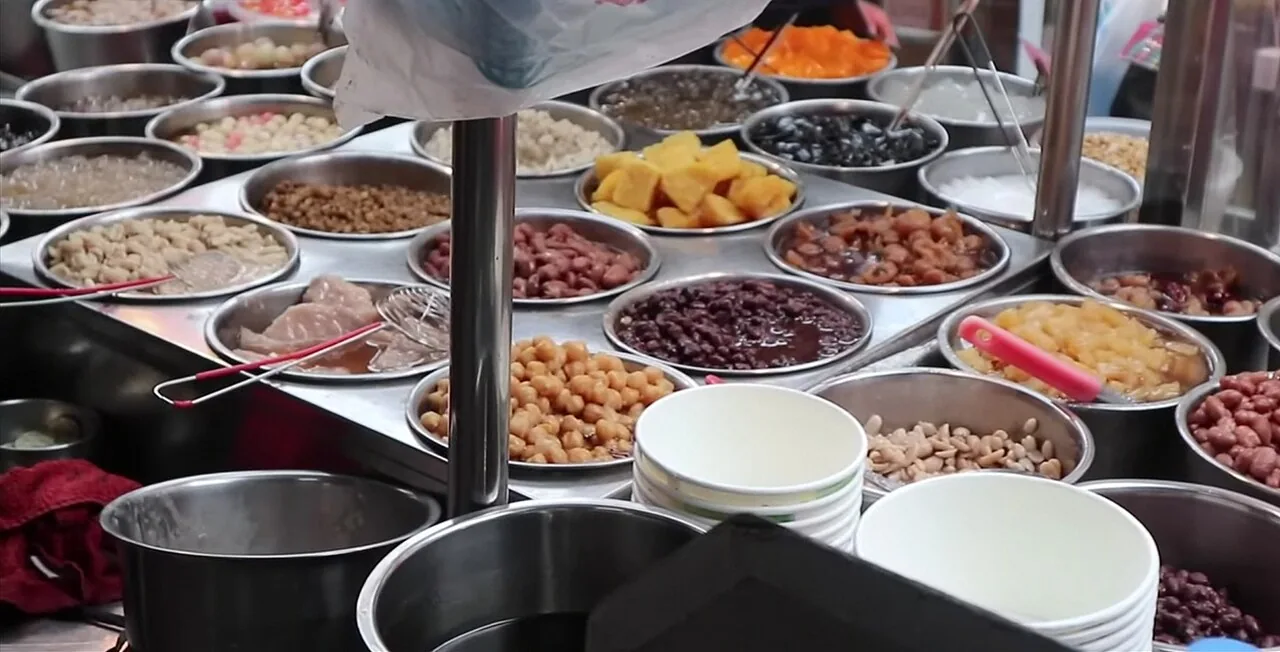
In 1965, Douhua Zhuang (豆花莊) began its business in Xinzhuang, relying initially on pushcarts hawking along the streets; it was only over twenty years later that it secured a fixed storefront in the Ningxia Night Market. 1 In 2023, the Ministry of Agriculture and Food Affairs' Food and Agriculture Education Information Integration Platform published an article on tofu pudding gelation, updated in 2024, which breaks down how the coagulants in tofu pudding powder transform hot soy milk into a gel. 2 This same food sits at two ends of a spectrum: one end is a street-side business where people chase after its sound every day, and the other is a material in classrooms where protein and ion reactions can be observed.
This contrast is precisely what makes tofu pudding worth writing about: it has never been merely "sweet tofu." In Taiwan, tofu pudding has been placed within the craftsmanship brought by immigrants, the hawking routes of tricycles, and the family memories of markets; it has also been placed within the choices of local youth returning home, domestic soybeans, and food-agriculture education. The whiter and softer the bowl appears, the more inflexible questions lie behind it: Who has the ability to rent a storefront? Which soybean can afford the cost? What texture counts as "hometown"?
Curator's Note: The history of tofu pudding does not begin with "invention," but with how a person carries a fragile food to the next street corner.

Taiwanese tofu pudding. Photo: Chocola Lala / Wikimedia Commons, CC0 1.0. Image from Archive Page, using an external hotlink; images are not preserved in the repository.

Sweet tofu pudding. Photo: Noramyn / Wikimedia Commons, CC BY-SA 4.0. Image from Archive Page, using an external hotlink.
A Bowl of Dessert: Mobility Before Fixity
A 2025 special feature on tofu pudding in Taiwan Panorama places the circulation of Taiwanese sweet tofu pudding within the context of post-WWII immigration. The article records that Chaoshan immigrants brought their hometown craftsmanship to Taiwan, after which tofu pudding grew into its own distinct forms in various places. 1 This does not mean Taiwanese tofu pudding has only one source, but rather reminds us that so-called "old-fashioned flavor" (gaozao wei) is often not preserved intact from ancient times, but re-established after population movements.
The scene most easily remembered is the broadcast sound of "tofu pudding~~ tofu pudding~~." In early days, vendors could not afford fixed stalls, so tricycles or pushcarts became the storefronts of their business. Only after accumulating customers and capital could the vendor carts lean against trees or under arcade walkways, finally entering markets or formal shops. The path of Douhua Zhuang is an example: from hawking along the streets of Xinzhuang to walking into the Ningxia Night Market, it still retains the memory of "a bowl of dessert that requires going after people." 1
Taichung's Luo Family Traditional Tofu Pudding (羅家傳統豆花) has kept this mobility to the present day. Reports record that Luo Nian-sheng rides a motorcycle every day, making two rounds around the city to sell; once the vehicle stops at a fixed point, customers gather from all directions. This method of selling is not a nostalgic performance, but a way of recombining shop rent, regular customers, and routes into a livelihood strategy. 1
How Taiwanese Eat It: Geography in Flavor
Food writer Chen Jing-yi, in an article in Smiling Taiwan (微笑台灣), observes different regional eating habits through the lens of "whether to mash the tofu pudding." She compares the coarseness of tofu pudding in Chaoshan, Taiwan, Hong Kong/Macau, and Singapore/Malaysia, noting that Taiwan's texture is intermediate, and the common Taiwanese way of eating is to mash the tofu pudding, sugar syrup, and toppings together, making the tofu pudding the base of a sweet soup. 3
This action is small, yet it carries a sense of locality. Traditional sweet tofu pudding in Hong Kong, Macau, and Singapore/Malaysia often comes only with sugar syrup, focusing on feeling the smooth texture with a spoon. Taiwanese tofu pudding, however, is more likely to be added with taro balls, tapioca pearls, red beans, mung beans, peanuts, and coix seed. Thus, "mashing" is not just a texture choice; it represents that this bowl of food can accommodate many things, and the tofu pudding does not need to stand alone in the center of the bowl.
Sugar syrup also leaves traces in different places. Taiwan Panorama records that in Chiayi, some tofu pudding shops use soy milk instead of sugar syrup; in the south, old shops use thicker syrup; and in Anping, Tainan, some shops have developed lemon tofu pudding. 1 These differences cannot be simplified into a binary of northern and southern tastes, because every shop is answering the same question: Should the soy aroma of the tofu pudding be supported by sugar syrup, or pulled apart by other flavors?
Curator's Note: What makes a bowl of tofu pudding most like Taiwan is not that it has many toppings, but that every place dares to change "orthodox" into its own daily routine.
Coagulation is Not Magic, But a Control Prone to Failure
The ingredients of tofu pudding can be few, but the production is not simple. The Ministry of Agriculture and Food Affairs article explains that hot soy milk must be quickly poured into a pre-mixed soy powder solution; only after the soy protein in the soy milk reacts with the coagulant will a gel form. Salt brine produces tofu pudding that is hard and crisp, while D-glucono delta-lactone produces a texture that is softer and more fragile; adding starch can increase softness and fineness. 2
This also explains why "soy powder" cannot be broadly treated as a single thing. Commercial formulas often mix different coagulants; different ratios result in different textures. The smoothness, tenderness, crispness, and elasticity discussed by tofu pudding shops are not just adjectives, but empirical summaries of temperature, protein concentration, and coagulation speed.
Tofu Pudding is Not Unformed Tofu
Both tofu pudding and tofu start from soy milk, but their post-coagulation treatments differ. Tofu pudding is usually coagulated directly in a container and then scooped out with a spoon, retaining a higher water content and a fragile gel. Tofu, however, typically requires stronger pressing and shaping to expel moisture, obtaining a structure that can be cut, fried, or transported. This difference shows that tofu pudding is not "tofu that hasn't finished being made," but another type of soy product premised on immediate consumption. 2
| Production Step | Key Point for Tofu Pudding | Result in Taste |
|---|---|---|
| Soy Milk Concentration | Soy protein is the basis for gel formation | Soy aroma and coagulation strength are affected |
| Coagulant | Salt brine, D-glucono delta-lactone, or compound soy powders differ | May be hard/crisp, soft, or fine |
| Temperature & Speed | Avoid delays after pouring hot soy milk into coagulant liquid | Affects whether the shape is uniform |
| Eating Method | No pressing; scooped directly in the bowl | Retains softness and tenderness, but increases transport difficulty |
Thus, the "on-site" nature of tofu pudding shops is important. If the tofu pudding is moved repeatedly after being made, the gel structure is easily broken. If the sugar syrup is too hot, the toppings too heavy, or the scooping angle incorrect, it will also cause a bowl of tofu pudding to lose its original layers. When people say it melts in the mouth, what lies behind is the shopkeeper arranging the production, serving, and eating times together.
The Food and Agriculture Education Achievement Page of the Taichung City Government Education Bureau leaves a detail more useful than success: students heated soy milk to 80°C and then poured it into soy powder water, but some groups failed to coagulate the tofu pudding in the end because they did not control the temperature well enough. 4 The failure of tofu pudding looks like merely not forming, but for the learner, it concretely explains that food does not automatically complete itself just by putting ingredients together.
When Taiwan Panorama interviewed Luo Family Traditional Tofu Pudding, it also recorded processes such as firing edible gypsum, grinding, and picking out impurities. Luo Family once tried using commercial gypsum powder directly, but returned to the slow firing method due to unsatisfactory texture. 1 Another report in the same publication places tofu pudding within the larger issue of soybean supply: tofu pudding, soy milk, tofu, and soy sauce all use soybeans as raw materials, but Taiwan still imports large quantities of soybeans annually, and domestic soybeans face pressure in food applications and price competition. 5
Boiling soy milk is especially invisible labor. Cheng Yi, the principal of Baishui Tofu Pudding (白水豆花), said in an interview: "Anyone who has boiled soy milk knows that burning it is easy; not burning it is harder." 1 This sentence pulls tofu pudding back from the nostalgic language of "old-fashioned flavor" to the kitchen: what is truly expensive may not be the coagulant, but the attention paid again and again to prevent the soy milk from burning.
From a Factory to a Local Story in an Old House
Fulin Tofu Pudding (福霖豆花) in Minxiong, Chiayi, offers another perspective. Interview records from the Ministry of Culture's Online Curation Platform indicate that Fulin Food has a fifty-year development history. Early on, its important work was the R&D and promotion of soy powder; later, it opened a physical store in a Japanese-style old house in Minxiong, transforming the industrial memory of a raw material factory into a space consumers can walk into. 6
Fulin's story has a noteworthy turning point: originally facing wholesale clients, it later had to face every person eating tofu pudding directly. A factory can talk about specifications and shipments, but a storefront must face "is it delicious today" and "can it be the same next time." This is the most everyday version of traditional industry transformation: not pasting a cultural creativity label on an old shop, but re-establishing reasons for quality, storytelling, and customer return.
Yuanchang, Miaoli's Yuandou Cui Shi (原豆粹食) is operated by Chen Yi-hsin, the third generation of Shengli Tofu (勝利豆腐), who returned home to run it. She uses non-GMO soybeans, allowing the tofu pudding to pair with traditional black sugar syrup or with her own low-sugar soy milk. Reports record that she spent half a year searching for Taiwanese crops and testing toppings, finally turning a bowl of tofu pudding into an entry point where local entrepreneurship and family memories intersect. 7
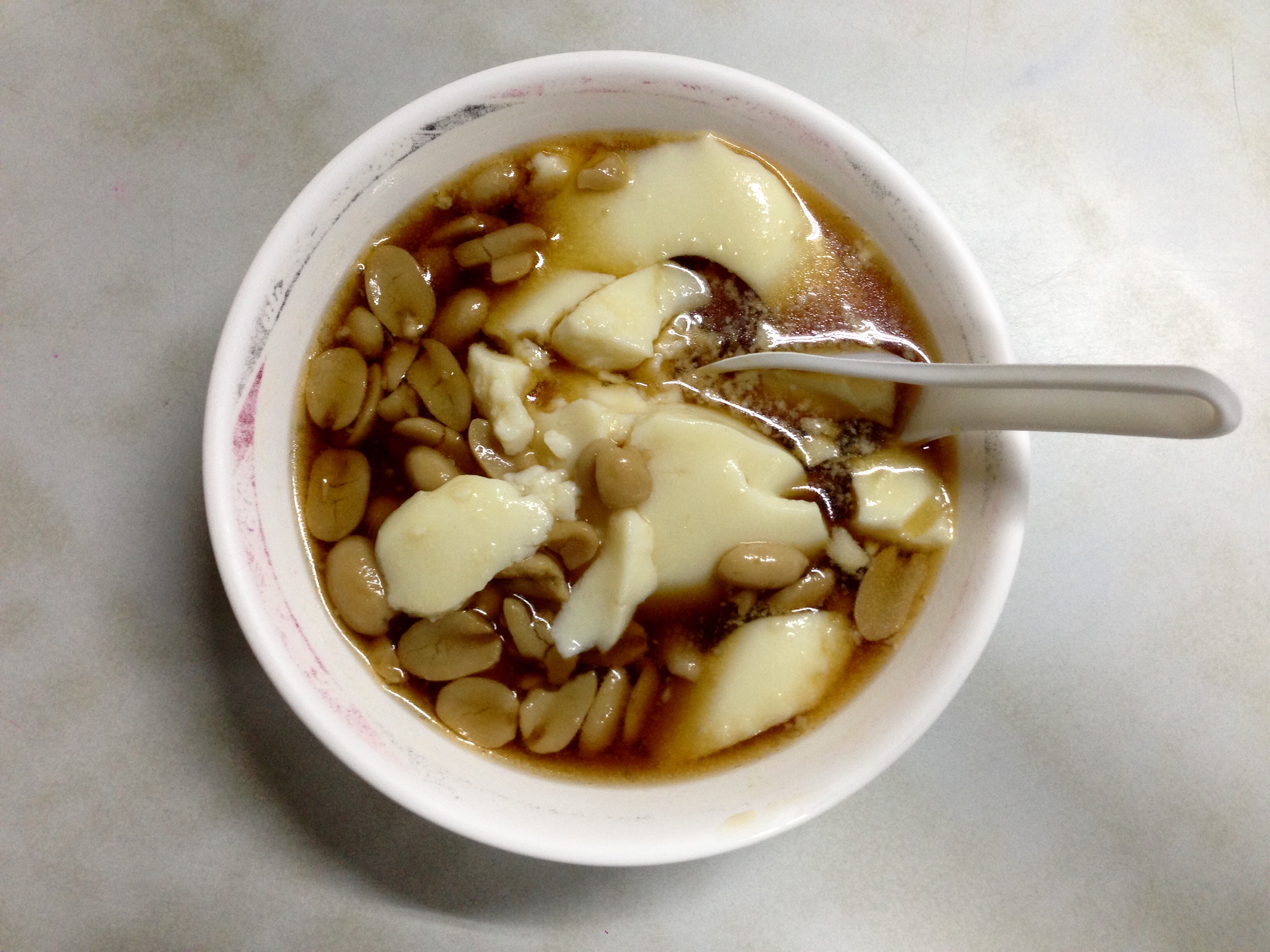
Peanut tofu pudding. Photo: Outlookxp / Wikimedia Commons, CC BY-SA 4.0. Image from Archive Page, using an external hotlink.
Chen Yi-hsin describes her shop as "delivering happiness through tofu pudding." 7 If this sentence is seen only as brand copywriting, it seems too light. But placed back in the context of her returning home, finding ingredients, testing toppings, and letting guests of different ages eat together, it actually speaks of a very pragmatic local work: letting the elderly eat familiar tofu pudding, letting children eat new soybean dishes, and giving a small shop a reason to keep the doors open.
Soybeans Are Not Background; They Are Choices
A report on domestic soybeans in Taiwan Panorama indicates that soybean planting was close to 60,000 hectares in the 1960s, later impacted by imported soybeans and market opening. The report also records that Taiwan imports about 2.6 million metric tons of soybeans annually, while domestic soybean production is about 5,900 metric tons; the price gap between domestic and imported soybeans can still reach more than double. 5
These numbers cannot directly lead to the conclusion that "eating tofu pudding can save agriculture." Whether a tofu pudding shop uses domestic soybeans must still face issues of cost, stable supply, varieties, and production flavor. A more meaningful question is: Can a bowl of tofu pudding allow consumers to see that white tofu pudding is not without a land source?
The restoration of domestic soybean cultivation is not just about finding a prettier origin story. The report records that legumes can fix nitrogen, increase soil organic matter, and rotate with rice. The Taichung Da-renwu Agricultural Products Marketing Cooperative aggregates small farmers' output through contract farming, then connects it with food processing and campus channels. 5 Here, tofu pudding may not be the final product, but it is an entry point to understanding "how a bean enters life."
The Taichung City Education Bureau's 2025 e-newsletter places soy milk, tofu, tofu pudding, tofu skin, soy sauce, and fermented tofu on the same soybean chain, and records the practical process in schools from soaking, grinding, filtering to boiling. The article mentions that Taiwan relies on importing about 2.6 million metric tons of soybeans annually, while domestic soybeans truly used for food are about 5,900 metric tons. 8 The value of food-agriculture education lies here: students do not just learn to make a bowl of tofu pudding, but begin to see the distance between "food" and its origin, climate, and price.

Taiwanese tofu pudding. Photo: Adonis Chen / Wikimedia Commons, CC BY 2.0, original source from Flickr. Image from Commons Archive Page, using an external hotlink.
Price, Time, and Texture: Who Decides a Bowl of Tofu Pudding?
The choices tofu pudding shops face daily often do not appear on the menu. Imported soybeans are easier to obtain; domestic soybeans may have a clearer origin and flavor, but supply volume, price, and the status of each batch of beans must be re-estimated. Salt brine can produce a mineral-flavored taste, but is more sensitive to temperature and experience. Commercial compound soy powders can stabilize the process, but do not mean everyone will eat it as the same "traditional" taste.
These choices also affect the shopkeeper's time. Soaking beans, grinding, and boiling soy milk at dawn means the shopkeeper must start working long before customers sit down. A fixed storefront requires rent; a mobile vendor cart requires routes and physical strength; an old-house shop must calculate space maintenance, cultural explanation, and meal quality into operations together. The selling price of tofu pudding thus buys not just a bowl of coagulated soy milk, but a time configuration that has been repeatedly practiced by people.
Smiling Taiwan lists the prices of tofu pudding in Taiwan, Singapore/Malaysia, and Hong Kong/Macau, reminding readers of the price gaps in different places, including invisible costs such as rent, personnel, utilities, and toppings. 3 If one explains it only with "it was cheaper before," one misses the difficulty of how tofu pudding shops survive in cities. The increase in toppings, the comfort of space, and the beginning of brands telling local stories are, to some extent, ways shopkeepers respond to rising costs.
Therefore, the "old-fashioned flavor" of tofu pudding cannot be defined solely by reducing toppings. For some, old-fashioned flavor is the sound of tricycle broadcasts. For others, it is a bowl of hot tofu pudding in the market, or the soy milk soup base eaten after returning to Yuanchang. The flavor has not left; only the container preserving it has changed.
Cold and Hot Are Not a Binary Choice
The temperature of tofu pudding changes people's judgment of its texture. The aroma of hot tofu pudding is more direct; when the spoon touches the surface, the softness appears with the steam. Iced tofu pudding makes the contrast between sugar syrup and toppings more obvious; the fragmentation and smoothness of the tofu pudding are amplified by the cold. This does not mean one temperature is more traditional, because the shopkeeper, season, and customers' life rhythms are constantly deciding together how a bowl of tofu pudding is served. 1 3
Toppings are not just decoration. Peanuts bring granularity and roasted aroma; red beans and mung beans pull the soy aroma of the tofu pudding toward grain sweetness; taro balls and tapioca pearls increase chewing time. When there are more toppings, the tofu pudding becomes more like a bowl that can be freely combined; when there are fewer toppings, the shopkeeper must make the details of soy milk, coagulation, and sugar syrup clearer. The tolerance of Taiwanese tofu pudding does not mean it lacks technical requirements, but rather disperses the technology to every place where it can be felt in each bite.
From this perspective, the local differences of tofu pudding are not a fixed map, but a set of adjustable knobs: sweetness, temperature, coagulation strength, topping density, and soy aroma concentration. Each shop turns them to different degrees, and customers name it with their own memories. Some call it old-fashioned, some call it innovative; both may merely be descriptions of the same bowl of tofu pudding at different moments.
What Does a Bowl of Tofu Pudding Leave Behind?
The future of tofu pudding will not have only one appearance. Some pursue traditional gypsum and hot tofu pudding; some choose salt brine, spring water, and gold-rimmed porcelain bowls; some put tofu pudding into old houses and handmade courses; others turn it into an experiment in schools that fails and tries again. These approaches differ from each other, but all deal with the same thing: how to maintain an identifiable flavor for a soft food in a changing life.
The Taiwan Studies Newsletter (台灣學通訊) of the National Taiwan Library in 2024, with the theme of food culture, points out that Taiwan's food resources and food concepts are shaped jointly by natural environment, ethnic migration, foreign trade, colonial rule, and the introduction of skills. 9 Tofu pudding perfectly compresses this complex history into a small bowl: it has craftsmanship brought by immigrants, local terroir and toppings, market rent and vendor routes, and the origin and food safety that people are now re-asking about.
Therefore, the true counter-intuitive nature of tofu pudding is not the pretty phrase "simple yet not simple," but that the more it strives to maintain white, tender, and bland, the more it requires many people to make concrete choices. Which bean to choose, to what temperature to boil, how much coagulant to add, whether the sugar syrup should be thick, whether to add toppings, whether to stay in the market. What we finally eat is not a fixed answer, but the trade-offs a place makes in the present.
Next time you pick up a spoon, you can first refrain from mashing the tofu pudding. Look at how it trembles in the bowl, think about which soybean it comes from, who started boiling soy milk at dawn, who once rode a bike to deliver this bowl to the street corner. Then eat according to your own habits. The place where Taiwanese tofu pudding is most like Taiwan may be that it allows you to keep your own way of eating.
Tofu pudding is therefore hard to become a simple souvenir. Tofu can be cut into blocks and vacuum-packed; tofu pudding relies more on the day's temperature, container, and scooping action. When shops offer takeout, they usually have to rethink the order of distributing sugar syrup and toppings to prevent the tofu pudding from being smashed during transport. This limitation does not keep tofu pudding in the past; rather, it makes shopkeepers continuously test new bowls, lids, and eating times. Softness is not fragility, but a reminder that it must be treated well. 1 2
Image Sources
- Hero: Taiwanese Tofu Pudding, Photo by Chocola Lala, Wikimedia Commons, CC0.
References
- Taiwan Panorama: Tofu Pudding — Simple Yet Not Simple, a Hidden Dragon Taiwanese Dessert — Deng Hui-chun, June 2025. Covers Douhua Zhuang, Luo Family Traditional Tofu Pudding, Jiang Ji Dongmen Tofu Pudding, Baishui Tofu Pudding, coagulants, and local tastes.↩23456789
- Ministry of Agriculture and Food Affairs Food and Agriculture Education Information Integration Platform: Introduction to Tofu Pudding Gel Mechanism — Ren Pei-jun, He Yu-xi, published April 15, 2023, updated November 1, 2024. Covers tofu pudding coagulants, soy milk protein, and gel mechanisms.↩234
- Smiling Taiwan: Mashing or Not Mashing Tofu Pudding Reveals Where You're From? Food Writer Traces the Origin of Tofu Pudding Across Regions — Chen Jing-yi, June 3, 2021. Covers the texture, eating methods, and price observations of tofu pudding in Chaoshan, Taiwan, Hong Kong/Macau, and Singapore/Malaysia.↩23
- Taichung City Government Food and Agriculture Education Network: 114th Year Various Schools' Food and Agriculture Education Achievements, Beishi Junior High School Food and Agriculture Education Course — Handmade Tofu Pudding — Established May 23, 2025. Covers 80°C soy milk, soy powder, coagulation, and course practice results.↩
- Taiwan Panorama: Planting Soybeans Back, The Path of Restoring Domestic Soybean Cultivation — Deng Hui-chun, June 2025. Covers soybean planting, imports and domestic production, contract farming, crop rotation, and the domestic soybean industry.↩23
- Ministry of Culture Online Curation Platform: Xin Yi Gao Telling Taiwan "The Soy Aroma Has Not Dispersed" — Curated by Zhang Xiang-yi, recording the industry, interviews, and local transformation of Fulin Tofu Pudding in Minxiong, Chiayi.↩
- Smiling Taiwan: Yuandou Cui Shi in Yuanchang, Miaoli, Tofu Pudding Simmered Slowly with Time — Yuanchang掀海風 (Yuanchang Lifting Sea Wind), October 28, 2017. Covers Chen Yi-hsin, third generation of Shengli Tofu, returning home, non-GMO soybeans, and soy milk tofu pudding.↩2
- Taichung City Education E-Newsletter: "Bean" Fun Life, The Magical Time from Soybeans to Soy Milk — Huang Xiao-wen, July 4, 2025. Covers the use of soybeans in Taiwanese food, import dependence, and campus food-agriculture practice.↩
- National Taiwan Library: Taiwan Studies Newsletter Issue 136 / Food Culture (Part Two of Two) — March 15, 2024. Provides the overall context that Taiwan's food culture is shaped by natural environment, ethnic migration, trade, colonialism, and the introduction of skills.↩