
30-second overview: In 1965, Philippine businessman Lee Hung-lueh bought the trademark and formula for “Apple Sidra” from America’s CosCo company and built a factory in Pingzhen, Taoyuan. Over the next 60 years, this golden sparkling drink became a fixture in rechao stir-fry restaurants, traditional catered banquets, and KTV rooms, and even crossed the sea when Korean idol Kyuhyun unexpectedly encountered it at Du Hsiao Yueh in Tainan. Yet for its first 30 years, the trademark never truly belonged to Taiwan. It passed through Cathay Trust in 1979, Hung Yuan in 1985, and Sun You-ying’s 1995 out-of-pocket US$800,000 redemption. After two food-safety incidents involving sediment in 2018 and 2023, Oceanic Beverages sold 7,222 ping of land in Hunei, Kaohsiung in 2024, bringing in NT$960 million, supporting NT$493 million in after-tax net profit and EPS of NT$8.71. In 2025, however, rumors again emerged that the general manager had been replaced. This sixty-year Taiwanese flavor is more complicated than the glass of rosé mixed with Apple Sidra in a KTV room.
Apple Sidra: From National Sparkling Drink to Capital-Market Storm, How a Sixty-Year Taiwanese Flavor Was Reborn
The Bottle in the Rechao Restaurant Refrigerator
From mountain-produce restaurants in Hsinchu to banquet caterers in Pingtung, Taiwan’s rechao stir-fry restaurant refrigerators almost always carry the same drink. Plastic bottle, red label, golden liquid, fizzing bubbles: poured into a plastic cup, it becomes the sparkling drink that has held the same place for 60 years.
Order alcohol in a KTV room, and the bar’s rosé wine will come with a bottle of Apple Sidra. On Oceanic Beverages’ official “cocktail tips” page, the company lists this 1:1 mixture as an officially endorsed way to drink it1. In central and southern Taiwan, folk cocktails such as “Apple Taibai” (Apple Sidra with rice wine) and “Apple Champagne” (Apple Sidra with white wine) had already circulated earlier2.
On a 2024 trip to Tainan to film a travel VLOG, Super Junior’s Kyuhyun tasted Apple Sidra at Du Hsiao Yueh after trying pork knuckle and fried rice. He left a few direct remarks:
“It’s so good. Korea doesn’t have this, right?” “It really does seem like it would taste great with alcohol!”3
Then he jokingly held the bottle up to the camera: “This should give me a chance to get a product placement deal.” This K-pop boost unexpectedly gave Apple Sidra a wave of cross-sea traffic during its 2024 food-safety recovery period3.
But the 60 years this golden sparkling drink has lived through are far more complicated than that mixed drink in a KTV room. For its first 30 years, its trademark never truly belonged to Taiwan; twice, it fell under the yeast and moldy ceilings of its own factory; and in 2024, its parent company had to sell 7,222 ping of land in Hunei, Kaohsiung to repay its final bank loans.
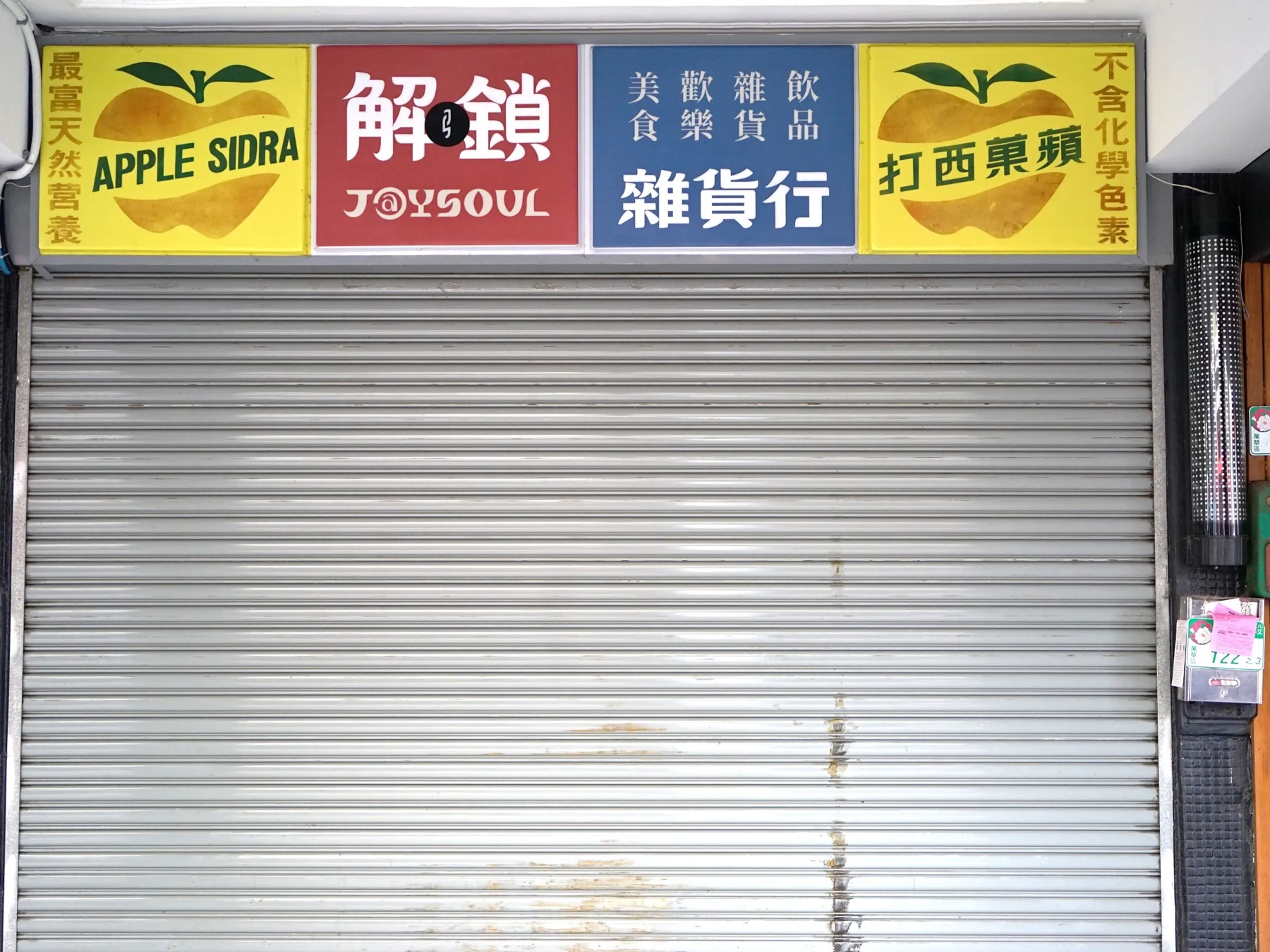
An Apple Sidra advertising light box at a shop in Ximending, photographed in February 2025. After the 2018 and 2023 food-safety incidents and the 2024 disposal of real estate in Tainan and Kaohsiung to clear debts, this sparkling drink whose formula was bought from America’s CosCo in 1965 can still be seen on Taiwan’s streets. Photo: Solomon203, 2025-02-01, CC BY-SA 4.0 via Wikimedia Commons.
Philippine Businessman Lee Hung-lueh and CosCo’s Order
On July 24, 1965, Philippine Chinese businessman Lee Hung-lueh invested in Taiwan and founded Oceanic Beverages4.
He obtained the trademark license, formula, and raw-material supply for “Apple Sidra” from America’s CosCo company, while also inviting Hong Kong’s Watsons Group to invest and provide factory production technology and management systems5. The next year, Tse Siu Bong, owner of Nin Jiom Pei Pa Koa, became chairman5.
The factory was built in Pingzhen, Taoyuan. This geographic choice later became a turning point in the brand’s fate: the plant built in 1965 remained in use until the first crack appeared in 2018, by which time the core equipment on the production line had already been running for 53 years.
The drink was initially called “American Apple Sidra,” emphasizing its original American lineage. In Taiwan from 1965 to 1979, the word “American” was a passport for consumers. Before Hollywood films, Coca-Cola, and McDonald’s had fully entered Taiwan, any product “from America” carried its own halo. Apple Sidra established its place on the dining table in that era. On January 1, 1979, the Republic of China broke diplomatic relations with the United States, and around that period the word “American” was quietly removed from the product name. From then on, it was called simply “Apple Sidra”6. A name change for an export product unexpectedly became a miniature footnote to Taiwan’s diplomatic history.
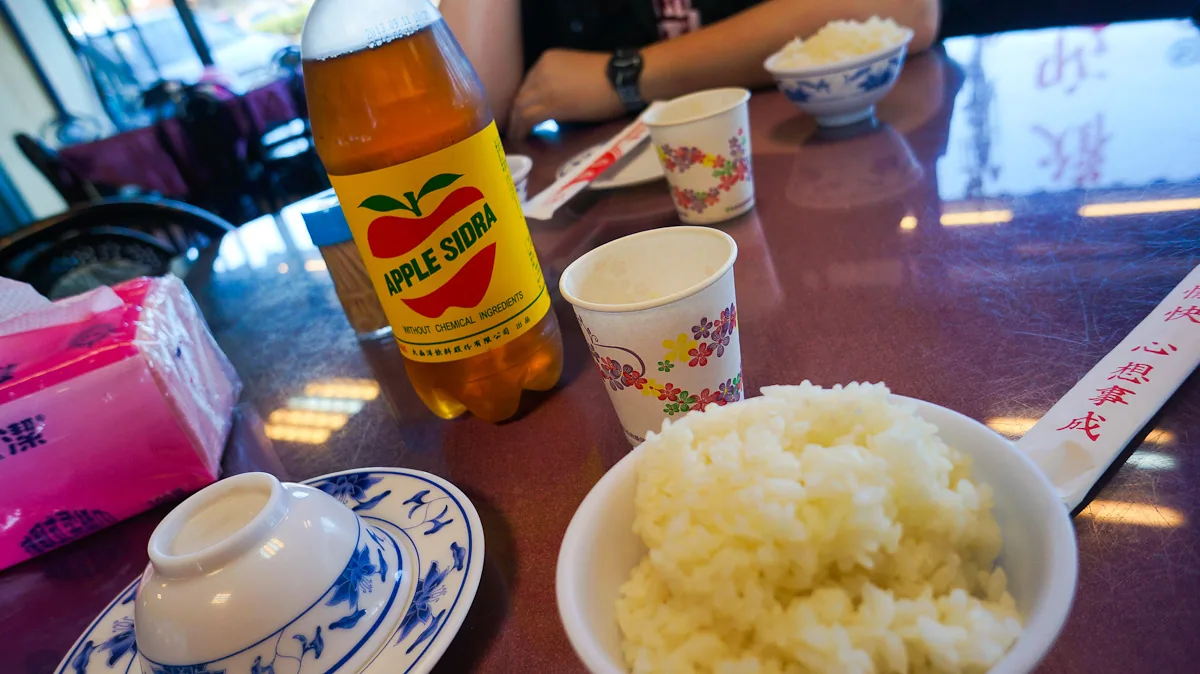
Apple Sidra and a bowl of rice on an everyday dining table, photographed in 2013. From its 1965 debut to its 2024 revival, this sparkling drink’s presence has always been built around its role as a “meal accompaniment”: with rechao stir-fry dishes, banquet tables, and dorm-room lunchboxes. Photo: Solomon203, 2013-11-23, CC BY-SA 4.0 via Wikimedia Commons.
A Shell-Borrowing American-Taiwanese Hybrid
📝 Curator’s note
In Europe and North America, cider refers to two different things: fermented hard cider, which is alcoholic, and unfermented soft cider, which is pure apple juice. Taiwan’s Apple Sidra is neither. It is a sparkling fruit-juice soda made from carbonated water, apple juice, apple flavoring, caramel coloring, and citric acid, and contains no alcohol7. “Sidral” is a Spanish generic term for a sparkling drink, and Mexico has a similar product, Sidral Mundet. The “formula” this Taiwanese drink bought from CosCo in 1965 was, in essence, a shell-borrowing product: a Taiwanese fruit-juice soda packaged in the vocabulary of Western beverage taxonomy.
Early advertising copy once emphasized “no chemical coloring” to highlight a natural image, but the caramel coloring in the actual formula was used to stabilize the product’s color and flavor7. This advertising strategy, “emphasizing naturalness while actually including industrial additives,” was a product of Taiwan’s food industry in the 1960s and 1970s. Consumers at the time had no food-labeling law to check against, and formula information could only be asserted by manufacturers themselves.
Apple Sidra’s flavor profile was also purely Taiwanese: relatively sweet, highly carbonated, and distinctly apple-scented. European and American soft cider tends toward tart fruit juice, while hard cider has an alcoholic character. Neither flavor suits the heavily seasoned dishes of rechao restaurants. Apple Sidra’s sweet bubbles happen to cut through oiliness, and this is the fundamental reason it has held its place on central and southern Taiwanese dining tables for 60 years.
Three Foreign Owners and an US$800,000 Check
For its first 30 years, ownership of the Apple Sidra trademark was never in Taiwanese hands.
In 1979, Lee Hung-lueh and the other original shareholders sold Oceanic Beverages, Kuo Hsin Foods, and Hsu Shun Foods as a “package” to Cathay Trust, controlled by Tsai Chen-nan, the second generation of the Lin Yuan Group8. That same year, the original formula company CosCo transferred Apple Sidra’s global license to America’s “Cosgo” company, while Taiwan continued producing it through licensed contract manufacturing5.
Over the next six years, ownership changed even faster:
- April 1981, Oceanic Beverages was listed on the Taiwan Stock Exchange under stock code 12135
- 1985, after the Taipei Tenth Credit Cooperative scandal broke out, Cathay Trust was affected by a bank run, and the equity in Oceanic Beverages, Kuo Hsin, and Hsu Shun was resold to the Hung Yuan Group5
- 1989, Apple Sidra trademark rights were transferred from America’s Cosgo to “Liberia-based Cosgo International”9
- 1990, after the Hung Yuan financial scandal erupted and the Hung Yuan organization collapsed, the bankruptcy administrator nominated Chou Chung-kang, Chang Yu-chun, and Sun You-ying as director representatives of Oceanic Beverages. That same year, Cosgo International demanded the termination of its licensing contract with Oceanic Beverages and planned to take back the trademark5
By 1995, Apple Sidra had already gone through three foreign owners: CosCo, Cosgo, and Liberia-based Cosgo International. In Taiwan, the company had just crawled out of the ruins of Hung Yuan’s bankruptcy. If the trademark problem was not resolved, the drink could no longer even use its own name.
At some point that year, Sun You-ying paid US$800,000 out of her own pocket, about more than NT$23 million, to buy from Liberia-based Cosgo International all rights to Apple Sidra’s trademark, formula, and sales franchise9.
✦ “She personally put up US$800,000 to purchase it from Cosgo International, taking into account that as much as 95% of Oceanic Beverages’ revenue came from selling Apple Sidra.”9
From that year onward, Apple Sidra truly belonged entirely to Taiwan. More precisely, it belonged to Sun You-ying personally. A “national beverage” that had been sold in Taiwan for 30 years only then ended its status as cross-sea contract manufacturing.
Dining Tables, Banquets, KTV Rooms: 60 Years of Drinking Culture
Apple Sidra became a national beverage not because of trademark ownership, but because it occupied a fixed place on central and southern Taiwanese dining tables for decades.
In its early years, Oceanic Beverages signed partnerships with rechao restaurants and eateries in central and southern Taiwan: the company sponsored refrigerators, and the shops promised to give Apple Sidra priority placement10. Open the glass door of a Taiwanese rechao refrigerator, and Taiwan Beer on the left and Apple Sidra on the right were almost the two fixed axes from the 1980s and 1990s into the 2000s. A common Taiwanese family dining-table scene was built this way: red-labeled golden liquid fizzing in plastic cups, paired with stir-fried eel, three-cup chicken, Hakka stir-fry, “fly’s head” chive-and-pork stir-fry, and basil omelet.
Traditional banquet catering had the same scene. At coastal fishing-village weddings, Hakka village wedding banquets, and open-air temple banquets after religious rites, Apple Sidra stood alongside Taiwan Beer and rice wine as one of the three fixed drinks. For elders, children, and pregnant women who did not drink alcohol, Apple Sidra was the day’s best drink for cutting grease.
From the 1990s onward, the drink also entered KTV rooms. The drinking culture at the time worked like this: order a bottle of rosé wine in a private room, and the bar would additionally send in several bottles of Apple Sidra for guests to mix themselves. After a 1:1 mixture, the taste resembled sparkling champagne: the tartness of the rosé was covered by bubbles and apple aroma, making it drink like a cheaper version of Champagne1. This method was later included on Oceanic Beverages’ official website as the official “rosé + Apple Sidra” formula.
More grounded mixed drinks also became popular in central and southern Taiwan. “Apple Taibai” is Apple Sidra with rice wine; “Apple Champagne” is Apple Sidra with white wine. These mixed drinks did not appear in official advertising. They were ways of drinking that consumers grew themselves2. In Taiwan, the same bottle of sparkling drink evolved into an entire series of popular mixed drinks.
By 2024, when this 60-year-old sparkling drink was at its lowest point in Taiwan after a collapse in food-safety trust and production-line shutdowns, it was instead unexpectedly boosted by a Korean idol filming a VLOG in Taiwan. After tasting pork knuckle, fried rice, and minced pork rice at Du Hsiao Yueh in Tainan, Super Junior’s Kyuhyun took a sip of Apple Sidra and reacted, “It’s so good. Korea doesn’t have this, right?” He then added, “It really does seem like it would taste great with alcohol!”3 ETtoday Star Cloud cut this VLOG into a news story, giving the drink an unexpected wave of K-pop traffic during its 2024 food-safety recovery period.
💡 Did you know?
Apple Sidra carved out market share from the “golden soda” trio of the 1970s and 1980s: HeySong Sarsaparilla, Tsin Tsin Asparagus Juice, and Apple Sidra. After health consciousness rose in the 2000s, high-sugar carbonated drinks as a whole shrank. But because Apple Sidra was bound to rechao restaurants, banquets, and KTV, it was affected less than ordinary colas and sodas. Its presence is not sustained by occasions for drinking it by itself, but by meals, alcohol, and social settings. As long as those occasions remain, the drink remains.
122 Complaints and the Line “A Bit Like Knowing Violation”
In July 2018, Oceanic Beverages began receiving complaints about sediment in Apple Sidra’s 2,000-milliliter large bottles. One month passed, then two, and the complaints accumulated to 122 cases11. The company never reported them to the New Taipei City Department of Health.
It was not until November 12 that the New Taipei City Department of Health went on its own to Oceanic Beverages’ Taipei sales office and convenience stores to conduct sampling. All six samples tested positive for mold and yeast, and two exceeded the standard for total viable count12. The product was finally removed from shelves across the board.
A subsequent investigation traced the problem to production line No. 1 at the Pingzhen plant in Taoyuan. This line had already been in use for more than 20 years. Cracks appeared on the inner wall of the raw-material mixing tank, and mold grew in the insulation cotton between the inner and outer walls, causing cross-contamination from the source of the production line13.
New Power Party legislator Huang Kuo-chang held a press conference:
“In July, there had already been complaints from 122 members of the public. Oceanic Beverages knew there was a problem from its own inspections, but it responded that expansion and contraction from heat during transport had caused air to enter through the cap and affect quality. Later, it said the cause was a mechanical failure on the production line. It did not remove all products from shelves until the incident broke out, proving that the company was lying from the very beginning.”11
Minister of Health and Welfare Chen Shih-chung responded in a more restrained tone when interviewed:
“It is a bit like a case of knowingly committing a violation.”14
The New Taipei City Department of Health later issued two fines totaling NT$2.2 million13. Apple Sidra was fully removed from shelves, and a complete rectification had to be carried out before it could be relaunched.
That was only the tip of the iceberg. In August of the following year, 2019, Sun You-ying became implicated in an asset-stripping case. Investigators found that from 2013 to March 2019, she used the method of “fake purchases, real payments” to falsely report purchases of sugar raw materials from eight vendors that had not actually supplied goods, including Oceanic Beverages’ own affiliates Kuo Hsin and Hsu Shun, extracting NT$108,528,700 in funds15.
On April 27, 2022, the High Court issued its second-instance judgment:
- Sun You-ying was convicted under the Securities and Exchange Act of causing the company to conduct unfavorable transactions and sentenced to 8 years and 2 months; she was also sentenced to 7 years and 6 months for breach of trust. The combined sentence for the two crimes was 9 years and 6 months of imprisonment, with NT$108,528,700 in criminal proceeds confiscated
- Co-defendant and former finance manager Chung Su-e received 7 years and 6 months15
The same person who in 1995 paid US$800,000 out of pocket to redeem Apple Sidra from a foreign company extracted NT$108 million over the six years beginning in 2013 from the company she herself had rescued.
41,237 Cases Sealed: The Second Crack
On April 7, 2023, employees at the Pingzhen plant discovered a problem.
They saw white sediment at the bottom of 2,000-milliliter PET bottles of Apple Sidra16. Employees self-reported, the factory stopped production on its own, and within two weeks the Taoyuan City Department of Public Health entered for inspection. This time, the finished products sealed included 14 cans sampled for testing, 41,237 cases, and a total of 82.3 metric tons, several times the scale of the 2018 incident16.
On May 19, the health bureau again entered the plant to inspect production lines No. 2 and No. 3:
“It discovered deficiencies including exposed equipment, mold stains on the ceiling, and mottled piping on production lines No. 2 and No. 3, which produced these two products. It judged that these were caused by aging production-line equipment and piping.”17
Production lines No. 2 and No. 3 were halted on the spot. Together with production line No. 1, already stopped in April, 99% of the Pingzhen plant’s capacity was frozen.
Five years separated the two food-safety incidents, yet the problems looked almost identical: aging equipment, lack of regular renovation, and metal and piping on the production lines slowly rusting and molding in Taiwan’s humid subtropical climate. The first incident involved yeast leaking from cracks in a mixing tank; the second involved ceiling mold stains dripping down along the piping. After reading the two health bureau documents, one is left with the sense that this was the same factory breaking twice in the same way.
In the early morning of May 3, 2023, marketing director Yu Chung-min walked into the office in Sanchong, New Taipei City and was promoted to general manager18. The day before, he had still been marketing director. From that day on, he would enter the general manager’s office next door, because his predecessor could no longer withstand the serial blows of the food-safety crisis. He had worked at Oceanic Beverages for more than 20 years; this was the first time he sat in the general manager’s seat.
The first thing he did was to “go to each department one by one to give confidence talks”18. But talks were useless. Employees began to have wages withheld, banks refused to lend more money, consumer trust drained away, and products were removed from shelves on a large scale.
📝 Curator’s note
The core equipment at the Pingzhen plant ran from 1965 to 2018. Main production line No. 1 ran for more than 20 years. The mixing tank, insulation cotton, and piping were all part of the same system. A listed company had accumulated billions in revenue and gone through four sets of owners, yet no round of owners was willing to spend money replacing the production lines. When readers see “sediment,” they instinctively think there was a problem with the drink formula. In fact, for many years this company treated the factory as a black box that would keep running by itself, until that black box cracked once in 2018 and again in 2023. Selling land to survive became necessary at the last moment because the equipment had actually failed. Without repairs, the company could not even make the drink.
One Piece of Land in Kaohsiung Sustained NT$493 Million in After-Tax Net Profit
When Yu Chung-min took office, banks were no longer willing to lend money. He began calculating what assets on hand could be converted into cash.
On the evening of September 1, 2023, Oceanic Beverages announced the disposal of seven parcels of land, including land no. 251-4 in the Jiali Section of Jiali District, Tainan. Together they totaled 1,039.54 ping and were Type A construction land in a designated agricultural zone. The buyer was Taipang Development and Construction Co., Ltd.19. In its material information disclosure, the company wrote the “disposal gain” as NT$138 million.
The Taiwan Stock Exchange quickly discovered the problem: NT$138 million was the “transaction amount,” not the “disposal gain.” The actual accounting disposal gain was only NT$40.43 million, a 3.4-fold difference. Oceanic Beverages was fined NT$30,000 in penalties for violating material information regulations20.
Selling Tainan land and paying a NT$30,000 fine still did not bring in enough money to fill the hole.
On the evening of July 15, 2024, Oceanic Beverages announced the disposal of 51 parcels of land and two buildings in the Zhongshan and Puji sections of Hunei District, Kaohsiung, with a total area of 23,877.25 square meters, or 7,222.8686 ping:
- Transaction amount: NT$962.74 million
- Disposal gain (accounting gross profit): NT$605.24 million
- Net disposal profit (after expenses): NT$591.423 million21
The next day, Oceanic Beverages’ share price rose more than 8%21. In November, the NT$960 million disposal proceeds were fully booked and used entirely to repay loans from financial institutions22.
At the investor conference on December 12, chairwoman Su Yun-le shouted at the end of the meeting, “Apple Sidra is making a major comeback”23. She and Yu Chung-min jointly announced:
| 2024 full-year indicator | Figure | Source |
|---|---|---|
| Consolidated revenue | NT$191 million | Investor conference |
| Annual growth | 58.27% | Same |
| After-tax net profit | NT$493 million | Same |
| EPS | NT$8.71 | Same |
| Net disposal profit | NT$591 million | Booked in November |
| Financial debt | 0 | Cleared in November |
📝 Curator’s note
NT$493 million in after-tax net profit, EPS of NT$8.71, annual growth of 58.27%. These numbers are so attractive that they almost make one forget where they came from. Core business revenue of NT$191 million was less than one-third of the NT$600 million disposal gain. What sustained the beautiful financial statements was a piece of land in Hunei, Kaohsiung, not beverages. After this land was sold, the question of where the next year’s revenue would grow from still had no answer.
After the Major Comeback
In the first quarter of 2025, Oceanic Beverages’ stock resumed normal trading24. On March 27, a senior reporter at Economic Daily News published a paid analysis article with a very direct headline: “Apple Sidra Just Got Back on Track, Then Rumors of Replacing the General Manager Erupt: Are Signs Emerging That Oceanic Beverages Is Brewing a Delisting?”25
The article’s body was behind a paywall, but its headline and introduction were publicly readable and clearly pointed to new internal turbulence in March 2025. When Commercial Times later reported on Oceanic Beverages’ June shareholders’ meeting, the only person quoted was chairwoman Su Yun-le; Yu Chung-min’s name no longer appeared26. The person who had stood beside her at the investor conference on December 12 the previous year to announce “zero debt” had quietly exited the media frame within half a year.
At the same shareholders’ meeting, Su Yun-le announced:
“With all debts reduced to zero and factory management back on track, this year’s production target is about 4.15 million cases of Apple Sidra, plus another 100,000 cases each of water and juice.”26
The company distributed a cash dividend of NT$0.35 per share, its first dividend resumption in eight or nine years22. Numerically, Apple Sidra completed its “major comeback”: channels from FamilyMart, PX Mart, and Hi-Life to Carrefour and RT-Mart all restocked it; in 2024, the company had no financial debt, had EPS, and paid dividends. But this comeback was obtained by exchanging two pieces of land. It was not earned by selling drinks.
From 1965 to 2025, the drink went through five major ownership groups: the original shareholders (Lee Hung-lueh + Watsons + Tse Siu Bong), Cathay Trust (Tsai Chen-nan), the Hung Yuan Group, Sun You-ying personally, and the board of Oceanic Beverages. The trademark also moved from America’s CosCo to America’s Cosgo, then to Liberia-based Cosgo International, and was only fully localized in 1995 when Sun You-ying redeemed it for US$800,000. Every transfer of ownership carried its period context: 1979 was the rupture of Taiwan-US diplomatic relations, 1985 was the Tenth Credit Cooperative scandal, 1990 was the Hung Yuan case, 2019 was the asset-stripping case, and 2023 was food safety. A bottle of sparkling drink compressed 60 years of Taiwan’s financial and food-safety history beneath the mold-stained ceiling of an old factory in Pingzhen, Taoyuan.
A Sixty-Year Taiwanese Flavor Lives in Two Memories
Rechao restaurants, banquet tables, KTV rooms, and Kyuhyun at Du Hsiao Yueh: these images are the cultural evidence of a national beverage. But on the Taiwan Stock Exchange’s Market Observation Post System, the material information column lists announcements such as “disposal of land in Hunei District, Kaohsiung,” “disposal of land in Jiali District, Tainan,” and “approval of director reelection.” The two kinds of memory live in different information systems and do not disturb each other. Cultural memory remembers the 1:1 rosé and Apple Sidra in a KTV room, the fizzing plastic bottle in a rechao restaurant refrigerator, and the grease-cutting drink a grandmother hands to her grandchild at a banquet. The capital market remembers the decimal points in earnings per share, the accounting entries for disposal gains, and the vote counts in director elections.
For readers, Apple Sidra is the golden sparkling drink that has not changed position in 60 years. For shareholders, it is listed stock code 1213, a NT$600 million disposal gain, EPS of NT$8.71, and the still-unanswered question of “what will keep it alive next year?”
From CosCo to Sun You-ying, from Lee Hung-lueh to Yu Chung-min, from the severing of Taiwan-US diplomatic relations to K-pop endorsement, this sparkling drink bought from America in 1965 carries a miniature of Taiwan’s financial, diplomatic, food-safety, and cultural history over 60 years. It has bubbled in rechao restaurant refrigerators for 60 years without changing its appearance, but the company behind it changed owners four times, suffered two sediment incidents, and sold two pieces of land before clearing its bank debt.
No one can answer how the next 60 years will be sustained with a single asset-disposal announcement. But as long as some rechao restaurant refrigerator is still lit, some KTV bar is still mixing rosé with Apple Sidra, and some foreign traveler at Du Hsiao Yueh in Tainan still unexpectedly exclaims, “Korea doesn’t have this, right?”, the cultural memory of this sparkling drink will continue to breathe.
Further reading:
- Taiwanese Banquet Culture — The beverage-culture context of rechao restaurants and banquet tables, and Apple Sidra’s place within this system
- Taiwanese Hand-Shaken Drink Culture — From tea drinks to carbonated beverages, the evolution of what Taiwanese people drink
- Taiwanese Enterprises: Uni-President Enterprises — A major competitor in the beverage market during the same period
- Taiwanese Enterprises: I-Mei Foods — Another legacy brand that experienced food-safety controversies
- Taiwan’s Stock Market and Capital Markets — The historical context of the 1985 Tenth Credit Cooperative scandal, the 1990 Hung Yuan case, and the 1985-1995 trademark transfers discussed in this article
Image Sources
This article uses two Wikimedia Commons CC-licensed images, cached in public/article-images/food/ to avoid hotlinking from the source server:
- Apple Sidra shop light box in Ximending 20250201.jpg — Photo: Solomon203, 2025-02-01, CC BY-SA 4.0, Wikimedia Commons file
File:Apple_Sidra_shop_light_box_in_Ximending_20250201.jpg - Apple Sidra and rice 20131123.jpg — Photo: Solomon203, 2013-11-23, CC BY-SA 4.0, Wikimedia Commons file
File:Apple_Sidra_and_rice_20131123.jpg
References
- Oceanic Beverages official website: Apple Sidra cocktail tips — Oceanic Beverages’ official “cocktail tips” page lists three company-endorsed ways to drink it: “rosé + Apple Sidra 1:1,” “Apple Taibai” (Apple Sidra + rice wine), and “Apple Champagne” (Apple Sidra + white wine).↩2
- Liberty Times Playing Cafe: the KTV drinking culture of rosé with Apple Sidra — A Liberty Times food column summarizes Apple Sidra mixed-drink culture, including the evolution of three folk mixing methods in central and southern Taiwan: “Apple Taibai,” “Apple Champagne,” and “rosé with Apple Sidra.”↩2
- ETtoday Star Cloud: Kyuhyun tastes Apple Sidra in a Tainan Du Hsiao Yueh VLOG — A 2024 ETtoday Star Cloud report quotes Super Junior’s Kyuhyun verbatim as he visits Du Hsiao Yueh in Tainan and tastes Apple Sidra, reacting “It’s so good. Korea doesn’t have this, right?” and “It really does seem like it would taste great with alcohol!”, as well as joking about product placement.↩23
- United Daily News Time: sixty years of Apple Sidra, Taiwan’s golden soda memory — A United Daily News Time column records the early history of Lee Hung-lueh founding Oceanic Beverages on July 24, 1965, and Watsons Group taking an equity stake.↩
- Wikipedia: Oceanic Beverages Company — The Oceanic Beverages entry provides a complete chronology, including the 1965 CosCo license, Tse Siu Bong’s 1966 chairmanship, the 1976 acquisition of Kuo Hsin and Hsu Shun equity, Tsai Chen-nan’s 1979 takeover, the 1981 listing, and Hung Yuan’s 1985 takeover.↩23456
- Wikipedia: Apple Sidra (brand) — The Apple Sidra brand entry records that in 1979, because of the severing of Taiwan-US diplomatic relations, the word “American” was removed from the product name “American Apple Sidra,” formally establishing the name “Apple Sidra.”↩
- Oceanic Beverages official website: Apple Sidra product introduction — Oceanic Beverages’ official product page lists Apple Sidra’s ingredients as carbonated water, fructose, natural concentrated apple juice, apple flavoring, caramel coloring, and citric acid.↩2
- Weekly History Time Machine: Apple Sidra brand story — Food-culture outlet weeklyhistory.net summarizes Apple Sidra’s equity-transfer chronology, recording that in 1979, Tsai Chen-nan’s Cathay Trust bought Oceanic Beverages, Kuo Hsin, and Hsu Shun as a package.↩
- ETtoday Finance Cloud: Sun You-ying personally paid NT$23 million to redeem Apple Sidra — A July 2021 ETtoday report provides the complete trademark-transfer chain: America’s Cosgo in 1980, Liberia-based Cosgo International in 1989, and Sun You-ying’s 1995 purchase for US$800,000, about more than NT$23 million.↩23
- NOWnews: Apple Sidra was once an essential drink at rechao restaurants and banquets — A 2023 NOWnews overview of Apple Sidra’s place in Taiwanese dining culture records Oceanic Beverages’ early strategy of using refrigerator sponsorships and exclusive channel distribution to enter restaurants in central and southern Taiwan.↩
- NOWnews: Huang Kuo-chang condemns Apple Sidra as an “unscrupulous manufacturer” — A November 14, 2018 NOWnews report quotes Huang Kuo-chang’s press-conference remarks in full, including “there had already been complaints from 122 members of the public in July” and “the company was lying from the very beginning.”↩2
- Liberty Times: all six Apple Sidra samples tested positive for mold and yeast — A November 14, 2018 Liberty Times report records the New Taipei City Department of Health’s November 12 sampling results: all six samples tested positive for mold and yeast, and two exceeded the standard for total viable count.↩
- SuperLab: summary of the Apple Sidra sediment incident — A third-party testing organization summarizes the 2018 incident, citing health bureau documents confirming the structural defect that “production line No. 1 at the Pingzhen plant had been in use for more than 20 years, and cracks in the inner wall of the raw-material mixing tank caused mold to grow in the insulation cotton between the inner and outer walls,” and records the New Taipei City Department of Health’s fines of NT$1 million and NT$1.2 million, totaling NT$2.2 million.↩2
- Liberty Times: Apple Sidra incident again; Chen Shih-chung rebukes “knowingly committing a violation” — A Liberty Times report on the November 14, 2018 press conference quotes Minister of Health and Welfare Chen Shih-chung verbatim: “It is a bit like a case of knowingly committing a violation.”↩
- Liberty Times: in Oceanic Beverages asset-stripping case, Sun You-ying sentenced to nine and a half years on second appeal — An April 27, 2022 Liberty Times report quotes the High Court’s second-instance judgment: 8 years and 2 months for causing the company to conduct unfavorable transactions, 7 years and 6 months for breach of trust, a combined sentence of 9 years and 6 months, confiscation of NT$108,528,700 in criminal proceeds, and 7 years and 6 months for co-defendant Chung Su-e.↩2
- TVBS News: Apple Sidra has another incident; white sediment reappears and 41,237 cases are sealed — An April 21, 2023 TVBS report records that employees discovered white sediment on April 7, the health bureau sampled 14 cans of finished product, and 41,237 cases totaling 82.3 metric tons were sealed.↩2
- Liberty Times: production lines No. 2 and No. 3 at Pingzhen Apple Sidra plant fully halted — A May 20, 2023 Liberty Times report quotes the health bureau’s May 19 inspection verbatim: it found “exposed equipment, mold stains on the ceiling, mottled piping, and other deficiencies, judged to be caused by aging production-line equipment and piping.”↩
- Business Today: 600 days to turn fate around; Yu Chung-min becomes general manager of Oceanic Beverages — A January 15, 2025 Business Today interview records the scene of Yu Chung-min walking into the Sanchong, New Taipei office in the early morning of May 3, 2023, and his career move from “marketing director” to “general manager.”↩2
- CTWANT: Oceanic Beverages disposes of seven parcels of land in Jiali, Tainan — A September 2023 CTWANT report quotes Oceanic Beverages’ material information disclosure verbatim: seven parcels of land including land no. 251-4 in the Jiali Section of Jiali District, totaling 1,039.54 ping, with Taipang Development and Construction Co., Ltd. as buyer.↩
- Economic Daily News: Oceanic Beverages fined for material information misstatement — A 2023 Economic Daily News report records that Oceanic Beverages misstated the NT$138 million “transaction amount” for the Tainan land as the “disposal gain,” while the actual disposal gain was only NT$40.4323 million, leading the Taiwan Stock Exchange to impose a NT$30,000 penalty.↩
- Commercial Times: Oceanic Beverages disposes of Hunei, Kaohsiung land for NT$960 million — A July 16, 2024 Commercial Times report records Oceanic Beverages’ announcement disposing of 51 parcels of land and two buildings in the Zhongshan and Puji sections of Hunei District, Kaohsiung: transaction amount NT$962.74 million, disposal gain NT$605.24 million, and net disposal profit NT$591.423 million.↩2
- ETtoday Finance Cloud: Oceanic Beverages cleared all financial debt in November and issued its first dividend in nine years, NT$0.35 — A December 2024 ETtoday report records that the disposal proceeds were fully received in November and entirely used to repay financial-institution loans; later reporting records that Oceanic Beverages’ 2025 shareholders’ meeting approved a cash dividend of NT$0.35 per share, its first dividend resumption in many years.↩2
- Commercial Times: Oceanic Beverages investor conference declares “Apple Sidra major comeback” — A December 12, 2024 Commercial Times report on the investor conference records chairwoman Su Yun-le shouting “Apple Sidra is making a major comeback,” and general manager Yu Chung-min announcing NT$591 million in net disposal profit and completion of debt clearance in November.↩
- ETtoday Finance Cloud: Oceanic Beverages stock resumes normal trading in the first quarter of 2025 — ETtoday reports the timing and market reaction of Oceanic Beverages’ stock resuming normal trading in the first quarter of 2025.↩
- vip.udn: Apple Sidra just got back on track, then rumors of replacing the general manager erupt: are signs emerging that Oceanic Beverages is brewing a delisting? — A March 27, 2025 paid analysis article from United Daily News VIP. The publicly readable headline clearly points to March 2025 internal turmoil at Oceanic Beverages involving replacement of the general manager and delisting rumors.↩
- Commercial Times: Oceanic Beverages 2025 shareholders’ meeting sets production target of 4.15 million cases — A June 11, 2025 Commercial Times report on the shareholders’ meeting quotes only Su Yun-le, with no mention of Yu Chung-min, and quotes verbatim: “This year’s production target is about 4.15 million cases of Apple Sidra, plus another 100,000 cases each of water and juice.”↩2