
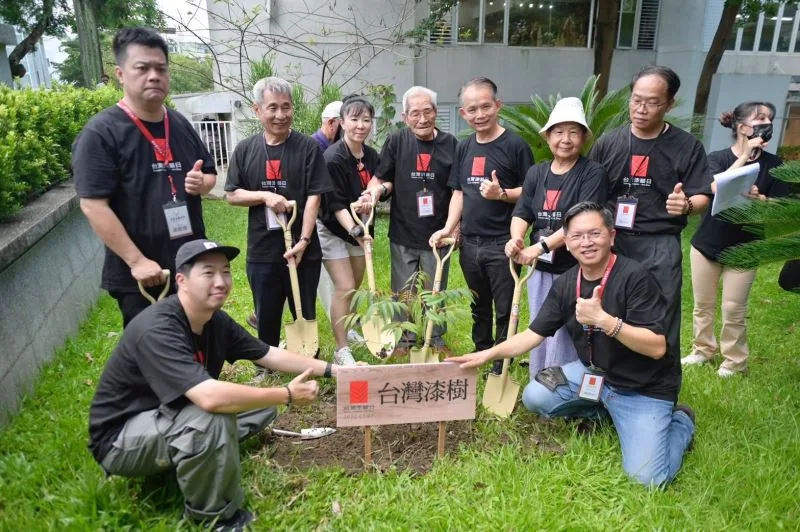
2022 Taiwan Lacquer Art Day tree restoration planting ceremony. Photo: Ministry of Culture, image and caption from the original press release. 1
30-Second Overview: Lacquerware is not merely "wood with a layer of shiny varnish." It was once a tea tray, bento box, cake stand, and wedding tea-serving vessel in Taiwanese homes, and an industry that exported to Japan in the 1970s. Later, plastic goods replaced lacquerware, causing the cultivation of lacquer trees, lacquer refining, mass production, and master-apprentice transmission to recede together. Today, when we discuss Taiwan lacquer art, we are actually discussing an industrial chain that moved from the mountains to daily life, and then retreated back into memory.
Beneath the Gloss is a Tree
The most common misconception about lacquerware is that people only see its surface. True natural lacquer is derived from the sap of the lacquer tree. After harvesting raw lacquer, it must be refined into cured lacquer, which can then be mixed with mineral pigments. Lacquer is waterproof, corrosion-resistant, heat-resistant, and acid-alkali resistant, while also possessing antibacterial and insulating properties. It serves as both a coating and an adhesive that binds materials together. 2 1
Thus, the first material of lacquerware is not wood, but time. The base can be made of wood, bamboo, rattan, paper, or pottery. Through base solidification, priming, and lacquering, layer by layer, the surface becomes a skin that can be used, touched, and preserved. Plain lacquering, gold tracing, carved lacquer, inlay, and clear coating are not different names for the same "coloring" process; they are distinct procedures requiring technical judgment. 2
Natural lacquer is not a nostalgic version of modern chemical coatings. It comes from the mountains and relies on tree species, climate, harvesting, and refining. The luster presented by the final object is connected to a whole system of understanding the material's temperament. This is why a seemingly quiet black lacquer box may explain more about how Taiwan transforms nature into daily life than an object with a flamboyant造型.
📝 Curator's Note
The "slowness" of lacquerware is not a romanticized decoration. Each layer of lacquer must wait to dry and stabilize. If this waiting is removed, what remains may still be glossy, but it is no longer the same kind of object.
Penglai Lacquer: How Taiwan Was Painted onto Objects
Taiwan had early habits of using lacquer introduced with Han Chinese activities, but the lacquerware craft truly matured during the Japanese colonial period. The National Museum of Traditional Arts notes that in 1916, Yamakami Nakamura opened the Yamakami Craft Institute in Taichung, incorporating indigenous totems, flora and fauna, and agricultural specialties into decorative patterns, gradually developing "Penglai Lacquer." The government later established the Taichung Craft Training Institute to cultivate lacquer art talent. 3
The significance of "Penglai Lacquer" lies not just in its aesthetics. It placed Taiwan's local imagery onto an object influenced by both Chinese and Japanese techniques, making lacquerware no longer just a copy of imported styles. The Kaohsiung Museum of Fine Arts also points out through its collection exhibitions that the style of Taiwan lacquerware was formed under the influence of different cultures, rather than developing linearly from a single route. 4
After the introduction of the Annan lacquer tree in 1921, successful trial planting occurred in Lianhua Chi, Yuchi, Nantou. Miaoli Tonglu and Tainan Yujing also planted extensively and established refining factories. This detail is crucial: the story of Taiwan lacquerware did not only happen in workshops; it also happened in forests, agricultural experiments, and raw material processing plants. The cultural history of objects always includes a history of plants and industry. 3
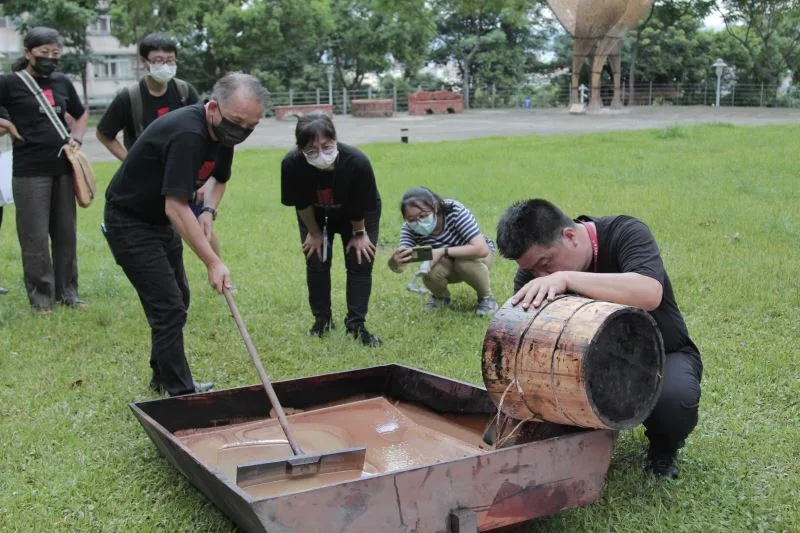
2022 Taiwan Lacquer Art Day lacquer refining demonstration, symbolizing the promotion of locally produced materials and production techniques. Photo: Ministry of Culture, original press release see 1.
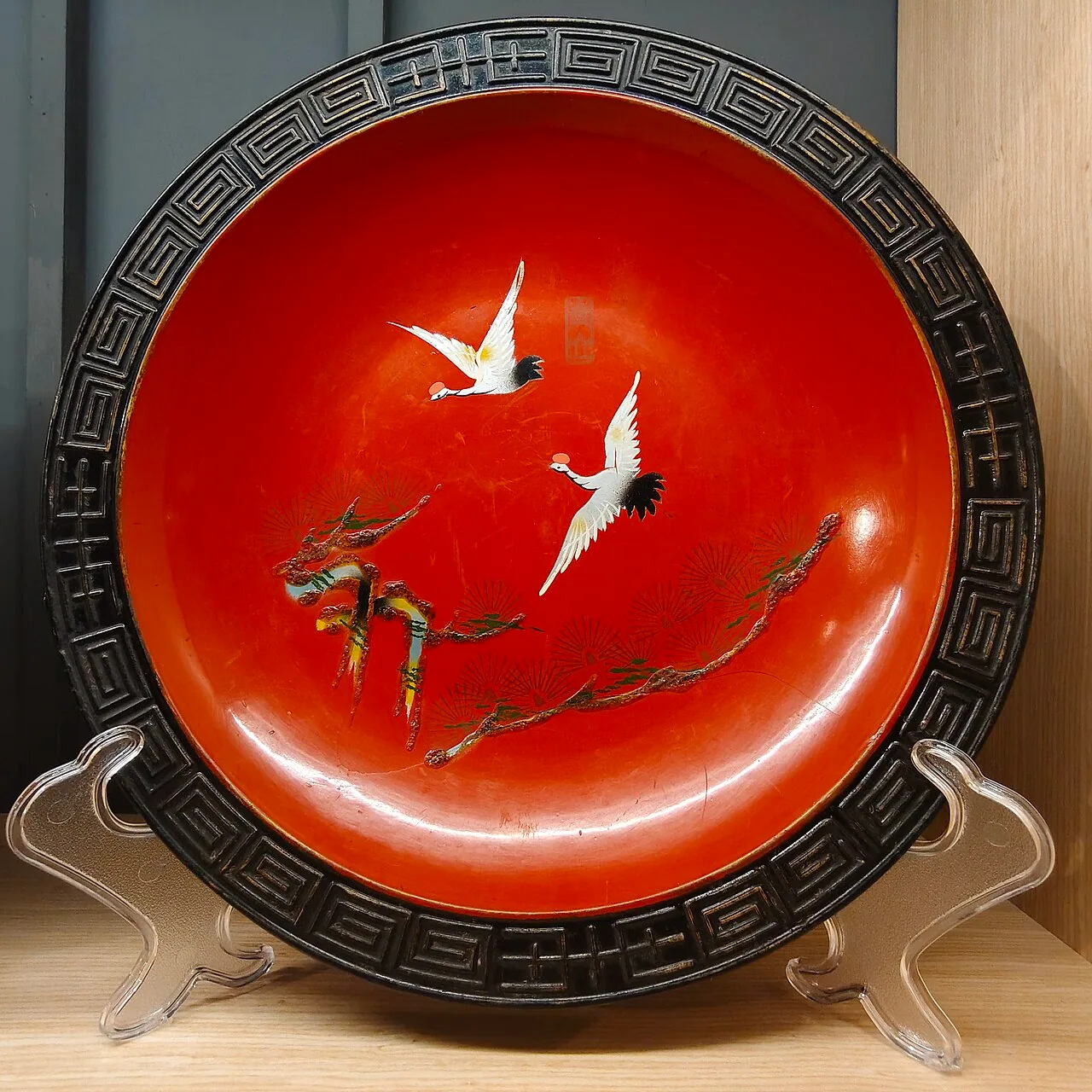
Pine and Crane Red-Inside Black-Ground Lacquer Plate, collection of Taipei City Archives. Photo: Qiu Yong, Wikimedia Commons, CC0 1.0. 5
Lacquerware Was Once Daily Life in the Home
The Kaohsiung Museum of Fine Arts describes colonial-era lacquerware as an indispensable part of civilian life. After the Republic of China era, usage gradually declined, but lacquerware remained in wedding and gift-giving scenarios. The museum's 2018 exhibition "Lacquer Journey. Record" started from civilian life, selecting over 100 collection pieces to help the audience see the usage landscape of lacquerware in its heyday. 4
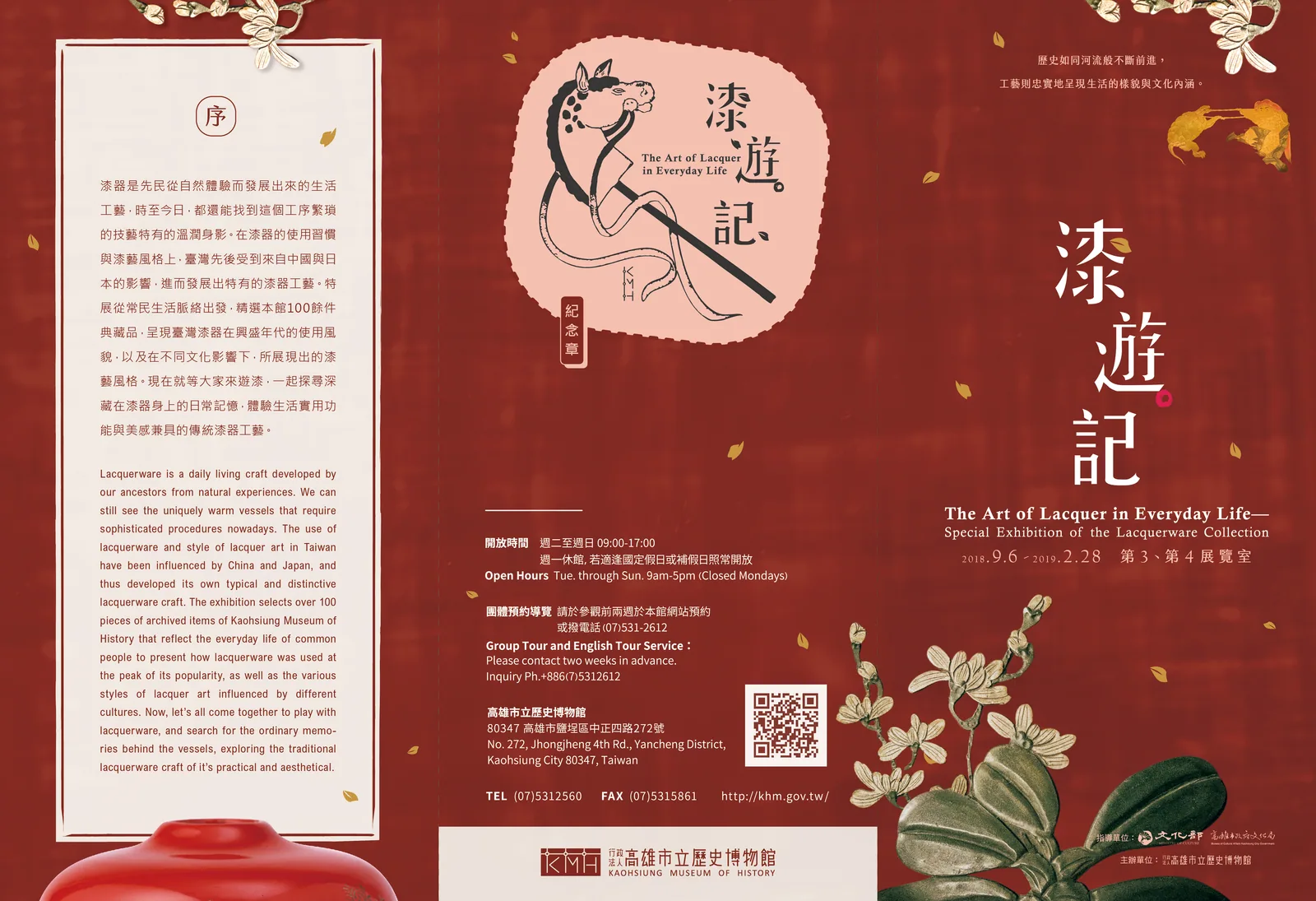
Kaohsiung Museum of Fine Arts "Lacquer Journey. Record" collection lacquerware special exhibition brochure. Photo: Kaohsiung Museum of Fine Arts, original exhibition page see 4.
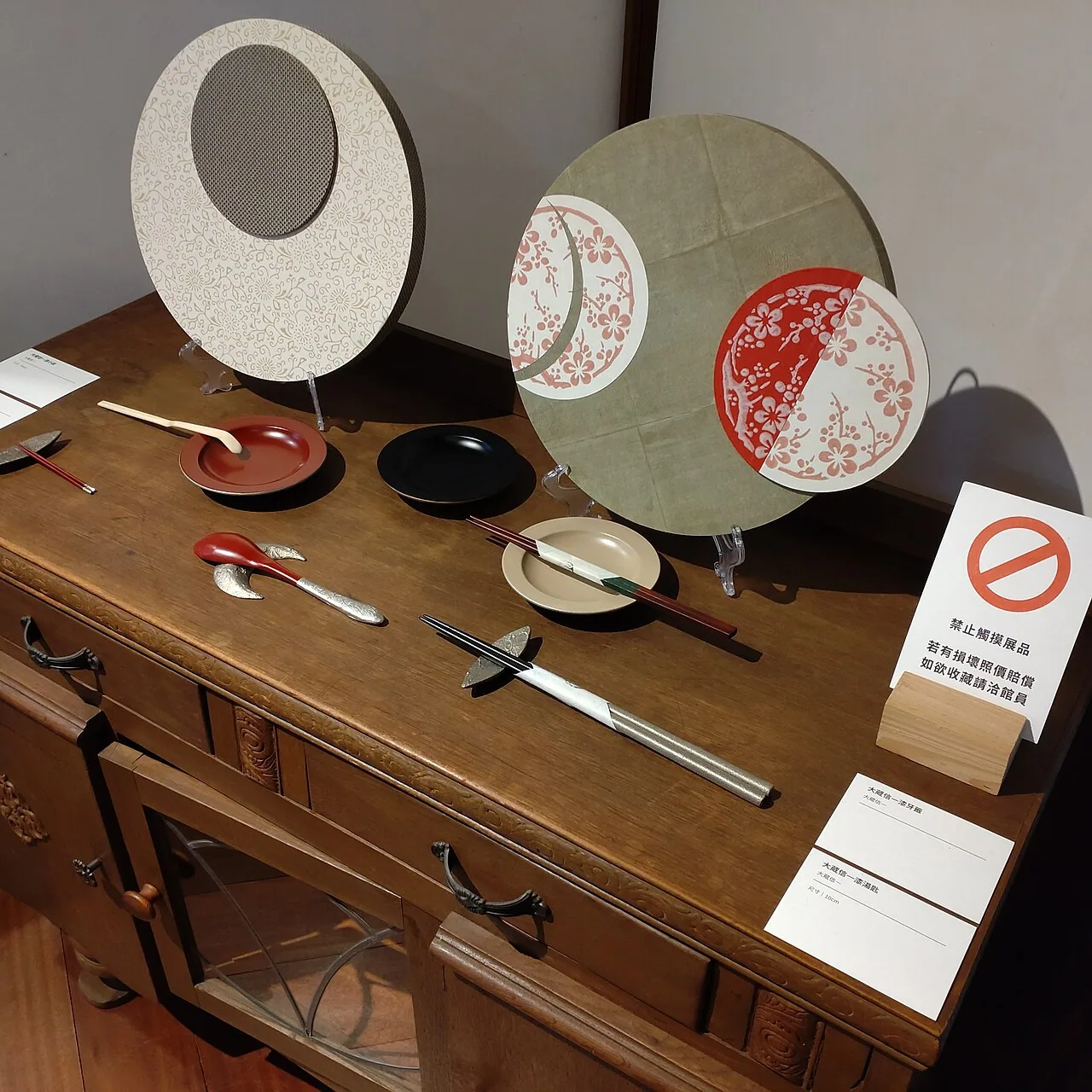
Taoyuan Branch Office Dormitory lacquerware. Photo: Wikimedia Commons, author and licensing info see file page. 6
These objects do not need to be placed in a museum first to have cultural value. Tea trays passed through hands serving tea; cake stands received festivals; document boxes stored papers for a family or a business. The history of lacquerware is often not written by famous works, but by objects repeatedly touched in daily life. The National Taiwan Craft Research and Development Center, when introducing the Meiyen Lacquer Art Workshop, also recorded the connection between tea trays used for wedding tea serving and early mass production for export. 7
| Scene of Lacquerware | Function It Bears | Cultural Clue It Leaves |
|---|---|---|
| Wedding Tea Serving | Holding tea cups, completing rituals | Family customs and object dignity |
| Festival Cake | Holding, distributing food | Diet and kinship exchanges |
| Document Boxes and Storage | Preserving documents and small items | Daily memory of families and businesses |
| Gift Giving | Expressing relationships and status | Objects as social language |
📝 Curator's Note
"Civilian" is not a low-spec version of craft history. When a tea tray is brought out, lacquerware is simultaneously furniture, ritual, industry, and touch. Its value lies not only in who made it most finely, but in how many people once considered it part of their lives.
From Peak Export to Replacement by Plastics
Post-war Taiwan lacquerware factories continued the talent and institutional foundation left by the colonial period. The National Museum of Traditional Arts notes that the 1970s were the peak period for Taiwan lacquerware exports to Japan. The main lacquer tree planting areas also shifted to Puli and Guoxing in Nantou. Raw lacquer was not only for domestic use but was also exported in large quantities to Japan. 3
This peak period is easily written as the "golden age of traditional crafts," but a more accurate description is: it was a craft industry that connected manual techniques, factory management, and international markets. Wang Hsien-min recalls that in the 1960s, his family's factory often lacked manpower; lacquerware mass production and export were seen as forward-looking enterprises. 7
The turning point became obvious after the 1980s. The Ministry of Culture points out that plastic goods gradually replaced lacquerware, and combined with economic structural changes and rising wages, the lacquer industry nearly shriveled after the 1990s, with domestic lacquer materials almost relying on imports. 1 This is not simply "people suddenly stopped loving tradition"; rather, price, speed, labor, and material supply simultaneously rewrote daily life.
| Period | Main Position of Lacquerware in Taiwan | Key Factor of Change |
|---|---|---|
| Colonial Period | Daily objects and craft systems matured | Yamakami Craft Institute, Penglai Lacquer, and training system |
| 1960s–1970s | Mass production, export, and industrial growth | Factoryization and Japanese market |
| 1980s–1990s | Decline in daily use | Plastic substitution, rising wages, industrial structural change |
| Post-2000s | Cultural assets, creation, and restoration | Preservation, teaching, material autonomy, and redesign |
The Hardest to Preserve is the Entire Material Chain
In 2022, the lacquer art community designated July 7 as "Taiwan Lacquer Art Day." The pun between the characters "Lacquer" (漆) and "Seven" (柒) is a memorable entry point, but the Ministry of Culture press release truly points out the problem: Taiwan lacquer art lacks material self-sufficiency, has few lacquer refiners, and an aging workforce. Preservation work cannot stop at displaying finished products. 1
This is why today's revitalization includes lacquer tree restoration, local lacquer refining, talent cultivation, and value chain reconstruction. If only artists are still creating, but no one knows how to care for lacquer trees, harvest raw lacquer, refine materials, treat bases, and restore old objects, then what remains is only the appearance of works; the ecology of skills has already broken.
The National Cultural Heritage Network has listed "Taiwan Natural Lacquer Industry Technology" as a cultural asset case. This registration reminds us that what should be preserved is not a single beautiful lacquer box, but the knowledge and objects required to make, restore, and practice this technology. 8
Wang Ching-shuang and the Relay of a Lacquer Path
The National Taiwan Craft Research and Development Center introduces that Wang Ching-shuang went to Japan to study lacquerware and brought the technology back to Taiwan. In 2010, he was designated as an "Important Traditional Art — Lacquer Craft Conservator" under the Cultural Assets Preservation Act. The same page records his son Wang Hsien-min taking over the workshop, shifting from mass production for export to creation and teaching. 7
This father-son lacquer path is not a simple story of "a master passing technology to the next generation." It passed through industrial peaks and market shrinkage. The next generation must take on not only techniques, but also how to answer a modern question: When a lacquerware object is no longer the cheapest, fastest container, why is it still worth making?
Relief lacquerware provides a concrete answer. The Craft Center's introduction explains that during production, lacquer and hemp cloth are repeatedly pasted onto a shaped base; after the thickness forms, the clay base is removed, leaving a hollow, lightweight cloth-lacquer base. Its value lies not in imitating antiquity, but in the result formed by material performance, bodily sensation, and process. 7
📝 Curator's Note
Inheritance is not sealing the past into a specimen. For lacquer art, true inheritance must simultaneously face whether there are lacquer trees in the forest, whether there are people in the workshop, and whether there are people in life willing to use it.
Local Workshops Are More Than Local Stories
The locality of lacquerware lies not only in which flowers and birds are painted on the object, but in how a place reconnects materials, workshops, and exhibitions. The Taoyuan City Daxi Woodcraft Ecological Museum organized the "Daxi Marries Lacquer" exhibition to organize the new face of contemporary lacquerware, allowing lacquer art to not only stay in the memories of old factories, but to meet woodcraft settlements, local museums, and new-generation creators. 9
The natural lacquer display in Puli, Nantou offers another entry point. The Sun Moon Lake Tourism Network introduces the Long Nan Museum of Natural Lacquer Wares, placing natural lacquer, the lacquerware industry, and Puli local tourism into the same narrative framework. This display still requires continuous verification and updating, but it at least reminds us that lacquerware preservation is not about moving an object into a showcase, but letting people see where the raw materials come from, how workshops operate, and why the local area is willing to continue talking about it. 10
Taiwan lacquerware thus has two easily overlooked scales. One is the scale that can be touched by the palm, such as the thickness of a lacquer plate's edge and the surface luster. The other is the scale on the map, such as the production, training, and exhibition networks of Puli, Guoxing, Tonglu, Yujing, and Taichung. Looking only at the former makes lacquerware become fine art. Looking only at the latter makes lacquerware become an industrial chronology. Only by putting them together can we see how it leaves weight in local life.
📝 Curator's Note
Free-license images allow the article to bring objects directly to the reader, but images are not a substitute for evidence. The author of the work, the collecting institution, the photographer, and the licensing terms must still be checked one by one on the file page. Seeing a lacquer plate is the beginning of reading, not the end of verification.
One Object, Three Different Times
Lacquerware lives simultaneously in three times. The first is the time of the tree: lacquer trees need to grow, raw lacquer needs to be harvested and cured, and raw materials are not inventory that can be increased by simply turning on a factory power switch. The second is the craftsman's time: base, priming, lacquering, and trimming must proceed according to the material's state; the skilled accumulate hand feel and judgment, not just fixed steps. The third is the user's time: the object must be taken out, cleaned, put away, and used again in the home to transform from a commodity into a life memory.
Industrialization once compressed the first two times into factories, allowing lacquerware to be mass-produced and exported. Plasticization changed the third time to "buy and use, replace when broken." Therefore, the decline of lacquerware does not mean a specific ancient aesthetic was eliminated alone, but that the three times can no longer meet in a single object. For today's restoration and creation to be meaningful, it cannot only make lacquerware look like the past, but must redesign the reason for its use in contemporary life.
Restoring old lacquerware is therefore not about completely eliminating cracks. The restorer must judge whether the base is deformed, whether the lacquer layer is peeling, and whether the patched lacquer can coexist with the original surface. Overly pursuing a brand-new appearance may instead erase the object's history of use. This judgment requires material knowledge and an understanding of the object's original function. When the Cultural Heritage Network lists natural lacquer industry technology as a preservation object, it is preserving these decisions that cannot be learned solely by looking at a display case.
Why Re-understand Lacquerware Today
Taiwan lacquerware is important not because it is "very traditional," but because it stacks several Taiwan issues usually discussed separately onto a single object: the flow of technology during the colonial period, the generation of local imagery, post-war export industry, family rituals, the consumer transformation of plasticization, and how cultural assets face material chain breaks. The Ministry of Culture's promotion of Taiwan Lacquer Art Day and lacquer tree restoration is precisely responding to this problem larger than a single work. 1
Putting lacquerware back into daily life also avoids speaking for it only with adjectives like "exquisite, warm, elegant." It was once used to hold food, serve tea, store documents, and make gifts. It once supported families through factories, and was squeezed out by cheaper materials. Today, its re-entry into exhibitions, teaching, and design does not mean history retreating to a golden age, but that Taiwan is trying to decide: which slow crafts are worth rearranging into life.
The luster of lacquerware is not applied in one coat. It comes from the sap of lacquer trees, the hands of craftsmen, the time waiting for drying, and from users taking it out again and again. When we see an old tea tray again, what we truly need to identify may not be how shiny it is, but how much of Taiwan's ability to produce, understand, and transmit itself remains in that light.
Image Sources
The first image and the lacquer refining demonstration image have been included in the project, taken from the Ministry of Culture press release "July 7 Taiwan Lacquer Art Day, Lacquer Artists Promote Sustainable Taiwan Lacquer Together," with original image URLs for Lacquer Tree Restoration Photo and Lacquer Refining Demonstration Photo. The exhibition brochure has also been included in the project, taken from the Kaohsiung Museum of Fine Arts "Lacquer Journey. Record — Collection Lacquerware Special Exhibition" Exhibition Attachment.
Two free-license images have been included in the project: the Pine and Crane Red-Inside Black-Ground Lacquer Plate is from Wikimedia Commons File Page, author Qiu Yong, CC0 1.0; the Taoyuan Branch Office Dormitory lacquerware is from Wikimedia Commons File Page, author Shishi, CC0 1.0.
Further Reading
- Taiwan Traditional Crafts and Intangible Cultural Assets — The position of lacquer art within Taiwan's traditional craft preservation system.
- Taiwan Floral Cloth — Another case from imported patterns, industrial production to local identity transformation.
- Taiwan Salt Industry — Another Taiwan material history from natural resources, industrialization to cultural preservation.
References
- July 7 Taiwan Lacquer Art Day, Lacquer Artists Promote Sustainable Taiwan Lacquer Together | Ministry of Culture — Taiwan Lacquer Art Day, industrial decline, plastic substitution, and material autonomy issues.↩23456
- Taiwan History in Lacquerware | Chuan Yi Online — Properties of natural lacquer, base making, and lacquering techniques.↩2
- Taiwan History in Lacquerware | Chuan Yi Online — Yamakami Craft Institute, Penglai Lacquer, Annan lacquer tree, 1970s export history.↩23
- Lacquer Journey. Record — Collection Lacquerware Special Exhibition | Kaohsiung Museum of Fine Arts — Civilian life, widespread use in the colonial period, decline after the Republic of China era, and over 100 collection pieces exhibition.↩23
- File: Pine and Crane Red-Inside Black-Ground Lacquer Plate.jpg | Wikimedia Commons — Author Qiu Yong, Own work, CC0 1.0 Universal Public Domain Dedication.↩
- File: Taoyuan Branch Office Dormitory lacquerware.jpg | Wikimedia Commons — Wikimedia Commons file page, author and licensing terms subject to the latest markings on the file page.↩
- Wang Hsien-min | National Taiwan Craft Research and Development Center — Wang Ching-shuang, Wang Hsien-min, Meiyen Lacquer Art Workshop, mass production export, and relief lacquerware.↩234
- Taiwan Natural Lacquer Industry Technology | National Cultural Heritage Network — Natural lacquer industry technology cultural asset case page.↩
- Daxi Marries Lacquer — Taiwan Lacquerware New Face Exhibition | Taoyuan City Daxi Woodcraft Ecological Museum — Contemporary Taiwan lacquerware exhibition and local woodcraft context.↩
- Long Nan Museum of Natural Lacquer Wares | Sun Moon Lake Tourism Network — Puli natural lacquer museum and Taiwan lacquerware industry history display.↩

