
30-Second Overview: In December 2022, the Ministry of Culture announced the latest list of "Living Treasure" preservers for "Cultural Assets Preservation Techniques." Su Qingliang, an 87-year-old earthwork master from Hulin, Kaohsiung, was designated as a preserver of "earthwork construction techniques"; he passed away six months later. Taiwan only incorporated the article on "Techniques for Preserving Cultural Assets and Their Preservers" into the Cultural Assets Preservation Act in 2005, and it was not until a 2016 revision that intangible cultural heritage was split into five major categories. Japan designated its first batch of 30 Living Treasures in 1955, and South Korea established a similar system in 1962. Taiwan was 50 years late. By the time the law was finally in place, the apprenticeship system had already collapsed in the waves of declining export-oriented manufacturing and industrialization during the 1970s–80s. Statistics from the Bureau of Cultural Heritage show that among the over 600 holders of the "Traditional Artisan" qualification nationwide, those under 50 are "only a minority." 1 2 3
The Last Coat of White Plaster Before the Datan Old Street
On December 19, 2022, the Ministry of Culture announced the list of preservers for the latest batch of "Cultural Assets Preservation Techniques." Su Qingliang, an 87-year-old earthwork master from Hulin, Kaohsiung, was listed under "earthwork construction techniques," becoming the first craftsman in Kaohsiung City to be recognized as a national-level intangible cultural heritage preserver under this category. 1
Counting from the year he became a disciple of earthwork master Han Qifu at age 16, he had been working with plaster for over 70 years. He has restored more than 30 historical sites, working from the northern tip to the southern tip of Taiwan: his handiwork can be seen in National Level Historical Sites such as the former Railway Bureau of the Taiwan Governor-General's Office, the Hsinchu Prefectural Government, the Lin Family Mansion in Wufeng, and the Hengchun Ancient City. 4
He told CNA in Taiwanese:
"We worked from the northern tip to the southern tip of Taiwan, always working in Datan... all the way to Hengchun." 1
In the year he was recognized, his grandson, Su Jianming, formally became a disciple and obtained the Ministry of Culture's Traditional Artisan qualification. The grandfather and grandson then jointly undertook the restoration of the tower top at the Kaohsiung Museum.
"I am very happy that my grandson wants to come out and do this! In this way, the work of restoring historical sites will not disappear! Because we happen to have three generations working on historical sites: my generation, the younger generation, and my grandson's generation." 1
Su Qingliang passed away on July 20, 2023. The President issued a commendation order, with the press release using the elegiac phrase "The Typical Example Lives in the Past." 5 The title "Living Treasure" became for him "finally, someone in my trade is taking over." But families with this three-generation inheritance are already exceptions in Taiwan's earthwork industry in 2026.
The Term "Living Treasure" Is a 50-Year-Late Import from Japan
The term "Living Treasure" originates from Japan; it is a transplant of the Japanese system to Taiwan.
Japan enacted the Act for Protection of Cultural Properties in 1950, initially focusing on passive protection ("selected because they are feared to disappear"). The first revision in 1954 explicitly established the recognition system for "Important Intangible Cultural Properties" and "Preservers." On February 15, 1955, the first batch of 30 "Preservers of Important Intangible Cultural Properties" (commonly known as Living Treasures) was designated. Starting in 1964, each individually recognized preserver received an annual government subsidy of 2 million yen, dedicated to training successors, research, and documentation. 6
South Korea enacted its Act for Protection of Cultural Properties in 1962. The system largely mimicked Japan's but included folklore within its scope. 7
What about Taiwan? The first version of the Cultural Assets Preservation Act did not appear until 1982, with the focus then on historical sites (tangible assets). It was not until the fifth major revision in 2005 that the article on "Techniques for Preserving Cultural Assets and Their Preservers" was added to the text, finally providing a legal basis corresponding to the spirit of the Japanese system. The 2016 revision further split "Intangible Cultural Heritage" into five major categories: traditional performing arts, traditional craftsmanship, oral traditions, folklore, and traditional knowledge and practices. 3
| Country | Law | System Launch | Gap with Taiwan |
|---|---|---|---|
| Japan | 1950 Act for Protection of Cultural Properties → 1954 Revision | 1955: First batch of 30 people | 50 years before Taiwan |
| South Korea | 1962 Act for Protection of Cultural Properties | 1962 | 43 years before Taiwan |
| Taiwan | 1982 CAPA → 2005 / 2016 Major Revisions | 2005: Codified in text / 2010: First individual recognition | — |
The common saying is "Taiwan developed later, so the system came later," but this statement reverses the causality. Taiwan's craftsmanship industry was a mainstay for exports in the 1950s–70s: rush grass hats, bamboo weaving, ceramics, and Christmas light decorations were exported in large quantities to the US and Japan, and the industry's scale was once more bustling than Japan's at the same time. The reason the system was late is that during these 50 years, the government's definition of cultural assets only included historical sites and artifacts, not "the people who make these things." By the time people were written into the law, these 50 years had caused the craftsmen in every household to age and pass away one by one.
📝 Curator's Note: The average age of Japan's first batch of Living Treasures in 1955 was 55. In 2025, the system underwent its first major overhaul in 50 years, incorporating "living culture" (cooks, sake brewers) because the aging of the craftsmanship technology sector is severe, with 5–10 Living Treasures passing away each year, leaving many crafts with "the last Living Treasure." 2 Taiwan's time lag means inheriting a system that is already running a race against time, yet without the same density of subsidies.
Yingge's Clay, Sanyi's Wood, Meinong's Rain
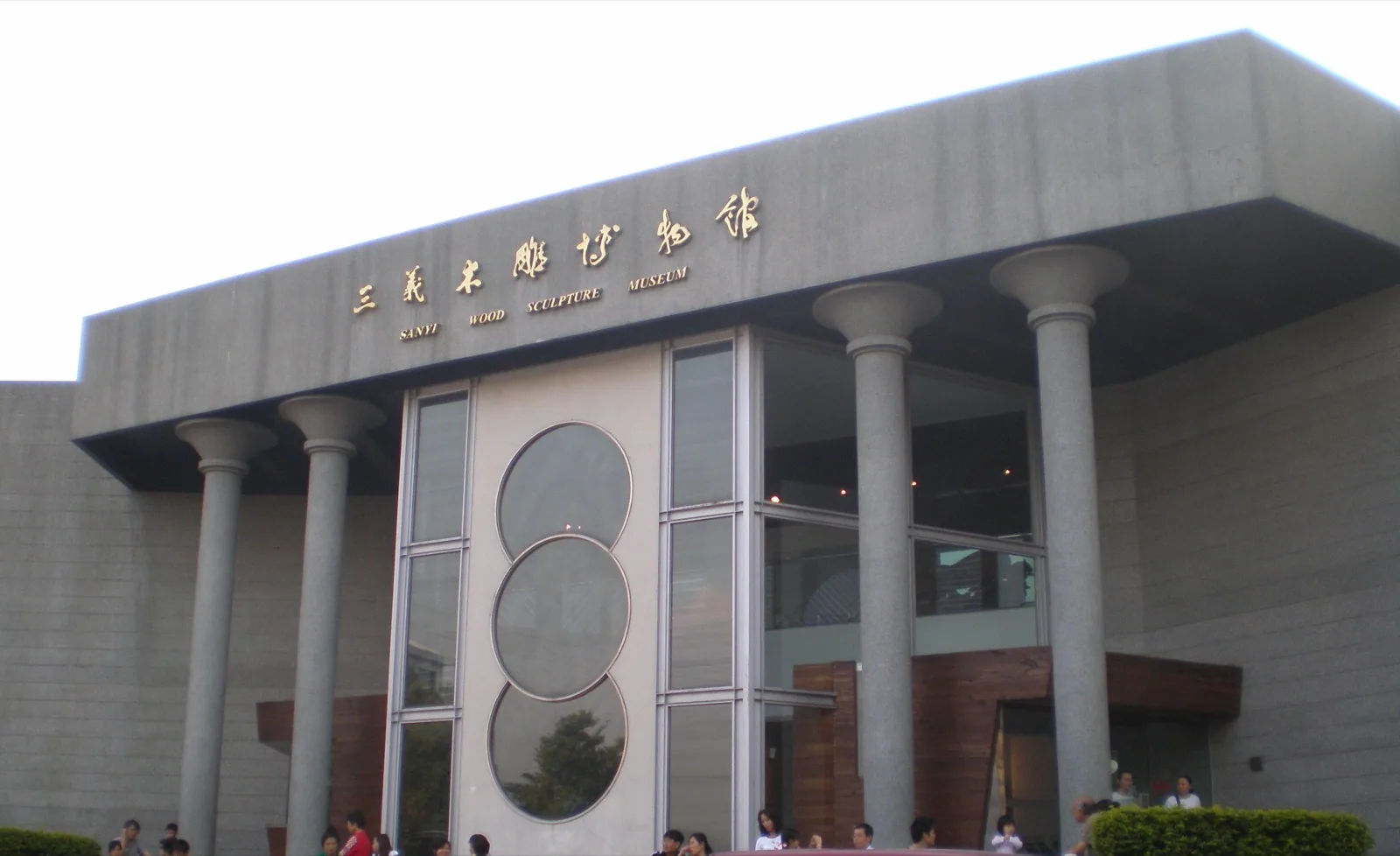
Exterior of the Sanyi Wood Sculpture Museum (Guangsheng Village, Sanyi Township, Miaoli County), Taiwan's only public museum themed around wood carving. Photo: Anrew0517, 2010-05-01, CC BY-SA 3.0, Commons File.
Craft clusters do not grow out of thin air. Each is a double crystallization of "local materials × techniques brought by immigrants." Geography locks production possibilities within a certain radius, while immigrants determine what industries grow within that radius.
Yingge (Ceramics): The clay in the Qianshan and Dahu areas is fine and sticky, ideal for pottery. In 1804 (the 9th year of the Jiaqing reign of the Qing Dynasty), Wu An crossed the sea from Cizao, Quanzhou, Fujian, and opened a kiln in Tuzikeng, Dahu. Due to the Quan-Zhang clan conflicts, the family moved to Kanjiao, and in 1853 (the 3rd year of the Xianfeng reign), moved again to Qianshanpu, which is today's Yingge Old Street. Clan members Wu An and Wu Su subsequently came to Taiwan to join. 8 9 After 1895, during the Japanese colonial period, the colonial government invested industrialization resources in Beitou, Nantou, Miaoli, and Yingge. The "Industrialization Movement" of 1931 introduced mechanized kiln equipment and firing techniques. 10 At its peak in the 1990s, Yingge had 1,300 ceramic factories, earning the international nickname "Taiwan's Jingdezhen." 11
Here is a number that will make you pause: According to statistics of non-metallic product factories, Yingge peaked at 701 factories in the late 1980s (Republic of China Year 70s) → 662 in 1997 → 554 in 2002 → 289 in 2007 → now, in 2024, fewer than 100 factories and individual studios remain. 12 Three reasons for the decline overlap: globalization moved production to China and Southeast Asia; automation led to oversupply; and environmental protection costs rose. The clay is still under Qianshan, but the people who know how to make pottery are gone.
Sanyi (Wood Carving): The Miaoli mountain area is covered with camphor trees. In 1918 (the 7th year of the Taisho era), Wu Jinbao established "Dongda Trading Co., Ltd." in joint venture with the Japanese Gaoqi, using his son Wu Luosong's name. At the time, camphor wood was controlled by the Japanese government. Wu Jinbao was detained for picking up camphor tree stumps and was only released after his wife, Luo Duanmei, worked to secure bail. He later had the opportunity to partner with Gaoqi. Sanyi wood carving differs from wood carving elsewhere in the world; it loves using "tree roots, stumps, and burls," or "ingenious carving of strange wood." The source is the waste left by the camphor industry. The Japanese needed camphor oil, not tree stumps. The byproduct of the camphor industry became the starting point of Taiwan's wood carving industry. 13
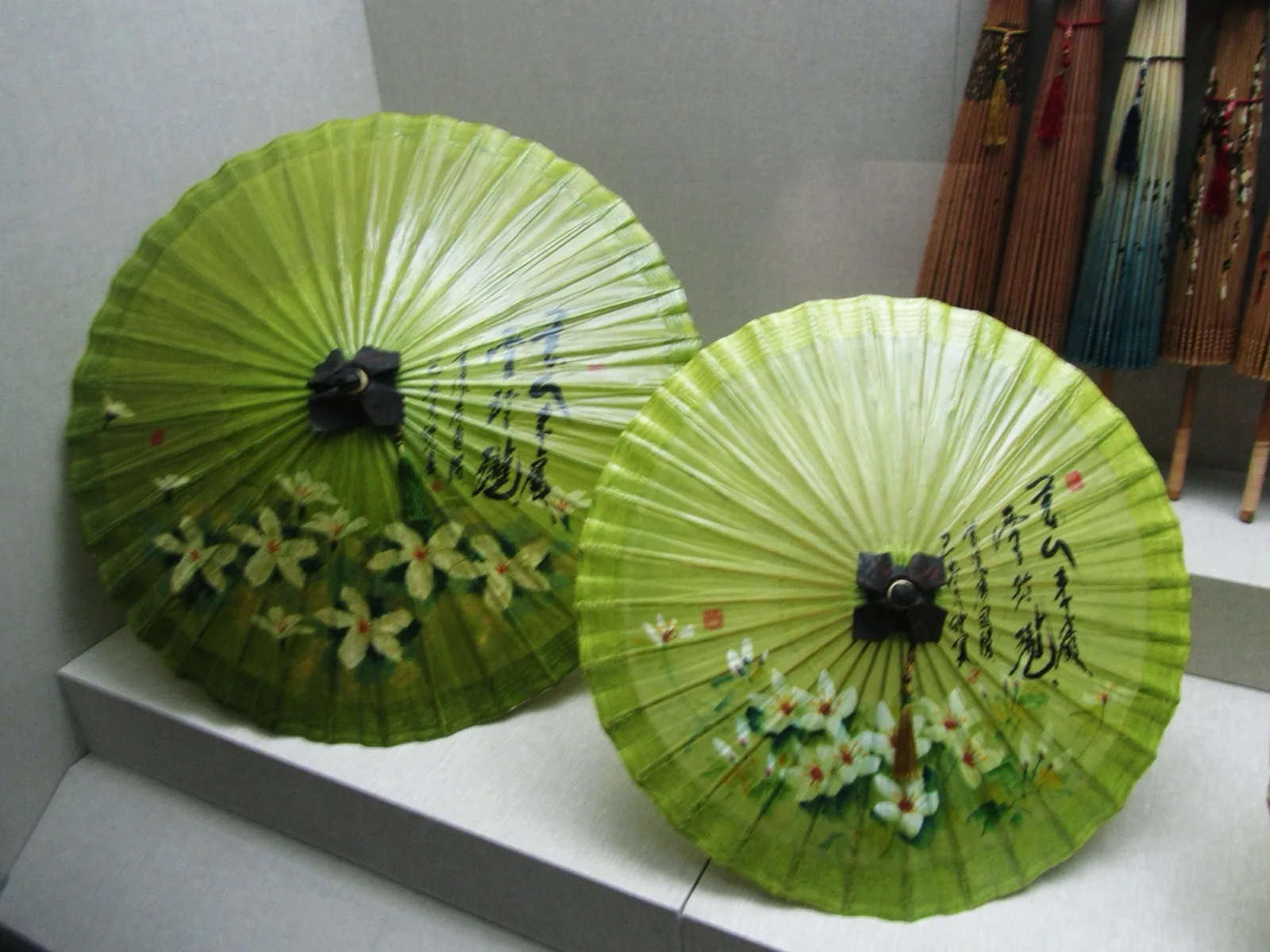
Meinong (Paper Umbrellas): During the Taisho era (1910s) of Japanese rule, Hakka immigrants Lin Agui and Wu Zhenxing invited masters from Chaozhou, Guangdong, to come to Taiwan to pass on their skills (another account says master Guo Yuqin from Meixian, Guangdong, crossed the sea to settle in Meinong). Early Meinong paper umbrella factories were mostly named with the character "Guang" (Guanghuaxing, Guangzhenxing, Guangdexing, Guangjinsheng) to commemorate their origins in Guangdong. 14 15 During the golden age of paper umbrellas in the 1960s, Meinong's annual production reached 20,000 umbrellas, with a value of NT$40 million. 14 A 1981 field survey by Kuohua magazine found: one person making alone averages two umbrellas per day. With five people分工 (dividing labor), monthly production reaches a maximum of 1,000 umbrellas. Umbrellas come in three standard sizes (24-inch / 14.5-inch / 12-inch), all with 32 bamboo frames; custom products have 40 bamboo frames and a 22-inch radius. Prices range from NT$350 to NT$1,000. 15
Lin Xianghong, owner of the Guangrongxing factory, told a Kuohua magazine reporter in 1981:
"Due to the complex production process and hard work, young people today have no patience or perseverance to learn. Thus, we are truly facing a situation where there are no successors." 15
This sentence was written in 1981. Reading it 45 years later sounds as if it were said today.
Nantou Zhushan (Bamboo Weaving): Bamboo forest resources, combined with the "Bamboo Craftsmanship Training Institute" established by Japanese officials Ikeda and Jingashen in Zhushan County in 1939, cultivated the center of post-war Taiwan's bamboo weaving craftsmanship. Huang Tusanshan graduated from Zhushan Public School in 1939 and entered the institute, later becoming one of the pioneers of the post-war Taiwan bamboo weaving system. 16 He was not recognized as a preserver of "bamboo weaving" until he was 84 (2010); he passed away in 2020.
It Wasn't the Government That Saved the Craft: The Revival of Sanxia Blue Dyeing
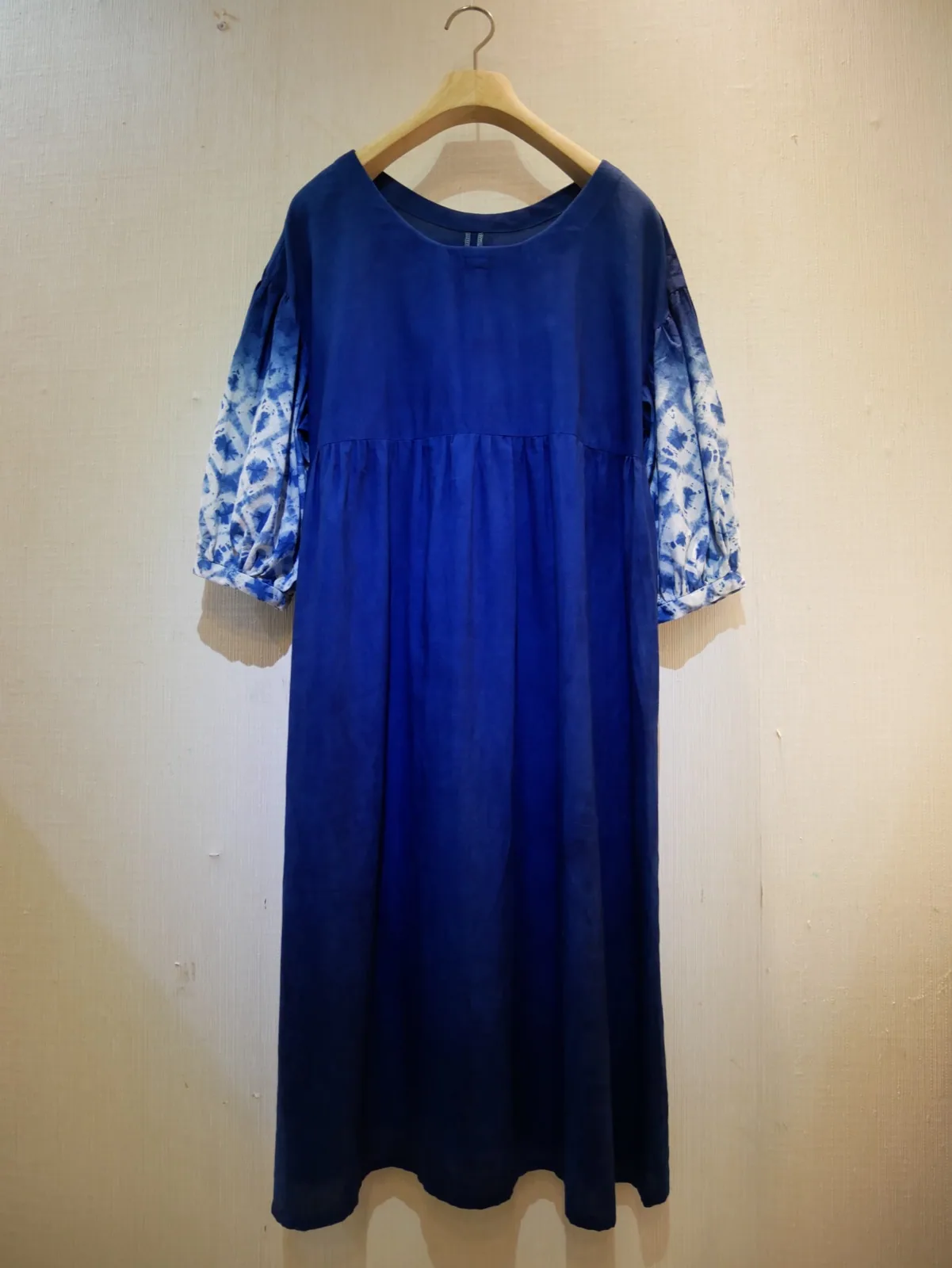
"Blue and White Series" blue-dyed clothing displayed in the Sanxia District Historical Museum, showing the contemporary application of Sanxia blue dyeing after its revival in 1996. Photo: 寺人孟子, CC BY-SA 4.0, Commons File.
Sanxia (formerly Sanjiaoyong) was the most important dyeing center in northern Taiwan during the Guangxu reign of the Qing Dynasty. Clear streams and humid valleys were suitable for the growth of indigo plants (Japanese indigo), and dye houses lined the streets. Today, the red brick facades of Sanxia Old Street remain a historical witness to the wealth generated by blue dyeing. 17
But during the Guangxu reign, the introduction of European synthetic dyes, and later the popularity of Western clothing and Japanese kimonos during the mid-colonial period, caused the traditional dyeing industry to gradually disappear. Sanxia's blue dyeing was lost for over 70 years.
The source of this revival in the 1990s was actually not in government departments, but in the local people of Sanxia finding it themselves. In 1990, Sanxia residents launched "Finding the Lost Sanxia Blue"; in 1994, the "Sanjiaoyong Cultural History Studio" was established; in 1996, the "Sanjiaoyong Cultural Association" was formally established; in 1999, the association launched a blue dyeing promotion and technology restoration plan. Association General Secretary Liu Meiling, along with teachers Ma Fenmei and Chen Jinglin, worked together to recover the lost blue dyeing techniques. 17
This reverses the timeline of the "Living Treasure" system: before the system (2005) arrived, craft revival (1990) had already occurred in civil society. When the Cultural Assets Preservation Act codified the preservation system, Sanxia blue dyeing had already been alive on its own for 15 years. The system came to certify, not to save.
📝 Curator's Note: The Sanxia case reveals an invisible contrast: "Bottom-up craft revival" vs. "Top-down cultural asset preservation" are two different paths. Most Ministry of Culture subsidies flow to organizations (associations, museums, research centers), with a small proportion reaching the craftsmen themselves; subsidies are "project-based," ending after one project is completed, unable to support craftsmen's long-term creation. Academic criticism of the subsidy structure is stuck in this structural misalignment.
Learning a Craft from a Master Who Has Been Dead for a Century
In the 70th year of the Republic of China (1981), the Ye Wang Jiaozhi (overglaze) pottery from Ciji Temple in Xuejia, Chiayi, was stolen.
Lin Kuang-yi, then in his early 30s, had just become a disciple of Lin Tianmu to learn Jiaozhi pottery glazes and took on the restoration project. Ye Wang (Ye Shi, born 1826, Taiwan's first indigenous Jiaozhi pottery artist) had been dead for over a century. The glaze formulas, firing temperatures, and color mixing ratios from that time left no written records. 18
During the restoration process, Lin Kuang-yi discovered that he fundamentally did not know what raw materials Ye Wang used or what glaze ratios were employed. Every color he mixed was wrong; every time the ratio was off, it felt like repeatedly verifying "that the era when Ye Wang was still alive can never be returned to." He later told a Classic magazine reporter:
"In the entire restoration process, I actually felt like I was learning everything from scratch." 18
He also said:
"If Ye Wang were still alive, I would definitely take him as my master." 18
Lin Kuang-yi spent over ten years slowly figuring it out and was later recognized as the "third-generation successor of Ye Wang's Jiaozhi pottery." But he knew that what he had recovered was only "the closest" to Ye Wang, not Ye Wang himself.
The true difficulty of craft transmission lies here: when one or two generations are interrupted, descendants who want to learn have no master to face. The apprenticeship system requires two people face-to-face, with the master correcting errors hand-in-hand; make a mistake, get corrected, and you will get it right next time. Ye Wang's apprentice chain broke after his death. Lin Kuang-yi could only learn from Ye Wang's "works," not from Ye Wang himself.
Patterns Are the Body's Memory: Yuma Taru's 34 Years
In 1992, Yuma Taru (Chinese name Huang Yali, Atayal, born 1963 in Taian Township, Miaoli), just turning 30, began "running the villages." She visited eight Atayal subgroups and over 100 villages for fieldwork. 19 Starting in 1996, her husband Baunay Watan spent three years accompanying her to film a documentary. In 1999, K'gi na yaki (Grandma's Ramie) was completed, recording the process of her learning traditional Atayal weaving techniques from her grandmother. 20
Her weaving studio, "Ye Tong Workshop," is located in the Xiangbi Village of Miaoli, recruiting indigenous women along the Da'an River valley to learn weaving. From 1992 to 2026, she has worked for 34 years and has successfully restored 400–500 pieces of traditional Atayal clothing. 21
In 2016, she was recognized by the Ministry of Culture as an "Important Traditional Craftsmanship Preserver" for "Atayal Dyeing and Weaving—Interlocking and Pick-Weaving Techniques and Atayal Weaving Patterns." At the time, she was Taiwan's youngest Living Treasure, aged 53. 22 She told a vocus interview reporter:
"Cultural identity is something you like from the bottom of your heart; if it doesn't truly enter your bones, it is useless." 23
"We should attract clan members in this way, not just by learning weaving to make traditional clothes, giving ourselves more dignity, and letting ourselves know who we are." 23
The phrase "entering the bones" is worth pausing over. The apprenticeship system of Han craftsmanship is a single-line inheritance from master to apprentice; Yuma Taru's revival of weaving patterns is about letting Atayal weaving patterns re-enter the bodies of an entire group of women. Things learned through the body survive much longer than those remembered from books.
Stone Carving Is Not on the List: Indigenous Craftsmanship Waited 11 Years for a Spot
As of the end of 2021, the Ministry of Culture's recognized "Important Traditional Craftsmanship Preservers" (National Level) totaled 21 categories and 29 individuals, covering seven major categories: ceramics, wood carving, bamboo weaving, lacquerware, dyeing and weaving, metalwork, and embroidery. 24 But there is a glaring gap: there are no national-level preservers for stone carving.
This is not because Taiwan does not do stone carving. Hualian Yuli, Taitung Dulan, Kinmen, and Penghu each have stone carving traditions; the stone houses and stone tools of indigenous villages are crafts continuing for millennia. But on the list of "Important Traditional Craftsmanship Preservers," stone carving has never had an individual recognition.
What is on the list, and what is not, is itself a curatorial choice. Taiwan's cultural asset preservation system has its own blind spots.
| Craft Category | Preserver | Year of Recognition |
|---|---|---|
| Lacquerware | Wang Ching-shuang (Still creating at 100) | 2010 |
| Bamboo Weaving | Huang Tusanshan (1926–2020) | 2010 |
| Traditional Wood Carving | Shih Chen-yang | 2011 |
| Tin Craft | Chen Wan-neng | 2011 |
| Carving Techniques | Li Ping-kuei | 2013 |
| Bamboo and Rattan Weaving | Chang Hsien-ping | 2016 |
| Atayal Dyeing and Weaving | Yuma Taru | 2016 |
| Important Traditional Wood Carving | Chen Chih-chun | 2019 |
| Kesi (Kesi Silk) | Huang Lan-ye | 2020 |
| Important Traditional Wood Carving | Li Ping-kuei (Double Recognition) | 2020 |
| Clay Sculpture | Du Mu-he | 2021 |
| Jiannian (Cut and Paste) | Chen San-huo | 2021 |
| Jade Carving | Huang Fu-shou | 2021 |
| Important Traditional Wood Carving | Tsai De-tai | 2021 |
| Lacquerware | Huang Li-shu | 2021 |
| Paiwan Embroidery Kinavatjesan | Chen Li-you-mei | 2021 |
| Kavalan Banana Fiber Weaving | Yan Yu-ying | 2021 |
| Paiwan Tjemenun Weaving | Hsu Chun-mei | 2021 |
| Seediq Gaya Tminun Weaving | Chang Feng-ying | 2021 |
| Fine Woodworking | You Li-hai | 2021 |
| Traditional Architectural Painting | Zhuang Wu-nan | 2021 |
| Earthwork Construction Techniques | Su Qingliang (1935–2023) | 2022 |
Looking closely at another structural issue: the four indigenous craft categories (Kavalan, two Paiwan, Seediq) all entered in the same batch in 2021. When the Cultural Assets Preservation Act was revised in 2005, indigenous crafts had almost no national-level registrations; it was not until the 2016 revision and another five years, in 2021, that the four categories were added together. The system recognized indigenous crafts at least 11 years later than Han crafts.
600 Artisans, "Only a Minority" Under 50
The arithmetic of 2026 is simple.
As of May 2023, Taiwan's intangible cultural heritage items (including general and important) totaled 6 major categories and 615 items, of which 182 items were in the traditional craftsmanship category. 25 The cumulative number of national-level "Important Traditional Craftsmanship Preservers" is 29 (2021 figures, with more added after 2022), and the "Traditional Artisan" qualification issued by the Ministry of Culture nationwide numbers over 600.
The Bureau of Cultural Heritage admitted in a report that traditional artisans under 50 are "only a minority." 26 This sentence sounds平淡 (flat), but when calculated out, it is shocking: if 70% of the 600 are estimated to be over 50, the remaining 180 under 50 are distributed across Taiwan's 6 major craft categories (ceramics, wood carving, dyeing/weaving, bamboo weaving, metalwork, lacquerware), averaging about 30 successors per category. To disperse these to all craft clusters in Taiwan—Yingge, Sanyi, Meinong, Miaoli, Guanmiao, Daxi, Lukang, Tainan—the number of young artisans in each cluster may be left with only single digits.
Contrast this with the numbers from Japan's Living Treasure system: as of July 2025, there are 105 living Japanese Living Treasures, each individually recognized preserver receiving an annual government subsidy of 2 million yen dedicated to training successors, research, and documentation. 2 Taiwan's current system does not offer an equivalent level of subsidies for "Important Traditional Craftsmanship Preservers"; local artisans mostly have to find their own markets. Commercialization, collaborating with designers, and entering cultural creative parks are life-extending methods actively sought by contemporary Taiwan craftsmen, not provided by the system.
Chen Wan-neng (Lugang tin craftsman, third-generation family business, recognized Living Treasure in 2011) told a Liberty Times Arts Weekend reporter:
"Innovation yesterday becomes tradition today; innovation today becomes tradition tomorrow." 27
The flip side of this sentence is: those who do not innovate today will be gone tomorrow.
⚠️ Controversy: The Ministry of Culture and the Taiwan Craft Research and Development Center (NTCRI) promote "Craft × Design" collaborations. Positively, brands like Twenty-Two Design, Yinprint, and the Taiwan Flower Brick Museum give old crafts new markets; negatively, craftsmen are treated as "material libraries": designers use them, but craftsmen lack IP dominance. Designer Hsiao Ching-yang said: "Only with good culture can there be good cultural creativity." 28 But "good culture" requires craftsmen to have time to slowly create and slowly teach, not to be rushed to shelf.
Grandfather and Grandson Plastering White Plaster Together
In 2022, when Su Qingliang was recognized at age 87, his grandson Su Jianming had just obtained the Ministry of Culture's Traditional Artisan qualification. That year, the grandfather and grandson jointly undertook the restoration of the tower top at the Kaohsiung Museum. 86-year-old Su Qingliang went to the construction site to guide, while the young Su Jianming plastered white plaster and repaired tiles. 1
Wang Ching-shuang, aged 100 (born 1922, still alive in 2025), creates for 5–6 hours every day. His sons Wang Xianmin and Wang Xianzhi took over, and his grandson Wang Junwei is the third generation. This family of three generations is one of the few craft families that did not break the apprenticeship chain. Wang Xianmin relayed his father's words:
"To do lacquerware well, you have to live long." 29
The Taiwan version of "To do lacquerware well, you have to live long" is "For the system to work well, we must hurry up." Taiwan only codified preservation techniques into the Cultural Assets Preservation Act in 2005, 50 years after Japan; it did not split intangible cultural heritage into 5 major categories until 2016, 13 years after the UNESCO 2003 Convention. The law exists, but the number of people alive who can still do and teach is limited. Su Qingliang passed away six months after recognition; Huang Tusanshan passed away 10 years after recognition. They were all from the 1925–35 generation. What about the 1945–65 generation? When the apprenticeship system collapsed in the 1970s, they were just about to become apprentices; most changed careers.
The clusters remain. The clay remains. The camphor trees will still grow. The bamboo forests will still shoot up. But the apprenticeship system requires two people face-to-face, with the master correcting errors hand-in-hand. When Su Qingliang's grandson applies that coat of white plaster on the tower top, beneath that white plaster lies one of the few remaining unbroken chains of Taiwan's traditional craftsmanship.
The list gets longer, the number of people who can teach gets smaller. Next time you walk into a cultural creative shop and see a Living Treasure's name behind every product, behind that name, there may be a person, or there may not be.
Further Reading:
- Blue Dyeing — A complete craft history of blue dyeing, from a major Qing Dynasty export to near extinction by 1940, and its independent revival in Sanxia, Miaoli, Taiping, and Jingliao.
- Taiwan Floral Cloth — The identity journey of Hakka red floral cloth, from Japanese colonial factory products to a symbol of local culture.
- Paper Umbrellas — The transformation path of Meinong paper umbrellas from rain-proof daily necessities to art pieces.
- Bamboo Hats — Rush grass weaving and representative artifacts of Taiwan's rural craftsmanship.
- Traditional Festivals and Ceremonies — Craftsmanship as the material carrier of festivals (paper offerings for Yanshui Fireworks, palanquins for Mazu processions).
Image Sources
This article uses 3 Wikimedia Commons CC-licensed images, all cached in public/article-images/culture/ to avoid hotlinking to source servers:
- Yuanxiangyuan Paper Umbrella, Taiwan 2013-07 — Photo: Outlookxp, 2013-07-20, CC BY-SA 3.0. A group of Hakka oil-paper umbrellas displayed at the Yuanxiangyuan Paper Umbrella Cultural Village in Meinong, with red, yellow, and black colors on the umbrella surfaces, is one of the most representative visual archives of Meinong paper umbrella craftsmanship.
- Sanyi Wood Sculpture Museum 20100501 — Photo: Anrew0517, 2010-05-01, CC BY-SA 3.0. The exterior of the Sanyi Wood Sculpture Museum (Guangsheng Village, Sanyi Township, Miaoli County), Taiwan's only public museum themed around wood carving.
- Blue and White Series Blue-Dyed Clothing Displayed in Sanxia District Historical Museum — Photo: 寺人孟子, CC BY-SA 4.0. The "Blue and White Series" blue-dyed clothing displayed in the Sanxia District Historical Museum, showing the contemporary visual application of Sanxia blue dyeing after its revival in 1996.
References
- Earthwork Construction for Over 70 Years: Su Qingliang Designated as Ministry of Culture "Living Treasure" — CNA report, 2022-12-19. The original CNA interview text on the day Su Qingliang was recognized, including his Taiwanese self-description "We worked from the northern tip to the southern tip of Taiwan" and the grandfather-grandson succession quote.↩2345
- 《Living National Treasure's Present》Profound Successor Issues — Yahoo Japan report. The first major overhaul of Japan's "Living Treasure" system in 2025, responding to the aging crisis in the craftsmanship technology sector; 105 living as of July 2025.↩23
- Cultural Assets Preservation Act — Wikipedia entry on the CAPA, including the 1982 legislation, the fifth major revision in 2005, the 2016 revision, the evolution of articles, and the establishment process of the "5 Major Categories of Intangible Cultural Heritage."↩2
- Su Qingliang — Wikipedia entry on Su Qingliang, recording his complete career: born 1935, became a disciple at 16, restored over 30 historical sites, recognized in 2022, passed away in 2023.↩
- Living Treasure of Cultural Asset Techniques Su Qingliang Passes Away: President Issues Commendation Order — Liberty Times 2023 news on Su Qingliang's passing, details of the presidential commendation order.↩
- Living National Treasure (Japan) — English Wikipedia entry on Japan's Living Treasure system, recording the 1950 Act for Protection of Cultural Properties, the 1954 revision, the first designation on 1955-02-15, and the launch of the 2 million yen subsidy system in 1964.↩
- National Intangible Cultural Heritage (South Korea) — English Wikipedia entry on South Korea's Important Intangible Cultural Property system, 1962 legislation, mimicking Japan but with a broader scope.↩
- Development of Yingge — Yingge District Office website "Development of Yingge" history. Wu An crossing the sea to open a kiln in 1804, the move to Qianshanpu in 1853, complete timeline and geographical context.↩
- Cizao Town—Yingge Ceramic History — Open Museum "Cizao Town" online exhibition. Exhibitionary narrative of Yingge ceramic origins and the Wu family from Cizao's path to Taiwan.↩
- Kiln It! Yingge's 200 Years of Ceramics History — Kuohua Magazine English version special on Yingge's 200-year ceramic history. Includes detailed timeline of 1895 Japanese colonial industrial promotion + 1931 Industrialization Movement and English primary source comparisons.↩
- Yingge Xinxing Collection of Ceramics — Official data from the old Yingge ceramic brand "Xinxing Collection of Ceramics." Data on 1,300 factories at peak in the 1990s and the source of the international title "Taiwan's Jingdezhen."↩
- T22 Magazine Origin Magazine 01 Clay, Kiln Firing, and Memory, Yingge's Extraordinary Path — Taiwan Design Research Institute (TDRI) Yingge Origin Magazine special. Includes annual data on non-metallic product factories (701→662→554→289) and the three causes of decline.↩
- Sanyi Wood Carving Style, Origins, and Evolution-02 Rise of Ingenious Carving of Strange Wood and Establishment of Dongda Trading — National Palace Museum Online Database. Detailed origin research on Sanyi wood carving's 1918 joint venture between Wu Jinbao and Gaoqi to establish "Dongda Trading Co., Ltd."↩
- Meinong oil-paper umbrellas — Council of Indigenous Peoples (CIP) English version special on Meinong paper umbrellas. Includes Taisho era introduction, Lin Agui + Wu Zhenxing inviting Guangdong masters to pass on skills, 1960s annual production of 20,000 umbrellas, and 40 million value data.↩2
- From Utensil to Art Piece—Meinong Paper Umbrellas — Kuohua Magazine 1981 field survey special. Includes Lin Xianghong's Guangrongxing factory quote "facing a situation where there are no successors" and primary records of production specifications, prices, and processes at the time.↩23
- Huang Tusanshan — Wikipedia entry on Huang Tusanshan (1926–2020). Records his entry into the Zhushan County Bamboo Craftsmanship Training Institute in 1939, his central position in post-war Taiwan bamboo weaving craftsmanship, and his recognition as a "bamboo weaving" preserver in 2010.↩
- Sanjiaoyong Cultural Association About Us — Sanjiaoyong Cultural Association website history. 1990 Sanxia blue dyeing revival origin, 1994 cultural history studio, 1996 association establishment, 1999 blue dyeing promotion and technology restoration plan complete timeline.↩2
- From Temple Eaves to the Human World: Jiaozhi Master Lin Kuang-yi — Classic Magazine profile. Lin Kuang-yi's complete story and quotes from the 1981 restoration of Ye Wang's Jiaozhi pottery at Ciji Temple in Xuejia, ten years of exploring glaze ratios, and final recognition as the third successor of Ye Wang's Jiaozhi pottery.↩23
- Yuma Taru — English Wikipedia entry on Yuma Taru. 1992 fieldwork running through 100+ villages, eight Atayal subgroups, Chinese name Huang Yali, born 1963 in Taian, Miaoli.↩
- Atayal Historian | Buanay Watan — Ministry of Culture (MOC) English version special. Husband Baunay Watan's work process filming K'gi na yaki (Grandma's Ramie) documentary from 1996-1999.↩
- Indigenous artist preserves traditional Atayal weaving — Taiwan Today English version special. Ye Tong Workshop operating in Xiangbi Village, cumulative successful restoration of 400-500 pieces of Atayal traditional clothing, work scale statistics.↩
- Yuma Taru — Wikipedia entry on Yuma Taru. 2016 (Republic of China Year 105) Ministry of Culture recognition as "Atayal Dyeing and Weaving—Interlocking and Pick-Weaving Techniques and Atayal Weaving Patterns" Important Traditional Craftsmanship Preserver, official record of being the youngest Living Treasure at the time (53 years old).↩
- Recording Beautiful Atayal Stories with Weaving Patterns — vocus interview with Yuma Taru. Includes Chinese verbatim quotes "Cultural identity is something you like from the bottom of your heart" and "giving ourselves more dignity, letting ourselves know who we are."↩2
- National Cultural Assets Network Important Traditional Craftsmanship Preservers — Ministry of Culture National Cultural Assets Network official announcement. Official list and recognition years of 21 categories and 29 "Important Traditional Craftsmanship Preservers" as of 2021.↩
- Bureau of Cultural Heritage — Ministry of Culture English version Bureau of Cultural Heritage website. As of May 2023, Taiwan's intangible cultural heritage 6 major categories, 615 items statistics, including 182 items detail in the traditional craftsmanship category.↩
- Traditional Artisan Talent Gap: Bureau of Cultural Heritage Training Courses Attended by North and South — Liberty Times report. Bureau of Cultural Heritage admits that among the over 600 "Traditional Artisan" qualifications nationwide, those under 50 are "only a minority." Includes official explanation of the Bureau's commissioning of National Tainan University of Arts to handle earthwork/plaster training courses.↩
- Father and Son Three People Cherish Tin to Create Art: Tin Crafts Living Treasure Chen Wan-neng Family — Liberty Times Arts Weekend Chen Wan-neng family special. Includes verbatim quote "Innovation yesterday becomes tradition today; innovation today becomes tradition tomorrow" and detailed records of Lugang tin crafts third-generation family business.↩
- Designer Hsiao Ching-yang: Only with Good Culture Can There Be Good Cultural Creativity — The News Lens Hsiao Ching-yang interview. Includes core viewpoint "Only with good culture can there be good cultural creativity" and detailed discussion on the relationship between Taiwan's cultural creativity and craftsmanship.↩
- Taiwanese National Treasure Lacquer Master Wang Ching-shuang Who Dedicated His Life to Lacquer Crafts! Seeing the Craftsman Time of Mr. Wang Ching-shuang of Nantou "Meiyan Lacquer Arts" — La Vie Magazine Wang Ching-shuang family special. Includes son Wang Xianmin relaying father's "To do lacquerware well, you have to live long" and three-generation family craft records.↩