
In May 2025, tens of thousands of fifteen-year-old students sat in examination rooms for the Comprehensive Assessment Program for Junior High School Students. On the science paper, one question asked them to design a controlled experiment to refute the claim that “at noon on Dragon Boat Festival, yang energy is at its strongest, so eggs are especially easy to stand upright”1. The exam writers were not asking students to recite the wisdom of the ancestors. They were asking them to prove that this wisdom could not stand up scientifically. Shen Wen-chun, a physics and chemistry teacher at Yongping High School in New Taipei, unpacked the logic of the question in an interview: the myth’s argument was that “the sun’s gravitational pull on the egg at noon is exactly opposite to the earth’s gravitational pull on the egg, so the two cancel each other out.” To overturn it, students had to design an experiment capable of producing evidence1. Wang Mei-ling, a teacher at Wanhua Junior High School, said the question “did not assess much subject knowledge, but instead asked examinees to think about how to design an experiment and provide evidence to refute the myth of ‘balancing an egg at Dragon Boat Festival’”1.
A national examination asked an entire generation of adolescents to prove, by experiment, that an ancestral custom was wrong. That fact reveals the least discussed secret of Dragon Boat Festival.
30-second overview: Dragon Boat Festival was originally not about commemorating anyone. It was an entire survival toolkit for resisting death during the “evil month” of the fifth lunar month: mugwort was an insecticide, realgar wine was poison used to ward off poison, noon water was disinfectant, egg balancing was sorcery, and dragon boats were originally used to drive away plague. Modern science has dismantled these functions one by one: mugwort has only a weak mosquito-repellent effect, egg balancing has nothing to do with yang energy or gravity, and noon water does not bring wealth or blessings. Yet in Taiwan, this holiday has not died. It has instead produced the north-south zongzi wars, noon water that draws nearly a thousand people, Lukang’s Taiwan-only Dragon King Festival, and in 2026 even Taiwan’s first world-class dragon boat race, with 8,000 participants from 30 countries. The medicine has expired, yet Taiwanese still take it every year, because it is no longer about preventing disease. It is about confirming that we are still together.
What Qu Yuan Overshadowed Was a Holiday Afraid of Death
Almost every Taiwanese person can recite the answer: Dragon Boat Festival commemorates Qu Yuan, who threw himself into a river. But that answer does not survive questioning. Sima Qian wrote a biography of Qu Yuan in the Records of the Grand Historian, yet never once said on what day Qu Yuan entered the river2. The earliest record linking “the fifth day of the fifth month” with Qu Yuan, and then sending dragon boats onto the water to “rescue him,” does not appear until Xu Qi Xie Ji from the Liang dynasty of the Southern Dynasties, roughly six hundred years later than the Records of the Grand Historian2. In other words, Qu Yuan was a label gradually attached by later generations. Historians have put it even more directly: the reason Taiwanese society today instinctively says “Qu Yuan” whenever Dragon Boat Festival is mentioned “mostly comes from the postwar baptism of textbooks”3. That is the standard answer taught by schoolbooks. It is something else entirely from the holiday’s real background.
Peel away the Qu Yuan label, and what appears beneath it is a holiday about fear. In southern China and Taiwan, the fifth lunar month falls just after the plum rains, when heat and humidity surge, mosquitoes breed, epidemics spread easily, and poisonous creatures emerge. Ancient people simply called the whole fifth month the “evil month.” How deep was this idea? Tian Wen, Lord Mengchang of the Warring States period, was born on the fifth day of the fifth month. His father Tian Ying believed that “a son born in the fifth month, if he grows as tall as the door, will bring harm to his parents,” and ordered that the child not be raised2. Fortunately, when Tian Wen grew up, he challenged his father face to face: is a person’s fate received from Heaven, or from the height of a doorway2? This was a protest against “evil month superstition” more than two thousand years ago. Texts that explicitly call the fifth month the “evil month” were not fixed in writing until Fengsu Tongyi in the Eastern Han and Huanglan Yili in the Wei-Jin period; the latter directly records that “the fifth month is commonly called the evil month”4.
📝 Curator’s note: Dragon Boat Festival has several rivers flowing into its source. Besides the loyal minister Qu Yuan, the state of Wu had Wu Zixu, who also died unjustly and was cast into a river; the Cao E Stele records that locally, “on the fifth day of the fifth month, people welcomed Lord Wu”5. Shangyu in Zhejiang had the filial daughter Cao E. The Book of the Later Han records in black and white that her father Cao Xu was a shaman who “could sing to string accompaniment and served as a ritual specialist.” On “the fifth day of the fifth month in the second year of Han’an,” he entered the water to welcome the god Posuo, drowned, and his body was never found. Fourteen-year-old Cao E wept along the river for seventeen days before throwing herself in to search for her father6. This primary source contains an overlooked clue: long before the Qu Yuan story became widespread, people were already welcoming gods and sacrificing to water deities by the riverside on the fifth day of the fifth month. Loyalty, grievance, and filial piety were three versions of memory that grew in different places around the same date.
As for the most widely circulated claim that Dragon Boat Festival originated in an ancient “Baiyue dragon-totem ritual,” it should be treated with caution. Its source is Wen Yiduo’s “A Study of Dragon Boat Festival,” written during the War of Resistance against Japan. Wen discussed a dragon-totem sacrifice among the “ancient Wu-Yue peoples,” not the “Neolithic period” that textbooks often add later7. Later scholars also criticized Wen’s argument as having “a strong political utilitarianism... more passion than logic”7. In an era of national salvation and survival, attaching the holiday to an older and more local source carried a mobilizing purpose of its own. The claim can be one clue among many. It is too much to make it the final verdict.
Insecticide at the Door, Arsenic in the Belly
If Dragon Boat Festival is, at its core, afraid of death, then its customs should be read as an entire survival toolkit. Start with the two “swords” at the door. Mugwort does have some ability: research by the Department of Entomology at National Taiwan University found that smoke from burning mugwort has “a certain knockdown effect” on Aedes aegypti mosquitoes. But the same study also honestly acknowledged that the effect was “weak and limited in range,” and did not recommend using it as a primary mosquito-repellent tool8. In other words, it works, but very weakly.
The other “sword” is even more counterintuitive. In legend, what one hangs at Dragon Boat Festival is calamus, because its long, narrow leaves resemble swords and are called “calamus swords.” But in reality, “among the commonly seen warding objects in Taiwan, calamus is almost never used.” Taiwanese people often mistake lemongrass, which has a similar blade-like shape, for the very rare calamus and hang it above the door9. That green “calamus sword” on your lintel is very likely not calamus at all.
The custom that takes “fighting poison with poison” to its extreme is realgar wine. Legend says drinking it can repel the five poisons and ward off evil. In The Legend of the White Snake, Bai Suzhen reveals her true form only after being undone by realgar wine. The problem is that realgar itself is poison. Health education materials from the Ministry of Health and Welfare state plainly: “Realgar is a mineral containing sulfur and arsenic. After heating, it oxidizes into the highly toxic component arsenic trioxide (As2O3),” and directly recommends that people “not drink realgar wine during Dragon Boat Festival”10. What is arsenic trioxide? In the words of a science writer, oxidized realgar is “precisely the famous arsenic, the essential good medicine for murder and silencing witnesses”11. A cup of wine meant to drive away poison becomes arsenic after heating.
The five-colored silk cord tied around a child’s wrist is the gentlest and most straightforward item in this toolkit. Fengsu Tongyi records: “On the fifth day of the fifth month, five-colored silk is tied to the arm and called the long-life cord... to ward off weapons and ghosts, and to prevent people from falling ill with plague”12. The “five poisons” it was meant to avoid were snakes, scorpions, centipedes, geckos, and toads, five creatures that could bite and kill12. The mugwort, realgar, and angelica stuffed into sachets; the calamus and mugwort on the door; the long-life cord on the wrist; and the noon water on the table: together, these objects, collectively called the “five auspicious things of midsummer,” formed an ancient Taiwanese household’s epidemic-prevention checklist13. Each one was a negotiation with death.
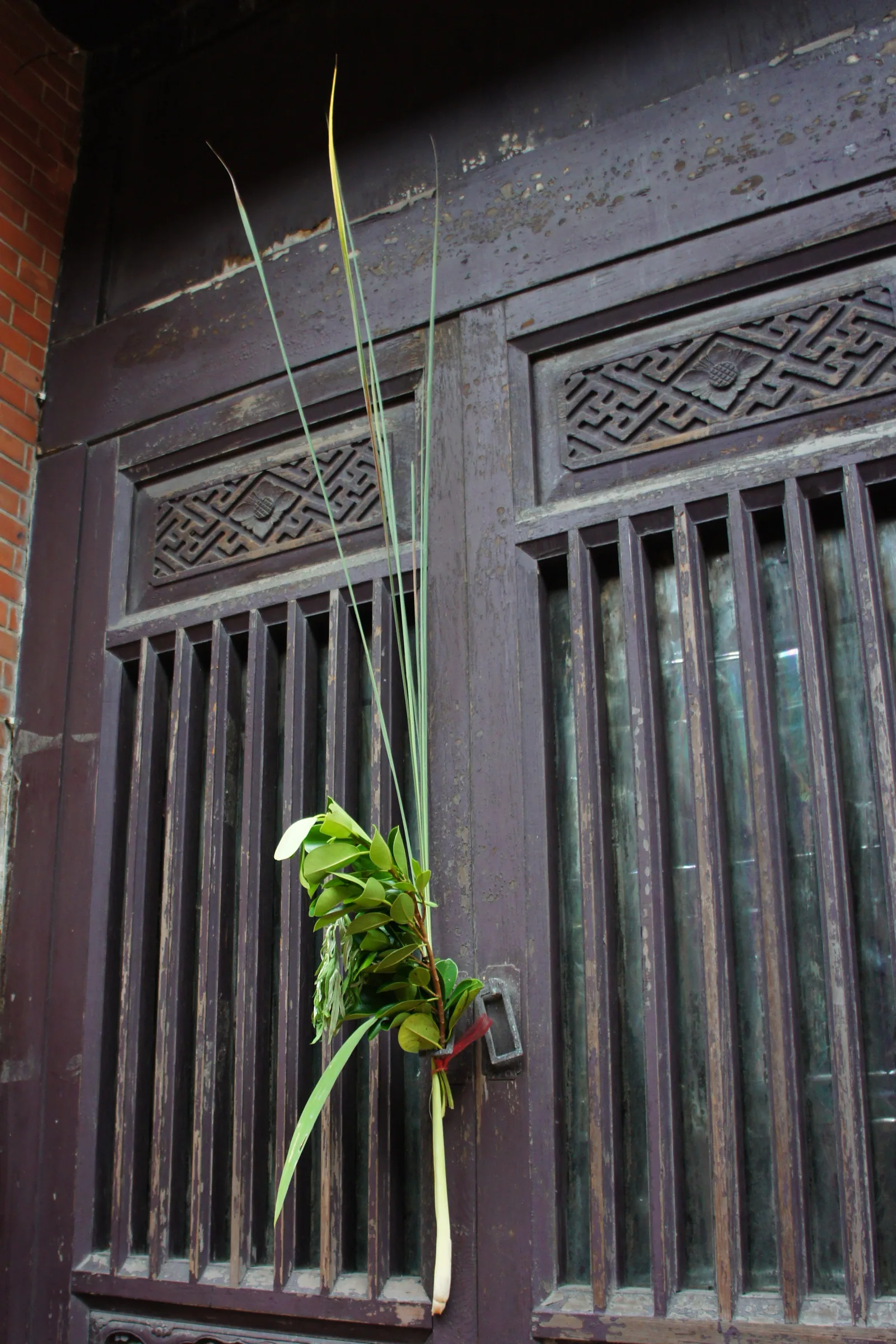
Plants hung at the door during Dragon Boat Festival to ward off evil. Ancient people used mugwort and calamus to repel insects and evil spirits; put plainly, this was a pre-scientific epidemic-prevention toolkit.
📝 Curator’s note: Spread these objects out and a fact hidden in folk custom emerges. The whole set of Dragon Boat Festival “rituals” was essentially a pre-scientific public-health measure. In an age without mosquito coils, disinfectant, or antibiotics, people could only use everything they had heard might work: burn what could be burned, hang what could be hung, drink what could be drunk. They were not necessarily effective scientifically, and some, like realgar wine, were harmful. But the anxiety of “I have to do something for my family” was real. Today we laugh at these customs as unscientific. Yet the act of hanging mugwort or making sachets is not so different from that of a mother two thousand years ago who feared her child might not survive the summer.
Standing Up an Egg
The exam question at the beginning asked students to refute the most theatrical Dragon Boat Festival custom: egg balancing. The folk explanation is mystical. Roughly speaking, noon on Dragon Boat Festival, from 11 a.m. to 1 p.m., is the moment of the year when “yang energy is strongest.” At this time, the sun’s gravitational pull and the earth’s gravity are evenly matched, so eggs are especially easy to stand upright, and a successful egg can bring good fortune for the whole year14.
The answer from physics is rather deflating. The “Science Vista” popular-science platform operated by the National Science and Technology Council explains it most directly: whether an egg can stand depends on the egg’s center of gravity and the friction of the contact surface. “As long as there are three contact points between the egg and the contact surface,” and one “finds a place with greater friction,” the egg can be made to stand15. As for the supposedly scientific “gravitational cancellation” claim, the platform is blunt: “Whether egg balancing succeeds has nothing to do with the gravitational pull between the sun and the earth,” so “eggs can be balanced at any time on all 365 days of the year; there is no need to choose Dragon Boat Festival”15. There are tricks to success, but they have nothing to do with yang energy: put the egg’s blunt end down, shake it to make the yolk sink and lower the center of gravity, or sprinkle a little salt on the table to increase friction, and the egg will stand16.
Source: Science Vista, National Science and Technology Council
Even after science punctures the myth, Taiwanese people still balance eggs with great enthusiasm. The largest attempt took place in Hsinchu. On Dragon Boat Festival in 2012, the Hsinchu City Government gathered 5,500 people to balance eggs at the same time. In the end, 4,247 eggs successfully stood upright, breaking a Guinness World Record and surpassing the 1,972 eggs recorded by Chiayi County in 200517. More than five thousand people squatted on the same open ground, wrestling with the centers of gravity of egg after egg. Of course they knew this had nothing to do with yang energy; that exam question would eventually teach the next generation. But more than four thousand eggs standing at once were never about a physics demonstration. They recorded the joy of a city finding a reason to do something silly together.
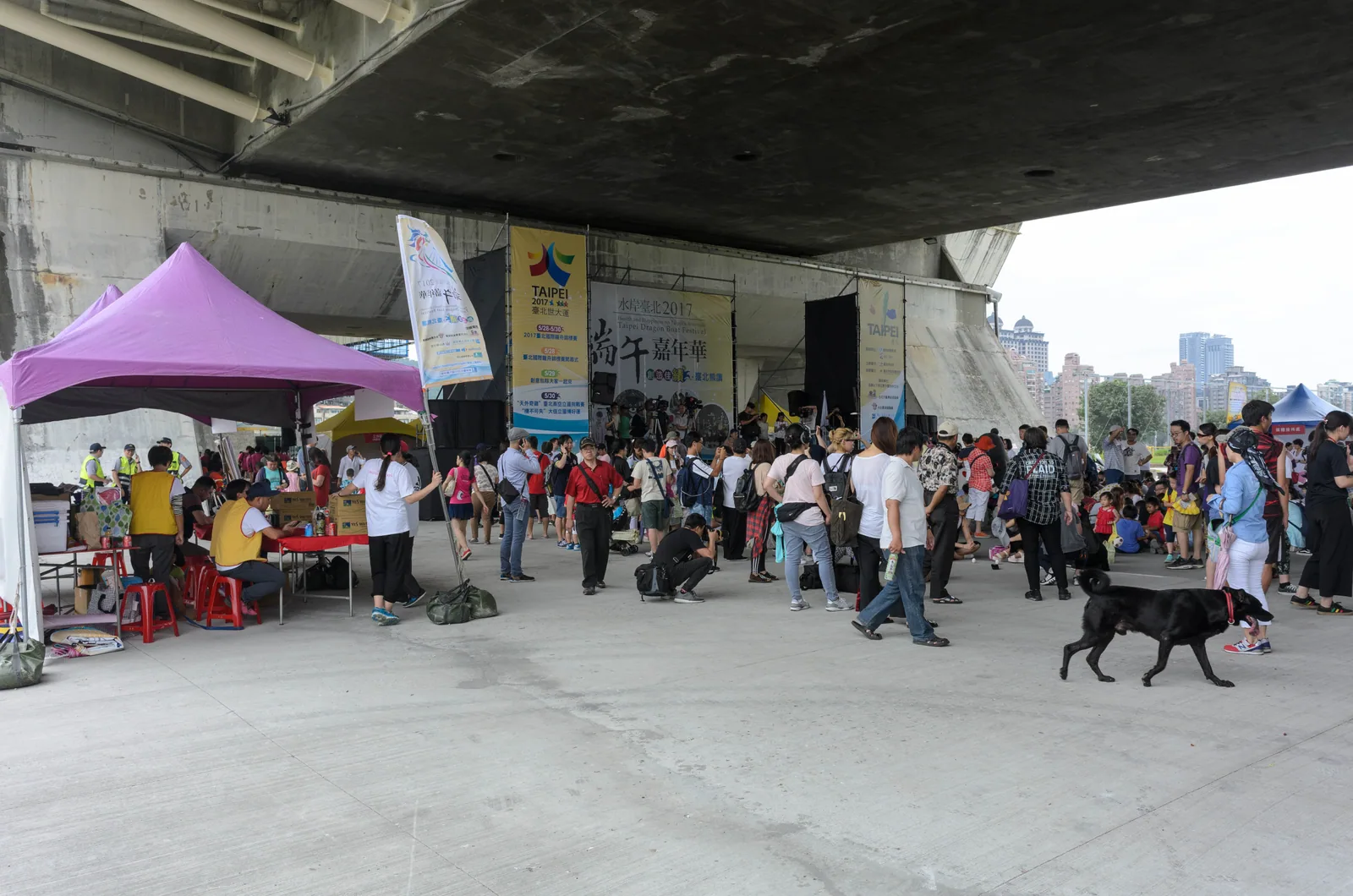
The egg-balancing site at the 2017 Taipei Dragon Boat Festival. Physically, eggs can stand on all 365 days of the year, but Taiwanese insist on squatting down together at noon on Dragon Boat Festival to try.
The Northern-Southern Zongzi War
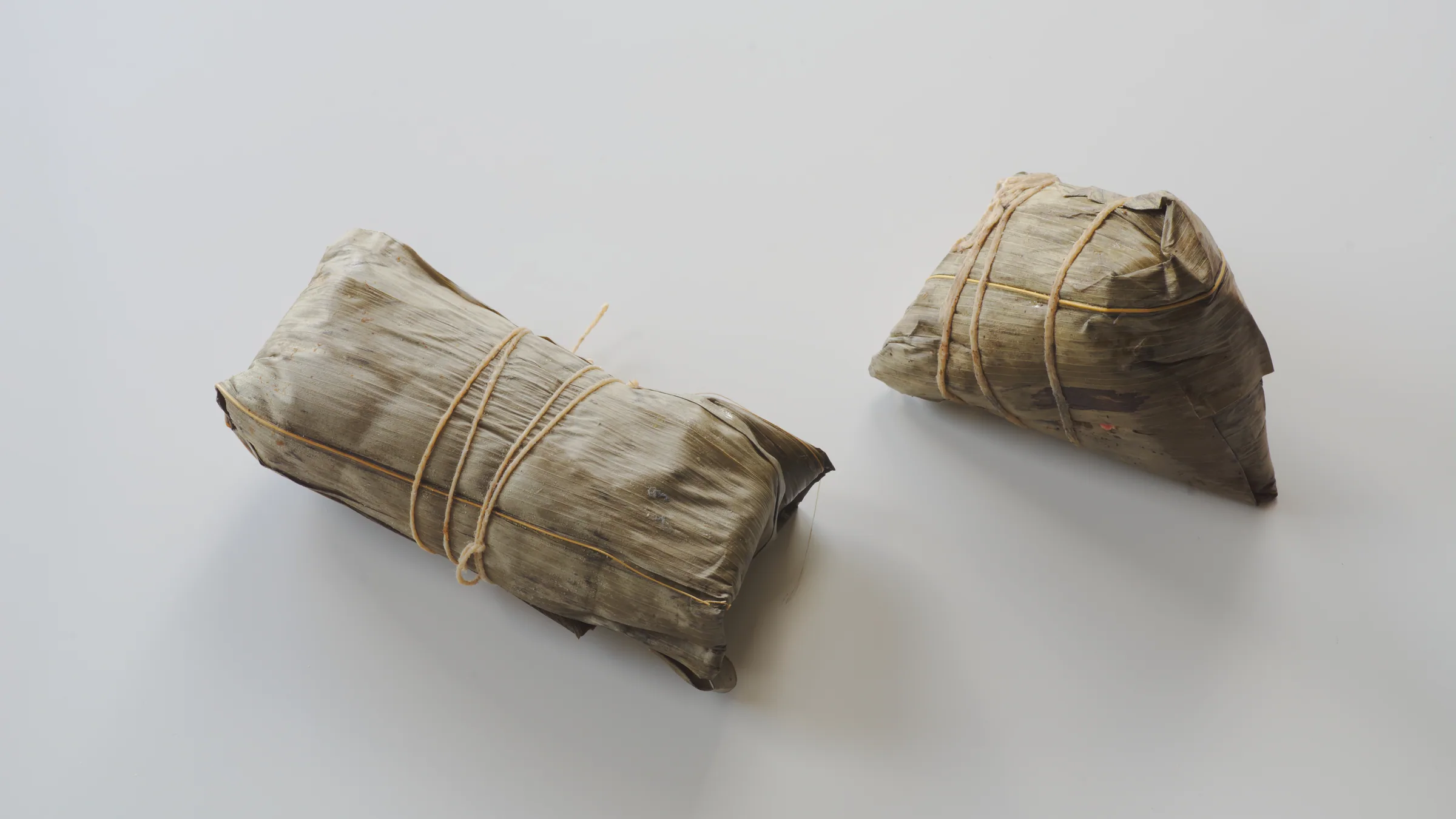
Every year around Dragon Boat Festival, Taiwanese social media reliably erupts into a “northern versus southern zongzi war.” The two camps in this war differ in two entirely different methods of preparation. For northern zongzi, glutinous rice is first stir-fried until cooked, mixed with the fillings, wrapped in leaves, and steamed. The texture has distinct grains and is close to youfan (savory sticky rice). The common claim that it uses “half-cooked glutinous rice” is actually wrong. Huang Wen-chun, known on PTT as the “Zongzi King,” once corrected it: “Northern zongzi does not use half-cooked glutinous rice. It uses cooked glutinous rice, with the fillings stir-fried... so after the fillings are wrapped, it is steamed a second time”18. There is another piece of trivia: the “bamboo leaf” used to wrap northern zongzi is, strictly speaking, the sheath of makino bamboo, the hard outer casing of the bamboo shoot. It is not really a leaf at all19.
Southern zongzi takes the opposite route. Raw glutinous rice is soaked in water, wrapped directly with the fillings in Dendrocalamus latiflorus bamboo leaves, and the whole thing is boiled in water. The result is moist, dense, and more fragrant with leaf aroma, often with peanuts added and sauce poured over it20. Both are called zongzi, but one is steamed and the other boiled; one is dry and distinct-grained, the other moist and sticky. No wonder the two sides argue endlessly.
Source: Global Views Monthly, PanSci, Ministry of Agriculture
Argue as people may, Taiwan’s zongzi map is not limited to northern and southern styles. Hakka ban zong takes another path: glutinous rice and ponlai rice are ground into slurry in set proportions, dehydrated, and kneaded into a rice-dough skin. The finished product is “springy and does not stick to the leaf,” with a texture closer to mochi21. Alkaline zongzi belongs to the dessert camp. The traditional method required burning plant ash, filtering out alkaline water, and mixing it with glutinous rice, an extremely laborious process. Wang Ching-chiu, a specialist in rice foods, recalled that making alkaline zongzi in the past “had to begin several months in advance,” but now “probably no one does it this way anymore”22. Plant ash has long been replaced by sodium carbonate and potassium carbonate, while toxic borax has been completely banned by health authorities23. Cooked alkaline zongzi is chilled, springy, and eaten with sugar or honey. There is also the “vegetable zongzi” spoken of in Tainan. Do not misunderstand: it refers to a vegetarian zongzi filled only with peanuts. In Tâi-gí, tshài means “vegetarian.” It is usually eaten for breakfast with a bowl of miso soup24.
📝 Curator’s note: The northern-southern zongzi war looks like an argument over food, but at its core it is a regional-identity game Taiwanese people have been playing for decades. It has the same structure as debates over whether tofu pudding should be savory or sweet, or whether bah-oan (Taiwanese meatballs) should be steamed or fried: the same food turns “where are you from?” into something people can jokingly fight over. But the most honest moment in this war comes when the data are laid out. A survey by the job-search site yes123 said 71.5% of white-collar workers preferred southern zongzi25. Yet 7-Eleven sales figures showed northern zongzi accounting for roughly 70% of sales25. Mouths support the south; wallets vote for the north. What Taiwanese identify with verbally and what they choose by hand are often two different things.
Incidentally, Indigenous peoples also have leaf-wrapped rice foods, such as cinavu among the Paiwan and Rukai and abay, which look like zongzi. But to be honest, these are not Dragon Boat Festival foods. As one Indigenous friend put it, “Indigenous friends did not have such a thing as zongzi in the past”26. They belong to another parallel universe of leaf-wrapped rice foods and should not be absorbed into the story of Dragon Boat Festival.
When it comes to giving zongzi as gifts, Taiwan has a cautiously transmitted taboo: do not give someone “a whole string” of zongzi, especially not to a household holding a funeral. Traditionally, the string of zongzi is cut apart into “loose zongzi” before being given. The reason is hidden in Tâi-gí: tying zongzi is called pa̍k-tsàng, and the act of tying can evoke hanging oneself. In coastal Changhua, there is even a ritual called “sending off meat zongzi” specifically meant to send away the malignant force of a death by hanging27. The sources for this taboo are relatively scattered. It is best treated as a footnote in folk psychology, without overstating it.
Only Taiwan Celebrates It This Way
After Dragon Boat Festival took root in Taiwan, it grew several things not found elsewhere. Start with a Tâi-gí proverb: “Before eating the zongzi of the fifth-day festival, one is reluctant to put away even a tattered winter coat.” It means that until one has eaten Dragon Boat Festival zongzi, one cannot bear to put away old winter clothing28. The saying positions Dragon Boat Festival as the switch inside Taiwanese bodies that officially turns on summer. Interestingly, someone used meteorological data from the Japanese colonial period (1894 to 1945) to test this old saying and found that Taiwan’s average minimum temperature does not steadily exceed 23 degrees Celsius until June. Putting away winter bedding after Dragon Boat Festival really does make some sense28.
One of the local rituals that best represents Dragon Boat Festival in Taiwan is “drawing noon water.” Noon water is water drawn between 11 a.m. and 1 p.m. on Dragon Boat Festival. Also called “pure yang water,” it is believed in folk tradition to remain unspoiled for a year and to ward off evil, dispel illness, and attract wealth29. The place where this belief is strongest is Sword Well on Tiezhen Mountain in Dajia, Taichung. Legend says that when Koxinga’s troops were surrounded on the mountain and desperately short of water, Koxinga drew his sword and thrust it into the ground, whereupon sweet spring water burst forth and relieved the army’s thirst30.
📝 Curator’s note: The legend of Sword Well is beautiful, but historians have poured cold water on it. Lin Heng-tao, a scholar of Taiwan history, verified the matter clearly: “During his time in Taiwan, Koxinga did not leave the vicinity of Tainan”30. After landing at Luermen in 1661, his activities remained around Tainan. In total, he spent less than a year in Taiwan and never went to Dajia. The well was originally called “Koxinga Well.” The more story-rich name “Sword Well” came only in 1953, when Yu Youren inscribed it30. In other words, at a place Koxinga never set foot, later generations grew a legend for him about thrusting a sword into the ground to make spring water rise. It still circulates today, attracting “nearly a thousand people to draw water” every Dragon Boat Festival, with 500 limited portions distributed31. Legend and historical fact diverge here, but the divergence itself is the most Taiwanese part: we know it may not be true, and still we are willing to make the trip every year.
Another Taiwan-only custom is Changhua’s Lukang Dragon King Festival. The wording should be careful: the official terms are “unique nationwide” and “unique to Taiwan,” not the vaguer “the only place in Taiwan that preserves ancient rites”32. The festival began in 1978, during the first National Folk Arts Activities, and had entered its 49th year by 202632. Its process is a complete set of ancient rites: first, the “Dragon King deity” is respectfully invited to depart from Lukang Longshan Temple; the procession then goes to Tianhou Temple to welcome the “Water Immortal King” to accompany it; finally, at the dragon boat race site on Fulu River, the “Dragon King rite and eye-dotting consecration” is held to dot the eyes of the dragon boats32. A river, a deity, and a consecration ritual that has continued for nearly half a century: this is a chapter Taiwan has written for Dragon Boat Festival that no one else has.
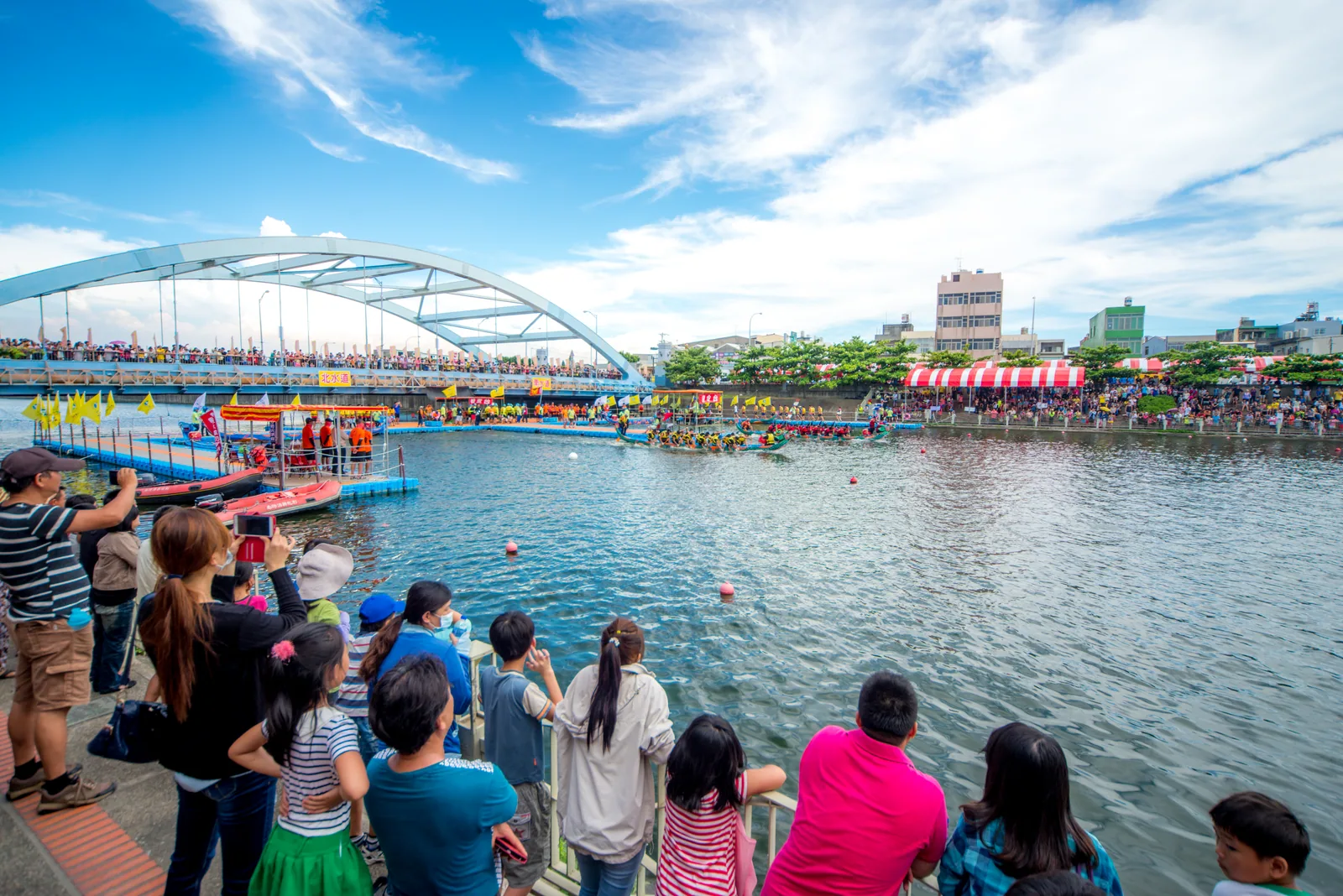
The 2015 Lukang Dragon Boat Festival race. The Taiwan-only Dragon King Festival has been held since 1978. Every year before the dragon boats enter the water, the dragon heads are consecrated by dotting their eyes.
From Searching for Qu Yuan to 8,000 People on Liyu Lake
Dragon boats are the liveliest scene of Dragon Boat Festival, and their background loops back neatly to the holiday’s original fear. One explanation says people rowed dragon boats to “borrow the dragon boat to scatter the fish in the river,” thereby preserving Qu Yuan’s body. But another, older explanation holds that “Dragon Boat Festival dragon-boat racing very likely originated in an annual spring ritual among the peoples of southern China to send away the plague god”33. Sending away the plague god returns us to the survival instinct against epidemics embedded in the “evil month.” A standard competitive dragon boat seats twenty paddlers, one drummer, and one steersperson33. With drums and gongs, an ancient plague-expulsion rite has been rowed into a modern competitive sport.
Today, Taiwan’s dragon boat races grow larger year by year. The race at Dajia Riverside Park in Taipei was “the largest in Taiwan” in 2025, gathering 221 teams34. Kaohsiung’s Love River had 192 teams and more than 4,000 people on the water in 202635. The Tainan Canal race in 2026 had 163 teams and over 4,000 participants, setting a new scale record36. Lukang’s Fulu River had 173 teams in 2026, with the international division alone drawing 17 teams across 20 countries32.
And in 2026, Taiwan’s dragon boat history will turn a new page. The 15th IDBF Club Crew World Championships (CCWC) will be held in Taiwan for the first time, at Liyu Lake in Hualien, from August 29 to September 6. Hualien County Government won the right to host by a vote of 24 to 19. This is “the first time Taiwan has obtained hosting rights for the highest-level dragon boat event,” and roughly 30 countries and 8,000 athletes are expected to gather at this alpine lake37. From a ritual more than two thousand years ago to search the river for Qu Yuan and drive away plague gods, to an international event of 8,000 people on Liyu Lake today, this dragon has rowed through the entire evolutionary history of Dragon Boat Festival.
Source: Records of the Grand Historian, Fengsu Tongyi, Xu Qi Xie Ji, Taiwan Prefecture Gazetteer, Changhua County Government, Hualien County Government
As for the “eco-friendly Dragon Boat Festival” often mentioned in recent years, it needs to be honestly toned down. Concrete plans circulating in the public sphere, such as biodegradable zongzi leaves or low-carbon dragon boats, cannot actually be matched to corresponding official policies in Taiwan38. The relatively concrete measure so far is only the Taipei City Department of Health’s promotion of “low-carbon vegetarian zongzi,” which concerns ingredients38. At the level of events, environmental protection remains mostly at the advocacy stage and has not really landed. It is better to describe the current situation accurately than to overstate it.
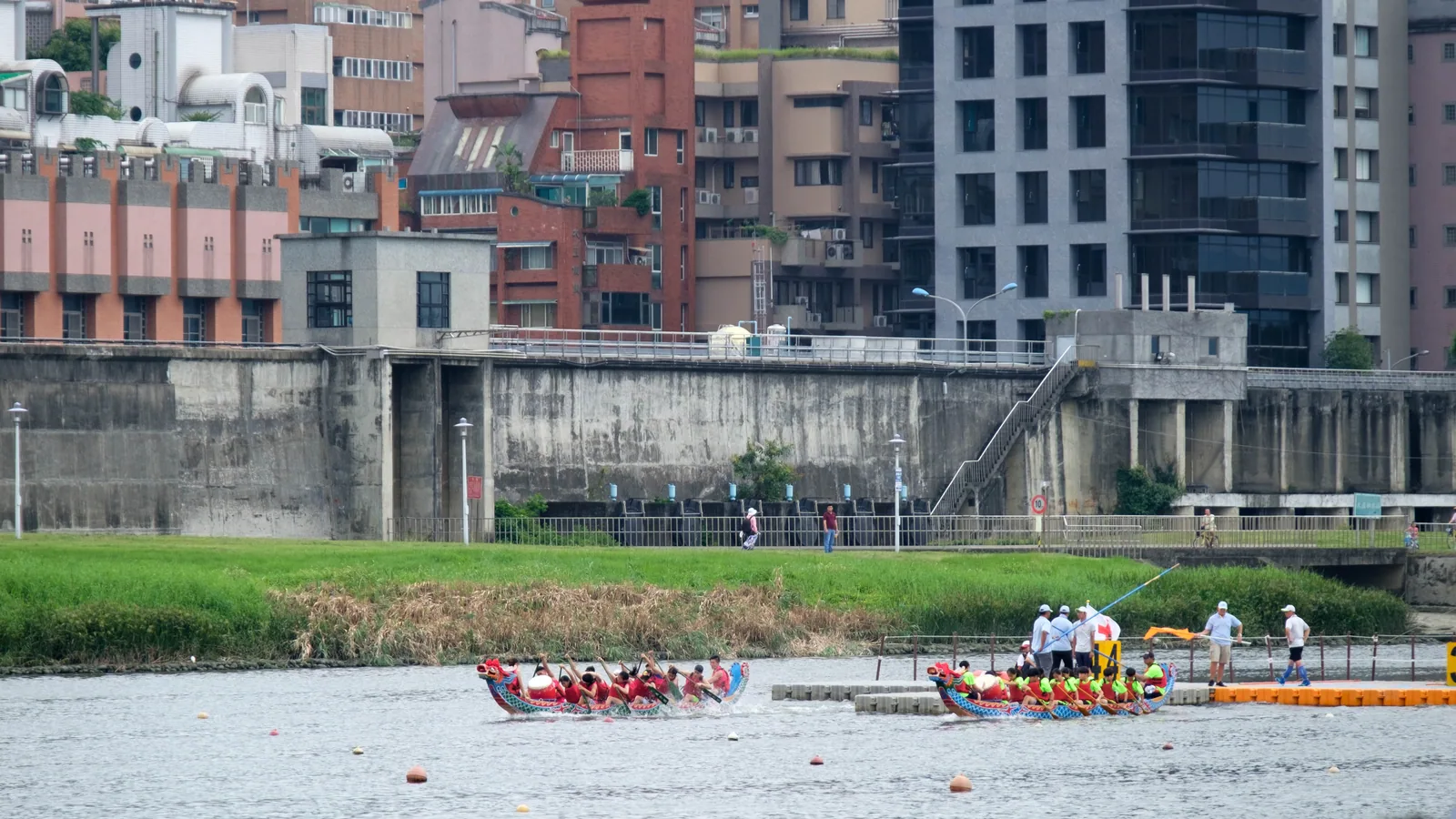
Dragon boat racing at Taipei’s Dajia Riverside Park in 2017. What began as a ritual to drive away plague and disease has been rowed into a water sport involving tens of thousands of people.
The Medicine Has Expired, But Reunion Remains
Return to that 2025 exam question. When tens of thousands of adolescents picked up their pens to design experiments proving that “Dragon Boat Festival egg balancing” could not stand up, they were in fact bearing witness to the whole holiday: mugwort cannot repel many mosquitoes, realgar wine turns into arsenic when heated, noon water is just ordinary water in a well-sealed container, and that upright egg can stand on any day of the year. Every medicinal effect that ancient people packed into this holiday has been verified, one by one, as expired.
Yet Taiwanese still take this expired medicine every year. Medicine has long since advanced beyond the need to rely on mugwort for epidemic prevention, and the National Science and Technology Council has plainly proven that egg balancing has nothing to do with yang energy. But every Dragon Boat Festival, some people still return to the kitchen to wrap zongzi with their grandmothers; nearly a thousand people still crowd to Sword Well in Dajia to compete for noon water; tens of thousands still line the riversides to watch dragon boats. That is because what remains of these customs was never the function they claimed on the surface. When the medicinal effect of epidemic prevention dissipated, what settled underneath was a reason for people to confirm each year: our family, this community, and this island are still together.
The egg that the exam paper asked students to overturn and the egg that more than four thousand people in Hsinchu stood upright at the same time are the same egg. Science is responsible for telling us why it can stand. Taiwanese people are responsible for remembering why we are still willing, year after year, to squat down and stand with it once.
Further Reading:
- National Holidays — How Dragon Boat Festival was elevated from an administrative order into a statutory holiday, another history Taiwanese wrote through “not having to go to work”
- Traditional Festivals and Celebrations — From epidemics to fireworks, how Taiwan’s festival culture evolved by accident along the way
- Taiwanese Snacks — Northern and southern zongzi are only the prologue; Taiwanese devotion to food has many more battlefields
- Koxinga — The protagonist of the Sword Well legend, a historical figure who left traces, and legends, all over Taiwan
Image Sources
- Dllu / Wikimedia Commons — CC BY-SA 4.0 (lead image: two styles of zongzi)
- Mk2010 / Wikimedia Commons — CC BY-SA 3.0 (plants at the door to ward off evil during Dragon Boat Festival)
- 玄史生 / Wikimedia Commons — CC0 (2017 Taipei Dragon Boat Festival egg-balancing event)
- 玄史生 / Wikimedia Commons — CC0 (2017 dragon boat racing at Taipei’s Dajia Riverside Park)
- Tony Tseng / Wikimedia Commons — CC BY 2.0 (2015 Lukang Dragon Boat Festival race)
References
- Central News Agency: CAP science exam tests Dragon Boat Festival egg-balancing myth; teachers praise life-oriented question design — A May 2025 Central News Agency report on a science question in the 2025 Comprehensive Assessment Program for Junior High School Students, interviewing teachers including Shen Wen-chun of Yongping High School in New Taipei and Wang Mei-ling of Wanhua Junior High School, and analyzing the question design that used a controlled experiment to refute the myth of “balancing an egg at Dragon Boat Festival.”↩23
- Wikipedia: Dragon Boat Festival — Summarizes the documentary context of Dragon Boat Festival’s origins, noting that Records of the Grand Historian: Biographies of Qu Yuan and Jia Yi does not record the date of Qu Yuan’s river death, and that the earliest binding of “the fifth day of the fifth month” to Qu Yuan appears in Wu Jun’s Xu Qi Xie Ji from the Liang dynasty of the Southern Dynasties, roughly six hundred years later than the Records of the Grand Historian; also includes the “evil month” taboo recorded in Records of the Grand Historian: Biography of Lord Mengchang, concerning Tian Wen’s birth on the fifth day of the fifth month.↩234
- Mingrentang: The truth of Dragon Boat Festival: an “invented” festival tradition — A United Daily News Mingrentang column that traces the multiple origins of Dragon Boat Festival from historical and folkloric perspectives, noting that in contemporary Taiwanese society, “the Qu Yuan origin story of Dragon Boat Festival that people can speak from within mostly comes from the postwar baptism of textbooks.”↩
- Epoch Times: Dragon Boat Festival and the taboos of the “evil month” — A media overview of the idea of the fifth month as the “evil month,” citing sources such as Dong Xun’s Wei-Jin Huanglan Yili and its phrase “the fifth month is commonly called the evil month.” A direct check against the Chinese Text Project shows that the “Monthly Ordinances” chapter of the Book of Rites contains no wording of “evil month”; the term is explicitly defined earliest in Ying Shao’s Eastern Han Fengsu Tongyi and in Wei-Jin texts.↩
- Wikipedia: Wu Zixu — Summarizes Wu Zixu’s connection to Dragon Boat Festival, citing Handan Chun’s Cao E Stele and its phrase “on the fifth day of the fifth month, people welcomed Lord Wu,” showing that the Wu-Yue region once had a tradition of welcoming and sacrificing to Wu Zixu at Dragon Boat Festival, another origin thread beyond the Qu Yuan theory.↩
- Chinese Text Project: Book of the Later Han, “Biographies of Exemplary Women,” Cao E — A primary source from Fan Ye’s Book of the Later Han, recording that the filial daughter Cao E’s father Cao Xu “could sing to string accompaniment and served as a ritual specialist,” and on “the fifth day of the fifth month in the second year of Han’an” drowned while welcoming the god Posuo, with his body never recovered; fourteen-year-old Cao E wept along the river for seventeen days and then threw herself into the river, revealing that water-deity rituals already existed on the fifth day of the fifth month.↩
- Li Woteng: The political motives behind Wen Yiduo’s “dragon totem theory” (Storm Media, republished by LINE TODAY) — A media commentary summarizing Wen Yiduo’s “ancient Wu-Yue peoples’ dragon totem sacrifice” argument in “A Study of Dragon Boat Festival,” and including scholar Li Woteng’s criticism that it had “a strong political utilitarianism... more passion than logic,” reminding readers that the theory carried the wartime motive of national salvation and should not be treated as a final conclusion.↩2
- College of Bioresources and Agriculture, National Taiwan University: Research focus on mugwort as mosquito repellent — Research from NTU’s Department of Entomology indicating that smoke produced by burning mugwort has “a certain knockdown effect” on Aedes aegypti, but that the effect is “weak and limited in range” and is not recommended as a primary mosquito-repellent tool, providing first-hand academic support for the conclusion that “mugwort works, but very weakly.”↩
- Wikipedia: Dragon Boat Festival in Taiwan — Records local features of Dragon Boat Festival warding objects in Taiwan, noting that “among the commonly seen warding objects in Taiwan, calamus is almost never used,” and that Taiwanese people often mistake the similarly shaped lemongrass for rare calamus and hang it up, a counterintuitive localization phenomenon.↩
- Ministry of Health and Welfare: Do not drink realgar wine during Dragon Boat Festival — Official health education material from the Ministry of Health and Welfare, explicitly stating that “realgar is a mineral containing sulfur and arsenic. After heating, it oxidizes into the highly toxic component arsenic trioxide (As2O3),” and directly recommending that people “not drink realgar wine during Dragon Boat Festival,” an authoritative primary source on the toxicity of realgar wine.↩
- PanSci: Can realgar wine neutralize snake venom? Be careful: drinking it may poison you instead — A popular-science platform explaining the chemical properties of realgar, noting that the arsenic trioxide produced after realgar oxidizes is “precisely the famous arsenic, the essential good medicine for murder and silencing witnesses,” using accessible language to explain the contrast that “the wine used to repel poison is itself poison.”↩
- National Religion Information Network, Ministry of the Interior: Long-life cords and five-colored silk — The Ministry of the Interior’s religious knowledge base cites Fengsu Tongyi: “On the fifth day of the fifth month, five-colored silk is tied to the arm and called the long-life cord... to ward off weapons and ghosts, and to prevent people from falling ill with plague,” and explains that the “five poisons” avoided during Dragon Boat Festival are snakes, scorpions, centipedes, geckos, and toads; an official source on religious and folk customs.↩2
- Agriharvest: How much do you know about Dragon Boat Festival customs? The “five auspicious things of midsummer” counteracting things with things, by Lin Yu-an — A Ministry of Agriculture-affiliated media article introducing the plant characteristics and folk functions of the Dragon Boat Festival “five auspicious things of midsummer” (calamus, mugwort, pomegranate flowers, garlic, and ixora), explaining how these objects formed an ancient household checklist for epidemic prevention and warding off evil.↩
- NOWnews: Why is egg balancing easiest at noon on Dragon Boat Festival? An explanation of the folk belief — A media summary of the folk belief surrounding Dragon Boat Festival egg balancing, recording the traditional claim that “at noon (11 a.m. to 1 p.m.), yang energy is strongest in the year, and the sun’s gravity equals the earth’s gravity, so eggs are especially easy to stand upright.”↩
- Science Vista, National Science and Technology Council: The science of egg balancing — The National Science and Technology Council’s official popular-science platform, explaining that successful egg balancing depends on center of gravity, contact points, and friction; that “as long as there are three contact points between the egg and the contact surface,” an egg can stand; and explicitly stating that “whether egg balancing succeeds has nothing to do with the gravitational pull between the sun and the earth” and that “eggs can be balanced at any time on all 365 days of the year.”↩2
- Uho: Tips for Dragon Boat Festival egg balancing — A health media article summarizing egg-balancing techniques, including placing the blunt end of the egg downward, shaking the egg so the yolk sinks to lower the center of gravity, and sprinkling salt on the table to increase friction, corresponding to the physical principles of center of gravity and friction.↩
- PTS News: Hsinchu City balances 4,247 eggs on Dragon Boat Festival, breaking Guinness World Record — A 2012 Public Television Service report stating that the Hsinchu City Government gathered 5,500 people to balance eggs simultaneously on Dragon Boat Festival, successfully standing 4,247 eggs, breaking a Guinness World Record and surpassing Chiayi County’s previous 2005 record of 1,972 eggs.↩
- Global Views Monthly: PTT’s Zongzi King on the truth about northern and southern zongzi — A Global Views Monthly interview with Huang Wen-chun, the well-known PTT user “Zongzi King,” correcting a common misstatement about northern zongzi: “Northern zongzi does not use half-cooked glutinous rice. It uses cooked glutinous rice, with the fillings stir-fried... so after the fillings are wrapped, it is steamed a second time.”↩
- PanSci: The leaves of northern zongzi are not actually leaves — A popular-science platform explaining the botany of zongzi wrappers, noting that the common northern zongzi wrapper is the “sheath” of makino bamboo, the hard outer casing of the bamboo shoot, rather than a bamboo leaf; southern zongzi uses leaves of Dendrocalamus latiflorus. This is a commonly overlooked and counterintuitive fact.↩
- Ministry of Agriculture Food and Agriculture Education Information Platform: Zongzi-wrapping plants and differences between northern and southern zongzi — Ministry of Agriculture food and agriculture education material explaining that southern zongzi is made by soaking raw glutinous rice, wrapping it with fillings in Dendrocalamus latiflorus leaves, and boiling the whole package; the green, soft leaves give southern zongzi a moist texture and stronger leaf aroma.↩
- Tainan City Government Hakka Affairs Commission: Hakka ban zong — An official introduction by Tainan’s Hakka Affairs Commission to the making of Hakka ban zong, which requires grinding glutinous rice and ponlai rice into slurry in proportion, dehydrating it, and kneading it into a rice-dough skin, producing a texture that is “springy and does not stick to the leaf” and resembles mochi.↩
- News & Market: The plant-ash method for traditional alkaline zongzi is disappearing — An independent agricultural media report on the traditional making of alkaline zongzi, interviewing rice-food specialist Wang Ching-chiu, who discusses the laborious process of filtering alkaline water from plant ash, which “had to begin several months in advance,” and sighs that “probably no one does it this way anymore.”↩
- Changhua County Public Health Bureau: Dragon Boat Festival food safety and borax inspections — Changhua County Public Health Bureau food-safety information explaining that commercial alkaline zongzi mostly use sodium carbonate and potassium carbonate to prepare alkaline water, while toxic borax has been completely banned as a food additive; inspections are strengthened before Dragon Boat Festival.↩
- Wikipedia: Dragon Boat Festival in Taiwan — Includes the definition of Tainan “vegetable zongzi,” explaining that the Tâi-gí word for “vegetable” means “vegetarian”; vegetable zongzi are vegetarian zongzi filled only with peanuts, commonly eaten by Tainan residents for breakfast with miso soup, a local specialty.↩
- Taipei Times: Northern vs southern zongzi debate heats up — A 2019 Taipei Times report on the northern-southern zongzi debate, citing a yes123 job-search site survey that found 71.5% of white-collar workers preferred southern zongzi, while 7-Eleven sales figures showed northern zongzi accounting for about 70% of sales, revealing the contradiction of “mouths saying southern, money buying northern.”↩2
- Mata Taiwan: Indigenous “zongzi,” cinavu and abay — Indigenous media introducing leaf-wrapped rice foods such as cinavu among the Paiwan and Rukai and abay, while noting that “Indigenous friends did not have such a thing as zongzi in the past,” reminding readers that these are not Dragon Boat Festival foods and should not be absorbed into the Dragon Boat Festival narrative.↩
- Lin Cheng-yi: “A Study of the Ritual of Sending Off Meat Zongzi to Avoid Malignant Forces,” Journal of National Formosa University — An academic paper studying the “sending off meat zongzi” ritual in coastal Changhua, which sends away the malignant force of death by hanging, analyzing it as a shamanic sacrificial rite for confronting anxiety about death and comparing it with similar rites among the Li people of Hainan Island; the Tâi-gí association between “tying zongzi” and hanging is the cultural root of the taboo on gifting zongzi.↩
- PanSci: A meteorological verification of “Before eating fifth-month zongzi, one is reluctant to put away a tattered winter coat” — A popular-science platform using meteorological data from the Japanese colonial period (1894–1945) to test the Tâi-gí proverb, finding that Taiwan’s average minimum temperature does not steadily exceed 23 degrees Celsius until June, so putting away winter bedding after Dragon Boat Festival has a climatic basis; the proverb is also included in the Ministry of Education’s Dictionary of Frequently-Used Taiwan Tâi-gí.↩2
- United Daily News: What is noon water? The folk belief of drawing water at Dragon Boat Festival — A media overview of the folk belief in noon water, or pure yang water, explaining that it is drawn between 11 a.m. and 1 p.m. on Dragon Boat Festival, and that folk tradition holds it can remain unspoiled for a year, ward off evil, dispel illness, and attract wealth; also introduces sites for drawing water such as Sword Well on Tiezhen Mountain in Dajia.↩
- Wikipedia: Sword Well — Summarizes the legend and historical facts of Sword Well on Tiezhen Mountain in Dajia, recording the folk legend that Koxinga thrust his sword into the ground and made spring water gush forth, while citing historian Lin Heng-tao’s verification that “during his time in Taiwan, Koxinga did not leave the vicinity of Tainan”; also explains that the well was originally called “Koxinga Well” and was renamed “Sword Well” only in 1953 after an inscription by Yu Youren.↩23
- Taichung Tourism: Dajia Sword Well noon-water drawing event — An event page from Taichung City Government’s tourism website introducing the Dragon Boat Festival folk event of drawing noon water at Dajia Sword Well, noting that “nearly a thousand people are attracted every year to draw water” and that 500 portions are distributed in limited quantities; an official primary source on the event.↩
- Changhua County Government: 2026 Lukang Dragon Boat Festival series: Dragon King Festival — Official Changhua County Government news explaining that the Lukang Dragon King Festival is a “Taiwan-only” and “unique nationwide” folk ritual, started in 1978 during the first National Folk Arts Activities and entering its 49th year in 2026; the process includes respectfully inviting the Dragon King deity from Longshan Temple, processing to Tianhou Temple to welcome the Water Immortal King, and holding the “Dragon King rite and eye-dotting consecration” at the Fulu River dragon boat race site. The 2026 competition had 173 teams, including 17 international-division teams across 20 countries.↩234
- Wikipedia: Dragon boat racing — Summarizes two origin theories for dragon boat racing: one that it commemorates Qu Yuan by “borrowing dragon boats to scatter the fish in the river,” and another that it “originated in an annual spring ritual among the peoples of southern China to send away the plague god”; also explains that the standard competitive dragon boat crew consists of 20 paddlers, one drummer, and one steersperson.↩2
- Taipei City Sports Department: 2025 Taipei International Dragon Boat Championships — Official event information from the Taipei City Sports Department, recording that the 2025 dragon boat race at Taipei’s Dajia Riverside Park was “the largest in Taiwan” and gathered 221 teams.↩
- Liberty Times: Kaohsiung Dragon Boat Festival race has 192 teams competing for NT$1.2 million in prize money — Reports on the 2026 Kaohsiung Love River Dragon Boat Festival Carnival and Dragon Boat Championships, with nearly 192 teams and more than 4,000 athletes registered, 32 more teams than the previous year and a new scale record, competing for NT$1.2 million in total prize money.↩
- Tainan City Government: Tainan Canal Dragon Boat Race — The official Tainan City Government dragon boat race website, recording that the 2026 Tainan Canal Dragon Boat Race had 163 teams and more than 4,000 participants, setting a new scale record, with total prize money of NT$1.8 million.↩
- Hualien County Government: 2026 IDBF Club Crew World Championships — Official Hualien County Government news explaining that the 15th IDBF Club Crew World Championships (CCWC) will be held in Taiwan for the first time, at Liyu Lake in Hualien, from August 29 to September 6, 2026. Hualien won the hosting rights by a vote of 24 to 19; this is “the first time Taiwan has obtained hosting rights for the highest-level dragon boat event,” with roughly 30 countries and 8,000 participants expected.↩
- Taipei City Department of Health: Eating the right zongzi can also love the earth: Dragon Boat Festival “low-carbon vegetarian food” — A Taipei City Department of Health press release in which a nutritionist demonstrates “low-carbon vegetarian zongzi,” replacing fatty pork with plant-based ingredients such as edamame and replacing lard with peanut sesame oil. Searches of Taiwanese official sources found no concrete event-level environmental policies such as biodegradable zongzi leaves or low-carbon dragon boats; the current situation remains mostly at the level of diet and advocacy.↩2