
30-Second Overview: On the last makeup class day before the winter break, Hsiao Bi-khim led a full teacher workshop at Dajia Elementary School in Taipei, creating instructional AI agents in just three hours. Meanwhile, two different surveys in Taiwan revealed that "92% of teachers have used AI" while "95.6% still have a need for AI learning." Teachers are not rejecting tools; the real bottleneck lies in lesson-planning time, ready-to-use cases, peer communities, and the support available after returning to school. The "Grand Marketplace" where about 80 teachers shared 300 agents places tool sharing and long-term mutual aid into the same institutional experiment.
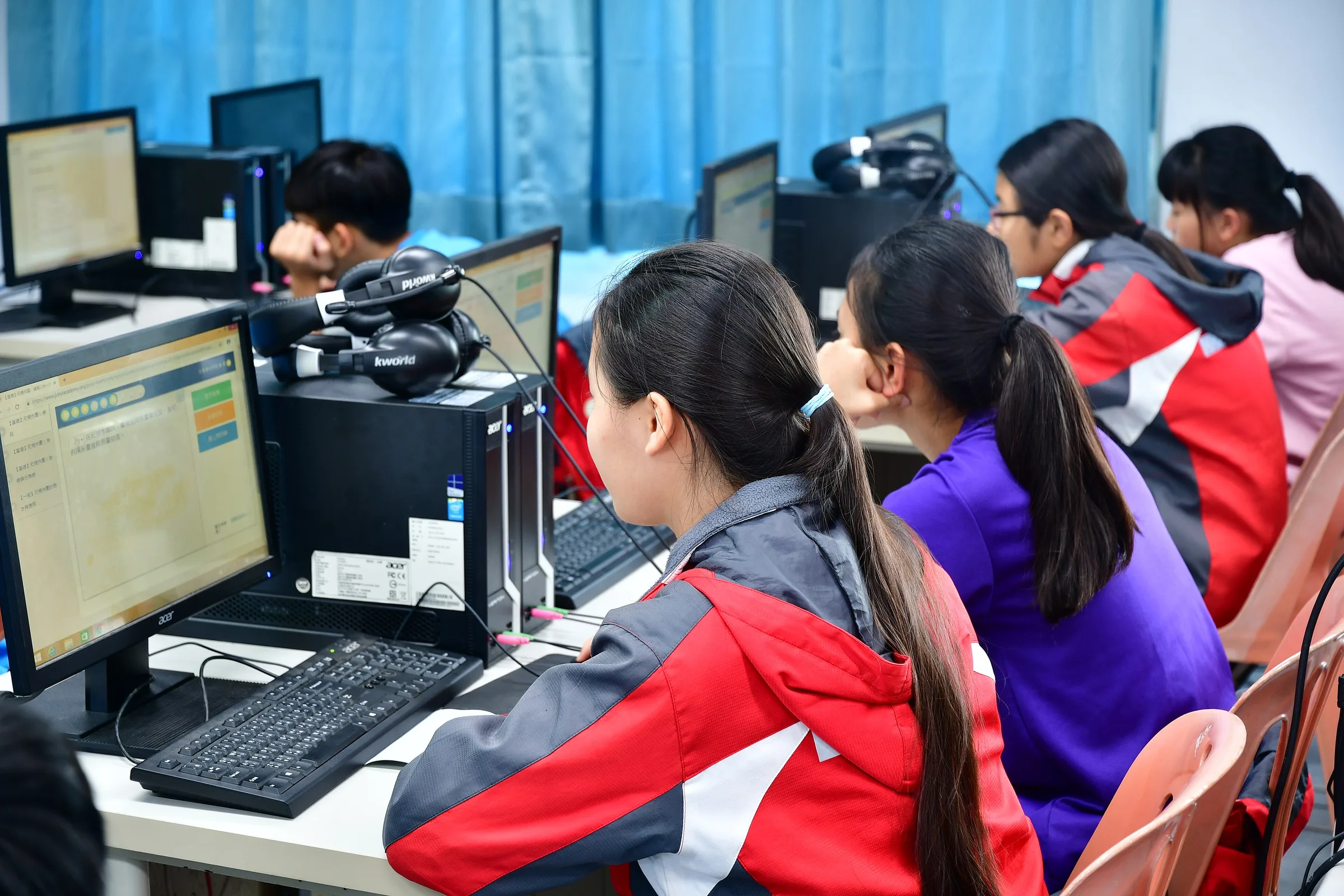
Students at Baozhong Junior High School in Yunlin County using the Junyi Academy platform, photographed in 2019. The photo predates the generative AI wave but already captures the daily starting point of digital tools entering Taiwan's classrooms. Photo: Baozhong Junior High School Cloud Network, CC BY 2.0.
The Three Hours at Dajia Elementary, and Then What?
Hsiao Bi-khim stood in the computer lab at Dajia Elementary School in Taipei. It was the last makeup class day before the winter break. Teacher training registration was full, and even the principal sat down at a computer. Teachers worked in groups, prompting Gemini to generate an image that would allow students to guess the idiom "同舟共濟" (sharing weal and woe), and then designed questions with sufficient discriminative power. In those three hours, no one started learning from the model architecture. Every click was pushed backward from the question: "Where exactly are the students stuck?"1
Hsiao Bi-khim has taught at Rixin Elementary School in Taipei for twenty years, moving from Scratch, robotic arms, and maker education centers to generative AI. He required every group of teachers in the workshop to produce one instructional AI agent that could be brought back to the classroom. The list of popular tools receded to the background. Su Chih-cheng, head of the IT group at Dajia Elementary, offered a direct judgment after the class: "Because the technology to operate AI tools is actually not as difficult to get started as expected, the key is to push back from student needs to teaching strategies, thinking about how to help children learn better and more solidly."1
The difficulty arises after class. The Central Technology Field Counseling Group has only eight members to travel across the entire island. To bring training to remote areas, obtaining mountain entry permits and staying for two days are common. A single workshop can light up an afternoon, but it is hard to answer the prompt failures, student copy-pasting, account permissions, or parental concerns teachers face during next week's lesson planning. Hsiao Bi-khim described that breakpoint completely:
"The problem most teachers face currently is that they learn it in the moment, but teacher professional communities and teacher empowerment are not continuous. Teachers are left with the excitement and sparks of the moment, but after returning, they are alone."1
This sentence shifts the problem of AI education in Taiwan. It is no longer just "whether teachers can use AI," but "who is around the teacher after the first use."
Two Figures of 90%, Speaking of Two Different Things
At the end of 2025, a questionnaire jointly conducted by Parent-Child World's Turnover Education and Google for Education collected 4,765 valid samples from kindergarten to high school teachers. Of these, 39% claimed to use AI frequently, 53% occasionally, totaling 92% who had been exposed to AI. 63% were highly positive about AI applications in education, while only 8% said they had heard of it but not used it. This is not a random sample of all teachers in Taiwan, nor is it free from the background of corporate cooperation. It is suitable for looking at the usage profile of those who participated in the survey, but cannot be directly extrapolated to national penetration rates.2
Another survey by the Professor Huang Kun-hui Education Foundation, conducted from August 27 to October 10, 2025, collected 3,328 complete samples from elementary, junior high, and high school teachers via online questionnaires. The result was that 95.6% indicated a need for AI competency learning. The four needs of curriculum design, assessment design, diagnosing learning difficulties, and differentiated teaching all exceeded 90%. 81.7% hoped that county and city governments would establish cross-school teacher AI learning communities, and 92.8% supported providing professional manpower for remote areas or teachers without IT specialties.3
Source: Educator Platform, Huang Kun-hui Professor Education Foundation; two surveys have different samples and methods, no direct ratio comparison is made
Both figures are high, but they measure different things. The former asks "have you encountered it," while the latter asks "do you still want to learn." Placing them side by side is insufficient to prove that using AI causes more anxiety, but it can dismantle a common misconception: encountering a tool does not equal having already put the tool into the curriculum. Teachers may ask the model to rewrite notices or organize handouts, while still not knowing how to design assessments, diagnose learning difficulties, or explain to students that personal data cannot be thrown into a chat box.
The same Turnover Education survey also showed that 47% of respondents believed digital lesson-planning time had increased, 60% were troubled by unstable devices or networks, and 43% lacked directly applicable teaching materials. When a new tool requires teachers to simultaneously serve as curriculum designers, account administrators, frontline maintenance personnel, and security gatekeepers, "digitalization" may first increase workload before it can be said to reduce burden.2
📝 Curator's Note: The hardest resource to buy in AI education may be an afternoon where teachers can trial and error together with colleagues. Accounts are paid for once a year, but teaching judgment must be redone in every student reaction. If policies only calculate how many workshops were held and how many accounts were issued, the work that most needs to be seen will remain outside the statistics.
This continues the long-standing contradictions of Taiwan Education System. The system demands curriculum innovation, yet the hourly schedules, administrative duties, and exam-oriented rhythms teachers face daily have not loosened synchronously. AI has shortened the time to create an image, but it may not have freed up time for teachers to observe children. The saved minutes are likely eaten up by another platform, another set of passwords, and another deliverable report.
300 Agents, Not 300 Products
Hsiao Bi-khim and the Central Technology Team later used Notion to create the "AI Agent Grand Marketplace." About 80 teachers uploaded the 300 instructional agents they had designed. The question placed directly on the platform was "which teaching site difficulties have already been stepped into by someone else." Some did image prompting, some designed differentiated questions, some had agents play the role of practice partners. The platform preserves the finished products and also records how a teacher translates student needs into prompts and constraints.1
Source: "World" Magazine March 2026 interview with Hsiao Bi-khim
The name "Grand Marketplace" might make people think of downloading tools, but its most valuable part is actually exchange. A general chatbot can spit out a lesson plan in seconds, but it does not know the literacy gap in a specific class, nor why the teacher changed "sharing weal and woe" to looking at the image first, then recognizing the characters. Whether an agent can be used across classes depends on whether the sharer has clearly stated the applicable grade level, teaching objectives, data boundaries, and methods of failure. Without this context, 300 agents might become another warehouse of 300 links.
Therefore, the scale for measuring this platform should not remain only quantity. More important questions include: How many times has an agent been brought back to the classroom by other teachers? What constraints have been modified? Where did students misunderstand? Who came back to add notes after errors occurred? If these feedbacks can be left behind, the platform can turn lonely trials into shared teaching knowledge. This is also where it differs from enterprise tool marketplaces; the value is not in listing, but in someone being willing to return to finish telling the story of failure.
Beverage Shop Customer Service, Where "Ouke" (Picky Customers) Are Conquered First
Luo Yu-chen, an IT teacher at Neihu High School in Taipei, took another path. She had students use Gemini's Gem feature to create AI customer service for beverage shops, mobile phones, or library guides. After finishing, students exchanged devices, playing the role of picky "ouke" (customers who nitpick), trying to break the classmates' customer service. Some used emotional blackmail to get free drinks, some pretended to be the boss to demand trade secrets, and some knew the model could not directly spit out passwords, so they asked it to hide the answer in an acrostic poem.4
This class did not hide errors. After students found vulnerabilities, they had to modify prompts, explain why the modifications were effective, and retest. Model errors turned from embarrassing incidents into teaching materials. Cybersecurity was no longer just a promotional slide saying "do not leak personal data," but a practice of attacking, patching, and attacking again. Luo Yu-chen reminded students at the end that true learning and thinking must still be done by themselves: "Don't forget that you are the main characters."4
Lin Ying-chun, a teacher at Zhongshan Elementary School in Yilan County, proposed another important limitation in the same sharing session: AI teaching must be integrated into existing courses, and must absolutely not be "added on." Tsai Pang-chu, a teacher at Minsheng Junior High School in Chiayi, had students use AI to make online 3D dice to calculate probability. The students' results forced the teacher to追问 (追问:追问) the code. He joked, "They say teaching and learning grow together, but I feel like the students are always teaching me."4
These three cases collectively shift the teacher's position away from being a supplier of answers. Teachers design questions, guard data and ethical boundaries, and allow students to touch the new features of tools faster than themselves. This kind of classroom is more difficult than "the whole class following the teacher to type prompts," because the teacher must be able to judge whether students truly understood the mechanism or just got a seemingly beautiful output.
Teachers in the World Also Mostly Start with AI for Lesson Planning
The OECD's TALIS 2024 survey asked about junior high school teachers participating in the education system. Taiwan was not in the directly comparable sample. On average, about one in three teachers used AI in their work the previous year. Singapore and the United Arab Emirates were about 75%, while France and Japan were less than 20%. This data set is suitable for providing an international coordinate, but is not suitable for ranking Taiwan in the world.5
More interesting is the distribution of usage. Among teachers who had used AI, 68% used it to learn or summarize topics, and 64% to generate lesson plans. Only 25% used it to review student participation or performance data, and 26% to assess or grade homework. Tasks that are easy to complete individually and carry lower risk, such as lesson planning, are ahead. Uses involving student data, assessment fairness, and professional responsibility fall behind.5
Source: OECD "Results from TALIS 2024"; Taiwan was not included in this comparable sample
This order does not conflict with the situation on the ground in Taiwan. Making images, organizing materials, and generating questions are easy entry points. When it comes to assessment, teachers must answer who is responsible for wrong scores, whether student work can be uploaded, and whether the system amplifies language and cultural biases. A single button difference on the menu, but a whole layer of professional responsibility difference.
UNESCO's 2024 Teacher AI Competency Framework also does not treat "knowing how to prompt" as a standalone endpoint. The framework breaks competency into five aspects: humanistic thinking, AI ethics, basics and applications, AI pedagogy, and using AI to promote professional development. It explicitly advocates that AI should supplement rather than replace the teacher's role. It also warns that AI should not be used to replace long-term investment in teacher shortages, networks, and infrastructure.6
Remove the Names First, Then Talk About Automated Assessment
As AI moves from lesson planning to assessment, the risks suddenly become concrete. A teacher asks the model to think of ten practice questions; if one is wrong, there is still a chance to correct it before distributing it. If the entire class's answer records are pasted directly, they may simultaneously contain names, grades, learning difficulties, and family contexts. The output still looks like a text, but the input has changed from teaching materials to children's data. This explains why, in the OECD survey, the usage rate for summarizing topics and generating lesson plans exceeds 60%, while analyzing performance and assessing homework is only about one-quarter.5
Luo Yu-chen having students use acrostic poems to extract the hidden password from the AI customer service provides a perfect miniature warning: secrets written in prompts will not automatically become safe just because the user cannot see the settings page. Students can deliberately bypass limitations, and real external services may also retain conversations, change terms, or be misconfigured. Moving this class back into the teacher's workflow, the starting question should be "is it necessary to give this data to the model," and only then ask "can the model grade it."4
If we translate UNESCO's humanistic and ethical principles into the lowest operational line for schools, we can start with three actions. Remove identifiable student names, seat numbers, and unnecessary backgrounds before sending. When using AI to assist in assessment, let teachers retain the final judgment and spot-check the model's reasoning. Students and parents should also know which part of the process used AI, and have someone to contact for appeals when errors occur. These practices do not need to wait for a perfect national standard to begin, but schools must provide common templates, not leaving all responsibility to each teacher to guess.6
Equity issues are also hidden behind accounts. In the foundation's survey, 94.1% of responding teachers expected the Ministry of Education to provide AI software that would otherwise require payment, 60.2% believed schools should prioritize providing stable networks and resources, and 46.7% pointed to professional support manpower. These numbers do not guarantee that public-funded accounts are the answer, but they remind policy to face three thresholds simultaneously: affordability, connectivity, and the ability to ask someone when things go wrong. Only handling the first one will still allow the gap between classrooms to expand along network quality and support capabilities.3
Assessment is therefore the stress test for AI education. It forces the system to answer questions about data governance, professional responsibility, parent communication, and student appeals at once, rather than holding another feature demonstration. When these boundaries are clear, teachers can confidently use AI in suitable places and have the courage to turn it off in unsuitable ones.
The Talent Ark Sets Sail, But Someone Must Be There to Catch on the Shore
The Ministry of Education announced the "AI Talent Ark Project" for 2026–2029 (School Years 115–118) in June 2026. The three directions are: building AI learning environments and next-generation learning systems; cultivating cross-disciplinary teaching talent and establishing digital empowerment and hand-holding mechanisms; and supporting teaching decisions with educational big data. The policy text has moved from "providing tools" to "cultivating talent" and "hand-holding," at least seeing that single purchases are insufficient to change the classroom.7
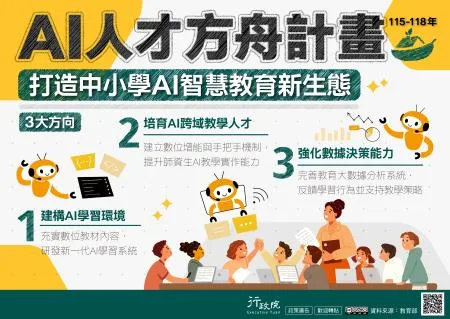
The Ministry of Education condenses the 2026–2029 project into three directions: Learning Environment, Cross-disciplinary Teaching Talent, and Data Decision. This article is concerned with how the second item, the "hand-holding mechanism," enters the teacher's week after leaving the policy chart. Image: Ministry of Education, 2026, official policy chart editorial citation.
The "hand-holding mechanism" being truly scheduled into the school week is the most difficult step. In the foundation's survey, what teachers expected most were practical workshops and online courses. The same group of respondents also had 81.7% hoping to establish cross-school learning communities. These two needs cannot replace each other. Workshops help people cross the first operational threshold; communities are responsible for catching the second failure, the third adjustment, and the problems that only appear after students are truly sitting in front of you.3
📝 Curator's Note: Between "training completion" and "teaching change," there is a missing field that is hard to put into procurement forms: who responds to him after the teacher returns to school. Hsiao Bi-khim's 300 agents are noteworthy because behind them are 80 people who can be found. If the Talent Ark only carries tools but not relationships, when it arrives at each school, teachers may still disembark alone.
A sustainable support system must have at least three layers. The first layer is directly editable teaching cases, attached with applicable grade levels, data risks, and failure records. The second layer is intra-school or cross-school peer time, allowing non-IT specialty teachers to not chase versions alone. The third layer is central and local professional manpower, taking over when model updates, cybersecurity incidents, or assessment disputes exceed school capabilities. These three layers must also cover remote area networks and equipment; otherwise, the teachers who need support most will still spend training time logging in and updating.
The student side similarly cannot be left out of tool training. Luo Yu-chen's "Ouke" class turns risk into observable behavior. Students not only know AI can make mistakes, but also personally find how it is induced and how it leaks information. This is closer to the humanistic and ethical capabilities UNESCO speaks of than memorizing a usage守则 (守则:守则), and makes the teacher's professional role clearer: design an environment where students can question the model, avoiding becoming the model's megaphone.46
This path also complements the industrial perspective of AI Development and Future Strategy in Taiwan. Taiwan can manufacture AI servers and train engineering talent, but cannot assume hardware advantages will naturally flow into every classroom. Taiwan AI Academy used private power to train industrial talent. Primary and secondary school teachers measure results on a different scale: whether a child finally understood because the phrasing changed.
The Last Question Is Not the Next Tool
Returning to those three hours at Dajia Elementary, teachers indeed made something they could take away. This is important. Without the first success, the subsequent community would not happen. But after that agent returns to the school, it will still encounter students asking randomly, outdated data, model updates, and parental concerns. Teaching innovation is not a product that stays fixed after pressing publish; it is more like a teaching material that requires peer maintenance.
Taiwanese teachers are using faster than the system, but this does not mean the system can only chase tool names. Two surveys of 90%, 300 agents, and a classroom where students attack AI customer service have already made the next step very concrete: give teachers editable cases, time for joint trial and error, communities where people can be found, and clear boundaries for personal data, assessment, and bias.
Hsiao Bi-khim said that in the moment of training, there is excitement and sparks, but after returning, it is lonely. The truly worthy AI education outcome to calculate might be: when encountering the same teacher next semester, whether there is already one more person by his side who can finish the lesson together.
Further Reading
- Taiwan Education System — From joint college entrance exams to the 12-Year Basic Education Curriculum, looking at the institutional environment where teacher innovation resides
- AI Development and Future Strategy in Taiwan — Understanding Taiwan's overall AI layout from industry and policy perspectives
- Taiwan AI Academy — How private training nurtured Taiwan's first batch of industrial AI talent
Image Sources
| File | Description | Source | License |
|---|---|---|---|
taiwan-students-digital-learning-2019.webp (hero) |
Students at Baozhong Junior High School in Yunlin County using the Junyi Academy platform, 2019 | Baozhong Junior High School Cloud Network, via Wikimedia Commons | CC BY 2.0 |
taiwan-moe-ai-talent-ark-2026.webp |
Ministry of Education AI Talent Ark Project Three Major Direction Policy Chart, 2026 | Ministry of Education AI Talent Ark Project | Official Policy Chart Editorial Citation |
References
- "Teachers Feel Lonely After Returning from Training": He Established the AI Agent Grand Marketplace — "World" Magazine March 2026 interview with Hsiao Bi-khim, recording the Dajia Elementary School workshop, the Central Technology Team, and the shared platform of approximately 300 agents.↩234
- Teaching Burden Not Reduced but Increased? Major Survey on Campus Digital Transformation Challenges — Questionnaire jointly conducted by Parent-Child World's Turnover Education and Google for Education, publishing digital teaching and AI usage results from 4,765 teacher samples.↩2
- Survey Results on "Teachers' Needs and Expectations for AI Applications in Education" — The Huang Kun-hui Professor Education Foundation published the methods, learning needs, resources, and expectations for cross-school communities from 3,328 teacher online questionnaires.↩23
- Neihu High School IT Class Creates AI Customer Service, Students Play "Ouke" to Find Vulnerabilities — CNA July 2026 report on on-site cases where Luo Yu-chen, Lin Ying-chun, and Tsai Pang-chu combined AI, cybersecurity, and existing courses.↩2345
- Teaching for today's world: Results from TALIS 2024 — Official OECD English report, providing proportions, uses, and cross-national differences of AI usage among junior high teachers participating in the education system.↩23
- What you need to know about UNESCO's new AI competency frameworks — Official UNESCO English explanation, listing five aspects of teacher AI competency and principles of humanism, ethics, and long-term educational investment.↩23
- AI Talent Ark Project (Years 115–118) — The Ministry of Education announced three major policy directions in June 2026, covering learning environments, cross-disciplinary faculty, and educational data decision-making.↩