
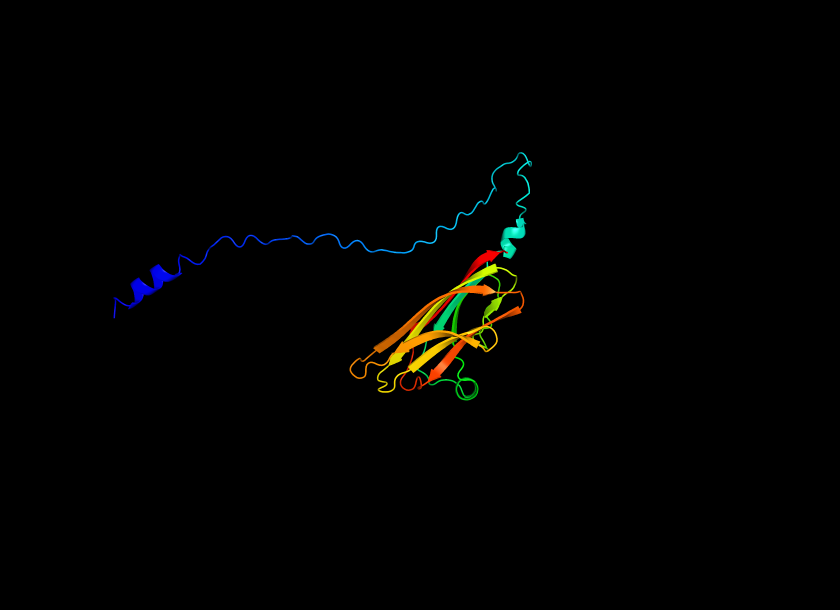
30-second overview: On October 8, 2024, the Nobel Prize in Physics went to the physicist who created the Hopfield Network and the cognitive scientist who developed backpropagation1. The next day, October 9, the Nobel Prize in Chemistry went to three researchers who used AI to solve the 50-year protein-folding problem2. On May 29 of the same year, NVIDIA CEO Jensen Huang appeared at Taipei’s Ningxia Night Market with Morris Chang, Barry Lam, and Rick Tsai to eat oyster omelets. TSMC captured 72% of global foundry revenue, while Foxconn, Quanta, and Wistron together produced 90% of the world’s AI servers. But in this two-day scientific ceremony that retrospectively conferred legitimacy on 42 years of neural-network history, not a single name came from Taiwan. From Taiwan AI Labs, founded by PTT founder Ethan Tu, to TAIDE, the government-backed traditional Chinese large language model, a wager is underway: moving from “manufacturing AI” to “becoming AI.”
42 Years of Recognition: 2024 Nobels Awarded on Back-to-Back Days
On the morning of October 8, 2024, in Stockholm. The Royal Swedish Academy of Sciences announced that the year's Nobel Prize in Physics would be awarded to two AI scientists: 91-year-old Princeton emeritus professor John J. Hopfield, and 76-year-old Geoffrey Hinton, who had left Google just five months prior. The prize money of 11 million Swedish kronor would be split equally between the two1.
The selection committee's stated reason was "for foundational discoveries and inventions that enable machine learning with artificial neural networks"1. This was the first time in the history of the Nobel Prize in Physics that the award was placed squarely in the field of neural networks.
The next day, October 9, came the Chemistry Prize. Three laureates: David Baker of the University of Washington, plus two from DeepMind, Demis Hassabis and John Jumper. Baker received half the prize money; Hassabis and Jumper shared the other half2. The citation was split in two: the first half for Baker's "computational protein design," the second for Hassabis and Jumper's "protein structure prediction."
Two days, two Nobels, both connected to AI. There was no precedent for this in Nobel Prize history.
Look at the timeline: when Hopfield published the paper "Neural networks and physical systems with emergent collective computational abilities" in the Proceedings of the National Academy of Sciences (PNAS) in 1982, he had just moved from condensed matter physics into neuroscience3. From 1982 to 2024 — a full 42 years. The 1986 paper by Hinton and Rumelhart that turned the backpropagation algorithm into a usable tool4 also took 38 years from publication to prize. AlphaFold, from its debut at CASP13 in 2018 to winning the Nobel in 2024, took only 6 years.
The point is, these two days of Nobels weren't awarded to ChatGPT, but to those few papers from three or four decades ago that no one could understand at the time. The time lag between basic research and industrial application has always been this way.
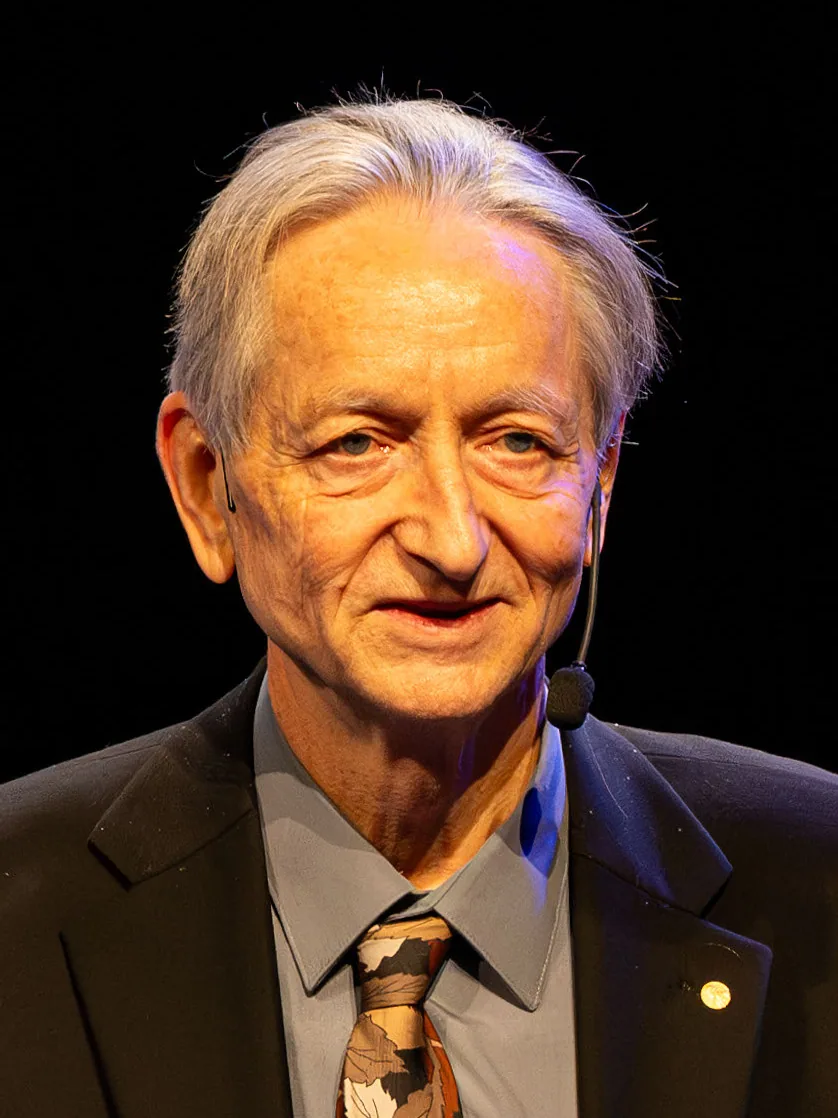
Geoffrey Hinton, 2024 Nobel Prize in Physics laureate, Stockholm Nobel Week. Photo: Arthur Petron, 2024-12-08. CC BY-SA 4.0 via Wikimedia Commons.
A Trillion-Dollar Dinner at Ningxia Night Market
On the evening of May 29, 2024, just before Computex opened, an unusual group of diners appeared at Taipei’s Ningxia Night Market. NVIDIA CEO Jensen Huang, TSMC founder Morris Chang, Quanta chairman Barry Lam, and MediaTek CEO Rick Tsai crowded around a stall to eat oyster omelets5. Passersby recognized Huang, and he was instantly surrounded by fans and reporters in a scene that resembled celebrity-chasing.
The combined market value represented at that meal exceeded several trillion U.S. dollars. But the real story was not at the table. It was in the industrial chain behind the table: the companies represented by those men support the physical foundation of global AI computing. During that trip to Taiwan, Huang publicly said, “Taiwan is one of the most important countries in the world”6. This was not politeness. Without Taiwan, the hardware foundation of the AI revolution would not exist.
Huang was born in Taipei in 1963, spent his childhood in Tainan, and immigrated to the United States at age nine7. NVIDIA, which he co-founded in 1993, is now synonymous with AI chips. Every advanced GPU NVIDIA designs, from the A100 and H100 used to train ChatGPT to the latest Blackwell series, is manufactured by TSMC8.
Four months later, when the two Nobel Prize lists were announced in Stockholm, none of the names had anything to do with that dinner. This gap was not a coincidence. It was a structural fact.
Hardware: An Island Supporting the Entire AI Revolution
Calling Taiwan’s position in the AI hardware supply chain “critical” understates the matter.
In chip manufacturing, TSMC captured 72% of global foundry revenue in 20259. In the most advanced nodes below 7 nanometers, TSMC’s market share exceeded 90%. NVIDIA’s share of the AI GPU market was about 86%, and those GPUs were almost entirely manufactured by TSMC10. Most of the computing power used worldwide to train and run AI models is born in Taiwan’s cleanrooms.
After chips are made, they still have to be assembled into servers before they can enter data centers. This stage is also dominated by Taiwan. Foxconn, Quanta, and Wistron, the three major ODMs, together produce roughly 90% of the world’s AI servers11. In 2025, each of these three companies surpassed NT$1 trillion, or about US$32 billion, in annual revenue, and AI server revenue overtook consumer electronics for the first time in the second quarter12.
AI chip performance depends not only on process-node shrinkage but also on packaging technology. TSMC’s CoWoS (Chip on Wafer on Substrate) advanced packaging technology is crucial for NVIDIA’s high-end GPUs to meet their performance targets. In 2026, NVIDIA alone was expected to demand 595,000 CoWoS wafers, accounting for 60% of global demand13.
Foxconn is also working with NVIDIA and the Taiwanese government to build a 100-megawatt AI factory supercomputer in Kaohsiung, using NVIDIA’s latest Blackwell architecture14. Taiwan is being upgraded from “the place that manufactures AI chips” to “the place where AI runs.”
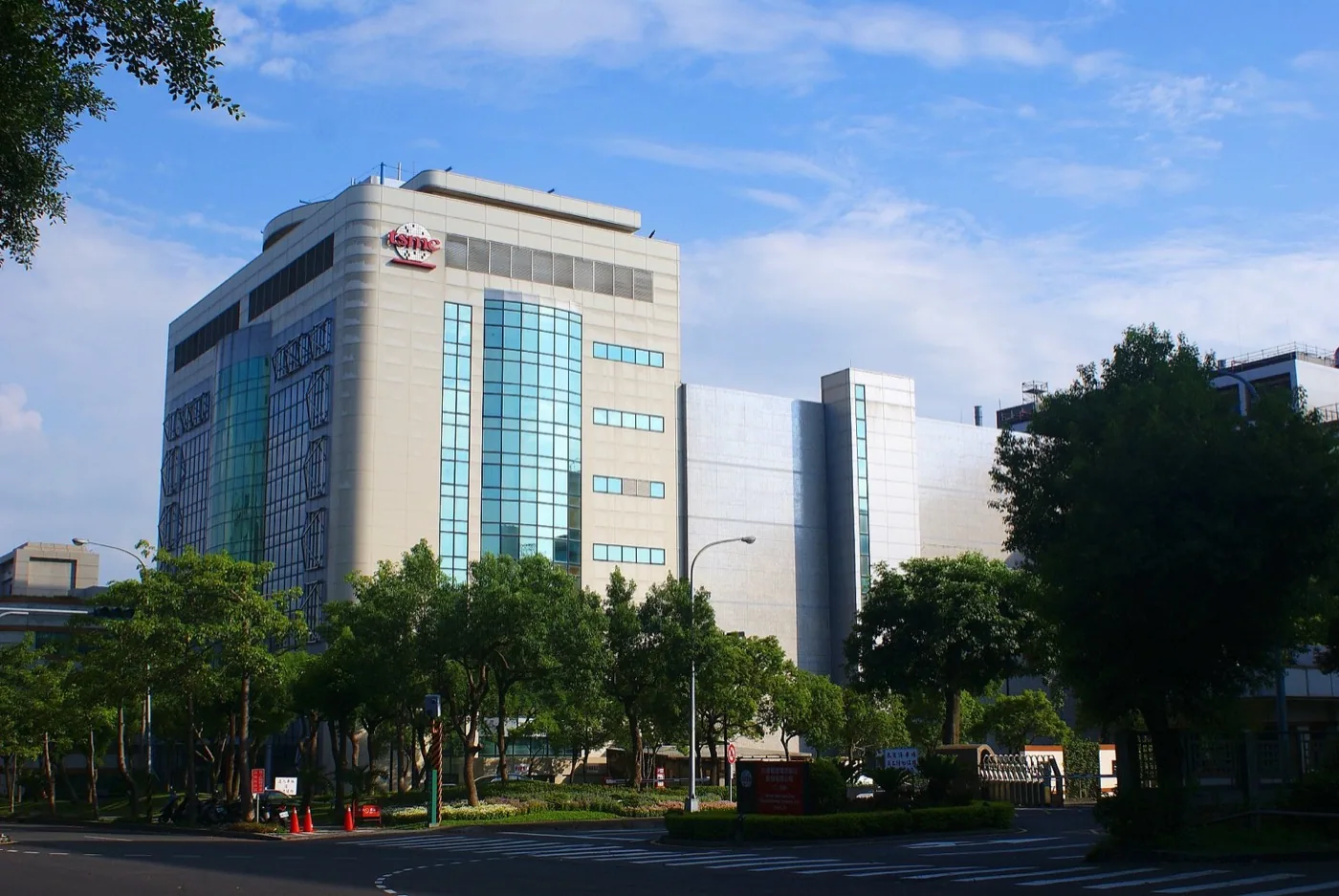
TSMC Fab 5 in Hsinchu, the physical site of AI chip foundry manufacturing. Photo: Wikimedia Commons via TSMC Fab 5 file.
The question is: once the hardware ticket has been secured, where will the next battle be?
📝 Curator’s Note
The usual phrasing is that “Taiwan’s sacred mountain protecting the nation supports the AI revolution.” The narrative is convenient, but it reverses half of the causality. The AI revolution chose TSMC because it needed GPUs; TSMC did not grow out of the AI revolution. The real tension is this: when GPUs become commodities, where does the next layer of value move? The two Nobel Prizes in 2024 gave one answer: the model itself. The 12 pages written by Hopfield; the night in 2012 when Hinton and his student Krizhevsky used AlexNet to pull ImageNet’s image-recognition error rate down from 26.2% to 15.3%15; and the afternoon when Hassabis’s team reached a median GDT of 92.4 at CASP14 with AlphaFold.
Hopfield 1982: A Physicist's Memory Model
In 1982, John Hopfield, a condensed matter physicist at Princeton, wrote a paper just 12 pages long, with a lengthy title: Neural networks and physical systems with emergent collective computational abilities, published in the Proceedings of the National Academy of Sciences 3.
What he did, in essence, was translate "memory" into physics.
In physics there is something called a spin glass: a collection of magnetic atoms each with their own spin direction, interacting with one another, and the system spontaneously finds a point of lowest energy. Hopfield ported this concept onto neurons: imagine neurons as spins, connection strengths as interactions, and the entire network spontaneously converges to a stable state at some "energy minimum" 3. Each energy minimum is a stored memory.
The elegance of this model lies in making memory something describable in the language of physics. Given an incomplete cue, the network finds the nearest energy minimum on its own, completing the entire memory. This is the mathematical ancestor of what generative AI does today.
In 1982, Taiwan's electronics industry was just getting started; TSMC didn't even exist yet. Morris Chang wouldn't found the company that would become the "sacred mountain protecting the nation" 42 years later until 1987. By 2026, Hopfield's paper had accumulated over 27,000 citations on Google Scholar 16.
Even more interesting is something Hopfield said later. He spent a lifetime doing condensed matter physics at Princeton, and his foray into neuroscience was seen by contemporaries as dilettantism. Until the 2024 Nobel list was announced, he was 91, and the Royal Swedish Academy of Sciences asked for his thoughts in a phone interview. He said he was uneasy about "no one understanding or controlling the direction of AI" 17.
The person who wrote the mathematical foundation of modern AI, on the day he received his medal, reminded everyone to be careful.
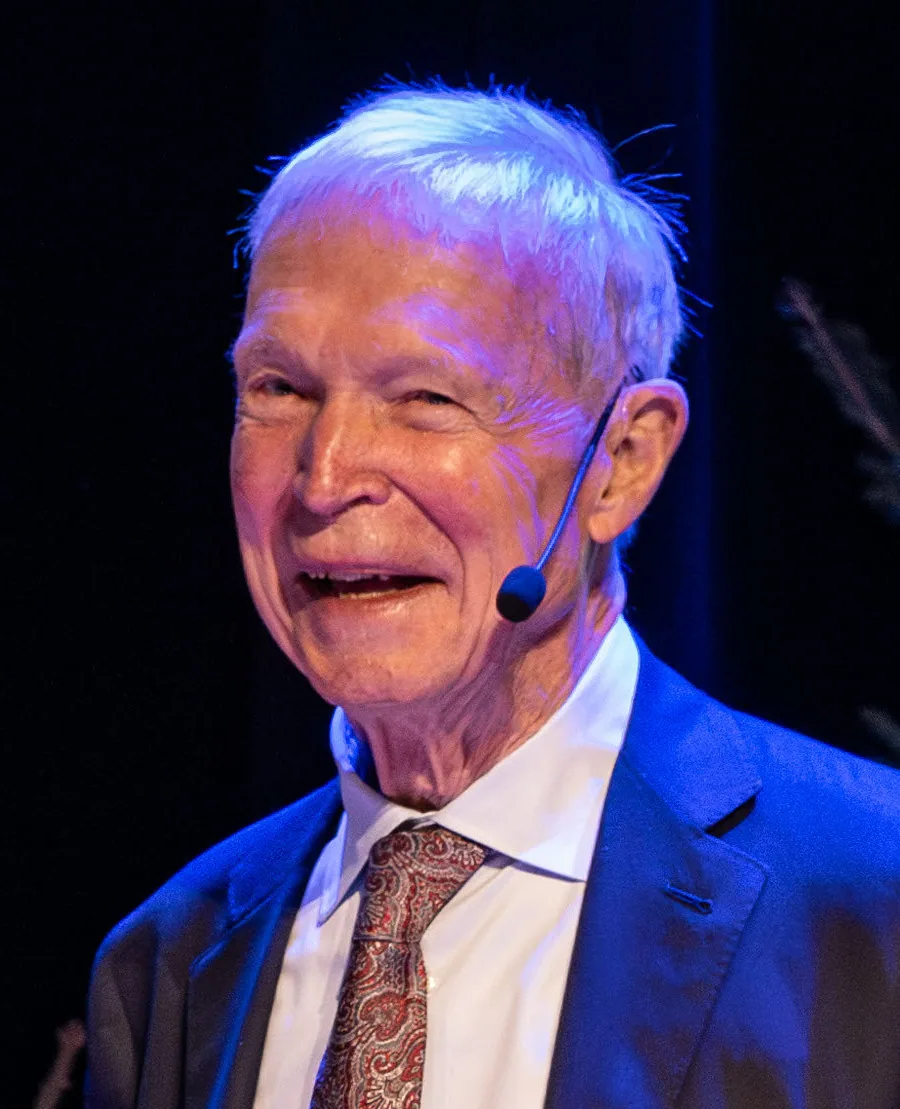
_John J. Hopfield, 2024 Nobel Prize in Physics laureate, Stockholm Nobel Week. Photo: Arthur Petron, 2024-12-08. CC BY-SA 4.0 via Wikimedia Commons._
Hinton: The 1986 Paper and the 2023 Warning After Leaving Google
Geoffrey Hinton, born in Wimbledon, London, in 1947, was another figure whom history recognized 38 years late18.
In 1986, Hinton published a paper on backpropagation in Nature with David Rumelhart and Ronald Williams4. The algorithm means this: when a neural network makes a mistake, the error signal can be sent backward through each layer, adjusting connection weights layer by layer. This is how essentially all deep-learning models train themselves today.
The algorithm was written in 1986, but it needed three conditions before it could ignite: sufficiently cheap computing power, sufficiently large datasets, and people willing to believe in this path. The first two were ready by the early 2010s. The representative figure for the third was Hinton, together with his two students, Alex Krizhevsky and Ilya Sutskever. In 2012, their GPU-trained convolutional neural network AlexNet achieved a top-5 error rate of 15.3% in the ImageNet image-recognition competition, far ahead of the second-place result of 26.2%15. Only then did the entire industry believe that backpropagation could truly work.
In March 2013, Google acquired Hinton’s small company, DNNresearch, for US$44 million and brought him, then 65, into the company18. Over the next decade, he was Silicon Valley’s most prestigious AI scholar.
Then, on May 1, 2023, The New York Times published an interview: Hinton had left Google.
His reason for leaving was not retirement. In the interview, he said he wanted to “talk about the dangers of AI without considering how this impacts Google”19. His warnings included that AI systems might soon become more intelligent than humans, that they could be used by bad actors, and that it was “hard to see how you can prevent” that from happening19. He even said that part of him regretted his life’s work19.
When the 2024 Nobel Prize in Physics was awarded to him, he repeated the warning in a telephone interview: people should be careful about the possibility that AI may go out of control20.
The person who wrote the training algorithm for deep learning and the person who wrote the memory model stood on the Royal Swedish Academy of Sciences’ stage on the same day in October 2024, and both warned that this thing might be more dangerous than imagined. The image has a counterpoint quality to Oppenheimer watching the mushroom cloud rise in the New Mexico desert in 1945.
Two months later, on December 8, 2024, Hinton delivered his Nobel Prize lecture at the Aula Magna of Stockholm University. The title was “Boltzmann Machines” — that early work, continuous with Hopfield's line, writing thermodynamic probability distributions into neural networks. Listening through it, one realized the 1986 backpropagation paper was not an isolated insight, but a whole framework that grew from the intersection of 1980s physics and cognitive science:
Royal Swedish Academy of Sciences official channel: Geoffrey Hinton's Nobel Prize in Physics lecture "Boltzmann Machines" on December 8, 2024. From the Boltzmann machine he and Sejnowski wrote in the 1980s, to backpropagation, to today's LLMs — a full forty years. In the final five minutes he returned again to his concerns about AI risk, this time from a Nobel lecture platform.
From PTT to an AI Lab: Ethan Tu’s Two Ventures
Return to the island of Taiwan. At the same time Hopfield was writing his memory model, Taiwan was only beginning to establish computer science departments.
In 1995, Ethan Tu, then a sophomore in National Taiwan University’s Department of Computer Science and Information Engineering, used a 486 computer and open-source software to set up PTT in his dorm room. It later became Taiwan’s largest bulletin board system. Thirty years later, PTT still has hundreds of thousands of daily users and remains a living fossil of Taiwanese internet culture.
Tu later went to Microsoft and participated in the development of the Cortana voice assistant. In April 2017, he gave up a high-paying Silicon Valley job and returned to Taiwan to found Taiwan AI Labs, Asia’s first nonprofit, open AI research organization21.
His motivation was straightforward: Taiwan had world-class software talent, but that talent was going to Silicon Valley. He wanted to build a platform that would give people who wanted to return, or wanted to stay, a place to do AI research.
Taiwan AI Labs’ best-known product is “Yating Transcription,” a speech-recognition system optimized for traditional Chinese and Taiwanese accents. During the COVID-19 pandemic, the lab also developed misinformation-detection tools and federated-learning medical AI22. These projects share one feature: they solve local Taiwanese problems, using local Taiwanese data, rather than simply translating American models for use in Taiwan.
Tu’s story, from PTT to AI Labs, is in some sense a condensed version of Taiwan’s software development: technical capacity is not lacking. What is missing is an ecosystem that allows talent to stay.
💡 Did You Know?
In 1986, the year Hinton published the backpropagation paper, Taiwan’s GDP was about US$77.9 billion, per capita GDP was about US$4,007, and Hsinchu Science Park had been operating for only six years23. These three things happened simultaneously on the same planet, but their historical lines would not converge on the ImageNet dataset until 26 years later. The timescale of basic research is always longer than industrial narratives perceive.
AlphaFold: The Other Half of the Nobel Prize for a 50-Year Protein-Folding Problem
The story of the 2024 Nobel Prize in Chemistry begins with a question from 1972.
That year, in his Nobel lecture, American biochemist Christian Anfinsen proposed a hypothesis: the three-dimensional folded structure of a protein is completely determined by its amino-acid sequence24. If this hypothesis was correct, then in theory, once we saw an amino-acid sequence, we should be able to calculate the corresponding 3D structure. But this “should” remained unfulfilled for half a century. Protein folding became known as a grand challenge. Since 1994, the academic community has held the CASP competition every two years, comparing submitted predictions with experimentally determined structures. After 13 rounds, no one had broken through25.
Then came CASP13 in 2018, when DeepMind entered the first generation of AlphaFold and won, though its accuracy was not yet practical. The real turning point came on November 30, 2020, at CASP14: AlphaFold 2 achieved a median GDT score of 92.425. A GDT of 92.4 means that in more than half of its predictions, the deviation between predicted atomic positions and experimental values was less than one angstrom, reaching experimental-resolution levels. CASP organizer John Moult said that day that, in a substantial sense, “the problem is solved”25.
A problem unsolved for 50 years was resolved in six years by a research team in London.
What followed moved even faster. In July 2021, AlphaFold 2’s source code was open-sourced. That same year, DeepMind and the European Molecular Biology Laboratory’s EMBL-EBI collaborated to turn AlphaFold’s predicted protein structures into a public database. In July 2022, the database covered one million species and about 200 million protein structures, effectively releasing free 3D models of almost all known proteins on Earth26.
On May 8, 2024, DeepMind published AlphaFold 3 in Nature, extending predictive capacity from single proteins to interactions among proteins, DNA, RNA, ligands, and ions27. From drug development and vaccine design to enzyme engineering, every field that needs to know how molecules lock together had its foundation rewritten by this tool.
Demis Hassabis, who built AlphaFold, is not a traditional biochemist. He began playing chess at age four and earned a master title at 13; at 17, he co-developed the simulation game Theme Park with Peter Molyneux, selling millions of copies28. In 2010, he founded DeepMind in London with Shane Legg and Mustafa Suleyman. Google acquired it in 2014 for £400 million28. In 2016, DeepMind’s AlphaGo defeated Lee Sedol; in 2020 came AlphaFold 2; in 2024, the Nobel Prize. The three events were less than ten years apart.
The line running through them is the same wager: using neural networks to solve problems that humans had been unable to solve with human minds alone. Go is rule-closed. Protein folding is rule-open but strongly constrained by physics. Hassabis chose the right battlefield in both cases.
In Taiwan, the glycomolecule and protein research established during the presidency of Academia Sinica’s Wong Chi-Huey (2006-2016) was Taiwan’s academic investment closest to this frontier29. Teams at Academia Sinica’s Institute of Biomedical Sciences and Institute of Biological Chemistry also use AlphaFold’s open-source weights for downstream research. But Taiwan currently has no corresponding institution for core model development at the AlphaFold level.
⚠️ Contested View
AlphaFold’s Nobel Prize in Chemistry prompted debate in academia. Some structural biologists argued that the prize should have gone to the scholars who performed the earliest key experiments in X-ray crystallography or nuclear magnetic resonance, rather than elevating a computational tool into the chemical canon30. Others argued that the debate itself was obsolete: when an algorithm can help humanity complete 3D structures for almost all proteins on Earth within five years, that is chemistry. After October 2024, the balance of the debate gradually shifted toward the latter position, but the tension it represents has not disappeared: as AI’s capabilities expand, should the boundaries of traditional disciplines be redrawn?
TAIDE: Why Taiwan Needs Its Own Language Model
In April 2023, six months after ChatGPT swept the world, Taiwan’s National Science and Technology Council (NSTC) launched the TAIDE project, short for Trustworthy AI Dialogue Engine31.
Why should an island country of 23 million people build its own large language model?
The reason is not only technological autonomy. Traditional Chinese accounts for a very small share of global AI training data, and most Chinese-language data comes from simplified Chinese websites. When Taiwanese users use ChatGPT or other models, the answers often carry usage habits and default perspectives from mainland China. Terms such as “視頻” rather than Taiwan’s “影片” for video, or “質量” rather than Taiwan’s “品質” for quality, may look like minor differences, but behind them lies the question of cultural subjectivity. CommonWealth Magazine reported on TAIDE under the direct headline “preventing Chinese AI cultural invasion”32.
In April 2024, the TAIDE team released the commercial TAIDE-LX-7B model and the academic-research TAIDE-LX-13B model, which performed well on tasks such as writing, translation, and summarization33. By 2026, TAIDE 2.0 had been released, and together with the MediaTek-supported Breeze-8B model, Taiwan’s LLM ecosystem had moved from the “catching up” stage into the “usable” stage34.
Even more interesting is the flourishing of applications. National Chung Hsing University used TAIDE to build an agricultural knowledge-retrieval system called “Shennong TAIDE.” National University of Tainan developed a Taiwanese-English conversational chatbot for Taiwanese-language teaching. National Yang Ming Chiao Tung University trained Taiwanese and Hakka versions of the TAIDE model35. These applications confirm one point: a language model is both a technical product and a cultural carrier. An AI that does not understand Tiancuan Day or the Mazu pilgrimage cannot truly serve Taiwanese people.
Still, TAIDE remains small in scale: the commercial model has 8B parameters and the academic-research model 13B, two orders of magnitude below models at the GPT-4 level from OpenAI, which are estimated to exceed one trillion parameters. Behind this gap lies a GPU budget problem, not a capacity problem. Training a frontier-level LLM requires computing resources measured in hundreds of millions of U.S. dollars, a scale comparable to the annual budget of a national research institution.
AI Cybersecurity Forged by Hacking
Taiwan is one of the countries most frequently targeted by cyberattacks in the world. This unfortunate reality has unexpectedly produced a formidable AI cybersecurity industry.
Founded at the end of 2017, CyCraft was Taiwan’s first cybersecurity company to combine AI with endpoint monitoring. Its technology has been included seven times in reports by Gartner, the global research and advisory firm, and it is the only Taiwanese vendor to pass the U.S. MITRE ATT&CK evaluation three times36. In February 2026, CyCraft listed on the Taiwan Stock Exchange’s Innovation Board, becoming the first AI cybersecurity software vendor in Taiwan’s capital market with internationally competitive in-house R&D capabilities37.
CyCraft’s clients include Taiwanese government agencies, defense units, banks, and semiconductor companies, precisely the targets most often selected by state-level hackers. The company has subsidiaries in Japan and Singapore and is exporting its “field experience forged by being hacked” across the Asia-Pacific region.
This case illustrates one thing: Taiwan’s AI advantage comes not only from semiconductors, but also from the practical capabilities honed by its distinctive geopolitical position.
Policy: From the “First Year of AI” to the Ministry of Digital Affairs
Taiwan’s AI policy development can be understood through three milestones.
The period from 2017 to 2018 was the starting phase. The Executive Yuan designated 2017 as the “first year of AI” and introduced the concept of “a small country’s grand AI strategy,” acknowledging Taiwan’s small market while emphasizing three cards: semiconductor manufacturing, the ICT supply chain, and science-and-engineering talent. In 2018, the first phase of the Taiwan AI Action Plan began, investing more than NT$40 billion over four years, with a focus on building AI computing infrastructure through the Taiwan AI Cloud, or TWCC38.
In 2022, policy moved toward institutionalization. The Ministry of Digital Affairs (moda) was established, integrating digital responsibilities that had previously been scattered across the Ministry of Science and Technology, the Ministry of Economic Affairs, and the Ministry of Transportation and Communications. The significance of this step was that AI policy was upgraded from “a Ministry of Science and Technology project” to “a cross-ministerial national strategy.” That same year, the government issued the “Artificial Intelligence Research and Development Guidelines,” emphasizing principles such as human-centeredness, transparency and explainability, and fairness without discrimination.
From 2023 onward, the turn has been toward generative AI. ChatGPT’s impact forced a sharp policy pivot. The TAIDE project was launched, draft legislation for an AI basic law advanced, and AI adoption in the public sector accelerated. Taiwan’s strategy is pragmatic: rather than competing with the United States and China on the number of basic-research papers, it grafts AI onto existing manufacturing strengths. Smart manufacturing, medical imaging, and semiconductor yield prediction are all areas where Taiwan has data, scenarios, and competitiveness.
The problem is that among the Nobel laureates announced over those two days in October 2024, not one came from the “smart manufacturing” path.
Anxiety: The Software Gap in a Hardware Empire
Behind the polished numbers, Taiwan’s AI development has a structural problem: a severe imbalance between hardware and software.
Taiwan produces 90% of the world’s AI servers and most AI chips, but in the “soft” layers of AI model development, data ecosystems, and platform software, its presence is faint. Among the world’s top 20 AI models, including GPT, Claude, Gemini, and LLaMA, none comes from Taiwan. Compare this with the work recognized by the two 2024 Nobel Prizes: from the Hopfield Network and backpropagation to AlphaFold, all three lines are far removed from Taiwan’s industrial base.
The reason is a new version of an old problem. When TSMC engineers can earn annual salaries of more than NT$2 million, software startups struggle to attract top talent. Google, Microsoft, and NVIDIA all have R&D centers in Taiwan, and their salaries and benefits create a powerful siphoning effect. A graduate of National Taiwan University’s computer science department often prefers a foreign company or TSMC IT over joining a domestic AI startup.
The more fundamental challenge is data. The value of AI models comes from training data, and the amount of high-quality traditional Chinese data is tiny compared with English or simplified Chinese. The volume of text generated by Taiwan’s 23 million people is naturally far smaller than that of the English-speaking world or mainland China. The TAIDE project attempts to address this problem, but the disadvantage in data scale is structural.
Taiwan’s real AI wager lies in vertical applications rather than foundation models. Instead of directly confronting OpenAI or Google in general-purpose models, Taiwan has chosen to find irreplaceable positions in semiconductor-process AI, medical-imaging AI, cybersecurity AI, and traditional Chinese NLP. In these fields, Taiwan has distinctive data and scenario advantages that are difficult for others to replicate.
The AI Choice of an Island
In 2026, Taiwan stands in a unique position: it has never been so indispensable in the AI hardware supply chain, yet it remains marginal in the AI software ecosystem.
This is not entirely bad. Historically, Taiwan’s success model has always been “do not be the brand; be the brand behind the brand.” The pure-play foundry model that Morris Chang invented in 1987 made TSMC one of the world’s ten largest companies by market capitalization. Today, the same logic is being replayed in the AI server industry: Foxconn does not build AI models, but AI models around the world run on servers assembled by Foxconn.
But the rules of the AI era may be different. As the center of value shifts from hardware to software and data, profit margins for those who only do contract manufacturing will be compressed. The recipients of the two Nobel Prizes awarded over those two days in 2024 all worked at the software layer. Hopfield wrote a mathematical model; Hinton wrote a training algorithm; Hassabis wrote a method for answering a biological problem. All of this work runs on hardware manufactured in Taiwan, but the prizes were not awarded to hardware.
Taiwan needs to build software and data capabilities on top of its hardware dominance. Hardware remains the chassis, with new layers of value stacked above it. TAIDE is one attempt. CyCraft is one attempt. Taiwan AI Labs is one attempt. What they share is that they do not seek to build “the world’s largest AI,” but rather “the AI that understands Taiwan best.”
Forty-two years ago, when Hopfield wrote those 12 pages at Princeton, no one knew they would become the mathematical foundation for today’s models of human memory. Fifty years ago, when Anfinsen proposed the protein-folding hypothesis in his Nobel lecture, no one expected that it would take until that afternoon in 2020 for a group of London researchers to solve it. The timescale of basic research is longer than every Computex.
That meal at Ningxia Night Market was the position Taiwan had accumulated over those 42 years. Where is the next battle? Not in front of the oyster omelet stall, but in whether Taiwan has the courage to let some student now writing code in an NTU dorm room win, 20 or 30 years from now, a Nobel Prize that belongs to this island.
Further Reading:
- The Rise of an AI Island: Taiwan’s Artificial Intelligence Development and Future Strategy — An earlier policy-framework narrative, covering the AI Action Plan, five strategic areas, and how the semiconductor “sacred mountain protecting the nation” was grafted onto the AI revolution.
- Taiwan AI Labs — Ethan Tu’s full trajectory from PTT to AI Labs, and the open-source language-model ecosystem around TAIDE / TAME / FedGPT.
- Taiwan AI Academy — The unfinished phone call and the AI military academy built through Chen Sheng-Wei’s NT$180 million in private fundraising: an eight-year history of training more than 10,000 alumni.
- AI in Everyday Taiwan — A documentary account of generative AI entering everyday life in Taiwan, from convenience-store ordering to batch review by the National Health Insurance Administration.
- Taiwanese Enterprise: TSMC — The global foundry leader and core of AI chip manufacturing, from Morris Chang’s pure-play foundry model to the story of advanced packaging.
- Semiconductor Industry — A full view of Taiwan’s semiconductor ecosystem, from IC design to packaging and testing.
- Development of Taiwan’s Cybersecurity Industry — How geopolitical pressure gave rise to an Asia-Pacific-level AI cybersecurity industry.
Image Sources
This article uses 4 public domain / CC-licensed images, all cached in public/article-images/technology/ to avoid hotlinking the source servers:
- Estructura tridimensional de la proteïna CBLN1 per AlphaFold amb codificació rainbow — hero, CBLN1 protein AlphaFold predicted structure, rainbow color encoding N→C terminus. Photo: BQUB25-UPoch (own work, AlphaFold + PyMOL), 2025-11-15, CC BY 4.0.
- Geoffrey E. Hinton, 2024 Nobel Prize Laureate in Physics (3x4 cropped) — inline, 2024 Nobel Week Hinton official portrait. Photo: Arthur Petron, 2024-12-08, CC BY-SA 4.0.
- John J. Hopfield, 2024 Nobel Prize Laureate in Physics 1 (cropped) — inline, 2024 Nobel Week Hopfield official portrait. Photo: Arthur Petron, 2024-12-08, CC BY-SA 4.0.
- TSMC Fab 5 — inline, TSMC Hsinchu Fab 5 facility, the physical site of AI chip foundry manufacturing. Photo: Wikimedia Commons (existing cache).
References
- The Nobel Prize in Physics 2024 press release — Official announcement by the Royal Swedish Academy of Sciences on October 8, 2024. Original text: “The Royal Swedish Academy of Sciences has decided to award the Nobel Prize in Physics 2024 to John J. Hopfield and Geoffrey Hinton 'for foundational discoveries and inventions that enable machine learning with artificial neural networks.'” The prize money was 11 million Swedish kronor, divided equally between the two laureates.↩23
- The Nobel Prize in Chemistry 2024 press release — Announcement on October 9, 2024. The prize money was 11 million Swedish kronor; David Baker received half “for computational protein design,” while Demis Hassabis and John Jumper shared the other half “for protein structure prediction.”↩2
- PNAS, 79(8), 2554-2558 — Hopfield, J. J. (1982). “Neural networks and physical systems with emergent collective computational abilities.”↩23
- Nature, 323, 533-536 — Rumelhart, D. E., Hinton, G. E., & Williams, R. J. (1986). “Learning representations by back-propagating errors.”↩2
- Tom's Hardware: Semiconductor legends take a stroll in a Taiwanese night market — Report on the Ningxia Night Market scene on May 29, 2024, documenting Jensen Huang, Morris Chang, Barry Lam, and Rick Tsai dining together.↩
- Taiwan News: Nvidia CEO calls Taiwan 'one of the most important countries in the world' — Jensen Huang’s public remarks during his May 30, 2024 visit to Taiwan.↩
- Wikipedia: Jensen Huang — Biographical information on Huang’s birth in Taipei in 1963, childhood in Tainan, and immigration to the United States at age nine.↩
- Klover.ai: TSMC AI Fabricating Dominance — All of NVIDIA’s advanced GPUs, including the A100, H100, and Blackwell series, are manufactured by TSMC. See↩
- SQ Magazine: AI Chip Statistics 2025 — Source for TSMC’s 72% foundry revenue market share in 2025; see also contemporary reporting by Motley Fool.↩
- PatentPC: The AI Chip Market Explosion — Source for NVIDIA’s 86% share of the AI GPU market.↩
- Tech-Now: Taiwan Leads Global AI Server Shift, Surpassing iPhones in 2025 — Data on Foxconn, Quanta, and Wistron accounting for 90% of global AI server shipments.↩
- DigiTimes: Foxconn, Wistron, Quanta to sustain trillion-dollar revenue on AI server in 2026 — Reporting on the three ODMs surpassing NT$1 trillion in annual revenue and AI servers overtaking consumer electronics.↩
- 36Kr: Who Will Divide Up the CoWoS Production Capacity in 2026? — Data on NVIDIA’s demand for 595,000 CoWoS wafers, accounting for 60% of the global total.↩
- NVIDIA Newsroom: Foxconn Builds AI Factory in Partnership With Taiwan and NVIDIA — Partnership for the 100MW AI factory in Kaohsiung; see also CNBC reporting on the 100MW power capacity.↩
- NeurIPS 2012 / NIPS Proceedings — Krizhevsky, A., Sutskever, I., & Hinton, G. E. (2012). “ImageNet Classification with Deep Convolutional Neural Networks.”↩2
- PanSci: 2024 Nobel Prize in Physics — Hopfield and Hinton Opened the Age of Machine Learning with Artificial Neural Networks — Content Curation Partner per MOU 2026-05-05. Covers the background to the Hopfield Network, the spin-glass analogy, accumulated citation counts, and its mathematical connection to contemporary deep learning.↩
- The Guardian: Nobel physics prize 2024 winner John Hopfield warns of AI dangers — October 8, 2024 report on the Nobel Physics telephone interview, in which Hopfield and Hinton both warned of AI risks.↩
- Wikipedia: Geoffrey Hinton — Hinton was born on December 6, 1947, in Wimbledon, London; he joined Google after Google acquired DNNresearch for US$44 million in March 2013.↩2
- BBC News: AI 'godfather' Geoffrey Hinton warns of dangers as he quits Google — May 1, 2023 report on Hinton’s concerns about AI risks after leaving Google. Original phrases include: “I left so that I could talk about the dangers of AI without considering how this impacts Google” and “a part of me now regrets my life's work.” The report also cites details from the contemporaneous New York Times interview.↩23
- Nature: AI scientist Geoffrey Hinton wins Nobel prize for physics — Nature’s detailed account of the 2024 Nobel Physics announcement and Hinton’s telephone interview.↩
- Taiwan AI Labs official website: About Us — Official profile of Ethan Tu’s founding of PTT at National Taiwan University in 1995 and his return to Taiwan in April 2017 to found Taiwan AI Labs.↩
- TechNews: AI Talent in Taiwan: Stay or Leave? Interview with Taiwan AI Labs Founder Ethan Tu — Introduction to core projects including Yating Transcription and federated-learning medical AI.↩
- Wikipedia: Economic history of Taiwan — Data on Taiwan’s GDP in 1986; Hsinchu Science Park was established in December 1980.↩
- Science, 181(4096), 223-230 — Anfinsen, C. B. (1973). “Principles that govern the folding of protein chains.”↩
- Nature: 'It will change everything': DeepMind's AI makes gigantic leap in solving protein structures — November 30, 2020 report on the CASP14 results: AlphaFold 2 achieved a median GDT of 92.4, and CASP organizer John Moult commented that “in some sense the problem is solved.”↩23
- DeepMind: AlphaFold reveals the structure of the protein universe — July 28, 2022 announcement that the AlphaFold Protein Structure Database covered one million species and about 200 million protein structures.↩
- Abramson, J., Adler, J., Dunger, J. et al. (2024). Accurate structure prediction of biomolecular interactions with AlphaFold 3. Nature 630, 493-500 — May 8, 2024 publication of AlphaFold 3, extending prediction to complexes involving proteins, DNA, RNA, ligands, and ions.↩
- Wikipedia: Demis Hassabis — Hassabis began playing chess at age four, co-developed Theme Park with Peter Molyneux at age 17 in 1994, founded DeepMind in London in 2010, and sold it to Google in 2014 for approximately £400 million.↩2
- Academia Sinica Genomics Research Center — The glycomolecule and protein-structure research center established during Wong Chi-Huey’s tenure as president of Academia Sinica (2006-2016).↩
- PanSci: 2024 Nobel Prize in Chemistry — David Baker, Demis Hassabis, and John Jumper Solve the Protein-Folding Problem — Content Curation Partner per MOU 2026-05-05. Covers the controversy over AlphaFold’s Nobel Prize in Chemistry and the disciplinary-boundary debate between structural biology and computational chemistry.↩
- Executive Yuan: Improving Taiwan’s AI Infrastructure — Building the Trustworthy AI Dialogue Engine TAIDE — Official explanation of the TAIDE project launch in April 2023.↩
- CommonWealth Magazine: “Preventing Chinese AI Cultural Invasion”: What Can Taiwan’s First Traditional Chinese Large Language Model TAIDE Do? — Feature report on TAIDE and the discourse of cultural subjectivity for traditional Chinese LLMs.↩
- NSTC Press Release: One Year of TAIDE: Public-Private Collaboration Advances a Large Language Model with Taiwanese Characteristics — April 2024 release of the commercial TAIDE-LX-7B and academic-research TAIDE-LX-13B models.↩
- CloudInsight: Taiwan LLM Development Status 2026 — Comprehensive overview of Taiwan’s LLM ecosystem, including TAIDE 2.0 and Breeze-8B.↩
- Same CloudInsight report. Detailed application cases include National Chung Hsing University’s “Shennong TAIDE,” National University of Tainan’s Taiwanese-English conversational chatbot, and National Yang Ming Chiao Tung University’s Taiwanese and Hakka TAIDE models.↩
- CIO Taiwan: Survey of Taiwanese Cybersecurity Vendors — CyCraft Technology — Details on CyCraft’s seven inclusions in Gartner reports and three MITRE ATT&CK evaluations.↩
- CyCraft official website: Innovation Board Debut for an AI Cybersecurity Leader! CyCraft Lists Today — February 5, 2026 press release on its Innovation Board listing.↩
- NSTC: AI Research Strategy — Policy framework including the NT$40 billion budget for the first Taiwan AI Action Plan and the establishment of TWCC.↩