
30-Second Overview: In 1979, Leofoo Village began as a 73-hectare free-range wildlife park in Guansi, Hsinchu. In the 1990s, four exotic-themed villages, roller coasters, and a water park were added, placing animal viewing, the pursuit of weightlessness, and family vacations on the same itinerary. Its most counterintuitive feature is this: the more successfully a park turns life into a journey, the less it can manage itself solely by the standards of amusement facilities.
Leofoo Village: A Theme Park Where Animals Came First, Then Roller Coasters Grew
In 1979, Chuang Fu purchased 73 hectares of land in Guansi, Hsinchu, to open a free-range wildlife park. 1 In 1990, Leofoo Development began planning a theme park, with four exotic-themed areas opening successively from June 1994. 2
Thus, the most memorable starting point of Leofoo Village is not any specific roller coaster, but the sequence: "animals first, then the theme park." It combines viewing wildlife, entering exotic scenes, riding thrill attractions, and staying in eco-lodges into a one- or two-day trip very familiar to Taiwanese families.
This combination appears natural but is actually rare. Amusement facilities can be measured by speed and screams, but zoos must face care, breeding, space, escape prevention, and educational responsibilities. Leofoo Village’s story is precisely about these two different timelines being forced into the same park.

Image source: Wikimedia Commons original file page, by Roller Coaster Philosophy, licensed under CC BY 2.0. The image was not downloaded; the article uses the Wikimedia Commons original file hotlink directly.
📝 Curator’s Note
Leofoo Village does not build an amusement park next to a zoo; it binds two different ways of viewing the world together.
Chuang Fu’s 73-Hectare Opening Move
Official data from Leofoo Village and the Ministry of Transportation and Communications’ (MOTC) Tourism Bureau list the 1979 Guansi, Hsinchu Wildlife Park as its predecessor. Official introductions state that at the time, it was the country’s only and largest free-range wildlife park, covering 73 hectares. 1 2
This number is not just the park’s scale, but also a microcosm of Taiwan’s leisure imagination in that era. Family travel at the time often treated "seeing exotic animals" as the destination itself. With sufficient land, animals could be placed in a more open viewing framework than traditional cages, allowing visitors to exchange a suburban trip for a sense of the exotic.
Chuang Fu, Leofoo Village’s founder, originally ran corporate and hotel businesses. Leofoo Development’s corporate history marks 1989 as the key node for creating a large-scale theme park combining a wildlife zoo, indicating that the transformation was not merely adding a few rides, but the company reselecting its direction within the leisure industry. 3
Here lies an easily overlooked distinction: Leofoo Village did not treat animals as decorations for an amusement park; it made the zoo itself the product’s skeleton. The subsequent themed villages, performances, hotels, and water parks all served to extend visitor stay time, ensuring that a single park entry was not just a line of ride queues, but a designed journey.
The 1990s: Exoticism Made Into a Park Map
After planning began in 1990, Leofoo Development commissioned the US firm Battaglia Associate Inc. for detailed design, using the American Great West, South Pacific, Arabian Palace, and African Wildlife Kingdom as the thematic skeleton. 2
These names may seem blunt today, but they effectively illustrate the approach of 1990s Taiwanese theme parks. The exotic was not a background poster, but a complete consumption language encompassing architecture, music, dining, rides, and animal displays. Visitors could switch between several "worlds" in a single afternoon without leaving the country.
MOTC Tourism Bureau data positions Leofoo Village as a comprehensive park combining four themed villages, an open wildlife zoo, performances, and amusement facilities. The data also lists facilities such as "Raptor," "Grand Canyon River Rafting," "Sea Pirate," "Apocalypse," and "Fenghuo Lun" (Wind and Fire Wheels). 2
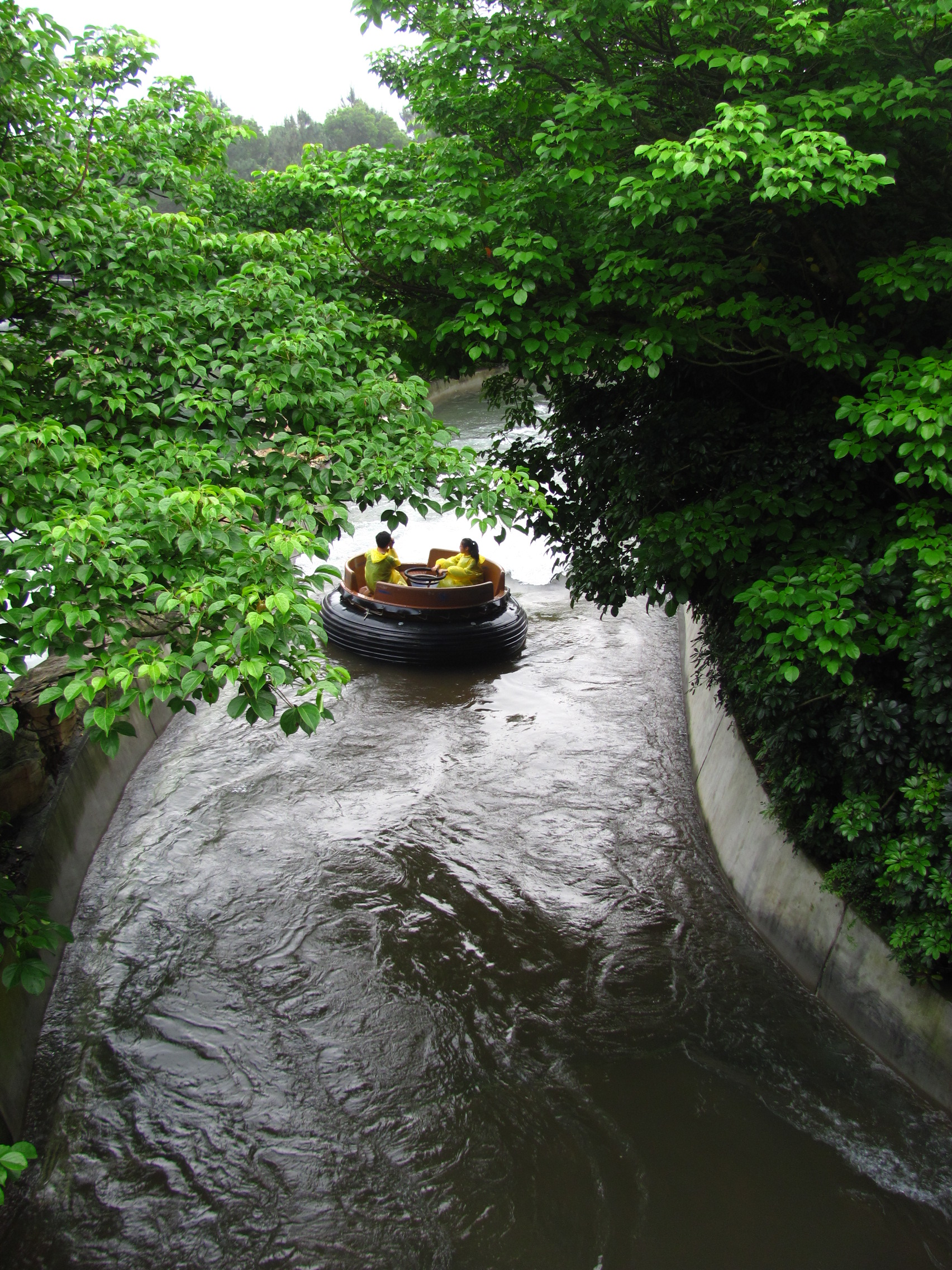
Image source: Wikimedia Commons original file page, by Roller Coaster Philosophy, licensed under CC BY 2.0. The image was not downloaded; the article uses the Wikimedia Commons original file hotlink directly.
The focus of this design is not the length of the facility list, but how the visitor’s body is arranged at different speeds. Steam trains and the beast area slow people down; themed streets make them stop to take photos; roller coasters suddenly surrender the body to gravity. Leofoo Village places "viewing" and "weightlessness" on the same itinerary.
📝 Curator’s Note
What Leofoo Village truly sells is not just a ticket, but the ability for different ages within the same family to find their own speed within the same park.

Image source: Wikimedia Commons original file page, by Roller Coaster Philosophy, licensed under CC BY 2.0. The image was not downloaded; the article uses the Wikimedia Commons original file hotlink directly.
From Wildlife Park to One-Day Journey
Official data states the park has approximately 70 species, nearly 1,000 animals, featuring an open wildlife zoo. These figures are self-reported by the park and tourism promotion materials, suitable for understanding how the park positions itself, but should not be directly treated as statistics from independent animal surveys. 1 2
The early "open" concept had a more concrete meaning: in the 1970s, Leofoo Village allowed visitors to drive their own cars into the wildlife area, with windows closed and no getting out of the vehicle. Giraffes, baboons, and elephants would appear directly beside the car. A 2024 report noted that this self-driving tour was later canceled due to safety concerns, making a brief return only as a limited-time "Zoo Self-Drive Tour" activity for its 45th anniversary. 4 Therefore, driving to Leofoo Village today is fundamentally different from driving into the animal display area in the early days. The self-driving mentioned in the park’s current traffic guide refers to arriving at the park and using the parking lot, not general visitors freely driving through the wildlife area. 5
The park’s space must therefore serve two different modes of viewing. Visitors want to get close; animals need distance. Visitors hope to see more within limited time; animals’ lives do not conform to tourists’ schedules. Amusement facilities can start according to a timetable; animal displays cannot demand each animal appear on time in the same manner.
In 2010, the Guansi Leofoo Village Eco-Resort Hotel opened, described by the group’s official channels as a hotel themed around animals and ecology. 1 In 2012, Leofoo invested NT$390 million to build a Greek-style water park, linking swimming, accommodation, animals, and themed facilities into a longer stay path. 2
This expansion was not merely lengthening the existing park, but transforming Leofoo Village from "deciding what to do after entering" into a pre-arranged vacation product. During the day, visitors can sequentially pass through themed villages, animal displays, and rides; in the evening, consumption extends to accommodation and dining; in summer, the water park offers another seasonal entry point. This is why Leofoo Village’s history cannot be described solely by the number of rides; the park truly changed the time visitors stay and how the enterprise connects different experiences along a single consumption path. 1 2 3
This path also changed the meaning of "going to Leofoo Village." It is no longer just children playing on rides while adults stand by waiting; it places transportation, dining, accommodation, photography, animal viewing, and amusement facilities into a single family decision. The more complete the park, the easier it is for visitors to stay, and the more types of risk the park must handle.
When Entertainment Becomes a Governance Issue

Image source: Wikimedia Commons original file page, by Roller Coaster Philosophy, licensed under CC BY 2.0. The image was not downloaded; the article uses the Wikimedia Commons original file hotlink directly.
In 2021, Leofoo Village and Leofoo Village announced they had obtained Hsinchu County’s performance animal permit. The park stated that the review affirmed the venue, facilities, activity spaces, medical equipment, and care staff. 6 This is the operator’s formal statement on its own management capabilities, indicating that obtaining the permit is viewed as an operational responsibility, not just an administrative document.
Video research also turns the gaze back to the amusement facilities themselves. In February 1999, the "Flying Carpet" in the Arabian Palace area struck a part-time worker who was not standing within the safety zone during descent; the worker was hospitalized but died. A follow-up report by NOWnews stated that the park reviewed facility safety after the accident and decided to install safety railings around the Flying Carpet. 7 This accident is not the same event as the later-apocryphal "Apocalypse Long Hair" urban legend, but together they illustrate how safety memories in theme parks are reassembled among visitors.
But a permit does not mean the end of controversy. In 2022, animal protection groups at a press conference commemorating Leofoo Village’s giraffe "Pudding Girl" pointed out that eight giraffes died in the park over ten years, questioning the breeding environment, animal performances, paid feeding, and breeding management. These contents are investigations and allegations by animal protection groups; the article does not rewrite them as facts already established by courts. 8 9
The same event thus presents two different source tones. The park’s announcement explains the affirmation of the venue and care by the permit review; animal protection groups demand the government review death records, display methods, and animal welfare. A reliable approach is not to pre-judge for either side, but to place both narratives back into the same institutional question: who inspects, what is inspected, whether inspection results are public, and who continuously follows up.
The 2022 giraffe import controversy was ultimately not just "whether to introduce three more giraffes." An English report from CNA stated that animal protection groups demanded the government prevent Leofoo Village from importing three giraffes from Mexico, citing claims that eight giraffes had died in the past decade. 10 This controversy linked import documents, veterinary care, venue design, and animal welfare into a single review.
📝 Curator’s Note
A park’s maturity is not only measured by whether it can make people scream, but also by whether it can answer the question: "Who looks out for the residents who cannot speak?"
From Urban Legends to Real Accidents
Ziqi Qiqi’s video separates the "Apocalypse Long Hair Pulled Off" legend from real amusement park accidents. The video itself is a research clue, not a substitute for court rulings, regulatory authority data, or original news articles. What can be directly cited in the article is the 1999 Flying Carpet accident news report and the park’s subsequent installation of safety railings. 7
This distinction is important. Urban legends cast shadows over facilities through fear; real accidents require answers regarding responsibility, operational standards, warning lines, and improvement measures. Blending the two into one event allows actual victims’ incidents to be obscured by legends, and makes unverified plots appear like historical records.
Baboon Escape Reveals Invisible Boundaries
In March 2023, an Eastern chimpanzee escaped from Leofoo Village and was later shot dead by a hunter in Taoyuan. A CNA report stated that after the incident, animal protection groups demanded investigations not only into the baboon area, but also into the park’s overall animal welfare and escape prevention management. 11
The Council of Inspection’s October 2023 investigation results elevated the event from an animal news story to a governance issue. The Council stated that the Taoyuan City Government did not appoint an on-site commander during the capture, and the Council of Agriculture did not provide sufficient situational briefings, ultimately turning what should have been "capture and placement" into "hunting." 12
The Council also noted that the cause of the chimpanzee’s escape and the exact number were still unknown at the time. Although the Hsinchu County Government demanded improvements to escape prevention measures, it should continue to track the breeding environment of animals within the park. The report also concluded that the current system lacks clear standards for individual identification of animals in open display areas and group breeding, as well as for "appropriate venues and equipment." 12
These sentences are heavy, but they should not be used solely to label Leofoo Village as "dangerous." They truly reveal the structural difficulties of hybrid parks: animal displays are part of the park’s attraction, but animal escapes immediately become cross-county public safety and wildlife management events. A door, a section of fence, or a registry within the park can become issues the government must take over once they leave the park.
The Society for the Protection of Life’s subsequent compilation of the 2022 giraffe controversy and the 2023 baboon event focused on the gray areas between central and local authority, performance permits, animal welfare, and educational purposes. This is policy analysis by an advocacy group, not an official ruling, but it provides important material for understanding institutional friction. 13
Why Leofoo Village Is Still Worth Writing About
If Leofoo Village is written only as "the place with roller coasters," its most Taiwanese aspect is missed. It connects the 1970s imagination of free-range zoos to the 1990s exotic theme parks, and further to today’s questions about animal welfare, public safety, and corporate responsibility.
If it is written only as an animal welfare controversy, the other half is also missed. Many Taiwanese families’ memories indeed take concrete shape here: the mountain roads of Guansi, the signs of African villages, the sense of movement of the steam train, the animals seen from afar while queuing, and the increasingly quiet wait before riding "Apocalypse" for the first time.
Leofoo Village’s dilemma is not "which is more important: animals or amusement." It has already chosen to let the two coexist, and must therefore manage the gap between them with higher standards. Visitors purchase entertainment; the park bears more than just entertainment. When animals are placed into tourism products, care and transparency cannot remain merely in the park’s self-introductions.
Next time you think of Leofoo Village, perhaps you can first recall that counterintuitive sequence: in 1979, the wildlife park appeared first; in 1994, the themed villages and large-scale amusement facilities followed. 1 This sequence makes Leofoo Village a concrete specimen of Taiwan’s leisure industry transformation, preventing it from being dismissed with just the four words "old theme park."
The question it truly leaves is: when a park simultaneously allows people to pursue speed, exotic imagination, and close-up viewing of life, can it ensure that every form of life is not just a scenic spot on a journey?
Video References
During the research phase, this article referenced the video "Economic Sense" discussing Taiwan’s theme park operation status using Leofoo Village as a case study, and the video by Ziqi Qiqi analyzing the "Apocalypse" urban legend and amusement park accidents. Video analysis results serve only as clues; ticket prices, revenue proportions, facility ages, and industry rankings not yet supported by official or news article cross-references are not written as conclusions. Video 1: Economic Sense, Leofoo Village and Taiwan Theme Park Operation Status. Video 2: Ziqi Qiqi, Apocalypse Urban Legend and Leofoo Village Accident.
Further Reading
To compare how Leofoo Village and other Taiwanese parks face disappearance, transformation, and collective memory, read the site’s Vanishing Amusement Parks: From "First Park" to Ghost Legends, Those Childhoods Seized by Urban Planning. To place Leofoo Village back on the map of Taiwan’s zoos and aquariums, read the site’s Which Zoos Are in Taiwan? The Oldest Is Not in Muozha, The Largest Is Not Just a Zoo.
References
- Leofoo Village Theme Park: About Leofoo Village — Leofoo Village’s official history page, detailing the 1979 wildlife park origin, 73-hectare scale, themed area transformation, and park self-description.↩23456
- Ministry of Transportation and Communications Tourism Bureau "Taiwan Good Parks": Leofoo Village Theme Park — MOTC theme park data, organizing nodes from 1979, 1990, 1994, 2010, 2012, and park facility positioning.↩234567
- Leofoo Group: History — Leofoo Group’s official history page, recording the 1989 large-scale theme park transformation, and recent animal conservation and international cooperation contexts.↩2
- Setnews: Super Crazy! Leofoo Village "Self-Drive Tour" to See Wildlife — 2024 report on early self-drive tour rules, later cancellation due to safety issues, and the return of the 45th-anniversary limited self-drive activity.↩
- Leofoo Village Theme Park: Traffic Guide — Official current traffic page describing self-driving to the park, parking lots, and parking methods.↩
- Guansi Leofoo Village: Animal Performance Permit — Operator announcement obtaining Hsinchu County Performance Animal Permit No. 110001, presenting the park’s formal stance on venue, care, and animal welfare.↩
- NOWnews: Leofoo Village Water Park Blood Splatter Accident, Sea God Raft Crash, Former "Flying Carpet" Killed Part-Time Worker — 2024 report reviewing the February 1999 Flying Carpet accident and the park’s subsequent installation of safety railings.↩2
- Environmental Information Center: 8 Giraffes Died in 10 Years, Animal Protection Groups Accuse Leofoo Village of Cruelty — 2022 report on animal protection groups’ allegations regarding giraffe deaths, captive environments, and paid feeding experiences, and regulatory responses.↩
- Society for the Protection of Life: Do Not Sacrifice in Vain — 2024 advocacy article reviewing the giraffe and baboon incidents, performance management, and central-local authority controversies.↩
- Focus Taiwan: Animal welfare groups protest Leofoo Village plan to import giraffes — CNA English article page, reporting on animal protection groups’ opposition to importing three giraffes from Mexico and their claims regarding death numbers.↩
- CNA: Animal Groups Urge Council of Inspection to Investigate Leofoo Village’s Overall Animal Welfare — 2023 CNA article, summarizing public questions regarding escape facilities, indoor enclosures, shelter, and overall park animal welfare following the baboon escape.↩
- Council of Inspection: Eastern Chimpanzee Straying Incident of Protected Wildlife — Council of Inspection’s 2023 investigation results, detailing improper capture, central-local responsibility, unknown escape numbers, and institutional improvement suggestions.↩2
- Society for the Protection of Life: Council of Inspection Proactively Investigates Leofoo Village Baboon Incident — 2023 association article and media link compilation, recording the context of animal protection groups demanding the investigation scope be expanded to overall park animal welfare.↩