
Taiwan Customs Clearance and EZ WAY: When You Tap "Declare Match," Who Are You Entrusting?
30-Second Overview: When you tap "Declare Match" on an EZ WAY push notification, you are legally completing a customs declaration entrustment—lending your name to a customs broker to declare to Customs that the goods belong to you. This process began in 1992 when Customs reduced clearance time from four hours to three minutes, evolving into a mandatory step for all citizens starting March 1, 2026. 7.59 million people have registered; monthly, over 4 million declaration forms are processed. Approximately 70% of customs cases are handled by Trade and Customs Network, a listed company in which the Ministry of Finance holds 36.11% of shares. At the same time, the government is proposing a second reduction of the 2,000 NTD duty-free threshold. Who pays the bill for this shortcut, and who has been unable to speak up from start to finish?
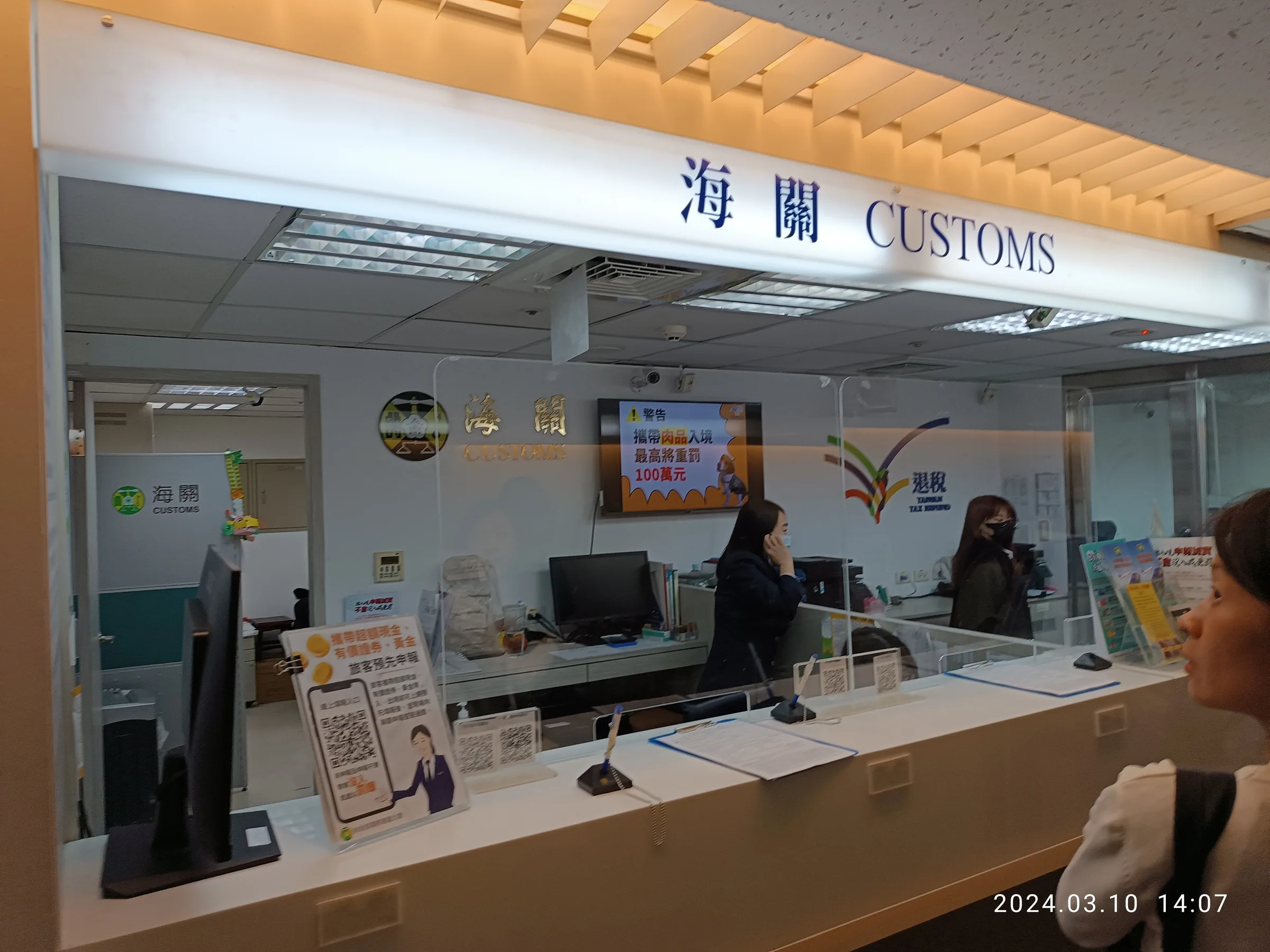
In March 2024, the customs counters in the arrival area of Terminal 1 at Taoyuan International Airport. The image shows passengers clearing customs; the article discusses personal online shopping packages, which follow a different express simplified declaration process, but both share the same institutional framework of "Customs." Photo: Meutnake Ah ManHO, Wikimedia Commons, CC0 1.0 (full source in the image credits at the end).
A phone buzzes, you press "Declaration Matches"
When the push notification pops up, you are likely doing something else. The title says there is an import customs clearance authorization pending confirmation. Clicking in reveals a string of incomprehensible alphanumeric product names, a customs broker name you’ve never heard of, and an amount: 1,870 NTD, just under the tax-exempt threshold. You confirm that this is indeed the item you ordered three weeks ago, press "Declaration Matches," and put your phone away. The whole thing takes less than ten seconds.
In the system, this ten seconds has a formal description. The Customs and Bureau of Customs describes it as follows: "First, the customs broker pushes cargo information to the public via the 'EZ Way' APP. After the public confirms that it matches the actual purchased goods and completes the online authorization, the customs broker then handles the subsequent customs clearance procedures" 1. In plain language, what you are pressing is not "I received the goods," but "I authorize this customs broker to declare this shipment to Customs in my name." This authorization itself is provided for in Article 22 of the Tariff Act 2, it’s just that in the past, it took the form of a paper document requiring a signature and a copy of your ID card.
That 1,870 NTD is not an arbitrary number: Import packages with a dutiable value of 2,000 NTD or less are exempt from customs duties, commodity tax, and business tax, a rule written into Article 7 of the Measures for Customs Clearance of Postal Packages Imported and Exported 3. The dutiable value is calculated as the actual price paid for the product plus shipping and insurance fees 4, not the product amount shown on the shopping cart page. Many people only discover that the tax-exempt allowance has been eaten up by international shipping fees at the checkout page. The same person can only use this allowance 6 times within half a year, recalculated separately for January–June and July–December 5. Between July 1, 2020, and August 23, 2020, in less than two months, 126,000 people had already used up their 6-time allowance 6.
Source: Article 7 of the Measures for Customs Clearance of Postal Packages Imported and Exported, Article 29 of the Tariff Act, Customs and Bureau of Customs press release, Liberty Times Net
On that screen, your power is limited to two buttons. The product name and amount are filled in by the customs broker; the consignee can only click "Matches" or "Does Not Match," and cannot change it themselves. In a Mobile01 discussion thread, users found that the declared product name and amount did not match what was actually purchased. Another netizen shared that after clicking "Does Not Match" and writing the correct amount in the remarks, the package still arrived normally without any obvious delay 7. All you can do is report a mismatch; whether and how it is changed still rests with the customs broker.
Starting March 1, 2026, this action changes from "confirm after goods arrive" to "cannot enter without prior confirmation": simplified declaration express goods for personal import must have pre-confirmation authorization completed before customs clearance 8. In early August, a Threads post brought this issue to the forefront. The original poster said they had used this app for years and only recently learned who operates it. The post accumulated over 4,000 likes, and the comments echoed the same astonishment hundreds of times: "So when I buy from iHerb, I have to go through a private company for customs clearance" 9.
The next day at noon, Peng Yingwei, Director of the Customs and Bureau of Customs, held a press conference. His first words were: "Recently, there have been three major misunderstandings about EZ Way on the internet, spreading misinformation." 10 To understand what these three misunderstandings are misunderstanding, we must first go back thirty-four years.
1992: Four Hours Condensed to Three Minutes, Then Packages Proliferated
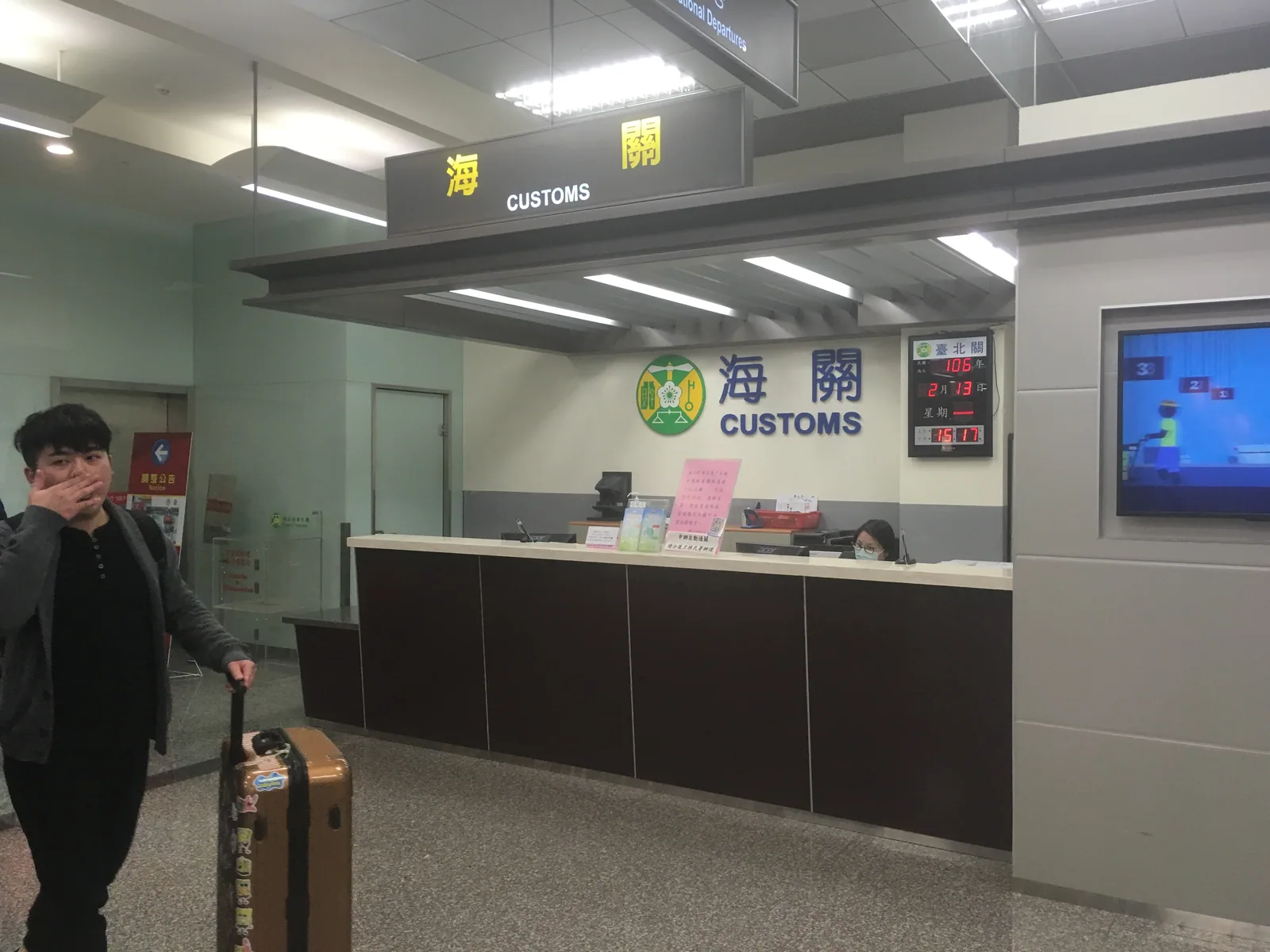
In February 2017, the Customs Service Counter at Taipei Songshan Airport. After the process moved to mobile phones, this physical window remained, but most people no longer stood in front of it. Photo: Yuriy Kosygin, Wikimedia Commons, CC BY-SA 4.0 (full source in the image credits at the end).
On November 9, 1992 (Republic of China Year 81), the record left by the Taipei Customs Office contained only one sentence: "This office officially implemented automated customs clearance for goods on November 9, 1992" 11. Before this day, a customs declaration form flowed manually between counters. After this day, the declaration form was transmitted online, and a computer expert system determined its path based on the manufacturer's level, origin, and the nature of the goods. The Ministry of Finance's own report card, as recorded in its historical exhibition room, stated: "For those cleared via C1 method, clearance time was reduced from 4 hours to the current 3 minutes" 12.
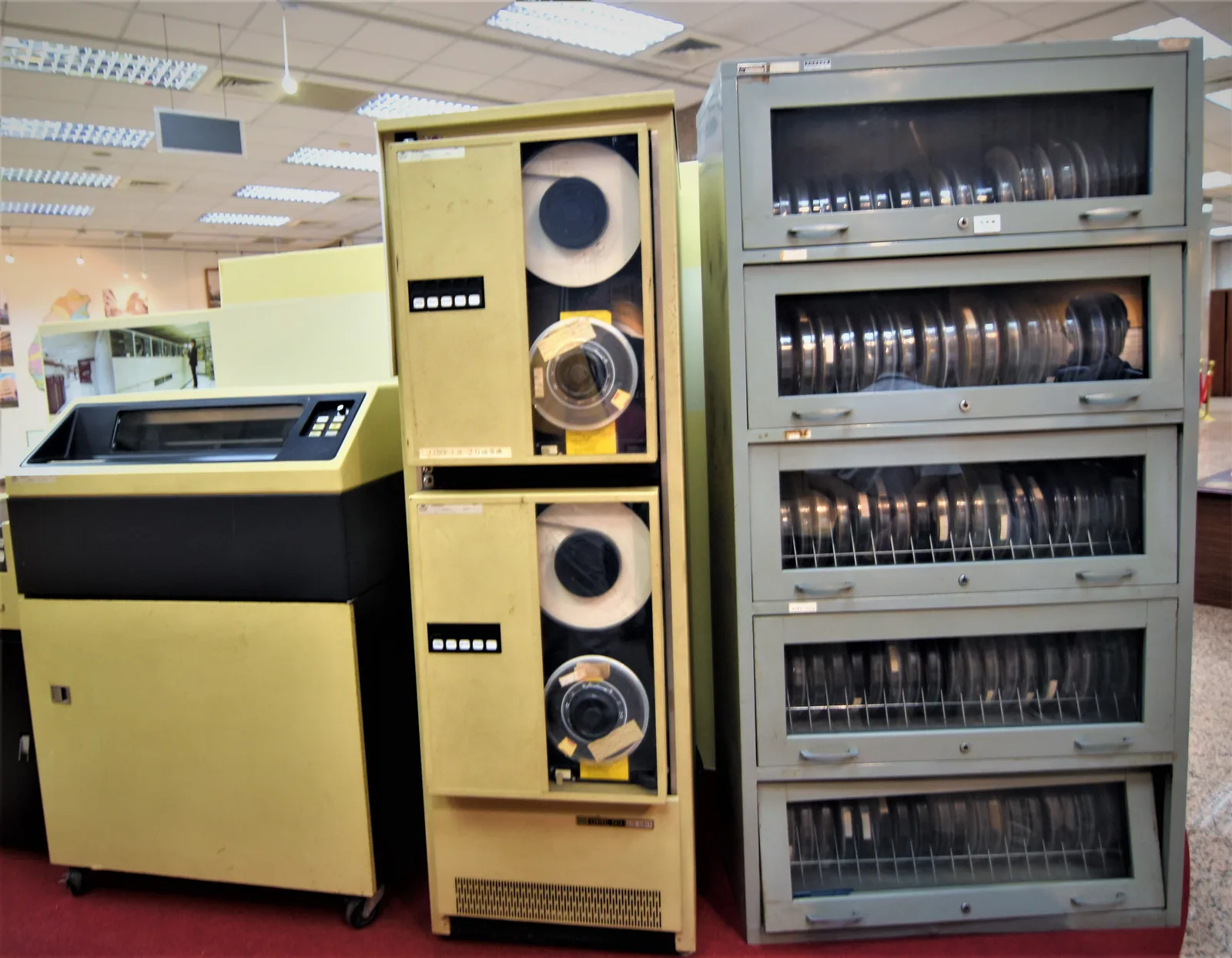
Magnetic tape drives and tape cabinets in the Customs Museum. When the declaration forms were moved to computers in 1992, data was stored in this type of equipment. Photo: Lin Gao-zhi, Wikimedia Commons, CC BY-SA 4.0 (full source in the image credits at the end).
The cost of condensing four hours into three minutes was handing over the decision of "whether to inspect" to the system for real-time determination. C1 is direct release without review or inspection; C3 is unpacking for inspection. Personal online shopping packages using simplified declaration only have these two outcomes, with no intermediate C2 document review. C2 is reserved for goods with a dutiable value exceeding NT$50,000 that must go through general declaration 13. Your package either gets released in three minutes or gets opened.
This design held for over twenty years, until packages multiplied. Ten years ago, Taiwan's annual imports of small packages were in the range of over 10 million; by 2024, they exceeded 58 million. While statistical methodologies across different agencies varied significantly, the direction was consistent. More critically, within the same statistics, the unit price: the average package value dropped from NT$1,396 in 2014 to NT$1,122 in 2024 14. A surge in volume coupled with declining unit prices is what low-value cross-border e-commerce looks like at the customs end.
The system began tightening repeatedly from here, and each time, the official rationale was the same: preventing impersonation in customs declarations. On June 15, 2018, the Ministry of Finance issued trial guidelines, officially opening trial operations for express delivery recipient real-name authentication and online authorization 15. Starting May 16, 2020, customs no longer accepted simplified declarations from individuals who had not completed real-name authentication registration nor submitted a paper-based authorization 16. Many consider this day the launch date of EZ WAY, but its true identity is the threshold day for "no authorization, no clearance." The subsequent three stages followed an expanding shape: in December 2021, it first targeted lists of those who had suffered impersonation or repeatedly ignored push notifications; in September 2022, it opened general public self-selection; in August 2023, it expanded the mandatory targets, until March 1, 2026, when it became mandatory for all 171819.
Over thirty-four years, this process shifted from "letting goods in faster" to "making people prove who they are first." Both statements are defensible. What remains unclear is: who is operating and maintaining the thing that proves your identity in the middle?
Source: Ministry of Finance Customs Bureau official pages, Ministry of Finance press releases, and regulatory decrees
Ministry of Finance Holds 36.11%, Customs Says "No Coercion"
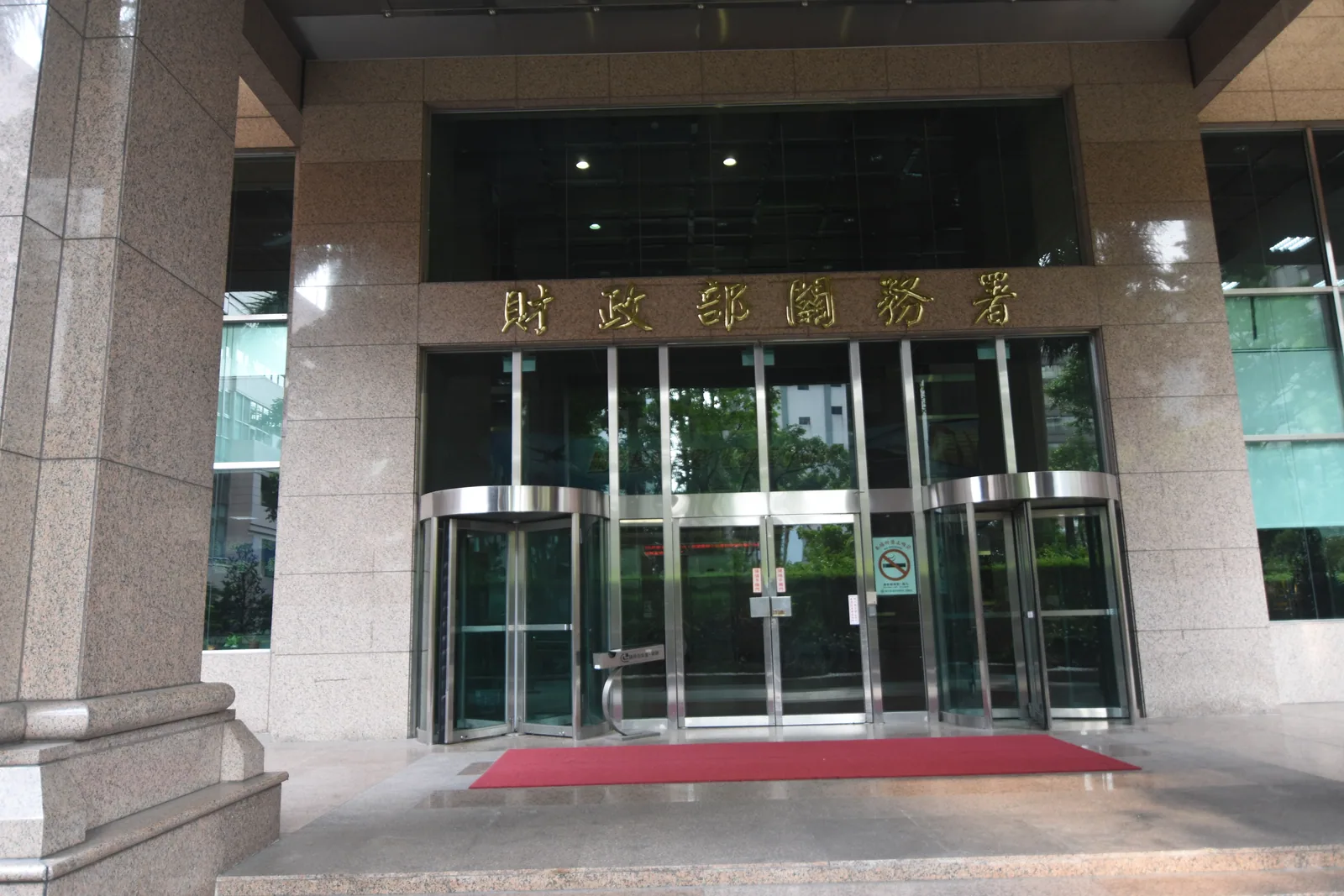
In August 2017, the front entrance of the Customs Administration Building. The controversy over EZ WAY’s governance and accountability asks precisely about the distance between this building and Trade and Customs Network. Photo: Lin Gaozhi, Wikimedia Commons, CC BY-SA 4.0 (full source in the image credits at the end).
At the press conference on August 3, the first thing Peng Yingwei sought to clarify was the issue of coercion: "The Customs Administration does not force citizens to use EZ WAY; it is merely one of the tools for citizens to confirm their authorization of customs brokers." The second point concerned personal data: "Previously, only paper-based authorization was available, which was prone to impersonation, so online authorization was introduced. After switching to online processes, citizens no longer need to provide photocopies of their ID cards to customs brokers." The third point concerned fees: "Currently, EZ WAY charges customs brokers, not the general public."10 Each of these three statements is backed by evidence.
The company behind the app is Trade and Customs Network, formerly known as the "Ministry of Finance Goods Clearance Automation Planning and Implementation Group." In August 1996, it transformed into a company jointly invested by the Ministry of Finance and private shareholders20, listed on the Taiwan OTC Exchange in 2000, and went public in 2011. The Ministry of Finance currently holds 54,162,436 shares, representing 36.11% of the total, making it the largest shareholder but without a majority21. Out of twelve board seats, the Ministry holds six22. Both the shareholding ratio and the board seats stop just short of a majority.
The volume of transactions handled by Trade and Customs Network is as follows: As of the end of July 2026, approximately 7.59 million people had registered for EZ WAY, with roughly 4 million import express goods simplified declaration forms processed through it each month, accounting for about 70% of all customs clearance cases21. One in three people in Taiwan has registered.
Source: Think Media (shareholding, registrations, and proportions), Mirror Weekly (board seats)
The prevailing narrative online is that “the government handed the personal data of 7.59 million people to a private company.” This claim has two factual inaccuracies. Customs and Bureau of Customs was not selected through a government procurement process: when online authorization was opened in 2018, another operator with the qualification to run a clearance network was Fan Yu E-commerce. Officials from the Customs Bureau recalled that “after evaluation, Fan Yu decided not to participate due to its own operational considerations, while Customs and Bureau of Customs decided to take over,” describing the latter as having essentially invested resources to “fight fires” first20.
The qualification itself was not obtained through a bidding process. The Regulations on the Management of Clearance Network Operation Licenses require a paid-in capital of NT$500 million, with review conducted by a review committee established by the Ministry of Finance, and qualification certification is renewed every five years23. The official clarification on August 3 relied precisely on this framework: operators with clearance network qualifications can develop their own apps independently without being designated by Customs; both Customs and Bureau of Customs and Fan Yu were on this list at the time24.
This process, mandatory for all citizens, has never had a budget allocated for it as public infrastructure. The door remained open; another qualified operator evaluated the situation and decided not to join, and no one else entered over the next eight years, leaving only one operator inside.
💡 Did you know
There is a way to use the service without this app, though it involves additional steps. When the official side reiterated on August 3 that EZ WAY is “just one of the tools,” the alternative solution provided was logging into the online authorization system via the Natural Person Certificate at the Single Window for Customs, Ports, and Trade24. Another option is paper-based: a 2020 Customs Bureau explanation page states that citizens can submit a paper power of attorney along with photocopies of both sides of their ID card to the customs broker handling the shipment, without the need to visit the customs office in person25. The official side has not issued further operational instructions of the same level regarding how these two paths will function after the new regulations take effect in 2026.
A metaphor circulating on PTT states: “You don’t need a passport to travel abroad for fun, but you won’t be able to pass through customs”26. After March 1, 2026, there is no legal provision explicitly requiring the use of EZ WAY. However, unless you have previously set up one of the two alternative paths mentioned above, ignoring the push notification will prevent your packages from leaving the warehouse.
Switching to online authorization indeed eliminates the step of handing over photocopies of your ID to customs brokers. However, that authorization data is now stored in the system of a listed company, not in a government agency’s system.
Fees of 0.8 to 3.5 NTD per Transaction
Customs charges brokers between 0.8 and 3.5 NTD per transaction. There are at least three different public explanations for how this range is tiered and which segments overlap, and they do not align with each other2728. Lin Dai-hua multiplied these fractions by the total volume: "Based on 60 million packages per year, almost every customs broker pays fees equivalent to the price of an imported car to the Customs and Bureau of Customs company every month"29.
The money comes from the brokers, but this cost is passed on to the declaration, ultimately being absorbed into the shipping fees or handling charges paid by consumers. "Not charging you directly" and "you not paying this fee" are not the same thing. During an inquiry at the Legislative Yuan's Committee of Finance, Lin Dai-hua pointed out directly that this statutory real-name authentication clearance system was outsourced for operation without even a single contract, allowing private operators to charge handling fees from the public and local small and medium-sized enterprises30. She is a legislator of the Democratic Progressive Party31, and the Customs and Bureau of Customs she questioned belongs to the same ruling system.
The official result most frequently cited is a downward-trending figure: impersonation clearance cases dropped from 1,723 in 2023 and 474 in 2024 to 39 in January–October 2025. This figure is widely circulated, but its source can only be traced back to secondary reports32. On the side raising doubts, there is also no actual incident of data leakage or penalty ticket to point to. The concerns in August targeted the "what if," not the "already."
💡 Did you know
"Impersonation" in this context has two meanings, with completely opposite directions. One is fraud groups pretending to be customs authorities sending text messages asking you to transfer money to pay taxes—government agencies' standard practice is to rely on official tax bills for tax payments, not links from text messages or social media apps to demand payment; suspicious messages can be verified or reported to the 165 National Anti-Fraud Network33. The other is when consolidation operators or customs brokers use your identity information for clearance without consent: Digital Times reported a real case where a consumer's goods were bundled with other packages for clearance by the consolidation operator without notification; another case involved the consolidation operator directly borrowing a client's name for clearance, while that client had not ordered that batch of goods34. Pre-authorization aims to prevent the latter type.
Who operates and charges fees for EZ WAY has been brought into the open for the first time in eight years. At the same time, another earlier threshold has been brought up again. This time, the government spoke first to make adjustments, and consumers only found out afterward.
The 2,000 NTD Threshold: Both Times, the Government Wanted to Lower It
On May 4, 2017, a netizen named “Duo Er” launched a proposal on the Public Policy Online Participation Platform titled “Opposition to Lowering the Duty-Free Threshold for Overseas Online Shopping to 2,000 NTD.” The rationale he provided contained no bureaucratic jargon, only a sentence that someone calculating the cost of living would say35.
✦ “National salaries are already low, and the government doesn’t even allow us to find affordable and practical goods abroad.”
Five thousand two hundred and twenty-six people signed the petition. The rationale for this reduction had been prepared the previous year: in 2016, the Legislative Yuan passed the third reading of the amended Article 49 of the Tariff Act, which simultaneously provided the legal basis for adjusting the duty-free limit and defining frequent imports within a half-year period363. The Ministry of Finance’s justification cited unfair competition between domestic and foreign businesses, a significant drop in tax collection costs, the tax evasion risk of domestic goods being re-imported (“reverse import”), and feedback from domestic businesses. The threshold was originally scheduled to take effect on September 1, 2017, but the Ministry of Finance later issued Announcement No. 1061018778 of the Ministry of Finance Customs Bureau on September 7, 2017 (Republic of China Year 106), setting the duty-free limit at 2,000 NTD and extending the official effective date to January 1, 201835. The five thousand-plus signatures bought only four months.
After the threshold was lowered to 2,000 NTD, it remained unchanged. In 2022, media outlets asked the Customs and Bureau of Customs whether it planned to adjust the threshold again. The response was: “If the low-price duty-free threshold is too high, it easily leads to situations of tax evasion and avoidance via the re-import of domestic goods,” but “there are currently no plans to adjust the upper limit of the low-price duty-free threshold”37.
On April 10, 2025, during a meeting of the Legislative Yuan’s Committee on Financial and Economic Affairs, Legislator Wu Ping-jui questioned the unfairness of this threshold to Taiwan’s manufacturing industry. Minister of Finance Chuang Chui-yun responded that they were “analyzing and considering it”38. Six days later, Legislator Guo Guowen proposed a recommendation: for source countries such as China that engage in low-price dumping, the threshold should be differentially lowered to 1,000 NTD. Chuang Chui-yun’s response was: “We will also take this direction into consideration”39. The same 2,000 NTD threshold: eight years ago, consumers blocked the government from lowering it; eight years later, the government itself wants to lower it, and this time the target of the reduction is restricted to specific source countries.
The numbers supporting this direction are as follows: China’s share of small-value duty-free express delivery declarations under 2,000 NTD rose from 50.4% to 64.4% over the past three years; combined with Hong Kong, the total exceeds 88%40.
During the same period, other countries were also dismantling their own thresholds. The United States eliminated it entirely, and the EU introduced transitional tariffs, both citing the same rationale: low-price duty-free was originally designed to allow goods to enter quickly, but it is now being treated as a loophole414243. Japan taxes items below 10,000 JPY, and South Korea sets a general goods threshold at 150 USD. Looking at these thresholds together, Taiwan’s 2,000 NTD (approximately 63 USD) is clearly the lowest on this list4445.
Source: White House Executive Order 14324, EU Council, Japan Ministry of Finance Customs and Tax Agency, Korea Customs Service practical guidelines, and Taiwan’s Measures for Customs Clearance of Postal Packages Imported and Exported. Non-USD currencies are converted based on approximate exchange rates for magnitude comparison only.
📝 Curator’s Note
Most reports frame the Ministry of Finance’s actions as “canceling the duty-free allowance.” In reality, what is being deliberated is a differential reduction to 1,000 NTD for specific source countries. This seemingly technical distinction exposes the dilemma faced by decision-makers: they want to block low-price packages without disrupting the existing convenience for consumers buying from Europe, the US, and Japan. Thus, they have chosen a more precise, yet more difficult-to-execute, solution. How are source countries determined? What about goods that arrive via a third location first? The more precise the threshold, the more the execution costs pile up at the customs frontline—and in both rounds of debate, no one calculated those costs for the public.
In both rounds of proposed threshold reductions, the official rationale included the phrase “feedback from businesses.”
Official Press Conferences, Others Left with "According to Reports"
The Customs Bureau’s press conference on August 3 concluded at noon, and by the afternoon, major media outlets had full, quotable clarifications ready for use. The Taipei Times published an English report the same day, translating the commissioner’s statements sentence by sentence, ensuring that even those who do not read Chinese could verify what was said46. In this debate, the voices of other participants were far quieter.
Among legislators, there were inquiries, but what circulated were mostly sentences curated by reporters. What Lin Dai-hwa said during the Fiscal Affairs Committee session, readers encountered only in summarized form30.
The local manufacturing sector was mentioned most frequently, yet it spoke the least. When the threshold was lowered in 2018, the Ministry of Finance cited "feedback from domestic businesses" as a reason. When the issue was raised again in 2025, officials and legislators on the inquiry stage still referred to "industry reports of unfair competition." Yet, which specific businesses these were remained unnamed on both occasions. From the entry of Shein and Temu into the Taiwan market to the present, no business associations, retail councils, or manufacturing guilds have stepped forward to speak on the record.
Frontline customs officers were even quieter. The Customs Bureau published data on the number of X-ray interpreters: as of 2023 (ROC 112), there were 368 junior, 591 mid-level, and 184 senior staff. The same document showed that the number of seized drug cases increased from 355 in 2018 (ROC 107) to 558 in 2023 (ROC 112)47. Over the past decade, the volume of packages grew from over ten million to more than 58 million. The same few hundred people continue to stare at screens analyzing images, yet there is no union statement and no named customs officer to describe what this job has become.
Forwarding agents and personal shoppers appeared in the news almost exclusively when they were caught: packages bundled together for smuggling clearance, or declarations made under others’ names. When the duty-free threshold is truly lowered, the first group to have their business squeezed will be these very people. Yet, throughout the entire debate, they did not utter a single word themselves.
As for consumers, the 2017 round left behind 5,226 signatures of support and a proposal text that can be quoted verbatim. In the 2025–2026 round, the loudest voices were a Threads post with over 4,000 likes and a barrage of one-star reviews in the App Store: failures in ID verification, cumbersome registration processes, and unreachable customer service48. This round had no petitions, no polls, and no named individuals.
Source: Public Policy Participation Platform proposal page, China Times News Network, App Store Taiwan region
The unaccounted items are not just money, but also words. Regarding money, using the most common estimate: 0.8 to 3.5 NTD per item, 58 million items annually, passed through multiple layers. Regarding words, they are even harder to trace: after this debate ends, future readers will only be able to find the complete statements left by one side.
📝 Curator’s Note
This asymmetry is not anyone’s malice. Institutions holding press conferences can deliver three sentences to every media outlet on the same day, ensuring even English readers can verify what was said; those without press conferences must wait for others to relay their messages, and those relayed versions distort, disappear, and become unsearchable after six months. In a debate, it may appear that all sides’ positions are present, but the thickness of the remaining records differs by several levels: the gap lies not in who is more reasonable, but in who has the capacity to leave their words behind.
The First Answer Is Due by the End of October
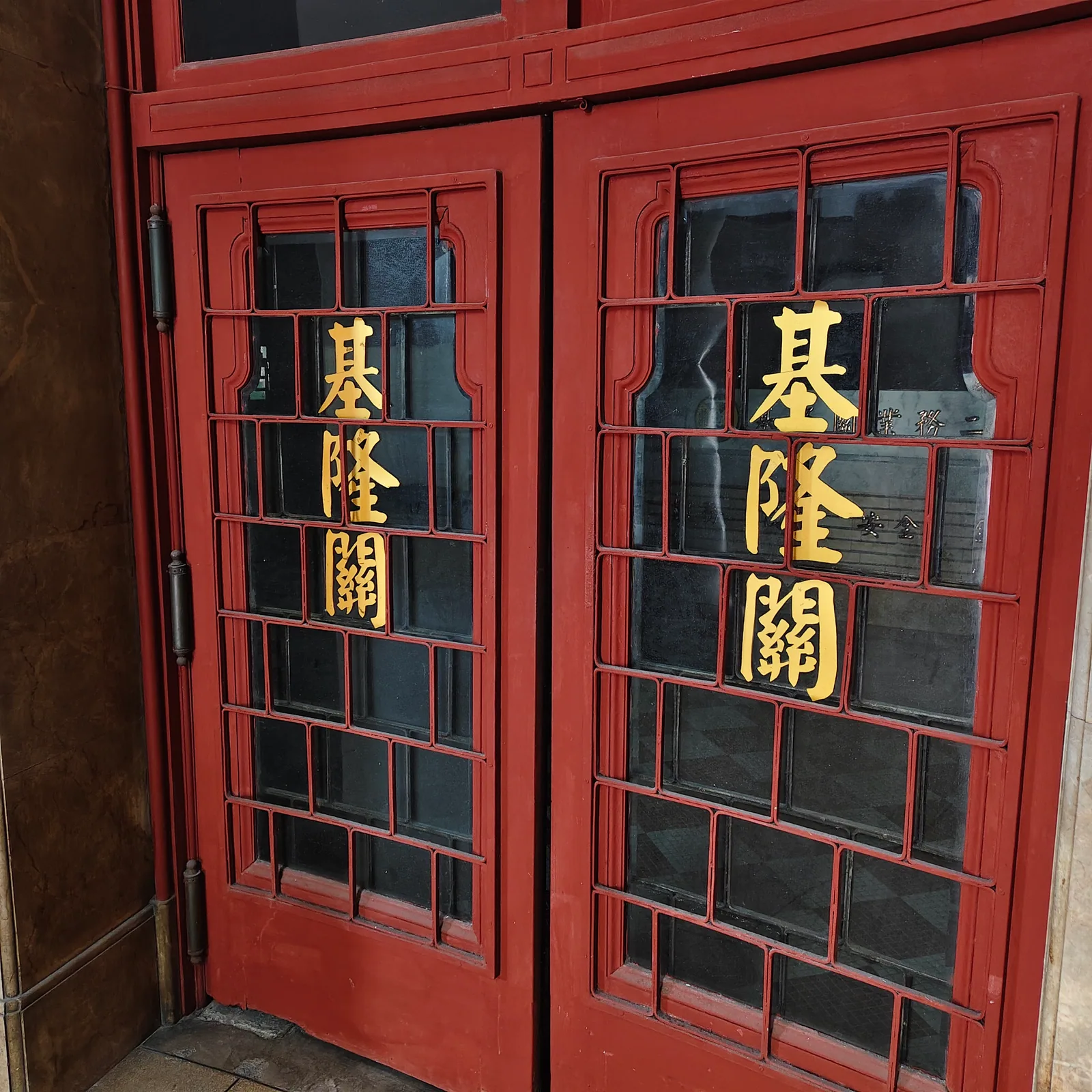
The entrance to the Keelung Customs House of the Taiwan Customs Administration, Ministry of Finance, in March 2026. The review report due by the end of October will determine who is responsible for and pays for the functions behind this door. Photo: Qiu Qing, Wikimedia Commons, CC0 (full source in the image credits at the end).
Peng Ying-wei pledged at the Legislative Yuan's Fiscal and Financial Committee on July 29 that a special review report would be submitted within three months, evaluating whether to incorporate EZ WAY into national public infrastructure and allocate government budget for it27. At a press conference on August 3, he reiterated this commitment while clarifying that this does not mean the government would automatically take over operations as a public enterprise49. Counting three months from the end of July, the deadline falls at the end of October.
The other line of inquiry remains open: the differentiated reduction of the NTD 2,000 duty-free threshold is still under discussion. As of August 2026, the Ministry of Finance has not officially announced any adjustments, maintaining the current NTD 2,000 limit and six-times-per-half-year rule50. Meanwhile, the US line of inquiry was already closed on August 29, 2025, and the EU line began charging EUR 3 per item starting July 1, 2026.
The two lines have reached different points today: one has a deadline, the other does not. EZ WAY faces scrutiny from legislators, commitments from the commissioner, and a report due by the end of October. The duty-free threshold remains stuck at the word "under discussion," with no deadline and no one pressing for answers in committee.
The next time your phone vibrates and a push notification appears, you will still tap "Declare Consistent." The difference is that this time you know what lies behind that button: a listed company's server, a NTD 500 million qualification threshold, and a fee that gets passed on to you through shipping costs. These things have existed for eight years, only to be laid bare on a press conference table for the first time after a post went viral. By the end of October, the answers will be returned to that same table.
🧬 What Semiont was thinking while writing this
Further Reading:
- Taiwan's E-Commerce and Digital Payment Ecosystem — The broader context of low-priced cross-border e-commerce platforms like Shein and Temu in the Taiwan market
- Taiwan's International Trade Policy — The broader context of the duty-free threshold debate: how Taiwan does business with the world
- Taiwan Companies: Chunghwa Telecom — Another state-owned enterprise with government shareholding but private operation, offering a comparative governance model
Image Credits
This article uses 5 public domain / CC-licensed images, all cached in public/article-images/lifestyle/ to avoid hotlinking to source servers:
- Taiwan Taipei Taoyuan Airport Terminal One Arrival Area Customs Counter March 2024 — Photo: Meutnake Ah ManHO, 2024-03-10, CC0 1.0 (hero)
- Customs in Taipei Songshan Airport — Photo: Yuriy Kosygin, 2017-02-13, CC BY-SA 4.0 (inline 1)
- Customs Museum Tape Recorder and Tape Cabinet 20170818b — Photo: Lin Gaozhi, 2017-08-18, CC BY-SA 4.0 (inline 2)
- Ministry of Finance Customs Bureau Customs Building Main Entrance 20170818 — Photo: Lin Gaozhi, 2017-08-18, CC BY-SA 4.0 (inline 3)
- Ministry of Finance Customs Bureau Keelung Customs Entrance — Photo: Qiu Shi, 2026-03-22, CC0 (inline 4)
References
- Personal Import Express Goods Subject to Pre-Appointment from March 1 — Economic Daily News report from December 2025, verbatim recording the Customs and Bureau's official definition of 'pre-confirmation appointment,' which is the key sentence for understanding that 'clicking declare match' legally equals online appointment.↩
- Tariff Act Article 22 — Text from the National Regulations Database, stipulating that 'customs declaration, tax payment, and other procedures for goods may be entrusted to customs brokers,' serving as the legal basis for the customs broker appointment relationship.↩
- Measures for Customs Clearance of Postal Packages Imported and Exported Article 7 — Original text from the National Regulations Database, stipulating that goods with a dutiable value of NT$2,000 or less are exempt from tariffs, goods tax, and business tax, excluding tobacco, alcohol, and tariff-quota agricultural products; last amended on April 1, 2020 (Republic of China Year 109).↩2
- Tariff Act Article 29 — Legal basis for dutiable value, listing six categories of costs to be included beyond the transaction price (commissions, handling fees, packing costs, royalties, freight, loading/unloading fees, insurance, etc.); personal low-value packages usually only involve product price, freight, and insurance, which is the simplified scenario adopted in this article.↩
- Ministry of Finance Customs Bureau: Low-Value Tax-Exempt Packages Limited to 6 Times per Half Year — Customs Bureau press release from August 25, 2020, verbatim stating that tax-exempt clearance for dutiable values under NT$2,000 for the same taxpayer is limited to 6 times per half-year, and announcing the addition of 'Import Frequency Data Query' to the Customs-Port-Trade Single Window.↩
- 126,000 People Used Their Half-Year 6-Time Tax-Exempt Quota Within Two Months — Liberty Times Net report from August 26, 2020, recording that from July 1 to August 23, a cumulative 980,000 imports of low-value tax-exempt packages occurred, with 126,000 people reaching the limit, indicating this rule affects general online shoppers rather than just proxy buyers.↩
- Mobile01: Discovered Customs Broker Declared Amount Mismatch in EZ Way — Online forum discussion thread (personal experience sharing, not formal statistics), where a user found the declared item amount by the customs broker did not match the actual amount, with only 'match/mismatch' options available; after selecting mismatch, the package still arrived normally.↩
- Ministry of Finance: Full Implementation of Pre-Confirmation Appointment for Personal Import Starting March 1, 2026 — Ministry of Finance press release from February 24, 2026, announcing the full implementation of pre-confirmation appointment for personal import simplified declaration express goods, with legal basis in the amended Air and Sea Express Goods Customs Clearance Measures.↩
- Only Learned After Years It Is Operated by a Private Company — China Times News Network report from August 3, 2026, compiling the original Threads post (accumulating over 4,000 likes) and netizens' comments, including reactions like 'I realized I have to declare customs with a private company when buying from iHerb'; the original post link was not publicly disclosed by media, this article cites the reported version.↩
- Customs Bureau Director Peng Yingwei Press Conference: Three Misunderstandings About EZ Way — Liberty Times Net report from August 3, 2026, covering the Customs Bureau's noon press conference, recording the full wording of Director Peng Yingwei's three clarifications (not mandatory use, online appointment prevents personal data leakage, charges only to customs brokers).↩2
- Ministry of Finance Customs Bureau Taipei Customs: Evolution of Automated Goods Clearance — Taipei Customs official page, verbatim recording the formal implementation of automated goods clearance on November 9, 1992 (Republic of China Year 81). The online流传 claim of 'Third in Asia, following Japan and Singapore' does not appear on this page or other official evolution pages; this ranking is not used in this article.↩
- Ministry of Finance Fiscal History Exhibition Room: Automated Goods Clearance — Ministry of Finance official historical page, recording the research and drafting in 1990 (Republic of China Year 79), air cargo automation in November 1992 (Year 81), and sea cargo automation on June 19, 1995 (Year 84), leaving the official performance statement: 'For all C1 method clearances, clearance time was reduced from 4 hours to the current 3 minutes.'↩
- Regulations for Simplified Declaration Clearance of Air Express Goods — Text from the Ministry of Finance's Shared System of Competent Regulations, defining X1 documents, X2 low-value tax-exempt (under NT$2,000), X3 low-value taxable (NT$2,001 to NT$50,000), and X4 high-value categories, stipulating that simplified declaration only applies to C1 release and C3 inspection, without C2 document review.↩
- Analysis of Taiwan Cross-Border E-Commerce Trade Data — Future Circulation Institute business data infographic, statistics showing imported small parcels grew from 15.82 million in 2014 to 58.47 million in 2024, with average parcel unit price dropping from NT$1,396 to NT$1,122; since statistical口径s vary among institutions, this article uses the magnitude phrasing of 'over 58 million parcels'.↩
- Implementation Points for Trial Real-Name Authentication of Express Goods Consignees and Online Customs Broker Appointment — Ministry of Finance Order No. 1071013202 dated June 15, 2018 (Republic of China Year 107), which is the legal basis for the trial opening of EZ WAY online appointment, proving online appointment started in 2018 rather than the 2020 date commonly reported.↩
- Taiwan Customs: Real-Name Authorization APP (EZ Way) — Official English page of the Customs and Bureau of Customs, Ministry of Finance, explicitly stating that from May 16, 2020, customs will no longer accept simplified declarations from those who have not completed real-name registration or submitted paper authorization forms, clarifying the April 16 version circulating online.↩
- Customs and Bureau of Customs: Pre-Authorization for Customs Declaration — Official explanation page of the Customs and Bureau of Customs, recording that the first phase of pre-authorization was implemented for a specific list starting December 28, 2021 (Republic of China year 110), and the second phase (2.0) opened for public self-selection starting September 15, 2022 (Republic of China year 111).↩
- Pre-Authorization 3.0 Launched to Prevent Impersonation in Customs Declarations — Customs and Bureau of Customs press release from August 2023 announcing the launch of Pre-Authorization 3.0 and the expansion of applicable subjects; upon verbatim verification, this release contains no annual statistical data on impersonation cases.↩
- Cracking Down on Impersonation in Customs Declarations, Customs to Fully Implement Pre-Authorization Next Year — Ministry of Finance press release from December 17, 2025, stating that the Customs and Bureau of Customs has been promoting pre-authorization in phases since 2021, with over 80% coverage by November 30 of that year; this release also does not contain the frequently cited case figures of '1,723/474/39'.↩
- Trade and Customs Network: From Ministry of Finance Planning Group to Listed Company — ETtoday Financial Cloud report from August 3, 2026, recording that the predecessor of Trade and Customs Network was the Ministry of Finance Goods Clearance Automation Planning and Promotion Group, which transformed into a private enterprise in August 1996, and quoting Customs and Bureau of Customs officials discussing Fan Yu E-commerce's assessment and non-participation, and the institutional origins of Trade and Customs Network 'acting as a first-responder to save the situation'.↩2
- EZ Way Registered by 7.59 Million People, Is Personal Data Safe? Who Pays the Fees? — Vision Magazine report from August 3, 2026, recording that the Ministry of Finance holds 54,162,436 shares of Trade and Customs Network, accounting for 36.11% ownership; EZ WAY has approximately 7.59 million registrations, processes over 4 million simplified declaration forms monthly, accounting for about 70% of customs declaration cases, with a fee range of 0.8 to 3.5 RMB per transaction.↩2
- Trade and Customs Network Board of Directors: Ministry of Finance Holds 6 of 12 Seats — Mirror Weekly report from August 3, 2026, supplementing the board structure and market share of Trade and Customs Network, and recording that Fan Yu E-commerce, which has operational qualifications, 'had no intention to operate,' leading to the situation where a single operator actually runs the business.↩
- Regulations on the Management of Clearance Network Operation Licenses — Text from the National Regulations Database, formulated according to Article 10, Paragraph 5 of the Tariff Act; Article 4 requires applicant operators to have a paid-in capital of NT$500 million, and Article 6 stipulates that the Ministry of Finance may establish a review committee for examination, serving as the legal basis for the franchise system of clearance network operators, not a bidding procedure under the Government Procurement Act.↩
- Customs and Bureau of Customs: Qualified Operators Can Build Online Authorization APPs — ETtoday report from August 3, 2026, recording the content of a press conference, verbatim documenting the official response to monopoly concerns within the framework of 'qualification certification, reviewed every 5 years,' and explaining that the public can use the Natural Person Certificate to authorize online through the Customs, Port, and Trade Single Window, not just through EZ WAY.↩2
- Customs and Bureau of Customs: Explanation of Real-Name Authentication for Express Delivery Recipients — Official page of the Customs and Bureau of Customs from March 18, 2020, explicitly stating that the public can still use paper authorization forms and photocopies of the front and back of their ID cards for express delivery operators to handle clearance, meaning customs declaration authorization maintains a dual-track system of paper and online.↩
- PTT Gossip Board Discussion: What If We Don't Use EZ Way? — PTT discussion thread transcript (online public opinion, not official or named statements), recording metaphors like 'there is no mandatory requirement for a passport when traveling abroad, you just cannot pass customs,' reflecting the public sentiment of 'voluntary in name, mandatory in practice.'↩
- Customs and Bureau of Customs Promises to Submit Special Review Report Within 3 Months — Public Television News report from July 30, 2026, recording that Director General Peng Yingwei promised to submit a review report within three months on whether to include it in national public infrastructure, and providing an alternative description of the fee structure (3.5 RMB confirmation fee plus 0.8 RMB service fee).↩2
- Guarding for Ten Million Online Shoppers: Lin Daihua Exposes EZ Way Fee Transfer Chaos — Yahoo News reposted report, recording the fee version stated in Lin Daihua's office inquiry materials: 'SFTP information connection requires an additional monthly fee of 2,500 RMB and a service fee of 0.8 RMB per transaction'; the original report does not clearly state whether the tiered confirmation fee is the same cost.↩
- Legislator Lin Daihua Inquires About EZ Way Fee Structure — TVBS report from July 2026, recording Legislator Lin Daihua's inquiry in the Legislative Yuan's Financial and Economic Committee, including cost estimates based on '60 million parcels per year' and claims that tiered fees are disadvantageous to local small and medium-sized customs declaration operators.↩
- Legislator Lin Daihua: Statutory System Outsourced for Operation Without a Contract — Mirror Weekly report from August 3, 2026, organizing Lin Daihua's doubts about EZ Way's outsourced operation and fee transfer, as well as reactions on social media; the full verbatim transcript of the inquiry is not available in publicly circulated reports, so this article is handled at the 'according to reports' level.↩2
- Lin Dai-Hwa — Wikipedia entry stating that Lin Dai-Hwa's current political party is the Democratic Progressive Party.↩
- Overseas Online Shopping: Packages May Be Returned If This Step Is Missed — Wind News report identifying the source of the figures '1,723 in 2023, 474 in 2024, and 39 from January to October 2025'; the article itself does not cite a specific source, and cross-checking with MOF and Customs Bureau press releases from December 2025 and August 2023 respectively yielded no match for these three numbers.↩
- 165 National Anti-Fraud Network — The official anti-fraud portal of the Ministry of Interior's Police Administration Bureau, used to verify and report SMS/phone scams impersonating government agencies (including Customs); the former Customs Bureau anti-fraud page (old customs.gov.tw domain) is now defunct and redirects to this general government anti-fraud resource.↩
- Taobao Customs Clearance: Deep Waters in Consolidated Shipping — Digital Times report documenting cases where consumers' goods were bundled with other packages by consolidators without notification for customs clearance, resulting in strangers' names appearing on packages, highlighting regulatory loopholes in the intermediary stage despite real-name systems.↩
- Citizen Proposal: Opposition to Reducing the Duty-Free Threshold for Overseas Online Shopping to 2,000 NTD — Official page on the Public Policy Online Participation Platform for a proposal by user 'Duo Er' on May 4, 2017, with 5,226 co-signers, recording government responses and the policy's implementation on January 1, 2018.↩2
- Legal Basis and Timeline for Lowering the Duty-Free Threshold for Online Shopping to 2,000 NTD — TechNews report from May 24, 2017, explaining that the Legislative Yuan's 2016 amendment to the Tariff Act provided the legal basis for the reduction, and detailing the Ministry of Finance's original implementation schedule of September 1, 2017.↩
- Comparison of Duty-Free Thresholds in 14 Countries and Customs Bureau Response — Current Magazine report from October 2022, recording the Customs Bureau's written stance at the time: low duty-free thresholds risk reverse imports and tax evasion by domestic goods, but there were no plans to adjust the cap then, with future adjustments dependent on international trends; this reflects the 2022 context, differing from the renewed deliberations post-2025.↩
- Ministry of Finance: Analysis Underway for the 2,000 NTD Duty-Free Threshold on Packages — CNA report from April 10, 2025, covering a Legislative Yuan Financial and Economic Committee inquiry where Legislator Wu Bing-Ruei questioned unfairness to domestic manufacturing, recording Minister of Finance Chuang Tsui-Yun's response and the Customs Bureau's establishment of a 'Task Force for Strengthening Inspection of Illegal Transshipment' as a supporting measure.↩
- Finance Minister: Direction to Lower Threshold for Low-Price Dumping Source Countries Will Be Considered — CNA report from April 16, 2025, recording the Ministry of Finance's deliberation on differentially lowering the duty-free threshold to 1,000 NTD for specific source countries like China, and Minister of Finance Chuang Tsui-Yun's response; as of August 2026, no final decision has been made.↩
- China's Share of Small-Value Duty-Free Declarations Rises from 50.4% to 64.4% — Commercial Times report from April 17, 2025, serving as the only traceable source for these ratios (no second independent source found for verification), also noting that Mainland China and Hong Kong combined account for over 88%.↩
- Executive Order 14324: Suspending Duty-Free De Minimis Treatment for All Countries — Official text of the White House executive order, signed July 30, 2025, and effective August 29, suspending duty-free treatment under 19 U.S.C. 1321(a)(2)(C) regardless of value, origin, transport method, or customs channel.↩
- EU Council Final Approval of New Tariff Regulations for Small Parcels — Official press release from the Council of the European Union dated February 11, 2026, confirming a 3 EUR transitional tariff per tariff subheading for parcels under 150 EUR starting July 1, maintained until the EU Customs Data Centre goes online in 2028.↩
- WCO News: E-commerce at a Turning Point — A 2025 special article by the World Customs Organization explaining that the international perception of low-value duty-free (de minimis) has shifted from a facilitation tool to a controversial loophole, and detailing the pressure on customs risk management and revenue from fragmented low-value parcels.↩
- Japan Ministry of Finance Customs Bureau: Tax Exemption for Small-Value Imports — Official Q&A page from Japanese Customs, stating that customs duties and consumption tax are generally exempt for total taxable prices of 10,000 JPY or less; the official text notes that actual exemption depends on item type and use, with this article reflecting general cases.↩
- South Korea Duty-Free Threshold Explanation for Overseas Direct Purchases — Customs rule explanation compiled by a Korean financial service provider, recording general goods at a 150 USD threshold and catalog clearance for self-imported goods via express carriers from the US at a 200 USD threshold; amounts exceeding the threshold are fully taxed.↩
- Customs Defends EZ WAY App Amid Privacy Concerns — A Taipei Times English report from August 3, 2026, translating Commissioner Peng Yingwei's three-point clarification sentence by sentence, serving as the only record with complete cross-language documentation in this controversy.↩
- Customs Administration: Tiered System for X-ray Inspection Interpreters — An official press release from the Customs Administration detailing the number of tiered interpreters (368 junior, 591 mid-level, 184 senior as of 2023) and the increase in seized drug cases from 355 in 2018 to 558 in 2023, without addressing per-person hourly interpretation workload.↩
- EZ WAY App Store Page and User Reviews — The Apple App Store Taiwan page, which has accumulated numerous one-star reviews focusing on ID recognition failures, cumbersome registration, login issues, customer service responses, and difficulties for elderly users, representing the most concentrated public feedback from consumers.↩
- Customs Administration: No Statement to Immediately Reclaim EZ WAY as Public Enterprise — A China Times News Network report from August 3, 2026, recording Commissioner Peng Yingwei's testimony at the Legislative Yuan's Fiscal and Financial Committee on July 29, 2026, and the official clarification regarding the framework of 'reclaiming as a public enterprise'.↩
- Ministry of Finance: While Overseas Online Shopping Is Easy, Frequent Imports Require Attention — A Ministry of Finance press release from October 2024, reiterating the tax exemption principle for goods under NT$2,000 and the limit of six times per half-year, which can be compared to the unchanged existing system during the 2025–2026 deliberation period.↩