
30-Second Overview: In 1931, the Chia-Yi Agricultural and Forestry School baseball team represented Taiwan at Japan’s Koshien tournament, becoming the first Taiwanese team to reach the finals of the summer tournament, ultimately finishing as runners-up. The team included Han, Indigenous, and Japanese students. This is not merely a sports story of an underdog’s triumph; it is also a story of how, under colonial rule, a group of students were arranged to play on the same field, and how the entire island came to treat the outcome as its own concern. 1 2 3
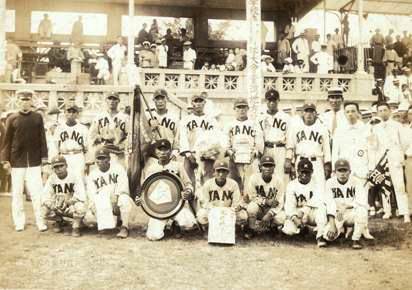
_Caption: Group photo of the 1931 Kano baseball team. Wikimedia Commons, Public domain. Archive page.*
On July 23, 1931, Taipei’s Yuanshan Stadium was packed with approximately 15,000 spectators. Chia-Yi Agricultural and Forestry defeated Taipei Commercial High School 11–10 in the Taiwan representative final, securing their ticket to Japan’s Koshien Stadium. On the same day, radios broadcast the game’s audio across the island. On August 21, they lost to Aichi Commercial High School in the Koshien final, becoming the runners-up. This team, which never won the championship, would forever be known as “The Greatest Kano” (Tenka Kano). 1 2
This contrast is worth placing on the table: Kano’s most significant match was not a victory, but a “so close” runner-up finish. It allowed Taiwan to appear on the national stage of the Japanese Empire, prompting later generations to constantly ask: who was actually being seen at that moment—Taiwan, Chia-Yi, or just a school team that happened to play well?
An Agricultural and Forestry School Finding a Common Language on the Red Dirt
Chia-Yi Agricultural and Forestry School was founded in 1919 with the mission of cultivating agricultural talent. The baseball club was established in 1928. Baseball was originally a leisure sport for Japanese people in the colony; after 1919, it was incorporated into school physical education, allowing Taiwanese students to gradually gain access to the sport. The Taiwan Physical Education Association was founded in 1920, bringing more fixed organization to island-wide competitions. Based on compiled oral histories, the introduction of baseball to Taiwan was closely linked to Japanese colonial rule. It first entered schools and the Japanese community, then was taken up by Taiwanese students for competition and practice, eventually growing into a sport no longer belonging solely to the colonizers. 2 3 4
Kano’s uniqueness does not lie in the “natural” mixing of three ethnic groups. The composition of Han, Indigenous, and Japanese students described in official exhibitions occurred within the school and competition frameworks provided by the Japanese colonial system. Players still lived within different hierarchies of identity. The field allowed them to be on the same team, but it did not thereby erase the colonial power gaps. 3 5
This is where the concept of “Three-Ethnic Harmony” is most easily flattened. It can be a beautiful name coined by later generations for their cooperation, but it cannot be retroactively applied as evidence of an equal society at the time. The weight of Kano’s story lies precisely in the coexistence of brief joint combat and the institutional inequality outside the field.
Coach Hideo Kondo was originally the Koshien coach at Matsuyama Commercial High School in Japan. Records from the Chia-Yi City Memory Bank note that players recalled his training as nearly Spartan: repetitive daily practice, grinding basic movements until there were no gaps, and then identifying each player’s unique talents. Kondo did not hand students a set of “hot-blooded” slogans; instead, through extremely concrete training, he transformed a team that struggled to win a single game into one capable of surviving island-wide competition. 2 6
Curator’s Note: The Kano spirit is not “everyone succeeds if they just work hard.” It is more like a question: When the rules are not written by you, can you still develop your own style within them?
Wu Ming-jie’s Hand, Securing Taiwan’s Representative Right for Kano
In July 1931, Kano first played in the Taiwan selection tournament at Taipei’s Yuanshan Stadium. Pitcher Wu Ming-jie threw a shutout against Taipei First High School; official records cite this as the first perfect game in Taiwanese baseball history. On July 23, Kano defeated Taipei Commercial High School 11–10, securing the right to represent Taiwan. 1 2
That final match was not a clean line of victory. Kano relied on defense, speed, and a comeback built point by point to secure the final berth against Taipei Commercial. Photos preserved by National Chiayi University show Lo Pao-nong scoring at home plate, Wu Ming-jie receiving awards, and players returning to Chia-Yi to offer thanks at the Chia-Yi Shrine. These photos pull the abstract title of “representing Taiwan” back into the reality of a group of people wearing jerseys. 1
After securing the representative right, the team departed from Keelung on August 5 aboard the Takachiho Maru for Japan. In this journey, there is an element easily overlooked by cinematic narratives: the players did not depart from an abstract “Taiwan,” but from Keelung Port, carrying the expectations of their school, families, and Chia-Yi’s local society, heading toward a field defined by the rules of Japan’s national tournament. 1 6
The Koshien tournament opened on August 13. Kano successively defeated Kanagawa Commercial and Industrial, Sapporo Commercial, and Kokura Industrial, entering the final on August 21. Historical photos from National Chiayi University record their lineup before the final and their appearance receiving the runner-up shield. 1 5
In the final, they lost to Aichi Commercial High School, failing to bring the victory flag back to Taiwan. But “runner-up” was not a consolation prize at the time: it was the first time a Taiwanese team reached the final of the Koshien Summer Tournament, and the furthest any colonial students had gone on the Japanese national stage. Indigenous literature documents that four of Kano’s starting nine players came from Taitung; Lo Pao-nong also became a key hitter for the tournament with a .533 batting average. 5
Koshien Is Not a Neutral Field
Writing Kano as “Taiwanese defeating Japanese” is dramatic but inaccurate. Kano faced Japanese schools in both the Taiwan selection and at Koshien, and was named, trained, and represented within the colonial system. The team’s Japanese students, coaches, and Taiwanese students cannot be simply placed into two opposing camps. 3 6
Similarly, writing it as “the colonial government successfully created three-ethnic fusion” is incomplete. Research on the film KANO points out that the movie made Kano an object of discussion for post-colonial identity. The cooperative values depicted in the film provide imagination for Taiwanese subjectivity, but also require confronting how it reorganizes the experience of Japanese colonialism. 7
This contradiction need not be smoothed over. Kano’s runner-up status can simultaneously be a product of colonial rule, the effort of Taiwanese students, a moment when Indigenous players were conscripted and seen, and the starting point for later Taiwanese to repurpose an external system into collective memory. History is not a binary choice between “glory” and “oppression.” It often ties both things to the same ball.
After the Team Left, the Story Remained in Taitung and Chia-Yi
Kano’s influence did not stop when the 1931 final whistle blew. Records from Chia-Yi City note that Chen Geng-yuan returned to Taitung to teach children baseball, and Yang Yuan-xiong also voluntarily trained the Hongye Little League team. This line, connected by Kano players and local coaches, ensures that the “Kano spirit” is not just a movie slogan, but continues through the teaching of baseball from person to person. 2
This line also connects Chia-Yi and Taitung. Kano’s players did not just leave their names in their hometowns; they brought training methods, match memories, and their understanding of the ball to the next generation of children. Later little league teams did not need to replicate 1931, but could borrow from that team an imagination that “local places can also take the field.” 2 5
After Kano, baseball in Taiwan often played two roles simultaneously: it could be the most daily practice in schools, or it could be packaged by the government as national glory on international stages. The National Archives exhibition places the Hongye Little League, the Jinlong Little League, and professional baseball into the same historical line from “yakyu” (wild ball) to “baseball,” reminding us that a team’s victory or defeat never belongs solely to the players; it is also used by different eras to explain “who we are.” 3
This is not a heritage exclusive to Kano. Indigenous literature places the Nenggao Group before Kano in the 1920s: this team, composed of Indigenous players, had traveled to Japan in 1925. Luo Dao-hou later became the first Taiwanese player to join the Japanese professional league. Hideo Kondo’s search for players in the eastern region was precisely the formation of Kano along this earlier existing path of Indigenous baseball. 5
Therefore, Kano should not be told as a story of Japanese coaches “discovering” Taiwanese talent. A more accurate statement is: people from different regions and ethnic groups in Taiwan were already playing baseball; Kano brought these scattered paths into one school team, and Kondo’s training pushed them onto the Koshien stage. Who is seen depends on who has the opportunity to enter that field. Who is remembered depends on whether later people are willing to write the names back in.
In 2014, the Film Brought the Runner-Up Back to the Streets
In 2014, the film KANO, produced by Wei Te-sheng and directed by Ma Chih-hsiang, was released. The film’s production moved Kano from alumni associations, local museums, and baseball historical materials into the screen of popular culture. Within seven weeks of release, box office revenue exceeded NT$300 million. In connection with the film’s premiere events, the Chia-Yi City government installed a statue of Wu Ming-jie pitching at the roundabout fountain. 2 6 7
The statue is an interesting turning point. In 1931, Wu Ming-jie in photos was the captain receiving awards and the ace pitcher. In 2014, he became a body beside a city roundabout, passed by pedestrians every day. History was no longer just placed in the school archives, but put onto the daily traffic routes of citizens. 1 2

_Caption: Statue of Wu Ming-jie at the Central Fountain Roundabout in Chia-Yi City. Wikimedia Commons, CC BY-SA 3.0, author Mk2010. Archive page._
This form of preservation carries risks. When a person is turned into a statue, their complex identity is easily reduced to the four characters “never give up.” When a multi-ethnic team is filmed as an inspirational movie, the specific experiences of colonial institutions and Indigenous players may recede into the background. Taiwan Insight’s analysis, therefore, both affirms the film’s power to recall baseball and Taiwanese identity, while also organizing critics’ concerns about the beautification of colonial modernity. 7
The film brought Kano into the memory of a new generation of viewers, but also changed the way people imagined it. The real 1931 did not have the dialogue for every character in the movie, nor a clean arc that could organize colonial experience into “never give up.” Researchers therefore remind us that when watching KANO, we must retain a post-colonial distance: respecting its power to recall memory, while recognizing how it selects, compresses, and reorganizes history. 7
The fact that Kano was remade into a film does not mean that 1931 finally found its one correct version. On the contrary, the film allowed more people the opportunity to return to names originally preserved only in alumni photos, local memory, and baseball history: Wu Ming-jie, Chen Geng-yuan, Takahiro Yamazaki (Tuo Hong-shan), Lo Pao-nong, Lan De-he, and other team members who did not stand in the center of the poster. 1 5
Curator’s Note: A film allowed Kano to be seen again, but true preservation is not turning players into myths, but leaving their identities, eras, and differences with each other intact.
A Commemorative Ball Bringing 1931 Back to Chia-Yi
Kano’s history exists not only in films and text. In 2024, on the 100th anniversary of the Koshien Stadium’s establishment, the Hanshin Koshien Baseball Museum curated a special exhibition featuring Taiwan and Chia-Yi Agricultural and Forestry, displaying the “Kano vs. Kanagawa Commercial and Industrial Koshien Match Commemorative Ball.” In 2026, when the President of Hanshin Electric Railway visited Chia-Yi, the Chia-Yi City government again placed this ball into the narrative of city exchange. 8
A ball’s weight is not great, but it can stack several places together: Chia-Yi’s school, Japan’s field, Kanagawa’s opponents, and two cities still exchanging artifacts and stories a century later. It is more troublesome and closer to history than the four characters “The Greatest Kano,” because what remains on the ball is a specific opponent, not abstract glory. 3 8
The National Development Council’s Archives also preserve a 1937 official document regarding subsidies for the repair of the Chia-Yi City baseball field, amounting to 1,752 yen. The field opened in 1918 and was later still used by the Chinese Professional Baseball League. This document moves Kano’s story out of “that one Koshien” and back to how the city built fields, repaired fields, and allowed the next game to continue happening. 3
Thus, Kano’s core object is not just a runner-up shield. The ticket, photos, commemorative ball, pitcher statue, and a repaired field each preserve different versions of memory. Placing them together allows us to see how Kano transformed from a single match into Chia-Yi’s public history.
Why the Runner-Up Stays in Taiwan Better Than the Champion
Kano’s most enduring quality may be precisely that it did not complete a perfect ending. It did not win the final match at Koshien, did not turn colonial limitations into a miracle that vanished overnight, nor did it make “Three-Ethnic Harmony” automatically equal to equality. It simply sent a school team starting from Chia-Yi to the final match of Japan’s national tournament in the summer of 1931. This was not Kano’s only time reaching that path: research data compilation shows Kano represented Taiwan at Koshien in 1931, 1933, 1935, and 1936. The 1931 runner-up is the most legendary, but subsequent appearances remind us that Kano is not a summer story of accidental historical intrusion, but a local institution that continuously treated baseball as part of school life. 9
But that “so close” was enough to change an island’s imagination. Baseball originally entered Taiwan with the Japanese colonial system, but was later used by Taiwanese to record their own speed, bodies, localities, and names. After Kano, the Hongye Little League, Jinlong Little League, professional baseball, and overseas players continuously pushed this sport onto new international stages. The National Archives exhibition calls this line from “yakyu” to “baseball”; what it truly explains is not a name change, but a change in the people using the sport. 3
Therefore, Kano is not just the “first success story” in Taiwanese baseball history. It is more like a cracked mirror: one side reflects the field arranged by the colonial empire, the other side reflects the routes run by Taiwanese students there. What readers finally remember may not be the 11–10 score, the 19–7 score, or the runner-up shield, but that harder-to-answer question: If a field was not originally built for you, how do you, after leaving the field, still bring it back to your own city? In 2026, the Chia-Yi City government recorded the visit of the Hanshin Electric Railway President to Chia-Yi and his tour of Kano artifacts; this connection spanning nearly a century shows that Koshien is no longer just a distant field from 1931, but a local memory that Chia-Yi continues to use to tell its own story. 8
- Secretariat Office — Nostalgic Photos of the Kano Baseball Team — Photos and records of Kano from 1928–1948 preserved by National Chiayi University, including the 1931 Taiwan representative right, Koshien tournament, and runner-up records.↩2345678
- Kano Baseball Team — Chia-Yi City Memory Bank compiles Kano’s founding, Hideo Kondo’s training, Wu Ming-jie’s perfect game, the 1931 runner-up finish, the transmission of teaching baseball, and the 2014 statue.↩23456789
- The Birth of a Ball — A special exhibition of baseball archives at the National Development Council’s Archives, explaining the context of baseball’s entry into Taiwan, the Nenggao Group, Kano’s three-ethnic composition, and the institutional context from “yakyu” to “baseball.”↩2345678
- 【Book Review】A Hundred Years Ago, They Were Just Starting to Play Baseball — Oral Histories of Taiwanese Baseball in the Japanese Colonial Period — An article from the National Publication Information Network, explaining the relationship between the emergence of baseball in Taiwan and Japanese colonial education and school systems.↩
- The Nenggao Baseball Team — The First Taiwanese Indigenous Team to Reach Koshien — An article from Indigenous Literature, supplementing data on the Nenggao Group, Indigenous players, Kano’s starting lineup, and Lo Pao-nong’s batting average.↩23456
- Yes they “Kano” — An article from Taipei Times, recording Kano’s multi-ethnic team, the 1931 Koshien final, photos preserved by the Chia-Yi Alumni Association, and local memory.↩234
- Wei Te-sheng’s KANO: A National Allegory and a Story About Baseball — A Taiwan Insight article analyzing how the film reorganizes colonial memory, ethnic cooperation, and Taiwanese identity, while also organizing criticisms regarding the beautification of colonial modernity.↩234
- KANO Connects Century-Long Friendship with Koshien: Hanshin Electric Railway President Kyu-soo Kusu Visits Chia-Yi City — A 2026 article from the Chia-Yi City Government Cultural Bureau, recording Koshien-related artifacts and cross-generational city exchange between Chia-Yi and Koshien.↩23
- From Kano to Hongye — The Story of Taiwanese Baseball — Research data from the Sports and Culture Digital Archive, compiling Kano’s four representations of Taiwan at Japan’s Koshien and its continuation in Taiwanese baseball history.↩