
Hualien County: The Sakizaya Who Hid for 129 Years, the Taroko Reclaimed Through Name Rectification, and 0403 Pushed It Away Again
30-Second Overview: Hualien County covers 4,628 square kilometers, making it Taiwan’s largest county by area. It runs 137.5 kilometers from north to south; at its narrowest point, only 5 kilometers separate the Central Mountain Range from the Pacific Ocean. On this thinnest strip of mountain-and-sea land live six Indigenous peoples: the Amis, Truku, Sakizaya, Seediq, Bunun, and Kavalan. After the 1878 Kavalan Incident, the Sakizaya hid within the Amis for 129 years, and were recognized as the 13th Indigenous people only on January 17, 2007, during the second term of the Chen Shui-bian administration. The Truku, meanwhile, separated from the Atayal classification on January 14, 2004, becoming the 12th. On August 17, 1986, Tzu Chi Hospital opened in Xincheng Township, only a few steps from the bishop wood tree where the chief had been executed by lingchi. At 7:58 a.m. on April 3, 2024, a magnitude 7.1 earthquake (initially measured at 7.2), with its epicenter in Shoufeng Township, struck; Taroko National Park is estimated to need 7 years to recover. In 2024, visitor numbers fell to 210,000, compared with 6.6 million in a normal year. This article’s point is this: all of Hualien’s beautiful landscapes were traded from the earth through millions of years of shaking; every people’s name was reclaimed through generations of living under hidden names.
The Lost Lake of Qixingtan
If you ask an elder in Xincheng Township why Qixingtan is called “Qixingtan,” he will not point to the crescent-shaped pebble bay in front of you. He will point inland, toward today’s Hualien Airport runway.
The “tan” in Qixingtan originally meant a lake, not the sea. Before 1936, to the east of today’s Hualien Airport there was a north-south chain of lakes shaped like the Big Dipper, hence the name “Qixingtan,” or “Seven Star Lake”1. In 1936, during Japanese rule, the Governor-General’s Office built the Hualien Harbor North Airfield, today’s Hualien Airport, and filled in those lakes. The residents who had lived by the lakes were relocated to the Pacific coast, and they brought the old place name with them1.
So when tourists today pick up stones on Qixingtan Beach and watch waves rolling toward Guishan, the “Qixingtan” they see is actually a bay, not a lake. An inland place name that disappeared in 1936 was reused for a coastal attraction that appeared after 1936. It is one of Taiwan’s rare cases of a place name being “misplanted” as a tourist site.
This story is a fitting opening for Hualien. Under almost every tourist place name in Hualien lies a layer of rewritten history. To outsiders, Taroko is a tourist attraction; to the Truku people, it is the home their ancestors crossed the mountains from Nantou to settle 300 years ago2. The bishop wood tree beside Tzu Chi Hospital marks the place where Qing troops executed Sakizaya chief Komod Pazik by lingchi in 18783. Even many Japanese-style neighborhoods in central Hualien City began as Yoshino, Toyota, and Hayashida villages, settlements created by the Governor-General’s Office in 19134.
The Hualien outsiders see is Taroko plus Qixingtan plus Tzu Chi. Locals know that on this 4,628-square-kilometer land, every inch has two layers of names.
A 5-Kilometer Crevice Between Mountain and Sea
To understand why Hualien can hold six Indigenous peoples, Taiwan’s largest NGO, and Taiwan’s largest inland earthquake, one must first look at the shape of the land.
Hualien County covers 4,628.57 square kilometers, the largest county area in Taiwan, accounting for one-eighth of the country’s total land area. It is 137.5 kilometers long from north to south, roughly the straight-line distance from Ruifang in New Taipei City to Houlong in Miaoli County. Yet at its narrowest east-west point, from the ridge of the Central Mountain Range to the Pacific Ocean, it is only about 5 kilometers wide, along the Qingshui Cliff section5.
This proportion is abnormal. A county 137.5 kilometers long and only 5 kilometers wide at its thinnest point is like compressing all of Taiwan into a long, thin strip and standing it upright on the edge of a tectonic plate.
The origin of this shape is the Penglai Orogeny of 6 million years ago. The Philippine Sea Plate, moving from south to north and east to west, collided with the edge of the Eurasian Plate, pushing the island of Taiwan up from the seabed. Hualien sits directly in this collision zone: to the west is the Central Mountain Range, including Yushan, Qilai Main Peak, and Nanhu Dashan; in the middle is the East Rift Valley, a 3-to-9-kilometer-wide suture zone between the Philippine Sea Plate and Eurasian Plate; to the east is the Coastal Mountain Range; beyond it is the Pacific Ocean5.
The Taroko National Park Headquarters summarizes the story of the Liwu River cutting through marble in one sentence: “About 6 million years ago, the Philippine Sea oceanic plate began colliding with the edge of the continental plate... the Liwu River appeared, and happened to flow across this thick layer of marble. The river water eroded downward continuously like a sharp blade. The uncanny Taroko Gorge was slowly formed over millions of years through two forces: plate uplift and stream downcutting.”6 The marble itself can be traced back 250 million years, when biological shells accumulated in the shallow Pacific, mixed with volcanic ash, and later underwent metamorphism.
The plates have never stopped shaking. On October 22, 1951, the first shock in the Longitudinal Valley earthquake series measured ML 7.3, with an epicenter offshore southeast of Hualien City; 85 people died, 200 were seriously injured, and more than 1,000 were lightly injured7. On November 25 of the same year, a second ML 7.3 earthquake struck, damaging the Yuli area. On November 15, 1986, an undersea ML 6.8 earthquake east of Hualien killed 15 and injured 62; the Suhua Highway and Central Cross-Island Highway were completely cut off, and tracks on the North-Link Railway were twisted. At 7:58 a.m. on April 3, 2024, an ML 7.1 earthquake struck, Taiwan’s largest inland earthquake since the 1999 Jiji earthquake8.

Liwu River, Taroko National Park. Photo: Vegafish, CC BY-SA 2.5 via Wikimedia.
The rain also keeps falling. Eastern Hualien faces the Pacific, and typhoons approaching from the east often make landfall first in Hualien. In summer, southwesterly flows are pushed upward by the Central Mountain Range, squeezing rain out over the mountains. In autumn and winter, the northeast monsoon carries Pacific moisture into the East Rift Valley. Annual rainfall is about 2,500 millimeters on the plains, while mountain townships such as Xiulin and Wanrong often exceed 4,000 millimeters. In 2024, the place with the most rainy days in Taiwan was Xiulin Township, Hualien, with 334 days9. Typhoon tracks, monsoons, and high-mountain terrain overlap in Hualien.
Mountains make up 85% of the county; plains and river terraces account for only 15%5. A population of 320,000 is compressed onto that 15%, mainly distributed along the East Rift Valley. The Indigenous population is 94,134 people as of the end of 2024, 29.8% of the county population, the highest proportion in Taiwan10.
The Bishop Wood Tree of 1878
To understand why the Sakizaya lived under hidden names for 129 years, one must begin on the morning of June 18, 1878.
That day, Kavalan people from the Karewan community, today’s Jiali Village in Xincheng Township, intercepted documents and grain being transported by Qing soldiers3. There are two accounts of the cause: one says the Han merchant Chen Wenli illegally occupied Kavalan land, and Qing troops sided with the Han when they intervened; another says that while driving away merchants, Qing soldiers also harassed women3. The next day, June 19, the Kavalan joined forces to besiege the Quezilong Fort, in today’s Jiali and Beipu area, wounding Qing deputy general Chen Desheng and killing Qing general Yang Yugui.
The Sakizaya village of Takubuwan, around today’s Hualien City, had been the Karewan community’s neighbor for generations. Chief Komod Pazik decided to join the battle.
The Qing counterattack came quickly. Sun Kaihua, the Fujian land-route commander, moved south from the north and set fire to Takubuwan; the village was destroyed. The Chinese Wikipedia entry records what followed: “After the Sakizaya surrendered, Qing troops bound Komod Pazik to a bishop wood tree near today’s Hualien Tzu Chi Hospital and executed him by lingchi.” “After Takubuwan was breached, the two peoples suffered near extermination. Survivors fled to the rift valley and the east coast, hiding among the Amis until their name rectification succeeded in 2007.”3
Lingchi was one of the cruelest punishments in Qing law, a slow cutting by hundreds of knife strokes. As Komod Pazik was executed beneath that tree, the Sakizaya people also made a collective decision: from then on, the survivors would say they were Amis.
📝 Curator’s Note: When a people chooses to live under hidden names for 129 years, from 1878 to 2007, it is not because they forgot who they were. It is because remembering hurt too much. During Japanese rule, the Japanese classified the Sakizaya as the “Kilai branch of the Amis.” After 1949, the Nationalist government inherited that classification and did not change it. A 2007 special issue of Taiwan Panorama stated this hidden history directly: “In 1878, the ‘Kavalan Incident’ occurred. The Sakizaya were defeated, causing village members to flee and scatter; compounded by displacement during Japanese rule to avoid corvee labor and flooding, the people thereafter hid their names under Amis villages.”11 Today’s Tzu Chi Hospital, opened in 1986, happens to stand near the bishop wood tree where the lingchi execution took place: one people’s most modern Taiwanese medical landmark sits beside another people’s deepest historical wound. Geography stacked two timescapes onto the same address.
In July 1990, the late elder Diway Sayun, Chinese name Li Laiwang, held a whole-people ancestral ceremony beside the Meilun River in Hualien City and launched the name-rectification movement11. On July 1, 2006, after a 128-year suspension, the Sakizaya revived the Palamal Fire God Festival in the Guofu community of Hualien City to commemorate the Kavalan Incident11. On January 17, 2007, the Executive Yuan, during the second term of the Chen Shui-bian administration, officially recognized the Sakizaya as Taiwan’s 13th Indigenous people. ⚠️ A Stage 0 note mistakenly wrote “Tsai Ing-wen administration”; in 2007 Tsai Ing-wen was not yet president, and the administration that recognized the Sakizaya was Chen Shui-bian’s11.
The then Council of Indigenous Peoples minister Walis Pelin told Taiwan Panorama: “The recognition of an ethnic group relies mainly on the will of that group’s communities, as well as distinctiveness in language, religion, culture, and other areas. The reason the Sakizaya were able to become Taiwan’s 13th Indigenous people was not only their strong collective will, but also the fact that the Sakizaya possess a distinctive language and culture, allowing name rectification to succeed.”11

Sakizaya Fire God Festival work-opening ritual, 2017-09-24. Photo: Tokoabibi, CC BY-SA 4.0 via Wikimedia.
In 1914, Governor-General Sakuma Brought in 11,075 People
During the same period in which the Sakizaya hid under other names, the Truku people on the other side of the mountains were preparing to confront another army.
The Truku crossed the mountains from Nantou 300 years ago. They share common ancestors with the Seediq, belonging to the same “Seediqic” language group. About 300 years ago, some migrated east from today’s Ren’ai Township in Nantou to Hualien and settled in the Liwu River basin2. During Japanese rule, the Japanese government classified all related groups uniformly as “Atayal,” absorbing both the Truku and the Seediq into that category.
In 1896, the Xincheng Incident occurred: soldiers of the Japanese garrison sexually assaulted Truku women, and the Truku launched a surprise attack, killing 13 officers and soldiers. This became the starting point of Truku resistance to Japan12. Conflicts continued for more than a decade afterward.
The showdown came in 1914. Sakuma Samata, the fifth governor-general of Taiwan, had been pushing the Five-Year Plan to Subdue the Aborigines from 1910 to 1915 for four years, and the Truku were the last mountain people who had not submitted. On May 14, 1914, Governor-General Sakuma appointed himself commander of the punitive force; on May 17, he ordered the campaign12.
The Japanese mobilization was rare in Taiwan’s anti-Japanese history: 6,235 military and police personnel, plus laborers and miscellaneous workers, totaling 11,075 people12, more than three times the Truku adult male fighting population, estimated at about 3,000.
The Truku used a different kind of warfare. Historical records note that they used “traditional hunting methods, traps, falling stones, skillful use of strongholds, terrain, objects, camouflage, night movements, ambushes, guerrilla tactics, surprise attacks, flanking maneuvers, and other tactics”12. On July 3, 1914, overall Truku chief Holok-Naowi led his people to surrender their weapons. Postwar Japanese statistics recorded 138 casualties among police units and 226 among military units12. For the Truku side, multiple secondary sources record more than 330 deaths, though ⚠️ this figure is frequently second-hand and lacks precise verification against a primary source12.
After the war, the Truku were subjected to forced “group relocation,” moved down from their traditional villages in the upper Liwu River and scattered through foothill areas of the East Rift Valley. Place names such as today’s Datong, Dali, and Jawan communities are all results of post-1914 resettlement.
The Bunun migration story connects to this forced relocation policy. The Bunun originally lived in the Zhuoshui River basin of Nantou County, in Xinyi and Ren’ai townships, and were divided into five major groups: Takitudu, Takivatan, Takbanuaz, Isbukun, and Takopulan13. From 1904 under Japanese rule, the authorities promoted “group relocation,” forcing deep-mountain villages to concentrate near police posts. In the late 1930s, during the first stage of the Kominka, or Japanization, policy from 1936 to 1940, this process accelerated, and large numbers of Nantou Bunun were moved to Yuli and Zhuoxi in Hualien13.
“1937” is often cited as the symbolic year for this migration, but a more precise description is a series of migrations from the 1930s to the 1940s. ⚠️ A single-year assertion is inaccurate13. Today, the Pasibutbut of the Bunun in Zhuoxi Township, an eight-part male circle song praying for millet abundance, is listed as a Hualien County cultural asset13. The homeland of this musical form was Nantou, but the place where it has been preserved in full to the present is the next station of forced migration.
The Hospital Built Beside the Lingchi Tree in 1986
To understand why Taiwan’s largest NGO was born in Hualien, one must return to the medical realities of 1960s Hualien.
In 1964, a 29-year-old Dharma Master Cheng Yen, born Wang Jinyun in Qingshui, Taichung, in 1935, borrowed space at Pu Ming Temple with her disciples and lived a life of farming and study14. On May 14, 1966, the 24th day of the third lunar month, the Buddhist Tzu Chi Merit Association was formally established in Hualien. That same year, the master’s lay mother, Wang Shen Yuegui, paid for land near the present site of the Jing Si Abode. In 1968, the land was used as collateral for a bank loan to build the Jing Si Abode, whose main hall adopted Tang-style architecture. In 1969, the Jing Si Abode was completed and put into use in Kangle Village, Xincheng Township, Hualien County14.
At the beginning there were 30 female followers, or senior sisters, who saved NT$0.50 each day in bamboo coin banks. In the market they spread the slogan: “We save 50 cents every day! We have a relief association to help others!”14 The bamboo-bank years later became Tzu Chi’s own founding myth. The Jing Si Abode still follows the spirit of “No work, no meal,” with monastics supporting themselves by making handmade foods such as Xiangji tofu and Jing Si noodles for income15.
But the key that took Tzu Chi from a Hualien abode to an international NGO was the hospital.
In the 1960s, Hualien lacked even a complete public hospital, and medical care in eastern Taiwan was difficult to access. To send a severely ill patient from Hualien to Taipei required road or sea transport, and the time on the way was often a matter of life and death. On May 10, 1979, Master Cheng Yen announced the plan to build a hospital. Ground was broken on February 5, 1983. On August 17, 1986, Hualien Tzu Chi Hospital officially opened14, not in 1991, which is ⚠️ a commonly confused year. Tzu Chi did establish another undertaking in 1991, but the hospital’s precise opening year was 1986. In 2002, Tzu Chi Hospital was upgraded to become eastern Taiwan’s only medical center.
The geographic coincidence is striking. The area around Kangle Village in Xincheng Township, where the Jing Si Abode and Tzu Chi Hospital are located, is historically the area near the bishop wood tree where Qing troops executed Sakizaya chief Komod Pazik in 18783. One people’s most painful memory and another faith system’s largest relief project are layered on the same land, separated by more than a century.
✦ “Why was Taiwan’s largest NGO born in 1960s Hualien, an eastern region without even a complete public hospital? Because lack is the starting point of compassion.”
Today Tzu Chi has NGO consultative status, a disaster-relief network spanning more than 130 countries, Hualien Tzu Chi University and Tzu Chi University of Science and Technology, and four missions: charity, medicine, education, and humanistic culture. But what Hualien people remember is that before that day in August 1986, the nearest medical center was 300 kilometers away.

Tzu Chi Jing Si Hall, Hualien City, 2009. Photo: Fred Hsu, CC BY-SA 3.0 via Wikimedia.
One People Returned Two Names
On January 14, 2004, the Executive Yuan approved the Truku as Taiwan’s 12th Indigenous people2. Counting from their Japanese-era classification as “Atayal,” they had waited a century to take back their name.
Teyra Yudaw, secretary-general of the Truku Name Rectification Promotion Association, later left one sentence in an interview with The Reporter: “The name ‘Taroko’ is the best gift our people have given to Taiwan.”16
In the Truku language, Truku means “a platform on the mountainside,” “a habitable place,” and also a “lookout place” used to guard against enemy surprise attacks2. The people are concentrated mainly in Xiulin Township, including Taroko Gorge, Wanrong Township, parts of Zhuoxi Township, and the Qingfeng, Nanhua, and Fuxing villages of Ji’an Township. The Truku population across Taiwan is about 29,847.
On January 17, 2007, the Sakizaya were rectified and recognized as the 13th people, as discussed above. Their 129 years of hidden names finally ended.
On April 23, 2008, the Seediq were rectified as the 14th people17; they share origins with the Truku but are the branch that remained in Nantou. On December 25, 2002, the Kavalan had already been rectified as the 11th people[^18]: they are a plains Indigenous people who migrated south from the Lanyang Plain in Yilan to Hualien in the 1830s, and the other main actor in the 1878 Kavalan Incident.
So today, Hualien County is home to six officially recognized Indigenous peoples, not five, a ⚠️ common simplification:
- Amis: Taiwan’s largest Indigenous people by population, with 220,000 people, and the largest Indigenous group in Hualien. Northern Nanshi Amis live in Xincheng, Hualien City, Ji’an, Shoufeng, and Fenglin; southern coastal Amis live in Fengbin and the Xiuguluan River mouth area. The harvest festival, Ilisin, is held mainly every August and is Taiwan’s largest Indigenous festival17
- Truku (recognized in 2004 as the 12th people): parts of Xiulin, Wanrong, and Zhuoxi. Traditions include facial tattooing, Ptasan, and the ancestral teachings of Gaya
- Sakizaya (recognized in 2007 as the 13th people): Xincheng and Ruisui areas. The Fire God Festival is held every year on the first Saturday of October
- Seediq (recognized in 2008 as the 14th people): parts of Wanrong Township, sharing origins with the Truku
- Bunun: Yuli Township and Zhuoxi Township. Migrated in from Nantou in the 1930s and 1940s. Known for Pasibutbut
- Kavalan (recognized in 2002 as the 11th people): Jiali Village in Xincheng Township and Xinshe Village in Fengbin Township. Migrated from Yilan in the 1830s and 1840s
Teyra Yudaw told The Reporter another sentence: “Right now there is no cultural tourism; it is more purely natural scenery. But for a place to develop tourism, it cannot rely only on natural resources. It should also take humanistic resources into account, so that it has richness and vitality.”16 Spoken the year before the 0403 earthquake, the sentence now reads like a prophecy.
Toyota in 1913, the North-Link Railway in 1980, Suhua Improvement in 2020
The Han Chinese story in Hualien began much later than in Qing-era western Taiwan. In 1875, Shen Baozhen’s policy of “opening the mountains and pacifying the barbarians” led Luo Dachun to supervise construction of the “northern route” from Su’ao to Qilai, today’s Hualien; this became the prototype of the Suhua Historic Trail18. But what truly connected Hualien with the north was three waves of construction during Japanese rule.
The first wave was the immigrant villages of 1913. The Japanese colonial government promoted a “free immigration” policy, recruiting Japanese farmers from Hokkaido and Shikoku to establish government-run immigrant villages in Hualien: Toyota Village, today’s Shoufeng Township, received its first group of 179 households and 866 settlers in July 1913; the settlement used a checkerboard street grid, and each household was allocated a 441-ping house-and-yard lot plus 3 jia of farmland4. Yoshino Village, today’s Ji’an Township, was built beside Hualien City. Hayashida Village, today’s Darong and Beilin villages in Fenglin Township, later became the area with the highest density of tobacco barns in Taiwan. The three villages together had about 3,386 immigrants. After the war, the Japanese left, the land was taken over by local Taiwanese, Toyota Village transformed into a mainly Hakka immigrant settlement, and the Lintianshan forestry settlement was once known as “Hualien’s Little Jiufen”4.
The second wave was the marble industry. Hualien’s marble reserves are estimated at 300 billion metric tons, the source of white, gray, and black marble as well as serpentinite. From the 1960s, mines expanded in northern Hualien: Heping, Hezhong, Heren, the Taroko entrance, and Sanzhan19. The stone-processing industry had an annual output value of NT$21 to 31 billion; in Hualien, about 15,000 people worked in the upstream and downstream sectors combined, roughly one-tenth of the county’s workforce. Asia Cement entered Xincheng Mountain in 1975 to mine limestone for cement raw material. Its mining area sits at the entrance to Taroko National Park, on the south bank of the Liwu River, later triggering the “Oppose Asia Cement, Return Our Land” movement, which remained unresolved as of 202619.
The third wave was the North-Link Railway. Construction began on December 25, 1973, as part of the Ten Major Construction Projects; the full line opened on February 1, 1980. The investment was NT$7.3 billion and construction took 6 years. Before the line opened, traveling from Taipei to Hualien required going first to Su’ao and transferring to a highway bus along the Suhua Highway, or taking a passenger boat from Keelung to Hualien; the full trip took about 18 hours. After the line opened, the North-Link Railway compressed the journey to about 5 hours20. In the same year the North-Link Railway opened, tourism in Hualien began to surge from the 1980s onward.
The Suhua Highway itself evolved through three generations. The first generation was Shen Baozhen’s Suhua Historic Trail of 1875. The second was the 119-kilometer modern Suhua coastal road completed by Japan in 1932, then called “the world’s most dangerous road.” The third was the 1990 completion of two-way traffic on the Suhua Highway. On February 5, 2018, the first section of the Suhua Highway Improvement Project, from Su’ao to Dong’ao, opened. On January 6, 2020, the Nan’ao-to-Heping section and the Hezhong-to-Daqingshui section opened, completing the full Suhua Improvement Project21. The project is 38.8 kilometers long, consisting of 8 tunnels totaling 24.6 kilometers, 13 bridges totaling 8.6 kilometers, and 5.6 kilometers of surface roads, replacing the most dangerous “nine bends and eighteen turns” section. The Suhua Safety Improvement Project, scheduled to begin in 2025 and targeted for completion in 2032, will address another 29.9 kilometers not built under the Suhua Improvement Project21.
📝 Curator’s Note: In the Suhua Highway’s century-plus evolution lies an axis of Hualien’s “distance from the world.” In 1875, the Suhua Historic Trail took several days to walk. In 1932, the coastal road made same-day travel possible, but it could be cut off at any moment by falling rocks or earthquakes. In 1980, the North-Link Railway took 5 hours. In 2020, the Suhua Improvement Project took 1 hour. Behind every shortened distance was an exchange of engineering and death: 26 kilometers of the Suhua Improvement Project itself lie inside mountain bodies, and the 4-kilometer-plus Heren Tunnel alone consumed several lives through underground water inflow and rockfall. But after 7:58 a.m. on April 3, 2024, this road was cut off again. The earthquake made 140-plus years of engineering history from 1875 to 2020 prove one thing: humans can shorten distance, but not enough to stop the earth from shaking.
The Swallow Grotto Gallery Collapsed in 98 Seconds
Time: 7:58:09 a.m., April 3, 2024.
Epicenter: Shoufeng Township, Hualien County, 23.88°N, 121.57°E.
Depth: 19.7 kilometers.
Magnitude: initially measured by the Central Weather Administration of the Ministry of Transportation and Communications as ML 7.2; revised and confirmed as ML 7.1 on February 1, 2025.
Maximum intensity: upper 6 in Heping Village, Xiulin Township, Hualien County; shaking lasted about 98 seconds8.
What does 98 seconds mean? The chorus of a song is about 30 seconds. When the main shock of an earthquake exceeds 30 seconds, people begin to wonder whether this is the end of the world. Ninety-eight seconds is not extremely long in earthquake history, but for those living in an upper-6 intensity zone, it is enough time to reset the body’s entire memory.
Casualty statistics were finalized on April 25, 2024: 20 dead, with early reports of 13, 17, and 18 revised upward over time; 1,155 injured; and 2 missing, one Singaporean and one German8.
Fatalities were scattered across Hualien. At kilometer 183.2 of the Central Cross-Island Highway, a slope-maintenance worker surnamed Yu was struck by falling rocks and died on site. At Silks Place Taroko Hotel in Tianxiang, a 17-year-old intern surnamed Huang was injured by falling rocks and died on April 25, becoming the 20th victim. In Hualien City’s Uranus Building, one person died; a female resident surnamed Kang was trapped for more than 12 hours and did not survive. This semi-collapsed building is the image many people remember most from the earthquake8.
The deepest damage inside Taroko National Park was to its trails. The Shakadang Trail, Swallow Grotto Trail, and Tunnel of Nine Turns section are the park’s three best-known routes; all three were destroyed. Lin Maoyao, a senior interpreter at Taroko National Park Headquarters, told CNA: “Swallow Grotto shocked me the most. After the earthquake I came to Swallow Grotto and kept trying to remember what it originally looked like. It felt especially bright; only then did I realize the entire gallery had collapsed.”22 Deputy Director Lin Zhongshan of the headquarters said: “Developing alternative attractions and promoting in-depth ecotourism are also necessary.”22 The whole park is estimated to need “about 7 years” to recover. Reconstruction of Shakadang and Swallow Grotto is estimated for completion in 2031, and the headquarters acknowledged that “opening the entire park in 7 years should be impossible”22.

Uranus Building rescue site, Xuanyuan Road, Hualien City, 2024-04-03. Photo: 總統府 Shufu Liu, CC BY 2.0 via Wikimedia.
Tourism numbers later proved how severe the disaster was. Before the earthquake, Taroko National Park had about 4 million visitors per year, reaching 6.6 million at its peak. In 2024, Taroko received only 210,000 visitors, 3.2% of the peak23. Across Hualien County, total visitor numbers in 2024 were about 6.7 million, compared with 14 million in 2023, a 54.29% decline, the largest in a decade. Among the county’s 135 hotels, 22 chose to exit or suspend operations23.
Qixingtan Beach is still there, and the shape of the rocky bay has not changed; but the Taroko entrance near Qixingtan has been closed for more than a year. Only on July 1, 2025, did the Taroko headquarters begin reopening some areas, including the Taroko Visitor Center and Tianxiang Recreation Area. Trails along the Suhua Highway began reopening in phases from April 202522.
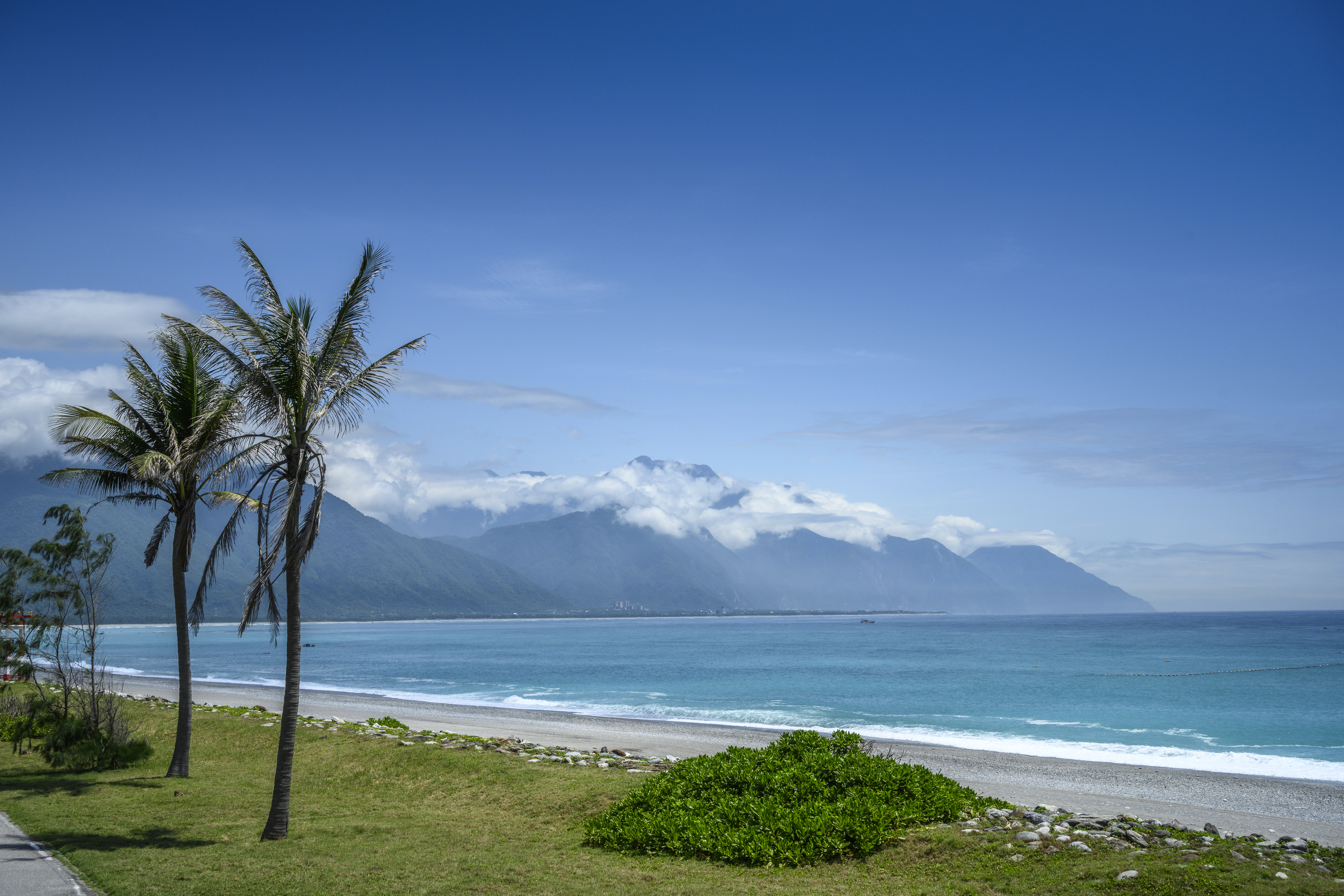
Qixingtan Beach, 2021. Photo: Artemas Liu, CC BY-SA 2.0 via Wikimedia.
After the earthquake, Teyra Yudaw also told The Reporter what he observed among his people: “Our people feel that this space seems to be getting farther and farther away from us. In the past we lived here, and things were fine; the animals did not decrease either. The government says it is protecting the mountains and forests, but from our people’s perspective, it is not truly protecting them.”16 The Truku reclaimed their name only in 2004, and in 2024 the national park collapsed. In the 20 years between name rectification and losing access again to this landscape, the timeline of a people’s relationship with a place folded in on itself.
Fenglin, Yuli, and Ruisui Beneath the Fu Family Dynasty
The last axis for seeing Hualien is local politics.
Hualien County’s “Fu family dynasty” is one of the longest continuously governing families in Taiwan’s local political history24. Fu Kun-chi was elected legislator in 2001 as a People First Party member, switched to the Kuomintang in 2008, and was elected legislator again. In 2009, after failing to receive the Kuomintang nomination, he ran independently without party affiliation and was elected Hualien County magistrate, becoming the county’s second non-Kuomintang magistrate. He was reelected magistrate in 2014. On September 12, 2018, his eight-month prison sentence in the Hogi stock case was finalized, and he was removed from the magistrate’s office under law. In 2020, he was elected Hualien legislator as an independent24.
In the 2018 nine-in-one local elections, Fu Kun-chi’s wife, Hsu Chen-wei, was nominated by the Kuomintang and elected Hualien County magistrate with 72.4% of the vote, becoming the county’s first female magistrate. She was reelected in 2022 with 64.57%, setting a record for the highest vote share among county and city leaders24. The Reporter’s long-running series “The Two Faces of Fu Kun-chi: Examining the Hualien King Phenomenon” noted that the Fu family used the Second Reserve Fund to develop tourist night markets and used NT$800 million in Hualien earthquake donations in 2018 for industrial relief, consolidating a “complicity structure” with local industrial interests25.
But Hualien’s story has never been confined to Hualien City.
Fenglin Township sits in the middle section of the East Rift Valley. It covers 121 square kilometers and has a population of about 12,500, with Hakka people making up about 70%. Taiwan Panorama called it “one of Taiwan’s most ‘authentic’ Hakka towns”26. Fenglin also has a more unusual record: more than 100 school principals at various levels have come from the town, the highest density in Taiwan, giving rise to the saying “Fenglin produces principals, Meinong produces PhDs.” Hakka culture’s emphasis on farming in fair weather and reading in rain, along with the Japanese-era Fenglin branch office chief’s residence, today’s Principal Dream Factory, as an education center, turned this small town into a hometown of principals26. One former resident of the Principal Dream Factory was Chang Chi-lang, a victim of the February 28 Incident and the first principal of Hualien High School. Fenglin’s Hakka migration history also dates to the early Japanese period, when large numbers of tenant farmers from Hsinchu Prefecture, facing concentrated land ownership and low income, moved south to Hualien and Taitung; after the war, more Hakka people moved in.
Fenglin pastor Chen Minghui told Taiwan Panorama: “Don’t underestimate these elders riding electric scooters or bicycles. Ask at random and you’ll find they are all over 80 years old.”26 Fenglin resident Liu Qingsong added: “At its peak in the 1960s, Fenglin’s population reached 30,000. Now only 12,459 remain.”26 From 30,000 to 12,459: this is the epitome of population outflow from Hualien’s townships.
Yuli, Ruisui, and Zhuoxi in southern Hualien are home to Bunun people who moved down from Nantou in the 1930s. Xincheng Township and the Ruisui area are core Sakizaya settlements. Xiulin and Wanrong townships sustain the Truku population. Beneath the vote counts of the Fu family dynasty are 320,000 people made up of these six Indigenous peoples, Hakka villages, and descendants of Japanese-era immigrant villages. Their memories of “Hualien” have never been only the county government and Taroko.
The Gift Remains; the Gallery Collapsed
Return to those 98 seconds at 7:58 a.m. on April 3, 2024.
Lin Maoyao said that after that day, when he arrived at Swallow Grotto, he kept trying to remember what it originally looked like: “It felt especially bright; only then did I realize the entire gallery had collapsed”22. After the gallery collapsed, light poured directly into the Liwu River valley. He saw a version of Taroko Gorge he had never seen in his 20-year career as an interpreter: a space that should have been cliffs holding a trail, holding a gallery, holding tourists, was now open. A landscape that human engineering had wrapped for decades returned in 98 seconds to something like what it was before Taroko National Park was established in 1986, or even before the 1914 Truku War.
The Sakizaya reclaimed their name only in 2007; the area around the bishop wood tree of lingchi had become Tzu Chi Hospital in 1986. The Truku reclaimed their name only in 2004; in 2024 the national park’s landmark trails were all destroyed. The tobacco barns brought by Japanese immigrants to Toyota Village in 1913, the danger of the Suhua coastal road in 1932, the North-Link Railway turning 18 hours into 5 in 1980, the full opening of the Suhua Improvement Project in 2020: every piece of history tried to pull Hualien closer to the outside world. But after those 98 seconds in 2024, the earth told everyone: the “closeness” you thought you had was borrowed.
Teyra Yudaw said, “The name Taroko is the best gift our people have given to Taiwan”16. That gift remains. Even if the Swallow Grotto gallery has collapsed, the Shakadang Trail is broken, and the Tunnel of Nine Turns must be repaired until 2031, the Truku people remain, as do their language, the ancestral teachings of Gaya, and the culture of facial tattooing. The Sakizaya Fire God Festival will still be held this October in the Guofu community of Hualien City. The Bunun of Zhuoxi Township will still sing Pasibutbut. The Hakka grandfathers and grandmothers of Fenglin will still ride electric scooters home from the fields.
Seen from the Pacific, this land between mountain and sea, only 5 kilometers wide at its thinnest, is still there. Southward from Qingshui Cliff, the Liwu River will keep cutting marble; annual rainfall in Xiulin Township will still reach 4,000 millimeters; the Philippine Sea Plate will keep pushing north. No one knows when the next magnitude 7 earthquake will come, but it certainly will. Hualien people began learning to live with earthquakes 50 years ago: Yuli 7.3 in 1951, offshore 6.8 in 1986, Shoufeng 7.1 in 2024. Each one teaches the next generation how to brace a chair under a table, where to keep an earthquake kit, and how to crawl out of shaking.
Next time you go to Hualien, do not go only to Taroko. Try driving to Xincheng Township at five in the morning and looking at the living bishop wood trees beside Tzu Chi Hospital. You will not know which one is the tree from 1878, but you will know the soil underneath still remembers. Or go to the Guofu community in Hualien City and ask when the Fire God Festival is; on that day, watch how Palamal places the battle of 1878 into ritual today. Or go to Darong Village in Fenglin and look at Chang Chi-lang’s bookshelf in the Principal Dream Factory, a house left by a principal killed in 1947 that is still teaching this town how to produce principals.
All of Hualien’s beautiful landscapes were traded from the earth through millions of years of shaking. Every people’s name was reclaimed through generations of living under hidden names.
Taroko National Park may reopen seven years from now. But after 0403, those who return to Swallow Grotto will not see what people saw before April 2, 2024.
Further Reading
- Yilan County — A companion article in the 22 Counties and Cities series; the Kavalan of Karewan migrated south from Yilan’s Lanyang Plain to Hualien in the 1830s, making the two articles extensions of each other
- Keelung City — The pilot article in the 22 Counties and Cities series; like Hualien, Keelung is a northeastern coastal county-city “invisible” to the capital
- Taroko National Park — Taiwan’s fourth national park, established in 1986; estimated to need 7 years to recover after the 0403 earthquake
- Taiwan Plate Motion and Seismic Activity — The position of the 0403 earthquake in Taiwan’s earthquake history: the Longitudinal Valley fault system in the collision zone between the Philippine Sea Plate and Eurasian Plate
- History of Taiwan’s Indigenous Peoples and Name Rectification Movements — The name-rectification trajectories of the Sakizaya, Truku, Seediq, and Kavalan in Hualien
- Cultural Map of Taiwan’s 16 Indigenous Peoples — The distribution of the Amis, Truku, Sakizaya, Seediq, Bunun, and Kavalan in Hualien
- Japanese Colonial Period — The three immigrant villages of Toyota, Yoshino, and Hayashida in 1913; the 1914 Truku War; the group relocation of Bunun in the 1930s
- Lin Yi-hsiung — Tangwai movement figure from Wujie Township, Yilan, sharing with Hualien the same 1980s axis of Taiwan’s democratization
Image Sources
This article uses 6 Wikimedia Commons images under CC licenses. The hero image is Taiwan 2009 CingShui Cliffs on SuHua Highway FRD 6762 Pano Extracted by Fred Hsu, CC BY-SA 3.0, a panoramic view of Qingshui Cliff along the Suhua Highway in 2009.
Inline scene images, in order, are: Taiwan LiWu River by Vegafish, CC BY-SA 2.5, showing the Liwu River cutting through marble layers in Taroko Gorge; 20170924-火神祭開工祭祀 (19) by Tokoabibi, CC BY-SA 4.0, showing the Sakizaya Fire God Festival work-opening ritual in 2017; Taiwan 2009 HuaLien City JingSi Hall FRD by Fred Hsu, CC BY-SA 3.0, showing Tzu Chi Jing Si Hall in Hualien City in 2009; Rescue workers near the semi-collapsed ten-story Uranus Building on Xuanyuan Road after the 2024 Hualien earthquake by 總統府 Shufu Liu, CC BY 2.0, showing the Uranus Building rescue site after the 0403 earthquake; and Qixingtan Beach, Taiwan by Artemas Liu, CC BY-SA 2.0, showing Qixingtan Beach in 2021.
Video Materials
Taroko National Park Headquarters’ 2025 documentary “Walking on the Road Home: Taroko” records the park’s conditions after the 0403 earthquake and reflections by park interpreters; it can be found on the official Taroko National Park YouTube channel. Official video records of the Sakizaya Fire God Festival, Palamal, can be found by searching “Palamal nu Sakizaya” on the official IPCF YouTube channel; Wikimedia Commons also hosts several related videos.
References
- Qixingtan — Wikipedia — The history of how, in 1936 under Japanese rule, the original north-south Qixingtan lake group east of today’s Hualien Airport was filled in to build Hualien Harbor North Airfield, now Hualien Airport; original residents relocated to the Pacific coast and kept the old place name, producing a “place name misplanted as scenic spot.”↩
- Truku People — Wikipedia — Complete ethnic data on their eastward migration across the mountains from Nantou to the Liwu River basin about 300 years ago; Japanese-era classification as “Atayal”; Executive Yuan recognition as the 12th people on January 14, 2004; Truku meaning “a platform on the mountainside” and “habitable place”; main settlement in Xiulin, Wanrong, parts of Zhuoxi, and Qingfeng, Nanhua, and Fuxing villages in Ji’an; and traditions of facial tattooing and Gaya ancestral teachings.↩
- Kavalan Incident — Wikipedia — Full event record of Kavalan interception of Qing grain documents on June 18, 1878; the June 19 siege of Quezilong Fort; participation by Sakizaya Takubuwan chief Komod Pazik; the Qing burning of Takubuwan; the verbatim statement “After the Sakizaya surrendered, Qing troops bound Komod Pazik to a bishop wood tree near today’s Hualien Tzu Chi Hospital and executed him by lingchi”; and the verbatim statement “After Takubuwan was breached, the two peoples suffered near extermination. Survivors fled to the rift valley and the east coast, hiding among the Amis until their name rectification succeeded in 2007.”↩
- Toyota Immigrant Village — Taiwan Panorama — History of Japanese-era immigrant villages: the Governor-General’s Office recruited farmers from Hokkaido and Shikoku in 1913; Toyota Village’s first group of 179 households and 866 people began settlement in July 1913; checkerboard streets; each household received a 441-ping house-and-yard lot plus 3 jia of farmland; Yoshino Village was built beside Hualien City; Hayashida Village, today’s Fenglin Township, had Taiwan’s highest density of tobacco barns; the three villages totaled 3,386 settlers; postwar takeover by local Taiwanese and Hakka transformation; and the Lintianshan forestry settlement as “Hualien’s Little Jiufen.”↩
- Hualien County — Wikipedia — Complete geographic data: area of 4,628.57 square kilometers, Taiwan’s largest county; north-south length of 137.5 kilometers; about 5 kilometers wide at the narrowest east-west point near Qingshui Cliff; 85% mountainous, plains and river terraces only 15%; three major terrain belts of Central Mountain Range, East Rift Valley, and Coastal Mountain Range; and population of about 320,000 at the end of 2024.↩
- The Past and Present of Taroko Gorge — Taroko National Park Headquarters — Geological formation history of the Penglai Orogeny 6 million years ago; collision between the Philippine Sea Plate and Eurasian Plate; the Liwu River cutting through marble; the verbatim statement “About 6 million years ago, the Philippine Sea oceanic plate began colliding with the edge of the continental plate... the Liwu River appeared, and happened to flow across this thick layer of marble. The river water eroded downward continuously like a sharp blade. The uncanny Taroko Gorge was slowly formed over millions of years through two forces: plate uplift and stream downcutting”; and marble traceable to 250 million years ago.↩
- 1951 Hualien Earthquake Series — Wikipedia — Hualien earthquake history timeline: the first shock of the Longitudinal Valley earthquake series on October 22, 1951, ML 7.3, with epicenter offshore southeast of Hualien City, 85 deaths, 200 serious injuries, and more than 1,000 light injuries; the second shock on November 25, ML 7.3, in the Yuli area; and the November 15, 1986, undersea ML 6.8 earthquake east of Hualien, with 15 deaths and 62 injuries, the Suhua and Central Cross-Island highways fully cut off, and North-Link Railway tracks twisted.↩
- 2024 Hualien Earthquake — Wikipedia — Complete data for the April 3, 2024, 7:58:09 a.m. earthquake: epicenter in Shoufeng Township, Hualien County, 23.88°N and 121.57°E; depth 19.7 kilometers; Central Weather Administration initial measurement of ML 7.2 and February 1, 2025, revision to ML 7.1; maximum intensity upper 6 in Heping Village, Xiulin Township, lasting about 98 seconds; 20 deaths as confirmed final count on April 25, 1,155 injured, 2 missing; fatal cases including worker surnamed Yu at kilometer 183.2 of the Central Cross-Island Highway, 17-year-old intern surnamed Huang at Silks Place Taroko, and female resident surnamed Kang in the Uranus Building; and Taiwan’s largest inland earthquake since 1999’s Jiji earthquake.↩
- Taiwan 2024 Rainfall Statistics — Central Weather Administration — Climate data on frequent eastern typhoon tracks in Hualien, annual rainfall over 4,000 millimeters in Xiulin and Wanrong townships, Xiulin Township in Hualien ranking first nationally for rainy days in 2024 with 334 days, alongside Datong in Yilan with 320 days and Wanrong in Hualien with 304 days, and the combined force of typhoons, southwesterly flows, and the northeast monsoon.↩
- Hualien County Indigenous Population Statistics — Council of Indigenous Peoples — Official population statistics: Hualien County Indigenous population of 94,134 at the end of 2024; 29.8% of the county population; Hualien accounting for the highest share of Taiwan’s Indigenous population at 15.4%; and the distribution structure of six peoples living together.↩
- Sakizaya Name Rectification — Taiwan Panorama 2007 — Complete record of the name-rectification movement: Diway Sayun, Chinese name Li Laiwang, launched name rectification beside the Meilun River in July 1990; the Palamal Fire God Festival was revived in Guofu community on July 1, 2006, after a 128-year suspension; the Executive Yuan recognized the Sakizaya as the 13th people on January 17, 2007, during the second term of the Chen Shui-bian administration; Council of Indigenous Peoples minister Walis Pelin’s verbatim statement that “The recognition of an ethnic group relies mainly on the will of that group’s communities, as well as distinctiveness in language, religion, culture, and other areas. The reason the Sakizaya were able to become Taiwan’s 13th Indigenous people was not only their strong collective will, but also the fact that the Sakizaya possess a distinctive language and culture, allowing name rectification to succeed”; and the verbatim statement “In 1878, the ‘Kavalan Incident’ occurred. The Sakizaya were defeated, causing village members to flee and scatter; compounded by displacement during Japanese rule to avoid corvee labor and flooding, the people thereafter hid their names under Amis villages.”↩
- The Truku War — StoryStudio — Complete event history: fifth Taiwan Governor-General Sakuma Samata’s Five-Year Plan to Subdue the Aborigines, 1910–1915; the 1896 Xincheng Incident in which Japanese soldiers sexually assaulted Truku women and Truku people killed 13 officers and soldiers in a surprise attack; Sakuma appointing himself punitive-force commander on May 14, 1914, and ordering the campaign on May 17; Japanese mobilization of 6,235 military and police plus 11,075 miscellaneous laborers, more than three times the Truku male fighting population of 3,000; the verbatim tactics list “traditional hunting methods, traps, falling stones, skillful use of strongholds, terrain, objects, camouflage, night movements, ambushes, guerrilla tactics, surprise attacks, flanking maneuvers, and other tactics”; Holok-Naowi leading surrender on July 3, 1914; Japanese casualties of 138 police and 226 military personnel; and postwar group relocation policy.↩
- Bunun Migration History — Wikipedia — Complete migration record: original homeland in the Zhuoshui River basin of Nantou County, in Xinyi and Ren’ai townships; five major groups of Takitudu, Takivatan, Takbanuaz, Isbukun, and Takopulan; Japanese group relocation policy beginning in 1904; late-1930s first-stage Kominka policy, 1936–1940, and serial relocations to Yuli and Zhuoxi in Hualien; Takivatan relocation to Mayuan Village in Wanrong Township and Zhuoxi Township; Takbanuaz relocation to Zhuoxi Township and Haiduan Township in Taitung; and Pasibutbut, the prayer song for millet abundance, listed as a Hualien County cultural asset.↩
- Development History of the Tzu Chi Foundation — Tzu Chi Foundation — Complete founding history: in 1964 Dharma Master Cheng Yen, lay name Wang Jinyun, born in Qingshui, Taichung, in 1935, lived with disciples at Pu Ming Temple; on May 14, 1966, the 24th day of the third lunar month, the Buddhist Tzu Chi Merit Association was founded in Hualien; in 1968, land was mortgaged to build the Tang-style main hall of the Jing Si Abode; the Jing Si Abode was completed in 1969 in Kangle Village, Xincheng Township; 30 female followers saved NT$0.50 per day during the bamboo-bank years; the verbatim slogan “We save 50 cents every day! We have a relief association to help others!”; announcement of the hospital plan on May 10, 1979; groundbreaking on February 5, 1983; Hualien Tzu Chi Hospital opening on August 17, 1986; and 2002 upgrade to eastern Taiwan’s only medical center.↩
- Jing Si Abode — Official Jing Si Abode Website — Official information on the core spirit “No work, no meal,” monastics’ self-support through handmade foods such as Xiangji tofu and Jing Si noodles, the current site in Kangle Village, Xincheng Township, and the Tang-style main hall.↩
- Truku Autonomy Dream and 0403 — The Reporter — In-depth reporting on Truku autonomy after the 0403 earthquake, including three first-hand quotations from Teyra Yudaw, secretary-general of the Truku Name Rectification Promotion Association and chair of the Truku Hunters Association: “The name ‘Taroko’ is the best gift our people have given to Taiwan”; “Our people feel that this space seems to be getting farther and farther away from us. In the past we lived here, and things were fine; the animals did not decrease either. The government says it is protecting the mountains and forests, but from our people’s perspective, it is not truly protecting them”; and “Right now there is no cultural tourism; it is more purely natural scenery. But for a place to develop tourism, it cannot rely only on natural resources. It should also take humanistic resources into account, so that it has richness and vitality.”↩
- Seediq and Amis — Council of Indigenous Peoples — Official data: Seediq recognized as the 14th people on April 23, 2008, sharing origins with the Truku but remaining in Nantou; the Amis as Taiwan’s largest Indigenous people with 220,000 people; Nanshi Amis in Xincheng, Hualien City, Ji’an, Shoufeng, and Fenglin; coastal Amis in Fengbin and the Xiuguluan River mouth; five subgroups of Nanshi, Xiuguluan, coastal, Falangaw, and Hengchun; and the harvest festival, Ilisin, held mainly every August as Taiwan’s largest Indigenous festival.↩
- Suhua Historic Trail and Opening the Mountains and Pacifying the Barbarians — Wikipedia — Formation history of the main eastern development route under Qing rule: Shen Baozhen’s 1875 policy of “opening the mountains and pacifying the barbarians,” with Luo Dachun supervising the “northern route” from Su’ao to Qilai, today’s Hualien, creating the Suhua Historic Trail.↩
- Asia Cement Xincheng Mountain Mining Area Controversy — Our Island, PTS — Complete controversy record: Hualien marble reserves of 300 billion metric tons; origin of white, gray, and black marble and serpentinite; expansion of mines from the 1960s in Heping, Hezhong, Heren, the Taroko entrance, and Sanzhan; stone-processing industry annual output of NT$21–31 billion; upstream and downstream workforce of 15,000 people, about one-tenth of the county labor force; Asia Cement entering Xincheng Mountain in 1975 to mine limestone for cement raw material; mining area located at the Taroko National Park entrance on the south bank of the Liwu River; the “Oppose Asia Cement, Return Our Land Self-Help Association” led by Truku woman Tian Chunchou; 2017 mining-right extension for 20 years to 2037; the Supreme Administrative Court’s September 16, 2021, rejection of Asia Cement’s appeal and cancellation of the extension while mining could continue under the Mining Act; and the controversial February 12, 2022, consultation-and-consent vote in the Bsngan community.↩
- North-Link Railway — Wikipedia — Complete railway history: construction began on December 25, 1973, as part of the Ten Major Construction Projects; the Hualien Harbor-to-Xincheng section opened on July 26, 1975; the Heping-to-Hualien New Station section was completed in December 1978; the full line opened on February 1, 1980, shortening Keelung-to-Hualien travel from 18 hours to about 5; investment of NT$7.3 billion and 6 years of construction; establishment of the Heping cement plant; and changes to eastern tourism and educational connections.↩
- Suhua Improvement and Suhua Safety Projects — Wikipedia — Complete highway evolution history: Suhua Improvement Project length of 38.8 kilometers, including 8 tunnels totaling 24.6 kilometers, 13 bridges totaling 8.6 kilometers, and 5.6 kilometers of surface roads; Su’ao-to-Dong’ao section opening on February 5, 2018; Nan’ao-to-Heping and Hezhong-to-Daqingshui sections opening on January 6, 2020, completing the full line; replacement of the “nine bends and eighteen turns” section; the 119-kilometer 1932 Suhua coastal road known as “the world’s most dangerous road”; two-way traffic completed in 1990; and the 29.9-kilometer Suhua Safety Improvement Project, including Dong’ao to Nan’ao 9.3 km, Heping to Hezhong 5.5 km, and Heren to Chongde 15.1 km, expected to begin in 2025 and finish in 2032.↩
- Taroko’s Worst Damage in 38 Years Since Opening — CNA 2025 — Recovery progress record: Shakadang, Swallow Grotto, and Tunnel of Nine Turns trails suffering the most severe damage; Taroko headquarters deputy director Lin Zhongshan’s verbatim statement “Developing alternative attractions and promoting in-depth ecotourism are also necessary”; senior interpreter Lin Maoyao’s verbatim statement “Swallow Grotto shocked me the most. After the earthquake I came to Swallow Grotto and kept trying to remember what it originally looked like. It felt especially bright; only then did I realize the entire gallery had collapsed”; whole-park estimated recovery time of “about 7 years,” with Shakadang and Swallow Grotto reconstruction estimated for completion in 2031; the headquarters’ acknowledgement that “opening the entire park in 7 years should be impossible”; partial reopening from July 1, 2025; and phased reopening of trails along the Suhua Highway from April 2025.↩
- Hualien Tourism Impact 2024 — Tourism Administration Statistics — Tourism impact figures: before the earthquake Taroko had about 4 million visitors annually and up to 6.6 million at its peak; in 2024 Taroko had only just over 210,000 visitors, 3.2% of the peak; Hualien County’s total 2024 visitor count of 6.7 million compared with 14 million in 2023, a 54.29% decline, the largest in nearly a decade; and 22 of 135 hotels exiting or suspending operations.↩
- Fu Kun-chi and Hsu Chen-wei — Wikipedia — Political history of the Fu family dynasty: Fu elected legislator in 2001 as a People First Party member, switching to the Kuomintang and reelected in 2008; elected Hualien County magistrate as an independent in 2009, becoming the county’s second non-Kuomintang magistrate; reelected in 2014; removed from office after an eight-month prison sentence in the Hogi stock case was finalized on September 12, 2018; elected legislator as an independent in 2020 and serving to the present; Hsu Chen-wei nominated by the Kuomintang and elected Hualien’s first female magistrate in 2018 with 72.4% of the vote; and reelected in 2022 with 64.57%, setting a record for the highest county-city leader vote share.↩
- The Two Faces of Fu Kun-chi: Examining the Hualien King Phenomenon — The Reporter — Long-running investigative series on the Fu family’s political economy, including use of the Second Reserve Fund to develop tourist night markets, NT$800 million in 2018 Hualien earthquake donations used for industrial relief, and a “complicity structure” with local industrial interests.↩
- Fenglin Hakka Town — Taiwan Panorama — Fenglin’s Hakka history: located in the center of the East Rift Valley plain; area of 121 square kilometers, population about 12,500, Hakka people about 70%; verbatim description as “one of Taiwan’s most ‘authentic’ Hakka towns”; more than 100 school principals born there, Taiwan’s highest density; the saying “Fenglin produces principals, Meinong produces PhDs”; the Principal Dream Factory, formerly the Japanese-era Fenglin branch office chief’s residence, as an education center; the residence of Chang Chi-lang, first principal of Hualien High School and victim of the February 28 Incident; Pastor Chen Minghui’s verbatim statement “Don’t underestimate these elders riding electric scooters or bicycles. Ask at random and you’ll find they are all over 80 years old”; Liu Qingsong’s verbatim statement “At its peak in the 1960s, Fenglin’s population reached 30,000. Now only 12,459 remain”; and Fenglin’s Hakka history of tenant farmers from Hsinchu Prefecture moving south in the early Japanese period.↩