
30-second overview: In 1697 (the 36th year of the Kangxi reign), Fuzhou native Yu Yonghe crossed the sea to Beitou to mine sulfur, trading cloth with the Ketagalan people for sulfurous soil1; the people there had originally called this steaming mountain Patauw, meaning “witch”2. In 1894-96, Osaka merchant Hirata Gengo found the hot springs and built Taiwan’s first hot spring inn, Tenguan, at today’s No. 234, Guangming Road3. On June 17, 1913, a two-story red-brick public bathhouse, supervised by Moriyama Matsunosuke of the Government-General’s Construction and Maintenance Section, opened4. In 1916, the Xinbeitou Branch Line opened; it was Taiwan’s first railway built purely for tourism5. On April 25, 1923, Crown Prince Hirohito came for a bath, and the bathhouse’s second floor was expanded with a more than 30-ping “imperial rest area” built especially for him6. After the war, wine houses, nakashi itinerant bands, and U.S. military R&R made Beitou the liveliest pleasure quarter in Taiwan, until a 1967 Time magazine report enraged Chiang Kai-shek7. On February 5, 1979, during Lee Teng-hui’s tenure as mayor, the Taipei City Council abolished Beitou District’s licensed hostess system, and wine houses went dark one after another8. In 1994, several teachers from Beitou Elementary School, while developing local-history teaching materials, accidentally rediscovered the abandoned red-brick bathhouse; in 1998, it became the Beitou Hot Spring Museum9. The same mountain spring was discovered by outsiders three times and adapted to by four generations of residents.
Six in the Morning, Steam Over Beitou Park
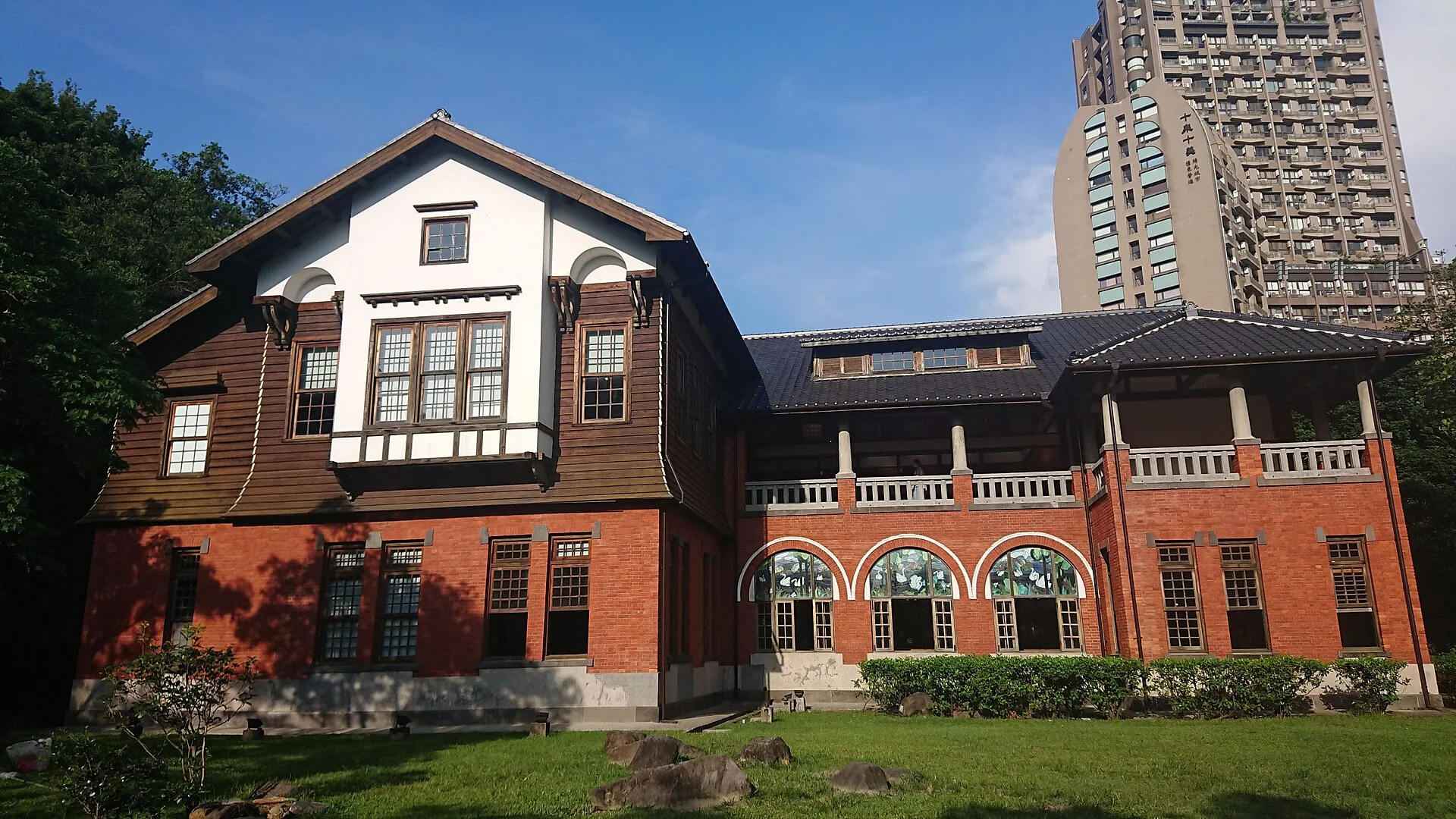
Exterior of Beitou Hot Spring Museum, originally the Beitou Hot Spring Public Bathhouse completed in 1913. Photo: Wikimedia Commons contributor. License via Wikimedia (CC BY-SA 4.0).
If you ask an 18-year-old in Taipei where to go on the weekend, he will say Ximen. If you ask a 70-year-old grandmother where she is going for a walk this morning, she will say Xinbeitou.
At six in the morning, Xinbeitou MRT Station is not yet open, but the breakfast shops on Guangming Road are already preparing ingredients. Walk north from Exit 1, follow Zhongshan Road for five minutes, and you arrive at Beitou Park. The circular fountain left from 1913 is still turning water in the park10, and beside it the shallow Beitou Creek flows down from the mountain, giving off white steam.
The water temperature is close to 100 degrees Celsius, and the spring is green sulfur spring water11. In 1697 (the 36th year of the Kangxi reign), when Fuzhou native Yu Yonghe came to these mountains to mine sulfur, he recorded that the water of this creek could “boil cauldrons and melt copper, utterly unlike boiling water.” He meant that the heat of the creek was unlike the boiled water in your home; it came up from underground1.
Walk farther uphill, and a two-story red-brick building in the style of an English country villa stands on the slope. This is the Beitou Hot Spring Museum, originally the “Beitou Hot Spring Public Bathhouse,” built in 1913 under the supervision of Moriyama Matsunosuke, head of the Construction and Maintenance Section of the Government-General, by order of Taipei Prefecture governor Imura Daikichi49.
At the steps in front of the museum, you will encounter a group of elderly residents practicing tai chi. Walk another hundred meters south, and you reach the outdoor public pool “Millennium Hot Spring,” opened in December 1999, the 88th year of the Republic of China calendar12. On weekdays, a ticket costs NT$40; with a swimsuit and swim cap, you can go in for a soak. Aunties and grandmothers arrive early with towels and plastic bags carrying a change of clothes.
This scene, a walking route an 18-year-old would not choose and a ritual a 70-year-old grandmother performs three times a week, stands on a mountain path Yu Yonghe walked 329 years ago.
📝 Curator’s note: Standard introductions tend to write Beitou as a “Japanese-style hot spring town,” an “old wine-house dream,” or a “hipster walking secret.” All three framings miss the same point. From 1697 to 2026, this street has always had people living here, people arriving, and people leaving; there has never been such a thing as a “golden age.” Before the Japanese built bathhouses, the Ketagalan people had lived here for hundreds of years; during the prosperous wine-house years of the 1960s and 1970s, Japanese-era buildings were being converted into Kuomintang public service offices at the very same time9; the 1980s and 1990s after the abolition of the licensed prostitution system look like decline, but that was also when a group of Beitou Elementary School teachers slowly rescued the public bathhouse. Beitou’s street has never stopped living; every era has simply had a different way of being alive.
A Place Called Patauw
To understand Beitou, we first need to go back before the two Chinese characters “Beitou” existed.
Before Qing rule, this place was not called Beitou. On the 1654 Map of Tamsui and Its Surrounding Villages compiled by the Dutch East India Company, the village was written as Kipatauw13. When the Spanish briefly occupied northern Taiwan from 1632 to 1642, their documents also wrote Kipatauw or Quipatauw2.
In 1899, during the early period of Japanese rule, scholar Inō Kanori conducted fieldwork at Beitou Village. When he asked elders about this place name, they told him: patauw means witch2. Like other plains Indigenous peoples, the Ketagalan people had a matrilineal society, and female ritual specialists responsible for sacrifice, healing, prayer, and funerals held the highest status2. Beitou’s Thermal Valley emits white steam all year, as if a witch were casting spells there2.
Modern oral accounts from elders of the Ketagalan Beitou community point out that Kipatauw should in fact be a verb, meaning “the act of performing magic”; Inō Kanori recorded it as the noun “witch,” and that incomplete early collection has been repeated ever since2. When Han Chinese settlers heard Patauw, they rendered it phonetically in Taiwanese as “Beitou,” written with characters including “北頭,” “八頭,” “八投,” and “北投”; the written form “北投” was fixed during Japanese rule2.
In the mid-17th century, Kipatauw likely had more than 30 households and over 100 people14. In 1709 (the 48th year of the Kangxi reign), after the Chen-Lai-Zhang reclamation syndicate petitioned the Qing court to open a large tract of land “east to Lei-xia Xiulang, west to outside Bali-fen Gantou, south to within the foothills of Xingzhi, and north to Dalang Bengou,” Han reclamation forces entered the greater Taipei area15. The Ketagalan people of Beitou gradually lost land rights and their language declined. Some households remained into the early 20th century; today they are mainly concentrated in the Fanzi Cuo settlement in Beitou District. The “Fanzi Wangye” and “Pingpu Community” Earth God icons enshrined at Baode Temple are among the few surviving material traces14.
The Qing court paid no special attention to this steaming mountain, but one Fuzhou native came. In 1696 (the 35th year of the Kangxi reign), a fire broke out at the Fuzhou gunpowder depot, leaving Fujian short of sulfur. Yu Yonghe volunteered to cross the sea to Taiwan to mine sulfur1. In April 1697, he landed in Tainan, traveled north to Beitou, set up work sheds at Dahuangzui (around today’s Sulfur Valley and Longfeng Valley), and traded with the Ketagalan people “cloth for sulfur”1.
In Small Sea Travel Diaries, Yu Yonghe wrote of this creek: “turning and folding through deep beauty, mountains encircling all the ridges, for six or seven li,” and “looking toward the mid-slope of the mountain ahead, strands of white vapor rise like mountain clouds just beginning to emerge... entering the sulfur cave, where the mountain creek breaks off”1. He described the landscape with a literati’s eye, but his purpose in coming here was raw material for gunpowder, not bathing. For him, this mountain was an industrial resource, not a tourist destination.
📝 Curator’s note: The standard Beitou story says “the Japanese discovered Beitou’s hot springs.” But that statement has two problems. First, the Ketagalan people had lived here for hundreds of years, and the place name Patauw directly referred to the “steaming mountain”; their familiarity with the mountain spring preceded the Japanese by three centuries2. They simply did not treat “hot-spring bathing as therapy” as a way of life. Second, Yu Yonghe mined sulfur here in 1697. He knew the water could scald people1, but he did not treat this mountain as a “hot spring resort,” either. The true meaning of “discovering hot springs” lies in a change of frame: turning hot water into a fee-charging object of therapy and recreation. That was a design the Japanese introduced in 1894-96, and it had nothing to do with the physical properties of the water itself.
1896, Hirata Gengo’s Thatched Hut
If the “second discovery” of this Beitou mountain by outsiders has a concrete date, it is March 1896.
Hirata Gengo was born in Japan in 1845, the second year of the Kōka era. In 1885, the 18th year of the Meiji era, he began working in mining for the Sumitomo family in Osaka and was later posted to the Sakurago copper mine in Chōshū16. After Japan took control of Taiwan in 1895, he came to Taiwan.
In December 1895, Hirata was already 50 and needed to recuperate after an injury from a fall. Through a friend’s introduction, he traveled north from Taipei to Beitou Village. He stayed beside Beitou Creek for 10 days, and his injury indeed improved. He realized something: the water of this mountain had therapeutic effects. But on that 1895 trip, he was poorly prepared and first returned to Taipei16.
In March 1896, the 29th year of the Meiji era, Hirata returned to Beitou and bought a thatched hut as his lodging, at what was then “Lot 73, Beitou Village, Zhilan Second Fort, Taipei Prefecture”3. He became the first private Japanese individual to acquire property in Beitou.
Between 1896 and 1900, he converted this thatched hut into the inn “Tenguan,” Taiwan’s first hot spring inn3. Today, that site is No. 234, Guangming Road, Beitou District, Taipei City; since 2010 it has been the location of the Radium Kagaya International Hotel, which still preserves the “Tenguan Historic Park” inside the hotel to commemorate this origin story17.
Besides opening the inn, Hirata did two other things. First, in 1905 he petitioned the Railway Department of the Taiwan Government-General, hoping for a Guanyin statue to protect the locality. The Railway Department funded the carving of a wooden Guanyin statue about 60 centimeters high, named the “Greatly Merciful and Compassionate Beitou Yumori Guanyin Bodhisattva”18, meaning the Guanyin who guards the hot spring waters.
Second, in the same year, 1905, Railway Department employees funded the construction of a Shingon Buddhist temple in Beitou. Because it commemorated railway workers who died while building the Xinbeitou Line, it was named Tesshin-in; another account says the name commemorated the posthumous Buddhist name “Tesshin” of Murakami Shōichi, head of the Railway Department’s Transportation Section18. The temple’s main hall used Taiwan cypress and was one of the rare purely Japanese Shingon Buddhist temples in Taiwan at the time. After the war, it was renamed Puji Temple, and the Yumori Guanyin was also enshrined there18.
Also in 1905, Japanese mineralogist Okamoto Yōhachirō found a special radium-bearing mineral with high radioactivity in Beitou Creek. He brought it back to his laboratory for analysis and named it Hokutolite, or “Beitou stone,” the only mineral among the world’s thousands of minerals to be named after a place in Taiwan11. To this day, Hokutolite exists in only two places worldwide: Beitou in Taiwan and Tamagawa Onsen in Akita Prefecture, Japan11.
Hirata Gengo lived at Tenguan until his death on July 7, 1919, the eighth year of the Taishō era16. He lived to 74 and spent his final 23 years in Taiwan. By the time he died, Beitou had already become something else.
📝 Curator’s note: What makes Hirata Gengo interesting is not that he “opened the first hot spring inn,” but that over 23 years he turned all the material foundations of this mountain into a Japanese-style “therapeutic resort” framework. Building Tenguan in 1896, persuading the Railway Department to fund Tesshin-in and enshrine the Yumori Guanyin in 1905, and Okamoto Yōhachirō’s naming of Hokutolite in 1905 all happened within 500 meters of the same Beitou Creek. Together, they translated this steaming mountain from the Ketagalan Patauw, the place of witches, into a Japanese “sacred site of convalescence.” The linguistic translation depended on Inō Kanori; the material translation depended on Hirata and Okamoto. After 1896, the mountain’s name was still the Taiwanese phonetic rendering of patauw, “Beitou,” but the world of meaning attached to it had changed.
1913, Moriyama Matsunosuke’s Red-Brick Bathhouse
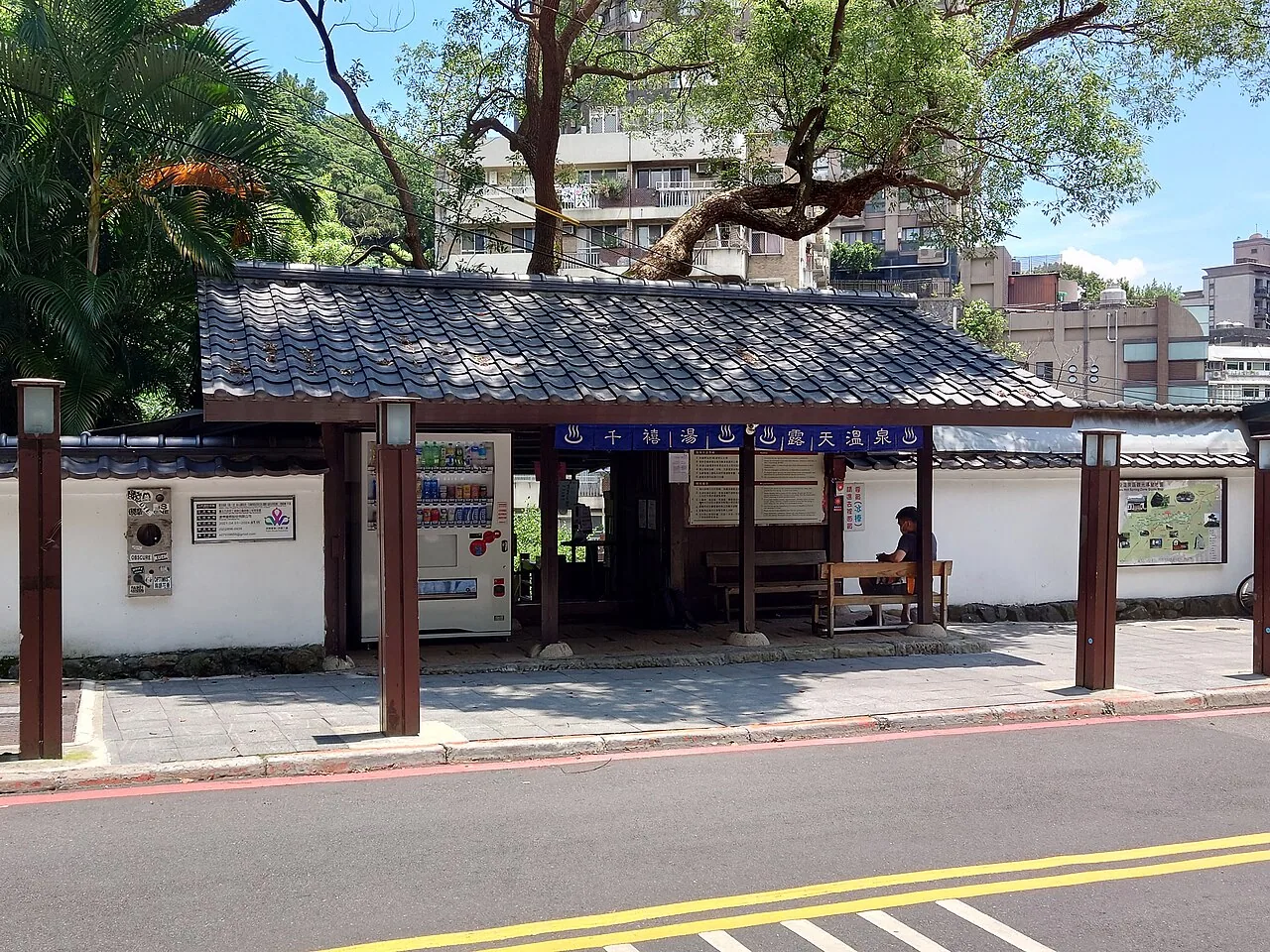
Entrance of Beitou Hot Spring Museum, formerly the 1913 public bathhouse. Photo: Wikimedia Commons contributor. License via Wikimedia (CC BY-SA).
After Tenguan was built, Beitou became a must-visit therapeutic resort for Japanese visitors to Taiwan. On June 17, 1913, the second year of the Taishō era, Taipei Prefecture spent more than 56,000 yen in public health funds to formally open a large-scale public bathhouse49.
The decision-maker behind this bathhouse was Imura Daikichi, then head of Taipei Prefecture. Its designer and supervising architect was Moriyama Matsunosuke, an architect in the Government-General’s Construction and Maintenance Section, who left in Taiwan such representative colonial public buildings as the Tainan Prefectural Hall, now the National Museum of Taiwan Literature; the Taipei Prefectural Hall, now the Control Yuan; and the Government-General Monopoly Bureau, now Taiwan Tobacco & Liquor Corporation9.
Moriyama Matsunosuke chose for the Beitou Public Bathhouse a design modeled on Izusan Onsen in Shizuoka Prefecture, Japan. The overall building was a two-story, English-style brick structure occupying about 700 ping9. The most distinctive feature on the first floor was a Roman-style large bath enclosed by rounded arches and columns, built of Qilian stone, the same stone also used at Takinoyu9. The walls of the corridor outside the bath were decorated with inlaid stained-glass window patterns. Sunlight came through the glass into the large bath, creating a bright and splendid bathing atmosphere9. The wooden rest area, recreation room, and large tatami hall on the second floor formed a social space where Japanese visitors could change into yukata9.
At the time, it was the largest public bathhouse in East Asia9.
On the day the public bathhouse opened, Beitou Park opened as well. The park was established under the “Park Management Rules” set by the Government-General in 1911, with a circular fountain, a wild-goose and duck fountain, trees, and benches10. Looking across from this side of the park, the red-brick bathhouse, the lines of an English country villa, blue-green roof tiles, and the mist-filled Beitou Creek layered together on the hillside.
Three years later, on April 1, 1916, the Xinbeitou Branch Line opened. It was a branch of the Taiwan Railway Administration’s Tamsui Line, 1.2 kilometers long, splitting from Beitou Station and built solely to carry travelers into the hot spring district5. In the history of Taiwan’s railways, it was the first railway built entirely for tourism5. Its promoter was Murakami Shōichi, head of the Transportation Section of the Government-General Transportation Bureau’s Railway Department5.
The terminus was “Xinbeitou Halt,” later Xinbeitou Station, a wooden station built mainly of Taiwan red cypress. After expansion in 1937, it took on its form with four round dormer-window openings, a look that remained until the line was abolished in 198819.
📝 Curator’s note: You can think of the 1913 public bathhouse and the 1916 Xinbeitou Branch Line as two components of the same system. The building Moriyama Matsunosuke constructed was essentially a colonial material publicity machine: it packaged a mountain spring Japanese people had never heard of into a combined brand of “East Asia’s largest public bathhouse” + “Taiwan’s first tourist railway” + “20 minutes from Taipei” + “used by the imperial household,” which would come later. The brand succeeded. It taught travelers from Japan proper that “in the colony of Taiwan, there is a hot spring resort called Beitou.” But this brand was not designed for the Ketagalan people, nor for the Han reclamation settlers left from the Qing period. It was designed for travelers of the Japanese empire. Once the 1913 red-brick bathhouse went up, this street became an imperial showroom.
A Visit by the Crown Prince in 1923
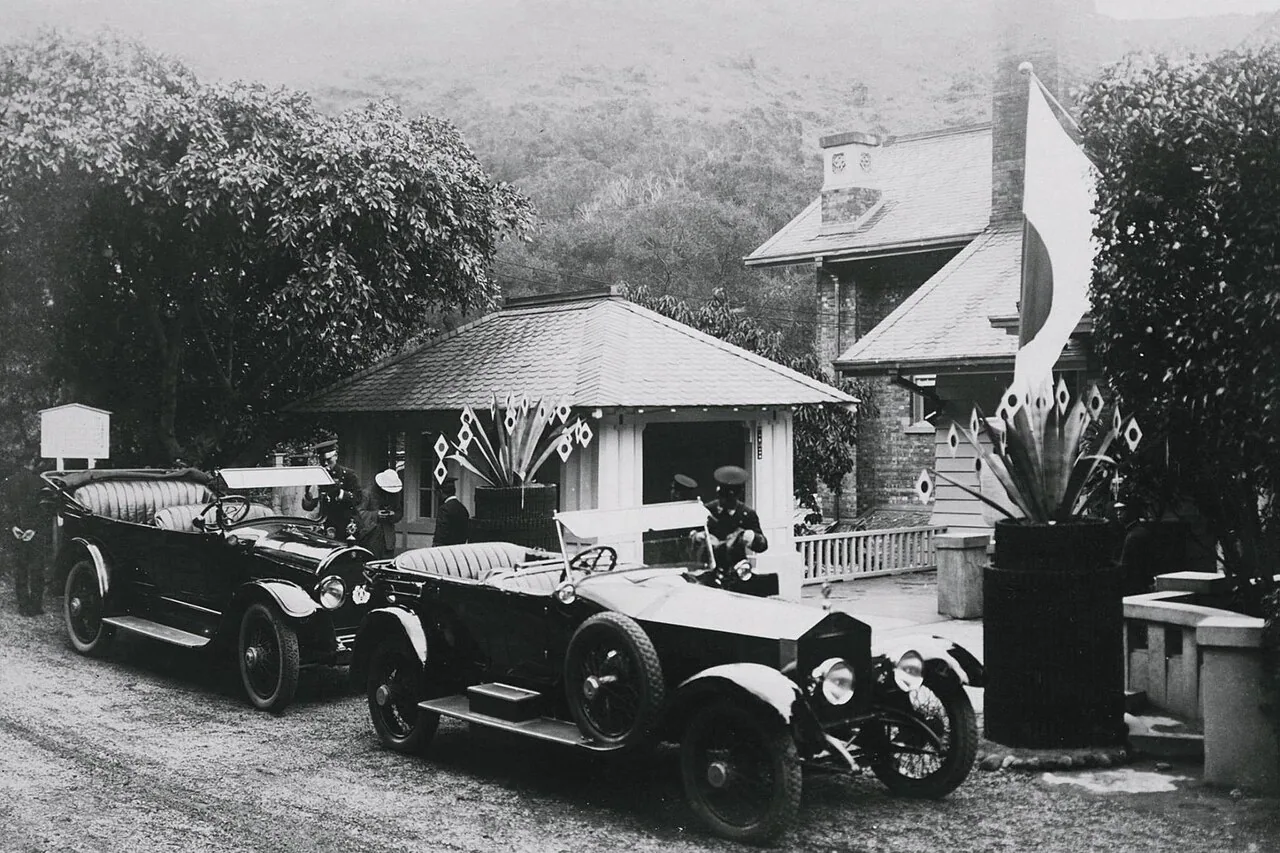
A record photo of Crown Prince Hirohito visiting the Beitou public bathhouse in 1923. Photo: Public domain (pre-war document, 1923). Wikimedia Commons.
In April 1923 (Taishō 12), Crown Prince Hirohito (later Emperor Shōwa) visited Taiwan as regent for Emperor Taishō for 12 days6. This was the first visit by the Japanese Imperial Family to the colony of Taiwan.
On April 25, Hirohito’s itinerary included a trip to Caoshan (now Yangmingshan) and Beitou. To prepare for his arrival, the Taipei Prefecture office had made renovations the previous year: the second floor of the Beitou Public Bathhouse was expanded by over 30 pings to create an "Imperial Rest Room," which was the location of the audiovisual room on the second floor of the Museum of Hot Springs today6.
Hirohito first toured the public bathhouse, then walked to the banks of the Beitou Stream to view the "Beitou Stones"—a mineral discovered 18 years earlier by Okamoto Yōhachirō, which was already an academic pride point for the Japanese Empire11. To allow the Crown Prince to walk and observe the Beitou Stones along the stream, blocks of "Tobishi" (stepping stones in Japanese) were specially laid above the second waterfall20.
In 1934 (11 years later), locals erected a "Monument Commemorating His Highness the Crown Prince's Crossing" by the second waterfall of the Beitou Stream to commemorate this day20. This monument nearly fell into ruin after the war but was fortunately preserved, and today it is located in the courtyard of Takinoyu Bathhouse20.
After Hirohito’s visit, Beitou gained a reputation for "Imperial endorsement" throughout Japan. Throughout the 1920s and 1930s, more inns began to appear in Beitou: Jiasan Hotel, built in 1921, was a two-story wooden Japanese building that was the highest and most upscale establishment in the area of Xinbeitou at the time. It is one of the few surviving buildings of its kind in Taiwan (it was later converted into the Ministry of Foreign Affairs Jiasan Guest House, and in 1983, Zhang Chunming of Sanfu Chemical took over to convert it into the Taiwan Folk Art Museum, which is now the Beitou Cultural and Historical Museum)21. Takinoyu, built in 1907, continued to operate as a public bathhouse (renamed after the war, continuing until its first major renovation in 2016 and reopening in 2017)22. Puji Temple also maintained the incense offerings for Guanyin.
What was Beitou like during that period? Wealthy Japanese locals came here for honeymoons, trading companies held banquets, military officers sought recuperation, and Taiwanese salaried workers were occasionally invited to attend. After the Sino-Japanese War broke out in 1937, Beitou inns began hosting Japanese soldiers, and Jiasan Hotel was once requisitioned by the military as a "Japanese Officer Club." Near the end of the war, it is recounted by local elders that Kamikaze pilots were sent to Beitou for revelry one week before their deployment21.
When Japan surrendered in August 1945, all Japanese people withdrew to their home country, leaving behind an empty hot spring town and a group of Taiwanese who did not know what would happen next.
The Two Postwar Decades: Nakashi, Wine Houses, and U.S. Troops
In the early postwar years, the public bathhouse sat idle and fell into disrepair. The Kuomintang government converted the red-brick building into the Yangmingshan Public Service Office9, turning a building originally built as a Japanese public health and recreation facility into a local outpost of the ruling party.
But the street’s identity as a “hot spring resort” did not disappear because political power changed hands. In the 1950s and 1960s, a new group of workers came in to fill the vacancy.
The first to appear were wine houses. On April 30, 1954, Beitou’s “Female Hostess Lodging Household Association” was established. This system legalized “female hostesses,” women workers who accompanied drinking, bathing, and lodging, and visitors could “select a hostess to attend bathing”78. The legal basis for this system was a local self-government ordinance, which designated Beitou, together with the only other such place in Taiwan, Shaochuantou in Kaohsiung, as a legal “special industry district.”
Wine-house culture drove the rise of nakashi. The word nakashi is a phonetic borrowing from the Japanese nagashi, meaning itinerant singing and performance23. From the 1960s onward, nakashi musicians flowed from one of Xinbeitou’s more than one hundred hot spring hotels to another; at the height of the hot spring district’s nakashi scene, there were more than one hundred bands23. Each hotel usually kept three to seven bands. Customers would request that a band come to their room to sing old Taiwanese songs, Japanese songs, and Mandarin pop songs23. Instruments evolved from early solo singer-instrumentalists, to small ensembles with accordion, guitar, and drums, and later to electronic keyboard and electric guitar23.
The third profession to emerge was time-limited delivery. Beitou has many slopes, narrow lanes, and places taxis could not easily reach. Hostesses needed to move quickly between hotels, so transport companies used motorcycles to provide 24-hour, on-call pickup and drop-off service24. By the end of Japanese rule, black three-wheeled vehicles were already running this route; after motorcycles were imported in the 1950s, they completely replaced the tricycles24. At the peak, more than 1,000 motorcycles in Beitou provided time-limited delivery service24.
A fourth group of customers arrived: U.S. troops. In 1965, as the Vietnam War began, the U.S. Department of Defense launched its Rest and Recreation program, abbreviated R&R. Soldiers who had served three months were entitled to a five-day leave, with airfare paid, and could choose any city in the Far East vacation circuit7. Beitou became a popular destination because it was 20 minutes by car from Taipei and had 75 hot spring hotels7. Records from the National Development Council Archives Administration state that during the Vietnam War from 1965 to 1972, 210,000 U.S. military personnel came to Taiwan for R&R, spending a cumulative US$52.8 million over several years7.
On December 22, 1967, the American magazine Time reported on Taiwan under the title “Beitou, the Gentle Village,” accompanied by a photograph of Beitou wine-house hostesses7. This report enraged Chiang Kai-shek. It was politically embarrassing for the “Republic of China anti-communist base for national recovery” to become, in the eyes of international media, a “pleasure village” for U.S. troops. In reality, however, Beitou hotels’ turnover during that period was several times what it had been in the 1950s, and the entire hot spring district functioned like a city whose lights never went out7.
Chen Ming-chang was born in Beitou Township on July 4, 195625. In childhood, he saw wine houses lining the streets, heard nakashi bands’ songs drifting out of rooms, and watched taxis and time-limited-delivery motorcycles weave through the lanes. In 1988, he collaborated with Greenray Theatre on a musical, Goodbye, Beitou (directed by Wu Nien-jen, composed by Chen Ming-chang, lyrics by Chen Ming-yu, sung by Pan Li-li), paying tribute in Taiwanese to nakashi culture25. The opening lyrics of the musical read: “Spring-night rain falls drop by drop, cold and frosty, dripping into this heartless dead-end lane; spring night in Beitou is tipsiness, is memory, is a fallen flower in the world of dust, is tenderness inside a three-part drunkenness.”25
📝 Curator’s note: The story of Beitou’s two postwar decades is easily written as a “dark age” or “lost romance.” Both framings dehistoricize it. In fact, Beitou during this period was a local projection of Taiwan’s postwar labor and gender structure. The legalization of female hostesses happened in 1954, and it belongs to the same society as the military brothel system, land reform, export expansion, and the U.S. aid system of the same period. The voices of nakashi musicians, the engines of time-limited-delivery drivers, the U.S. dollars in American soldiers’ pockets, and the camera of Time magazine together depict the concrete way Taiwan made a living on the Cold War periphery. When Chen Ming-chang wrote Goodbye, Beitou in 1988, he deliberately avoided nostalgic romance. He chose to record the workers of those days. The line “a fallen flower in the world of dust” is both lament and level gaze.
1979, the Year Lee Teng-hui Was Mayor
Xinbeitou’s wine-house culture lasted 25 years and was cut off in 1979.
On February 5 of that year, the Taipei City Council passed the abolition of the “Beitou District Hostess System.” Overnight, the legal basis for the “female hostess” system that had been legalized since 1954 disappeared78. Mayor Lee Teng-hui, whose term ran from 1978 to 1981, implemented the decision8.
On November 1 of the same year, 1979, the city government went further: hotels were prohibited from summoning women to drink, bathe, or lodge with guests, and bands were prohibited from singing for pay8. In other words: the three main customer sources for wine houses, nakashi bands, and time-limited delivery were cut off at the same time.
The political background to this decision was this: in 1971, the Republic of China withdrew from the United Nations; in 1972, Tanaka Kakuei visited China; in 1978, the United States announced that it would establish diplomatic relations with Beijing; on January 1, 1979, Taiwan and the United States severed diplomatic relations. During the same period, the Kuomintang in Taiwan faced pressure from the dangwai opposition movement, and the self-image of the “Republic of China anti-communist base for national recovery” urgently needed rebuilding. Beitou, the stain that Time magazine had written up as a “pleasure village,” was something the regime was eager to erase.
After the abolition of licensed prostitution, Beitou wine houses closed one after another78. According to Beitou local gazetteers, by the early 1980s hot spring hotels had less than 20 percent of the customers they had in the 1970s; the number of nakashi bands fell from more than one hundred to single digits; escort drinking culture went underground and developed toward Linsen North Road and Taipei’s East District237.
Time-limited-delivery companies responded by adjusting their customers. Since they could no longer transport hostesses, they began serving ordinary residents by buying groceries, picking up children, and delivering boxed meals24. After 1979, time-limited delivery changed from a transport line for the sex industry into a family courier service for Beitou’s hillside town. This transition took about 10 years. By the 1990s, the companies were still there, but the customers were completely different24.
Chen Shui-bian’s abolition of the “Taipei City Regulations for the Management of Prostitutes” on September 4, 1997, was another battle 18 years later, involving the citywide licensed prostitution system and a self-help association formed by 128 licensed prostitutes26. That is the story of another street, and it is a different event from Beitou’s 1979 abolition.
What was Beitou like in the 1980s? Chen Ming-chang wrote it into the musical Goodbye, Beitou: hotels emptied out, nakashi guitars gathered dust in corners, taxi drivers waiting in line could only chat because there was no business, and time-limited-delivery motorcycles that once carried hostesses began delivering gas cylinders for residents25.
But the street did not die. On July 15, 1988, the Taiwan Railways Beitou-Tamsui Line was converted into the MRT, and the Xinbeitou Branch Line was abolished along with it. The station built in 1916 from Taiwan red cypress was, through arrangements by architect Lee Chung-yao, sold by the Taipei City Government to Shih Chin-shan of Changhua’s Taiwan Folk Village for a “symbolic NT$1”19. The station was dismantled, moved to Changhua, and reassembled inside the folk village19.
That year, Xinbeitou lost its railway station for the first time.
1994, Several Teachers Rediscover a Bathhouse
In 1994, the 83rd year of the Republic of China calendar, several teachers at Beitou Elementary School, Lyu Hong-wen, Huang Gui-guan, Hsieh Shu-ling, and Hsu Chia-pao, were planning a “local studies” curriculum for that school year’s resource class9.
When Lyu Hong-wen and Huang Gui-guan took students to investigate the area along Beitou Creek, they walked into a red-brick building that looked like a ruin. At the time, the building was being used as a Taipei County Council guesthouse. It was usually locked, its exterior mottled, and there were no explanatory signs nearby9.
The two teachers checked the literature and discovered, with shock, that this building was the 1913 “Beitou Hot Spring Public Bathhouse”9. It was the building supervised by Moriyama Matsunosuke, ordered by Imura Daikichi, visited for bathing by Crown Prince Hirohito, converted after the war into a Kuomintang public service office, later turned into a county council guesthouse, and now remembered by no one for what it was9.
The teachers began mobilizing. They contacted media, cultural-history workers, Beitou neighborhood chiefs, and the Taipei City Government’s Department of Cultural Affairs9. In 1995 and 1996, local cultural groups joined one after another, and the “Beitou Hot Spring Public Bathhouse Preservation Movement” took shape9.
In February 1997, Taiwan’s Ministry of the Interior formally designated the Beitou Hot Spring Public Bathhouse a third-class historic monument, later reclassified as a municipal historic monument9. In 1998, the Taipei City Government’s Department of Civil Affairs funded restoration, and on October 31 of that year, the Beitou Hot Spring Museum officially opened9.
From its completion in 1913 to its conversion into a museum in 1998, the red-brick bathhouse passed through 85 years: the first 32 years as a Japanese-era public bathhouse, from 1913 to 1945, and the next 53 years as a postwar received property, moving from public service office to county council guesthouse to ruin to historic monument to museum.
In December 1999, the Beitou Park Outdoor Hot Spring Bathing Pool opened across from the museum. Because it coincided with the millennium, it was named “Millennium Hot Spring”12. This outdoor public pool occupies about 1,000 square meters, draws its source water from Thermal Valley, has six public pools, four hot and two cold, with water temperatures of 38-45 degrees Celsius, and uses green sulfur spring water12. Weekday admission is NT$40, and visitors enter wearing swimsuits and swim caps12. Aunties and grandmothers gained an outdoor pool where they could come early in the morning to soak.
In November 2002, the Ketagalan Culture Center opened at No. 3-1, Zhongshan Road, Beitou District. It was Taiwan’s first cultural, artistic, and educational study center centered on Indigenous peoples27. From Inō Kanori’s 1899 collection of the oral explanation that patauw meant witch at Beitou Village, to the 2002 presence on this street of a center named “Ketagalan,” 103 years passed before the Indigenous history of this mountain finally had a material place.
📝 Curator’s note: The story of the four Beitou Elementary School teachers in 1994 is the most interesting turn in this street’s history. They were not cultural heritage experts, architects, or politicians. They were a group of teachers doing a local-studies assignment. But that act did one thing right: they brought students in front of that ruin and forced themselves to find out “what this is.” The 1994 local-studies curriculum was a tiny slice of Taiwan’s localization during the 1990s, under Lee Teng-hui’s presidency; people began asking what the ground beneath their feet was. From this angle, the transformation of the Beitou Public Bathhouse into a museum has its own historical context. It is one piece of material evidence for the reorganization of Taiwan’s self-understanding in the 1990s. The 1979 abolition of licensed prostitution swept this street into blankness; the 1994 local-studies work filled it back in. Both were “politics,” but in opposite directions.
2017, the Station Comes Home
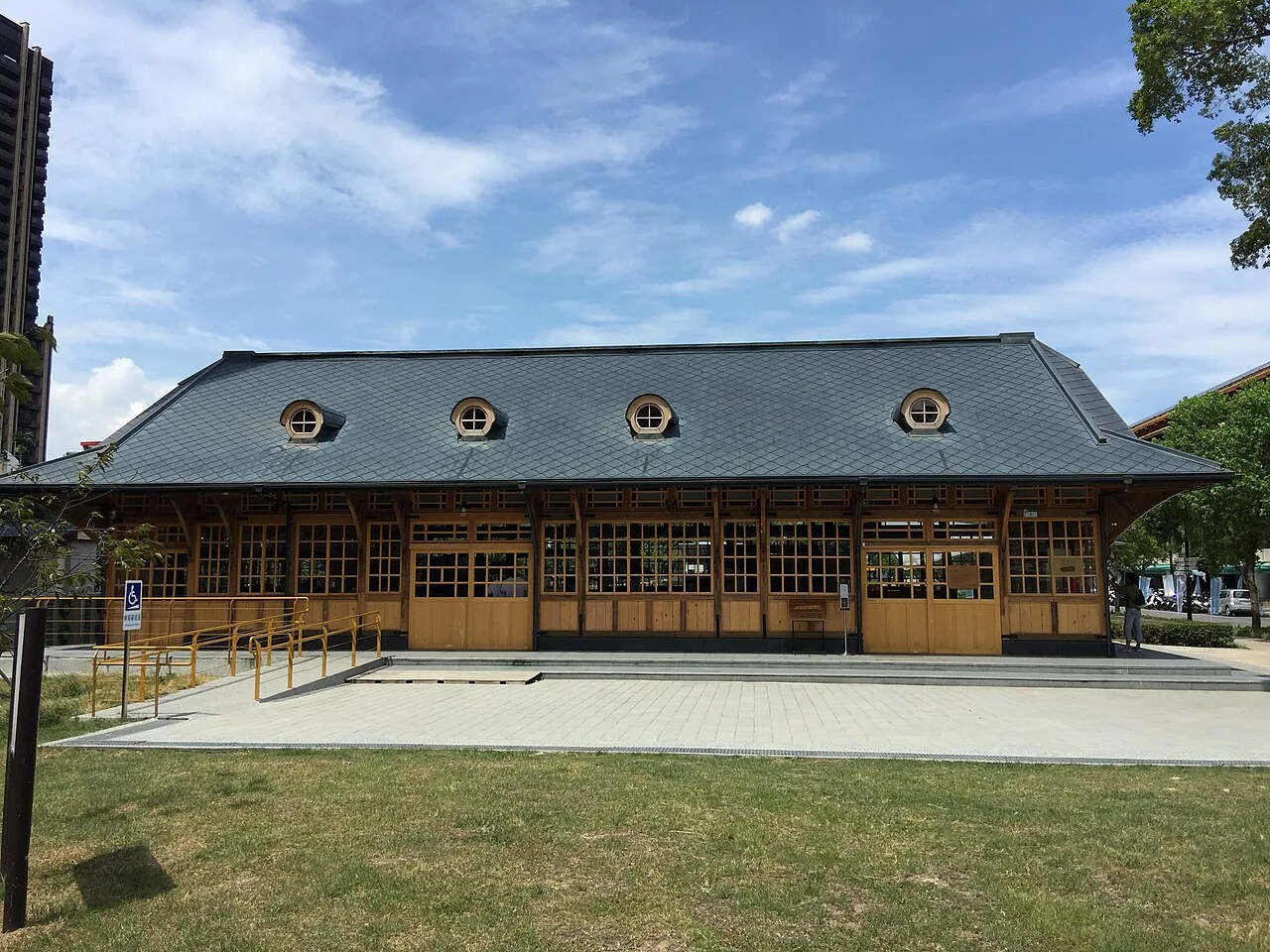
Xinbeitou Station as reassembled in Qixing Park today. Photo: Wikimedia Commons contributor. License via Wikimedia (CC BY-SA).
On July 15, 1988, the day the Xinbeitou Branch Line was abolished, the 1916 Taiwan red cypress station was dismantled, shipped to Changhua, and reassembled inside Taiwan Folk Village19. It stayed in Changhua for 24 years. No one boarded a train at that station there. It became an exhibit in the folk village, a place where tourists took photos, glanced, and walked on19.
In 1996, Beitou Community magazine published an article titled “Finding a Lost Relative, Welcoming Xinbeitou Station Again,” which ignited local discussion28. From 2003 to 2004 onward, residents successively launched the “Xinbeitou Station Homecoming Action,” seeking help from the Taipei City Government, the Ministry of Culture, and Taiwan Folk Village28. As Taiwan Folk Village’s business situation deteriorated, the new owner, Jih Rong Company, eventually donated the station without compensation to the Taipei City Government28.
But “coming home” was more complicated than expected. The original site, where the 1916 station had once stood, is now the plaza of Xinbeitou MRT Station and could not accommodate the station. After repeated cultural heritage review discussions, the final choice was to “shift the original site by about 50 meters” and reassemble the station in Qixing Park, with the address set as “No. 1, Qixing Street”28.
On April 1, 2017, the station’s 101st birthday, the reassembly was completed and the station formally opened to the public28.
The controversy did not end. Events in Focus once published an article titled “The Location, Appearance, and Materials Are All Wrong: Has Xinbeitou Station Really ‘Come Home’?” questioning the reassembly29. The location was not the original site; some timber had been damaged during the Taiwan Folk Village years and replaced with new wood; added structures differed from the 1916 original appearance29. Cultural heritage circles were divided: some argued that “being able to preserve it is already a good thing,” while others argued that “this station has essentially become our 2017 interpretation of the 1916 original”29.
However one views it, the 2017 station stands again in Xinbeitou, 50 meters from its original site, using some new timber, with its four round dormer-window openings still present. It and the 1913 red-brick bathhouse across the way once again became two architectural objects on the same line.
From 1916 to 2017, this station experienced: Japanese-era tourist railway (1916-1945) → postwar Taiwan Railways Beitou-Tamsui Line (1945-1988) → wandering in Changhua (1988-2012) → reassembly in Qixing Park (2017 to the present). In the eyes of four generations, it has been four different things.
Material Layers: Red Brick, Qilian Stone, Hokutolite, Cypress
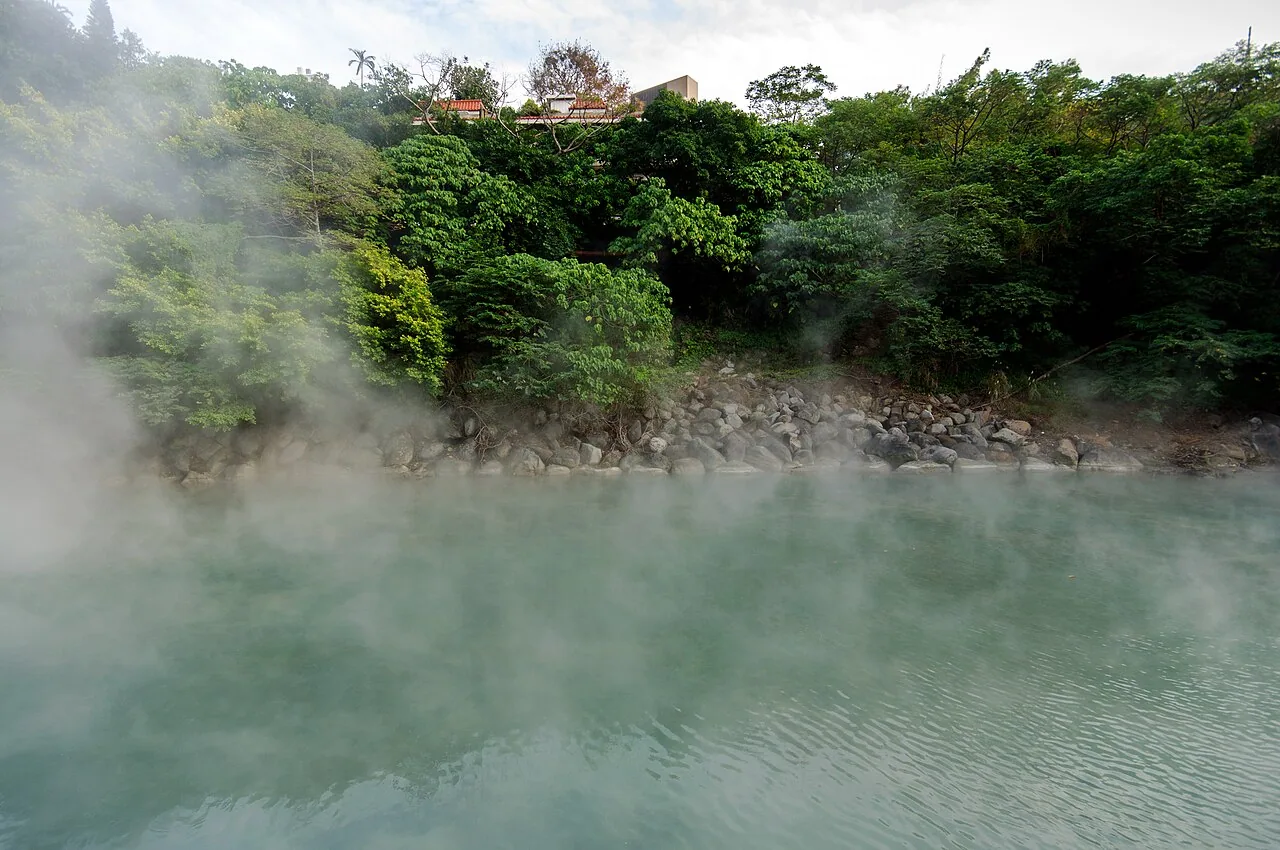
Green sulfur spring at Thermal Valley. Photo: Wikimedia Commons contributor. License via Wikimedia (CC BY-SA).
Every material layer of Beitou’s street has a story.
Red brick: The bricks used in the 1913 Beitou Public Bathhouse were red bricks fired locally in Taiwan. The exposed red-brick walls paired with blue-green roof tiles, and the overall style imitated an English country villa9. Moriyama Matsunosuke’s design belonged to the standard colonial public architecture of Japanese-era Taipei at the time; the Government-General Monopoly Bureau and the Tainan Prefectural Hall used similar styles9.
Qilian stone: The Roman-style large bath inside the bathhouse was built of pale gray Qilian stone9. This stone was abundant in Beitou and Shilin, and after the war it was also used in building the baths at Takinoyu. The method of bonding Qilian stone with sulfur mud has allowed Takinoyu’s baths to stand for more than 100 years without leaking22.
Hokutolite: The radium-bearing mineral Okamoto Yōhachirō collected in Beitou Creek in 1905 was formally named Hokutolite11. Among thousands of minerals in the world, it is the only one named after a place in Taiwan. In 1933, the Japanese government designated Beitou Creek a “natural monument protection area,” the world’s first natural monument centered on a mineral11. After the war, it remained protected11.
Cypress: Xinbeitou Station, built in 1916, used Taiwan red cypress, a high-grade local building material the Japanese found in Taiwan and widely used in Japanese-era public buildings19. The “four round dormer-window openings” added in the 1937 expansion were also part of a cypress structure19. The main hall of Puji Temple, formerly Tesshin-in, is also built of cypress18.
Green sulfur spring: Thermal Valley’s water is a hydrochloric acidic spring with a pH of about 1.6 and a temperature of 90-100°C, commonly called green sulfur spring water11. Beitou Thermal Valley was once called “Beitou Creek Hot Spring” or “Hell Valley.” During Japanese rule, tourists slipped and fell into the spring, were scalded, and died, hence the name “hell.” Later, because the name was considered inelegant, it was changed to “Jade Spring Valley” and then to today’s “Thermal Valley”11. Thermal Valley’s spring water is beneficial for joints, muscles, skin, bronchial conditions, and nerves11, but the water temperature is too high for direct bathing. All Beitou hot spring hotels draw water from here and mix it with cold water to lower it to around 40 degrees.
Material layers that have disappeared: the signboards of the more than one hundred wine houses and inns that once existed after the war, the black motorcycle fleets of time-limited delivery, the wooden guitars slung over the shoulders of nakashi bands, and the music stands in their suitcases. These things were not preserved in the museum, but Chen Ming-chang’s 1988 musical preserved them in sound25.
Three Places Locals Will Take You
If you ask someone who grew up in Beitou “besides the museum and Thermal Valley, where else can we go,” they might name these three places.
Puji Temple, formerly Tesshin-in, No. 112, Guangming Road, an eight-minute uphill walk from Xinbeitou MRT Station18. Built in 1905 with funds contributed by Railway Department employees, it is one of Taiwan’s rare purely Japanese Shingon Buddhist temples. The main hall uses Taiwan cypress, the roof is in Japanese irimoya style, and the “Greatly Merciful and Compassionate Beitou Yumori Guanyin,” carved with Railway Department funding after Hirata Gengo’s petition, is enshrined inside18. Each year, it opens for only a short period for worship of the Yumori Guanyin18.
Beitou Park Outdoor Hot Spring Bathing Pool, Millennium Hot Spring, No. 6, Zhongshan Road, opened in December 199912. A ticket costs NT$40. Visitors enter wearing swimsuits and swim caps. There are six pools, four hot and two cold. The 5:30-7:30 a.m. session is most worth attending: it is the fixed routine of aunties and grandmothers, who chat about neighborhood gossip after soaking12. Note: It has been temporarily closed for renovation since January 24, 2025, with work expected to take about one year12.
Takinoyu, No. 244, Guangming Road, built in 190722. During Japanese rule, it was a convalescent facility for Japanese soldiers, originally with only a men’s bath. After the war, it was sold to its original tenant, Lin Tianhan, and it has continued under its postwar name to this day22. The baths are built of Qilian stone bonded with sulfur mud and have not leaked for more than 100 years22. The “Monument to His Imperial Highness the Crown Prince’s Crossing” in the courtyard was erected in 193420. In 2016, it underwent its first major renovation in 60 years and reopened in 201722.
Visit these three places, plus the Hot Spring Museum and Thermal Valley, and an afternoon from about five to eight-thirty is just right.
The Same Mountain Spring, the Next Generation of Residents
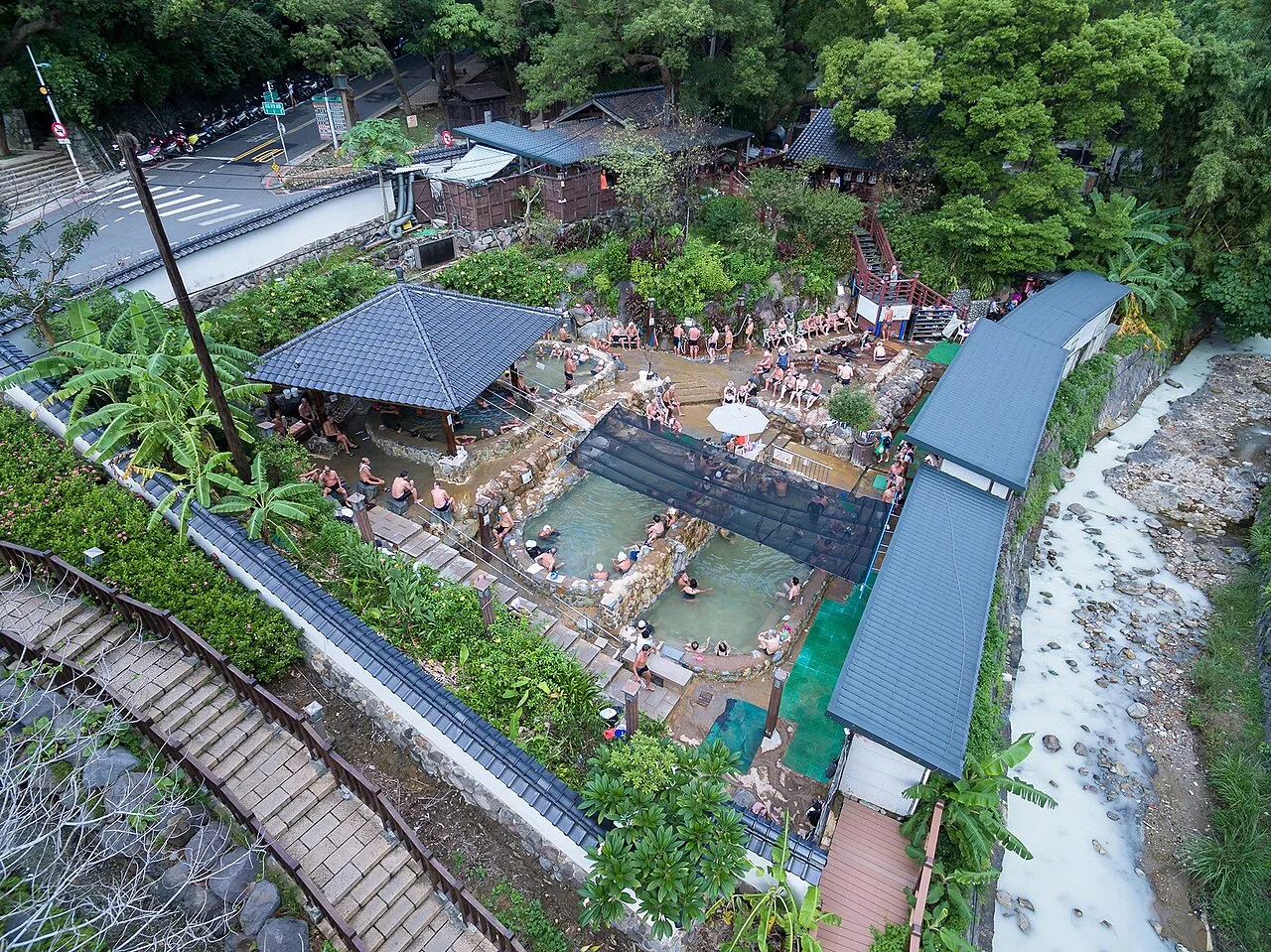
Beitou Park Outdoor Hot Spring Bathing Pool, Millennium Hot Spring. Photo: Wikimedia Commons contributor. License via Wikimedia (CC BY-SA).
At six in the morning, before the outdoor bath has opened, a row of aunties and grandmothers is already sitting at the entrance.
Each carries a plastic bag holding a towel, swim cap, change of clothes, a bottle of water, and a small plastic bag of dry food. The grandmother at the front of the line wears a light-colored T-shirt and loose sweatpants, chatting with the woman beside her about yesterday’s vegetable prices at the traditional market.
They know where Thermal Valley is, know which lane is faster for getting to Takinoyu, and know what time the MRT Red Line opens in the morning. Some of them are 70, some 80. Some are wives of veterans who moved to Beitou in the 1950s. Some are former wine-house employees who stayed after the 1979 abolition and are now grandmothers.
They may not know that Yu Yonghe came here in 1697. They may not know that patauw means witch. They may not remember that Crown Prince Hirohito came for a bath in 1923.
But their footprints tread this street on the same mountain path as the four generations before them.
From the Fuzhou man’s work sheds in 1697, to the Osaka man’s thatched hut in 1896, to the colonial red-brick bathhouse in 1913, to the crown prince’s stepping stones in 1923, to the U.S. military jeeps in 1967, to the wine houses whose lights went out in 1979, to the Beitou Elementary School teachers who rediscovered the public bathhouse in 1994, to this line of aunties and grandmothers at six in the morning in 2026, this street has changed through five generations of residents, while the mountain spring’s smell has not changed.
The Ketagalan people called it Patauw, “the place of witches.” In 1899, Inō Kanori said it was “the act of performing magic.”
Those aunties and grandmothers may not know this. But every morning at six, they walk into the steam of Thermal Valley.
That is a kind of magic.
Further reading:
- Taipei City — a panorama of the 12 districts, Beitou District’s position, and its relationship to other historic districts in Taipei
- Cultural Map of Taiwan’s 16 Indigenous Peoples — the distribution of the Ketagalan people and other plains Indigenous groups in Taiwan
- Dadaocheng — a historic district from the same period, another key commercial center in Taipei after the 1860 opening of the port
- Bangka — the prosperous starting point of Qing-era Taipei’s “first Tainan, second Lukang, third Bangka,” and its relationship to Beitou
- Ximending — an entertainment district planned by the Japanese in 1896, whose start ran parallel to Hirata Gengo’s Tenguan in Beitou that same year
- Zhongshan North Road Tiaotong — the tree-lined boulevard from the 1898 Chokushi Road to Yuanshan Shrine; after Taiwan and Japan severed diplomatic relations in 1972, its Japanese-business izakaya culture and Beitou’s 1979 abolition of licensed prostitution became two diverging branches of Taipei’s postwar special-industry landscape
Image Sources
This article uses six CC-licensed images, all cached in public/article-images/geography/ to avoid hotlinking to Wikimedia Commons:
- Beitou Hot Spring Museum 2 — Photo: Wikimedia Commons contributor, 2020-08-20, CC BY-SA 4.0
- Crown Prince Hirohito's visit at Hokutō Public Bathhouse 1923 — Public domain (prewar document, 1923)
- Entrance of Beitou public hot spring — Photo: Wikimedia Commons contributor, CC BY-SA
- Beitou Thermal Valley — Photo: Wikimedia Commons contributor, CC BY-SA
- Beitou Park Outdoor Hot Spring Bathing Pool — Photo: Wikimedia Commons contributor, CC BY-SA
- Front view of Xinbeitou Station on a bright sunny day — Photo: Wikimedia Commons contributor, CC BY-SA
References
- Yu Yonghe came to Taiwan to mine sulfur and wrote Small Sea Travel Diaries — Taiwan Literature Knowledge Platform — An entry on the Taiwan Literature Knowledge Platform established by the National Museum of Taiwan Literature, recording the historical background of Yu Yonghe’s voluntary sea crossing to Taiwan to mine sulfur after the 1696 fire at the Fuzhou gunpowder depot, as well as the details of his 1697 arrival at Beitou’s Dahuangzui, where he set up work sheds and traded cloth with the Ketagalan people for sulfur. It also records the specific description in Small Sea Travel Diaries of the Beitou Creek hot spring as able to “boil cauldrons and melt copper, utterly unlike boiling water.”↩23456
- Taiwan Indigenous Peoples Cultural Knowledge Network — Plains Indigenous Peoples — Where Did the Ki-Patauw Witch Account Come From? — An official page of the Taipei City Government Indigenous Peoples Commission’s knowledge network, recording Spanish and Dutch archival references to Beitou Village as Kipatauw, and Inō Kanori’s 1899 oral-history collection at Beitou Village indicating that patauw meant witch. Modern oral accounts from community chiefs point out that Kipatauw was actually the verb “to perform magic,” while Inō’s incomplete collection was recorded and repeated to the present day.↩2345678
- Hirata Gengo — Taipei Hot Springs Association — An official page of the Taipei Hot Springs Association, recording Hirata Gengo’s birth in Japan in 1845, his mining work for the Sumitomo family in Osaka beginning in 1885, his December 1895 discovery of the Beitou hot springs, and his March 1896 purchase of a thatched hut at Lot 73, Beitou Village, Zhilan Second Fort, Taipei Prefecture, now No. 234, Guangming Road, which he converted into the Tenguan inn, Taiwan’s first hot spring inn.↩23
- Beitou Public Bathhouse — National Cultural Heritage Database — An official entry in the Bureau of Cultural Heritage, Ministry of Culture’s National Cultural Heritage Database, recording that the Beitou Hot Spring Public Bathhouse was built by Taipei Prefecture in June 1913, the second year of the Taishō era, using more than 56,000 yen in public health funds; that it was modeled on Izusan Onsen in Shizuoka Prefecture, Japan; and that it was completed on June 17, 1913.↩23
- Xinbeitou Branch Line — Wikipedia — The Wikipedia entry on the Xinbeitou Branch Line, recording that the line opened on April 1, 1916, the fifth year of the Taishō era; was promoted by Murakami Shōichi, head of the Transportation Section of the Government-General Transportation Bureau’s Railway Department; was 1.2 kilometers long and built purely for tourism; and was Taiwan’s earliest railway built purely for sightseeing.↩234
- 16. Crown Prince Hirohito’s 1923 Beitou Visit — Beitou Hot Spring Museum — An official service-learning page of the Beitou Hot Spring Museum, recording Crown Prince Hirohito’s April 25, 1923 visit to Beitou, including his visits to Caoshan and the Beitou Hot Spring Public Bathhouse and his inspection of Hokutolite. It also records the historical detail that a more than 30-ping “imperial rest area,” now the audiovisual room on the second floor of the Hot Spring Museum, was specially added to the second floor of the public bathhouse.↩23
- The “Hot Spring Photo” in Time Magazine 50 Years Ago Enraged Chiang Kai-shek! — CitiOrange — An in-depth CitiOrange report recording the U.S. military R&R program after the Vietnam War began in 1965, Time magazine’s December 22, 1967 report on Taiwan under the title “Beitou, the Gentle Village,” the 210,000 Vietnam War-era U.S. troops who came to Taiwan for R&R and spent US$52.8 million, and the political embarrassment the report caused Chiang Kai-shek.↩2345678910
- Sex Industry in Taiwan — Wikipedia — The Wikipedia entry on Taiwan’s sex industry, recording the April 30, 1954 establishment of Beitou’s “Female Hostess Lodging Household Association,” the Taipei City Council’s February 5, 1979 abolition of the legal status of Beitou District hostesses during Lee Teng-hui’s mayoralty from 1978 to 1981, and the November 1, 1979 further ban on hotels summoning women to drink, bathe, or lodge with guests and on bands singing for pay.↩23456
- Beitou Hot Spring Museum — Wikipedia — The Wikipedia entry on the Beitou Hot Spring Museum, recording the completion of the Beitou Hot Spring Public Bathhouse on June 17, 1913; its designer Moriyama Matsunosuke; its planning by order of Taipei Prefecture governor Imura Daikichi; its postwar conversion into the Yangmingshan Public Service Office; its 1994 rediscovery by Beitou Elementary School teachers Lyu Hong-wen, Huang Gui-guan, Hsieh Shu-ling, and Hsu Chia-pao; its February 1997 designation as a third-class historic monument; and the museum’s official opening on October 31, 1998.↩2345678910111213141516171819202122
- Beitou Park — Wikipedia — The Wikipedia entry on Beitou Park, recording that the park was established under the Taiwan Government-General’s 1911 “Park Management Rules,” opened on June 17, 1913, and included facilities such as a circular fountain, a wild-goose and duck fountain, trees, and benches.↩2
- Thermal Valley — TravelKing — TravelKing’s official introduction page, recording that Thermal Valley’s hot spring is commonly called green sulfur spring water, with a hydrochloric acidic pH of about 1.6 and spring temperature of 90-100°C; that it was formerly called Hell Valley and later renamed Jade Spring Valley; and that in 1905 Japanese mineralogist Okamoto Yōhachirō discovered in Beitou Creek the highly radioactive radium-bearing mineral Hokutolite, the world’s only mineral named after a place in Taiwan, found globally only in Beitou, Taiwan, and Tamagawa Onsen, Japan.↩2345678910
- Beitou Park Outdoor Hot Spring Bathing Pool_Millennium Hot Spring — Taipei Travel — An official Taipei Travel attraction page, recording that the Beitou Park Outdoor Hot Spring Bathing Pool opened in December 1999, the 88th year of the Republic of China calendar; was named “Millennium Hot Spring” because it coincided with the millennium; occupies about 1,000 square meters; has six public pools, four hot and two cold; has water temperatures of 38-45°C; charges NT$40 on weekdays; and has been temporarily closed for renovation since January 24, 2025.↩234567
- Beitou Village — Wikipedia — The Wikipedia entry on Beitou Village, recording that Spanish and Dutch archival documents generally wrote Beitou Village as Kipatauw, including the 1654 Map of Tamsui and Its Surrounding Villages compiled by the Dutch East India Company.↩
- Taiwan Indigenous Peoples Cultural Knowledge Network — Plains Indigenous Peoples — Beitou Village — An official page of the Taipei City Government Indigenous Peoples Commission’s knowledge network, recording that in the mid-17th century Kipatauw had more than 30 households and over 100 people; that Inner Beitou covered neighborhoods in today’s Beitou District including Qingjiang, Chang’an, Zhongzheng, Zhongyang, Wenquan, Qingjiang, and Baxian, while Outer Beitou was around today’s Beitou Borough in Tamsui District, New Taipei City; and that the surviving Fanzi Cuo settlement and Baode Temple’s enshrined “Fanzi Wangye” and “Pingpu Community” Earth God preserve historical traces.↩2
- Witnesses to Plains Indigenous Settlement Remains — Baode Temple’s Fanzi Wangye and “Pingpu Community” Earth God in Beitou — An article in the Council of Indigenous Peoples’ Indigenous Peoples Literature e-journal, recording the details of the 1709, 48th year of the Kangxi reign, Chen-Lai-Zhang reclamation syndicate petition for land “east to Lei-xia Xiulang, west to outside Bali-fen Gantou, south to within the foothills of Xingzhi, and north to Dalang Bengou,” as well as the historical process by which Ketagalan people lost land rights and their language declined after Han settlement.↩
- Hirata Gengo — Wikipedia — The Wikipedia entry on Hirata Gengo, recording that he was born in 1845, the second year of Kōka; died on July 7, 1919, the eighth year of Taishō; began mining work for the Sumitomo family in Osaka in 1885, the 18th year of Meiji; sought a hot spring area in 1895 after an injury; and returned to Beitou in 1896 to buy a thatched hut and convert it into the Tenguan inn.↩23
- The Site of Taiwan’s First Hot Spring Inn, Tenguan — Taiwan Memo — An in-depth heritage-recording blog post documenting the Tenguan site at today’s No. 234, Guangming Road, Beitou District, Taipei City; its use since 2010 as the site of the Radium Kagaya International Hotel; and the hotel’s preservation of the “Tenguan Historic Park” to commemorate the origin of Taiwan’s hot spring industry.↩
- Beitou Puji Temple — Beitou District Office Historic Sites Guide — An official historic-sites guide page from Taipei City’s Beitou District Office, recording that Puji Temple was founded in 1905 with contributions from employees of the Taiwan Government-General Railway Department; that during Japanese rule it was called Tesshin-in, with one account saying it commemorated railway worker casualties and another saying it commemorated Transportation Section chief Murakami Shōichi’s posthumous Buddhist name “Tesshin”; that its main hall is built of Taiwan cypress; and that it enshrines the “Greatly Merciful and Compassionate Beitou Yumori Guanyin Bodhisattva,” carved with Railway Department funding after a petition by Hirata Gengo.↩234567
- Xinbeitou Station — Wikipedia — The Wikipedia entry on Xinbeitou Station, recording that Xinbeitou Halt opened on April 1, 1916; used Taiwan red cypress as its main building material; was expanded in 1937 with four round dormer-window openings; was abolished on July 15, 1988; and, through arrangements by architect Lee Chung-yao, was sold by the Taipei City Government for a symbolic NT$1 to Shih Chin-shan’s Taiwan Folk Village in Changhua.↩234567
- Takinoyu — Courtyard Treasure — Monument to His Imperial Highness the Crown Prince’s Crossing — An official Takinoyu bathhouse page, recording that during the crown prince’s 1923 visit to Beitou, stepping stones, or tobiishi, were specially laid to facilitate his crossing of the creek for sightseeing; that in 1934, 11 years later, residents erected the “Monument to His Imperial Highness the Crown Prince’s Crossing” beside Beitou Creek’s second waterfall; and that the monument is now preserved in the Takinoyu courtyard.↩234
- Beitou Museum — Wikipedia — The Wikipedia entry on the Beitou Museum, recording that its predecessor, Kazan Inn, was built in 1921; that it is Taiwan’s only surviving purely wooden two-story Japanese-style building of its kind; that in the late Second World War it was requisitioned by the military as a “Japanese Officers’ Club”; that Beitou elders orally recounted kamikaze pilots reveling there in the week before departure; that after the war it was taken over by the Ministry of Foreign Affairs as Kazan Guest House; and that in 1983 San Fu Chemical’s Chang Chun-ming took it over and converted it into the Taiwan Folk Arts Museum, later renamed the Beitou Museum.↩2
- Takinoyu — National Cultural Memory Bank — An official Ministry of Culture National Cultural Memory Bank entry, recording that Takinoyu was built around 1907; that its name came from Beitou Creek’s “second waterfall”; that during Japanese rule it was a convalescent facility for Japanese soldiers, originally with only a men’s bath; that around 1950 it was sold to original tenant Lin Tianhan and added a women’s bath and private bathing rooms; that the baths were built of Qilian stone bonded with sulfur mud; and that it began its first major renovation in 60 years in 2016 and reopened in 2017.↩23456
- Introduction to Nakashi Culture — Station: A Century — An exhibition introduction page from “Station: A Century,” a collaboration between Beitou Community University and Beitou local studies, recording that nakashi is a phonetic borrowing from the Japanese nagashi; that it rose with hot spring hotels in the 1960s; that in its 1970s heyday Beitou had more than one hundred hotels and more than one hundred nakashi bands; that instruments evolved from early singer-instrumentalists to accordion, guitar, and drum ensembles and later electronic keyboard and electric guitar; and that it gradually declined after the 1979 abolition of licensed prostitution and the rise of karaoke and KTV.↩2345
- Beitou Time-Limited Delivery — Taipei Hot Springs Association — An official Taipei Hot Springs Association introduction, recording the demand during Japanese rule for transporting female hostesses between hot spring hotels; the 1950s replacement of tricycles by motorcycles as the mainstream vehicle; the more than 1,000 time-limited-delivery motorcycles during the 1970s peak; and the occupational history by which, after the 1979 abolition of licensed prostitution, transport companies expanded their service targets and transformed into ordinary household courier services for Beitou residents.↩2345
- Beitou’s Former Glory: An Interview with Chen Ming-chang and Ho Hung-chi — Central News Agency — An in-depth Central News Agency culture feature and interview, recording Chen Ming-chang’s birth in Beitou Township on July 4, 1956; his childhood experience of Beitou’s many wine houses and nakashi culture; and the creative background of his 1988 collaboration with Greenray Theatre on the musical Goodbye, Beitou, directed by Wu Nien-jen, composed by Chen Ming-chang, lyrics by Chen Ming-yu, sung by Pan Li-li, including the opening lyric “Spring-night rain falls drop by drop, cold and frosty...”↩2345
- Defending the Right to Survival to the Death — The Taipei City Licensed Prostitution Abolition Incident (1997.09-1999.03) — Taiwan Women — An entry on the National Museum of Taiwan History’s “Taiwan Women” history platform, recording the Taipei City Council’s July 30, 1997 abolition of the “Taipei City Regulations for the Management of Prostitutes,” the September 4 establishment of the “Taipei City Licensed Prostitutes’ Self-Help Association,” and the historical protest by a self-help association formed by 128 licensed prostitutes during Chen Shui-bian’s mayoralty, a different event from Beitou’s 1979 abolition of licensed prostitution.↩
- Ketagalan Culture Center — Wikipedia — The Wikipedia entry on the Ketagalan Culture Center, recording that it opened in November 2002; is located at No. 3-1, Zhongshan Road, Beitou District, Taipei City, near Xinbeitou MRT Station and Beitou Park; and is Taiwan’s first cultural, artistic, and educational study center centered on Indigenous peoples.↩
- After 24 Years Adrift, Homecoming Nears: The Return of Xinbeitou Railway Station — Taiwan Panorama — An in-depth report by Taiwan Panorama, Ministry of Foreign Affairs, Republic of China, recording how the 1996 Beitou Community magazine article “Finding a Lost Relative, Welcoming Xinbeitou Station Again” ignited local discussion; how residents launched the “Xinbeitou Station Homecoming Action” from 2003 to 2004 onward; how, after Taiwan Folk Village’s business deteriorated, the new owner Jih Rong Company donated the station without compensation; and how the station was reassembled in Qixing Park and officially opened to the public on April 1, 2017, its 101st birthday.↩2345
- The Location, Appearance, and Materials Are All Wrong: Has Xinbeitou Station Really “Come Home”? — Events in Focus — An in-depth Events in Focus report, recording the controversy over Xinbeitou Station’s reassembly in Qixing Park: the location is not the original 1916 site, which is now an MRT plaza; some timber was damaged during the Taiwan Folk Village period and replaced with new wood; added structures differ from the 1916 original appearance; and cultural heritage circles are divided between the views that “being able to preserve it is already a good thing” and “this is no longer the station from 1916.”↩23