
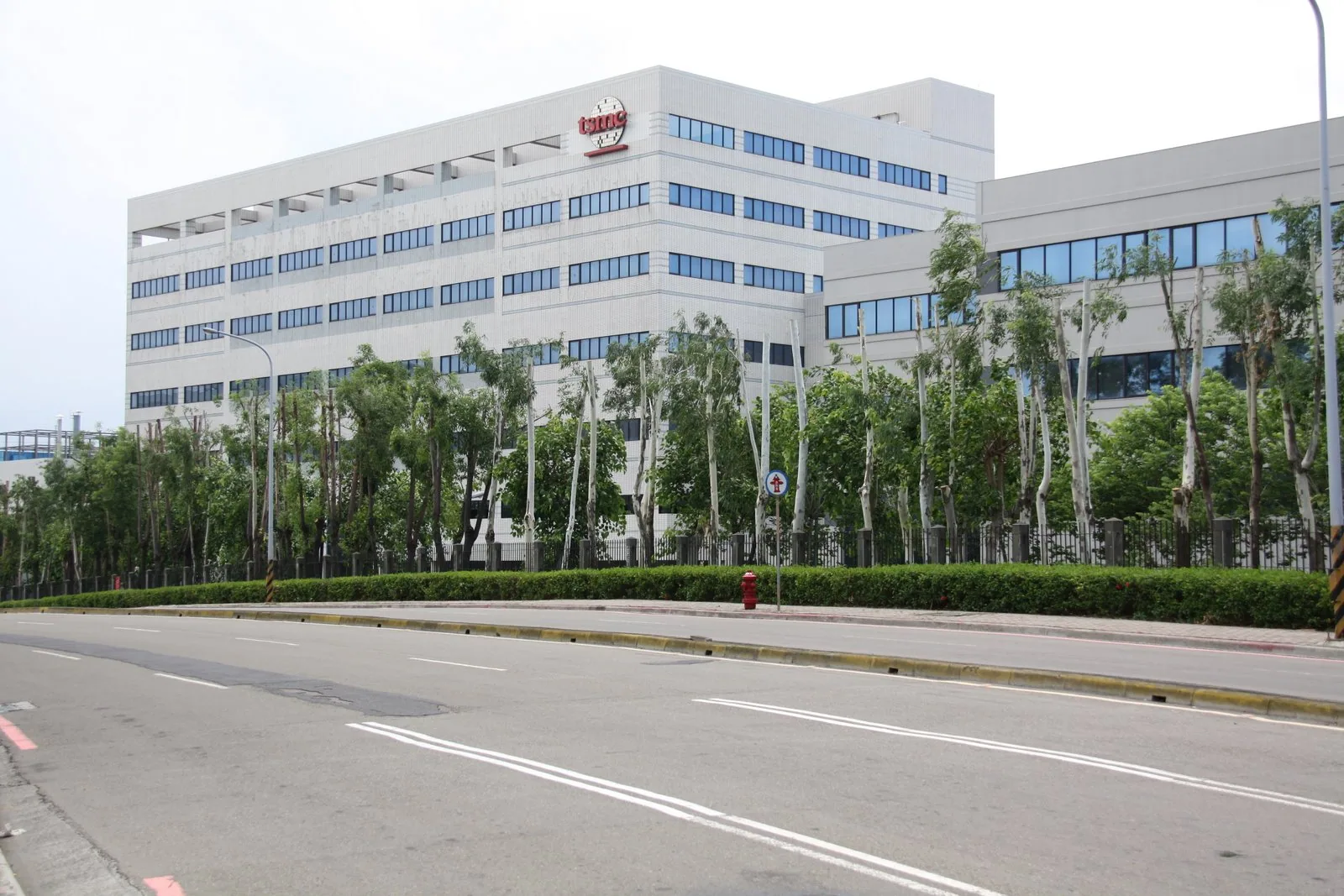
30-second overview: After the market closed on May 19, 2026, TSMC's market capitalization stood at NT$57.18 trillion. One company accounted for 31.51% of the Taiwan Capitalization Weighted Stock Index, roughly 40% of total Taiwan stock market capitalization, and 71% of global foundry market share. The 49 spots behind it were divided among 12 financial holding companies, 11 semiconductor firms, 6 electronics contract manufacturers, and 5 veterans of traditional industry. The so-called tripartite balance of electronics, finance, and traditional industries is in fact half a body held up by one electronics leg; since 2024, the AI wave has pulled Quanta, Wistron, Wiwynn, and Hon. Precision from the middle of the pack toward the top, further raising concentration. Reading the top 50 table is like reading an anatomical chart of Taiwan's economy: where the spine is, where the single point of failure is, and where the internal organs hidden outside the table are.
On the evening of May 28, 2024, five people sat at plastic tables and chairs in Taipei's Ningxia Night Market. Jensen Huang, Morris Chang, Rick Tsai, Barry Lam, and Kris Yao, several of the most important names in the semiconductor and architecture industries, ate street food and drank beer that night1. The next day, COMPUTEX 2024 opened at National Taiwan University's Sports Center. On Jensen Huang's projection screen was a map of Taiwan, marked with the names of TSMC, Foxconn, Quanta, and 16 universities, in front of an audience of 5,0002. After he said, "Taiwan is an unsung hero, yet the pillar of the world," every company named on that map opened higher in the stock market the following day.
The names on that map are almost a miniature version of Taiwan's top 50 companies ranking. A single slide pinned a country's economic structure onto a screen3.
📝 Curator's Note
Reading the top 50 table is like reading a map. Reading from top to bottom, the number of seats occupied by semiconductors, electronics contract manufacturing, finance, traditional industry, and telecom reflects the industrial skeleton of the island of Taiwan. Readers can see three things on this skeleton: which bone is the spine, which part is the vulnerable rib, and whether the heart is beating regularly.
A Map That Pins Up a Country
After the market closed on May 19, 2026, the ranking looked like this[^4]: first place was TSMC, with a market capitalization of NT$57.18 trillion (2330); second was MediaTek, at NT$5.06 trillion (2454); third was Delta Electronics, at NT$4.97 trillion (2308); fourth was Hon Hai, at NT$3.43 trillion (2317); fifth was ASE Technology Holding, at NT$2.11 trillion (3711). These five companies alone had a combined market capitalization of NT$72 trillion, more than half of the total market value of Taiwan stocks.
From sixth to thirtieth place, three further layers are visible. In the semiconductor camp were UMC (2303), GUC (3443), Winbond (2344), Nanya Technology (2408), and Chroma (2360). In finance were Fubon Financial (2881), Cathay Financial (2882), CTBC Financial, Yuanta Financial, Mega Financial, Taishin Shin Kong Financial, and E.SUN Financial (2884). In electronics contract manufacturing and AI peripherals were Quanta (2382), Accton (2345), Wiwynn (6669), Auras (3017), Hon. Precision (7769), Unimicron (3037), Taiwan Union Technology (2383), and Yageo (2327). Among traditional industries and telecoms, only Chunghwa Telecom (2412) and Nan Ya (1303) squeezed into the top 304.
The 31st to 50th places were even more crowded. China Steel (2002), Formosa Petrochemical (6505), Evergreen Marine (2603), and Uni-President (1216), veterans that helped sustain the economic miracle of the 1970s and 1980s, held the back end of the ranking. Wistron (3231), ASUS (2357), Lite-On Technology, Advantech (2395), and Alchip-KY (3661), together with financial holding companies, rotated positions, all with market capitalizations in the NT$400-500 billion range, where a one-percentage-point difference could change the order5.
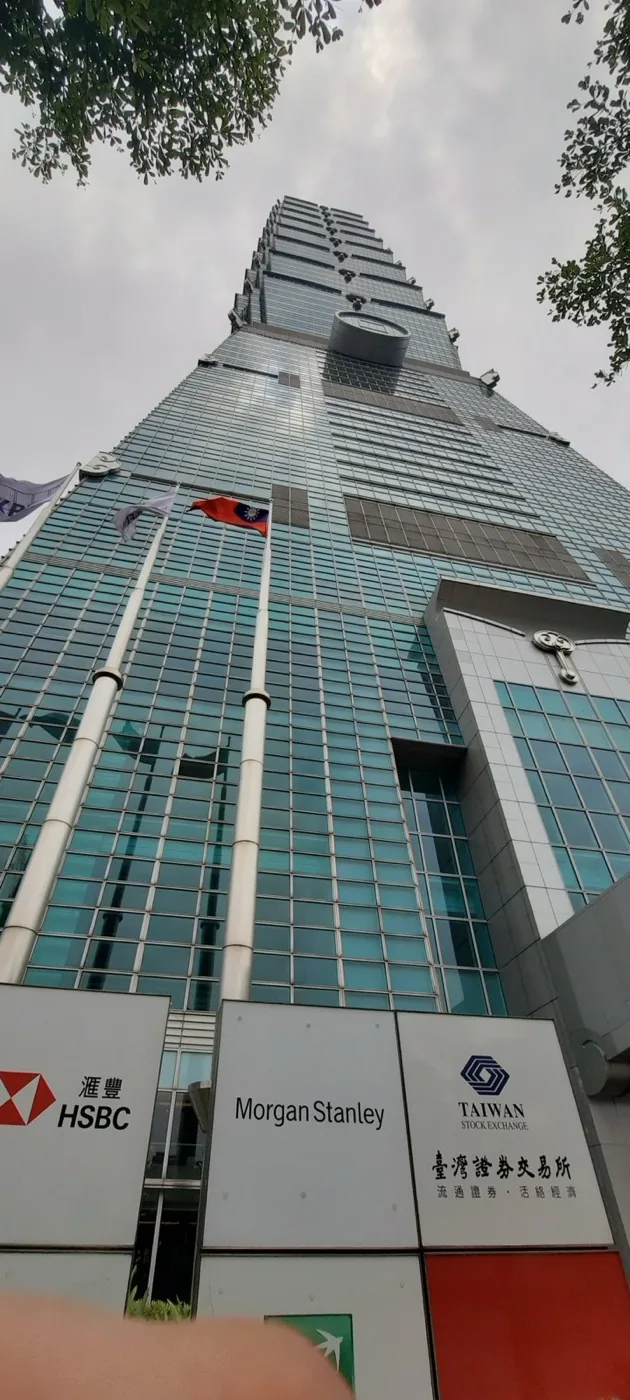
Taipei 101 in Xinyi District, Taipei. The Taiwan Stock Exchange is headquartered inside this 508-meter landmark building; the opening bell for Taiwan stocks rings here every day. Photo: Anas1712, 2023-05-11. CC BY 4.0 via Wikimedia Commons.
Slicing the top 50 by industry, excluding the Yuanta Taiwan 50 and Yuanta High Dividend ETFs:
| Industry Category | Seats | Share |
|---|---|---|
| Semiconductors (foundry / IC design / packaging and testing / memory / equipment) | 11 seats | 23% |
| Finance (financial holding companies) | 12 seats | 25% |
| Electronics contract manufacturing (including AI servers and branded PCs) | 6 seats | 13% |
| PCB / ABF substrates / thermal solutions | 5 seats | 10% |
| Traditional industries (petrochemicals / steel / shipping / food) | 5 seats | 10% |
| Communications (telecom) | 3 seats | 6% |
| Networking / industrial computers / passive components / optics / testing | 7 seats | 15% |
| Other (auto distribution) | 1 seat (borderline) | 2% |
💡 Did You Know
Investors have long used the mnemonic "electronics, finance, traditional industries" to describe the three pillars of Taiwan stocks. But when the 2026 top 50 are laid out, electronics plus semiconductors already take 36% of the seats, finance 25%, and traditional industries are compressed to 10%. The tripartite balance is in fact half a body held up by one leg, another leg (finance) holding up one quarter, and the remaining toes distributed among traditional industry, communications, and passive components.
The Two Sides of the Sacred Mountain
Zoom in on the company in first place: TSMC's market capitalization was NT$57.18 trillion, accounting for 31.51% of the entire weighted index6. Think of the Taiwan stock market as a scale: TSMC alone sits in the basket on one side, while more than 1,000 other companies combined sit on the other, and neither side tips over.
Zoom in one level further: it accounted for roughly 42% of total Taiwan stock market capitalization7. It held 71% of the global foundry market in the third quarter of 20258. In advanced process nodes below 10 nanometers, TSMC and Samsung together monopolized the world; Samsung was left with only 6.8%, while TSMC had 71%, a tenfold gap. Within 5 nm, 3 nm, and 2 nm advanced processes, there is only one street where the key position exists, and that street is called Baoshan, Hsinchu.
📝 Curator's Note
The metaphor of the "sacred mountain protecting the nation" can be read in reverse. TSMC is a mountain because it is high enough, heavy enough, and irreplaceable enough; but the mountain is also a mountain on an earthquake belt, and beneath its shadow stand all the Taiwanese people whose livelihoods depend on this supply chain. The mountain's height and its fragility share the same geology on this island.
The theme of C.C. Wei's speech at National Taiwan University's EMBA program on January 16, 2025, was "If There Were No TSMC"9. He described one case: after the Arizona fab began mass production, sulfuric acid of a grade suitable for IC manufacturing could not be purchased locally in the United States, so TSMC shipped sulfuric acid from Taiwan to the Port of Los Angeles and then trucked it to Phoenix, which was still cheaper than buying it in the United States. "Building a fab in the United States has had me crying and sniffling" was a line he said more than once. TSMC's entire supply chain is not portable. What the Arizona fab moved was equipment and process technology; what it could not move was a small universe extending from chemicals to photomasks to EUV maintenance, and that small universe remains in Taiwan.
The other side of concentration is taxes and exports. The semiconductor industry accounted for 34.7% of Taiwan's total exports, according to 2024 Ministry of Finance data10, while the top 50 companies together accounted for 51.5% of total exports, according to 2023 data11. TSMC alone accounted for 8.1% of net profit-seeking enterprise income tax collected, according to the company's own 2022 disclosure12. These figures are often compressed on social media into the claim that "TSMC accounts for 7% of GDP, 15% of tax revenue, and 36% of exports." Of these, only the 7% GDP figure is relatively close to reality: the 2022 value-added estimate was 7.94%. No formal source has ever been found for the 15% tax figure, and the 36% export figure mistakenly rewrites "the semiconductor industry" as "TSMC alone." The next time readers see this set of numbers, they should remember to read it in pieces.
⚠️ Contested View
The "sacred mountain effect" of the sacred mountain protecting the nation is also a kind of curse. Scholars generally call this structure the silicon shield, meaning that because Taiwan's semiconductors matter to the whole world, the cost of China taking action rises and the United States' incentive to protect Taiwan strengthens13. The opposing view is that entrusting national security to one company, one supply chain, and one industry is itself a structural weakness. If TSMC's competitiveness declines, or if U.S. CHIPS Act subsidies eventually disperse the supply chain to Arizona and Kumamoto, will the shield grow thinner? This is one of the sharpest debates Taiwan will face over the next decade.
The AI Wave Has Made the Electronics Leg Twice as Long
From the moment ChatGPT ignited demand for AI computing power in 2022, the reshuffling of Taiwan's top 50 began to accelerate.
Wistron's (3231) share price rose from NT$23.1 in 2022 to a 2025 high of NT$161.5, a sixfold increase in three years14. Quanta (2382) rose from NT$66.2 to NT$345, a 4.2-fold increase in three years. Wiwynn (6669), Wistron's spin-off specializing in hyperscaler cloud servers, posted full-year 2025 EPS of NT$275.06, up 117% year on year, and broke into the top 20 by market capitalization15. Quanta's full-year 2025 revenue was NT$2.12 trillion; in the first quarter of 2026, revenue reached a record NT$809.2 billion, and March revenue of NT$362.8 billion surpassed NT$300 billion for the first time16.
The AI wave lifted more than contract manufacturers. The three PCB / ABF substrate leaders, Unimicron (3037), Taiwan Union Technology (2383), and Nan Ya PCB (8046); thermal solutions leader Auras (3017); testing interface company Hon. Precision (7769); ASIC design service providers GUC (3443) and Alchip-KY (3661); and networking equipment maker Accton (2345) had mostly been hovering around the 30th to 50th place boundary before 2022. By 2025, they collectively squeezed into the top 20. Once the next layer of an industry moves, the whole supply chain is lifted by NVIDIA's GB200 and GB300 orders.
On May 19, 2025, the opening day of COMPUTEX, Jensen Huang took 36 senior Taiwanese technology executives to a Taipei "trillion-dollar banquet"17. The combined market capitalization of the people around that table exceeded NT$100 trillion.
💡 Did You Know
Every time Jensen Huang visits Taiwan, he goes to a night market. In 2024, he ate street food with Morris Chang at Ningxia Night Market. On January 17, 2025, he originally planned to visit Taichung's Feng Chia Night Market, but because the crowd was too large, security called it off, and Huang left after 10 minutes18. The CEO of one of the world's ten largest companies by market capitalization could not last 10 minutes at Taiwan's most famous night market. That scene explains more concretely than any GDP number why Taiwan matters to AI computing power.
The AI wave has made the electronics leg longer, and it has also raised concentration further. The five largest electronics-related companies, TSMC, MediaTek, Delta Electronics, Hon Hai, and ASE Technology Holding, together account for more than 50% of Taiwan's total stock market capitalization. The combined share of semiconductor and electronics contract manufacturing seats rose from about 30% in 2020 to 36% in 2026. The relative proportions of finance and traditional industries have been squeezed, even though their absolute market capitalizations have also grown.
Seven Families and One Succession Table
The ownership structure behind the top 50 is another map.
The Formosa Plastics Wang family is the first old-line empire. After Wang Yung-ching died in 2008, William Wong took over as president and steered the group for 17 years before stepping down in August 202519. His successor, Wu Chia-chau, is the first president in Formosa Plastics Group history who is not from the Wang family, marking Formosa Plastics' entry into the era of professional management. In December 2025, Wang Yung-ching's youngest son, Winston Wong, filed suit again in a U.S. court, seeking to change a NT$600 billion overseas trust into a structure jointly managed by 17 people. This dispute has been fought across borders for 17 years.
The Hon Hai Gou family is the second case. Terry Gou publicly promised in 2016 that he would retire only when Hon Hai's share price reached NT$200. In June 2024, that target was reached, and he fulfilled the promise he had made years earlier20. Young Liu has been chairman for six years. At the 2025 shareholders' meeting, Terry Gou abstained from voting with 1.74 million shares, while Liu was still elected, bringing Hon Hai into a substantive "post-Gou era."
📝 Curator's Note
For Taiwanese family businesses, the four characters meaning "generational handover" usually carry several other keywords behind them: how many children, separation among siblings, will litigation, and overseas trusts. The Evergreen Chang family is the sharpest example. Chang Yung-fa died in 2016, leaving a handwritten will that made Chang Kuo-wei, son of the second household, the sole heir. In August 2024, the Supreme Court's judgment became final, giving the second household NT$14 billion in inheritance plus overseas assets21. In September of the same year, Chang Kuo-wei turned around and sued his eldest brother for breach of trust. One will, two branches of a family, eight years of litigation, and cross-border asset distribution: this was one of the most concrete internal reckonings in Taiwanese capitalism.
The Fubon Tsai family and the Cathay Tsai family both trace their origins to Tsai Wan-chun (1906-1986), with two brothers' lines splitting into two major financial holding companies. At Fubon, Daniel Tsai leads the senior branch and also Taiwan Mobile (3045), while Richard Tsai leads Fubon Financial. At Cathay, the third generation of Tsai Wan-lin's line is led by Tsai Hong-tu. In 2001, the CTBC Koo family underwent a "quiet separation": Jeffrey Koo Jr. took CTBC Financial, Angelo Koo took KGI Financial, formerly China Development Financial, and Chester Koo took Chailease22. In 2025, Jeffrey Koo Jr.'s investment in Taiwan Cement was read as a "centennial Koo family reunion," with the three brothers' business territories intersecting again after two decades. The Far Eastern Hsu family was founded by Yu-Ziang Hsu and is now led by Douglas Hsu. Far EasTone (4904), Asia Cement (1102), and Far Eastern New Century (1402) are linked together, while third-generation Hsu Hsien-an became vice chairman of U-Ming Marine in August 202323.
The proportion of top-tier companies without family control and run by professional managers is not high, but they are all top tier: TSMC, where Morris Chang retired in 2018, Mark Liu and C.C. Wei served as dual leaders, and Wei became sole chairman after June 2024; MediaTek, founded by Tsai Ming-kai but without concentrated shareholding and with a professionalized board; and Delta Electronics, where Bruce Cheng stepped down in 2012, Yancey Hai served for 12 years, and Cheng Ping took over in May 2024, a case widely seen as a textbook example of "handing over first to professional managers for 12 years before passing the baton to the son"24. Chunghwa Telecom (2412) was transformed from the Ministry of Transportation and Communications' Directorate General of Telecommunications before privatization in 1996; its chairperson is appointed through the ministry's director and supervisor representation and serves as a representative of state ownership.
⚠️ Contested View
"Family concentration" is a double-edged sword in Taiwanese capitalism. On one hand, long-term family ownership can allow companies to make 10- to 20-year investments in capital-intensive industries such as semiconductors and shipbuilding, without being disturbed by short-term shareholder pressure. On the other hand, when the second and third generations take over, the two axes of "socialization of equity" and "governance transparency" are examined at the same time. Formosa Plastics' first non-Wang president, Terry Gou's voting abstention at Hon Hai, the Evergreen second household's sole inheritance, and Delta Electronics' 12-year professional-manager buffer all share the same structural pressure: Taiwan's capital market is entering a hybrid era in which family and institutions coexist, and this process is not yet over.
The Other Half the Top 50 Cannot See
The ranking counts only public-market listed companies. Looking at the top 50 is like looking at 70% of Taiwan's economy, but another 30% remains invisible.
I-Mei Foods, founded in 1934, has never gone public. The four Kao brothers have divided responsibilities across three generations. Its revenue is estimated to exceed NT$10 billion, but because it does not issue publicly traded shares, it appears in no ranking25. Hotai Motor (2207) ranks around 51st, with a market capitalization of NT$264 billion; whether it enters the top 50 depends on that day's share price, but the fact that Toyota's distribution business in Taiwan has been stably profitable for a decade does not change with the ranking. Shin Kong Life only entered the top 30 after being merged into Taishin Financial at the end of 2025 to become Taishin Shin Kong Financial (2887); before that, for a century, it had been part of the private domain of the Wu Tung-chin family26.
Ting Hsin International's main entity is listed in China through Tingyi, while the Wei family's Taiwan-side businesses are unlisted. Prince Housing, Chang Chun Petrochemical in Kaohsiung, and many other century-old firms are mostly absent from the top 50. Chang Chun Petrochemical is Taiwan's largest private chemical company; the party responsible for the 2014 Kaohsiung gas explosions was LCY Chemical, whose name is often confused with Chang Chun Petrochemical, so the distinction is especially important27.
💡 Did You Know
Listed companies have public disclosure obligations, so rankings are visible, market capitalization can be calculated, and boards include independent directors. Unlisted companies do not need to disclose, so can I-Mei be directly compared in scale with Uni-President? The answer is no, because their financial-reporting structures differ. But in terms of employee numbers, influence on Taiwanese household diets, and local employment, I-Mei has distributors and factories in every county and city; it is an invisible giant at the same level as the food companies in the top 50.
PM2.5 on Kaixuan 3rd Road
While the top 50 sustain a GDP, they also leave other accounts to be settled on the island of Taiwan.
From late at night on July 31 to the early hours of August 1, 2014, Kaixuan 3rd Road in Qianzhen District, Kaohsiung, was blasted into a trench28. Thirty-two people died and 321 were injured. The accident originated from leakage caused by external corrosion of a four-inch propylene pipeline inside a drainage box culvert. This pipeline belonged to LCY Chemical. The 12 defendants included senior executives at LCY Chemical, China General Terminal & Distribution, and the Kaohsiung City Government's Public Works Bureau. By the time the judgment became final, eight years had passed since the gas explosion. That section of Kaixuan 3rd Road was later repaved, and traces of that year are now difficult to see on the road surface. But for residents of Qianzhen District, the fact that "the petrochemical industry is right behind the house" has not faded since that night.
Formosa Plastics Group's Sixth Naphtha Cracker in Mailiao, Yunlin, has been operating since 1998. A 2012 study by Professor Chan Chang-chuan of National Taiwan University's College of Public Health found that concentrations of heavy-metal metabolites in the urine of residents within 10 kilometers were 5.5 times those of residents more than 10 kilometers away; the Sixth Naphtha Cracker emitted 132 toxic carcinogenic substances, and annual PM2.5 emissions reached the scale of 140,000 tons29. In 2015, 75 Yunlin residents jointly sought NT$70 million in damages, but the Yunlin District Court dismissed the case because causation was "difficult to establish." From January to September of the same year, Yunlin had the dirtiest air of any county or city in Taiwan.
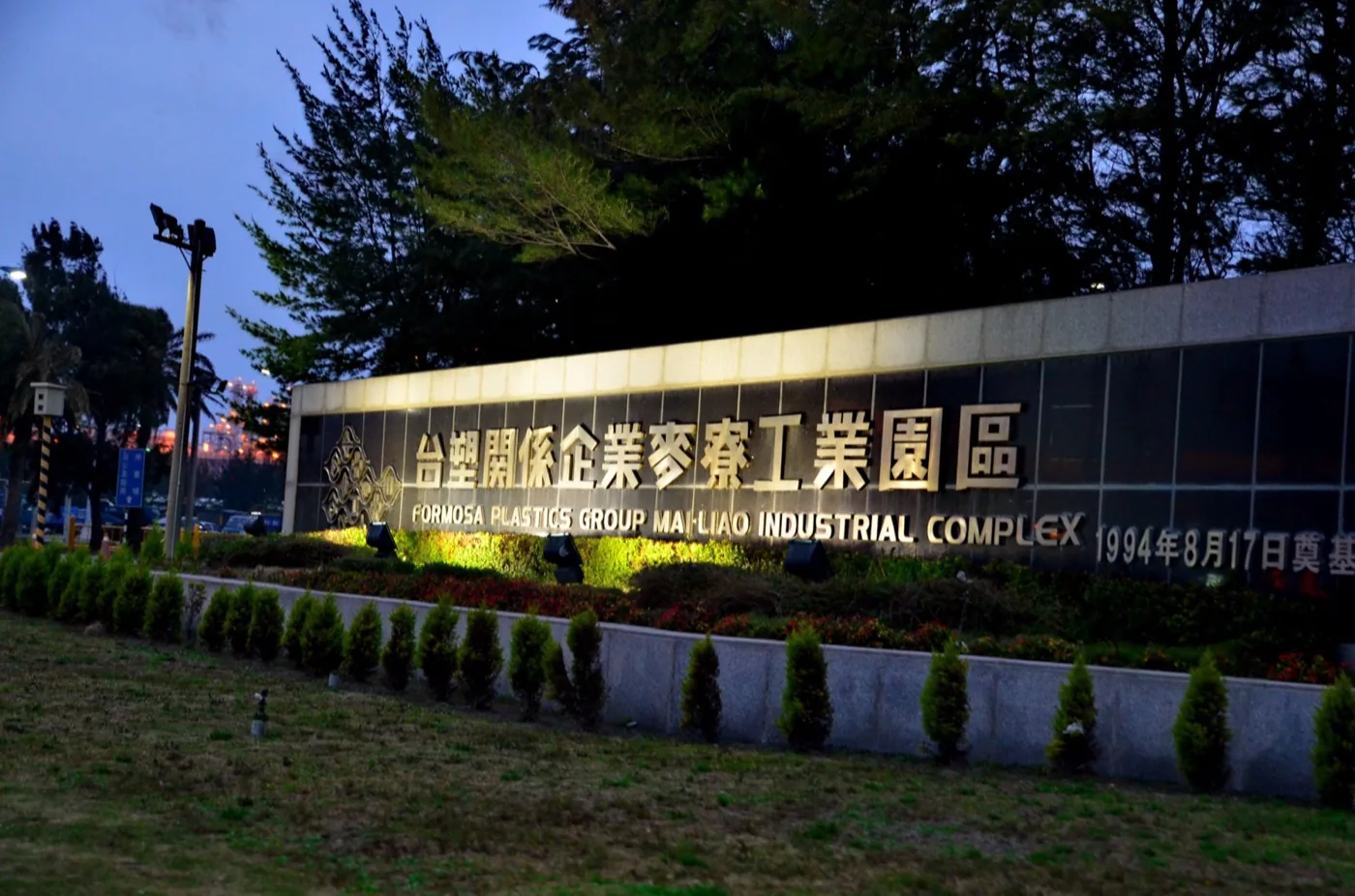
_Aerial view of Formosa Plastics Group's Sixth Naphtha Cracker industrial complex in Mailiao, Yunlin. Operating since 1998, the complex covers more than 2,600 hectares. It is Taiwan's largest petrochemical industrial cluster and one of the environmental ledgers left by the traditional-industry camp among the top 50 companies. Photo: Mk2010 (Malcolm Koo), 2014-03-15. CC BY-SA 3.0 via Wikimedia Commons._
China Steel in Xiaogang, Kaohsiung, also carries a bill. Data from the Citizen of the Earth Foundation indicate that 80-90% of air pollution from Kaohsiung's steel industry comes from China Steel, and that among Kaohsiung's stationary pollution sources, 36% of PM emissions and 32% of SOx emissions come from the steel industry30. China Steel invested NT$4.756 billion from 2017 to 2020 to improve equipment, reducing PM by 15.6%, SOx by 18.9%, and NOx by 11.3%. The numbers improved, but the structure in which "the steel industry as a whole affects Kaohsiung's air quality" did not change.
📝 Curator's Note
The other side of the top 50 is 50 ledgers of external costs. What GDP counts is factory output. What it does not count is medical spending by households around the factories, the long-term-care burden borne by Yunlin residents lining up for care, or relocation costs for residents of Qianzhen, Kaohsiung. Economists call this the internalization of externalities: when society forces companies to take back the costs they once spilled outward, that is the true meaning of ESG. Among Taiwan's top 50, the semiconductor and financial sectors generally lead in ESG ratings, while traditional industries and petrochemicals are the targets of scrutiny. This reshuffling of scores will change the ranking more deeply over the next decade than any single quarterly report.
Ningxia Night Market and Kaixuan 3rd Road
Linking the opening and the ending brings together two extremes in the same coordinate system.
That night at Ningxia Night Market, five of the most important people in semiconductors drank beer on plastic tables and chairs; the next day, the market value of three of their companies increased by hundreds of billions overnight. That night on Kaixuan 3rd Road, 32 Qianzhen residents were blasted from their homes into the sky; the case took eight years to adjudicate, and no one could pay those lives back.
Between these two images lies the entire span of the top 50 table.
The sacred mountain protecting the nation stands at the top, holding up the entire industry and the entire country. At the foot of that mountain are Mailiao's PM2.5, Qianzhen's smell of propylene, and the influence of I-Mei factories and Hotai showrooms that does not appear in the ranking. The 50 companies together are Taiwan's spine. One company is the thickest lumbar vertebra in that spine. But beyond the spine, there are muscles, nerves, and skin that GDP does not capture.
After reading this table, what readers should take away is not "who ranks where, and who has what market value." It should be an anatomical chart: where the spine is, where the single point of failure is, where the external costs are, and where the internal organs hidden outside the table are. When the next AI wave reshuffles the deck, when the next round of U.S.-China geopolitics turns over, when the next company challenges TSMC's position in a particular process node, this anatomical chart will be redrawn. The names in those 50 seats will change, disappear, or multiply, but this table will always record one thing: which companies determine how this generation of Taiwanese people eat, work, and worry about tomorrow.
✦ "Semiconductors have put Taiwan at the center of the world. But what the top 50 table does not write down are the island's internal organs and skin; they are also part of Taiwan, only invisible to GDP."
Further Reading:
- Taiwan Company: TSMC — The number-one company in the top 50, accounting for 31.51% of the weighted index
- Taiwan's SMEs and Hidden Champions — Beyond I-Mei and Hotai, the invisible 30% of the economic structure
- Taiwan's Semiconductor Industry — From ITRI to 2 nm, the origins of the 11 semiconductor seats in the top 50
- Taiwan's Stock Market and Capital Markets — The weighted index, market-cap rankings, and the structure of institutional investors
- Taiwan's National Defense and Military Modernization — The geopolitical linkage between the silicon shield and the top 50
- Taiwan Science Parks — The production bases behind the top 50's 11 semiconductor seats, and the spatial version of three-park output concentration
Image Sources
This article uses three public-domain / Creative Commons licensed images, all cached in public/article-images/economy/ to avoid hotlinking source servers:
- Hero: Tsmc factory hsinchu — Photo: Arusanov, 2009-07-20, exterior of a TSMC plant in Hsinchu Science Park. Public domain via Wikimedia Commons.
- Inline 1 (Taipei 101 / Taiwan Stock Exchange): Taipei 101 20230511 114624 — Photo: Anas1712, 2023-05-11, exterior of Taipei 101, headquarters of the Taiwan Stock Exchange. CC BY 4.0 via Wikimedia Commons.
- Inline 2 (Mailiao Sixth Naphtha Cracker): Formosa Plastics Group Mail-Liao Industrial Complex, Yunlin (Taiwan) — Photo: Malcolm Koo (User:Mk2010), 2014-03-15, aerial view of Formosa Plastics Group's Sixth Naphtha Cracker industrial complex in Mailiao, Yunlin. CC BY-SA 3.0 via Wikimedia Commons.
References
- Tom's Hardware: Jensen Huang dines at Taipei night market with Taiwan tech CEOs — Media record of the May 28, 2024, dinner at Ningxia Night Market attended by Jensen Huang, Morris Chang, Rick Tsai, Barry Lam, and Kris Yao.↩
- NVIDIA COMPUTEX 2024 keynote video — Official video of Jensen Huang's June 2, 2024, speech at National Taiwan University's Sports Center, including the exact line "Taiwan is an unsung hero, yet the pillar of the world" and a Taiwan map slide containing more than 40 suppliers.↩
- Tatler Asia: Jensen Huang's COMPUTEX speech and Taiwan's pivotal AI moment — Record of the market response in which all 40-plus named companies opened higher on the day after the speech.↩
- HiStock: Taiwan Capitalization Weighted Stock Index constituent weights — Official data for May 2026 index constituent weights, including specific weights such as TSMC at 31.51%, Hon Hai at 2.7%, and MediaTek at 2.5%.↩
- companiesmarketcap.com: Largest companies in Taiwan by market cap — USD-denominated ranking of Taiwan's top 60 companies by market capitalization from a global company market-cap database, used to cross-check the 31st to 50th range.↩
- HiStock: TSMC 2330 weighted-index weight — TSMC's May 2026 share of the weighted index was 31.51% on a free-float-adjusted basis, a historical high for a single stock.↩
- Business Insider Taiwan: Taiwan stock market total capitalization statistics — Taiwan stock market total capitalization after the first quarter of 2026 was NT$135.7 trillion (single source; year-to-year growth requires cross-checking), used to calculate TSMC's roughly 42% share of total market capitalization.↩
- TechNews: TSMC's 71% global foundry market share in 2025 Q3 — TrendForce-cited global foundry market share for the third quarter of 2025: TSMC 71%, Samsung 6.8%, UMC 4.7%.↩
- TechNews: C.C. Wei's NTU EMBA speech, "If There Were No TSMC" — C.C. Wei's January 16, 2025, NTU EMBA speech, in which he described the case of shipping sulfuric acid for the Arizona fab from Taiwan by sea, as well as the exact quote about building a fab in the United States being tearful and difficult.↩
- Customs Administration, Ministry of Finance: Taiwan 2024 export statistics — In 2024, the semiconductor industry accounted for 34.7% of Taiwan's total exports; this is often compressed into "TSMC accounts for 36% of exports," but the two are not the same indicator.↩
- TechNews: Top 50 manufacturers account for 51.5% of total exports — Ministry of Finance statistics for 2023: the top 20 accounted for 39.4% and the top 50 for 51.5% of exports, with concentration rising year by year.↩
- TSMC 2022 Sustainability Report — TSMC's 2022 corporate disclosure stated that it accounted for 8.1% of Taiwan's net profit-seeking enterprise income tax collected, the highest traceable official figure currently available.↩
- Taiwan Insight: TSMC, the enduring silicon shield of Taiwan's economy — Full academic analysis of the silicon shield concept, including an estimate that TSMC's quarterly revenue accounts for about 3.5% of quarterly GDP.↩
- Storm Media: Share price analysis of the three AI server leaders — Stock gains of Wistron, Quanta, and Hon Hai from 2022 to 2025: Wistron from NT$23.1 to NT$161.5, sixfold; Quanta from NT$66.2 to NT$345, 4.2-fold; Hon Hai from NT$94 to NT$265, 1.8-fold.↩
- cmoney: Wiwynn 2025 EPS of NT$275.06, up 117% year on year — Wiwynn, the Wistron spin-off specializing in hyperscaler cloud servers, reported full-year 2025 financial results with EPS reaching a record high since listing.↩
- Economic Daily News: Quanta's 2026 Q1 revenue reaches a record high — Quanta's full-year 2025 revenue of NT$2.12 trillion; 2026 Q1 revenue of NT$809.2 billion; March revenue of NT$362.8 billion, surpassing NT$300 billion for the first time.↩
- SCMP: Jensen Huang's COMPUTEX 2025 Taipei summit dinner — Record of the May 19, 2025, COMPUTEX opening day event in which Jensen Huang invited 36 senior Taiwanese technology executives to a Taipei "trillion-dollar banquet."↩
- Taiwan News: Jensen Huang's Feng Chia night market visit cut short — On-site record of Jensen Huang's January 17, 2025, visit to Taichung's Feng Chia Night Market, which ended after 10 minutes because of crowding.↩
- Mirror Media: William Wong steps down as Formosa Plastics president; Wu Chia-chau becomes first non-Wang president — Formosa Plastics Group succession in August 2025, and Winston Wong's December 2025 cross-border litigation seeking to change a NT$600 billion overseas trust into joint management by 17 people.↩
- Business Today: Hon Hai share price rises above NT$200, fulfilling Terry Gou's retirement pledge — Record of Hon Hai's June 2024 final-session rise above NT$200, fulfilling Terry Gou's 2016 public promise to retire only at NT$200.↩
- Central News Agency: Chang Yung-fa will judgment gives second-household son Chang Kuo-wei sole inheritance of NT$14 billion — Supreme Court final judgment on August 14, 2024, and record of the second household's September 2024 countersuit against the eldest brother for breach of trust.↩
- CommonWealth Magazine: Twenty years after the Koo brothers' "quiet separation" — The 2001 separation of the CTBC Koo family's three brothers: Jeffrey Koo Jr. with CTBC Financial, Angelo Koo with KGI Financial, formerly China Development Financial, and Chester Koo with Chailease; Jeffrey Koo Jr.'s 2025 investment in Taiwan Cement was read as a signal of reunion.↩
- Far Eastern Group official website: Hsu Hsien-an becomes vice chairman of U-Ming Marine — In August 2023, third-generation Far Eastern Group member Hsu Hsien-an became vice chairman of U-Ming Marine; at the May 2025 shareholders' meeting, he chaired on behalf of an absent Douglas Hsu.↩
- Business Weekly: Delta Electronics' Bruce Cheng and the 12-year professional-manager succession buffer — A family-business governance case study: Bruce Cheng stepped down in 2012, Yancey Hai served as professional manager from 2012 to 2024, and Cheng Ping took over in May 2024.↩
- Global Views Monthly: I-Mei's 90-year hidden-champion story — Record of I-Mei Foods, founded in 1934 and never listed, with analysis of estimated revenue and employee scale under the Kao family's four brothers and three generations of divided management.↩
- Cnyes: Taishin Shin Kong Financial 2025 merger progress — The merger process and market-cap changes involved in the late-2025 merger of Taishin Financial and Shin Kong Financial into "Taishin Shin Kong Financial" (2887).↩
- Wikipedia: 2014 Kaohsiung gas explosions — The July 31, 2014, Kaixuan 3rd Road propylene pipeline leak that caused 32 deaths and 321 injuries; the main responsible party was LCY Chemical, whose name is often confused with Chang Chun Petrochemical.↩
- The Reporter: Tenth-anniversary review of the Kaohsiung gas explosions — Engineering details of the Kaixuan 3rd Road accident, in which a four-inch propylene pipeline leaked because of external corrosion after being improperly encased inside a drainage box culvert, as well as records of the judgments against 12 defendants.↩
- The Reporter: Long-term investigation of health risks for residents near the Sixth Naphtha Cracker — Professor Chan Chang-chuan's 2012 NTU College of Public Health study: heavy-metal metabolite concentrations in urine among residents within 10 kilometers were 5.5 times those among residents more than 10 kilometers away; the Sixth Naphtha Cracker emitted 132 toxic carcinogenic substances, with annual PM2.5 emissions on the scale of 140,000 tons.↩
- Citizen of the Earth Foundation: Analysis of air-pollution sources in Kaohsiung's steel industry — 80-90% of air pollution from Kaohsiung's steel industry comes from China Steel; 36% of PM and 32% of SOx come from the steel industry; comparison data before and after China Steel's 2017-2020 investment of NT$4.756 billion in improvements.↩