
SLP Taipei Startup Leadership Program: A Course Starting at NT$6,000, Rising to NT$58,000 While Still Being Hard to Find
In July 2013, a reporter from This Week Magazine did some calculations. At the time, a group in Taipei ran a training camp called the "Startup Leadership Program," charging NT$6,000 for seventeen classes, three of which were full-day workshops. The reporter divided the total hours to arrive at a headline: the cost per hour was less than one hundred dollars1.
Today, fourteen years later, the one-time fee is NT$58,0002. With about thirty spots available, the number of applicants has exceeded one hundred every year3.
The fee has nearly tenfold increase, yet the demand has not decreased. And the core logic of the organizers has not changed from the first cohort to the present: a group of entrepreneurs running a "entrepreneur-to-entrepreneur" class pro bono, without taking equity.
30-Second Overview: The SLP (Startup Leadership Program) Taipei chapter is the Taipei branch of a global non-profit startup program founded in Boston in 2006, establishing its 22nd chapter globally in 20124. It offers six months of intensive courses, a two-day/one-night consensus camp, and a one-day Pitch Day, charging a one-time fee without taking equity. This fee rose from NT$6,000 in 2012 to NT$58,000 in 2026, yet the official website has consistently stated that "all funds are used for students"2. Over fourteen years, it has accumulated a group of entrepreneurs across technology, food service, law, and design. The organizers have mostly done this without charge. This is a concrete answer to how civil society in Taiwan can sustain something without relying on government funding or venture capital equity.
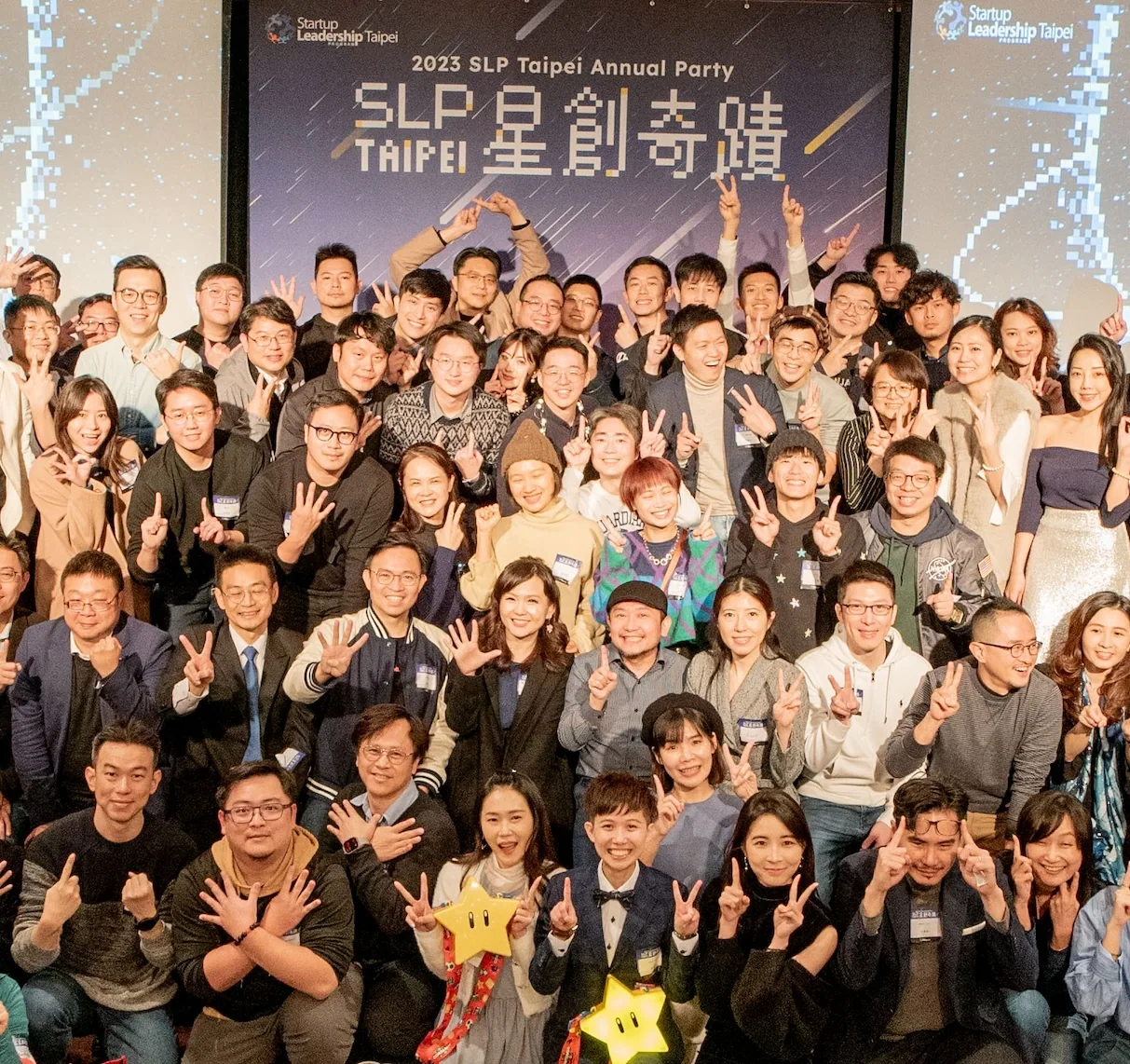
The "Star Creation Miracle" 2023 Party. Photo: SLP Taipei Startup Leadership Program official website (fair use editorial commentary).
The Fee That Grew from Six Thousand to Fifty-Eight Thousand
First, look clearly at the fee structure because this is the most concrete entry point into SLP Taipei.
In its first cohort in 2012, the one-time fee was NT$6,000. At the time, media outlets described it as a "material fee," but that was the reporter's own phrasing. The official website of SLP has never used the terms "material fee" or separate "tuition fee" from 2012 to the present; it always states "one-time fee" 5. This insistence on terminology is a clue: they do not position themselves as a "tutoring center selling courses."
There are large gaps in the data regarding the increases, but the few points that can be gathered draw a curve that steepens later. The first cohort was NT$6,000. Around the eleventh cohort, it reached NT$25,000. The fourteenth cohort (2024) was NT$48,000. The fifteenth cohort (September 2026 to January 2027) is NT$58,000 6. In the ten years from six thousand to twenty-five thousand, and in the subsequent two or three years from twenty-five thousand to nearly sixty thousand. The Taiwanese startup ecosystem itself was transitioning from its nascent stage to a more institutionalized phase during this period; SLP's fee curve is, in a way, a physical scale of that institutionalization process.
What these NT$58,000 buy is clearly stated on the official website: lecturer fees for over twenty courses, venue costs, the two-day/one-night consensus camp, Pitch Day, year-end party, and graduation ceremony are all used for the participants 2. There are no offices, and there is no seed funding.
📊 How the One-Time Fee Grew
Cohort (Year) One-Time Fee 1st Cohort (2012) NT$6,000 11th Cohort (Approx. 2020) NT$25,000 * 14th Cohort (2024) NT$48,000 15th Cohort (2026-2027) NT$58,000 * The 11th cohort figure is from a single source; the original page is defunct, so credibility is moderate; fees for cohorts 2-10, 12-13 were not publicly disclosed.
It is worth pausing honestly here. An organization that positions itself as a non-profit entity run by volunteers raised its fee from six thousand to nearly sixty thousand without publicly explaining the reasons for each increase; the statistics presented on the official website are inconsistent across different pages (the homepage states "over 360 graduating entrepreneurs," the association introduction page says "nearly 300," and the 13th cohort acceptance page mentions "over 150") 7. These numbers are not large, nor are they consistent, but they are real and verifiable; one can see them by looking at the official website. This is not some external criticism. Very few people in Taiwan's startup community have publicly discussed this matter, and this article does not intend to make a judgment of "contradiction" or "falsity," but merely places the numbers next to its self-positioning, allowing the reader to sit with it for a while.
No Equity, But We Expect Your Time
That question naturally arose: how can a model survive if it doesn't take equity and isn't a typical incubator, relying only on one-time fees to cover venue and speaker costs?
The answer is contained in a single sentence from the global SLP. This logic is the operating philosophy common to the entire SLP network; Taipei continued this without self-founding. The official website of its India chapter translated this sentence most directly into English: "We take zero equity but we charge them⋯to take care of operational expenses." The site further explains that the program follows a lean, community-driven model where every participant must volunteer twenty hours to help operate it. This mechanism cultivates the Fellows' passion and sense of ownership in the program itself8.
In other words, students are both payers and volunteers. The money you pay covers fixed costs; the time you contribute is the real fuel for this community. "Skin in the game" does not refer to shares, but to time and commitment. This explains why core organizers can take nothing, even as the fees increase year after year. INSIDE wrote in 2013 that the executive team of the SLP Taipei chapter participated and organized on a "completely unpaid, voluntary basis"9. Money flows to the students; people flow to the community.
Compared to commercial startup classes, this is a very different path. Some business courses charge seventy or eighty thousand for two full-day sessions with more hype than content, but those are unrelated to SLP and should not be confused with it. The one-time fee for SLP is also not cheap, but it lays bare the destination of every penny and the unpaid status of the organizers. This line—"no equity, but we expect your time"—is how it draws a clear boundary with venture capital accelerators and tutoring schools simultaneously.
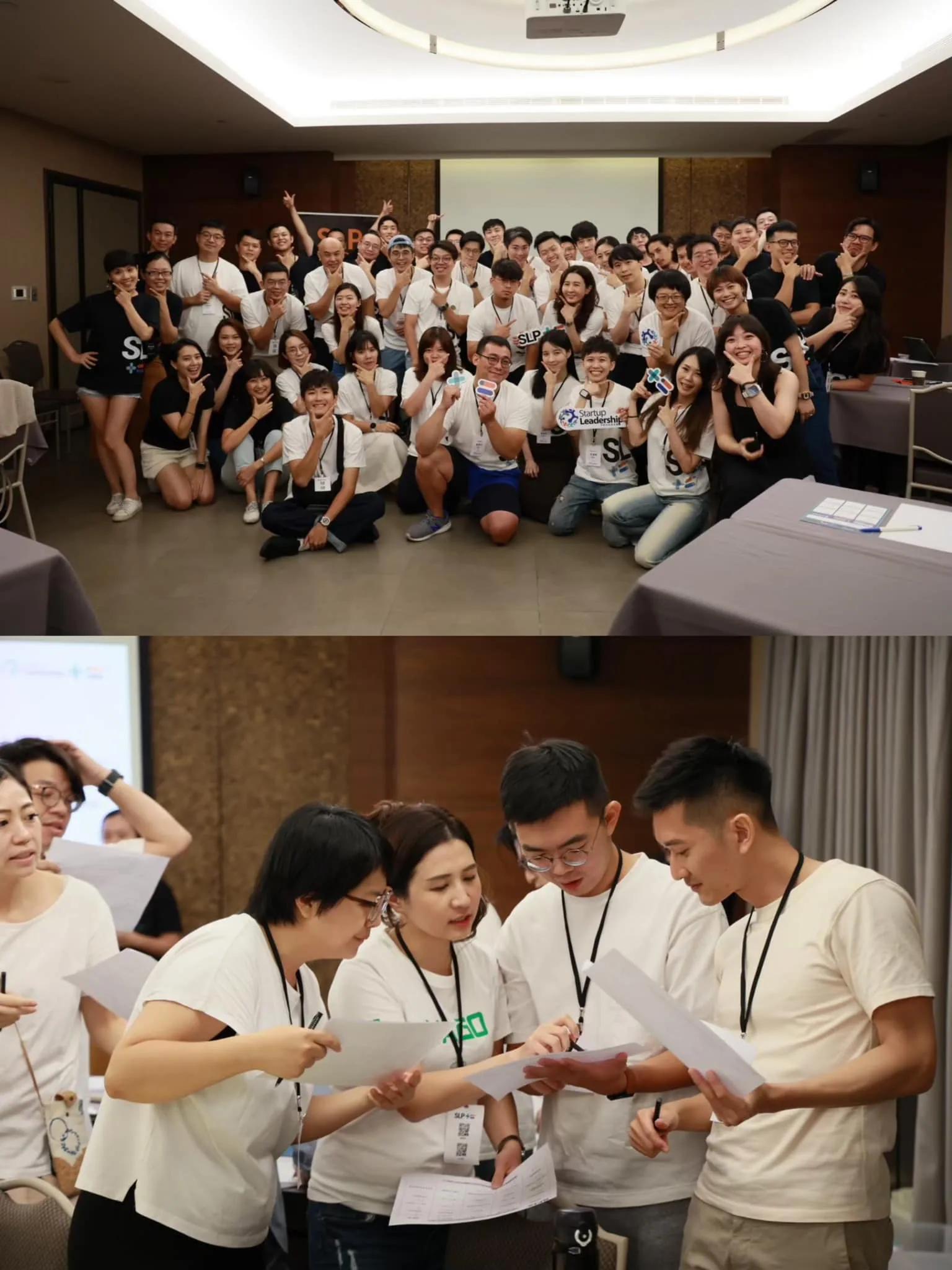
12th Consensus Camp. Photo: SLP Taipei Entrepreneurship Leadership Program official website (fair use editorial commentary).
An Organizer Who Later Became a Legislator
If one were to pick the most unexpected name from this group, it would be Ge Ru-jun.
He is known online as "Dr. Bao." He was in charge of the SLP Taipei program during 2013 and 2014. He later stated that his experience running the SLP Taipei program "significantly influenced his admission to Singularity University" 10. Singularity University is an institution famous for exponential technology in Silicon Valley. Subsequently, he became a non-partisan legislator for the Kuomintang.
The trajectory—from a young person who voluntarily organized an entrepreneurial training camp, to Singularity University, and then to the Legislative Yuan—is not detailed in any SLP recruitment brochure. It reminds us of something easily overlooked: the output of SLP Taipei is far more than just startups. It is a place that gathers people together, allowing them to refine each other, and these individuals later branch out into all sorts of unforeseen directions. Sometimes, the organizer themselves is the one who changes the most while running a program.
This also leads to an undermentioned background issue regarding SLP Taipei: Who were the people who started it in 2012? The origin of the global SLP itself is clear; it was founded in Boston in 2006 by Anupendra Sharma and his father-in-law, Puran Dang. The first cohort had only seven fellows, lasted twelve months, and focused on life sciences 11. However, when the Taipei chapter launched, the official earliest blog only stated that "SLP was founded in 2006 in Boston, a major East Coast city with a flourishing entrepreneurial atmosphere, and by 2012 had expanded to twenty cities globally," without naming the initiators in Taipei 12. One of the confirmed core organizers is HsinFu Kuo, a co-founder of SLP Taipei and currently the CEO of the sports technology company bOMDIC; however, his title in the execution team introduction from 2012 to 2013 was "Finance Director at M2 Communication," which is completely different from his current position 11. It is not uncommon for the names of the earliest people to become vague after a program runs for over ten years, especially in volunteer-driven organizations without a corporate entity; this is another side of its reliance on "people rather than systems."
Personal Qualities Account for Half: They Are Selecting People, Not Companies
The selection method used by SLP Taipei embodies its philosophy in the scoring rubric.
The evaluation criteria are broken down as follows: personal qualities 50%, goal planning 10%, learning and failure experiences 10%, leadership and professional achievements 10%, company size 10%, and other factors 10%13. Personal qualities account for half the weight, while company size accounts for only one-tenth. This means they care more about "who you are" than "how big your company is." The admission requirements have no age or industry restrictions; you don't even need to have a company yet.
How many people apply? In the second cohort, there were over 140 applicants, which the organization called the "SLP crown from around the world," with 33 accepted initially and an additional eight admitted14. This results in an acceptance rate of roughly 20%. This creates a counterintuitive picture: fees keep rising, the barrier is "are you the right person," yet over a hundred people compete for thirty spots every year.
The industries of those who are accepted are more diverse than expected. The first cohort in 2012 was composed of 40% internet startups, 40% biotech, and 20% cultural creativity1; by the thirteenth cohort in 2024, the website described the industry types as "software technology, e-commerce retail, interior design, healthcare, law, and marketing" 15. There are food businesses like 1997 Oven Pizza, law firms, and teams involved in e-commerce warehousing and logistics. The cultural creativity category accounted for 20% early on, but its prominence seems to have faded later—this drift curve of industry composition is also a side story that hasn't been widely discussed. In the twelfth cohort (2023), there were simultaneously founders doing brand research, those in warehousing and logistics, and a line-up of entrepreneurs from various fields: KT Chu Kai-ti, Chang He-sheang of JENJAN Zhenzhan, Wu Zheyu, and about thirty other founders listed together16. The selection logic that places half the weight on personal qualities results in this wide and diverse group.
📝 Curator's Notes
A scoring sheet that places "personal qualities" at 50% is, in fact, quietly admitting one thing: this course doesn't just sell knowledge. The content of the twenty sessions (business model deconstruction, fundraising simulation, presentation training) can be found online or in bookstores without needing to spend NT$58,000. What is truly scarce and what people are paying for is the six months spent being observed by a whole line of alumni—the experience of being accepted by thirty others who are also striving. They are not choosing those who "can be taught," but those who are "worthy of recognition by this group."
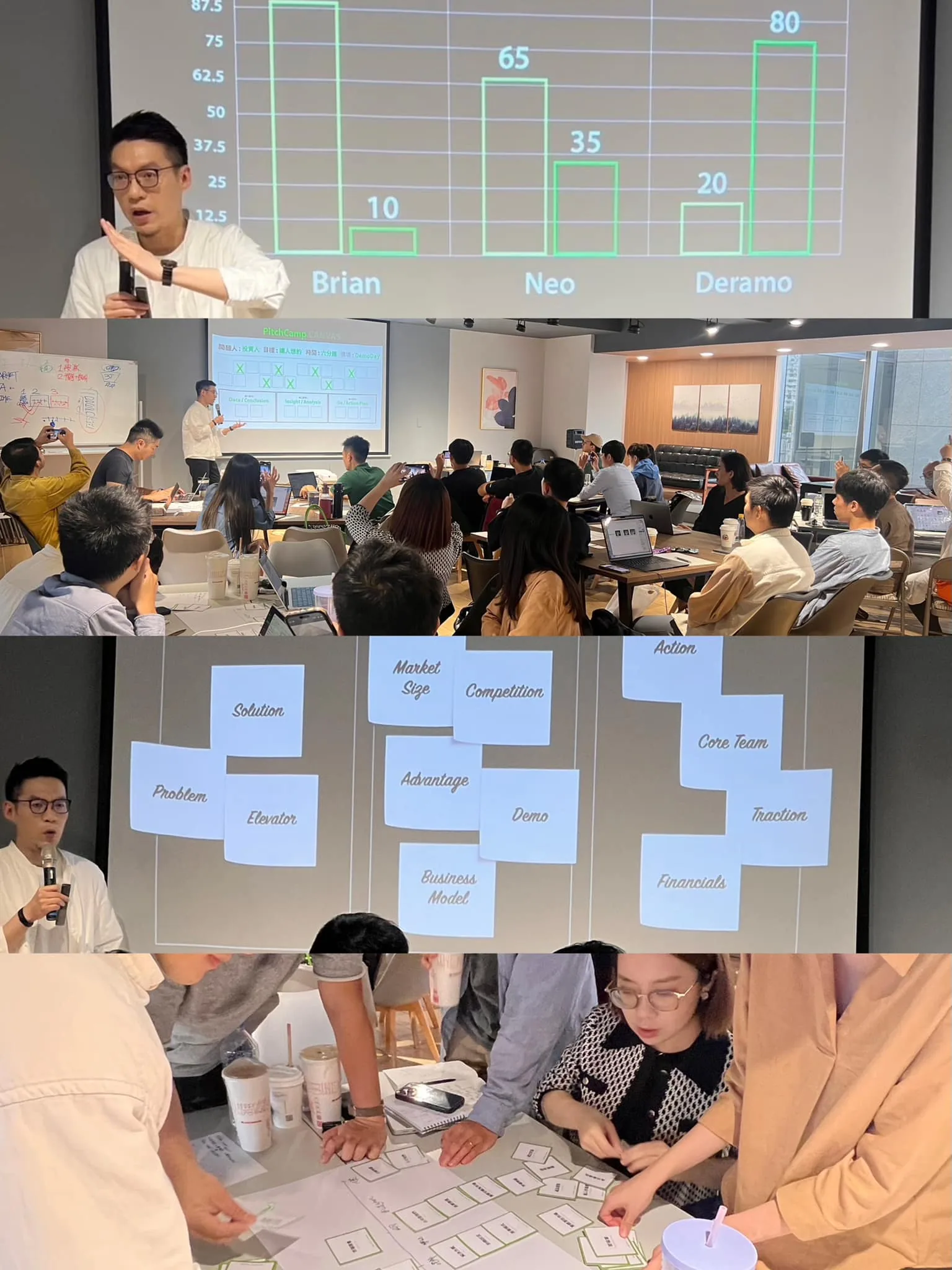
A snapshot from the Business Pitch Workshop. Photo: SLP Taipei Startup Leadership Program official website (fair use editorial commentary).
Alumni Teaching Back
After spending time at SLP Taipei, one notices a cycle: the person lecturing on stage today might have been sitting in the audience yesterday.
Casper Chen (陳欽章) was an alumnus of the fourth cohort and later became an instructor for multiple courses, teaching organizational growth and team leadership17. Boz Lu (盧永偉), an alumnus of SLP, returned to lead brand workshops. This tradition of "alumni mentoring current students" is not accidental; it has been institutionalized into a mechanism called Founder Buddy: every student in the fifteenth cohort is paired with a Buddy from the fourteenth cohort, meeting once every two months18. It is a horizontal, peer-to-peer transmission across generations.
The mentors' side is surprisingly stable. Amber Chang (張毓純) of Xizi Technology has been on the mentor roster since the first cohort in 201219 and continues to be involved. The group of professional mentors comes from consulting firms like Boston Consulting Group and PwC, as well as venture capital firms such as China Development Capital, PSS, ETP, and Huahui20. An alumnus might become an instructor for the next cohort after graduation, and a mentor might stick with the program for over ten years. This human resource structure requires almost no cost, relying instead on the same group of people being willing to return again and again. This perfectly aligns with the concept of "skin in the game": those who invest their time later become part of the program itself.
The course pace revolves around three high-emotional intensity events. The Consensus Camp is a unique icebreaker activity at SLP, lasting two days and one night. Many student testimonials mention the moment of letting down their guard and getting to know each other in the hotel conference room21; this is followed by over twenty intensive classes over six months, covering topics from Business Model Canvas (BMC) deconstruction and fundraising simulations to presentation training; finally, there is Pitch Day, which features a three-minute Founder Pitch for everyone in the morning and booth exhibitions in the afternoon. This event was formerly called "Demo Day" but has been uniformly renamed Pitch Day in recent years. It is worth noting that Pitch Day does not feature prize money, judges, or ranking mechanisms; it is simply an exhibition where six months of work is showcased. The intensive six months, the tears from the Consensus Camp, and the three minutes on Pitch Day—when combined—are what this course truly sells: the time spent binding a group together is difficult to replicate with any amount of knowledge found in a slide deck.
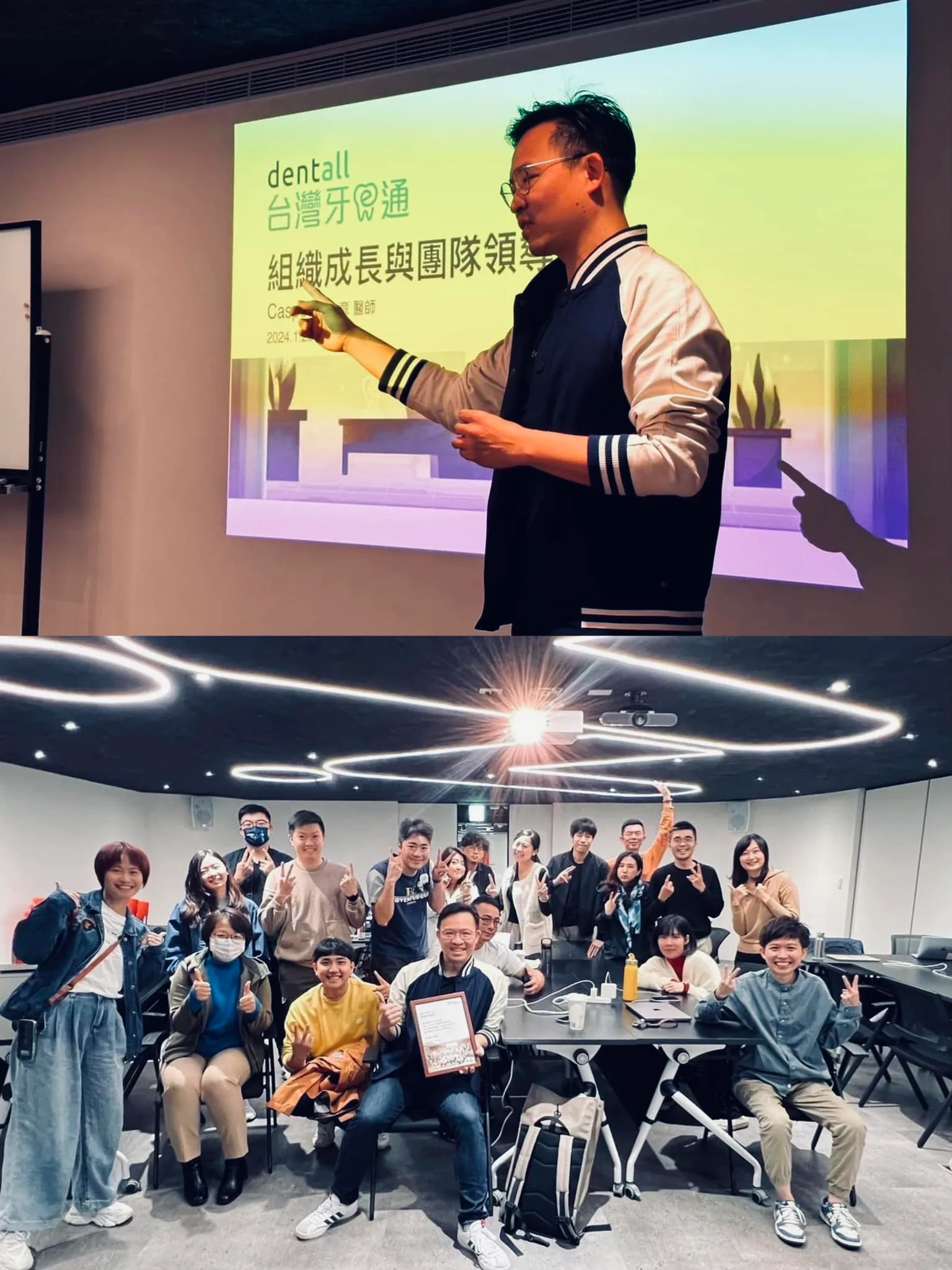
A snapshot of Casper Chen (陳欽章) teaching the "Organizational Growth and Team Leadership" course. Photo: SLP Taipei Entrepreneurial Leadership Program Official Website (fair use editorial commentary).
How Fortunate, and "Regretting Not Setting Goals"
To see what this group has left in people over the past six months, we must listen to the students themselves.
KT Chu Kai-teh from the 12th cohort wrote after the Consensus Camp: "We are so fortunate to have met each other at such an important time in our lives!"22 Ken Ho (何洛) from the 11th cohort, founder of Tracle Laka, summarized his experience in one sentence: "Entrepreneurship shouldn't be a solo battle; it has more chances of success when fighting as a group." He also specifically thanked senior students Chou Dai-xiang, Chen Qin-zhang, and Ye De-wei for their guidance during his application and selection process23. These are the two most common sentiments in SLP student testimonials: the sense of belonging within a like-minded community, and gratitude that "the seniors were truly helpful."
SLP 10 Alumni Interview: Chou Dai-xiang, Founder of Jiadian Magic (one of the three seniors thanked by Ken Ho).
But if the collective portrait only contains praise, it becomes a promotional photo. The closest firsthand account we have that is not purely laudatory comes from Chu Chin-hua (周欽華) of the first cohort, who later started reading in Taiwan and reported on his progress. Reflecting back, he said: "Looking back now, I regret not setting a clear goal before applying... If I had a clearer goal back then... I would have gained more."24 This statement is hardly negative criticism; it is more like an honest self-reminder: the resources you invest yourself with, and how clearly you enter with a purpose, largely determines how much you take out. Even the best course cannot sustain someone who doesn't know what they want. Placing this sentiment into the collective portrait makes the group three-dimensional—some were moved to tears at the Consensus Camp, while others only realized later that they hadn't utilized it well.
As for which members went the farthest, there are a few named signals. Ye De-wei’s PackAge+ partnered with Acer (9th cohort) on eco-friendly recycling bins and established a subsidiary in Singapore, aiming for an IPO by 2027; Tsai Ming-ru's Yuanchu Bean Workshop reached all FamilyMart convenience stores across Taiwan in June 2026; and Cheng Bo-yuan’s home studio (10th cohort) secured over ten million in seed funding with monthly revenue of five million25. We must honestly add that we could not find any named alumni cases of clear bankruptcy or failure, but this may simply be because the media rarely reports failures, not that there is a zero failure rate. Successful names are remembered; those who fold usually disappear quietly.
A Name to Clarify: Wu Jiajun is Not an SLP Alumnus
In social communities that rely on word-of-mouth, the easiest mistake to make is including names that do not belong. We must clarify one point here.
Wu Jiajun, a co-founder of iCHEF, is occasionally listed online as an SLP alumnus, which is incorrect. A meticulous check reveals that he is an entrepreneur from the fourth cohort of the AAMA Taipei Cradle Program, which is a separate organization; searching through the complete list of alumni for SLP from the first to the thirteenth cohorts on the official website yields no mention of "Wu Jiajun" 26. His only confirmed connection to SLP was being invited to speak at the eighth cohort recruitment briefing, discussing general network value—"these are all critical issues, so it is better to know them early, and all the networking resources within this community are important assets" 27. He spoke about the community and networks, not the course itself; iCHEF's own growth story makes no mention of SLP.
This small correction brings up the landscape of non-equity startup support in Taiwan. SLP involves tuition fees, an intensive six-month curriculum, and horizontal mentorship from senior to junior members; AAMA Taipei Cradle Program is charitable and free, offering two years of one-on-one mentoring with seasoned entrepreneurs—both established around 2012 and do not take equity. Interestingly, they are like two parallel worlds: a search through public records reveals no report comparing the two, nor any entrepreneur publicly stating that they applied to both; even media coverage has been distinctly separate 28. They are not in a competition where one is better than the other; rather, they represent two answers that emerged from Taiwan's question of "what other startup support models exist besides equity-based accelerators (like AppWorks)."
📝 Curator's Note
Looking globally reveals an even more counterintuitive fact. The SLP Bangalore chapter in India was established in 2010, two years before Taipei, with a four-month course and a fee of about NT$12,000, far lower than the current NT$58,000 in Taipei—yet one of its alumni is Skyroot Aerospace, a leader in Indian private aerospace 29. The chapter with lower fees and shorter duration produced the most prominent single case in the network. This shows one thing: the real output of these types of programs is not companies "taught" by the course, but the people who are screened and ignited by that process. That cannot be bought with a price tag.
Epilogue: Doing Something Long-Term Without Relying on Government or Equity
In 2012, a group of people who were themselves entrepreneurs held a course in Taipei out of pocket and pro bono. The first session cost six thousand NTD for a one-time fee, which equates to less than one hundred NTD per hour.
Fourteen years later, the same endeavor evolved into an institutionalized community event held annually, where over 100 people compete for thirty spots at a price nearing sixty thousand NTD in 2023. It was officially established as an association that year. The price has increased nearly tenfold, yet the core logic of its organization remains unchanged—entrepreneurs helping entrepreneurs; they charge your time but not your equity, and every penny is designated "entirely for the members."
It never made it onto international media, nor was it frequently featured in major publications like business magazines or Tianxia 30; instead, it quietly spread through INSIDE, among startup gatherings, and on its own YouTube channel with thirteen subscribers, generation after generation. Ultimately, this is a slice of mutual aid within Taiwan: how a group managed to grow and sustain a small endeavor into a hard-to-find entity after fourteen years, relying not on government subsidies or capital markets, but on personal connections and the belief that "only by forming groups can we succeed."
More interviews with alumni and course snippets are collected on the SLP Taipei official YouTube channel.
Further Reading:
- Startup Ecosystem in Taiwan — From the dilemma of Taiwanese startups lacking venture capital to the overall development pursued by AppWorks, venture capital, and unicorns, SLP is a branch within this ecosystem that "does not take equity."
- The Economy of Taiwanese Self-Media Creators: A Fragmented Battlefield of 23 Million People — This represents another model of the Taiwanese economy where "the individual precedes the company," which resonates with the logic of SLP, which "selects people, not companies."
- Taiwan's Industrial Transformation and Upgrading: From Manufacturing Powerhouse to Innovative Nation — The grand backdrop behind the cost curve of SLP—the transition from grassroots beginnings to institutionalization—is part of Taiwan's industrial transformation.
- Ecosystem of Commercial Areas Surrounding Taiwanese Science Parks — Another manifestation of entrepreneurial energy solidifying into physical communities.
Image Sources
This article uses 4 images, all cached in public/article-images/economy/ to avoid hotlinking from source servers:
- SLP Taipei Startup Leadership Program 2023 Annual Party "Star Creation Miracle" — SLP Taipei Startup Leadership Program official website, Fair use editorial commentary
- SLP 12th Consensus Camp Group Photo — SLP Taipei Startup Leadership Program official website, Fair use editorial commentary
- Business Pitch Workshop Course Snippets — SLP Taipei Startup Leadership Program official website, Fair use editorial commentary
- Course Snippets of "Organizational Growth and Team Leadership" — SLP Taipei Startup Leadership Program official website, Fair use editorial commentary
References
- This Week Magazine: Under NT$100 Per Hour, Get International Level Entrepreneurship Course (2013/7/30) — This Week Magazine's report on the early days of SLP Taipei states that in the first cohort in 2012, there were 28 participants, with industry proportions being 40% Internet / 40% Biotech / 20% Creative Industries, a one-time fee of NT$6,000, and seventeen classes including three full-day workshops. It clearly states that "SLP does not provide office space for entrepreneurial teams nor does it require the entrepreneurial teams to give back company shares." The term "material fees" in the text is a reporter's paraphrase, not official SLP language.↩2
- SLP Taipei Official Website: 15th Program Page — The program page of the SLP Taipei entrepreneurial leadership program official website meticulously details the schedule for the 15th cohort (September 2026 to January 2027), a one-time fee of NT$58,000 "all used for students," covering over 20 classes / consensus building / Pitch Day / graduation ceremony, and the Founder Buddy matching system. The entire official website uses "one-time fee" instead of "tuition fees" or "material fees."↩23
- ACCUPASS: SLP 14th Recruitment Page — The announcement of the recruitment schedule and scoring standards for the 14th cohort of SLP Taipei, which corroborates the enrollment scale with approximately 30 slots per cohort and enthusiastic applications.↩
- Startup Leadership Program Global Official Website: 22nd Chapter (Taipei) — The Taipei chapter page on the global SLP official website confirms that Taipei is the 22nd chapter globally, with Co-PL and co-founder HsinFu Kuo; it also lists the overall scale of global SLP having nurtured over 3,900 fellows across 14 countries, with fellows founding over 2,500 startups and raising US$4.6B+ (this is a global figure, not exclusive to the Taipei chapter).↩
- SLP Taipei Official Website Homepage — The official homepage of SLP Taipei entrepreneurial leadership program states self-descriptions such as "12 years of experience transfer," "alumni background covers ten industries," and "over 28 chapters in 19 cities globally." This is consistent with the term "one-time fee" on the program page, allowing cross-verification that the official site never used the term "material fees."↩
- Digital Age / Meet Entrepreneurship Gathering: Report on SLP Taipei Entrepreneurial Leadership Program — A series of reports by an entrepreneurship media affiliated with Digital Age about SLP Taipei, which lists alumni industries spanning IoT, biomedical, children's education, digital music, new media, chain dining, gaming, and creative industries, and records the one-time fee for the 14th cohort as NT$48,000. The amount of NT$25,000 for the 11th cohort is from a single search source, and the original page is invalid, so it cannot be verified word-for-word; the credibility rating is medium.↩
- SLP Taipei Official Website: Association Introduction Page — The official association introduction page of SLP Taipei meticulously details the incorporation of the "SLP Taiwan Entrepreneur Leader Association" as a legal entity in 2023, accumulating 'nearly 300' high-quality entrepreneurs over 11 years, and the core philosophy of "entrepreneurs helping entrepreneurs." The numbers on this page ('nearly 300') are inconsistent with the figures on other pages of the official website, such as 'over 360' on the homepage and 'over 150' on the 13th cohort admission page.↩
- Startup Leadership Program India Chapter: About Us — The official website of the SLP India chapter meticulously discusses the globally common "skin in the game" operating philosophy of SLP in English: "We take zero equity but we charge them...to take care of operational expenses," and explains that each student must dedicate 20 hours of volunteer assistance to help run the program to build a sense of responsibility and ownership. This confirms that "fee payment + volunteer contribution" is a globally common model for SLP, not unique to Taipei.↩
- INSIDE: Report on SLP Taipei Entrepreneurial Leadership Program — A report by the technology media INSIDE on the early days of SLP Taipei clearly states that the executive team of the SLP Taipei chapter participated and organized the program in a "completely unpaid, voluntary capacity." (The original page returned 403 after multiple attempts; content snippets are from search engine caches.)↩
- Youwu Report: Ge Ru Jun (Dr. Bao) and Qidian University — As reported by Youwu, Ge Ru Jun personally stated that "the experience of executing the SLP Taipei 2013-2014 program significantly influenced his admission to Qidian University." Ge Ru Jun (JuChun Ko, online nickname Dr. Bao) was a core member of the early executive team of SLP Taipei and later became a non-partisan legislator for the Kuomintang.↩
- Golden Wiki: Startup Leadership Program Entry — This entry states that SLP was founded in Boston in 2006 by Anupendra Sharma (an alumnus of BITS Pilani) and his father-in-law Puran Dang (an alumnus of IIT Kharagpur), with the first cohort having only 7 fellows for a 12-month program focusing on life sciences. HsinFu Kuo, a co-founder of SLP Taipei, held the title 'CFO of M2 Communication' during the 2012-2013 executive team, which is different from his current role as CEO of bOMDIC.↩2
- SLP Taipei 2012 Original Blog: About SLP — The original WordPress blog from when SLP Taipei was established in 2012 meticulously states that "SLP was founded in 2006, starting from the booming entrepreneurial atmosphere of Boston on the East Coast of America, and by 2012 it had expanded to 20 cities globally." The text does not name the specific founders of the Taipei chapter, providing primary evidence for an organization whose origin is "relying on people rather than systems."↩
- SLP Taipei Official Website: Program Page Selection Criteria — The SLP Taipei official program page explicitly lists the selection weighting: Personal Qualities 50%, Goal Planning 10%, Learning and Failure Experience 10%, Leadership and Professional Achievements 10%, Company Size 10%, Other 10%, confirming that candidate selection heavily emphasizes 'who this person is'.↩
- SLP Taipei Official Website: Alumni and Past Enrollment Records — The SLP Taipei official alumni page records that the second cohort had over 140 applicants, with 33 entrepreneurs (plus 8 admitted later) ultimately accepted from around the world, suggesting an acceptance rate of approximately 20%.↩
- SLP Taipei Official Website: Class 13 Acceptance List Page — The SLP Taipei official page for Class 13 lists 30 startup companies and their industries—'Software Technology, E-commerce Retail, Interior Design, Healthcare, Law, and Marketing'—including non-tech cases like the 1997 pizza and a law firm, which can be compared to the industry composition shift from the first cohort in 2012 ('40% Web / 40% Biotech / 20% Creative').↩
- SLP Taipei Official Website: Past Alumni List (Classes 10-13) — The SLP Taipei official alumni page meticulously records the full names and company names of students from Classes 10 through 13; the Class 12 (2023) list includes over thirty cross-industry entrepreneurs such as KT Chu Kai-te, JENJAN Zhang He-xiang, and Wu Che-yu.↩
- SLP Taipei Official Website: Course Snippets / Mentor and Instructor Introduction — The SLP Taipei official course snippet page records that Chen Chin-chang (Casper, founder of Dental e-Tong) served as an instructor for multiple classes as a student in the fourth cohort, teaching organizational growth and team leadership, which verifies the mentorship cycle of 'graduates returning to teach.'↩
- SLP Taipei Official Website: Founder Buddy System — The SLP Taipei official program page describes the Founder Buddy system: each student in Class 15 is matched with a Buddy from Class 14, and they meet once every 1-2 months, which is a horizontal succession mechanism of 'senior mentoring junior.'↩
- SlideShare: SLP Taipei 2013-2014 Recruitment Briefing Presentation — The official SLP Taipei recruitment briefing presentation confirms Amber Chang (CEO of Xizi Technology) as a long-term industry mentor; cross-referencing the first cohort's mentor list from 2012 confirms she was part of the mentorship group from the very first cohort.↩
- POWER FOR PITCH: SLP Eighth Cohort Recruitment Report — The startup media POWER FOR PITCH reported on the eighth cohort of SLP Taipei, listing eleven venture capital and corporate investment executives as mentors, including those from Boston Consulting Group, CICC, Morgan Stanley, Cathay Bank, PTT, E.Sun, and Huawei.↩
- SLP Taipei Official Website: Class 12 Consensus Camp Record — The SLP Taipei official record page for the Class 12 Consensus Camp explicitly states that 'the consensus camp is a unique ice-breaking activity for SLP' and is a 'two-day, one-night event,' and it includes firsthand experiences from students.↩
- SLP Taipei Official Website: Class 12 Consensus Camp Student Experiences — The SLP Taipei official consensus camp page meticulously records the experience of student KT Chu Kai-te (founder of Essence Research) as: 'We are so lucky to meet each other at such an important time in our lives!'↩
- Medium / Entrepreneurship Treasury: We Joined SLP! — A first-person account published by Ken Ho (founder of Tracle), who was in SLP Class 11, on August 28, 2022, meticulously writes that 'entrepreneurship should not be done alone; it is more successful when fighting as a group,' and specifically thanks alumni Zhou Dai-xiang, Chen Chin-chang, and Ye De-wei. Tagged #SLP11.↩
- Komico Weekly: Report on the Founding Period of SLP Taipei (Interview with Chou Chin-hua) — The Komico Weekly report includes a verbatim reflection from the first cohort student, Chou Chin-hua (later founder of Tech Island Read and Youwu Report): 'Looking back now, I regret not setting a clear goal before applying... if I had a clearer goal back then, I would have gained more.' This is currently the closest firsthand account that is not purely praise.↩
- SLP Taipei Official Website: Alumni News — The SLP Taipei official alumni news series records the subsequent developments of named alumni from different classes: Ye De-wei / PackAge+ (Class 9, collaborating with TSMC on eco-friendly circulation boxes, establishing a subsidiary in Singapore, aiming for IPO in 2027), Cai Ming-ru / Yuanchu Bean Factory (expanding to all FamilyMart convenience stores in Taiwan in June 2026), and Cheng Bo-yuan / Home Decoration Studio (Class 10, achieving tens of millions in seed funding and 5 million RMB monthly revenue).↩
- AAMA Taipei Cradle Program Official Website: Wu Jiajun Introduction Page — The AAMA Taipei Cradle Program official website meticulously states that Wu Jiajun, co-founder of iCHEF, is a 'Founder from the 4th Batch.' Cross-referencing the complete alumni list (Classes 1-13) on the SLP official website shows no record of Wu Jiajun, which clarifies that he is not an SLP alumnus.↩
- POWER FOR PITCH: SLP Eighth Admissions Briefing Panel Discussion — A POWER FOR PITCH report on the eighth admissions briefing for SLP Taipei, featuring an invited discussion by Wu Jiajun, co-founder of iCHEF, who stated verbatim: "Most are many attempts in the 0 to 1 process... these are all fatal problems, so it's better to know sooner, and all the network resources within this community are important assets." This is from an invited speaker, not a testimonial from an SLP alumnus.↩
- AAMA Taipei Cradle Program Official Website: Program Introduction — The official website of the AAMA Taipei Cradle Program states that it is a non-profit program, does not charge fees to students for operational use, has approximately 12 mentors and 20 students per year, and a two-year mentorship period, forming one parallel model compared to SLP's paid six-month intensive course format in Taiwan's non-equity startup support system. Multiple specialized searches have found no mention or side-by-side comparison of these two on their official websites or in media reports.↩
- Startup Leadership Program India Chapter Official Website — The official website of the SLP India chapter (independent domain startupleadership.in) confirms that the Indian chapter was established in 2010 (two years earlier than Taipei), has a four-month course, costs Rs 35,000 (approximately NT$12,600), and has an alumnus including Skyroot Aerospace, an Indian private aerospace company, who is the most prominent single alumnus found in the global SLP network.↩
- Wikipedia: Startup accelerator (Accelerator definition index) — The English Wikipedia entry on accelerators defines an "accelerator" as a program with a "fixed term, cohort system, mentors and educational content," and one that "can exchange equity for funding," serving as a benchmark against which SLP and AAMA's "no-equity" model is compared. Media exposure of SLP Taipei is currently confirmed to be limited to Chinese startup media circles (INSIDE, Startup Gathering, POWER FOR PITCH), with no specialized reports from business magazines, The World, or international media.↩