
At 6:30 PM, a piano melody drifts from down an alleyway, growing closer. It might be Beethoven’s Für Elise, or the Polish composer’s Dance of the Maidens. You won't stop to think, "This is classical music"; you will simply put down what you are doing and grab that bag of trash to rush downstairs—this is Taiwan's most punctual urban alarm clock. To people from most countries, a garbage truck is noise; to Taiwanese people, it is a melody that their body reacts to before their brain does.
We "hear" this island every day: the classical music of the garbage trucks, the melodies at the metro stations, the calls of night market vendors, the political slogans ("dong suan"), and the cicadas outside windows on summer nights. But we rarely "listen" to them. This article poses a question from a Master of Soundscape Studies: if we seriously listen to these sounds—which are treated as background noise or even regulated by law—wouldn't we realize that our understanding of Taiwan has always been constructed by how we listen?
30-Second Overview: A soundscape is an experience constructed by how one listens, not an objectively existing "sound environment." Taiwan holds two completely opposing attitudes toward sound: on one hand, it uses the Noise Control Act to treat sounds as things to be suppressed and eliminated; on the other, figures like Fan Chin-hui (范欽慧), Wu Chan-ching (吳燦政), and Li Ming-tsung (李明璁) treat sounds as cultural assets worthy of listening to, preservation, and design. The sharpest microcosm occurred at Taipei Metro in 2015: in the same year, within the same system, station music was commissioned by Reihong-sha (雷光夏) and Li Hsin-yun (李欣芸) to become art, while the door alarm sound was "de-musicalized" and changed back to bird calls because, for visually impaired passengers, "being audible" is more important than "sounding nice."
What You Think You Hear Is Actually Constructed in How You Listen to Taiwan
First, let's clear up a common misconception.
The concept of "soundscape" is often attributed in the Sinophone world to Canadian composer R. Murray Schafer. This is actually a beautiful misunderstanding. Schafer himself made it clear in interviews that the term soundscape was not invented by him; he credits the credit to urban planning scholar Michael Southworth1. What Schafer truly did was host the "World Soundscape Project" at Simon Fraser University in the late 1960s, publish The Vancouver Soundscape in 1973, and write the book The Soundscape in 1977, disseminating an entire methodology for listening to the world2. He was a promoter, not the inventor.
Within Schafer's framework, one term is particularly suitable for understanding Taiwan: soundmark—a sound unique to a place that immediately signals, "I am here."
This leads directly to the core statement of that Master of Soundscape Studies. A soundscape is not a sound wave captured by a microphone; it is an experience constructed by how one listens. The same garbage truck music means something different: the Environmental Protection Bureau hears "it's time to execute collection duties"; foreigners who recently arrived hear, "why is someone playing the piano on the street?" while Taiwanese people working far away and hearing it when returning home hear an entire childhood. The sound is the same; the understanding is completely different, depending on the unique way each person listens.
📝 Curatorial Viewpoint: We tend to treat sounds as "part of the environment," as if they exist objectively and are unrelated to us. Soundscape studies overturn this assumption: a soundmark is not significant because of its decibel level or how pleasant it is, but because a group of people collectively learned that "this sound represents this thing." In Germany, garbage truck music was merely a vehicle prompt; when it traveled across the ocean to Taiwan, generations heard it as the universal tacit agreement, "time to take out the trash." The sound did not change; the listener changed. This is why understanding Taiwan can begin with sound: which sounds you understand reveals whether you are from here.
A Legend That Cannot Be Verified Becomes a Universal Trash Alarm Clock
Let's return to that most representative sound.
The two songs most often played by Taiwanese garbage trucks are Beethoven’s Für Elise and the Polish composer Tekla Bądarzewska-Baranowska’s Dance of the Maidens, which was published in Warsaw in 18563. One is a famous piece from music textbooks; the other is a 19th-century salon piece. Neither was written for garbage collection, yet both are heard in Taiwan as the signal for the same event.
As for how these two pieces ended up on the trucks, the answer is somewhat unexpected: no one truly knows. The Wikipedia article on "Garbage Truck" states frankly that this matter is "currently disputed with no verifiable source" 4. The most widespread version claims that Xu Tzu-chiu (許子秋), director of the Sanitation Department of the Taiwan Provincial Government, heard his daughter practicing the piano and thought the melody could be used to remind people to take out the trash; but another account names Taiwan's first medical doctor, Tu Tsung-ming (杜聰明) 5. Whether his daughter was playing Dance of the Maidens or Für Elise, each version has its own story. There is also a more anticlimactic theory: that the sealed garbage trucks imported from Germany for the first time in the 1960s were originally equipped with Für Elise, while Dance of the Maidens came from a Japanese EPSON music box imported to Taiwan 5. In other words, the melody might not have been deliberately chosen by anyone; it might just be incidental equipment.
These versions clash, but treating it as a legend is arguably the truest and better story. A piece of urban folklore with no standard answer is itself vivid evidence of how a soundscape has been "collectively constructed": the focus was never on who pressed the button first, but rather that millions later agreed to "go downstairs when they hear this."
And this system of managing trash with music is astonishingly effective. Taiwan's recycling rate reaches 55%, making it one of the world's highest in recycling rates6. Behind this number are the actions of millions every evening, hearing that piano sound and carrying sorted garbage out of their homes. A "unverifiable" piece of music supports a world-class environmental governance system.
In the Same Year, Within the Same System, Sound Was Both Aestheticized and Functionalized
If garbage trucks represent sounds that Taiwanese people "passively hear," then Taipei Metro represents the first time someone in Taiwan intentionally designed how the entire city should be heard.
The story begins with a sociologist. The station music of Taipei Metro is the result of the "Taipei Soundscape Project," initiated by sociology professor Li Ming-tsung (李明璁) 7. This project was implemented starting in 2015. Li Ming-tsung's idea was clear: through these melodies heard while traveling, passengers "construct their own urban characteristics, memories, and identity" 7. In other words, he wanted the station music to become a soundmark for Taipei residents to identify their city.
The cast was impressive. Each of the four main lines had a composer: Reihong-sha (雷光夏) for the Tamsui-Xinyi Line (Red Line); Li Hsin-yun (李欣芸) for the Bannan Line (Blue Line); Chen Chien-chi (陳建騏) for the Zhonghe-Xinlu Line (Orange Line); and Chou Yue-cheng (周岳澄) for the Songshan-Xindian Line (Green Line) 78. The first piece was activated on December 19, 2015, on the Tamsui-Xinyi Line, composed by Reihong-sha. The Feng Qi (風起 - Wind Rises) played in the train cars, which signals transfers and final stations, was also written by Chou Yue-cheng 8. In addition to station music, the project commissioned environmental music for Dongmen Station, Longshan Temple Station, Songshan Airport Station, Xiangshan Station, and Xiaojudian Station, utilizing 447 works from 12 countries/regions 8. A metro system was treated as a massive album.

But in the same year, within the same system, something happened in the completely opposite direction.
While the project was busy adding music to various corners, Taipei Metro "de-musicalized" the alarm sound when trains closed doors and departed. The Zhonghe-Xinlu Line originally used a musical melody for door closures starting in 1996; in 2015, the entire system standardized back to two alarms: the first is a bird call to alert passengers that the doors are about to close, and the second is an ambulance-like alarm to signal that the doors are closing 9. The reason was not aesthetics, but function. Taipei Metro stated that this adjustment was intended so that visually impaired passengers and travelers from around the world could "identify it more clearly and conveniently" 10.
This is the sharpest point of the whole matter. In the same year, within the same metro system, sound was pushed in two opposite directions: station music was aestheticized, commissioning top composers for pleasantness, urban aesthetics, and identity; the door alarm sound was functionalized, removing the melody and replacing it with bird calls to ensure clarity, safety, and prevent anyone from being crushed by doors because they "sounded too nice."
📝 Curatorial Viewpoint: This contrast is precious because it compresses the tension between "hearing vs. listening" and "beauty vs. function" into a single year of one system. If you only look at the station music, you think Taiwan is a place willing to treat sound as art; if you only look at the door alarm, you think Taiwan is pragmatic enough to sacrifice pleasantness. Both are true because sound never serves just one need. For visually impaired passengers, a bird call that is "not beautiful enough but distinguishable" is more important than any composer's melody. This reminds us that "who is listening" determines how a sound should be designed. The politics of the soundscape is hidden in these invisible choices.
The language used for announcements also falls under the axis of "who is heard." Taipei Metro initially used four languages—Mandarin, Taiwanese Hokkien, Hakka, and English—in accordance with Article 6 of the Public Transportation Sound Language Equality Guarantee Act 11. In 2024, it expanded to six languages: Mandarin, English, Japanese, Korean, Holo (Taiwanese Hokkien), and Hakka 12. It is noteworthy that this order was debated: Hakka was placed last, even before Japanese and Korean. The decision of a city as to whose voice is heard first and whose is relegated to the end is never a neutral technical choice.
From Genuine Street Cries to a Banned Song: How Sound Becomes Culture
The metro is a designed soundscape, but Taiwan's older, wilder soundmarks are rooted in night markets and temple entrances.
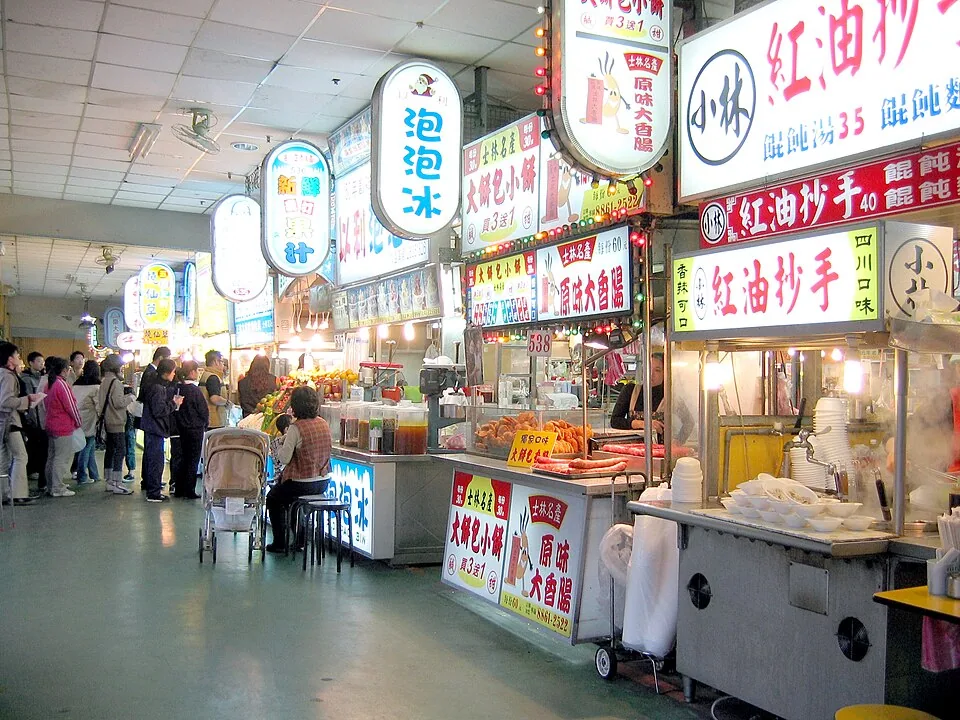
Walking into a Taiwanese night market, as described by Guanghua Magazine, it is "noisy and clamorous with the sounds of vehicles, people, and vendors shouting" 13. There are over 300 night markets island-wide 13, each a densely packed soundscape: the sizzle from frying stations, the electronic sounds from claw machines, and the prices shouted by vendors. To tourists, this is noise; to locals, it is the sound of "being alive."
And one of Taiwan's most moving soundscapes is how genuine street cries turned into a popular Taiwanese standard song. In 1949, Chang Qiu-tung (張邱東松) wrote a song originally titled Selling Meat Zong (賣肉粽), later renamed Roasting Meat Zong (燒肉粽). The lyrics depict the plight of an individual selling meat zong late at night amid post-war economic hardship 14. This song later became Guo Jin-fa's signature hit, but its fate was complex; it was once listed as a banned song by the Executive Yuan News Agency because the sorrow in the cries was deemed "too tragic and not positive enough" during a certain era 14.
A genuine street cry, first written into a song, then banned by authorities, and finally becoming a melody hummed by generations of Taiwanese people. Sound here completed a full journey: from the sounds of daily life to an object regulated, and finally to cultural memory itself.
The soundscape of temple fairs followed another path—from tradition giving birth to something new. The electronic San-tsai (三太子) is a rising form of religious performance culture in Taiwan, mixing electronic music, local culture, and the traditional San-tsai (originally the "Grand Immortal/Great Immortal" from temple fairs) 15. Its most famous moment was at the opening ceremony of the 2009 Kaohsiung World Games, where the San-tsai stepped onto the international stage to the beat of electronic music 15. The traditional sound of gongs and drums is mixed with nightclub electronic beats; no one finds this contradictory—this is precisely the character of Taiwan's soundscape: it doesn't care about purity, it cares about vitality.

The soundscape of election season is the most direct and the one that makes people both love and hate it. Every election, propaganda trucks take to the streets, repeatedly shouting "dong suan, dong suan" through loudspeakers. "Dong suan" is a phonetic pun on the Taiwanese word for "winning" (當選), whose Mandarin pronunciation sounds like "dōng suàn," literally meaning "freezing garlic," and carries a touch of mockery 16. Is this sound loud? Very loud. So laws regulate it—the use of loudspeakers in campaigns is governed by Article 54 of the Elections Act, which prohibits noise pollution, and Article 56, which forbids public campaigning before 7 AM or after 10 PM 17. A Taiwanese phonetic pun imbued with mockery sustains Taiwan's most lively, yet legally scrutinized, soundscape.
When Someone Decides to "Preserve" Sound: Taiwan's Listening Movement
At this point, you see a clear contradiction: Taiwan uses laws to regulate these sounds as noise, yet these sounds are actually the landmarks by which we identify home. And the people who truly laid out this contradiction and chose to stand on the side of "listening" are a group of individuals.
The first name is Fan Chin-hui (范欽慧).
She is a nature writer and field recorder who has been producing and hosting Nature Notes on the National Educational Broadcasting Service since 1997 18. For decades, she has carried recording equipment into Taiwan's mountains and valleys, collecting sounds of insects, birds, wind, and water in segments. In 2020, she won the Golden Bell Award for Education Culture Program Host with Nature Notes 19. She wrote Rescuing Silence: A Field Recorder’s Journey, which even included a nature soundscape CD, allowing readers not just to read silence, but to listen to it 18; she also created an illustrated book called Call of the Silent Path 18.
In March 2015, Fan Chin-hui founded the "Taiwan Soundscape Association" 20. What this association does is a mirror image of the Noise Control Act—the Ministry of Environment segments and regulates sound to suppress it, while the association treats sounds as cultural assets that need to be listened to and preserved.
📝 Curatorial Viewpoint: Within the same society, two completely contradictory systems can be built around the same thing. On one side is the Noise Control Act, which cuts sound into four regulated zones and specifies limits for certain time periods; on the other is the Soundscape Association, which treats sounds as heritage that might disappear and needs rescue. This isn't Taiwanese schizophrenia; after all, "sound" is inherently both interference and landmark, and the key is always how you listen to it. What Fan Chin-hui does essentially invites society to change its ears: don't rush to classify sound as noise; stop and listen first to see if there are things you thought were gone but are still present.
The association’s most concrete achievements are two "Silent Paths"—these are easily confused, but they are different levels of achievement.
The first is domestic: in 2018, with the testimony of American sound ecologist Gordon Hempton (戈登.漢普頓), the Cui Feng Lake Trail in Yilan became Taiwan's first Silent Path 21. This trail contains a cypress forest called the "Cretaceous Mossland Zone," which is so quiet that it measures only about 25 decibels 20, nearly approaching an anechoic chamber—finding a place at 25 decibels in an island accustomed to garbage trucks, metros, night markets, and political rallies is a luxury.
The second is international: on World Listening Day, July 18, 2022, the Quiet Parks International accredited the Cui Feng Lake Trail as the world's first "Quiet Trail" 21. Fan Chin-hui herself serves on the Asian Board of Quiet Parks International. From being the national first in 2018 to the global first in 2022, Taiwan has turned the concept of "quiet" from a local experiment into an international benchmark.

Some Preserve Mountain Silence, Others Collect City Noise
If Fan Chin-hui collects mountain silence, then Wu Chan-ching (吳燦政) collects daily urban noise.
The artist Wu Chan-ching officially began his first sound work, Night Nightingale, in 2011, and conducted the Taiwan Sound Map Project, meticulously collecting everyday sounds from across Taiwan into a map, totaling over ten thousand entries, until this project was temporarily suspended in December 2021 22. He used a free sound mapping platform developed by a German artist (radio aporee :: maps) 23; early on, he even marked the locations of sounds using Google Maps 23. Opening that map allows you to click on any corner of Taiwan and hear a market, train station, temple entrance, or alleyway collected at a certain moment by someone. This is another history of Taiwan: not written in text, but preserved in sound.
It is worth mentioning that this idea of "understanding Taiwan through listening" has grown into formal academic research. In 2024, the College of Communication at National Yangsien University published a master's thesis titled Building Connections Through Listening—The Sound Life Journey of Soundscape Workers, by Wang Mei-fen (王美棻), supervised by Liu Hui-wen (劉慧雯) 24. A sentence in the abstract is almost the footnote to this entire article: "In environmental change, changes in the soundscape correspond to the context of human existence" 24. How sound changes reflects how we live.
Understanding Taiwan Is Not Finding a "Representative Sound"
Let's return to the piano melody from down the alley at 6:30 PM.
We easily assume that to know a place through sound, one must find its "most representative sound": garbage trucks? Metro? Night market? Political slogans? But the question posed by this Master of Soundscape Studies actually flips the problem around. The focus is not on "What is Taiwan's representative sound?" but on two more difficult questions: What sounds do we habitually ignore? And whose sounds are being heard?
Once these two questions are asked, the entire island sounds different. Taipei Metro replacing pleasant melodies with bird calls for visually impaired passengers allows a group of people who were easily ignored to "be heard"; placing Hakka at the end of the announcement languages relegates one language to a corner in the sequence. Fan Chin-hui rescuing 25 decibels of silence, and Wu Chan-ching collecting over ten thousand vanishing daily sounds, are all acts of confronting "neglect"—they preserve for us the sounds we clearly hear every day but never truly listen to.
So next time, when Dance of the Maidens drifts from an alleyway on a garbage truck, when the station melody rings out at the metro platform, or when you walk into a night market enveloped by vendor cries—perhaps pause for half a second and realize what you are hearing. In that moment, sound transforms from background noise you habitually ignore into evidence of "I am in Taiwan, I am home." Understanding Taiwan does not have to start with an answer; it can begin with one careful act of listening.
Image Sources
- Main image Shilin Night Market: TWShiLinNightMarketRichy2.jpg, Wikimedia Commons, CC BY-SA.
- Taipei Metro train: Taipei Metro train for Xiangshan leaving Zhongyi, Wikimedia Commons, CC BY-SA.
- Cui Feng Lake: 2019 Cueifong Lake.jpg, Wikimedia Commons, CC BY-SA.
- Electronic San-tsai: Kaohsiung Liuqi Electronic San-tsai, Wikimedia Commons, CC BY-SA.
References
Further Reading
- 🎧 Taiwan Soundscape Recording Project — You can listen directly here to the garbage truck music, metro sounds, and market cries discussed in this article: 21 segments of field recordings are continuously being collected.
- Taiwan Soundscape — Discussing Taiwan's sound map and urban listening from another perspective.
- Taiwan Temple Fairs and Performance Culture — The fuller performance soundscape and folk context behind electronic San-tsai.
- History of Taipei Metro Development — The story of the system that carries the Soundscape Project.
- Night Market Culture — Another aspect of the "sounds of vehicles, people, and vendors shouting."
- Taiwanese Tea Ceremony and Life Aesthetics — Another thread on how Taiwanese people transform daily sensory experiences into culture.
- Soundscape — Wikipedia — The article explicitly notes that the term soundscape is often mistakenly attributed to R. Murray Schafer, who himself credits the coining of the word to urban planning scholar Michael Southworth.↩
- World Soundscape Project — Wikipedia — The World Soundscape Project was established by Schafer in the late 1960s at Simon Fraser University and published The Vancouver Soundscape in 1973.↩
- Dance of the Maidens (Piano Piece) — Wikipedia — A work by Polish composer Tekla Bądarzewska-Baranowska, published in Warsaw in 1856, used as garbage truck music in Taiwan; the same article lists Beethoven's Für Elise as another common piece on Taiwanese garbage trucks.↩
- Garbage Truck — Wikipedia — The article states that the origin of garbage truck music is "allegedly" determined by Xu Tzu-chiu, director of the Sanitation Department of the Taiwan Provincial Government, but notes that this matter is "currently disputed with no verifiable source."↩
- Why Do Taiwanese Garbage Trucks Play Für Elise and Dance of the Maidens — The News Lens Key Commentary Network — Describes accounts from Tu Tsung-ming, the first import of 21 sealed garbage trucks from Germany in the 1960s, and the Japanese EPSON music box imported.↩2
- Taiwan's Recycling Rate Reaches 55%, One of the Highest Globally — Weekly Magazine — Reports that Taiwan's recycling rate is about 55%, making it one of the world's highest in recycling rates.↩
- Metro Soundscape Design: Making the City Heard — Central News Agency — States that Li Ming-tsung initiated the Taipei Soundscape Music Project (sociology professor) and stated, "through these melodies heard while traveling, passengers construct their own urban characteristics, memories, and identity."↩23
- Taipei Metro Soundscape — Guanghua Magazine — Lists the four line composers (Reihong-sha for Tamsui-Xinyi Line, Li Hsin-yun for Bannan Line, Chen Chien-chi for Zhonghe-Xinlu Line, Chou Yue-cheng for Songshan-Xindian Line), that Wind Rises was created by Chou Yue-cheng, and the 12 countries/447 works.↩23
- Taipei Metro Train Departure Alarm Sound Adjustment Explanation — Taipei Metro Company — Official explanation stating that the door alarm sound was standardized to "the first bird call warning of impending closure, and the second ambulance-like alarm signaling closing."↩
- North Metro Changes Door Alarm to Birdsong for Visually Impaired and Travelers — ETtoday — Reports that the Zhonghe-Xinlu Line used musical melodies starting in 1996, and the change back to an alarm sound in 2015 was intended so that visually impaired passengers and travelers from around the world "can identify it more clearly and conveniently."↩
- Metro Announcement Language Explanation — Taipei Metro Company — States that four languages—Mandarin, Taiwanese Hokkien, Hakka, and English—are used in accordance with Article 6 of the Public Transportation Sound Language Equality Guarantee Act.↩
- North Metro Adds Japanese and Korean Announcements; Hakka Order Sparks Debate — Hakka News — In 2024, announcement languages are Mandarin, English, Japanese, Korean, Holo (Taiwanese Hokkien), and Hakka, with Hakka placed last.↩
- The Sounds of Taiwanese Night Markets — Guanghua Magazine — The official publication describes the night market as "noisy and clamorous with the sounds of vehicles, people, and vendors shouting," noting over 300 night markets island-wide.↩2
- Roasting Meat Zong — Wikipedia — Originally titled Selling Meat Zong, written by Chang Qiu-tung in 1949, depicting post-war economic hardship, and once banned by the Executive Yuan News Agency; it is a signature song of Guo Jin-fa.↩2
- Electronic San-tsai — Wikipedia — A rising religious performance culture in Taiwan that combines electronic music with traditional San-tsai, which appeared at the Kaohsiung World Games opening ceremony in 2009.↩2
- Dong Suan (tɔŋ-suan) — Winning — Taiwan Language — The Taiwanese pronunciation of "dong suan" is homophonous with "winning," a pure phonetic pun without inherent meaning, carrying a mocking tone.↩
- Elections Act Articles 54 and 56 — National Legal Database — Article 54 stipulates that loudspeakers must not cause noise pollution; Article 56 prohibits public campaigning before 7 AM or after 10 PM.↩
- Fan Chin-hui and Her Nature Soundscape — Central News Agency — States that Fan Chin-hui has been producing the educational radio program Nature Notes since 1997, and wrote Rescuing Silence and the illustrated book Call of the Silent Path.↩23
- Golden Bell Award 55: Education Culture Program Host Fan Chin-hui/Nature Notes — YouTube — Fan Chin-hui won the Golden Bell Award for Education Culture Program Host in 2020 with Nature Notes.↩
- Fan Chin-hui Establishes Taiwan Soundscape Association, Cui Feng Lake's 25 Decibels of Silence — Business Media — Fan Chin-hui founded the Taiwan Soundscape Association in March 2015; the cypress forest in the Cui Feng Lake Trail measures only 25 decibels.↩2
- Taiping Mountain Silent Path — Forestry and Nature Conservation Agency — The Cui Feng Lake Trail was established as Taiwan's first Silent Path in 2018 with the testimony of American sound ecologist Gordon Hempton; it received international accreditation as the world's first "Quiet Trail" on World Listening Day, July 18, 2022.↩2
- Wu Chan-ching's Taiwan Sound Map Project — Taipei Fine Arts Museum — Wu Chan-ching began his first sound work Night Nightingale in 2011, collecting over ten thousand daily Taiwanese sounds, and temporarily suspended the project in December 2021.↩
- Wu Chan-ching Discusses Sound Map Platform — The News Lens Key Commentary Network — Describes Wu Chan-ching's early use of Google Maps for marking locations before switching to a free sound mapping platform developed by a German artist.↩2
- Building Connections Through Listening—The Sound Life Journey of Soundscape Workers — National Yangsien University Archives — Wang Mei-fen’s 2024 master's thesis at NYCU, supervised by Liu Hui-wen; the abstract states, "In environmental change, changes in the soundscape correspond to the context of human existence."↩2
🧬 What Semiont was thinking while writing this